Leo Tolstoy on Finding Meaning in a Meaningless World

Here’s the link to this article.

“For man to be able to live he must either not see the infinite, or have such an explanation of the meaning of life as will connect the finite with the infinite.”

BY MARIA POPOVA

Shortly after turning fifty, Leo Tolstoy (September 9, 1828–November 10, 1910) succumbed to a profound spiritual crisis. With his greatest works behind him, he found his sense of purpose dwindling as his celebrity and public acclaim billowed, sinking into a state of deep depression and melancholia despite having a large estate, good health for his age, a wife who had born him fourteen children, and the promise of eternal literary fame. On the brink of suicide, he made one last grasp at light amidst the darkness of his existence, turning to the world’s great religious and philosophical traditions for answers to the age-old question regarding the meaning of life. In 1879, a decade after War and Peace and two years after Anna Karenina, and a decade before he set out to synthesize these philosophical findings in his Calendar of Wisdom, Tolstoy channeled the existential catastrophe of his inner life in A Confession (public library) — an autobiographical memoir of extraordinary candor and emotional intensity, which also gave us Tolstoy’s prescient meditation on money, fame, and writing for the wrong reasons.

He likens the progression of his depression to a serious physical illness — a parallel modern science is rendering increasingly appropriate. Tolstoy writes:

Then occurred what happens to everyone sickening with a mortal internal disease. At first trivial signs of indisposition appear to which the sick man pays no attention; then these signs reappear more and more often and merge into one uninterrupted period of suffering. The suffering increases, and before the sick man can look round, what he took for a mere indisposition has already become more important to him than anything else in the world — it is death!

The classic symptoms of anhedonia engulfed him — he lost passion for his work and came to dismiss as meaningless the eternal fame he had once dreamt of. He even ceased to go out shooting with his gun in fear that he might be too tempted to take his own life. Though he didn’t acknowledge a “someone” in the sense of a creator, he came to feel that his life was a joke that someone had played on him — a joke all the grimmer for the awareness of our inescapable impermanence, and all the more despairing:

Today or tomorrow sickness and death will come (they had come already) to those I love or to me; nothing will remain but stench and worms. Sooner or later my affairs, whatever they may be, will be forgotten, and I shall not exist. Then why go on making any effort? . . . How can man fail to see this? And how go on living? That is what is surprising! One can only live while one is intoxicated with life; as soon as one is sober it is impossible not to see that it is all a mere fraud and a stupid fraud! That is precisely what it is: there is nothing either amusing or witty about it, it is simply cruel and stupid.

[…]

Had I simply understood that life had no meaning I could have borne it quietly, knowing that that was my lot. But I could not satisfy myself with that. Had I been like a man living in a wood from which he knows there is no exit, I could have lived; but I was like one lost in a wood who, horrified at having lost his way, rushes about wishing to find the road. He knows that each step he takes confuses him more and more, but still he cannot help rushing about. It was indeed terrible. And to rid myself of the terror I wished to kill myself.

And yet he recognized that the inquiry at the heart of his spiritual malady was neither unique nor complicated:

My question … was the simplest of questions, lying in the soul of every man from the foolish child to the wisest elder: it was a question without an answer to which one cannot live, as I had found by experience. It was: “What will come of what I am doing today or shall do tomorrow? What will come of my whole life?” Differently expressed, the question is: “Why should I live, why wish for anything, or do anything?” It can also be expressed thus: “Is there any meaning in my life that the inevitable death awaiting me does not destroy?”

Seeking to answer this seemingly simple yet paralyzingly profound question, Tolstoy first turned to science, but found that rather than recognizing and answering the question, science circumvented it and instead asked its own questions, then answered those. Most of all, he found it incapable of illuminating the infinite and instead reducing its questions and answers to finite. He writes:

These are all words with no meaning, for in the infinite there is neither complex nor simple, neither forward nor backward, nor better or worse.

[…]

One who sincerely inquires how he is to live cannot be satisfied with the reply — “Study in endless space the mutations, infinite in time and in complexity, of innumerable atoms, and then you will understand your life” — so also a sincere man cannot be satisfied with the reply: “Study the whole life of humanity of which we cannot know either the beginning or the end, of which we do not even know a small part, and then you will understand your own life.”

A century and a half before Alan Lightman tussled, elegantly, with the same paradox, Tolstoy captured the Catch-22 of the predicament:

The problem of experimental science is the sequence of cause and effect in material phenomena. It is only necessary for experimental science to introduce the question of a final cause for it to become nonsensical. The problem of abstract science is the recognition of the primordial essence of life. It is only necessary to introduce the investigation of consequential phenomena (such as social and historical phenomena) and it also becomes nonsensical. Experimental science only then gives positive knowledge and displays the greatness of the human mind when it does not introduce into its investigations the question of an ultimate cause. And, on the contrary, abstract science is only then science and displays the greatness of the human mind when it puts quite aside questions relating to the consequential causes of phenomena and regards man solely in relation to an ultimate cause.

He then turned to philosophy, but found himself equally disillusioned:

Philosophy not merely does not reply, but is itself only asking that question. And if it is real philosophy all its labour lies merely in trying to put that question clearly.

Instead of an answer, he finds in philosophy “the same question, only in a complex form.” He bemoans the inability of either science or philosophy to offer a real answer:

One kind of knowledge did not reply to life’s question, the other kind replied directly confirming my despair, indicating not that the result at which I had arrived was the fruit of error or of a diseased state of my mind, but on the contrary that I had thought correctly, and that my thoughts coincided with the conclusions of the most powerful of human minds.

Frustrated, Tolstoy answers his own question:

“Why does everything exist that exists, and why do I exist?” “Because it exists.”

It’s a sentiment that John Cage would second a century later (“No why. Just here.”) and George Lucas would also echo (“There is no why. We are. Life is beyond reason.”) — a proposition that comes closest to the spiritual tradition of Buddhism. And, indeed, Tolstoy turns to spirituality in one final and desperate attempt at an answer — first by surveying how those in his social circle lived with this all-consuming inquiry. He found among them four strategies for managing the existential despair, but none that resolved it:

I found that for people of my circle there were four ways out of the terrible position in which we are all placed. The first was that of ignorance. It consists in not knowing, not understanding, that life is an evil and an absurdity. From [people of this sort] I had nothing to learn — one cannot cease to know what one does know.

The second way out is epicureanism. It consists, while knowing the hopelessness of life, in making use meanwhile of the advantages one has, disregarding the dragon and the mice, and licking the honey in the best way, especially if there is much of it within reach… That is the way in which the majority of people of our circle make life possible for themselves. Their circumstances furnish them with more of welfare than of hardship, and their moral dullness makes it possible for them to forget that the advantage of their position is accidental … and that the accident that has today made me a Solomon may tomorrow make me a Solomon’s slave. The dullness of these people’s imagination enables them to forget the things that gave Buddha no peace — the inevitability of sickness, old age, and death, which today or tomorrow will destroy all these pleasures.

The third escape is that of strength and energy. It consists in destroying life, when one has understood that it is an evil and an absurdity. A few exceptionally strong and consistent people act so. Having understood the stupidity of the joke that has been played on them, and having understood that it is better to be dead than to be alive, and that it is best of all not to exist, they act accordingly and promptly end this stupid joke, since there are means: a rope round one’s neck, water, a knife to stick into one’s heart, or the trains on the railways; and the number of those of our circle who act in this way becomes greater and greater, and for the most part they act so at the best time of their life, when the strength of their mind is in full bloom and few habits degrading to the mind have as yet been acquired…

The fourth way out is that of weakness. It consists in seeing the truth of the situation and yet clinging to life, knowing in advance that nothing can come of it. People of this kind know that death is better than life, but not having the strength to act rationally — to end the deception quickly and kill themselves — they seem to wait for something. This is the escape of weakness, for if I know what is best and it is within my power, why not yield to what is best? … The fourth way was to live like Solomon and Schopenhauer — knowing that life is a stupid joke played upon us, and still to go on living, washing oneself, dressing, dining, talking, and even writing books. This was to me repulsive and tormenting, but I remained in that position.

Finding himself in the fourth category, Tolstoy begins to question why he hadn’t killed himself. Suddenly, he realizes that a part of him was questioning the very validity of his depressive thoughts, presenting “a vague doubt” as to the certainty of his conclusions about the senselessness of life. Humbled by the awareness that the mind is both puppet and puppet-master, he writes:

It was like this: I, my reason, have acknowledged that life is senseless. If there is nothing higher than reason (and there is not: nothing can prove that there is), then reason is the creator of life for me. If reason did not exist there would be for me no life. How can reason deny life when it is the creator of life? Or to put it the other way: were there no life, my reason would not exist; therefore reason is life’s son. Life is all. Reason is its fruit yet reason rejects life itself! I felt that there was something wrong here.

And he discovers the solution not in science or philosophy or the life of hedonism, but in those living life in its simplest and purest form:

The reasoning showing the vanity of life is not so difficult, and has long been familiar to the very simplest folk; yet they have lived and still live. How is it they all live and never think of doubting the reasonableness of life?

My knowledge, confirmed by the wisdom of the sages, has shown me that everything on earth — organic and inorganic — is all most cleverly arranged — only my own position is stupid. And those fools — the enormous masses of people — know nothing about how everything organic and inorganic in the world is arranged; but they live, and it seems to them that their life is very wisely arranged! . . .

And it struck me: “But what if there is something I do not yet know? Ignorance behaves just in that way. Ignorance always says just what I am saying. When it does not know something, it says that what it does not know is stupid. Indeed, it appears that there is a whole humanity that lived and lives as if it understood the meaning of its life, for without understanding it could not live; but I say that all this life is senseless and that I cannot live.

Awake to what Stuart Firestein would call “thoroughly conscious ignorance” some 130 years later, Tolstoy sees his own blinders with new eyes:

In the delusion of my pride of intellect it seemed to me so indubitable that I and Solomon and Schopenhauer had stated the question so truly and exactly that nothing else was possible — so indubitable did it seem that all those milliards consisted of men who had not yet arrived at an apprehension of all the profundity of the question — that I sought for the meaning of my life without it once occurring to me to ask: “But what meaning is and has been given to their lives by all the milliards of common folk who live and have lived in the world?”

I long lived in this state of lunacy, which, in fact if not in words, is particularly characteristic of us very liberal and learned people. But thanks either to the strange physical affection I have for the real laboring people, which compelled me to understand them and to see that they are not so stupid as we suppose, or thanks to the sincerity of my conviction that I could know nothing beyond the fact that the best I could do was to hang myself, at any rate I instinctively felt that if I wished to live and understand the meaning of life, I must seek this meaning not among those who have lost it and wish to kill themselves, but among those milliards of the past and the present who make life and who support the burden of their own lives and of ours also. And I considered the enormous masses of those simple, unlearned, and poor people who have lived and are living and I saw something quite different. I saw that, with rare exceptions, all those milliards who have lived and are living do not fit into my divisions, and that I could not class them as not understanding the question, for they themselves state it and reply to it with extraordinary clearness. Nor could I consider them epicureans, for their life consists more of privations and sufferings than of enjoyments. Still less could I consider them as irrationally dragging on a meaningless existence, for every act of their life, as well as death itself, is explained by them. To kill themselves they consider the greatest evil. It appeared that all mankind had a knowledge, unacknowledged and despised by me, of the meaning of life. It appeared that reasonable knowledge does not give the meaning of life, but excludes life: while the meaning attributed to life by milliards of people, by all humanity, rests on some despised pseudo-knowledge.

He considers the necessary irrationality of faith and contemplates its unfair ask of forsaking reason:

Rational knowledge presented by the learned and wise, denies the meaning of life, but the enormous masses of men, the whole of mankind receive that meaning in irrational knowledge. And that irrational knowledge is faith, that very thing which I could not but reject. It is God, One in Three; the creation in six days; the devils and angels, and all the rest that I cannot accept as long as I retain my reason.

My position was terrible. I knew I could find nothing along the path of reasonable knowledge except a denial of life; and there — in faith — was nothing but a denial of reason, which was yet more impossible for me than a denial of life. From rational knowledge it appeared that life is an evil, people know this and it is in their power to end life; yet they lived and still live, and I myself live, though I have long known that life is senseless and an evil. By faith it appears that in order to understand the meaning of life I must renounce my reason, the very thing for which alone a meaning is required…

A contradiction arose from which there were two exits. Either that which I called reason was not so rational as I supposed, or that which seemed to me irrational was not so irrational as I supposed.

And therein he finds the error in all of his prior reasoning, the root of his melancholia about life’s meaninglessness:

Verifying the line of argument of rational knowledge I found it quite correct. The conclusion that life is nothing was inevitable; but I noticed a mistake. The mistake lay in this, that my reasoning was not in accord with the question I had put. The question was: “Why should I live, that is to say, what real, permanent result will come out of my illusory transitory life — what meaning has my finite existence in this infinite world?” And to reply to that question I had studied life.

The solution of all the possible questions of life could evidently not satisfy me, for my question, simple as it at first appeared, included a demand for an explanation of the finite in terms of the infinite, and vice versa.

I asked: “What is the meaning of my life, beyond time, cause, and space?” And I replied to quite another question: “What is the meaning of my life within time, cause, and space?” With the result that, after long efforts of thought, the answer I reached was: “None.”

In my reasonings I constantly compared (nor could I do otherwise) the finite with the finite, and the infinite with the infinite; but for that reason I reached the inevitable result: force is force, matter is matter, will is will, the infinite is the infinite, nothing is nothing — and that was all that could result.

[…]

Philosophic knowledge denies nothing, but only replies that the question cannot be solved by it — that for it the solution remains indefinite.

Having understood this, I understood that it was not possible to seek in rational knowledge for a reply to my question, and that the reply given by rational knowledge is a mere indication that a reply can only be obtained by a different statement of the question and only when the relation of the finite to the infinite is included in the question. And I understood that, however irrational and distorted might be the replies given by faith, they have this advantage, that they introduce into every answer a relation between the finite and the infinite, without which there can be no solution.

So that besides rational knowledge, which had seemed to me the only knowledge, I was inevitably brought to acknowledge that all live humanity has another irrational knowledge — faith which makes it possible to live. Faith still remained to me as irrational as it was before, but I could not but admit that it alone gives mankind a reply to the questions of life, and that consequently it makes life possible.

Tolstoy notes that, whatever the faith may be, it “gives to the finite existence of man an infinite meaning, a meaning not destroyed by sufferings, deprivations, or death,” and yet he is careful not to conflate faith with a specific religion. Like Flannery O’Connor, who so beautifully differentiated between religion and faith, Tolstoy writes:

I understood that faith is not merely “the evidence of things not seen”, etc., and is not a revelation (that defines only one of the indications of faith, is not the relation of man to God (one has first to define faith and then God, and not define faith through God); it is not only agreement with what has been told one (as faith is most usually supposed to be), but faith is a knowledge of the meaning of human life in consequence of which man does not destroy himself but lives. Faith is the strength of life. If a man lives he believes in something. If he did not believe that one must live for something, he would not live. If he does not see and recognize the illusory nature of the finite, he believes in the finite; if he understands the illusory nature of the finite, he must believe in the infinite. Without faith he cannot live…

For man to be able to live he must either not see the infinite, or have such an explanation of the meaning of life as will connect the finite with the infinite.

And yet the closer he examines faith, the more glaring he finds the disconnect between it and religion, particularly the teachings of the Christian church and the practices of the wealthy. Once again, he returns to the peasants as a paragon of spiritual salvation, of bridging the finite with the infinite, and once again seeing in their ways an ethos most closely resembling the Buddhist philosophy of acceptance:

In contrast with what I had seen in our circle, where the whole of life is passed in idleness, amusement, and dissatisfaction, I saw that the whole life of these people was passed in heavy labour, and that they were content with life. In contradistinction to the way in which people of our circle oppose fate and complain of it on account of deprivations and sufferings, these people accepted illness and sorrow without any perplexity or opposition, and with a quiet and firm conviction that all is good. In contradistinction to us, who the wiser we are the less we understand the meaning of life, and see some evil irony in the fact that we suffer and die, these folk live and suffer, and they approach death and suffering with tranquility and in most cases gladly…

In complete contrast to my ignorance, [they] knew the meaning of life and death, labored quietly, endured deprivations and sufferings, and lived and died seeing therein not vanity but good…

[…]

I understood that if I wish to understand life and its meaning, I must not live the life of a parasite, but must live a real life, and — taking the meaning given to live by real humanity and merging myself in that life — verify it.

A Confession is a remarkable read in its entirety. Complement it with Tolstoy’s subsequent opus of philosophical inquiry, A Calendar of Wisdom, and this rare recording of him reading from the latter, exploring the object of life shortly before his death.

Also see more meditations on the meaning of life from Carl SaganMaya AngelouRichard FeynmanDavid Foster WallaceJohn SteinbeckAnaïs NinGeorge Lucas, and Viktor Frankl.

How Inviting the Unknown Helps Us Know Life More Richly

Here’s the link to this article.

“The unknown was my encyclopedia. The unnamed was my science and progress.”

BY MARIA POPOVA

“Have patience with everything unresolved in your heart and try to love the questions themselves,” Rilke famously urged“It is possible to live and NOT know,” Richard Feynman dissented in his memorable meditation on the responsibility of scientists. John Keats called for “negative capability” — that peculiar art of remaining in doubt “without any irritable reaching after fact & reason.” Debbie Millman advised to look both ways when lingering at the intersection of the known and the unknown. And yet we continue to grasp for the security of our comfort zones, the affirmation of our areas of expertise, the assurance of our familiar patterns — however badly they may need rewiring.

In an entry from April of 1945 found in The Diary of Anais Nin, Vol. 4: 1944-1947 (public library) — which also gave us Nin on the meaning of lifewhy emotional excess is essential to creativity, and how our objects define us — the beloved diarist and reconstructionist considers the vital importance of allowing for not-knowing in order to truly know the world in its fullest dimension, of using the unknown as a gateway to deeper presence and greater awareness:

It is possible I never learned the names of birds in order to discover the bird of peace, the bird of paradise, the bird of the soul, the bird of desire. It is possible I avoided learning the names of composers and their music the better to close my eyes and listen to the mystery of all music as an ocean. It may be I have not learned dates in history in order to reach the essence of timelessness. It may be I never learned geography the better to map my own routes and discover my own lands. The unknown was my compass. The unknown was my encyclopedia. The unnamed was my science and progress.

Five years later, in the fifth volume of her diaries, Nin would revisit and evolve this sentiment in her famous words on embracing the unfamiliar, writing:

It is a sign of great inner insecurity to be hostile to the unfamiliar.

In a testament to that rare and powerful intersection of the romantic, the intellectual, and the creative — the kind of love emanating from such celebrated creative couples as Frida Kahlo and Diego RiveraGeorgia O’Keeffe and Alfred Stieglitz, and Charles and Ray Eames — Henry Miller, Nin’s then-lover, echoes the same sentiment in his reflections on writing:

Understanding is not a piercing of the mystery, but an acceptance of it, a living blissfully with it, in it, through and by it.

For more of Nin’s timeless wisdom, see her insights on anxiety and lovethe necessary fluidity of characterparenting and personal responsibility, and the magic of letterpress and handcraft.

How to Survive Hopelessness

Here’s the link to this article. Definitely worth your time!

“You can expect good and bad luck, but good or bad judgment is your prerogative.”

BY MARIA POPOVA

How to Survive Hopelessness

Dougal Robertson (January 29, 1924–September 22, 1991) was still a teenager, the youngest of a Scottish music teacher’s eight children, when he joined the British Merchant Navy. After a Japanese attack on a steamship during WWII killed his wife and young son, he left the navy and moved to Hong Kong, where he eventually met and married a nurse.

Together, they began a new life as dairy farmers in the English countryside, on a farm without electricity or running water. Eventually, they had a daughter, then a son, then a pair of twins.

After nearly two decades on the farm, the family had an unorthodox idea for how to best educate their children, how to show them what a vast and wondrous place the world is, full of all kinds of different people and all kinds of different ways of living: They sold everything they had, bought a schooner, and set out to sail around the world, departing on January 27, 1971.

The Robertson family

After more than a year at sea, just as they were rounding the tip of South America to begin their Pacific crossing, killer whales attacked the schooner 200 miles off the coast of Galapagos, sinking it in less than a minute. They piled into the inflatable life-raft, managed to grab a piece of sail from the water, and rigged it to the 9-foot dinghy they had on board to use it as a tugboat for the raft now housing six human beings.

Suddenly, they were a tiny speck in Earth’s largest ocean, enveloped by the vast open emptiness of infinite horizons. With no nautical instruments or charts, powered only by their makeshift sail, they had no hope of reaching land. Their only chance was rescue by a passing vessel. Given the immensity of the Pacific Ocean, it was an improbability bordering on a miracle.

The Great Wave off Kanagawa by Japanese artist Hokusai, 1831. (Available as a print and as a face mask, benefitting The Nature Conservancy.)

Seventeen days into their life as castaways, the raft deflated. All they had now was the narrow fiberglass dinghy, its rim barely above the water’s edge with all the human cargo.

By that blind resilience life has of resisting non-life, they persisted, eating turtle meat and sweet flying fish that landed in the bottom of the boat, drinking rainwater and turtle blood. Storms lashed them. Whales menaced them. Thirst and hunger subsumed them. Their bodies were covered in salt-water sores. Enormous ships passed within sight, missing their cries for help. But they pressed on, hoping against hope, toiling in every conceivable way to keep the spark of life aflame.

After 37 days as castaways, chance smiled upon them — a Japanese fishing boat spotted their distress flare and came to their rescue. Their tongues were so swollen from dehydration that they could hardly thank their saviors.

Restaging of the rescue, demonstrating how the family fit inside the dinghy.

Throughout it all, Dougal kept a journal in case they lived — an act itself emblematic of that touching and tenacious optimism by which they survived. He later drew on it to publish an account of the experience, then distilled his learnings in Sea Survival: A Manual (public library).

Nested amid the rigorously practical advice is a poetic sentiment that applies not only to survival at sea but to life itself — a soulful prescription for what it takes to live through those most trying periods when you feel like a castaway from life, beyond the reach of salvation, depleted of hope.

He writes:

I have no words to offer which may comfort the reader who is also a castaway, except that rescue may come at any time but not necessarily when you expect it; and that even if you give up hope, you must never give up trying, for, as the result of your efforts, hope may well return and with justification.

Echoing Einstein’s views on free will and personal responsibility, he adds:

You can expect good and bad luck, but good or bad judgment is your prerogative, as is good or bad management.

This simple advice reads like a Zen koan, to be rolled around the palate of the mind, releasing richer and richer meaning, deeper and deeper assurance each time.

Complement with John Steinbeck on the true meaning and purpose of hope, Jane Goodall on its deepest wellspring, and some thoughts on hope and the remedy for despair from Nick Cave and Gabriel Marcel, then zoom out to the civilizational scale and revisit Road to Survival — that wonderful packet of wisdom on resilience from the forgotten visionary who shaped the modern environmental movement.

Thanks, Nina

The Magic of Moss and What It Teaches Us About the Art of Attentiveness to Life at All Scales

Here’s the link to this attention-grabbing article by Maria Popova.

“Attention without feeling,” Mary Oliver observed in her magnificent memoir of love and loss, “is only a report.” In Gathering Moss: A Natural and Cultural History of Mosses (public library) — an extraordinary celebration of smallness and the grandeur of life, as humble yet surprisingly magical as its subject — botanist Robin Wall Kimmerer extends an uncommon and infectious invitation to drink in the vibrancy of life at all scales and attend to our world with befitting vibrancy of feeling.

One of the world’s foremost bryologists, Kimmerer is a scientist blessed with the rare privilege of belonging to a long lineage of storytellers — her family comes from the Bear Clan of the Potawatomi. There is a special commonality between her heritage and her scientific training — a profound respect for all life forms, whatever their size — coupled with a special talent for rendering that respect contagious, which places her prose in the same taxon as Mary Oliver and Annie Dillard and Thoreau. Indeed, if Thoreau was a poet and philosopher who became a de facto naturalist by the sheer force of poetic observation, despite having no formal training in science, Kimmerer is a formally trained scientist whose powers of poetic observation and contemplative reflection render her a de facto poet and philosopher. (So bewitching is her book, in fact, that it inspired Elizabeth Gilbert’s beautiful novel The Signature of All Things, which is how I first became aware of Kimmerer’s mossy masterwork.)

Scale by Maria Popova

Mosses, to be sure, are scientifically impressive beyond measure — the amphibians of vegetation, they were among the first plants to emerge from the ocean and conquer the land; they number some 22,000 species, whose tremendous range of size parallels the height disparity between a blueberry bush and a redwood; they inhabit nearly every ecosystem on earth and grow in places as diverse as the branch of an oak and the back of a beetle. But beyond their scientific notoriety, mosses possess a kind of lyrical splendor that Kimmerer unravels with enchanting elegance — splendor that has to do with what these tiny organisms teach us about the art of seeing.

She uses the experience of flying — an experience so common we’ve come to take its miraculousness for granted — to illustrate our all too human solipsism:

Between takeoff and landing, we are each in suspended animation, a pause between chapters of our lives. When we stare out the window into the sun’s glare, the landscape is only a flat projection with mountain ranges reduced to wrinkles in the continental skin. Oblivious to our passage overhead, other stories are unfolding beneath us. Blackberries ripen in the August sun; a woman packs a suitcase and hesitates at her doorway; a letter is opened and the most surprising photograph slides from between the pages. But we are moving too fast and we are too far away; all the stories escape us, except our own.

Illustration by Peter Sís from The Pilot and the Little Prince

We, of course, need not rise to the skies in order to fall into the chronic patterns of our myopia and miss most of what is going on around us — we do this even in the familiar microcosm of a city block. Kimmerer considers how our growing powers of technologically aided observation have contributed to our diminished attentiveness:

We poor myopic humans, with neither the raptor’s gift of long-distance acuity, nor the talents of a housefly for panoramic vision. However, with our big brains, we are at least aware of the limits of our vision. With a degree of humility rare in our species, we acknowledge there is much we can’t see, and so contrive remarkable ways to observe the world. Infrared satellite imagery, optical telescopes, and the Hubble space telescope bring vastness within our visual sphere. Electron microscopes let us wander the remote universe of our own cells. But at the middle scale, that of the unaided eye, our senses seem to be strangely dulled. With sophisticated technology, we strive to see what is beyond us, but are often blind to the myriad sparkling facets that lie so close at hand. We think we’re seeing when we’ve only scratched the surface. Our acuity at this middle scale seems diminished, not by any failing of the eyes, but by the willingness of the mind. Has the power of our devices led us to distrust our unaided eyes? Or have we become dismissive of what takes no technology but only time and patience to perceive? Attentiveness alone can rival the most powerful magnifying lens.

But the rewards of attentiveness can’t be forced into manifesting — rather, they are surrendered to. In a sentiment that calls to mind Rebecca Solnit’s spectacular essay on how we find ourselves by getting lost, Kimmerer writes:

A Cheyenne elder of my acquaintance once told me that the best way to find something is not to go looking for it. This is a hard concept for a scientist. But he said to watch out of the corner of your eye, open to possibility, and what you seek will be revealed. The revelation of suddenly seeing what I was blind to only moments before is a sublime experience for me. I can revisit those moments and still feel the surge of expansion. The boundaries between my world and the world of another being get pushed back with sudden clarity an experience both humbling and joyful.

[…]

Mosses and other small beings issue an invitation to dwell for a time right at the limits of ordinary perception. All it requires of us is attentiveness. Look in a certain way and a whole new world can be revealed.

[…]

Learning to see mosses is more like listening than looking. A cursory glance will not do it. Starting to hear a faraway voice or catch a nuance in the quiet subtext of a conversation requires attentiveness, a filtering of all the noise, to catch the music. Mosses are not elevator music; they are the intertwined threads of a Beethoven quartet.

Echoing Richard Feynman’s iconic monologue on knowledge and mystery, Kimmerer adds:

Knowing the fractal geometry of an individual snowflake makes the winter landscape even more of a marvel. Knowing the mosses enriches our knowing of the world.

Moss and air plant sculpture by Art We Heart

This knowing, at its most intimate, is a function of naming — for words are how we come to know meanings. Kimmerer considers this delicate dialogue between a thing’s essence and its name:

Having words for these forms makes the differences between them so much more obvious. With words at your disposal, you can see more clearly. Finding the words is another step in learning to see.

[…]

Having the words also creates an intimacy with the plant that speaks of careful observation.

[…]

Intimacy gives us a different way of seeing, when visual acuity is not enough.

The remarkable diversity of moss varieties known and named only adds to the potentiality for intimacy with the world at all scales. But among this vast multiplicity of mosses is one particular species inhabiting the small caves carved by glaciers into the lakeshore, which alone embodies immense wisdom about the mystery and meaning of life. Kimmerer writes:

Schistostega pennata, the Goblins’ Gold, is unlike any other moss. It is a paragon of minimalism, simple in means, rich in ends. So simple you might not recognize it as a moss at all. The more typical mosses on the bank outside spread themselves to meet the sun. Such robust leaves and shoots, though tiny, require a substantial amount of solar energy to build and maintain. They are costly in solar currency. Some mosses need full sun to survive, others favor the diffuse light of clouds, while Schistostega lives on the clouds’ silver lining alone.

Goblins’ Gold (Photograph: Matt Goff)

This singular species subsists solely on the light reflections emanating from the lake’s surface, which provide one-tenth of one percent of the solar energy that direct sunlight does. And yet in this unlikely habitat, Schistostega has emerged as a most miraculous jewel of life:

The shimmering presence of Schistostega is created entirely by the weft of nearly invisible threads crisscrossing the surface of the moist soil. It glows in the dark, or rather it glitters in the half light of places which scarcely feel the sun.

Each filament is a strand of individual cells strung together like beads shimmering on a string. The walls of each cell are angled, forming interior facets like a cut diamond. It is these facets which cause Schistostega to sparkle like the tiny lights of a far-away city. These beautifully angled walls capture traces of light and focus it inward, where a single large chloroplast awaits the gathering beam of light. Packed with chlorophyll ad membranes of exquisite complexity, the chloroplast converts the light energy into a stream of flowing electrons. This is the electricity of photosynthesis, turning sun into sugar, spinning straw into gold.

But more than a biological marvel, Schistostega presents a parable of patience and its bountiful rewards — an allegory for meeting the world not with grandiose entitlement but with boundless generosity of spirit; for taking whatever it has to offer and giving back an infinity more. Kimmerer writes:

Rain on the outside, fire on the inside. I feel a kinship with this being whose cold light is so different from my own. It asks very little from the world and yet glitters in response.

[…]

Timing is everything. Just for a moment, in the pause before the earth rotates again into night, the cave is flooded with light. The near-nothingness of Schistostega erupts in a shower of sparkles, like green glitter spilled on the rug at Christmas… And then, within minutes, it’s gone. All its needs are met in an ephemeral moment at the end of the day when the sun aligns with the mouth of the cave… Each shoot is shaped like a feather, flat and delicate. The soft blue green fronds stand up like a glad of translucent ferns, tracking the path of the sun. It is so little. And yet it is enough.

This tiny moss is a master of “the patient gleaming of light” — and what is the greatest feat of the human spirit, the measure of a life well lived, if not a “patient gleaming of light”? Annie Dillard knew this when she wrote: “I cannot cause light; the most I can do is try to put myself in the path of its beam.” And Carl Jung knew it when he insisted that “the sole purpose of human existence is to kindle a light in the darkness of mere being.” The humble, generous Schistostega illuminates the darkness of mere being into blazing awe at the miracle of life itself — a reminder that our existence on this unremarkable rock orbiting an unremarkable star is a glorious cosmic accident, the acute awareness of which calls to mind poet Mark Strand’s memorable words: “It’s such a lucky accident, having been born, that we’re almost obliged to pay attention.”

To pay attention, indeed, is the ultimate celebration of this accidental miracle of life. Kimmerer captures this with exuberant elegance:

The combination of circumstances which allows it to exist at all are so implausible that the Schistostega is rendered much more precious than gold. Goblins’ or otherwise. Not only does its presence depend on the coincidence of the cave’s angle to the sun, but if the hills on the western shore were any higher the sun would set before reaching the cave… Its life and ours exist only because of a myriad of synchronicities that bring us to this particular place at this particular moment. In return for such a gift, the only sane response is to glitter in reply.

Gathering Moss is a glittering read in its entirety. Complement it with Annie Dillard on the art of seeing and the two ways of looking.

Cosmic Insignificance Therapy

Are you feeling stressed? Have more to do than you could ever accomplish? Or, not enough to do? Do you have regrets over past failures? Whatever your situation today, listen to this short episode by Oliver Burkeman from the Waking Up APP.

I’ve found it to be SIGNIFICANT to me, so much, I’ve listened to it two days in a row.

https://screencast-o-matic.com/watch/c0nt6xVyCTo

The Creative Accident: Visionary Ceramicist Edith Heath on Serendipity, the Antidote to Obsolescence, and the Five Pillars of Timelessness

Here’s the link to his article.

On aligning the things we make with basic human values for an enduring world.

BY MARIA POPOVA

The Creative Accident: Visionary Ceramicist Edith Heath on Serendipity, the Antidote to Obsolescence, and the Five Pillars of Timelessness

“No one is fated or doomed to love anyone,” the philosopher-poet Adrienne Rich wrote, “the accidents happen.”

What is true of interpersonal love is also true of our labors of love — creative accidents are a mighty instrument of art, often steering entire trajectories of expression and endeavor in directions we could not have willed.

That is what the visionary ceramicist Edith Heath (May 24, 1911–December 27, 2005) explores in a previously unpublished lecture titled “The Creative Accident.”

Edith Heath at the wheel, 1960. (UC Berkeley Environmental Design Archives.)

Heath discovered art while studying to become a schoolteacher, then fell in love with the particular creative potential of clay. Largely self-taught, she spent WWII foraging materials from defunct clay pits closed during the war — brick clay from the Bay Area, talc from Southern California, fire clays from the Sierra Nevada foothills. In the final years of the war, she learned ceramic chemistry from an émigré physicist, then went on to revolutionize pottery with her alchemical approach to clay and glaze, becoming ceramicist and chemist, designer and inventor, idealist and entrepreneur, using the principles of science to place everyday beauty within reach of the working class. She lived nearly a century as an unstoppable creative force, touching millions of lives with her work that endures as the iconic Heath Ceramics.

At the heart of Heath’s creative practice was the element of fire, reminding her always of a time when “the Earth was a red-hot molten mass of chemicals and minerals,” primordial and uncontrollable. Seeing in fire a parallel of the creative force itself, Heath argues that at the center of art lies a kind of “acceptance of the accidental” that is counter to the basic human instinct for controlling chaos. The artist then emerges as a kind of shaman of the accidental, dancing between its acceptance and its control.

She writes:

Perhaps the artist has been trying to do both — accept the accident through finding meaning in it. And in finding meaning in it, it is no longer accidental and disquieting, but rather presents a state of equilibrium. This equilibrium manifests in the controlled accident of a work of art may be symbolic of all the controlled accidents that non-artists accept every day.

In sentiments epochs ahead of her time, Heath holds capitalism accountable for its tacit acceptance of practices that foment economic inequality and environmental collapse. While on the other edge of the landmass Rachel Carson was insisting that “the real wealth of the Nation lies in the resources of the earth — soil, water, forests, minerals, and wildlife,” Heath writes:

We accept the accidents of economics that necessitates (designing for obsolescence in order to maintain high employment and high standard of living). We accept the accident of over-production of food stuff in this country — setting a ceiling on what can be grown — while millions of people go hungry in other countries. We accept the accident that more natural resources are wasted in the United States than almost anywhere else in the world and proceed to waste them with no guilty conscience… We accept the accident that some people are born with dark skin, or are born to wealth of poverty, with high or low IQs.

By “accident,” of course, she means outcomes beyond the reach of our individual control — functions of a confluence of chance and choice on behalf of forces far larger than us, operating on time scales far beyond our individual lifetimes. She observes:

We can safely refer to these happenstances as accidents, for certainly no one would say they were “planned”. Certainly an error in judgment in diplomacy is not intentional. Planned obsolescence is intentional but it is nevertheless a negative solution to the unpredictability of economic forces. The farmer did not know he would be growing too much food. Our forefathers did not know this land would be filled with natural resources. Since nature bestowed them upon us, why shouldn’t we exploit them? Race, color, creed, intelligence and national pride too are accidents of heritage over which the individual had no control.

Heath Ceramics buffet service pieces, 1955 (UC Berkeley Environmental Design Archives)

Heath was far ahead of her time in her understanding of cultural dynamics and civilizational urgencies. Observing that, historically, creative breakthroughs have come far more frequently from individuals than from groups, she presages that a great impending calamity — atomic destruction in her day, climate catastrophe in ours — has the power of fomenting extraordinary collective creativity:

Because we are teetering on the probability of the most terrible accident in history… it may force more individuals to become creative as a group. In other words, terrible accidents motivate group actions toward creative solution. Potential accident is not a good motivating force, just as capital punishment does not deter crime. Real accidents, however, do in time motivate a group.

An epoch before the term “sustainability” came to bear its ecological connotations, and long before the world awoke to the hazard of climate change, Heath — whose working ethos was to “use the Earth to save the Earth” — adds:

Design for obsolescence as well as depletion of natural resources are real accidents of history that do exist today, which are beginning to compel creative people to design for more basic human values than superficial “styling.” The designer sees in these two accidents of economy a new potential for genuine development in… our whole way of life around the world.

With the depletion of natural resources, we will begin to make and build things to last. Since they must last longer, they must… take on a timeless quality.

This timeless quality, she argues, must be cultivated in all creative works — “whether a painting, a house, a piece of music, a car, or a piece of pottery.” With an eye to her own field, she offers five pillars of timelessness that a maker must follow:

TRUTH — to materials, method, use. Materials not faked to look like something else. Respect material and let it state its unique esthetic… Method of production should not simulate or be imitative of another process — respect the handmade — respect the machine-made — each has its own beauty.

USE — does it function well? Does it please the senses as well as the mind?

SENSE OF EVOLUTION — does it reflect a concept of evolution? In other words, does it give one a sense of well-being because it has evolved through man’s search for new understanding of materials, processes, and a good way of life?

SPIRIT — does it make you feel snobbish or superior or does it excite and exalt you to the point where you want to share the experience with others? In other words, does it ignoble or demean or does it bring dignity and pleasure to you and your fellow-man?

PERSPECTIVE — does it recognize relevance, relationship? Does it exist harmoniously in relationship to other things? Is it too dominant, too weak, too trite, or does it function genuinely, lively, appropriately?

Couple “The Creative Accident” with artist Ann Hamilton’s lovely notion of “making not knowing,” then revisit the poetic physicist Alan Lightman’s The Accidental Universe.

Special thanks to Sarah C. Rich at Heath Ceramics and Jennifer Volland at the UC Berkeley Environmental Design Archives for granting me access to Edith Heath’s unpublished manuscripts.

Meditation in Sunlight: May Sarton’s Stunning Poem About the Relationship Between Presence, Solitude, and Love

Here’s the link to this article.

“…and joy instead of will.”

BY MARIA POPOVA

Meditation in Sunlight: May Sarton’s Stunning Poem About the Relationship Between Presence, Solitude, and Love

May Sarton (May 3, 1912–July 16, 1995) was thirty-three when she left Cambridge for Santa Fe. She had just lived through a World War and a long period of personal turmoil that had syphoned her creative vitality — a kind of deadening she had not experienced before. Under the immense blue skies that had so enchanted the young Georgia O’Keeffe a generation earlier, she started coming back to life. Her white-washed room at the boarding house had mountain views, a rush of sunlight, and a police dog and “a very nice English teacher” for neighbors. As the sun rose over the mountains, she woke up each morning “simply on fire” with poetry — new poems she read to the English teacher, not yet knowing she was falling in love with her. Judy would become her great love, then her lifelong friend and the closest she ever had to family.

Among the constellation of Santa Fe poems composed during this creative renaissance is an especially beguiling reflection on the relationship between presence, solitude, and love, soon published in Sarton’s 1948 poetry collection The Lion and the Rose (public library) — her first in a decade — and read here for us by my longtime poetry co-invocator Amanda Palmer in her lovely oceanic voice:

https://w.soundcloud.com/player/?visual=true&url=https%3A%2F%2Fapi.soundcloud.com%2Ftracks%2F1445390686&show_artwork=true&maxheight=1000&maxwidth=680

MEDITATION IN SUNLIGHT
by May Sarton

In space in time I sit
Thousands of feet above
The sea and meditate
On solitude on love

Near all is brown and poor
Houses are made of earth
Sun opens every door
The city is a hearth

Far all is blue and strange
The sky looks down on snow
And meets the mountain-range
Where time is light not shadow

Time in the heart held still
Space as the household god
And joy instead of will
Knows love as solitude

Knows solitude as love
Knows time as light not shadow
Thousands of feet above
The sea where I am now

Complement with Sarton on the cure for despairhow to live openheartedly in a harsh world, and her stunning ode to solitude, then revisit Amanda’s soulful readings of Jane Kenyon’s meditation on life with and after depression, Elizabeth Bishop’s timeless consolation for loss, Ellen Bass’s immense and intimate poem of perspective and possibility, and Mary Oliver’s “When I Am Among the Trees.”

User-Friendly Self-Deception: Philosopher Amélie Rorty on the Value of Our Delusions and the Antidote to the Self-Defeating Ones

Here’s the link to this article.

“The question is: how can we sustain the illusions essential to ordinary life, without becoming self-damaging idiots?”

BY MARIA POPOVA

“Life is a dream. ‘Tis waking that kills us. He who robs us of our dreams robs us of our life,” Virginia Woolf wrote as she considered how our illusions keep us alive, shining a sidewise gleam on an elemental fact of human nature: We are touchingly prone to mistaking our models of reality for reality itself, mistaking the strength of our certainty for the strength of the evidence, thus moving through a dream of our own making that we call life. It can only be so — given how many parallel truths comprise any given situation, given how multifarious the data points packed into any single experience, given that this very moment “you are missing the vast majority of what is happening around you,” we are simply not capable of processing the full scope of reality. Our minds cope by choosing fragments of it to the exclusion, and often to the erasure, of the rest.

Art by Dorothy Lathrop, 1922. (Available as a print and as stationery cards.)

But what we choose and how we choose it defines the measure of our sanity, and how we go about choosing our adaptive delusions over the maladaptive ones defines our fitness for life. That is what philosopher Amélie Rorty (May 20, 1932–September 18, 2020) explores in a marvelous 1994 paper in the Journal of the Royal Institute of Philosophy, marvelously titled User-Friendly Self-Deception.

Recognizing that “many varieties of self-deception are ineradicable and useful,” Rorty writes:

We should not wish to do without the active, self-induced illusions that sustain us. Nor can we do without second order denials that they are illusions, the second order and regressive strategies that we self-deceptively believe rationalize our various self-deceptive activities. The question is: how can we sustain the illusions essential to ordinary life, without becoming self-damaging idiots? Are there forms of user-friendly self-deception that do not run the dangers that falsity, irrationality and manipulation are usually presumed to bring?

Self-deception, she notes, has various “cousins and clones” — among them “compartmentalization, adaptive denials, repressed conflicts and submerged aggressions, false consciousness, sublimation, wishful thinking, suspiciously systematic errors in self-reflection” — some of which are socially rewarded for their adaptive value in helping us attain our goals:

When we admire persistent and dedicated single-minded attention that systematically resists the distraction of fringe phenomena, we call it courage or purposeful resolution.

But as much as self-deception might animate our own inner lives, with our reflexive tendency to mistake self-righteousness for morality, we too readily indict with self-delusion anyone whose model of reality differs from ours:

The person who does not have our favoured reactions is open game for the charge of self-deception, if not of a more serious form of psychological abnormality.

One necessity of self-deception is the paradox of the self in time: We must each answer the question of what makes us and our childhood selves the “same” person despite a lifetime physical and psychological change, and we can only do so with a certain measure of self-deception, because, of course, in some essential sense we are not the same person — our personhood is pocked by inconstancy and inner contradiction, unstable across time. As Iris Murdoch reminds us, “the self, the place where we live, is a place of illusion” — the fundamental illusion upon which the structure of human life is built.

One of teenage artist Virginia Frances Sterrett’s 1920 illustrations for old French fairy tales. (Available as a print.)

Rorty considers the psychological roots and mechanisms of self-deception:

Like deception, self-deception is a species of rhetorical persuasion; and like all forms of persuasion, it involves a complex, dynamic and co-operative process. Successful deceivers are acute rhetoricians, astute seducers who know how to co-opt the psychology of their subjects. They begin with minute and subtle interactions designed to establish trust, with a manner of approach, certain gestures and intonation patterns, intimations of directed and redirected attention.

With an eye to the social dimension of all deception, she adds:

Deception and self-deception are not merely detached conclusions of invalid arguments: they are interactive processes with a complex cognitive and affective aetiology.

[…]

The canny self-deceiver puts herself in situations where her deflected attention will be strongly supported by her fellows.

[…]

It is extremely difficult to sustain self-deception without a little help from our friends, often rendered by observant but tactful silence.

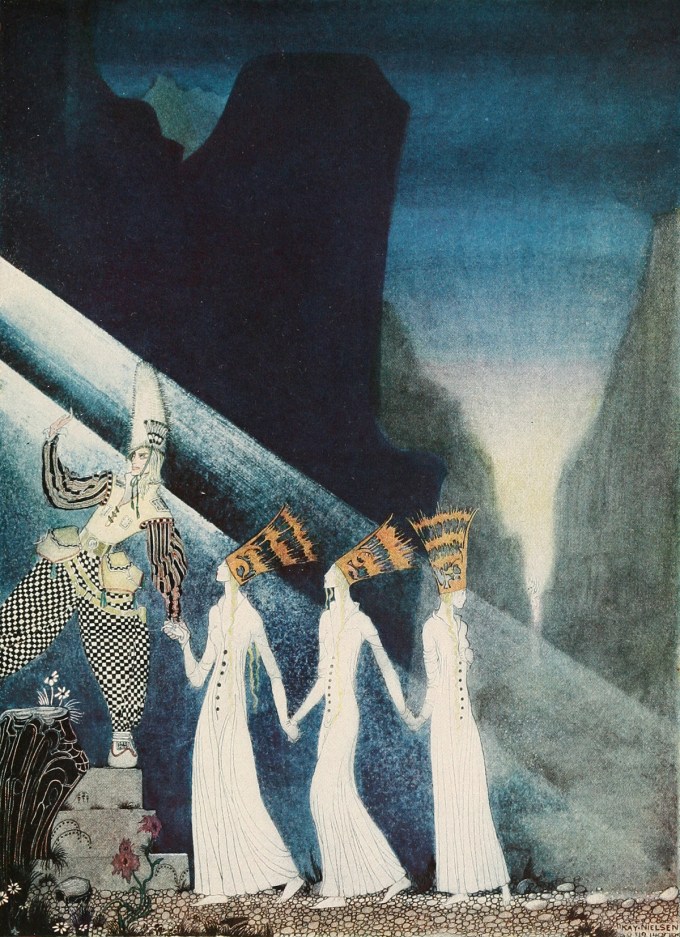
Art by Kay Nielsen from East of the Sun and West of the Moon, 1914. (Available as a print and as stationery cards.)

This very fact points at the best antidote to harmful self-deception:

Since we are highly susceptible to socially induced self-deception, the wisest practical course is to be very careful about the company we keep… Unfortunately self- deception is just the thing that prevents us from seeking its best therapy: it does not know when to expand, and when to limit its epistemological company. Fortunately, we have many other kinds of reasons for being astute about the company we keep. With luck, a canny self-deceiver’s other psychological and intellectual habits — a taste for astringency and a distrust of hypocrisy, for instance — can prevent the wild imperialistic tendencies of self-deception from becoming entrenched and ramified.

Much self-deception, Rorty observes, is not a matter of outright lying to oneself, but of selective attention and fragmentation of truth:

Self-deception need not involve false belief: just as the deceiver can attempt to produce a belief which is — as it happens — true, so too a self-deceiver can set herself to believe what is in fact true. A canny self-deceiver can focus on accurate but irrelevant observations as a way of denying a truth that is importantly relevant to her immediate projects.

This is something that stems from the psychological machinery of all deception, possible because “any experience is open to an indefinite number of true and even relatively salient descriptions”:

Clever deceivers rarely tell outright falsehoods. It’s too risky. The art of deception is closely related to the magician’s craft: it involves knowing how to draw attention to a harmless place, to deflect it away from the action. Deeply entrenched patterns of perceptual, emotional and cognitive dispositions serve as instruments of deception. A skilled deceiver is an illusionist who knows how to manipulate the normal patterns of what is salient to their audience. He places salient markers — something red, something anomalous, something desirable — in the visual field, to draw attention just where he wants it. The strategy of perceptual self-deception is identical: the trick is to place oneself where patterns of salience are likely to deflect attention away from what we do not wish to see.

But for all of its pitfalls, and for all the urgency of continually questioning when it becomes self-defeating, self-deception can be greatly beneficent in our endeavors of self-transformation and growth, offering assurance that bolsters our will and an antidote to the “generalized uncertainty about the worth of our projects.” Rorty writes:

By convincing themselves that a desired self-transformation is within relatively easy reach, canny self-improvers can use self-deception as an energizing instrument.

Art by Dorothy Lathrop, 1922. (Available as a print and as stationery cards.)

Self-deception is also necessary in propping up the precarious pillar of modern life in this century of selfing — identity:

We invent something we call our identity, resting our self-respect on our engaging in its projects, independently of any other measure of their merits.

But perhaps the most essential function of healthy self-deception is in allaying our ambivalence about projects and life-choices that bring us tremendous rewards, but also have tremendous personal costs, an accurate assessment of which might undermine our willingness to undertake them:

Without some species of self-deception, our dedications, our friendships, our work, our causes would collapse. In deciding to have children, we ignore the travails of parents, obliterating our otherwise keen awareness of the typical relations among parents and children; in devoting ourselves to writing philosophy, we conveniently forget how little philosophy we are willing to read; in the interest of sanity and joy, we sidestep our deep ambivalences about our kith and kin.

[…]

Disguising and submerging the ambivalence that is natural to most of our enterprises not only brings us the energy, verve, style and ease that successful action requires; it also helps to assure the social co-operation that is equally essential to our individual and collective projects. A good deal of the polite conversation of social life, — the public description of the joys of our social roles and functions (friend, mother, teacher, scholar) — channels and streams us to play our parts without the mess, confusion and upheaval that would occur if we openly expressed our natural and sensible ambivalence about these roles. It is virtually impossible to imagine any society that does not systematically and actively promote the self-deception of its members, particularly when the requirements of social continuity and cohesion are subtly at odds with one another and with the standard issue psychology of their members. Socially induced self-deception is an instrument in the preservation of social co-operation and cohesion.

Complement with Walter Lippmann’s superb century-old anatomy of deception and self-delusion, then revisit Rorty on what makes a person: the seven layers of identity, in literature and life.

Trees at Night: Rebecca Solnit Reads and Reflects on a Stunning Century-Old Poem by the Young Harlem Renaissance Poet Helene Johnson

Here’s the link to this article.

An eighteen-year-old prodigy’s song of praise for the eternal consolation of trees.

BY MARIA POPOVA

Trees at Night: Rebecca Solnit Reads and Reflects on a Stunning Century-Old Poem by the Young Harlem Renaissance Poet Helene Johnson

It’s a hard thing, achieving perspective — hard for the human animal, pinned as we each are to the dust-mote of spacetime we’ve been allotted, not one of us having chosen where or when to be born, not one of us — not even the most fortunate — destined to live for more than a blink of evolutionary time. It is no wonder, then, that our lens so easily contracts to a pinhole through which the fleeting frights and urgencies of the present stream in to fill the chamber of our complex consciousness with blinding totality.

Remembering that we only have approximately four thousand weeks helps. Taking the telescopic perspective helps. Trees, especially, help — for they remedy our loss of perspective as Earth’s own telescopes of time and mortality, each of them a perpetual death and yet potentially immortal, each a clockwork portal to the past, each “a little bit of the future,” as Wangari Maathai exulted in her Nobel Peace Prize acceptance speech a blink before she became compost for future forests.

Winter Moon at Toyamagahara, 1931 — one of Japanese artist Hasui Kawase’s stunning vintage woodblocks of trees. (Available as a print, benefitting The Nature Conservancy.)

Charles Babbage, while dreaming up the world’s first computer with Ada Lovelace, marveled at how tree rings encode information about the past — living logs as precise as digital data, as primal as the human heartbeat:

Every shower that falls, every change of temperature that occurs, and every wind that blows, leaves on the vegetable world the traces of its passage; slight, indeed, and imperceptible, perhaps, to us, but not the less permanently recorded in the depths of those woody fabrics.

It is also no wonder, then, that we see ourselves so readily in trees — not only in the easy (and therefore limited) anthropomorphic sense of Western fairy tales and Eastern folk myths that have accompanied our civilization, but in the deeper, more poetic sense that reveals us to ourselves as imaginative creatures animated by a restless yearning to reconcile the ephemeral and the eternal. This is the sense William Blake captured in his most beautiful letter:

The tree which moves some to tears of joy is in the eyes of others only a green thing which stands in the way. As a man is, so he sees.

This is also the sense the young Harlem Renaissance poet Helene Johnson (July 7, 1906–July 7, 1995) captured a century and a half after Blake, in a spare and stunning poem written when she was only eighteen: “Trees at Night,” first published in 1925 — just as the high school dropout turned artist and activist Art Young’s beloved graphic series by the same title began appearing in the Saturday Evening PostCollier’s, and LIFE, most likely inspiring the young Johnson, whose precocious erudition and literary taste must have feasted on the era’s most popular magazines.Art by Art Young from his 1920s series Trees at Night. (Available as a print, benefitting The Nature Conservancy.

Johnson’s poem originally appeared in the May edition of the National Urban League’s Opportunity: A Journal of Negro Life, when a year later, not yet twenty, she won First Honorable Mention in the journal’s literary contest, judged by James Weldon Johnson and Robert Frost. “Trees at Night,” along with all of her surviving poems and a wealth of letters, was later included in the wonderful posthumous volume This Waiting for Love: Helene Johnson, Poet of the Harlem Renaissance (public library) by African American literature professor Verner D. Mitchell.

Although she published poetry for less than a decade — a common talent-corseting reality of marriage for women a mere century ago, radiating from the title of Johnson’s last published poem, at age twenty-nine: “Let Me Sing My Song” — she lived a long life, dying on her eighty-eighth birthday, having witnessed the triumph of the suffrage movement and the civilizational defeat of two World Wars, the horror of the Holocaust and the hard-won hope of Civil Rights, the discovery of the double helix and the retroviral genocide of AIDS, the dehumanizing agony of the atomic bomb and the first human footfall on the Moon. Hers was a true saeculum — that beautiful Etruscan word I learned from Rebecca Solnit, denoting the period of time since the birth of the oldest living elder in the community.

Naturally, it was Rebecca I invited to read “Trees at Night” at the 2022 Universe in Verse. (A free “retrostream” of the full show is available worldwide between 12PM EST on May 21 and 4PM EST on May 22). Being one of the most devoted climate thinkers and activists of our time, she prefaced her reading with a soaring meditation on trees as an antidote to the erasures of human history and a moral compass for our planetary future — the kind of extemporaneous prose poem that can sprout from the lushest minds, next to which Johnson’s lyric loveliness rises even more majestic:

https://w.soundcloud.com/player/?visual=true&url=https%3A%2F%2Fapi.soundcloud.com%2Ftracks%2F1272382819&show_artwork=true&maxheight=1000&maxwidth=680

TREES AT NIGHT
by Helene Johnson

Slim Sentinels
Stretching lacy arms
About a slumbrous moon;
Black quivering
Silhouettes,
Tremulous,
Stencilled on the petal
Of a bluebell;
Ink sputtered
On a robin’s breast;
The jagged rent
Of mountains
Reflected in a
Stilly sleeping lake;
Fragile pinnacles
Of fairy castles;
Torn webs of shadows;
And
Printed ’gainst the sky —
The trembling beauty
Of an urgent pine.

Complement with Ursula K. Le Guin’s love-poem to trees as a lens on life and death, then step into Rebecca’s inspiriting new project, Not Too Late — a welcoming portal into the climate movement for newcomers and an arsenal of reinvigoration “for people who are already engaged but weary.”

Consciousness and the Constellations: Cognitive Scientist Alexandra Horowitz Reads and Reflects on Robert Frost

“You’ll wait a long, long time for anything much to happen…”

Here’s the link to this article.

BY MARIA POPOVA

Consciousness and the Constellations: Cognitive Scientist Alexandra Horowitz Reads and Reflects on Robert Frost

The first English use of the word space to connote the cosmic expanse appears in line 650 of Book I of Milton’s Paradise Lost:

Space may produce new Worlds; whereof so rife.

On this world, space has produced “atoms with consciousness,” in the lovely phrase of the later poet Richard Feynman. Minds. A world rife with minds, as various as they are numerous.

Elsewhere in his seventeenth-century epic of philosophy in blank verse, Milton formulated the quintessence of human experience:

The mind is its own place, and in it self
Can make a Heav’n of Hell, a Hell of Heav’n.

One of William Blake’s rare illustrations for Paradise Lost

In all of this, a paradox: A mind as complex and highly organized ours can perceive the fact of other minds, even more different from our own than the bodies they govern — an awareness haunted by Iris Murdoch’s reminder that the tragic freedom of our experience is the recognition that “others are, to an extent we never cease discovering, different from ourselves.” And yet the human mind is governed by a single organizing principle — self-reference, known often by its other names: memory, language, love.

Because it is its own place, it can only perceive the rest of reality from that place: Our entire view of the world, including the recognition of otherness, is lensed through our own particular mind, ground into shape by its particular genetic inheritance, smudged by its particular life-experience. Everything we see — ourselves, each other, the universe itself — is focused into meaning by that lens.

Plate from An Original Theory or New Hypothesis of the Universe by Thomas Wright, 1750. (Available as a print and as stationery cards.)

Milton lived through a turning point in human thought — an era that cleared the inner lens into a discomposing glimpse of reality as Galileo turned the lens of his primitive telescope outward to dismantle our illusions of centrality, our puerile cosmic self-reference. By the time Milton visited Galileo, he was too old and blind to look through the astronomer’s telescope and marvel at its concrete revelations of other moons spinning around other worlds spinning around a shared star. But he saw the abstract truth beyond it: The universe is rife with otherness, every point of light a point of view.

An epoch of lens-clearing after Milton, as we discovered that the universe is wildly larger than we thought and that our own world is wild with other consciousnessesRobert Frost (March 26, 1874–January 29, 1963) took up this subject with great subtlety and splendor in his poem “On Looking Up by Chance at the Constellations.”

At the fifth annual Universe in Verse — which explored through the dual lens of science and poetry the ultimate question animating these atoms with consciousness: What is life? — Frost’s poem came alive in a lovely reading by cognitive scientist Alexandra Horowitz — director of the Dog Cognition Lab at Barnard College, writer of some uncommonly poetic books about how canine minds see the world, creator and host of the wonderful new podcast Off Leash. She prefaced her reading with a poignant reflection on the limits of consciousness lensed through a point of view:

https://w.soundcloud.com/player/?visual=true&url=https%3A%2F%2Fapi.soundcloud.com%2Ftracks%2F1282449085&show_artwork=true&maxheight=1000&maxwidth=680

ON LOOKING UP BY CHANCE AT THE CONSTELLATIONS
by Robert Frost

You’ll wait a long, long time for anything much
To happen in heaven beyond the floats of cloud
And the Northern Lights that run like tingling nerves.
The sun and moon get crossed, but they never touch,
Nor strike out fire from each other nor crash out loud.
The planets seem to interfere in their curves —
But nothing ever happens, no harm is done.
We may as well go patiently on with our life,
And look elsewhere than to stars and moon and sun
For the shocks and changes we need to keep us sane.
It is true the longest drout will end in rain,
The longest peace in China will end in strife.
Still it wouldn’t reward the watcher to stay awake
In hopes of seeing the calm of heaven break
On his particular time and personal sight.
That calm seems certainly safe to last to-night.

Complement with Rebecca Solnit’s splendid reading of and reflection on the century-old poem “Trees at Night” from the same show, then revisit this rare recording of JFK’s tribute to Robert Frost — which is at heart a manifesto for the power of art to clarify, sanctify, and defend truth.