I encourage you to read these articles (and watch the videos) to gain understanding and perspective concerning the historical federal case of United States of America vs. Donald J. Trump.
I encourage you to read these articles (and watch the videos) to gain understanding and perspective concerning the historical federal case of United States of America vs. Donald J. Trump.
Trump’s hoarding of official secrets is both breathtakingly careless and utterly calculated.
June 10, 2023
Department of JusticePhotographs from 2021 of boxes of documents in storage at Mar-a-Lago, included in the Justice Department’s indictment of Donald Trump
Secrets are a kind of currency. They can be hoarded, but if kept for too long they lose their value. Like all currencies, they must, sooner or later, be used in a transaction—sold to the highest bidder or bartered as a favor for which another favor will be returned. To see the full scale of Donald Trump’s betrayal of his country, it is necessary to start with this reality. He kept intelligence documents because, at some point, those secrets could be used in a transaction. What he was stockpiling were the materials of treason. He may not have known how and when he would cash in this currency, but there can be little doubt that he was determined to retain the ability to do just that.
Before the publication of the grand jury’s indictment, it was possible to believe that Trump’s retention of classified documents was reckless and stupid. The indictment reveals that recklessness and stupidity are the least of his sins. With Trump, it’s always a mistake to equate anarchy with purposelessness or to think that the farce is not deadly serious. Trump’s hoarding of official secrets is both breathtakingly careless and utterly calculated. At the heart of that calculation is a cold resolve to not give up the power that access to highly restricted information had given him.
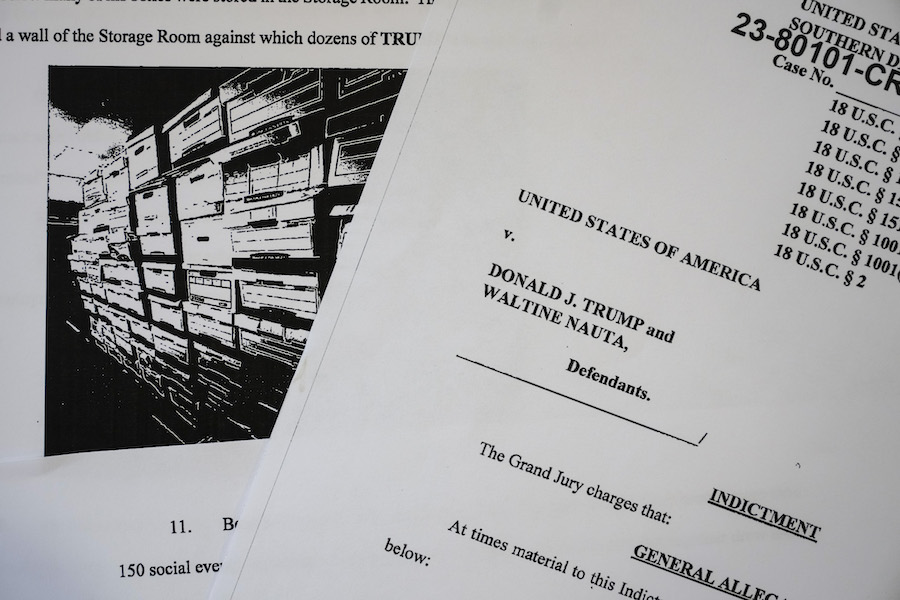
The most immediately striking parts of the indictment may, in this regard, be something of a distraction. The photographs that show boxes of papers at Mar-a-Lago, piled high on a ballroom stage, in a bathroom, and spilling out onto the floor of a storage room, convey an almost comic sense of chaos. If comedy is generated by incongruity, what could be more incongruous than nuclear plans or details of “potential vulnerabilities of the United States and its allies to military attack” sitting beside a toilet?
It all seems random and haphazard, an impression greatly magnified by the knowledge that Mar-a-Lago, in the eighteen months after Trump took the documents from the White House, was, as the indictment states, the venue for “more than 150 social events, including weddings, movie premieres and fundraisers that together drew tens of thousands of guests.” The New York Times has published photographs, scraped from social media, of people in party dresses or casual summer clothes around the Mar-a-Lago pool. We can see that, behind them, the door that leads to the storeroom, which was packed with boxes of official papers, is wide open. In those boxes, when the FBI opened them in August 2022, were eleven documents marked Top Secret, thirty-six marked Secret, and twenty-eight marked Confidential. It would have been the least thrilling spy thriller ever made. No James Bond high-tech gadgets or George Smiley ingenuity—just turn up in a cocktail dress, slip through an open door, and help yourself to the US military’s contingency plans for invading Iran.
Yet this ludicrous vulnerability to foreign spies is both remarkable and somewhat beside the point. The slapdash storage of classified papers is shocking—but also misleading. It defines the scandal as, in the words of Alan Feuer and Maggie Haberman in The New York Times, “Mr. Trump’s indifference toward the country’s most sensitive secrets.” But this is not a tale of indifference. Trump cared a great deal about the value of the documents. He cared enough, per the indictment, to suggest that his attorney lie to the FBI and a grand jury about what papers he did or did not have. Even Trump does not engage in a criminal conspiracy purely for its own sake. The retention of those boxes mattered to him because he understood the market value of what they contained.
It is important to bear in mind that chaos is Trump’s natural element. It is the medium in which his narcissism thrives. When there is no plan, the only law is his own desire. He alone knows at any given moment what he will do. In this light, the apparent disorderly storage of the boxes at Mar-a-Lago does not signify a lack of concern with what they contained. It is just the norm of Trumpworld. Derangement is his modus operandi.
The indictment makes clear that Trump knew very well that he was breaking the law. He was repeatedly warned by the National Archives and Records Administration that if he did not hand over the missing records, he would be referred to the Department of Justice. He had, of course, made a very big point in his attacks on Hillary Clinton of the need for zero tolerance for any lack of rigor in the handling of classified documents. He fully understood that the laws applied to everyone, including the president. As he declared in September 2016, before that year’s election, “We can’t have someone in the Oval Office who doesn’t understand the meaning of the word confidential or classified.” As president, in July 2018, he issued a statement saying that “as the head of the executive branch and Commander-in-Chief, I have a unique constitutional responsibility to protect the nation’s classified information, including by controlling access to it.”
More specifically, Trump knew that he was taking huge risks when he allegedly instructed his lawyer to lie to the FBI and the grand jury. That lawyer, quoted in the indictment, recalls that when Trump told him to take a folder of documents to his hotel room, he made a silent “plucking motion,” as if to say, “if there’s anything really bad in there, like, you know, pluck it out.” Precisely because Trump knew that he was committing a crime, he preferred not to utter the incriminating words. There is nothing thoughtless or accidental in all of this. He clearly believed that the risks were worth taking.
This does not suggest that he was holding these documents merely as souvenirs. It’s quite possible to believe that part of his motivation lay in his fantasy that he was still the real president: retaining the intelligence briefings he received as POTUS would make him still, at some level of self-delusion, potent. The two known occasions, cited in the indictment, when Trump produced some of the documents to outsiders while explicitly referring to them as secret and confidential have this air of showing off—perhaps as much to himself as to those he was trying to impress. It is also quite reasonable to think of him experiencing a tingle of pure pleasure in imagining his own impunity—knowing that he was committing the ultimate transgression and thrilling to the idea that he would get away with it because he had always in his life gotten away with everything.
Drew Angerer/Getty ImagesPages from the Justice Department’s indictment of Donald Trump, June 9, 2023
But these elements of twisted psychology can coexist with a more rational impulse: to keep hold of secrets that could be traded at some point for his personal gain. Trump sees himself above all as a deal-maker: “The nation’s classified information” is a potentially lucrative part of one or many deals.
This intent would be treasonous. Trump may not have actually committed treason, but he was consciously putting himself in a position to be able to do so. For what is not secret is the identity of the foreign countries that would be most interested in acquiring the details of the military plans and vulnerabilities of the US and its allies. The indictment states that the documents also included information that could identify US agents and informants in some of those countries and “the continued viability of sensitive intelligence collection methods.” This is worth underlining: Trump went to great lengths to retain for himself, as a private citizen, the power to reveal to any foreign power not just US military secrets but the workings of US intelligence-gathering in those countries. It is impossible to believe that he did this accidentally or without considering that he might at some time use that power in return for some financial or other benefits.
Which makes it all the more astonishing that most of the Republican Party is fine with this. Much of the history of the right in America is bound up with paranoia about the possible existence of traitors at high levels of government. Here is stark evidence of the existence of one at the very highest level of government, and Republicans are rushing to defend him. The Elizabethan courtier Sir John Harington famously asked, “Treason doth never prosper: what’s the reason?” and answered, “For if it prosper, none dare call it Treason.” If the hoarding of state secrets as valuable currency cannot be called treason, the concept has gone the way of honor, truthfulness, and respect for law. It has ceased to exist for the Republican Party.
Fintan O’Toole is the Advising Editor at The New York Review, a columnist for The Irish Times, and the Leonard L. Milberg Professor of Irish Letters at Princeton. His most recent book, We Don’t Know Ourselves: A Personal History of Modern Ireland, was published in the US last year. (June 2023)
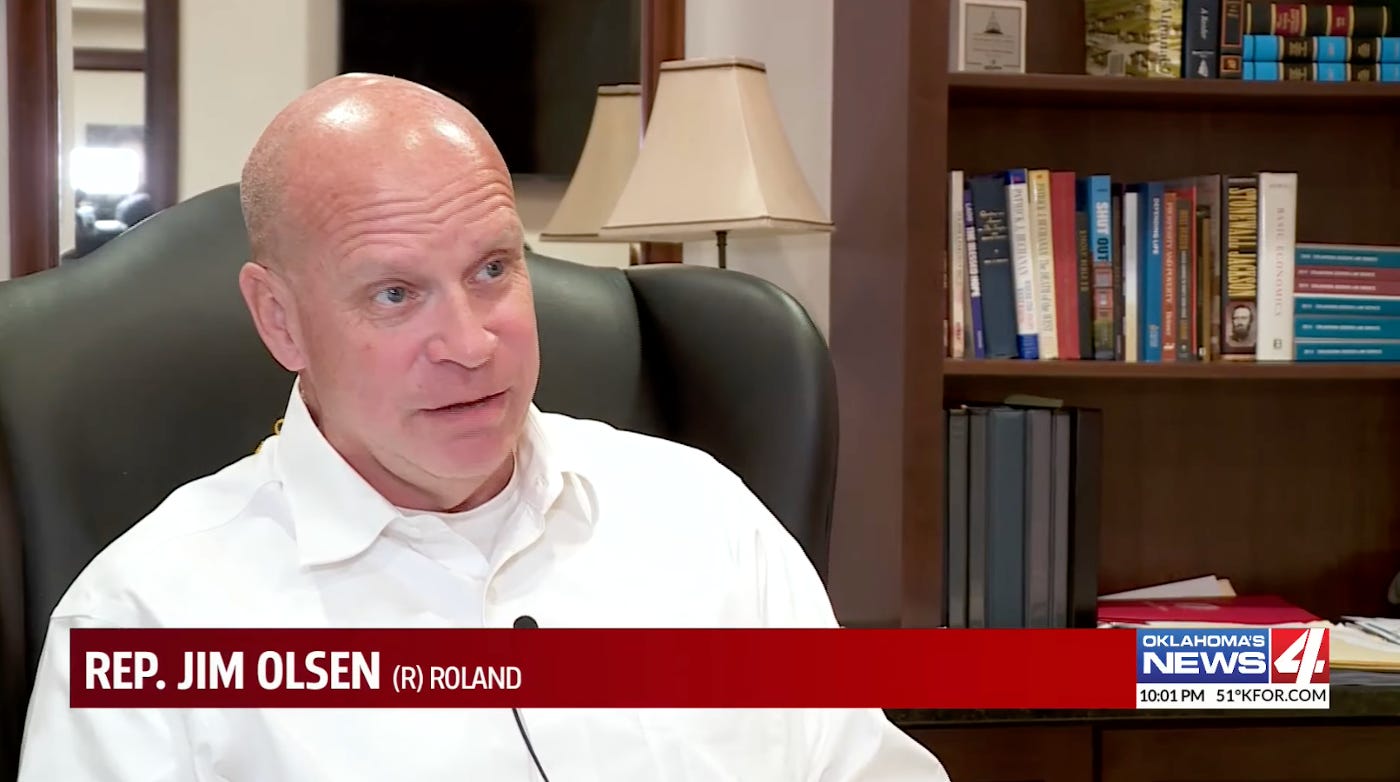
State Rep. Jim Olsen helped defeat a bill that would’ve banned the use of corporal punishment against students with special needs
This Substack newsletter is free, but it’s only able to sustain itself due to the support I receive from a small percentage of regular readers. Would you please consider becoming one of those supporters? You can use the button below to subscribe to Substack or use my usual Patreon page!
Republicans in Oklahoma had the chance to ban corporal punishment against students with disabilities… but failed to pass the bill today, in part because one legislator said beating kids with special needs was biblical.
Oklahoma currently permits corporal punishment in public schools. That’s a problem in and of itself, but the law at least has a carve-out exempting students with “the most significant cognitive disabilities.” Teachers can theoretically spank kids but a handful of students are off-limits.
House Bill 1028, sponsored by Republican State Rep. John Talley, was designed to broaden that exemption so that it applied to all students with disabilities. GOP State Rep. Anthony Moore signed on as a co-sponsor of the bill specifically because he thought this would be an easy vote. “There’s going to be nobody who’s for corporal punishment on students with disabilities,” he said.
He must have forgotten that he’s surrounded by other Republicans from Oklahoma.
They will always find a way to defend abuse in the name of Jesus.
State Rep. Jim Olsen argued earlier today that the Bible permits hitting a child as a form of discipline—therefore that option must be available to teachers.
Rep. Jim Olsen, seen here after comparing abortion to slavery (screenshot via YouTube)
You know, several scriptures could be read here. Let me just read just one: Proverbs 29: “The rod and reproof give wisdom, but a child left to himself bringest his mother to shame.”
So that would seem to endorse the use of corporal punishment.
So how would you reconcile this bill with scriptures…?
Who cares. It’s the Bible and he’s a legislator. We don’t need to run policy ideas through his favorite book.
Olsen later cited Proverbs 13:24, the infamous verse that gave us, “Spare the rod, spoil the child.” Kudos to the Tulsa World for including this line in its article:
Olsen did not turn to Deuteronomy 21:18-21, which is usually translated as God ordering that “stubborn and rebellious” sons be stoned to death.
And what about the American Academy of Pediatrics, which supports banning any form of physical discipline against children because there’s plenty of evidence showing the harm it causes in the long term?
Olsen didn’t care.
“God’s counsel is higher than the American Academy of Pediatrics,” said Olsen. “God’s word is higher than all the so-called experts.”
To paraphrase a famous line, Olsen acts like he placed his hand on the Constitution and swore to uphold the Bible. It’s supposed to be the other way around.
But the Bible wasn’t the only way a Republican defended hitting kids with disabilities. Another one said teachers needed the threat of discipline in order to coerce kids to do their bidding.
Rep. Randy Randleman, R-Eufaula, made a different argument from Olsen’s against HB 1028. A child psychologist who often infuses religion into his medical opinions on the House floor, Randleman this time said spanking is almost always inappropriate but is sometimes called for. And he said teachers need the threat of corporal punishment to maintain classroom order.
“‘You can’t touch me.’ I hear that over and over. I don’t want to hear that in school,” said Randleman.
If your classroom is so chaotic that physical discipline is your only solution, you shouldn’t be a teacher. And if you’re someone who thinks threatening children—special needs children!—with abuse is the only way to maintain order, you shouldn’t be anywhere in a position of power. Yet here we are.
Today’s vote in the House was 45-43 in favor of exempting kids with disabilities from physical punishment in schools. That sounds like good news… but because there are 101 members of the State House, 51 votes are needed for a bill to pass. That’s why the bill was technically defeated. More than a dozen legislators were absent for the vote.
Because neither side had the majority, the bill may come up for a vote later in the legislative session. 10 Republicans have yet to cast a vote on this matter. At least a few of them would have to do the right thing for the bill to pass.
Democratic State Rep. Forrest Bennett put today’s vote bluntly:
“It’s 1880 in here” should really be Oklahoma’s State Motto.
Incidentally, hitting kids has long been a core belief among fundamentalist Christians. Years ago, Michael and Debi Pearl wrote an infamous guide to faith-based abuse called To Train Up a Child. It’s a book that tells adults how to properly hit their kids, and it’s as awful as it sounds, recommending that Christian parents physically discipline kidsas young as six months with “the same principles the Amish use to train their stubborn mules.”
In Oklahoma, this isn’t just theoretical. Corporal punishment is legal in the state and school officials take advantage of that:
Oklahoma educators reported using physical discipline 3,968 times during the 2017-18 school year, according to the most recent federal data available from the Office of Civil Rights of the U.S. Department of Education. The federal government reported that corporal punishment was administered at more than 1,800 Oklahoma schools.
Ultimately, the Sunday School teacher who routinely cites the Bible to defend horrible policies used his power to defeat a bill so that more vulnerable students could be hurt just a little more. He’s the sort of guy who wants to protect kids from learning about systemic racism while making sure teachers have the option to beat students with disabilities.
All because his Christian faith taught him that abuse is more important than compassion.
Tommy Tuberville is an embarrassment to all sane people. What on earth does his stupidity say about all the folks who voted for him?
Alabama deserves so much better. Alabamians can do so much better by reading and thinking for themselves and not being kowtowed by Tuberville and his ilk.
I would greatly appreciate it if you became a full subscriber! You can use the button below to subscribe to Substack or use my usual Patreon page!
On a straight party-line vote, Arizona Republicans have backed a billforcing public school students to say the Pledge of Allegiance. While no penalty is specified for those who disobey, the illegal bill offers no exceptions for students who refuse to participate in the religious ritual.
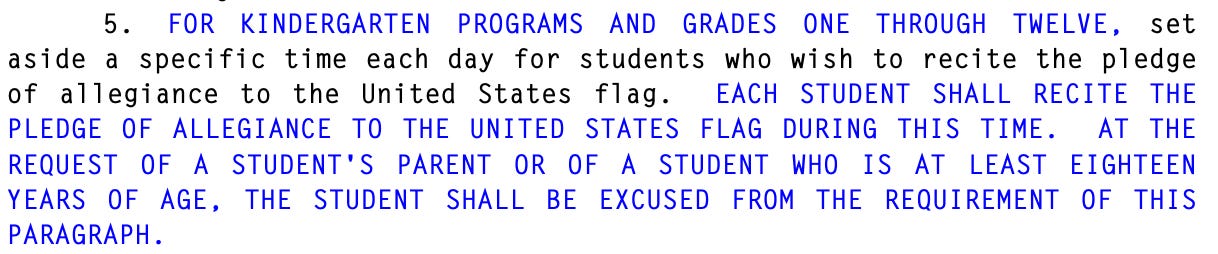
HB2523, which passed by a slim 31-29 vote, says that all K-12 students “shall recite the Pledge of Allegiance to the United States Flag.” The only exceptions apply to students who are at least 18 or who have the explicit permission of their parents to sit out. But students who oppose saying the Pledge on principle would have no recourse here unless their parents were on their side.
The phrase “under God” pushes religion onto people who may not be religious. Even without that phrase, the very notion of pledging allegiance to a flag violates the religious beliefs of some students who believe only God deserves allegiance.
The Pledge also falsely suggests that we have “liberty and justice for all,” which is one reasons students of color have opposed it in recent years.
And frankly, our country doesn’t always deserve admiration. Why would we want to “pledge allegiance” to a nation that is so often a global embarrassment? If Saudi Arabia forced students to say a pledge to their country every day, we’d immediately call it a form of brainwashing.
Those are all reason not to say the Pledge in a normal situation, but forcing students to participate in the religious ritual against their will, unless their parents feel the same way they do, is undoubtedly a violation of students’ civil rights.
That means this bill is illegal and would provoke a lawsuit if it ever became law. In fact, the Supreme Court ruled in Barnette in 1943 that students couldn’t be forced to salute the flag or say the Pledge. (That decision overturned a notoriously awful ruling from 1940 which said the opposite.) While “Under God” wasn’t in the Pledge at the time, the justices said the government could not compel speech, with one justice famously writing, “If there is any fixed star in our constitutional constellation, it is that no official, high or petty, can prescribe what shall be orthodox in politics, nationalism, religion, or other matters of opinion or force citizens to confess by word or act their faith therein.”
None of that mattered to the bill’s sponsor, first-term Republican State Rep. Barbara Parker, who, in a speech just before the vote took place, implied that church/state separation was a myth and that the 1943 Supreme Court decision was irrelevant.
First of all, a couple of things. One is: It’s really important that we clear up a few things that should never be said again from lawmakers in a legislature.
One: The separation of church and state is in the Constitution. That was never said in the Constitution. It was written in a letter years later. The separation clause was therefore the government couldn’t form a religion or couldn’t force a state religion. So let’s never hear that again.
A second thing is that: Everybody tends to quote the Barnette ruling from 1943. First of all, “Under God” wasn’t put in in 1943. It was put in in 1954. And nobody’s really ever opposed that.
Furthermore, we stand and say the Pledge of Allegiance everyday on this floor. What’s good for us is good for the children.
Separation of church and state emerges from the First Amendment and has repeatedly been interpreted that way by the courts. To pretend the government can therefore promote religion is nothing more than willful ignorance by someone who has plenty to spare.
More importantly, Parker is flat-out wrong about the Barnette case. She cited it because a Democrat mentioned it just before she spoke, but Parker seemed to think the case was being used to push back against “Under God.” It wasn’t. It was cited to point out that government cannot force students to say or do something political against their will. (And, yes, plenty of people and judges have opposed both mandatory recitation of the Pledge and the inclusion of “Under God.”)
Parker also thinks that if her legislative colleagues do it, it should be okay for kids to follow suit. Again, she has no clue what she’s talking about. Just to give one example, the Supreme Court has permitted invocation prayers at city council meetings, but the same privilege doesn’t extend to school board meetings or graduations where children may be present.
Just because Republicans in the Arizona legislature want to use their majorities to inflict Christianity on their colleagues doesn’t mean they have any right to force that on children.
The Arizona Senate, where the bill now heads, also has a slim Republican majority of 16-14. Even if it passes there, though, Gov. Katie Hobbs, a Democrat, can thankfully veto it. If and when that happens, Hobbs would be saving taxpayers from a costly lawsuit they would inevitably lose.
The government cannot force children to say a prayer in school no matter how much misinformation Christians like Barbara Parker want to spread.
Christianity has a brand problem. If it were a corporation, brand managers would be scrambling to scrub public image—maybe by greenwashing or with corporate diversity trainings or by renaming their product, say natural gas instead of methane, or by coming up with a new catchy slogan. Or they might actually do something substantive, like ceasing to “gift” baby formula to poor moms or to use child labor in their factories. There are many ways to polish brand.
Christianity’s recently launched He Gets US campaign—millions of people got a dose during the Superbowl—tells us two things: 1. Conservative Evangelical Christians care about their brand problem. 2. Some major Christian donors have decided, to the tune of $100 million apparently, to go with the greenwashing strategy rather than substantive change. And that combination provides a possible avenue for fighting back against some of the ugly objectives and tactics of the Religious Right.
The people paying for this ad campaign are the same ones promoting homophobia, advocating against reproductive healthcare for women, and funding politicians to protect the good old pecking orders: rich over poor, men over women, pasty white people over everyone with more melanin.
Losing customers Back when the world and I were young, Evangelical Christians were a politically diverse group. But Republican strategists recognized them as a potential political voting block. Hierarchical social structures within churches meant the strategists had to recruit only Church leaders, and those leaders would bring along their congregations. It worked for the Republican party, but at an enormous cost to Christianity as an institution. That is because right wing operatives were spending down Christianity’s good name by merging its brand with their own. The more Christianity came to be associated with ugly political priorities—and then crass power grab-‘em-by-the-pussies—the more young people fled the Church. By the millions. (Tangentially, Islam faces a similar brand problem and deconversion pattern wherever the Mullahs wield political force. Almost half of Iranians say they used to be religious.)
Losing money Losing customers by the millions would be a problem for any corporate body—especially one with a product that people realize they don’t need when they actually take a good look. When there are better options, in this case secularism, people rarely go back to the same-old-same-old. The financial impact of deconversion is potentially huge. The Mormon Church may coerce tithes with visits from elders who review a family’s finances, but most protestant and Catholic sects rely on more subtle social and emotional pressures. Either way, market share requires mindshare. You have to get people in the door before you can pass the basket.
Losing prospects But this isn’t merely a financial calculus. At some point, brand damage becomes a threat to identity. Evangelicals are evangelical. It’s part of the ideology. Go into all the world and make disciples of every creature. Unlike Judaism or Hinduism, Christianity is a proselytizing religion. Proselytizing (ok, coupled with colonization and holy wars) has been the strategy that allowed Christianity to spread across the planet. Missionaries may not explicitly recognize that they are recruiting paying customers who will trade cash for club benefits and afterlife services, but they do recognize that “harvesting souls” is a central commandment of their faith. For many, this mandate—called the Great Commission—is their version of praying five times facing Mecca. For some, it becomes an underlying feature in virtually every relationship: All non-Christians are potential converts; friendliness becomes friendship missions; feeding the poor becomes first-and-foremost a path to winning their souls. Evangelicals are a sales force, and as their brand becomes more and more soiled, it gets harder to do their job.
In need of a savior Having spent down Christianity’s brand, the patriarchs of the religious right are uncomfortable with how far that has gone—the image, that is, not the substance. Most Americans used to think of the Bible as The Good Book, but not anymore. Most Americans used to think of Christianity (and religion more broadly) as benign, but not anymore. Jesus, though—the image of Jesus is relatively untainted. Even those who don’t buy into the idea of him being the perfect human sacrifice who saves our souls (Are you washed in the blood?) tend to believe that he was a good, wise, loving man. They think we know a lot more about him than we do, and what they think we know is positive. So, it totally makes sense that a $100 million rebranding and recruiting effort would center on the person of Jesus. Much of Christian theology is nasty, and the Iron Age texts in the Bible contradict what we now know about science, anthropology and—well, pretty much every other field of modern scholarship. This iconic personal Jesus is all they have left.
The fact that conservative Christians are spending $100 million on marketing Jesus means they are bad off and know it. It means they recognize the deterioration in their brand, and they feel desperate to turn it around. They have made the mistake of letting that desperation slip out, and those of us who would rather not return to the good old dark ages when the Church ruled the world can exploit that vulnerability. Their product sucks, and we need to keep saying so in every way possible. We need to make sure the general public keeps associating Christianity with what Christians are doing, not what they are saying: Those anti-abortion centers that dupe women into keeping pregnancies aren’t Crisis Pregnancy Centers, they are Church Pregnancy Centers. Fetal personhood isn’t a philosophical debate, it’s theology. Denying rights to queer folks and women isn’t conservative, it’s theocracy.
When people do ugly things that are motivated by religious dogma, we should name what’s going on. Conservative Christians are telling us that they can’t afford more brand damage. And maybe if their bad works keep getting exposed they will realize that the answer isn’t Jesus-washing; it’s substantive change.
_________________________________
Valerie Tarico is a psychologist and writer in Seattle, Washington. She is the author of Trusting Doubt: A Former Evangelical Looks at Old Beliefs in a New Light and Deas and Other Imaginings. Her articles about religion, reproductive health, and the role of women in society have been featured at sites including The Huffington Post, Salon, The Independent, Quillette, Free Inquiry, The Humanist, AlterNet, Raw Story, Grist, Jezebel, and the Institute for Ethics and Emerging Technologies. Subscribe at ValerieTarico.com.





 Richard L. Fricks