Two Months in Georgia: How Trump Tried to Overturn the Vote

Here’s the link to this article.

The Georgia case offers a vivid reminder of the extraordinary lengths Mr. Trump and his allies went to in the Southern state to reverse the election.

A man in a blue suit stands offstage and looks toward the right. A reflection of him looks toward the left.
Former President Trump in the White House briefing room after making a statement on Nov. 5, 2020.Credit…Doug Mills/The New York Times
Danny Hakim
Richard Fausset

By Danny Hakim and Richard Fausset

Reporting from Atlanta

Aug. 14, 2023, 3:00 a.m. ET

When President Donald J. Trump’s eldest son took the stage outside the Georgia Republican Party headquarters two days after the 2020 election, he likened what lay ahead to mortal combat.

“Americans need to know this is not a banana republic!” Donald Trump Jr. shouted, claiming that Georgia and other swing states had been overrun by wild electoral shenanigans. He described tens of thousands of ballots that had “magically” shown up around the country, all marked for Joseph R. Biden Jr., and others dumped by Democratic officials into “one big box” so their authenticity could not be verified.

Mr. Trump told his father’s supporters at the news conference — who broke into chants of “Stop the steal!” and “Fraud! Fraud!” — that “the number one thing that Donald Trump can do in this election is fight each and every one of these battles, to the death!”

Over the two months that followed, a vast effort unfolded on behalf of the lame-duck president to overturn the election results in swing states across the country. But perhaps nowhere were there as many attempts to intervene as in Georgia, where Fani T. Willis, the district attorney of Fulton County, is now poised to bring an indictment for a series of brazen moves made on behalf of Mr. Trump in the state after his loss and for lies that the president and his allies circulated about the election there.

Mr. Trump has already been indicted three times this year, most recently in a federal case brought by the special prosecutor Jack Smith that is also related to election interference. But the Georgia case may prove the most expansive legal challenge to Mr. Trump’s attempts to cling to power, with nearly 20 people informed that they could face charges.

It could also prove the most enduring: While Mr. Trump could try to pardon himself from a federal conviction if he were re-elected, presidents cannot pardon state crimes.

Perhaps above all, the Georgia case assembled by Ms. Willis offers a vivid reminder of the extraordinary lengths taken by Mr. Trump and his allies to exert pressure on local officials to overturn the election — an up-close portrait of American democracy tested to its limits.

There was the infamous call that the former president made to Brad Raffensperger, Georgia’s Republican secretary of state, during which Mr. Trump said he wanted to “find” nearly 12,000 votes, or enough to overturn his narrow loss there. Mr. Trump and his allies harassed and defamed rank-and-file election workers with false accusations of ballot stuffing, leading to so many vicious threats against one of them that she was forced into hiding.

They deployed fake local electors to certify that Mr. Trump had won the election. Within even the Justice Department, an obscure government lawyer secretly plotted with the president to help him overturn the state’s results.

And on the same day that Mr. Biden’s victory was certified by Congress, Trump allies infiltrated a rural Georgia county’s election office, copying sensitive software used in voting machines throughout the state in their fruitless hunt for ballot fraud.

The Georgia investigation has encompassed an array of high-profile allies, from the lawyers Rudolph W. Giuliani, Kenneth Chesebro and John Eastman, to Mark Meadows, the White House chief of staff at the time of the election. But it has also scrutinized lesser-known players like a Georgia bail bondsman and a publicist who once worked for Kanye West.

As soon as Monday, there could be charges from a Fulton County grand jury after Ms. Willis presents her case to them. The number of people indicted could be large: A separate special grand jury that investigated the matter in an advisory capacity last year recommended more than a dozen people for indictment, and the forewoman of the grand jury has strongly hinted that the former president was among them.

If an indictment lands and the case goes to trial, a regular jury and the American public will hear a story that centers on nine critical weeks from Election Day through early January in which a host of people all tried to push one lie: that Mr. Trump had secured victory in Georgia. The question before the jurors would be whether some of those accused went so far that they broke the law.

A large screen hangs behind a row of people in a stately chamber. On the screen. one man is shown on the left, and one man is shown on the right.
A recording of Mr. Trump talking to Brad Raffensperger, secretary of state of Georgia, was played during a hearing by the Jan. 6 Committee last October. Credit…Alex Wong/Getty Images

It did not take long for the gloves to come off.

During the Nov. 5 visit by Donald Trump Jr., the Georgia Republican Party was already fracturing. Some officials believed they should focus on defending the seats of the state’s two Republican senators, Kelly Loeffler and David Perdue, who were weeks away from runoff elections, rather than fighting a losing presidential candidate’s battles.

But according to testimony before the Jan. 6 committee by one of the Trump campaign’s local staffers, Mr. Trump’s son was threatening to “tank” those Senate races if there was not total support for his father’s effort. (A spokesman for Donald Trump Jr. disputed that characterization, noting that the former president’s son later appeared in ads for the Senate candidates.)

Four days later, the two senators called for Mr. Raffensperger’s resignation. The Raffensperger family was soon barraged with threats, leading his wife, Tricia, to confront Ms. Loeffler in a text message: “Never did I think you were the kind of person to unleash such hate and fury.”

Understand Georgia’s Investigation of Election Interference

Card 1 of 5

A legal threat to Trump. Fani Willis, the Atlanta area district attorney, has been investigating whether former President Donald Trump and his allies interfered with the 2020 election in Georgia. The case could be one of the most perilous legal problems for Trump. Here’s what to know:

Looking for votes. Prosecutors in Georgia opened their investigation in February 2021, just weeks after Trump made a phone call to Brad Raffensperger, Georgia’s secretary of state, and urged him to “find” enough votes to overturn the results of the election there.

What are prosecutors looking at? In addition to Trump’s call to Raffensperger, Willis has homed in on a plot by Trump allies to send fake Georgia electors to Washington and misstatements about the election results made before the state legislature by Rudy Giuliani, who spearheaded efforts to keep Trump in power as his personal lawyer. An election data breach in Coffee County, Ga., is also part of the investigation.

Who is under scrutiny? Giuliani has been told that he is a target of the investigation. Willis’s office has also warned some state officials — including David Shafer, the head of the Georgia Republican Party — and pro-Trump “alternate electors” that they could be indicted.

The potential charges. Experts say that Willis appears to be building a case that could target multiple defendants with charges of conspiracy to commit election fraud or racketeering-related charges for engaging in a coordinated scheme to undermine the election. The grand jury, which recently concluded its work, recommended indictments for multiple people, the forewoman of the jury said.

Four other battleground states had also flipped to Mr. Biden, but losing Georgia, the only Deep South state among them, seemed particularly untenable for Mr. Trump. His margin of defeat there was one of the smallest in the nation. Republicans controlled the state, and as he would note repeatedly in the aftermath, his campaign rallies in Georgia had drawn big, boisterous crowds.

By the end of November, Mr. Trump’s Twitter feed had become a font of misinformation. “Everybody knows it was Rigged” he wrote in a tweet on Nov. 29. And on Dec. 1: “Do something @BrianKempGA,” he wrote, referring to Gov. Brian Kemp of Georgia, a Republican. “You allowed your state to be scammed.”

But these efforts were not gaining traction. Mr. Raffensperger and Mr. Kemp were not bending. And on Dec. 1, Mr. Trump’s attorney general, William P. Barr, announced that the Department of Justice had found no evidence of voting fraud “on a scale that could have effected a different outcome in the election.”

It was time to turn up the volume.

Mr. Giuliani was on the road, traveling to Phoenix and Lansing, Mich., to meet with lawmakers to convince them of fraud in their states, both lost by Mr. Trump. Now, he was in Atlanta.

Even though Mr. Trump’s loss in Georgia had been upheld by a state audit, Mr. Giuliani made fantastical claims at a hearing in front of the State Senate, the first of three legislative hearings in December 2020.

A man in a dark blue suit and blue and red tie walks through a wooden doorway.
Rudolph Giuliani at a legislative hearing at the Georgia State Capitol in Atlanta in December 2020.Credit…Rebecca Wright/Atlanta Journal-Constitution, via Associated Press

He repeatedly asserted that machines made by Dominion Voting Systems had flipped votes from Mr. Trump to Mr. Biden and changed the election outcome — false claims that became part of Dominion defamation suits against Fox News, Mr. Giuliani and a number of others.

Mr. Giuliani, then Mr. Trump’s personal lawyer, also played a video that he said showed election workers pulling suitcases of suspicious ballots from under a table to be secretly counted after Republican poll watchers had left for the night.

He accused two workers, a Black mother and daughter named Ruby Freeman and Wandrea Moss, of passing a suspicious USB drive between them “like vials of heroin or cocaine.” Investigators later determined that they were passing a mint; Mr. Giuliani recently admitted in a civil suit that he had made false statements about the two women.

Other Trump allies also made false claims at the hearing with no evidence to back them up, including that thousands of convicted felons, dead people and others unqualified to vote in Georgia had done so.

John Eastman, a lawyer advising the Trump campaign, claimed that “the number of underage individuals who were allowed to register” in the state “amounts allegedly up to approximately 66,000 people.”

That was not remotely true. During an interview last year, Mr. Eastman said that he had relied on a consultant who had made an error, and there were in fact about 2,000 voters who “were only 16 when they registered.”

But a review of the data he was using found that Mr. Eastman was referring to the total number of Georgians since the 1920s who were recorded as having registered before they were allowed. Even that number was heavily inflated due to data-entry errors common in large government databases.

The truth: Only about a dozen Georgia residents were recorded as being 16 when they registered to vote in 2020, and those appeared to be another data-entry glitch.

Several protesters waving American flags gather in front of a barricaded building.
Trump supporters protesting election results at State Farm Arena in Atlanta in the days following the 2020 election.Credit…Audra Melton for The New York Times

In the meantime, Mr. Trump was working the phones, trying to directly persuade Georgia Republican leaders to reject Mr. Biden’s win.

He called Governor Kemp on Dec. 5, a day after the Trump campaign filed a lawsuit seeking to have the state’s election results overturned. Mr. Trump pressured Mr. Kemp to compel lawmakers to come back into session and brush aside the will of the state’s voters.

Mr. Kemp, who during his campaign for governor had toted a rifle and threatened to “round up illegals” in an ad that seemed an homage to Mr. Trump, rebuffed the idea.

Two days later, Mr. Trump called David Ralston, the speaker of the Georgia House, with a similar pitch. But Mr. Ralston, who died last year, “basically cut the president off,” a member of the special grand jury in Atlanta who heard his testimony later told The Atlanta Journal Constitution. “He just basically took the wind out of the sails.”

By Dec. 7, Georgia had completed its third vote count, yet again affirming Mr. Biden’s victory. But Trump allies in the legislature were hatching a new plan to defy the election laws that have long been pillars of American democracy: They wanted to call a special session and pick new electors who would cast votes for Mr. Trump.

Never mind that Georgia lawmakers had already approved representatives to the Electoral College reflecting Biden’s win in the state, part of the constitutionally prescribed process for formalizing the election of a new president. The Trump allies hoped that the fake electors and the votes they cast would be used to pressure Vice President Mike Pence not to certify the election results on Jan. 6.

Mr. Kemp issued a statement warning them off: “Doing this in order to select a separate slate of presidential electors is not an option that is allowed under state or federal law.”

Rather than back down, Mr. Trump was deeply involved in the emerging plan to enlist slates of bogus electors.

Mr. Trump called Ronna McDaniel, the head of the Republican National Committee, to enlist her help, according to Ms. McDaniel’s House testimony. By Dec. 13, as the Supreme Court of Georgia rejected an election challenge from the Trump campaign, Robert Sinners, the Trump campaign’s local director of Election Day operations, emailed the 16 fake electors, directing them to quietly meet in the capitol building in Atlanta the next day.

Mr. Trump’s top campaign lawyers were so troubled by the plan that they refused to take part. Still, the president tried to keep up the pressure using his Twitter account. “What a fool Governor @BrianKempGA of Georgia is,” he wrote in a post just after midnight on Dec. 14, adding, “Demand this clown call a Special Session.”

A woman wearing a red sweater stands in front of a podium that says “Trump Pence.”
Ronna McDaniel, chair of the Republican National Committee, at a news conference following the election in 2020.Credit…Al Drago for The New York Times

Later that day, the bogus electors met at the Statehouse. They signed documents that claimed they were Georgia’s “duly elected and qualified electors,” even though they were not.

In the end, their effort was rebuffed by Mr. Pence.

In his testimony to House investigators, Mr. Sinners later reflected on what took place: “I felt ashamed,” he said.

Confused about the inquiries and legal cases involving former President Donald Trump? We’re here to help.

With other efforts failing, the White House chief of staff, Mark Meadows, got personally involved. Just before Christmas, he traveled to suburban Cobb County, Ga., during its audit of signatures on mail-in absentee ballots, which had been requested by Mr. Kemp.

Mr. Meadows tried to get into the room where state investigators were verifying the signatures. He was turned away. But he did meet with Jordan Fuchs, Georgia’s deputy secretary of state, to discuss the audit process.

During the visit, Mr. Meadows put Mr. Trump on the phone with the lead investigator for the secretary of state’s office, Frances Watson. “I won Georgia by a lot, and the people know it,” Mr. Trump told her. “Something bad happened.”

Byung J. Pak, the U.S. attorney in Atlanta at the time, believed that Mr. Meadows’s visit was “highly unusual,” adding in his House testimony, “I don’t recall that ever happening in the history of the U.S.”

In Washington, meanwhile, a strange plot was emerging within the Justice Department to help Mr. Trump.

Mr. Barr, one of the most senior administration officials to dismiss the claims of fraud, had stepped down as attorney general, and jockeying for power began. Jeffrey Clark, an unassuming lawyer who had been running the Justice Department’s environmental division, attempted to go around the department’s leadership by meeting with Mr. Trump and pitching a plan to help keep him in office.

A man in a dark coat and red tie walks in front of a woman and another man outside a white building.
Mr. Trump, his daughter Ivanka Trump and Mark Meadows, his chief of staff, leaving the White House en route to Georgia in January 2021.Credit…Pool photo by Erin Scott

Mr. Clark drafted a letter to lawmakers in Georgia, dated Dec. 28, falsely claiming that the Justice Department had “identified significant concerns” regarding the state’s election results. He urged the lawmakers to convene a special session — a dramatic intervention.

Richard Donoghue, who was serving as acting deputy attorney general, later testified that he was so alarmed when he saw the draft letter that he had to read it “twice to make sure I really understood what he was proposing, because it was so extreme.”

The letter was never sent.

Still, Mr. Trump refused to give up. It was time to reach the man who was in charge of election oversight: Mr. Raffensperger, Georgia’s secretary of state.

On Jan. 2, he called Mr. Raffensperger and asked him to recalculate the vote. It was the call that he would later repeatedly defend as “perfect,” an hourlong mostly one-sided conversation during which Mr. Raffensperger politely but firmly rejected his entreaties.

“You know what they did and you’re not reporting it,” the president warned, adding, “you know, that’s a criminal — that’s a criminal offense. And you know, you can’t let that happen. That’s a big risk to you.”

Mr. Raffensperger was staggered. He later wrote that “for the office of the secretary of state to ‘recalculate’ would mean we would somehow have to fudge the numbers. The president was asking me to do something that I knew was wrong, and I was not going to do that.”

Mr. Trump seemed particularly intent on incriminating the Black women working for the county elections office, telling Mr. Raffensperger that Ruby Freeman — whom he mentioned 18 times during the call — was “a professional vote-scammer and hustler.”

“She’s one of the hot items on the internet, Brad,” Mr. Trump said of the viral misinformation circulating about Ms. Freeman, which had already been debunked by Mr. Raffensperger’s aides and federal investigators.

Trump-fueled conspiracy theories about Ms. Freeman and her daughter, Ms. Moss, were indeed proliferating. In testimony to the Jan. 6 committee last year, Ms. Moss recounted Trump supporters forcing their way into her grandmother’s home, claiming they were there to make a citizen’s arrest of her granddaughter; Ms. Freeman said that she no longer went to the grocery store.

Then, on Jan. 4, Ms. Freeman received an unusual overture.

Trevian Kutti, a Trump supporter from Chicago who had once worked as a publicist for Kanye West, persuaded Ms. Freeman to meet her at a police station outside Atlanta. Ms. Freeman later said that Ms. Kutti — who told her that “crisis is my thing,” according to a video of the encounter — had tried to pressure her into saying she had committed voter fraud.

“There is nowhere I feel safe. Nowhere,” Ms. Freeman said in her testimony, adding, “Do you know how it feels to have the president of the United States target you?”

In an image taken from video, several people work in an office.
Cathy Latham, center, in a light blue shirt, in the elections office in Coffee County, Ga., while a team working on Mr. Trump’s behalf made copies of voting equipment data in January 2021.Credit…Coffee County, Georgia, via Associated Press

On Jan. 7, despite the fake electors and the rest of the pressure campaign, Mr. Pence certified the election results for Mr. Biden. The bloody, chaotic attack on the Capitol the day before did not stop the final certification of Biden’s victory, but in Georgia, the machinations continued.

In a quiet, rural county in the southeastern part of the state, Trump allies gave their mission one more extraordinary try.

A few hours after the certification, a small group working on Mr. Trump’s behalf traveled to Coffee County, about 200 miles from Atlanta. A lawyer advising Mr. Trump had hired a company called SullivanStrickler to scour voting systems in Georgia and other states for evidence of fraud or miscounts; some of its employees joined several Trump allies on the expedition.

“We scanned every freaking ballot,” Scott Hall, an Atlanta-area Trump supporter and bail bondsman who traveled to Coffee County with employees of the company on Jan. 7, recalled in a recorded phone conversation. Mr. Hall said that with the blessing of the Coffee County elections board, the team had “scanned all the equipment” and “imaged all the hard drives” that had been used on Election Day.

A law firm hired by SullivanStrickler would later release a statement saying of the company, “Knowing everything they know now, they would not take on any further work of this kind.”

Others would have their regrets, too. While Mr. Trump still pushes his conspiracy theories, some of those who worked for him now reject the claims of rigged voting machines and mysterious ballot-stuffed suitcases. As Mr. Sinners, the Trump campaign official, put it in his testimony to the Jan. 6 committee last summer, “It was just complete hot garbage.”

By then, Ms. Willis’s investigation was well underway.

“An investigation is like an onion,” she said in an interview soon after her inquiry began. “You never know. You pull something back, and then you find something else.”

Danny Hakim is an investigative reporter. He has been a European economics correspondent and bureau chief in Albany and Detroit. He was also a lead reporter on the team awarded the 2009 Pulitzer Prize for Breaking News. More about Danny Hakim

Richard Fausset is a correspondent based in Atlanta. He mainly writes about the American South, focusing on politics, culture, race, poverty and criminal justice. He previously worked at The Los Angeles Times, including as a foreign correspondent in Mexico City. More about Richard Fausset

Welcome to the Transhumanist Party

Here’s the link to this article.

Avatar photoby JONATHAN MS PEARCE

JUL 30, 2023

AI-generated image by ArtificialArtist on Pixabay

Reading Time: 7 MINUTES

There are some new kids on the block, and they’re pretty cool. You know, into tech and everything.

They are the transhumanists, and they’re living forever—or at least much longer than we do right now.

Transhumanism isn’t really a new thing—it’s an idea that has interested philosophers in different ways for quite some time. But in a time when technological advance seems to be gaining at a record-breaking pace, is there a place for it front-and-center in a worldview—or in a political party?

There are differing definitions of transhumanism, and each has its advocates. Let us defer, for simplicity’s sake, to the Encylopaedia Britannica:

transhumanism, philosophical and scientific movement that advocates the use of current and emerging technologies—such as genetic engineering, cryonics, artificial intelligence (AI), and nanotechnology—to augment human capabilities and improve the human condition. Transhumanists envision a future in which the responsible application of such technologies enables humans to slow, reverse, or eliminate the aging process, to achieve corresponding increases in human life spans, and to enhance human cognitive and sensory capacities. The movement proposes that humans with augmented capabilities will evolve into an enhanced species that transcends humanity—the “posthuman.”

Before you think that transhumanism might be something that applies to other people, check yourself. Everyone is a transhumanist to some degree. We all use technology in some way to enhance our lives, our behaviors, our health, or our performances.

I wear glasses. I experience the world on a daily basis, almost every minute of it, through that bit of really quite vital technology. I have relatives with stents and pacemakers, friends with titanium bolts holding bones together, fellow multiple sclerosis sufferers who use leg braces, walking aids, and buggies.

The question is, as ever, how far along the continuum do we go…should we go?

I recently interviewed a number of members of the US Transhumanist Party (“putting science, health, and technology at the forefront of American politics”), including their presidential candidate. It was a fascinating chat:

YouTube video

There is certainly a lot of crossover between transhumanism and humanism, such that the movement is often called humanism+. Science, rational thinking, evidence: all of these ideas are solid common ground. And, in the interview, I also asked whether nonbelief in God is a prerequisite for transhumanism.

Although transhumanists are generally less religious and more scientifically minded, said Tom Ross, the Transhumanist Party’s Presidential candidate, “We do have very active Christian transhumanists, Mormon transhumanists, and they’re growing all the time.” It is not necessarily an either/or.

Being who you are, plus

But given that liberals have been found to be more open to new experiences, the challenge and potential benefits of technology (such as artificial intelligence [AI]) are things that liberals are more inclined to embrace.

Tom Ross’s campaign manager Maura Abad told me, “It’s keeping who you are, it’s being true to yourself plus enhancement. One of the themes that blew my mind is that you can have any other religion plus you can be transhumanist. Life is not about one or another, life can be both—there is space for everything. Sometimes, we sell ourselves short: Do you want this or do you want that? What if you can have it all? It’s our own limitations; sometimes we say ‘We are our own worst enemy.’ There is no one or another, it is all together. It’s who we are. Embrace it.”

There is definitely an inclusivity to this approach, a move away from the “us and them” mentality we see in so many other political contexts, and that is refreshing.

The question for me that stands out concerns how you get from transhumanism to politics. Or more precisely, how do you develop a manifesto? Politics is morality writ large across society. So on what is the moral basis of the movement founded? To be fair, outside of theocratic political movements, the diktats are not found in holy books. But they might be found in other schools of thought and works, from Karl Marx to Ayn Rand, Milton Friedman to John Rawls.

There is certainly the basis of humanism, which can be seen as follows: A humanist is someone who

  • trusts to the scientific method when it comes to understanding how the universe works and rejects the idea of the supernatural (and is therefore an atheist or agnostic)
  • makes their ethical decisions based on reason, empathy, and a concern for human beings and other sentient animals
  • believes that, in the absence of an afterlife and any discernible purpose to the universe, human beings can act to give their own lives meaning by seeking happiness in this life and helping others to do the same.

Although some transhumanists might step away from the overtly nonreligious framing of the last statement.

Indeed, the core ideals that the Transhumanist Party are guided by have a similar feel:

Ideal 1. The Transhumanist Party supports significant life extension achieved through the progress of science and technology.

Ideal 2. The Transhumanist Party supports a cultural, societal, and political atmosphere informed and animated by reason, science, and secular values.

Ideal 3. The Transhumanist Party supports efforts to use science, technology, and rational discourse to reduce and eliminate various existential risks to the human species.

It could be that, like with any other political party, there will be a phase of finding their feet, of working out where they stand in domains such as defense and education, social welfare, environment, and healthcare. At the moment, the Transhumanist Party is interested in the big ideas and how embracing technology can help.

Current parties ‘don’t meet the minimum requirements for what’s coming’

“One of my initiatives,” Ross tells me, “is to elect, to create, a Secretary of Singularity seat. The Republicans and the Democrats don’t meet the minimum system requirements for what’s coming. We have the economic singularity on its way faster than we were expecting. We have the technological singularity. We need a whole executive branch focused on this.”

We are at a period in time where AI and AGI are taking off. AGI is artificial general intelligence, a concept whereby an autonomous system can surpass human capabilities to perform the majority of economically viable tasks. The potential scenario is one where we could see a mass displacement of human beings with automation take over.

“I think there is going to be a lacuna of time where we are going to have to grapple with these things. There will probably be a lot homelessness and a lot of people laid off from their jobs and I think it’s going to be happening within the next 18 months within this campaign.” This is a note of warning, perhaps the result of the law of unintended consequences, with regard to the development of technology to aid humanity. Tom Ross is well aware of this. “So a big part of our campaign is coming up with ideas to help people who will be displaced. To put the human back into transhuman that way to give people a practical solution. We need to be really focused on this. The Republicans and the Democrats are not thinking about these very serious issues. That’s what brought me into this party because they were discussing policies that will affect me now and my children and children’s children over the next hundred years.”

There is something to be said about run-of-the-mill politics, where fighting and infighting concerns merely a four-year cycle without thinking to look to the horizon.

Daniel E. Twedt, who lost to Tom Ross in the vote for Presidential candidate and who would take a Vice President role, talks of the need for politicians and parties to embrace futurism: “I think government has dropped the ball on all the futurist impending issues. It’s time for the citizen scientist to step forward and use these voluntary institutions that we haven’t used yet, and use the geographic part of the information revolution we haven’t used yet…”

Of course, the biggest challenge for the Transhumanist Party is the same challenge any party has in an overtly two-party political system: the problem is the system.

“This is a pretty historic election season,” continued Twedt, “because the disenfranchised, the independent, the undecided voter are now effectively the majority, and they’re not being allowed to the table. If we can form these coalitions with all the other factors, the minor parties, to hammer away at the rank-choice voting issue, and not just that but the non-political avenues…”

This is, sadly, easier said than done. It is no small coincidence that the US remains an incredibly narrow manifestation of democracy. For a nation that talks big about free-market economics, they certainly don’t apply those ideals to politics. The barriers to entry for political parties and players are prohibitive. No one else has a chance, especially given that in often tight races, the third party will usually steal votes from one party as opposed to another. The Green Party being on the ticket will be unlikely to cause problems for the Republican Party, after all.

In other words, changing the system to benefit pluralism and citizens’ better representation is an existential threat to the very people who can change those rules. So changing those rules is a huge uphill battle.

To change rules, though, people need to understand that there is a problem in the first place. People need to understand the challenge to epistemic security. Truth is the first victim in political war, especially in a society where it has been shown that fake news travels faster and more effectively than truth.

Jason Geringer sees education as a key, setting up education groups within the party. “Education is the key to dealing with the problem—getting people to be media literate.”

There is nothing to disagree with there. Perhaps countries can take a leaf out of Finland’s book. The nation has formalized learning in schools about misinformation.

Climate change is another increasingly important area of concern (an understatement for “existential threat to humanity”). I liked Geringer’s analogy here: “Even with climate change, our Party’s position is that we will use technology to clean it up. Because, honestly, it’s like trying to ask the world to go to rehab. It’s not going to happen.”

Nonetheless, for the Transhumanist Party to succeed, there really does need to be root and branch change to the electoral system. That said, we are starting to see this, with rank-choice voting shifting outcomes in Alaska, and changes in other places such as Maine.

Daniel Twedt doesn’t cup his hand over his eyes to survey the political landscape, he would rather be peering through the James Webb telescope. “I see the transhumanist movement’s job is to be the next evolution of the internet and to keep the American experiment open-sourced. Make it a civilization-wide experiment, and a solar-system experiment, and a galactic-wide experiment eventually…”

His background is the American flag, but where 50 stars would otherwise be placed in an ordered set of lines, on his flag sits the spiral beauty of a galaxy.

The realist in me defers to the old adage, “You can’t learn to run before you can crawl.” But you can dream of running, and you can put things in place so that when you do need to run, you’re pretty swift.

As for taking those initial steps, here we are. The Transhumanist Party are in that game and we are talking about them.

Welcome to the Party.

Trump’s lawyers are too cowardly to quit or to tell Trump to shut up


I contend Lawrence’s coward accusation against Trump lawyers applies in equal measures to the following Alabama Republicans who endorsed Trump for President last week before the Alabama Republican Convention.

Alabama Republican members of the U.S. House of Representatives: Robert Aderholt, Jerry Carl, Barry Moore, Gary Palmer, Mike Rogers and Dale Strong;

Alabama Lt. Gov. Will Ainsworth;

Alabama Agriculture Commissioner Rick Pate;

Alabama Public Service Commission President Twinkle Andress Cavanaugh;

and Alabama Public Service Commissioners Chip Beeker and Jeremy Oden.

They’re all cowards and, by their endorsements, fully accept EVERY word and action Donald Trump says or does, including his love of Christian Nationalists, hatred of women, blacks (especially black women), gays, and anyone who confronts his unending lies.


And, of course, we know where Alabama Senator Tommy Tuberville stands.

Despicable. All of them. The Republican Party has become the Regressive Department, determined to destroy our democracy.

Here’s the link to the following article.

Trump picks up major Alabama endorsements ahead of Montgomery visit tonight

.
Former President Donald Trump arrives to speak at a fundraiser event for the Alabama Republican Party, Friday, Aug. 4, 2023, in Montgomery, Ala. (AP Photo/Butch Dill)AP

Former President Donald Trump picked up a wave of endorsements from top Alabama Republicans on Friday, hours before he is scheduled to speak in Montgomery.

Trump’s campaign announced that Tommy Tuberville, Alabama’s senior senator, and the state’s six Republican members of the U.S. House of Representatives – Robert Aderholt, Jerry Carl, Barry Moore, Gary Palmer, Mike Rogers and Dale Strong – are backing the former president in his bid to return to the White House. Other endorsements came from Lt. Gov. Will Ainsworth, Agriculture Commissioner Rick Pate, Public Service Commission President Twinkle Andress Cavanaugh and Public Service Commissioners Chip Beeker and Jeremy Oden.

Not listed among the endorsements Friday by the Trump campaign were Gov. Kay Ivey and U.S. Sen. Katie Britt. A statement from Britt on Friday said that she is maintaining neutrality in the Republican primary while serving on the Republican National Committee’s Republican Party Advisory Council. Trump endorsed Britt in the Republican Senate primary in 2022.

Related: Biden campaign knocks Donald Trump visit to Alabama as endorsement of Tuberville’s ‘political antics’

Related: Trump rules early Alabama fundraising and national polling, but pundits claim: ‘It’s just too early’

The endorsements perhaps come as no surprise given past support for Trump — the frontrunner in the 2024 Republican presidential primary — but it would seem to reiterate Alabama as a Trump stronghold even amid legal issues that have seen him indicted in three different investigations in recent months.

Newsom-DeSantis debate is about the future of America

Here’s the link to this article.

STEVE SCHMIDT

AUG 5, 2023


Photo credits: (L) Justin Sullivan/Getty Images and (R) Paul Hennessy/SOPA Images/LightRocket/Getty Images

I’m going to make a prediction.

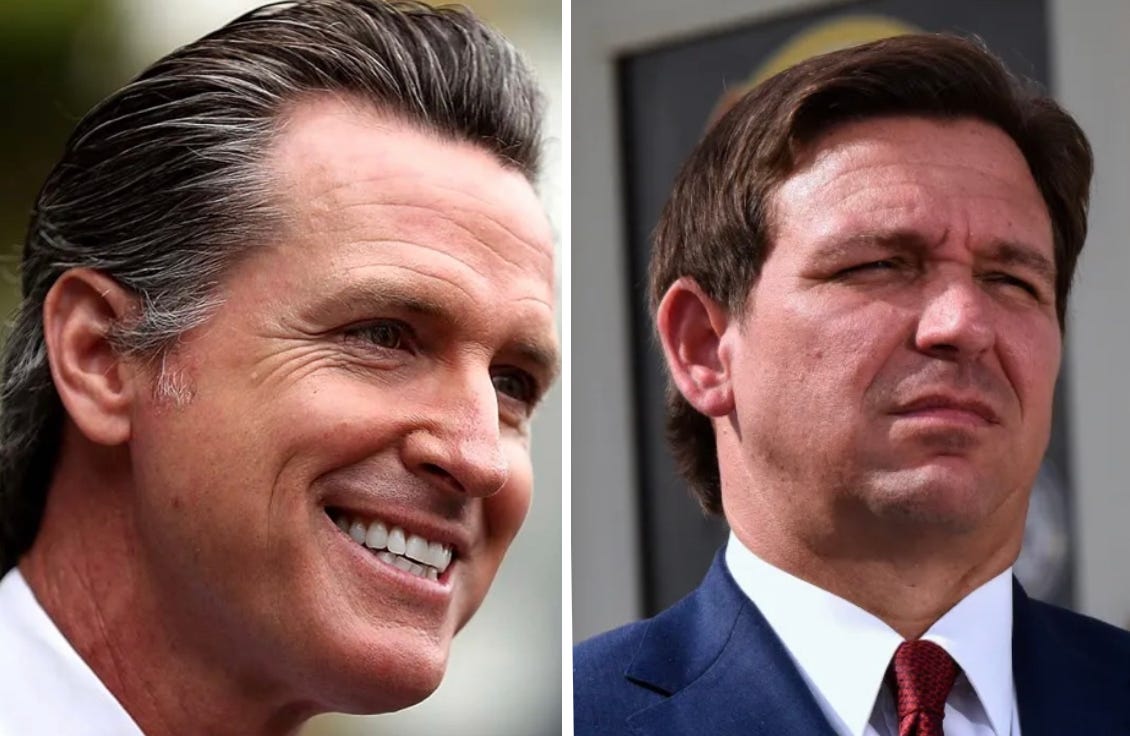
The forthcoming debate between Gavin Newsom and Ron DeSantis, hosted by Sean Hannity on Fox News, will humiliate Ron DeSantis. It will demonstrate how extreme Florida politics has become, and effectively end Ron DeSantis’s life in national politics.

Gavin Newsom, on the other hand, will emerge from the Fox lion’s den unscathed and victorious with his national stature cemented.

MAGA extremists have no idea how to handle California’s razor sharp and habitually underestimated second term governor, who is a first rate communicator, fearless on issues of liberty and freedom, and aggressive on the debate stage. Newsom will maintain an affable bearing and friendly smile, while skewing the absurdities and delusions of the Tallahassee Mussolini, who seeks the presidency of the United States to “slit throats.”

Gavin Newsom has a very different temperament and character. Here is a true story about Gavin Newsom. He gave me the best parenting advice anyone has ever given me, and I will always be grateful to him for that:

James Redford produced and directed an HBO documentary called ‘The Big Picture: Rethinking Dyslexia,’ in which Governor Newsom is featured. Newsom subsequently created a brilliant children’s book about dyslexia that has helped multitudes of American parents and kids deal with the challenges and opportunities facing dyslexic kids.

Many years ago, I found myself having a conversation with Newsom about my then five-year-old son, who had just been diagnosed as dyslexic. There was a room full of people who were eager to talk to the Lt. Governor, but he didn’t excuse himself from the conversation. He said there would definitely be obstacles to face and overcome, but that, in the end, my son would come to realize that his learning difference was  “his great gift.” Whatever anyone else may think of what he told me, I regard it as brilliant, and more importantly, true. More than that, on every occasion I have seen him since, he has asked how my son is doing.

He is a good man. He is decent, and he cares about leaving the world better off. He cares about leaving America stronger for our descendants. He understands the concepts of obligation and responsibility that defend liberty that Ron DeSantis disdains and denigrates with his actions and performative cruelties. This will all come through during the Hannity debate. Newsom’s fearlessness of the MAGA mob will give courage to decent Americans — even those who disagree with him on some issues — to take a stand against the smallness, vindictiveness, and appalling disregard for the American way of life that DeSantis demonstrates through word and deed.

The American creed and the MAGA creed are oppositional, irreconcilable and diametrically opposed. The MAGA creed is a grotesquerie that imposed a dogma of obedience and submission upon the weak-minded who believe jingoism is patriotism and progress is revanchism. The concept of individual responsibility has been replaced by a gospel of grievance and resentment. It is accompanied by a shrill chorus of victimization and whining that has abandoned grit, perseverance, duty, responsibility and self-respect in favor of their opposites.

Today, the taker reigns supreme inside of the MAGA delusion-sphere in which a vast audience of brittle sheep have been coddled in their hallucinations, as opposed to being confronted directly with reality through a medium that used to be called “The News.” The world that Gavin Newsom is entering believes the lies they have been fed. The propaganda has been ceaseless and effective. Generally speaking, there have been few antidotes offered against it, and it has spread far and wide.

The Hannity audience is as deluded as it gets. No doubt vast segments believe Portland and Seattle were destroyed as thoroughly as Hiroshima by Black Lives Matter and Antifa. They have been primed to be abused with lies, lies, lies and more lies. It is tragic, but also predictable because the lie is a feature of every autocratic system and movement there has ever been. The lie is to the tyrant what gravity is for everyone else. It anchors everything. Everything is touched by gravity, as all things are touched by the lie — until the moment the veil is pierced with the truth. In this regard, Gavin Newsom is playing the role of a Cold War president speaking directly to the Soviet people without the filter of state propagandists interfering. What Hannity’s audience will hear is a profound moral choice laid out. Gavin Newsom will be making the case for America.

A twisted theology has taken root in America over the Trump era. Its despicable apostles have become the everyday voices of extremism to which we have become desensitized, at our peril. The rhetoric of fascist Charlie Kirk calling for prison or the death penalty for President Biden isn’t just a federal crime, but an inherently political proposition. The MAGA right is now explicitly embracing the murder, assassination, mayhem, street violence, and disorder that it had previously intimated. Listen:

Revenge. Intimidation. Threats. Retribution. Death. Is this what we want? Is it possible this is what the American people will choose on the eve of the 250th anniversary of American independence? Does the coalition of the extreme and apathetic outnumber the patriotic, tolerant and decent? Is thuggery appealing? If not, why are Biden and Trump running even in the polls? Shouldn’t we the people talk about such things?

Ron DeSantis may be the worst presidential candidate of the last 50 years who has received any attention whatsoever from the national media. He is a most peculiar man — to say the least.

Rarely, if ever, is the sheltered Fox crowd exposed to the concept of complexity and pragmatism. The governor of California is afforded no such luxuries, given that he has one of America’s most complicated jobs. He will be a worthy messenger from the world where there isn’t much appetite for civil war, shooting protesters, locking up political opponents, or excusing the most reckless and depraved behavior possible as essential to protecting America.

This debate will be one worth watching. It is always worth watching when America is being defended against treachery and corruption. The argument matters. The principles matter. I can’t wait to watch.

You may regret reading this

Here’s the link to this article.

Avatar photoby ADAM LEE JUL 31, 2023

A man doubled over, holding his head in regret | You may regret reading this
Credit: Alex Green, Pexels

Overview:

The religious right’s legislative strategy of the moment is to restrict abortion and gender transition because some people might later regret them. But why don’t they apply that same logic to other major life decisions?

Reading Time: 5 MINUTES

“Abortion regret” has been a linchpin of the anti-choice strategy for decades. Before they had the power to ban abortion, conservative legislators tried to guilt and shame women out of seeking termination. They spread bogus narratives and required doctors to read scripts full of misinformation that abortion causes depression. They even floated the idea of allowing women to sue their doctors, even years later, if they changed their minds and decided getting an abortion wasn’t the right decision.

More recently, the religious right has adopted the same strategy with transgender people. Conservative pundits say that a small number of people who transition regret the choice and try to undo it. They consider this an adequate reason to ban or severely restrict surgery and hormones for everyone.

Now, it should be said: if conservatives really stand for “freedom”, then whether or not people regret these things should be irrelevant. Real freedom means having the right to make our own choices and then live with the consequences. It doesn’t mean paternalistically restricting people’s choices in the belief that we know better than they do.

However, there’s a better argument to prove that this is a bad-faith strategy. Namely, they aren’t trying to discourage people from making other decisions that millions regret, because those choices line up with the conservative vision of the world.

Let’s look at some examples:

Getting married. Although Christian conservatives treat marriage as the ideal state of human existence, actual humans seem to disagree. In 2021, the U.S. had 1,985,000 marriages and 689,000 divorces, or slightly more than one divorce for every three marriages.

Clearly, a large fraction of people regret getting married. Does that mean we should ban marriage, or make it harder for people to marry? Should we have legally required premarital counseling, or mandated waiting periods?

By Republican logic, the answer would be yes. However, conservatives aren’t pushing for this, but the opposite. The next step in their culture war is seeking to repeal no-fault divorce laws. In other words, they want to make divorce harder. Instead of making it easy for people to undo a choice that they regret, conservatives want to force them to live with it. They want to keep people stuck in marriages that they don’t want to be in.

A fact that probably has a lot to do with this is that 70% of divorces are initiated by women. The Republican opposition to abortion and LGBTQ rights are just prongs of their overarching goal, which is the restoration of patriarchy. They want to bring back a world where straight white men ruled over everyone else, and getting rid of anything that allows women to be independent brings that goal closer.

Getting a tattoo. In most states, you can get tattooed the day you turn 18. But while a tattoo is permanently etched into the skin, most of us grow, mature and change over the course of our lives. A tattoo that feels deeply meaningful to a person when they’re young may seem dated or downright embarrassing to them ten or twenty years later.

According to one survey, about one in four people with tattoos regret getting them. Should we consider outlawing or restricting tattoos to stop this regret?

Cosmetic surgery. Although conservatives are fixated on transgender people getting hormones and sex-change operations, millions of cisgender people also get surgery that alters their bodies. They get liposuction, breast implants, tummy tucks, calf implants, facelifts, chin implants, nose jobs, lip fillers, hair plugs, Botox injections, and more. We might also call these “gender-affirming” procedures, insofar as they bring people closer to what they consider the ideal appearance for their gender.

Some cosmetic surgeries are done to fix serious defects or disfiguring injuries, but others are merely for vanity. Even teenagers are getting these operations. (One hair-raising example that I’d never heard of before and that I came across while researching this article: doctors giving estrogen to girls to keep them from growing too tall.)

By some figures, the regret rate for plastic surgery is almost two-thirds. There’s no shortage of stories about celebrities who get addicted to surgery and regret the results.

If protecting kids is the goal, shouldn’t Republicans be slapping harsh restrictions on these procedures? Putting onerous regulations on plastic surgery clinics? Calling for prosecution of parents who allow their kids to get it?

Getting knee surgery. Research suggests that as many as 20% of knee-replacement patients are dissatisfied with the results. That’s a shockingly high percentage for major surgery, far higher than reported regret rates for abortion or gender transition.

As with plastic surgery, you’d think that conservatives would be against this. Should we force elderly patients to go through counseling and a waiting period? Requiring orthopedic doctors to read scripts about how these operations are dangerous and unlikely to go well?

Playing football. What parent would choose to inflict brain damage on their children? But that, like it or not, is the consequence of playing tackle football and other violent sports.

The brain is soft and squishy as a bowl of Jello. Whenever a person takes a hard hit to the head, their brain slams against the inside of their skull, bruising and tearing the delicate connections. Even hits that don’t cause concussions, when they’re repeated thousands of times, cause cumulative damage.

CTE—chronic traumatic encelopathy—is the result. The symptoms aren’t pretty: dementia, mood swings, impulsive and violent behavior, and suicidal tendencies. Athletes with CTE, and their families and loved ones, undoubtedly rue their choice to play these sports. To save people from this suffering and regret, we should give serious thought to banning football and any other sport that entails frequent blows to the head.

Buying a home. According to a 2022 survey by Zillow, 75% of recent homebuyers have regrets. Some people regret buying a house that was too expensive or needed too much maintenance, others that they didn’t look longer or search harder before buying.

What is the government doing to protect people from these regrets? Should homebuyers be able to sue sellers if they regret their decision? If this isn’t something the state should intervene in, why does it have an interest in other, equally consequential decisions?

Joining a religion. In the last few decades, there’s been a spiritual exodus in America. Millions of people are leaving the religions they grew up in. Some are switching to other faiths, while others are giving up on organized religion entirely. Of these ex-believers, many speak eloquently about the trauma they suffered from abusive, controlling, high-demand belief systems.

If you join a church and later decide it didn’t meet your needs, or even that it inflicted psychological or physical harm on you, should you be able to sue that church to compensate you for your regret? If not, why not?

Having children. In a society that holds family as a sacred ideal, it’s intensely taboo to admit this, or even to talk about it. Nevertheless, surveys consistently find that a minority of parents regret having children:

When American parents older than 45 were asked in a 2013 Gallup poll how many kids they would have if they could “do it over,” approximately 7 percent said zero. In Germany, 8 percent of mothers and fathers in a 2016 survey “fully” agreed with a statement that they wouldn’t have children if they could choose again (11 percent “rather” agreed). In a survey published in June, 8 percent of British parents said that they regret having kids. And in two recent studies, an assistant psychology professor at SWPS University, Konrad Piotrowski, placed rates of parental regret in Poland at about 11 to 14 percent, with no significant difference between men and women. Combined, these figures suggest that many millions of people regret having kids.“The Two Reasons Parents Regret Having Kids.” Gail Cornwall, The Atlantic, 31 August 2021.

Regretful parents cite all manner of concerns: from a lack of free time and money, to exhaustion and burnout, to the especially grueling challenges of raising special-needs children. Some people regret having kids with an absent or abusive partner, while others never wanted kids but had them to appease a partner who did.

Having children is the most personal decision a person can make. No other choice has such immense and intimate consequences, whether for better or for worse. That’s why it’s so abhorrent for any outside force to interfere in it, one way or the other. It shows the extreme hypocrisy of political parties that cite “regret” as a reason to ban abortion, but feel no concern about forcing people to have children whether they want to or not.

The hour of choosing has arrived

Here’s the link to this article.

STEVE SCHMIDT

AUG 6, 2023

Perhaps it is best to start by looking back at the moment immediately before Donald Trump descended via escalator in Trump Tower into the 2016 presidential race on June 16, 2015.

Two thousand nine hundred and seventy-two days have passed since then, and the end stage of a great American travesty and tragedy is at hand. What lies beyond it is unclear because behind us is a vast wreckage field where shards of shattered trust and the jagged edges of obliterated integrity lay scattered. The American people have lost faith in their society, and become estranged from the nation’s most important institutions. They disdain the media, politics, politicians, political parties, powerful tech companies, billionaires, corporations and a system where there seems to be one set of rules for people at the top, and one for everyone else.

Trump’s rise is a symptom, not the cause, of America’s current cancer. A man like Trump simply does not get elected to the presidency of a stable and healthy country. He is a marker of decay and a catalyst for it. His presidency was a vicious cycle of degradations, national humiliations, collaboration, betrayal, failure and incandescent cowardice. It has led us here — to this epic hour where the citizens of the United States must make a decision for the future that will either begin an era of renewal and reform, or one that cripples American democracy and murders the republic born in 1776. Whatever the choice may be, it will be made by this generation of Americans on the eve of America’s 250th anniversary of independence.

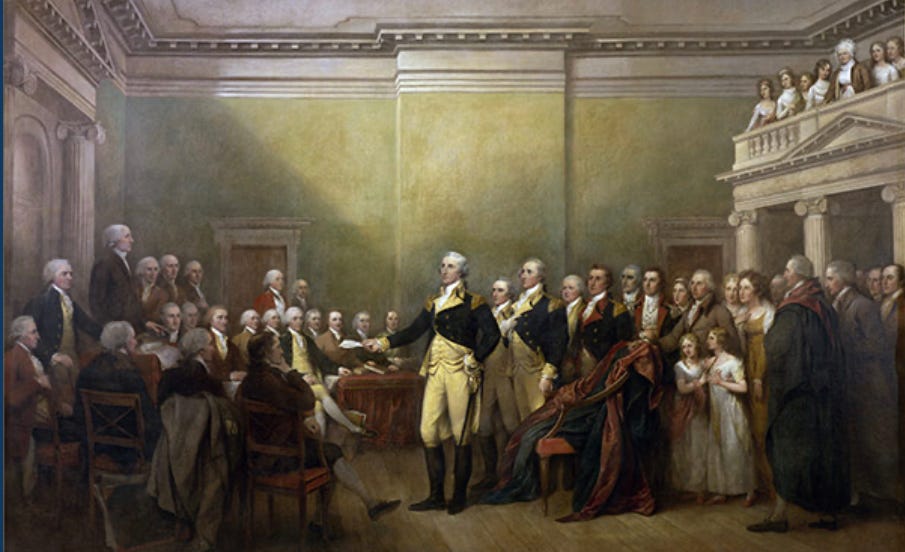
Maybe we wouldn’t have gotten here if there wasn’t so much arrogant disdain for the achievements of our ancestors and the magnificence of their most noble acts. There has never been a just or perfect era in America’s story. Instead, there has been the opportunity for progress and the expansion of justice handed to each generation of free citizens who can all claim the legacy of America’s founding. The unfolding story of American liberty is among mankind’s greatest achievements. Understanding the story and knowing the details is essential to its survival and continuation. Let us talk about George Washington. Washington is America’s most important and wisest teacher. His lessons were about humility. There is great strength through authentic humility. America should remember this:

This painting by John Trumbull of General Washington resigning his commission hangs in the rotunda of the United States Capitol. Notice the chair larger than the rest draped with a cloak. It symbolizes Washington’s act of resigning from his position of power. Turnbull considered this to be amongst the “highest moral lessons ever given to the world.”

Washington entered the chambers of the Maryland State House where the Congress of the Confederation had convened for a highly scripted ceremony that had been meticulously planned down to the last detail. The date was December 23, 1783, and Washington had come to lay down his power. He could have been Caesar. Instead, he became president six years later when his country called him to service again. Washington could have been a tyrant or a king. He chose a different path because of the magnificence of his character.

The Warning with Steve Schmidt is a reader-supported publication. To receive new posts and support my work, consider becoming a free or paid subscriber.

Upgrade to paid

The great tragedy of this moment is that Trump’s delusions simply needed to be repudiated with the truth. Yet there was none to be found on a vast desert of MAGA cowardice, where the essence of the American system was left undefended lest it piss Trump off. The fear of mean tweets is all it took to undo the act of humility that made the nation spring to life.

When Trump sent his mob to reverse Washington’s submission to Congress and make him dictator, they paraded past the old painting of George Washington. The criminals who attacked on Trump’s orders smeared excrement on the walls of the Capitol and urinated on the floors of the US Senate and House. They desecrated America’s capitol and founding with treachery and venom. It was a despicable act, and it was created by Trump. It was his moment. His actions were a declaration of repudiation against what Washington fought to create. Shameful doesn’t begin to describe it.

We the people must not tolerate it any longer. It is time to move on to a new era and leave Donald Trump behind. There is no way to support Trump and maintain loyalty to America. They are antithetical propositions and the hour of choosing has arrived. Soon we will know.

Our Fragile Freedom

Here’s the link to this article.

DAN RATHER AND ELLIOT KIRSCHNER
AUG 3
(Photo by Drew Angerer)

In an era of unprecedented upheaval, it is difficult to find suitable context and perspective for the latest indictment of Donald Trump. 

After all, this isn’t the first indictment he has faced, or even the first in federal court. It isn’t the first time we have had to grapple with his moral failings, the unleashing of political violence, or the degradation of our constitutional order. 

Much of what is in the document made public on Tuesday we knew before. We saw it unfold on TV. We read the reporting of its aftermath. We heard the gripping public testimony in front of the bipartisan House Select Committee that investigated the insurrection of January 6. 

It wasn’t even that the indictment was a surprise. For a long time, the investigation has been in the public consciousness. After Trump announced that he had been told he was a target, it was mostly a matter of when, not if

It is important to keep in mind that this latest indictment does not charge Trump with arguably the gravest potential crimes, like insurrection or sedition, even though many who watched in horror the events leading up to and cresting on January 6 think it obvious he is guilty of both. 

Randall Eliason, a former chief of the fraud and public corruption section at the U.S. Attorney’s Office for the District of Columbia, argued in a New York Times opinion piece titled “What Makes Jack Smith’s New Trump Indictment So Smart” that the special counsel wisely chose to limit the scope of the case (and the number of defendants) to just Trump despite the six other unnamed but easily identifiable co-conspirators. Smith did this, the piece points out, in order to proceed quickly to trial and yield the best chance at conviction. “Although it might have been psychologically gratifying to see Mr. Trump charged with sedition, the name of the legal charge is less important than the facts that will make up the government’s case,” Eliason wrote. 

In other words, Smith decided not to try to prove too much; keep the charges few and based on what facts he believes are most likely to convince a jury — and whatever part of the public may be open to persuasion. 

Let us stop for a moment to ponder these facts and the narrative they tell. They are chilling, but we must remember the Department of Justice will have to prove them in a court of law. Trump is presumed not guilty until and unless he is proven otherwise. He has every right to mount a vigorous defense. It’s probably best for the country that his lawyers fight hard and smart. The more thoroughly this case is adjudicated, the more its conclusion is likely to be strengthened by the process. 

But in reading the indictment, all who love and care for our precious republic and its democratic traditions should feel a deep shudder of fear that we were driven to such a precipice. The writing itself is not fancy — no stacking of dependent clauses or diving into a thesaurus in search of adjectives. Reading the introduction aloud, it almost has the syncopation of a children’s picture book, even if the story it tells is one of horror: 

The Defendant, DONALD J. TRUMP, was the forty-fifth President of the United States and a candidate for re-election in 2020. 

The Defendant lost the 2020 presidential election.

Despite having lost, the Defendant was determined to remain in power. 

So for more than two months following election day on November 3, 2020, the Defendant spread lies that there had been outcome-determinative fraud in the election and that he had actually won. 

These claims were false, and the Defendant knew that they were false.

But the Defendant repeated and widely disseminated them anyway — to make his knowingly false claims appear legitimate, create an intense national atmosphere of mistrust and anger, and erode public faith in the administration of the election.

The Defendant had a right, like every American, to speak publicly about the election and even to claim, falsely, that there had been outcome-determinative fraud during the election and that he had won. 

He was also entitled to formally challenge the results of the election through lawful and appropriate means, such as by seeking recounts or audits of the popular vote in states or filing lawsuits challenging ballots and procedures. 

Indeed, in many cases, the Defendant did pursue these methods of contesting the election results. 

His efforts to change the outcome in any state through recounts, audits, or legal challenges were uniformly unsuccessful. 

Shortly after election day, the Defendant also pursued unlawful means of discounting legitimate votes and subverting the election result.

What follows that in the indictment is a story we all saw unfold in real time, laid bare in a double-spaced legal document. There is also a lot to read between the lines. Even former Trump Attorney General Bill Barr, who enabled many of Trump’s worst instincts and misled the American public about Trump’s fitness for office, told CNN he thinks prosecutors have more evidence than what they have shared thus far. He called the indictment “very spare” and added, “I think there’s a lot more to come and I think they have a lot more evidence as to President Trump’s state of mind.” 

Be that as it may, these 45 pages comprise one of the most consequential pieces of writing in American history. It does not have the earth-shattering rhetoric of our Declaration of Independence, the poetry of Lincoln’s “Gettysburg Address” or the urgent morality of Dr. Martin Luther King’s “Letter from Birmingham Jail.” But it is a clear statement at one of the most pivotal intersections in our nation’s narrative; that autocracy and the fomenting of political violence to subvert the peaceful transfer of presidential power is not only anathema to our values — it is illegal. 

History is riddled with “what ifs.” We are left to ponder what the worst outcomes might have been if things had turned out differently, from our own revolution, to World War II, to the Cuban Missile Crisis. January 6 should be added to that list. 

As bad as it was, it could have been (and came close to being) much worse. And that reality bursts forth from this indictment. According to what is written in the indictment, violence was expected by Trump and his co-conspirators. They understood that their schemes to steal an election would almost certainly plunge the nation into chaos. That was the plan. 

In the end, their plot was unsuccessful, but the danger has not receded. Trump is running for president. At this point he is the favorite, by far, to win the Republican nomination. And that means he could win reelection. That result would likely usher in chaos, greater and deeper division than even what we now have. It could very well end the country as we know it. 

That may sound to some to be hyperbole, but by any reasonable analysis, that is a lesson to be learned from this indictment. And that is what Jack Smith hopes to prove in federal court. One can make a credible argument that this is one of (if not THE) most consequential criminal cases in American history. 

A former and potentially future president is accused of trying to destroy the United States. His own vice president is a key witness. You couldn’t make this up. But this is the reality of what we face. Democracy is always fragile and must be fought for to survive. A free people must constantly be on alert and working to preserve their liberty.

At the birth of our nation, Benjamin Franklin is said to have quipped that the Framers had produced “a republic, if you can keep it.” Lincoln, in his Gettysburg Address, spoke of how the Civil War was a “test” of whether a nation “conceived in Liberty, and dedicated to the proposition that all men are created equal … can long endure.” We, the people, can take nothing for granted.

This concept of the United States of America, still relatively new in human history, is impossible to maintain without the continual peaceful transfer of power at the top. That is what this new indictment is about. 

In his first inaugural address as governor of California in 1967, Ronald Reagan spoke eloquently of this truth: 

“We are participating in the orderly transfer of administrative authority by direction of the people. And this is the simple magic of the commonplace routine, which makes it a near miracle to many of the world’s inhabitants. This continuing fact that the people, by democratic process, can delegate power, and yet retain the custody of it. Perhaps you and I have lived too long with this miracle to properly be appreciative. Freedom is a fragile thing and it’s never more than one generation away from extinction. It is not ours by way of inheritance; it must be fought for and defended constantly by each generation.”

This is what is at stake for the generations alive today. It is an epic battle that will now take place in federal court as well as at the ballot box. 

Note from Joyce: Alabama’s Attorney General Wants to Control Your Access to Reproductive Medical Care

Here’s the link to this article.

By JOYCE VANCE

 LISTEN

Featured Image
  • Show Notes

Dear Reader,

On Monday, the ACLU sued Alabama Attorney General Steve Marshall on behalf of the West Alabama Women’s Center and the Alabama Women’s Center, both providers of women’s medical care and support. They sued because Alabama is trying to extend its state abortion ban beyond its borders by making it illegal for people to help Alabamians access abortion in states where it remains legal.

You’ll recall the underlying premise of the Supreme Court’s decision in Dobbs, when it upset 50 years of abortion rights. The Court said the decision about whether – and to what extent – abortion should be legal would be left up to each state. Post-Dobbs, some states have continued to permit women to make their own medical decisions, while others have imposed bans, some near-total. But even a near-total ban is not enough for Alabama, where the Attorney General has announced his intention of trotting out a never-used 1896 conspiracy provision to criminally prosecute those who assist individuals who want to travel across states lines – something we are all free, as Americans, to do – in order to obtain legal abortion care outside of Alabama. 

This is the next frontier in expanding newly-permissible state bans on abortion care. The courts will have to decide whether the Supreme Court meant it when it said abortion was an issue for each state to decide for its residents. Because now that conservative states have expanded abortion bans as far as they can within their borders, the push to extend them beyond their borders is on, in lieu of a highly unpopular national ban. This is the next fight. 

Alabama Attorney General Marshall threatened to prosecute people who help Alabamians travel out of state to obtain abortions where they are legal. Attorneys general in red states like Idaho, where there is litigation pending as well, and Alaska, have said they will seek criminal penalties against those who help pregnant people obtain out-of-state abortions. 

Strangely, Marshall has conceded that “There’s nothing about [Alabama] law that restricts any individual from driving across state lines and seeking an abortion in another place.” And yet, he publicly made the threats to prosecute those who do and who help others to do so. That’s the heart of the concern here: making the threat chills people’s exercise of their constitutional rights. Fear about the threat of prosecution accomplishes what the state knows it cannot do constitutionally: prosecuting people for leaving or helping someone leave the state to visit another state and do something there that is entirely legal.

The Plaintiffs, who currently provide non-abortion reproductive health care to pregnant patients in Alabama, are afraid that if they provide information, counseling, or other forms of practical support to assist pregnant people who may end up going out of state to obtain care, they’ll be prosecuted as conspirators or accessories. To avoid the chill on exercise of rights to which all of this uncertainty leads, they ask the courts to clarify that Alabama cannot prosecute them for assisting Alabamians who want to travel across state lines and access legal abortion care.

Meagan Burrows, an ACLU attorney representing the plaintiffs, characterized the lawsuit this way: “Because Alabama cannot constitutionally ban abortion in states that have chosen to keep abortion legal, the Attorney General is instead trying to have the same effect by criminalizing the provision of information and assistance to Alabamians seeking to exercise their constitutional right to cross state lines for lawful abortion care. But this too is blatantly unconstitutional. We’re hopeful that the Court sees through this attempted end-run around the constitutional limits on Alabama’s power.”  

One important question is whether the plaintiffs have standing to bring the case. No one has been prosecuted yet, and as students of the last Supreme Court term know, plaintiffs must have standing to sue, which means there must be an actual case or controversy for the court to resolve. While standing may not be apparent here, there is actually a strong argument the court should hear this case now. This is a classic pre-enforcement challenge, allowing the plaintiffs to challenge Alabama before it takes any enforcement action to avoid scaring people out of exercising their constitutional rights. Situations like this are why pre-enforcement of the law challenges exist.

Many of the people who need access to abortion services are low-income Alabamians who lack the resources to negotiate the patchwork quilt of abortion laws that blanket the country. They need to be able to get advice they can trust from their doctors. Depriving them of that kind of assistance realistically ends their right to travel to another state. This kind of interstate travel advice doesn’t seem to be a problem when people can take advantage of marijuana tourism. Abortion is not different. Medical professionals have a First Amendment right to provide advice, and pregnant people have a right to take advantage of it and to travel if they choose to. 

In his Dobbs concurrence, Supreme Court Justice Brett Kavanaugh acknowledged the right Americans have to travel between states in this context. “For example,” he said, “may a State bar a resident of that State from traveling to another State to obtain an abortion? In my view, the answer is no, based on the constitutional right to interstate travel.” Alabama’s Attorney General, while paying lip service to that legal principle in one breath, seemed determined to roll it back in the next. He has said that he intends to enforce Alabama’s abortion ban to its fullest extent, which means not just in-state, but out of state, too. The plaintiffs in the newly-filed case are taking him at his word – which leaves them unable to “provide specific information, counseling, and other forms of practical support to assist individuals who are seeking to exercise their constitutional right to cross state lines and obtain legal medical care outside of Alabama” – and we should too, unless and until a court says otherwise. 

The impact of Attorney General Marshall’s actions and the outcome of this lawsuit will have a ripple effect far beyond the borders of Alabama. This case may shape the contours of Americans’ rights across the country. A decision that Alabama’s Attorney General can sacrifice Alabamians’ rights on the altar of his political views will mean the same for people throughout the United States. It’s essential that the courts protect people’s rights in the face of the intransigence of states like Alabama that want to impose their own views on others.

Stay Informed,

Joyce

Whitmire: Tommy Tuberville leaves Alabama lost in space

Here’s the link to this article.

  • Published: Aug. 01, 2023, 2:46 p.m.
Tommy Tuberville
FILE – Sen. Tommy Tuberville, R-Ala., a member of the Senate Armed Services Committee, talks to reporters at the Capitol in Washington, May 16, 2023. (AP Photo/J. Scott Applewhite, File)AP

By 

Sign up for Alabamafication: Kyle Whitmire’s newsletter, “Alabamafication” examines the outsized influence of this very strange state, taking aim at corruption, cruelty, incompetence and hypocrisy while also seeking out those righteous folks making their state and country better places for all.

This is an opinion column.

Don’t blame Tommy Tuberville for losing Space Command.

Blame Kay Ivey.

As Alabama governor, she is supposed to be our state’s first, best champion.

Don’t blame Tommy Tuberville for losing Space Command.

Blame Tommy Battle.

As Huntsville mayor, he is supposed to look out for the interests of his city.

Don’t blame Tommy Tuberville for losing Space Command.

Blame Katie Britt.

Coach isn’t Alabama’s only U.S. senator.

Tuberville’s manipulation of Senate rules to stonewall military promotions isn’t a novel, genius political tactic. He’s a toddler who found a pistol on the nightstand. And when the gun goes off, and somebody gets hurt, it’s not the kid that’s to blame. It’s the grownups who didn’t do anything to stop it from happening in the first place.

Alabama is short of responsible grownups willing to stop Tuberville, so now it’s time to hold some of these grownups responsible.

Want to know who they are? Look around at who’s trying to blame somebody else.

Ivey, Britt and every member of our Congressional delegation — including the lone Democrat, Terri Sewell — shook their fingers and clucked their tongues at the president.

Fine. But what else did they expect? Of course, President Biden had every incentive to put Space Command in Colorado. As Birmingham Mayor Richard Arrington once said after he was accused of giving business to his friends, “Who am I supposed to give it to? My enemies?”

The time for sanctimony has passed. Bluster and bravado are worthless.

“This fight is far from over,” U.S. Rep. Mike Rogers, R-Saks, tweeted.

Ahem. It’s over.

What’s remarkable about Biden’s decision is how long it took. He could have flipped this switch the moment Donald Trump copped to rigging the game for Alabama on the Rick & Bubba Show. Trump’s dumb comments — which were probably another lie — gave Biden cover to do for Colorado what Trump claimed to have done for Alabama.

What Biden needed was a veneer of plausibility. He needed a general to say this was the right thing to do.

And what Alabama needed was military brass to say, “No, Mr. President, Colorado is not the best place for this. We did a study and …”

But who’s going to do that when Alabama’s senior senator is being a jerk to the very folks Alabama needed on our side?

In the end, the Associated Press reported, it was General James Dickinson, the head of Space Command, who persuaded the president that Colorado was the best choice.

In politics, sometimes you have to make enemies, but you always have to make friends. Tuberville doesn’t get that. And a man who’s lost his shirt in two ponzi schemes isn’t likely to learn from his mistakes.

If your senior senator can’t do that, then someone needs to tell the senator to sit down and shut up. Someone needed to put Tuberville in a corner.

Alabama’s top public officials weren’t willing to do that. Officials who knew better whispered to each other and looked nervously around the room waiting for somebody else to do something.

Meanwhile, the political delinquent acted out as he pleased.

Republicans don’t like calling out Republicans — not for Ronald Reagan’s Eleventh Commandment, or whatever. Rather, an iota of dissent could get you labeled a liberal Democrat, if not a groomer. They’re terrified they’ll get booed, like those Republican primary candidates who bring up Trump’s indictment.

If Alabama were a two-party state that would be fine. Democrats would savage Republicans for their failure and balance would be restored. There would be billboards at the gates of every Alabama military base saying “We wouldn’t hurt you like this.”

But not here. Alabama Democrats can’t run a Twitter account, much less an effective messaging strategy. They’re too busy fighting with each other to keep Republicans honest.

And what’s the result? Well, that might be the saddest thing of all.

Hidden in plain view is a clear indicator of how leaderless and desperate Alabama has become.

After decades of bribing auto manufacturers with tax breaks and cheap labor (some of it children), what do we have left when it comes to economic recruitment?

Our strategy for economic growth was having the president of the United States order people to move to Alabama, no matter if they wanted to or not.

Get much more desperate than that and you’ll trigger an Amber alert.

Alabama has to attract business and development by making itself attractive. We need elected leaders with vision, smarts and guts.

The folks we have now don’t have any of those qualities. I’m not sure they’re really in control and they certainly aren’t looking out for us. They’re just here for the ego fulfillment — not so much different than Tuberville.

Ultimately, blame doesn’t stop at these officials. If our Republican officials won’t hold Tuberville accountable, and if Democrats can’t hold Republicans accountable, then we, the voters, have to be the grownups. We have to make better choices.

We elected a day-trading, Florida-living, mediocre football coach to the U.S. Senate.

The blame lands where the responsibility always was.

We put the toddler in the room with the loose gun, and now we caught a bullet in the groin.

This one’s on us.

Kyle Whitmire is the state political columnist for AL.com and the 2023 recipient of the Pulitzer Prize for commentary. Sign up for his weekly newsletter and get “Alabamafication” in your inbox every Wednesday.