The Mirror of Enigmas: Chance, the Universe, and the Fragile Loveliness of Knowing Who We Are

Here’s the link to this article.

“There is no human being on earth capable of declaring with certitude who he is.”

BY MARIA POPOVA

The Mirror of Enigmas: Chance, the Universe, and the Fragile Loveliness of Knowing Who We Are

It takes a great sobriety of spirit to know your own depths — and your limits. It takes a special grandeur of spirit to know the limits of your self-knowledge.

A recent brush with those limits reminded me of a short, stunning essay by Jorge Luis Borges (August 24, 1899–June 14, 1986) titled “The Mirror of Enigmas,” found in his Labyrinths (public library) — the 1962 collection of stories, essays, and parables that gave us his timeless parable of the divided self and his classic refutation of time.

Titling the essay after St. Paul’s famous cryptic statement Videmus nunc per speculum in aenigmate — loosely translated as We now see through a mirror, enigmatically — Borges considers the tribe of thinkers who have perched their efforts to reconcile knowledge and mystery, the scientific and the spiritual, on the assumption that “the history of the universe — and in it our lives and the most tenuous detail of our lives — has an incalculable, symbolical value.” With his characteristic poetic precision, he condenses this common and somewhat tired hypothesis:

The outer world — forms, temperatures, the moon — is a language humans have forgotten or which we can scarcely distinguish.

No one, Borges argues, has taken this precarious hypothesis to more surefooted ground than the French novelist, poet, and philosophical pamphleteer Léon Bloy (July 11, 1846–November 3, 1917).

Digging through the surviving fragments of Bloy’s written thought, he surfaces a passage emblematic of Bloy’s uncommon physics of the metaphysical — an 1894 passage fomented by his interest in the teachings of St. Paul. Translated by Borges himself, Bloy writes:

[St. Paul’s statement] would be a skylight through which one might submerge himself in the true Abyss, which is the soul of man. The terrifying immensity of the firmament’s abyss is an illusion, an external reflection of our own abysses, perceived “in a mirror.” We should invert our eyes and practice a sublime astronomy in the infinitude of our heart… If we see the Milky Way, it is because it actually exists in our souls.

Art from Thomas Wright’s An Original Theory or New Hypothesis of the Universe, 1750 — the first book to describe the spiral shape of the Milky Way. (Available as a print and as a face mask.)

A century before Milan Kundera considered the eternal challenge of knowing what we really want in his classic novel The Unbearable Lightness of Being, Bloy shines a sidewise gleam on the elemental self-opacity with and within which we live:

Everything is a symbol, even the most piercing pain. We are dreamers who shout in our sleep. We do not know whether the things afflicting us are the secret beginning of our ulterior happiness or not.

These ideas haunted Bloy, animated his pamphlets, his poems, his novels, then culminated in his 1912 book-length essay The Soul of Napoleon — a philosophical prose poem that sets out, as Borges puts it, “to decipher the symbol Napoleon, considered as the precursor of another hero — man and symbol as well — who is hidden in the future.” Bloy, translated again by Borges, writes in this uncommon work:

Every man* is on earth to symbolize something he is ignorant of and to realize a particle or a mountain of the invisible materials that will serve to build the City of God.

[…]

There is no human being on earth capable of declaring with certitude who he is. No one knows what he has come into this world to do, what his acts correspond to, his sentiments, his ideas, or what his real name is, his enduring Name in the register of Light… History is an immense liturgical text where the iotas and the dots are worth no less than the entire verses or chapters, but the importance of one and the other is indeterminable and profoundly hidden.

But as you contemplate these existential immensities, you face the limits of contemplation — the limits of meaning-making in relation to elemental truth.

Borges recognized this, closing the essay with by acknowledging “it is doubtful that the world has a meaning… even more doubtful that it has a double or triple meaning.”

I recognized this upon sitting down in for morning meditation in my garden after a nightlong storm and watching an almost otherworldly deposit roll onto the cushion: a tiny, perfect robin egg, improbable and sorrowful in its displaced blue beauty.

Singing Only Is by Maria Popova. (Available as a print.)

I considered climbing the neighbor’s colossal tree to find the storm-shaken nest and reinstate the egg. (Perfectly, the tree is an Ailanthus altissima, known as “tree-of-heaven” in its native China — a migrant now rooted in Brooklyn, like me.)

But then I considered this chance-event as the product of the same impartial forces that deposited the exact spermatozoid of my father’s onto my mother’s ovum at the exact moment to produce the chance-event of my particular configuration of atoms animated by this particular consciousness that just is, the consciousness mourning the robin that will never be. To call one expression of chance good and another bad is mere human hubris — the hubris of narrative and interpretation superimposed on an impartial universe devoid of why, awash in is.

No one knows the meaning of why anything comes to be, or doesn’t. Here is this pale blue orb, dropped from the tree-of-heaven onto a tiny Brooklyn point on the face of this Pale Blue Dot, itself a “mote of dust suspended in a sunbeam” within an immense and impartial universe, conceived in the creation myths and early scientific theories of our meaning-hungry ancestors as a great cosmic egg.

Art from An Original Theory or New Hypothesis of the Universe, 1750, illustrating Thomas Wright’s model of the cosmos as an egg-like structure of nested infinities. (Available as a print and as a face mask.)

Here I am, and here you are, and here is the robin’s egg in its near-life collision with chance. To ask for its meaning is as meaningless a question as to demand the meaning of a color or the meaning of a bird. On this particular day, at this particular moment — the only locus of aliveness we ever have — the contour of meaning comes in shades of blue, singing only is.

Yes to Life, in Spite of Everything: Viktor Frankl’s Lost Lectures on Moving Beyond Optimism and Pessimism to Find the Deepest Source of Meaning

Here’s the link to this article.

“Everything depends on the individual human being, regardless of how small a number of like-minded people there is… on each person… creatively making the meaning of life a reality in his or her own being.”

BY MARIA POPOVA

Yes to Life, in Spite of Everything: Viktor Frankl’s Lost Lectures on Moving Beyond Optimism and Pessimism to Find the Deepest Source of Meaning

“To decide whether life is worth living is to answer the fundamental question of philosophy,” Albert Camus wrote in his classic 119-page essay The Myth of Sisyphus in 1942. “Everything else… is child’s play; we must first of all answer the question.”

Sometimes, life asks this question not as a thought experiment but as a gauntlet hurled with the raw brutality of living.

That selfsame year, the young Viennese neurologist and psychiatrist Viktor Frankl (March 26, 1905–September 2, 1997) was taken to Auschwitz along with more than a million human beings robbed of the basic right to answer this question for themselves, instead deemed unworthy of living. Some survived by reading. Some through humor. Some by pure chance. Most did not. Frankl lost his mother, his father, and his brother to the mass murder in the concentration camps. His own life was spared by the tightly braided lifeline of chance, choice, and character.

Viktor Frankl

A mere eleven months after surviving the unsurvivable, Frankl took up the elemental question at the heart of Camus’s philosophical parable in a set of lectures, which he himself edited into a slim, potent book published in Germany in 1946, just as he was completing Man’s Search for Meaning.

As our collective memory always tends toward amnesia and erasure — especially of periods scarred by civilizational shame — these existential infusions of sanity and lucid buoyancy fell out of print and were soon forgotten. Eventually rediscovered — as is also the tendency of our collective memory when the present fails us and we must lean for succor on the life-tested wisdom of the past — they are now published in English for the first time as Yes to Life: In Spite of Everything (public library).

Frankl begins by considering the question of whether life is worth living through the central fact of human dignity. Noting how gravely the Holocaust disillusioned humanity with itself, he cautions against the defeatist “end-of-the-world” mindset with which many responded to this disillusionment, but cautions equally against the “blithe optimism” of previous, more naïve eras that had not yet faced this gruesome civilizational mirror reflecting what human beings are capable of doing to one another. Both dispositions, he argues, stem from nihilism. In consonance with his colleague and contemporary Erich Fromm’s insistence that we can only transcend the shared laziness of optimism and pessimism through rational faith in the human spirit, Frankl writes:

We cannot move toward any spiritual reconstruction with a sense of fatalism such as this.

Liminal Worlds by Maria Popova. (Available as a print.)

Generations and myriad cultural upheavals before Zadie Smith observed that “progress is never permanent, will always be threatened, must be redoubled, restated and reimagined if it is to survive,” Frankl considers what “progress” even means, emphasizing the centrality of our individual choices in its constant revision:

Today every impulse for action is generated by the knowledge that there is no form of progress on which we can trustingly rely. If today we cannot sit idly by, it is precisely because each and every one of us determines what and how far something “progresses.” In this, we are aware that inner progress is only actually possible for each individual, while mass progress at most consists of technical progress, which only impresses us because we live in a technical age.

Insisting that it takes a measure of moral strength not to succumb to nihilism, be it that of the pessimist or of the optimist, he exclaims:

Give me a sober activism anytime, rather than that rose-tinted fatalism!

How steadfast would a person’s belief in the meaningfulness of life have to be, so as not to be shattered by such skepticism. How unconditionally do we have to believe in the meaning and value of human existence, if this belief is able to take up and bear this skepticism and pessimism?

[…]

Through this nihilism, through the pessimism and skepticism, through the soberness of a “new objectivity” that is no longer that “new” but has grown old, we must strive toward a new humanity.

Sophie Scholl, upon whom chance did not smile as favorably as it did upon Frankl, affirmed this notion with her insistence that living with integrity and belief in human goodness is the wellspring of courage as she courageously faced her own untimely death in the hands of the Nazis. But while the Holocaust indisputably disenchanted humanity, Frankl argues, it also indisputably demonstrated “that what is human is still valid… that it is all a question of the individual human being.” Looking back on the brutality of the camps, he reflects:

What remained was the individual person, the human being — and nothing else. Everything had fallen away from him during those years: money, power, fame; nothing was certain for him anymore: not life, not health, not happiness; all had been called into question for him: vanity, ambition, relationships. Everything was reduced to bare existence. Burnt through with pain, everything that was not essential was melted down — the human being reduced to what he was in the last analysis: either a member of the masses, therefore no one real, so really no one — the anonymous one, a nameless thing (!), that “he” had now become, just a prisoner number; or else he melted right down to his essential self.

Illustration by Margaret C. Cook for a rare 1913 edition of Leaves of Grass. (Available as a print.)

In a sentiment that bellows from the hallways of history into the great vaulted temple of timeless truth, he adds:

Everything depends on the individual human being, regardless of how small a number of like-minded people there is, and everything depends on each person, through action and not mere words, creatively making the meaning of life a reality in his or her own being.

Frankl then turns to the question of finding a sense of meaning when the world gives us ample reasons to view life as meaningless — the question of “continuing to live despite persistent world-weariness.” Writing in the post-war pre-dawn of the golden age of consumerism, which has built a global economy by continually robbing us of the sense of meaning and selling it back to us at the price of the product, Frankl first dismantles the notion that meaning is to be found in the pursuit and acquisition of various pleasures:

Let us imagine a man who has been sentenced to death and, a few hours before his execution, has been told he is free to decide on the menu for his last meal. The guard comes into his cell and asks him what he wants to eat, offers him all kinds of delicacies; but the man rejects all his suggestions. He thinks to himself that it is quite irrelevant whether he stuffs good food into the stomach of his organism or not, as in a few hours it will be a corpse. And even the feelings of pleasure that could still be felt in the organism’s cerebral ganglia seem pointless in view of the fact that in two hours they will be destroyed forever. But the whole of life stands in the face of death, and if this man had been right, then our whole lives would also be meaningless, were we only to strive for pleasure and nothing else — preferably the most pleasure and the highest degree of pleasure possible. Pleasure in itself cannot give our existence meaning; thus the lack of pleasure cannot take away meaning from life, which now seems obvious to us.

He quotes a short verse by the great Indian poet and philosopher Rabindranath Tagore — the first non-European to win the Nobel Prize, Einstein’s onetime conversation partner in contemplating science and spirituality, and a man who thought deeply about human nature:

I slept and dreamt
that life was joy.
I awoke and saw
that life was duty.
I worked — and behold,
duty was joy.

In consonance with Camus’s view of happiness as a moral obligation — an outcome to be attained not through direct pursuit but as a byproduct of living with authenticity and integrity — Frankl reflects on Tagore’s poetic point:

So, life is somehow duty, a single, huge obligation. And there is certainly joy in life too, but it cannot be pursued, cannot be “willed into being” as joy; rather, it must arise spontaneously, and in fact, it does arise spontaneously, just as an outcome may arise: Happiness should not, must not, and can never be a goal, but only an outcome; the outcome of the fulfillment of that which in Tagore’s poem is called duty… All human striving for happiness, in this sense, is doomed to failure as luck can only fall into one’s lap but can never be hunted down.

In a sentiment James Baldwin would echo two decades later in his superb forgotten essay on the antidote to the hour of despair and life as a moral obligation to the universe, Frankl turns the question unto itself:

At this point it would be helpful [to perform] a conceptual turn through 180 degrees, after which the question can no longer be “What can I expect from life?” but can now only be “What does life expect of me?” What task in life is waiting for me?

Now we also understand how, in the final analysis, the question of the meaning of life is not asked in the right way, if asked in the way it is generally asked: it is not we who are permitted to ask about the meaning of life — it is life that asks the questions, directs questions at us… We are the ones who must answer, must give answers to the constant, hourly question of life, to the essential “life questions.” Living itself means nothing other than being questioned; our whole act of being is nothing more than responding to — of being responsible toward — life. With this mental standpoint nothing can scare us anymore, no future, no apparent lack of a future. Because now the present is everything as it holds the eternally new question of life for us.

Another of Margaret C. Cook’s illustrations for the 1913 English edition of Leaves of Grass. (Available as a print.)

Frankl adds a caveat of tremendous importance — triply so in our present culture of self-appointed gurus, self-help demagogues, and endless podcast feeds of interviews with accomplished individuals attempting to distill a universal recipe for self-actualization:

The question life asks us, and in answering which we can realize the meaning of the present moment, does not only change from hour to hour but also changes from person to person: the question is entirely different in each moment for every individual.

We can, therefore, see how the question as to the meaning of life is posed too simply, unless it is posed with complete specificity, in the concreteness of the here and now. To ask about “the meaning of life” in this way seems just as naive to us as the question of a reporter interviewing a world chess champion and asking, “And now, Master, please tell me: which chess move do you think is the best?” Is there a move, a particular move, that could be good, or even the best, beyond a very specific, concrete game situation, a specific configuration of the pieces?

What emerges from Frankl’s inversion of the question is the sense that, just as learning to die is learning to meet the universe on its own terms, learning to live is learning to meet the universe on its own terms — terms that change daily, hourly, by the moment:

One way or another, there can only be one alternative at a time to give meaning to life, meaning to the moment — so at any time we only need to make one decision about how we must answer, but, each time, a very specific question is being asked of us by life. From all this follows that life always offers us a possibility for the fulfillment of meaning, therefore there is always the option that it has a meaning. One could also say that our human existence can be made meaningful “to the very last breath”; as long as we have breath, as long as we are still conscious, we are each responsible for answering life’s questions.

Art from Margaret C. Cook’s 1913 English edition of Leaves of Grass. (Available as a print.)

With this symphonic prelude, Frankl arrives at the essence of what he discovered about the meaning of life in his confrontation with death — a central fact of being at which a great many of humanity’s deepest seers have arrived via one path or another: from Rilke, who so passionately insisted that “death is our friend precisely because it brings us into absolute and passionate presence with all that is here, that is natural, that is love,” to physicist Brian Greene, who so poetically nested our search for meaning into our mortality into the most elemental fact of the universe. Frankl writes:

The fact, and only the fact, that we are mortal, that our lives are finite, that our time is restricted and our possibilities are limited, this fact is what makes it meaningful to do something, to exploit a possibility and make it become a reality, to fulfill it, to use our time and occupy it. Death gives us a compulsion to do so. Therefore, death forms the background against which our act of being becomes a responsibility.

[…]

Death is a meaningful part of life, just like human suffering. Both do not rob the existence of human beings of meaning but make it meaningful in the first place. Thus, it is precisely the uniqueness of our existence in the world, the irretrievability of our lifetime, the irrevocability of everything with which we fill it — or leave unfulfilled — that gives our existence significance. But it is not only the uniqueness of an individual life as a whole that gives it importance, it is also the uniqueness of every day, every hour, every moment that represents something that loads our existence with the weight of a terrible and yet so beautiful responsibility! Any hour whose demands we do not fulfill, or fulfill halfheartedly, this hour is forfeited, forfeited “for all eternity.” Conversely, what we achieve by seizing the moment is, once and for all, rescued into reality, into a reality in which it is only apparently “canceled out” by becoming the past. In truth, it has actually been preserved, in the sense of being kept safe. Having been is in this sense perhaps even the safest form of being. The “being,” the reality that we have rescued into the past in this way, can no longer be harmed by transitoriness.

In the remainder of the slender and splendid Yes to Life, Frankl goes on to explore how the imperfections of human nature add to, rather than subtract from, the meaningfulness of our lives and what it means for us to be responsible for our own existence. Complement it with Mary Shelley, writing two centuries ago about a pandemic-savaged world, on what makes life worth living, Walt Whitman contemplating this question after surviving a paralytic stroke, and a vitalizing cosmic antidote to the fear of death from astrophysicist and poet Rebecca Elson, then revisit Frankl on humor as lifeline to sanity and survival.

Enchantment and the Courage of Joy: René Magritte on the Antidote to the Banality of Pessimism

Here’s the link to this article.

“Life is wasted when we make it more terrifying, precisely because it is so easy to do so.”

BY MARIA POPOVA

Enchantment and the Courage of Joy: René Magritte on the Antidote to the Banality of Pessimism

In a world pocked by cynicism and pummeled by devastating news, to find joy for oneself and spark it in others, to find hope for oneself and spark it in others, is nothing less than a countercultural act of courage and resistance. This is not a matter of denying reality — it is a matter of discovering a parallel reality where joy and hope are equally valid ways of being. To live there is to live enchanted with the underlying wonder of reality, beneath the frightful stories we tell ourselves and are told about it.

Having lost his mother to suicide, having lived through two World Wars, the Belgian surrealist artist René Magritte (November 21, 1898–August 15, 1967) devoted his life and his art to creating such a parallel world of enchantment.

The Lovers II by René Magritte, 1928

In a 1947 interview included in his Selected Writings (public library) — the first release of Magritte’s manifestos, interviews, and other prose in English, thanks to the heroic efforts of scholar Kathleen Rooney — he reflects:

Experience of conflict and a load of suffering has taught me that what matters above all is to celebrate joy for the eyes and the mind. It is much easier to terrorize than to charm… I live in a very unpleasant world because of its routine ugliness. That’s why my painting is a battle, or rather a counter-offensive.

Magritte revisits the subject in his manifesto Surrealism in the Sunshine, indicting the cultural tyranny of pessimism and fear-mongering — a worldview we have been sold under the toxic premise that if we focus on the worst of reality, we are seeing it more clearly and would be prepared to protect ourselves from its devastations. A quarter century before the great humanistic philosopher and psychologist Erich Fromm insisted that “pessimism [is] an alienated form of despair,” Magritte writes:

We think that if life is seen in a tragic light it is seen more clearly, and that we are then in touch with the mystery of existence. We even believe that we can reach objectivity thanks to this revelation. The greater the terror, the greater the objectivity.

This notion is the result of philosophies (materialist or idealist), that claim that the real world is knowable, that matter is of the same essence as mind, since the perfect mind would no longer be distinct from the matter it explains and would thus deny it. The man on the street is unknowingly in harmony with this idea: he thinks there is a mystery, he thinks he must live and suffer and that the very meaning of life is that it is a dream-nightmare.

In his art and the worldview from which it springs, Magritte presents an antidote to this warped thinking — a backdoor out of our elective suffering. An epoch before we began to understand the neurophysiology of enchantment, he echoes his contemporary Egon Schiele’s exhortation to “envy those who see beauty in everything in the world,” and writes:

Our mental universe (which contains all we know, feel or are afraid of in the real world we live in) may be enchanting, happy, tragic, comic, etc.

We are capable of transforming it and giving it a charm which makes life more valuable. More valuable since life becomes more joyful, thanks to the extraordinary effort needed to create this charm.

Life is wasted when we make it more terrifying, precisely because it is so easy to do so. It is an easy task, because people who are intellectually lazy are convinced that this miserable terror is “the truth”, that this terror is knowledge of the “extra-mental” world. This is an easy way out, resulting in a banal explanation of the world as terrifying.

Creating enchantment is an effective means of counteracting this depressing, banal habit.

[…]

We must go in search of enchantment.

Complement with Viktor Frankl on saying “yes” to life in spite of everything and Walt Whitman on optimism as a force of resistance, then revisit Rebecca Solnit on hope in dark times.

Cosmic Insignificance Therapy

Are you feeling stressed? Have more to do than you could ever accomplish? Or, not enough to do? Do you have regrets over past failures? Whatever your situation today, listen to this short episode by Oliver Burkeman from the Waking Up APP.

I’ve found it to be SIGNIFICANT to me, so much, I’ve listened to it two days in a row.

https://screencast-o-matic.com/watch/c0nt6xVyCTo

Writing and snake-handling

Yesterday, I finally focused on a task I’d been postponing for days. It was time for a new tag line for my website.

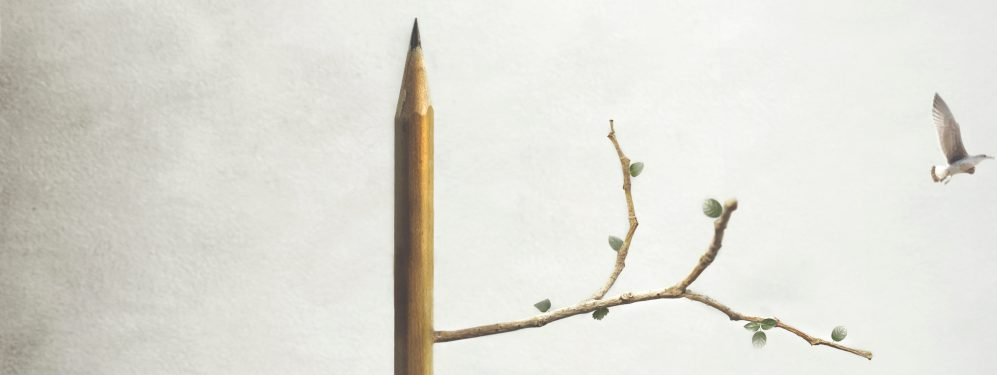
Even though my web address is my name, a year or so ago I’d given it a title that meant a lot to me personally: The Pencil Driven Life. I’d coined this phrase much earlier. Initially, it was created as a response to Rick Warren’s book, The Purpose Driven Life.

In it, Warren claims that God creates every human with a purpose. This comes about before each person is conceived. Although I once believed this, I no longer do. The Pencil Driven Life is simply the reverse, the opposite of Warren’s position. I now believe that there’s insufficient reason to believe Warren’s God exists. Thus, what naturally follows is that every person creates his or her own meaning; it comes from within, not from without. Each person decides what he wants to pursue. And, there’s no better creative tool than the lowly pencil. Properly used, this wonderful tool is a pathway to clarify one’s thinking and choosing what matters. It’s all about individual choice, not some supernatural force superimposing his/her/its choice.

My old tag line was: Reading and writing will change your life for the good. I wanted to make myself more clear. At bottom, I wanted my new tag line to express what I’d personally discovered since changing my religious beliefs, and starting a regular writing practice in 2015.

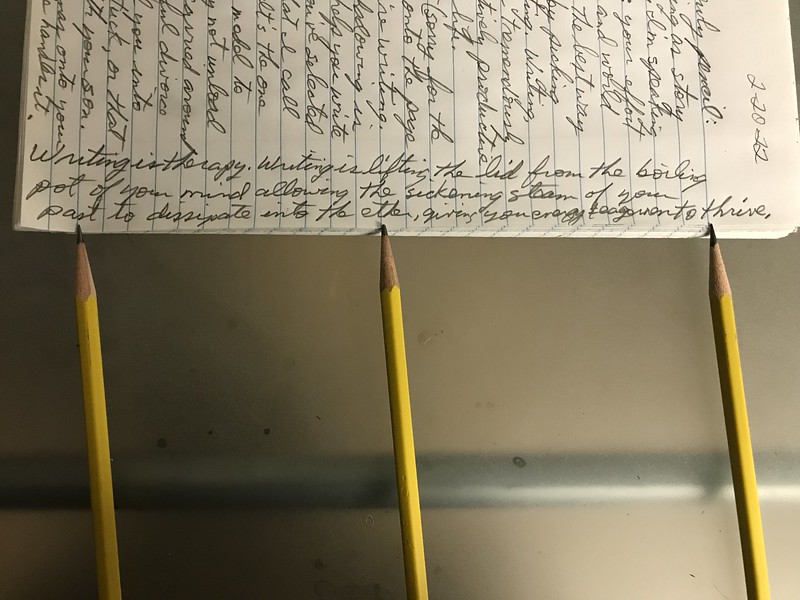
After an hour or so of thinking, doodling, considering various words and their definitions, and reviewing what many others have said about why they write, this is the current result: Writing is a tool for thinking, for discovering the truth obscured by a cluttered, unquestioning, and gullible mind.

Consider these words and their definitions (quotation marks omitted):
Cluttered–filled or scattered with a disorderly accumulation of objects or rubbish;
Unquestioning–not inclined to ask questions, being without doubt or reserve;
Gullible–naive and easily deceived or tricked.

Look carefully at the following quote. I don’t think anyone–ever–has better illustrated the necessity of writing.

I write entirely to find out what I’m thinking, what I’m looking at, what I see and what it means. What I want and what I fear.

Joan Didion

Note the meaning of necessity—“the condition of being essential or indispensable.” To Joan and many others, including me, writing is essential to a good life.

If we want to think better we need to start writing. Don’t believe this? Then, take this test. Sit down, alone, with as few distractions as possible. Start observing your mind. It won’t take long to discover it’s a mess (“dirty and disorderly”). Thoughts start appearing. You can’t stop them and most of them vanish as rapidly as they appear. It’s chaotic, disorderly. I close my eyes and my first thought is a snake story. More on this later.

None of this means writing isn’t messy. It is. Try it. You’ll soon conclude it’s a arduous process. The difference between initial thoughts and first scribblings, and a cogent representation of what you’re looking at, of what you’re seeing, and of what it means, is in the focusing, the determination, the doggedness of the rewriting.

Ernest Hemingway once said, “the only kind of writing is rewriting.” And, in the same vein, Robert Graves said, “there is no such thing as good writing, only good rewriting.” I’m certain Joan Didion would agree. It was not in her “easily deceived” mind or in her first marks on the page, but in her rewriting that she discovered what truly was obscured inside the cluttered back-room of her mind. I think it goes without saying that rewriting involves a ton of questioning.

Let’s talk about snakes. Today, I saw a 2014 abcNews article titled, “Snake-Handling Pentecostal Pastor Dies From Snake Bite.” Here’s the link. I encourage you to read it and watch the embedded video.

In a separate Google search, here’s what this pastor, Jamie Coots, said some years before his death in response to the question, “What does the Bible mean by taking up serpents?”

Takin’ up serpents, to me, it’s just showin’ that God has power over something that he created that does have the potential of injuring you or takin’ your life.

Jamie Coots

Was Mr. Coots correct? Let’s say we’d heard about snake handling, and learned that those who practiced it believed it’s how Jesus wanted Christians to demonstrate their faith. Maybe we’ve done some reading on the topic and even sat in a service at Full Gospel Tabernacle in Jesus Name in Middlesboro, Ky.

We’re back home now and want to sort things out–we want to find out what we’re thinking, what we’re looking at, what we see and what it means. What we want and what we fear. We grab a pencil and notepad and start brainstorming, jotting down a number of questions. Such as, what does the Bible actually say? And, what happened to Pastor Coots? Was he a true believer?

The abcNEWS article referenced Mark 16:18, so we look it up. As an aside, I recalled my beliefs from my sixty years as a Southern Baptist fundamentalist, and, after considering the above article and video, I quickly discover I’d never been as ‘fundamentalist’ as Jamie Coots.

For better context, here’s Mark 16:15-18 in the King James Version:

15 And he said unto them, Go ye into all the world, and preach the gospel to every creature.
16 He that believeth and is baptized shall be saved; but he that believeth not shall be damned.
17 And these signs shall follow them that believe; In my name shall they cast out devils; they shall speak with new tongues;
18 They shall take up serpents; and if they drink any deadly thing, it shall not hurt them; they shall lay hands on the sick, and they shall recover.

For comparison, here’s the passage in the New International Version:

15 [Jesus] said to them, “Go into all the world and preach the gospel to all creation.
16 Whoever believes and is baptized will be saved, but whoever does not believe will be condemned.
17 And these signs will accompany those who believe: In my name they will drive out demons; they will speak in new tongues;
18 they will pick up snakes with their hands; and when they drink deadly poison, it will not hurt them at all; they will place their hands on sick people, and they will get well.

The first thing we note is the problem of interpreting verse 18. Ignoring the ‘taking up’ versus ‘picking up’ in the first part of this verse, it seems the subject is changed to drinking deadly poison. Do we assume it means the person with the snake in hand somehow drinks some of the snakes venom? That seems odd given what we know about how the venom is transferred via the snake’s bite. Oddly, it seems to say something else, that some other person, if they drink deadly poison, the result will be positve. “[I]t will not hurt them.”

For now, let’s skip over this and hypothesize Mark is saying a true believer can handle snakes and not be harmed. And, even further (since it’s all in the same verse; probably not the best assumption), the true believer’s action of snake handling will give them power to heal sick folks.

As to our question whether Mr. Coots was a true believer, it appears he either wasn’t or there’s something else going on. Again, look at the Coots quote from above: “Takin’ up serpents, to me, it’s just showin’ that God has power over something that he created that does have the potential of injuring you or takin’ your life.” We might ask ourselves concerning Coots, what happened to God’s power?

Can we conclude Jesus’ promise applies only to “believers”? True believers are saved. The snakes will not harm true believers. Why not scribble a note to the side of our paper: Right now I have grave doubts what I’m reading here in Mark represents reality.

We dig a little deeper. Let’s look back at our NIV Bible. At the end of Mark 16:8, there’s a footnote:

“Mark 16:8 Some manuscripts have the following ending between verses 8 and 9, and one manuscript has it after verse 8 (omitting verses 9-20): Then they quickly reported all these instructions to those around Peter. After this, Jesus himself also sent out through them from east to west the sacred and imperishable proclamation of eternal salvation. Amen.”

Here’s verses 9-20 in the NIV:

9 When Jesus rose early on the first day of the week, he appeared first to Mary Magdalene, out of whom he had driven seven demons. 10 She went and told those who had been with him and who were mourning and weeping. 11 When they heard that Jesus was alive and that she had seen him, they did not believe it. 12 Afterward Jesus appeared in a different form to two of them while they were walking in the country. 13 These returned and reported it to the rest; but they did not believe them either. 14 Later Jesus appeared to the Eleven as they were eating; he rebuked them for their lack of faith and their stubborn refusal to believe those who had seen him after he had risen. 15 He said to them, “Go into all the world and preach the gospel to all creation. 16 Whoever believes and is baptized will be saved, but whoever does not believe will be condemned. 17 And these signs will accompany those who believe: In my name they will drive out demons; they will speak in new tongues; 18 they will pick up snakes with their hands; and when they drink deadly poison, it will not hurt them at all; they will place their hands on sick people, and they will get well.” 19 After the Lord Jesus had spoken to them, he was taken up into heaven and he sat at the right hand of God. 20 Then the disciples went out and preached everywhere, and the Lord worked with them and confirmed his word by the signs that accompanied it.

Two observations. First, it’s reasonable to conclude these verses were added to later manuscripts to support Jesus and a supernatural resurrection (see especially vs. 19). The second observation is that these highly questionable verses include our snake handling promise, including the promise such handlers will have special powers to heal sick folks.

It appears reasonable to question whether Mr. Coots sole authority for his Christian snake-handling beliefs, for his God-inspired way to demonstrate his faith, shouldn’t even be included in the Bible. Of course, this assumes the Bible, without these verses is the inerrant, infallible word of God. I wanted show it here but it doesn’t take much research to conclude Mark didn’t write the book of Mark. The author or authors are anonymous. But, we’ll leave that alone for now.

It seems our first draft raised some serious issues, none of which will likely be resolved to everyone’s satisfaction, especially to folks like Jamie Coots.

But, what about you? Will you stake your life on Rick Warren’s Bible? Believing God created and ordained you for a specific purpose in this life? Believing God that you’ll come to no harm handling those diamondback rattlers?

Or, is it more likely that if you do lean toward trusting in Warren’s Bible, you’ll at least ignore Mark 16:18 and cherry pick other verses to decide what you believe?

Ending thoughts. Why didn’t earlier manuscripts include verses 9-20? And, was Jamie Coots more likely to become a snake-handling Christian because of his ancestors (recall, both his father and grandfather were snake-handlers)? If so, does this indicate where we are born and to what parents and what they believe may be the primary reason we believe as we do.

Finally, can writing help us make better choices? Recall my new tag line: Writing is a tool for thinking, for discovering the truth obscured by a cluttered, unquestioning, and gullible mind.

Want a life with fewer snakes? Then, write to life.


For additional insight into Mark 16, read David Madison’s article, The Colossal Embarrassment of Mark 16.