Morning Mental Meanderings–11/24/23

I sat in the Pencil Pit, staring at the blank page. The early morning light filtered in through the barn window, illuminating specks of dust floating gently in the air. It was quiet except for the scratching of chickens outside.

Writer’s block had firmly planted itself between me and the page again. I knew I needed to write my regular Morning Mental Meanderings blog post, but no words came. I reread the quote by Charles Bukowski that I had scribbled down last night – “writing about a writer’s block is better than not writing at all.”

With a sigh, I picked up my favorite #2 pencil and began:

I gazed at the empty page, willing words to flow but finding none. Bukowski’s advice rattled around in my head…maybe writing about the block itself would help dislodge it. My mind felt stuffed with cotton, mute and tangled. I longed for the relief that came with a free flowing stretch of typing on my old typewriter, when the words tumble out almost faster than my arthritic fingers can catch them.

But for now, there was only the oppressive blankness glaring back at me. The vast whiteness seemed to mock me. You call yourself a writer? After decades as a small town lawyer, you thought retirement would make you an author overnight? What a joke. I shook my graying head and shifted in the creaky wooden chair. The morning sunlight felt harsh now instead of comforting. The chickens’ cackling sounded more smug by the minute.

With a deep breath, I lowered my eyes to the hateful blank page again. Bukowski was right – just acknowledging the block was better than ignoring it and giving up completely. The words would come again, eventually. I just had to sit with the discomfort and not lose hope.

Dipping my #2 pencil once more, I began drafting a description of the fickle muse’s abandonment. Might as well make use of the empty time by writing ABOUT not writing…

Morning Mental Meanderings–11/23/23

Confined Spaces – From Gaza to Knox’s Ordeal

In the quiet sanctuary of the Pencil Pit this morning, warmed by a new heater, my mind wanders back to the contrasting experiences of confinement that I encountered yesterday. The solitude of this barn, my chosen place of reflection, starkly contrasts with the stories of enforced and tragic confinements I absorbed.

An article I read yesterday from The New York Times about the crisis in Gaza lingered in my thoughts. Children like Khaled Joudeh, trapped not only in the physical rubble of a war-torn region but also in a situation far beyond their control or understanding. The image of Khaled, grieving beside his family, encapsulates a confinement of the most harrowing kind – trapped in a cycle of violence and loss, a life dictated by forces outside one’s control.

As I drove to Lowe’s yesterday, the narrative of confinement continued, this time through the podcast recounting Amanda Knox’s ordeal. Her story – one of wrongful accusation and years spent in an Italian jail – is a different kind of confinement. It’s a mental and physical imprisonment, compounded by the weight of injustice and misunderstanding. Knox’s voice, recounting her experiences, was a stark reminder of how freedom, something we often take for granted, can be so fragile.

These stories of confinement, both physical and metaphorical, make me reflect on the nature of freedom. In my barn, the Pencil Pit, I find a liberating solitude, a space where my thoughts and words are free to roam. This freedom, however, is a privilege, one that many, like the children in Gaza or Knox in her cell, are brutally denied.

It leads me to ponder the resilience of the human spirit in the face of such trials. There’s a certain strength, an indomitable will, that both Khaled and Knox exhibit – a refusal to be completely subdued by their circumstances. Yet, the unfairness of their situations, the pain of being confined and constrained by external forces, is deeply troubling.

As I sit here, my thoughts are a mix of gratitude for my own freedom and a deep empathy for those who are unjustly confined. These reflections are not just idle musings; they are a call to awareness and action. They remind me that while some of us have the luxury to build our sanctuaries, others are fighting battles for their basic freedoms.

Today’s mental meandering is a somber journey through the extremes of human experience. It is a recognition of the spaces we occupy – some chosen, some imposed – and the profound impact they have on our lives. In the Pencil Pit, surrounded by the early morning tranquility, I’m reminded that every word I write, every thought I explore, is a testament to the freedom that I have, and a tribute to those who are unjustly deprived of theirs.

Morning Mental Meanderings–11/22/23

The Insurrection of Curiosity

In the early hours of dawn, as I sit in the Pencil Pit, my barn transformed into a haven of thought and reflection, I ponder a quote by Nabokov that I stumbled upon: “Curiosity is insubordination in its purest form.” These words, piquant and profound, resonate within the walls of this rustic retreat, where curiosity is not just welcomed but revered.

Yesterday’s experiences seemed to dance around this very theme. My 16-mile bike ride, a ritualistic embrace of nature and endurance, was unusually challenged by rain. Clad in a cheap rainsuit, ostensibly a shield against the elements, I found myself battling not just the external downpour but an internal one too. Drenched in sweat, every pedal stroke became a rebellion against discomfort, against the urge to seek shelter. It was as if the very act of pushing through the rain was an insubordination against the body’s natural inclination for comfort and dryness.

This physical challenge oddly mirrored my mental explorations later in the day, lounging in my bedroom chair, diving deep into Sam Harris’ Waking Up app. The episode titled ‘Beginning Again’ offered a contemplative journey into mindfulness and the power of resetting one’s thoughts. It struck me then how curiosity – the kind that propels us to question, explore, and even defy our comfort zones – is a form of beginning again. Each time we allow our minds to wander into uncharted territories, question ingrained beliefs, or challenge the status quo, we are, in essence, starting anew. We are shedding the old skin of complacency and conformity.

Curiosity, in its relentless pursuit of ‘what if’ and ‘why not,’ is indeed an act of insubordination against the mundane, the accepted, and the unchallenged. It’s a rebellion against the intellectual lethargy that often seeps into our lives unnoticed. Whether it’s questioning the mechanics of a rainsuit during a deluge or contemplating philosophical insights about mindfulness, curiosity propels us into a state of perpetual growth and learning.

In the Pencil Pit, surrounded by the tools of my trade – books, notes, and, of course, pencils – I realize that this space is a physical manifestation of curiosity. It’s where thoughts are not just born but also nurtured and challenged. It’s where the insubordination of curiosity isn’t just an act of defiance but a celebration of the human spirit’s unquenchable thirst for understanding.

As I embark on today’s journey, both in the Pencil Pit and beyond, I carry with me Nabokov’s words as a reminder of the transformative power of curiosity. It is, after all, in the questioning, the exploring, and the rebelling that we truly begin again, continuously redefining ourselves and our understanding of the world around us.

Morning Mental Meanderings–11/21/23

As I sit in the Pencil Pit, the early morning light casting soft shadows around my barn-turned-sanctuary, my mind meanders through the events of yesterday, each a metaphor in its own right, each a lesson subtly veiled.

My thoughts first drift to a casual remark made at the Walgreen’s drive-thru, about Canadian geese that, contrary to their migratory nature, never leave. This offhand comment, punctuated by the distant squawks of the geese, stayed with me. It’s fascinating how, like these geese, certain elements of our psyche – be it fear, resentment, or outdated beliefs – choose to roost permanently in our minds. They linger, often unnoticed, long past their natural season to depart. It’s a gentle reminder of the mental clutter we ought to clear, yet somehow, it remains, nested comfortably in the crevices of our thoughts.

Later, in the attic, amidst the chore of stuffing insulation into the exhaust fan, I was struck by the likeness of the white, blown insulation to clouds. It was a moment of unexpected beauty, a reminder of how perspective can transform the mundane into the extraordinary. It made me think about perception – how the way we choose to see things can alter our entire experience. There, in the dusty corners of the attic, amidst the routine task, lay a whimsical landscape, a sky within a home.

The day ended in the garden with Jon and Donna, our hands working in unison to remove the tomato cages, making way for the planting of Crimson Clover. This act, simple yet profound, is a dance with the rhythm of nature – a preparation for renewal and growth. Planting a winter cover crop is an investment in the future; it’s about nurturing the soil, even when it lies dormant under the cold sky. It symbolizes hope, care, and the foresight to prepare today for tomorrow’s harvest.

These moments, as ordinary as they may seem, are threads in the tapestry of daily life. The geese that don’t migrate remind us to let go of what no longer serves us. The cloud-like insulation speaks of finding wonder in the everyday. The act of preparing the garden soil is a testament to the cycles of nature and life – of preparation, care, and eventual rejuvenation.

In the quiet of the Pencil Pit, as I reflect on these seemingly disparate experiences, I find a common theme – the importance of perspective, the beauty in the ordinary, and the continuous cycle of holding on and letting go. It’s remarkable how life, in its unassuming way, offers lessons at every turn, in every attic corner, every garden patch, and even in the flight patterns of geese.

Morning Mental Meanderings–11/20/23

Sitting in the quietude of the Pencil Pit before dawn, my mind wanders through the vast cosmos, far beyond the confines of this rustic barn. The phrase “everyone loses everything” lingers in my thoughts, now intertwined with the staggering scale of the universe I pondered yesterday.

I watched a video that put the size of our Milky Way Galaxy into perspective. Imagine the entire United States (just the lower 48 states) representing the Milky Way. In this grand scale, our entire solar system is a mere speck around Kansas City, Kansas. It struck me profoundly. On the fingertip of a person, amidst the ridges and valleys of a fingerprint, a tiny yellow ball represented our Sun – smaller than a grain of sand, yet in reality almost 900,000 miles in diameter. The immensity is unfathomable.

Lying in bed last night, I couldn’t shake off the image of our solar system, all seven planets and their orbits, fitting on a man’s fingertip. In this grand cosmic scale, the significance of a single human, or even humanity as a whole, becomes infinitesimally small. We are but a fleeting whisper in the boundless universe, one of billions of galaxies, each with its own billions of stars and planets.

And yet, here I am, in the Pencil Pit, pondering the finite nature of our existence. “Everyone loses everything” – the phrase seems even more poignant against the backdrop of the cosmos. Our time, our possessions, our very beings are transient in this vast universe. But rather than diminishing our lives, this thought imbues them with a profound significance. Each moment we live, each connection we make, every line we write is a miracle against the canvas of this almost endless universe.

This perspective, from the scale of galaxies down to the simple act of writing in my barn, is a humbling reminder of our place in the cosmos. It grounds me in the present, reinforcing the importance of cherishing every fleeting moment. In the grand scheme of things, we may be insignificant, but in the realm of our personal experiences, every moment is vast and meaningful. This is where the true spirituality lies – not in clinging to what we will eventually lose, but in fully embracing the now, the ephemeral beauty of existence in a universe so vast, it’s beyond our full comprehension.

The Pencil Pit

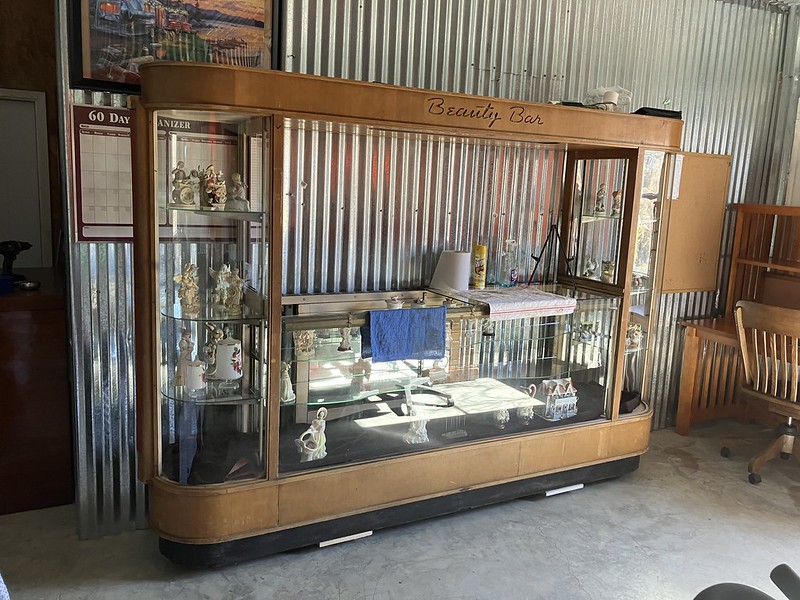
Upgraded writing room in the barn (now known as the Pencil Pit): big desk used in law practice (HEAVY!); ‘Beauty Bar’ (antique) included in old downtown building purchased in 1999 (story is it was purchased from a pharmacy in Gadsden and was there for decades). Figurines in ‘Beauty Bar’ were mother’s.

Most wonderful characteristic of the Pencil Pit–no internet.

Einstein on Free Will and the Power of the Imagination

Here’s the link to this article.

“Human being, vegetables or cosmic dust, we all dance to an invisible tune, intoned in the distance by a mysterious player.”

BY MARIA POPOVA

We are accidents of biochemistry and chance, moving through the world waging wars and writing poems, spellbound by the seductive illusion of the self, every single one of our atoms traceable to some dead star.

In the interlude between the two World Wars, days after the stock market crash that sparked the Great Depression, the German-American poet and future Nazi sympathizer George Sylvester Viereck sat down with Albert Einstein (March 14, 1879–April 18, 1955) for what became his most extensive interview about life — reflections ranging from science to spirituality to the elemental questions of existence. It was published in the Saturday Evening Post on October 29, 1929 — a quarter century after Einstein’s theory of relativity reconfigured our basic understanding of reality with its revelation that space and time are the warp and weft threads of a single fabric, along the curvature of which everything we are and everything we know is gliding.

Albert Einstein by Lotte Jacobi. (University of New Hampshire Museum of Art.)

Considering the helplessness individual human beings feel before the immense geopolitical forces that had hurled the world into its first global war and the decisions individual political leaders were making — decisions already inclining the world toward a second — Einstein aims in his sensitive intellect at the fundamental reality of existence:

I am a determinist. As such, I do not believe in free will. The Jews believe in free will. They believe that man shapes his own life. I reject that doctrine philosophically. In that respect I am not a Jew… I believe with Schopenhauer: We can do what we wish, but we can only wish what we must. Practically, I am, nevertheless, compelled to act is if freedom of the will existed. If I wish to live in a civilized community, I must act as if man is a responsible being.

When asked about any personal responsibility for his own staggering achievements, he points a steadfast finger at the nonexistence of free will:

I claim credit for nothing. Everything is determined, the beginning as well as the end, by forces over which we have no control. It is determined for the insect as well as for the star. Human being, vegetables or cosmic dust, we all dance to an invisible tune, intoned in the distance by a mysterious player.

Art by Dorothy Lathrop, 1922. (Available as a print and as stationery cards.)

For Einstein, the most alive part of the mystery we live with — the mystery we are — is the imagination, that supreme redemption of human life from the prison of determinism. With an eye to his discovery of relativity, he reflects:

I believe in intuitions and inspirations. I sometimes feel that I am right. I do not know that I am. When two expeditions of scientists, funded by the Royal Academy, went forth to test my theory of relativity, I was convinced that their conclusions would totally tally with my hypothesis. I was not surprised when the eclipse of May 29, 1919, confirmed my intuitions. I would have been surprised if I had been wrong.

[…]

I am enough of an artist to draw freely from the imagination. Imagination is more important than knowledge. Knowledge is limited. Imagination encircles the world.

Complement with Robinson Jeffers’s superb science-laced poem “The Beginning and the End,” Simone Weil on the relationship between our rights and our responsibilities, and neuroscientist Sam Harris on our primary misconception about free will, then revisit Einstein on the interconnectedness of our fates.

James Baldwin on Love, the Illusion of Choice, and the Paradox of Freedom

Here’s the link to this article.

“Nothing is more unbearable, once one has it, than freedom.”

BY MARIA POPOVA

jamesbaldwin
James Baldwin on Love, the Illusion of Choice, and the Paradox of Freedom

We, none of us, choose the century we are born in, or the skin we are born in, or the chromosomes we are born with. We don’t choose the incredibly narrow band of homeostasis within which we can be alive at all — in bodies that die when their temperature rises above 40 degrees Celsius or drops below 20, living on a planet that would be the volcanic inferno of Venus or the frigid desert of Mars if it were just a little closer to or farther from its star.

And yet, within these narrow parameters of being, nothing appeals to us more than the notion of freedom — the feeling that we are free, that intoxicating illusion with which we blunt the hard fact that we are not. The more abstract and ideological the realm, the more vehemently we can insist that moral choice in specific situations within narrow parameters proves a totality of freedom. But the closer the question moves to the core of our being, the more clearly and catastrophically the illusion crumbles — nowhere more helplessly than in the most intimate realm of experience: love. Try to will yourself into — or out of — loving someone, try to will someone into loving you, and you collide with the fundamental fact that we do not choose whom we love. We could not choose, because we do not choose who and what we are, and in any love that is truly love, we love with everything we are.

James Baldwin (August 2, 1924–December 1, 1987) was a young man — young and brilliant and aflame with life, blazing against society’s illusion of stability and control — when he composed his stunning semi-autobiographical novel Giovanni’s Room (public library), making the paradox of freedom its animating theme.James Baldwin

Baldwin writes:

Nothing is more unbearable, once one has it, than freedom.

To bear the unbearable, Baldwin intimates, we construct and cling to artificial structures of choice, personal and social — habits, routines, the contractual commitment of marriage, the moralistic frameworks that indict one kind of love as good and another as bad. Today, Giovanni’s Room is celebrated as a pioneering liberation and representation of LGBTQ+ love — a term that did not exist in Baldwin’s day, for it speaks to a cultural silence so deep then that there was no adequate language for it. (The language we use today is hardly adequate — but language is always a placeholder for a culture’s evolving understanding of itself, the space in which we work out our concepts as we learn how to think about them in learning how to speak of them.) Baldwin rose against a tidal force of cowardice from publishers at a time when the Bible of psychiatry — the Diagnostic Manual of Mental Disorders — classified love as so many of us know it as a “sociopathic personality disturbance.” At the center of his act of courage and resistance is the recognition that the experience of love is our most primal confrontation with the illusion of freedom.

Art by Dorothy Lathrop, 1922. (Available as a print and as stationery cards.)

Exactly half a century after the Spanish-American poet, philosopher, and novelist George Santayana considered why we like what we like and a decade after the Holocaust survivor Viktor Frankl made his hard-earned case for saying yes to life in the most unfree of circumstances, Baldwin writes:

People can’t, unhappily, invent their mooring posts, their lovers and their friends, anymore than they can invent their parents. Life gives these and also takes them away and the great difficulty is to say Yes to life.

Art by Margaret C. Cook from a rare 1913 edition of Walt Whitman’s Leaves of Grass. (Available as a print.)

Four years later, Baldwin would develop these ideas in his immensely insightful speech-turned-essay on freedom and how we imprison ourselves.

In the final years of his life, he would look back on the crucible of these ideas, describing Giovanni’s Room as a book not about one kind of love or another but “about what happens to you if you’re afraid to love anybody.” In his most intimate interview, he would recount the best advice he ever received on the transcendent, terrifying choicelessness of love and the implicit, seemingly paradoxical demand for choice within it — advice given him by an old friend:

You have to go the way your blood beats. If you don’t live the only life you have, you won’t live some other life, you won’t live any life at all.

Art by Margaret C. Cook from Leaves of Grass. (Available as a print.)

Complement with Toni Morrison on the deepest meaning of freedom and Simone de Beauvoir on how chance and choice converge to make us who we are, then revisit Baldwin on the doom and glory of knowing who you are.

The Paradox of Free Will

Here’s the link to this article.

The neuroscience, physics, and philosophy of freedom in a universe of fixed laws.

BY MARIA POPOVA

“Nothing is more unbearable, once one has it, than freedom,” James Baldwin observed in recognizing how limited our freedom is and how illusory our choices, for he knew that “people can’t, unhappily, invent their mooring posts, their lovers and their friends, anymore than they can invent their parents.”

And yet we move through the world with an air of agency, without which life would feel unlivable — a gauntlet of causality stretching all the way back to the Big Bang, into which we are hurled as helpless pawns in some cosmic game that has already played out. It is a disquieting notion — one we have countered with our dream of free will, continually mistaking the feeling of freedom for the fact of freedom.

But even within the presets and parameters conferred upon us by the cosmic and cultural forces that made us, there exists a margin of movement in which notions like control, agency, and moral responsibility live. In that margin, we become fully human.

In this fascinating BBC documentary, journalist Melissa Hogenboom and a constellation of neuroscientists, physicists, and philosophers explore the science and subtleties of the free will question — a question that remains not only unanswered but a testament to Hannah Arendt’s astute observation that “to lose the appetite for meaning we call thinking and cease to ask unanswerable questions [would be to lose] the capacity to ask all the answerable questions upon which every civilization is founded.”

Complement with Einstein on free will and the power of the imagination, C.S. Lewis on suffering and what it means to have free will in a universe of fixed laws, and neuroscientist Christof Koch on the paradox of freedom.

Singularity: Marie Howe’s Ode to Stephen Hawking, Our Cosmic Belonging, and the Meaning of Home, in a Stunning Animated Short Film

Here’s the link to this article.

“For every atom belonging to me as good belongs to you. Remember?”

BY MARIA POPOVA

UPDATE 2022: This poem has since inspired the magnificent “Singularity (after Marie Howe)” by the young poet Marissa Davis.

“We, this people, on a small and lonely planet,” Maya Angelou begins “A Brave and Startling Truth” — her cosmic wakeup call to humanity, which flew into space aboard NASA’s Orion spacecraft and which opened the 2018 Universe in Verse, dedicated to our ecological awakening on the wings of Rachel Carson’s courageous work.

That year, Marie Howe — one of our great living poets, who awakens the creaturely conscience of the next generation in her ecopoetry class at Sarah Lawrence College — premiered a kindred poem that stilled the crowd constellating at Pioneer Works before erupting into a thousand-bodied standing ovation. While inspired by Stephen Hawking (who had just returned his stardust to the universe several weeks earlier) and titled after his trailblazing work on black holes and singularities — work that shines a sidewise gleam on the origin of everything — the poem is at bottom a stunning meditation on the interconnectedness of belonging across space and time, across selves and species, across the myriad artificial unbelongings we have manufactured as we have drifted further and further from our elemental nature. Its closing line is an invocation, an incantation, ending with a timeless word of staggering resonance today: home.

As we now stand on a profound precipice two years later — facing our deeply interconnected ecology of being on this shared cosmic home as we look back on fifty years of Earth Day built on Carson’s legacy, facing the most intimate meaning of home in our isolated shelters scattered across this “small and lonely planet” — the poem pulsates with a whole new meaning, as all great poems do in the veins of time.

And so, as a special treat for the 2020 Universe in Verse, streaming on April 25 into millions of homes around this sole shared home, I teamed up with SALT Project — a kindred clan of visual storytellers, who have won some hearts and won some Emmys with their soulful shorts ranging from book trailers to bird migration documentaries — to bring Howe’s “Singularity” to life in a transcendent short film, illustrated by paper collage artist Elena Skoreyko Wagner and featuring original music by the heroic cellist Zoë Keating, who was present in atoms at the 2018 show when “Singularity” premiered and who also composed the score for “Antidotes to Fear of Death” — the headlining miracle of a poem for the 2020 show.

It is with exuberant joy and gratitude that I share, as a special taste of the 2020 Universe in Verse, this symphony of beauty and perspective, over which so many talented women have labored with so much heart and generosity of spirit .

SINGULARITY
by Marie Howe

          (after Stephen Hawking)

Do you sometimes want to wake up to the singularity
we once were?

so compact nobody
needed a bed, or food or money —

nobody hiding in the school bathroom
or home alone

pulling open the drawer
where the pills are kept.

For every atom belonging to me as good
Belongs to you.
   Remember?

There was no   Nature.    No
 them.   No tests

to determine if the elephant
grieves her calf    or if

the coral reef feels pain.    Trashed
oceans don’t speak English or Farsi or French;

would that we could wake up   to what we were
— when we were ocean    and before that

to when sky was earth, and animal was energy, and rock was
liquid and stars were space and space was not

at all — nothing

before we came to believe humans were so important
before this awful loneliness.

Can molecules recall it?
what once was?    before anything happened?

No I, no We, no one. No was
No verb      no noun
only a tiny tiny dot brimming with

is is is is is

All   everything   home

Complement with an ink-and-watercolor animation of Mojave American poet Natalie Diaz’s gorgeous poem of brokenness and belonging and an animated adaptation of Neil Gaiman’s ode to women’s prehistoric role in the history of the scientific method.