The peaceful transfer of power

Here’s the link to this article. Read and be sure to watch each of the short video clips.

STEVE SCHMIDT

AUG 18, 2023

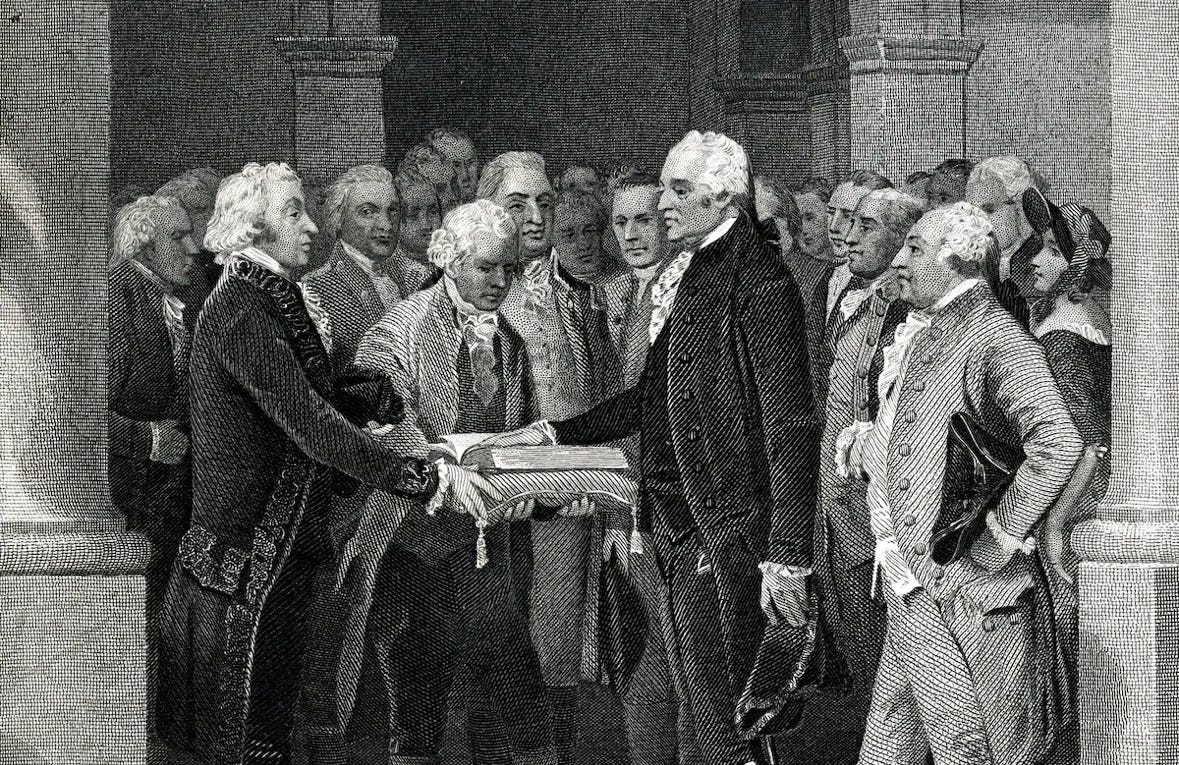
Engraving from 1869 commemorating the first inauguration of President George Washington on April 30, 1789

American greatness has been fueled and sustained by qualities of character that are timeless and sorely needed during these days of national crisis.  There should be no mistake about this being a moment of crisis or blindness about its cause, or who specifically is responsible.

The three greatest American presidents — Washington, Lincoln and Franklin Roosevelt — collectively created America, saved the Union, ended slavery, and saved the world from tyranny. Each man’s greatest achievements and service were fueled by their exceptional character and dedication to virtue.

Washington was a man of exceptional humility, who repeatedly walked away from power to set in motion a new epoch of history. He was an example of the restraint necessary to sustain a republic. His actions awed the world, as well as the people of our young nation. When he passed he was eulogized as first in war, first in peace and first in the hearts of his countrymen. 

Lincoln demonstrated iron strength, indomitability, fortitude and magnanimity. His second inaugural is the greatest speech in America’s secular canon. Its words are transcendent.

He makes clear that the cause of war was the moral catastrophe of slavery. His determination is absolute.

Fondly do we hope ~ fervently do we pray ~ that this mighty scourge of war may speedily pass away. Yet, if God wills that it continue until all the wealth piled by the bondsman’s two hundred and fifty years of unrequited toil shall be sunk and until every drop of blood drawn with the lash shall be paid by another drawn with the sword as was said three thousand years ago so still it must be said ‘the judgments of the Lord are true and righteous altogether.’

So is his grace and magnanimity:

With malice toward none with charity for all with firmness in the right as God gives us to see the right let us strive on to finish the work we are in to bind up the nation’s wounds, to care for him who shall have borne the battle and for his widow and his orphan ~ to do all which may achieve and cherish a just and lasting peace among ourselves and with all nations.

Franklin Roosevelt had the gift of faith, and because of it, he possessed a bottomless wellspring of optimism. Because of it, he was fearless — and made his nation so. His last inaugural address was the shortest in history. It stood at 544 words, but remains remarkable nonetheless as a declaration of moral purpose around a national purpose. FDR was a man without doubt by the end. His faith was in us, and it was not misplaced then or now. Here is what he said:

Mr. Chief Justice, Mr. Vice President, my friends, you will understand and, I believe, agree with my wish that the form of this inauguration be simple and its words brief.

We Americans of today, together with our allies, are passing through a period of supreme test. It is a test of our courage–of our resolve–of our wisdom–our essential democracy.

If we meet that test–successfully and honorably–we shall perform a service of historic importance which men and women and children will honor throughout all time.

As I stand here today, having taken the solemn oath of office in the presence of my fellow countrymen–in the presence of our God– I know that it is America’s purpose that we shall not fail.

In the days and in the years that are to come we shall work for a just and honorable peace, a durable peace, as today we work and fight for total victory in war.

We can and we will achieve such a peace.

We shall strive for perfection. We shall not achieve it immediately–but we still shall strive. We may make mistakes–but they must never be mistakes which result from faintness of heart or abandonment of moral principle.

I remember that my old schoolmaster, Dr. Peabody, said, in days that seemed to us then to be secure and untroubled: “Things in life will not always run smoothly. Sometimes we will be rising toward the heights–then all will seem to reverse itself and start downward. The great fact to remember is that the trend of civilization itself is forever upward; that a line drawn through the middle of the peaks and the valleys of the centuries always has an upward trend.”

Our Constitution of 1787 was not a perfect instrument; it is not perfect yet. But it provided a firm base upon which all manner of men, of all races and colors and creeds, could build our solid structure of democracy.

And so today, in this year of war, 1945, we have learned lessons– at a fearful cost–and we shall profit by them.

We have learned that we cannot live alone, at peace; that our own well-being is dependent on the well-being of other nations far away. We have learned that we must live as men, not as ostriches, nor as dogs in the manger.

We have learned to be citizens of the world, members of the human community.

We have learned the simple truth, as Emerson said, that “The only way to have a friend is to be one.” We can gain no lasting peace if we approach it with suspicion and mistrust or with fear.

We can gain it only if we proceed with the understanding, the confidence, and the courage which flow from conviction.

The Almighty God has blessed our land in many ways. He has given our people stout hearts and strong arms with which to strike mighty blows for freedom and truth. He has given to our country a faith which has become the hope of all peoples in an anguished world.

So we pray to Him now for the vision to see our way clearly–to see the way that leads to a better life for ourselves and for all our fellow men–to the achievement of His will to peace on earth.

Eighty-two days later he was dead.

The Warning with Steve Schmidt is a reader-supported publication. To receive new posts and support my work, consider becoming a free or paid subscriber.

Upgrade to paid

Harry Truman had been vice president for just 82 days when he was received by Eleanor Roosevelt in her study in the White House on April 12, 1945. He had been playing poker in Speaker Sam Rayburn’s hideaway when a call came summoning him back to the White House.

Harry, the president is dead.

Truman responded:

Is there anything I can do for you?

Eleanor Roosevelt, a giant of the 20th century, replied:

No, Mr. President. Is there anything I can do for you? You are the one in trouble now.

Truman, a decorated combat veteran of the First World War, recalled his emotions this way, telling reporters the following day:

I felt like the moon, the stars and all the planets had fallen on me.

Why did he feel that way? What burden was thrust upon him?

It was the burden imposed by the most solemn oath that exists in American public life. Thirty-five words long, it is specifically proscribed in the US Constitution, and was taken for the first time on March 4, 1789, by George Washington. When Truman raised his hand, he was the 32nd person in American history to swear it. When he did, he became president of the United States of America. His styling was simple and unadorned. “Mr. President” is what we call the person who swears that oath. Here it is:

I do solemnly swear to faithfully execute the office of President of the United States and to the best of my ability preserve, protect and defend the Constitution of the United States.

When it is sworn, executive power is either renewed or transferred. For 223 years, including through civil war, world war, assassination, economic depression and presidential resignation, it was peacefully transferred.

The first time it was peacefully transferred occurred in 1797. John Adams was fully aware that the unprecedented event was regarded with amazement. He recognized the significance of the moment and spoke about the “great uncertainty” that had followed the revolution and the establishment of the republic. The achievement was fresh, new, extraordinary and filled with promise and peril. This is how Adams described the achievement that would utterly transform world history and human civilization:

But this is very certain, that to a benevolent human mind there can be no spectacle presented by any nation more pleasing, more noble, majestic, or august, than an assembly like that which has so often been seen in this and the other Chamber of Congress, of a Government in which the Executive authority, as well as that of all the branches of the Legislature, are exercised by citizens selected at regular periods by their neighbors to make and execute laws for the general good. Can anything essential, anything more than mere ornament and decoration, be added to this by robes and diamonds? Can authority be more amiable and respectable when it descends from accidents or institutions established in remote antiquity than when it springs fresh from the hearts and judgments of an honest and enlightened people? For it is the people only that are represented. It is their power and majesty that is reflected, and only for their good, in every legitimate government, under whatever form it may appear. The existence of such a government as ours for any length of time is a full proof of a general dissemination of knowledge and virtue throughout the whole body of the people. And what object or consideration more pleasing than this can be presented to the human mind? If national pride is ever justifiable or excusable it is when it springs, not from power or riches, grandeur or glory, but from conviction of national innocence, information, and benevolence. 

In the midst of these pleasing ideas we should be unfaithful to ourselves if we should ever lose sight of the danger to our liberties if anything partial or extraneous should infect the purity of our free, fair, virtuous, and independent elections. If an election is to be determined by a majority of a single vote, and that can be procured by a party through artifice or corruption, the Government may be the choice of a party for its own ends, not of the nation for the national good. If that solitary suffrage can be obtained by foreign nations by flattery or menaces, by fraud or violence, by terror, intrigue, or venality, the Government may not be the choice of the American people, but of foreign nations. It may be foreign nations who govern us, and not we, the people, who govern ourselves; and candid men will acknowledge that in such cases choice would have little advantage to boast of over lot or chance.

The peaceful transfer of power is at the core of the American system of government and way of life. Its endurance was mistakenly interpreted by most of the country as permanence. It is not an inherited right. It marks renewal and recommitment to the core of the American revolution and the ideals that animate America. When power is transferred in America, it is a powerful and profound moment.

It is important to understand the desecration and chaos Trump and his mob have wrought with their attack against America. They have normalized conspiracy. They have made the truth and lie equal in a public square contaminated by the toxic sewage of division, propaganda and misinformation. They have assaulted the essence of America through a conspiracy to seize power that was bestowed by the American people on Joe Biden. The treachery is historic, unprecedented and ongoing. The days ahead will test America’s spirit, resolve and democracy.

Below are the moments when power was transferred. Listen to select words of the inaugural speeches of America’s Democratic and Republican presidents. Do you see the continuity and the majesty of what Trump and his filthy accomplices desecrated?

Upgrade to paid

Dwight Eisenhower, 1953

John F. Kennedy, 1963

Jimmy Carter, 1976

Ronald Reagan, 1980

Bill Clinton, 2000

‘That’s why we have an Insurrection Act’

Here’s the link to this article.

Avatar photoby ADAM LEE AUG 07, 2023

The US Capitol building, lit up at dusk | "That's why we have an Insurrection Act"
Credit: Martin Falbisoner, CC BY-SA 3.0

Overview:

Special Counsel Jack Smith’s indictment reveals how far Donald Trump and his cronies were willing to go to overturn the election. American democracy had a very narrow escape indeed in 2020.

Reading Time: 5 MINUTES

Throughout his long life of wealth and privilege, Donald Trump has dodged consequences time and again. Could this finally be the case that brings him to heel?

At the start of 2023, progressives could have been forgiven for feeling cynical. At that point, it had been over two years since the election, and despite his numerous and well-documented acts of criminality, he was facing no charges. It seemed a foregone conclusion that, yet again, he would thumb his nose at the law and get off scot-free.

However, that pessimism was premature. While it took an unacceptably long time, the machinery of the justice system is finally creaking into action.

In the last few months, Trump has been hit with a flurry of indictments. He’s now facing criminal charges in New York (for his hush-money payments to a sex worker, in violation of election law); in federal court in Florida (for stealing classified documents and refusing to return them); and possibly soon in Georgia (for his felonious attempt at strong-arming the Secretary of State to “find” more votes for him).

But this is the big one. Special Counsel Jack Smith has filed felony charges against Trump for his attempts to overturn the 2020 election, including his role in inciting the deadly January 6 insurrection.

What’s in the indictment

There’s little in this indictment we didn’t already know. Most of it recounts the evidence gathered by the Congressional January 6 Commission. But it’s both informative and terrifying to see it in one place.

In late 2020, when it was clear that he had lost, Trump started spreading lies that the election was fraudulent, despite being told by his own advisors that there was no basis for believing this. A Trump campaign advisor complained about having to defend “conspiracy shit beamed down from the mothership”.

He filed a blizzard of groundless lawsuits, all of which were thrown out, and pressured Republican legislatures in swing states to override their own voters and award him the election. This effort failed as well.

The crux of the scheme, and of Jack Smith’s criminal charges, is this: When his other strategies to steal the election floundered, Trump came up with a last-ditch plan to rig the Electoral College. He conspired with his supporters to draw up fake electoral-vote certificates, hand them to Vice President Mike Pence on the floor of Congress, and have him reject the real electoral votes and count the fake ones.

Conspiracy against rights

To be perfectly clear: This isn’t free speech; this is a crime. It’s a scheme to use forged versions of official documents to change the outcome of a legal proceeding. This is like printing counterfeit dollar bills and trying to use them in a store, or forging a dead person’s will and giving it to a lawyer to read to the heirs because you don’t like what’s in the real one.

(Fittingly, one of the charges stemming from this plan is “conspiracy against rights”, first passed into law in the Ku Klux Klan Act of 1870.)

However, Pence wouldn’t go along with the plan. He insisted that the Vice President had no power to arbitrarily pick and choose electoral votes (because of course he doesn’t—if he did, no incumbent president would ever lose reelection). Trump berated him for being “too honest”, but Pence didn’t give in.

I despise Pence for being a soulless theocrat whose heart pumps sour milk instead of blood, but I have to grudgingly give him credit for this. He refused to go along with Trump’s lawbreaking, and he held firm on that stance despite enormous pressure.

However, not everyone in Trump’s circle was so principled. The most hair-raising line of the indictment is a transcript of a conversation between White House deputy counsel Patrick Philbin and a person identified as “Co-conspirator #4″—widely believed to be Jeffrey Clark, a Trump crony in the Justice Department.

Philbin argued that if Trump succeeded with his scheme, there would be riots in every major American city. Clark/Co-conspirator 4 said:

“…that’s why there’s an Insurrection Act.”

Sit with these words for a minute.

We know—even if it’s come to seem less shocking through sheer repetition—that the president of the United States schemed to steal an election, in plain sight, and remain in office against the will of the voters. We now know, in addition, that the conspirators expected mass protest from the American people, and that they were at least considering calling out the military to put the protests down by force.

A second Civil War

As I said at the time, it’s no exaggeration to say that a competent fascist could have overthrown the United States government in 2020. We came right up to the edge of killing democracy and turning the country over to a military junta.

It’s possible the military would have refused to follow these orders if Trump had given them—but at minimum, we’d have been plunged into a massive constitutional crisis. And what would have happened if some branches of the military had gone along with the scheme while others refused? Blue states claiming Trump wasn’t president while red states claimed he was? It could have ignited a second Civil War.

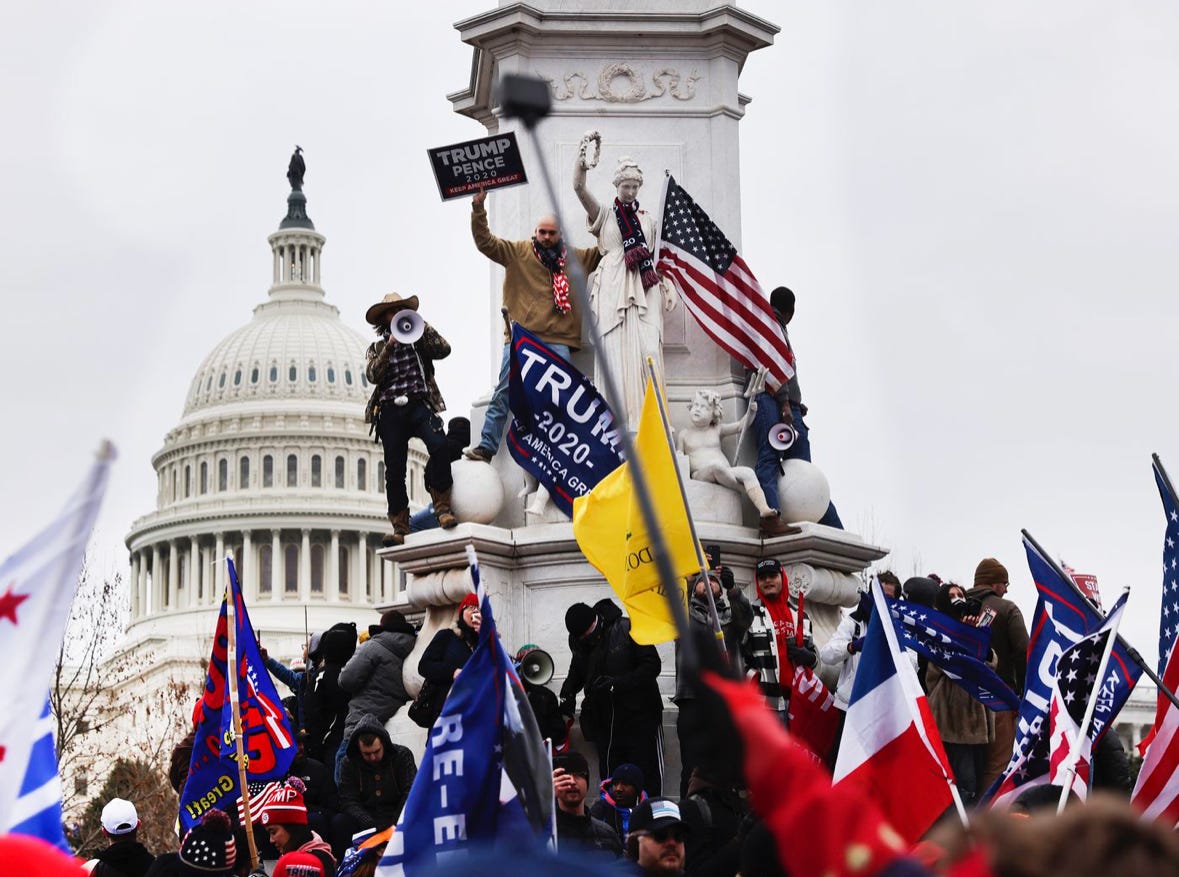
Either way, we escaped by the skin of our teeth. We know the next and final act of the drama: when everything else failed, Trump gathered a mob of his followers in Washington, D.C., riled them up with more lies about a stolen election, and incited them to assault the Capitol. The mob overwhelmed the Capitol police, broke into the building while Congress fled in a panic, and ransacked the halls of government until law enforcement regrouped and chased them out. They failed to disrupt the election, but if they had captured Pence or any member of Congress, we know what they intended. They built a gallows.

A norm not to be broken lightly

There’s good reason not to prosecute former presidents. It’s not a norm to be broken lightly. Otherwise, we risk becoming a banana republic where every new president persecutes and jails his opposition. It’s not hyperbole to say that this norm has helped America have smooth handovers of power for the last two centuries, something other nations have struggled with.

But there have to be limits to what we’re willing to tolerate. Otherwise, a president could commit crimes with impunity. There may still be reason to overlook minor offenses, but extraordinary crimes demand an extraordinary response.

We approached this precipice once before, with a different Republican president. However, with Nixon, it mattered that the entire political apparatus was united against him. He resigned because Congressional Republicans made it clear to him that they’d support impeachment. Without the party behind him, he had no prospect of political survival. Rightly or wrongly, Ford’s decision to pardon him was likely motivated by the belief that there was no further harm he could do.

The situation we’re facing is very different. With a handful of principled exceptions—many of whom have already lost their seats in primaries—the Republican Party has fallen into line behind Trump. They’re still excusing his flagrant lawbreaking and his attempted coup. Even his political rivals, who’d benefit most if he were removed from the board, continue to attack and denounce Democrats for prosecuting him. Whatever the outcomes of the criminal trials, he’s all but certain to be the 2024 nominee.

Can our democracy survive when one of its two major parties has embraced insurrection and authoritarianism? Perhaps, but only if it’s apparent to everyone that there will be consequences. The United States has to deliver a strong message that attacks on the fabric of our society will be punished. Otherwise, he and others like him will just be emboldened to try again.

There’s no question about whether Trump committed the acts he’s charged with. Of course, the real hurdle is finding a jury willing to convict him. But that’s no reason not to try. On the contrary, justice demands we make the attempt. To give up before we start would be to concede that the rich and politically influential are above the law, whereas if we try him, there’s at least a chance. And if the prosecutors succeed, they may just save American democracy in the bargain.

Our Fragile Freedom

Here’s the link to this article.

DAN RATHER AND ELLIOT KIRSCHNER
AUG 3
(Photo by Drew Angerer)

In an era of unprecedented upheaval, it is difficult to find suitable context and perspective for the latest indictment of Donald Trump. 

After all, this isn’t the first indictment he has faced, or even the first in federal court. It isn’t the first time we have had to grapple with his moral failings, the unleashing of political violence, or the degradation of our constitutional order. 

Much of what is in the document made public on Tuesday we knew before. We saw it unfold on TV. We read the reporting of its aftermath. We heard the gripping public testimony in front of the bipartisan House Select Committee that investigated the insurrection of January 6. 

It wasn’t even that the indictment was a surprise. For a long time, the investigation has been in the public consciousness. After Trump announced that he had been told he was a target, it was mostly a matter of when, not if

It is important to keep in mind that this latest indictment does not charge Trump with arguably the gravest potential crimes, like insurrection or sedition, even though many who watched in horror the events leading up to and cresting on January 6 think it obvious he is guilty of both. 

Randall Eliason, a former chief of the fraud and public corruption section at the U.S. Attorney’s Office for the District of Columbia, argued in a New York Times opinion piece titled “What Makes Jack Smith’s New Trump Indictment So Smart” that the special counsel wisely chose to limit the scope of the case (and the number of defendants) to just Trump despite the six other unnamed but easily identifiable co-conspirators. Smith did this, the piece points out, in order to proceed quickly to trial and yield the best chance at conviction. “Although it might have been psychologically gratifying to see Mr. Trump charged with sedition, the name of the legal charge is less important than the facts that will make up the government’s case,” Eliason wrote. 

In other words, Smith decided not to try to prove too much; keep the charges few and based on what facts he believes are most likely to convince a jury — and whatever part of the public may be open to persuasion. 

Let us stop for a moment to ponder these facts and the narrative they tell. They are chilling, but we must remember the Department of Justice will have to prove them in a court of law. Trump is presumed not guilty until and unless he is proven otherwise. He has every right to mount a vigorous defense. It’s probably best for the country that his lawyers fight hard and smart. The more thoroughly this case is adjudicated, the more its conclusion is likely to be strengthened by the process. 

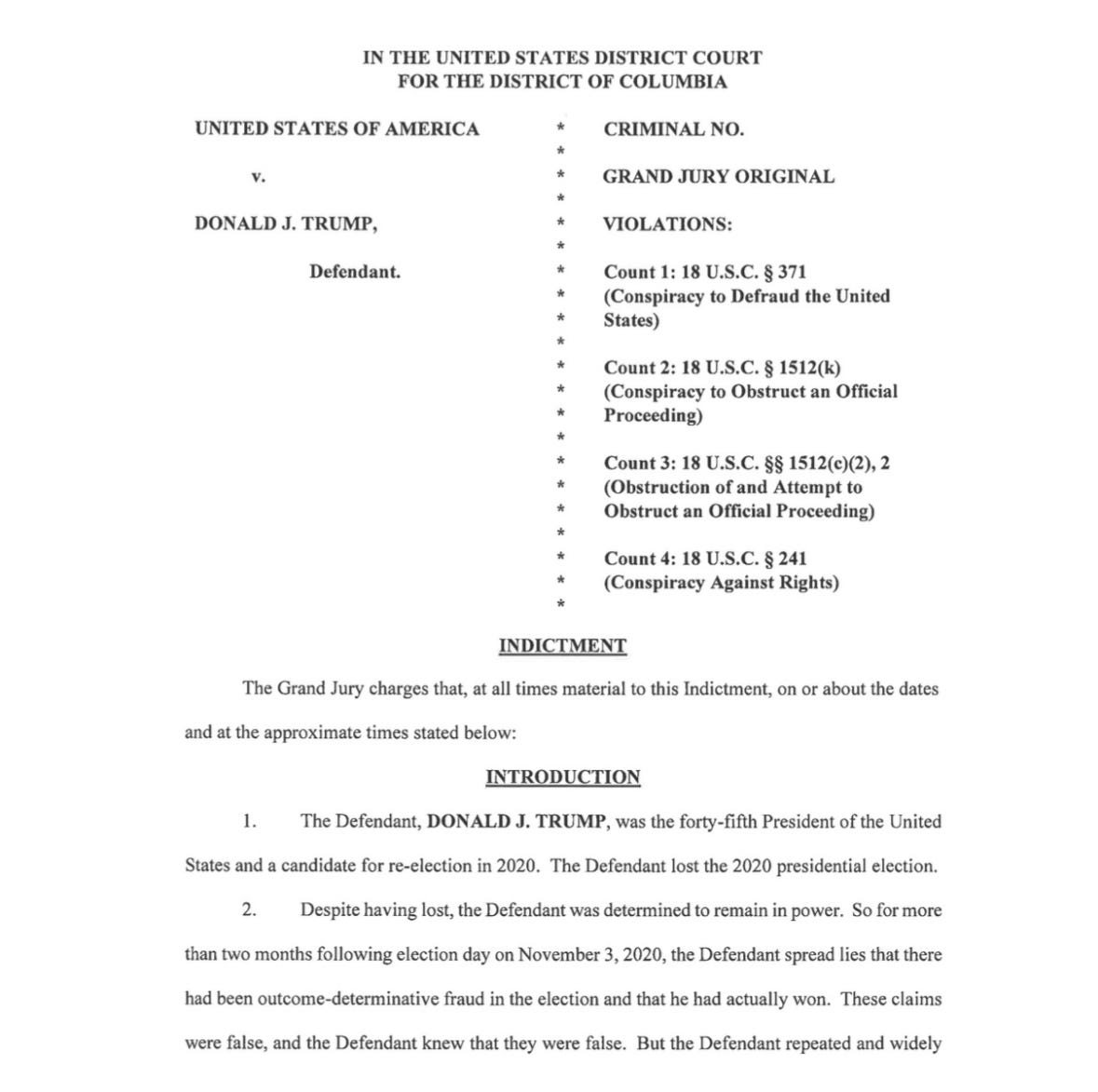
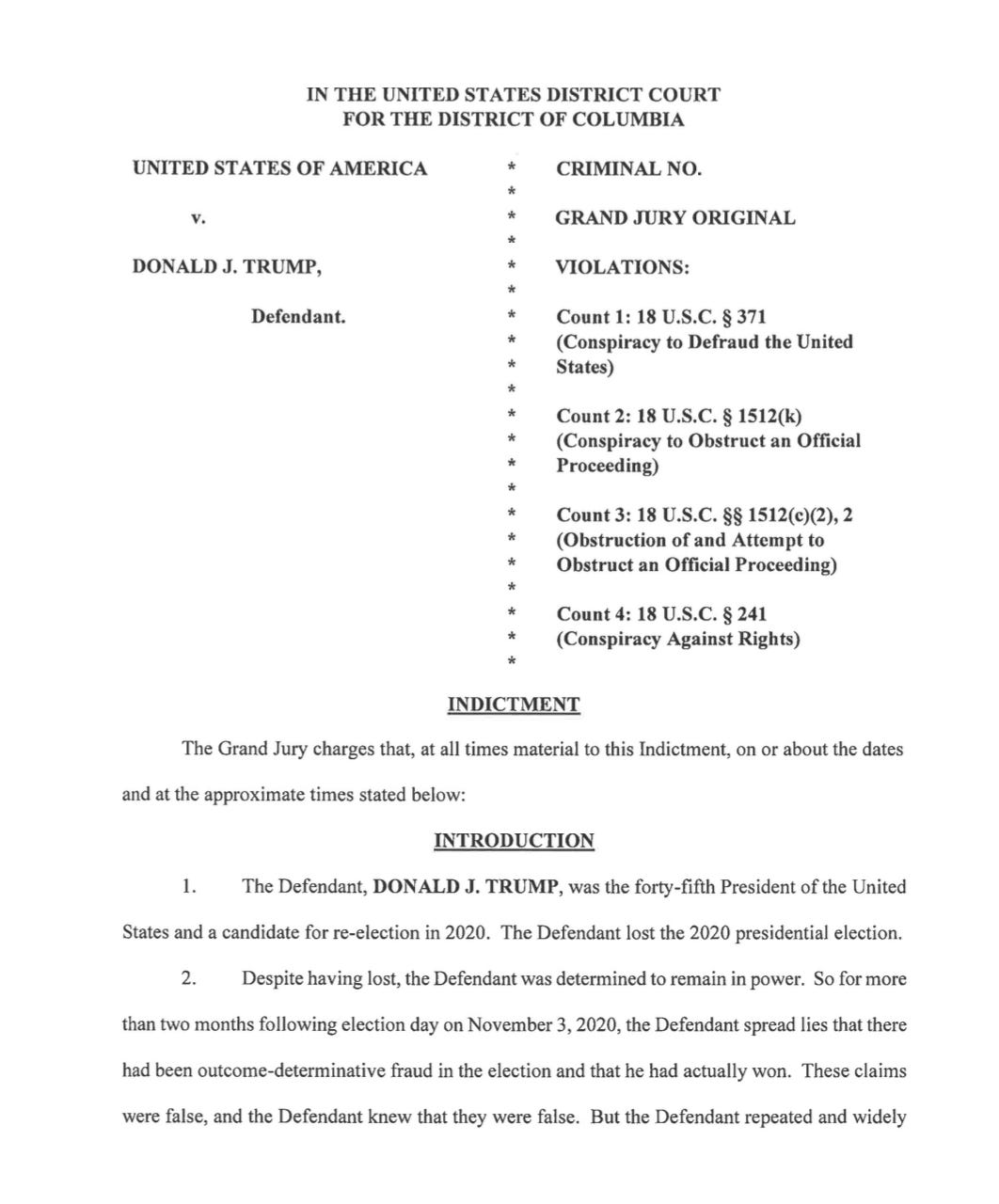
But in reading the indictment, all who love and care for our precious republic and its democratic traditions should feel a deep shudder of fear that we were driven to such a precipice. The writing itself is not fancy — no stacking of dependent clauses or diving into a thesaurus in search of adjectives. Reading the introduction aloud, it almost has the syncopation of a children’s picture book, even if the story it tells is one of horror: 

The Defendant, DONALD J. TRUMP, was the forty-fifth President of the United States and a candidate for re-election in 2020. 

The Defendant lost the 2020 presidential election.

Despite having lost, the Defendant was determined to remain in power. 

So for more than two months following election day on November 3, 2020, the Defendant spread lies that there had been outcome-determinative fraud in the election and that he had actually won. 

These claims were false, and the Defendant knew that they were false.

But the Defendant repeated and widely disseminated them anyway — to make his knowingly false claims appear legitimate, create an intense national atmosphere of mistrust and anger, and erode public faith in the administration of the election.

The Defendant had a right, like every American, to speak publicly about the election and even to claim, falsely, that there had been outcome-determinative fraud during the election and that he had won. 

He was also entitled to formally challenge the results of the election through lawful and appropriate means, such as by seeking recounts or audits of the popular vote in states or filing lawsuits challenging ballots and procedures. 

Indeed, in many cases, the Defendant did pursue these methods of contesting the election results. 

His efforts to change the outcome in any state through recounts, audits, or legal challenges were uniformly unsuccessful. 

Shortly after election day, the Defendant also pursued unlawful means of discounting legitimate votes and subverting the election result.

What follows that in the indictment is a story we all saw unfold in real time, laid bare in a double-spaced legal document. There is also a lot to read between the lines. Even former Trump Attorney General Bill Barr, who enabled many of Trump’s worst instincts and misled the American public about Trump’s fitness for office, told CNN he thinks prosecutors have more evidence than what they have shared thus far. He called the indictment “very spare” and added, “I think there’s a lot more to come and I think they have a lot more evidence as to President Trump’s state of mind.” 

Be that as it may, these 45 pages comprise one of the most consequential pieces of writing in American history. It does not have the earth-shattering rhetoric of our Declaration of Independence, the poetry of Lincoln’s “Gettysburg Address” or the urgent morality of Dr. Martin Luther King’s “Letter from Birmingham Jail.” But it is a clear statement at one of the most pivotal intersections in our nation’s narrative; that autocracy and the fomenting of political violence to subvert the peaceful transfer of presidential power is not only anathema to our values — it is illegal. 

History is riddled with “what ifs.” We are left to ponder what the worst outcomes might have been if things had turned out differently, from our own revolution, to World War II, to the Cuban Missile Crisis. January 6 should be added to that list. 

As bad as it was, it could have been (and came close to being) much worse. And that reality bursts forth from this indictment. According to what is written in the indictment, violence was expected by Trump and his co-conspirators. They understood that their schemes to steal an election would almost certainly plunge the nation into chaos. That was the plan. 

In the end, their plot was unsuccessful, but the danger has not receded. Trump is running for president. At this point he is the favorite, by far, to win the Republican nomination. And that means he could win reelection. That result would likely usher in chaos, greater and deeper division than even what we now have. It could very well end the country as we know it. 

That may sound to some to be hyperbole, but by any reasonable analysis, that is a lesson to be learned from this indictment. And that is what Jack Smith hopes to prove in federal court. One can make a credible argument that this is one of (if not THE) most consequential criminal cases in American history. 

A former and potentially future president is accused of trying to destroy the United States. His own vice president is a key witness. You couldn’t make this up. But this is the reality of what we face. Democracy is always fragile and must be fought for to survive. A free people must constantly be on alert and working to preserve their liberty.

At the birth of our nation, Benjamin Franklin is said to have quipped that the Framers had produced “a republic, if you can keep it.” Lincoln, in his Gettysburg Address, spoke of how the Civil War was a “test” of whether a nation “conceived in Liberty, and dedicated to the proposition that all men are created equal … can long endure.” We, the people, can take nothing for granted.

This concept of the United States of America, still relatively new in human history, is impossible to maintain without the continual peaceful transfer of power at the top. That is what this new indictment is about. 

In his first inaugural address as governor of California in 1967, Ronald Reagan spoke eloquently of this truth: 

“We are participating in the orderly transfer of administrative authority by direction of the people. And this is the simple magic of the commonplace routine, which makes it a near miracle to many of the world’s inhabitants. This continuing fact that the people, by democratic process, can delegate power, and yet retain the custody of it. Perhaps you and I have lived too long with this miracle to properly be appreciative. Freedom is a fragile thing and it’s never more than one generation away from extinction. It is not ours by way of inheritance; it must be fought for and defended constantly by each generation.”

This is what is at stake for the generations alive today. It is an epic battle that will now take place in federal court as well as at the ballot box. 

Note from Joyce: Alabama’s Attorney General Wants to Control Your Access to Reproductive Medical Care

Here’s the link to this article.

By JOYCE VANCE

 LISTEN

Featured Image
  • Show Notes

Dear Reader,

On Monday, the ACLU sued Alabama Attorney General Steve Marshall on behalf of the West Alabama Women’s Center and the Alabama Women’s Center, both providers of women’s medical care and support. They sued because Alabama is trying to extend its state abortion ban beyond its borders by making it illegal for people to help Alabamians access abortion in states where it remains legal.

You’ll recall the underlying premise of the Supreme Court’s decision in Dobbs, when it upset 50 years of abortion rights. The Court said the decision about whether – and to what extent – abortion should be legal would be left up to each state. Post-Dobbs, some states have continued to permit women to make their own medical decisions, while others have imposed bans, some near-total. But even a near-total ban is not enough for Alabama, where the Attorney General has announced his intention of trotting out a never-used 1896 conspiracy provision to criminally prosecute those who assist individuals who want to travel across states lines – something we are all free, as Americans, to do – in order to obtain legal abortion care outside of Alabama. 

This is the next frontier in expanding newly-permissible state bans on abortion care. The courts will have to decide whether the Supreme Court meant it when it said abortion was an issue for each state to decide for its residents. Because now that conservative states have expanded abortion bans as far as they can within their borders, the push to extend them beyond their borders is on, in lieu of a highly unpopular national ban. This is the next fight. 

Alabama Attorney General Marshall threatened to prosecute people who help Alabamians travel out of state to obtain abortions where they are legal. Attorneys general in red states like Idaho, where there is litigation pending as well, and Alaska, have said they will seek criminal penalties against those who help pregnant people obtain out-of-state abortions. 

Strangely, Marshall has conceded that “There’s nothing about [Alabama] law that restricts any individual from driving across state lines and seeking an abortion in another place.” And yet, he publicly made the threats to prosecute those who do and who help others to do so. That’s the heart of the concern here: making the threat chills people’s exercise of their constitutional rights. Fear about the threat of prosecution accomplishes what the state knows it cannot do constitutionally: prosecuting people for leaving or helping someone leave the state to visit another state and do something there that is entirely legal.

The Plaintiffs, who currently provide non-abortion reproductive health care to pregnant patients in Alabama, are afraid that if they provide information, counseling, or other forms of practical support to assist pregnant people who may end up going out of state to obtain care, they’ll be prosecuted as conspirators or accessories. To avoid the chill on exercise of rights to which all of this uncertainty leads, they ask the courts to clarify that Alabama cannot prosecute them for assisting Alabamians who want to travel across state lines and access legal abortion care.

Meagan Burrows, an ACLU attorney representing the plaintiffs, characterized the lawsuit this way: “Because Alabama cannot constitutionally ban abortion in states that have chosen to keep abortion legal, the Attorney General is instead trying to have the same effect by criminalizing the provision of information and assistance to Alabamians seeking to exercise their constitutional right to cross state lines for lawful abortion care. But this too is blatantly unconstitutional. We’re hopeful that the Court sees through this attempted end-run around the constitutional limits on Alabama’s power.”  

One important question is whether the plaintiffs have standing to bring the case. No one has been prosecuted yet, and as students of the last Supreme Court term know, plaintiffs must have standing to sue, which means there must be an actual case or controversy for the court to resolve. While standing may not be apparent here, there is actually a strong argument the court should hear this case now. This is a classic pre-enforcement challenge, allowing the plaintiffs to challenge Alabama before it takes any enforcement action to avoid scaring people out of exercising their constitutional rights. Situations like this are why pre-enforcement of the law challenges exist.

Many of the people who need access to abortion services are low-income Alabamians who lack the resources to negotiate the patchwork quilt of abortion laws that blanket the country. They need to be able to get advice they can trust from their doctors. Depriving them of that kind of assistance realistically ends their right to travel to another state. This kind of interstate travel advice doesn’t seem to be a problem when people can take advantage of marijuana tourism. Abortion is not different. Medical professionals have a First Amendment right to provide advice, and pregnant people have a right to take advantage of it and to travel if they choose to. 

In his Dobbs concurrence, Supreme Court Justice Brett Kavanaugh acknowledged the right Americans have to travel between states in this context. “For example,” he said, “may a State bar a resident of that State from traveling to another State to obtain an abortion? In my view, the answer is no, based on the constitutional right to interstate travel.” Alabama’s Attorney General, while paying lip service to that legal principle in one breath, seemed determined to roll it back in the next. He has said that he intends to enforce Alabama’s abortion ban to its fullest extent, which means not just in-state, but out of state, too. The plaintiffs in the newly-filed case are taking him at his word – which leaves them unable to “provide specific information, counseling, and other forms of practical support to assist individuals who are seeking to exercise their constitutional right to cross state lines and obtain legal medical care outside of Alabama” – and we should too, unless and until a court says otherwise. 

The impact of Attorney General Marshall’s actions and the outcome of this lawsuit will have a ripple effect far beyond the borders of Alabama. This case may shape the contours of Americans’ rights across the country. A decision that Alabama’s Attorney General can sacrifice Alabamians’ rights on the altar of his political views will mean the same for people throughout the United States. It’s essential that the courts protect people’s rights in the face of the intransigence of states like Alabama that want to impose their own views on others.

Stay Informed,

Joyce

What he did

Here’s the link to this article. I encourage you to subscribe to Steve Schmidt’s The Warning.

STEVE SCHMIDT

AUG 3, 2023

Photo credit: Spencer Platt/Getty Images

Donald Trump tried to overthrow the American republic because he lost an election. Nearly every single Republican member of Congress helped him do it by suborning his ceaseless and premeditated lies. They stoked the fires of incitement that led to Trump’s coup as his collaborators and partners. Ambition and fear overwhelmed their duty and patriotism.

The wretched truth is that with scant exceptions the entirety of the Republican Party from its elected officials, party officials, donors, activists and volunteers abandoned America in favor of their faction. George Washington’s fears had come to pass just as his warnings went unheeded by this generation of Americans. In his farewell address on September 17, 1796, he said the following:

However [political parties] may now and then answer popular ends, they are likely in the course of time and things, to become potent engines, by which cunning, ambitious, and unprincipled men will be enabled to subvert the power of the people and to usurp for themselves the reins of government, destroying afterwards the very engines which have lifted them to unjust dominion.

Every American has an absolute obligation and duty to read the details of the most important criminal indictment in American history carefully and thoroughly. The language is stark, vivid and declarative. The indictment rejects the jaundiced notion that there is dispute around the details of the election. Instead, it boldly embraces reality in a way that the overwhelming majority of the American media has refused to do so on a consistent basis. It declares flatly and directly:      

He absolutely did lose the 2020 presidential election. Yet, he wanted power. What he did was try and take it through a conspiracy of lies and thuggery. Though he knew he lost, he didn’t care. What followed was the most reprehensible actions in American history by an American president. They represent a betrayal of stupendous dimensions. What Donald Trump did was amoral, illegal and nearly cataclysmic.

The Warning with Steve Schmidt is a reader-supported publication. To receive new posts and support my work, consider becoming a free or paid subscriber.

Upgrade to paid

Donald Trump desecrated the sacrifices and patriotism of the men and women who laid down their lives so America could endure and survive. He tried to take America away from all of us. Donald Trump isn’t just a failed and seditious president and an accused criminal, he is an abomination and every loyal citizen should be enraged by what he did. He assaulted our ancestors and our descendants, while trying to burn down our way of life and taking our right to choose our leaders from us. It cannot be forgiven, excused, rationalized or minimized. The propaganda of Fox News and all of its derivative media cannot hide the simple truth. Trump tried to destroy the United States. He is a domestic enemy.

We must not allow the ambitions of one man and his cabal to destroy the American way of life. It cannot happen. It must be fiercely opposed. Donald Trump and his cause are a national cancer, and it remains deeply embedded in our politics. This age of extremism must yield, or democracy will be lost.

The only thing that matters is that the Republican frontrunner doesn’t believe in democracy. He is running on a platform of revenge and retribution.

Everything is on the line in 2024. Will it be America’s last election not decided in advance?

Let’s hope not, and let’s work very hard to make sure it isn’t.

How to Read the Indictment

Here’s the indictment. Click trumpj6indictment link below for larger view.

Now, to Joyce Vance’s excellent article.

United States v. Trump, again

Here’s the link to Joyce’s article. Please read!

JOYCE VANCE

AUG 2, 2023

First off tonight, I want to thank all of you who sent emails and left comments about my Mom. I appreciate all of them, I’ve read through them and continue to read them. I’ve gained a lot of strength from your support, and I’m touched and honored by the stories you’ve shared. Thank you from the bottom of my heart.

Today, Tuesday, August 1, 2023, was the day the Justice Department indicted the wretch of a former president for trying, and damn near succeeding, in preventing American voters from determining the outcome of the presidential election in 2020. It’s about time.

The January 6 investigation was massive, and it’s remarkable Jack Smith got to this point so quickly. He owes a huge debt of gratitude to the House January 6 Committee, which did prosecutors’ work, unearthing much of the evidence that was used to indict. In a very real sense, prosecutors in this case stand on the shoulders of the members of the House who insisted on pursuing the investigation and made Americans believe that accountability for the former president was possible.

The conduct, the swarm of different angles Trump worked to try and steal the election, makes for a complicated prosecution. It was a massive effort at political interference in the constitutional processes that make our country a republic. The factual basis for the charges, even though we’ve lived through the events themselves, is not simple like the Mar-a-Lago classified documents case is. There you can readily wrap your mind around the basics and understand Trump kept classified documents he wasn’t entitled to and obstructed the government’s efforts to get them back. You can’t do the January 6 investigation in one sentence like that. Trump had a lot of moving parts in play to try and hold onto power, some legal, and many others not.

So the question has always been, how would Jack Smith make sense of it all, organize the conduct, and charge this case? It has to be done in a way that, legally speaking, is air tight—there’s no point in fighting for a conviction that you lose on appeal—but it also has to make sense out of a morass. For instance, we all understand now that there was a scheme to use fake slates of electors to try and interfere with the count of votes under the Electoral Count Act. But in the wake of the election, as news of an event here and another there began to emerge, we didn’t have the roadmap we have now for understanding the component pieces, which include efforts in swing states, the attempt to pervert DOJ, the pressure campaign on Pence, and so on. That’s the challenge: draft an indictment that will make compelling sense to 12 jurors in a courtroom who get to hear all the evidence and make a decision based on it. Which of Trump’s many crimes do you charge him with?

Now we know.

Tonight, I want to give you a bit of a guide for reading the indictment for yourself. I think it’s important to do that. Set aside an hour or two, or find ten minutes here and there over the course of the next week. You’ll understand it better if you read it for yourself. The indictment is written in a manner that makes it clear prosecutors wanted it to be comprehensible to anyone who wanted to read it.

The indictment is a speaking indictment—the story of the three conspiracies that are charged is told in detail.

First off, you get some framing in the introductory paragraphs. The government alleges that Trump “spread lies” and that he “knew that they were false.” And it sets up some parameters: Trump could legally lie about the election and say it was tainted by fraud. That’s okay—what I would call awful but lawful. He could challenge the results in court and seek recounts. But DOJ draws the line in paragraph 4 and says that what he can’t do is pursue “unlawful means of discounting legitimate votes and subverting the election results.” In other words, some of what he did, the lawsuits for instance, was lawful. His lies to the public were distasteful and inappropriate but still, not crimes. But then Trump crossed the line into criminal. That’s the conduct, we learn in the introduction, that we’re going to hear about in the rest of the indictment.

It’s done artfully; it clarifies that this isn’t about going after Trump for his speech, which is arguably (at least in his view) protected by the First Amendment. It’s about his conduct, illegal conduct. In the opening lines of the indictment, prosecutors effectively gut the First Amendment defense Trump has been floating for the last two years.

There is only one defendant, Donald Trump. That’s likely a strategy for streamlining the process to get the case to trial as quickly as possible. He has six uncharged and therefore unnamed (but as good as identified) co-conspirators. We’ll get to them in a moment. The indictment alleges three separate conspiracies:

  • one to defraud the United States by interfering with the lawful processes that are used to collect, count, and certify the presidential election (18 USC § 371)
  • one to obstruct the January 6 congressional proceeding in which the results are counted and certified (18 USC § 1512)
  • one to defeat citizens’ right to vote and have their votes counted (18 USC § 241)

It alleges that each conspiracy was fostered by the “widespread mistrust the Defendant was creating through pervasive and destabilizing lies about election fraud.” There is also one substantive charge of obstruction related to the second conspiracy.

The penalties are serious. 18 USC § 371 carries a five-year maximum. The two charges under 18 USC § 1512 each have a 20-year maximum penalty. And the maximum penalty for violating 18 USC § 241 is 10 years. While the sentencing guidelines often set a lower range the judge is advised to sentence within, here, and especially if Trump has picked up one or more prior convictions before he’s sentenced, there is serious time associated with conviction on any one of these charges.

Here’s the trick to understanding the indictment. Because the same facts underlie each of the charges, the government sets them out only once, in the first count. Then it adopts them as the factual basis for each of the next three charges. That means that the first count, which begins on page 3, takes up the bulk of the indictment. It concludes on page 42. But once you’ve read it, you have the facts and the key aspects of each of the conspiracies that are charged. If you want a refresher on the basics of conspiracy law before you get started, we did that here at Civil Discourse, back in July of 2022, with chicken videos to explain the finer points of the law: “Conspiracy! Understanding the basics (with chickens).”

First, we get the “purpose of the conspiracy.” This is a standard inclusion in conspiracy indictments. In essence, here, it’s the purpose of all three conspiracies. The government alleges Trump’s purpose “was to overturn the legitimate results of the 2020 presidential election by using knowingly false claims of election fraud to obstruct the federal government functions by which those results are collected, counted, and certified.” The plain, legal prose is so dry that it almost masks what this is about: a president who wanted to take away the right of Americans to vote.

The next section clarifies who the “co-conspirators” referred to throughout the indictment are. But because they aren’t charged in the indictment, DOJ policy says they can’t be identified by name. Instead, we get descriptions that all but identify them after informing us that Trump “enlisted co-conspirators to assist him in his criminal efforts to overturn the legitimate results of the 2020 presidential election and retain power.” I’ve added their likely identities in italics following the language describing them from the indictment:

a. “Co-Conspirator 1, an attorney who was willing to spread knowingly false claims and pursue strategies that the Defendant’s 2020 re-election campaign attorneys would not.” Rudy Giuliani

b. “Co-Conspirator 2, an attorney who devised and attempted to implement a strategy to leverage the Vice President’s ceremonial role overseeing the certification proceeding to obstruct the certification of the presidential election.” Trump lawyer John Eastman, whose communications were disclosed after a judge found the crime–fraud exception meant the attorney–client privilege should be set aside

c. “Co-Conspirator 3, an attorney whose unfounded claims of election fraud the Defendant privately acknowledged to others sounded ‘crazy.’ Nonetheless, the Defendant embraced and publicly amplified Co-Conspirator 3’s disinformation.” “Kraken” lawyer Sidney Powell

d. “Co-Conspirator 4, a Justice Department official who worked on civil matters and who, with the Defendant, attempted to use the Justice Department to open sham election crime investigations and influence state legislatures with knowingly false claims of election fraud.” DOJ environmental lawyer and AG wannabe Jeffrey Bossert Clark

e. “Co-Conspirator 5, an attorney who assisted in devising and attempting to implement a plan to submit fraudulent slates of presidential electors to obstruct the certification proceeding.” Kenneth Chesebro, another lawyer involved in devising the fake electors scheme

f. “Co-Conspirator 6, a political consultant who helped implement a plan to submit fraudulent slates of presidential electors to obstruct the certification proceeding.” Identity unclear

Next up is a section entitled “Federal Government Function” that manages to explain, in one paragraph, how the electoral college system works. It will also make you wonder why we still use this godforsaken system that unduly focuses presidential selection power in less populated parts of the country, but we’ll leave that for another day. Like all conspiracy indictments, this one has an involved section on “Manner and Means,” which is an overview that explains how they did it. Here, it’s a helpful summary of all the conduct that’s laid out next. There is the use of fake fraud claims to try and subvert the outcome of state elections, the fraudulent slates of electors, the attempted subversion of DOJ, the pressure campaign on Vice President Mike Pence, and Trump’s exploitation of the violence at the Capitol on January 6 to try and convince Congress to delay certification of the vote.

Before the indictment dives into the details of those means of effectuating the conspiracies, we get a section you don’t normally see in indictments, where the government sets forth its evidence that Trump knew the fraud claims he was making about the election were false. We discussed the importance of the government being able to use circumstantial evidence to establish what was going on inside of Trump’s mind, notably, that he knew he’d lost the election but lied about it. The government uses three and one half pages of the indictment to set out its evidence in that regard in detail. With that important detail established, we then get a detailed layout of each of the “Manner and Means” of executing the conspiracy, and it’s here that you may want to spend some time. Most of the contours are familiar; we know about the events in Georgia, for instance, but some of the detail is informative, and it’s an excellent refresher to make sure you remember the details you first learned while watching the January 6 Committee hearings.

So we get a speaking indictment, or as MSNBC anchor Ari Melber quipped tonight, a shouting indictment. We still have some unanswered questions. The status of the unindicted co-conspirators isn’t clear. Often, people identified that way are cooperators, but that doesn’t appear to be the case here. It seems likely that some or all of these people will face charges in the future. Their crimes are set out clearly in the indictment, and there’s little rationale other than expediency, a weak one at best, for permitting them to escape accountability for their conduct. But there are other people who appear to be working with the government. Mike Pence, after trying to fight off his subpoena with all sort of excuses, testified and would seem to be the only possible source of information about his personal conversations with Trump, which includes this fascinating passage in paragraph 90:

On January 1, the Defendant called the Vice President and berated him because he had learned that the Vice President had opposed a lawsuit seeking a judicial decision that, at the certification, the Vice President had the authority to reject or return votes to the states under the Constitution. The Vice President responded that he thought there was no constitutional basis for such authority and that it was improper. In response, the Defendant told the Vice President, “You’re too honest.” Within hours of the conversation, the Defendant reminded his supporters to meet in Washington before the certification proceeding, tweeting, “The BIG Protest Rally in Washington, D.C., will take place at 11.00 A.M. on January 6th. Locational details to follow. StopTheSteal! [emphasis added.]

Still more interesting is the question of Mark Meadows’ status. In paragraph 28, there is information that seems like it would have to have come from him: “On December 23, a day after the Defendant’s Chief of Staff personally observed the signature verification process at the Cobb County Civic Center and notified the Defendant that state election officials were ‘conducting themselves in an exemplary fashion’ and would find fraud if it existed, the Defendant tweeted that the Georgia officials administering the signature verification process were trying to hide evidence of election fraud and were ‘[t]errible people!’” If Meadows is actually cooperating, in the sense that he’s finally decided to share everything he knows about Trump with prosecutors, that would be big. But there’s little additional information in the indictment to suggest that. Prosecutors aren’t obligated to reveal all of their evidence, but in the event they want to convince some of the six unindicted co-defendants to cooperate, they might want to show off a little more evidence to help them understand the peril of their situation if they don’t. Five of them, after all, are lawyers, and all quite capable of assessing the evidence. It’s surprising we don’t get more here if Meadows is in fact on board.

So, take some time when you can, and read the indictment for yourself! Encourage others to do it, too. Most importantly, don’t accept the defeatist mentality that no Trump supporters can take in the information and change their minds. While his hardcore base may not, there are others who may support him for policy or political reasons, but who, when confronted with the hard facts about his complicity, including Count Four where he is charged with a conspiracy to interfere with Americans’ right to vote, may finally decide they’ve had enough.

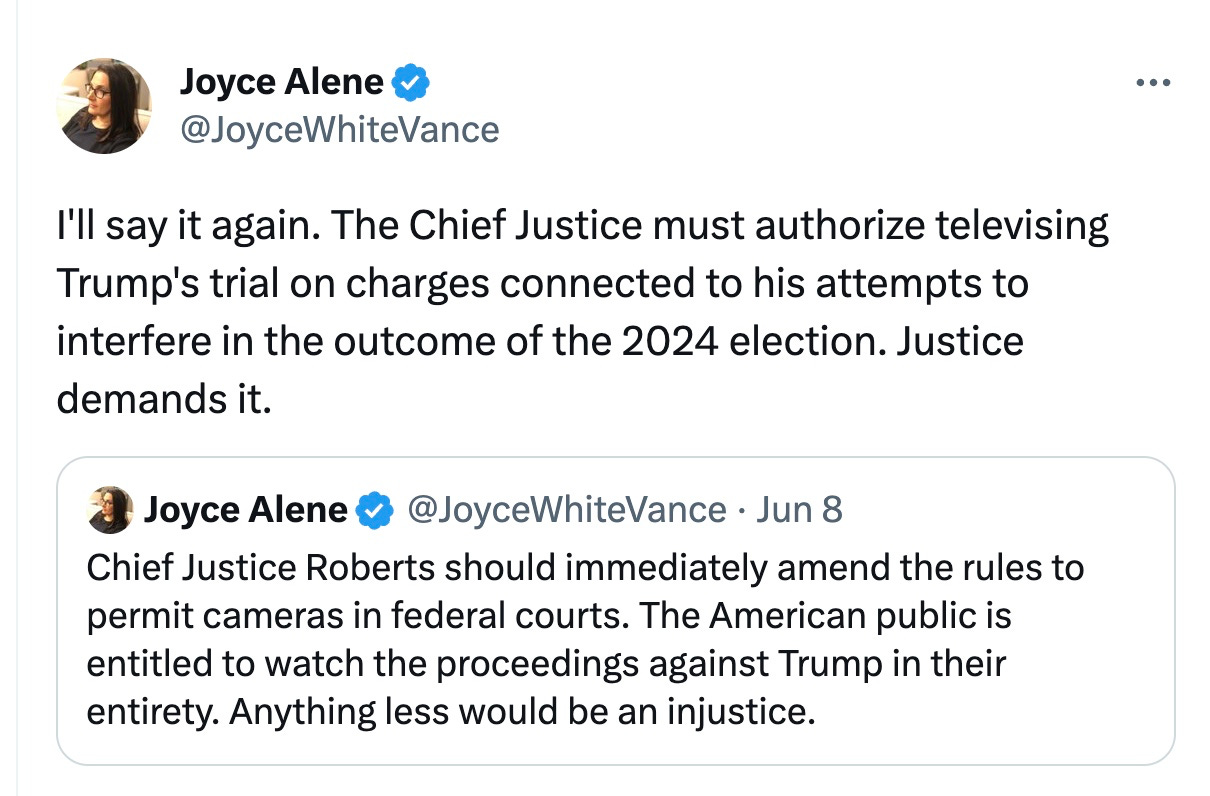
Finally, cameras in the courtroom. Chief Justice Roberts could ensure these proceedings were made publicly available. He can order that there be cameras in the courts. And he should. That final charge makes it clear that we are all victims of this crime. We have the right to watch the proceedings.

Because this isn’t a case about classified information. We’ll see more of the proceedings in public, and it should kick into gear more quickly, with arraignment scheduled for Thursday afternoon. The Judge, Obama appointee Tanya Chutkan, confirmed in the Senate by a vote of 95-0 in 2014, has signaled she means business with that prompt kickoff. But given the time it takes to get cases to trial in the District of Columbia’s courts, often over a year and a half, we’ll have to wait to see if there’s even a prospect of this case, so highly important and certain to be aggressively litigated, getting to trial ahead of the election.

Today was one of the good days for people who believe in the Republic. No man should be above the law. Trump is finding out that democracy and the Constitution are for real.

We’re in this together,

Joyce

p.s.: If you’re not already a paid subscriber and you’re enjoying Civil Discourse, I hope you’ll consider up-subscribing (if that’s a word). But we live in challenging times, and I understand that not everyone can or wants to buy a paid subscription. I’m happy to have you here either way! I’m glad we’re all committed to saving the Republic. Tonight, it feels like we’re making progress.

The Ultimate Deal

Here’s the link to this article. Please subscribe to The New York Review of Books.

Fintan O’Toole

Trump’s hoarding of official secrets is both breathtakingly careless and utterly calculated.

June 10, 2023

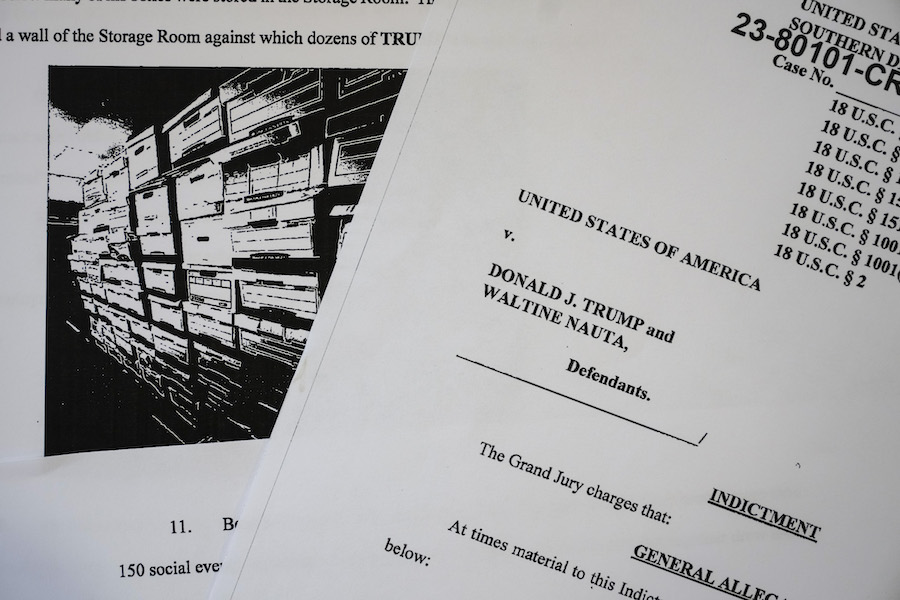
Department of JusticePhotographs from 2021 of boxes of documents in storage at Mar-a-Lago, included in the Justice Department’s indictment of Donald Trump

Secrets are a kind of currency. They can be hoarded, but if kept for too long they lose their value. Like all currencies, they must, sooner or later, be used in a transaction—sold to the highest bidder or bartered as a favor for which another favor will be returned. To see the full scale of Donald Trump’s betrayal of his country, it is necessary to start with this reality. He kept intelligence documents because, at some point, those secrets could be used in a transaction. What he was stockpiling were the materials of treason. He may not have known how and when he would cash in this currency, but there can be little doubt that he was determined to retain the ability to do just that.

Before the publication of the grand jury’s indictment, it was possible to believe that Trump’s retention of classified documents was reckless and stupid. The indictment reveals that recklessness and stupidity are the least of his sins. With Trump, it’s always a mistake to equate anarchy with purposelessness or to think that the farce is not deadly serious. Trump’s hoarding of official secrets is both breathtakingly careless and utterly calculated. At the heart of that calculation is a cold resolve to not give up the power that access to highly restricted information had given him.

The most immediately striking parts of the indictment may, in this regard, be something of a distraction. The photographs that show boxes of papers at Mar-a-Lago, piled high on a ballroom stage, in a bathroom, and spilling out onto the floor of a storage room, convey an almost comic sense of chaos. If comedy is generated by incongruity, what could be more incongruous than nuclear plans or details of “potential vulnerabilities of the United States and its allies to military attack” sitting beside a toilet?

It all seems random and haphazard, an impression greatly magnified by the knowledge that Mar-a-Lago, in the eighteen months after Trump took the documents from the White House, was, as the indictment states, the venue for “more than 150 social events, including weddings, movie premieres and fundraisers that together drew tens of thousands of guests.” The New York Times has published photographs, scraped from social media, of people in party dresses or casual summer clothes around the Mar-a-Lago pool. We can see that, behind them, the door that leads to the storeroom, which was packed with boxes of official papers, is wide open. In those boxes, when the FBI opened them in August 2022, were eleven documents marked Top Secret, thirty-six marked Secret, and twenty-eight marked Confidential. It would have been the least thrilling spy thriller ever made. No James Bond high-tech gadgets or George Smiley ingenuity—just turn up in a cocktail dress, slip through an open door, and help yourself to the US military’s contingency plans for invading Iran.

Yet this ludicrous vulnerability to foreign spies is both remarkable and somewhat beside the point. The slapdash storage of classified papers is shocking—but also misleading. It defines the scandal as, in the words of Alan Feuer and Maggie Haberman in The New York Times, “Mr. Trump’s indifference toward the country’s most sensitive secrets.” But this is not a tale of indifference. Trump cared a great deal about the value of the documents. He cared enough, per the indictment, to suggest that his attorney lie to the FBI and a grand jury about what papers he did or did not have. Even Trump does not engage in a criminal conspiracy purely for its own sake. The retention of those boxes mattered to him because he understood the market value of what they contained.

It is important to bear in mind that chaos is Trump’s natural element. It is the medium in which his narcissism thrives. When there is no plan, the only law is his own desire. He alone knows at any given moment what he will do. In this light, the apparent disorderly storage of the boxes at Mar-a-Lago does not signify a lack of concern with what they contained. It is just the norm of Trumpworld. Derangement is his modus operandi.

The indictment makes clear that Trump knew very well that he was breaking the law. He was repeatedly warned by the National Archives and Records Administration that if he did not hand over the missing records, he would be referred to the Department of Justice. He had, of course, made a very big point in his attacks on Hillary Clinton of the need for zero tolerance for any lack of rigor in the handling of classified documents. He fully understood that the laws applied to everyone, including the president. As he declared in September 2016, before that year’s election, “We can’t have someone in the Oval Office who doesn’t understand the meaning of the word confidential or classified.” As president, in July 2018, he issued a statement saying that “as the head of the executive branch and Commander-in-Chief, I have a unique constitutional responsibility to protect the nation’s classified information, including by controlling access to it.”

More specifically, Trump knew that he was taking huge risks when he allegedly instructed his lawyer to lie to the FBI and the grand jury. That lawyer, quoted in the indictment, recalls that when Trump told him to take a folder of documents to his hotel room, he made a silent “plucking motion,” as if to say, “if there’s anything really bad in there, like, you know, pluck it out.” Precisely because Trump knew that he was committing a crime, he preferred not to utter the incriminating words. There is nothing thoughtless or accidental in all of this. He clearly believed that the risks were worth taking.

This does not suggest that he was holding these documents merely as souvenirs. It’s quite possible to believe that part of his motivation lay in his fantasy that he was still the real president: retaining the intelligence briefings he received as POTUS would make him still, at some level of self-delusion, potent. The two known occasions, cited in the indictment, when Trump produced some of the documents to outsiders while explicitly referring to them as secret and confidential have this air of showing off—perhaps as much to himself as to those he was trying to impress. It is also quite reasonable to think of him experiencing a tingle of pure pleasure in imagining his own impunity—knowing that he was committing the ultimate transgression and thrilling to the idea that he would get away with it because he had always in his life gotten away with everything.

Drew Angerer/Getty ImagesPages from the Justice Department’s indictment of Donald Trump, June 9, 2023

But these elements of twisted psychology can coexist with a more rational impulse: to keep hold of secrets that could be traded at some point for his personal gain. Trump sees himself above all as a deal-maker: “The nation’s classified information” is a potentially lucrative part of one or many deals.

This intent would be treasonous. Trump may not have actually committed treason, but he was consciously putting himself in a position to be able to do so. For what is not secret is the identity of the foreign countries that would be most interested in acquiring the details of the military plans and vulnerabilities of the US and its allies. The indictment states that the documents also included information that could identify US agents and informants in some of those countries and “the continued viability of sensitive intelligence collection methods.” This is worth underlining: Trump went to great lengths to retain for himself, as a private citizen, the power to reveal to any foreign power not just US military secrets but the workings of US intelligence-gathering in those countries. It is impossible to believe that he did this accidentally or without considering that he might at some time use that power in return for some financial or other benefits.

Which makes it all the more astonishing that most of the Republican Party is fine with this. Much of the history of the right in America is bound up with paranoia about the possible existence of traitors at high levels of government. Here is stark evidence of the existence of one at the very highest level of government, and Republicans are rushing to defend him. The Elizabethan courtier Sir John Harington famously asked, “Treason doth never prosper: what’s the reason?” and answered, “For if it prosper, none dare call it Treason.” If the hoarding of state secrets as valuable currency cannot be called treason, the concept has gone the way of honor, truthfulness, and respect for law. It has ceased to exist for the Republican Party.

Fintan O’Toole

Fintan O’Toole is the Advising Editor at The New York Review, a columnist for The Irish Times, and the Leonard L. Milberg Professor of Irish Letters at Princeton. His most recent book, We Don’t Know Ourselves: A Personal History of Modern Ireland, was published in the US last year. (June 2023)

Modern Liberalism Born of Enlightenment Thought

Here’s the link to this article.

James A. Haught | March 31, 2023 | Kiosk Article


Values that later grew into liberalism began stirring in the epoch now known as the Enlightenment, starting more than three centuries ago, chiefly in England and France. It was an era when kings still ruled brutally by “divine right,” and the church still sought to execute “heretics” holding irregular beliefs, or jail skeptics for blasphemy. Most people were agricultural serfs, working on lands inherited by wealthy barons and counts. The bottom-rung majority had virtually no rights.

But the Enlightenment roused a new way of thinking: a sense that all people should have some control over their lives, a voice in their own destiny. Absolute power of authorities—either the throne or the cathedral—was challenged. Reformers asserted that human reason and the scientific method can improve society and benefit nearly everyone.

The 1600s were a time of ugly intolerance, much of it stemming from alliances between church and throne. In England’s notorious Star Chamber, controlled by the Anglican archbishop, Puritan and Presbyterian dissenters were forced to testify against themselves, then sentenced to have their ears cut off or their faces branded with markings such as S. L. (for seditious libeler). One victim, John Lilburne, became a public hero because he wrote pamphlets claiming that all people deserved “freeborn rights” not subject to king or church.

Europe was emerging from horrors of religious wars and massacres between Catholics and Protestants. Catholic France persecuted Huguenot Protestants. Jews were attacked cruelly and banned from certain nations, including England. Sporadic executions of “heretics” and “witches” still occurred. England’s last accused witch was put to death in 1684. A few others were executed around Europe and the New World for another century.

This was the background that helped spawn Enlightenment reform.

England was shattered by civil war in the 1640s between Parliament and Puritans on one side versus King Charles I and Anglicans on the other. Charles was beheaded and the power of kings was reduced—expanding an erosion that began four centuries earlier when barons forced King John to sign the Magna Carta, yielding certain rights.

By the late 1600s, some thinkers began pondering society and government.

Thomas Hobbes (1588-1679) wrote Leviathan asserting that people need a “social contract” to secure safe lives. In a dog-eat-dog natural state, he said, everyone suffers from “continual fear and danger of violent death; and the life of man [is] solitary, poor, nasty, brutish and short.” Therefore, he said, people must yield power to a sovereign government to enforce order and protect them. Hobbes supported a king as the sovereign—but the tide away from absolute kings already was flowing. Hobbes raised awareness that the social order is made by humans, not by God.

In his many writings, Hobbes repeatedly affronted the clergy. A bishop accused him of atheism, possibly punishable by death. The allegation subsided, then flared again. Nearing 80 years old, Hobbes hastily burned some of his papers and eluded prosecution.

John Locke (1632-1704) hatched notions of democracy, arguing that all people, male and female, deserve a degree of equality. He dismissed the divine right of kings, and advocated separation of church and state to avert religious conflict.

John Milton (1608-1674) was more than an epic poet who wrote in four languages. He also supported popular government and attacked state-mandated religion. When Parliament imposed censorship on writings, he defied a licensing requirement and published an Areopagitica pamphlet claiming that all thinking people are entitled to free expression of their beliefs. “Books are not absolutely dead things,” he said. “He who destroys a good book kills reason itself.” The principle of free speech and free press was furthered.

In France, Baron de Montesquieu (1689-1755) championed democracy and envisioned an elected government with power divided between executive, legislative and judicial branches.

Francois Marie Arouet (1694-1788)—”that consuming fire called Voltaire,” as Will Durant called him—was a brilliant French writer who became a heroic champion of human rights. Endlessly, he denounced cruelties of bishops and aristocrats. Here’s an example: In the devout town of Abbeville, a teen-age youth, Francois de la Barre, was accused of marring a crucifix, singing impious songs and wearing his hat while a church procession passed. He was sentenced to have his tongue torn out, his head chopped off, and his remains burned. Voltaire wrote bitter protests against this savagery. He helped appeal the youth’s case to Parliament, which showed “mercy” by affording the blasphemer a quick death by beheading—with a copy of Voltaire’s Philosophical Dictionary nailed to his body.

Voltaire’s protest writings roused ferment across Europe and won reversal of a few cases. He freed Jean Espinas, who had spent 23 years aboard a penal galley ship because he sheltered a fugitive Protestant minister for one night. Likewise, he freed Claude Chaumont from a galley bench, where he had been sentenced for attending a Protestant worship service.

In The Rights of Man, Thomas Paine wrote that Voltaire’s “forte lay in exposing and ridiculing the superstitions which priestcraft, united with statecraft, had interwoven with governments.”

At first, Enlightenment ideas were somewhat suppressed in Europe, where kings and archbishops still prevailed, but they found fertile ground in America’s colonies. Brilliant radicals such as Thomas Jefferson, John Adams, Benjamin Franklin and James Madison read them ardently and adopted them as a pattern for the first modern democracy, the United States of America. In the Declaration of Independence, Jefferson summed up the essence:

All men are created equal and endowed by their creator with certain inalienable rights, among these life, liberty and the pursuit of happiness.

Less-known founding father George Mason incorporated the principles into the Bill of Rights, keeping church and state apart, guaranteeing free speech, and protecting each person from abuses by the majority. Similarly, the personal liberties were reiterated in the Rights of Man and the Citizen adopted by the French Revolution, and eventually in the Universal Declaration of Human Rights that Eleanor Roosevelt helped craft for the United Nations.

Thus democracy became self-contradictory. A basic premise is majority rule—yet a bill of rights prevents majority rule. For example, the Christian majority cannot vote to banish minority Jews or skeptics. Personal beliefs are exempt from majority rule.

The Enlightenment was the seedbed that sprouted most of the liberal freedoms now enjoyed in democracies everywhere. It projected a model for humane, safe, fair modern life.

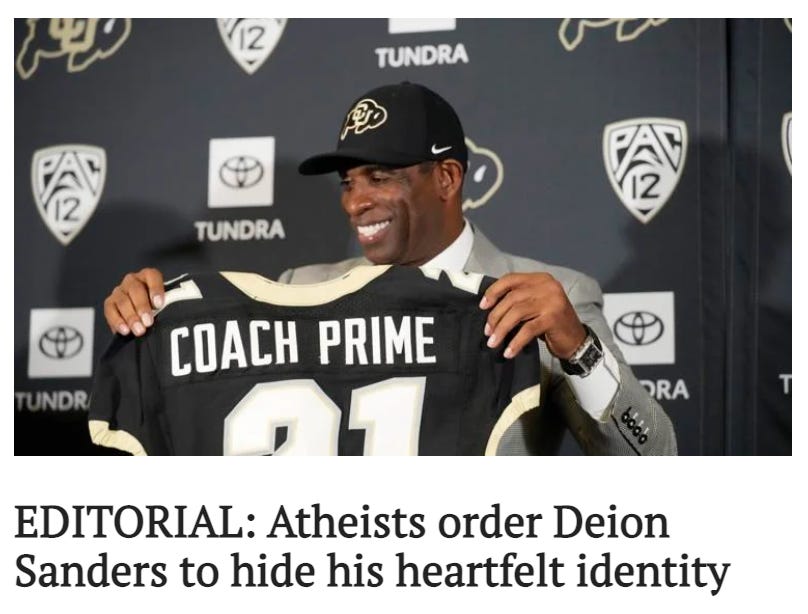
This editorial defending Coach Deion Sanders’ prayers is a massive fumble

Here’s the link to this article by Hemant Mehta.

The Gazette Editorial Board published a pathetic defense of proselytizing by an NFL legend hired to coach a college football team

Hemant Mehta

This Substack newsletter is free, but it’s only able to sustain itself due to the support I receive from a small percentage of regular readers. Would you please consider becoming one of those supporters? You can use the button below to subscribe to Substack or use my usual Patreon page!Subscribe


There are bad editorials. There are outright embarrassing ones. And then there’s the piece that was published today by the Pulitzer Prize-winning Gazette in Colorado Springs trashing the Freedom From Religion Foundation for calling out a beloved football coach.

When I first read it, I thought it had to be the work of a misinformed columnist since there’s no shortage of those, but nope, it was an editorial without a byline, representing the authority of the newspaper’s board. While the Gazette is a conservative paper owned by the same company that runs the right-wing Washington Examiner, it still stood out for how badly it defended a practice that needs to end.

Here’s the backstory: Back in December, NFL legend Deion Sanders was named the new head coach for the University of Colorado’s football team. The two-time Super Bowl winner would be paid a minimum of $5 million per year to turn around a team that went 1-11 last season and hasn’t won a bowl game in nearly two decades. Even if he failed, though, his name alone would bring attention and (some) prestige to a program that has been unable to earn it on merit.

Sanders hasn’t coached any games just yet. He’s in the process of building his staff and recruiting players for next season. But in December, one assistant coach allegedly began a meeting with an explicitly Christian prayer. And then in January, just before a team meeting, Sanders directed another coach to lead everyone in another Christian prayer:

Lord, we thank You for this day, Father, for this opportunity as a group. Father, we thank You for the movement that God has put us in place to be in charge of. We thank You for each player here, each coach, each family. In Jesus’ name, we pray. Amen.

It’s one thing to praise God during your first press conference, as Sanders did when he was hired; it’s another to foist one particular religion on students at a public university. This is something Sanders has been doing for years, too, as evidenced by pre-game warmups he did at Jackson State, where he coached before this new gig.

“Repeat after me,” Sanders tells his squad. “Lord, I love you. Lord, I thank you. Lord, I magnify you. Lord, I glorify you.

“Without You, I wouldn’t be a thing! A thing! A thing!”

The message was clear even if it went unstated: If you’re part of Sanders’ teams, then you better be on board with his prayers. Leaving the huddle, or remaining silent, or suggesting Christian prayers shouldn’t be part of of the coaching process could brand you as an athlete who’s not a team player. It could lead to less playing time. It could hamper your future opportunities. Even if that hasn’t happened yet, there’s a reason courts worry about religious coercion when it comes to adults at public schools leading or joining prayers with students. It’s true in high school and it applies to public colleges and universities.

In last year’s awful decision in Bremerton, the Supreme Court said that a public high school football coach’s post-game look-at-me-look-at-me-I’m-special prayers at midfield weren’t coercive. I believe that argument is wildly flawed, but even those conservative justices said a coach praying on his own (at least in theory) was okay even if a coach leading his team in Christian-only prayer would have crossed the line. The latter, they implied, was definitely coercive.

Deion Sanders, then, is doing something clearly illegal. It’s not just bad for team morale and a sign that the guy can’t coach since he’s relying on a Higher Power to do the heavy lifting; his Christian prayers violate the law.

That’s what FFRF reminded the university about in January when these reports surfaced. In a letter to Chancellor Phil DiStefano of the University of Colorado Boulder, attorney Chris Line explained how Sanders’ actions could jeopardize the school:

… It seems that in this case, Coach Sanders has not hired a Christian chaplain to impose religion on her players, but has done so himself, creating a Christian environment within his football programs that excludes non-Christian and non-religious players.

… Players trying to please their coach surely will feel immense pressure to participate in religious activities and go along with Coach Sanders’ proselytizing.

It is no defense to call these religious messages and activities “voluntary.” Courts have summarily rejected arguments that voluntariness excuses a constitutional violation.

Coach Sanders’ team is full of young and impressionable student athletes who would not risk giving up their scholarship, giving up playing time, or losing a good recommendation from the coach by speaking out or voluntarily opting out of his unconstitutional religious activities—even if they strongly disagreed with his beliefs. Coaches exert great influence and power over student athletes and those athletes will follow the lead of their coach. Using a coaching position to promote Christianity amounts to religious coercion.

FFRF wasn’t suing the school. They were just reminding the chancellor of the law and giving him the opportunity to correct the mistake. Sanders could run his program as he saw fit, but there were legal limits. Pushing Jesus on his athletes was not an option. (The conservative legal group First Liberty Institute sent its own letter telling the school Sanders was in the clear. As usual, FLI is wrong.)

FFRF’s letter worked. The university wrote back to them the following week and said they spoke with Sanders about the problem:

“Last Friday, the Office of Institutional Equity and Compliance personally met with Coach Sanders to provide guidance on the nondiscrimination policies, including guidance on the boundaries in which players and coaches may and may not engage in religious expression,” University of Colorado Executive Vice Chancellor and Chief Operating Officer Patrick T. O’Rourke recently responded to FFRF“Coach Sanders was very receptive to this training and came away from it with a better understanding of the University of Colorado’s policies and the requirements of the Establishment Clause.”

Even if you don’t believe a word of that, the university did the right thing. They acknowledged the line had been crossed, they made clear that Sanders was also aware of it, and they assured FFRF it wouldn’t happen again.

That should’ve been the end of the story. Everyone was on the same page.

Except, that is, the editorial board of The Gazette. Their headline gives away the game: “Atheists order Deion Sanders to hide his heartfelt identity.”

We could refute the headline alone, but it’s worth going through the whole piece. Right from the beginning, things start going downhill:

Diversity must threaten the Freedom From Religion Foundation. The club’s 15-member “honorary board” consists only of white anti-religionists. These self-righteous faux legal proselytizers want everyone to live and believe as they do.

It’s bizarre that they focus on the honorary board rather than the actual board of directors which includes people of color, but the central point is still wrong: FFRF, which is unabashedly atheistic, wasn’t asking Sanders or the university to adopt a position of atheism. Sanders can talk about God all he wants in his personal life. He won’t even get much backlash for doing it during press conferences. Well-deserved eyerolls? Maybe. But no lawsuits.

That nuance, which is the basis of this whole controversy, was lost on the editorial board. But they kept going.

It is no surprise this outfit wants national treasure Deion Sanders to behave as they dictate in his new role as the University of Colorado’s football coach. They want the NFL Hall of Famer and former pro baseball player to shut up and coach. They demand he suppress something central to his being — a trait no less important than his racial identity.

This is not Laura Ingraham telling LeBron James to “shut up and dribble” rather than speak out in support of protests shortly after the murder of George Floyd. This is an atheist group reminding a public university that it is, in fact, a public university.

To pretend a reminder to follow the law is the equivalent of a racist taunt tells you the editors of this newspaper have no clue how the law works, what the law is, or how the law must be followed.

They’re either willfully ignorant or eager propagandists. Take your pick.

While you think about that, the editorial continued acting like this was all about race and a desire to impede diversity:

Boulder and the University of Colorado’s flagship have long struggled in futility to achieve diversity. Blacks comprise 1.2% of Boulder’s population. Last fall, among the 36,122 CU-Boulder students, 2.6% were black.

Boulder and CU lack the big three in diversity — race, ethnicity and religion. Nearly 60% of Boulder residents surveyed claim “no religion.” Non-denominational Christians are such an anomaly they show up as 0.0% on surveys. A Gallup poll ranks Boulder the second-least religious city in the United States.

The hiring of an iconic, universally respected Black man with a household name has ignited hope for mitigating Boulder’s diversity problem.

There are plenty of reasons sports commentators could offer for why the school shouldn’t have hired Sanders. But literally no one involved in this discussion cares about his race. If Sanders’ presence helps bring more Black students to the school, great. (I mean, if you think hiring a famous Black athlete is the solution to fixing your school’s diversity problems, you’re ignoring all kinds of larger issues, but that’s besides the point.)

But that passage actually justifies what FFRF is doing! The people in Boulder are largely non-religious! Even if most players are recruited from other places, that suggests there’s a greater likelihood that some of those athletes might not be on board with performative Christian prayers.

It wouldn’t be okay if an atheist coach did it. It’s not okay when a Christian coach does it.

Later in the piece, the editorial board attempts to law-splain the Constitution to a group of First Amendment experts:

The law is not on [FFRF’s] side. The First Amendment says the free exercise of religion may not be infringed. We have freedom of religious expression, not freedom from it. The Constitution doesn’t carve an exception for coaches at state-funded schools. The First Amendment prohibits governments from obstructing religious beliefs, meaning private entities probably have more authority than their public counterparts to regulate expressions of faith.

The 2022 U.S. Supreme Court ruling in Kennedy v. Bremerton School District erased any doubt about Sanders’ right to speak and pray in his public-sector job. The court ruled against the district for firing a football coach for praying in the middle of the field in view of players and the public, with players often joining him.

This is how you know you’re dealing with the dumbest people in the newspaper business. They’re rehashing right-wing talking points about the First Amendment, not realizing everything they say supports FFRF’s position.

As I mentioned earlier, the Bremerton ruling doesn’t support Sanders’ actions here because Sanders wasn’t praying privately. If Joe Kennedy led his team in Christian prayer before a game, he would’ve lost the case. His entire position was that he was praying privately… even if people saw him and joined in. Using that case to support Sanders’ actions shows a remarkable lack of understanding of what’s going on right now.

The editors continued digging their own grave:

Sanders should not and does not coerce prayer or acceptance of his faith by anyone on campus. Oh, say the Freedom From Religion bullies, religious coaches will bench players who don’t appreciate their displays of faith. That amounts to coercion, they insist. It is hard to imagine a sillier hypothesis. Coaches win or get fired. They play those who increase the odds of winning, whether they worship trees or the secular movement’s Flying Spaghetti Monster.

Sanders adds to Boulder’s racial and religious diversity, and that’s a good thing. He is, through and through, a Black man who openly worships God. That is his identity, of which he is proud, and he should not change it for anyone. The law, as ruled by the court of final appeal, has the coach’s back in this attack on who he is.

It’s almost laughable to say hiring a Christian adds to our religious diversity, as if Christianity has ever not been represented on a football team. And if racial diversity matters to the University of Colorado, you’ll never believe how many Black professors you can hire for $5 million a year! (Spoiler: It’s more than one.)

Or—I’m just spitballing here—spend just $2 million hiring professors of color and then offer $3 million in scholarships to students of color! There are all kinds of ways to increase racial diversity in Boulder that don’t involve hiring a single famous Black athlete who commands a giant salary. But the editorial board didn’t do that math because they don’t actually give a shit about diversity.

This isn’t about a Black Christian. This is about a football coach who thinks he can push his faith on his athletes. The identity of the coach is irrelevant.

What the editorial board chooses not to understand is that coercion isn’t just about benching someone who doesn’t pray. (To use language they’ll understand, you don’t have to wear a KKK hood to be a racist.) The fear, as we’ve seen in so many actual cases, is that a student who doesn’t pray could be ostracized by teammates and looked down upon by coaches in a way that’s independent of his on-field talent. Sure, star players may get great opportunities regardless of their beliefs, but every football team has dozens of players on the cusp of greatness who need as many chances as possible to prove themselves to people who can make or break their careers.

The benefit of the doubt shouldn’t go to an athlete who professes a belief in Christ.

Why is there more of a rush to defend Sanders’ public Christianity than the rights of players not to participate in those prayers? They don’t have a $5 million contract to fall back on. There’s far more pressure on them to just stay and pray.

We wouldn’t even be having this discussion if Sanders weren’t Christian. If he began promoting Islam to his team the way he’s been pushing Christianity, the Gazette’s editorial board would never just sit back and relax. You know they’d immediately demand his resignation.

To pretend FFRF’s concerns are somehow racist is a red herring. The Gazette can’t defend what Sanders is doing because, in the editors’ minds, there are always special rules carved out for Christians.

Incidentally, I asked FFRF’s co-president Annie Laurie Gaylor what she thought about this editorial. She made several of the same points I’ve mentioned above, but she added that “even if every single one of the team members claimed to be Christian… it would still be unconstitutional and inappropriate to introduce his religion into public university sports.”

FFRF’s Chris Line, who wrote the letter to the school, added this:

FFRF does not find Coach Sanders’ faith offense. We find his inability to perform his secular position at a public university without incorporating his religious beliefs into his official job duties offensive…

No one, certainly not FFRF, is asking that Coach Sanders change his identity. We are simply asking that he abide by the law, which requires him to act in a neutral manner with regard to religion in his official capacity as a public school employee.

We are not attacking who he is, we are trying to protect students from what he is trying to do. 

He’s right. This is all about protecting the students from the religious zeal of their coach, who knows every rule about boundary lines on the field yet appeared to be oblivious to where they are off of it.

The Gazette’s editorial board—Ryan McKibben (Chairman), Christian Anschutz (Vice Chairman), Chris Reen (Publisher), Wayne Laugesen (Editorial Page Editor), and Pula Davis (Newsroom Operations Director)—are lazy writers who think Christianity deserves more leeway than all other religions (and far more than no religion).

If they actually cared about the students at the university, they would tell the coaches to focus on coaching instead of using their platform to preach.

For now, at least, Sanders and the university seem to have gotten that message even if their biggest defenders still don’t get it.