On Monday, the ACLU sued Alabama Attorney General Steve Marshall on behalf of the West Alabama Women’s Center and the Alabama Women’s Center, both providers of women’s medical care and support. They sued because Alabama is trying to extend its state abortion ban beyond its borders by making it illegal for people to help Alabamians access abortion in states where it remains legal.
You’ll recall the underlying premise of the Supreme Court’s decision in Dobbs, when it upset 50 years of abortion rights. The Court said the decision about whether – and to what extent – abortion should be legal would be left up to each state. Post-Dobbs, some states have continued to permit women to make their own medical decisions, while others have imposed bans, some near-total. But even a near-total ban is not enough for Alabama, where the Attorney General has announced his intention of trotting out a never-used 1896 conspiracy provision to criminally prosecute those who assist individuals who want to travel across states lines – something we are all free, as Americans, to do – in order to obtain legal abortion care outside of Alabama.
This is the next frontier in expanding newly-permissible state bans on abortion care. The courts will have to decide whether the Supreme Court meant it when it said abortion was an issue for each state to decide for its residents. Because now that conservative states have expanded abortion bans as far as they can within their borders, the push to extend them beyond their borders is on, in lieu of a highly unpopular national ban. This is the next fight.
Alabama Attorney General Marshall threatened to prosecute people who help Alabamians travel out of state to obtain abortions where they are legal. Attorneys general in red states like Idaho, where there is litigation pending as well, and Alaska, have said they will seek criminal penalties against those who help pregnant people obtain out-of-state abortions.
Strangely, Marshall has conceded that “There’s nothing about [Alabama] law that restricts any individual from driving across state lines and seeking an abortion in another place.” And yet, he publicly made the threats to prosecute those who do and who help others to do so. That’s the heart of the concern here: making the threat chills people’s exercise of their constitutional rights. Fear about the threat of prosecution accomplishes what the state knows it cannot do constitutionally: prosecuting people for leaving or helping someone leave the state to visit another state and do something there that is entirely legal.
The Plaintiffs, who currently provide non-abortion reproductive health care to pregnant patients in Alabama, are afraid that if they provide information, counseling, or other forms of practical support to assist pregnant people who may end up going out of state to obtain care, they’ll be prosecuted as conspirators or accessories. To avoid the chill on exercise of rights to which all of this uncertainty leads, they ask the courts to clarify that Alabama cannot prosecute them for assisting Alabamians who want to travel across state lines and access legal abortion care.
Meagan Burrows, an ACLU attorney representing the plaintiffs, characterized the lawsuit this way: “Because Alabama cannot constitutionally ban abortion in states that have chosen to keep abortion legal, the Attorney General is instead trying to have the same effect by criminalizing the provision of information and assistance to Alabamians seeking to exercise their constitutional right to cross state lines for lawful abortion care. But this too is blatantly unconstitutional. We’re hopeful that the Court sees through this attempted end-run around the constitutional limits on Alabama’s power.”
One important question is whether the plaintiffs have standing to bring the case. No one has been prosecuted yet, and as students of the last Supreme Court term know, plaintiffs must have standing to sue, which means there must be an actual case or controversy for the court to resolve. While standing may not be apparent here, there is actually a strong argument the court should hear this case now. This is a classic pre-enforcement challenge, allowing the plaintiffs to challenge Alabama before it takes any enforcement action to avoid scaring people out of exercising their constitutional rights. Situations like this are why pre-enforcement of the law challenges exist.
Many of the people who need access to abortion services are low-income Alabamians who lack the resources to negotiate the patchwork quilt of abortion laws that blanket the country. They need to be able to get advice they can trust from their doctors. Depriving them of that kind of assistance realistically ends their right to travel to another state. This kind of interstate travel advice doesn’t seem to be a problem when people can take advantage of marijuana tourism. Abortion is not different. Medical professionals have a First Amendment right to provide advice, and pregnant people have a right to take advantage of it and to travel if they choose to.
In his Dobbsconcurrence, Supreme Court Justice Brett Kavanaugh acknowledged the right Americans have to travel between states in this context. “For example,” he said, “may a State bar a resident of that State from traveling to another State to obtain an abortion? In my view, the answer is no, based on the constitutional right to interstate travel.” Alabama’s Attorney General, while paying lip service to that legal principle in one breath, seemed determined to roll it back in the next. He has said that he intends to enforce Alabama’s abortion ban to its fullest extent, which means not just in-state, but out of state, too. The plaintiffs in the newly-filed case are taking him at his word – which leaves them unable to “provide specific information, counseling, and other forms of practical support to assist individuals who are seeking to exercise their constitutional right to cross state lines and obtain legal medical care outside of Alabama” – and we should too, unless and until a court says otherwise.
The impact of Attorney General Marshall’s actions and the outcome of this lawsuit will have a ripple effect far beyond the borders of Alabama. This case may shape the contours of Americans’ rights across the country. A decision that Alabama’s Attorney General can sacrifice Alabamians’ rights on the altar of his political views will mean the same for people throughout the United States. It’s essential that the courts protect people’s rights in the face of the intransigence of states like Alabama that want to impose their own views on others.
Donald Trump tried to overthrow the American republic because he lost an election. Nearly every single Republican member of Congress helped him do it by suborning his ceaseless and premeditated lies. They stoked the fires of incitement that led to Trump’s coup as his collaborators and partners. Ambition and fear overwhelmed their duty and patriotism.
The wretched truth is that with scant exceptions the entirety of the Republican Party from its elected officials, party officials, donors, activists and volunteers abandoned America in favor of their faction. George Washington’s fears had come to pass just as his warnings went unheeded by this generation of Americans. In his farewell address on September 17, 1796, he said the following:
However [political parties] may now and then answer popular ends, they are likely in the course of time and things, to become potent engines, by which cunning, ambitious, and unprincipled men will be enabled to subvert the power of the people and to usurp for themselves the reins of government, destroying afterwards the very engines which have lifted them to unjust dominion.
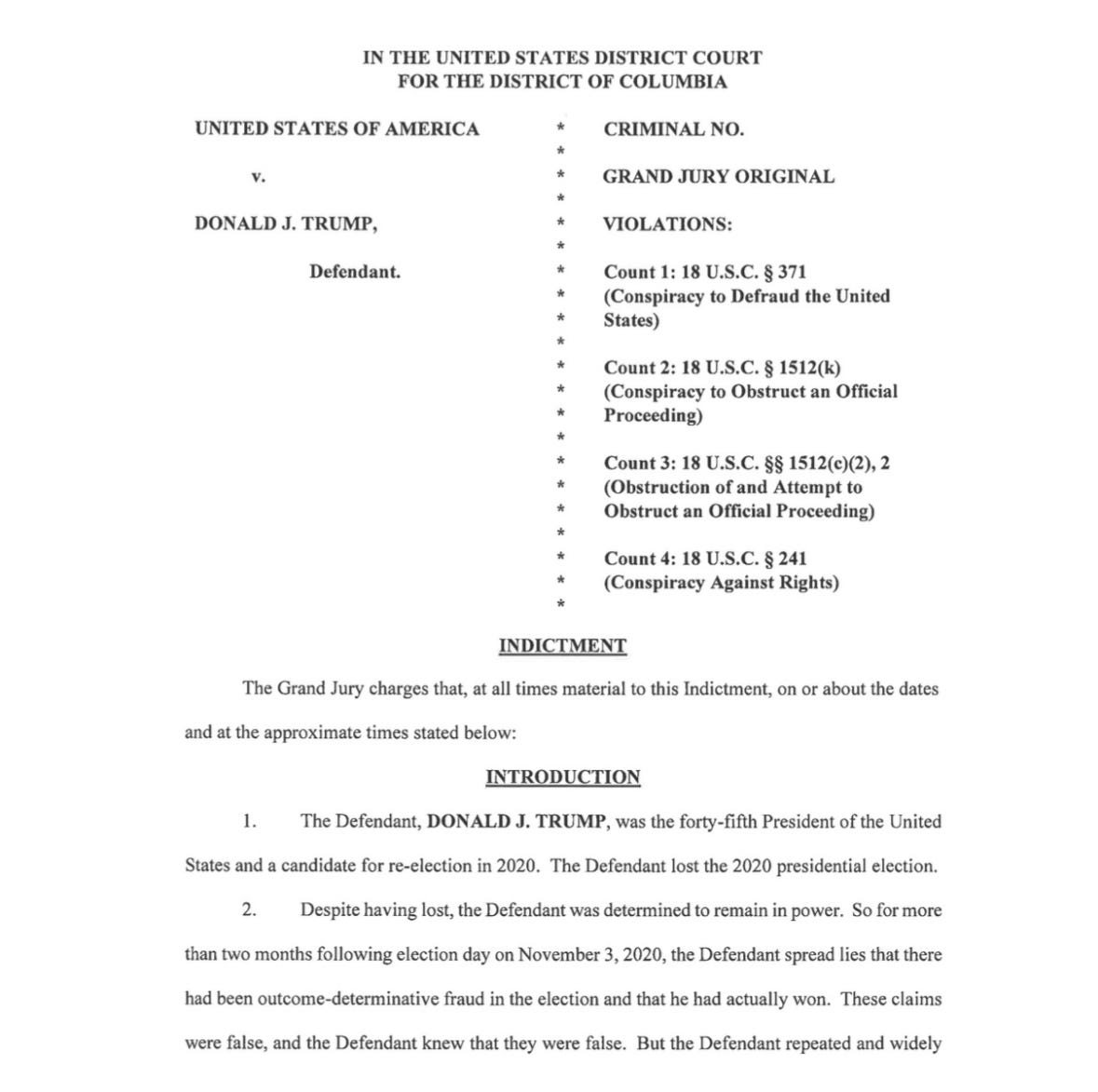
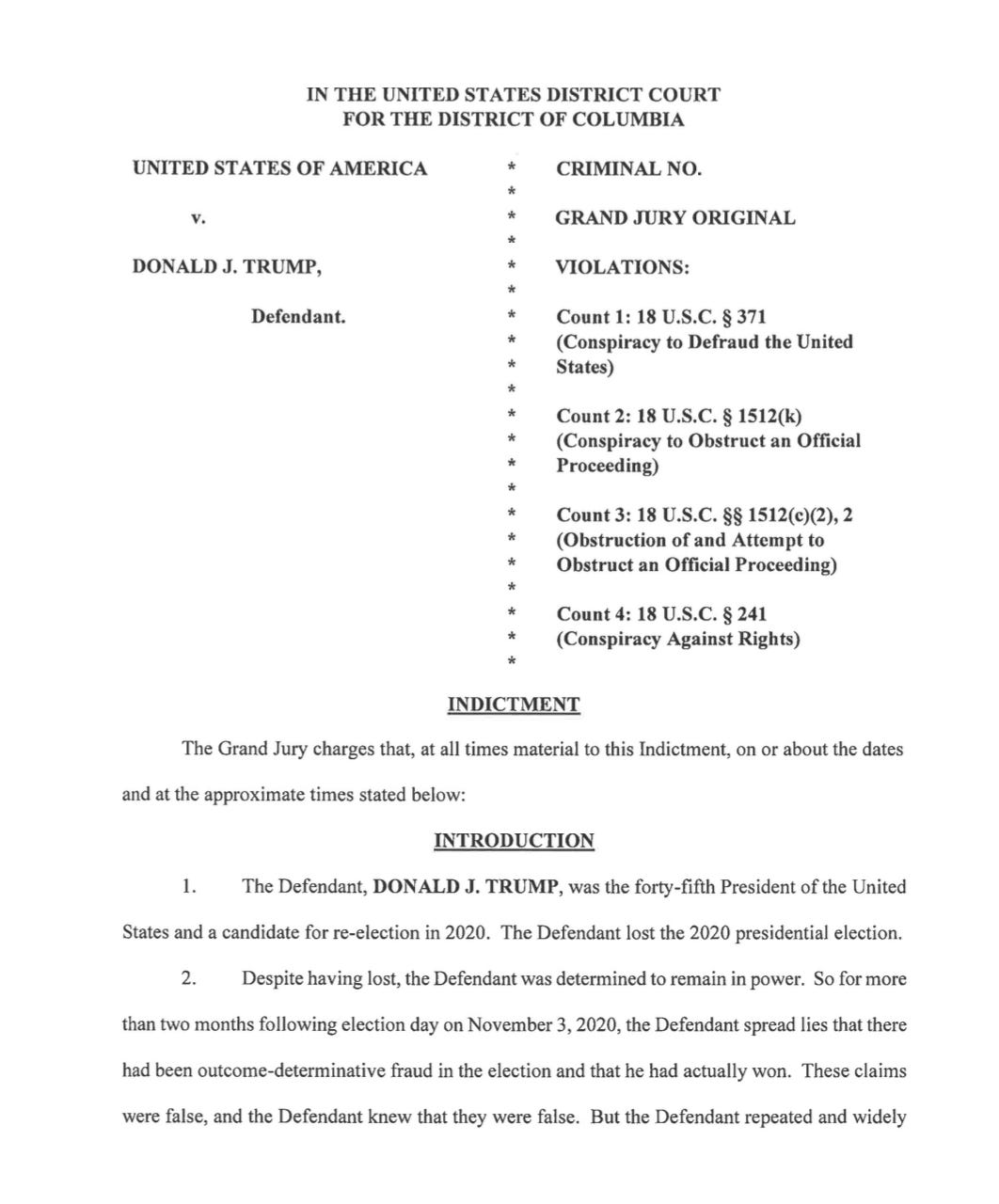
Every American has an absolute obligation and duty to read the details of the most important criminal indictment in American history carefully and thoroughly. The language is stark, vivid and declarative. The indictment rejects the jaundiced notion that there is dispute around the details of the election. Instead, it boldly embraces reality in a way that the overwhelming majority of the American media has refused to do so on a consistent basis. It declares flatly and directly:
He absolutely did lose the 2020 presidential election. Yet, he wanted power. What he did was try and take it through a conspiracy of lies and thuggery. Though he knew he lost, he didn’t care. What followed was the most reprehensible actions in American history by an American president. They represent a betrayal of stupendous dimensions. What Donald Trump did was amoral, illegal and nearly cataclysmic.
The Warning with Steve Schmidt is a reader-supported publication. To receive new posts and support my work, consider becoming a free or paid subscriber.
Upgrade to paid
Donald Trump desecrated the sacrifices and patriotism of the men and women who laid down their lives so America could endure and survive. He tried to take America away from all of us. Donald Trump isn’t just a failed and seditious president and an accused criminal, he is an abomination and every loyal citizen should be enraged by what he did. He assaulted our ancestors and our descendants, while trying to burn down our way of life and taking our right to choose our leaders from us. It cannot be forgiven, excused, rationalized or minimized. The propaganda of Fox News and all of its derivative media cannot hide the simple truth. Trump tried to destroy the United States. He is a domestic enemy.
We must not allow the ambitions of one man and his cabal to destroy the American way of life. It cannot happen. It must be fiercely opposed. Donald Trump and his cause are a national cancer, and it remains deeply embedded in our politics. This age of extremism must yield, or democracy will be lost.
The only thing that matters is that the Republican frontrunner doesn’t believe in democracy. He is running on a platform of revenge and retribution.
Everything is on the line in 2024. Will it be America’s last election not decided in advance?
Let’s hope not, and let’s work very hard to make sure it isn’t.
First off tonight, I want to thank all of you who sent emails and left comments about my Mom. I appreciate all of them, I’ve read through them and continue to read them. I’ve gained a lot of strength from your support, and I’m touched and honored by the stories you’ve shared. Thank you from the bottom of my heart.
Today, Tuesday, August 1, 2023, was the day the Justice Department indicted the wretch of a former president for trying, and damn near succeeding, in preventing American voters from determining the outcome of the presidential election in 2020. It’s about time.
The January 6 investigation was massive, and it’s remarkable Jack Smith got to this point so quickly. He owes a huge debt of gratitude to the House January 6 Committee, which did prosecutors’ work, unearthing much of the evidence that was used to indict. In a very real sense, prosecutors in this case stand on the shoulders of the members of the House who insisted on pursuing the investigation and made Americans believe that accountability for the former president was possible.
The conduct, the swarm of different angles Trump worked to try and steal the election, makes for a complicated prosecution. It was a massive effort at political interference in the constitutional processes that make our country a republic. The factual basis for the charges, even though we’ve lived through the events themselves, is not simple like the Mar-a-Lago classified documents case is. There you can readily wrap your mind around the basics and understand Trump kept classified documents he wasn’t entitled to and obstructed the government’s efforts to get them back. You can’t do the January 6 investigation in one sentence like that. Trump had a lot of moving parts in play to try and hold onto power, some legal, and many others not.
So the question has always been, how would Jack Smith make sense of it all, organize the conduct, and charge this case? It has to be done in a way that, legally speaking, is air tight—there’s no point in fighting for a conviction that you lose on appeal—but it also has to make sense out of a morass. For instance, we all understand now that there was a scheme to use fake slates of electors to try and interfere with the count of votes under the Electoral CountAct. But in the wake of the election, as news of an event here and another there began to emerge, we didn’t have the roadmap we have now for understanding the component pieces, which include efforts in swing states, the attempt to pervert DOJ, the pressure campaign on Pence, and so on. That’s the challenge: draft an indictment that will make compelling sense to 12 jurors in a courtroom who get to hear all the evidence and make a decision based on it. Which of Trump’s many crimes do you charge him with?
Now we know.
Tonight, I want to give you a bit of a guide for reading the indictment for yourself. I think it’s important to do that. Set aside an hour or two, or find ten minutes here and there over the course of the next week. You’ll understand it better if you read it for yourself. The indictment is written in a manner that makes it clear prosecutors wanted it to be comprehensible to anyone who wanted to read it.
The indictment is a speaking indictment—the story of the three conspiracies that are charged is told in detail.
First off, you get some framing in the introductory paragraphs. The government alleges that Trump “spread lies” and that he “knew that they were false.” And it sets up some parameters: Trump could legally lie about the election and say it was tainted by fraud. That’s okay—what I would call awful but lawful. He could challenge the results in court and seek recounts. But DOJ draws the line in paragraph 4 and says that what he can’t do is pursue “unlawful means of discounting legitimate votes and subverting the election results.” In other words, some of what he did, the lawsuits for instance, was lawful. His lies to the public were distasteful and inappropriate but still, not crimes. But then Trump crossed the line into criminal. That’s the conduct, we learn in the introduction, that we’re going to hear about in the rest of the indictment.
It’s done artfully; it clarifies that this isn’t about going after Trump for his speech, which is arguably (at least in his view) protected by the First Amendment. It’s about his conduct, illegal conduct. In the opening lines of the indictment, prosecutors effectively gut the First Amendment defense Trump has been floating for the last two years.
There is only one defendant, Donald Trump. That’s likely a strategy for streamlining the process to get the case to trial as quickly as possible. He has six uncharged and therefore unnamed (but as good as identified) co-conspirators. We’ll get to them in a moment. The indictment alleges three separate conspiracies:
one to defraud the United States by interfering with the lawful processes that are used to collect, count, and certify the presidential election (18 USC § 371)
one to obstruct the January 6 congressional proceeding in which the results are counted and certified (18 USC § 1512)
one to defeat citizens’ right to vote and have their votes counted (18 USC § 241)
It alleges that each conspiracy was fostered by the “widespread mistrust the Defendant was creating through pervasive and destabilizing lies about election fraud.” There is also one substantive charge of obstruction related to the second conspiracy.
The penalties are serious. 18 USC § 371 carries a five-year maximum. The two charges under 18 USC § 1512 each have a 20-year maximum penalty. And the maximum penalty for violating 18 USC § 241 is 10 years. While the sentencing guidelines often set a lower range the judge is advised to sentence within, here, and especially if Trump has picked up one or more prior convictions before he’s sentenced, there is serious time associated with conviction on any one of these charges.
Here’s the trick to understanding the indictment. Because the same facts underlie each of the charges, the government sets them out only once, in the first count. Then it adopts them as the factual basis for each of the next three charges. That means that the first count, which begins on page 3, takes up the bulk of the indictment. It concludes on page 42. But once you’ve read it, you have the facts and the key aspects of each of the conspiracies that are charged. If you want a refresher on the basics of conspiracy law before you get started, we did that here at Civil Discourse, back in July of 2022, with chicken videos to explain the finer points of the law: “Conspiracy! Understanding the basics (with chickens).”
First, we get the “purpose of the conspiracy.” This is a standard inclusion in conspiracy indictments. In essence, here, it’s the purpose of all three conspiracies. The government alleges Trump’s purpose “was to overturn the legitimate results of the 2020 presidential election by using knowingly false claims of election fraud to obstruct the federal government functions by which those results are collected, counted, and certified.” The plain, legal prose is so dry that it almost masks what this is about: a president who wanted to take away the right of Americans to vote.
The next section clarifies who the “co-conspirators” referred to throughout the indictment are. But because they aren’t charged in the indictment, DOJ policy says they can’t be identified by name. Instead, we get descriptions that all but identify them after informing us that Trump “enlisted co-conspirators to assist him in his criminal efforts to overturn the legitimate results of the 2020 presidential election and retain power.” I’ve added their likely identities in italics following the language describing them from the indictment:
a. “Co-Conspirator 1, an attorney who was willing to spread knowingly false claims and pursue strategies that the Defendant’s 2020 re-election campaign attorneys would not.” Rudy Giuliani
b. “Co-Conspirator 2, an attorney who devised and attempted to implement a strategy to leverage the Vice President’s ceremonial role overseeing the certification proceeding to obstruct the certification of the presidential election.” Trump lawyer JohnEastman, whose communications were disclosed after a judge found the crime–fraud exception meant the attorney–client privilege should be set aside
c. “Co-Conspirator 3, an attorney whose unfounded claims of election fraud the Defendant privately acknowledged to others sounded ‘crazy.’ Nonetheless, the Defendant embraced and publicly amplified Co-Conspirator 3’s disinformation.” “Kraken” lawyer Sidney Powell
d. “Co-Conspirator 4, a Justice Department official who worked on civil matters and who, with the Defendant, attempted to use the Justice Department to open sham election crime investigations and influence state legislatures with knowingly false claims of election fraud.” DOJ environmental lawyer and AG wannabe Jeffrey Bossert Clark
e. “Co-Conspirator 5, an attorney who assisted in devising and attempting to implement a plan to submit fraudulent slates of presidential electors to obstruct the certification proceeding.” Kenneth Chesebro, another lawyer involved in devising the fake electors scheme
f. “Co-Conspirator 6, a political consultant who helped implement a plan to submit fraudulent slates of presidential electors to obstruct the certification proceeding.” Identity unclear
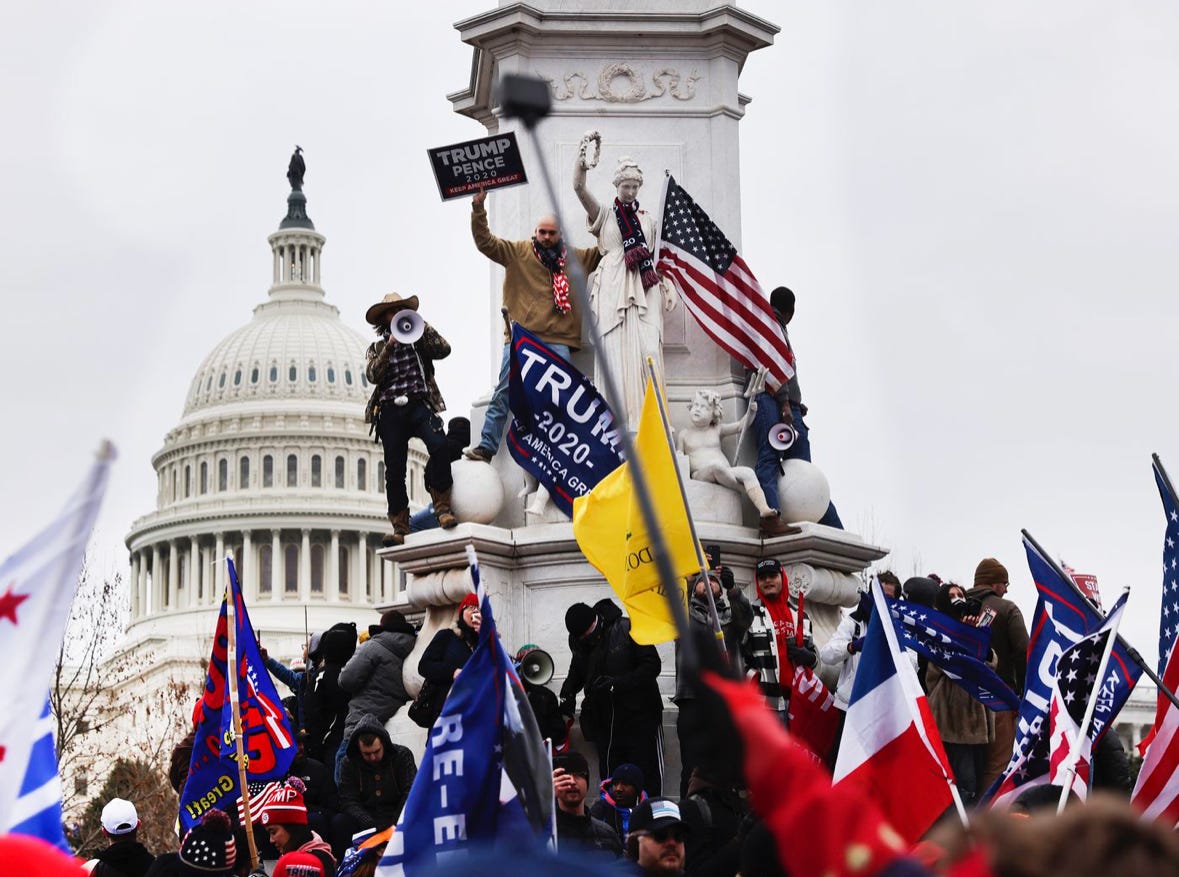
Next up is a section entitled “Federal Government Function” that manages to explain, in one paragraph, how the electoral college system works. It will also make you wonder why we still use this godforsaken system that unduly focuses presidential selection power in less populated parts of the country, but we’ll leave that for another day. Like all conspiracy indictments, this one has an involved section on “Manner and Means,” which is an overview that explains how they did it. Here, it’s a helpful summary of all the conduct that’s laid out next. There is the use of fake fraud claims to try and subvert the outcome of state elections, the fraudulent slates of electors, the attempted subversion of DOJ, the pressure campaign on Vice President Mike Pence, and Trump’s exploitation of the violence at the Capitol on January 6 to try and convince Congress to delay certification of the vote.
Before the indictment dives into the details of those means of effectuating the conspiracies, we get a section you don’t normally see in indictments, where the government sets forth its evidence that Trump knew the fraud claims he was making about the election were false. We discussed the importance of the government being able to use circumstantial evidence to establish what was going on inside of Trump’s mind, notably, that he knew he’d lost the election but lied about it. The government uses three and one half pages of the indictment to set out its evidence in that regard in detail. With that important detail established, we then get a detailed layout of each of the “Manner and Means” of executing the conspiracy, and it’s here that you may want to spend some time. Most of the contours are familiar; we know about the events in Georgia, for instance, but some of the detail is informative, and it’s an excellent refresher to make sure you remember the details you first learned while watching the January 6 Committee hearings.
So we get a speaking indictment, or as MSNBC anchor Ari Melber quipped tonight, a shouting indictment. We still have some unanswered questions. The status of the unindicted co-conspirators isn’t clear. Often, people identified that way are cooperators, but that doesn’t appear to be the case here. It seems likely that some or all of these people will face charges in the future. Their crimes are set out clearly in the indictment, and there’s little rationale other than expediency, a weak one at best, for permitting them to escape accountability for their conduct. But there are other people who appear to be working with the government. Mike Pence, after trying to fight off his subpoena with all sort of excuses, testified and would seem to be the only possible source of information about his personal conversations with Trump, which includes this fascinating passage in paragraph 90:
On January 1, the Defendant called the Vice President and berated him because he had learned that the Vice President had opposed a lawsuit seeking a judicial decision that, at the certification, the Vice President had the authority to reject or return votes to the states under the Constitution. The Vice President responded that he thought there was no constitutional basis for such authority and that it was improper. In response, the Defendant told the Vice President, “You’re too honest.” Within hours of the conversation, the Defendant reminded his supporters to meet in Washington before the certification proceeding, tweeting, “The BIG Protest Rally in Washington, D.C., will take place at 11.00 A.M. on January 6th. Locational details to follow. StopTheSteal! [emphasis added.]
Still more interesting is the question of Mark Meadows’ status. In paragraph 28, there is information that seems like it would have to have come from him: “On December 23, a day after the Defendant’s Chief of Staff personally observed the signature verification process at the Cobb County Civic Center and notified the Defendant that state election officials were ‘conducting themselves in an exemplary fashion’ and would find fraud if it existed, the Defendant tweeted that the Georgia officials administering the signature verification process were trying to hide evidence of election fraud and were ‘[t]errible people!’” If Meadows is actually cooperating, in the sense that he’s finally decided to share everything he knows about Trump with prosecutors, that would be big. But there’s little additional information in the indictment to suggest that. Prosecutors aren’t obligated to reveal all of their evidence, but in the event they want to convince some of the six unindicted co-defendants to cooperate, they might want to show off a little more evidence to help them understand the peril of their situation if they don’t. Five of them, after all, are lawyers, and all quite capable of assessing the evidence. It’s surprising we don’t get more here if Meadows is in fact on board.
So, take some time when you can, and read the indictment for yourself! Encourage others to do it, too. Most importantly, don’t accept the defeatist mentality that no Trump supporters can take in the information and change their minds. While his hardcore base may not, there are others who may support him for policy or political reasons, but who, when confronted with the hard facts about his complicity, including Count Four where he is charged with a conspiracy to interfere with Americans’ right to vote, may finally decide they’ve had enough.
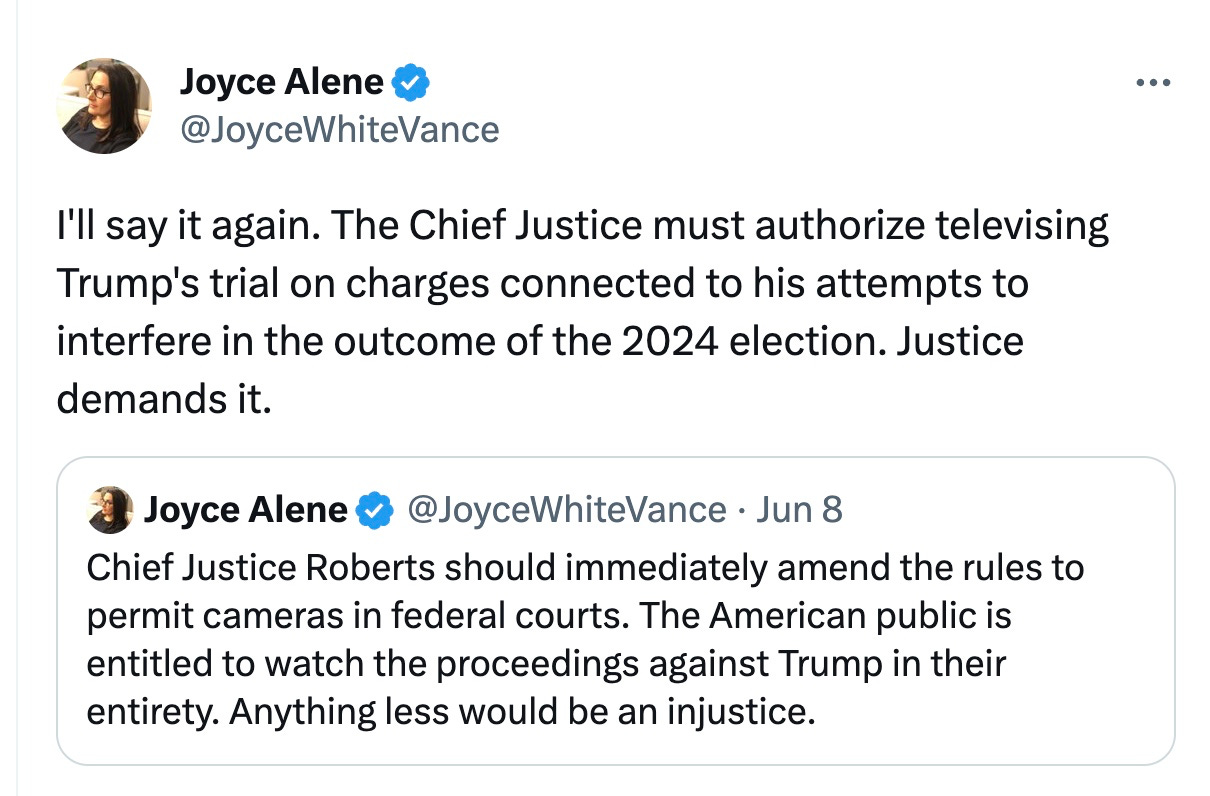
Finally, cameras in the courtroom. Chief Justice Roberts could ensure these proceedings were made publicly available. He can order that there be cameras in the courts. And he should. That final charge makes it clear that we are all victims of this crime. We have the right to watch the proceedings.
Because this isn’t a case about classified information. We’ll see more of the proceedings in public, and it should kick into gear more quickly, with arraignment scheduled for Thursday afternoon. The Judge, Obama appointee Tanya Chutkan, confirmed in the Senate by a vote of 95-0 in 2014, has signaled she means business with that prompt kickoff. But given the time it takes to get cases to trial in the District of Columbia’s courts, often over a year and a half, we’ll have to wait to see if there’s even a prospect of this case, so highly important and certain to be aggressively litigated, getting to trial ahead of the election.
Today was one of the good days for people who believe in the Republic. No man should be above the law. Trump is finding out that democracy and the Constitution are for real.
We’re in this together,
Joyce
p.s.: If you’re not already a paid subscriber and you’re enjoying Civil Discourse, I hope you’ll consider up-subscribing (if that’s a word). But we live in challenging times, and I understand that not everyone can or wants to buy a paid subscription. I’m happy to have you here either way! I’m glad we’re all committed to saving the Republic. Tonight, it feels like we’re making progress.
Donald Trump, the greatest failure in American history, betrayed the United States of America and desecrated the presidential oath of office.
Twice impeached and charged with 37 felony counts over his alleged misconduct involving the nation’s most sensitive secrets, Donald Trump will soon be held accountable for inciting an insurrection against the US Constitution and trying to take political power illegally. He attempted to incite a coup d’état. It was planned, organized and executed from within his White House. It was seditious and criminal.
There is no betrayal against the American flag that equals Trump’s since the Civil War. His treachery equals that of Jefferson Davis. He attacked what he swore to preserve, protect and defend. He assaulted the sacrifices and memory of 250 years of patriots who built the United States with his outlandish misconduct. His presidency was a national humiliation without respite.
His current candidacy is our national herpes. He is America’s loathsome canker and most exquisite scum bag. He is rotten, dishonest, staggeringly corrupt, bombastic, ignorant and cruel. He combines imbecility and arrogance into a potent weapon, which for some reason has found appeal among America’s vast taker and victim classes. Wherever grievance is a virtue and self-pity heroic, a Trump flag will be flying high. The pathetic and weak need their heroes too, after all.
All of the graves in the American cemetery that lies above Omaha Beach face west, back across the Atlantic Ocean towards the United States. The graves are laid out in perfect symmetry. It is an American army at permanent rest. Each died in combat against a profound evil. They died so that darkness would not fall over the world. How are we measuring up?
Donald Trump is a criminal and an abomination. He is a grotesquerie. He tried to burn America down. What he did was criminal, and no one is above the law in America. He is a shameful man and his bill has come due — finally.



 Richard L. Fricks