Defend Democracy: A Little Civil Discourse

by Joyce Vance

Here’s the link to this article.

In the middle of all the high stakes political maneuvering going on in Washington, we shouldn’t overlook the importance of a little civil discourse in our own lives. Like the elegantly simple statement being made by the woman in front of me in line at the airport this morning who was nice enough to let me snap a photo.
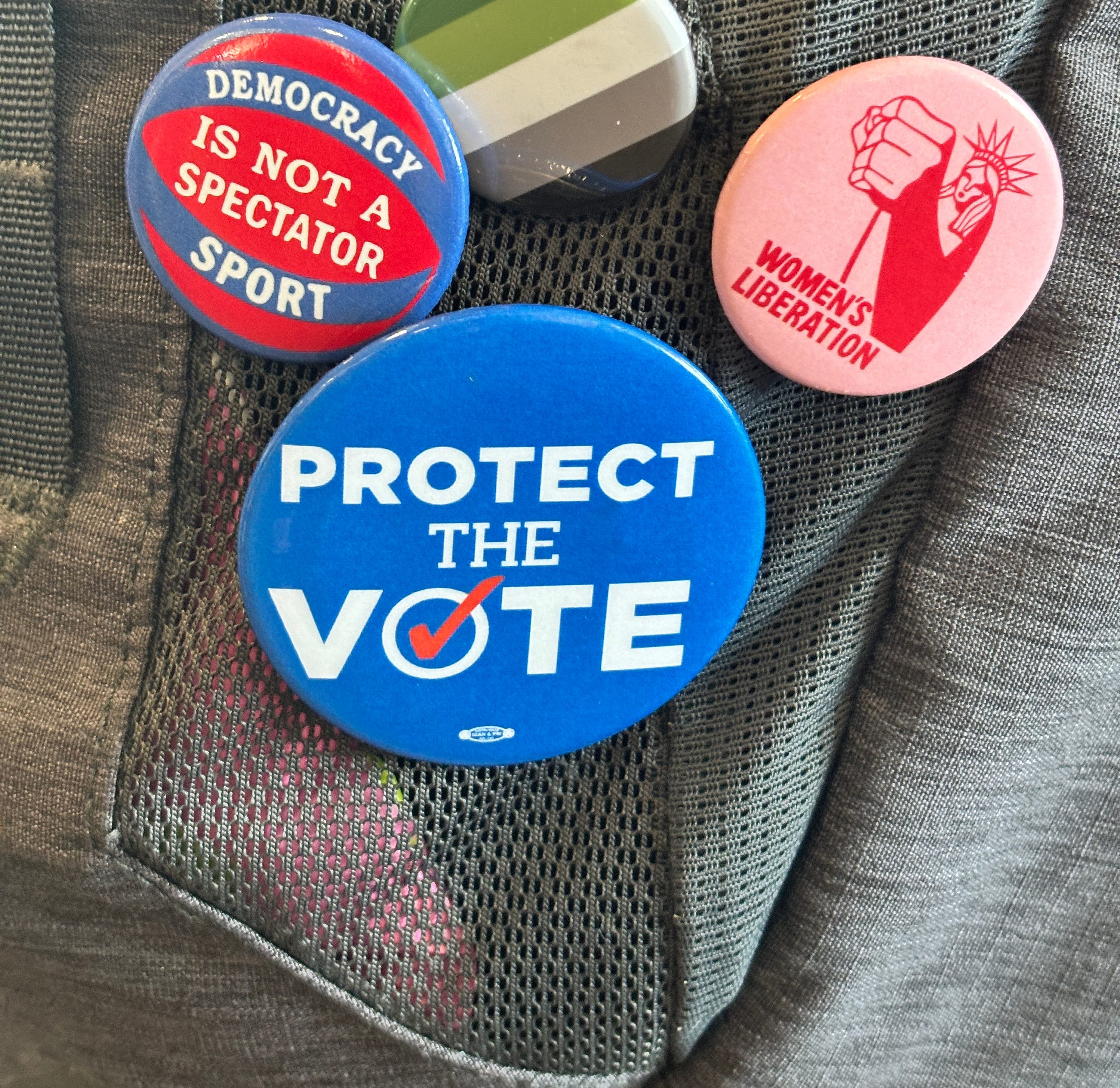
These simple reminders help people who understand that democracy is on the ballot know that they aren’t alone. They are also seeds that we plant for people who are still trying to decide whether and how to vote.

It’s hard to understand how anyone could still be on the fence, but we don’t have to figure that out. What we need to understand is the importance of meeting people where they are and, rather than expressing surprise that they’re undecided, trying to counter some of the disinformation that’s circulating and may be keeping them on the ledge, with facts.

Last week, one of the favorite Republican political myths, that Biden is too old to be president while Trump is capable and vibrant, resurfaced.

Joe Biden out for a ride on June 1, 2024 in Rehoboth, Delaware.

Seen Trump on a bicycle lately?

Biden is 81 years old. Trump turned 78 on Friday. It’s not a significant difference in age. While both of them occasionally have to reach for a word, as so many perfectly capable people do as they grow older, the similarities stop there. But the narratives being told about the candidates’ age and ability are very different and don’t match the reality that anyone who takes the time to can readily observe.

Biden flew to Europe for the D-Day anniversary, then home, then back to Europe for the G7 Summit, and held up to the rigors of travel well. His foreign policy expertise was on full display as he deftly handled key allies amid Putin’s war in Ukraine.

What did the President’s political opponents make of his trips? Right-wing media outlets circulated video, now all over social media, that makes it appear that Biden wandered off at the G7 summit while all the leaders were gathered. But that’s not what happened. The actual video shows Biden walking over to congratulate parachutists who were part of the celebration.

You might ask fence-sitters to consider, why would anyone do this? If Biden really isn’t up to the job, right-wingers wouldn’t have to make up a story, deceptively edit video, and push it out. If they’d make up a story like that, what else are they lying about? And perhaps most importantly, why are they lying to you?

What was Trump doing while Biden was supporting our key European alliances? His teleprompter went down during a campaign speech in Nevada with awkward results.
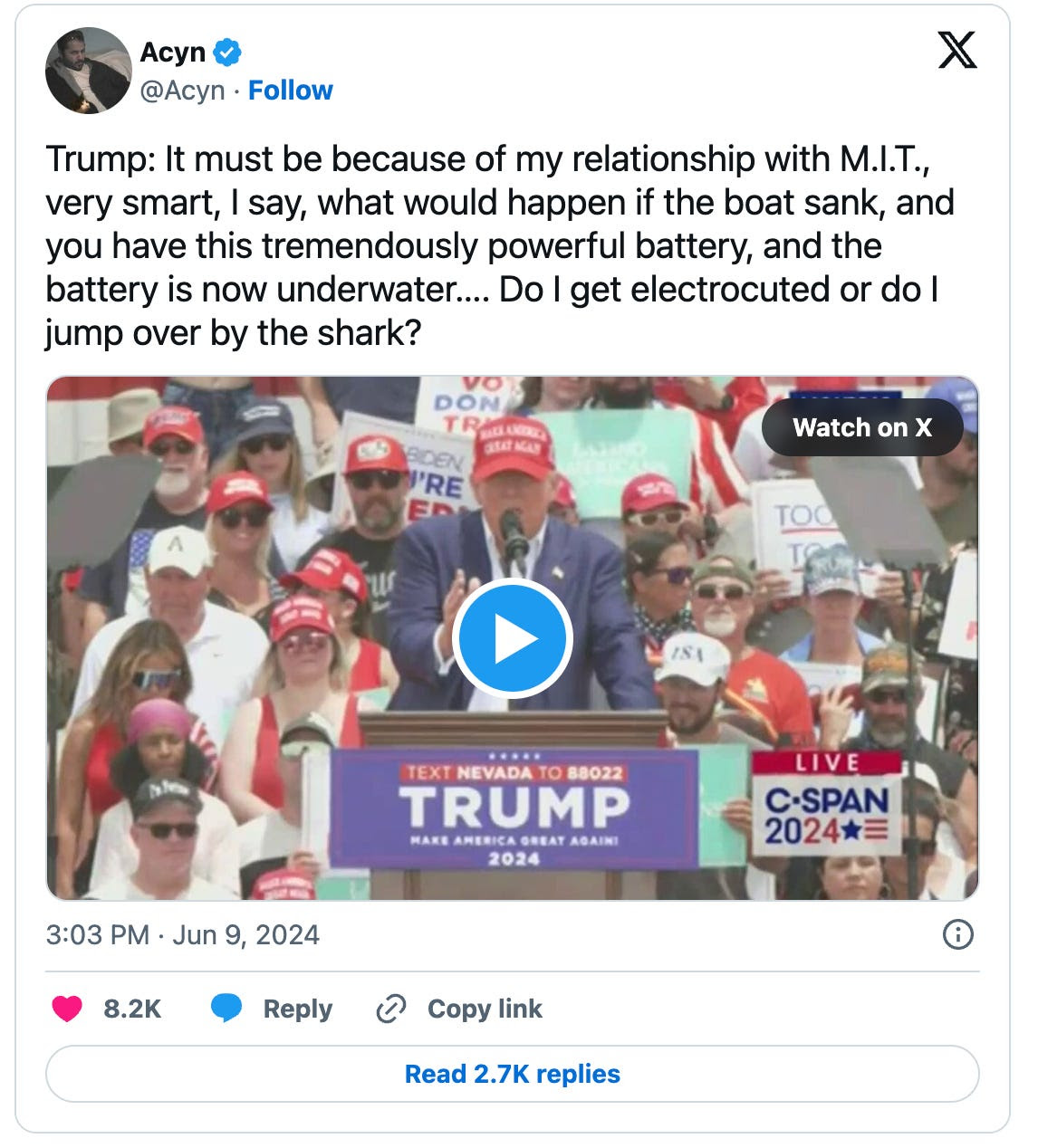
“I’ll take electrocution every single time,” Trump said. “I’m not getting near the shark.” Okay. I’ll take the guy who is handling American business over the guy babbling about sharks every time. And maybe if some of the folks who haven’t made up their minds yet knew about it, they would too.

It’s a good time to try out a little civil discourse and encourage people to look up the actual facts and video for themselves—they don’t have to take your word for it. You can explain what is actually happening to them, but tell them to check it out for themselves. One of the benefits of having truth on your side is that you can do that. Trump’s claims about Biden don’t withstand daylight.

The GOP is still beating the “Biden crime family” dead horse when in fact, their efforts to provoke criminal investigation or impeachment have all spectacularly and publicly failed. Their key witness lied to the FBI and faces prosecution—they seem to have forgotten his existence. And despite the strong push to “get” Hunter Biden, which produced the gun charges he was just convicted on and the tax charges he still faces, no evidence surfaced that implicated President Biden in international corruption or fraud schemes MAGA Republicans have been pushing. Last September, three-fifths of American voters believed the unproven but widely repeated allegations that Joe Biden was involved in corruption. Since then, those allegations have gone from being unproven to disproven. There were even suggestions that the failed GOP witness, Alexander Smirnov, was peddling lies for Russia.

Anyone who is turned off from voting because they hear Joe Biden was as corrupt as Trump? Turns out it was all a mirage, a very successful public relations coup for Republicans.

That’s an important point to share. Suggest that your friends examine what they see on social media carefully, because it’s not all true. Concerned about Gaza? It’s worth it for a voter for whom that issue is important to take a look at the differences between Biden’s and Trump’s positions and decide which they feel better serves their concerns. Worried about climate change? Trump’s recent meeting with Big Oil—the one where he asked them to to donate $1 billion to his campaign while promising he would terminate Biden’s policies on electric vehicles, wind energy, and other plans to decrease reliance on fossil fuels—is informative. Do they really want to trust the guy who is calling for a revenge presidency? The guy who blithely attacks Joe Biden for being old, while the press seems to give him a pass on far worse.
The key point is this: democracy is the system that unlocks all of our other rights. In its absence, those rights fade away. How you are able to live your life could come down to the whims of a ruler who has only his own self-interest in mind. People still get to vote this November. They should exercise that right carefully, and cherish it, especially if they want to be able to do it in the future.

A little civil discourse can go along way. Don’t hesitate to practice. And please share the newsletter—it’s free—with folks you think might benefit from being encouraged to think and fact check for themselves.

We’re in this together,

Joyce

Upgrade to paid

Share

The Christian nationalism is coming from inside the House

Here’s the link to this article.

Avatar photoby ADAM LEE NOV 02, 2023

Official portrait of Speaker Mike Johnson | The Christian nationalism is coming from inside the House

Overview:

Mike Johnson, the new Speaker of the House, is a radical Christian nationalist who opposes democracy—and he still might not be extreme enough for his own caucus.

Reading Time: 5 MINUTES

In 2023, Kevin McCarthy made ignominious history by becoming the first Speaker of the House in US history to be ejected by his own party.

It took multiple rounds of voting, with McCarthy groveling before his party’s most extreme members, before he got the job in the first place. But he lasted only a few months before enraging them by passing a bill to prevent a shutdown. For the grave sin of governing, he was kicked out of the speaker’s chair.

Several weeks of chaos and dysfunction ensued as various House Republicans stepped forward to run for speaker and others shot them down. Finally, the infighting exhausted them enough to coalesce around a new speaker, Louisiana Congressman Mike Johnson. (I wonder if Johnson won because his generic name made him seem unobjectionable.)

But despite his bland, forgettable demeanor, Johnson is no moderate. As the modern Republican Party keeps finding new depths of political nihilism to sink to, he may be the worst yet to hold the post.

A young-earth creationist

Johnson got his start working for the Alliance Defending Freedom, a right-wing legal group. He spent years arguing that abortion should be outlawed and that states should have the right to criminalize consensual same-sex relationships.

He’s also a young-earth creationist who’s represented Answers in Genesis in court to argue for tax exemptions for their Noah’s Ark theme park.

He believes that teaching evolution causes school shootings:

During a 2016 sermon at the Christian Center in Shreveport, Louisiana, Johnson said that a “series of cultural shifts” in the United States — led by “elites” and “academics” in the 1930s who were engaging with the theories of Charles Darwin — erased the influence of Christian thinking and creationism from society.

“People say, ‘How can a young person go into their schoolhouse and open fire on their classmates?’” Johnson asked the audience. “Because we’ve taught a whole generation — a couple generations now — of Americans, that there’s no right or wrong, that it’s about survival of the fittest, and [that] you evolve from the primordial slime. Why is that life of any sacred value? Because there’s nobody sacred to whom it’s owed. None of this should surprise us.”“New House Speaker Blamed School Shootings on Teaching Evolution and Abortion.” Nikki McCann Ramirez, Rolling Stone, 26 October 2023.

This feels almost quaint. It’s been a while since I’ve seen a young-earth creationist in the wild. I had assumed most of them had long since moved on to QAnon.

Needless to say, the idea that belief in God prevents violence is a blackly comical absurdity. Not only is that not true, it’s the flat opposite of the truth. Human history is a bloodstained chronicle of devout believers slaughtering each other for believing in the wrong god—or believing in the right god, but worshipping it in the wrong way. Just imagine trying to tell people from the era of the Inquisition or the Crusades that religion is a force for peace that teaches us to treat all life as sacred.

The Bible records a campaign of genocide enthusiastically carried out by the Hebrew tribes against their pagan enemies. Medieval Europe is an endless battle of Catholic-versus-Protestant warfare, Christian-versus-Muslim warfare, and everyone killing and persecuting Jews. Sunni and Shi’a Muslims have clashed again and again. Western nations have subjugated, colonized, enslaved and killed indigenous “heathens” from all over the world in the name of spreading the gospel. The ongoing Israel-Hamas war is a battle between two religious sects that both believe they have a God-given right to possess the same land.

In addition to his anti-evolution views, Johnson ticks every other box on the list of Christian “antis”. Like all fundamentalists, his worldview is defined by what he’s against: He is anti-abortion, anti-gay-rights, anti-feminism, anti-climate-science. He’s even anti-divorce—believing, as many religious conservatives are starting to, that it gives women too much power. In a bid to shore up the crumbling walls of patriarchy, he wants to abolish no-fault divorce so they’ll be forced to stay in unhappy or abusive marriages.

A Christian nationalist

But, above all else, Johnson is a Christian nationalist. Like all Christian nationalists, he believes (falsely, based on right-wing pseudo-history) that America was founded as a Christian nation, and therefore a Christian view of law and morality should rule.

It hardly needs emphasizing that, when Johnson and his ilk speak of a “Christian” view, they don’t mean a generically Christian, ecumenical, big-tent view. They mean their own interpretation—a hardcore right-wing, patriarchal, anti-science, literalist reading of the Bible. They believe that this fundamentalist theology should reign supreme over every other interpretation of Christianity, not to mention all the other religions, philosophies, and worldviews in our multicultural melting pot.

The most disturbing aspect of Johnson’s view is that, because he believes America is a Christian nation, he holds that evangelical Christians like himself are entitled to rule regardless of elections. That’s why he’s against democracy.

That’s not a polemical attack. He says so himself!

“We don’t live in a democracy, because democracy is two wolves and a lamb deciding what’s for dinner.”“He Seems to Be Saying His Commitment Is to Minority Rule.” Katelyn Fossett, Politico, 27 October 2023.

Yes, the Speaker of the House of Representatives, second in line to the presidency, is an avowed opponent of democracy.

These aren’t empty words. Johnson has acted in line with them. He was one of the Republicans who voted unsuccessfully to overturn the 2020 election. He wrote a brief in support of Texas’ toweringly arrogant lawsuit to throw out the results of elections in other states that voted differently. He spread bizarre conspiracy theories about Hugo Chavez writing voting machine software.

All of this isn’t an aberration. It flows from Johnson’s Christian nationalist theology. In this monarchical worldview, Christians like him get to be in charge, no matter what. If the voters say something different, too bad for them. He believes in throwing out the “wrong” votes and handpicking the person who “should” have won.


READChristian nationalists: Drop Mike, hold on to your Johnson


Johnson’s anti-democratic, election-denying views mirror the general trend toward authoritarianism among conservative Christians. They were only ever in favor of democracy as long as they thought they’d win every time. When that stopped being the case, they started wanting to change the rules to suit them. From Kristin Du Mez:

I think what has escalated things in the last decade or so is a growing alarm among conservative white Christians that they no longer have numbers on their side. So looking at the demographic change in this country, the quote-unquote “end of white Christian America” and there’s where you can see a growing willingness to blatantly abandon any commitment to democracy.

It’s really during the Obama presidency that you see the escalation of not just rhetoric, but a kind of desperation, urgency, ruthlessness in pursuing this agenda. Religious freedom was at the center of that. And it was, again, not a religious freedom for all Americans; it was religious freedom to ensure that conservative Christians could live according to their values. Because they could see this kind of sea change on LGBTQ rights, they could see the demographic changes, and inside their spaces, they have really played up this language of fear that liberals are out to get you, and you cannot raise your children anymore.“He Seems to Be Saying His Commitment Is to Minority Rule.” Katelyn Fossett, Politico, 27 October 2023.

For all the danger Johnson presents, the one thing he’s not is unusual. This election-denying, freedom-refuting ideology, once the fringe of the fringe, has swallowed the entire Republican party. Anyone the party might be expected to support would hold these same beliefs.

Johnson’s elevation isn’t an aberration, but a punctuation mark. It’s a sign that, for the foreseeable future, this is the course the Republican party has committed itself to. Elections in America are no longer a choice between two points on the same political spectrum. They’re a struggle for the continued existence of democracy over those who favor fascism and authoritarian rule.

Not extreme enough

As bad as that is, there are hints that even Johnson isn’t extreme enough for some members of his caucus.

For all his repugnant politics, he has an adopted Black son. Johnson has spoken frankly about the racism his son faces and said there’s a need for “systematic change”. He’s also said George Floyd was murdered by the police: “I don’t think anyone can view the video and objectively come to any other conclusion.”

For these remarks, perpetually-furious conservative pundits have already labeled Johnson a disgrace, a fraud and a secret Democrat. The right wing has done so much to nurture their own sense of grievance, there’s a chance that they’re truly ungovernable. No human being who could run for office and win could ever satisfy them.

If that’s true, then Johnson, for all his radicalism, might not end up enjoying a longer or easier tenure than his predecessor.

What a joke

Here’s the link to this article.

STEVE SCHMIDT

AUG 25, 2023

It is hard to sort through the surreality and absurdity of the FOX-hosted MAGA/GOP debate for the “also rans” that linger 40 points behind front runner Donald Trump, who faces 91 felony charges across four different jurisdictions, thus far. Absurdities piled up on top of one another, while hypocrisy, grandiosity, delusion and performative posturing could have been confused by a casual observer as being the necessary qualifications to run for president as a Republican. 

Sixty-two years ago, a 43-year-old man rose and swore the 35-word oath that made him the 35th president of the United States. He was a decorated naval officer and combat veteran, who had served as a US senator for eight years and a congressman for six. He was thoughtful, observant, introspective and skeptical. His inaugural address ranks among the greatest in American history, and included these prescient words that I couldn’t stop thinking about last night as a 38-year-old demagogue and fame-seeking millennial took control of the debate from a feckless lineup of collaborators, appeasers, and FOX propagandists, with a fusillade of weapons- grade nuttery, rice paper-thin ignorance, and mind-bending naïveté wrapped together by ad hominem character attacks. 

Let every nation know, whether it wishes us well or ill, that we shall pay any price, bear any burden, meet any hardship, support any friend, oppose any foe to assure the survival and the success of liberty.

This much we pledge–and more.

To those old allies whose cultural and spiritual origins we share, we pledge the loyalty of faithful friends. United there is little we cannot do in a host of cooperative ventures. Divided there is little we can do–for we dare not meet a powerful challenge at odds and split asunder.

To those new states whom we welcome to the ranks of the free, we pledge our word that one form of colonial control shall not have passed away merely to be replaced by a far more iron tyranny. We shall not always expect to find them supporting our view. But we shall always hope to find them strongly supporting their own freedom–and to remember that, in the past, those who foolishly sought power by riding the back of the tiger ended up inside.

They most certainly did. Deep inside. 

The Warning with Steve Schmidt is a reader-supported publication. To receive new posts and support my work, consider becoming a free or paid subscriber.

Upgrade to paid

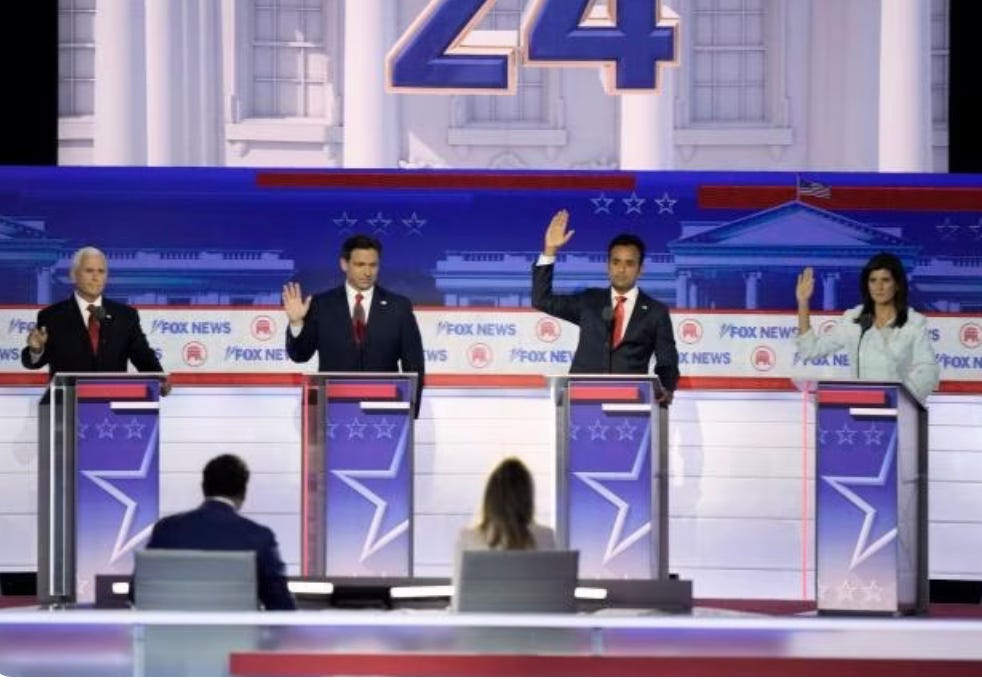
There were some astonishing and illuminating moments from the FOX-fest, such as when Mike Pence and Ron DeSantis looked left and right before deciding whether to put their hands up and pledge to support Trump for president whether he is convicted, imprisoned, or anything else — no matter what, forever and ever. 

Both men came into the debate filled with the conviction that shouting and inconsistencies are the key to projecting strength to an audience of extremists. Clearly when it comes to thinking on his feet and mirroring others, DeSantis was stuck in the pudding compared to Pence, who had much more experience. Let’s watch him do the same thing with water during a White House meeting with Trump before the former president and current criminal defendant tried to hang him:

‘Tis the season for revisionist history, and Mike Pence has made clear that Mike Pence is a hero for telling the man who incited an insurrection that killed and maimed, that he couldn’t help him overturn the election. He tried and thought about it, but when he called Dan Quayle, he told Pence that he was nuts and quite the hero. Watching Mike Pence perform his squinty-eyed, pious Reagan imitation right down to his canned and cheesy line that he is a “Christian, conservative and a Republican — in that order” has always been aneurysm-inducing for people with common sense and character. Mike Pence is a former cigarette spokesperson and lobbyist, who used donor money to live off during his first losing congressional race. He is a fraud, an extremist, and profoundly full of shit. After everything, when the question came about whether he’ll be behind the man who burned down what he said matters most, he made clear what he values — and it isn’t America. I guess there has always been a reason for Mike Pence why American wasn’t on his list. Mike Pence was Donald Trump’s partner and accomplice in all things — except one at the end. Remember though, but for Pence, we never would have gotten there. 

Nikki Haley is the exact same person. There were moments in the debate where she appeared honest, cogent, strong, competent and principled. Of course none of those things are true, as has been ably demonstrated over the last seven years. She proved it when her hand shot up during the Trump forever auction. No matter what, she will be with Trump, whom she spent the debate excoriating by proxy through her castigations of Ramaswamy as an unprepared gadly for aping Trump’s positions 100% as his “mini me.” It makes no sense.

The abortion section of the debate was deeply chilling, and should terrify American women who don’t want their Republican member of Congress joining them in their bedroom, MD’s or pastor’s office. Though Mike Pence’s political career is at an end  “The Handmaid’s Tale” is not. Can someone call casting please? What a commander he’d make. Chilling though he was, and as extreme as everyone else was, the DeSantis comments were memorable, right? I’m not the only person in America who heard him talk about a friend who survived multiple abortions, and was born in a pan, right? Please tell me I’m not alone in knowing that’s made up. The reason why I’m asking is because it’s important, given there is no such thing as up-to-the-moment of birth elective abortions that Republicans keep talking about. It isn’t real, and it’s never challenged. The failure of the Democratic Party to wrestle this issue into reality is appalling. Nevertheless, Nikki Haley was correct with regards to her worry about the political backlash that is coming to the nuttiness. There will likely be a women’s tsunami at the polls, unless America’s women are ready to sign up for transportation backwards in time about 60 years. I suspect it’s an offer they will enthusiastically refuse. 

Lastly, there was the rushed and nervous discussion around the Trump coup that was handled by FOX and the candidates, except Christie and Hutchison, as a live incendiary device on a timer. There are no words to describe the trivialization of the greatest act of treachery and political misconduct in American history by the very same news anchor — Bret Baier— who kicked off the madness with his worries about delivering the news that the orange führer had lost the election to his manipulated, incited and radicalized audience.

What a small, petty affair last night was. 

Oh, and Asa Hutchison appears to be a normal, responsible, serious person. He’s clearly in the wrong party to have a chance. 

Yesterday, I said the “debate would be a travesty and a farce.” Looking back, I was way too optimistic. What a joke. 

LETTERS FROM AN AMERICAN–08/19/23

Here’s the link to this article.

LETTERS FROM AN AMERICAN

August 19, 2023

HEATHER COX RICHARDSON

AUG 20, 2023


Various constitutional lawyers have been weighing in lately on whether former president Donald Trump and others who participated in the effort to overturn the results of the 2020 presidential election are disqualified from holding office under the Fourteenth Amendment to the Constitution. The third section of that amendment, ratified in 1868, reads: 

“No person shall be a Senator or Representative in Congress, or elector of President and Vice-President, or hold any office, civil or military, under the United States, or under any State, who, having previously taken an oath, as a member of Congress, or as an officer of the United States, or as a member of any State legislature, or as an executive or judicial officer of any State, to support the Constitution of the United States, shall have engaged in insurrection or rebellion against the same, or given aid or comfort to the enemies thereof. But Congress may by a vote of two-thirds of each House, remove such disability.”

On August 14 an article forthcoming from the University of Pennsylvania Law Review by William Baude of the University of Chicago Law School and Michael S. Paulsen of the University of St. Thomas School of Law became available as a preprint. It argued that the third section of the Fourteenth Amendment is still in effect (countering arguments that it applied only to the Civil War era secessionists), that it is self-executing (meaning the disqualification of certain people is automatic, much as age limits or residency requirements are), and that Trump and others who participated in trying to steal the 2020 presidential election are disqualified from holding office.

This paper was a big deal because while liberal thinkers have been making this argument for a while now, Baude and Paulsen are associated with the legal doctrine of originalism, an approach to the law that insists the Constitution should be understood as those who wrote its different parts understood them. That theory gained traction on the right in the 1980s as a way to push back against what its adherents called “judicial activism,” by which they meant the Supreme Court’s use of the law, especially the Fourteenth Amendment, to expand the rights of minorities and women. One of the key institutions engaged in this pushback was the Federalist Society, and both Baude and Paulson are associated with it. 

Now the two have made a 126-page originalist case that the Fourteenth Amendment prohibits Trump from running for president. Their interpretation is undoubtedly correct. But that interpretation has even larger implications than they claim.

Moderate Republicans—not “Radical Republicans,” by the way, which was a slur pinned on the Civil War era party by southern-sympathizing Democrats—wrote the text of the Fourteenth Amendment at a specific time for a specific reason that speaks directly to our own era. 

When John Wilkes Booth assassinated President Abraham Lincoln in April 1865, Congress was not in session. It had adjourned on the morning of Lincoln’s second inauguration in early March, after beavering away all night to finish up the session’s business, and congressmen had begun their long journeys home where they would stay until the new session began in December. 

Lincoln’s death handed control of the country for more than seven months to his vice president, Andrew Johnson, a former Democrat who wanted to restore the nation to what it had been before the war, minus the institution of slavery that he believed concentrated wealth and power among a small elite. Johnson refused to call Congress back into session while he worked alone to restore the prewar system, dominated by Democrats, as quickly as he could. 

In May, Johnson announced that all former Confederates except for high-ranking political or military officers or anyone worth more than $20,000 (about $400,000 today) would be given amnesty as soon as they took an oath of loyalty to the United States. He pardoned all but about 1,500 of that elite excluded group by December 1865.

Johnson required that southern states change their state constitutions by ratifying the Thirteenth Amendment prohibiting enslavement except as punishment for a crime, nullifying the ordinances of secession, and repudiating the Confederate war debts. Delegates did so, grudgingly and with some wiggling, and then went on to pass the Black Codes, laws designed to keep Black Americans subservient to their white neighbors. 

Under those new state constitutions and racist legal codes, southern states elected new senators and representatives to Congress. Voters put back into national office the very same men who had driven the rebellion, including its vice president, Alexander Stephens, whom the Georgia legislature reelected to the U.S. Senate. When Congress reconvened in December 1865, Johnson cheerily told them he had reconstructed the country without their help.

It looked as if the country was right back to where it had been in 1860, with legal slavery ended but a racial system that looked much like it already reestablished in the South. And since the 1870 census would count Black Americans as whole people for the first time, southern congressmen would have more power than before. 

But when the southern state delegations elected under Johnson’s plan arrived in Washington, D.C., to be seated, Republicans turned them away. They rejected the idea that after four years, 600,000 casualties, and more than $5 billion, the country should be ruled by men like Stephens, who insisted that American democracy meant that power resided not in the federal government but in the states, where a small, wealthy minority could insulate itself from the majority rule that controlled Congress. 

In state government a minority could control who could vote and the information to which those voters had access, removing concerns that voters would challenge their wealth or power. White southerners embraced the idea of “popular sovereignty” and “states’ rights,” arguing that any attempt of Congress to enforce majority rule was an attack on democracy.

But President LIncoln and the Republicans reestablished the idea of majority rule, using the federal government to enforce the principle of human equality outlined by the Declaration of Independence. 

And that’s where the Fourteenth Amendment came in. When Johnson tried to restore the former Confederates to power after the Civil War, Americans wrote into the Constitution that anyone born or naturalized in the U.S. was a citizen, and then they established that states must treat all citizens equally before the law, thus taking away the legal basis for the Black Codes and giving the federal government power to enforce equality in the states. They also made sure that anyone who rebels against the federal government can’t make or enforce the nation’s laws. 

Republicans in the 1860s would certainly have believed the Fourteenth Amendment covered Trump’s attempt to overturn the results of a presidential election. More, though, that amendment sought to establish, once and for all, the supremacy of the federal government over those who wanted to solidify their power in the states, where they could impose the will of a minority. That concept speaks directly to today’s Republicans.

In The Atlantic today, two prominent legal scholars from opposite sides of the political spectrum, former federal judge J. Michael Luttig and emeritus professor of constitutional law at Harvard Law School Laurence H. Tribe, applauded the Baude-Paulsen article and suggested that the American people should support the “faithful application and enforcement of their Constitution.” 

‘That’s why we have an Insurrection Act’

Here’s the link to this article.

Avatar photoby ADAM LEE AUG 07, 2023

The US Capitol building, lit up at dusk | "That's why we have an Insurrection Act"
Credit: Martin Falbisoner, CC BY-SA 3.0

Overview:

Special Counsel Jack Smith’s indictment reveals how far Donald Trump and his cronies were willing to go to overturn the election. American democracy had a very narrow escape indeed in 2020.

Reading Time: 5 MINUTES

Throughout his long life of wealth and privilege, Donald Trump has dodged consequences time and again. Could this finally be the case that brings him to heel?

At the start of 2023, progressives could have been forgiven for feeling cynical. At that point, it had been over two years since the election, and despite his numerous and well-documented acts of criminality, he was facing no charges. It seemed a foregone conclusion that, yet again, he would thumb his nose at the law and get off scot-free.

However, that pessimism was premature. While it took an unacceptably long time, the machinery of the justice system is finally creaking into action.

In the last few months, Trump has been hit with a flurry of indictments. He’s now facing criminal charges in New York (for his hush-money payments to a sex worker, in violation of election law); in federal court in Florida (for stealing classified documents and refusing to return them); and possibly soon in Georgia (for his felonious attempt at strong-arming the Secretary of State to “find” more votes for him).

But this is the big one. Special Counsel Jack Smith has filed felony charges against Trump for his attempts to overturn the 2020 election, including his role in inciting the deadly January 6 insurrection.

What’s in the indictment

There’s little in this indictment we didn’t already know. Most of it recounts the evidence gathered by the Congressional January 6 Commission. But it’s both informative and terrifying to see it in one place.

In late 2020, when it was clear that he had lost, Trump started spreading lies that the election was fraudulent, despite being told by his own advisors that there was no basis for believing this. A Trump campaign advisor complained about having to defend “conspiracy shit beamed down from the mothership”.

He filed a blizzard of groundless lawsuits, all of which were thrown out, and pressured Republican legislatures in swing states to override their own voters and award him the election. This effort failed as well.

The crux of the scheme, and of Jack Smith’s criminal charges, is this: When his other strategies to steal the election floundered, Trump came up with a last-ditch plan to rig the Electoral College. He conspired with his supporters to draw up fake electoral-vote certificates, hand them to Vice President Mike Pence on the floor of Congress, and have him reject the real electoral votes and count the fake ones.

Conspiracy against rights

To be perfectly clear: This isn’t free speech; this is a crime. It’s a scheme to use forged versions of official documents to change the outcome of a legal proceeding. This is like printing counterfeit dollar bills and trying to use them in a store, or forging a dead person’s will and giving it to a lawyer to read to the heirs because you don’t like what’s in the real one.

(Fittingly, one of the charges stemming from this plan is “conspiracy against rights”, first passed into law in the Ku Klux Klan Act of 1870.)

However, Pence wouldn’t go along with the plan. He insisted that the Vice President had no power to arbitrarily pick and choose electoral votes (because of course he doesn’t—if he did, no incumbent president would ever lose reelection). Trump berated him for being “too honest”, but Pence didn’t give in.

I despise Pence for being a soulless theocrat whose heart pumps sour milk instead of blood, but I have to grudgingly give him credit for this. He refused to go along with Trump’s lawbreaking, and he held firm on that stance despite enormous pressure.

However, not everyone in Trump’s circle was so principled. The most hair-raising line of the indictment is a transcript of a conversation between White House deputy counsel Patrick Philbin and a person identified as “Co-conspirator #4″—widely believed to be Jeffrey Clark, a Trump crony in the Justice Department.

Philbin argued that if Trump succeeded with his scheme, there would be riots in every major American city. Clark/Co-conspirator 4 said:

“…that’s why there’s an Insurrection Act.”

Sit with these words for a minute.

We know—even if it’s come to seem less shocking through sheer repetition—that the president of the United States schemed to steal an election, in plain sight, and remain in office against the will of the voters. We now know, in addition, that the conspirators expected mass protest from the American people, and that they were at least considering calling out the military to put the protests down by force.

A second Civil War

As I said at the time, it’s no exaggeration to say that a competent fascist could have overthrown the United States government in 2020. We came right up to the edge of killing democracy and turning the country over to a military junta.

It’s possible the military would have refused to follow these orders if Trump had given them—but at minimum, we’d have been plunged into a massive constitutional crisis. And what would have happened if some branches of the military had gone along with the scheme while others refused? Blue states claiming Trump wasn’t president while red states claimed he was? It could have ignited a second Civil War.

Either way, we escaped by the skin of our teeth. We know the next and final act of the drama: when everything else failed, Trump gathered a mob of his followers in Washington, D.C., riled them up with more lies about a stolen election, and incited them to assault the Capitol. The mob overwhelmed the Capitol police, broke into the building while Congress fled in a panic, and ransacked the halls of government until law enforcement regrouped and chased them out. They failed to disrupt the election, but if they had captured Pence or any member of Congress, we know what they intended. They built a gallows.

A norm not to be broken lightly

There’s good reason not to prosecute former presidents. It’s not a norm to be broken lightly. Otherwise, we risk becoming a banana republic where every new president persecutes and jails his opposition. It’s not hyperbole to say that this norm has helped America have smooth handovers of power for the last two centuries, something other nations have struggled with.

But there have to be limits to what we’re willing to tolerate. Otherwise, a president could commit crimes with impunity. There may still be reason to overlook minor offenses, but extraordinary crimes demand an extraordinary response.

We approached this precipice once before, with a different Republican president. However, with Nixon, it mattered that the entire political apparatus was united against him. He resigned because Congressional Republicans made it clear to him that they’d support impeachment. Without the party behind him, he had no prospect of political survival. Rightly or wrongly, Ford’s decision to pardon him was likely motivated by the belief that there was no further harm he could do.

The situation we’re facing is very different. With a handful of principled exceptions—many of whom have already lost their seats in primaries—the Republican Party has fallen into line behind Trump. They’re still excusing his flagrant lawbreaking and his attempted coup. Even his political rivals, who’d benefit most if he were removed from the board, continue to attack and denounce Democrats for prosecuting him. Whatever the outcomes of the criminal trials, he’s all but certain to be the 2024 nominee.

Can our democracy survive when one of its two major parties has embraced insurrection and authoritarianism? Perhaps, but only if it’s apparent to everyone that there will be consequences. The United States has to deliver a strong message that attacks on the fabric of our society will be punished. Otherwise, he and others like him will just be emboldened to try again.

There’s no question about whether Trump committed the acts he’s charged with. Of course, the real hurdle is finding a jury willing to convict him. But that’s no reason not to try. On the contrary, justice demands we make the attempt. To give up before we start would be to concede that the rich and politically influential are above the law, whereas if we try him, there’s at least a chance. And if the prosecutors succeed, they may just save American democracy in the bargain.

Our Fragile Freedom

Here’s the link to this article.

DAN RATHER AND ELLIOT KIRSCHNER
AUG 3
(Photo by Drew Angerer)

In an era of unprecedented upheaval, it is difficult to find suitable context and perspective for the latest indictment of Donald Trump. 

After all, this isn’t the first indictment he has faced, or even the first in federal court. It isn’t the first time we have had to grapple with his moral failings, the unleashing of political violence, or the degradation of our constitutional order. 

Much of what is in the document made public on Tuesday we knew before. We saw it unfold on TV. We read the reporting of its aftermath. We heard the gripping public testimony in front of the bipartisan House Select Committee that investigated the insurrection of January 6. 

It wasn’t even that the indictment was a surprise. For a long time, the investigation has been in the public consciousness. After Trump announced that he had been told he was a target, it was mostly a matter of when, not if

It is important to keep in mind that this latest indictment does not charge Trump with arguably the gravest potential crimes, like insurrection or sedition, even though many who watched in horror the events leading up to and cresting on January 6 think it obvious he is guilty of both. 

Randall Eliason, a former chief of the fraud and public corruption section at the U.S. Attorney’s Office for the District of Columbia, argued in a New York Times opinion piece titled “What Makes Jack Smith’s New Trump Indictment So Smart” that the special counsel wisely chose to limit the scope of the case (and the number of defendants) to just Trump despite the six other unnamed but easily identifiable co-conspirators. Smith did this, the piece points out, in order to proceed quickly to trial and yield the best chance at conviction. “Although it might have been psychologically gratifying to see Mr. Trump charged with sedition, the name of the legal charge is less important than the facts that will make up the government’s case,” Eliason wrote. 

In other words, Smith decided not to try to prove too much; keep the charges few and based on what facts he believes are most likely to convince a jury — and whatever part of the public may be open to persuasion. 

Let us stop for a moment to ponder these facts and the narrative they tell. They are chilling, but we must remember the Department of Justice will have to prove them in a court of law. Trump is presumed not guilty until and unless he is proven otherwise. He has every right to mount a vigorous defense. It’s probably best for the country that his lawyers fight hard and smart. The more thoroughly this case is adjudicated, the more its conclusion is likely to be strengthened by the process. 

But in reading the indictment, all who love and care for our precious republic and its democratic traditions should feel a deep shudder of fear that we were driven to such a precipice. The writing itself is not fancy — no stacking of dependent clauses or diving into a thesaurus in search of adjectives. Reading the introduction aloud, it almost has the syncopation of a children’s picture book, even if the story it tells is one of horror: 

The Defendant, DONALD J. TRUMP, was the forty-fifth President of the United States and a candidate for re-election in 2020. 

The Defendant lost the 2020 presidential election.

Despite having lost, the Defendant was determined to remain in power. 

So for more than two months following election day on November 3, 2020, the Defendant spread lies that there had been outcome-determinative fraud in the election and that he had actually won. 

These claims were false, and the Defendant knew that they were false.

But the Defendant repeated and widely disseminated them anyway — to make his knowingly false claims appear legitimate, create an intense national atmosphere of mistrust and anger, and erode public faith in the administration of the election.

The Defendant had a right, like every American, to speak publicly about the election and even to claim, falsely, that there had been outcome-determinative fraud during the election and that he had won. 

He was also entitled to formally challenge the results of the election through lawful and appropriate means, such as by seeking recounts or audits of the popular vote in states or filing lawsuits challenging ballots and procedures. 

Indeed, in many cases, the Defendant did pursue these methods of contesting the election results. 

His efforts to change the outcome in any state through recounts, audits, or legal challenges were uniformly unsuccessful. 

Shortly after election day, the Defendant also pursued unlawful means of discounting legitimate votes and subverting the election result.

What follows that in the indictment is a story we all saw unfold in real time, laid bare in a double-spaced legal document. There is also a lot to read between the lines. Even former Trump Attorney General Bill Barr, who enabled many of Trump’s worst instincts and misled the American public about Trump’s fitness for office, told CNN he thinks prosecutors have more evidence than what they have shared thus far. He called the indictment “very spare” and added, “I think there’s a lot more to come and I think they have a lot more evidence as to President Trump’s state of mind.” 

Be that as it may, these 45 pages comprise one of the most consequential pieces of writing in American history. It does not have the earth-shattering rhetoric of our Declaration of Independence, the poetry of Lincoln’s “Gettysburg Address” or the urgent morality of Dr. Martin Luther King’s “Letter from Birmingham Jail.” But it is a clear statement at one of the most pivotal intersections in our nation’s narrative; that autocracy and the fomenting of political violence to subvert the peaceful transfer of presidential power is not only anathema to our values — it is illegal. 

History is riddled with “what ifs.” We are left to ponder what the worst outcomes might have been if things had turned out differently, from our own revolution, to World War II, to the Cuban Missile Crisis. January 6 should be added to that list. 

As bad as it was, it could have been (and came close to being) much worse. And that reality bursts forth from this indictment. According to what is written in the indictment, violence was expected by Trump and his co-conspirators. They understood that their schemes to steal an election would almost certainly plunge the nation into chaos. That was the plan. 

In the end, their plot was unsuccessful, but the danger has not receded. Trump is running for president. At this point he is the favorite, by far, to win the Republican nomination. And that means he could win reelection. That result would likely usher in chaos, greater and deeper division than even what we now have. It could very well end the country as we know it. 

That may sound to some to be hyperbole, but by any reasonable analysis, that is a lesson to be learned from this indictment. And that is what Jack Smith hopes to prove in federal court. One can make a credible argument that this is one of (if not THE) most consequential criminal cases in American history. 

A former and potentially future president is accused of trying to destroy the United States. His own vice president is a key witness. You couldn’t make this up. But this is the reality of what we face. Democracy is always fragile and must be fought for to survive. A free people must constantly be on alert and working to preserve their liberty.

At the birth of our nation, Benjamin Franklin is said to have quipped that the Framers had produced “a republic, if you can keep it.” Lincoln, in his Gettysburg Address, spoke of how the Civil War was a “test” of whether a nation “conceived in Liberty, and dedicated to the proposition that all men are created equal … can long endure.” We, the people, can take nothing for granted.

This concept of the United States of America, still relatively new in human history, is impossible to maintain without the continual peaceful transfer of power at the top. That is what this new indictment is about. 

In his first inaugural address as governor of California in 1967, Ronald Reagan spoke eloquently of this truth: 

“We are participating in the orderly transfer of administrative authority by direction of the people. And this is the simple magic of the commonplace routine, which makes it a near miracle to many of the world’s inhabitants. This continuing fact that the people, by democratic process, can delegate power, and yet retain the custody of it. Perhaps you and I have lived too long with this miracle to properly be appreciative. Freedom is a fragile thing and it’s never more than one generation away from extinction. It is not ours by way of inheritance; it must be fought for and defended constantly by each generation.”

This is what is at stake for the generations alive today. It is an epic battle that will now take place in federal court as well as at the ballot box.