
A Field Guide to Getting Lost: Rebecca Solnit on How We Find Ourselves

Here’s the link to this article.

“The things we want are transformative, and we don’t know or only think we know what is on the other side of that transformation… Never to get lost is not to live.”

BY MARIA POPOVA

“On how one orients himself to the moment,” Henry Miller wrote in reflecting on the art of living“depends the failure or fruitfulness of it.” Indeed, this act of orienting ourselves — to the moment, to the world, to our own selves — is perhaps the most elusive art of all, and our attempts to master it often leave us fumbling, frustrated, discombobulated. And yet therein lies our greatest capacity for growth and self-transcendence.

Rebecca Solnit, whose mind and writing are among the most consistently enchanting of our time, explores this tender tango with the unknown in her altogether sublime collection A Field Guide to Getting Lost (public library).

Solnit writes in the opening essay:

Leave the door open for the unknown, the door into the dark. That’s where the most important things come from, where you yourself came from, and where you will go. Three years ago I was giving a workshop in the Rockies. A student came in bearing a quote from what she said was the pre-Socratic philosopher Meno. It read, “How will you go about finding that thing the nature of which is totally unknown to you?” I copied it down, and it has stayed with me since. The student made big transparent photographs of swimmers underwater and hung them from the ceiling with the light shining through them, so that to walk among them was to have the shadows of swimmers travel across your body in a space that itself came to seem aquatic and mysterious. The question she carried struck me as the basic tactical question in life. The things we want are transformative, and we don’t know or only think we know what is on the other side of that transformation. Love, wisdom, grace, inspiration — how do you go about finding these things that are in some ways about extending the boundaries of the self into unknown territory, about becoming someone else?

Illustration from ‘Where You Are: A Collection of Maps That Will Leave You Feeling Completely Lost.’ Click image for details.

The inquiry itself carries undertones of acknowledging the self illusion, or at the very least brushing up against the question of how we know who “we” are if we’re perpetually changing. But for Solnit, as for Rilke, that uncertainty is not an obstacle to living but a wellspring of life — of creative life, most of all. Bridging the essence of art with the notion that not-knowing is what drives science, she sees in the act of embracing the unknown a gateway to self-transcendence:

Certainly for artists of all stripes, the unknown, the idea or the form or the tale that has not yet arrived, is what must be found. It is the job of artists to open doors and invite in prophesies, the unknown, the unfamiliar; it’s where their work comes from, although its arrival signals the beginning of the long disciplined process of making it their own. Scientists too, as J. Robert Oppenheimer once remarked, “live always at the ‘edge of mystery’ — the boundary of the unknown.” But they transform the unknown into the known, haul it in like fishermen; artists get you out into that dark sea.

But unlike the dark sea, which obscures the depths of what is, of what could be seen in the present moment, the unknown spills into the unforeseen. Solnit turns to Edgar Allan Poe, who argued that “in matters of philosophical discovery … it is the unforeseen upon which we must calculate most largely,” and considers the deliberate juxtaposition of the rational, methodical act of calculation with the ineffable, intangible nature of the unforeseen:

How do you calculate upon the unforeseen? It seems to be an art of recognizing the role of the unforeseen, of keeping your balance amid surprises, of collaborating with chance, of recognizing that there are some essential mysteries in the world and thereby a limit to calculation, to plan, to control. To calculate on the unforeseen is perhaps exactly the paradoxical operation that life most requires of us.

The poet John Keats captured this paradoxical operation elegantly in his notion of “negative capability,” which Solnit draws on before turning to another literary luminary, Walter Benjamin, who memorably considered the difference between not finding your way and losing yourself — something he called “the art of straying.” Solnit writes:

To lose yourself: a voluptuous surrender, lost in your arms, lost to the world, utterly immersed in what is present so that its surroundings fade away. In Benjamin’s terms, to be lost is to be fully present, and to be fully present is to be capable of being in uncertainty and mystery. And one does not get lost but loses oneself, with the implication that it is a conscious choice, a chosen surrender, a psychic state achievable through geography. That thing the nature of which is totally unknown to you is usually what you need to find, and finding it is a matter of getting lost.
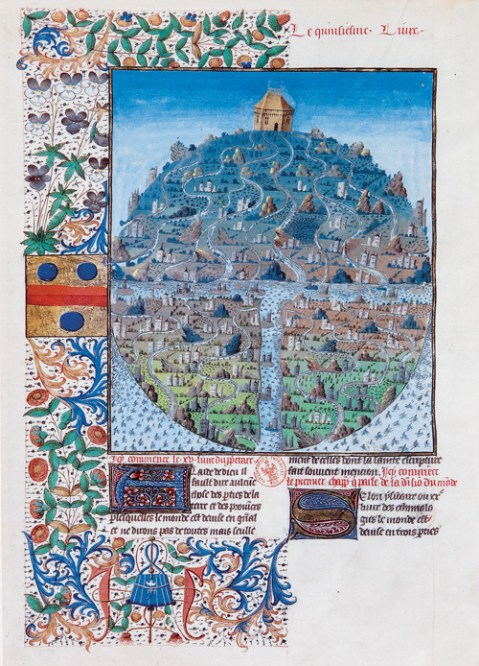
T and O map by Bartholomaeus Angelicus, 1392, from Umberto Eco’s ‘The Book of Legendary Lands.’ Click image for details.

Even the word itself endured an unforeseen transformation, its original meaning itself lost amidst our present cult of productivity and perilous goal-orientedness:

The word “lost” comes from the Old Norse los, meaning the disbanding of an army, and this origin suggests soldiers falling out of formation to go home, a truce with the wide world. I worry now that many people never disband their armies, never go beyond what they know. Advertising, alarmist news, technology, incessant busyness, and the design of public and private space conspire to make it so.

Taking back the meaning of lost seems almost a political act, a matter of existential agency that we ought to reclaim in order to feel at home in ourselves. Solnit writes:

There’s another art of being at home in the unknown, so that being in its midst isn’t cause for panic or suffering, of being at home with being lost.

[…]

Lost [is] mostly a state of mind, and this applies as much to all the metaphysical and metaphorical states of being lost as to blundering around in the backcountry.

The question then is how to get lost. Never to get lost is not to live, not to know how to get lost brings you to destruction, and somewhere in the terra incognita in between lies a life of discovery.

Illustration for ‘Mapping Manhattan.’ Click image for details.

During a recent vacation, I went horseback riding on a California ranch, home to a tight-knit equine community. Midway along the route, my horse glimpsed his peer across the field, carrying another rider on a different route, and began neighing restlessly upon the fleeting sight. Our guide explained that the horses, despite being extraordinarily intelligent beings, had a hard time making sense of seeing their friends appear out of nowhere, then disappear into the distance. Falling out of sight held the terror of being forever lost. My horse was calling out, making sure his friend was still there — that neither was lost. Underneath the geographic disorientation, one can imagine, lies a primal fear of losing control.

Despite the evolutionary distance, this equine disposition bears a disorienting similarity to the duality of our own relationship to the concept of lost — losing something we care about, losing ourselves, losing control — which Solnit captures beautifully:

Lost really has two disparate meanings. Losing things is about the familiar falling away, getting lost is about the unfamiliar appearing. There are objects and people that disappear from your sight or knowledge or possession; you lose a bracelet, a friend, the key. You still know where you are. Everything is familiar except that there is one item less, one missing element. Or you get lost, in which case the world has become larger than your knowledge of it. Either way, there is a loss of control. Imagine yourself streaming through time shedding gloves, umbrellas, wrenches, books, friends, homes, names. This is what the view looks like if you take a rear-facing seat on the train. Looking forward you constantly acquire moments of arrival, moments of realization, moments of discovery. The wind blows your hair back and you are greeted by what you have never seen before. The material falls away in onrushing experience. It peels off like skin from a molting snake. Of course to forget the past is to lose the sense of loss that is also memory of an absent richness and a set of clues to navigate the present by; the art is not one of forgetting but letting go. And when everything else is gone, you can be rich in loss.

A Field Guide to Getting Lost is a sublime read in its entirety. Complement it with Where You Are, an exploration of cartography as wayfinding for the soul, then revisit Anaïs Nin on how inviting the unknown helps us live more richly.

Uncertainty and Our Search for Meaning: Legendary Psychiatrist Irvin D. Yalom on How We Glean Our Sense of Purpose

Here’s the link to this article.

“The search for meaning, much like the search for pleasure, must be conducted obliquely. Meaning ensues from meaningful activity: the more we deliberately pursue it, the less likely are we to find it.”

BY MARIA POPOVA

“The sole purpose of human existence,” Carl Jung wrote in his notebooks, “is to kindle a light in the darkness of mere being.” In a universe devoid of purpose in the human sense, in which we are but a cosmic accident, the darkness of mere being can easily overwhelm us — and yet we go on striking the match of meaning. “However vast the darkness,” Stanley Kubrick urged in a 1968 interview, “we must supply our own light.”

How we supply that light is what the great existential psychiatrist Irvin D. Yalom (b. June 13, 1931) explores in a portion of the wholly illuminating 1989 classic Love’s Executioner and Other Tales of Psychotherapy (public library).

Yalom has done for psychotherapy what Oliver Sacks has done for neurology, using case studies as a storytelling springboard for contemplating some of the largest and most perennial human questions. Through the stories of ten patients, he examines what the four main aspects of psychotherapy — the inevitability of death, the freedom to shape our own lives, our ultimate aloneness, and the absence of any obvious meaning or sense to life.

The last of the four, which Yalom considers the existential human dilemma of “a being who searches for meaning and certainty in a universe that has neither,” is both the most elusive and the most fertile, for embedded in it are the other three. He writes:

If death is inevitable, if all of our accomplishments, indeed our entire solar system, shall one day lie in ruins, if the world is contingent (that is, everything could as well have been otherwise), if human beings must construct the world and the human design within that world, then what enduring meaning can there be in life? … We are meaning-seeking creatures. Biologically, our nervous systems are organized in such a way that the brain automatically clusters incoming stimuli into configurations. Meaning also provides a sense of mastery: feeling helpless and confused in the face of random, unpatterned events, we seek to order them and, in so doing, gain a sense of control over them. Even more important, meaning gives birth to values and, hence, to a code of behavior: thus the answer to why questions (Why do I live?) supplies an answer to how questions (How do I live?).

Art from a vintage children’s-book adaptation of Voltaire’s philosophical homage to Newton and the human condition. Click image for more.

Indeed, humanity’s entire history of contemplating how to live is rooted in this question of meaning. And yet Yalom argues that we can only search for meaning indirectly. In a sentiment that calls to mind Virginia Woolf on the paradox of writing about the soul, he asserts:

The search for meaning, much like the search for pleasure, must be conducted obliquely. Meaning ensues from meaningful activity: the more we deliberately pursue it, the less likely are we to find it; the rational questions one can pose about meaning will always outlast the answers. In therapy, as in life, meaningfulness is a by-product of engagement and commitment, and that is where therapists must direct their efforts — not that engagement provides the rational answer to questions of meaning, but it causes these questions not to matter.

Art by Jean-Pierre Weill from ‘The Well of Being.’ Click image for more.

In both therapy and life, this sidewise gleam of meaning requires cultivating a comfort level with uncertainty and continually asking what Hannah Arendt so memorably termed the “unanswerable questions” that make us human; it then requires that, to paraphrase Rilke’s immortal words, we live those questions. Yalom writes:

The capacity to tolerate uncertainty is a prerequisite… The powerful temptation to achieve certainty through embracing an ideological school and a tight therapeutic system is treacherous: such belief may block the uncertain and spontaneous encounter necessary for effective therapy.

[…]

I must assume that knowing is better than not knowing, venturing than not venturing; and that magic and illusion, however rich, however alluring, ultimately weaken the human spirit.

How to dispel those illusions and strengthen the human spirit through meaningful uncertainty is what Yalom explores in the remainder of the altogether revelatory Love’s Executioner. Complement this particular focal point with Parker Palmer on how to discern your purpose, Viktor Frankl on the human search for meaning, and Hannah Arendt on the crucial difference between truth and meaning.

Hope in the Dark: Rebecca Solnit on the Redemptive Radiance of the World’s Invisible Revolutionaries

Here’s the link to this article.

“The grounds for hope are in the shadows, in the people who are inventing the world while no one looks, who themselves don’t know yet whether they will have any effect…”

BY MARIA POPOVA

Hope in the Dark: Rebecca Solnit on the Redemptive Radiance of the World’s Invisible Revolutionaries

I think a great deal about what it means to live with hope and sincerity in the age of cynicism, about how we can continue standing at the gates of hope as we’re being bombarded with news of hopeless acts of violence, as we’re confronted daily with what Marcus Aurelius called the “meddling, ungrateful, arrogant, dishonest, jealous, and surly.”

I’ve found no more lucid and luminous a defense of hope than the one Rebecca Solnit launches in Hope in the Dark: Untold Histories, Wild Possibilities (public library) — a slim, potent book penned in the wake of the Bush administration’s invasion of Iraq; a book that has grown only more relevant and poignant in the decade since.

Rebecca Solnit (Photograph: Sallie Dean Shatz)

We lose hope, Solnit suggests, because we lose perspective — we lose sight of the “accretion of incremental, imperceptible changes” which constitute progress and which render our era dramatically different from the past, a contrast obscured by the undramatic nature of gradual transformation punctuated by occasional tumult.

Each of our lifetimes brims with personal evidence of these collective cultural shifts: At the time I was born, no one imagined that the Cold War would end and a girl raised in communist Bulgaria would make a life for herself reading and writing about books in English while facing the Manhattan skyline; a mere decade ago, it seemed inconceivable that a distributed tribe of strangers would raise a million dollars for refugees in another part of the world via an instantaneous global communication system of 140-character neo-telegrams; just a couple of years ago, it was hard to imagine that the day would come when all of us would be able to marry the people we love.

Solnit writes:

There are times when it seems as though not only the future but the present is dark: few recognize what a radically transformed world we live in, one that has been transformed not only by such nightmares as global warming and global capital, but by dreams of freedom and of justice — and transformed by things we could not have dreamed of… We need to hope for the realization of our own dreams, but also to recognize a world that will remain wilder than our imaginations.

In a sentiment that parallels the relationship between dark matter and ordinary matter in the formation of the universe, Solnit offers the perfect metaphor for the source of our tenuous grip on hope:

Imagine the world as a theater. The acts of the powerful and the official occupy center stage. The traditional versions of history, the conventional sources of news encourage us to fix our gaze on the stage. The limelights there are so bright they blind you to the shadowy spaces around you, make it hard to meet the gaze of the other people in the seats, to see the way out of the audience, into the aisles, backstage, outside, in the dark, where other powers are at work. A lot of the fate of the world is decided onstage, in the limelight, and the actors there will tell you that no other place matters.

Art from Maurice Sendak's take on Nutcracker
Art from Maurice Sendak’s take on Nutcracker

In a passage that calls to mind Simone Weil’s memorable words — “When someone exposes himself as a slave in the market place, what wonder if he finds a master?” — Solnit adds:

What is onstage is a tragedy, the tragedy of the inequitable distribution of power and of the too-common silence of those who settle for being audience while paying the price of the drama. Traditionally, the audience is supposed to choose the actors, and the actors are quite literally supposed to speak for us. This is the idea behind representative democracy. In practice, various reasons keep many from participating in the choice, other forces — like money — subvert that choice, and onstage too many of the actors find other reasons — lobbyists, self-interest, conformity — to fail to represent their constituents.

GeorgeLauri1916

Hope, Solnit observes, dies when we choose to watch the unfolding drama in resignation and abdicate all responsibility, pointing a blaming finger at those in the limelight. (Lest we forget, Joseph Brodsky put it best: “A pointed finger is a victim’s logo.”)

She considers the disposition of the hopeless:

They speak as though we should wait for improvement to be handed to us, not as though we might seize it. Perhaps their despair is in some ways simply that they are audience rather than actors.

Our most radiant horizon of hope, Solnit argues, lies in the darkness beyond the limelight:

The grounds for hope are in the shadows, in the people who are inventing the world while no one looks, who themselves don’t know yet whether they will have any effect, in the people you have not yet heard of who will be the next Cesar Chavez, the next Noam Chomsky, the next Cindy Sheehan, or become something you cannot yet imagine. In this epic struggle between light and dark, it’s the dark side — that of the anonymous, the unseen, the officially powerless, the visionaries and subversives in the shadows — that we must hope for. For those onstage, we can just hope the curtain comes down soon and the next act is better, that it comes more directly from the populist shadows.

Hope in the Dark is an immensely invigorating read in its entirety. Complement it with E.B. White’s elevating letter to a man who had lost faith in humanity, Albert Camus on how to ennoble our spirits in dark times, and Viktor Frankl on why idealism is the best activism, then revisit Solnit on how we find ourselves by getting lostwhat reading does for the human spirithow modern noncommunication is changing our experience of time, solitude, and communion, and her beautiful manifesto for the spiritual rewards of walking.

Love of Life: Albert Camus on Happiness, Despair, the Art of Awareness, and Why We Travel

Here’s the link to this article.

“There is no love of life without despair of life.”

BY MARIA POPOVA

Love of Life: Albert Camus on Happiness, Despair, the Art of Awareness, and Why We Travel

“Those who prefer their principles over their happiness,” Albert Camus (November 7, 1913–January 4, 1960) wrote in his notebook toward the end of his life, “they refuse to be happy outside the conditions they seem to have attached to their happiness.” Indeed, our principles tend to harden into habits and although habits give shape to our inner lives, they can mutate into the rigidity of routine and create a kind of momentum that, rather than expanding our capacity for happiness, contracts it. In the trance of routine and principled productivity, we end up showing up for our daily lives while being absent from them.

Few things things break us out of our routines and awaken us to the living substance of happiness more powerfully than travel. Camus knew this. Decades earlier, when he was only twenty-two and still a long way from becoming the second-youngest recipient of the Nobel Prize in Literature, he explored this human perplexity with unparalleled intellectual elegance and spiritual grace in a gorgeous essay titled “Love of Life,” eventually included in his posthumously published collection Lyrical and Critical Essays (public library).

albertcamus

Recounting the sight of a young woman dancing deliriously in a Spanish cabaret, Camus — whose entire life was undergirded by the ethos that happiness is our moral obligation — writes:

Without cafés and newspapers, it would be difficult to travel. A paper printed in our own language, a place to rub shoulders with others in the evenings enable us to imitate the familiar gestures of the man we were at home, who, seen from a distance, seems so much a stranger. For what gives value to travel is fear. It breaks down a kind of inner structure we have. One can no longer cheat — hide behind the hours spent at the office or at the plant (those hours we protest so loudly, which protect us so well from the pain of being alone). I have always wanted to write novels in which my heroes would say: “What would I do without the office?” or again: “My wife has died, but fortunately I have all these orders to fill for tomorrow.” Travel robs us of such refuge. Far from our own people, our own language, stripped of all our props, deprived of our masks (one doesn’t know the fare on the streetcars, or anything else), we are completely on the surface of ourselves. But also, soul-sick, we restore to every being and every object its miraculous value. A woman dancing without a thought in her head, a bottle on a table, glimpsed behind a curtain: each image becomes a symbol. The whole of life seems reflected in it, insofar as it summarizes our own life at the moment. When we are aware of every gift, the contradictory intoxications we can enjoy (including that of lucidity) are indescribable.

But this contact with absolute bliss, Camus cautions, necessitates an equal capacity for contact with absolute despair:

There lay all my love of life: a silent passion for what would perhaps escape me, a bitterness beneath a flame. Each day I would leave this cloister like a man lifted from himself, inscribed for a brief moment in the continuance of the world… There is no love of life without despair of life.

Echoing Kierkegaard’s unforgettable admonition — “Of all ridiculous things the most ridiculous seems to me, to be busy,” the Danish philosopher wrote in contemplating our greatest source of unhappiness — Camus considers how the trance of productivity robs us of the very presence necessary for happiness:

Life is short, and it is sinful to waste one’s time. They say I’m active. But being active is still wasting one’s time, if in doing one loses oneself. Today is a resting time, and my heart goes off in search of itself. If an anguish still clutches me, it’s when I feel this impalpable moment slip through my fingers like quicksilver… At the moment, my whole kingdom is of this world. This sun and these shadows, this warmth and this cold rising from the depths of the air: why wonder if something is dying or if men suffer, since everything is written on this window where the sun sheds its plenty as a greeting to my pity? I can say and in a moment I shall say that what counts is to be human and simple. No, what counts is to be true, and then everything fits in, humanity and simplicity. When am I truer than when I am the world? My cup brims over before I have time to desire. Eternity is there and I was hoping for it. What I wish for now is no longer happiness but simply awareness.

[…]

The great courage is still to gaze as squarely at the light as at death. Besides, how can I define the link that leads from this all-consuming love of life to this secret despair? If I listen to the voice of irony, crouching underneath things, slowly it reveals itself. Winking its small, clear eye, it says: “Live as if …” In spite of much searching, this is all I know.

Complement the altogether beautiful Lyrical and Critical Essays with Camus on happiness, unhappiness, and our self-imposed prisons, his illustrated wisdom on love, and the beautiful letter of gratitude he wrote to his childhood teacher after receiving the Nobel Prize.

Story vs. Plot vs. Theme: Know Your 5Ws and H

Here’s the link to this article.

June 13, 2023 by Jami Gold

Journalism writing often uses the 5W1H structure. The first few paragraphs of a news article should answer 6 basic questions (which start with 5 Ws and an H): Who, What, When, Where, Why, and How.

While fiction writing doesn’t try to cram the essentials into the beginning paragraphs, those same questions are important for our storytelling. In fact, we can use specific questions from that structure to understand the big picture—or essence—of our story, plot, and theme.

Story vs. Plot

First, though, we need to understand that our story and our plot are not the same. A story is about our characters’ struggle, while a plot is the events that reveal the characters and choices explored in the story.

Let’s illustrate the difference with an example plot idea: An asteroid is coming to smash the Earth to smithereens.

Yikes! Okay, but what about it? Who’s doing the struggling against those consequences?

Without characters, that asteroid’s just going to do its thing, same as it would on an uninhabited planet. Boom, crash, the end. There’s no story there because there’s no story problem there—no characters attempting to overcome the obstacles of the plot.

What’s a Story?

To have a story, we need characters who face a problem. And it’s only when we decide who our characters are or the choices they’ll face that we’ll know what our asteroid story is:

  • Plucky team of astronauts try to destroy the asteroid before it reaches Earth.
  • Doomed world leaders debate how to help their citizens react in the last days.
  • Estranged family members reach out to each other and heal wounds before the end.
  • And so on…

Each of those character examples defines a story problem—they want to destroy, debate, or heal. In turn, the story problem defines the story, as the characters attempt to solve their problem.

What’s a Plot?

On the other hand, if the asteroid is only big enough to cause a few cloudy days, our characters would have no reason to make big changes or choices. That’s where plot comes in: Plot events are the triggers forcing choices and changes in our characters.

Story Questions vs. Plot Questions

Now back to that 5W1H structure…

Story Questions

As a story is about a struggle or an attempt to solve a story problem, we can begin to define the layers of our story with questions that focus on that struggle or problem:

  • Who? Who is doing the struggling or attempting to solve the problem? (team of astronauts)
  • What? What is the struggle or problem? What do our characters want? (destroy the asteroid)

We can further define our story with other questions, especially in certain genres such as historical or science fiction (When? 1892 or the distant future, Where? England or outer space), but the two bullets above are generally the most important.

Plot Questions

As a plot is about the events that force choices and changes, we can begin to define the layers of our plot with questions that focus on those events:

  • How? How are the characters being pushed into action or choices? How are they trying to reach their goal? (an asteroid is coming to smash the Earth, so they’re trying to blow it up)

Note that it may seem like additional questions would help us further define the plot:

  • What? What plot events will best reveal our characters? (an accident takes out the mission leader and the protagonist needs to step up)
  • When? or Where? to describe the circumstances causing the story to take place now (explaining the reasons those estranged family members finally reach out to each other, when they technically could have healed the wounded relationship at any time)

But those are all just other ways of getting at the How, defining the triggers that force the changes and choices in our story.

How Does Our Story’s Theme Fit In?

Theme is usually said to be a story’s “message,” but what does that mean in practice? How can we define what the theme of a particular story might be, especially when…

  • themes are less concrete or obvious (often found in the subtext or a single sentence)
  • stories contain multiple themes (formed by story premise, worldview, character arc, plot events, etc.)
  • stories often include unintended themes (which can undermine our intended themes)

In other words, we might not know what our story’s themes are—or should be. Even if we brainstorm from “theme idea” lists, those nouns or short phrases (war vs. peace, coming of age, love, survival, etc.) aren’t themes until we figure out what we’re trying to say about that topic.

Theme Questions

To figure out what we’re trying to say with our story, we can begin to define the layers of our themes with big-picture questions:

  • Why? Why does our character participate in the story (in the big picture)? Why are we writing this story? (such as: our protagonist believes the world is worth saving, or we want to inspire others to not give up)

Our Why answers help us narrow down what we’re trying to say with our story, which then helps us define our intended themes. Our protagonist could learn to not take life for granted. Our plot events could present reasons and opportunities for our protagonist to give up, but they believe in the importance of their actions and make choices revealing their persistence. And so on.

From Journalism to Storytelling

Taking a page from journalism writing to identify the most important aspects of our story can help us see the big picture as we plan, draft, or edit our story. Using the 5W1H questions forces us to focus on the essence of our story, especially:

  • Who are our characters?
  • What do they want?
  • How are they going to try to get it?
  • Why is the story important (to our character(s) and to us)?

Those answers give us direction as we attempt to get our big-picture thoughts onto the page for our readers to enjoy. *smile*

Have you ever struggled to see your story’s big picture or to identify/develop your story’s themes? Does this framework of using specific questions to define our story’s essence make sense to you? Do you have any questions about story vs. plot vs. theme or how to apply these questions?

JAMI GOLD – Resident Writing Coach

Jami Gold, after muttering writing advice in tongues, decided to become a writer and put her talent for making up stuff to good use, such as by winning the 2015 National Readers’ Choice Award in Paranormal Romance for her novel Ironclad Devotion.

To help others reach their creative potential as well, she’s developed a massive collection of resources for writers. Explore her site to find worksheets—including the popular Romance Beat Sheet with 80,000+ downloads—workshops, and over 1000 posts on her blog about the craft, business, and life of writing. Her site has been named one of the 101 Best Websites for Writers by Writer’s Digest.

Einstein on Free Will and the Power of the Imagination

Here’s the link to this article.

“Human being, vegetables or cosmic dust, we all dance to an invisible tune, intoned in the distance by a mysterious player.”

BY MARIA POPOVA

We are accidents of biochemistry and chance, moving through the world waging wars and writing poems, spellbound by the seductive illusion of the self, every single one of our atoms traceable to some dead star.

In the interlude between the two World Wars, days after the stock market crash that sparked the Great Depression, the German-American poet and future Nazi sympathizer George Sylvester Viereck sat down with Albert Einstein (March 14, 1879–April 18, 1955) for what became his most extensive interview about life — reflections ranging from science to spirituality to the elemental questions of existence. It was published in the Saturday Evening Post on October 29, 1929 — a quarter century after Einstein’s theory of relativity reconfigured our basic understanding of reality with its revelation that space and time are the warp and weft threads of a single fabric, along the curvature of which everything we are and everything we know is gliding.

Albert Einstein by Lotte Jacobi. (University of New Hampshire Museum of Art.)

Considering the helplessness individual human beings feel before the immense geopolitical forces that had hurled the world into its first global war and the decisions individual political leaders were making — decisions already inclining the world toward a second — Einstein aims in his sensitive intellect at the fundamental reality of existence:

I am a determinist. As such, I do not believe in free will. The Jews believe in free will. They believe that man shapes his own life. I reject that doctrine philosophically. In that respect I am not a Jew… I believe with Schopenhauer: We can do what we wish, but we can only wish what we must. Practically, I am, nevertheless, compelled to act is if freedom of the will existed. If I wish to live in a civilized community, I must act as if man is a responsible being.

When asked about any personal responsibility for his own staggering achievements, he points a steadfast finger at the nonexistence of free will:

I claim credit for nothing. Everything is determined, the beginning as well as the end, by forces over which we have no control. It is determined for the insect as well as for the star. Human being, vegetables or cosmic dust, we all dance to an invisible tune, intoned in the distance by a mysterious player.

Art by Dorothy Lathrop, 1922. (Available as a print and as stationery cards.)

For Einstein, the most alive part of the mystery we live with — the mystery we are — is the imagination, that supreme redemption of human life from the prison of determinism. With an eye to his discovery of relativity, he reflects:

I believe in intuitions and inspirations. I sometimes feel that I am right. I do not know that I am. When two expeditions of scientists, funded by the Royal Academy, went forth to test my theory of relativity, I was convinced that their conclusions would totally tally with my hypothesis. I was not surprised when the eclipse of May 29, 1919, confirmed my intuitions. I would have been surprised if I had been wrong.

[…]

I am enough of an artist to draw freely from the imagination. Imagination is more important than knowledge. Knowledge is limited. Imagination encircles the world.

Complement with Robinson Jeffers’s superb science-laced poem “The Beginning and the End,” Simone Weil on the relationship between our rights and our responsibilities, and neuroscientist Sam Harris on our primary misconception about free will, then revisit Einstein on the interconnectedness of our fates.

The Paradox of Free Will

Here’s the link to this article.

The neuroscience, physics, and philosophy of freedom in a universe of fixed laws.

BY MARIA POPOVA

“Nothing is more unbearable, once one has it, than freedom,” James Baldwin observed in recognizing how limited our freedom is and how illusory our choices, for he knew that “people can’t, unhappily, invent their mooring posts, their lovers and their friends, anymore than they can invent their parents.”

And yet we move through the world with an air of agency, without which life would feel unlivable — a gauntlet of causality stretching all the way back to the Big Bang, into which we are hurled as helpless pawns in some cosmic game that has already played out. It is a disquieting notion — one we have countered with our dream of free will, continually mistaking the feeling of freedom for the fact of freedom.

But even within the presets and parameters conferred upon us by the cosmic and cultural forces that made us, there exists a margin of movement in which notions like control, agency, and moral responsibility live. In that margin, we become fully human.

In this fascinating BBC documentary, journalist Melissa Hogenboom and a constellation of neuroscientists, physicists, and philosophers explore the science and subtleties of the free will question — a question that remains not only unanswered but a testament to Hannah Arendt’s astute observation that “to lose the appetite for meaning we call thinking and cease to ask unanswerable questions [would be to lose] the capacity to ask all the answerable questions upon which every civilization is founded.”

Complement with Einstein on free will and the power of the imagination, C.S. Lewis on suffering and what it means to have free will in a universe of fixed laws, and neuroscientist Christof Koch on the paradox of freedom.

Singularity: Marie Howe’s Ode to Stephen Hawking, Our Cosmic Belonging, and the Meaning of Home, in a Stunning Animated Short Film

Here’s the link to this article.

“For every atom belonging to me as good belongs to you. Remember?”

BY MARIA POPOVA

UPDATE 2022: This poem has since inspired the magnificent “Singularity (after Marie Howe)” by the young poet Marissa Davis.

“We, this people, on a small and lonely planet,” Maya Angelou begins “A Brave and Startling Truth” — her cosmic wakeup call to humanity, which flew into space aboard NASA’s Orion spacecraft and which opened the 2018 Universe in Verse, dedicated to our ecological awakening on the wings of Rachel Carson’s courageous work.

That year, Marie Howe — one of our great living poets, who awakens the creaturely conscience of the next generation in her ecopoetry class at Sarah Lawrence College — premiered a kindred poem that stilled the crowd constellating at Pioneer Works before erupting into a thousand-bodied standing ovation. While inspired by Stephen Hawking (who had just returned his stardust to the universe several weeks earlier) and titled after his trailblazing work on black holes and singularities — work that shines a sidewise gleam on the origin of everything — the poem is at bottom a stunning meditation on the interconnectedness of belonging across space and time, across selves and species, across the myriad artificial unbelongings we have manufactured as we have drifted further and further from our elemental nature. Its closing line is an invocation, an incantation, ending with a timeless word of staggering resonance today: home.

As we now stand on a profound precipice two years later — facing our deeply interconnected ecology of being on this shared cosmic home as we look back on fifty years of Earth Day built on Carson’s legacy, facing the most intimate meaning of home in our isolated shelters scattered across this “small and lonely planet” — the poem pulsates with a whole new meaning, as all great poems do in the veins of time.

And so, as a special treat for the 2020 Universe in Verse, streaming on April 25 into millions of homes around this sole shared home, I teamed up with SALT Project — a kindred clan of visual storytellers, who have won some hearts and won some Emmys with their soulful shorts ranging from book trailers to bird migration documentaries — to bring Howe’s “Singularity” to life in a transcendent short film, illustrated by paper collage artist Elena Skoreyko Wagner and featuring original music by the heroic cellist Zoë Keating, who was present in atoms at the 2018 show when “Singularity” premiered and who also composed the score for “Antidotes to Fear of Death” — the headlining miracle of a poem for the 2020 show.

It is with exuberant joy and gratitude that I share, as a special taste of the 2020 Universe in Verse, this symphony of beauty and perspective, over which so many talented women have labored with so much heart and generosity of spirit .

SINGULARITY
by Marie Howe

          (after Stephen Hawking)

Do you sometimes want to wake up to the singularity
we once were?

so compact nobody
needed a bed, or food or money —

nobody hiding in the school bathroom
or home alone

pulling open the drawer
where the pills are kept.

For every atom belonging to me as good
Belongs to you.
   Remember?

There was no   Nature.    No
 them.   No tests

to determine if the elephant
grieves her calf    or if

the coral reef feels pain.    Trashed
oceans don’t speak English or Farsi or French;

would that we could wake up   to what we were
— when we were ocean    and before that

to when sky was earth, and animal was energy, and rock was
liquid and stars were space and space was not

at all — nothing

before we came to believe humans were so important
before this awful loneliness.

Can molecules recall it?
what once was?    before anything happened?

No I, no We, no one. No was
No verb      no noun
only a tiny tiny dot brimming with

is is is is is

All   everything   home

Complement with an ink-and-watercolor animation of Mojave American poet Natalie Diaz’s gorgeous poem of brokenness and belonging and an animated adaptation of Neil Gaiman’s ode to women’s prehistoric role in the history of the scientific method.

The Mirror of Enigmas: Chance, the Universe, and the Fragile Loveliness of Knowing Who We Are

Here’s the link to this article.

“There is no human being on earth capable of declaring with certitude who he is.”

BY MARIA POPOVA

The Mirror of Enigmas: Chance, the Universe, and the Fragile Loveliness of Knowing Who We Are

It takes a great sobriety of spirit to know your own depths — and your limits. It takes a special grandeur of spirit to know the limits of your self-knowledge.

A recent brush with those limits reminded me of a short, stunning essay by Jorge Luis Borges (August 24, 1899–June 14, 1986) titled “The Mirror of Enigmas,” found in his Labyrinths (public library) — the 1962 collection of stories, essays, and parables that gave us his timeless parable of the divided self and his classic refutation of time.

Titling the essay after St. Paul’s famous cryptic statement Videmus nunc per speculum in aenigmate — loosely translated as We now see through a mirror, enigmatically — Borges considers the tribe of thinkers who have perched their efforts to reconcile knowledge and mystery, the scientific and the spiritual, on the assumption that “the history of the universe — and in it our lives and the most tenuous detail of our lives — has an incalculable, symbolical value.” With his characteristic poetic precision, he condenses this common and somewhat tired hypothesis:

The outer world — forms, temperatures, the moon — is a language humans have forgotten or which we can scarcely distinguish.

No one, Borges argues, has taken this precarious hypothesis to more surefooted ground than the French novelist, poet, and philosophical pamphleteer Léon Bloy (July 11, 1846–November 3, 1917).

Digging through the surviving fragments of Bloy’s written thought, he surfaces a passage emblematic of Bloy’s uncommon physics of the metaphysical — an 1894 passage fomented by his interest in the teachings of St. Paul. Translated by Borges himself, Bloy writes:

[St. Paul’s statement] would be a skylight through which one might submerge himself in the true Abyss, which is the soul of man. The terrifying immensity of the firmament’s abyss is an illusion, an external reflection of our own abysses, perceived “in a mirror.” We should invert our eyes and practice a sublime astronomy in the infinitude of our heart… If we see the Milky Way, it is because it actually exists in our souls.

Art from Thomas Wright’s An Original Theory or New Hypothesis of the Universe, 1750 — the first book to describe the spiral shape of the Milky Way. (Available as a print and as a face mask.)

A century before Milan Kundera considered the eternal challenge of knowing what we really want in his classic novel The Unbearable Lightness of Being, Bloy shines a sidewise gleam on the elemental self-opacity with and within which we live:

Everything is a symbol, even the most piercing pain. We are dreamers who shout in our sleep. We do not know whether the things afflicting us are the secret beginning of our ulterior happiness or not.

These ideas haunted Bloy, animated his pamphlets, his poems, his novels, then culminated in his 1912 book-length essay The Soul of Napoleon — a philosophical prose poem that sets out, as Borges puts it, “to decipher the symbol Napoleon, considered as the precursor of another hero — man and symbol as well — who is hidden in the future.” Bloy, translated again by Borges, writes in this uncommon work:

Every man* is on earth to symbolize something he is ignorant of and to realize a particle or a mountain of the invisible materials that will serve to build the City of God.

[…]

There is no human being on earth capable of declaring with certitude who he is. No one knows what he has come into this world to do, what his acts correspond to, his sentiments, his ideas, or what his real name is, his enduring Name in the register of Light… History is an immense liturgical text where the iotas and the dots are worth no less than the entire verses or chapters, but the importance of one and the other is indeterminable and profoundly hidden.

But as you contemplate these existential immensities, you face the limits of contemplation — the limits of meaning-making in relation to elemental truth.

Borges recognized this, closing the essay with by acknowledging “it is doubtful that the world has a meaning… even more doubtful that it has a double or triple meaning.”

I recognized this upon sitting down in for morning meditation in my garden after a nightlong storm and watching an almost otherworldly deposit roll onto the cushion: a tiny, perfect robin egg, improbable and sorrowful in its displaced blue beauty.

Singing Only Is by Maria Popova. (Available as a print.)

I considered climbing the neighbor’s colossal tree to find the storm-shaken nest and reinstate the egg. (Perfectly, the tree is an Ailanthus altissima, known as “tree-of-heaven” in its native China — a migrant now rooted in Brooklyn, like me.)

But then I considered this chance-event as the product of the same impartial forces that deposited the exact spermatozoid of my father’s onto my mother’s ovum at the exact moment to produce the chance-event of my particular configuration of atoms animated by this particular consciousness that just is, the consciousness mourning the robin that will never be. To call one expression of chance good and another bad is mere human hubris — the hubris of narrative and interpretation superimposed on an impartial universe devoid of why, awash in is.

No one knows the meaning of why anything comes to be, or doesn’t. Here is this pale blue orb, dropped from the tree-of-heaven onto a tiny Brooklyn point on the face of this Pale Blue Dot, itself a “mote of dust suspended in a sunbeam” within an immense and impartial universe, conceived in the creation myths and early scientific theories of our meaning-hungry ancestors as a great cosmic egg.

Art from An Original Theory or New Hypothesis of the Universe, 1750, illustrating Thomas Wright’s model of the cosmos as an egg-like structure of nested infinities. (Available as a print and as a face mask.)

Here I am, and here you are, and here is the robin’s egg in its near-life collision with chance. To ask for its meaning is as meaningless a question as to demand the meaning of a color or the meaning of a bird. On this particular day, at this particular moment — the only locus of aliveness we ever have — the contour of meaning comes in shades of blue, singing only is.

Yes to Life, in Spite of Everything: Viktor Frankl’s Lost Lectures on Moving Beyond Optimism and Pessimism to Find the Deepest Source of Meaning

Here’s the link to this article.

“Everything depends on the individual human being, regardless of how small a number of like-minded people there is… on each person… creatively making the meaning of life a reality in his or her own being.”

BY MARIA POPOVA

Yes to Life, in Spite of Everything: Viktor Frankl’s Lost Lectures on Moving Beyond Optimism and Pessimism to Find the Deepest Source of Meaning

“To decide whether life is worth living is to answer the fundamental question of philosophy,” Albert Camus wrote in his classic 119-page essay The Myth of Sisyphus in 1942. “Everything else… is child’s play; we must first of all answer the question.”

Sometimes, life asks this question not as a thought experiment but as a gauntlet hurled with the raw brutality of living.

That selfsame year, the young Viennese neurologist and psychiatrist Viktor Frankl (March 26, 1905–September 2, 1997) was taken to Auschwitz along with more than a million human beings robbed of the basic right to answer this question for themselves, instead deemed unworthy of living. Some survived by reading. Some through humor. Some by pure chance. Most did not. Frankl lost his mother, his father, and his brother to the mass murder in the concentration camps. His own life was spared by the tightly braided lifeline of chance, choice, and character.

Viktor Frankl

A mere eleven months after surviving the unsurvivable, Frankl took up the elemental question at the heart of Camus’s philosophical parable in a set of lectures, which he himself edited into a slim, potent book published in Germany in 1946, just as he was completing Man’s Search for Meaning.

As our collective memory always tends toward amnesia and erasure — especially of periods scarred by civilizational shame — these existential infusions of sanity and lucid buoyancy fell out of print and were soon forgotten. Eventually rediscovered — as is also the tendency of our collective memory when the present fails us and we must lean for succor on the life-tested wisdom of the past — they are now published in English for the first time as Yes to Life: In Spite of Everything (public library).

Frankl begins by considering the question of whether life is worth living through the central fact of human dignity. Noting how gravely the Holocaust disillusioned humanity with itself, he cautions against the defeatist “end-of-the-world” mindset with which many responded to this disillusionment, but cautions equally against the “blithe optimism” of previous, more naïve eras that had not yet faced this gruesome civilizational mirror reflecting what human beings are capable of doing to one another. Both dispositions, he argues, stem from nihilism. In consonance with his colleague and contemporary Erich Fromm’s insistence that we can only transcend the shared laziness of optimism and pessimism through rational faith in the human spirit, Frankl writes:

We cannot move toward any spiritual reconstruction with a sense of fatalism such as this.

Liminal Worlds by Maria Popova. (Available as a print.)

Generations and myriad cultural upheavals before Zadie Smith observed that “progress is never permanent, will always be threatened, must be redoubled, restated and reimagined if it is to survive,” Frankl considers what “progress” even means, emphasizing the centrality of our individual choices in its constant revision:

Today every impulse for action is generated by the knowledge that there is no form of progress on which we can trustingly rely. If today we cannot sit idly by, it is precisely because each and every one of us determines what and how far something “progresses.” In this, we are aware that inner progress is only actually possible for each individual, while mass progress at most consists of technical progress, which only impresses us because we live in a technical age.

Insisting that it takes a measure of moral strength not to succumb to nihilism, be it that of the pessimist or of the optimist, he exclaims:

Give me a sober activism anytime, rather than that rose-tinted fatalism!

How steadfast would a person’s belief in the meaningfulness of life have to be, so as not to be shattered by such skepticism. How unconditionally do we have to believe in the meaning and value of human existence, if this belief is able to take up and bear this skepticism and pessimism?

[…]

Through this nihilism, through the pessimism and skepticism, through the soberness of a “new objectivity” that is no longer that “new” but has grown old, we must strive toward a new humanity.

Sophie Scholl, upon whom chance did not smile as favorably as it did upon Frankl, affirmed this notion with her insistence that living with integrity and belief in human goodness is the wellspring of courage as she courageously faced her own untimely death in the hands of the Nazis. But while the Holocaust indisputably disenchanted humanity, Frankl argues, it also indisputably demonstrated “that what is human is still valid… that it is all a question of the individual human being.” Looking back on the brutality of the camps, he reflects:

What remained was the individual person, the human being — and nothing else. Everything had fallen away from him during those years: money, power, fame; nothing was certain for him anymore: not life, not health, not happiness; all had been called into question for him: vanity, ambition, relationships. Everything was reduced to bare existence. Burnt through with pain, everything that was not essential was melted down — the human being reduced to what he was in the last analysis: either a member of the masses, therefore no one real, so really no one — the anonymous one, a nameless thing (!), that “he” had now become, just a prisoner number; or else he melted right down to his essential self.

Illustration by Margaret C. Cook for a rare 1913 edition of Leaves of Grass. (Available as a print.)

In a sentiment that bellows from the hallways of history into the great vaulted temple of timeless truth, he adds:

Everything depends on the individual human being, regardless of how small a number of like-minded people there is, and everything depends on each person, through action and not mere words, creatively making the meaning of life a reality in his or her own being.

Frankl then turns to the question of finding a sense of meaning when the world gives us ample reasons to view life as meaningless — the question of “continuing to live despite persistent world-weariness.” Writing in the post-war pre-dawn of the golden age of consumerism, which has built a global economy by continually robbing us of the sense of meaning and selling it back to us at the price of the product, Frankl first dismantles the notion that meaning is to be found in the pursuit and acquisition of various pleasures:

Let us imagine a man who has been sentenced to death and, a few hours before his execution, has been told he is free to decide on the menu for his last meal. The guard comes into his cell and asks him what he wants to eat, offers him all kinds of delicacies; but the man rejects all his suggestions. He thinks to himself that it is quite irrelevant whether he stuffs good food into the stomach of his organism or not, as in a few hours it will be a corpse. And even the feelings of pleasure that could still be felt in the organism’s cerebral ganglia seem pointless in view of the fact that in two hours they will be destroyed forever. But the whole of life stands in the face of death, and if this man had been right, then our whole lives would also be meaningless, were we only to strive for pleasure and nothing else — preferably the most pleasure and the highest degree of pleasure possible. Pleasure in itself cannot give our existence meaning; thus the lack of pleasure cannot take away meaning from life, which now seems obvious to us.

He quotes a short verse by the great Indian poet and philosopher Rabindranath Tagore — the first non-European to win the Nobel Prize, Einstein’s onetime conversation partner in contemplating science and spirituality, and a man who thought deeply about human nature:

I slept and dreamt
that life was joy.
I awoke and saw
that life was duty.
I worked — and behold,
duty was joy.

In consonance with Camus’s view of happiness as a moral obligation — an outcome to be attained not through direct pursuit but as a byproduct of living with authenticity and integrity — Frankl reflects on Tagore’s poetic point:

So, life is somehow duty, a single, huge obligation. And there is certainly joy in life too, but it cannot be pursued, cannot be “willed into being” as joy; rather, it must arise spontaneously, and in fact, it does arise spontaneously, just as an outcome may arise: Happiness should not, must not, and can never be a goal, but only an outcome; the outcome of the fulfillment of that which in Tagore’s poem is called duty… All human striving for happiness, in this sense, is doomed to failure as luck can only fall into one’s lap but can never be hunted down.

In a sentiment James Baldwin would echo two decades later in his superb forgotten essay on the antidote to the hour of despair and life as a moral obligation to the universe, Frankl turns the question unto itself:

At this point it would be helpful [to perform] a conceptual turn through 180 degrees, after which the question can no longer be “What can I expect from life?” but can now only be “What does life expect of me?” What task in life is waiting for me?

Now we also understand how, in the final analysis, the question of the meaning of life is not asked in the right way, if asked in the way it is generally asked: it is not we who are permitted to ask about the meaning of life — it is life that asks the questions, directs questions at us… We are the ones who must answer, must give answers to the constant, hourly question of life, to the essential “life questions.” Living itself means nothing other than being questioned; our whole act of being is nothing more than responding to — of being responsible toward — life. With this mental standpoint nothing can scare us anymore, no future, no apparent lack of a future. Because now the present is everything as it holds the eternally new question of life for us.

Another of Margaret C. Cook’s illustrations for the 1913 English edition of Leaves of Grass. (Available as a print.)

Frankl adds a caveat of tremendous importance — triply so in our present culture of self-appointed gurus, self-help demagogues, and endless podcast feeds of interviews with accomplished individuals attempting to distill a universal recipe for self-actualization:

The question life asks us, and in answering which we can realize the meaning of the present moment, does not only change from hour to hour but also changes from person to person: the question is entirely different in each moment for every individual.

We can, therefore, see how the question as to the meaning of life is posed too simply, unless it is posed with complete specificity, in the concreteness of the here and now. To ask about “the meaning of life” in this way seems just as naive to us as the question of a reporter interviewing a world chess champion and asking, “And now, Master, please tell me: which chess move do you think is the best?” Is there a move, a particular move, that could be good, or even the best, beyond a very specific, concrete game situation, a specific configuration of the pieces?

What emerges from Frankl’s inversion of the question is the sense that, just as learning to die is learning to meet the universe on its own terms, learning to live is learning to meet the universe on its own terms — terms that change daily, hourly, by the moment:

One way or another, there can only be one alternative at a time to give meaning to life, meaning to the moment — so at any time we only need to make one decision about how we must answer, but, each time, a very specific question is being asked of us by life. From all this follows that life always offers us a possibility for the fulfillment of meaning, therefore there is always the option that it has a meaning. One could also say that our human existence can be made meaningful “to the very last breath”; as long as we have breath, as long as we are still conscious, we are each responsible for answering life’s questions.

Art from Margaret C. Cook’s 1913 English edition of Leaves of Grass. (Available as a print.)

With this symphonic prelude, Frankl arrives at the essence of what he discovered about the meaning of life in his confrontation with death — a central fact of being at which a great many of humanity’s deepest seers have arrived via one path or another: from Rilke, who so passionately insisted that “death is our friend precisely because it brings us into absolute and passionate presence with all that is here, that is natural, that is love,” to physicist Brian Greene, who so poetically nested our search for meaning into our mortality into the most elemental fact of the universe. Frankl writes:

The fact, and only the fact, that we are mortal, that our lives are finite, that our time is restricted and our possibilities are limited, this fact is what makes it meaningful to do something, to exploit a possibility and make it become a reality, to fulfill it, to use our time and occupy it. Death gives us a compulsion to do so. Therefore, death forms the background against which our act of being becomes a responsibility.

[…]

Death is a meaningful part of life, just like human suffering. Both do not rob the existence of human beings of meaning but make it meaningful in the first place. Thus, it is precisely the uniqueness of our existence in the world, the irretrievability of our lifetime, the irrevocability of everything with which we fill it — or leave unfulfilled — that gives our existence significance. But it is not only the uniqueness of an individual life as a whole that gives it importance, it is also the uniqueness of every day, every hour, every moment that represents something that loads our existence with the weight of a terrible and yet so beautiful responsibility! Any hour whose demands we do not fulfill, or fulfill halfheartedly, this hour is forfeited, forfeited “for all eternity.” Conversely, what we achieve by seizing the moment is, once and for all, rescued into reality, into a reality in which it is only apparently “canceled out” by becoming the past. In truth, it has actually been preserved, in the sense of being kept safe. Having been is in this sense perhaps even the safest form of being. The “being,” the reality that we have rescued into the past in this way, can no longer be harmed by transitoriness.

In the remainder of the slender and splendid Yes to Life, Frankl goes on to explore how the imperfections of human nature add to, rather than subtract from, the meaningfulness of our lives and what it means for us to be responsible for our own existence. Complement it with Mary Shelley, writing two centuries ago about a pandemic-savaged world, on what makes life worth living, Walt Whitman contemplating this question after surviving a paralytic stroke, and a vitalizing cosmic antidote to the fear of death from astrophysicist and poet Rebecca Elson, then revisit Frankl on humor as lifeline to sanity and survival.