09/08/23 Biking & Listening

Biking is something else I both love and hate. It takes a lot of effort but does provide good exercise and most days over an hour to listen to a good book or podcast. I especially like having ridden.

Here’s my bike, a Rockhopper by Specialized. I purchased it November 2021 from Venture Out in Guntersville; Mike is top notch! So is the bike, and the ‘old’ man seat I salvaged from an old Walmart bike.

Here’s a link to today’s bike ride.


Something to consider if you’re not already cycling.

I encourage you to start riding a bike, no matter your age. Check out these groups:

Cycling for those aged 70+(opens in a new tab)

Solitary Cycling(opens in a new tab)

Remember,

Photo by Suzy Hazelwood on Pexels.com

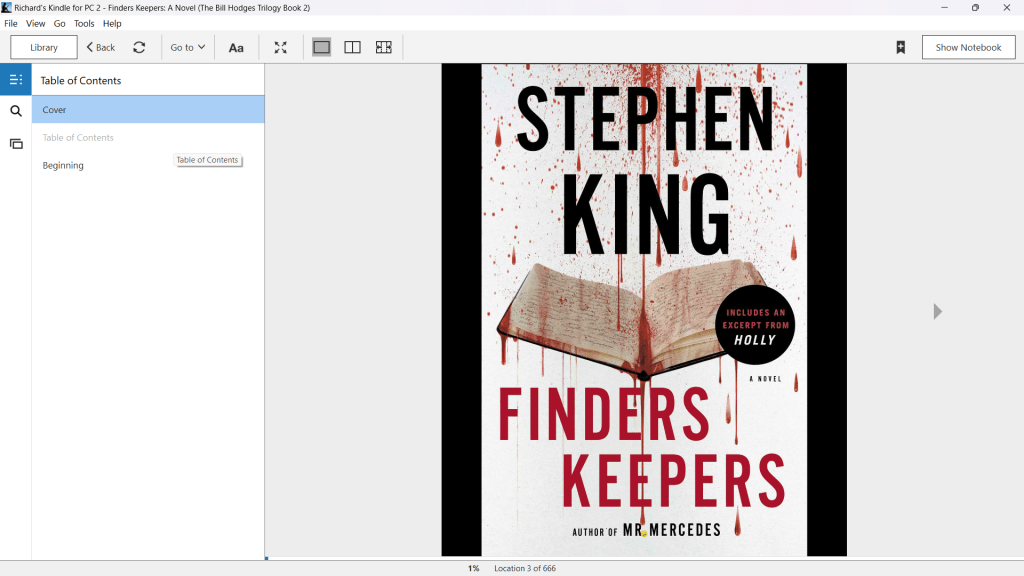
Novel listening: Finders Keepers by Stephen King

Abstract of Finders Keepers

The second book in Stephen King’s Bill Hodges trilogy (Mr. MercedesFinders KeepersEnd of Watch)—now an AT&T Audience Original Series!

“Stephen King’s superb stay-up-all-night thriller is a sly tale of literary obsession that recalls the themes of his classic 1987 novel Misery” (The Washington Post)—the #1 New York Times bestseller about the power of storytelling, starring the same trio of unlikely and winning heroes Stephen King introduced in Mr. Mercedes.

“Wake up, genius.” So announces deranged fan Morris Bellamy to iconic author John Rothstein, who once created the famous character Jimmy Gold and hasn’t released anything since. Morris is livid, not just because his favorite writer has stopped publishing, but because Jimmy Gold ended up as a sellout. Morris kills his idol and empties his safe of cash, but the real haul is a collection of notebooks containing John Rothstein’s unpublished work…including at least one more Jimmy Gold novel. Morris hides everything away—the money and the manuscripts no one but Gold ever saw—before being locked up for another horrific crime. But upon Morris’s release thirty-five years later, he’s about to discover that teenager Pete Saubers has already found the stolen treasure—and no one but former police detective Bill Hodges, along with his trusted associates Holly Gibney and Jerome Robinson, stands in the way of his vengeance…

Not since Misery has Stephen King played with the notion of a reader and murderous obsession, filled with “nail biting suspense that’s the hallmark of [his] best work” (Publishers Weekly).

Podcasts listened to


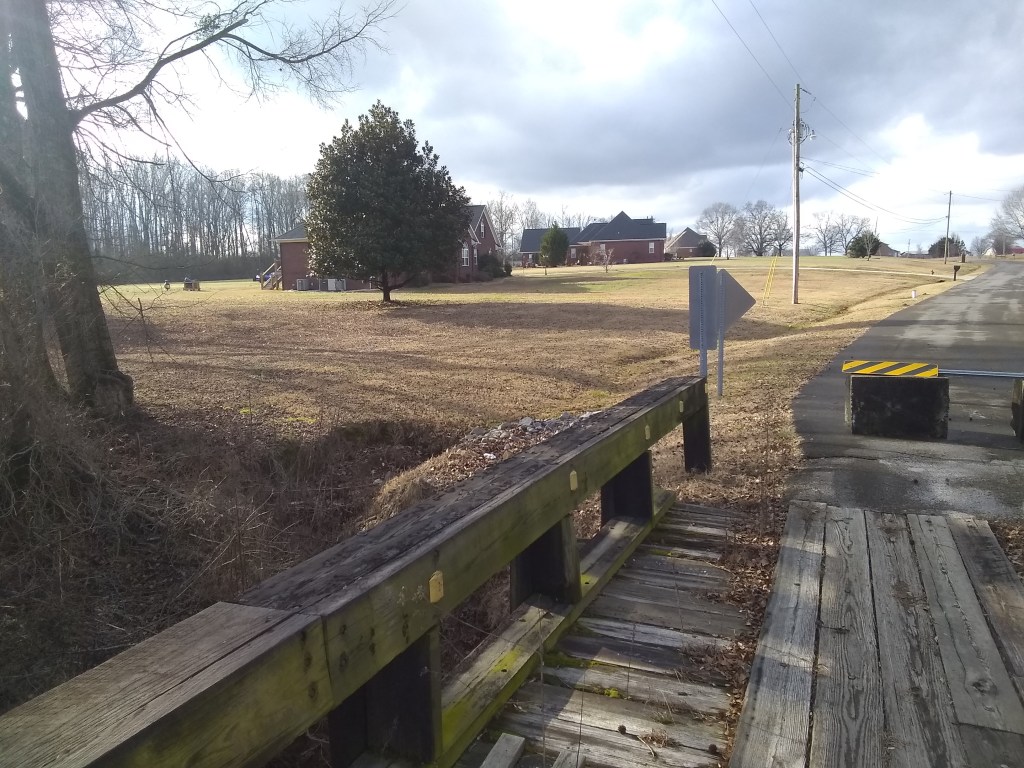
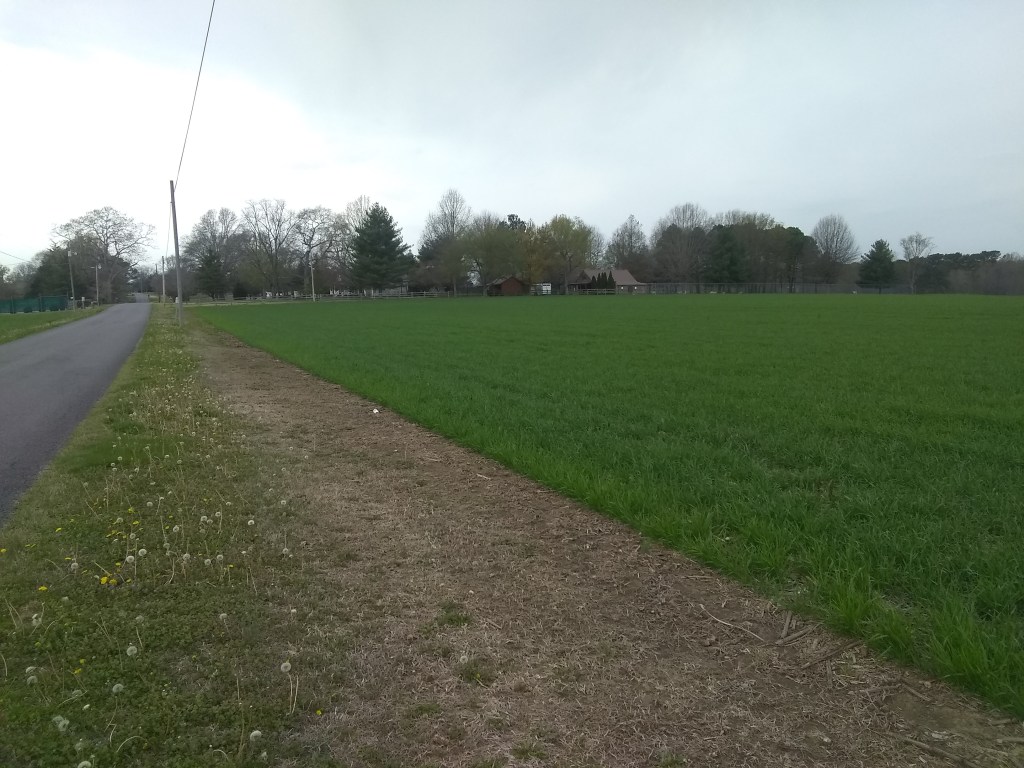
Here’s a few photos from along my pistol route:

The Boaz Stranger–Chapter 52

The fallout triggered by Lillian and Ray’s quasi-mediation session wasted over a week.

To her surprise, he had offered to settle: Lillian would receive half a billion dollars in cash plus 49% ownership in Rylan’s Boaz location, with quarterly dividend distributions expected, but not guaranteed.

I had to admit, the offer was generous, except for two conditions Ray claimed were non-negotiable. The first required Lillian’s best ‘stand-by-her-man’ performance at today’s groundbreaking ceremony for the Rylan’s development on Thomas Avenue. This was distasteful to say the least. The second condition was wholly despicable and revealed Ray’s guilt and fear. It mandated that Lillian, and thus me, cease all efforts to implicate him in a crime.

 Oddly, the second condition was a deal breaker from the beginning, but it had consumed virtually every waking hour since Lillian and Micaden had returned from Huntsville eleven days ago.

There was one other issue with Ray’s offer. At the end of their session, Ray’s attorney had told Micaden in private that the offer had to be accepted by 5:00 PM January the 15th. That’s today. And, the closing of the transaction, including transfer of a $500,000,000 cashier’s check, would take place Friday, January 29th at 2:00 PM in Huntsville. No doubt Ray had learned of mine and Lillian’s plans to return to New Haven that very afternoon. Micaden had protested, but attorney Selvidge had said two weeks was the minimum Ray needed to raise that much cash, since he didn’t intend to start the asset juggling and swapping until Lillian accepted his offer. In writing.

It was 1:00 PM when Kyla and I exited her house and walked to her Silverado. I’d asked if I could borrow it late afternoon for an errand I had to run. Lillian had driven her Lincoln Aviator an hour ago and was now rehearsing the ceremony with Ray, Mayor Ted King, and the five city councilmen.

 It was four hours until Ray’s settlement offer would evaporate, unless Lillian hand-delivered her written acceptance. I knew the two of us had prepared two letters, one accepting Ray’s offer, and the other a counter, the details of which he likely would find repulsive. For many reasons, I was nervous, even anxious about today’s event. Much could happen in four hours. The only thing that gave me consolation was that the ceremony was out in the open with an expected standing-room-only crowd.

“Stop at the mailbox, I’m expecting a package.” Kyla said as soon as I buckled my seatbelt.

Although Lillian and I had invested considerable time in Ray’s offer and brainstormed a zillion potential responses, this didn’t mean the investigation had ceased. P.I. Connor Ford had pursued Darrell Clements from Jane’s photo of the note Ray had tucked inside his cash disbursements ledger. The bottom line was that he had paid Clements $7,500 to vouch for a cleverly concocted story about Buddy’s truck. In the fictional narrative, Buddy had sold Clements the blue Chevrolet pickup and Ray had delivered it to his HorsePens 40 campsite. Impressive as they were, Ford had determined the transaction documents—Bill of Sale and Title—were forgeries. Shocking as this discovery was, it paled, considering what had occurred in the Sharon Teague case.

Nick Pearson, current General Manager and CEO of MUB Electric in Albertville, and pastor at Skirum Creek Methodist Church in Crossville, was arrested last Wednesday night a week ago during midweek prayer time. Supposedly, Pearson was standing at the pulpit petitioning God to heal Christine Dalrymple’s varicose veins when four Marshall County deputies entered the church and handcuffed the sixty-seven-year-old bi-vocational preacher.

After seeing Pearson’s arrest in the Sand Mountain Reporter’s Crime Blotter, I almost called District Attorney Pam Garrison to tell her she’d made a grave mistake. But I’d resisted the temptation. I knew her to be competent and extremely detailed. Through Micaden and Connor, I’d learned what had led to this surprising event.

An anonymous tip had prompted DA investigator Avery Proctor to pay a friendly at-first visit to Pearson at his MUB office. Neither Micaden nor Connor knew the details of the tip but had learned Pearson was adamant he had nothing to do with the disappearance of Sharon Teague over half-a-century ago. In fact, he was so confident he volunteered to take a lie-detector test, and suggested, even encouraged, law enforcement to search his home in Albertville Country Club Estates.

Proctor had acted promptly. After accepting Pearson’s offer and having him sign a written consent form, the veteran investigator had requested three deputies meet him at MUB. Less than an hour later, Deputy Jared Lang found Sharon Teague’s 1970s dog tag and her Albertville High School class ring in a shoe box on the top shelf of Pearson’s closet. This find prompted Proctor to secure a search warrant for 683 East Mann Avenue, Pearson’s childhood home where his ninety-year-old parents still lived. There, in a bedroom virtually unchanged since their only son had left for college in the fall of 1972, deputies found three bones, a human’s left femur, right tibia, and left fibula, tucked inside an Albertville High School gym bag filled with hundreds of unbound baseball cards. That was nine days ago, and the bones have already made a round-trip to and from the Department of Forensic Sciences in Birmingham. With the help (including DNA contribution) of Susan Vick, the victim’s sister, the Department positively identified the bones as those of Sharon Elizabeth Teague.

As Kyla and I waited for the red light at Highway 431, I was more confident than ever that Ray Archer or a crony had planted the evidence and made the anonymous call. How he had stolen Sharon Teague’s dog tag from Dorothy Bennett’s jewelry box, and how he had hidden the bones inside the elderly Pearson’s home was shocking and scary. I was sick by the thought the Teflon man was, once again, going to escape prosecution. I made a mental note to ask Connor or Micaden what the DA’s theory was, and what Nick Pearson’s motive was to kill Sharon Teague.

***

I made the mistake of turning right on Darnell Street and left on East Mann Avenue thinking I would find a spot next to Old Mill Park like I did at Kyle’s memorial. That area was overflowing, so I continued to Highway 205 and turned right. I eased through the red light at Thomas and into a gravel and chert area once occupied by Cox Chevrolet directly west of Rylan’s. It was the city block the mayor and council had recently purchased to resolve Ray’s concern his development would be doomed if customers didn’t have a nearby parking lot. So far, all the city had accomplished was razing the one residence and four dilapidated commercial buildings, and doing a little land prep.

By the time Kyla and I exited her Silverado, another vehicle pulled beside us, and two younger couples nodded as they hurried east on Thomas. I semi-yelled, “what’s the rush?” earning a ‘you can be an obnoxious dumb ass’ look from Kyla.

“Free food.” I didn’t figure out Kyla’s response until we reached the Brown Street intersection. Beginning there, parked along Thomas Avenue and facing future development, were a dozen or more food trucks offering anything from BBQ sandwiches, pizza, and tacos to snow cones and cotton candy.

“Not your typical groundbreaking ceremony.” I said, glancing toward the row of garden homes behind all the food trucks.

 “Food is a good way to draw a crowd.” Kyla added as we headed to the makeshift platform the city had built where Julia Street Methodist Church once stood for a hundred years. There were several hundred metal chairs set up in a semicircle around the stage. Thankfully, half the folks in attendance were more interested in food than boring speeches, leaving at least a third of the seats empty. We grabbed two in the center section underneath the outstretched limbs of an aging oak. Oddly, it was the only tree that survived the month-long demolition.

From our vantage point sixty feet from the stage, I could see, all seated, the mayor, five councilmen, Dan Brasher, and of course, the photogenic couple who’d spawned the Rylan’s idea. Lillian was smiling, but it wasn’t genuine. I could hear her thinking, “oh shit, what have I gotten into?” It was like she was directing her thoughts at Jane, seated in the front row between Stella Newsome and Nick Lancaster.

We hadn’t been seated for five minutes when the mayor walked to the podium. He welcomed everyone and promised today would be a new beginning for Boaz. He then launched into a rather long and overly detailed explanation of the Hunt House fire and the death of Eric Snyder, ending with a short moment of silence for the dead man, followed by an excited declaration as he turned and stared at the slippery eel sitting beside the woman I loved. “Ray, my friend, I’ve always known you had nothing to do with any of that, but you know how rumors ignite. I’m proud to announce they have completely exonerated you.” Mayor Ted said the last sentence after he’d returned his gaze to the crowd.

This was my queue to leave, for at least two reasons. I hated lies and the smarminess of Ray’s protector, and I needed to find Jane Fordham’s Equinox.

***

I patted Kyla’s knee and exited the semi-circle of metal chairs. I’d wasted enough time grading papers and batting Ray’s settlement offer back and forth with Lillian. It was time to shake the tree.

I weaved my way to Thomas, keeping my head down. I continued west to Taylor’s Taco truck and waited in line. After ordering a burrito and leaving a $5.00 tip, I mingled with the crowd for a few minutes before easing my way between Taylor’s and a pizza rig to the sidewalk in front of the garden homes. I walked eastward and reached Whitman Street before finishing the overly spiced burrito.

Jane’s Equinox was parked next to Lillian’s Aviator, just like she’d promised. It was the exact spot I’d used while attending Kyle’s memorial service. I did a slow 360-degree turn and scan before unlocking the Aviator. I opened the passenger door and leaned forward like I was grabbing something from the console. As far as I could tell, no one was paying any attention. I semi-stood before squatting. I reached inside my jacket pocket and removed a metal, magnetic case. Inside was an inch thick GPS tracker. I opened the case and flipped the ‘ON’ switch. A green light appeared in the lower right corner. I lay on my back and slid a half-foot underneath Jane’s SUV and found a spot on the frame to attach the magnetic case. Online reviewers touted the GL300 as the best on the market. I bought it, along with the case, from Spytec. Lillian and I tested it, along with its accompanying real time iPhone App, yesterday afternoon.

For several reasons, I didn’t trust Jane. I rooted my primary reason in how quickly Ray had emptied his safe. If Jane had told Lillian, Kyla, and me the truth, she would have left things exactly like she’d found them. Jane had shown us the photos she’d taken, both before and after removing the contents. To me, Ray would have no reason to suspect Jane had been inside his safe. Sure, given the mess we had made in the snow, he might have suspected her, but he knew Jane didn’t have the safe’s combination. Again, if we believed Jane. At least, that’s what she had said. I doubted the empty safe was simply a coincidence.

***

I retraced my steps along Whitman and the sidewalk in front of the garden homes. After I edged my way between Taylor’s Taco and Perfect Pizza, I noticed the food junkie crowd had disappeared. They had migrated to the semicircle and filled every metal seat I could see. I had to slide sideways across a dozen knees before I reached my spot beside Kyla.

She gave me a questioning look. I nodded affirmatively. “What’d I miss?”

She leaned toward my left ear and whispered, “nothing.” I knew I hadn’t been gone long, but something had to have happened. “Five councilmen, all boring, repetitive. Thank goodness their ‘Boaz is on the upswing’ speeches were short.”

Next up was Dan Brasher, the graying, middle-aged man who likely fought a daily weight battle. He clearly was losing. Since I’d seen him last November, he’d gained at least ten to fifteen pounds. His soft-spoken and careful articulation had remained, subjectively conveying his goodness.

“Thank you, Mayor, for giving me the honor of speaking today. Let me first say that God is good.” I heard a chorus of scattered voices respond in virtual unison, “all the time.” I closed my eyes in befuddlement and concluded Dan was also going to be boring.

“I want to brag about my city. Somehow, our wise leaders realized it was time our community entered the promised land. Thank you, Mayor King and councilmen, for your foresight and bravery.” I was about to dose off when a loud and cracking voice to my left boomed disagreement.

“Debt feeds the devil. Don’t you know that?” Apparently, everyone in the crowd didn’t agree with Dan, or the ‘wisdom’ of the city fathers.

Not to be deterred, Dan outstretched his hands as though commanding the sea to calm. “My church, Julia Street Methodist, stood on this very spot for over a hundred years. It was dying in more ways than one. Our sanctuary was teetering on collapse. Now, our new facilities are about to sprout-to-life on three beautiful acres across from The Shack. To God be the glory, great things He has done, and is doing. This is good news for everyone.”

I tried to relax and grade Dan’s talk so far on the shallowest of curves. I started brainstorming reasons Mayor King and Ray would have asked Dan to be the event’s keynote speaker. The most logical was that Dan, as pastor and spokesperson for the development’s largest former-occupant, was the best choice to dedicate Rylan’s to future success. And God’s glory. I was a stranger in a strange place.

Dan spent the next few minutes similarly praising the other nine landowners who had ultimately seen the light. He then launched into a detailed description of how the city had, without obligation at all, gifted an extra $10,000 each for living expenses while they constructed a new home or otherwise dealt with the transition. Kyla whispered the city was priming the pump for the next project on the horizon. Rumor had it the city was interested in using its eminent domain power to convert the residential block to the south of the new Marshall-Dekalb Electric Coop building into a commercial zone.

Finally, Dan caught my attention, but not until he had praised Ray Archer, and Rob and Rosa Kern. His words continued their generic and bland flavor. “In closing, I want you to know the city cares about each of its citizens, not just those owning properties situated inside the progressive wave.” That was an odd way to put it. Dan continued as he walked down the platform’s make-shift steps and approached an elderly gentleman in the front row that I hadn’t noticed before. “Please stand,” Dan said, reaching out his hand to assist. “Folks, this is Jackie Frasier, Boaz’s oldest citizen. Yesterday was his birthday. He’s now one hundred- and four-years young. Doesn’t he look good?”

Jackie rose, and Dan gently manipulated the ancient relic toward the crowd. “Folks, Jackie has a new home, actually two.” Dan paused and leaned into whisper something to the man I recalled as the high school custodian, tall, slender, confident. Now, he seemed a half-foot shorter, almost gaunt. Dan pointed toward the sky. “Yesterday, over cake and ice-cream, I had the honor and pleasure of leading my newest friend to the Lord. He now has a home in Heaven.” Dan turned and looked across the platform behind him and pointed again. “And, while his journey in this life continues, Jackie has a new home on Elm Street. Our wonderful city has gifted him one of Randall Pankey’s new garden homes across from the library.” Jackie looked tired, but he managed a weak wave and a fake smile. Or that’s what it seemed to me. “Folks, Jackie has lived west of Boaz on King Street for over eighty years. My fellow citizens, take note, the city takes care of its own.”

The same craggy voice we’d heard earlier spewed forth a volley of questions: “Is that legal? How much did that cost? Is the city going to buy my parents a new home? Like Jackie, they live in a mobile home dump.” It took a police officer to shut down the bearded man in an Earnhardt racing cap.

“Give Jackie a round of applause to show your support to a man who’s weathered many a storm.” I clapped, as did most of the crowd. You must respect those who’ve beaten life’s odds.

As the applause settled, I captured a scene that highlighted the red flag that had appeared in my mind when Dan introduced the City’s oldest citizen. I saw Mayor King and Ray exchange a rather long look. I couldn’t help but believe the two had conspired to figuratively put duct tape over Jackie’s mouth. If gut feelings could talk, mine would declare the longtime occupant of 275 King Street knew some things the two criminals didn’t want revealed.

09/07/23 Biking & Listening

Biking is something else I both love and hate. It takes a lot of effort but does provide good exercise and most days over an hour to listen to a good book or podcast. I especially like having ridden.

Here’s my bike, a Rockhopper by Specialized. I purchased it November 2021 from Venture Out in Guntersville; Mike is top notch! So is the bike, and the ‘old’ man seat I salvaged from an old Walmart bike.

Here’s a link to today’s bike ride.


Something to consider if you’re not already cycling.

I encourage you to start riding a bike, no matter your age. Check out these groups:

Cycling for those aged 70+(opens in a new tab)

Solitary Cycling(opens in a new tab)

Remember,

Photo by Suzy Hazelwood on Pexels.com

Novel listening: Finders Keepers by Stephen King

Abstract of Finders Keepers

The second book in Stephen King’s Bill Hodges trilogy (Mr. MercedesFinders KeepersEnd of Watch)—now an AT&T Audience Original Series!

“Stephen King’s superb stay-up-all-night thriller is a sly tale of literary obsession that recalls the themes of his classic 1987 novel Misery” (The Washington Post)—the #1 New York Times bestseller about the power of storytelling, starring the same trio of unlikely and winning heroes Stephen King introduced in Mr. Mercedes.

“Wake up, genius.” So announces deranged fan Morris Bellamy to iconic author John Rothstein, who once created the famous character Jimmy Gold and hasn’t released anything since. Morris is livid, not just because his favorite writer has stopped publishing, but because Jimmy Gold ended up as a sellout. Morris kills his idol and empties his safe of cash, but the real haul is a collection of notebooks containing John Rothstein’s unpublished work…including at least one more Jimmy Gold novel. Morris hides everything away—the money and the manuscripts no one but Gold ever saw—before being locked up for another horrific crime. But upon Morris’s release thirty-five years later, he’s about to discover that teenager Pete Saubers has already found the stolen treasure—and no one but former police detective Bill Hodges, along with his trusted associates Holly Gibney and Jerome Robinson, stands in the way of his vengeance…

Not since Misery has Stephen King played with the notion of a reader and murderous obsession, filled with “nail biting suspense that’s the hallmark of [his] best work” (Publishers Weekly).

Podcasts listened to


Here’s a few photos from along my pistol route:

The Boaz Stranger–Chapter 51

Finished. Finally. It had taken two weeks to grade the one-hundred and five exams, including a thirty-one-hour marathon over the three-day New Year’s Day weekend. Overall, I was disappointed. Only nineteen students earned an A. Unsurprising, Jodie Allison’s brilliance garnered her an A+ and the top spot among all three of my classes.

Other than helping Lillian and Kyla rescue a stranded Jane the day after Christmas, I had done little else, including nothing to assist my friends and colleagues in finding justice for Kyle and Ray Archer’s other victims. That had to change since there were only twenty-five days until my return flight to New Haven on the 29th. I didn’t doubt the competence of DA Pam’s team, along with Connor Ford and Micaden Tanner, to continue the mission after I left town, but I subconsciously knew these next few weeks would likely be my last chance to discover what really happened to Kyle, and why Rachel committed suicide.

I wanted to go back to sleep, but Lillian’s clanking in the kitchen dissipated all hope. She was tired of Kyla’s dominance at Hardy Hillside, especially her unwillingness to share the cooking department. Lillian’s desire for her own pancakes was one reason we’d opted for a little sabbatical. I crawled out of bed and slipped on a pair of sweatpants and tee-shirt. At 9:30 last night, after uploading my grades to the Yale Law School teacher portal, the two of us had come to Lillian’s house for our first overnight stay since someone (Ray or Ray’s goon) had riddled Lillian’s bed and bedroom with what Etowah County investigators said were 45 caliber hollow points. I understood their explanation to mean that when the projectile impacts a soft target (the bed and wooden wall), it would expand the surface area of the projectile, increasing the kinetic energy transferred to the soft target.

I walked to the bathroom to pee and wash my face. Now that I was free from essay grading, my mind couldn’t resist regurgitating the ice and snow scene at Ray’s lodge. It had been a close call for the four of us. If he had shown up a minute earlier, our safe escape would have been impossible.

After Jane had called and announced her predicament, Lillian, Kyla, and I raced to Skyhaven Estates in her truck. Before leaving Harding Hillside, I’d grabbed a long chain from the barn and hoped Kyla’s four-wheel drive would find sufficient traction to extricate Jane’s Equinox. It had, but only after repositioning the Silverado three times. I was wet and freezing by the time the four of us exited Ray’s driveway. Halfway down Skyhaven Drive, we met Ray’s Suburban, sending us all into heart attack territory. Thankfully, he was preoccupied in thought and unfamiliar with Jane’s exchange of vehicles. Either way, he didn’t stop, or turn and follow. Regardless, one thing was certain, Ray would see the mess we’d left in his driveway and along the south side of the detached garage: the snow and ice, the footprints and tire marks.

***

I eased into the kitchen and paused. The smell of cheese-eggs and sausage triggered my hunger. Lillian was doing something at the far counter, facing away from me. I couldn’t help but notice her figure. How could a sixty-six-year-old woman be so, well, shapely? Although her house seemed a little cool, she was wearing a pair of red running shorts and a gray Nike sports bra. She must have changed clothes since donning the bulky Alabama Crimson Tide tee-shirt when she’d crawled out of bed forty-minutes ago. No doubt, kitchen work is a hot job.

Lillian’s body looked younger, tighter, and stronger. It could be the walking and slow jogging she’d done at Kyla’s the past two weeks while I was immersed in schoolwork. Whatever it was, I liked it.

Lillian had pinned her silky hair to the back of her head, exposing her neck and back. I explored every inch of exposed skin resting my eyes on her especially tight thighs. Her skin tone had always been a light caramel color, but now it seemed she’d spent a month at the beach.

“I know you’re staring.” She said without turning toward me. I smiled, amazed at my own amazement over the transformation Lillian Archer, soon-once-again-to-be Lillian Bryant, had brought into my life.

“Caught me. What’s my punishment?” Although I was still recovering from last night’s romp, I would endure a short and figurative whipping to balance the scales of justice. I shook my head sideways. I was losing it.

Lillian turned with a platter full of buttered pancakes, smiled, and answered my question: “Sing that song. Right now.”

“Uh?” Then it registered. Saturday night, when Lillian headed to bed and I was focused on essay grading, she’d placed a yellow sticky on Kyla’s table beside my laptop. In elementary print was, “listen to this song before coming to bed. ‘She’s Everything to Me.’”

At midnight, I’d found it on YouTube. Written by Brad Paisley, it was redneck country. Not my favorite, but intimately meaningful. My favorite line, one I dared not share, “She’s the giver I wish I could be and the stealer of the covers.”

I couldn’t resist and belted out with my oh so terrible voice, “She’s a soft place to land.” My second favorite line.

Lillian set the pancakes on the table. That’s when I noticed she’d prepared a feast. She motioned me to sit and gave me a pardon. “Let’s eat before it gets cold. You can hum it to me tonight.” Relieved, I obeyed.

While she poured coffee, I noted the spread before me. Besides pancakes, Lillian’s table hosted scrambled cheese-eggs, bacon, sausage links, blueberries, banana slices, and both maple and strawberry syrup. This woman offered way more than a shapely body, including domestic skills that would rival my sister.

***

We ate in silence for the next ten minutes, other than a few “Mmm mmm good” declarations from me. When I forked a banana slice to sop my remaining syrup, Lillian walked to the counter and returned with the coffeepot and a plain #10 envelope. She laid the latter halfway between my plate and hers while filling our cups. After re-nesting the pot in the coffeemaker, she turned and leaned against the sink. The slightly upward cock of her head made me believe she had shed some of the sadness she’d worn since before her accident. I wondered if it had anything to do with her recently revived exercise program.

“Open says-a-me.” Lillian’s eyes glanced at the blank envelope.

“Is that the bill for this wonderful breakfast? If so, I’ll gladly pay.” I glanced from the envelope to the beauty standing at the sink. I considered offering a tip of the non-cash type but declined.

“Look first. The amount might be more than you can handle.” I tried to imagine what little game Lillian was playing. She normally wasn’t as mysterious. Again, I did as instructed, and was pleased by what I found inside the envelope. It was a Delta airline ticket, a one-way flight on January 29th from Birmingham to New Haven. I chose a smart-ass response.

“I don’t need another ticket. Remember, I already bought one.” Lillian rolled her eyes and walked to me. She took my hands in hers and gently had me reposition my chair. As she knelt on one knee beside me, I noticed she wasn’t wearing any makeup. The slow crawling of crow’s feet away from both her eyes reminded me we were two individuals on a fast track to the big 70.

“Lee, that’s my ticket.” She released my right hand and placed her left on my cheek. “I’ve changed my mind. If you will have me, I’m yours forever.” Although she didn’t mention the marriage word, that’s where my mind went. It didn’t matter. This was Lillian’s way of proposing, accepting my earlier invitation, she return to New Haven with me at the end of the month.

I semi-stood, scooted my chair backwards, and joined Lillian on one knee. I smiled, nodding affirmatively and pulled her close. “Thank you,” I said, hugging her tightly. “I love you baby and am ecstatic over your decision.”

“Are you sure?” Lillian asked as we untangled and stood. Her smile evaporated and she creased her eyebrows as she stared into my eyes—that always means she’s serious. “You better be because once we touch down in New Haven, I’m never leaving.”

“I’m sure. Surer than you can imagine, or I can express. That’s what I mean when I say I love you.” I meant exactly what I said, but this didn’t imply I wasn’t dumbfounded over what had happened since I’d arrived in Alabama shortly before Thanksgiving.

“And I love you more Lee Harding.”

Lillian insisted we sit. Over our second cup of coffee, she brought us down from the clouds and encouraged me to share my vision of our future life together in New Haven. When I’d finished sketching a picture of me as professor and her as household manager, she took out a figurative eraser. “Old boy, you’re in for a rude awakening. I’m ready to live and learn. I’ve been dreaming of going back to school for a creative writing degree. We’ll share household duties. On weekends, I want to explore all New England.” And on and on Lillian painted the landscape of our upcoming weeks, months, and years.

At 7:45, I interrupted. “What time do you have to be at Micaden’s?” Even though it had only been eighteen days since he’d filed Lillian’s divorce complaint, the case had launched like a rocket. This afternoon, Lillian and Micaden were traveling to Huntsville to meet with Ray and his attorney for a quasi-mediation session (absent the professional mediator). Such settlement attempts normally followed months of pretrial proceedings, including in-court motion arguments and several rounds of out-of-court discovery.

“He wants to leave at 11:00. The meeting is at 1:00.” Lillian stood and transferred our plates and coffee cups to the counter next to the sink. She probably was regretting her earlier decision not to install a dishwasher given the pile of dirty dishes scattered about.

 I had an idea. “That means you have a couple of hours before getting ready. Let’s take a walk or go sit on the pier. I promise I’ll cleanup this mess.” Lillian gave me a frown. I took it to mean, ‘let’s see if you can do any better when it’s your turn to cook a breakfast feast.’

Instead, she stopped running water in the sink and said, “Sounds good, but first let me put on a sweatsuit.” That was a good idea, given the forty-degree weather.

 After feeding the fish, Lillian and I settled into the two Adirondack chairs at the end of the pier. I wished I’d grabbed a thicker jacket.

“Today is going to be a total waste.” Lillian said, crossing her arms in frustration. I nodded in support, but she was staring across the pond at the homesteading geese making their way from an adventure on the other side of Cox Gap Road. “He’ll be such an ass.”

“Because he feels emboldened?” This was the umpteenth time since New Year’s Day Lillian had raised this subject. She wasn’t the only one frustrated. One of my chief pet peeves is plowing the same ground over and over. Two times was usually my outside limit but given the subject’s importance (not to mention my feelings toward Lillian), I made an exception.

“Ray’s like Teflon.” Again, I nodded. I had no basis for disagreement. In fact, Lillian was spot on. Last Friday, the Marshall County District Attorney’s office had directed the execution of a search warrant at Ray’s lodge. To everyone’s surprise—other than Ray—the hidden safe was empty.

The DA had spent the better part of two weeks evaluating the photos Jane had given to Micaden Tanner, her attorney. He’d performed admirably as usual and had extracted a conditional immunity agreement for her in exchange for illegal discoveries inside Ray’s home (conditional on Jane not being involved with the murder of Kyle Bennett, Sharon Teague, or anyone else).

The leading explanation among the DA’s office, Micaden, Connor Ford, and the four horsemen (a label I’d adopted for Lillian, Kyla, Jane and myself) for Ray’s decision to empty his safe, was the mess he had found in his driveway and yard the afternoon of Jane’s burglary. The DA had reasoned that Ray’s empty safe gave defense counsel an almost unbeatable argument: the whole thing was a setup; Jane had fabricated the whole scenario. The missing evidence also meant the DA had insufficient evidence to pursue murder charges against Ray for the deaths of Sharon Teague, Kyle Bennett and Billy and Buddy James.

And, if an empty safe wasn’t good enough to assure Ray’s Teflon status, yesterday afternoon’s news would do the job. Apparently, Judge Broadside worked weekends, including holiday weekends. At least sometimes. Micaden had called a few minutes before 5:00 pm and read me the two-sentence Order that had just been posted to AlaCourt. “This Court grants Defendant Archer’s motion to suppress evidence. An agent of law enforcement illegally discovered it.”

Although he didn’t know for sure, Micaden speculated that Judge Broadside had based his decision on Ray’s Brief in support of his motion. To me, it was too tenuous a connection. Attorney Morton Selvidge had argued that Lillian and I were acting as agents of the District Attorney when we’d recorded Ray meeting Buddy James at Ted King’s cabin.

Unbelievable. I had called P.I. Connor Ford to ask him to perform the task, but he had been in Gatlinburg. What I didn’t know until I’d read Selvidge’s Brief was that after I called Ford, he had called Avery Proctor, the DA’s investigator, who had admitted saying, “that’s a good idea.”

There was no way an appeals court would uphold Judge Broadside’s Order, but the Alabama Court of Criminal Appeals could take weeks to consider and rule. In the meantime, the DA’s office would have to keep searching for credible evidence in order to proceed with the Hunt House arson case.

For sure, Ray was the Teflon man.

***

“There’s Jane.” Lillian said, snatching me back from an intensifying nightmare. I looked to my left and saw the blue Equinox pulling to a stop beside the pasture gate.

“Are you expecting her?” I figured Lillian would have told me, but it could have slipped her mind.

“No.” She walked the pier halfway. “Hey, we’re out here.” Jane apparently had not seen us and was headed to the back porch. “Grab a chair.” Lillian pointed to the small gazebo where several were stored.

I tried to read Jane’s face as she and Lillian approached. My conclusion was mixed. Other than a quick exchange of hellos between Jane and me, the first thing she said was, “I’ve got to get something off my chest.”

“Okay.” Lillian said, giving Jane’s arm a soft touch. “But first, let me give you some good news. I’m moving to New Haven with Lee.” I couldn’t have been more surprised. First, Lillian had butted in just as Jane had an urgent need to confess something. Second, although I knew Lillian was excited about our move, but now didn’t seem the time to make such an announcement. Mainly because I still had this nagging feeling about Jane, that she was still playing chess.

“That’s great, I needed some good news.” Jane said, glancing my way. “When are you guys leaving?” I thought she knew my plans, but she could assume Lillian and I had bumped-up our departure date.

“End of the month, now, back to you. Sorry I interrupted.” I sometimes wished Lillian was a little more careful about sharing.

“No problem.” Jane twisted in her chair, probably because it wasn’t comfortable, being it was metal with no cushion or padding. “This is going to be shocking, and that’s one reason I haven’t told either of you, but it’s time.”

Lillian activated her iPhone to check the time. “Just tell us, you know I’m on a schedule today.”

Jane sat straighter and said, “I betrayed Elita and received a reward for disclosing her whereabouts.” At first, my mind locked. It couldn’t decide the time frame.

I quickly said, “explain, please.” Before she responded, I concluded she was referring to something that happened thirty-five years ago.

“The flier. Clipped to a newspaper article. At your house.” Lillian’s mind was working faster than mine.

“Yes. Let me give you the full story.” Jane looked straight at me. “It was late fall 1985, around Thanksgiving. You and Rachel were living in Washington, DC. You were working for a law firm and…”

“White and Case.” I added.

“Rachel was teaching.” 

“At Hardy Middle School.” Lillian gave me her cocked head with creased eyebrows look. “Hardy, not Harding.”

Jane continued. “Somehow Elita had found Rachel. The fifteen-year-old was pregnant. Elita’s adoptive parents, the Packer’s, had recently shared the truth, which included that her biological mother had got pregnant when she was fifteen. Elita and Rachel bonded almost instantly, but she knew she was ill-equipped to deal with a teenager and an infant, not to mention the shock this would be to you.” Again, Jane poured her piercing green eyes into mine. “Plus, Elita had shared that her parents were good people determined to find their daughter. They had already hired an investigative team and had posted a reward offer.”

“Take a breath and let me project.” Jane waved me away, but Lillian came to my rescue, insisting it would be best. Jane agreed. “You and Rachel were close and the two of you concocted a plan. Rachel was a mothering figure to you. So, she suggested you notify the Packers of Elita’s whereabouts and receive the reward. Right?” If true, this was wrong on so many levels.

“Pretty close, but there was an intermediary. A guy she taught with. The Packer’s never knew about me.” Lillian stood and eased past me to the end of the pier. I wondered if she was going for a swim. If she did, I’d join her in the frigid water. Anything to get away from this sordid tale.

“Cut to the chase. I’m about to have to get ready.” Lillian was angry, probably because she knew how personal this was to me. Rachel, my wife, had never breathed a word of this to me. I wondered where Elita had stayed the few days she was in DC, certainly not at our townhouse.

“A pair of investigators came and escorted Elita back to Sydney and her adoptive parents.” Jane paused and Lillian returned to my side, placing her hand on my shoulder. “Sit, this is the sad part.”

Lillian did as instructed. “Go ahead.”

“Six months later, Elita was dead, complications during the delivery.”

“What about the baby?” Lillian’s question was instant.

Jane paused, stood, glanced at the geese swimming by, and answered. “It was a little girl. Although born a few weeks premature, it lived. After a few weeks of intensive care in the hospital, they placed the baby in foster care.”

“What?” I said. Something was wrong with Jane’s story. The Packer’s would never have allowed that.

“It gets sadder. Shortly before the baby was born, Elita had run away again. This time to Hong Kong. Before you ask, yes, she and Rachel had kept in touch. By this time, Elita knew every detail about Rachel’s teenage pregnancy, including the hospital where she had given birth. Elita apparently wanted her baby to be born in the same place, maybe in the same hospital room, as she was sixteen years earlier.”

Lillian stood again. “Why didn’t the Packer’s keep the little girl? Quickly, please.”

“They didn’t know. Somehow Elita had concealed her identity, and the baby went into foster care until it was adopted almost two years later.”

“Who? Who adopted Elita’s baby?” I couldn’t help but sense, strangely, a connection between the little girl and myself. It was almost like she was my responsibility.

“I don’t know. Neither did Rachel, but it was a couple here in the states.”

“You two can talk as long as you want. I have thirty minutes to shower and drive to Micaden’s.” Lillian blew me a kiss and headed to the cabin.


09/06/23 Biking & Listening

Biking is something else I both love and hate. It takes a lot of effort but does provide good exercise and most days over an hour to listen to a good book or podcast. I especially like having ridden.

Here’s my bike, a Rockhopper by Specialized. I purchased it November 2021 from Venture Out in Guntersville; Mike is top notch! So is the bike, and the ‘old’ man seat I salvaged from an old Walmart bike.

Here’s a link to today’s bike ride. Note I used 090523 bike data (my iphone died), but my route was identical.


Something to consider if you’re not already cycling.

I encourage you to start riding a bike, no matter your age. Check out these groups:

Cycling for those aged 70+(opens in a new tab)

Solitary Cycling(opens in a new tab)

Remember,

Photo by Suzy Hazelwood on Pexels.com

Novel listening: Finders Keepers by Stephen King

Abstract of Finders Keepers

The second book in Stephen King’s Bill Hodges trilogy (Mr. MercedesFinders KeepersEnd of Watch)—now an AT&T Audience Original Series!

“Stephen King’s superb stay-up-all-night thriller is a sly tale of literary obsession that recalls the themes of his classic 1987 novel Misery” (The Washington Post)—the #1 New York Times bestseller about the power of storytelling, starring the same trio of unlikely and winning heroes Stephen King introduced in Mr. Mercedes.

“Wake up, genius.” So announces deranged fan Morris Bellamy to iconic author John Rothstein, who once created the famous character Jimmy Gold and hasn’t released anything since. Morris is livid, not just because his favorite writer has stopped publishing, but because Jimmy Gold ended up as a sellout. Morris kills his idol and empties his safe of cash, but the real haul is a collection of notebooks containing John Rothstein’s unpublished work…including at least one more Jimmy Gold novel. Morris hides everything away—the money and the manuscripts no one but Gold ever saw—before being locked up for another horrific crime. But upon Morris’s release thirty-five years later, he’s about to discover that teenager Pete Saubers has already found the stolen treasure—and no one but former police detective Bill Hodges, along with his trusted associates Holly Gibney and Jerome Robinson, stands in the way of his vengeance…

Not since Misery has Stephen King played with the notion of a reader and murderous obsession, filled with “nail biting suspense that’s the hallmark of [his] best work” (Publishers Weekly).

Podcasts listened to


Here’s a few photos from along my pistol route:

The Mind Held Captive

Here’s the link to this article.

By Merle Hertzler / 2023-08-28

If you search for my site, The Mind Set Free, you are likely to first find a book and sermon by Jimmy Evans, A Mind Set Free. Evans promises mental freedom. Yet he relies on the theme verse, “Casting down arguments, and every high thing that exalts itself against the knowledge of God, bringing every thought into captivity to the obedience of Christ.” That does not sound like mental freedom to me. That sounds like mental captivity.

By contrast, when I speak of the mind set free, I am encouraging intellectual freedom, which is the freedom to explore ideas that differ with your religious background or cultural demands. Evans, however, asks people to commit that they will listen only to that which is consistent with what he calls The Word of God. He asks people to consciously block out ideas that differ with that Word of God. That is mental captivity.

The Place of the Skull

He explains why he thinks they crucified Jesus at a location called The Place of the Skull. It turns out God chose this place, Evans tells us, because God wanted to show the inherent corruption of natural thoughts that takes place inside our skulls. How does Evans know this is the reason for the selection of this site for the crucifixion? He doesn’t know this. But it makes for a good story. And so, he tells it as truth, not merely as one possible explanation. We hear that Jesus died in the place of the skull so he could let us know he wanted control of what happens in the skull. Really? That explanation sounds contrived.

I know how this works. Years ago, I regularly taught Sunday School. One can simply make up an explanation that sounds feasible, and so that is what it is. There is no need to question it or say this is just one interpretation. We found an explanation, so that’s how it is. Onward.

We hear that the devil and others are corrupting our thoughts in our skulls. What is his solution? He asks us to cast those thoughts out. We cannot allow ourselves to listen to anything that differs with The Word of God, which is, or course, his name for the Bible.

Why listen to The Word of God? He explains that the words in the Bible are so powerful, they even brought into existence the very matter that forms the pulpit from which he is preaching. That is quite a stretch. First, nobody knows how the universe came into existence, but most likely the ultimate cause of the universe did not even have a mind. But even if the ultimate source of the universe had a mind, and we choose to call that mind God, we are still a long way from proving that this cause revealed himself in the ancient Hebrew scriptures and that the Bible contains his words. But even if that book contains God’s words, those words wouldn’t be the same words that created the atoms that made up his pulpit. Nevertheless, Evans somehow equates the words of the Bible with words that created all the matter we see. So, listen up!

He tells us to force ourselves to live by these words that he finds so powerful. “Every thought that comes into my mind,” he argues, “I need to point a spear under its neck and say ‘You are going to listen to what Jesus has to say’…Any thought that does not agree with the Word of God, I take it out.”

A lot of thoughts pass through my mind each day. Even if I wanted to avoid thinking them, how would I prevent my mind from thinking about these things? I don’t even know what my next thought will be. How can I prevent it from being one that opposes the Bible? He proposes that we block out those thoughts through biblical meditation.

Biblical meditation, as he defines it, is quite different from Eastern meditation, which is a process by which one empties the conscious thought stream while observing the thoughts that enter the mind outside of the normal stream of conscious thought. Some find that emptying the conscious mind this way is an effective method to see what is really going on inside the mind outside the clamor of everyday life. Others use relaxing vacations to do the same thing. The whole idea is to give the mind a little freedom to generate its own thoughts.

But biblical medication, as he proposes it, is the opposite of emptying the mind to give it freedom. Instead, he argues for purposely filling one’s mind with a particular set of thoughts. He asks us to force these thoughts from The Word of God into our consciousness night and day, constantly ruminating on them, constantly forcing the consciousness to dwell on the desired thoughts. We overcome atheist thoughts, he says, by forcing the correct thoughts–the thoughts that supposedly created atoms–into our minds.

To illustrate this, he tells us that, if we are told we should not think about a yellow elephant, we would find it hard to keep thoughts of yellow elephants out of our minds by sheer willpower. But if, instead, we force ourselves to think about purple lizards, then we won’t be thinking about yellow elephants. And so, he tells us, if we constantly think about the Bible (or purple lizards), then we won’t be able to think about atheist books (or yellow elephants).

The whole idea of trying to suppress certain thoughts often has paradoxical results. In psychology, Ironic Process Theory suggests that trying to suppress thoughts actually makes them stronger. In a famous experiment Daniel Wegner found that subjects who tried not to think of white bears later found themselves thinking of white bears even more. In another experiment subjects listening to a story on a tape were divided into three groups that were each instructed either to a) deliberately not think about the tape, b) think about anything at all, or c) think about anything including the tape during the time the tape played. After the story finished, those who had been asked not to think about the story were more likely to talk about the story compared with those in the other groups. Similarly, another experiment found that subjects with a spider phobia, who were told not to think about spiders for five minutes, found themselves more likely to speak about spiders after that period was over. In yet another experiment, subjects with chronic low back pain were asked to play a computer game against a harassing opponent. Some subjects were told to suppress feelings of anger during the game. Those subjects who were told to suppress feelings of anger were later more angry and more aware of their chronic back pain after the game was over.

All these experiments show it is not easy to suppress thoughts and feelings. Attempts to do so can have paradoxical effects. The suppressed thoughts often later rebound to become very strong. The person who is going to continually suppress thoughts against his religion and force himself to think only thoughts in line with his beliefs, can find himself needing ever larger efforts to keep the unwanted thoughts out. The result is not mental freedom. It is mental captivity.

When we hear new ideas, and our minds are interested, then it is fine to listen. That is what I refer to as the mind set free. It is simply observing that some new way of viewing the world has stimulated our thinking and then taking the time to understand and analyze that new view. If we find the new thoughts helpful, we can incorporate them into our worldview. If we find the new ideas worthless, we now understand why we don’t want to pursue those ideas further. If the ideas come up again, we know immediately why we rejected them before. No need to pursue them further. We already thought it through. Those thoughts already had their day in court. We move on. That is true mental freedom.

But Evans apparently would not have us take time to understand opposing thoughts coming from the world. He tells us instead to take those thoughts out. When the atheist speaks, we should apparently metaphorically clap our hands over our ears and shout the thought down: “I don’t hear you! I don’t hear you! Thus saith the Lord…Be gone, yellow elephant. Purple lizards, purple lizards, I am thinking of purple lizards. I don’t see no yellow elephant!”

That is not mental freedom. It is mental captivity.

Self-Esteem

One thought stream he tells us to avoid is thoughts of low self-esteem. I agree that self-esteem issues can lead to depression and anxiety, so yes, it is important to have a healthy self-esteem. The combination of our biology and previous experiences can sometimes lead many of us into dangerously negative self-thoughts. That is a real problem. To overcome this, Evans resorts again to his self-brainwashing technique, in which one overflows the mind with thoughts he considers proper such that the negative thoughts don’t even have a chance.

With his technique, we endlessly concentrate on The Word of God. One verse he suggests is Psalm 139:14, “I am fearfully and wonderfully made.” So, if you are feeling down, just keep repeating this verse? I can tell you from experience this does not work for me. Constantly repeating a verse that tells me what to think does not overcome what the mind wants to think.

Yes, we are wonderfully made. Any biology book will tell you the amazing details of human biology. And many books talk about the marvelous things that we can do. But, of course, our biology is also deeply flawed, leaving us susceptible to diseases and unnecessary limitations, and our inner selves can also be flawed. But still, the overall being is good. And so, we can find many reasons to view ourselves as something worthy of value and respect. If we understand those reasons, we can truly feel good about ourselves, while balancing this positive view with realistic knowledge of our limitations. Such understanding is far more fruitful than repeating that an ancient book says I am wonderfully made. We overcome low self-esteem by understanding what it means to be good as a human. We cannot overcome it by drowning out reason with a steady stream of preferred thoughts.

Evans turns to another verse to build our self-esteem: “I can do all things through Christ who strengthens me.” (Philippians 4:13) Here we have a statement that is simply false. You cannot do all things, even if Christ strengthens you. You are human. You have human weakness. You are limited. Endlessly repeating that we can do all things is simply brainwashing ourselves to believe something that is not true. If you truly force yourself to believe that you can do all things through Christ, then you have an unrealistically high view of yourself, a view that others that see you can easily interpret as hubris.

If your solution to negative self-thinking is unrealistically positive I-can-do-all-things thinking, it is no wonder that such positive thoughts don’t do well at crowding out the negative. Eventually those suppressed negative thoughts push their way to the forefront of consciousness. It is better to instead understand the many facts about the whole self that are both realistic and positive.

In the popular secular treatment, Cognitive Behavioral Therapy, patients learn about negative thoughts that distort reality, such as, “People always focus attention on me, especially when I fail, ”  “Only my failures matter. I am measured by my failures,” and I am responsible for every failure and every bad thing that happens.” These are distortions of reality. In Cognitive Behavioral Therapy, one learns to identify these distortions that are clouding the thinking and learns to view things more positively based on realistic assertions. Such therapy is far different from the therapy that simply brainwashes one’s self into thinking one set of thoughts that is not exactly true in the real world.

Evans tells us that it is the devil that is telling us to have low self-esteem. One wonders then why the Westminster Confession of Faith says, “We are utterly indisposed, disabled, and made opposite to all good, and wholly inclined to all evil,” and why John Calvin taught that self-love was a noxious pest. Were these people doing the work of the devil? Faced with the facts, Christians simply abandoned the historical Christian teaching on self-esteem, and conveniently find that thoughts which promote self-esteem were in their Bible all along. But the positive thoughts they are finding in the Bible are often far from reality.

Lust

Evans turns next to a discussion of sexual desire. He tells us that, when he was young, sexual thoughts overwhelmed him. He doesn’t tell us if his desires were for men or women, and I don’t care. Sexual thoughts are totally normal in young people. I have no problem with a person having and enjoying thoughts of sexual arousal, provided one doesn’t then behave and talk in ways that are inappropriate.

How did Evans conquer his lusts? “I began to meditate on scripture,” he tells us. “I got set free that quick,” he says with a snap of his fingers, “It didn’t take two seconds.”

Somehow, I don’t believe it was that simple. If sexual thoughts come to my mind, then no, constantly repeating “whoever looks at a woman to lust for her has already committed adultery with her in his heart,” (Matthew 5:28) does nothing to help me. Instead, I could simply acknowledge the thoughts and find ways to act morally and respectfully in the situation. If the drive becomes strong, there are ways for people to later relieve the urges in the privacy of one’s bedroom or with a consensual adult partner. But if one insists on removing the thoughts through self-brainwashing alone, then I doubt this will do the trick in two seconds as claimed. When faced with sexual desires, endlessly repeating Bible verses until the thought goes away only induces guilt without addressing the thoughts. Such attempts at mental freedom do not work.

Suppressing sexual desires can have all the familiar paradoxical effects of suppressing any thoughts. The suppression can lead to the thoughts becoming stronger. By contrast, understanding, accepting, and dealing rationally with the desires can break the power of those thoughts.

Bruce Gerencser has documented countless times that members of the clergy have been charged with black collar crimes, often involving sex. No doubt many of these people knew verses about sexual purity, preached them, and thought about the verses often. But in the end, somehow the urges allegedly drove these people to immoral activity. Endless meditation on commands does not end the desires. Understanding the desires and appropriate responses is far better.

Conclusion

Evans promises that his technique of metaphorically shouting down every idea that differs from the Bible is guaranteed to free you from fear, anxiety, depression, and lust, and that any Christian who does not know such verses is bound for defeat. He is simply wrong. Ask any good psychologist. There is simply no evidence that forcing yourself to think about how Jesus does not want you to fear, become discouraged, or lust will solve your problems. There are plenty of other good psychological options.

If you agree with Evans’ technique of closing your mind to every idea that differs with the Bible, it is doubtful that you have read this whole post. The words written here are specifically words he probably wants you to avoid. It is your choice. If you want to allow only those thoughts that say the Bible is God’s word, that say you can do all things through Christ, and that condemn any thought of sexual fulfillment outside of strict biblical norms, be my guest. But please, do not call that a mind set free. It is not. It is a mind held captive.

The Boaz Stranger–Chapter 50

Last night, after the quick trip to her house, Jane had reluctantly agreed to sleep in Kyla and Lee’s parents’ old bedroom. It had remained the same since Bonnie and Zeke Harding had spent their last night snuggled in each other’s arms. Less than sixteen hours after awakening, a horrible auto accident ended their lives. That was New Year’s Eve 2018, minutes before the dawning of a new year.

Before crawling into bed, Jane had spent an hour researching home safes. There were many brands, models, and sizes, but only two types: dial and digital. The latter would contain a keypad and require the entry of a numerical code. Numbers also dictated the dial type, but the method of entry was more complicated, including a four-step process of spinning the dial in alternating counter-clockwise and clockwise directions. The final article she’d read described the emergency key feature of all dial types, but Jane didn’t pay it much mind since she figured Ray’s safe would be the digital type; he always tried to shun the difficult.

 Jane felt befuddled. Ray’s safe was the combination type. Unusual, she thought, more difficult than simply punching in a code on a keypad, but doable.

Jane turned the dial counterclockwise, passing 12 four times. She stopped at 12 on her 5th rotation. Her best guess, again, was that Ray had chosen his football number in some alternating sequence. She next turned the dial clockwise, past 21 twice, and stopped at 21 on her third time. Jane removed the slip of paper from her jeans pocket containing notes she’d made from an article found last night online. She wanted to verify the third step. She did, and proceeded, turning the dial counterclockwise, passing 42 once, and stopping at 42 the second time. On to step 4, which required her to turn the dial clockwise until the dial stopped. Jane eased the dial towards the diary table, hoping she’d guessed right. She hadn’t. The dial didn’t stop.

Forty-five minutes later, Jane was ready to give up. She had attempted four additional times to discover the correct combination, using various sequences (including doubling and tripling) from the numbers embroidered across Ray’s football jersey.

Jane had also left the hidden room and searched in three places for the infamous emergency key: Ray’s desk, his gun-cleaning kit atop the giant gun cabinet in the great room, and the cabinet style toolbox in the detached garage on the wall behind Ray’s shiny Corvette. No key anywhere, but she had discovered the weather was getting colder, and it was sleeting.

Now, shivering and staring at Ray’s safe, she decided she needed a break. Maybe that would somehow generate a better idea. Jane exited the hidden room, yearning for a cup of coffee. She closed the bookcase door. As she slid the bolt to the left, she recalled something she’d seen when helping Ray remove his ankle monitor. It was a small and weirdly shaped piece of copper wedged inside a clear plastic sleeve rolled up with a dozen sizes and types of tweezers. That day, also a Saturday, the last place Jane remembered Ray had gone before the little green pouch had appeared, was the master bathroom. And that’s where Jane found it, lying along the right edge of the middle drawer of the massive mahogany dresser that served as the vanity.

After returning to the hidden room, Jane pushed back the diaries and unrolled the pouch, laying it open and flat against the table’s top. There, in the brightness of her flashlight, lay twenty or more types of tweezers. And that odd-shaped piece of copper. It had to be the emergency key.

And it was. From her research, she had learned how to remove the dial contraption itself from the front of the safe. All it took was a firm grip and a quick snap to the left. Once removed, Jane used the flashlight to locate the tiny keyhole. In the center, with three teethed wheels forming a pyramid style triangle around it, the emergency key fit snug like a gloved hand. One simple and easy turn to the right was all it took. Jane depressed the handle and pulled the thick door open. She had done it. With God’s help. It had to be a miracle. “Thank you, Jesus,” she said in a whisper.

***

This time, it was Lillian’s voice. “If you’re successful at opening the safe, snap a photo of the insides. This way you can return the contents to their same position. Ray would notice this type of thing.” Jane laid the flashlight on top of the diaries, removed her iPhone from her left rear pocket, and did as instructed. A timesaving and light enhancing idea came to mind.

It took three trips for Jane to remove the safe’s contents, walk them to Ray’s study, and lay them across his giant desk. Nothing struck her as a smoking gun: a ledger book with frayed spine; one bundle of cash; one or more deeds folded inside a plastic sleeve; an opaque ziplock bag containing what felt like an assortment of jewelry; and one canary-colored envelope, thick like it contained several DVDs.

Jane stared at the items and pondered where to start, jewelry or the envelope. The former seemed uninteresting—probably trophies from the many women Ray had bedded. The envelope it was.

Jane unfolded the metal clasp and removed the contents. One rubber-banded stack of 4 inch by 6-inch photographs was it. An over-sized sticky note concealed the top photo. Ray had scrawled ‘Destroy,’ across it. Jane whispered, “who keeps photos in a safe unless they are vitally important?” She sat in Ray’s antique desk chair, removed the rubber band and note, and was shocked by what she saw. Who in the hell had captured this on camera? It was her, Ray, and Rachel standing in front of his blue Chevrolet pickup; it had to be the night Kyle disappeared, and there she was, decked out in his clothes, all for Ray and Rachel to create a story, one untrue, but one to be masqueraded and marshaled to sustain a fictional account. Given the required position of the photographer, someone took the photos (all fourteen of them) from the direction of Jackie Frasier’s mobile home.

Then Jane recalled the rumors. Jade, Jackie’s daughter, disabled, disfigured, lived a lonesome and solitary life in the tiny mobile home. She wouldn’t dare appear in public, but word was, she roamed the sparsely populated neighborhood at night, secretly capturing outdoor scenes in the rural world she loved to explore.

It was Rachel’s idea. “It’s well known that us four left the warehouse to return the church’s PA system, and for Ray to taxi each of us home. We made it look like that’s what he did.” Rachel’s statement had come after her, Ray, and Jane had bound, gagged, and stashed Kyle inside an old shed between the train station and the ice plant. Ray had pointed a gun at Kyle to convince him to strip down. Rachel had insisted Jane slip on his clothes. Ray had driven to King Street and the intersection of Kent and Kyle’s driveway. Someone, no doubt Jade Frazier, had captured multiple photos of Jane walking away, along the Bennetts’ driveway towards their house. Until she was out of sight. A hundred feet before reaching the old rickety house, Jane had turned right into the woods and hiked a semi-circular path back to King Street, where Ray and Rachel were waiting. Jane couldn’t do anything but close her eyes and shake her head. This was unbelievable. But how had Ray come to have these photos in the first place?

Jane used her iPhone to snap a copy of each of the photos before returning them to the envelope. The last one, the fourteenth one, felt thicker than the others. As she tucked them away, she noticed it was two stuck together, making fifteen photographs that Ray had labeled ‘Destroy.’ Jane gently separated the two and was again surprised. It wasn’t a photo of her strolling down Kyle’s driveway. It was a snapshot of a much younger Stella Lancaster (now Newsome). Jackie Frasier was standing beside her. The two were in front of Jackie’s mobile home, posing along the edge of the small front porch. It looked like someone snapped the photo at sundown, given the dark sky beyond the single bulb to the top right of the door. The only thing Jane could conclude was that Jade was a former patient of Stella, who was a private nurse for at least twenty-five years before going to work at the hospital in the ICU. Jane snapped a copy of Stella and Jackie and returned the stack to the envelope, not forgetting to secure them with the rubber band.

Five minutes later, Jane believed she had figured it out. From a quick review of the ledger, she discovered Ray had recently paid Jade Frasier $25,000. Jane surmised that somehow he had learned Jade possessed incriminating evidence against him. Maybe it was Jade who had started the conversation and asked for money. Either way, Ray now possessed photos that revealed Ray, Rachel, and Jane were involved with Kyle’s disappearance.

The ledger was old. In fact, it predated Ray’s adulthood. There were payments to Rob and Rosa Kern, payments to Buddy and Billy James, and many others. The amounts varied from small to large. The writer provided no explanations. Each contained only the name, date, and amount. The most recent payment was to Jade. The one before that was to Buddy James for $100,000. Jane figured one had to do with the Hunt House, given its proximity to the fire.

Jane flipped through the few remaining blank pages in the ledger and found a half-folded sheet of notebook paper tucked inside the back cover. Written across the top was $7,500. Underneath was “Darrell Clements/Buddy’s truck and HorsePens 40.” Jane didn’t have a clue what this meant. Had Ray paid this Clements fellow $7,500? And how was this related to Buddy’s truck and HorsePens 40? Finally, why hadn’t Ray already recorded the amount and date (what date?) in the ledger?

It took several minutes to snap photos of every page in the ledger, including the Clements note. It was now 9:00 AM. The three hours Jane had allotted were racing by. She sat aside the ledger and picked up the plastic sleeve.

It contained two deeds. One evidencing Ray purchased the Hunt House property. Rob Kern was the grantor. The second deed posed another mystery. Again, Ray was the buyer/grantee. The seller/grantor was a man named Harlan Johnson. Jane attempted to read the legal description, but it was all gibberish, stuff like “Southeast quarter of Southeast quarter (SE 1/4 of SE 1/4),” but a little farther down she noticed a comprehensible phrase, “containing sixty (60) acres of land, more or less, together with residence, garage, barns and garden used by Henry and Nancy Johnson for the past sixty-eight (68) years.” The date at the bottom of the deed was December 11th, 2020. Two weeks ago. Jane had no inclination why Ray had purchased another piece of real estate. What was he up to? She surmised it was a response to his father refusing to sell him the Dogwood Trail farm. Ray would never, could never, cede defeat.

Jane started brainstorming ideas to find the sixty acres. A gust of wind against the side of the Lodge made the blinds rattle. A heavy thud followed. Jane walked to the window and saw that a large limb had fallen from the tree nearest the driveway. What really startled her was a landscape of solid white. The sleet had turned to snow. “I’ve got to get out of here,” Jane whispered, and activated her iPhone. It was now 9:24, but she still wanted to inspect the jewelry.

She returned to the antique chair, opened the brownish-colored bag, and gently dumped the contents on Ray’s desk. Jane had been correct. There was an assortment: ten or twelve rings, all for females, some with diamonds, some without; a gold cross and chain; and two items wrapped in tissue paper. Jane removed the paper from the lightest and thinnest item. What she saw further validated that the contents of Ray’s safe would be his undoing. The small, thin, silver-colored metal was easily identified. It was a dog tag. Jane held it near her eyes. The machine-stamped indentions read:

KYLE THOMAS BENNETT

DOROTHY BENNETT

294 KING STREET

BOAZ, ALA,

12 3 53 P

“Kyle’s dog tag? Ray is so stupid. This is almost as bad as having a video recording of him committing murder.” Unbelievable, Jane muttered, shaking her head with eyes closed. She couldn’t help but recall what Kyla had told her that Lee had discovered: Mrs. Bennett had Sharon Teague’s dog tag. She had found it in a shoebox in Kyle’s closet after he disappeared.

Jane removed the tissue paper from the second item. It was roundish and much thicker and heavier, a class ring. It too was gold or gold plated. Starting at the left side of the beautiful emerald stone and continuing in an arch were the words, “Albertville High School.” Inscribed inside the band was “Sharon Elizabeth Teague.” Oh, my fucking god, Jane thought, pausing a second to seek God’s forgiveness. “Ray’s ass is cooked,” was her loudest whisper so far.

Another gust of wind, this one stronger than the previous, was Jane’s siren call. She had to leave even if she wanted to stay and read a while in the diaries.

It took five minutes to photograph the jewelry and return everything to its proper place. Jane verified her arrangement by thrice checking her previous photos. She removed the emergency key and re-affixed the dial to the outside of the safe. After returning the tweezer pouch to the vanity drawer, Jane returned and snapped a few photos of the diary table. She exited the hidden room, closed the bookshelf door, and slid the bolt in place. She stuffed the flashlight inside her duffel, walked to the kitchen, and stared outside at the snow-covered deck.

Jane’s journey to her car took several minutes, given the icy, snowy conditions. She nearly slipped when she transitioned from the steps to the sidewalk. Thankfully, the backyard provided more traction and improved her pace. When she reached the Equinox, she looked at her iPhone. It was 10:48 AM. She had been at the Lodge going on four hours. As she tossed her duffel in the back seat, she remembered she’d forgotten to reset the disconnect breakers. “Oh my God, that was close.”

During the two-minute walk to and from the corner of the house, Jane worried about two things: what if Ray returns home before the snow melts and sees all her tracks? And, what if he has some type of battery-operated camera that captures her every move?

She almost slipped again as she crawled inside the Equinox. It started on the first attempt. Jane breathed a sigh of relief, concerned that her soon-to-be car might present problems given the harshness of the weather. She let the engine warm a minute before shifting the transmission into reverse. She eased pressure on the gas pedal. That’s when she learned she had another problem. Her rear tires were spinning. She was stuck in the ice and snow. She’d made a terrible mistake pulling onto the grass beside the detached garage. Oh, my fucking god, Jane thought, pausing a second to seek God’s forgiveness.

Bremerton’s praying football coach got what he wanted, so now he may quit for good

Here’s the link to this article.

Christian football coach Joe Kennedy returned to the field Friday night, perhaps for the last time

HEMANT MEHTA

SEP 2, 2023


Last night marked the first football game of the season for the boys at Bremerton High School in Washington—they won 27-12—but the majority of spectators were there to watch something else entirely: A post-game prayer from assistant coach Joe Kennedy. A prayer made possible by a right-wing majority on the Supreme Court that ignored the facts in order to let Kennedy have his moment at the 50-yard line.

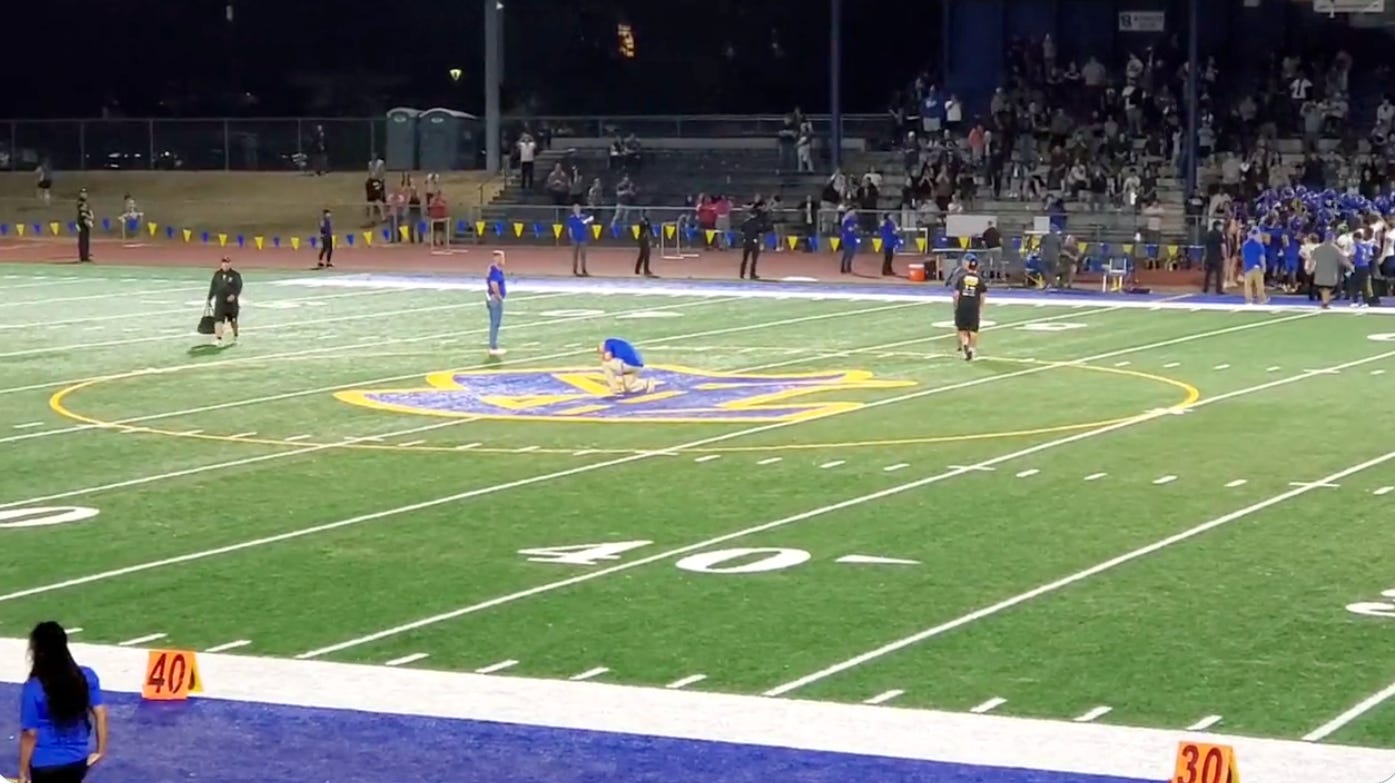
After the game was over, Kennedy walked to midfield for a brief, uneventful prayer during which he wasn’t surrounded by anyone. He got the attention he wanted before heading back to the locker room.

For all the events that led up to that moment, it may have been his last time on the field.

Joe Kennedy delivers a performative prayer after Bremerton’s game (via @JeffGrahamKS / Twitter)

A quick refresher in case you forgot: Kennedy argued that he lost his coaching job in 2015 because he wanted to deliver a quiet Christian prayer at midfield after games. All of that was exaggerated or untrue. He was never actually fired. The prayers weren’t “quiet.” And the concern was far more about the coercive nature of his showboat prayers, not his ability to privately pray. But the only reason the Bremerton case was in front of the Supreme Court at all was because, theoretically, their decision was the only way Kennedy could regain his job and the right-wing justices were eager to jump into the fray.

In 2022, the Court’s conservative majority ignored the facts of the case and sided with Kennedy, further eroding church/state separation and requiring the district to give him his old job back. The district is now obligated to pay attorneys’ fees amounting to over $1.7 million, some portion of which will be paid through their insurance.

Despite Supreme Court win, Bremerton's praying football coach is long gone | Former Bremerton football coach Joe Kennedy

The irony with the Supreme Court’s decision was that it seemed hard to believe Kennedy was just going to waltz back onto the football field. He moved away from Bremerton to Florida years ago. Was he seriously going to move back for a low-paying coach position?

Last September, months after the decision came down, the Seattle Times reported that Kennedy was nowhere to be found. Was he too busy being a conservative celebrity to actually do the job he claimed he wanted (which is precisely what atheist groups predicted would happen)? Yes and no.

It’s true that Kennedy will soon release a ghostwritten memoir called Average Joe: The Coach Joe Kennedy Story. There’s also a movie about him in the works produced by the God’s Not Dead people; while he’s not directly involved with it, he’ll presumably be involved with the publicity campaign. But the delay on the field likely had more to do with paperwork than anything else. Only this past March did the district announce that everything was finally completed:

Mr. Kennedy will be an assistant football coach for Bremerton High School for the 2023 season.  Mr. Kennedy has completed human resources paperwork and we are awaiting the results of his fingerprinting and background check.  Mr. Kennedy will need to complete all training required by WIAA.  Football coach contracts are approved by the Board at the August 3, 2023 board meeting, and begin in mid-August. As with any other assistant coach, Mr. Kennedy will be included in coaching staff communication and meetings, spring football practice and other off-season football activities.

That’s why it took until last night for Kennedy to finally get back on the field. First Liberty Institute, the conservative legal group that backed him, urged other coaches to pray at midfield Friday night in solidarity, though it’s not clear if anyone did that.

But despite everything Kennedy went through to get back his position, it may also have been his final game because the pull of Christian celebrity is as strong as ever. Besides the book and movie, the Seattle Times notes that Kennedy gets paid to give speeches and that politicians like Ron DeSantis have attempted to get his endorsement. (Not surprisingly, Kennedy is a firm Donald Trump supporter.)

Need more evidence coaching isn’t in his future? He hasn’t bothered moving back to Bremerton.

He’s currently housesitting, and said he and his wife have talked about parking an RV on her sister’s property in the area during football season.

They’re not looking for homes in the community. They haven’t sold their property in Pensacola. Kennedy wouldn’t answer questions about his plans beyond Friday:

… Will Kennedy stick around after the first game?

On the last question, he’s not saying. Everything’s been leading up to Friday’s game, he said, “the fine bow” on top of his Supreme Court victory, which overturned lower court rulings and the public school district’s directive against overt activity while on duty that could be taken as an endorsement of religion. He insisted he can’t think further ahead than Friday.

What sort of football coach can’t see past the first game of the season? One who’s already heading toward the exits, that’s who. Kennedy also added that his future plans might include “some ministry or something.”

If and when he walks away, it’ll be definitive proof that he’s only coaching for the purpose of praying on the field. Does anyone seriously think he’s doing this for the students? How shitty must those athletes feel knowing that, regardless of how they play, all the media attention will be on a coach who has already planned a future without them?

As any high school coach could tell you, the job is a sacrifice. You don’t get paid much and it takes a lot of time, but you do it because you love the students. You do it because what you get out of it is more valuable than a paycheck. When Kennedy used his platform to advertise his religion, it was clear the students were not his main priority. It’s clear that hasn’t changed in eight years.

He never cared about the kids, the team, or the job. He only ever cared about himself.

Last night, the Freedom From Religion Foundation announced that they had placed a billboard about two minutes away from the high school. It says, “Wishing Bremerton High School a safe, secular & successful school year.”

It’s a fine message that capitalizes on the story, but it’s telling that the atheists are focused on what’s best for students while Joe Kennedy’s main concern is staring back at him in the mirror.

“Coach Kennedy’s antics are a desperate way of keeping his unconstitutional agenda in the spotlight,” says FFRF Legal Director Rebecca Markert. “We’ll be countering it whichever way we can.”

To their credit, the district issued strict guidelines about Kennedy’s prayers in accordance with the SCOTUS decision and the law as it stands: Any prayers (a.k.a. “personal conduct”) had to occur outside of game time when coaches were on duty, and only when students were at least 25 feet away at the start of it. In short, they were saying the prayer had to be a solo event after the game even if students decided to join in after it began. Looks like the students didn’t want to do that last night.

If Kennedy really cared about these students, he’d accept his SCOTUS victory and let the kids play without him there. He has no reason to be there other than a desperate desire for the spotlight—and to create a postscript for the movie version of his life. He could easily have stayed in Florida and said that God gave him the ultimate victory so now, for the sake of the children, he’ll stay put in Pensacola so that the attention remains on the student athletes where it belongs. He didn’t do that. He wanted to bask in the glory once more because he thinks high school football is all about him.

Once he’s gone, which could be very soon, the attention will finally be where it belongs: on the students playing the game, not the coach using them for his personal benefit.

09/05/23 Biking & Listening

Biking is something else I both love and hate. It takes a lot of effort but does provide good exercise and most days over an hour to listen to a good book or podcast. I especially like having ridden.

Here’s my bike, a Rockhopper by Specialized. I purchased it November 2021 from Venture Out in Guntersville; Mike is top notch! So is the bike, and the ‘old’ man seat I salvaged from an old Walmart bike.

Here’s a link to today’s bike ride.


Something to consider if you’re not already cycling.

I encourage you to start riding a bike, no matter your age. Check out these groups:

Cycling for those aged 70+(opens in a new tab)

Solitary Cycling(opens in a new tab)

Remember,

Photo by Suzy Hazelwood on Pexels.com

Novel listening: Finders Keepers by Stephen King

Abstract of Finders Keepers

The second book in Stephen King’s Bill Hodges trilogy (Mr. MercedesFinders KeepersEnd of Watch)—now an AT&T Audience Original Series!

“Stephen King’s superb stay-up-all-night thriller is a sly tale of literary obsession that recalls the themes of his classic 1987 novel Misery” (The Washington Post)—the #1 New York Times bestseller about the power of storytelling, starring the same trio of unlikely and winning heroes Stephen King introduced in Mr. Mercedes.

“Wake up, genius.” So announces deranged fan Morris Bellamy to iconic author John Rothstein, who once created the famous character Jimmy Gold and hasn’t released anything since. Morris is livid, not just because his favorite writer has stopped publishing, but because Jimmy Gold ended up as a sellout. Morris kills his idol and empties his safe of cash, but the real haul is a collection of notebooks containing John Rothstein’s unpublished work…including at least one more Jimmy Gold novel. Morris hides everything away—the money and the manuscripts no one but Gold ever saw—before being locked up for another horrific crime. But upon Morris’s release thirty-five years later, he’s about to discover that teenager Pete Saubers has already found the stolen treasure—and no one but former police detective Bill Hodges, along with his trusted associates Holly Gibney and Jerome Robinson, stands in the way of his vengeance…

Not since Misery has Stephen King played with the notion of a reader and murderous obsession, filled with “nail biting suspense that’s the hallmark of [his] best work” (Publishers Weekly).

Podcasts listened to


Here’s a few photos from along my pistol route: