09/11/23 Biking & Listening

Biking is something else I both love and hate. It takes a lot of effort but does provide good exercise and most days over an hour to listen to a good book or podcast. I especially like having ridden.

Here’s my bike, a Rockhopper by Specialized. I purchased it November 2021 from Venture Out in Guntersville; Mike is top notch! So is the bike, and the ‘old’ man seat I salvaged from an old Walmart bike.

Here’s a link to today’s bike ride.


Something to consider if you’re not already cycling.

I encourage you to start riding a bike, no matter your age. Check out these groups:

Cycling for those aged 70+(opens in a new tab)

Solitary Cycling(opens in a new tab)

Remember,

Photo by Suzy Hazelwood on Pexels.com

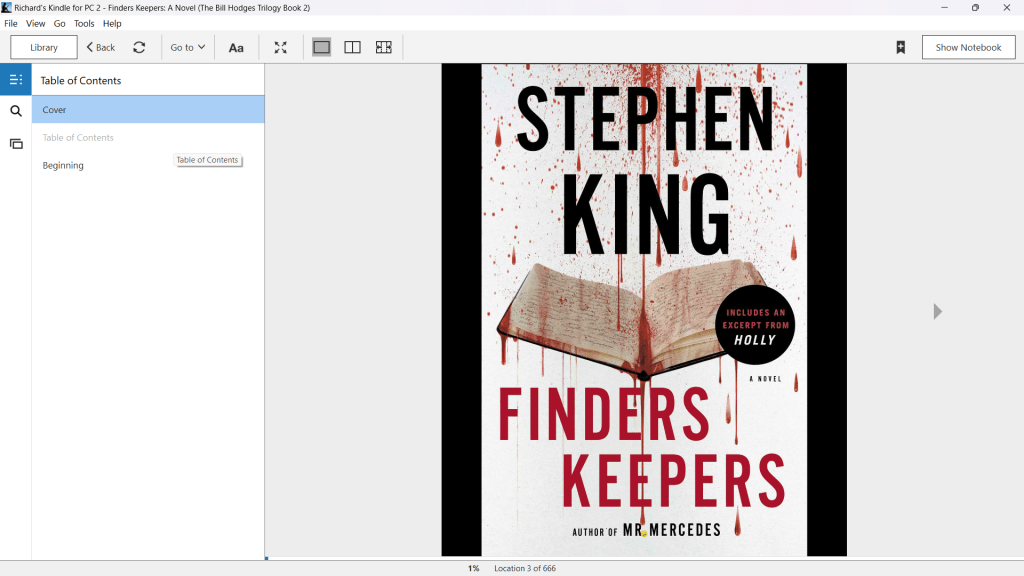
Novel listening: Finders Keepers by Stephen King

Abstract of Finders Keepers

The second book in Stephen King’s Bill Hodges trilogy (Mr. MercedesFinders KeepersEnd of Watch)—now an AT&T Audience Original Series!

“Stephen King’s superb stay-up-all-night thriller is a sly tale of literary obsession that recalls the themes of his classic 1987 novel Misery” (The Washington Post)—the #1 New York Times bestseller about the power of storytelling, starring the same trio of unlikely and winning heroes Stephen King introduced in Mr. Mercedes.

“Wake up, genius.” So announces deranged fan Morris Bellamy to iconic author John Rothstein, who once created the famous character Jimmy Gold and hasn’t released anything since. Morris is livid, not just because his favorite writer has stopped publishing, but because Jimmy Gold ended up as a sellout. Morris kills his idol and empties his safe of cash, but the real haul is a collection of notebooks containing John Rothstein’s unpublished work…including at least one more Jimmy Gold novel. Morris hides everything away—the money and the manuscripts no one but Gold ever saw—before being locked up for another horrific crime. But upon Morris’s release thirty-five years later, he’s about to discover that teenager Pete Saubers has already found the stolen treasure—and no one but former police detective Bill Hodges, along with his trusted associates Holly Gibney and Jerome Robinson, stands in the way of his vengeance…

Not since Misery has Stephen King played with the notion of a reader and murderous obsession, filled with “nail biting suspense that’s the hallmark of [his] best work” (Publishers Weekly).

Podcasts listened to


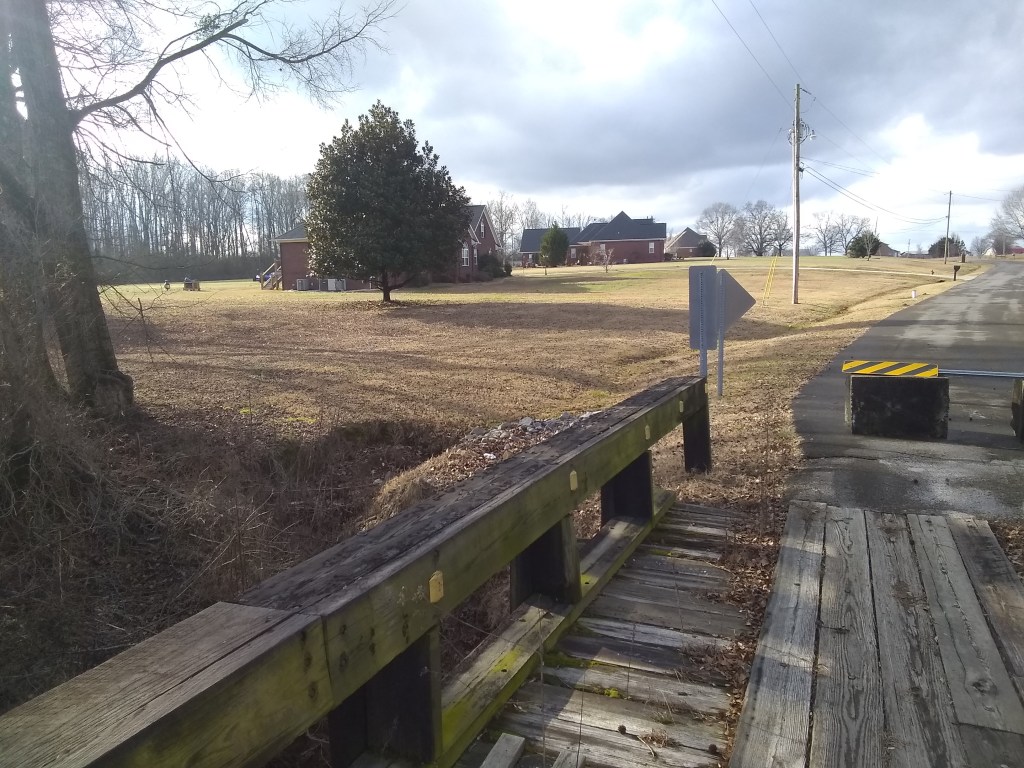
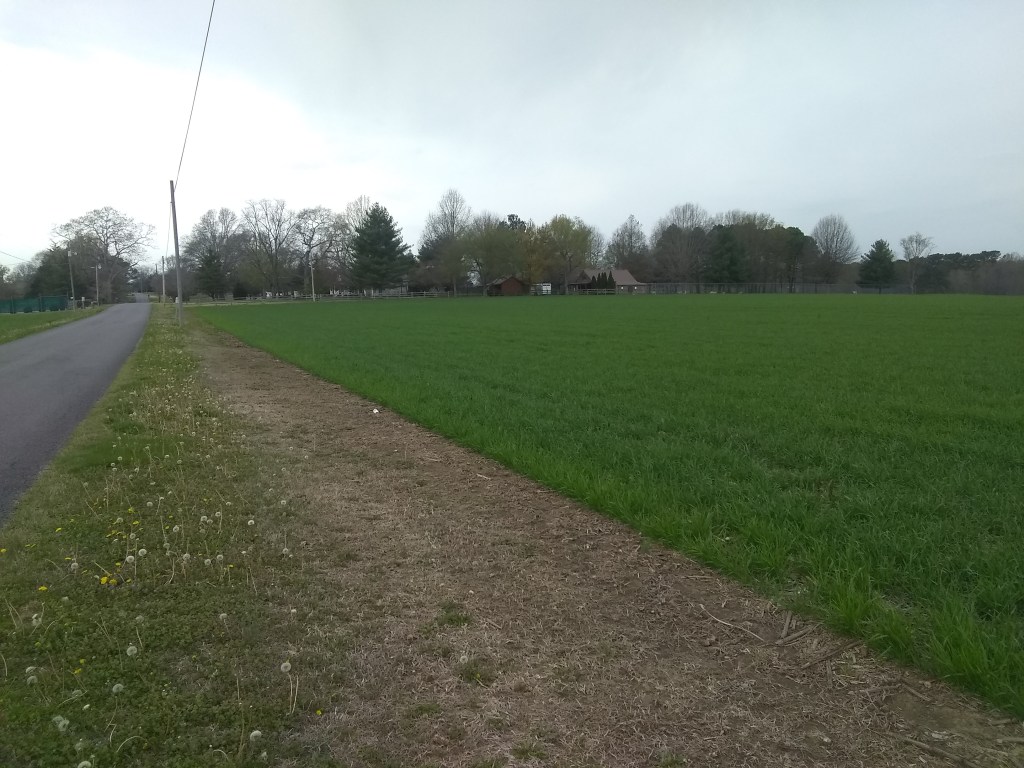
Here’s a few photos from along my pistol route:

The Gateway to Doubting the Gospel Narratives Is The Virgin Birth Myth

Here’s the link to this article.

By John W. Loftus at 6/13/2020

There is an often repeated argument that marijuana is the gateway drug leading to dangerous drugs. [I think it’s largely false but don’t get sidetracked on it.] There is however, a gateway to doubting the whole Bible that I want to highlight here. Lately I’ve been focusing on the virgin birth claim because this is the gateway to doubting the gospel narratives, just as Genesis 1-11 is the gateway to doubting the Old Testament narratives. It was for me anyway. You can see this double doubting of both Testaments in the list of the five most important books that changed my mind, and the five most powerful reasons not to believe.

Apologists and theologians focus on the resurrection of Jesus primarily because they have studied it so much more than the virgin birth narratives. They now use the minimal facts approach of Gary Habermas, Mike Licona, and William Lane Craig, who want to sweep off the table a great deal of what atheists all agree on, especially their unanimous agreement that a virgin named Mary did not give birth to an incarnate god. The reason this atheist agreement should stay on the table is because it speaks directly to the credibility of the gospel narratives as a whole. Since there’s no good reason to believe the virgin birth myth, there’s no good reason to believe the resurrection myth either, despite any agreements atheist scholars and Christian apologists have about the resurrection narratives. After all, the virgin birth narratives are in the same gospels that contain the resurrection narratives (Matthew & Luke anyway). If the narratives about the virgin-born incarnate god can be shown to be non-historical myth, then so too are the narratives about the resurrection of this same virgin-born incarnate god. The virgin myth began as an concocted explanation for how an incarnate god came into human existence. So now without a credible virgin birth story, Christians are left with no explanation for how an incarnate god came into human existence!

So here’s the scoop on the virgin birth. See what YOU think! First read Part 1 (included below) then read Part 2 (included below). For the best book-length analysis of the virgin birth see Robert Miller, Born Divine: The Births of Jesus and Other Sons of God. Miller wrote the chapter on Jesus fulfilling prophecy for my anthology, The Case against Miracles.

Part 1

Tonight’s Debate Opener vs William Albrecht On “Was Jesus Born of a Virgin?”

By John W. Loftus at 1/26/2020

My debate opponent believes a virgin named Mary gave birth to a divine child named Jesus over two-thousand years ago. The most significant problem is that theologians cannot explain how a human being and a god can be one and the same, that is, 100% human and 100% divine, with every essential characteristic of humanity and divinity included. How can a god be a god if he has a body? How can an infinite timeless god exist in time? Conversely, how can a human be a human if he or she doesn’t have a body? How can a finite human take on eternal godlike characteristics and still remain a human being? How can a human be perfectly good incapable of being tempted to sin, and yet also be tempted to sin? Christians themselves have shown the incoherence of a divine/human being by their 2000 year long disagreements over it.

Make no mistake about it. This is what my debate opponent is aiming at in this debate. The virgin birth is a first step toward claiming Jesus was God incarnate. My aim is to stop him short of this first step, even though his case isn’t done until he tackles the second step by dealing with some formidable philosophical objections to a divine/human being. With no such being there’s no virgin birth either.

Let’s start by talking about the kind of evidence we need.

All claims about the objective world require sufficient objective evidence appropriate to the nature of the claim. This applies to ordinary claims, extraordinary claims and miraculous claims. The amount and quality of the evidence required is dependent on the type of claim being made.

An ordinary claim is one made about events that are commonplace within nature, which require ordinary levels of evidence. Most all of these claims are based on testimonial evidence alone. That is, the trustworthiness of the person making the claim is enough to establish them, especially where there’s no reason to suspect deception and there’s no dispute by others as to the facts. [“Earlier today I was in Indiana.”]

An extraordinary claim is one made about events that are extremely unusual, rare and even strange within the world of nature. Mere testimonial evidence is helpful but not enough to establish these claims. They require some strong objective evidence for them. That is, the more unusual the claim is then the stronger the objective evidence must be for them. [“I was abducted by an alien”].

A miraculous claim is one made about events that are impossible to take place by natural processes alone, which requires a high level of strong objective evidence for them. As David Hume argued, “No testimony is sufficient to establish a miracle, unless the testimony be of such a kind, that its falsehood would be more miraculous than the fact which it endeavours to establish.” The fact that a miracle requires extraordinary evidence over and above the fallibility of ordinary human testimony is not an unreasonable demand. It’s the nature of the beast. A forensic TV show I watched had a character say, “The evidence doesn’t lie. People do.” If this is acknowledged in criminal investigations it should be acknowledged much more so in miraculous investigations. So mere testimonial evidence is insufficient when it comes to miracle claims, especially when it comes to miracle claims in the distant past from sources we cannot cross-examine for consistency and truth.

Tonight, I’m going to show that the required objective evidence for the miraculous birth of Jesus is not there, at all. Beyond this I’ll I’m going to show the testimonial evidence in the New Testament is insufficient. My main point is that if the gospels are inaccurate and untrustworthy in historical matters that we can check, then there’s absolutely no reason to think they are accurate and trustworthy when it comes to the miraculous virgin birth of Jesus either.

The most significant problem for my debate opponent is that there’s no objective evidence to corroborate the virgin birth stories in the New Testament. None. None at all! Where’s the evidence Mary was a virgin? We hear nothing about her wearing a barbaric chastity belt to prove her virginity. No one checked for an intact hymen before she gave birth either. Where’s the evidence that neither Joseph nor any other man was not the father? Maury Povich was not there with a DNA test to verify Joseph was not the baby daddy, nor did he test others.

We don’t even have firsthand testimonial evidence for it, since the story is related to us by others, not Mary, or Joseph. At best, all we have is the second-hand testimony of one person, Mary, or two if we include Joseph who was unreasonably convinced Mary was a virgin because of a dream, yes, a dream (see Matthew 1:19-24). We never get to independently cross-examine them, along with the people who knew them, which we would need to do, since they may have a very good reason for lying, like a pregnancy out of wedlock! Before there can be a virgin birth one must first show Mary wasn’t pregnant. One must also show neither Joseph nor any other man was not the baby daddy.

What we know is that neither of the two earliest New Testament writers refer to the virgin birth of Jesus. That’s very telling. Neither the apostle Paul nor the author of the gospel of Mark referred to it. It’s inconceivable neither of them mentioned it. The virgin birth story was an unimportant afterthought for the later gospels of Matthew and Luke. This only makes sense as a non-historical myth made up on hindsight to explain how Jesus came down from the sky above the clouds to earth.

Additionally, in the gospel of Mark the family of Jesus themselves thought he was crazy, not God’s son. “He is out of his mind” they said, and tried “to take charge of him (Mark 3:19–21, 31–35). This makes no sense if the virgin birth stories are true in the later gospels of Matthew and Luke. How could his mother Mary forget how her son Jesus was conceived, or what was said about him at the time of his birth? The angel Gabriel said he would be called “the Son of God” (Luke 1:35). Her cousin Elizabeth said Mary was the “mother of my Lord” (Luke 1:43), and she herself said, “from henceforth all generations shall call me blessed” (Luke 1:48). No mother would ever forget the circumstances of his birth, if it happened as reported.

In Luke’s gospel when Mary first hears from the angel Gabriel that she’s to give birth, she objects by saying, “How shall this be, since I know not a man?” (Luke 1:34). Surely Mary wouldn’t feel it necessary to inform Gabriel that she hadn’t had sex with a man. If this conversation took place at all, she would’ve said, “How shall this be, since I know not my husband.” The way it’s written in Luke is to justify Mary’s virginity to the reader, rather than to tell us what she said. So Mary’s stated objection to the angel is a literary invention.

Now one might simply trust the anonymous gospel writer(s) who wrote this extraordinary story down, but why? How is it possible that THEY could find out a virgin named Mary gave birth to a deity? No reasonable investigation could take Mary and/or Joseph’s word for it. With regard to Joseph’s dream, Thomas Hobbes tells us, “For a man to say God hath spoken to him in a Dream, is no more than to say he dreamed that God spoke to him; which is not of force to win belief from any man.” [Leviathan, chap. 32.6] So it’s down to unreliable hearsay testimonial evidence from Mary. Why should we believe her? Would you?

It gets worse. There are seven facts to consider.

1) The Genealogies are Inaccurate and Irrelevant. The royal genealogies of Jesus in the later gospels of Luke (3:23–37) and Matthew (1:1–17) have historical problems with them. For instance, Matthew’s gospel makes Jesus a descendent of king Jeconiah (1:11), even though the prophet Jeremiah had proclaimed none of Jeconiah’s descendents would ever sit of the throne of David (Jer. 22:30). Someone messed up big time here, don’t you think?

The genealogies of Jesus are irrelevant if he was born of a virgin. Jewish royal lineages are traced through men not women, so Luke’s genealogy is irrelevant since it traces the lineage of Jesus through Mary. Matthew’s genealogy is equally irrelevant, since it traces the lineage of Jesus through Joseph, who was not his father, according to gospel accounts. To desperately claim Mary’s baby was a new divine creation unrelated to the lineages of either Mary or Joseph, also makes the genealogies irrelevant. For then it wouldn’t matter which mother’s womb God decided to create his son inside.

Modern genetics decisively render the genealogies irrelevant since one cannot even have a human being without the genetic contributions of both a male seed and a female egg. To claim, as Catholic New Testament scholar Raymond Brown did, that Jesus was “technically” the adopted son of Joseph, is absurd and also irrelevant since only blood lines count in royal lineages. Adopted sons would never legitimately inherit any throne.

2) Jesus Was Not Born in Bethlehem. In Matthew 2:5 we’re told Jesus was to be born in Bethlehem. But the precise phrase “Bethlehem Ephratah” in the original prophecy of Micah 5:2 refers not to a town, but to a family clan: the clan of Bethlehem, who was the son of Caleb’s second wife, Ephratah (1 Chron. 2:19, 2:50–51, 4:4). Furthermore, Micah’s prophecy predicts a military commander who would rule over the land of Assyria (which never happened), and was certainly not about a future Messiah.

The earliest gospel of Mark begins by saying Jesus came from Nazareth of Galilee, not from Bethlehem (Mark 1:9). Let that sink it. The first gospel says he’s from Nazareth. In the later Gospel of John, Jesus was rejected as the Messiah precisely because the people of Nazareth knew he was born and raised in their town! That’s the whole reason they rejected him as the Messiah! They rhetorically asked, “How can the Messiah come from Galilee?” They said, “A prophet does not come out of Galilee” (John 7:42, 52). [He was from Nazareth. Therefore he’s not the Messiah.]

Since everyone knew the Messiah would not come from Galilee, Matthew and Luke invented conflicting stories to overcome this insurmountable problem. In Matthew’s gospel—the one most concerned with making Jesus fit prophecy—Joseph’s family is living in Bethlehem when Jesus was born (Matt. 2). In order to explain how Jesus got to Nazareth, Joseph was warned in a dream to flee to Egypt because of Herod (Matt. 2:15). After Herod died, Joseph took his family to Nazareth and lived there (Matt. 2:21–23). Luke’s gospel, by contrast, claims Joseph and Mary lived in the town of Nazareth but traveled to Bethlehem for a Roman census, at which time Jesus was born (Luke 1:26; 2:4). After he was born they went back home to Nazareth (Luke 2:39).

When we compare Matthew and Luke’s accounts, Raymond Brown concludes, “Despite efforts stemming from preconceptions of biblical inerrancy or of Marian piety, it is exceedingly doubtful that both accounts can be considered historical. A review of the implications explains why the historicity of the infancy narratives has been questioned by so many scholars, even by those who do not in advance (i.e., a priori) rule out the miraculous.”

To make these stories work they invented a world-wide Roman census (per Luke), to get the holy family to Bethlehem, and the slaughter of the innocents by Herod (per Matthew), to explain why the holy family left Bethlehem for good. Matthew’s gospel invented a Messianic Star for emphasis, which was overkill, based on Numbers 24:17. But there was no census, no massacre of children and no Bethlehem star. [As we’ll see in the next three facts to consider].

3) There Was No Census. Luke’s gospel tells us something bizarre, that Joseph had to go to Bethlehem to register for the census because “he was from the house and lineage of David.” (Luke 2:4) According to Luke’s genealogy king David had lived forty-two generations earlier. Why should everyone have had to register for a census in the town of one of his ancestors forty-two generations earlier? There would be millions of ancestors by that time, and the whole empire would have been uprooted. Why forty-two generations and not thirty-five, or sixteen? If this requirement was only for the lineage of King David, what was Caesar Augustus thinking when he ordered it? He had a king, Herod.

Both Matthew and Luke said Jesus was born during the time of Herod the Great (Matthew 2:1, Luke 1:5). Herod died in 4 BC, so Jesus was born at the latest in 4 BC. The only known census of that period was a local one in Galilee which took place in 6 AD by Syrian governor Quirinius. There’s a gap of ten years between Herod’s death and the alleged census, which means there was no census at the birth of Jesus, if he was born during the reign of Herod. But Luke’s gospel said it was a world-wide census, not a local one. And that census didn’t take place at all, for as Raymond Brown tells: “A census of the known world under Caesar Augustus never happened” and he reigned from 27 BC to 14 AD.

4) There Was No Slaughter of the Innocents. In Matthew’s gospel king Herod was said to have ordered all the male children “in Bethlehem and all the surrounding countryside” to be slaughtered (2:16). But there is no other account of such a massacre in any other source. It’s clear that the first century Jewish historian Josephus hated Herod. He chronicled in detail his crimes, many of which were lesser in kind than this alleged wholesale massacre of children. Yet nowhere does Josephus’ mention this slaughter even though he was in a position to know of it, and even though he would want to mention it. So the story is a gospel fiction, like the virgin birth story.

5) There Was No Star of Bethlehem. Matthew’s gospel says: “The star, which they (the Magi) had seen in the east, went on before them until it came and stopped over the place where the child was.” (2:9–10). There is no independent corroboration of this tale by any other source, Christian or otherwise. No astrologer/astronomer anywhere in the world recorded this event, even though they systematically searched the stars for guidance and predictions of the future. More significantly the author of Luke chose not to include the story of a Star, Magi, or the attempt on Jesus’ life, which is telling, since his gospel was written after “a careful study of everything” he says, so readers could know what actually took place from what didn’t. (1:1-4).

Theories for this Star include a comet, a supernova, or the conjunction of planets. The fatal problem is that none of them conform to what the text actually says in Matthew’s gospel. The Magi see the Star “leading” or directing them to Bethlehem from Jerusalem. Not only are moving stars pre-scientific nonsense, they would be moving in a southern direction, from Jerusalem down to Bethlehem. Stars don’t move in the sky, and they certainly don’t appear to move in a southerner direction. They all appear to move from the east to west, like the sun, because of the spin of the earth. Then we’re told the Star stopped in the sky directly over a place in Bethlehem. But there’s no way to determine which specific house a star stopped over, if it did! This is only consistent with pre-scientific notions of the earth being the center of the universe with the stars being moved by a god who sits on a throne in the sky.

6) The Prophecies Are Faked. In Matthew 1:20–23 the author claims that Isaiah 7:14 predicts Jesus’ virgin birth. The context for the prophecy in Isaiah tells us that before a son born of a “young woman” (not a virgin) “is old enough to know how to choose between right and wrong the countries of two kings (i.e., Syria and Samaria) will be destroyed” (7:15-16). The prophecy in the original Hebrew says nothing whatsoever about a virginal conception. Period. It says nothing about a messiah, either. The prophecy was actually fulfilled in Isaiah 8:3 with the birth of the son Maher-shalal-hash-baz.

The Hebrew word for virgin is betulah. It’s used five times in the book of Isaiah. Isaiah 7:14 isn’t one of them. The word used in Isaiah 7:14 is ‘almah, which means young woman, or simply girl. It does not specify a virgin. Full Stop. The gospel of Matthew’s error was to use a 200 year old Greek translation of the Hebrew which used the word parthenos. Originally the Greek word parthenos meant “young girl,” but by the time Matthew wrote his gospel that word had been changed by usage to signify a “virgin” rather than a young girl. This is not unlike how the words nice and gay have changed in meaning over the years. So Matthew grossly misunderstood the original Hebrew text in Isaiah by incorrectly claiming Jesus was to be born of a virgin.

A second prophecy in Isaiah 9:6–7 reads: “For to us a child is born, to us a son is given, and the government will be on his shoulders. And he will be called Wonderful Counselor, Mighty God, Everlasting Father, Prince of Peace.” [See Luke 1:31-33] Any Jew writing at that time might express the same hope for a Messiah/savior who would rescue their nation from their oppressors. But an expressed hope for a future Messiah is not to be considered a prediction, unless along with that expressed hope are specific details whereby we can check to see if it was fulfilled in a specific person. Isaiah provides none. With no details there isn’t any real prediction.

German theologian Ute Ranke-Heinemann concludes after her own study: “If we wish to continue seeing Luke’s accounts… as historical events, we’d have to take a large leap of faith: We’d have to assume that while on verifiable matters of historical fact Luke tells all sorts of fairy tales but on supernatural matters—which by definition can never be checked—he simply reports the facts. By his arbitrary treatment of history, Luke has shown himself to be an unhistorical reporter—a teller of fairy tales.” [Putting Away Childish Things, p. 14]

7) The Virgin Birth of Jesus Has Pagan Parallels. Robert Miller shows us many important people in the ancient world were believed to have been the product of virgin births: “People in the ancient world believed that heroes were the sons of gods because of the extraordinary qualities of their adult lives, not because there was public information about the intimate details of how their mothers became pregnant. In fact, in some biographies the god takes on the physical form of the woman’s husband in order to have sex with her.” [Born Divine, p. 134] And then he proceeds to document some of these stories. There was Theagenes, the Olympic champion, who was regarded as divine for being one of the greatest athlete’s in the ancient world. Hercules was the most widely revered hero of the ancient world. He was promoted to divine status after his death, and it was said he was fathered by Zeus. Alexander the Great was believed to be conceived of a virgin and fathered in turn by Heracles. Augustus Caesar was believed to be conceived of a virgin and fathered by Apollo, as was Plato, the philosopher. Apollonius of Tyana was believed to be a holy man born of a virgin and fathered by Zeus. Pythagoras the philosopher was believed to be a son of Apollo. There were also savior-gods, like Krishna, Osiris, Dionysus, and Tammuz, who were born of virgins and known to the Gospel writers centuries before.

Justin Martyr was a second-century Christian apologist who tried to convince the pagans of his day of the truth of Christianity. In his First Apology to Roman people he wrote:

When we say that the Word, who is the first-birth of God, was produced without sexual union, and that he, Jesus Christ, our teacher, was crucified and died, and rose again, and ascended into heaven, we propound nothing different from what you believe regarding those whom you esteem sons of Jupiter…Of what kind of deeds recorded of each of these reputed sons of Jupiter, it is needless to tell to those who already know…[I]f we even affirm that he [Jesus] was born of a virgin, accept this in common with what you accept of Perseus.

All that these virgin birth claims show is that someone thought these people were important, and that’s it. None of them are taken to be literal virgin births, probably not even in that day! So it should not come as a surprise that the early Christians came up with similar myths about Jesus. It’s myth all the way down with no historical reality to it. There’s no reason to accept this extraordinary claim at all.

To read my analysis of the debate see here.

Part 2

An Analysis of My Recent Debate On the Virgin Birth of Jesus

By John W. Loftus at 2/01/2020

I’ve already published my debate opener on the virgin birth right here. One of the best things about debates, for me anyway, is that they force me to write debate openers. They are succinct statements of why I don’t believe. They will stand the test of time, even if public debates allow for the irrelevancies and non-sequiturs of my debate opponents to muddy the waters.

To write them means I must also participate in a public debates, so I do. In this debate I had some problems with the logistics for several reasons. It was supposed to give presenters 30 minutes each for their opening statements. That’s was too long. So we agreed to limit it to 20 minutes just prior to the debate. I thought it would be better for the audience, and that I could fit my opener into that time. I was wrong. I was also wrong to ask my opponent to time it. There should’ve been someone chosen in the audience to time our debates, and to give us a 5 minute, 2 minute, then 1 minute warning. There should also have been a moderator during our cross-examination, and someone to field questions for us during the Q & A period. I wasn’t in charge of these details but I should have inquired. For without a moderator we interrupted each other far too often. That’s what happens without a moderator, and it sucked. Big Time! For I have a hard time listening and responding to utter nonsense.

I eventually got through my debate opener since during the cross-examination phase I finished it.

On the substantive issues I did well.

One of the most significant points made by my opponent was based on an early Christian forgery called the Proto-Gospel of James (Dated 140-170 AD) which was falsely claimed to be written by James the brother of Jesus. This Gospel was rejected as authentic by the early church. It’s supposed to provide the objective evidence that Jesus was born of a virgin named Mary, my opponent said. I didn’t respond too well, but I did respond adequately. I had said such an account is irrelevant to the case for the virginity of Mary.

The Proto-Gospel of James follows a lot of what we read in the canonical gospel accounts, which is significant, since it repeats some of the fraudulent claims in the gospels, such as the world-wide census under Augustus Caesar, the sign of the Star, the slaughter of the innocents, and Bethlehem being the birthplace of Jesus, which my opening statement debunks. It also repeats the claim that Joseph was initially convinced by a dream that Mary was impregnated by God. *cough*

In the Proto-Gospel of James both Joseph and Mary participated in a barbaric trial by ordeal (based on passages like Numbers 5 quoted below). After drinking contaminated water they did not show evidence of “sin”, that is, adultery or fornication. Exonerated, right? No, not at all. Trial by ordeals do not work. They’re barbaric and unbecoming of a God to require it. One might as well use it on people convicted of a capital crime to determine if juries were correct to find them guilty. If they pass the ordeal then free them, despite what juries had just determined. Why not? If the one in the Proto-Gospel of James is good, so is the other.

In the Proto-Gospel of James there was a midwife for Mary named Salome. She testified Mary was still a virgin afer she gave birth to Jesus, and by doing so, provided testimony that Mary was also perpetual virgin! Reminiscent of the tale of Doubting Thomas, who refused to believe Jesus was resurrected until he saw Jesus and touched his wounds, Salome refused to believe Mary was a virgin until she checked Mary’s hymen after the birth of Jesus! Upon testing Mary for an intact hymen her hand began to burn as if it caught on fire. Salome prays for forgiveness for questioning, and her hand was subsequently healed. [In the tale of Doubting Thomas we’re told to believe without seeing, whereas here we’re told God is displeased when we question–even though in this case it supposedly produced a good result!] You can read a summary of Salome’s bizarre story right here.

A late dated forgery containing an additional miracle such as Salome’s supposed healed hand doesn’t provide support for the original miracle claim of the virgin birth. It isn’t considered objective evidence nor is it considered good testimonial evidence. In fact, if it takes an additional miracle claim to support the original miracle claim of the virgin birth, then this compounds the problem of verification. That’s because Salome’s unevidenced miracle is not evidence for another unevidenced miracle of the virgin birth!

This forged gospel contains known historical falsehoods as it’s based on what we read in the gospels. It is late, untrustworthy and inauthentic. It doesn’t provide the needed objective evidence or testimonial evidence to support a miracle claim, as I mentioned in my opening statement. It is therefore irrelevant!

———————–

Follow this link to read the The Proto-Gospel of James.

Trial by Ordeal, Numbers 5:16-27

16 ‘Then the priest shall bring her near and have her stand before the Lord, 17 and the priest shall take holy water in an earthenware vessel; and he shall take some of the dust that is on the floor of the tabernacle and put it into the water. 18 The priest shall then have the woman stand before the Lord and let the hair of the woman’s head go loose, and place the grain offering of memorial in her hands, which is the grain offering of jealousy, and in the hand of the priest is to be the water of bitterness that brings a curse. 19 The priest shall have her take an oath and shall say to the woman, “If no man has lain with you and if you have not gone astray into uncleanness, being under the authority of your husband, be immune to this water of bitterness that brings a curse; 20 if you, however, have gone astray, being under the authority of your husband, and if you have defiled yourself and a man other than your husband has had intercourse with you” 21 (then the priest shall have the woman swear with the oath of the curse, and the priest shall say to the woman), “the Lord make you a curse and an oath among your people by the Lord’s making your thigh waste away and your abdomen swell; 22 and this water that brings a curse shall go into your stomach, and make your abdomen swell and your thigh waste away.” And the woman shall say, “Amen. Amen.”

23 ‘The priest shall then write these curses on a scroll, and he shall wash them off into the water of bitterness. 24 Then he shall make the woman drink the water of bitterness that brings a curse, so that the water which brings a curse will go into her and cause bitterness. 25 The priest shall take the grain offering of jealousy from the woman’s hand, and he shall wave the grain offering before the Lord and bring it to the altar; 26 and the priest shall take a handful of the grain offering as its memorial offering and offer it up in smoke on the altar, and afterward he shall make the woman drink the water. 27 When he has made her drink the water, then it shall come about, if she has defiled herself and has been unfaithful to her husband, that the water which brings a curse will go into her and cause bitterness, and her abdomen will swell and her thigh will waste away, and the woman will become a curse among her people. 28 But if the woman has not defiled herself and is clean, she will then be free and conceive children.

The Boaz Stranger–Chapter 55

I turned left and pulled my iPhone from the windbreaker I’d grabbed from Lillian’s back porch. I didn’t relish this call, but Kyla was expecting me, even though I was already half an hour late for dinner. Plus, there was that promise I’d made to keep her updated on what was going on.

When I turned right on Simpson Street, Kyla was brainstorming positive reasons Jane was at Ted’s cabin. Things like, “I think she’s brave. Probably trying to gather more ammunition for us to ambush Teflon Ray.”

I had to cut her off and end the call when Barry and Vanessa Clausen’s house came into view. There was a light upstairs, but no vehicles or other signs that either of them was home. I eased past the house and opted for a spot fifty yards beyond the attached garage where Lillian had parked her Aviator during our last visit.

I pressed the trunk release button and thought of the flashlight I’d purchased at Walmart the night I’d arrived in town. After verifying it still worked, I thought of how unprepared I was for this little hike, and especially for what could go wrong if discovered. If I had been prudent, I would have at least explored Lillian’s cabin to find the night vision goggles she’d brought on our first trip. Thank goodness the moon was almost full. I closed the trunk lid and gave myself an audible “Oh boy.” At least three additional items, a toboggan or a handkerchief large enough to cover my face, and a baseball cap, would be welcomed.

As I entered the woods, I activated my iPhone. It was 6:30, ninety minutes before calling Lillian. I knew my round-trip hike took forty minutes, an hour at an outside extreme, given the weather. This would still leave more than enough time to get in a suitable position to see, and hopefully hear, what Jane and Ted, and probably Ray, were up to.

It was 6:49 when I reached the giant oak I’d seen during my last hike. This was the last time I could safely light my surroundings before I got close to the cabin. To be safe, I powered down my iPhone and continued in the bright moonlight toward the rear of the cabin, remembering that I had forgotten to bring the H & K.

***

I continued my march to the backside of Ted’s cabin, relieved I hadn’t brought the pistol. Besides its weight and bulkiness (I didn’t have a holster), I wouldn’t need it.

All I intended to do was get close enough to see who was there. I knew Jane, more accurately, Jane’s Equinox, was present, but I needed to know if Ray was. If so, that would go a long way to confirm my suspicion that Jane couldn’t be trusted. I didn’t expect to understand a single word since I’d be looking through a door or window.

To my surprise, when I reached the creek, I saw a blazing fire only fifty or sixty feet away. Through the trees, I could see Jane standing and facing me with the cabin behind her a similar distance to what I was from her. To Jane’s right and left were Ted and Ray, respectively. Both sat, their backs to me. Jane appeared to be roasting hot dogs on a stick. There was a portable table to her right containing ketchup, mustard, and probably buns, but a tree obstructed my view of the left half of the table. I edged forward and sideways enough to gain the security of a larger tree. By the time I crouched, Jane removed the wiener from the stick, stuck it inside a bun, and added the condiments. Ray stood and reached toward her.

Over the crackling of the fire, I heard Ted’s voice. “I thought we were having your scrumptious chili.”

“Shit Ted, give her a break. Even Wonder Woman needs to rest.” It was Ray’s words, although altered by a mouth full of hot dog.

“Yeah Ted, how about a little gratitude?” Jane reached under the table and grabbed what was probably a beer. She handed it to Ray.

“Okay, sorry. Thanks for all your efforts. So, what time did you get back?” What was this all about? Where had Jane gone? And here I was thinking she had been home since late Friday night. Apparently, that applied only to her Equinox.

“Just before daylight. It took five hours.” Jane waved the stick with flaming wiener back and forth above her head. “Shit, I’ll take this one.”

“Any problem with Enterprise?” This was getting weird. Was Ted referring to the car rental company? I stood to ward off a cramp but stayed solidly behind the oak.

“Easy peasy. My disguise was a killer. So was Mandy’s.” Mandy? Who was Mandy? Man? Woman? The only Mandy I knew, rather, had heard of, was Alex Mandy.

“Give me another dog. I’ll take the crispy one.” Ray stood and walked to a tree to his right, maybe ten feet away. He returned with a stick and started prodding the fire. “Where did ya’ll switch?”

I shook my head sideways and closed my eyes. I wanted to cross the creek and join the conversation around the fire. So far, my best guess was that at some place five hours away, two people, Jane and a Mandy, had rented vehicles from Enterprise and then later met to swap. I assume their rentals.

“Cracker Barrel in Pigeon Forge.” Jane pulled a chair away from the fire and sat. Her statement was troubling. She had gone to Pigeon Forge. I now knew Jane had feigned her sickness.

Ray returned the fire poker to the tree and headed to the cabin. Halfway there, he stopped and looked back over his shoulder. “Tell me you reviewed the itinerary before you started home.”

“She better have.” Ted added.

“You two know me better than to doubt. Unless preacher man is a fucking idiot, he knows to do his deed and then swap vehicles at Laurel Point Resort. When he gets back to Fort Payne, he’ll dump the Ranger and return to Boaz in my old Impala, assuming Chevrolet of Boaz’s new engine did the trick.”

A wave of terror ran through me like an electrical shock, but before I could review what I’d heard, another man exited the cabin, walked across the porch, and descended the steps. At first, I didn’t recognize him, but then I recalled a photograph Micaden had shown me. The young man had to be Orin Russell.

“Anything?” Ray asked, motioning for Orin to join the bonfire and wiener roast.

“He’s still not home, neither was Vanessa even though there’s a light on upstairs.”

“What do you like on your hot-dog?” Jane asked, looking at Orin.

“Everything you got.” He sat in the folding chair that Ray offered. “Funny thing happened while hiding at Barry’s.”

“What’s that?” Ted asked.

“A maroon sedan drove past the Clausen’s house. It finally stopped along the edge of the woods. I couldn’t make out who was driving, but I got the heck out of dodge.” Orin motioned Jane for a beer.

“What brand?” Ray asked.

“Uh?” Orin popped the top and guzzled several swallows.

“The car. Honda? Toyota?” Ted asked, standing and tossing another log on the fire.

“Neither. It’s the one with the two men shaking hands.” Orin set his beer on the ground and formed a circle, maybe an oval, with both hands. “Hyundai. The H, its crossbar, represents the men shaking.”

Jane handed Orin his hot-dog, raised both hands, palms open and semi-shouted: “Oh shit, oh shit, oh shit.”

“What the hell is wrong?” Ted asked.

“That could be Lee’s rental car. It’s maroon, and it’s a Hyundai.”

“Fuck. That must be where him and Lillian parked when they came snooping around when Buddy came for his pay.” Ray said, looking at Ted, who was now walking straight towards the creek. And me.

I stood sideways behind the big oak, knowing he couldn’t see me. If I didn’t move.

“Come on. Let’s take a ride.” Ray said.

“Can I come?” Jane asked.

“Okay,” Ray barked and pointed at Orin. “You drive to Lillian’s and look for Lee’s car, the maroon Hyundai. If it’s not there, go to Kyla’s.” Ray turned to Ted, who had moved back toward the fire. “Ted, you hike through the woods. We’ll meet you there.” Apparently, Orin knew about Kyla’s place.

Ted didn’t verbally respond, but I knew what he was thinking. He wasn’t the hiking type, although he had on a pair of new-looking boots. I’d never seen Ted when he wasn’t dressed to the nines. I painted him soft, not as a Ranger type.

This was my chance. I eased backwards from tree to tree, keeping the fire in sight. I had to get back to my car and away from the Clausen’s before Ray and Jane would arrive.

09/10/23 Biking & Listening

Biking is something else I both love and hate. It takes a lot of effort but does provide good exercise and most days over an hour to listen to a good book or podcast. I especially like having ridden.

Here’s my bike, a Rockhopper by Specialized. I purchased it November 2021 from Venture Out in Guntersville; Mike is top notch! So is the bike, and the ‘old’ man seat I salvaged from an old Walmart bike.

Here’s a link to today’s bike ride.


Something to consider if you’re not already cycling.

I encourage you to start riding a bike, no matter your age. Check out these groups:

Cycling for those aged 70+(opens in a new tab)

Solitary Cycling(opens in a new tab)

Remember,

Photo by Suzy Hazelwood on Pexels.com

Novel listening: Finders Keepers by Stephen King

Abstract of Finders Keepers

The second book in Stephen King’s Bill Hodges trilogy (Mr. MercedesFinders KeepersEnd of Watch)—now an AT&T Audience Original Series!

“Stephen King’s superb stay-up-all-night thriller is a sly tale of literary obsession that recalls the themes of his classic 1987 novel Misery” (The Washington Post)—the #1 New York Times bestseller about the power of storytelling, starring the same trio of unlikely and winning heroes Stephen King introduced in Mr. Mercedes.

“Wake up, genius.” So announces deranged fan Morris Bellamy to iconic author John Rothstein, who once created the famous character Jimmy Gold and hasn’t released anything since. Morris is livid, not just because his favorite writer has stopped publishing, but because Jimmy Gold ended up as a sellout. Morris kills his idol and empties his safe of cash, but the real haul is a collection of notebooks containing John Rothstein’s unpublished work…including at least one more Jimmy Gold novel. Morris hides everything away—the money and the manuscripts no one but Gold ever saw—before being locked up for another horrific crime. But upon Morris’s release thirty-five years later, he’s about to discover that teenager Pete Saubers has already found the stolen treasure—and no one but former police detective Bill Hodges, along with his trusted associates Holly Gibney and Jerome Robinson, stands in the way of his vengeance…

Not since Misery has Stephen King played with the notion of a reader and murderous obsession, filled with “nail biting suspense that’s the hallmark of [his] best work” (Publishers Weekly).

Podcasts listened to


Here’s a few photos from along my pistol route:

Those First Copy-Cat Christian Theologians

Here’s the link to this article.

By David Madison at 9/08/2023

The imagined, invented Jesus of the New Testament 

The huge faith bureaucracy—aka the church—is guilty of many sins, but one of its major failings is deception. It specializes in diverting the attention of its faithful followers from what has been learned about Christian origins. Perhaps the greatest irony in this exercise in cheating is that major discoveries about Christian origins—including the unreliability of the gospel accounts of Jesus—have been made by devout scholars who had set out to prove that the gospels tell the true story of their lord and savior. 

But as professionally trained historians examined the gospels, it became clear that these documents fail to qualify as history. In 1835, David Friedrich Strauss published Das Leben Jesu, kritisch bearbeitet (The Life of Jesus, Critically Examined), in which he argued that the miracle elements in Jesus stories were mythical. In 1933, Charles Guignebert published another major study, titled simply Jesus, in which he wrote: “It was not the essence of Jesus that interested in the authors of our gospels, it was the essence of Christ, as their faith pictured him. They are exclusively interested, not in reporting what they know, but in proving what they believe” (p. 53). He labeled the gospels “propaganda texts.”

In his 1988 classic, Gospel Fictions, Randel Helms stated: “The gospels are, indeed—to a much greater degree than those who read them with pious inattention even begin to realize—imaginative literature, fiction, and critics have been using such terms about them for a long time” (p. 11).                         

Those who read them with pious inattention. This is what the church and the clergy are counting on. Indeed, surveys have shown that most laypeople don’t spend a lot of time reading the gospels, let alone studying them. We can assume that the clergy do this kind of study, and know the problems presented—and they dearly hope the laity won’t notice. Again, Randel Helms:

“Perhaps the earliest revision of Mark is to be found in the Gospel of Matthew. Of the 661 verses in Mark, 606 appear in Matthew, many with deliberate stylistic and theological changes, others with fictional additions” (p. 35, Gospel Fictions). 

Thousands of Bible scholars in religious academia have examined the gospels thoroughly, and, as Helms notes, “have been using such terms [imaginative literature, fiction] for a long time.” But all of this has happened beyond the awareness of church folks, who might wonder, “What’s going on?” if they carefully considered what Matthew did with Mark’s text. And how shocking that the Jesus in John’s gospel is so very different from Mark’s Jesus. Comparison of the gospels is dangerous business, but studying the context in which Christianity arose even more so. 

The laity, however, treasure the “greatest story ever told,” without giving much—if any—thought to how the story was fashioned from so many different ideas that were circulating at the time. Nor do they want to think about it. Faith is commonly preserved by ignoring information that may jeopardize cherished beliefs—mainly, I suspect because doubts are not too far below the surface.  

Last March I published an article here in which I commented on some of the religious ideas in circulation in the first century, based on Richard Carrier’s massive documentation of these concepts when Christianity first emerged. In fact, he lists 48 elements that are crucial for an understanding of Christian origins.  See pp. 65-234 of On the Historicity of Jesus: Why We Might Have Reason for DoubtChances are close to zero that churchgoers would read this book, although Carrier has made a point of writing in an easily-accessible style—and he explains why in his Preface. 

In the March article, I focused on Elements 4, 15, 31 and 43. Let’s look at four more. 

Element 11, pages 96-107

“The earliest definitely known form of Christianity was a Judeo-Hellenistic mystery religion. This is also beyond any reasonable doubt, yet frequently denied in the field of Jesus research, often with a suspiciously intense passion” (p. 96, OHJ). Of course, Christian apologists want to resist any suggestion that their faith is derivative. 

“If we then expand that definition to include a set of specific features held in common by all other mystery religions of the early Roman era, then Christianity becomes even more demonstrably a mystery religion, so much so, in fact, that it’s impossible to deny it was deliberately constructed as such. Even the earliest discernible form of Christianity emulates numerous cultic features and concepts that were so unique to the Hellenistic mystery cults that it is statistically beyond any reasonable possibility that they all found their way into Christianity by mere coincidence” (p. 96-97 OHJ). 

“…all [mystery religions] involve a ritual meal that unites initiated members in communion with one another and their god (1 Cor. 11:23-28). All of these features are fundamental to Christianity, yet equally fundamental to all the mystery cults that were extremely popular in the very era that Christianity arose. The coincidence of all of these features together lining up this way is simply too improbable to propose as just an accident” (p. 99, OHJ).

While such beliefs thrived in the milieu which gave birth to Christianity, some aspects were much older. Carrier notes later in the book that “…the savior cult of the resurrected Zalmoxis (of Thracian origin) is clearly attested in Herodotus centuries before Christianity; the imperial cult of the resurrected Romulus is likewise attested in several pre-Christian authors…” (p. 171, OHJ).

I recommend a careful reading of Carrier’s Element 11, paying close attention to the detailed information that he provides in the footnotes. These pages do a splendid job of destroying any claim that Christianity is the one true faith. 

It’s obvious how much early Christian theologians imagined/invented their Jesus according to ideas popular in other cults at the time. 

Element 16, pages 137-141

“The earliest Christians claimed they knew at least some (if not all) facts and teachings of Jesus from revelation and scripture (rather than from witnesses), and they regarded these as more reliable sources than word-of-mouth (only many generations later did Christian views on this point noticeably change)” (p. 137, OHJ).

“…people often received communications from Jesus via revelation (even if indirectly: i.e., through intuited feelings attributed to the holy spirit, or visions or prophetic messages communicated through angels or subordinate spirits), and no one thought this was unusual or inferior to any other source. To the contrary, Paul’s argument in Galatians 1 entails Christians had the opposite view: that information derived by revelation was more authoritative and trustworthy than any human tradition” (pp. 138-139).

A startling example of this is the Christian ritual meal, known as communion or the eucharist: Just where did it come from? “Well, Jesus at the last supper, of course,” is the natural response. But where do we find this Jesus-script for the first time? In I Corinthians 11:23:26, written by the apostle Paul—well before the gospels existed—who didn’t know Jesus, was not at the last supper. Paul bragged (Galatians 1:11-12) that he learned nothing about Jesus from the people who had known him. Paul claims in the opening verse of this text that he received these words “from the lord.” Which means in his visions, i.e., his hallucinations of the heavenly Jesus. It seems likely that the author of Mark’s gospel based his last supper Jesus-script on what he found in I Corinthians 11. Oh the irony: Mark invented a scene, using Paul’s words of Jesus that he imagined in visions. 

Element 16 illustrates the primary reason why secular—and even many devout—historians distrust the stories we find in the gospels especially. They cannot be verified by contemporaneous documentation, e.g. letters, diaries, transcriptions, interviews of eyewitnesses. The early Christian authors were okay with what they saw/heard in visions. Other religions do exactly the same thing, resulting in vastly different concepts of the divine. 

Ever wonder how Christianity ended up in such a mess today? By which I mean thousands of different denominations, divisions, sects, cults. It’s such a scandal that Christians have never been able to agree on their god, Jesus, and the proper forms of worship. 

Well, it was that way from the very beginning….

Elements 20 and 21, pp. 146-148

“Element 20: (a) The earliest known Christians proselytized Gentiles but required them to convert to Judaism. (b) Paul is the first known Christian to discard that requirement (having received a special revelation instructing him to), and he had to fight the earliest known leaders of the cult for acceptance of that radical idea. (c) But some books in the NT are from the sect that did not adopt this innovation but remained thoroughly Jewish (most obviously Matthew, the letters of John and James, and Revelation)” (p. 146, OHJ).

“Element 21: Paul and other NT authors attest that there were many rival Christian sects and factions teaching different gospels throughout the first century. In fact, evidence of such divisions and disagreements date as far back as extant records go” (pp. 146-147, OHJ).

“The epistles written during the first generation of Christians (from the 30s to the 60s CE) reveal a highly fragmented church already from the earliest recorded time, rife with fabricated new gospels and teachings effectively beyond the control of any central authority” (p. 147, OHJ).

It never dawned on these ancient rivaling Christians that their visions/revelations did not deliver reliable, trustworthy information about their god and his holy hero. And the failure of critical thinking continues to this day, when the devout are confident that they know god and Jesus because they “feel him in their heart.” Yet they fight tooth and nail against other devout Christians whose heartfelt feelings are so very different. 

It’s no mystery at all that Christianity remains such a mess.  

David Madison was a pastor in the Methodist Church for nine years, and has a PhD in Biblical Studies from Boston University. He is the author of two books, Ten ToughProblems in Christian Thought and Belief: a Minister-Turned-Atheist Shows Why You Should Ditch the Faith, now being reissued in several volumes, the first of which is Guessing About God (2023) and Ten Things Christians Wish Jesus Hadn’t Taught: And Other Reasons to Question His Words (2021). The Spanish translation of this book is also now available. 

His YouTube channel is here. At the invitation of John Loftus, he has written for the Debunking Christianity Blog since 2016.

The Cure-for-Christianity Library©, now with more than 500 titles, is here. A brief video explanation of the Library is here

The Boaz Stranger–Chapter 54

I almost turned left at the McVille Road intersection. I wouldn’t have many more opportunities to spend with Kyla before I returned to New Haven.

Instead, I continued straight on Bruce Road, still intent on going the back roads to the little cabin by the pond. I wanted to talk or text with Lillian to share what I’d learned from Rosa. Plus, a nap on her soft but squeaky king bed would hopefully spawn a host of peaceful images of the two of us in New Haven, immersed in our new life.

It was two hours before Lillian responded to my first text. I was semi-dozing on her couch (postponing the king and more serious sleep) and barely heard the notification ping from my iPhone. I’d forgotten to turn up the volume after leaving Rosa’s room.

After returning from a shopping trip to Pigeon Forge, Stella had laid across her bed and was now snoring. Although I’d rather hear Lillian’s voice, out of respect, she’d insisted we stick to digital communications (I wondered why she didn’t simply step out into the hallway). I was glad she promised we’d talk tonight after her and Stella’s dinner at The Peddler. I couldn’t help but wish it was Lillian and me awaiting our reservations at the five-star restaurant.

After an exchange of ‘I miss you,’ and ‘I love you,’ I shared my news, assuming Stella had preferred shopping over revealing secrets. I was wrong. Apparently, the ICU nurse had been in the talking mood during their near bumper-to-bumper return drive from Pigeon Forge to Gatlinburg. I’d only made that trip a handful of times but recall it’s only eight or ten miles. Normally, it takes thirty or forty minutes given the traffic, unless of course, it’s the middle of the night.

Lillian’s simple “what’s Nick been up to?” question was all it had taken.

Although Stella repeatedly prefaced her statements with either, “I don’t know for sure,” or “Nick may change his mind,” she provided a plethora of details concerning the upcoming Sand Mountain Reporter article. They centered it on Nick’s interview with the old and highly respected Jackie Frasier, also known as (at least among the Greasy Monkeys, as the ‘tag thief.’)

Things had happened fast since Jackie’s appearance at the groundbreaking ceremony. Sometime late Friday afternoon, complaining of chest pains, an ambulance transported him to Marshall Medical Center South. Skipping a few sidelines and pit-stops, the near-death experience had prompted Jack to call Nick. Before the sun set, Nick had the makings of a great article, and Jack had the security of the Marshall County Sheriff’s Department.

Long story short, years ago and unknown to everyone save employer and employee, Jackie had worked for Roland Archer, Ray’s father. After Rachel had shot and killed Kyle (this was obviously confusing given Rosa’s account), Rob, on Ray’s insistence, had called Roland. A team was assembled, and Kyle’s body was disposed of, leaving not a trace for anyone to discover. Except Kyle’s dog tag. Somehow, it wound up in Jackie’s pocket, unknown to everyone except himself. That is, until a few weeks ago. Possibly prompted by Lillian and my investigative interest, Jackie had given Ray the only piece of evidence he thought could tie him to criminal conduct.

To my surprise, just as I finished typing Lillian a follow-up question, her pretty face appeared on my screen. She was calling.

“Hey dear. Did Stella wake up?” I asked, standing and walking around the den to ward off an expected leg cramp.

“She did. Headed straight for the bathroom. I couldn’t resist calling. I miss you so much.”

“I miss you too. Please promise me you’ll never leave me again.” My words both surprised me and didn’t surprise me. Before coming to Alabama, I was stoic, virtually emotionless. Now, I was transforming into a full-fledged romantic.

“I promise, but we can talk lovey-dovey tonight. Here’s one final tidbit before I have to go.”

“Okay.”

Lillian turned the volume down on the TV. “Ten days ago, Stella was with Jade, conducting her once-per month medical evaluation that’s required by Medicare. To Stella’s surprise, Jade had purchased a new camera. Later, Stella researched the make and model and discovered it sold on Amazon for ten thousand dollars. This was way beyond the reach of someone living at Mt. Vernon Homes.”

Before I could respond, I heard Stella in the background say, “Let’s go ride the tram to the Park, you know, Ober Gatlinburg.”

“Okay, I guess.” Lillian responded to Stella. “Lee, I need to go. I’ll call you tonight, 9:00 o’clock sharp. That’s 8:00 your time. That’s when Stella meets Greg. Love you always and forever. Bye.”

The call ended as my mind contemplated the Greg fellow. Who was he? His appearance in our conversation, heck, his appearance in Stella and Lillian’s entire weekend adventure, seemed odd.

I considered going outside and sitting at the end of the pier. Instead, I chose Lillian’s king and the sweet smell of lavender.

***

After an hour or more of tossing, turning, and imagining Lillian’s reactions to her first visit to the Yale campus, I fell into a deep sleep and dreamed. It may have been triggered by our imagined tour of Yale’s mock courtroom on the law school’s fourth floor.

I dreamed I was back in law school, at Harvard. My trial practice class. It was early evening in the middle of the week. I’d just completed my cross-examination of Dale, an auto mechanic. What followed was the worst intimidation I’d ever endured. Alan Dershowitz, my Trial Practice professor, spent half an hour before the entire class, excoriating every mistake I’d made. Although he was an excellent professor, who later became a friend, his dress-down of my cross seemed savagely brutal.

When I heard a bell ringing, I thought I was at the end of classmate Tony Rawling’s redirect examination. The bell was Dershowitz’s way of signaling we were out of time.

Instead, the shrill and repetitive sound was my iPhone. I struggled to escape my dream and grab my cell on the nightstand jammed between the king and the outer wall. The dinging bell was Spytech’s way of telling me my tracker device had been activated. Jane was on the move.

I tossed back the covers and stood. After sliding the notification to the right, I touched OPEN. A Google Maps screen appeared. I saw a blue dot moving north on King Street. If this was happening in real time, Jane would be driving slowly. I glanced at the time at the top of the screen. It was 6:06. I couldn’t believe I’d slept for nearly three hours. I peeked through the blinds. It was midnight dark.

When the blue dot turned left on Highway 168, I guessed Jane was headed to Foodland for some groceries. She hadn’t moved since Friday night. Maybe it was time for milk and bread.

I walked to the den, sat on the couch, and laid my iPhone on the coffee table. Just as the blue dot did what I thought it would do, Kyla called. We spoke for five minutes, a mere one-sixth Dershowitz dress-down, but still unwelcome, all for me forgetting to be at her house ten minutes ago for dinner. I promised I would hurry.

When she ended her call, the Google Maps screen reappeared. The blue dot now was passing through old downtown Boaz, headed toward Highway 431. I slipped the iPhone into my pocket and walked to the bathroom, brushed my teeth, gargled, and slipped on the sweatshirt I had hung over the shower curtain rod. I reconnoitered the house, locking the front door, turning off lights, and tossing an empty Coke can in the trash.

By the time I locked the back door and exited the porch, I rechecked the Spytech App. The blue dot was turning right onto Bruce Road. This caught my attention. Where was she going?

I quickened my pace to my Hyundai parked outside the detached garage. Jane had gone to Foodland, for food and drink of some sort. Was she headed to a party?

After I backed toward the barn, I reached underneath the seat. It was still there. I liked the feel of the polymer on the frame.

Shortly after Ray assaulted Lillian in his garage, I had purchased the Heckler & Koch VP9 from Sand Mountain Pawn in Boaz. I probably couldn’t have done it without Micaden Tanner’s help. In my concealed permit application, I’d told a white lie about my residency. Micaden’s relationship with the Etowah County Sheriff’s Department and his vouching for my ‘moral character,’ were the deciding factors.

I was adept with guns as a boy growing up in the country—thanks to Dad. Until this purchase, I hadn’t touched a firearm of any type since moving to Virginia and college at age 18. The adage, “it’s like riding a bicycle, you never forget,” seemed à propos given the three or four times I’d practiced firing the 9mm at the C. A. Langford rock quarry west of Guntersville (again, thanks to Micaden’s relationship with the owner).

By the time I reached Highway 431, I answered my question. Jane was headed to Ted King’s place. The blue dot had already passed underneath his arched entranceway and was now past his main house and pool, transitioning from a paved driveway to a winding gravel road. A quarter mile down the deeply forested trail was the dead end and the mayor’s log cabin, the place Lillian and I had visited, and where no doubt Ray had paid Buddy James for burning the Hunt House.

Over the next five minutes, I brainstormed my plan. One thing I knew for sure. I wasn’t about to follow Jane’s path. Following the one-way-in, one-way-out approach wasn’t wise. I only had two choices: either abandon my idea of learning what Jane was up to or repeating what Lillian and I had done during our adventure over seven weeks ago. By the time I reached Bethsaida Road, I’d made my decision. I think the bright moonlight and cool weather caused it. If it had been rainy and cold like the last time, I probably would have made a U-turn and headed to Kyla’s.

09/09/23 Biking & Listening

Biking is something else I both love and hate. It takes a lot of effort but does provide good exercise and most days over an hour to listen to a good book or podcast. I especially like having ridden.

Here’s my bike, a Rockhopper by Specialized. I purchased it November 2021 from Venture Out in Guntersville; Mike is top notch! So is the bike, and the ‘old’ man seat I salvaged from an old Walmart bike.

Here’s a link to today’s bike ride.


Something to consider if you’re not already cycling.

I encourage you to start riding a bike, no matter your age. Check out these groups:

Cycling for those aged 70+(opens in a new tab)

Solitary Cycling(opens in a new tab)

Remember,

Photo by Suzy Hazelwood on Pexels.com

Novel listening: Finders Keepers by Stephen King

Abstract of Finders Keepers

The second book in Stephen King’s Bill Hodges trilogy (Mr. MercedesFinders KeepersEnd of Watch)—now an AT&T Audience Original Series!

“Stephen King’s superb stay-up-all-night thriller is a sly tale of literary obsession that recalls the themes of his classic 1987 novel Misery” (The Washington Post)—the #1 New York Times bestseller about the power of storytelling, starring the same trio of unlikely and winning heroes Stephen King introduced in Mr. Mercedes.

“Wake up, genius.” So announces deranged fan Morris Bellamy to iconic author John Rothstein, who once created the famous character Jimmy Gold and hasn’t released anything since. Morris is livid, not just because his favorite writer has stopped publishing, but because Jimmy Gold ended up as a sellout. Morris kills his idol and empties his safe of cash, but the real haul is a collection of notebooks containing John Rothstein’s unpublished work…including at least one more Jimmy Gold novel. Morris hides everything away—the money and the manuscripts no one but Gold ever saw—before being locked up for another horrific crime. But upon Morris’s release thirty-five years later, he’s about to discover that teenager Pete Saubers has already found the stolen treasure—and no one but former police detective Bill Hodges, along with his trusted associates Holly Gibney and Jerome Robinson, stands in the way of his vengeance…

Not since Misery has Stephen King played with the notion of a reader and murderous obsession, filled with “nail biting suspense that’s the hallmark of [his] best work” (Publishers Weekly).

Podcasts listened to


Here’s a few photos from along my pistol route:

The Boaz Stranger–Chapter 53

It was the first night I’d spent away from Lillian since the end of November. That night, she’d come to Kyla’s, scared of Ray after learning he had a powerful motive to kill the two of us.

It was also the first night I’d stayed alone at Lillian’s cabin on Cox Gap Road. There were two reasons I had awakened this Sunday morning at her house, in her tiny bedroom, on her squeaky king-size mattress. The first was Lillian’s decision to go to Gatlinburg, and the second was yesterday’s frustration at Kyla’s nosy intrusion into mine and Lillian’s business.

I activated my iPhone. It was 6:00 AM. I eased out of bed and peeked through the window blinds. The sky was gray, but at least it wasn’t raining. I slipped into the jeans and sweatshirt I’d worn yesterday. After a pit stop at the bathroom, I walked to the kitchen, poured a cup of coffee, and succumbed to the temptation to go back to bed. At the last moment, I changed my mind and took Lillian’s advice. Before she and Stella had left for Gatlinburg, my dearest had declared, “if you want to stop missing me so much you should go to my house and grab Grisham’s latest novel, A Time for Mercy. It will keep you mesmerized and intrigued. It’s lying on my desk, next to the bookcase lined with every novel he’s ever written.”

I needed something to occupy my mind. I walked inside the spare bedroom she’d converted to an office and instantly saw the book where she said it would be. Instead of grabbing it and heading to the pier as I’d intended, I sat in her over-sized chair and turned to Chapter 1. The scene was intense, ending with sixteen-year-old Drew shooting his wife-beating stepfather. Interesting as it was, I wasn’t in the mood. I sat the book aside and pondered calling Lillian. It was nearly 7:30 in Gatlinburg. Surely, she was up, or at least awake. Finally, I dialed, needing desperately to hear her voice. But her phone went straight to voicemail. I continued to sit, gazed left to right at the clutter, and recalled she’d said her mind was more organized than her scribbled meanderings.

After Friday’s groundbreaking ceremony, Jane and Stella had asked Lillian to join them on their annual trip to the Smoky Mountains. They somehow persuaded Lillian she needed a respite from her stressful life. The planned departure time was early yesterday morning, but a bug Jane blamed on Taylor’s Tacos had delayed the trio. Why Lillian had agreed to go without Jane and with Stella had everything to do with her crime reporter brother. “Baby, you know I’d rather stay here with you, but this might be our best chance to learn what Nick knows.” Lillian had said this to me in a whisper before she and the ICU nurse departed in Lillian’s Aviator.

As to the second reason I was alone at the small but rustically appealing cabin just off Cox Gap Road, my dear sister had spent every opportunity yesterday advising me to marry Lillian as soon as her divorce was final. Kyla’s chief argument was that an honest beauty like Lillian didn’t come along every day, especially one with a half-billion dollars. By twilight, with the goats fed and my impatience firing, I’d packed a bag and headed to Lillian’s vacant oasis.

I made a round-trip to the kitchen to top-off my coffee. When I returned, my iPhone vibrated. It was a text from Lillian: “Glad I came. Stella is opening up. Nick says another search warrant is in the works for Ray’s properties, including his office. Will call later tonight, hopefully with the smoking gun! Oh, BTW, Jane wasn’t sick at all. What’s up with that?”

It was refreshing to hear the news about the search warrant. Maybe Ray wasn’t Teflon Man after all. Lillian’s last statement confirmed I was on the right track. Jane was playing both sides to the middle, as the old saying goes. I activated my iPhone, and the Spytech APP. Jane’s Equinox was sitting in her driveway. It hadn’t moved since late Friday afternoon after the ground-breaking ceremony. I wondered what made Lillian conclude Jane hadn’t been sick. I’d be sure and ask her tonight when we talked.

Hearing Lillian’s voice, although written, made me miss her that much more. I wish I had gone with her and Stella. I stood and started stacking the scattered papers on her desk, hoping this would somehow bring me closer to the one who had transformed my heart.

After sorting the household bills and bank statements, I stacked two dozen letter-size sheets, all containing Lillian’s scribblings. I noted each was a half-page quote from one of Grisham’s books. Lillian had simply rewritten his words. I guessed she liked the language and hoped that someday she could return to college and learn to write as well.

To the right of her closed laptop was a wooden stacker containing four shelves. Lillian’s custom stationery and envelopes filled the bottom two. The next-to-the-top contained several monthly statements for an account at Wells Fargo Bank. The balance on the most recent one was $158,768.43, a small sum for a woman who was about to receive half-a-billion dollars. The top shelf contained two legal documents: a deed and Lillian’s Last Will and Testament, both prepared by Micaden Tanner. I couldn’t resist reading, although I should have. If Lillian had wanted me to know the details, she would have told me.

It was a simple Will with me named as executor and primary beneficiary. Kyla was the second in line for both positions. This was shocking. For two reasons. What had compelled Lillian to prepare a new Will, now? Why hadn’t she waited until the court issued the divorce decree? Or after we moved to New Haven and married?

The deed was also a surprise. On the same day she’d signed her new Will, Ray conveyed to Lillian the house I was sitting in, including the surrounding ten acres. I pondered the date of both documents, January 6th. That was two days after Lillian and Micaden had traveled to Huntsville for the quasi-mediation session with Ray and his attorney. Apparently, Micaden had used his experience and skills to persuade Ray it was in his best interest to show good faith even before Lillian’s deadline for accepting or rejecting his offer. Shrewd indeed.

I slid the legal documents back inside the stacker’s top shelf and walked to the kitchen. My iPhone rang while I poured a bowl of cereal. I didn’t recognize the number. “Hello.”

“Lee, this is Randy, Randy Kern, your brother-in-law.” I knew his voice.

“I know who you are. How are you? What’s going on?” I tried to remember the last time I’d spoken to Rachel’s brother. I recalled how disappointed Rob had seemed when he and I, and Rosa, had breakfast at Bella’s last November.

“Mother wanted me to call and ask you to come see her.” I felt guilty. It had been over a month since I’d paid her a visit, although I had called once a week. And I still needed to return her book, The Cost of Discipleship.

“Okay, I’ll go this morning.”

“She’s on the third floor, Room 323.” Third floor? There wasn’t even a second floor at Bridgewood Gardens, much less a third. Plus, I remembered the numbers 188 on the sign at the top left of her door.

“Uh?”

“She’s in the hospital, Marshall Medical Center South. They admitted her Friday night. Celia and I arrived this morning, maybe an hour ago.”

“What’s wrong with her?”

“Double pneumonia. A nurse just started her on the last antibiotic available. If this doesn’t beat the infection, well, you know.”

“Oh boy. Your dad and now your mom. I can’t believe this is happening.” While Randy and I talked, I returned to the bedroom and remembered I didn’t have any decent clothes. I’d have to swing by Kyla’s before heading to the hospital.

“That’s life. The good thing is they both lived a long and happy life. Well, mostly.” I felt Randy was meaning more than his words were conveying. I figured he was referring to Rachel and her suicide. Either way, he seemed a little too nonchalant.

“Will I see you there?”

“No, if you’re coming right on. Mother wants to talk to you alone, so Celia and I will eat breakfast and hang out at The Shack. I’ve wanted to try it since Dad’s funeral.”

“Okay, I should be there in thirty or forty minutes. Take care.”

I thought the call ended, but Randy semi-yelled, “Lee, you there?”

“Yeah.”

“I almost forgot. Mom wants you to bring the book. She said you’d know which one.”

***

It was 9:00 AM when I walked inside Room 323. What I saw shocked me. Rosa was lying on her back with an oxygen mask across her face. Her gray hair was all disheveled, something I’d never seen. Her face was gaunt and almost as pale as the closed curtains on the far wall. I walked to her bedside and stood staring. She was asleep and labored to breathe.

As I retreated to a nearby chair, Rosa pulled off her mask and announced, “I’m glad you came.” Her eyes were sunken and dark. Foreboding was my first impression.

I stood and held her right hand. “I’m sorry I didn’t come earlier.”

“Raise my bed.” She untangled our hands and fumbled for the controller.

“Here, let me do that.”

“Thanks.” Rosa smiled and her eyes froze on Bonhoeffer’s book I’d laid on the mobile food counter at the foot of her bed. “I see you finally returned my book.”

She nodded when I situated the bed like she wanted. “All I can say is I’m sorry. I don’t have a good excuse.”

“You’re not the only one who is sorry, but mine is for good reason.” Rosa motioned toward the book. “Hand it here. Please. And hand me my glasses.” She nodded her head towards the table beside her bed.

I did as instructed. She used her stiff and twisted fingers to put on her glasses. She struggled to turn the pages. “You want me to find something for you?” I figured she was looking for a favorite passage or two.

“That would help.” She handed me the book. “Turn to Chapter 11, the last page.” I took the book and turned to the Table of Contents. Chapter 11, “Truthfulness,” Chapter 12 was “Revenge.” I turned to the latter and backwards one page to 155.

“Okay, I have it.” She or Rachel had highlighted several lines. There were also two notes in the margins.

Before I could read them, Rosa said, “read the highlighted sentences. Out loud. Just the first one to start.”

It was in the third paragraph from the end, “‘Complete truthfulness is only possible where sin has been uncovered and forgiven by Jesus.’”

“Stop there. Lee, I wasn’t exactly truthful with you when you visited me a month ago.” Rosa glanced at me but didn’t continue. Instead, she looked down at her folded hands, then closed her eyes. “My sin, and Rob’s, goes back half-a-century. We’ve been living a lie, and now Rob’s dead. And my time is fast approaching.”

Rosa’s breathing looked difficult. She needed to lie back and relax. “Mom, you don’t have to do this. Let me help you put your oxygen mask back on.” I reached for it, but she softly slapped my hand.

“Please, this may be my last chance at complete truthfulness. Now listen and do what I say.”

“Okay, I will.” I concluded Rosa needed to get something off her chest, something more painful than the lack of oxygen.

“Let me have it.” She reached both hands upwards for the book. When I let go, it fell in her lap, but she quickly saved the place. “‘There is no truth towards Jesus without truth towards man.’” Rosa took two deep breaths and continued. “Here, Rob and I failed. We should have gone to the police and told the truth. All I can do now is tell you. It’s too late for Rob.” I wondered why she hadn’t summoned the DA or some other law enforcement person if she’d wanted to confess. Of course, I really did not know what Rosa was about to say. I might not relate it to what I thought it was. She paused for quite a spell, like she was fighting the temptation to remain untruthful as opposed to what Bonhoeffer was advising.

Finally, I said, “has this got something to do with Rachel?”

Rosa nodded but returned her gaze to page 155. “We cannot follow Christ unless we live in revealed truth before God and man.”

“You’re feeling the need to confess something, something you’ve concealed, as you say, for half-a-century? And, that truth that you failed to tell me at your apartment?” I felt Rosa needed some nudging.

“Yes.” I wasn’t expecting her next words. “Ray Archer didn’t kill Kyle Bennett. Rob did. With Rachel’s help.” I thought I was going to faint. With both hands, I grabbed the metal railing on Rosa’s bed. I closed my eyes to gain balance and composure.

“Mom, I’m confused. There have been too many trails since reading Rachel’s journal entries, all attempting to describe that awful night.” A question popped into my head. Could I trust Rosa? I was just about to ask whether I could believe her, even now at what could be the last time we would ever talk. But I kept quiet.

She handed me the book. “Read the two notes.”

The first one, scrawled in an upward direction along the left side of the page, read: “I guess I’ll have to take my chances.”

As though she knew which one I was reading, Rosa said, “That one’s by Rachel. She knew she could never reveal the truth because it would destroy her daddy.”

I nodded and then read the second note, the one on the right edge with a faint pencil line connecting it back to Rachel’s note. It read, “I hope you are wrong Mr. Bonhoeffer.”

“The one on the right is mine. I wrote it many years before Rachel wrote hers. I’m sure you could say I haven’t been a true disciple, a loyal follower of Christ, since I’ve kept this horrible sin buried.”

I didn’t know how to respond, so I asked a question instead. “Mom, please tell me exactly what happened to Kyle.”

Rosa talked for several minutes until a nurse came in and checked her temperature and pulse. After the grossly overweight woman left, Rosa summarized: “In a nutshell, after Rachel returned home that night, she shared what her and Ray and Jane had been up to and that they couldn’t go through with it. That’s when Rachel and her father left the Hunt House. Several hours later, they returned. When Rob and I finally went to bed, probably three or four AM, he said, ‘It’s done. Rachel’s safe. So is Ray. Kyle won’t ever say a word or ever be discovered.’”

I don’t know how long I would have stood there in silence if Randy and Celia hadn’t walked in. For me, it was the worst timing ever. There was much more Rosa knew, answers to questions I had on the tip of my tongue. Things like: What was Rachel’s motive? (Although I guessed it had something to do with her pregnancy, Sharon’s death, and clearly, Kyle’s knowledge); How did Rob kill Kyle? (Shot him with Roland’s 38 caliber pistol?); How did Rachel help Rob kill Kyle? And on and on.

After exchanging pleasantries, I made the mistake of asking Randy how life was out on the road. This triggered the retelling of a frightening experience when he and Celia were in Hackberry, Louisiana last August. Five minutes later, his too-long story about Hurricane Laura was still gaining steam. Contrary to my usual style, I faked an iPhone notification, announced I had to run, kissed Rosa goodbye, and exited Room 323. Randy had never been my favorite brother-in-law, albeit my only brother-in-law, thanks to Kyla’s celibacy.

To my amazement, before reaching the elevator, I received a call from Attorney Tanner.

“Hello.”

“This is Tanner, can you talk?”

“I can listen for now. I’m leaving the hospital.”

“Sorry about Rosa. I wish the Macrolides had worked.” Micaden not only knew my mother-in-law was in the hospital but that the antibiotics of choice weren’t effective in treating her pneumonia. Obviously, the man has eagle eyes and bat ears.

“Thanks.” I eased to the rear of the elevator behind two older women. They, too, were headed to the ground floor.

“I wanted to give you an update. Connor spoke with Orin Russell after he caught a DUI. He, Ford, is pretty sure Orin has defected, but he unintentionally divulged a good tip.” I’d heard Orin liked the bottle.

“What would that be?” I allowed the two women to exit, then followed at a distance, all three of us headed to the main entrance.

“Your friend Barry Clausen.”

“I’m not following.” Other than him being married to a woman Ray had often bedded, it seemed, according to Jane, he was the one who’d traveled to New Haven, ransacked my home, and stolen Rachel’s diaries.

“The deputy who stopped and arrested Orin said he had delivered a Rylan’s leasing packet to Barry and had stayed long enough to consume two beers. That caught Connor’s attention. It made little sense. The kid must have been delivering something else.” Lillian had said Barry was retired but spent his time managing his investments. Maybe he was interested in retail.

I exited the hospital and walked to my Hyundai while Micaden was semi-whispering with Tina, his assistant. “I can talk now. So, Connor payed Barry a visit?” I said, speculating but believing that’s where our conversation was leading.

“He did, and it was fruitful, potentially a motherlode. Connor can be persuasive. Clausen folded, or so it seems.”

“How so?”

“After a call to the DA and her strong indication she would cut Barry a break, he revealed his relationship to what he referred to as the ‘Grease monkeys.’ That’s a slang term for a burglar with entry skills, someone with a slight build. Apparently, they don’t hold tightly to the size characteristic.”

“Interesting. I guess that makes sense given Barry and my home burglary.”

“You’ll find this interesting. Clausen said there were three main grease monkeys, the others were underlings. Buddy and Billy have obviously cleaned up, sorry for the dark humor, which leaves a preacher named Alex Mandy as the head greaser. He’s the James brother’s nephew.”

“Dang, it’s a small world. If it’s the same man, he recently preached a revival at Gadsden First Baptist Church. Jane and Lillian attended the Friday night service.”

“Two other things Connor learned before I have to go.” I wondered why Micaden, and Tina were working on a Sunday.

“The underling monkeys are Eric Snyder and his brother Ethan.” Micaden paused. I heard him rustle some paper. When he restarted, I could tell he’d eaten something. “Of course, you know Eric died in the Hunt House fire. Oh, are you sitting down?”

“I am, please don’t give me any bad news.”

“I’d say it is possibly good news, for where it can lead.”

“Okay.” I backed out of my parking spot and headed for the exit.

“Jackie Frasier. He’s known amongst his Grease Monkey friends as ‘the tag thief.’”

“Oh, my gosh. You are talking about the hundred-and four-year-old that everyone-loves?”

“The same. That might explain his new garden home.” Micaden said, continuing to munch on something.

“This is unbelievable. I’m now thinking it might be why Ray didn’t eliminate Jade Frasier, instead of paying for her silence.”

Micaden paused and rustled some papers. “I agree, but let’s not get ahead of ourselves. All we know is Ray paid her $25,000, if we believe the photos Jane took of Ray’s ledger. The twenty-five grand might be a donation for Jade to have correctional surgery.”

“I doubt that.”

Micaden interrupted before I could continue. “There’s one other thing before I have to go. Derrick Hart and your Walmart attack. You know, the ‘God4USA’ tag.”

“Yeah, the case that got lost. The one I’ve been calling about for nearly eight weeks.”

“The tag was stolen. Most likely, by Jackie, but I’m speculating who stole it.”

I quickly posed a question. “Do you have any idea how Jackie got entangled with Ray Archer?” The connection seemed impossible. Jackie, Jack, as he was known, had a stellar reputation. Everyone loved him. His story was inspiring. For decades, the man had worked three jobs. Why did he need a fourth?

“We don’t know for sure. Might just be that Jackie loves money. But that’s a guess. One thing seems certain, according to Conner, is the connection between Ray and Alex Mandy, the preacher.”

“Don’t tell me it’s their love for the Lord Jesus.” Micaden belted out a thunderous laugh.

“That’s close, but not like you’re thinking. It’s a woman named Becky Brownfield from Albertville. Apparently, she was both men’s plaything. At some point, she recommended Mandy to Ray. You can figure out the rest.”

What Micaden told me was refreshing, hopefully helpful, but I had that nagging feeling it wouldn’t amount to much. Ray had too much Teflon in his blood. He was slippery as an eel. He would somehow wiggle out of all his crimes. I turned left on Bruce Road. “I hope you’re right that Connor found the motherlode, but I kind of doubt it.”

“Keep the faith, my friend. It ain’t over till the skinny girl jumps.”

“Uh?”

“See you later. The fish are biting.”

Our call ended. I couldn’t help but envy Micaden. Hopefully, someday, he and I will become good friends. I’d love to hear his story.