God and Girl–Chapter 14

God and Girl is my first novel, written in 2015. I'll post it, a chapter a day, over the next few weeks.

Dad’s “Take a Stand” march is today.  He has been working on it for weeks and has over 40 churches signed up to participate.  Early on, I promised Dad I would walk with him, be by his side.

Dad had intended the march to take two days, starting in Boaz and walking north on Highway 431 all the way through Guntersville and across the Big River Bridge.  But local law enforcement, with guidance from the local circuit court judge, just wouldn’t allow it.  They said it was not a reasonable exercise of our First Amendment right, that it was a substantial interference with others’ rights to move about freely, or something along those lines.  Dad finally acquiesced and agreed to a march across the Big River Bridge from the south end of Guntersville.  

Over 600 people participated in the march, most everybody carried a “Take a Stand” sign. I walked besides Dad and we talked about the importance of being grounded in our beliefs and being willing to stand up and speak out to show the world who we really are.

The road to the bridge was not flat.  It was an uphill climb the whole way.  Even the long bridge was more of a semi-flattened oval.  It was not until we reached the center of the bridge that we saw a sea of rainbow clothed people standing at the bottom of the bridge, where the bridge ended, and the highway continued towards Huntsville.  There seemed to be about twice as many of them as there were of us.  And, they also were carrying signs: “Stand for Love.”  I was happy they were not carrying and holding sticks and stones, but I was still scared.

Dad and I were leading our group.  We stopped in our tracks the moment we saw our opposition and felt a confrontation would be the natural thing to happen if we walked right up into their faces.

After what seemed like hours—it was just a few minutes—two women from their group started walking towards us.  Dad turned to his followers and said, “stay here for now.”  He turned again and started walking towards the two women.  I hesitated a few seconds but jogged quickly to catch up.  “I don’t have a clue what is about to happen but I’m glad you’re with me.” Dad said.

Soon we were standing right in front of them, out in the middle of the bridge, the sky bright blue, not a cloud anywhere in sight. “Hello, I’m Ann and this is Gina.  I assume you are Joseph Brown.”

“I am, and this is my daughter Ruthie.  Nice to meet you.  I think.” Dad said.

“Please know we come in peace.  We have no intentions of harming anyone, or of causing any type of ruckus.  But, we would like to have a polite and respectful discussion.”  Ann said.

“Okay.  I don’t see the harm in that.  Maybe it would be fruitful for all. How do you want to do this?”  Dad said.

“I suggest we all move in closer together.  And all sit down.  We can leave thirty feet or so of space between our two groups.  Enough space for a group representative to stand and walk around a little if she or he wishes.  I will speak for our group and I assume you will speak for yours. 

Okay?”  Ann said.

“Sounds like a workable plan.  I’ll go tell our group what is happening and we’ll all come back and sit down.  Dad and I walked back up the bridge to our group.  He shared what was going on and asked everyone to pile their signs over by the side of the bridge and to come sit down.  He encouraged them to let him do the talking.

After everyone had gathered around as agreed, Dad said it seemed right for Ann to go first. “Ladies first,” he said.

Ann got on her feet as Dad and I sat down.

“Thank you for the opportunity to meet with you here on this beautiful autumn day.  I believe it is a positive testimony to the beauty of humankind for what we have just accomplished here.  We all came in peace and sat down in peace and agree to listen to others who have different feelings and beliefs.

Some of us are Christians, some of us are simply spiritualists, some of us are atheists, some of us are agnostics, and some of us are unsure what we are when it comes to God and religion.  But, for sure, we are all humans. We want what all Americans want—to be safe, to have a roof over our heads, food on our tables, to have a family, to have love, to be in love, to live with purpose, and to contribute to the betterment of society.  We believe in treating our fellow man like we want to be treated.

I suspect you, Mr. Brown, and your entire group want pretty much the same things.  Of course, we have differences, or we would not be here today out on this bridge.  Some of us in my group believe that we were born as homosexuals, with a sexual orientation attracting us to a person of the same gender.  Of course, you and your group do not believe this.  Which is fine.

The only goal I have in my talk, the only goal we have in our group coming out here today, is to politely, respectfully, ask you and your group to consider us as equals, to give us the opportunity to live and work together to make our America a better place for all.  To join hands and fight poverty and hunger and homelessness, real life-threatening issues.  

We respect your beliefs and will fight to give you the right to hold onto your beliefs.  However, we must be clear. We believe in the rule of law, that the U.S. Supreme Court has spoken.  We believe we now have just as much legal right as you do to marry who we want.  We don’t want war.  We want peace.  Further, we know we must be willing to do much more than many other groups have had to do to earn your trust.  We intend to do that.  We simply ask you to treat us with real respect.  That, will get you much more than your condemnation.”  Ann said.

It was Dad’s turn.  Ann sat down, and Dad stood up.

“Thank you Ann for being so clear.  I appreciate what you have just said.  We do respect homosexuals as humans.  We wish no ill will on any of you.  We recognize that we all, your group and mine, are humans.  But, we can look back on history and see that not all human conduct is beneficial to society.  Please know that I mean no disrespect when I say that slavery was not a good thing—it produced untold suffering for America and the world.  The same can be said for Hitler and Nazism.  Again, please don’t think I am saying that homosexuality is just like slavery or Nazism.  However, I must be direct.  Our nation was founded on Christian principles, and the Bible is our clearest and best source for those principles.  The Bible is clear that homosexuality is a sin.  This same Bible says that all sin disrespects God and has consequences—the ‘wages of sin is death,’ it says in Romans 6:23.  If this is true, then it doesn’t matter in the end whether our U.S. Supreme Court has blessed homosexual marriage or not.  Even more to the point, if homosexuality is a sin as it says in the Bible, in the end it really won’t matter what we do from a church’s standpoint—the natural consequences will follow. And, they will not be good.

I am not saying that there is no legal right in this country for gays to marry.  Clearly, the Court has ruled on this and it is the law of the land.  I am not like some who say that the Court cannot make law, that it is just the opinion of five justices-lawyers, one politician calls them.

We always want peace.  We want and need friends.  But, when the Court approves of sin as a constitutional right, then what starts off as public policy enters our churches and one law leads to another.  Our stand here today is not a stand against you. It is a stand for our beliefs, a stand for Christian marriage, a stand for the institution that God created, that of marriage between one man and one woman.  Like you, we have a right to stand up and speak out.  We cannot, we will not, be swayed from our Biblical beliefs.  We will stand up for religious freedom.

I know it may seem hollow, but I do love you Ann and every one of you.  I do believe all of us have a responsibility to take care of the poor, the hungry, and the homeless.  I am happy you agree.  I am joyed by that fact.

Thank you all for coming today.  I hope you have felt welcome.  You are welcome to come to any of the 40 churches or so that are represented here today by our group.  Each one of us will do our best to make you feel welcome.” Dad said.

Ann and Dad shook hands again.  Nothing scary or violent took place, although I heard a few of Ann’s group say they heard nothing new, that homosexuals were as bad as slavery and Nazism, and needed to be exterminated.  Our group walked slowly and quietly back to our cars parked on the south end of the bridge.  

Very little was said on the way home. For some reason, all I could think of was writing a poem about the Bible and homosexuality.  I felt I could make some connections that would give me, and maybe even Dad, reason to think outside the narrow lines, lines that he and the other pastors who marched today would likely die to protect.
09/29/23 Biking & Listening

Here’s a link to today’s bike ride.

Why I ride

Biking is something I both love and hate. The conflicting emotions arise from the undeniable physical effort it demands. However, this exertion is precisely what makes it an excellent form of exercise. Most days, I dedicate over an hour to my cycling routine, and in doing so, I’ve discovered a unique opportunity to enjoy a good book or podcast. The rhythmic pedaling and the wind against my face create a calming backdrop that allows me to fully immerse myself in the content. In these moments, the time spent on the bike seems worthwhile, as I can’t help but appreciate the mental and physical rewards it offers.

I especially like having ridden. The post-biking feeling is one of pure satisfaction. The endorphin rush, coupled with a sense of accomplishment, makes the initial struggle and fatigue worthwhile. As I dismount and catch my breath, I relish the sensation of having conquered the challenge, both physically and mentally. It’s a reminder that the things we sometimes love to hate can often be the ones that bring us the most fulfillment. In the end, the love-hate relationship with biking only deepens my appreciation for the sport, as it continually pushes me to overcome my own limitations and embrace the rewards that follow the effort.

My bike

A Rockhopper by Specialized. I purchased it November 2021 from Venture Out in Guntersville; Mike is top notch! So is the bike. The ‘old’ man seat was salvaged from an old Walmart bike (update: seat replaced, new photo to follow, someday).


Something to consider if you’re not already cycling.

I encourage you to start riding a bike, no matter your age. Check out these groups:

Cycling for those aged 70+(opens in a new tab)

Solitary Cycling(opens in a new tab)

Remember,

Photo by Suzy Hazelwood on Pexels.com

Memoir I’m listening to:

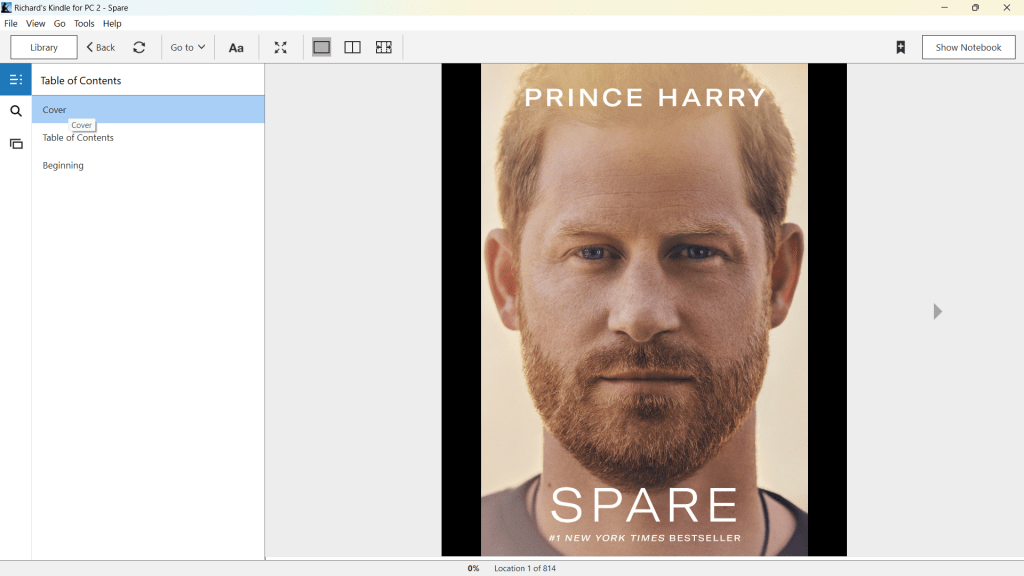
Spare by Prince Harry

Amazon abstract:

#1 NEW YORK TIMES BESTSELLER • Discover the global phenomenon that tells an unforgettable story of love, loss, and healing.

“Compellingly artful . . . [a] blockbuster memoir.”—The New Yorker

It was one of the most searing images of the twentieth century: two young boys, two princes, walking behind their mother’s coffin as the world watched in sorrow—and horror. As Princess Diana was laid to rest, billions wondered what Prince William and Prince Harry must be thinking and feeling—and how their lives would play out from that point on.

For Harry, this is that story at last.

Before losing his mother, twelve-year-old Prince Harry was known as the carefree one, the happy-go-lucky Spare to the more serious Heir. Grief changed everything. He struggled at school, struggled with anger, with loneliness—and, because he blamed the press for his mother’s death, he struggled to accept life in the spotlight.

At twenty-one, he joined the British Army. The discipline gave him structure, and two combat tours made him a hero at home. But he soon felt more lost than ever, suffering from post-traumatic stress and prone to crippling panic attacks. Above all, he couldn’t find true love. 

Then he met Meghan. The world was swept away by the couple’s cinematic romance and rejoiced in their fairy-tale wedding. But from the beginning, Harry and Meghan were preyed upon by the press, subjected to waves of abuse, racism, and lies. Watching his wife suffer, their safety and mental health at risk, Harry saw no other way to prevent the tragedy of history repeating itself but to flee his mother country. Over the centuries, leaving the Royal Family was an act few had dared. The last to try, in fact, had been his mother. . . .

For the first time, Prince Harry tells his own story, chronicling his journey with raw, unflinching honesty. A landmark publication, Spare is full of insight, revelation, self-examination, and hard-won wisdom about the eternal power of love over grief.

Podcasts I’m listening to:


Here’s a few photos from along my pistol route:

Biden makes history on the picket line

Here’s the link to this article.

Avatar photoby ADAM LEE SEP 28, 2023

President Joe Biden standing for a photo with striking UAW workers | Biden makes history on the picket line
Credit: NBC News

Overview:

From an unpromising beginning, Joe Biden has become one of the most progressive presidents the U.S. has ever had.

Reading Time: 3 MINUTES

I’m not ashamed to admit it: Joe Biden has exceeded my expectations.

When he was running in the 2020 presidential primaries, I wasn’t thrilled by him. I thought Bernie Sanders or Elizabeth Warren were better options. Both of them represented a bold progressive spirit that America sorely needed—while Biden, I believed, was at best a reiteration of the status quo. I thought he stood for more of the same bland, watered-down, just-barely-left-of-center politics that have defined the Democratic Party for decades.

But I was wrong.

Enter Dark Brandon

I never expected to write these words, but Joe Biden is the most transformative Democratic president of my lifetime. Despite having only a nailbiter majority, he’s racked up a long list of big, significant wins.

At the top of this list is the Inflation Reduction Act, far and away the most ambitious law ever passed to fight climate change and build a better future for our children. He brought the U.S. back into the Paris Agreement and shut down the Keystone XL pipeline. He won ratification of the Kigali Amendment to the Montreal Protocol, phasing out hydrofluorocarbons that are a major cause of global warming.

He’s passed a series of less world-historical, but still big and badly needed, infrastructure bills. He’s made several other progressive wishlist items a reality, like enshrining Juneteenth as a federal holiday, ending the forever war in Afghanistan, forgiving student loan debt, giving Medicare the power to negotiate drug prices, capping insulin costs, and outlawing forced arbitration and NDAs in workplace sexual assault cases.

He’s been a steadfast supporter of arming Ukraine to defend against Russia’s savage war of aggression. He oversaw the appointment of a special counsel that’s now moving forward with the well-deserved prosecution of Donald Trump. He’s confirmed a record number of federal judges.

Biden appointees in the executive branch have made an impact as well, like the restoration of net neutrality from the FCC, and a a massively significant decision from the National Labor Relations Board expanding workers’ rights to organize.

And now, this:

President Joe Biden made history Tuesday when he visited a picket line in Michigan in a show of loyalty to autoworkers who are striking for higher wages and cost-of-living increases.

Biden, who is looking to polish his pro-labor persona, is the first sitting president to appear on a picket line.

Speaking through a bullhorn, he told the striking autoworkers in Wayne County, “You deserve what you earned, and you’ve earned a hell of a lot more than you’re getting paid now.”“Biden makes history by joining striking autoworkers on the picket line.” Peter Nicholas, NBC News, 26 September 2023.

I was, frankly, shocked to hear that Joe Biden is the first sitting president ever to show up on a picket line. Barack Obama, when he was a candidate, said he would do it but never did.

Even in the golden age of American unions, presidents like Eisenhower or Kennedy never took a step as audacious as this. But after all, why not?

Republican presidential candidates speak to evangelical churches, because they know that’s their base of support. If there’s anything that Democrats have consistently stood for, it’s the working class and unions. In an age of gross inequality and concentrated corporate power, politicians should take a stand for labor against capital. The moneyed classes may throw a tantrum over it, but there’s no more natural alliance than a Democratic president and organized labor.

Hot Labor Summer

It’s been a year of renewed labor power and activism. And for the most part, unions has been winning.

The Writers’ Guild of America just won their strike against the Hollywood studios. The Teamsters got a new contract with UPS, securing wage raises and air conditioning in their delivery vans (!!). Although Biden and the Democrats attracted criticism for blocking a railroad workers’ strike, they came back to help them get the sick leave they asked for.

Now the United Auto Workers have gone on strike against the Big Three automakers: General Motors, Ford and Stellantis (Chrysler). Among their demands are for a 40% raise—the same percentage that company executives have granted themselves over the past few years. That’s the kind of cheeky negotiating tactic I can get behind!

By appearing on the UAW picket line, Biden has put a very large thumb on the scale on the side of the workers. He’s shone a national spotlight on them and given legitimacy to their demands.

Granted, this is a symbolic gesture. But symbolism matters.

The “bully pulpit” is both the president’s most underappreciated power, and in some ways, his broadest. By design, the president isn’t an all-powerful king. His hands are tied by existing law. He can’t force Congress to pass legislation or choose how the courts rule. But, more than the other branches of government, he has power to persuade. For better or for worse, he defines the national mood and chooses what to focus our attention on.

In a strike, where public perception and sympathy plays a large part in deciding the outcome, that matters. When corporations know that the public mood is against them, they have an incentive to settle labor disputes as quickly as possible. That’s a huge gift both to the UAW and to union power in battles yet to come, and we have President Biden to thank for it.

God and Girl–Chapter 13

God and Girl is my first novel, written in 2015. I'll post it, a chapter a day, over the next few weeks.

Monday, oh wonderful Monday, here again.  I seem to have no memory of what happened before lunch, including lunch now that I think of it.  I thought it was probably because Ellen is absent today, along with her Mom.  I’m not sure why and she hasn’t returned my text from earlier this morning.

Hopefully, Poetry class will wake me up.

Mr. Johnson seemed quieter than normal as I walked in.  He was hovered over his desk reading something, apparently deep in thought.  He didn’t even look up when my chair squeaked as I sat down. I took out my pad and pen and waited.  It seemed like a very long time but a glance at the wall clock revealed it was only a couple of minutes.

“Good afternoon.  It has been several weeks since we started school and we have moved along quite nicely.  I’ve enjoyed reading each of your poems. Today, I’m going to give you my “Waking Up” speech that I give every semester. I want to try my best to wake each of you up to the real power and purpose of poetry.”  Mr. Johnson said.

“If you let it, poetry can truly change your life.  Would you agree with me that each of us is on a journey? It is rather simple to look backwards, over our lives, and see where we have been.  We probably cannot make sense of why our lives have taken the paths they have already taken.  But, looking forward is not as clear.  It is rather mysterious.  Some of us, maybe most of us, don’t really know where we are heading, what we really want out of life.  Many of you may think, what’s the rush?  I’m in the ninth grade so I’m just going to coast along.

Think with me, if you will, about what truth means to you.  You may think and believe that you know some truth. Truth may or may not be important to you.  But, let me promise you, as you grow older you will want to know more and more.  Of course, there are the age-old questions of ‘Where did I come from?  How did I get here?  What am I supposed to do with my life?  Where am I going?’ and these are all very interesting and important questions.

I believe poetry can become your framework, your way of both asking and attempting to answer these questions.  Not only these age-old fundamental questions, but pretty much any question you have.

Poems don’t have to be about truth.  You already know this.  They can be about anything.  They can contain half-truths.  Most importantly, they can contain your truth, what you conclude is true.  This may certainly change over time, say, over the course of your life.  Having confidence in how you feel, even though you may somehow know that you are missing some important, or vital information, can make a dark day in your life less dark than it would be without poetry.

Remember, there is only one rule in poetry and here it is: there are no rules in poetry.  You should have learned that the first day of class. With this rule always whispering to you from the back of your mind, you can create a thing of beauty, a poem that helps you answer the question or questions you need answering at that very moment in your life.  Now, don’t get me wrong.  Poetry, your poems, will not all be about these life questions.  But, my “Waking Up” talk today is limited to talking about showing you a powerful way that poetry can help you find your bearings and your pathway.

Let’s look at an example, one I’ve used many years in this class.  Please know that I don’t mean to poke fun at anyone whether they are religious or not, whether they are science fans or not.  My example is just for illustration purposes only.

Imagine you are religious, you have grown up in a religious home. One day a friend tells you your religion is full of holes, that it isn’t true.  Your friend goes on to tell you that you and chimpanzees came from a common ancestor and are therefore close kin.  Now, again, please know that I have used this example for at least six years—way before Dr. Ayers came along and started exposing our students to evolution.  By the way, a long time before you, Ruthie, were here—so I’m not picking on you for having grown up with a pastor dad in a religious home.

Let’ go back to my example.  So, your friend has basically called you a quack, and an apelike creature of sorts.  You may ponder this little conversation for days, you may be worried, or unsettled about it.  You may dismiss your friend’s statements as totally untrue, lulling yourself to believing that you know what truth is, and that you certainly know more than your friend.  No matter.  If you want, you have a way to deal with these questions.

You find a quiet and private place, take out a sheet of paper and pen and draft a poem.  Here are a few lines:

God is truth.

Adam & Eve are real.

Really?

I’m no ape.

My ancestors were not apes.

Really?

If Adam & Eve were apes,

So was God,

Since they were made in His image.

If Adam & Eve were not real,

God is not real.

Really?

God is real.

He is truth.

Apes are real.

Apes are truth.

If Adam & Eve were apes, I am too, God is too.

That is truth.

God is still real for me.

Really!

Here is a copy to look at, as I read it again.  One thing I want you to carefully consider, maybe even write this down and keep it close.  “We know so very little.”  Okay, got it?  Think about it. Make this a good thing.  The unknown is often mysterious.  If we knew everything we never would have a question, would we?  I’m encouraging you to take life as it is, often good, but very often bad, dark, lonely, troubling, and sinister.  Let’s look back at my somewhat silly little poem.  Ruthie, if you will, read it out loud for the class.”

I did so and was struck by its simplicity and its perplexity.  I recognized it as a thing of beauty, a model that I could use in my life, especially in my life right now.

“Thanks Ruthie.  We note that it’s okay to both know and not know.  Can we know and not know at the same time about the very same thing?  ‘God is truth.’  This sounds right, but what is the author saying?  Forgive me, I said author.  I meant reader, because that is the one who determines what a poem means.  Sure, the writer/author/creator of the poem had his own thoughts, meaning, truth if you will, of what he was writing.  This can be very different for a reader.  Could it be that he or she is saying ‘the God that I know from the Bible is truth, no matter what science or anyone else says?’”

This type of poetry is often written strictly for ourselves.  Again, the model I’m sharing with you is mainly for you to answer your own questions, to help you carve out the best pathway for you to follow as you make your way through life.

One final thing about what may appear a simple little poem.  Poetry is the perfect playground for connecting things that normally don’t connect, that don’t usually go together.  Notice what we have done.  We believe that God creates—man or apes.  We believe that God creates Adam & Eve—whether they are man or ape—in His image.  Look at the line ‘If Adam & Eve were apes, I am too, God is too.’  Here we are calling God an ape.  Something you don’t hear very often.  But, in this helpful little tool we now have, we can do anything.  

I had so much more I wanted to say about this, but the surprise fire drill in the middle of my lesson said otherwise.  We are out of time.  Maybe we can continue this subject later.  I encourage each of you to start playing around with this type poetry, even tonight if you have time.  Start with a question you have about the world, one that is close to you.  See if you can discover new ways of looking at truth, or of creating your own truth.”  Mr. Johnson said.

It was as though he had prepared today’s class just for me.  His talk was just what I needed.  Some way of dealing with my struggle. I believe poetry can give me purpose and peace.  It can give me truth, even though I may not like it.  I’m excited about becoming a real, live, breathing truth-explorer.

09/28/23 Biking & Listening

Here’s a link to today’s bike ride.

Why I ride

Biking is something I both love and hate. The conflicting emotions arise from the undeniable physical effort it demands. However, this exertion is precisely what makes it an excellent form of exercise. Most days, I dedicate over an hour to my cycling routine, and in doing so, I’ve discovered a unique opportunity to enjoy a good book or podcast. The rhythmic pedaling and the wind against my face create a calming backdrop that allows me to fully immerse myself in the content. In these moments, the time spent on the bike seems worthwhile, as I can’t help but appreciate the mental and physical rewards it offers.

I especially like having ridden. The post-biking feeling is one of pure satisfaction. The endorphin rush, coupled with a sense of accomplishment, makes the initial struggle and fatigue worthwhile. As I dismount and catch my breath, I relish the sensation of having conquered the challenge, both physically and mentally. It’s a reminder that the things we sometimes love to hate can often be the ones that bring us the most fulfillment. In the end, the love-hate relationship with biking only deepens my appreciation for the sport, as it continually pushes me to overcome my own limitations and embrace the rewards that follow the effort.

My bike

A Rockhopper by Specialized. I purchased it November 2021 from Venture Out in Guntersville; Mike is top notch! So is the bike. The ‘old’ man seat was salvaged from an old Walmart bike (update: seat replaced, new photo to follow, someday).


Something to consider if you’re not already cycling.

I encourage you to start riding a bike, no matter your age. Check out these groups:

Cycling for those aged 70+(opens in a new tab)

Solitary Cycling(opens in a new tab)

Remember,

Photo by Suzy Hazelwood on Pexels.com

Memoir I’m listening to:

Spare by Prince Harry

Amazon abstract:

#1 NEW YORK TIMES BESTSELLER • Discover the global phenomenon that tells an unforgettable story of love, loss, and healing.

“Compellingly artful . . . [a] blockbuster memoir.”—The New Yorker

It was one of the most searing images of the twentieth century: two young boys, two princes, walking behind their mother’s coffin as the world watched in sorrow—and horror. As Princess Diana was laid to rest, billions wondered what Prince William and Prince Harry must be thinking and feeling—and how their lives would play out from that point on.

For Harry, this is that story at last.

Before losing his mother, twelve-year-old Prince Harry was known as the carefree one, the happy-go-lucky Spare to the more serious Heir. Grief changed everything. He struggled at school, struggled with anger, with loneliness—and, because he blamed the press for his mother’s death, he struggled to accept life in the spotlight.

At twenty-one, he joined the British Army. The discipline gave him structure, and two combat tours made him a hero at home. But he soon felt more lost than ever, suffering from post-traumatic stress and prone to crippling panic attacks. Above all, he couldn’t find true love. 

Then he met Meghan. The world was swept away by the couple’s cinematic romance and rejoiced in their fairy-tale wedding. But from the beginning, Harry and Meghan were preyed upon by the press, subjected to waves of abuse, racism, and lies. Watching his wife suffer, their safety and mental health at risk, Harry saw no other way to prevent the tragedy of history repeating itself but to flee his mother country. Over the centuries, leaving the Royal Family was an act few had dared. The last to try, in fact, had been his mother. . . .

For the first time, Prince Harry tells his own story, chronicling his journey with raw, unflinching honesty. A landmark publication, Spare is full of insight, revelation, self-examination, and hard-won wisdom about the eternal power of love over grief.

Podcasts I’m listening to:


Here’s a few photos from along my pistol route:

He Was Always A Fraud

Here’s the link to this article.

DAN RATHER  AND ELLIOT KIRSCHNER

SEP 27, 2023

(Photo by Scott Olson)

Donald Trump is and has always been a fraud, a con man, and a flimflam artist in it for the quick buck and to satisfy the basest of his selfish needs. 

There is never any joy in having to remind ourselves of this truth. Instead, there is a sadness in having to face the fact that such a man became president of the United States — and may become president again.

But face it we must.

Evidence for these harsh conclusions about the man is overwhelming and longstanding and comes in many forms, the latest installment making waves yesterday courtesy of a civil trial in New York. There, the Trump business conglomerate and those who run it — including Trump, members of his family, and longtime associates — have been in the investigative crosshairs of the state’s attorney general, Letitia James. 

After reviewing the bank and insurance paperwork that Trump and his associates used to obtain favorable terms, a New York judge ruled that the documents “clearly contain fraudulent valuations which the defendants employed in their business.” And that’s how the words “Trump” and “fraud” found themselves in close proximity in blockbuster headlines across the country this week. 

The ruling could lead to a major financial hit. It is also a direct threat to the Trump brand and business. He could lose control of multiple New York properties, including his garish namesake tower on Manhattan’s Fifth Avenue. And further ripple effects could spiral from there, creating centrifugal forces that will further pull at a wobbly enterprise. 

Of course, this isn’t the only legal threat the country’s most famous multiply-indicted defendant finds himself confronting. Reading yesterday’s news reports, it was amusing how reporters tried to explain to readers that this case was different from all the others they are trying to follow. 

What all these cases have in common, however, is a return to where we started: Trump is a fraud and a liar. Whether it’s absconding with classified documents, paying hush payments to a mistress, strong-arming election officials in Georgia, or inciting a violent attempted coup, the common denominator is that Trump is only out for himself, and he will do whatever is necessary, as dangerous as that course may be, to keep his lifelong con going. 

In trying to contextualize yesterday’s news, one can’t help but think back to the NBC reality show “The Apprentice.” The portrayal of Donald Trump as a decisive leader, successful businessman, and respected member of New York society was always a fiction created through scripting, marketing, and editing. At the time, the charade was treated as harmless enough, just another offering in a form of lowbrow entertainment featuring those who sought fame and fortune at any cost. Hindsight sadly provides a much clearer — and more troubling — picture. 

Trump is a showman without shame, which just so happens to be the perfect attribute for thriving in reality television. He already had decades of experience lying about the reality of his business empire, which often teetered on the brink of collapse. But now he was aided and abetted by a team of producers, editors, and writers (plus no doubt a ton of hair and makeup help). If Trump looked good — no matter the truth — everyone stood to make a lot of money. What no one could have predicted at the time was that these years of Trump’s primetime propaganda would lay the groundwork for the most unlikely and arguably the most damaging president in American history. 

Another truth that emerges from these court cases, as with the television show, is that Trump could not have done any of this by himself. At every turn, he has had help. The idea that people would do business with him or serve in his administration after all that we have seen is a sad testimony to what greed and a thirst for power and personal advancement will drive people to do.

Time and again, those who should know better could have tried to stop him. Far too few in his orbit stepped up to the challenge. That dynamic now includes most of the Republican Party. 

For years, those who saw the truth about Trump have desperately waited for the one revelation that would finally cause his rabid supporters to understand the full scale of the grift. It has become clear now that if the events leading up to and cresting on January 6 couldn’t do that, then nothing will. But perhaps the fraud ruling in New York and other challenges Trump faces can chip away at the edifice. 

Ultimately, “The Apprentice” became a shadow of its one-time popularity. As its ratings dropped, Trump and the producers became more and more desperate for shticks that would lure viewers. Acts can get tired, especially when they lose the luster of success.

Trump has always been fiercely afraid of accountability, because he knows it shines an ugly light on his false reality. It’s why he lies about crowd sizes, vote totals, and his own body weight when he is booked in jail. It’s all related. Pull back the curtain of his threats, projections, and cheap bravado, and you’re left with a frightened man desperately trying to outrun reality, and now the law. There’s nothing quite like seeing a con man get backed into a corner by the truth. 

The questions are, will any of this resonate with Republicans? Influence independents? Or drive Democrats to the polls?

God and Girl–Chapter 12

God and Girl is my first novel, written in 2015. I'll post it, a chapter a day, over the next few weeks.

It is way too early on a Saturday morning in late September.  It is 7:45 a.m. and Ellen and I are sitting in the media room off the auditorium balcony. Dad has spent the last several weeks organizing a pastor’s conference of sorts.  The purpose is to unite and organize and eventually kickoff his “Take a Stand” program with a march to Guntersville and over the big river bridge.

Ellen is here because she wants to be.  Last night was our recurring theme of staying together at either my house or hers and completing our weekly team assignment for Biology class.  For several days we have been talking about this conference and what it stands for and what she will likely hear.  Ellen says she wants to learn more about what I am struggling with in my faith.  I am glad she is here.

Dad had asked me to videotape the conference. He knew I was pretty good with the new system the church had installed a few weeks ago.  I think he also just wanted me here.  Some form of him appeasing his guilt for spending so little time with me.

“Okay, Pastor Williams is about to deliver his sermon.” I said.

“Good morning fellow pastors.  It is an honor to be here with you, and it is encouraging to see so many out today, ready to ‘Take a Stand’ for our Lord and Savior Jesus Christ.

Before I get into the scriptures, before I give you a detailed exegesis of why we are right, why marriage is between one man and one woman, let me give you a real short summary of why we are right to be here today and why we are right to take real action to oppose gay marriage.

We have a guidebook for living.  It is called the Bible.  In it we find that God created our world and that he created all living things including humans.  He created Adam and Eve.  Now, they were very different from the birds, the fish, the reptiles, and the mammals.  God created man and woman in His image.  This means He created them with souls. His purpose in creating Eve was to give Adam a helpmate, a partner in life.  He didn’t give him a man.  God knew that only woman could fulfill His purposes for man. God said be fruitful and multiply.  In God’s creation, only man and woman, joined as one in Holy Matrimony, can produce offspring.  So, we know, we easily know, what is true about marriage.

But we also have another question.  What do we do if we face opposition?  If we face opposition that threatens our ability to fulfill God’s wishes, His commands?  We ‘Take a Stand.’  We let the world know God’s plan.  The early Christians had to fight the Roman government and opposing religious sects to build the Kingdom of God.  If they had chosen not to, then we wouldn’t have our freedoms today.

This country was founded by men and women who were Godfearing believers, who had fled England, a place of little religious freedom.  They were fleeing a government-run church.  That’s why they, in our Constitution, gave us religious freedom.  That means they believed, risking their very lives to do so, every man, woman, boy, and girl had the inalienable right to worship as he saw fit.  This sounds as though I am saying that gays should have this right too.  I’m not.  Their marrying isn’t about worship.  It is about rejection and revolt.  They are rejecting the Christian religion.  As we will see in the Book of Romans, homosexuals are denying God.  Our Founders all believed in the Bible as God’s Word.  They never envisioned a day when our government and its Supreme Court would reject the Bible.  There was never a single component of religious freedom, as embodied in the First Amendment, that recognized sin as a form of worship, and therefore guaranteed the protection of the Constitution.

If we do not ‘Take a Stand’ then someday we, as pastors, will be forced by government to marry gay couples.  We will be forced to assimilate gay couples in our churches exactly as we do Christian couples.  Can you imagine going on a marriage retreat to Gatlinburg, like so many of us have done in the past, and sharing a room with a gay couple?

Fellow pastors, if we want to stay in the business of building God’s Kingdom here on earth, we have to shore up our foundations and ‘Take a Stand.’”

Pastor Williams spent the next 45 minutes diligently laying out scriptures scanning the entire Bible, from Genesis through Revelation.  By the end of his sermon he had the entire conference united and chanting ‘Take a Stand.’

The day was long, all the way up to 4:30.  After Pastor Williams sermon, there was a two-hour Q & A with a panel of five pastors fielding questions from the other pastors.  Then we had an hour for lunch.  The afternoon was committee work. All types of committees had been organized—everything from ‘Licenses & Permits’ for the upcoming bridge march, to ‘Media Management’ including how to handle radio, newspaper, and social networking.  Ellen and I had been asked to capture the core of what was going on in these committees all over the church. 

We each had a camera and each a list of committees and their locations. 

She went her way and I went mine.

Dad, Ellen, and I met after all the pastors had left to discuss the status of our media work.  Dad would later have Todd Barrett, the church’s media director, assimilate and edit all segments to prepare a complete video of the entire day.  Dad intended to use this piece to encourage other pastors, even pastors in other states, to start their own ‘Take a Stand’ program.

Dad gave Ellen and me $50.00 each for our day’s work.  I was not expecting this.  He didn’t have to do it, but he did.  And he even dropped us off at Crater’s for dinner.  We had arranged to meet Ryan, Lisa, and Sarah there for our Saturday night hang-out since Ryan’s parents were hosting a Sunday School party in their basement rec room.

Sunday morning came way too soon.  I was still very tired from yesterday’s pastors conference, but I had to stay awake through Dad’s sermon.  He always kept an eye on me to make sure I was truly listening.  I never could figure out how he could see me, at least enough to check my ears and mind to see how tuned in I was, especially with me sitting up in the balcony with Ryan and Lisa.  But, I came to believe he had special powers because sometimes his questions at lunch made me realize I was clueless as to the answer, and that it was probably because I had zoned out during that part of his sermon.

So, I marshaled all my energies to listen.  About halfway through the preaching, my body came to full attention when out of nowhere I heard someone raise their voice at Dad from the congregation.  “Bigot, King of Bigots.”  A man shouted.  Then, like a choir chiming in around him, “Gays are humans.  You say you love them.  So, love them instead of fight them.”  Then the one man repeated his ‘Bigot’ phrase.  It was apparent we had been invaded.  

Dad was ready, well he was ready to press his lifeline button.  A year or so ago, Dad had installed a communication device on the right side of his pulpit.  It was designed to quickly summon the police.  This was precipitated by all the school and church shootings.  I’m confident Dad pressed the button almost before the end of the first chorus. 

In the meantime, a group of men, church members, confronted the group. From where I was seated I could see there were at least 10 of them.  Our men shouted to them to leave, but they refused and kept up their ‘song.’  Then, one of our men, Tom Dalton I believe, grabbed one man standing at the end of a pew and started pulling him out into the aisle.  Before Tom got him out and before he could turn him toward the back exit, I saw another member of the gang jump over the back of a pew and swing a fist at Tom.  A lot more of our men rushed the melee and thankfully before guns came out, the police arrived and took control of the escalating situation and escorted all 10 men to the city jail. All these men were unknown to me and probably everyone else in church.

When the agitators left, Dad asked everyone to return to their seats.  He finished his sermon as though nothing at all had happened, never mentioning anything about what everyone had just witnessed.

After the sermon, Dad, as always, stood at the front of the church and shook hands.  Then, we went home.  It was a quiet ride; only silent words being spoken.

Later we found out that the 10 men gang was not a gay group at all, but a rag-tag group from North Jackson County that had recently affiliated with a new, but growing, national group called ‘Freedom from Religion.’  The national group had a website that declared that religion, particularly the Christian religion, was taking over the entire country and that it was organized to prevent the United States from becoming a theocracy.

Sunday lunch with the family was as quiet as the car ride home.  Getting up from the table and about to head to my room, I turned to Dad and told him that I loved him and that I was proud of him.  He just looked at me and half smiled, and half cried.

I changed clothes and rode my bike to Ellen’s as planned.  We rode our bikes to the City Park and went to our thinking spot.  The one I had for a very long time, my very own personal spot.  Now, it was mine and Ellen’s.  To me, we were one.

“Finally, alone with my love.”  I said after filling her in on what happened at church this morning.  “I feel dirty after being at the conference all day yesterday and at church this morning.  I have never felt this way.  What is going on?”

“Of course, I do not know for sure, but could it be that you are going through a time that milk and baby food is no longer as satisfying as it used to be, and that you are now enjoying hamburgers and French fries.”  Ellen said.

“Great analogy, but it breaks down pretty quick in my mind.  Everyone, did I say everyone, knows that a baby starts off on milk and baby food.  It is a natural part of life, and again, the world knows this.  There is no surprise, and nothing wrong, with a baby growing up and moving onto hamburgers and fries.”  

“You obviously think that there is a right and wrong in your life.  That church and God and heterosexual couples are right, and evolution and homosexual couples, and me, are wrong.  Doesn’t that sum it up right now?  Of course, today, right here, right now, you are greatly questioning whether church and God’s ways are right.  But, still, at your core, you are firmly rooted in your faith. Right?”  Ellen said.

“You are right.  As always.  Ha.  Let’s drop this for now.  I want to concentrate on you.  I have missed you so much.  I have missed your touch, our talk, our time.  By the way, I wrote you a poem.  It is more like a letter than a poem.  Last night after I got home from Crater’s, where we didn’t get much alone time, I just had to express myself to you. 

I hope it speaks to you, honey.”

“Can I read it out loud?”  Ellen said.

“Sure, whatever you want.”

“Lying beside you is a most wonderful, glorious experience.  I love your naked body against mine.  I love our interlocking legs. I love to caress your body.  I love kissing your body.  I love your eyes smiling into me as I kiss your lips, eyes wide open.

But, as heavenly as this is, I’m convinced that dancing, slow dancing with you, my hands touching your hands, is just as good.

As is, riding bikes with you.

As is, singing together, hand in hand, walking in the rain.

As is, reading poems to each other leaning together against our big oak in your backyard.

As is, writing you a poem or a letter,

As is, kissing your picture when I go to bed at night,

As is, pulling your hair outside your jacket when you have forgotten, or when you just want me to notice it there,

As is, your text ‘good morning my one and only,’ every morning at 5:30,

As is, everything we do together and alone.

Because, you are my life, my world, my multi-verse.  You are in every cell of my body.  Everything about you is about me. You make my life worth living.  You give me real purpose.  You hold my world in your hands.

Without you, there is no reason to live.

Thank you, my love, for loving me, for choosing me.  When you could have had anyone else in the world, you chose me.

And, I am yours,

Always and Forever.” Ellen read out loud.

“You are a good reader.”  I said.

“You are a good listener.  So, listen.  I also wrote you a poem.  But, darn, I forgot to bring it.  I want this moment to be equally special for you as it has just been for me.  Would you read this poem to me and pretend I wrote it, because my love, I feel exactly as you do?  Your words are my words.  Okay?”  Ellen said.

“Beautiful.  Sure, I will read ‘your’ letter out loud.”  I said.

And I did, and the sun shone brighter, the wind blew calmer and cooler, and I imagined the rain, wherever it was, fell more sweetly and softly on couples walking down little winding pathways in the woods.  I was happy, happy for these imaginary/real couples, and I was happy for Ellen and me.

I lay in Ellen’s lap for as long as I could.  And talked.  And talked.  Her pulling my long brown hair up and back, across my face and under my nose. And laughed. And laughed.  Holding my hand.  Caressing my side and arm.  Just loving me. And loving. And loving more.

We kissed softly before we left our spot and parted.  Ellen to her house, me to mine.  I hummed Adele all the way home.  Happy.  So very happy.

09/27/23 Biking & Listening

Here’s a link to today’s bike ride.

Why I ride

Biking is something I both love and hate. The conflicting emotions arise from the undeniable physical effort it demands. However, this exertion is precisely what makes it an excellent form of exercise. Most days, I dedicate over an hour to my cycling routine, and in doing so, I’ve discovered a unique opportunity to enjoy a good book or podcast. The rhythmic pedaling and the wind against my face create a calming backdrop that allows me to fully immerse myself in the content. In these moments, the time spent on the bike seems worthwhile, as I can’t help but appreciate the mental and physical rewards it offers.

I especially like having ridden. The post-biking feeling is one of pure satisfaction. The endorphin rush, coupled with a sense of accomplishment, makes the initial struggle and fatigue worthwhile. As I dismount and catch my breath, I relish the sensation of having conquered the challenge, both physically and mentally. It’s a reminder that the things we sometimes love to hate can often be the ones that bring us the most fulfillment. In the end, the love-hate relationship with biking only deepens my appreciation for the sport, as it continually pushes me to overcome my own limitations and embrace the rewards that follow the effort.

My bike

A Rockhopper by Specialized. I purchased it November 2021 from Venture Out in Guntersville; Mike is top notch! So is the bike. The ‘old’ man seat was salvaged from an old Walmart bike (update: seat replaced, new photo to follow, someday).


Something to consider if you’re not already cycling.

I encourage you to start riding a bike, no matter your age. Check out these groups:

Cycling for those aged 70+(opens in a new tab)

Solitary Cycling(opens in a new tab)

Remember,

Photo by Suzy Hazelwood on Pexels.com

Memoir I’m listening to:

Spare by Prince Harry

Amazon abstract:

#1 NEW YORK TIMES BESTSELLER • Discover the global phenomenon that tells an unforgettable story of love, loss, and healing.

“Compellingly artful . . . [a] blockbuster memoir.”—The New Yorker

It was one of the most searing images of the twentieth century: two young boys, two princes, walking behind their mother’s coffin as the world watched in sorrow—and horror. As Princess Diana was laid to rest, billions wondered what Prince William and Prince Harry must be thinking and feeling—and how their lives would play out from that point on.

For Harry, this is that story at last.

Before losing his mother, twelve-year-old Prince Harry was known as the carefree one, the happy-go-lucky Spare to the more serious Heir. Grief changed everything. He struggled at school, struggled with anger, with loneliness—and, because he blamed the press for his mother’s death, he struggled to accept life in the spotlight.

At twenty-one, he joined the British Army. The discipline gave him structure, and two combat tours made him a hero at home. But he soon felt more lost than ever, suffering from post-traumatic stress and prone to crippling panic attacks. Above all, he couldn’t find true love. 

Then he met Meghan. The world was swept away by the couple’s cinematic romance and rejoiced in their fairy-tale wedding. But from the beginning, Harry and Meghan were preyed upon by the press, subjected to waves of abuse, racism, and lies. Watching his wife suffer, their safety and mental health at risk, Harry saw no other way to prevent the tragedy of history repeating itself but to flee his mother country. Over the centuries, leaving the Royal Family was an act few had dared. The last to try, in fact, had been his mother. . . .

For the first time, Prince Harry tells his own story, chronicling his journey with raw, unflinching honesty. A landmark publication, Spare is full of insight, revelation, self-examination, and hard-won wisdom about the eternal power of love over grief.

Podcasts I’m listening to:


Here’s a few photos from along my pistol route:

Robert Sapolsky’s new book on determinism

Here’s the link to this article.

Jerry A. Coyne, 9/25/23

Robert Sapolsky, a biological polymath who’s written several best-selling books, pointed out in earlier ones (like Behave) that he was a hard determinist, a view he reinforced on a Sci. Am. podcast—one of their rare positive contributions. Now, as I mentioned in February, his new book, totally about determinism, is about to come out—on October 17. You can order it by clicking on the screenshot below. It ain’t cheap at $31.50 for the hardcover, but I may have to dig down deep to get it–or order it from the library.

Here’s the Amazon summary, which implies that Sapolsky isn’t buying any of the compatibilism bullpucky:

Robert Sapolsky’s Behave, his now classic account of why humans do good and why they do bad, pointed toward an unsettling conclusion: We may not grasp the precise marriage of nature and nurture that creates the physics and chemistry at the base of human behavior, but that doesn’t mean it doesn’t exist. Now, in Determined, Sapolsky takes his argument all the way, mounting a brilliant (and in his inimitable way, delightful) full-frontal assault on the pleasant fantasy that there is some separate self telling our biology what to do.

Determined offers a marvelous synthesis of what we know about how consciousness works—the tight weave between reason and emotion and between stimulus and response in the moment and over a life. One by one, Sapolsky tackles all the major arguments for free will and takes them out, cutting a path through the thickets of chaos and complexity science and quantum physics, as well as touching ground on some of the wilder shores of philosophy. He shows us that the history of medicine is in no small part the history of learning that fewer and fewer things are somebody’s “fault”; for example, for centuries we thought seizures were a sign of demonic possession. Yet, as he acknowledges, it’s very hard, and at times impossible, to uncouple from our zeal to judge others and to judge ourselves. Sapolsky applies the new understanding of life beyond free will to some of our most essential questions around punishment, morality, and living well together.By the end, Sapolsky argues that while living our daily lives recognizing that we have no free will is going to be monumentally difficult, doing so is not going to result in anarchy, pointlessness, and existential malaise. Instead, it will make for a much more humane world.

As I wrote in February based on this summary:

It’s clear from the summary that the “free will” Sapolsky’s attacking is dualistic or libertarian free will (“some separate self telling our biology what to do”). And although some readers think that kind of free will is passé, that everyone already rejects it, that’s wrong. I suspect those who say such things are compatibilists who don’t get out much.  According to surveys in four countries, most people accept libertarian free will, i.e., if you repeated an episode with everything exactly the same, a person could have decided or behaved differently. They also think that a naturalistic universe (or “deterministic” one, if you will) robs people of their moral responsibility. As I’ve long argued, yes, the concept of “moral” responsibility loses meaning in a naturalistic universe, but the concept of responsibility  (i.e., X did action Y) still makes a lot of sense, and that alone gives us justification for punishment—although non-retributive punishment.

If you doubt the pervasiveness of belief in dualistic free will, just look at religion: the Abrahamic religions and many other faiths are absolutely grounded in free will. They are, after all, predicated on you choosing the right religion and/or savior. This means that you do have a free choice, and woe be unto you if you choose wrong. (Calvinists or any religion that believes in “the elect” are exceptions.)

. . . So it goes. Back to Sapolksky. He espoused his determinism in Behave, but this is a full-length treatment, and a book I would like to have written. My main fear about the book was that Sapolsky would take the Dennett-ian stand towards free will, saying that we really have the only kind worth wanting, and downplaying the naturalism that, Dan believes (with other compatibilists), leaves us only one course of thought and action open at any one time. As I’ve argued, while hard determinism leads immediately to a discussion of the consequences for our world, how we judge others, and the justice system, compatibilism seems to me the “cheap way out,” reassuring us that we have free will and not going far beyond that—certainly not into the consequences of naturalism, which are many. It is the hard determinists, not the compatibilists, who follow the naturalistic conclusion to its philosophical conclusions.

The good news is that now when someone wants to understand determinism, I can just shut up and say, “Read Sapolsky’s book,” for I see no divergence between his views and mine (I’d also add Free Will by Sam Harris.) In the end—and I’ll get in trouble for this—I think compatibilists are semantic grifters. They’re really all determinists who want to find some way to convince people that they have a form of free will, even though they couldn’t have behaved other than how they did. This is the “little people’s” argument, not for religion but for philosophy. But in the end it’s the same: “People need religion/the notion of free will because without it, society could not flourish.” That, of course, is bogus. As long as we feel we make choices, even if intellectually we know we couldn’t have chosen otherwise, society will go on.  After all, I’m a hard determinist and yet I’m still alive, getting out of bed each morning. I don’t know what I’ll pick when I go to a restaurant, even though I know it’s determined right before I look at the menu.

Reader Tom Clark wrote a positive review of Sapolsky’s book on the Naturalism site. Click below to read it.

I’ll give just two of Clark’s quotes:

If free will is widely conceived as being opposed to determinism[1], it isn’t surprising that the latter is seen as a threat to responsibility, meaning, creativity, rationality, and other desiderata tied to our core notion of agency. If we’re fully caused to be who we are and do what we do, then it seems we’re merely biological robots, acting out a pre-ordained script; we don’t make real choices for which we might be praised or blamed.

Could you have done otherwise?

This is why Robert Sapolsky’s book Determined: A Science of Life Without Free Will(link is external), is likely to ruffle more than a few feathers (although it will do so very entertainingly, see below). Following up on his earlier work Behave(link is external), Sapolsky, a behavioral biologist, is intent on making it clear to anyone who will listen that there is no escaping determinism if we’re serious about understanding ourselves: understanding how we got to be the exact persons we are and why our intentions and choices arise as they do. Moreover, as he takes pains to point out, indeterminism or randomness doesn’t help the cause of agency. After all, as deciders we want to determine our choices, not have them be subject to factors we don’t control. Strangely enough, therefore, determinism, construed commonsensically as the existence of reliable causal, and more broadly, explanatory connections between our desires, decisions, actions, and their effects on the world, seems a necessary condition of genuine agenthood. We really make choices, just not undetermined or arbitrary ones.

Well, the last sentence is a bit grifty given that “make choices” means, to most people, “we could have made other choices.” But I won’t quibble too much. The best part is that, according to Clark, Sapolsky has no truck with compatibilism:

The fight with compatibilists isn’t about determinism; compatibilists agree that we and our choices are in principle explicable by various determinants, not the causa sui. It’s rather about the relative importance assigned to determinism and its implications for moral responsibility and other beliefs, attitudes, and social practices informed by our conception of agency. Sapolsky argues that compatibilists tend to ignore the causal story behind an individual in order to fix our attention on agents and their capacities for rationality and reasons-responsiveness, capacities that compatibilists argue justify holding each other morally responsible.[8] Most of us are capable in these respects to varying degrees, but by downplaying determinism and the causal story, what Sapolsky calls taking the ahistorical stance, compatibilists in effect block access to the psychological and practical benefits of putting determinism front and center: increased compassion and more attention paid to the conditions that thwart human flourishing. Due to factors beyond our control too many of us end up with the short end of the stick when it comes to health, education, social skills, and employability. Sapolsky is especially critical of compatibilist Daniel Dennett, who has claimed that “luck averages out in the long run”. He responds in characteristically plain-spoken style:

No it doesn’t. Suppose you’re born a crack baby. In order to counterbalance this bad luck, does society rush in to ensure that you’ll be raised in relative affluence and with various therapies to overcome your neurodevelopmental problems? No, you are overwhelmingly likely to be born into poverty and stay there. Well then, says society, at least let’s make sure your mother is loving, is stable, has lots of free time to nurture you with books and museum visits. Yeah, right; as we know your mother is likely to be drowning in the pathological consequences of her own miserable luck in life, with a good chance of leaving you neglected, abused, shuttled through foster homes. Well, does society at least mobilize then to counterbalance that additional bad luck, ensuring you live in a safe neighborhood with excellent schools? Nope, your neighborhood is likely to be gang-riddled and your school underfunded.

In arguing against compatibilists, Sapolsky engages with the philosophical literature, citing skeptics about free will and moral responsibility such as Neil Levy, Gregg Caruso, Derk Pereboom, and Sam Harris (see references below). Such backup suggests he is not completely crazy to think that a robust appreciation of determinism, and therefore the sheer contingency of our formative circumstances, should force reconsideration of our conceptions of credit, blame, reward, and punishment.

Clark’s final sentence:

[Sapolsky’s] persistence in seeing Determined to completion – a prodigious undertaking – is much to be congratulated, although he would disavow deserving any such praise. Even if he’s right about that, we’re still lucky to have him.

YES!  But read the rest for yourself. This is a book we can all benefit from (even those miscreants who accept libertarian free will or compatibilism), and I’m glad I can point to a respected polymath who makes an argument I agree with, but written much better than I’d be able to.

What I’d love to see: a debate about compatibilism between Dennett and Sapolsky.

God and Girl–Chapter 11

God and Girl is my first novel, written in 2015. I'll post it, a chapter a day, over the next few weeks.

It was Sunday afternoon on a walk with Mom around our neighborhood that the subject came back up.  

“Honey, I’ve thought nonstop about our conversation yesterday and your final statement.  First, I want you to know that I am not going to tell your dad right now.  But, I cannot promise that I will never tell him.  Again, you must trust my judgment.  And, as always, I appreciate your trust.

“I don’t know much at all about homosexuality, but I bet it is a complex subject.  You said that you were in love with Ellen, so I am assuming you believe or know that you are gay.  Am I correct?”  Mom said.

“Yes, I have felt different for a long time. I don’t know much about what it means to be gay either, but I know two things.  One, I am struggling over this from the standpoint of how it affects my faith, or how it reveals my lack of faith, and secondly, I know I care very, very much for Ellen.  I know I have never felt this way about anyone, most especially a boy, but no other girl either.”

“We could talk about this forever and I doubt I could change your mind.  I know that if I had spoken to someone about John and me when I fell in love with him that it basically would have been a waste of time.  My youth and my emotions would have squelched any rationality that I tried to muster.  And, I strongly suspect that it will be the same with you.  Even if I locked you in a cage for the next five years it probably wouldn’t help anything.

“Why don’t we do this.  You fully commit to seeking the truth and wisdom, and I will be available anytime and anywhere for you.  I know it must be hard talking to your mother about such sensitive subjects, but I believe you do, in large part, because of how we have always been.”  Mom said.

“I agree totally with what you are saying.  Mom, I do want to do the right thing.  But, please know that walking with you now, right here, I know my heart.  I know I have such genuine feelings for Ellen.  And, I believe she feels the same for me.  Thanks for trusting me and always being here for me.”
We arrived home a few minutes later in time to eat a snack and get ready for church.

The next week went by rather slowly while the routine of ninth grade started to fall into place.  I was particularly enjoying Biology and Poetry.  Friday came, and Ellen and I had again not completed our team assignment in Biology.  Just like last week we would have to finish it after school and tonight up until midnight, our deadline.  Mom simply said “Okay” when I told her, very humbly, that I would be staying over at Ellen’s tonight.  She then gave me permission to spend Saturday with Ellen, in part I suspect because her mom had asked me to.

After school, I caught a ride home with Jacob, packed a few things in a backpack, and rode my bike to Ellen’s.

We worked surprisingly focused on our paper.  Again, we finished just in time to submit it before midnight.  We have got to quit doing this.  We are cutting this way too close.

“How about a swim?” Ellen said.

“Where?”

“In our pool goofball.”

“I didn’t know you had a pool.”  I said.

“It’s indoors, downstairs, and it’s heated.  Not that we need that much heat.  I mean it is still warm weather.”  Ellen said.

“Sounds good, and you’re right.  The water could be freezing cold but go to boiling soon after we both jumped in.  Ha. Ha.”

“Here is a bathing suit I bet will fit you perfectly.”  Ellen said.

“I’ve never worn a two-piece before.  And, you are a lot more bosomy than me.”

“Don’t worry.  It is a couple of years old.  Back when I was a little flatter like you.  No disrespect intended.”  Ellen said.

“None taken.  Hand it here.”  I said heading for her bathroom to change.

The water was a little cool when I first jumped in, but that changed quickly.  I had wanted to tip-toe in from the steps at the shallow end, but Ellen would have no part of it.  She grabbed my hand and pulled me down to the deep end and kept our hands together all the way to the bottom. The pool was well-lit, and I opened my eyes after my foot touched the bottom.  Ellen’s face was nearly next to mine and she let go my hand and pulled me close to her with her hands on my lower back.  She attempted a kiss, but I was needing air, so I torpedoed upward.

“Sorry, if I was too forward.”  Ellen said as we both swam to poolside.

“Don’t say that.  My lungs were respectfully calling for air, but not far away from an all-out scream.   I hope you know that I am always open to your forwardness.”  I said.

“Let me ask you something.  Do you think we are taking things a little too fast?”  Ellen said.

“Okay, you asked, and you should recall that we have already fully committed to each other to be totally honest at all times.  You do remember our agreement, don’t you?”  I asked.

“Of course, I do.”  Ellen said.

“Well, in a sense I do think this is all happening at light speed.  I am okay with it because it is so wonderful.  I have never had feelings like this before.  So, all of this is brand new to me.  Here is the rest of my answer to your question.  I am struggling with my faith. Of course, this is because I have always been taught that homosexuality was a sin and that marriage, I know we are not married, but we are a couple, that marriage was between a man and a woman.  I hope you are not mad at me for having this struggle.”  I said as we each climbed the ladder out of the pool, grabbed towels, and sat in two lounge chairs.

“Actually, I feel better.  If you were not struggling then I would think that you were shallow and that your life before me, that is, your life in church, in both home and church with your Dad as pastor, would just have been a joke, a sham.”  Ellen said.

“I’m very thankful you are this open-minded.  I am committed to finding the truth about life, my truth.  I am open to finding out things that I do not now know.  I want and need your help on this journey.  I guess this is going to be a part of our journey to love.

“I am here to help anyway I can.  I’m not going anywhere my dear.  Now, come on, let’s swim some laps.”  Ellen said.

We jumped in again and spent the next thirty minutes racing lengthwise across the pool, and diving for quarters and then treading water in the deep end.  During our treading, we often touched hands, fingertips, and finally embraced and sank to the bottom holding each other, nuzzling kisses until our breath ran out.  Exhausted, we grabbed our towels and headed for the kitchen.  We were famished, having skipped supper to work on our paper.

After devouring a large pizza, albeit reheated, we returned to Ellen’s room.  She opened Pandora on her iPad and activated her Adele station.

“I love Adele and her song “Set Fire to The Rain.”  The first two stanzas so beautifully capture how I feel about you.  Listen carefully.”  Ellen said.

“I let it fall, my heart

And as it fell, you rose to claim it

It was dark, and I was over

Until you kissed my lips and you saved me.

My hands, they’re strong

But my knees were far too weak

To stand in your arms

Without falling to your feet.”

“Awesome, totally awesome.”  I said.

“Now, just listen to the music and the beating of my heart,” Ellen said as she stepped closer to me and pulled me into her body.  We slow danced for what seemed like an hour, letting the music station play songs as it wished.  It seemed every song was specially selected for our dance.

We couldn’t keep our eyes off each other.  Since the first time I saw Ellen her blue eyes mesmerized me—even from a distance.  But now, as our bodies were pressing each other, her eyes seemed to be singing softly that her heart was pure and that I could give my all to her and not worry that she would break my heart and ruin my life.

Now, her lips were on mine and my body was tingling as I felt her undoing my bikini top—having totally forgotten we both were still wearing our swim suits. I didn’t resist, and I didn’t resist as she, with both hands, removed my bikini bottom.  She motioned me to her bed, removed her swimsuit, took my hand and sweetly, gently pulled me beside her to lay with her, body to body.

We kissed, and laughed, and talked, and touched for hours, or so it seemed, finally dozing off as the sun danced around her half-open blinds.  Around noon, we were awakened by her mom knocking on Ellen’s door asking if we would like breakfast.

After breakfast, we played a game of tennis.  I also didn’t know until today that the Ayers’ had a tennis court.  We both kind of sucked at tennis so we sat with our bottled water in nice soft chairs at a table at a very private patio outside the basement and the indoor swimming pool.

“Australopithecus afarensis.”  Ellen said as we took our chairs.

“What?  What language are you speaking?  Is that a love song you want me to learn?”  I said.

“Well, not exactly, but I guess you could say it is about love.  I’m speaking of human evolution.  And, come to think of it, we wouldn’t be here if it weren’t for evolution.  Australopithecus Afarensis is a species of human.  Well, maybe not human, but somewhat like human.  Lucy is the easy, short name, personal name, given to a skeleton found in 1974, a female.  Why am I bringing this up?”  Ellen said.

“I was wondering the same thing.”

“You said last night that you were looking for truth.  For some reason, your words have been tossing and turning around in my head ever since we tried to volley the tennis ball back and forth over the net.  In our Biology book, Why Evolution is True, there is a chapter on human evolution.  Of course, it is way towards the back of the book and we haven’t gotten close to that, but we will.  Ruthie, my dear, I firmly believe that you and I, and all other humans, also known as homo sapiens, descended from a common ancestor of chimps.  Millions of years ago chimps and one of our forebears—not like us in so many ways—started their own branches on our family tree.  Scientists believe that Lucy, that is, her species, came about early on after the branching, again, from that common ancestor we share with chimps.  Lucy, that is Lucy’s fossils, shows that she had characteristics both apelike and human-like.”  Ellen said.

“You know this is totally unlike what I was raised to believe.  I was taught that God created the first man and woman, Adam and Eve, and that took place less than 10,000 years ago, and that all humans are descended from them.  Adam and Eve were perfect to begin with, but they sinned at some early point after they were created.  That sin is referred to as The Fall, or Original Sin, and that all men were born sinners as a result.  That years and years later God sent His Only Son, Jesus, as an atonement for all sins, to die on a cross.”  I said.

“I know, my dearest Ruthie.  I know what you believe.  And, you need to know that I don’t believe in your creation story.  I believe in evolution.  But, I hope, and as you say, I pray, these two very opposing beliefs won’t hurt us, won’t keep us apart.  Ruthie, I have fallen in love with you and never want to be separated from your seriously sexy smile.”  Ellen said with a sheepish grin.

“Ellen, it means the world to me that you have been willing to be so open, to share your heart. I too want nothing more than to be with you and love you.  You do know that I am in love with you?” I said.

“I do.  I know this now more than ever, especially after our sweet time last night and our honest disclosures here today.”  Ellen said.