Writer / Observer / Builder — Presence, clarity, and living without a script
Author: Richard L. Fricks
Writer. Observer. Builder. I write from a life shaped by attention, simplicity, and living without a script—through reflective essays, long-form inquiry, and fiction rooted in ordinary lives. I live in rural Alabama, where writing, walking, and building small, intentional spaces are part of the same practice.
Fighting back—and winning—is achievable, important, and actually enjoyable
***
The Art of Noticing
Simple and uncommon exercises to reveal what’s hidden in plain sight.
In The Art of Noticing, Rob Walker—a journalist, author, and educator—invites us to attend carefully and playfully to everyday curiosities that most of us tend to overlook.
“Fending off distraction isn’t quite the same thing as making the most of our attention.” By engaging the senses, Rob says, we can enrich our daily lives with meaning, boost creativity, and even “reframe the way we take in the world.”
***
Rob Walkeris a journalist and author. He is a longtime contributor to The New York Times, and a columnist for Fast Company. His recent books are The Art of Noticing, and Lost Objects, co-edited with Joshua Glenn. He is on the faculty of the Products of Design program at the School of Visual Arts. You can find his newsletter at robwalker.substack.com.
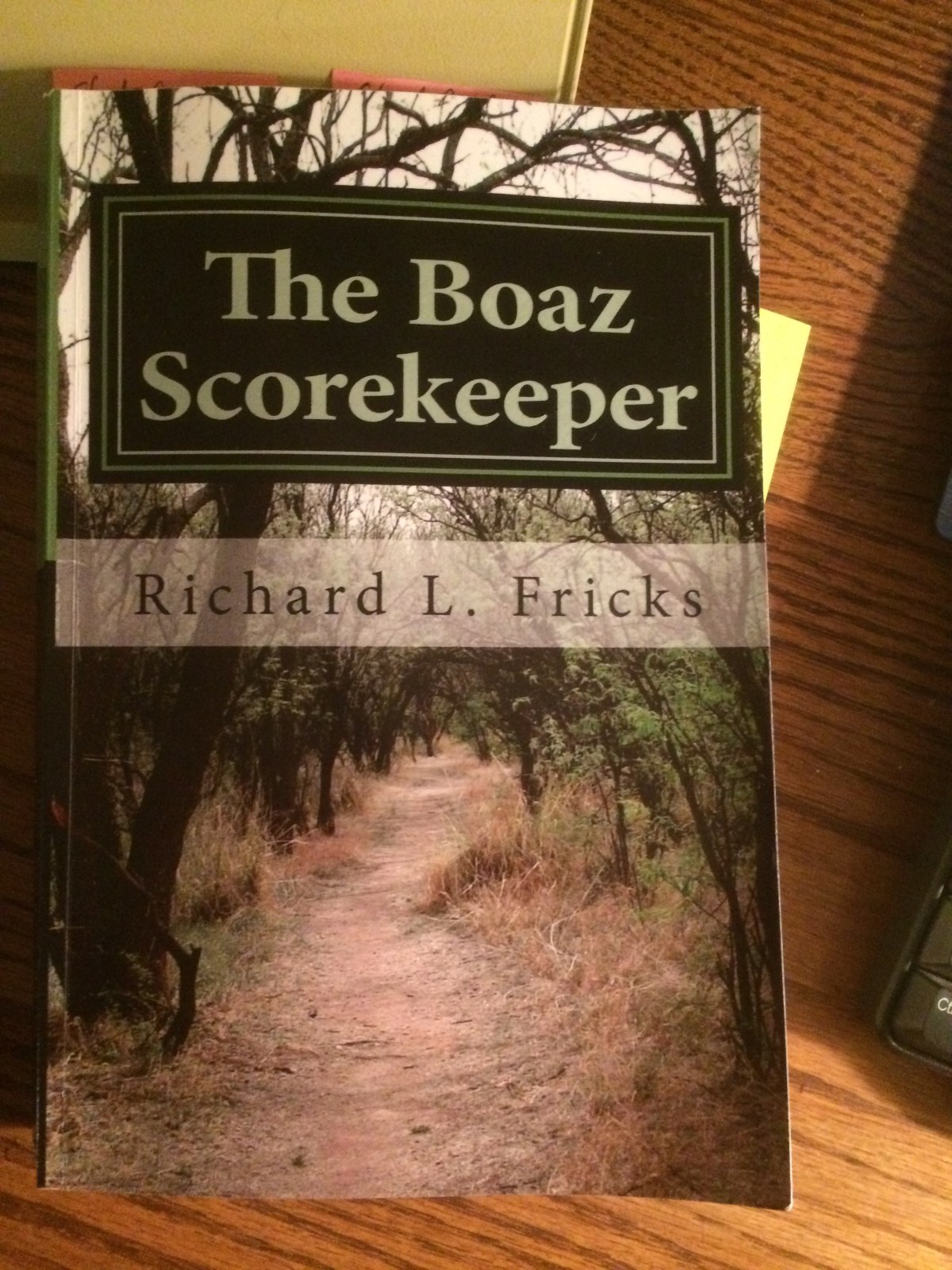
The Boaz Scorekeeper, written in 2017, is my second novel. I'll post it, a chapter a day, over the next few weeks.
Ever since I became the Boaz scorekeeper I heard more and more about Club Eden. It apparently was this mythical place where the Flaming Five hung out on weekends. The Tuesday after my first visit to First Baptist Church of Christ, John Ericson invited me to camp out with him and the other four Friday night since there wasn’t a basketball game. He said Club Eden was a private club and I had to swear not to disclose its location or what happens. He told me to meet him at San Ann #1 at 5:00 p.m. When I arrived, Fred was with John in his big red Chevy Blazer. They made me sit between them with a black hood over my head. They told me that I couldn’t know where Club Eden is until I became a full member. I asked how I became a member and all they would say is, “we have to know that you are a true believer. Don’t worry, it will take a while but we believe you have what it takes.”
It was not until much later that I learned why I had even been considered for membership. It was Fred’s dad, Fitz, who had suggested to the other members they give me a try. My Dad had told me at least a hundred times since the middle of the 9th grade how proud he was of me for transforming Fred into a good student. Dad also had told me how thankful Fitz Billingsley was and had often asked Dad how he could repay me.
Now, riding along, bumping and weaving, I tried to visualize where John was taking us but after a couple of turns and Fred’s loud impression of ‘Imagine,’ I quickly became confused. After twenty minutes or so, John parked and Fred pulled the mask off my head. We were sitting in front of an old log cabin in the woods that sat beside an overflowing creek. Fred told me to check things out as he and John unloaded the coolers, several boxes of food, a couple of lanterns, and a host of other gear.
The cabin had a porch across its front with five big oak rocking chairs. I walked around to the back of the cabin and saw a fire pit encircled with big rocks and an assortment of chairs and benches. Thirty feet or so beyond the fire pit was a twenty-foot-wide creek that revealed the effects of the big rains we had had the last several days. Upstream to the left I could see an old army tent. I walked the 100 feet or so to it and raised the front flap and peeped inside. There were two large beds set up, one on the far left, the other on the right. They were both partially covered with what looked like bearskins. The floor was covered in a green bristly carpet that reminded me of a hairbrush my mother had—but it was brown.
I walked back outside and heard another vehicle driving up. As I came around to the front of the cabin I saw Wade getting out of his blue Chevy Blazer. I never did know why Wade and John chose the same type vehicle. At least they were different colors.
Randall hopped out the other side and opened the rear hatch. Out poured James along with two girls. I could tell they were girls even though they had black masks over their heads. I didn’t know either one of them.
Over the next several hours we grilled burgers, built a big fire in the fire pit, and listened to James’s boombox. Fred told a ghost story that made me want to go home. Around 10:00 p.m., Wade and Fred walked away with the two girls, which I never knew their names, and wound up in the tent. About an hour later Fred and Wade returned to the fire pit and Randall and James went to the tent. As far as I remember, John stayed at the fire and never went to the tent, but the other four were persistent in taking their hour-long turns. No one said anything about what was going on in the tent but I figured I was learning firsthand that the rumors I had heard about the underlying meaning of ‘the Flaming Five’ was apparently true—they were as determined to score with the girls as they were to fire up the nets.
Around 2:45 a.m., Wade and James left with the girls. I caught a glimpse of them before Wade pulled on their masks. They didn’t look near as happy and gleeful as they did when they arrived nearly eight hours earlier. Wade and James returned in about an hour and we all pulled out our sleeping bags and slept under the cold starry sky. After a breakfast of eggs, sausage, toast, and coffee, and ten minutes of packing, I was again sitting between Fred and John under a damp and black hood heading back to San Ann #1, my car, and with a new understanding of the real Flaming Five.
Biking is something I both love and hate. The conflicting emotions arise from the undeniable physical effort it demands. However, this exertion is precisely what makes it an excellent form of exercise. Most days, I dedicate over an hour to my cycling routine, and in doing so, I’ve discovered a unique opportunity to enjoy a good book or podcast. The rhythmic pedaling and the wind against my face create a calming backdrop that allows me to fully immerse myself in the content. In these moments, the time spent on the bike seems worthwhile, as I can’t help but appreciate the mental and physical rewards it offers.
I especially like having ridden. The post-biking feeling is one of pure satisfaction. The endorphin rush, coupled with a sense of accomplishment, makes the initial struggle and fatigue worthwhile. As I dismount and catch my breath, I relish the sensation of having conquered the challenge, both physically and mentally. It’s a reminder that the things we sometimes love to hate can often be the ones that bring us the most fulfillment. In the end, the love-hate relationship with biking only deepens my appreciation for the sport, as it continually pushes me to overcome my own limitations and embrace the rewards that follow the effort.
My bike
A Rockhopper by Specialized. I purchased it November 2021 from Venture Out in Guntersville; Mike is top notch! So is the bike. The ‘old’ man seat was salvaged from an old Walmart bike (update: seat replaced, new photo to follow, someday).
Something to consider if you’re not already cycling.
I encourage you to start riding a bike, no matter your age. Check out these groups:
Our task isn’t to comb through haystacks, but to maximize what we’ve already found.
***
You Are Here
Find greater enjoyment and meaning in navigating life’s unknowns.
In You Are Here, author and journalist Oliver Burkeman offers a collection of essays exploring the nature of limitation, uncertainty, unpredictability, accomplishment, enjoyment, and more.
“Life is so intrinsically confusing and precarious,” Burkeman says. But when we stop struggling against that reality, we are “liberated at last to give this admittedly rather preposterous business of being a human absolutely everything we’ve got.”
***
Oliver Burkemanisthe author of the New York Times bestseller Four Thousand Weeks: Time Management for Mortals, about embracing limitation and finally getting around to what counts. For many years, he wrote a popular column on psychology for The Guardian, “This Column Will Change Your Life,” and has reported from London, New York, and Washington, DC.
Iceland is a fascinating place for reasons geologic, geographic, linguistic, and cultural. Add to the list that it’s one of the least religious nations on Earth.
Unlike most of secular Europe, this isn’t a recent development. Prominent Icelandic expressions of nonbelief extend nearly a thousand years into the past. To gaze into the soul of a culture, look at their legends, the stories they tell about themselves. For Iceland, that would be the Sagas of Icelanders.
Consisting mostly of refugees from Norway in the 9th century, the earliest Icelanders brought Norse paganism along with them. The official religion became Christianity, though many of the settlers retained their pagan beliefs. And whenever two prominent religions cohabitate, a third strain of nonbelief is usually found nestling between them.
The first of the Sagas were written in the 13th century, at the tail end of a period wracked by violence and political uncertainty, and describe life in Iceland from the earlier period just after the Norse explorers had settled it. Among the most popular is the Saga of Hrafnkell.
13th-century Icelandic manuscript. Public domain.
Hrafnkell’s Saga tells of a warrior chief, Hrafnkell, who worships Freyr, the Norse god of such lovely things as wealth, sunshine, and sex. Hrafnkell gives Freyr his best offerings and constant devotion, even building a grand temple to the god. Despite all this devotion, Hrafnkell is attacked by an enemy, his temple burned, and he and his people enslaved.
“It is folly to believe in gods,” he says, vowing never to perform another sacrifice. Stories of lost faith in hard times are easy to come by, and you can usually count on the hero to experience a sudden epiphany that leads him back to the fold before the closing credits. But Hrafnkell’s Saga takes an unexpected turn: He escapes slavery, spares the life of his captor in exchange for freedom, and lives his life in peace and contentment without gods.
The most famous contributor to the Icelandic Sagas was the wonderfully-named Snorri Sturleson. In addition to leading the nation’s parliament and writing history, Snorri was a mythographer, a gatherer of myths and beliefs. And interestingly, Snorri came to precisely the same conclusion as the mythographer Euhemerus of Crete about the origin of god belief: Human warrior chiefs and kings were venerated in life, then venerated in death, then gradually became venerated as gods.
The more contact a person has with human mythmaking, the more he or she seems to see the man behind the curtain.
It’s unsurprising that Hrafnkell remains among the most beloved and widely-read of the Sagas of Icelanders among Icelanders today. Though most are nominally Lutheran, fully 60 percent of Icelandic respondents in a 2011 Gallup poll said religion is unimportant in their daily lives. It’s a number that is certain to have increased since then, making Iceland one of the least religious countries on Earth.
The Boaz Scorekeeper, written in 2017, is my second novel. I'll post it, a chapter a day, over the next few weeks.
Boaz lost its Saturday afternoon quarter-finals game to Anniston High School ending the best year ever for Pirates basketball.
Sunday morning, I met Wade Tillman outside First Baptist Church of Christ not really knowing why I had showed up. He thanked me for coming and led me to the second floor of the education building and the youth Sunday School Department. Mr. Neal Smith was a short and balding middle-aged man who knew his Bible and conveyed a respect for God and Jesus that I had never seen, other than Brother G of course. But, this Sunday, he did allow a few minutes for rehashing yesterday’s game.
James, Randall, Fred, and John were also present and, along with Wade, led the charge in the classroom nearly as well as they did out on the basketball court. I was surprised how engaging they were with Mr. Smith. It seemed that each of them had studied the lesson encased in a thick brightly colored book with a picture on its front cover of the crucified Christ hanging on the Cross.
I don’t think I really learned anything new in Sunday School that day, or during the preaching hour for that matter. It wasn’t because of poor teaching or preaching. All my life I had attended a Baptist Church. Although Clear Creek Baptist Church was probably only about a tenth as big as First Baptist, it taught the Bible as seriously as what I had just witnessed. Come to think of it, I guess I did learn something during my first visit. I learned that ‘the Flaming Five,’ as they were being called, had just as strong a faith in the Bible, God and Christ, as I did. They didn’t seem to have any doubts whatsoever that Jesus was God’s Son, born of a virgin, died for our sins on the Cross, was resurrected on the third day, and was now in Heaven sitting beside God waiting until Jesus’ return at the end of the ages. As for me, I did have a few little doubts, but I had always sized them up simply as a lack of faith, not as something to explore, and for sure, not something to share and talk about in a community that was so infiltrated by and immersed in Christianity that it would likely burn heretics at the stake.
Biking is something I both love and hate. The conflicting emotions arise from the undeniable physical effort it demands. However, this exertion is precisely what makes it an excellent form of exercise. Most days, I dedicate over an hour to my cycling routine, and in doing so, I’ve discovered a unique opportunity to enjoy a good book or podcast. The rhythmic pedaling and the wind against my face create a calming backdrop that allows me to fully immerse myself in the content. In these moments, the time spent on the bike seems worthwhile, as I can’t help but appreciate the mental and physical rewards it offers.
I especially like having ridden. The post-biking feeling is one of pure satisfaction. The endorphin rush, coupled with a sense of accomplishment, makes the initial struggle and fatigue worthwhile. As I dismount and catch my breath, I relish the sensation of having conquered the challenge, both physically and mentally. It’s a reminder that the things we sometimes love to hate can often be the ones that bring us the most fulfillment. In the end, the love-hate relationship with biking only deepens my appreciation for the sport, as it continually pushes me to overcome my own limitations and embrace the rewards that follow the effort.
My bike
A Rockhopper by Specialized. I purchased it November 2021 from Venture Out in Guntersville; Mike is top notch! So is the bike. The ‘old’ man seat was salvaged from an old Walmart bike (update: seat replaced, new photo to follow, someday).
Something to consider if you’re not already cycling.
I encourage you to start riding a bike, no matter your age. Check out these groups:
Kate Cohen’s excellent essay about the importance of atheists being open about their atheism is exactly right. But maybe we need to extend that sentiment even further.
I’ve been in both situations: a onetime Pentecostal who saw Christianity as the default setting for humanity, and an outsider who was no longer part of the tribe.
Recently, Kate Cohen wrote a moving opinion piece for Washington Post concerning atheism. In her essay, she speaks of a number of reasons why atheists should—if they can—be vocally atheistic. All of them sound perfectly fine. I’d like to add one more: the essential nature of diversity in a society that values human rights and civil liberties. That diversity destroys dysfunctional authoritarians’ perceived base of power even as it opens the door to dialogues between different people.
I learned that lesson myself at a very tender age when I got my first taste of being a despised majority.
Set your Wayback Machine for about 1990. Grunge was taking over the world, and yet Princess Di still owned our hearts. The best Total Recall adaptation came out that year, along with The Hunt for Red October. One of the most popular songs that year was “U Can’t Touch This” by MC Hammer.
As far as I knew, though, we were damn near 100% of the count.
That year, I was in college and newly married to my Evil Ex Biff. One day, he announced that he would be starting a prayer group on campus with a weird new-convert friend of his named James. Mainly, this was James’ idea, but Biff loved it.
We attended a very large state-funded university that was very generous to student groups. Thus, it cost Biff nothing whatsoever to start this group. They’d give us meeting rooms, audiovisual materials of all sorts almost upon demand, and even a small allowance we could use for campus events. All they really required in exchange for that largesse were three officers who were actively-enrolled students there, and for us to actually use what we requested from them.
Eventually, the group ran afoul of both requirements.
First of all, there simply weren’t three Pentecostals on campus willing to act as active officers of the group. James wasn’t even enrolled anywhere. And I’m female and therefore was ineligible (in our flavor of Christianity) for any leadership over men, even if my demanding school schedule allowed me to be active in any group. After some fuss, Biff discovered a friend from church who attended our school, then calmed his misogyny long enough to ask me to sign me up anyway. With Tim and me willing to pretend to be officers at least, Biff could file the startup paperwork for the group. He titled it PRAYER WARRIORS FOR JESUS. Yes, in all caps. Of course. Before its first meeting, Biff had already drawn up a logo with impressively sharp, gleaming, sword-like edges to the words.
We officers represented the entire membership of the group. Nobody ever joined for what now seem like obvious reasons.
Undeterred, Biff reserved rooms for our group to use for prayer five days a week.
Now, why did three or four individual Christians need a whole meeting room reserved for prayer? Why couldn’t they just pray anywhere in our school’s expansive, garden-like campus that they liked? Or even, dare I mention, at the school’s beautiful nondenominational chapel?
Because our university printed campus-group meeting schedules every day, then posted them all over the place. Biff wanted everyone to see PRAYER WARRIORS FOR JESUS prominently figuring in those schedules.
This desire of Biff’s had nothing to do with evangelism. Maybe that motivated James, but not Biff, who never once mentioned soulwinning as a motivation. What Biff actually said at the time was that he wanted people to see the name and know that TRUE CHRISTIANS™ were on campus.
Biff’s special calling was apparently to combat atheism on campus
In evangelicalism as well as in other flavors of Christianity, Christians believe that Jesus has created every person with a special role to play in his divine, ineffable plan for Earth. They call this role their divine calling. It represents their main purpose in life. It’s the reason they exist, the mission for which they were born.
At some point, Biff got the idea that his calling involved converting atheists and defeating atheism on our college campus. He very mistakenly thought that tons of atheists attended our university, making atheism a valid enemy to Christians like himself.
Being in Texas, most students there were Christian. But there were some outspoken atheists among the student body, and Biff glommed right onto them.
He’d been unsuccessfully evangelizing atheists for two years by the time we married and he started PRAYER WARRIORS FOR JESUS.
Something strange was happening on campus, though. People did notice the group. They just weren’t reacting as I’d expected. Biff, I think, expected all of the reactions he ever got. He was an experienced RL troll (what people sometimes more graciously term a provocateur and less graciously a chain-yanking asshole). But I sure wasn’t, and so I didn’t.
What it’s like to grow up in a cultural bubble
I grew up before everything, it feels like: Before nearly ubiquitous home computers, before the internet, before cell phones, before smartphones, before AI, before the internet of things. For the first two decades of my life, most libraries used card catalogs with actual typed-up 3×5″ cards in long drawers to keep track of their books. Local-area dial-up Bulletin Board Systems (BBSs) barely began to pop up in major cities when I was in my teens.
Making my world even more insular, I was also a military brat. My family lived on military bases sometimes, in regular houses other times, but we always tended to center our lives on my dad’s work.
So my entire world was Christian. I didn’t need to attend parochial school to be fully immersed in that bubble!
Everybody I knew was Christian. Everything in my world centered around Christianity and its rituals, its myths and folklore, its rules, its culture, its entire worldview. The only real question to ask was what flavor of Christian someone was, not whether they were Christian at all. We all already knew the answer to that.
(This is how I suspect Southerners picked up the habit of asking newcomers to their communities what church they attend. They still do it. Long ago, it was a legit question. Nowadays, it’s much more of a veiled interrogation.)
Until I went to college, I didn’t know anyone who wasn’t at least nominally Christian. If I ever ran into anyone who wasn’t, I didn’t even think about them. They were exceptions; they fell out of my mind and memory. Confirmation bias ensured that.
Nowadays, you’ve got to be a religiously-homeschooled evangelical kid with particularly controlling parents to come even close to this level of insularity. Back then, though, it was normal for kids in my area and circumstances. We just didn’t have any counterpoints or other frames of reference.
Well, college fixed that for me in a hurry.
My worldview takes a roundhouse to the jaw
I attended a couple of prayer meetings myself, but very soon I became entirely too busy for it. (I had also gotten weirded out at how non-divine prayer looked and felt when performed in a corporate meeting room.) That was fine, though. The entire idea was really the Biff and James Show, live every weekday at 12:00 noon.
One day while relaxing in a student lounge, I opened our campus newspaper. I was (and still am) a readaholic who must read All. The. Words, so I started with the letters to the editor. A minor funding squabble had erupted on campus over an increase in student fees covering campus groups, so most letters addressed that subject. One in particular stood out to me: A student making the point that that fee covered all students, even those with groups diametrically opposed to the views of any one particular student, and that this was a good thing because it encouraged diverse opinions in an educational setting.
She used PRAYER WARRIORS FOR JESUS as a specific example of what she meant in her own case.
I just stared at that letter for a long time. My brain had gone into vapor lock. My entire worldview had just tilted on its ear and divided by zero.
It’s not like I hadn’t recognized the group’s name as an attention-seeking tactic from my supremely narcissistic then-husband. But the way that student talked, she wasn’t even Christian at all.
Atheism is part of the human situation
By then, I’d been in college for two years. However, I still perceived Christianity as the default state of humanity. When I considered the overall arc of human history, I still put Christianity front and center. Though I’d met any number of atheists and pagans and Muslims (oh my!) by then, I still generally perceived them as pre-Christian. Even the other Christians I met got judged by my own doctrinal beliefs, even if I wasn’t arguing with them for anywhere near as long as Biff did.
Yes, I was exactly that Christian kid in the iconic “Jesus is so lucky to have us!” cartoon:
“Isn’t Jesus lucky to have us!” Tom’s Doubts #14, by Saji
As if by magic, that student’s letter pulled me out of my entire way of thinking. Perhaps it was because I didn’t have any idea who she was. She could have been any woman I walked past on campus. Any woman I walked past on campus, in other words, could be thinking that PRAYER WARRIORS FOR JESUS was dumb, irrelevant, and utterly counter to her own worldview. For that matter, any person period could be thinking that.
With that, my perception of myself began to subtly alter. The arrogance and privilege of my presumptuous placement of Christianity as the default began to fade. It could not survive my sudden realization that lots of people lived in this world and all had their own ideas about religion.
I suspect most people learn similar lessons in childhood. Somehow, I’d avoided that one until I was twenty. But better late than never. My world became a tapestry of living colors as if I was an extra in the movie Pleasantville.
Just a couple of years later, when my slow-burn deconversion began in earnest, I still didn’t know anyone who’d deconverted. For a long time, I thought I was the literal only person in the history of Christianity who’d ever believed what we called the full gospel and then realized it wasn’t true. I didn’t meet another ex-Pentecostal for a long time, and when I did, she had thought the same about herself!
We ex-Christians had to forge a path from scratch, just about, on an individual basis with each one of our deconversions. Nowadays, that’s nowhere near as common a story. There’s such a painful sense of sheer isolation when you’re positive you’re the only one who ever.
It’s not just atheism. The world needs everyone who can do so to be vocal about who and what they are.
As Kate Cohen notes in her essay, lots of people even in America aren’t free to express their beliefs/nonbelief. Anyone who’s done hard time in the Deep South likely knows this truth painfully well. It can be risky to declare one’s status as out-of-step with the lockstep march that evangelicalism in particular demands.
Insular religious communities like those are risky precisely because the members of the perceived majority like it that way. They like there being no other options besides the one they offer. There’s way less chance of someone veering out of step that way.
When someone isn’t keeping the beat, it’s glaringly obvious to everyone else. That poor schmuck stands out! As a result, it doesn’t take much effort from the rest of the group to get that person back into line. Social freezing-out, nasty comments, loss of customers, maybe trouble fomented at school or a little “evandalism” of the black sheep’s possessions: it’s minor stuff that functions as a prelude to the big guns: mysteriously losing one’s job, marriage, kids, and community standing.
But if a solid 25% of the marchers lose step and start veering off-course, the majority suddenly has a whole bunch of problems. Now there are too many targets for the tribe’s usual methods of retaliation. They can’t focus properly on any one person, much less on all of the people requiring their Christian love.
It’s like adding another person to the safety net’s edges to hold it out for the others
Oh, but matters get still worse for the majority. Thirty years ago, a whole bunch of Christians didn’t even know anyone who wasn’t Christian. Now, with so many more non-Christians floating around in the mix, Christians can’t help knowing at least one person who isn’t like themselves. In fact, they probably know a lot of non-Christians by now.
The tribe’s party line about outsiders can hold only when there aren’t a lot of ’em around. The more Christians learn about outsiders, the more they’ll realize the party line isn’t correct at all. Once one false belief gets shaken, let me tell you from painful personal experience along exactly these lines, it’s a lot easier to shake the rest.
Those false beliefs have lasted for many years precisely because the majority group heard next to no pushback about them. The sort of Christians who want to rule over everything, in particular, tend to assume that if they don’t hear any pushback, then whatever they’re doing is A-OK.
So if it’s safe for anyone to start being vocal and open about their worldview, that makes the waters just a tiny bit safer for every other person who wants to do the same, but can’t right now.
(In other words, don’t ever wonder why it’s those Christians who viciously fight against diversity and anti-racism measures.)
Whether someone is simply an ex-Christian, a None, an agnostic, an atheist, a pagan, or whatever else, they have a part in this glorious multicolored tapestry that depicts the human situation. With every new, colorful thread woven into it, it becomes progressively more difficult for the one-time majority to go back to their monochrome world.
The more hands we can get on deck, the better it’ll get for those who must watch quietly from the shore.
It isn’t difficult to accomplish everything you want to. It’s impossible.
***
You Are Here
Find greater enjoyment and meaning in navigating life’s unknowns.
In You Are Here, author and journalist Oliver Burkeman offers a collection of essays exploring the nature of limitation, uncertainty, unpredictability, accomplishment, enjoyment, and more.
“Life is so intrinsically confusing and precarious,” Burkeman says. But when we stop struggling against that reality, we are “liberated at last to give this admittedly rather preposterous business of being a human absolutely everything we’ve got.”
***
Oliver Burkemanisthe author of the New York Times bestseller Four Thousand Weeks: Time Management for Mortals, about embracing limitation and finally getting around to what counts. For many years, he wrote a popular column on psychology for The Guardian, “This Column Will Change Your Life,” and has reported from London, New York, and Washington, DC.
The Boaz Scorekeeper, written in 2017, is my second novel. I'll post it, a chapter a day, over the next few weeks.
I never told anybody about what happened that night. But, I never forgot. The next week football season ended and basketball season became the talk of the town. There was much anticipation and hope for a winning season. Wade, James, Randall, Fred, and John became an almost unbeatable team. They only lost to Etowah and Guntersville but went on to win the County tournament and made it to the final four in the State playoffs.
Before the quarter-finals and after school on Thursday, Wade Tillman approached me as I was closing my locker. He said that he was sorry about what happened in October and invited me to church on Sunday. As other students were leaving, James, Randall, Fred, and John walked up and apologized. They said they were ashamed how they had treated me and hoped that I would forgive them. They said they had rededicated their lives to God during the youth revival that had been going on all week at First Baptist Church of Christ.
Now, right before my seventeenth birthday I wasn’t as religious as I had been in Elementary and Junior High school, but I rarely ever missed a Sunday at Clear Creek Baptist Church listening to a Brother G sermon. I had never been to First Baptist. It was the biggest church in town and had the reputation for being a little too uppity-up for me and my blue-collar family. I told them not to worry about what had happened and said I would think about coming to church on Sunday.





















 by
by 

 by
by 


 Richard L. Fricks