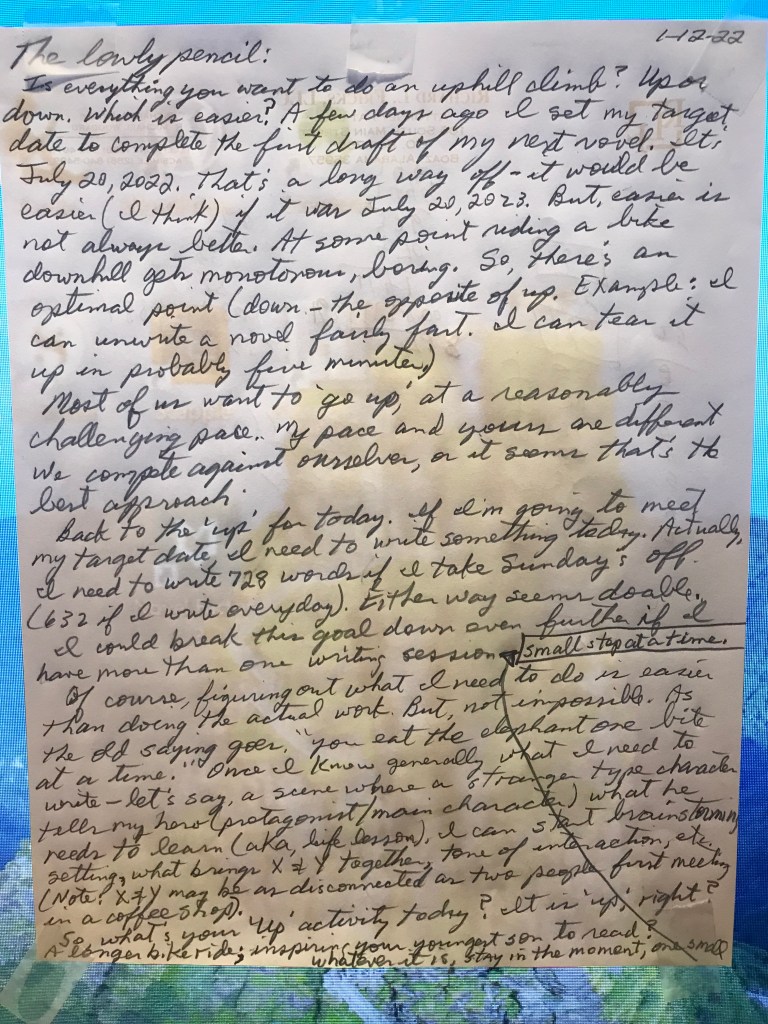
Penciling from pain to purpose


Today’s ride in 48 degree sunny weather.

With pencil, you can always erase.
Sue Monk Kidd

The worst thing you can do is censor yourself as the pencil hits the paper. You must not edit until you get it all on paper. If you can put everything down, stream-of-consciousness, you’ll do yourself a service.
Stephen Sondheim

Map out your future – but do it in pencil. The road ahead is as long as you make it. Make it worth the trip.
Jon Bon Jovi

Do you have hands? Excellent. That’s a good start. Can you hold a pencil? Great. If you have a sketchbook, open it and start by making a line, a mark, wherever. Doodle
Chris Riddell

It is the very mutability of the pencil mark that enables one to keep thinking in process.
Peter Saville
Before you run off, consider Tom. Other than Mrs. Steed’s eighth grade art class, he’s never drawn a thing. Other than that high school short story project (grade = D), Tom’s never written a thing (ignoring the occasional grocery list). Other than humming the high school Alma Mater during his class’s tenth-year reunion, Tom’s never been much into music.
So, Tom’s not the creative type. Or so he thinks. But remember, Tom is human and non-creative humans are an anomaly, or they don’t survive.
If we look closer at Tom, we learn he likes to build stuff, things like knives, swords, meat cleavers, and small wood-burning heaters and pizza ovens (he’s also built a farm carryall). Sure, he uses tools: sanders, grinders, welders, air-compressors. But his designs are unique to him.
Tom’s metal-working isn’t a job; he does it to fight depression, and to battle the boredom of his day job (he’s a truck driver and delivers feed to poultry houses). Of late, Tom’s been thinking of a dream he had a few weeks ago. He was walking down an aisle towards a podium to receive the educator of the year award. The dream, or some variant of its theme, comes now at least twice a month.
Well, what do you know? Tom is creative, even though it might seem involuntary. He has an imagination, albeit fueled by the mysterious dream world. Truth be told, Tom would love to teach metal-working at the local technical college.
You and I are a lot like Tom, at least at times. We have hopes and dreams, and we get discouraged, maybe slid into depression.
Mine dream is to become a better novelist, all while encouraging others to write fiction. Yours might be to draw or paint landscapes, write poetry or short-stories, or learn how to play the guitar.
Whatever our dreams and hopes, it likely involves doing something, learning better ways of doing something. Doing and being require a multitude of skills (some of which we already have). Even if you were born knowing Beethoven’s Moonlight Sonata (unlikely!), you still have room to learn and grow.
Here’s some good advice from famous poet Jane Kenyon:
“Be a good steward of your gifts. Protect your time. Feed your inner life. Avoid too much noise. Read good books, have good sentences in your ears. Be by yourself as often as you can. Walk. Take the phone off the hook. Work regular hours.”
I encourage you to read Maria Popova’s article: Poet Jane Kenyon’s Advice on Writing: Some of the Wisest Words to Create and Live By.
I’m certain I never would have written eleven novels since November 2015 if it hadn’t been for the wonderful writing software known as Scrivener. It is the best way to simplify the complex process of writing, especially an extensive work. If you missed my Scrivener introductory video, you can watch it here.
My current work in progress (WIP) is a book I’ve titled, The Boaz Slavemaster (for now, this is a placeholder title). To gain a little familiarity with my WIP, and particularly Scene 7, click here.
My purpose for jumping from an introductory video to Scrivener (hands down, the best writing software available) straight into a scene eighteen thousand words into my manuscript, is to illustrate two things: 1) you already possess a ton of skills that can be utilized in the writing of your first novel; and 2) novel writing consists of a million small tasks.
Here’s something to keep in mind as you watch this video. You can edit a draft. You cannot edit a blank page. Of course, these words aren’t original to me, but they’re critical for you to adopt. The foremost aim for you to accomplish in writing your first novel is to complete your first draft. This requires you to put words on the page. What I hope Lesson 2 reveals is a simple process of doing just that.
One final tip. Forget time. Take as long as you want and need. I’ve been working on Scene 7 for over a week. Let’s do some quick math: if you can write 200 to 250 words per day (FACT: you’ve just read around 250 to this point), you can complete a first draft in less than a year. (disclosure: my books are typically longer than this). Said another way, with a twist: develop a writing habit, preferably every day. Take your time, but move forward; adopt the pace that is comfortable for you, the pace that you can keep up.
On to the video. I hope to keep them coming. DO NOT FORGET—you can write a novel.
Click the following to continue.