Novelist / Story Coach / Observer — Fiction rooted in Boaz, Alabama
Author: Richard L. Fricks
Richard L. Fricks is a novelist, former attorney and CPA, Fictionary Certified StoryCoach Editor, and creator of The Pencil-Driven Life. He lives in rural North Alabama near Boaz, where much of his fiction and reflection remain rooted. His work explores story, inherited purpose, faith and doubt, family pressure, moral contradiction, consciousness, ordinary life, and the practice of beginning again with a pencil.
Here’s the link to this article by Bruce Gerencser.
Evangelicals believe that the moment a sinner is saved, God, in the person of the Holy Spirit/Holy Ghost, comes into the born-again sinner’s life and lives — somewhere, no one can say for sure where — inside of that person. This is commonly called the “indwelling of the Spirit of God.” Every true Christian® is indwelt by the Holy Spirit. 1 Corinthians 6:19 states that the bodies of Christians belong to God; that these bodies are the temple, the residence, of the Holy Ghost.
What? know ye not that your body is the temple of the Holy Ghost which is in you, which ye have of God, and ye are not your own?
In Romans 8:7-10,13,14,16, the Apostle Paul says that Christians have the Spirit of God dwelling inside of them.
Because the carnal mind is enmity against God: for it is not subject to the law of God, neither indeed can be. So then they that are in the flesh cannot please God. But ye are not in the flesh, but in the Spirit, if so be that the Spirit of God dwell in you. Now if any man have not the Spirit of Christ, he is none of his. And if Christ be in you, the body is dead because of sin; but the Spirit is life because of righteousness. For if ye live after the flesh, ye shall die: but if ye through the Spirit do mortify the deeds of the body, ye shall live. For as many as are led by the Spirit of God, they are the sons of God…The Spirit itself beareth witness with our spirit, that we are the children of God:
Those who do not have the Spirit’s indwelling are not Christian. How can someone know he is indwelt by the Holy Spirit? While Evangelicals tend to focus on right beliefs as evidence of salvation, Paul says that behavior is evidence of whether someone is led by the Spirit. Those who are in the flesh (unbelievers) cannot please God, but, according to Paul, Christians are “not in the flesh, but in the Spirit.” Paul speaks of death for those who live according to the flesh. True Christians® are to mortify (put to the death) the flesh. This mortification of the body brings life, both in the present and the afterlife.
Reflecting the Gnosticism found throughout the Bible, Paul tells the Church at Corinth that the things of God cannot be known apart from the indwelling of the Holy Ghost:
But God hath revealed them unto us by his Spirit: for the Spirit searcheth all things, yea, the deep things of God. For what man knoweth the things of a man, save the spirit of man which is in him? even so the things of God knoweth no man, but the Spirit of God. Now we have received, not the spirit of the world, but the spirit which is of God; that we might know the things that are freely given to us of God. Which things also we speak, not in the words which man’s wisdom teacheth, but which the Holy Ghost teacheth; comparing spiritual things with spiritual. But the natural man receiveth not the things of the Spirit of God: for they are foolishness unto him: neither can he know them, because they are spiritually discerned. (1 Corinthians 2:10-14)
The natural man (non-Christian) cannot understand the things of God. Supposedly, only Christians can understand and correctly interpret the inspired, inerrant, infallible Word of God. The Bible is the only book ever written that cannot be understood just by reading it. Unbelievers, according to Evangelicals, have sin-darkened hearts and are in bondage to the ruler of this earth, the prince and power of the air, Satan. According to the Bible, non-Christians are deaf and blind to Biblical truth. No unbeliever can understand the Bible without first being saved and indwelt by the Holy Spirit.
New Testament scholar Dr. Bart Ehrman tackles unbelievers not understanding the Bible in a post titled Does a Person Need the Holy Spirit to Interpret the Bible?
I’ve never found it at all convincing that a person needs the Holy Spirit in order to interpret the Bible. As an agnostic, of course, I don’t believe in the Holy Spirit (since I don’t believe in God). But even when I did believe in the Holy Spirit, I thought that it was silly to claim that a person could not interpret the Bible correctly without the Spirit – for a couple of reasons that have always struck me as virtually irrefutable.
The first is this: if it’s true that the Holy Spirit is the one who provides the correct interpretation of Scripture, then why is it that so many people who claim to have the Holy Spirit cannot agree on what the Bible means? This is simply an empirical fact that is not open to dispute. Different Christian interpreters of the Bible, all of them claiming to be guided by the Holy Spirit based on humble prayer, come away with diametrically opposed interpretations of major important passages, of minor less important passages, and of major biblical themes and doctrines – just about everything.
I saw this vividly when I was myself a fundamentalist Christian: clear and hard-core different interpretations of major issues, by devout and spiritual Christians, based on how the New Testament was being read. As a poignant example: I had come out of a charismatic background where we believed that “speaking in tongues” was the clearest manifestation of God’s spirit, based on our reading of Acts 2 and 1 Corinthians 12 and 14. At Moody Bible Institute, on the other hand, we were taught that charismatic activity, and especially the speaking in tongues, was a demonic activity and that the charismatic group from which I had come was misinterpreting these passages. Well, which is it? Both groups claimed to be representing the views of the Holy Spirit that had guided their reading of Scripture.
I could point to passage after passage after passage where well-meaning and clear headed Christians who claim to be given their understanding by the Spirit provide two, three, or four contradictory interpretations of the passage. So what is the evidence that the Spirit assists in interpretation?
The second reason I’ve never bought this is that as a complete agnostic who does not believe in the Holy Spirit, I have studied passages and come to the very same conclusions as those who claim the Spirit has told them what the passages mean. If I “need” the Holy Spirit to interpret these passages, why have I interpreted them in the same way that people who have the Holy Spirit has interpreted them? Seems like I’ve done all right without the Spirit.
And there’s a reason for that. Whatever you think about God, the Holy Spirit, or the Bible – the Bible is written in human languages following human rules of spelling and grammar and coming out of completely human situations lived in by human authors. To interpret the Bible you need to be a human, one who can read words and understand sentences. Even if the Bible is inspired, it is inspired in human words and is, therefore, susceptible of human understanding. My view is that the Spirit does not contribute to the process.
Ehrman is quite right when he says that Christian confusion over exactly what the Bible says belies the notion that the Holy Spirit lives inside Evangelicals, acting as some sort of divine GPS or search engine. According to many Evangelicals, all they need to do is say, Lord lead me/show me the way, and BOOM! their lives follow the exact course mapped out by the Holy Spirit. The same goes for understanding the Bible. Evangelicals metaphorically type their questions into God’s Google app, and BOOM! the Holy Ghost leads them to the exact book/chapter/verse answer. Awesome, right? No need to think. Just “Ask, and it shall be given you; seek, and ye shall find; knock, and it shall be opened unto you,” with God promising “every one that asketh receiveth; and he that seeketh findeth; and to him that knocketh it shall be opened.” (Matthew 7:7,8)
If the Holy Spirit lives inside EVERY believer, why can’t Christians even agree on the basics: salvation, baptism, communion, and whether masturbation is a sin. There are thousands of Christian sects, each guided by the Holy Spirit, each believing that their Jesus is the way, truth, and life and their little merry band of believers is the holder of the faith once delivered to the saints. Christianity might — I say might — be taken more seriously by non-Christians if sects/churches/pastors all spoke with one voice. But, they don’t. Instead, Christianity is rife with internecine warfare, with sects and churches competing with each other over money — err — I mean souls. Jesus said that the world would know that people were his followers by their love for one another. Hey Christians . . . how’s that loving one another thing working out?
Supposedly, being indwelt by the Holy Ghost gives Christians the requisite power necessary to live above sin (transgression of the law of God) and the world. I say supposedly, because from my seat in the atheist pew, I don’t see any difference between Christians and non-Christians. Am I missing something here, Christians? If all the above is true, if God the Holy Spirit, really does live inside of you and is your teacher and guide, why is it that Christians don’t live any differently from unbelievers? If, as John says, in 1 John 2:3,4,15, 29, 3:6:
….we do know that we know him, if we keep his commandments. He that saith, I know him, and keepeth not his commandments, is a liar, and the truth is not in him…. Love not the world, neither the things that are in the world. If any man love the world, the love of the Father is not in him….ye know that every one that doeth righteousness is born of him….whosoever sinneth hath not seen him, neither known him.
Can anyone really say that he or she is a Christian? 1 John 3:8 states that anyone who sins is of the devil! Can someone be a Christian AND a child of the devil? At this point, Evangelical readers likely will say, Bruce, Christians aren’t perfect, just forgiven. Christians are works in progress. Wait a minute, what about all the verses mentioned above? What about what 1 John 3:10 says, “In this the children of God are manifest, and the children of the devil: whosoever doeth not righteousness is not of God, neither he that loveth not his brother.” John says the difference between God’s children and Satan’s children is behavior. The writer of the book of Matthew says in chapter 25 that on judgment day it will be what people did and did not do that will determine where they spend eternity.
I am sure that I will hear from Evangelicals who will castigate me for “wrongly” interpreting the Bible. After all, I don’t have the Holy Spirit living inside of me, so how can I possibly tell others what the Bible says and means? Well, I just did. So much for needing the Holy Ghost to know what the Bible says. The aforementioned verses aren’t ambiguous, so what conclusions should unbelievers come to when observing how Evangelicals live their day-to-day lives? At best, we can conclude that Christians are, in every way, just like unbelievers; that if the Holy Spirit lives inside of believers, he is fast asleep or on vacation; that Christianity has no moral or ethical authority, given that Christians themselves can’t practice what they preach.
If you are an Evangelical, think about the notion that God lives inside of you; that the Bible is some sort of Gnostic book that can’t be understood by six-sevenths of the human race; that only the saved understand what the Bible teaches. Do you REALLY believe these things? Do you really believe that the moment I left Christianity that I lost the ability to understand the teachings of the Bible; that decades of reading and study disappeared from my memory, never to be remembered again? In what other realm do we see this kind of thinking?
Sadly, Evangelicals, unlike liberal and progressive Christians, stubbornly hold on to their literalistic interpretations of the Bible — interpretations that force them to endorse, support, and defend silly beliefs, no matter how stupid and ignorant it makes them look. There is little that any of us can do to reach people who think they know the punch line for the biggest joke in history. While mere worldlings feast on the plethora of literature available today, Evangelicals scour the pages of a book deemed inexhaustible, hoping to find Bronze age wisdom for twenty-first-century living.
Bruce Gerencser, 65, lives in rural Northwest Ohio with his wife of 44 years. He and his wife have six grown children and thirteen grandchildren. Bruce pastored Evangelical churches for twenty-five years in Ohio, Texas, and Michigan. Bruce left the ministry in 2005, and in 2008 he left Christianity. Bruce is now a humanist and an atheist.
Molly knew for certain her mother was deeply depressed when she didn’t knock on the bathroom door. Like yesterday morning, Molly had awakened nauseated and rushed to the toilet.
Millie’s slide had begun after she learned of Molly’s pregnancy. Somehow she’d found the energy to go Christmas shopping, but the power emanating from that maternal chore was fully depleted by dinner time. Millie had gone to bed, early, and without eating a bite. Molly had stayed up until nearly 11:00 PM, watching TV and exchanging texts with Alisha.
“Mom. Mom.” Molly stood beside her mother’s bed and kept repeating her name. Finally, Millie opened her eyes and managed the weakest of smiles.
“Here’s your Depokote, and time to open presents.” Molly thought if she acted normal and excited that might persuade her mother to do the same. Or, at least, give it a shot.
Millie sat-up, swallowed her tablets, and untangled from her covers. “I’m sorry,” she managed to whisper, not wanting the most important person in her life to know she was overwhelmed with guilt concerning Molly’s pregnancy. If only she’d never let Colton move in. If, if, if. Millie finally stood and inched to the bathroom, recalling an even worse thought she’d had, or had she dreamed it? Thoughts of suicide. Never before had it gotten this bad.
“Tomorrow, we’re going to see your psychiatrist.” Molly said from the kitchen, thinking of Dr. Ginger Hanover, the woman Millie’s Chicago psychiatrist had recommended.
Without responding, Millie motioned Molly to join her at the table. She’d insisted her mother buy a Christmas tree. Yesterday, she had, one eight inches tall. Now, it was set in the middle of the dining table, surrounded by Molly’s presents, four to be exact.
To the twelve-year-old, the size and shape of the wrapped presents told her they were books, although the larger one, flatter, might be some type of fold-out game board.
“Well, what are you waiting for?” Millie asked.
This was all the prompting Molly needed. She had little doubt Millie would buy her the novels she’d requested. The first one was It Sounded Better in my Head by Nina Kenwood. Since the second grade, Molly had always preferred coming-of-age books where the protagonist was older. Natalie was 18, a high school graduate with separated parents. She despises her appearance and has a skin disorder. Her world falls apart, including her relationship with her boyfriend. Molly hoped Natalie’s experience would help her navigate her new life in New York City.
The second book was Don’t Stop Thinking about Tomorrow by Siobhan Curham. Alisha had recommended it. Fourteen-year-old Stevie is having it rough. Her dad has passed away, leaving her mum severely depressed so she is unable to work. Stevie has a passion for her dad’s music and that is what gets her by in tough times. Again, Molly seeks a pathway to survival, maybe even happiness.
The third book was The Book Thief by Markus Zusak. Another girl protagonist. This one, living in a time Hitler was gaining power over Germany. A story of tragedy and suffering, and how the protagonist copes with the pain. No doubt, all three shared the common theme of overcoming hardship to find a better life. Just what Molly needed.
The fourth present was totally unexpected. It wasn’t a board game, but a 12.9‑inch iPad Pro. “Wow. I don’t deserve this.” Molly couldn’t believe her mother had spent so much money, especially now.
Millie managed a smile and reached out and laid a hand on her daughter’s. “It’s not about deserving. It’s about the joy of seeing your eyes sparkle.” Even though she was deeply depressed, buying such an expensive gift was such a small way of saying, ‘I’m sorry for all the pain and heartache I’ve caused you.’ Millie couldn’t erase the nightmare image fixed in the center of her mind, the horrendous reality of Colton atop Molly, legs spread, him thrusting inside her. Her thoughts of payback would have continued if not for her daughter’s request.
“Okay, my turn. Please close your eyes.” Millie complied and Molly stood, walked to her back pack lying on the floor next to her bed, and removed a red and green gift wrapped box without bow. No doubt, a book. She returned, lay the gift in front of Millie, and asked, “well, what are you waiting for?”
The book was Bipolar Disorder for Dummies by Candida Fink. Molly was halfway nervous whether her choice was appropriate but had confidence her mother would know her daughter’s intent was noble. Molly had purchased the combination scholarly, self-help book at Barnes & Noble last Thursday night after her, Alisha, and her parents had eaten out at Miss Ricky’s. If Mr. Maynard didn’t get his fix of Charred Octopus at least once per month he wouldn’t survive.
“Thank you dear. I promise I’ll read it through and take its message to heart.” The homemade Christmas card tucked inside was intended to motivate Millie to keep a long-range perspective. On the outside front, Molly had pencil-drawn the cabin her and Millie had chosen for their next-summer’s vacation. It was in the heart of the beautiful Catskill’s Mountains, and would be their reward for the trials and hardships they were guaranteed to face during their first year living in New York City.
“It’s just what I need. To the refrigerator it goes.” Millie opened the card and read Molly’s well-crafted words, ‘To the best mother in the world. I love you with all my heart and know we can survive and thrive in our new home. Never forget, we are a team forever and always.’ Millie cried and insisted Molly stand and join her in a long hug.
After thirty minutes of trying to stay awake Millie returned to bed. ‘Oh well, this is going to be a good Christmas,’ Molly thought as she sat on the couch and started flipping channels on the TV. The preliminaries to The Disney Parks Magical Christmas Day Parade were in full force but didn’t spark her interest. Instead, she decided to call Mama and Papa Anderson.
This call was overdue and had been a major point of contention since Millie had made the final decision for her and Molly to move to New York City. Once the two had decided that fleeing Colton and Chicago was their best option, Molly had argued for Sanford, North Carolina. That’s where Mama and Papa, Brad and Charlotte Anderson, lived. It was a small, safe town, with a good school system, and plenty of aunts and uncles around for support.
But, Millie had rejected the idea. For two main reasons, actually three. First, her hometown would be one of the first places Colton would look for her and Molly. Second, Millie didn’t want to work for her father. And third, she wanted to raise Molly on her own; Mama and Papa had been equally dominating when it came to Millie’s upbringing. It would be the same with Molly, even if they didn’t live in the same household.
During the bus ride, Molly had finally convinced her mother they needed to call Papa and Mama and tell them about the move. Millie had agreed they would do this on Christmas Day. Well, it’s Christmas Day and the agreement’s in place, even if Millie isn’t awake to take part. Molly looked toward her mother and listened. The breathing puffs were regular. This meant she was sound asleep. Molly inserted her ear plugs and walked to the kitchen. It was the furtherest point in the apartment from Millie’s bed that had a wall to block sound waves. After several rings, Papa answered. “Hello.”
“Papa, it’s Molly. Merry Christmas.” The precocious twelve-year-old’s mind was far advanced for her age but her feelings about the importance of family was underdeveloped. Molly had seen her maternal grandparents once-per-year for eleven straight years, although she didn’t recall the first few times. Out of all these annual visits, Molly had only visited Mama and Papa’s place one time, and that was two years ago. Now, something was motivating her to get to know them. It might have to do with Millie’s illness, and Molly’s fear of bad days to come.
“Hey baby. Merry Christmas to you. Hold on, let me get your grandmother.” Molly glanced around the kitchen corner. Millie was still asleep.
“What a wonderful surprise. Merry Christmas to my only granddaughter.” Mama asked where Millie was. Molly wanted to be truthful, but lied instead. Her mother had instructed her to keep her diagnosis a secret. At least for now.
“We were late sending Christmas presents, and we’ve been trying to call.” Papa said, which led into a discussion of Millie and Molly’s move to New York City and the need to ditch their old phones. She knew they hadn’t received the packages and wondered what would become of them.
“Oh my gosh. You’re mother knows we want you here. This is awful. How could she be so naive, so selfish?” Molly could sense Mama was exactly like Millie described: judgmental and controlling. “It’s always about Millie.” For the first time, Molly was glad her and her mother hadn’t moved to Sanford.
The conversation went silent. Finally, Papa said, “Mama and I are finally taking that vacation we’ve talked about for years.”
“That sounds good.” Molly hoped to travel someday, of being on her own and doing anything she wanted. “Tell me about it.”
“We’re going to Europe. We’ll fly to London, spending our first week in England and Ireland, then hopscotch to Germany, France, Italy. Our last stop will be in Athens, Greece.” Mama said.
“Wish you could come with us.” Papa said, but added, “I guess that’s not a good idea since we’ll be gone a month, and you need to be in school.” Papa sounded excited, but Millie had said since he was a lawyer he could put on a good act.
Mama announced they were leaving on the sixth, before listing all the other cities they would visit. Again, the conversation went silent. The call ended with Molly lying about someone knocking on the door.
There hadn’t been a sound coming from the front door but for some strange reason—maybe Molly’s interest in honesty—she walked outside into the hallway. No one in either direction. Instead of returning to the couch Molly ventured across the hall to an identical door. To the right of the door knob, just past the door frame, was a bronze plaque engraved with the names, Kenneth and Nita Eldridge. “Neighbors.” Molly whispered. She walked down the hall and looked at the other two doors, one across the hallway from the other. There must be four apartments per floor, all likely matching hers and Millie’s, Molly thought then remembered theirs was a studio apartment in a building with at least three different layouts: studio, one-bedroom, and two-bedroom.
Molly made a mental note of the names on the bronze plaques beside these two doors: “Rob Fitzgerald and Taylor Morgan, and Audrey Givings and Hannah Morrison. “Neighbors,” she whispered again.
The elevator dinged and Molly rushed back to her own apartment, noticing for the first time the identical plaque now beside her and Millie’s door. “Millie and Molly Anderson.” She knew it wasn’t there yesterday afternoon. The super must have installed it this morning, she thought.
Millie was still asleep, even more so now since she was snoring. Molly heated two waffles in the toaster and returned to the couch. After connecting her new iPad to the WiFi (thanks Matt or somebody), she began searching for a movie to watch. The ten minute search resulted in The Journey of Natty Gann, a choice which made Molly wonder if it was fate, God, chance, or something else that spun up this uniquely related show.
The protagonist, Natty Gann, is a 12-year-old Depression-era girl. “Now that’s weird; my age,” Molly whispered louder than in the hallway. Natty’s father previously left her in Chicago. “Now, that’s even more weird.” He goes to Washington State looking for work in the timber industry. Natty runs away to follow her father. “Now, that would be totally weird.”
She couldn’t resist. For the next hour and a half, Molly connected with Natty, following her adventures and misadventures in various farmhouses, police stations, hobo camps, reform schools, and boxcars. Molly’s favorite part was Natty being befriended by a wolf that had been abused in dog fights. Her least favorite was the near failure of Natty to find her father. Although they did unite at the end, Molly found the scene unsatisfying, even depressing. Natty is attempting to catch a ride on a truck but it gets away. That’s when she hears a voice calling her name. It’s her father. The best thing about this ending, at least to Molly, was Wolf standing atop a cliff looking down on the reunion.
After the movie ended, Molly lay across the couch and thought of her own father, and what adventures she would experience if she ran away. At least, unlike Natty, she knew exactly where her father was: a small town in North Alabama, a thousand miles away. It was past 2:00 PM when she was awakened by the vibrating of her new cell phone. It was Tracey, Tracey from the Greyhound bus ride.
This also is a little weird, Molly thought as she reached for her phone on the side table. “Hey Tracey.”
“Well, I’m impressed. You saved my phone number.” Molly had entered it into Contacts as soon as Tracey departed the bus in King of Prussia.
“I did, hoping to reconnect.” Things were just strange today. During her hallway investigation Molly had thought about Tracey, even hoping to see her name, Tracey Dawson, on one of the bronze plaques. The thought was silly because her bus friend had told her where she lived, the Glenwood Building, which obviously wasn’t the building her and Millie now called home. There was some traditional Christmas music playing in the background, a little surprising to Molly who’d pegged Tracey more as an alternative genre type.
“Girl, you’re spot on. That’s exactly why I’m calling. How about Friday night? My place. For dinner.”
Millie was starting to stir. She’d already thrown down her covers and was untangling her feet from the sheet and thermal blanket. “Who’s that?”
Molly held out her phone and whispered. “It’s Tracey. Remember?” The invitation was good news to Molly. She was already tired of being stuck on the tenth floor. She needed something to look forward to. “Sounds good to me but I better ask Mom.”
“Oh, she’s also invited. It’s just a small gathering of family and friends.” Tracey said, knowing the mother-daughter team might be a little lonely in a city of nine million.
Molly laid her phone on the table and walked to Millie. She was sitting on the edge of her bed staring out the window. “Mom, Tracey wants us to come to her place for dinner Friday night.”
A social event was the last thing Millie wanted but remembered how quickly Molly and Tracey had connected during their bus ride, and the meal they’d shared in Pittsburg. A baby-sitter type, no, a friend and companion for Molly might be needed someday. “I guess we can. If you want to.” Millie paused, stood, and headed toward the bathroom. “Ask her what time and if we can bring anything.”
Molly returned to the couch and her cell phone. “Tracey, we’d love to. What time?”
“How about seven?” The two talked another minute or so, mainly about the remaining bus ride after Tracey departed, and the specifics of her address. The call ended with Molly winning the argument over bringing a dessert. Millie’s Keylime pie was the twelve-year-old’s favorite.
Spend enough time around Evangelicals and you will learn that not only do they talk to God, but they also “hear” God talk to them. In any other setting, “hearing” voices will land you in the hospital on a 72-hour psych hold, but if the voice being heard is GOD, then hearers of this silent utterance are considered sane, rational beings. Evangelicals believe God not only speaks to them through the words in the Bible, but he also audibly, yet silently, speaks to them during prayer and meditation and at random moments throughout the day. Evidently, the Christian God is able to carry on millions of silent conversations with his followers at the same time. Awesome, right? Too bad this same God is not very good at making sure everyone he is talking to is hearing the same message.
Evangelicals say they hear the voice of God, but often other followers of Jesus hear different things, often wildly contrary to what God told someone else. I noticed this particularly during church business meetings. Members were expected to pray and seek the will of God on the matter of business before the church. After, “hearing” from God, members were expected to be of one mind — Greek for “agreeing with the pastor.” As anyone who has ever attended a Baptist business meeting will tell you, unity of mind is rarely on display. If everyone is supposedly “hearing” the voice of God, why are there so many competing viewpoints? What color should we paint the auditorium, the pastor asks? Let’s seek God’s mind on the matter! You would think that God would tell everyone BLUE. Nope. God, ever the jokester, whispers to various members different colors, sowing discord among the brethren.
Years ago, I started Somerset Baptist Church — an Independent Fundamentalist Baptist (IFB) congregation in southeast Ohio. The congregation first met in an empty storefront. After a few months, we moved to what was then called the Landmark Building. We rented the entire second floor for $200 a month. One day, I was out and about and stumbled upon an old abandoned Methodist church building — five miles east of Somerset, on top of Sego Hill. I made some inquiries about the building, and found out that it was for sale. I told the congregation about my exciting find, asking that they would pray about us buying the building. After a week or so, I held a business meeting, thinking God had told congregants the same thing he told me: buy the building! Imagine my surprise when it became clear to me that the church was NOT in favor of buying the building. I was so depressed. How could they NOT hear God’s voice? I thought. Yes, the building was $20,000, a large sum for a fledgling church, but I believed God never ordered anything he didn’t pay for. Dejected, I called the Methodists and told them we wouldn’t be buying the building.
Several weeks later, the Methodists called me and asked me if the church had changed its mind about buying the building. Before I could respond, the man said, make us an offer, Bruce. I shot a quick prayer to Jesus, asking him what I should do. As sure as I am sitting here today, I heard him say, offer them $5,000. I thought, $5,000? The Methodists will never accept such a low offer. But, not wanting to disappoint Jesus, I made the $5,000 offer. The man said, we will talk it over. Sure enough, a few days later, the Methodists called to tell me that they accepted my offer! I thought, PRAISE JESUS, we are going to have our own building. All I had to do is convince the congregation that the voice they thought they heard at the business meeting was not God’s; either that, or in the intervening weeks God had changed his mind. Fortunately, the church heard MY voice, and we bought the building.
Silly story, I know, but I think it aptly illustrates the idea that God speaks to people. I wanted something — a church building — and I got my way. I heard the voice of God countless times during the twenty-five years I spent in the ministry, and, without exception, what God was saying almost always perfectly aligned with what I wanted, needed, or desired. God’s will be done, as Evangelicals are wont to say, was actually Bruce’s will be done.
In late 1993, Pastor Pat Horner and Community Baptist Church in Elmendorf, Texas, extended to me an invitation to become their co-pastor. I prayed about the matter, deciding that God wanted me to stay as pastor of Somerset Baptist Church. I “wanted” to move to Texas, but God said NO, or so I told myself anyway. Several weeks later, I was pondering the future of Somerset Baptist, and all of a sudden, I started crying. In that moment God spoke to me, telling me he wanted me to move my family to San Antonio, Texas so I could become the co-pastor of Community Baptist. Wait a minute, didn’t God “tell” you several weeks before that he wanted me to stay in Ohio? Yes, he did, but evidently, he changed his mind. Never mind the fact that the Bible says, I am the Lord thy God and I changeth not and Jesus is the same yesterday, today, and forever. I called Pat Horner and asked if the offer was still open. It was. You see, God had told them that I was going to be their co-pastor, so me — uh, I mean God — changing his mind was just confirmation to them of what he said to them. Two months later, I packed up my family and worldly goods and moved to Texas. My tenure at Community lasted all of seven months — an unmitigated disaster.
Another silly story, I know, but it again illustrates how crazy it is to think God “speaks” to anyone. God didn’t tell me not to move, nor did he tell me to move. There is no God, so the only voice I was hearing was my own. The NO and YES were in my mind and reflected the struggle I was having about whether I wanted to continue pastoring Somerset Baptist Church. I spent eleven years at Somerset Baptist, living in poverty the whole time. For five years, my family and I — all eight of us — lived in a 12×60 mobile home fifty feet from the church building. I was worn out, burned out, and tired of being poor, yet I loved the congregation. What was it then that caused me to change my mind?
We heated our mobile home with coal and wood. We also heated the church and school building the same way. We were running out of wood, so I asked a man in the church if he could get some wood for us to burn, He said, sure. Several days later, the man dumped a pickup load of wood in the parking lot and quickly left. I thought, it would have been nice if he had stacked it, but okay, he at least got the wood for us. I gathered up some of the wood, took it inside, and put it in our Warm Morning stove. I quickly found out that wood was unusable — too wet and green to burn. At first, I was angry over the wet wood, but then I began to cry. This one event — not a big deal in and of itself — pushed me over the proverbial edge. I was done. Is it any surprise, then, that God changed his mind and told me he wanted me to move to Texas? A good salary and a new 14×70 mobile home awaited me. A congregation thrilled over the prospect of me being their co-pastor awaited me. A young, fast-growing congregation awaited me. New challenges and opportunities awaited me. I said NO to all of this because I had a sense of loyalty to the people at Somerset Baptist. Most of them had been members for years and walked beside me as we built the church. I felt guilty over thinking about leaving them so I could have a better life; so my family would no longer have to live in poverty. But when the wet, green wood was dumped in the parking lot, my thinking changed. Enough, I thought, and God agreed with me.
Now, I am sure that my critics will pick these stories apart, suggesting that I was the problem, not God; that the voice I was hearing was self, and that if I had been more spiritual, I would have heard God’s voice and he was would have directed me in paths of righteousness for his name’s sake. I don’t believe that for a moment. There is no God, so I couldn’t have heard his voice. All my decisions reflected were the struggles I was having over life and the ministry. The voice I heard was my own, giving life to my wants, needs, and desires.
Bruce, I don’t care what happened in your life, I KNOW God speaks to me. How do you KNOW it is God’s voice you are hearing? What evidence can you give for such a claim? Why do God’s silent utterances to you almost always match your own wants, needs, and desires? Have you ever stopped to think that maybe, just maybe the voice you are hearing is your own? Yes, the Bible contains stories about God speaking to people — from God speaking to Moses from a burning bush, to God telling Abraham to murder his son Isaac, to God speaking to the crowd at Jesus’ baptism. Jesus told his disciples: my sheep hear my voice, and I know them, and they follow me. How can any of us know that it is God speaking? There’s absolutely zero evidence for God speaking to anyone. Evangelicals are free to believe that they have heard the voice of God, but they can’t expect non-believers to accept their stories as true without some sort of verifiable proof.
Believing God speaks to you is a matter of faith, a faith I do not have. Most often, hearing the voice of God is harmless, but there are times when hearing his voice leads to dangerous, harmful behavior — including murdering your children or taking a twelve-year-old girl as your virgin bride. Evangelical missionaries John Allen Chau and Charles Wesco lost their lives because they believed that they had heard the voice of God commanding them to go reach the lost for Jesus in dangerous foreign lands. Why would God tell these men to leave their houses and lands and go to the mission field only to kill them days later? What a cruel, schizophrenic God. Or, perhaps God has nothing to do with this; perhaps the only voices these men heard were their own; perhaps their deaths rest on the shoulders of the myriad of pastors, professors, and parents who whispered in their ears about the wonders of serving God in a foreign land and the rewards that would await them if they became missionaries.
Think I am wrong? Just ask God to tell me.
Bruce Gerencser, 65, lives in rural Northwest Ohio with his wife of 44 years. He and his wife have six grown children and thirteen grandchildren. Bruce pastored Evangelical churches for twenty-five years in Ohio, Texas, and Michigan. Bruce left the ministry in 2005, and in 2008 he left Christianity. Bruce is now a humanist and an atheist.
There was a time when I was busy doing what I thought was the Lord’s work. I remember one church program that I was excited about. I was busy trying to get the program started. But other people at my church disagreed with me. They did not think God was on my side, so they worked behind the scenes to oppose my plans.
What did I do? I prayed. Do you know what God told me? That’s right, God told me that he was on my side. (It seemed to me that I was hearing a lot from God in those days.) And I read the Bible. God spoke to me when I read, or so it seemed to me. What did he say? He said he was on my side. He said that those that opposed me were wrong. I was right. God himself told me that I was right. Or so it seemed to me.
Across town there were other people who also talked to God. They also were serious about serving God. They didn’t like my plans. So ,they prayed to God. Guess what happened when they prayed? That’s right. God spoke to them. He told them that I was wrong. He told them that they were right. He told them to stop me from doing what I wanted to do. Surely, they were doing the right thing. God himself was on their side. Or so it seemed to them.
I look back on it all and smile. But it was not funny back then. It was quite frustrating.
I see it over and over. Why is it that God always seems to be saying exactly what people expect to hear?
God-and-country fundamentalists hear God in their prayers. He tells them to go to war and kill evil people–at least that’s what they tell us they hear. But then Mennonites also hear God. He tells them to condemn war and oppose the hawkish Christians.
Charismatics hear God in their prayers leading them to speak in tongues. Others hear God telling them to condemn the charismatic movement.
Gay Christians hear God telling them to build churches that support alternate lifestyles. Anti-gay churches hear God telling them to oppose gay churches.
A thought comes to mind. Perhaps at least some of these people are not really hearing God. Perhaps gullible people misunderstand when they think they hear from God. Do you agree? Good. So tell me: Should you and I include ourselves in that list of people who might possibly be deceived? If others are mistaken when they think they hear from God, maybe we are too.
You may tell me that you have had a wonderful experience of God’s Spirit. Perhaps you have felt a sweet inner peace, an unexplainable joy, a deep conviction, or an overwhelming sense of communion with God.
Please understand that many have had similar experiences. I doubt if you think they all were experiencing God. Catholics, Fundamentalists, Charismatics, Anti-Charismatics, gays, anti-gays, hawks, doves, Messianic Jews, Neo-Nazis, Universalists, narrow-minded bigots, witchdoctors, and the robed guys at the airport have all claimed similar experiences. Do you understand how some of these experiences were only the result of the mental processes inside the minds of the believers, and were not the direct hand of God? If you can understand that the experiences felt in a cultic ritual may not be of God, then you should be able to understand why others might think that your experience might not be the direct act of God.
Surely God’s Spirit was not simultaneously inspiring both Catholics and Protestants to kill each other in Ireland. Surely you must agree that at least some of those combatants were mistaken.
It is interesting to talk to somebody who hears from God. He is not wrong. God is on his side. To change his mind would mean disobeying God. He has a personal connection with God, a direct line to the throne. If he doesn’t know what to do, he can just ask God. And God reportedly gives him an inner feeling that directs his paths. Once he feels God directing in his heart, how can he possibly listen to those who suggest he do otherwise? How could he possibly be wrong?
I know what it is like. I used to be there. But things have changed. I no longer look for an inner feeling in my spirit to lead me. I no longer assume that feelings inside are directly caused by God. I now use the process of observation and reason to determine what is best. And I ask a lot of questions. I find that rational thought is better than trusting an inner feeling. And it helps to keep me humble.
Biking is something else I both love and hate. It takes a lot of effort but does provide good exercise and most days over an hour to listen to a good book or podcast. I especially like having ridden.
Here’s my bike, a Rockhopper by Specialized. I purchased it November 2021 from Venture Out in Guntersville; Mike is top notch! So is the bike, and the ‘old’ man seat I salvaged from an old Walmart bike.
Currently, I splitting my biking time listening to two books. Here they are:
The God Delusion, by Richard Dawkins.
Amazon Abstract
A preeminent scientist — and the world’s most prominent atheist — asserts the irrationality of belief in God and the grievous harm religion has inflicted on society, from the Crusades to 9/11.
With rigor and wit, Dawkins examines God in all his forms, from the sex-obsessed tyrant of the Old Testament to the more benign (but still illogical) Celestial Watchmaker favored by some Enlightenment thinkers. He eviscerates the major arguments for religion and demonstrates the supreme improbability of a supreme being. He shows how religion fuels war, foments bigotry, and abuses children, buttressing his points with historical and contemporary evidence. The God Delusion makes a compelling case that belief in God is not just wrong but potentially deadly. It also offers exhilarating insight into the advantages of atheism to the individual and society, not the least of which is a clearer, truer appreciation of the universe’s wonders than any faith could ever muster.
The Remains of the Day, by Kazuo Ishiguro
Amazon Abstract
BOOKER PRIZE WINNER • From the winner of the Nobel Prize in Literature, here is“an intricate and dazzling novel” (The New York Times) about the perfect butler and his fading, insular world in post-World War II England.
This is Kazuo Ishiguro’s profoundly compelling portrait of a butler named Stevens. Stevens, at the end of three decades of service at Darlington Hall, spending a day on a country drive, embarks as well on a journey through the past in an effort to reassure himself that he has served humanity by serving the “great gentleman,” Lord Darlington. But lurking in his memory are doubts about the true nature of Lord Darlington’s “greatness,” and much graver doubts about the nature of his own life.
Sam Harris speaks with Bart D. Ehrman about the prophecies contained in the book of Revelation. They discuss his latest book, Armageddon, and widespread Christian beliefs about the coming end of the world.
Bart D. Ehrman is a leading authority on the New Testament and the history of early Christianity and a Distinguished Professor of Religious Studies at the University of North Carolina at Chapel Hill. The author of six New York Times bestsellers, he has written or edited more than thirty books, including Misquoting Jesus, How Jesus Became God, The Triumph of Christianity, and Heaven and Hell. Ehrman has also created nine popular audio and video courses for The Great Courses. His books have been translated into twenty-seven languages, with over two million copies and courses sold. Website: https://ehrmanblog.org/Twitter: @BartEhrman
The Nashville school had plenty of prayers. But that’s no match for a killer armed with assault weapons.
In what has become an all too familiar story, all because Republican officials continue prioritizing guns over humans, another six people are dead after a mass shooting at The Covenant School in Nashville, Tennessee. Three students (all aged nine) and three staffers died because of a shooter armed with “two assault-style weapons and a handgun.”
The entrance to The Covenant School (screenshot via Google Maps)
As of this writing, the motive of the shooter is unknown, so I won’t waste time speculating on that.
But can we at least put to rest the suggestion, that never made any sense, that more prayer is the solution to our gun epidemic?
I’m not talking about the trite, lazy way many politicians offer “thoughts and prayers” in the wake of mass murders, as if that’ll deflect from their own refusal to take action to prevent gun violence. Many people say it as a condolence because they just can’t think of anything else to say. It’s not going away anytime soon.
What can change is prayer as a literal answer to mass shootings.
This act of violence occurred at a private Christian school affiliated with the Presbyterian Church in America and run as a ministry of the Covenant Presbyterian Church. As far as religious denominations go, very few are more conservative than this one, especially on “culture war” issues. I say that only to point out how this was not a school lacking in prayer. They prayed all the time. Yesterday’s school day even began with a chapel service.
But for years now, one of the many explanations put forth by Republicans who are allergic to gun safety measures is that public schools don’t have forced Christian prayers. If they had prayers, the rhetoric goes, they wouldn’t have these shootings.
Last year, televangelist Kenneth Copeland said all school shootings are the result of the 1963 Supreme Court decision that removed mandatory Christian prayer from public schools, implying we needed to bring it back.
… If we heard more prayers from leaders of this country instead of taking God’s name in vain, we wouldn’t have the mass killings like we didn’t have before prayer was eliminated from school.
A few years ago, immediately after mass shootings in Texas and Ohio, former Republican presidential candidate Mike Huckabee said “the lack of thought and prayers is probably the single biggest factor” when it came to gun violence. (Yesterday, proving irony is dead, he lamented how “some will make this a political issue before the names of the victims or the shooter or a motive is even known.”)
The Covenant School prayed and prayed often. Unfortunately (and predictably), prayers are no match for a killer armed with assault weapons.
Keep in mind that the people calling for more prayer never say that when they actually want something to change. When it comes to elections, Republicans never ask Christians to pray them into office. When it comes to abortion, Republicans never ask Christians to pray that people won’t have them. They know actions speak louder than words. They know passing bills or installing like-minded judges will actually get stuff done.
When it comes to guns, they call for more prayer—or mandatory prayer—because eventheyknow how useless it will be.
It won’t faze them that this shooting happened at a Christian school because they say the same prepared prayer line when shootings occur in churches, synagogues, and mosques.
We don’t need forced prayer in schools now because the gun crisis isn’t the result of forced prayers being removed from schools back then. There was no spike in school shootings in the decades following those Supreme Court decisions upholding religious neutrality in schools. Not until Columbine, really, did we start to see these horrific mass shootings by people who just wanted to unleash their rage and had access to weapons to make it happen.
A lack of prayer cannot be blamed for a uniquely American problem. Other nations don’t have forced Christianity in school. They also struggle with mental illness. They play video games. Yet mass shootings in those countries are incredibly rare. The common denominator in all the massacres we see in our country are the weapons. (Often, the same kind.)
Want to reduce mass shootings? Put more obstacles in the way for gun owners. Especially people who want weapons that can kill several people in seconds. Raise the legal age to own one. Make owners go through a certain amount of training. Register the weapons the way we register cars.
There are many more possible answers to the problem, but conservatives are hell-bent on fighting every single one of them because they love semi-automatic weapons more than children. Dead kids are a price Republicans will gladly pay to continue their violent hobbies. The NRA always takes precedence over the PTA.
We don’t need more guns in the hands of teachers—something that has routinely been proposed by the same people who don’t trust teachers to pick out books. We don’t need the death penalty for shooters as Republican Senator Rick Scottidiotically proposed (despite the Covenant shooter getting gunned down by police, putting a wrench in that plan anyway). We definitely don’t need congress members like the Republican representing Nashville, Rep.Andy Ogles, fetishizing guns like they’re a personality quirk and fun for children.
And now, since it appears that the shooter was a transgender former student, you can bet conservatives will cite that as the sole cause. Anything to get attention off their weapons of choice. (Even if it turns out this was some personal vendetta against the Christian school, the murders could not have occurred this easily or quickly without the shooter’s ability to acquire assault weapons.)
Republican lawmakers in Tennessee certainly don’t care. They recently passed a law banning drag shows in the name of protecting kids, but you can bet they’ll do absolutely nothing to protect kids from actual threats to their safety. In fact, it’s the opposite. Those lawmakers have proposed a bill to lower the age to legally carry a handgun in public from 21 to 18.
Prayers aren’t going to fix our problem. They never did.
And any God who lets six people get murdered because not enough people were stroking His Holy Ego isn’t a God worth worshipping anyway.
On September 11, 2001, millions of people watched in horror as the second plane crashed into the World Trade Center. Why did God allow it to happen? Many were praying for God to protect their loved ones. And yet they watched the dreadful destruction occur. Why did this happen? Did God not love those people in the towers and in the planes? Did God not have the power to stop it? Christians would certainly say he had the power to prevent it. But he did not.
What about the thousands that died that day? You might suggest that God had some mysterious purpose in letting them die. Perhaps their time on earth was done.
Imagine the details that God would have had to control to assure that only those people whose time had come were killed. What if the planes had hit several stories higher or lower? What if the flights had been delayed 10 minutes? What if somebody in the towers had gotten stuck in traffic that morning? What if the planes had hit at a different angle? All these things would have altered the death toll. If God had planned for certain people to die that day, then he must have guided all these details. He must have guided the planes to hit the buildings exactly where they did. In other words, God would have had to have been in control of those airplanes, and the terrorists were merely doing what God directed. All of this is of course absurd. Such a God is a micro-manager. Such a God wanted those planes to hit the towers where they did.
And so, I conclude that the reason these people died had nothing to do with God having a purpose in them dying. It just happened. Random forces were at work. God was not in control.
Some would tell me he allowed it to happen to punish people. Did all those that died that day deserve to be punished? How did God control it so only those who deserved to die were killed?
Why does God allow suffering? Why do 3 million children starve every year? Why is there so much disease? Why does God not stop terrorists? These questions have been asked many times.
And it is good to ask such questions. A good God would expect us to ask questions.
Somehow, God is said to have a reason for it all. If a car misses us, that must have been God’s protection. If it hits us, somebody will say God is trying to teach us something. Everything must have a purpose. Otherwise, we are left with a God who refuses to help.
You and I would not respect a policeman who sees a rape about to take place and did nothing. It would be hard to respect someone who could help and refuses to do anything.
Where was God on 9/11? People cannot bear the thought that God might have just stood back and not cared. So, we are told that God must surely have had a purpose.
If God was in control of what happened to the people in those planes on September 11, and if he wanted them to die this way, then this event was not a tragedy. It was God’s will. But we all agree that it was a tragedy. So, it therefore was not a good God’s will. Things happened that a good God would not have wanted. For whatever reason, God, if he exists, did not take control.
Now if God did not want it to be this way, and could have stopped it, how can you explain his actions? Many people have been blamed for that day. We have heard the pundits criticize the FBI and CIA. We have heard how airport and airline security was lax, and that airplane doors were not designed correctly. What about God? He apparently could have stopped it all, wanted to stop it, and did not stop it.
Likewise, disease has destroyed many lives throughout history. What did God think in the past when he looked down on children in polio wards? Did he look at the pain and suffering of innocent children, and think it was good? Did it have a purpose? No, I think not.
Many people were sure that this suffering was pointless. They thought that nature was acting by itself and causing this suffering. They wanted to stop it. They looked for a natural cause, and they found it. Then they looked for a way to overcome that natural cause, and they developed a vaccine. When the vaccine and other preventions became readily available, the illness was controlled. If God had a purpose for polio, were these people right to try to prevent it? Yes. They were very right. Polio was bad.
Did God cease to have a purpose for polio the moment prevention became readily available? Does God still have a purpose in allowing under-privileged children to suffer who do not have access to medicine? Isn’t it odd that the probability that God will have a purpose in a child being crippled by polio has a direct correlation with whether the child has access to modern medicine and sanitation?
Suppose that firemen arrive at a burning house with a child inside that they could rescue. Is it possible that God wants this child to suffer? If God wants the child to suffer, are they doing the child a disservice by rescuing her? Of course not. The firemen would not think that for a minute. They would do everything they could to rescue the child. They would assume that the suffering was bad.
Tomorrow, almost everyone will be doing something to prevent others from suffering. Nurses will care for the sick. Policemen will protect us. Road workers will fill in potholes. Researchers will look for cures for diseases. Truckers and sailors will bring us lots of cool stuff–all the way from China. We will go about our lives hoping to minimize the suffering of others. We all know suffering is bad. And so, we will try to stop it.
Which brings us to God. Suffering will happen tomorrow. God, if he exists, will not stop it. People will get sick. Accidents will happen. And where will God be? For whatever reason he will not stop it. But people will know that it hurts. They will know it is bad, and they will try to stop it. Even if you tell us that suffering has a purpose, we will assume it is pointless, and will try to prevent it. But God will not stop it.
You think that he sometimes helps? Fine, but why is there all that suffering that he does not stop?
Some would argue that God is there comforting the suffering people. But how does that solve the problem? Would a fireman be excused for ignoring a fire if he later comforts the survivors? It is a good thing to comfort the suffering, but when it is completely within somebody’s power to stop suffering, and he does not do so, his comfort is small consolation to the victims. Has God been demoted from Supreme Ruler to Comforter-in-Chief?
It appears that God was not in control of the circumstances when those planes hit the towers. So why think that he is in control when somebody takes your parking space, a tree falls on your house, or a loved one has cancer? Why try to answer the agonizing question about why God did this? Is God trying to teach you patience? Is he trying to win people to himself? Is he punishing you, or teaching you to rely on him? No, it would seem to me that it just happens. And it seems that our minds can be much more at peace when we realize this.
I don’t think God has a purpose when bad things happen. I do not see a strong wind or a mighty movement of the earth when I need it. Random events cause random suffering. I accept that. God is not in control.
Or maybe God doesn’t even exist.
Some people might say that I should not be looking for God to intervene in might or power, but I should be listening instead for a still, small voice. I discuss that next.
Biking is something else I both love and hate. It takes a lot of effort but does provide good exercise and most days over an hour to listen to a good book or podcast. I especially like having ridden.
Here’s my bike, a Rockhopper by Specialized. I purchased it November 2021 from Venture Out in Guntersville; Mike is top notch! So is the bike, and the ‘old’ man seat I salvaged from an old Walmart bike.
This is what I’m listening to: The God Delusion, by Richard Dawkins.
A preeminent scientist — and the world’s most prominent atheist — asserts the irrationality of belief in God and the grievous harm religion has inflicted on society, from the Crusades to 9/11.
With rigor and wit, Dawkins examines God in all his forms, from the sex-obsessed tyrant of the Old Testament to the more benign (but still illogical) Celestial Watchmaker favored by some Enlightenment thinkers. He eviscerates the major arguments for religion and demonstrates the supreme improbability of a supreme being. He shows how religion fuels war, foments bigotry, and abuses children, buttressing his points with historical and contemporary evidence. The God Delusion makes a compelling case that belief in God is not just wrong but potentially deadly. It also offers exhilarating insight into the advantages of atheism to the individual and society, not the least of which is a clearer, truer appreciation of the universe’s wonders than any faith could ever muster.
You may have been told that you will live forever, but that seems quite unlikely to me. For our brains will one day be gone. All our lives those brains have been the seat of our thoughts, emotions, and memories. So, when the brain is gone, then the lights must go out. Surely then it is all over.
But some will tell me that something else lives on even after the brain has disintegrated. They often call this the soul. And ultimately, they say, the soul is the seat of the mind. And so, even if the brain is gone, the mind can continue as a function of a soul that survives death.
If the soul is really in charge, why do you even need a brain? If thinking is done by the soul, what is left for the brain to do? Some propose that the brain is simply an interface to the body. It gathers information from the senses and feeds it to the soul. There the soul processes the incoming data, saves memories, and makes decisions. The soul then somehow directs the brain to drive the muscles of the body. The soul is in charge, and the brain handles the interface with the body.
But science has shown that it is truly the brain that is in charge. We think with our brains, not with immaterial souls.
Have you got soul?
Let’s look at some evidence that the brain is in charge, and that there is no separate, non-material soul.
First, there is the evidence of amnesia. When elderly people suffer a stroke, or when trauma occurs to the brain, patients often lose the ability to remember things that happen after that tragic event. The person loses an important mental function, the ability to remember new things. But it was not the soul that had been damaged. The brain was damaged. Somehow damage to the brain causes that person to lose the ability to efficiently store new memories. If memories are actually a function of the soul, why would damage to the brain affect the functioning of the soul? Since damage to the brain affects the ability to store memories, then it must be the brain that stores the memories.
You might argue that what happened is that the brain stops giving the soul new data. Thus, the soul has nothing to remember. But that is clearly not what is happening. The essence of the person is still communicating with us. That person sees us, recognizes us, and communicates. The mind’s senses are still working. The mind is still able to observe, but the person forgets what was observed. Why? The brain is damaged. And this damage hinders memory storage. So, it must be the brain that is remembering. When the brain is affected, the mind is affected.
Second, when conditions prevent a brain from developing properly, the personality does not reach maturity. If the soul is distinct from the brain, why wouldn’t the soul go on to maturity?
A third evidence that the brain is doing the thinking is the fact that, if the brain slows down and goes to sleep at night, the soul also sleeps. Suppose your soul is something different from the brain. Why does the soul go to sleep when the brain sleeps? Why can’t it just keep on being your soul, wide awake, even though the brain goes to sleep and has stopped giving the soul input from the world? It doesn’t work that way. When the brain is affected, the mind is affected.
The effect is even more pronounced under anesthesia. In such procedures, one loses virtually all contact with the world and does not sense even severe pain. After waking up, one is not even aware of the passage of time while he was unconscious. If the soul was distinct from the brain, one would think you could simply start counting as you go under and keep on counting into the thousands in your soul while contact with the world goes blank. It would be like losing the connection while on a Zoom call. The soul would still be awake. The person whose brain is sleeping would still be able to count or plan his next day, but the incoming senses of the world would temporarily be blank. This is not what happens.
Fourth, evidence shows that we inherit our basic personality through our genes. How is it that genes can affect our personality? Genes must surely be directing the brain’s physical development, which then influences the personality development. How could genes also change a separate, immaterial soul? That makes no sense. Personality must therefore be a function of the brain, not of a separate entity known as the soul. How else could genes have such a significant effect on the personality?
Fifth, a patient with Alzheimer’s disease enters a period of altered mental capability due to brain disease. Is the soul of the Alzheimer’s victim also changed by his physical condition? That makes no sense. The disease affects the brain, not the soul. But if the soul is working normally, why are the thoughts so confused?
You may argue that the soul is still normal, but the connection of the brain to the soul is blurred. And yet we can still communicate with the essence of the Alzheimer’s victim, with the part you would call the soul. That spark of the inner person is still there. The communication still works. But we can see that the very essence of the inner person is changing. The part you would call the soul is deteriorating. Why? The brain is being altered. Since the mind is a function of the brain, it too becomes altered.
Are we to believe that death does for the Alzheimer’s victim what no medicine can do? Does death suddenly restore the mind to full functioning? How could that be? The disease gradually destroys the brain, and this deteriorate the mind. How then could the full destruction of the brain at death cause the mind to become restored?
Sixth, if the soul is separate from the brain, exactly how does a soul interface with the brain? As far as we can tell, brain function consists of movements of electrons and chemicals. How could our soul communicate with this brain? Does the soul somehow start moving electrons around in our brains so that the brain knows to move a certain muscle or to command the mouth to say a certain word? How can the stuff of the soul push matter? Wouldn’t a soul push right through an electron, just like spirits supposedly pass through walls?
And if souls actually push molecules or electrons around, why can’t they push the molecules that are outside of the brain? If your soul can push molecules in your brain, why can’t it push molecules in my brain?
None of this can be observed in nature. Nowhere do we find evidence for souls deflecting molecules. So, how can a non-physical soul affect the movements of the body? It can’t. I conclude the mind is simply a function of the brain.
Seventh, as discussed earlier in my Dare to Question series, we have evolved from other animals. Do apes have souls? Do reptiles, fish and germs have souls? If not, exactly when was a soul inserted for the first time? Was the first being to have a soul raised by someone without a soul? It is easy to see how mind functions could develop incrementally through many generations as we evolved. It is difficult to see how an evolved creature would somehow suddenly get a separate, immaterial soul for the first time. And if apes don’t have souls, how do their brains partially duplicate some of the functions we require a soul to do?
For all these reasons, I conclude that it is the brain, not an immaterial soul, that stores memories and does the thinking. For more on mind-brain dependence see The Case Against Immortality by Keith Augustine, Mind-Brain Dependence by Steven J. Conifer, and section III.6 of Sense and Goodness without God by Richard Carrier.
Consciousness
Yes, I know, you look inside, and you see your conscious mind is in there telling the body what to do. Your consciousness is in charge, or so it seems to you. And you equate that consciousness with a soul that is separate from the body. So how can you be perceiving this soul inside you to be directing the show, when actually it is brain molecules that are doing the heavy lifting? Good question.
Science has shown that the brain decides to do things before the person is aware that he made the decision. One experiment that verified this involved subjects who were told to decide to bend their wrist while watching a slowly spinning disk. They were told to tell the experimenters exactly where the disk was when they decided to bend their wrist. The experimenters used this information to determine when the subject was aware that he was making the decision. The subjects were also hooked up to sensors that could detect brain activity that occurred when the subjects decided to act.
It turns out that the brainwaves started before the subjects were aware that they were deciding. If you asked the subjects, they would tell you that they made the decision consciously at the moment that they were aware of it. But the instruments they were wired to indicate otherwise. The brain cells had begun to fire and started the process of commanding the hand to move before the person was consciously aware of the decision. [1]
Could it be that our brain cells are running the show, and that what we call the conscious mind comes along later and fills in the story after the fact? This kind of after-the-fact consciousness has been demonstrated in another experiment. Here is how it worked. A red dot was projected onto a screen. Then the red dot was turned off and, a split second later, a green dot was projected near the spot where the red dot had been. When people saw this, they reported that they saw the red dot start to move to the side, then change suddenly to a green dot as it moved along, and then continue to the new location as a green dot. Obviously, this is not what they saw. There was no moving dot that changed colors. The dot had never been in the middle. But the conscious mind told the story that the dot had traveled, and that the dot’s color had changed from red to green at the middle. The conscious mind was convinced that it had observed this happen. It was mistaken. [2]
And so, in that experiment, we find that minds rewrote history, just like the historians in the novel 1984 rewrote history to reflect what Big Brother wanted. A similar thing must have happened in the minds of the subjects. Their minds had known that objects don’t usually just disappear and immediately show up in a new location. They knew that, in such instances, the object probably moved from point A to point B. And if it changed colors, it had to change somewhere. The mind makes up the story that it observed the dot changing color when it was in the middle of its movement. The subject’s minds rewrote their memories and did it so well that they were confident the revised story was true.
Their conscious memory of seeing the dot change color as it moved was a sheer fabrication. The subjects “remember” it, but it never happened.
You have probably observed the mind rewriting memories. A significant event may happen to somebody, and immediately he tells us what happened. Ten minutes later you hear him tell the same story again, but it is a little different this time. An hour later, the story has been modified further. We hear the same story the next day and the next week. Each time we hear it, it is a little different. And often we can observe a trend in the rewrite. What the person thinks he should have said becomes a memory of what he did say.
True, sometimes the person modifying the story may be deliberately deceptive. But often the person is not trying to lie to us. He is an honest person, and yet his mind is changing the story.
Folks have probably observed a similar thing in you and me. Our minds gradually and unconsciously change the memories of the past so that they conform to what makes sense to us. Thus, we end up with memories of being conscious of something in the past, even though we never actually experienced it that way.
Notice that the memories of the person who saw a dot disappear and another dot appear are just like the memories of the person who truly saw a dot move. One memory reflects what was consciously observed. One is a fabrication. We cannot tell the difference. Our minds are being misinformed about what we consciously experienced. We believe the lies that are being written to our memories.
Notice also that it is our memory of past events that is fundamental to our consciousness. Suppose that you had no ability to remember anything. You would be constantly aware of your current state at each moment, but you would be totally unaware of anything that had happened a microsecond earlier. It would be like listening to a music CD that was stuck on the same chord. Now that would not be real music. Music requires change, and so does consciousness. To really mean anything, our consciousness must consist of an awareness of the narrative that has brought us to the current state.
But as we have seen, this narrative is often freely being changed. We think we have conscious memories of how the story has unfolded, but somehow what we call our conscious memory is only the modified story that our minds create. What we call consciousness is just the story of how we got to where we are. The problem is, this story is somewhat illusory, since our minds are constantly revising that story, sometimes incorrectly.
So perhaps this explains how our minds can deceive ourselves into believing that there is a soul inside that is making the decision, even though experiments show that the decisions were made before we were aware of them. Perhaps our minds continuously create the story we call consciousness and write it in such a way that we think consciousness is making the decisions.
Where do your words come from?
Think about it. Where do your decisions come from? When you decide to speak, for instance, where do those words come from? You really don’t know, do you?
Think about all that is involved in creating spontaneous speech. Your brain contains information about thousands of thoughts that you could express. You have a vocabulary of thousands of words that you can use, and your mind knows the definition of each. And these words must be put together according to the syntax of your language. But you don’t remember sorting through your mental dictionary to look up the meanings of all relevant words to select the proper words to express the thought you chose. No, you just speak, and the right words present themselves to you. And you and your listeners both hear the sentence from your mouth at the same time. But where did the words come from?
If your soul is the speechwriter, why isn’t the soul aware of how the words came into your consciousness? Why isn’t your soul aware of looking up the meanings of all the words it could have used? Instead, behind the scenes, something must be working to look up available words and form those sentences for you. I contend this something is nothing more than the millions of neurons in your brain. They must be working behind the scenes to write your speech for you. You and I think that our conscious mind is speaking, but the conscious mind isn’t even aware of how the speech is being written.
Even when we slowly deliberate, weighing every word carefully before speaking, we cannot tell where those word options originated. The words just present themselves to us. Something looked through our mental dictionary and pulled those words up for us.
Many Christians seem to recognize that thoughts come to us fully formed. I have heard some ascribe different authors to the thoughts that stream through their minds. It is interesting to hear them describe the experience. They will tell me that Satan was saying something in their minds, and then they responded, and then God said something, and then the old nature argued, and then Jesus said something, and so on. It must be interesting being them! There are enough of people inside to have great conversation. But perhaps they are mistaken. Perhaps various thoughts originate, not from various competing spirit beings inside the mind, but from various competing coalitions of neurons in the brain.
Science indicates that there are millions of neurons working in our brains, and that this activity produces thoughts. It is a cacophony of voices, with many different ideas competing for dominance. But somehow the winning thoughts come to the top and present themselves as a string of conscious ideas. The real work, however, is done among all these competing neurons.
Often our language betrays the fact that things are going on outside of our direct conscious control. We say things like “I didn’t mean to do that,” “The words wouldn’t come,” “I couldn’t help myself,” or “I don’t know why I did that.” In such statements there is a subtle recognition that our consciousness is not really in charge.
The consciousness is along for the ride, observing the finished work that the neurons have put together. And the consciousness rewrites its memories in such a way that it seems to us that our consciousness is making the decisions.
I conclude that thinking is done by the brain, and these thoughts produce our consciousness. Consciousness does not come from an immaterial soul.
Life after death
We know that brain activity stops when we die. If our memories are in the brain, how could they remain after death? And how can the inherited personality survive if the very brain that produced it is destroyed? It seems that it too must be gone. If my memories and personality are gone, how can I still be said to exist?
Some will agree that the brain is doing the thinking here on earth, but there is a soul in there also. And the soul just so happens to want the same thing the brain wants and store the same memories the brain stores. So, though the brain is gone at death, the soul that works in parallel remains. How convenient. Seems implausible to me. So, I won’t waste time hoping that it is so.
Ah, but someone might ask if God couldn’t just make a copy of all that we experienced in our brain. When we die, God restores everything from the backup, just like we would do on a computer. Our mind would literally be backed up in the cloud.
If there is a backup of my mental database that will be used to drive a new body someday, how do we know it won’t happen to two bodies, or even a thousand? Will there be thousands of copies of me out there running off the same backup database of me? It is difficult to see how we can refer to any of those backups as “me”. They are copies, not me. The same thing can be said about the first copy made from a backup database of my memories. It’s not really me. Would it be fair to punish or reward a copy of me for what I have done here on earth?
Is it possible a God is making a backup copy of me that can live forever? Perhaps, but I can make hundreds of similar wild guesses as to what might happen someday. For instance, is there a possibility that aliens will land on Jupiter, transform it into a paradise for humans, and then offer free shuttle service back and forth to earth? Perhaps. But I don’t spend long hoping for that to happen. Nor do I spend long hoping that some backup copy of me lives forever.
So it appears that neither a soul nor a copy of the brain’s database survives death.
But what about bodily resurrection? Perhaps the brain lies dormant until God puts it back together and resurrects the body. But how could that happen? What about the bodies of people that died a thousand years ago? Their bodies have disintegrated, and the constituent atoms are spread throughout the world. Some of those particles could be in your brain now. Some atoms may have been part of many people’s brains throughout history. To which brain will they go in the resurrection?
If, on the other hand, I am reconstructed from a new set of molecules, is not such a reconstructed me just one of many possible copies of me that could be made? We are left with a copy, or even multiple copies, not a continued existence of my mind. A copy of me is not the same thing as me.
So, it appears that our minds will not survive death. Your mind is a function of your brain, and your brain will someday die. If you and I are going to find the good life, we will need to make the most of what we have here. Let us make this life count.
Where does this leave God if he exists? If he is not preparing a place for us, what is he doing for us in this life? Let’s explore that next.
In an online debate of this page, Mountainmanmike suggested that near-death experiences are evidence for souls. He contended that souls can somehow travel from the body and sense events happening remote from the body.
Near-death experiences are reported by less than 20% of people that were near death. If souls really do these things near death, why do not most people observe this?
There are many things that can cause such experiences. Oxygen deprivation, for instance, will restrict side vision, and make it appear like one is in a dark tunnel. Hence, the reports of traveling through a tunnel.
Did the reported experiences truly happen while physical consciousness was gone? We have no proof of that. There can be a rush of thoughts as one fades in and out of consciousness. So, the reported vague consciousness during the experience can simply be memories as one went in and out of consciousness.
What about the fact that people sometimes have knowledge of things that were happening in the room? Such knowledge can come while partially conscious, from later hearing about the events from others, or by simply making educated guesses about what happened.
WHAT ABOUT PEOPLE WHO SENSE THINGS FAR AWAY?
Mountainmanmike also argued that twins can sense the death of a twin far away.
Although there are many such claims, none can be repeated in controlled studies. Yes, a twin may die, and the other twin may report having a strange feeling at that moment, but how does that prove that the soul of the dead twin travelled to be with the other twin? We are going strictly off the memory of the events. And memories change with time. We selectively remember things that match what we want. We ignore all those times when we felt uneasy, and there was no tragedy elsewhere, or when tragedy happened, and nobody reports this experience.
Such claims of remote sensing were never verified in controlled studies, where we would need to show that the knowledge supposedly transmitted was such that it was unlikely to have happened by chance.
And even if twins are shown to consistently know when a distant twin dies, how would that prove that a soul left a body? How would you know that is not just some yet unknown sense such as a bat’s radar that can sense things from a distance?
WHY DO WE NEED CONTROLLED STUDIES?
Anecdotal evidence is extremely unreliable. For years people were pitching snake oil and all kinds of claims based on anecdotal evidence. But people see what they want to see. So, if they invest in snake oil, for instance, they will often think they see fantastic things happen with snake oil. And they will tell stories of the success of snake oil. That is why scientists got away from trusting such anecdotal evidence and look instead for the results of controlled studies.
If we accept claims of remote sensing without having a controlled study to verify it, we are relying only on anecdotal evidence. Should we also go back to the days where all sorts of flimflam cures were promoted on nothing more than anecdotes? Should we abandon modern medicine based on controlled studies, and instead trust anecdotes? I prefer scientific evidence and controlled studies.
WHEN A SCIENTIST DESCRIBES AN EXPERIMENT, ISN’T THAT JUST ANECDOTAL?
Mountainmanmike continued with a long list of pseudoscience mixed with descriptions of science. Since all stories can be called anecdotes, is all evidence anecdotal?
He is confusing telling an account of the experimental procedure and uncontrolled anecdotal evidence. When scientists speak of anecdotal evidence, they are speaking of a claim with no scientific methodology to prevent bias from influencing the result. Real scientists use studies that are designed to discover the truth, regardless of any pre-existing bias that they may have. And when they do such experiments, they describe what they did. Such descriptions of experiments are quite different from anecdotal evidence.
Scientific observation is based on getting information that is not the result of the scientist’s bias. For instance, when testing new medicines, the medicine is tested in a controlled double-blind trial. Such studies, when properly done, minimize the effects of bias on the results. So, the studies give valuable information.
When Mountainmanmike reports that a twin had an odd feeling when a distant twin died, what controls were used to keep bias out of the claim?
There is a difference between a properly done statistical study and anecdotal evidence that has no scientific controls. The table listed at Learn How Anecdotal Evidence Can Trick You is a good description of the difference.
WHAT ABOUT DREAMS?
On this thread, Yaaten wrote, “The soul sleeps at night because the brain is asleep?…Don’t you dream when you’re asleep?”
Yes, of course, I dream while asleep. We can go through stages of consciousness, especially when fading in and out of sleep. But clearly the conscious mind is not in the same state during sleep as it is while awake.
How can you explain that? If you are counting sheep when going to sleep, you will always stop counting when you go to sleep. If your soul or mind is the conscious part of you, and is distinct from the brain, why doesn’t it continue to be the conscious part in a fully alert state while your brain sleeps? Why can’t your independent soul just keep on counting, fully conscious, while the brain dozes?
If the soul is in charge, and the brain is just my connection to the world, why would the soul start dreaming when the connection gets cut off? But if instead, the brain is the seat of the mind, and it goes through various stages of sleep, it is certainly understandable that the brain could then act differently and cause the mind to dream.
NOTES
1. Dennett, Daniel C., Consciousness Explained (Boston: Back Bay Books, 1991) pp. 162-163
2. Dennett, Daniel C., Consciousness Explained (Boston: Back Bay Books, 1991) p 114
Copyright Merle Hertzler 2002, 2005, 2006, 2022. All rights reserved.



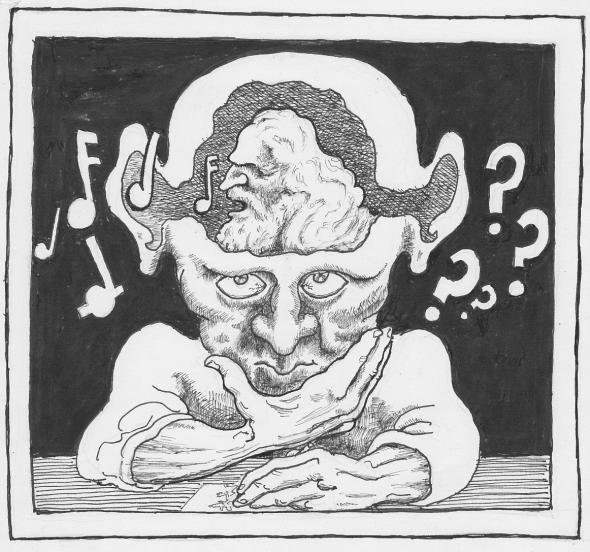



































 Richard L. Fricks