
Author: Richard L. Fricks
Richard L. Fricks is a novelist, former attorney and CPA, Fictionary Certified StoryCoach Editor, and creator of The Pencil-Driven Life. He lives in rural North Alabama near Boaz, where much of his fiction and reflection remain rooted. His work explores story, inherited purpose, faith and doubt, family pressure, moral contradiction, consciousness, ordinary life, and the practice of beginning again with a pencil.
04/12/23 Biking & Listening

Biking is something else I both love and hate. It takes a lot of effort but does provide good exercise and most days over an hour to listen to a good book or podcast. I especially like having ridden.
Here’s my bike, a Rockhopper by Specialized. I purchased it November 2021 from Venture Out in Guntersville; Mike is top notch! So is the bike, and the ‘old’ man seat I salvaged from an old Walmart bike.

Here’s a link to today’s bike ride. This is my pistol ride.
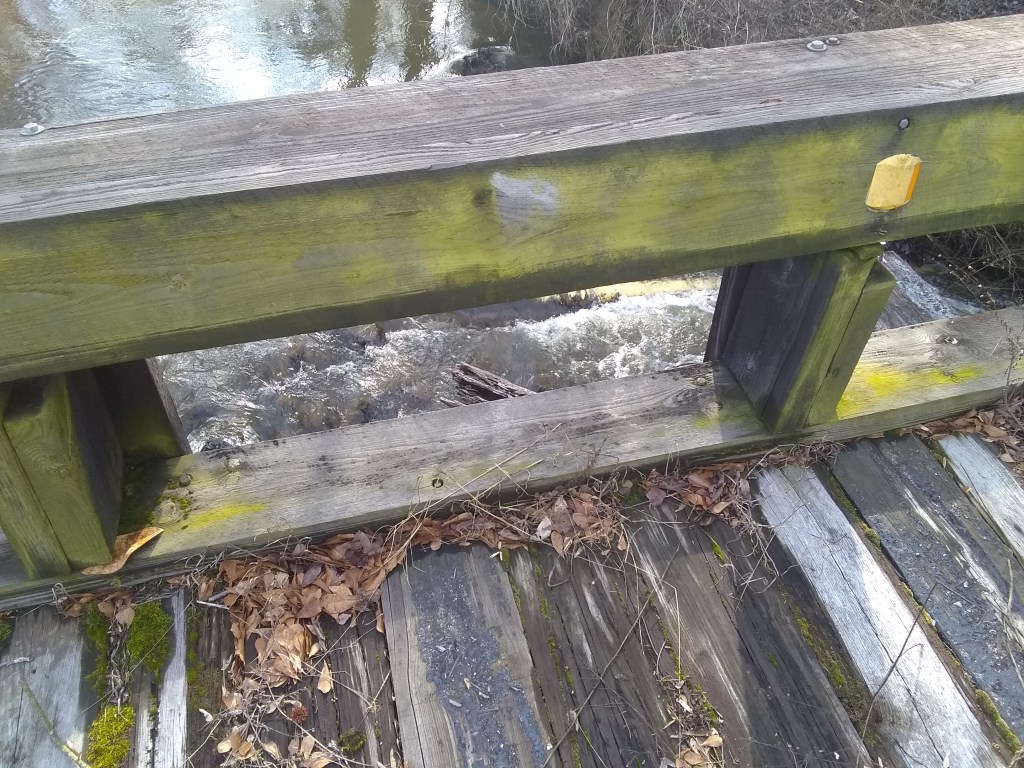
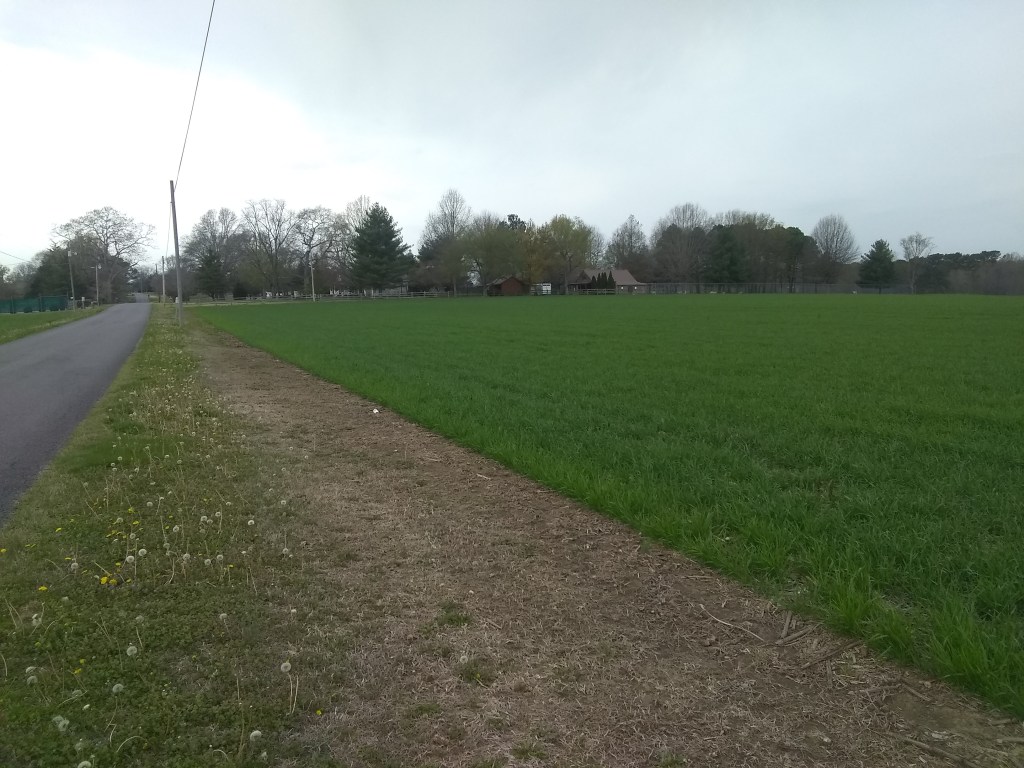
Here’s a few photos taken along my route:
























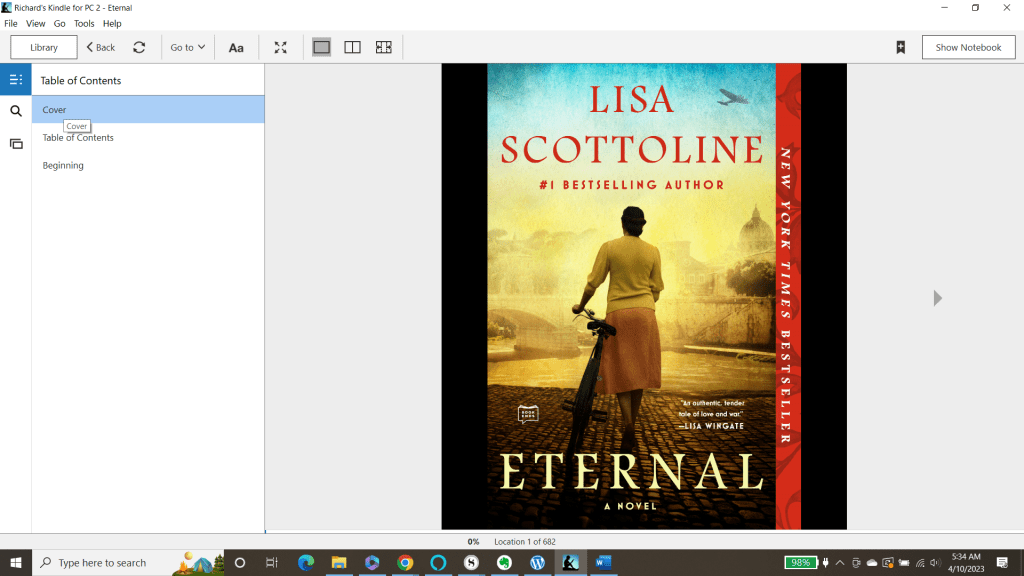
I’m listening to Eternal, by Lisa Scottoline:
Amazon Abstract
NEW YORK TIMES BESTSELLER
#1 bestselling author Lisa Scottoline offers a sweeping and shattering epic of historical fiction fueled by shocking true events, the tale of a love triangle that unfolds in the heart of Rome…in the creeping shadow of fascism.
What war destroys, only love can heal.
Elisabetta, Marco, and Sandro grow up as the best of friends despite their differences. Elisabetta is a feisty beauty who dreams of becoming a novelist; Marco the brash and athletic son in a family of professional cyclists; and Sandro a Jewish mathematics prodigy, kind-hearted and thoughtful, the son of a lawyer and a doctor. Their friendship blossoms to love, with both Sandro and Marco hoping to win Elisabetta’s heart. But in the autumn of 1937, all of that begins to change as Mussolini asserts his power, aligning Italy’s Fascists with Hitler’s Nazis and altering the very laws that govern Rome. In time, everything that the three hold dear–their families, their homes, and their connection to one another–is tested in ways they never could have imagined.
As anti-Semitism takes legal root and World War II erupts, the threesome realizes that Mussolini was only the beginning. The Nazis invade Rome, and with their occupation come new atrocities against the city’s Jews, culminating in a final, horrific betrayal. Against this backdrop, the intertwined fates of Elisabetta, Marco, Sandro, and their families will be decided, in a heartbreaking story of both the best and the worst that the world has to offer.
Unfolding over decades, Eternal is a tale of loyalty and loss, family and food, love and war–all set in one of the world’s most beautiful cities at its darkest moment. This moving novel will be forever etched in the hearts and minds of readers.
Refuting the Irrefutable Proof of God–part XII
Carl Sagan on Science and Spirituality
Here’s the link to this article.
“The notion that science and spirituality are somehow mutually exclusive does a disservice to both.”
BY MARIA POPOVA
The friction between science and religion stretches from Galileo’s famous letter to today’s leading thinkers. And yet we’re seeing that, for all its capacity for ignorance, religion might have some valuable lessons for secular thought and the two need not be regarded as opposites.
In 1996, mere months before his death, the great Carl Sagan (November 9, 1934–December 20, 1996) — cosmic sage, voracious reader, hopeless romantic — explored the relationship between the scientific and the spiritual in The Demon-Haunted World: Science as a Candle in the Dark (public library). He writes:
Plainly there is no way back. Like it or not, we are stuck with science. We had better make the best of it. When we finally come to terms with it and fully recognize its beauty and its power, we will find, in spiritual as well as in practical matters, that we have made a bargain strongly in our favor.
But superstition and pseudoscience keep getting in the way, distracting us, providing easy answers, dodging skeptical scrutiny, casually pressing our awe buttons and cheapening the experience, making us routine and comfortable practitioners as well as victims of credulity.
And yet science, Sagan argues, isn’t diametrically opposed to spirituality. He echoes Ptolemy’s timeless awe at the cosmos and reflects on what Richard Dawkins has called the magic of reality, noting the intense spiritual elevation that science is capable of producing:
In its encounter with Nature, science invariably elicits a sense of reverence and awe. The very act of understanding is a celebration of joining, merging, even if on a very modest scale, with the magnificence of the Cosmos. And the cumulative worldwide build-up of knowledge over time converts science into something only a little short of a trans-national, trans-generational meta-mind.
“Spirit” comes from the Latin word “to breathe.” What we breathe is air, which is certainly matter, however thin. Despite usage to the contrary, there is no necessary implication in the word “spiritual” that we are talking of anything other than matter (including the matter of which the brain is made), or anything outside the realm of science. On occasion, I will feel free to use the word. Science is not only compatible with spirituality; it is a profound source of spirituality. When we recognize our place in an immensity of light years and in the passage of ages, when we grasp the intricacy, beauty and subtlety of life, then that soaring feeling, that sense of elation and humility combined, is surely spiritual. So are our emotions in the presence of great art or music or literature, or of acts of exemplary selfless courage such as those of Mohandas Gandhi or Martin Luther King Jr. The notion that science and spirituality are somehow mutually exclusive does a disservice to both.

Reminding us once again of his timeless wisdom on the vital balance between skepticism and openness and the importance of evidence, Sagan goes on to juxtapose the accuracy of science with the unfounded prophecies of religion:
Not every branch of science can foretell the future — paleontology can’t — but many can and with stunning accuracy. If you want to know when the next eclipse of the Sun will be, you might try magicians or mystics, but you’ll do much better with scientists. They will tell you where on Earth to stand, when you have to be there, and whether it will be a partial eclipse, a total eclipse, or an annular eclipse. They can routinely predict a solar eclipse, to the minute, a millennium in advance. You can go to the witch doctor to lift the spell that causes your pernicious anaemia, or you can take vitamin Bl2. If you want to save your child from polio, you can pray or you can inoculate. If you’re interested in the sex of your unborn child, you can consult plumb-bob danglers all you want (left-right, a boy; forward-back, a girl – or maybe it’s the other way around), but they’ll be right, on average, only one time in two. If you want real accuracy (here, 99 per cent accuracy), try amniocentesis and sonograms. Try science.
Think of how many religions attempt to validate themselves with prophecy. Think of how many people rely on these prophecies, however vague, however unfulfilled, to support or prop up their beliefs. Yet has there ever been a religion with the prophetic accuracy and reliability of science? There isn’t a religion on the planet that doesn’t long for a comparable ability — precise, and repeatedly demonstrated before committed skeptics — to foretell future events. No other human institution comes close.
Nearly two decades after The Demon-Haunted World, Sagan’s son, Dorion, made a similar and similarly eloquent case for why science and philosophy need each other. Complement it with this meditation on science vs. scripture and the difference between curiosity and wonder.
04/11/23 Biking & Listening
Biking is something else I both love and hate. It takes a lot of effort but does provide good exercise and most days over an hour to listen to a good book or podcast. I especially like having ridden.
Here’s my bike, a Rockhopper by Specialized. I purchased it November 2021 from Venture Out in Guntersville; Mike is top notch! So is the bike, and the ‘old’ man seat I salvaged from an old Walmart bike.
Here’s a link to today’s bike ride. This is my pistol ride.
Here’s a few photos taken along my route:
I’m listening to Eternal, by Lisa Scottoline:
Amazon Abstract
NEW YORK TIMES BESTSELLER
#1 bestselling author Lisa Scottoline offers a sweeping and shattering epic of historical fiction fueled by shocking true events, the tale of a love triangle that unfolds in the heart of Rome…in the creeping shadow of fascism.
What war destroys, only love can heal.
Elisabetta, Marco, and Sandro grow up as the best of friends despite their differences. Elisabetta is a feisty beauty who dreams of becoming a novelist; Marco the brash and athletic son in a family of professional cyclists; and Sandro a Jewish mathematics prodigy, kind-hearted and thoughtful, the son of a lawyer and a doctor. Their friendship blossoms to love, with both Sandro and Marco hoping to win Elisabetta’s heart. But in the autumn of 1937, all of that begins to change as Mussolini asserts his power, aligning Italy’s Fascists with Hitler’s Nazis and altering the very laws that govern Rome. In time, everything that the three hold dear–their families, their homes, and their connection to one another–is tested in ways they never could have imagined.
As anti-Semitism takes legal root and World War II erupts, the threesome realizes that Mussolini was only the beginning. The Nazis invade Rome, and with their occupation come new atrocities against the city’s Jews, culminating in a final, horrific betrayal. Against this backdrop, the intertwined fates of Elisabetta, Marco, Sandro, and their families will be decided, in a heartbreaking story of both the best and the worst that the world has to offer.
Unfolding over decades, Eternal is a tale of loyalty and loss, family and food, love and war–all set in one of the world’s most beautiful cities at its darkest moment. This moving novel will be forever etched in the hearts and minds of readers.
Refuting the Irrefutable Proof of God–part XI
Carl Sagan on the Meaning of Life
Here’s the link to this article.
“We live in a vast and awesome universe in which, daily, suns are made and worlds destroyed, where humanity clings to an obscure clod of rock.”
BY MARIA POPOVA
Carl Sagan was not only one of the greatest scientific minds in modern history, he was also an unrelenting humanist with profound insight on spirituality, psychology, and even literature. From The Meaning of Life: Reflections in Words and Pictures on Why We Are Here (public library) — the same wonderful 1991 anthology that gave us timeless meditations on existence from such luminaries as John Cage, Annie Dillard, Stephen Jay Gould, Arthur C. Clarke, and Charles Bukowski — comes a remarkable contribution from Sagan, an anchoring reminder that rings with exquisite timeliness:
In the past few decades, the United States and the Soviet Union have accomplished something that — unless we destroy ourselves first — will be remembered a thousand years from now: the first close-up exploration of dozens of other worlds. Together we have found much out there that is magnificent, instructive and of practical value. But we have found no trace, no hint of life. The Earth is an anomaly. In all the solar system, it is, so far as we know, the only inhabited planet.
We humans are one among millions of separate species who live in a world burgeoning, overflowing with life. And yet, most species that ever were are no more. After flourishing for one hundred fifty million years, the dinosaurs became extinct. Every last one. No species is guaranteed its tenure on this planet. And humans, the first beings to devise the means for their own destruction, have been here for only several million years.
We are rare and precious because we are alive, because we can think. We are privileged to influence and perhaps control our future. We have an obligation to fight for life on Earth — not just for ourselves but for all those, humans and others, who came before us and to whom we are beholden, and for all those who, if we are wise enough, will come after. There is no cause more urgent than to survive to eliminate on a global basis the growing threats of nuclear war, environmental catastrophe, economic collapse and mass starvation. These problems were created by humans and can only be solved by humans. No social convention, no political system, no economic hypothesis, no religious dogma is more important.
The hard truth seems to be this: We live in a vast and awesome universe in which, daily, suns are made and worlds destroyed, where humanity clings to an obscure clod of rock. The significance of our lives and our fragile realm derives from our own wisdom and courage. We are the custodians of life’s meaning. We would prefer it to be otherwise, of course, but there is no compelling evidence for a cosmic Parent who will care for us and save us from ourselves. It is up to us.

The Meaning of Life is superb in its entirety. Pair it with Sagan’s reading list, his gentle warning to future Mars explorers, and his superb advice on mastering the vital balance between skepticism and openness.
04/10/23 Biking & Listening
Biking is something else I both love and hate. It takes a lot of effort but does provide good exercise and most days over an hour to listen to a good book or podcast. I especially like having ridden.
Here’s my bike, a Rockhopper by Specialized. I purchased it November 2021 from Venture Out in Guntersville; Mike is top notch! So is the bike, and the ‘old’ man seat I salvaged from an old Walmart bike.
Here’s a link to today’s bike ride. This is my pistol ride.
Here’s a few photos taken along my route:
I’m listening to Eternal, by Lisa Scottoline:
Amazon Abstract
NEW YORK TIMES BESTSELLER
#1 bestselling author Lisa Scottoline offers a sweeping and shattering epic of historical fiction fueled by shocking true events, the tale of a love triangle that unfolds in the heart of Rome…in the creeping shadow of fascism.
What war destroys, only love can heal.
Elisabetta, Marco, and Sandro grow up as the best of friends despite their differences. Elisabetta is a feisty beauty who dreams of becoming a novelist; Marco the brash and athletic son in a family of professional cyclists; and Sandro a Jewish mathematics prodigy, kind-hearted and thoughtful, the son of a lawyer and a doctor. Their friendship blossoms to love, with both Sandro and Marco hoping to win Elisabetta’s heart. But in the autumn of 1937, all of that begins to change as Mussolini asserts his power, aligning Italy’s Fascists with Hitler’s Nazis and altering the very laws that govern Rome. In time, everything that the three hold dear–their families, their homes, and their connection to one another–is tested in ways they never could have imagined.
As anti-Semitism takes legal root and World War II erupts, the threesome realizes that Mussolini was only the beginning. The Nazis invade Rome, and with their occupation come new atrocities against the city’s Jews, culminating in a final, horrific betrayal. Against this backdrop, the intertwined fates of Elisabetta, Marco, Sandro, and their families will be decided, in a heartbreaking story of both the best and the worst that the world has to offer.
Unfolding over decades, Eternal is a tale of loyalty and loss, family and food, love and war–all set in one of the world’s most beautiful cities at its darkest moment. This moving novel will be forever etched in the hearts and minds of readers.
Refuting the Irrefutable Proof of God–part X
The Ego and the Universe: Alan Watts on Becoming Who You Really Are
Here’s the link to this article.
“Unless one is able to live fully in the present, the future is a hoax. There is no point whatever in making plans for a future which you will never be able to enjoy.”
BY MARIA POPOVA
During the 1950s and 1960s, the British philosopher Alan Watts (January 6, 1915–November 16, 1973) began popularizing Eastern philosophy in the West, offering a wholly different perspective on inner wholeness in the age of anxiety and what it really means to live a life of purpose. We owe much of today’s mainstream adoption of practices like yoga and meditation to Watts’s influence. His 1966 masterwork The Book: On the Taboo Against Knowing Who You Are (public library) builds upon his indispensable earlier work as Watts argues with equal parts conviction and compassion that “the prevalent sensation of oneself as a separate ego enclosed in a bag of skin is a hallucination which accords neither with Western science nor with the experimental philosophy-religions of the East.” He explores the cause and cure of that illusion in a way that flows from profound unease as we confront our cultural conditioning into a deep sense of lightness as we surrender to the comforting mystery and interconnectedness of the universe.
Envisioned as a packet of essential advice a parent might hand down to his child on the brink of adulthood as initiation into the central mystery of life, this existential manual is rooted in what Watts calls “a cross-fertilization of Western science with an Eastern intuition.”

Though strictly nonreligious, the book explores many of the core inquiries which religions have historically tried to address — the problems of life and love, death and sorrow, the universe and our place in it, what it means to have an “I” at the center of our experience, and what the meaning of existence might be. In fact, Watts begins by pulling into question how well-equipped traditional religions might be to answer those questions:
The standard-brand religions, whether Jewish, Christian, Mohammedan, Hindu, or Buddhist, are — as now practiced — like exhausted mines: very hard to dig. With some exceptions not too easily found, their ideas about man and the world, their imagery, their rites, and their notions of the good life don’t seem to fit in with the universe as we now know it, or with a human world that is changing so rapidly that much of what one learns in school is already obsolete on graduation day.
Watts considers the singular anxiety of the age, perhaps even more resonant today, half a century and a manic increase of pace later:
There is a growing apprehension that existence is a rat-race in a trap: living organisms, including people, are merely tubes which put things in at one end and let them out at the other, which both keeps them doing it and in the long run wears them out.
He weighs how philosophy might alleviate this central concern by contributing a beautiful addition to the definitions of what philosophy is and recognizing the essential role of wonder in the human experience:
Most philosophical problems are to be solved by getting rid of them, by coming to the point where you see that such questions as “Why this universe?” are a kind of intellectual neurosis, a misuse of words in that the question sounds sensible but is actually as meaningless as asking “Where is this universe?” when the only things that are anywhere must be somewhere inside the universe. The task of philosophy is to cure people of such nonsense… Nevertheless, wonder is not a disease. Wonder, and its expression in poetry and the arts, are among the most important things which seem to distinguish men from other animals, and intelligent and sensitive people from morons.
At the heart of the human condition, Watts argues, is a core illusion that fuels our deep-seated sense of loneliness the more we subscribe to the myth of the sole ego, one reflected in the most basic language we use to make sense of the world:
We suffer from a hallucination, from a false and distorted sensation of our own existence as living organisms. Most of us have the sensation that “I myself” is a separate center of feeling and action, living inside and bounded by the physical body — a center which “confronts” an “external” world of people and things, making contact through the senses with a universe both alien and strange. Everyday figures of speech reflect this illusion. “I came into this world.” “You must face reality.” “The conquest of nature.”
This feeling of being lonely and very temporary visitors in the universe is in flat contradiction to everything known about man (and all other living organisms) in the sciences. We do not “come into” this world; we come out of it, as leaves from a tree. As the ocean “waves,” the universe “peoples.” Every individual is an expression of the whole realm of nature, a unique action of the total universe. This fact is rarely, if ever, experienced by most individuals. Even those who know it to be true in theory do not sense or feel it, but continue to be aware of themselves as isolated “egos” inside bags of skin.
(A curious aside for music aficionados and fans of the show Weeds: Watts uses the phrase “little boxes made of ticky-tacky” to describe the homogenizing and perilous effect of the American quest for dominance over “nature, space, mountains, deserts, bacteria, and insects instead of learning to cooperate with them in a harmonious order.” The following year, Malvina Reynolds used the phrase in the lyrics to her song “Little Boxes”, which satirizes suburbia and the development of the middle class. The song became a hit for Pete Seeger in 1963 and was used by Showtime as the opening credits score for the first three seasons of Jenji Kohan’s Weeds.)
Religions, Watts points out, work to reinforce rather than liberate us from this sense of separateness, for at their heart lies a basic intolerance for uncertainty — the very state embracing which is fundamental to our happiness, as modern psychology has indicated, and crucial to the creative process, as Keats has eloquently articulated. Watts writes:
Religions are divisive and quarrelsome. They are a form of one-upmanship because they depend upon separating the “saved” from the “damned,” the true believers from the heretics, the in-group from the out-group… All belief is fervent hope, and thus a cover-up for doubt and uncertainty.
In a sentiment that Alan Lightman would come to echo more than half a century later in his remarkable meditation on science and what faith really means, Watts adds:
Irrevocable commitment to any religion is not only intellectual suicide; it is positive unfaith because it closes the mind to any new vision of the world. Faith is, above all, open-ness — an act of trust in the unknown.
[…]
No considerate God would destroy the human mind by making it so rigid and unadaptable as to depend upon one book, the Bible, for all the answers. For the use of words, and thus of a book, is to point beyond themselves to a world of life and experience that is not mere words or even ideas. Just as money is not real, consumable wealth, books are not life. To idolize scriptures is like eating paper currency.
Instead, Watts proposes that we need “a new domain, not of ideas alone, but of experience and feeling,” something that serves as “a point of departure, not a perpetual point of reference” and offers not a new Bible but a new way of understanding human experience, “a new feeling of what it is to be an ‘I.’” In recognizing and fully inhabiting that feeling, he argues, lies the greatest taboo of human culture:
Our normal sensation of self is a hoax, or, at best, a temporary role that we are playing, or have been conned into playing — with our own tacit consent, just as every hypnotized person is basically willing to be hypnotized. The most strongly enforced of all known taboos is the taboo against knowing who or what you really are behind the mask of your apparently separate, independent, and isolated ego.
And yet, he argues, the sense of “I” and the illusion of its separateness from the rest of the universe is so pervasive and so deeply rooted in the infrastructure of our language, our institutions, and our cultural conventions that we find ourselves unable to “experience selfhood except as something superficial in the scheme of the universe.” The antidote lies in recognizing not merely that we belong to and with the rest of universe, but that there is no “rest” in the first place — we are the universe.

Still, Watts cautions that this is not to be confused with the idea of unselfishness promoted by many religions and ideologies, “which is the effort to identify with others and their needs while still under the strong illusion of being no more than a skin-contained ego”:
Such “unselfishness” is apt to be a highly refined egotism, comparable to the in-group which plays the game of “we’re-more-tolerant-than-you.”
Echoing C.S. Lewis’s advice to children on duty and love, Watts writes:
Genuine love comes from knowledge, not from a sense of duty or guilt.
[…]
Our whole knowledge of the world is, in one sense, self-knowledge. For knowing is a translation of external events into bodily processes, and especially into states of the nervous system and the brain: we know the world in terms of the body, and in accordance with its structure.
One thing that reinforces our isolated sensation of self, Watts argues, is our biological wiring to err on always either side of the figure-ground illusion, only ever able to see one half of the whole and remaining blind to the rest. He illustrates this with a beautiful analogy:
All your five senses are differing forms of one basic sense—something like touch. Seeing is highly sensitive touching. The eyes touch, or feel, light waves and so enable us to touch things out of reach of our hands. Similarly, the ears touch sound waves in the air, and the nose tiny particles of dust and gas. But the complex patterns and chains of neurons which constitute these senses are composed of neuron units which are capable of changing between just two states: on or off. To the central brain the individual neuron signals either yes or no — that’s all. But, as we know from computers which employ binary arithmetic in which the only figures are 0 and 1, these simple elements can be formed into the most complex and marvelous patterns.
In this respect our nervous system and 0/1 computers are much like everything else, for the physical world is basically vibration. Whether we think of this vibration in terms of waves or of particles, or perhaps wavicles, we never find the crest of a wave without a trough or a particle without an interval, or space, between itself and others. In other words, there is no such thing as a half wave, or a particle all by itself without any space around it. There is no on without off, no up without down.
[…]
While eyes and ears actually register and respond to both the up-beat and the down-beat of these vibrations, the mind, that is to say our conscious attention, notices only the up-beat. The dark, silent, or “off” interval is ignored. It is almost a general principle that consciousness ignores intervals, and yet cannot notice any pulse of energy without them. If you put your hand on an attractive girl’s knee and just leave it there, she may cease to notice it. But if you keep patting her knee, she will know you are very much there and interested. But she notices and, you hope, values the on more than the off. Nevertheless, the very things that we believe to exist are always on/offs. Ons alone and offs alone do not exist.

Indeed, he argues that the general conditioning of consciousness is to ignore intervals. (We’ve seen the everyday manifestation of this in Alexandra Horowitz’s fascinating exploration of what we don’t see.) We register the sound but not the silence that surrounds it. We think of space as nothingness in which certain somethings — objects, planetary bodies, our own bodies — hang. And yet:
Solids and spaces go together as inseparably as insides and outsides. Space is the relationship between bodies, and without it there can be neither energy nor motion.
What further fuels this half-sighted reliance on intervals is the way our attention — which has been aptly called “an intentional, unapologetic discriminator” — works by dividing the world up into processable parts, then stringing those together into a pixelated collage of separates which we then accept as a realistic representation of the whole that was there in the first place:
Attention is narrowed perception. It is a way of looking at life bit by bit, using memory to string the bits together — as when examining a dark room with a flashlight having a very narrow beam. Perception thus narrowed has the advantage of being sharp and bright, but it has to focus on one area of the world after another, and one feature after another. And where there are no features, only space or uniform surfaces, it somehow gets bored and searches about for more features. Attention is therefore something like a scanning mechanism in radar or television. . . . But a scanning process that observes the world bit by bit soon persuades its user that the world is a great collection of bits, and these he calls separate things or events. We often say that you can only think of one thing at a time. The truth is that in looking at the world bit by bit we convince ourselves that it consists of separate things, and so give ourselves the problem of how these things are connected and how they cause and effect each other. The problem would never have arisen if we had been aware that it was just our way of looking at the world which had chopped it up into separate bits, things, events, causes, and effects.
Nature and nurture conspire in the architecture of this illusion of separateness, which Watts argues begins in childhood as our parents, our teachers, and our entire culture “help us to be genuine fakes, which is precisely what is meant by ‘being a real person.’” He offers a fascinating etymology of the concept into which we anchor the separate ego:
The person, from the Latin persona, was originally the megaphone-mouthed mask used by actors in the open-air theaters of ancient Greece and Rome, the mask through (per) which the sound (sonus) came.
Indeed, this bisection is perhaps most powerful and painful not in our sense of separateness from the universe but in our sense of being divided within ourselves — a feeling particularly pronounced among creative people, a kind of “diamagnetic” relationship between person and persona. While the oft-cited metaphor of the rider and the elephant might explain the dual processing of the brain, it is also a dangerous dichotomy that only perpetuates our sense of being separate from and within ourselves. Watts writes:
The self-conscious feedback mechanism of the cortex allows us the hallucination that we are two souls in one body — a rational soul and an animal soul, a rider and a horse, a good guy with better instincts and finer feelings and a rascal with rapacious lusts and unruly passions. Hence the marvelously involved hypocrisies of guilt and penitence, and the frightful cruelties of punishment, warfare, and even self-torment in the name of taking the side of the good soul against the evil. The more it sides with itself, the more the good soul reveals its inseparable shadow, and the more it disowns its shadow, the more it becomes it.
Thus for thousands of years human history has been a magnificently futile conflict, a wonderfully staged panorama of triumphs and tragedies based on the resolute taboo against admitting that black goes with white.
Returning to our inability to grasp intervals as the basic fabric of world and integrate foreground with background, content with context, Watts considers how the very language with which we name things and events — our notation system for what our attention notices — reflects this basic bias towards separateness:
Today, scientists are more and more aware that what things are, and what they are doing, depends on where and when they are doing it. If, then, the definition of a thing or event must include definition of its environment, we realize that any given thing goes with a given environment so intimately and inseparably that it is more difficult to draw a clear boundary between the thing and its surroundings.
[…]
“Individual” is the Latin form of the Greek “atom” — that which cannot be cut or divided any further into separate parts. We cannot chop off a person’s head or remove his heart without killing him. But we can kill him just as effectively by separating him from his proper environment. This implies that the only true atom is the universe — that total system of interdependent “thing-events” which can be separated from each other only in name. For the human individual is not built as a car is built. He does not come into being by assembling parts, by screwing a head onto a neck, by wiring a brain to a set of lungs, or by welding veins to a heart. Head, neck, heart, lungs, brain, veins, muscles, and glands are separate names but not separate events, and these events grow into being simultaneously and interdependently. In precisely the same way, the individual is separate from his universal environment only in name. When this is not recognized, you have been fooled by your name. Confusing names with nature, you come to believe that having a separate name makes you a separate being. This is — rather literally — to be spellbound.
So how are we to wake up from the trance and dissolve the paradox of the ego? It all comes down to the fundamental anxiety of existence, our inability to embrace uncertainty and reconcile death. Watts writes:
The hallucination of separateness prevents one from seeing that to cherish the ego is to cherish misery. We do not realize that our so-called love and concern for the individual is simply the other face of our own fear of death or rejection. In his exaggerated valuation of separate identity, the personal ego is sawing off the branch on which he is sitting, and then getting more and more anxious about the coming crash!
And so we return to the core of Watt’s philosophy, the basis of his earlier work, extending an urgent invitation to begin living with presence — a message all the timelier in our age of worshipping productivity, which is by definition aimed at some future reward and thus takes us out of the present moment. Watts writes:
Unless one is able to live fully in the present, the future is a hoax. There is no point whatever in making plans for a future which you will never be able to enjoy. When your plans mature, you will still be living for some other future beyond. You will never, never be able to sit back with full contentment and say, “Now, I’ve arrived!

Traditionally, humanity has handled this paradox in two ways, either by withdrawing into the depths of consciousness, as monks and hermits do in their attempt to honor the impermanence of the world, or servitude for the sake of some future reward, as many religions encourage. Both of these, Watts argues, are self-defeating strategies:
Just because it is a hoax from the beginning, the personal ego can make only a phony response to life. For the world is an ever-elusive and ever-disappointing mirage only from the standpoint of someone standing aside from it — as if it were quite other than himself — and then trying to grasp it. Without birth and death, and without the perpetual transmutation of all the forms of life, the world would be static, rhythm-less, undancing, mummified.
But a third response is possible. Not withdrawal, not stewardship on the hypothesis of a future reward, but the fullest collaboration with the world as a harmonious system of contained conflicts — based on the realization that the only real “I” is the whole endless process. This realization is already in us in the sense that our bodies know it, our bones and nerves and sense-organs. We do not know it only in the sense that the thin ray of conscious attention has been taught to ignore it, and taught so thoroughly that we are very genuine fakes indeed.
The failure to recognize this harmonious interplay, Watts argues, has triggered a lamentable amount of conflict between nations, individuals, humanity and nature, and with the individual. Again and again, he returns to the notion of figure and ground, of a cohesive whole that masquerades as separate parts under the lens of our conditioned eye for separateness:
Our practical projects have run into confusion again and again through failure to see that individual people, nations, animals, insects, and plants do not exist in or by themselves. This is not to say only that things exist in relation to one another, but that what we call “things” are no more than glimpses of a unified process. Certainly, this process has distinct features which catch our attention, but we must remember that distinction is not separation. Sharp and clear as the crest of the wave may be, it necessarily “goes with” the smooth and less featured curve of the trough… In the Gestalt theory of perception this is known as the figure/ground relationship.

Noting “our difficulty in noticing both the presence and the action of the background,” Watts illustrates this with an example, which Riccardo Manzotti reiterated almost verbatim half a century later. Watts writes:
A still more cogent example of existence as relationship is the production of a rainbow. For a rainbow appears only when there is a certain triangular relationship between three components: the sun, moisture in the atmosphere, and an observer. If all three are present, and if the angular relationship between them is correct, then, and then only, will there be the phenomenon “rainbow.” Diaphanous as it may be, a rainbow is no subjective hallucination. It can be verified by any number of observers, though each will see it in a slightly different position.
Like the rainbow, all phenomena are interactions of elements of the whole, and the relationship between them always implies and reinforces that wholeness:
The universe implies the organism, and each single organism implies the universe — only the “single glance” of our spotlight, narrowed attention, which has been taught to confuse its glimpses with separate “things,” must somehow be opened to the full vision
In recognizing this lies the cure for the illusion of the separate ego — but this recognition can’t be willed into existence, since the will itself is part of the ego:
Just as science overcame its purely atomistic and mechanical view of the world through more science, the ego-trick must be overcome through intensified self-consciousness. For there is no way of getting rid of the feeling of separateness by a so-called “act of will,” by trying to forget yourself, or by getting absorbed in some other interest. This is why moralistic preaching is such a failure: it breeds only cunning hypocrites — people sermonized into shame, guilt, or fear, who thereupon force themselves to behave as if they actually loved others, so that their “virtues” are often more destructive, and arouse more resentment, than their “vices.”

In considering how an organism might realize this sense of implying the universe and how we might shake the ego-illusion in favor of a deeper sense of belonging, Watts expresses a certain skepticism for practices like yoga and meditation when driven by striving rather than total acceptance — a skepticism all the more poignant amidst our age of ubiquitous yoga studios and meditation retreats, brimming with competitive yogis and meditators:
An experience of this kind cannot be forced or made to happen by any act of your fictitious “will,” except insofar as repeated efforts to be one-up on the universe may eventually reveal their futility. Don’t try to get rid of the ego-sensation. Take it, so long as it lasts, as a feature or play of the total process — like a cloud or wave, or like feeling warm or cold, or anything else that happens of itself. Getting rid of one’s ego is the last resort of invincible egoism! It simply confirms and strengthens the reality of the feeling. But when this feeling of separateness is approached and accepted like any other sensation, it evaporates like the mirage that it is.
This is why I am not overly enthusiastic about the various “spiritual exercises” in meditation or yoga which some consider essential for release from the ego. For when practiced in order to “get” some kind of spiritual illumination or awakening, they strengthen the fallacy that the ego can toss itself away by a tug at its own bootstraps.
In asserting that the ego is “exactly what it pretends it isn’t” — not the epicenter of who we are but a false construct conditioned since childhood by social convention — Watts echoes Albert Camus on our self-imposed prisons and reminds us:
There is no fate unless there is someone or something to be fated. There is no trap without someone to be caught. There is, indeed, no compulsion unless there is also freedom of choice, for the sensation of behaving involuntarily is known only by contrast with that of behaving voluntarily. Thus when the line between myself and what happens to me is dissolved and there is no stronghold left for an ego even as a passive witness, I find myself not in a world but as a world which is neither compulsive nor capricious. What happens is neither automatic nor arbitrary: it just happens, and all happenings are mutually interdependent in a way that seems unbelievably harmonious. Every this goes with every that. Without others there is no self, and without somewhere else there is no here, so that — in this sense — self is other and here is there.
(Perhaps this is what Gertrude Stein really meant when she wrote “there is no there there.”)
And therein lies the essence of what Watts is proposing — not a negation of who we are, but an embracing of our wholeness by awakening from the zombie-like trance of separateness; not in resignation, but in active surrender to what Diane Ackerman so memorably termed “the plain everythingness of everything, in cahoots with the everythingness of everything else,” that immutable recognition of the sum that masquerades as parts:
In immediate contrast to the old feeling, there is indeed a certain passivity to the sensation, as if you were a leaf blown along by the wind, until you realize that you are both the leaf and the wind. The world outside your skin is just as much you as the world inside: they move together inseparably, and at first you feel a little out of control because the world outside is so much vaster than the world inside. Yet you soon discover that you are able to go ahead with ordinary activities—to work and make decisions as ever, though somehow this is less of a drag. Your body is no longer a corpse which the ego has to animate and lug around. There is a feeling of the ground holding you up, and of hills lifting you when you climb them. Air breathes itself in and out of your lungs, and instead of looking and listening, light and sound come to you on their own. Eyes see and ears hear as wind blows and water flows. All space becomes your mind. Time carries you along like a river, but never flows out of the present: the more it goes, the more it stays, and you no longer have to fight or kill it.
[…]
Once you have seen this you can return to the world of practical affairs with a new spirit. You have seen that the universe is at root a magical illusion and a fabulous game, and that there is no separate “you” to get something out of it, as if life were a bank to be robbed. The only real “you” is the one that comes and goes, manifests and withdraws itself eternally in and as every conscious being. For “you” is the universe looking at itself from billions of points of view, points that come and go so that the vision is forever new.
You do not ask what is the value, or what is the use, of this feeling. Of what use is the universe? What is the practical application of a million galaxies?
Watts ends with a wonderful verse by the infinitely inspiring James Broughton:
This is It
and I am It
and You are It
and so is That
and He is It
and She is It
and It is It
and That is That
No words can describe just how profoundly perspective-shifting The Book: On the Taboo Against Knowing Who You Are is in its entirety, and with what exquisite stickiness it stays with you for a lifetime.
 Richard L. Fricks