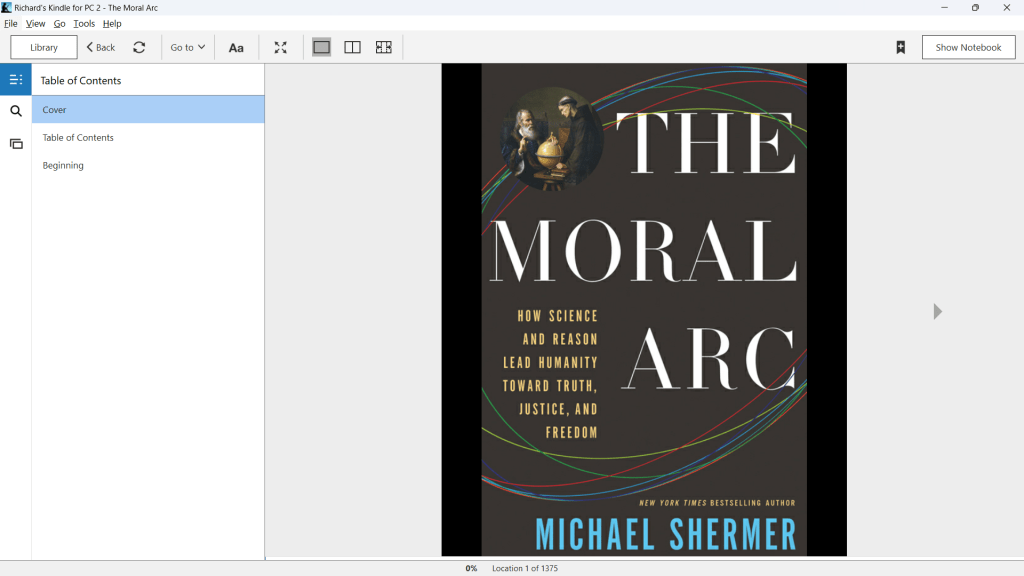
Bending the Moral Arc

Here’s the link to this article.

Honoring Dr. Martin Luther King, Jr. nearly 60 years after his “How Long” speech in Montgomery, Alabama on March 25, 1965

MICHAEL SHERMER

JAN 16, 2023

Sunday, March 21st, 1965. Selma, Alabama.

About 8,000 people gather at Brown Chapel and begin to march from the town of Selma to the city of Montgomery, Alabama. The demonstrators are predominantly African-American and they’re marching on the capitol for one reason. Justice. They want simply to be given the right to vote. But they’re not alone in their struggle. Demonstrators of “every race, religion, and class,” representing almost every state, have come to march with their black brothers and sisters.[1] And at the front of the march is the Reverend Dr. Martin Luther King Jr., Nobel Prize winner, preacher, and civil rights activist leading the march like Moses leading his people out of Egypt.

In the teeth of racial opposition backed by armed police and riot squads, they had tried to march twice before, but both times were met with violence by state troopers and a deputized posse. The first time—known as Bloody Sunday—the marchers were ordered to turn back but refused and, as onlookers cheered, they were met with tear gas, billy clubs, and rubber tubing wrapped in barbed wire. The second time they were again met by a line of state troopers and ordered to turn around, and after asking for permission to pray, King led them back.

But not this time. This time President Lyndon B. Johnson, finally having seen the writing on the wall, ordered that the marchers should be protected by 2,000 National Guard troops and federal marshals. And so they marched. For five days, over a span of 53 miles, through biting cold and frequent rain, they marched. Word spread, the number of demonstrators grew, and by the time they reached the steps of the capitol in Montgomery on March 25, their numbers had swelled to at least 25,000.
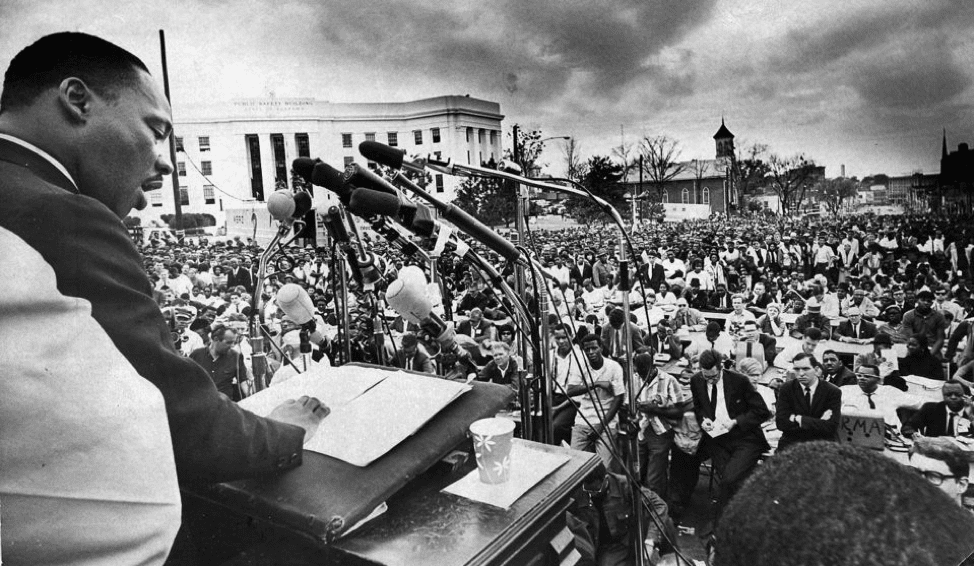
But King wasn’t allowed on the steps of the capitol—the marchers weren’t allowed on state property. Sitting in the capitol dome like Pontius Pilate, Alabama Governor George Wallace refused to come out and address the marchers, and Dr. King delivered his speech from a platform constructed on a flatbed truck parked on the street in front of the building.[2] And from that platform, King delivered his stirring anthem to freedom, first recalling how they had marched through “desolate valleys,” rested on “rocky byways,” were scorched by the sun, slept in mud, and were drenched by rains.

The crowd, consisting of freedom-seeking people who had assembled from around the United States listened intently as Dr. King implored them to remain committed to the nonviolent philosophy of civil disobedience, knowing that the patience of oppressed peoples wears thin and that our natural inclination is to hit back when struck. He asked, rhetorically, “How long will prejudice blind the visions of men, darken their understanding, and drive bright-eyed wisdom from her sacred throne?” And “How long will justice be crucified and truth bear it?” In response, Dr. King offered words of counsel, comfort, and assurance, saying that no matter the obstacles it wouldn’t be long before freedom was realized because, he said, quoting religious and biblical tropes, “truth crushed to earth will rise again,” “no lie can live forever,” “you shall reap what you sow,” and “the arc of the moral universe is long, but it bends toward justice.”[3]

Skeptic is a reader-supported publication. Paid subscriptions go to the Skeptics Society, a 501(c)(3) nonprofit educational organization. Please consider becoming a paid subscriber.

Upgrade to paid

It was one of the greatest speeches of Dr. King’s career, and arguably one of the greatest in the history of public oratory. And it worked. Less than five months later, on August 6th, 1965, President Johnson signed the voting rights act into law. It was just as Dr. King had said—the arc of the moral universe is long but it bends toward justice. The climatic end of the speech can be seen on YouTube:

Dr. King’s reference—the title inspiration for my 2015 book The Moral Arc—comes from the 19th-century abolitionist preacher Theodore Parker, who penned this piece of moral optimism in 1853, at a time when, if anything, pessimism would have been more appropriate as America was inexorably sliding toward civil war over the very institution Parker sought to abolish:

I do not pretend to understand the moral universe; the arc is a long one, my eye reaches but little ways; I cannot calculate the curve and complete the figure by the experience of sight; I can divine it by conscience. And from what I see I am sure it bends towards justice.[4]

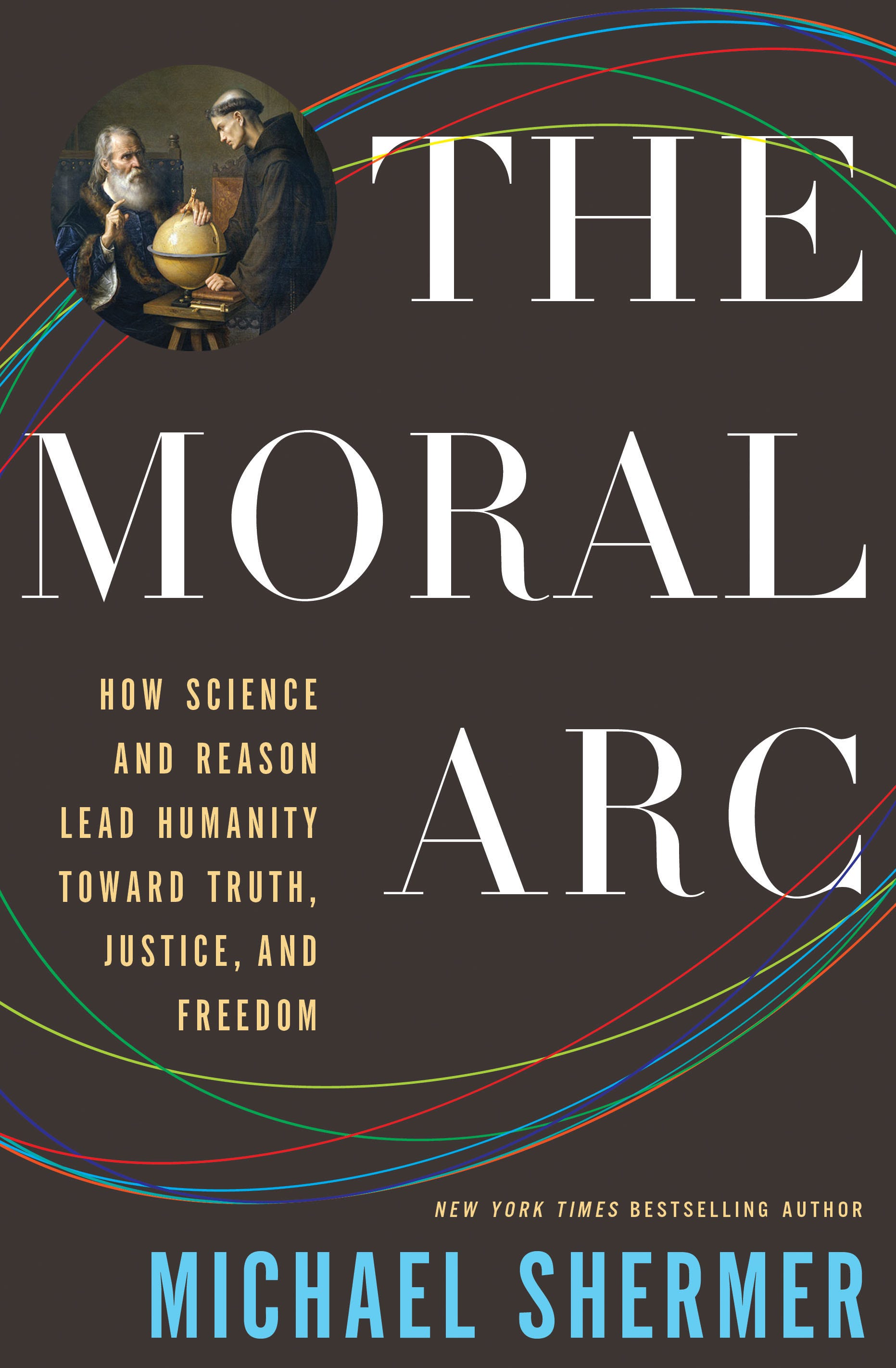
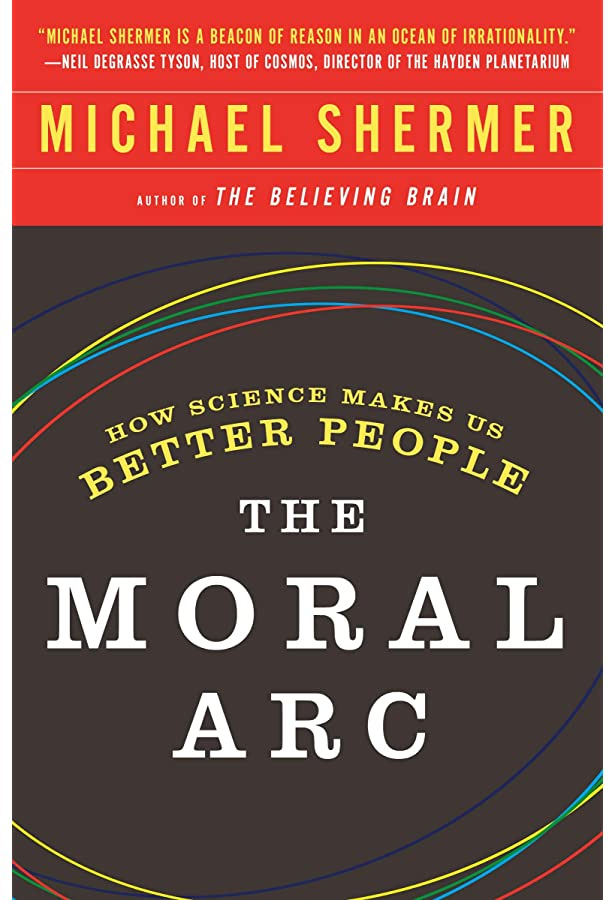
The aim of my book is to show that the Reverends Parker and King were right—that the arc of the moral universe does indeed bend toward justice. In addition to religious conscience and stirring rhetoric, however, we can trace the moral arc through science with data from many different lines of inquiry, all of which demonstrate that in general, as a species, we are becoming increasingly moral. As well, I argue that most of the moral development of the past several centuries has been the result of secular, not religious forces, and that the most important of these that emerged from the Age of Reason and the Enlightenment are science and reason, terms that I use in the broadest sense to mean reasoning through a series of arguments and then confirming that the conclusions are true through empirical verification. (You can order The Moral Arc here.)
Further, I demonstrate that the arc of the moral universe bends not merely toward justice, but toward truth and freedom, and that these positive outcomes have largely been the product of societies moving toward more secular forms of governance and politics, law and jurisprudence, moral reasoning and ethical analysis. Over time it has become less acceptable to argue that my beliefs, morals, and ways of life are better than yours simply because they are mine, or because they are traditional, or because my religion is better than your religion, or because my God is the One True God and yours is not, or because my nation can pound the crap out of your nation. It is no longer acceptable to simply assert your moral beliefs; you have to provide reasons for them, and those reasons had better be grounded in rational arguments and empirical evidence or else they will likely be ignored or rejected.  

Historically, we can look back and see that we have been steadily—albeit at times haltingly—expanding the moral sphere to include more members of our species (and now even other species) as legitimate participants in the moral community. The burgeoning conscience of humanity has grown to the point where we no longer consider the wellbeing only of our family, extended family, and local community; rather, our consideration now extends to people quite unlike ourselves, with whom we gladly trade goods and ideas and exchange sentiments and genes, rather than beating, enslaving, raping, or killing them (as our sorry species was wont to do with reckless abandon not so long ago). Nailing down the cause-and-effect relationship between human action and moral progress—that is, determining why it’s happened—is the other primary theme of this book, with the implied application of what we can do to adjust the variables in the equation to continue expanding the moral sphere and push our civilization further along the moral arc. Improvements in the domain of morality are evident in many areas of life:

  • governance (the rise of liberal democracies and the decline of theocracies and autocracies)
  • economics (broader property rights and the freedom to trade goods and services with others without oppressive restrictions)
  • rights (to life, liberty, property, marriage, reproduction, voting, speech, worship, assembly, protest, autonomy, and the pursuit of happiness)
  • prosperity (the explosion of wealth and increasing affluence for more people in more places; and the decline of poverty worldwide in which a smaller percentage of the world’s people are impoverished than at any time in history)
  • health and longevity (more people in more places more of the time live longer healthier lives than at any time in the past)
  • war (a smaller percentage of people die as a result of violent confict today than at any time since our species began)
  • slavery (outlawed everywhere in the world and practiced in only a few places in the form of sexual slavery and slave labor that are now being targeted for total abolition)
  • homicide (rates have fallen precipitously from over 100 murders per 100,000 people in the Middle Ages to less than 1 per 100,000 today in the Industrial West, and the chances of an individual dying violently is the lowest it has ever been in history)
  • rape and sexual assault (trending downward, and while still too prevalent, it is outlawed by all Western states and increasingly prosecuted)
  • judicial restraint (torture and the death penalty have been almost universally outlawed by states, and where it is still legal is less frequently practiced)
  • judicial equality (citizens of nations are treated more equally under the law than any time in the past)
  • civility (people are kinder, more civilized, and less violent to one another than ever before).

In short, we are living in the most moral period in our species’ history.

I do not go so far as to argue that these favorable developments are inevitable or the result of an inexorable unfolding of a moral law of the universe—this is not an “end of history” argument—but there are identifiable causal relationships between social, political, and economic factors and moral outcomes. As Steven Pinker wrote in The Better Angels of Our Nature, a work of breathtaking erudition that was one of the inspirations for my book:

Man’s inhumanity to man has long been a subject for moralization. With the knowledge that something has driven it down we can also treat it as a matter of cause and effect. Instead of asking “Why is there war?” we might ask “Why is there peace?” We can obsess not just over what we have been doing wrong but also what we have been doing right. Because we have been doing something right and it would be good to know what exactly it is.[5]

For tens of millennia moral regress best described our species, and hundreds of millions of people suffered as a result. But then something happened half a millennium ago. The Scientific Revolution led to the Age of Reason and the Enlightenment, and that changed everything. As a result, we ought to understand what happened, how and why these changes reversed our species historical trend downward, and that we can do more to elevate humanity, extend the arc, and bend it ever upwards.

                                     *                                  *                                  *

During the years I spent researching and writing The Moral Arc, when I told people that the subject was moral progress, to describe the responses I received as incredulous would be an understatement; most people thought I was hallucinatory. A quick rundown of the week’s bad news would seem to confirm the diagnosis.

The reaction is understandable because our brains evolved to notice and remember immediate and emotionally salient events, short-term trends, and personal anecdotes. And our sense of time ranges from the psychological “now” of three seconds to the few decades of a human lifetime, which is far too short to track long-term incremental trends unfolding over centuries and millennia, such as evolution, climate change, and—to my thesis—moral progress. If you only ever watched the evening news you would soon have ample evidence that the antithesis of my thesis is true—that things are bad and getting worse. But news agencies are tasked with reporting only the bad news—the ten thousand acts of kindness that happen every day go unreported. But one act of violence—a mass public shooting, a violent murder, a terrorist suicide bombing—are covered in excruciating detail with reporters on the scene, exclusive interviews with eyewitnesses, long shots of ambulances and police squad cars, and the thwap thwap thwap of news choppers overhead providing an aerial perspective on the mayhem. Rarely do news anchors remind their viewers that school shootings are still incredibly rare, that crime rates are hovering around an all-time low, and that acts of terror almost always fail to achieve their objective and their death tolls are negligible compared to other forms of death.

News agencies also report what happens, not what doesn’t happen—we will never see a headline that reads…

ANOTHER YEAR WITHOUT NUCLEAR WAR

This too is a sign of moral progress in that such negative news is still so uncommon that it is worth reporting. Were school shootings, murders, and terrorist attacks as commonplace as charity events, peacekeeping missions, and disease cures, our species would not be long for this world.

As well, not everyone shares my sanguine view of science and reason, which has found itself in recent decades under attack on many fronts: right-wing ideologues who do not understand science; religious-right conservatives who fear science; left-wing postmodernists who do not trust science when it doesn’t support progressive tenets about human nature; extreme environmentalists who want to return to a pre-scientific and pre-industrial agrarian society; anti-vaxxers who wrongly imagine that vaccinations cause autism and other maladies; anti-GMO (genetically modified food) activists who worry about Frankenfoods; and educators of all stripes who cannot articulate why Science, Technology, Engineering, and Math (STEM) are so vital to a modern democratic nation.

Evidence-based reasoning is the hallmark of science today. It embodies the principles of objective data, theoretical explanation, experimental methodology, peer review, public transparency and open criticism, and trial and error as the most reliable means of determining who is right—not only about the natural world, but about the social and moral worlds as well. In this sense many apparently immoral beliefs are actually factual errors based on incorrect causal theories. Today we hold that it is immoral to burn women as witches, but the reason our European ancestors in the Middle Ages strapped women on a pyre and torched them was because they believed that witches caused crop failures, weather anomalies, diseases, and various other maladies and misfortunes. Now that we have a scientific understanding of agriculture, climate, disease, and other causal vectors—including the role of chance—the witch theory of causality has fallen into disuse; what was a seemingly moral matter was actually a factual mistake.

This conflation of facts and values explains a lot about our history, in which it was once (erroneously) believed that gods need animal and human sacrifices, that demons possess people and cause them to act crazy, that Jews cause plagues and poison wells, that African blacks are better off as slaves, that some races are inferior or superior to other races, that women want to be controlled or dominated by men, that animals are automata and feel no pain, that Kings rule by divine right, and other beliefs no rational scientifically-literate person today would hold, much less proffer as a viable idea to be taken seriously. The Enlightenment philosopher Voltaire explicated the problem succinctly: “Those who can make you believe absurdities, can make you commit atrocities.”[6] 

Thus, one path (among many) to a more moral world is to get people to quit believing in absurdities. Science and reason are the best methods for doing that. As a methodology, science has no parallel; it is the ultimate means by which we can understand how the world works, including the moral world. Thus, employing science to determine the conditions that best expand the moral sphere is itself a moral act. The experimental methods and analytical reasoning of science—when applied to the social world toward an end of solving social problems and the betterment of humanity in a civilized state—created the modern world of liberal democracies, civil rights and civil liberties, equal justice under the law, open political and economic borders, free markets and free minds, and prosperity the likes of which no human society in history has ever enjoyed. More people in more places more of the time have more rights, freedoms, liberties, literacy, education, and prosperity than at any time in the past. We have many social and moral problems left to solve, to be sure, and the direction of the arc will hopefully continue upwards long after our epoch so we are by no means at the apex, but there is much evidence for progress and many good reasons for optimism.

                                     *                                  *                                  *

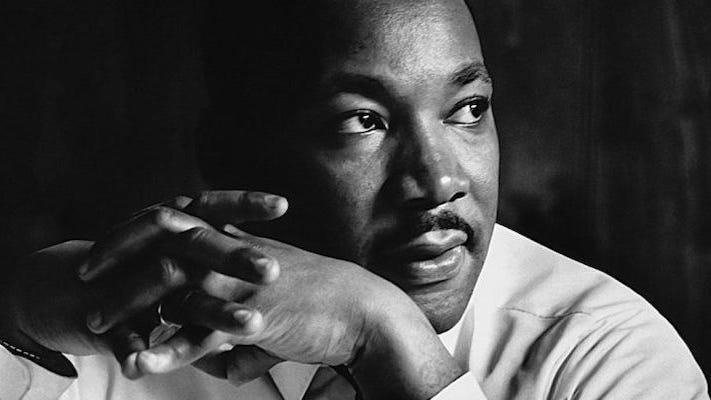
Three years after Dr. King’s “How Long” speech, on April 3, 1968, the civil rights crusader delivered his final speech, I’ve Been to the Mountaintop, in Memphis, Tennessee in which he exhorted his followers to work together to make America the nation its founding documents decreed it would be, foreseeing that he might not live to see the dream realized. “I’ve seen the Promised Land. I may not get there with you,” he hinted ominously. “But I want you to know tonight, that we, as a people, will get to the promised land!” The next day Dr. King was assassinated.

It is to his legacy, and the legacies of all champions of truth, justice, and freedom throughout history, that we owe our allegiance and our efforts at making the world a better place. “Each of us is two selves,” Dr. King wrote. “The great burden of life is to always try to keep that higher self in command. And every time that old lower self acts up and tells us to do wrong, let us allow that higher self to tell us that we were made for the stars, created for the everlasting, born for eternity.”
We are, in fact, made from the stars. Our atoms were forged in the interior of ancient stars that ended their lives in spectacular paroxysms of supernova explosions that dispersed those atoms into space where they coalesced into new solar systems with planets, life, and sentient beings capable of such sublime knowledge and moral wisdom. “We are stardust, we are golden, we are billion-year old carbon…” (from the lyrics of “Woodstock”, by Joni Mitchell).

Morality is something that carbon atoms can embody given a billion years of evolution—the moral arc.

Skeptic is a reader-supported publication. Subscriptions go to the Skeptics Society, a 501(c)3) nonprofit educational organization. Please consider becoming a paid subscriber.

Upgrade to paid

###

Michael Shermer is the Publisher of Skeptic magazine, the host of The Michael Shermer Show, and a Presidential Fellow at Chapman University. His many books include Why People Believe Weird ThingsThe Science of Good and EvilThe Believing BrainThe Moral Arc, and Heavens on EarthHis new book is Conspiracy: Why the Rational Believe the Irrational. You can order The Moral Arc here.
References


[1] King, Coretta Scott. 1969. My Life With Martin Luther King Jr. New York: Holt, Rinehart, and Winston. 267.

[2] Many accounts describe King as being either at the top of the capitol steps, on the steps, or at the bottom of the steps. There are eyewitnesses accounts in which it is claimed that King delivered his famous speech from the steps. For example, John N. Pawelek recalls: “When we arrived at the state capitol, the area was filled with throngs of marchers. Martin Luther King was on the steps. He gave a fiery speech which only a Baptist minister can give.” The Alabama Byways site tells its patrons reliving the Selma to Montgomery march to “walk on the steps of the capitol, where King delivered his ‘How Long, Not Long’ speech to a crowd of nearly 30,000 people. In his book Getting Better: Television and Moral Progress (Transaction Publishers, 1991, p. 48), Henry J. Perkinson writes: “By Thursday, the marchers, who now had swelled to twenty-five thousand, reached Montgomery, where the national networks provided live coverage as Martin Luther King strode up the capital [sic] steps with many of the movement’s heroes alongside. From the top of the steps, King delivered a stunning address to the nation.” Even the Martin Luther King Encyclopedia puts him “on the steps.”

            This is incorrect. The BBC reports of the day, for example, say that King “has taken a crowd of nearly 25,000 people to the steps of the state capital” but was stopped from climbing the steps and so “addressed the protesters from a podium in the square.” The New York Times reports that “The Alabama Freedom March from Selma to Montgomery ended shortly after noon at the foot of the Capitol steps” and that “the rally never got on to state property. It was confined to the street in front of the steps.” The original caption to the aerial photograph included in the text, from an educational online source, reads: “King was not allowed to speak from the steps of the Capitol. Can you find the line of state troopers that blocked the way?” This is confirmed by these firsthand accounts: “A few state employees stood on the steps. They watched a construction crew building a speaker’s platform on a truck bed in the street.” And: “The speakers platform is a flatbed truck equipped with microphones and loudspeakers. The rally begins with songs by Odetta, Oscar Brand, Joan Baez, Len Chandler, Peter, Paul & Mary, and Leon Bibb. From his truck-bed podium, King can clearly see Dexter Avenue Baptist Church.”

[3] The speech is commonly known as the “How Long, Not Long” speech (or sometimes “Our God is Marching On”) and is considered one of King’s three most important and impactful speeches, along with “I Have a Dream” and the tragically prescient “I’ve Been to the Mountaintop.” It can be read in its entirety at http://mlk-kpp01.stanford.edu/index.php/kingpapers/article/our_god_is_marching_on/

[4] Parker, Theodore. 1852/2005. Ten Sermons of Religion. Sermon III: Of Justice and Conscience. Ann Arbor: University of Michigan Library.

[5] Pinker, Steven. 2011. The Better Angels of Our Nature: Why Violence Has Declined. New York: Viking, xxvi.

[6] Voltaire, 1765. “Question of Miracles.” Miracles and Idolotry. Penguin.

Why Christian hypocrites describe their darkest deeds as ‘sin’

Here’s the link to this article.

It’s no accident that evangelical abusers keep referring to their dark deeds as ‘sin.’

Avatar photoby CAPTAIN CASSIDY

NOV 28, 2022

Why Christian hypocrites describe their darkest deeds as 'sin'
Shutterstock

Overview:

The sin script may have gotten seriously rolling in the late 1980s. Since then, it’s been honed razor-sharp. It helps evangelical leaders who are mired in scandal to keep their jobs—and their followers’ trust and love. But it sure doesn’t help any of the people victimized by these leaders.

Reading Time: 12 MINUTES

When abusive evangelical pastor Christian Watts tried to downplay his grooming of a teenager decades earlier, he described his predation as ‘my past sin.’ That’s a time-honored tactic for people caught in his exact circumstances. Let’s take a closer look at this tactic to see why it works so well in evangelical culture.

Those who are without sin, cast the first stone

In the Bible, a famous passage describes Jesus’ defusing of a very sensitive situation. Jewish leaders in Jerusalem asked him to adjudicate the case of a woman caught committing adultery. By Jewish law, the community was now compelled to stone her to death. (That means throwing rocks at her until she died. God of love, everybody!) But the city leaders wanted to “test” Jesus by seeing how he’d handle the situation.

Instead of answering them, Jesus knelt and wrote in the ground with his finger. The story does not relate what he wrote. But when they pressed him, he finally told them something that’s so famous that even non-Christians usually know it:

“Let him who is without sin among you be the first to cast a stone at her.”John 8:7

Apparently, that suggestion so embarrassed the city leaders that they left the scene. Finally, only Jesus was left with the woman. And he told her he wasn’t going to condemn her. Instead, he released her, telling her to “go and sin no more.”

We never learn anything else about the woman. She simply drops out of the story.

Christians love to quote that one line from it, though, especially when defending one of their own who has been caught doing something illegal or distasteful.

Not too illegal or distasteful, of course. If one of the flock does something completely beyond the pale, that person becomes a fake Christian. The rest of the flock strips the label of “Christian” from them just like the Skeksis strip the Chamberlain’s clothes from him after he loses the duel in The Dark Crystal, and for the same reasons.

However, it takes a lot to move an evangelical pastor across that line.

What evangelicals mean by ‘sin’

In Christianese, the word sin does a lot of heavy lifting. First and foremost, it means the commission of any deed, word, or thought that offends Jesus.

Second, it means any deed, word, or thought that didn’t happen but needed to, thus offending Jesus. You’ll often hear this second meaning expressed as “missing the mark,” an allusion to 1 Timothy 1:6. In this verse, evangelicals learn that “mark” means a shooting target. And their god, of course, is the one who sets the target up for them to hit. When people talk about “sins of omission,” this is what they mean.

You might notice that sin has nothing to do with hurting other people, however. Sin only concerns evangelicals insofar as it offends their god. His opinion is the only one that matters to them.

As a result of this focus, sins are often completely victimless. Consensual sex between two adults who are not married is utterly sinful. Even if they marry, if they are of the same sex then it’s still sinful. Almost all evangelicals regard masturbation as sinful as well.

And because Jesus’ opinion is the only one that truly matters to them, evangelical abusers tend to be curiously callous toward their victims—just like their god.

Because victims get swept aside in the rush to seek Jesus’ forgiveness, evangelicals tend only to focus on that forgiveness above all. Thankfully for them, Jesus is quick to forgive literally anything. Once he forgives, he forgets. And so must everyone else, or they risk Jesus’ wrath for remembering what he has already forgotten.

Most importantly, evangelicals believe that all sins are equal in Jesus’ eyes.

I could not design a better system for shielding abusers and perpetuating abuse—not even if I had ten years, a million dollars, and a mission statement etched in gold above my throne.

How abusers use sin to minimize predatory behavior

On November 2nd, Christian Watts wrote a Facebook post to his followers. It read in part:

I know these past several weeks have been difficult and I am so sorry for the pain and hurt many of you have experienced as a result of my past sin.From a screengrab of Christian Watts’ November 2nd post

His “past sin,” of course, was grooming a 13-year-old in the youth group he led as a married Southern Baptist youth pastor, then initiating sex with her once she turned 16. This abuse lasted until she left town for college. To my knowledge, he’s never apologized to his victim. He insists that because it was technically legal at the time for him to have sex with a 16-year-old, he’s done nothing really wrong. But here he is apologizing to his congregation for having sinned.

They’d already forgiven him, though, if their own comments to his earlier statements are anything to go by. One even specifically referred to the stone-throwing story from the Gospels.

And why wouldn’t they fully support him? He’d invoked the S-word. They’ve been primed since birth to respond exactly like this. Evangelical leaders have taught them for decades how to react to their leaders’ confessions of sin.

The template for excusing dark deeds with sin

They’ve been at it since at least 1988, when televangelist Jimmy Swaggart famously confessed to sin after being photographed with a sex worker. At the time, he said:

“I do not plan in any way to whitewash my sin or call it a mistake,” he told his tearful but apparently forgiving congregation. “I call it a sin.”The Crimson, 1988

If confessions exactly like his weren’t already a template, they sure became so afterward.

After Ted Haggard got exposed for drug-fueled sexcapades with another man, he drew upon the sin template to write a 2013 blog post criticizing evangelicals’ focus on “image management and damage control”:

My sin never made me suicidal, but widespread church reaction to me did. [. . .]

Jesus has been faithful to all of us in the midst of our pain, our suffering, and our disappointments. Why don’t we tell that? Every one of us have had sin horribly intrude in our lives after being saved and filled with the Holy Spirit, and God is faithfully healing us or has healed us. Why don’t we tell that?“Suicide, Evangelicalism, and Sorrow,” Ted Haggard’s blog, 2013

He’s ostensibly talking about two children of major evangelical figures who had recently died by suicide. But he can’t help but link the parents’ anguish and their children’s own shortcomings to his own sin, meaning the drug-fueled sexcapades. He’s got something to say on that score:

Everyone I’ve mentioned here has fallen because of obvious sin. But I did not mention the proud, envious, gluttonous, angry, greedy, blamers and scrutinizers in the body of Christ who have equally fallen but their sins are acceptable in our culture so they do not even realize their sin or need for repentance. Why? They are too busy with the sins of others.“Suicide, Evangelicalism, and Sorrow,” Ted Haggard’s blog, 2013

And that, he insists, is what actually “stimulates sin,” especially in evangelicals.

Very quickly, evangelicals learned to accept this template

Haggard’s comments are filled with Christians who agree completely with him:

JohnR: We are all sinners, it makes no difference what the sin is, it’s still sin, and we will continue to sin until we all meet at Jesus’ feet.

Eric Cowley: Our Lord Jesus said, he that has not sinned cast the first stone. I have friends in the ministry who have committed adultery and I will not judge them as it is by the grace of God we go. I am thankful you bring up the point that what is the difference between sexual sin and other sins.

laurakthompson: Pastor Ted could easily have disappeared from public life after his tragedy. Goodness knows that there were enough people who wanted him to do just that. But his message of hope for the hurting, grace for the sinners (read: every single one of us), and restoration for the fallen is so powerful and true, I am thankful he chose to heed the voice of God instead of the voice of the Pharisees.

Yolie Parsons: We are ALL sinners saved by grace by a loving God. Why are we surprise when somebody sins? Why don’ we have each other’s back?

Scott Helsel: Three and a half years ago my wife and i left a church that we planted because of my sin. We had been married 17 years and I hid my unfaithfulness from early in our marriage. . . I know that it was my inability to face my fears of exposure and my intense need to be pleasing in the sight of man that kept me in hiding.Various comments to Ted Haggard’s blog post

They’ve learned well.

Just call it sin, and watch the criticism fade!

In December 2016, Clayton Jennings decided to issue a confession of sin. The handsome, puppy-dog-eyed evangelist and author’s timing was impeccable. At the time, six different women were accusing him of manipulating them into “sexual behavior.” One even claimed he told her to take a morning-after pill after they’d had sex, because “his entire ministry would be ruined if [she] were to get pregnant.” Once he’d gotten what he wanted from these women, he ghosted them with claims that he was dying or had to tend to a sick relative.

These are devastating claims, but Jennings used the usual sin script to get out of them:

“I never claimed to be perfect and I never said I was sinless. Presenting you with a fake facade of greatness is never why I got in this,” he said in the video. “I want you to know this: I’ve sinned—a lot.”

“I could tell you stories of my past sin, but I wouldn’t know when to stop.”“Promiscuous Preacher Caught in Sex Scandal Aims for New Year Comeback Despite Elders’ Counsel.” Reprinted at Bishop Accountability. Originally from Christian News Network, December 30, 2016.

At the time, he attended his dad’s church. That church’s elders strongly urged Jennings to take a break from ministry for a while to focus on “repentance,” which is the process of getting forgiveness-and-forgetting from Jesus. Jennings chose to ignore this good advice. Instead, he scooted across to another church that had offered him a ministry position despite the scandal. In relaying that news, Jennings wrote in an email:

“I understand that being a public figure comes with attacks from people and the press. I also understand that I am guilty of certain sins in the past that I wish I could take back. Thankfully, God forgives and forgets, even when others try to hold it over your head and gossip/lie about it.”“Promiscuous Preacher Caught in Sex Scandal Aims for New Year Comeback Despite Elders’ Counsel.” Reprinted at Bishop Accountability. Originally from Christian News Network, December 30, 2016.

Like jeez, why was everyone still talking about him preying on young women? That was, like, months ago!

But I’m not sure he’s been doing much since then. He has a very sparse Facebook presence and a YouTube channel containing some old “spoken word” evangelical poetry of his. If he holds any public-facing ministry positions, I haven’t found anything about it.

Maybe his 2019 arrest for assault against a woman might have something to do with his radio silence.

All across the Christ-o-sphere, sin abounds

In May this year (2022), an Indiana pastor named John Lowe II resigned his position at New Life Christian Church and World Outreach. Twenty years earlier, he told his congregation, he’d “committed adultery.” He left out exactly how, though. He took a 16-year-old girl’s virginity on his office floor after apparently grooming her for a while. Once it began in earnest, the sexual abuse continued for many years, according to her husband. It was witnessed at least once by her brother.

My personal guess is that Lowe realized the jig was up and he was about to be exposed. So he chose to proactively resign. To do it, he used Jimmy Swaggart’s sin script, telling his congregation:

“I committed adultery. It was nearly 20 years ago. It continued far too long. It involved one person, and there has been no other nor any other situations of unbecoming conduct for the last 20 years. I will not use the Bible to defend, deflect, protect my past sin. I have no defense. I committed adultery,” Lowe said without sharing any specifics.Christian Post, May 2022

But he didn’t commit adultery, as that Christian Post article points out. He committed an actual crime against a child. In Indiana, the age of consent is 16, yes. But if an adult “in a position of supervision or trust” engages in any kind of sexual activity with someone that old, that’s a crime. Unfortunately, because of how long ago it happened, he probably won’t ever face justice for abusing that girl.

But this time, the sin script went pear-shaped

After Lowe finished his statement, the victim and her husband came to the microphone to set the record straight. To the church’s credit, they overwhelmingly supported the victim.

Once the victim and her husband had finished revealing exactly what Lowe had done to her, Lowe went back to the microphone to try to sweet-talk the congregation into not throwing stones at him:

Lowe took the microphone and confirmed that he began having sex with the victim when she was a teenager.

“You should have went to prison,” a voice shouted back at him.

“It was wrong. … I can’t make it right,” Lowe said. “All I can do is ask your forgiveness. … I’m doing what the biblical process is. I am stepping down, stepping aside. … I deeply hurt them, I deeply hurt you. I ask you to forgive me.”Christian Post, May 2022

Incredible! But I don’t think they were having it. The church’s website is now completely dismantled. I think they took it offline a few days after the Christian Post story ran. And I can see why. At the end of May, a protest sprang up outside the church. On June 1st, we learned that the state police were looking into the situation. The rest of the church’s leaders decided to call off services for a few weeks, but I wonder if they’ll ever reconvene.

It’s refreshing to see an evangelical church take abuse seriously.

What’s happening when an evangelical leader uses the sin script

When an evangelical leader reaches for the tribe’s sin script, it’s not being done accidentally. These leaders know exactly how this script manipulates the flocks’ minds and hearts.

First, it zings them with the entire force of their indoctrination. They only know one punishment for sin, after all: Hell. Only Jesus’ forgiveness-and-forgetting prevents this penalty from landing on their own heads.

Further, all sins are considered equal to Jesus. When I was just a little Catholic girl, my aunt-the-nun taught me that even if I’d been the only human ever born, my sins would have been enough to make Jesus need to die for them.

At the time, I was mightily dubious. I mean, I was eight years old. I knew that I hadn’t ever done anything that bad. But my aunt insisted. Just being born meant inheriting the full weight of humans’ sins against Jesus.

Later, in evangelicalism, I heard exactly the same teachings. All sin made Jesus sad and unhappy with us. And everybody sinned.

It’s not hard to find evangelicals trying to amend this shoddy teaching. Even Billy Graham’s site tries, bless its cotton socks. But for the sin script to work, that’s how it must be. The person using it needs their audience to put their offenses on the same scale as the sins they themselves commit/omit.

And a quick yank of the leash before anyone thinks twice

The idea of Jesus’ forgiveness always looms large in these scripts, too. It must. Once Jesus has forgiven a sin, he forgets it. It’s washed away by his blood, as the macabre evangelical saying goes. So refusing to forgive a sinner, or refusing to forget about the sin, becomes sinful in and of itself. It’s like slapping Jesus in the face.

That’s why Clayton Jennings specifically referred to how Jesus “forgives and forgets.” He contrasted that sublime state to how sinful evangelicals refused to do that. Instead, they were “holding it over [his] head.” They were “gossiping/lying” about what he’d done.

You’ll look in vain for any explanation of exactly what such critics are gossiping or lying about. Same for Christian Watts, who claimed that a news site’s article about him contained “gross inaccuracies.” He’s never specified what wasn’t accurate. Somehow, that info never seems to make it into an abuser’s defiant statements. But he, too, praised Christians who “see [him] through the eyes of Jesus.”

It’s also why John Lowe specifically invoked “the biblical process” for confessing his sins to his congregation. He wasn’t really following it at all, but that’s not the point. By yanking his congregation’s attention to the Bible (probably Matthew 18, which contains a set of instructions beloved of evangelical abusers), Lowe hoped to jump-start their obedience to their indoctrination. Thankfully, it did not work.

When one’s myths revere the forgiven, forgiveness becomes mandatory

For centuries, Christians have thrilled to stories of sweeping personality changes induced by Jesus’ forgiveness. They love hearing about the guy who made the song “Amazing Grace,” even if their mythology differs from reality in some key respects. The point, they think, is that Jesus totally changes people who put their faith in him. Even if that offer contains a lot of asterisked terms and conditions, and even though it fails to happen more often than not, they still take it as a canonical belief.

That’s why so many of Christian Watts’ congregation referred to this myth in their replies to his social media posts. One replied, “Obviously the publication doesn’t understand God’s redemptive and restorative power.” Another thought that Watts’ past had better prepared him to be a better leader for their church. Their meaning is clear: Jesus had clearly forgiven-and-forgotten what their pastor did. They felt that he’d learned from his sinful past. And they refused to throw stones at him.

But it wasn’t their stones that Watts should have feared.

It was those of his victim.

Why sin is such an evil concept

Christian Watts’ congregation had nothing to forgive him for doing.

Neither did Jesus.

The person he’d really offended was his victim.

Only her forgiveness has ever mattered here.

And even if she ever forgives him, evangelicals still have a moral duty to keep abusers out of ministry positions. No matter what this guy claims to have learned through his abuse of her, no matter what divine grace he claims to feel after appealing to Jesus for forgiveness, he has permanently disqualified himself from ministry forever. He needs to find something to do that will keep him well away from future victims for the rest of his life. He needs to begin a new career in, I dunno, drain cleaning.

[Note: That’s what Watts has actually been doing lately for money.]

By cutting his victim out of his entire sin narrative, Christian Watts—like his fellow predatory evangelical peers—was able to forgive-and-forget the harm he’d done to her. As long as he kept that abuse secret, it might as well not have happened at all.

Even after the news reached the public, he tried to use the evangelical sin script to avoid repercussions for his decision to abuse a child. He tried to minimize what he did. To manipulate his flock into embracing him and keeping him firmly ensconced in his pulpit.

I’ve never heard a single word from him or his congregation about the person he abused. I’ve looked. Nobody has expressed a single word of concern for her or her well-being. She might as well be a character from a morality play starring Christian Watts as Everyman. When all that happened to her is Sin, then the solution is just more Jesus-ing for her and her abuser both.

We need to pay attention when evangelicals ascribe their criminal, predatory, hypocritical, and most execrable behavior as sin. They always do it for a reason.

06/06/23 Biking & Listening

Biking is something else I both love and hate. It takes a lot of effort but does provide good exercise and most days over an hour to listen to a good book or podcast. I especially like having ridden.

Here’s my bike, a Rockhopper by Specialized. I purchased it November 2021 from Venture Out in Guntersville; Mike is top notch! So is the bike, and the ‘old’ man seat I salvaged from an old Walmart bike.

Here’s a link to today’s bike ride.

Here’s what I’m listening to: The Moral Arc, by Michael Shermer

Amazon abstract:

Bestselling author Michael Shermer’s exploration of science and morality that demonstrates how the scientific way of thinking has made people, and society as a whole, more moral

From Galileo and Newton to Thomas Hobbes and Martin Luther King, Jr., thinkers throughout history have consciously employed scientific techniques to better understand the non-physical world. The Age of Reason and the Enlightenment led theorists to apply scientific reasoning to the non-scientific disciplines of politics, economics, and moral philosophy. Instead of relying on the woodcuts of dissected bodies in old medical texts, physicians opened bodies themselves to see what was there; instead of divining truth through the authority of an ancient holy book or philosophical treatise, people began to explore the book of nature for themselves through travel and exploration; instead of the supernatural belief in the divine right of kings, people employed a natural belief in the right of democracy.

In The Moral Arc, Shermer will explain how abstract reasoning, rationality, empiricism, skepticism–scientific ways of thinking–have profoundly changed the way we perceive morality and, indeed, move us ever closer to a more just world.


Here’s a few photos from along my pistol route:

06/05/23 Biking & Listening

Biking is something else I both love and hate. It takes a lot of effort but does provide good exercise and most days over an hour to listen to a good book or podcast. I especially like having ridden.

Here’s my bike, a Rockhopper by Specialized. I purchased it November 2021 from Venture Out in Guntersville; Mike is top notch! So is the bike, and the ‘old’ man seat I salvaged from an old Walmart bike.

Here’s a link to today’s bike ride.

Here’s what I’m listening to: The Believing Brain, by Michael Shermer

Amazon abstract:

The Believing Brain is bestselling author Michael Shermer’s comprehensive and provocative theory on how beliefs are born, formed, reinforced, challenged, changed, and extinguished.

In this work synthesizing thirty years of research, psychologist, historian of science, and the world’s best-known skeptic Michael Shermer upends the traditional thinking about how humans form beliefs about the world. Simply put, beliefs come first and explanations for beliefs follow. The brain, Shermer argues, is a belief engine. From sensory data flowing in through the senses, the brain naturally begins to look for and find patterns, and then infuses those patterns with meaning. Our brains connect the dots of our world into meaningful patterns that explain why things happen, and these patterns become beliefs. Once beliefs are formed the brain begins to look for and find confirmatory evidence in support of those beliefs, which accelerates the process of reinforcing them, and round and round the process goes in a positive-feedback loop of belief confirmation. Shermer outlines the numerous cognitive tools our brains engage to reinforce our beliefs as truths.

Interlaced with his theory of belief, Shermer provides countless real-world examples of how this process operates, from politics, economics, and religion to conspiracy theories, the supernatural, and the paranormal. Ultimately, he demonstrates why science is the best tool ever devised to determine whether or not a belief matches reality.

Here’s a few photos from along my pistol route:

The Role of the Bible in Destroying Faith

Here’s the link to this article.

By David Madison at 5/12/2023

Deceptive translators don’t want readers to see the problems 

There has been a meme floating about on the Internet: “If you ever feel worthless, remember, there are people with theology degrees.” These degrees are granted by a huge variety of religious schools, ranging from fundamentalist Protestant to Vatican-loyal Catholic. So among those holding these degrees—what else would we expect?—there is substantial disagreement regarding what god is like, how he/she/it expects people to behave, how he/she/it wants to be worshipped. This is one of the reasons Christianity has splintered into thousands of quarreling brands.

This confusion and strife can be traced to many sources (e.g., personality conflicts, egos, desire for power and control), but the Bible must take a large share of the blame. It is a deeply flawed document that shows no evidence whatever of divine inspiration: it contains so many contradictions, so much incoherence and bad theology. Thus the irony that the Bible itself—carefully read, that is—has destroyed faith for so many people. Mark Twain argued that the “best cure for Christianity is reading the Bible.” Andrew Seidel has pointed out that “the road to atheism is littered with Bibles that have been read cover to cover.”

Even a casual reading of the Bible can be shocking: “God so loved the world,” yet he got so mad at humans that he destroyed all human and animal life—except for the crowd on Noah’s boat. Jesus suggested that people should forgive seventy-times seven, yet assured his disciples that any village that did not welcome their preaching would be destroyed—and that hatred of family was a requirement for following him. This is what I mean by incoherence and bad theology. Anyone with common sense can figure it out.  

These are items that are visible on the surface, and it gets worse; a closer examination reveals deeper problems. Devout Bible scholars have been aware for a long time that this is the case, and secular scholars don’t hesitate to expose the ways—unnoticed by the laity—in which the Bible itself destroys the faith that so many hold dear. On 1 May 2023, an article written by John Loftus was published on The Secular Web: Does God Exist? A Definitive Biblical Case. This is a must read. Bookmark the link for future reference. I printed the article to go in a binder of important essays. If you can manage to get Christian family and friends to do some homework on the Bible, this piece should be included.   

Loftus invites his readers to see what is actually there in the Bible:

“What is almost always overlooked in debating the existence of the theistic god is that such a divine being has had a complex evolution over the centuries from Elohim, to Yahweh, to Jesus, and then to the god of the philosophers, without asking if the original gods had any merit…If believers really understood the Bible, they wouldn’t believe in any of these gods.”

Theologians and apologists, priests and preachers, have worked so hard over the centuries to clean up the god(s) that we find in the Bible, so that the faith today—that so many people are comfortable embracing—has a noble, positive flavor. If only the devout would bother to think carefully about their most common, cherished Bible texts. For example: “Our father, who art in heaven, hallowed be thy name.” Just what is god’s name? An easy answer would be, “Well, Jesus, of course.” But before Jesus, what was it? As Loftus mentions, one of them was Elohim, but pious translators sense their god having a name might make it look like he was just one of many of the pagan gods. And that was exactly the case, as Loftus notes: “When we take the Bible seriously, we discover a significant but unsuccessful cover-up about the gods that we find in the Bible, who evolved over the centuries through polytheism to henotheism to monotheism.” 

When I printed the Loftus essay, it came to twenty pages, seven of which are about Elohim—and most of this content never comes to the attention of devout laypeople. Loftus offers a careful analysis of the first two verses of Genesis 1, which are commonly translated something like this:

“In the beginning God created the heavens and the earth. Now the earth was without form and void, and darkness covered the surface of the abyss, and the Spirit of God was moving over the waters.”

He points out that this is a more accurate rendering:

“Elohim made the skies and dry land, beginning with land that was without form and void, with darkness covering the surface of the chaos, and the wind of Elohim hovering over the waters,” while noting that “the original grammar is a bit difficult to translate. If nothing else, consider this a slightly interpretive translation using corrected wording.”

Loftus notes seven elements of this text that are commonly misunderstood, e.g., there is nothing here about the beginning of time, or creation out of nothing. Nor is the claim by contemporary theologians that an all-powerful cosmic god did the deed. Believers want to assume this was the case, and translators cooperate in promoting this deception, i.e., “In the beginning, God…” But the text says that Elohim was the initiator of this drama. 

Just who was this Elohim? “The Hebrew word Elohim is derived from the name of the Canaanite god El, a shortened version of which is El Elyon, or ‘God Most High.’” Well, there, don’t you have the grand god Christians want? No, far from it: “El was the head of the Canaanite pantheon of gods.” Loftus quotes scholar Mark S. Smith: 

“Archaeological data in the Iron I age suggests that the Israelite culture largely overlapped with and derived from Canaanite culture… In short, Israelite culture was largely Canaanite in nature.” (The Early History of God: Yahweh and Other Deities of Ancient Israel, 2002, pp. 6-7.)

The influence of Elohim-belief is reflected in so many of the names familiar to us in the Old Testament, e.g., Bethel, Michael, Daniel, and even Israel.

Elohim the tribal deity was imagined as we would expect of ancient writers who had no understanding whatever of the Cosmos. So it is silly to read the god imagined by modern believers into the Genesis story. Loftus describes the naïveté of these ancient theologians:

“Elohim showed no awareness of dinosaurs, nor the fact that the history of evolution has shown that 99.9% of all species have gone extinct, since evolution produces a lot of dead ends on its way to producing species that survive. Imagine that! On every day in Genesis 1 the supposed creator god Elohim knows nothing about the universe! … There is no excuse for a real creator to utterly fail a basic science class…There is no excuse for a real creator to mislead his creatures about something so important, which would lead generations of scientifically literate people away from the Christian religious faith and into damnation.”

Do things get any better with the other tribal deity who plays a major role in the Old Testament, namely Yahweh? Devout folks today can be forgiven if, when asked what god’s name is, they fail to answer, Yahweh. One of the most famous—and annoying—Christian cults proudly labels itself Jehovah’s Witnesses. That is, they know god’s name, as adjusted in English translation. Ancient Hebrew was written without vowels, and some of the consonants were flexible. Hence YHWH could also be JHVH. Plug in different vowels, and it becomes Jehovah instead of Yahweh. Even so, most of the devout—outside the Witness cult—wouldn’t right way agree that god’s name is Jehovah, let alone Yahweh.

One of the reasons for this, again, is that translators are eager to cover up the tribal god’s name, as Loftus points out:

“In the Old Testament, whenever you come across ‘the Lord Our God,’ or ‘the Lord God,’ or even ‘Lord,’ Christian translators have hidden the truth behind those words. It’s ‘Yahweh’ or ‘Yahweh your god.’” It’s easy to spot this coverup in the Revised Standard Version, which renders Yahweh as LORD, i.e., all capital letters. The ancient theologians who cobbled together the Old Testament were happy to put stories about Elohim right beside stories about Yahweh, e.g. the two creation stories in Genesis. 

Loftus devotes a full eight pages in this essay to Yahweh, making quite clear that this was indeed an inferior tribal deity. He presents four aspects of Yahweh that qualify him as a moral monster, especially his behavior in the story of Job: 

“In this story Yahweh lives in a separate palace in the sky and acts like a petty narcissistic king who would treat his subjects terribly simply because he could do so, just like any other despotic Mediterranean king they knew. Job was a pawn who was tortured for the pleasure of Yahweh and other sons of Elohim. At the end Yahweh doesn’t reveal why Job suffered, just that Job wasn’t capable of understanding why, so he was faulted for demanding an answer from the Almighty.”

Loftus also describes Yahweh’s guilt in terms of genocide, slavery, and child sacrifice—and limited power. Translators should be especially ashamed of labelling this deity LORD God: far from being omnipotent, its inferior status is obvious: “The LORD was with Judah, and he took possession of the hill country but could not drive out the inhabitants of the plain, because they had chariots of iron” (Judges 1:19). 

Loftus is right: “Imagine that! An all-powerful god cannot defeat men in iron chariots! What could he do against tanks and fighter jets?”

In the final pages of the essay Loftus addresses the issue of Jesus as god. He had pointed out that Yahweh was depicted as having a body (in the Genesis story of the Garden of Eden, in his meetings with Moses), but the ultimate god-in-bodily-form would have to be Jesus. But the utter moral failures of Yahweh should encourage even the devout to admit, “No, that tribal god didn’t really exist.” But Loftus notes the devastating implications for the Jesus story:

“If the embodied moral monster Yahweh doesn’t exist, then the embodied god Jesus depicted in the Gospels doesn’t exist, either, since he’s believed to be the son of Yahweh, a part of the Trinity, and in complete agreement with everything that Yahweh said and did. That should be the end of it.” 

This is not necessarily to say that Jesus as an actual historical person didn’t exist—although there are serious arguments that cause us to doubt it. But Loftus is saying that Jesus as a god is based so thoroughly on Yahweh the flawed tribal deity; hence the divine nature of Jesus can’t be taken seriously.  He also notes that Justin Martyr, “the grandfather of the entire tradition of Christian apologetics,” sought to bolster the case for divine Jesus by arguing that he was like others who came before him:

“When we say that the Word, who is the first-birth of God, was produced without sexual union, and that He, Jesus Christ, our Teacher, was crucified and died, and rose again, and ascended into heaven, we propound nothing new from what you believe regarding those whom you esteem sons of Zeus.” 

Loftus notes Richard Miller’s summation of Justin Martyr’s approach: “Our new hero is just like your own, except ours is awesome, whereas yours are the deceptions of demons.” (Miller, Resurrection and Reception in Early Christianity, 2017)  Sounds a lot like how Christians put down other brands of Christians!

In my article here last week, I argued that core Christian beliefs are a “clumsy blend of ancient superstitions, common miracle folklore, and magical thinking.” Christian theologians have worked so hard over the centuries to overcome this huge handicap. Their god must be the best, the ultimate—he must be an omni-god: all good, all powerful, all knowing. But these arguments plunge their faith into massive incoherence. Loftus notes that the “problem of horrendous suffering renders that god-concept extremely improbable to the point of refutation” (see his anthology, God and Horrendous Suffering). Their whole endeavor—creating the god of the philosophers—is a fool’s errand: “If theists think that an omni-everything God can legitimately be based on the Bible or its theology, they are fooling themselves. They are inventing their own versions of God, just like the ancient peoples in the Bible did.”

David Madison was a pastor in the Methodist Church for nine years, and has a PhD in Biblical Studies from Boston University. He is the author of two books, Ten Tough Problems in Christian Thought and Belief: a Minister-Turned-Atheist Shows Why You Should Ditch the Faith (2016; 2018 Foreword by John Loftus) and Ten Things Christians Wish Jesus Hadn’t Taught: And Other Reasons to Question His Words (2021). The Spanish translation of this book is also now available. 

His YouTube channel is here. He has written for the Debunking Christianity Blog since 2016.

The Cure-for-Christianity Library©, now with more than 500 titles, is here. A brief video explanation of the Library is here.

06/04/23 Biking & Listening

Biking is something else I both love and hate. It takes a lot of effort but does provide good exercise and most days over an hour to listen to a good book or podcast. I especially like having ridden.

Here’s my bike, a Rockhopper by Specialized. I purchased it November 2021 from Venture Out in Guntersville; Mike is top notch! So is the bike, and the ‘old’ man seat I salvaged from an old Walmart bike.

Here’s a link to today’s bike ride.

Here’s what I’m listening to: The Believing Brain, by Michael Shermer

Amazon abstract:

The Believing Brain is bestselling author Michael Shermer’s comprehensive and provocative theory on how beliefs are born, formed, reinforced, challenged, changed, and extinguished.

In this work synthesizing thirty years of research, psychologist, historian of science, and the world’s best-known skeptic Michael Shermer upends the traditional thinking about how humans form beliefs about the world. Simply put, beliefs come first and explanations for beliefs follow. The brain, Shermer argues, is a belief engine. From sensory data flowing in through the senses, the brain naturally begins to look for and find patterns, and then infuses those patterns with meaning. Our brains connect the dots of our world into meaningful patterns that explain why things happen, and these patterns become beliefs. Once beliefs are formed the brain begins to look for and find confirmatory evidence in support of those beliefs, which accelerates the process of reinforcing them, and round and round the process goes in a positive-feedback loop of belief confirmation. Shermer outlines the numerous cognitive tools our brains engage to reinforce our beliefs as truths.

Interlaced with his theory of belief, Shermer provides countless real-world examples of how this process operates, from politics, economics, and religion to conspiracy theories, the supernatural, and the paranormal. Ultimately, he demonstrates why science is the best tool ever devised to determine whether or not a belief matches reality.

Here’s a few photos from along my pistol route:

06/03/23 Biking & Listening

Biking is something else I both love and hate. It takes a lot of effort but does provide good exercise and most days over an hour to listen to a good book or podcast. I especially like having ridden.

Here’s my bike, a Rockhopper by Specialized. I purchased it November 2021 from Venture Out in Guntersville; Mike is top notch! So is the bike, and the ‘old’ man seat I salvaged from an old Walmart bike.

Here’s a link to today’s bike ride. Had trouble with my biking APP, but distance is correct.

Here’s what I’m listening to: The Believing Brain, by Michael Shermer

Amazon abstract:

The Believing Brain is bestselling author Michael Shermer’s comprehensive and provocative theory on how beliefs are born, formed, reinforced, challenged, changed, and extinguished.

In this work synthesizing thirty years of research, psychologist, historian of science, and the world’s best-known skeptic Michael Shermer upends the traditional thinking about how humans form beliefs about the world. Simply put, beliefs come first and explanations for beliefs follow. The brain, Shermer argues, is a belief engine. From sensory data flowing in through the senses, the brain naturally begins to look for and find patterns, and then infuses those patterns with meaning. Our brains connect the dots of our world into meaningful patterns that explain why things happen, and these patterns become beliefs. Once beliefs are formed the brain begins to look for and find confirmatory evidence in support of those beliefs, which accelerates the process of reinforcing them, and round and round the process goes in a positive-feedback loop of belief confirmation. Shermer outlines the numerous cognitive tools our brains engage to reinforce our beliefs as truths.

Interlaced with his theory of belief, Shermer provides countless real-world examples of how this process operates, from politics, economics, and religion to conspiracy theories, the supernatural, and the paranormal. Ultimately, he demonstrates why science is the best tool ever devised to determine whether or not a belief matches reality.

Here’s a few photos from along my pistol route:

Revisiting Hitchens’ challenge and the value of hope

Here’s the link to this article.

Avatar photoby BOB SEIDENSTICKER

APR 21, 2023

(image by Rafael Rex Felisilda from Unsplash)

Overview:

Atheist Christopher Hitchens made a famous moral challenge to Christians. Let’s consider a second Christian response.

Reading Time: 6 MINUTES

Atheist Christopher Hitchens had a moral challenge for Christians: identify a moral action taken or a moral sentiment uttered by a believer that couldn’t be taken or uttered by a nonbeliever—something that only a believer could do and an atheist couldn’t. Part 1 is here.

A second apologist, this time a Catholic, also has some pushback for the Hitchens Challenge. Towards that end, he makes some nutty claims about the value of Christian hope.

Hitchens assumed—like many secular thinkers—that the only good is the good of social or material progress. An atheist can ladle soup in a soup kitchen—same as a Christian—so Christianity must not bring anything to the table….

It’s just not true that soup ladles are the sole measure of value. Catholicism, in particular, for all its good works and charity, has always rejected the idea that religion should aim for Utopia in this world or that it exists only to promote material wellbeing. “The Church is not an NGO,” as Pope Francis says frequently.

You got that right—the church is a terrible NGO! Americans give $100 billion annually to religion. The Roman Catholic Church’s annual intake worldwide must be far larger. The Catholic Church gives a lot of money to charity, but that’s only because it is huge. As a percentage of the Church’s expenses, I’m guessing that charity accounts for two percent. That’s an educated guess, but it’s just a guess because churches’ books are (unaccountably) closed (one wonders what they’re trying to hide).

With 98% overhead, they’d be the world’s most inefficient NGO.

This response sounds like, “Hitchens was right, but that’s okay because the church never claimed to produce progress.” I can accept that. (More on Christianity’s disinterest in social progress here.)

An aside on Mother (now Saint) Teresa

Back to the article: 

Perhaps this is why Hitchens hated Mother Theresa [sic] so much. (He wrote viciously about her.) He understood her mission better than many. He knew that her main goal was not social work, but mysticism. “We are misunderstood, we are misrepresented, we are misreported,” Mother Theresa said. “We are not nurses, we are not doctors, we are not teachers, we are not social workers. We are religious, we are religious, we are religious.”

That’s an embarrassing admission, that “her main goal was not social work, but mysticism,” but I appreciate the honesty. Now show me the check box that donors to Teresa’s Missionaries of Charity had to mark to acknowledge that they understand that “We are not nurses, we are not doctors, we are not teachers, we are not social workers. We are religious.”

Hundreds of millions of dollars went into this charity, and an enormous fraction—I’m guessing most of it—was because the donors assumed that they were funding healthcare.

Hitchens might have hated Mother Teresa, but that would’ve been because of the disconnect between her public image as a healer and the reality of her homes for the sick being little more than comfortable places to die. Her charity received vast donations, but Forbes reported that “only seven percent of the donation received at Missionaries of Charity was used for charity.”

The greatest thing faith brings is hope

Nope, Teresa wasn’t focused on improving life here on earth.

Mother Theresa knew (and struggled with the fact) that the greatest value of religious faith in this life is not material wellbeing, but the gift of transcendent hope. That’s something a believer can give that Hitchens can never give.

Just to be argumentative, I could see an atheist claiming transcendent hope. Imagine a story about aliens coming to free us from our mortal coils as with the Heaven’s Gate cult. An extraterrestrial technology claim is as groundless a claim as a supernatural one (though less farfetched), but that could be a transcendent hope.

The key point isn’t that it’s transcendent hope but that it’s evidence-less hope, hope that can be in anything because it needn’t have evidence to support it.

But you’re right that atheists avoid giving groundless transcendent hope. Is that a problem? Science gives reality and grounded hope. Science is what’s working on cures for disease or ways to improve food yields. Science is where improvement comes from, and that’s where atheists usually get their hope.

Note the contrast. Christianity has put all its eggs in the “gift of transcendental hope” basket. It’s not like it’s simultaneously using its own methods to solve society’s problems. Christianity is static. A thousand years of Christianity’s “transcendent hope” in a desperate society gives you a thousand years of the same desperate society, while a thousand years of science can transform that society to one that is happy and healthy, one where groundless hope is much less needed.

Christianity can still flog its claims of a beautiful afterlife, but so what? Yes, it’s a remarkable, possibly desirable claim, but so what when there’s no evidence for it? Science has nothing to offer except a continually improving reality (and mountains of evidence that it delivers).

Faith, hope, and love are precisely the formula for happiness even in the midst of material deprivation.

Not when that faith, hope, and love paper over the actual problems in society. A life that is drugged to block out a horrible reality is a wasted life. I’m in no position to criticize someone who falls back on hope to endure a desperate life, but see how it directs our attention to feeling better and away from solving problems.

This was where Karl Marx was going with his observation that religion is the opium of the people. He was complimenting religion—it helps when society is in bad shape. But in the same way that opium only addresses the symptoms of a broken leg (you should still get medical treatment), religion only addresses the symptoms of bad society (you still need to fix that society).

The research of Gregory Paul is relevant here. He not only points out that religious belief correlates with worse social metrics, he also hypothesizes that poor social conditions cause more religion (more). In other words, when you see religion embraced by some subset of society, those people have social problems that need fixing.

How to get a better society

But even if nonbelievers do good things, there is still no reason to conclude that unbelief is the best stance for advancing material and social wellbeing. [One source compellingly argued,] “Human development is best advanced by transcendent hope.”

We’re just going to hope our way to an improved society? Not going to do anything about it, just hope? That reminds me of William Lane Craig’s portrayal of life here on earth as “the cramped and narrow foyer leading to the great hall of God’s eternity.” Wow—what an empty view of the one life we can all agree that we actually have.

Instead of making do, instead of wringing our hands in despair, perhaps we should get busy trying to improve the status quo by solving problems.

The fact is that atheists don’t ladle as much soup as Catholics. It was the Catholic Church that invented the modern institutions of benevolence.

You mean modern institutions of benevolence like Social Security, Medicare, medical insurance, and modern hospitals? The Catholic Church’s small contribution to charity is appreciated, but let’s not exaggerate it. U.S. churches together contribute a few billion dollars to the problem annually while the U.S. government and other institutions devote a few trillion dollars to the problem.

You could sneer at that and say that that’s just money returning to the taxpayers or the insured who provided it in the first place. And that’s true. But it’s still citizens caring for other citizens, redistributing wealth to help the orphans and widows that Jesus cared so much about. The Church in America makes a tiny fraction of this impact.

As for atheists vs. Catholics, even if Catholics do more per capita on assuaging pain (and I’m not sure that’s the case), atheists probably focus more on the fix-society side of the problem.

[The Catholic Church invented the modern institutions of benevolence] precisely because Catholics believe in the transcendent dignity of human beings.

This is what the Hitchens Challenge addresses. There is no benevolent act that Catholics do that couldn’t be performed by an atheist.

See also: When Christianity Was in Charge, This Is What We Got.

The Hitchens Challenge, part 2

Hitchens has more. Once you’ve seen that a nonbeliever can perform the same good moral actions that a believer can, think of the reverse: think of something terrible that only a believer would do or say. Now, lots of examples come to mind.

  • Abraham being willing to sacrifice Isaac (and modern apologists defending God’s indecipherable actions)
  • The Canaanite genocide
  • “Thou shalt not suffer a witch to live” and witch burnings
  • “God hates fags” from Westboro Baptist Church
  • Flying a plane into a building or blowing yourself up to kill people you don’t like

Or any hateful or selfish conclusion justified by “because God (or the Bible) says” such as condemning homosexuality, blocking civil rights, limiting stem cell research, or dropping adoption services or hospital funding in protest of some law.

The article responds that, sure, religion can make people do evil things, but that’s “obviously true of secular ideology. All ideology is subject to abuse and manipulation.”

So we’re to believe that anything bad done in the name of Christianity is just an “abuse and manipulation” of Christianity and that Christianity, read correctly, doesn’t actually justify that? Who will be the judge to sift out the correct interpretations from the many incorrect ones?

The Bible is a sock puppet that can be made to justify just about anything. Let’s not pretend that there’s one objectively correct interpretation when thousands of Christian denominations squabble over the correct path.

The Hitchens Challenge remains a helpful illustration that Christianity has no moral upside (atheists can be just as moral as Christians) but has a big downside (religious belief can justify in the believer’s mind moral evil that an atheist would never imagine).

With or without religion,
you would have good people doing good things
and evil people doing evil things.
But for good people to do evil things,
that takes religion.
— Steven Weinberg

Hitchens’ Challenge: How well has it stood up?

Here’s the link to this article.

Avatar photoby BOB SEIDENSTICKER

APR 04, 2023

hitchens challenge - old man with magnifying glass
(image by mari lezhava from Unsplash)

Overview:

Atheist Christopher Hitchens made a famous moral challenge to Christians. Let’s consider two Christian responses.

Reading Time: 3 MINUTES

Identify a moral action taken or a moral sentiment uttered by a believer that couldn’t be taken or uttered by a nonbeliever—something that only a believer could do and an atheist couldn’t.

This was Christopher Hitchens’ famous moral challenge. He said that he had never been given a satisfactory answer.

Amy Hall from Greg Koukl’s Stand to Reason ministry thinks she is up to the challenge. Let’s take a look.

1. Hitchens misunderstands the theist’s point

[Hitchens thinks the Christian is saying] that without God, we couldn’t know right from wrong, when the actual objection is that there wouldn’t be any right or wrong.

I believe Hitchens was responding to the assumption that being a Christian provided some moral advantage. (And, according to Christianity, it does: “We know that anyone born of God does not continue to sin” (1 John 5:18).)

And if you want to argue that morality exists only because God put it there, that needs some evidence. You’ve provided none (more on Christians’ inability to defend the claim of objective morality here).

2. The Challenge is unanswerable

This is a clever observation: if Hitchens the atheist is the judge of the Hitchens Challenge, the Christian can’t win because he decides what is moral.

There might be certain acts that only theists would recognize as being moral. Atheists, not recognizing those acts as being good, would not attempt to do them as moral acts.

The first problem is that this undercuts another popular Christian apologetic argument. What’s wrong with Hitchens as judge—don’t you say that morality is objective? If morality is objective (defined by apologist William Lane Craig as “moral values that are valid and binding whether anybody believes in them or not”) and we humans can reliably access those values, Hitchens or any honest atheist would be as good a judge as anyone.

Since it is logically impossible to give an answer that will satisfy Hitchens, he may as well ask us to draw him a square circle and then declare himself the winner when we fail. In the end, his challenge is nothing but a rhetorical trick, and it should be exposed and dismissed as such. Hitchens should never get away with even asking it, let alone demanding we give him an “acceptable” answer in order to defend theism.

I’m reminded of the lawyer’s maxim, “When the facts are on your side, pound the facts. When the law is on your side, pound the law. When neither is on your side, pound the table.” There’s a lot of table pounding here along with the demand that the Challenge be dismissed as inadmissible.

The resolution is simple: insist that objective, unbiased third parties must judge this Challenge. If Christians like those from Stand to Reason believe that objective moral facts can be reliably found, they can find judges who are infallible at finding objective morality. Prove to everyone that they are reliable with public tests. Now we have judges that everyone admits are reliable, and Hall’s concern is satisfied.

As it happens, there is an answer to Hitchens’s question—one that seemed obvious to me immediately—and it illustrates perfectly the problem with the challenge. The highest moral good a person can do is to worship the living, true, sovereign God—to love Him with all one’s heart, soul, mind, and strength. Not only will no atheist ever do this, no atheist can do this.

That’s the pinnacle of morality? It’s an odd definition of morality that has nothing to do with doing good to living beings, but I guess Christians can define their dogma as they choose. And that’s the point: this is dogma that is specific to Christians. Our objective, unbiased third party judges would reject this. (More on how praise applied to God makes no sense here.)

Now it looks like it’s you who’s playing the rhetorical trick.

If we all share Adam’s sin, we must all have the moral wisdom of the Tree of the Knowledge of Good and Evil. How then can atheists not agree with you that worship is the highest moral good?

Let’s return to the Challenge. Hitchens was simply saying that Christians can claim no moral high ground over atheists and that Christianity brings nothing moral to the table that wasn’t already part of humanity’s social interaction. God pretends to generously gives morality to humans, but, like Dorothy’s ruby slippers, it was theirs all along.

Concluded in part 2 with one more Christian response.

If there is a God,
He will have to beg my forgiveness.
—  written on a wall in
Mauthausen concentration camp

More people have noticed Christianity’s decline in America

Here’s the link to this article.

The theme of that decline is still Christianity’s loss of coercive power. And the solution is still just as dark as its reacquisition.

Avatar photoby CAPTAIN CASSIDY

JAN 10, 2023

More people have noticed Christianity's decline in America | ruined church in hungary
Via Unsplash

Not long ago, some readers linked me to a piece in Grid about Christianity’s decline in America. As well, a few new books have popped up on booksellers’ shelves about the topic. These insights join credible recent research about Christianity’s ongoing decline in America. None of it’s looking good for that old-time religion, so to speak, but it does highlight one ongoing theme observers have noted for years: Without Christians somehow regaining their powers of coercion, Christianity will inevitably become irrelevant in America.

The worst part of this situation, though, is this: A lot of the worst-of-the-worst Christians are well aware of that fact.

Christianity’s decline began with a trickle of information

For years now, I’ve kept track of the incredible—and astonishingly swift—decline of Christianity’s cultural power, membership, and credibility in America. Since the mid-2000s, Christians have been in freefall on all three counts.

If someone had told me when I was Pentecostal, in the 1980s and 1990s, that this would one day happen, I’d have simply assumed this decline to be part of the Endtimes prophesied in the Bible. But if I’d heard such a prediction in the early 2000s, I’d have thought it was simply impossible.

Yet here we are.

When I began writing about religion in the early 2010s, I noticed a few signs of what was coming. Pastors were complaining more often about falling attendance on Sundays and blaming it on the strangest things: a lack of parking, the rise of youth sports leagues that played that day, etc. Youth pastors, in particular, were starting to talk about a sharp rise in the number of young Christians who were abandoning the faith as soon as they got free of their parents’ control.

As well, the few surveys and studies I could find on this subject all indicated that a sea change was coming for Christianity. None of this research offered Christian leaders any hope of surviving that change with their cultural power, membership numbers, or credibility intact.

Nowadays, we’re surrounded by this research. An unthinkable number of churches from every flavor of Christianity are closing each year. Once-powerful denominations are sliding more in membership and credibility with every passing year. No relief is in sight, no matter what Christian leaders propose to end their slump. Kids entering college this year might not even remember a time when Christianity wasn’t in decline.

Well, now we have a few more experts weighing in on that decline.

Pew Research recently modeled Christianity’s decline

In September 2022, Pew Research offered up a three-part model of Christianity’s potential future in America. For their model, they envisioned three different scenarios. These scenarios involved Americans’ rate of religious switching. For our purposes, that term means Christians changing their flavor of Christianity—or entering or leaving the religion itself.

If no more switching occurs by 2070, only about 54% of Americans would still consider themselves Christian. However, if switching continues to occur at the rate it does now, 46% of our population will profess Christianity. And if disaffiliation continues to rise, then 35-39% of Americans will be Christian. Here’s their graph:

Via Pew Research Center

These scenarios may still be a little optimistic. None of the declines charted match the steep, unparalleled decline noted prior to 2020. Still, they’ve got good reasons for modeling their numbers this way. For now, I’m content to bow to their almost-certain-to-be superior statistical understanding while also waiting with a sly smile to see if the real results bring about a revision to the model.

If there is one thing that Christianity’s decline has taught observers, it is that we should be careful about underestimating it. It is happening so much faster and more completely than anything we ever dared to dream might happen.

Where we are now, I once did not expect us to be until decades after my death.

Two recent books that each highlight different aspects of Christianity’s decline

Lately, two books on the topic of Christianity’s decline have hit booksellers’ shelves and sites. A large Catholic site, NCR Online, recently reviewed both of them.

Brian D. McLaren’s book, Do I Stay Christian? A Guide for the Doubters, the Disappointed, and the Disillusioned, came out in May 2022. It offers its audience two major sections. One devotes itself to answering “yes” to its titular question, the other “no.” The book has generally high ratings from readers on Amazon.

Its author used to be a major voice in evangelical leadership. But he began to break from lockstep around 2010 or 2011. He’s still Christian, but more emergent than evangelical these days.

(Emergent Christianity is a movement within more liberal, progressive Christian flavors. In its heyday in the mid-2010s, evangelicals seriously ranked it right up there next to Communism and Islam as threats to their dominance.)

Of interest to observers of Christianity’s decline are McLaren’s criticisms of how American Christianity has failed Christians and America alike. He criticizes Christian leaders for substituting strict orthodoxy and checklists of doctrinal beliefs over charity and compassion for others. This criticism is 100% on point, and it happens for a very good reason: it’s a lot easier to justify oneself that way when one doesn’t want to do all that boring stuff Jesus explicitly told his followers to do.

In addition, McLaren points out that all the horrific stuff that Christians have done over the centuries was stuff they could all easily justify in the exact same way that Christians justify their behavior today: with Bible verses galore, wordplay, and redefinitions of common words like “love” and “respect.”

Focusing on fixing the present to get to the future

Bob Smietana’s book, Reorganized Religion: The Reshaping of the American Church and Why It Matters, came out in August 2022. Smietana is a Pulitzer-prizewinning journalist who focuses on religious matters. He used to be the senior editor of Christianity Today. These days, his work can be reliably found at Religion News Service.

Instead of offering advice to doubting Christians, Smietana instead focuses on what McLaren calls “the failed project” of American Christianity. He tracks more recent developments in the religion, including the deep hypocrisy, scandals, and abuses of its biggest names, as well as the shocking failure of American Christians overall to even bother pretending that they take their Savior’s commands even a little seriously.

Smietana believes that Christians need to reject the lies their leaders have told them about the past, realign themselves with the truth about their religion’s flaws, and fix their most glaring issues. If they can’t, he warns, then they absolutely will not be able to attract new generations to their churches.

An interesting takeaway from these two books

It’s interesting that NCR Online’s takeaway from these two books revolves around the deep need for American Catholics to reinvent their communities and institute changes in how they do church, to borrow the evangelical Christianese:

What lies ahead is speculative, but it involves change both institutionally and personally. Any change, however, will rest on the foundation that proceeds from an honest assessment of what is. And that assessment is the most valuable contribution by McClaren and Smietana. The inconvenient truths won’t disappear because we ignore them.

Yes. Because as we all know, if there is one eternal truth about American Christianity in general and Catholicism in particular, is that its leaders and members alike are eager and willing to carefully examine themselves for errors, to fully own their mistakes, then to dismantle those mistakes, and finally to build a whole new group paradigm that looks ahead to the future.

Oh wait. Actually, the reverse is true.

In truth, Christians’ absolute unwillingness to do a single bit of that is exactly why nobody credible gives them a single chance in hell, if you’ll pardon the pun, of returning to their former dominance.

What Grid gets correct about Christianity’s decline: “Why now?”

Other countries that were once dominated by Christians began secularizing decades ago. What Americans are seeing now happened in those other countries in the 1990s or so. We’ve always lagged behind Europe and the UK by decades in these religious trends.

Another Christian writer, Stephen Bullivant, has tried to answer the question of why American Christianity has taken so long to hit its big decline. He’s a Catholic educator who’s just published his own book, Nonverts: The Making of Ex-Christian America, in December 2022.

(He also published Mass Exodus: Catholic Disaffiliation in Britain and America since Vatican II, in 2019. As you might guess from the subtitle, he is not a fan of those reforms at all. Like many Catholic hardliners, he may blame Catholicism’s steep declines in membership and credibility on them.)

In Nonverts, Bullivant points out that America may have lagged behind other secularizing countries because of how patriotism got indelibly linked with intense Christian faith. To be atheistic, to criticize Christians’ stranglehold on government and culture for any reason, was to implicitly declare oneself a traitor—and even the enemy of all that was good. In particular, Americans linked communism, which was their big enemy during the Cold War, to atheism.

This is correct. It fits in with all the reading I’ve done of Christians during this period of time.

What Grid completely misses about Christianity’s decline: How that link got established, why, and by whom

As each new generation got further and further away from the Cold War and its moral panics, Bullivant asserts, the less the people within it felt forced to adopt and display Christianity as a way of demonstrating their patriotism and social acceptability. Their culture provided more room not only to question Christianity, but to carve out a life entirely free of it.

The discussion in Grid makes this progress sound like it all happened accidentally, almost incidentally.

In truth, Christian leaders worked with conservative Republican politicians to engineer the Red Scare. They created this moral panic deliberately, and they did so with one goal in mind: to return power to themselves that had been steadily ebbing away for years.

Particularly after World War II, Christian leaders lamented their lack of power and authority over Americans. I own a book written around that time frequently referencing that complaint, As We Were: Family Life in America 1850-1900 (printed in 1946; author Bellamy Partridge, with copious images from Otto Bettmann, and yes, it’s the Bettmann Archives fellow).

As We Were captures the roots of the Red Scare. Its author was a rural lawyer who despised the trends of his time, but not enough to reject a lucrative offer from Hollywood to adapt his bestselling book Country Lawyer for film. Unfortunately, America’s entry into WWII stymied the project. Perhaps losing it gave him time enough to write a book lamenting Americans’ increasing distance from the gauzy religious sentimentality and intense nostalgia he peddled instead.

Clearly, many American Christians agreed with him.

One of the Christian leaders who came to prominence in those same days, Billy Graham, became a powerful voice for decades by asserting the imagined links between faith, American-style democracy, and patriotism. The high-level politicians he advised, like Dwight Eisenhower, came to “evoke faith as a weapon against communism, just as Graham had done.”

In this environment of hypercharged Christian nationalism, anything less than devoted faith became an implicit declaration of treason.

And quite a few Christians liked it that way.

How American Christians kept their cultural dominance for decades after WWII

Even now, America contains many communities that never knew the Cold War ended. In these mostly-evangelical communities, Christians dominate at all levels of society: legal, cultural, legislative, you name it.

In these Christian-dominated communities, Christians control what schoolchildren in taxpayer-funded schools learn (and more importantly, don’t learn) and read (or more importantly, do not read). If their state happens to have laws against what they’re doing, or if their desired courses of action violate big swathes of federal law, they simply ignore those obstacles.

In these communities, dissenters do not ever dare to raise their voices against the Christians oppressing them.

The penalties for open dissent are simply too much to bear: vandalism and property theft/destruction, threats of violence and occasionally actual violence, loss of livelihood and income, perhaps the loss of one’s home, and more. Those penalties are guaranteed to fall upon the heads of not only the transgressor but also the transgressor’s entire family and their friends.

When you hear about some Christian-dominated community’s shocking overreach, remember one thing above all:

This is how these communities usually worked in the past almost everywhere. They only stopped if someone with more power than they had forced them to stop. If these obstacles were ever removed, they’d instantly revert back to their former behavior.

Even now, when Christians decide to start intensely-Christian communities that are run by Christian-centric rules, more often than not we soon hear about the abuses and scandals erupting out of those communities.

The fly in the Vaseline: the rise of the consumer internet

So nothing about Christians’ dominance of post-WWII America was accidental or incidental. It was, rather, the result of stoking endless and deliberate moral panics and allowing conservative politicians to purchase their votes through cheap, tawdry pandering. After achieving their desired results, guarding their dominance was as simple as allowing local Christian communities to stomp on anyone who dared reveal that they were anything less than true-blue, gung-ho Christians.

When I first ran across a 1959 evangelical-written book about evangelism, its overly-simplistic suggestions seemed completely surreal. In fact, I’d gotten my hands on a 1981 edition of the book. It still bore no resemblance whatsoever to personal evangelism in the mid-to-late 1980s. Absolutely nothing its author suggested worked then. In all likelihood, those suggestions have worked less and less well since then.

But I hadn’t quite reckoned with exactly how oppressive Christianity was in 1959. Even in the early 1980s, Christians hadn’t yet come to terms with their diminishing power. Its author had never really dealt with people who had no reason at all to buy his product. (The product is always active membership in the evangelist’s group.) More importantly, he’d never dealt with people who had very little fear of what these ambassadors of the Prince of Peace and Lord of Love would do to them if they refused the so-called “good news.”

His head would have exploded like that guy on Scanners if a time-traveler had told him about the rise of the consumer internet.

Very quickly, the internet connected people. It also gave them spaces to build communities of their own that entirely lacked Christian control and oversight. In those spaces, doubting Christians could network with other doubters and find answers. Often, these were not the hand-waving “Sunday School answers” that their church leaders gave—or approved. When these Christians deconverted, their online communities provided them with space to deconstruct their beliefs and discuss their frustrations.

For countless ex-Christians, they still do.

Why Christianity’s decline won’t be ending any time soon

Bullivant recognizes the power of the internet in destroying Christian control over America, at least. He also understands that even if churches realign themselves with modern American values and mores, that won’t bring people back to their groups. He just doesn’t seem to connect the dots as to why a realignment won’t work, any more than NCR Online grasps why realignment won’t ever happen, ever, and really can’t.

Christian groups are like any other group. People join them and stick around because they find membership meaningful and rewarding. When membership stops feeling that way, they look around for another similar group to join. Or increasingly, they leave and don’t bother seeking another like that.

And for decades, Christian leaders were happy to market their groups in exactly this way. They were happy to evangelize along similar lines: Join us, obey us, and you will get rewards beyond your wildest dreams in both this life and the next.

Unfortunately, people don’t often join Christian groups to do real work, challenge themselves, or deny themselves stuff they really want. Instead, they align themselves with flavors of the religion that mostly already agree with their worldview and ambitions, then make peace with or work around the rest.

In Divided by Faith, we find this hefty dose of wisdom:

If we accept the oftentimes reasonable proposition that most people seek the greatest benefit for the least cost, thy will seek meaning and belonging with the least change possible. Thus, if they can go to either the Church of Meaning and Belonging, or the Church of Sacrifice for Meaning and Belonging, most people choose the former. It provides benefit for less cost. Prophetic voices calling for the end of group division and inequality, to the extent that this requires sacrifice or threatens group cohesion, are perfectly free to exist, but they are ghettoized.Divided by Faith, quoted by vialogue

And that about covers flybys. If churches realign too much, then whatever meaning and belonging their remaining congregants derive from membership will end. But they will never be assured of drawing back those who’ve already rejected them.

Evangelicals, in particular, have been indoctrinated for decades to believe that any such realignment is nothing more than evil compromise, and they will reject and trample anyone suggesting it.

Summary: How it started vs. how it’s going now

In the social chaos occurring after World War II, American Christian leaders got handed an unimaginable prize: dominance.

Of course, what they did with this prize is exactly what similar Christians have always done with it: they immediately began using it and pushed it to its utter limits for as long as they possibly could, stopping only when forced to stop by forces greater than themselves.

“Jesus” has never stopped Christians from abusing their power. But laws enforcing individual freedom of religion and America’s status as a secular country certainly have done a lot to make it safer and safer for dissenters to reject Christian overreach.

At first, it was dangerous to do that. But Christians’ ability to retaliate drops with every new target that enters their arena. Before too long, only the highest-profile dissenters needed to fear that retaliation—and those still trapped in the few remaining pockets of Christian dominance.

Americans find ourselves now in a situation that is completely unprecedented. Our government is dominated by Christians, evangelicals in particular. Our government’s religious makeup looks less and less like the face of America itself.

Culturally speaking, Christianity has little power in America. Americans don’t care what this or that Christian leader thinks about much of anything. Christians’ credibility is at an all-time low, along with their membership numbers.

But that’s not where the real power lives.

Power is the key to Christian dominance, and it always was

The real power lives in the government. At local, state, and federal levels, its three branches (executive, legislative, judicial) tend to be completely swamped by people seeking Christians’ approval.

Here’s one example of what I mean. In 2015, a high school football coach had a habit of showboating his religion after games by praying ostentatiously. The school district rightly told him to cut that out. In response, the coach sued them. His lawsuit got all the way to the Supreme Court. This summer, we discovered that the highest court in our land is equally full of approving fellow Christians who somehow don’t see how coercive that coach’s behavior was, nor what message it sent to the children in that taxpayer-funded school.

The coach was sublimely unconcerned about Jesus’ direct command to his followers to avoid ever praying in public. (In fact, Jesus said in the verse preceding that one that public prayer was something that only hypocrites did so they could get the approval of other people. I guess the Bible isn’t always wrong, because that’s always seemed like the coach’s motivation.)

Sure, very few of that coach’s players, their families, and their allies will think fondly of control-hungry, power-grabby Christians forever after.

But do you honestly think that coach or his Christian pals care about that?

Christianity’s decline is about power

No, they absolutely don’t. If they cared what people thought of their childish and hypocritical antics, they wouldn’t do that stuff in the first place.

What they care about is power. A high school football coach in a small town likes to swan around at the 50-yard-line after games, staring earnestly and worshipfully at his idol-football as he kneels in prayer to it. In a very real way, he’s thumbing his nose at all the people he knows don’t like what he’s doing. He’s expressing his sense of dominance over his critics.

Yes, I’m comparing these power-hungry Christians to catcallers. It’s not about worshiping Jesus or putting him first in their lives, any more than catcallers just want to vocalize their appreciation of women’s attractiveness. It’s about power.

It always was. It always will be.

Some years ago, I wondered if American Christian leaders recognized lost coercive power as the reason for their decline. Now, I don’t wonder at all. I know they’re aware of it, simply because their strategies all seem to center around regaining that power specifically. They expect that once they have it again, they’ll be able to trample dissenters back into silence, if not back into the pews themselves.

Hey, it worked during the Red Scare!

And if you don’t believe me, check out this video and the commentary around it. (Archive link to video.)

Yes, they know.

If lost coercive power caused American Christianity’s decline, then it sure doesn’t take a rocket surgeon to figure out that the fix involves getting it back.


If you like the information I share, consider subscribing.