07/24/23 Biking & Listening

Biking is something else I both love and hate. It takes a lot of effort but does provide good exercise and most days over an hour to listen to a good book or podcast. I especially like having ridden.

Here’s my bike, a Rockhopper by Specialized. I purchased it November 2021 from Venture Out in Guntersville; Mike is top notch! So is the bike, and the ‘old’ man seat I salvaged from an old Walmart bike.

Here’s a link to today’s bike ride.


Something to consider if you’re not already cycling.

I encourage you to start riding a bike, no matter your age. Check out these groups:

Cycling for those aged 70+(opens in a new tab)

Solitary Cycling(opens in a new tab)

Remember,

Photo by Suzy Hazelwood on Pexels.com

I’m listening to Don’t Let Go by Harlan Coben

Amazon Abstract

FROM THE BESTSELLING AUTHOR AND CREATOR OF THE HIT NETFLIX DRAMA THE STRANGER

With unmatched suspense and emotional insight, Harlan Coben explores the big secrets and little lies that can destroy a relationship, a family, and even a town in this powerful new thriller.

Suburban New Jersey Detective Napoleon “Nap” Dumas hasn’t been the same since senior year of high school, when his twin brother Leo and Leo’s girlfriend Diana were found dead on the railroad tracks—and Maura, the girl Nap considered the love of his life, broke up with him and disappeared without explanation. For fifteen years, Nap has been searching, both for Maura and for the real reason behind his brother’s death. And now, it looks as though he may finally find what he’s been looking for. 

When Maura’s fingerprints turn up in the rental car of a suspected murderer, Nap embarks on a quest for answers that only leads to more questions—about the woman he loved, about the childhood friends he thought he knew, about the abandoned military base near where he grew up, and mostly about Leo and Diana—whose deaths are darker and far more sinister than Nap ever dared imagine.


Here’s a few photos from along my pistol route:

What Would Convince Us Christianity is True?

Here’s the link to this article.

By John W. Loftus at 6/30/2023

We atheists are asked to imagine what would convince us that Christianity is true. The short answer is this: We need sufficient objective evidence that can transform the negligible amount of human testimony found in the Bible into verified eyewitness testimony. But it does not exist. Given the extraordinary nature of the miracle tales in the Bible, this requirement means the past has to be changed and that can’t be done. Let’s explore this.

Consider the Christian belief in the virgin-birthed deity. Just ask for the objective evidence. There is no objective evidence to corroborate the Virgin Mary’s story. We hear nothing about her wearing a misogynistic chastity belt to prove her virginity. No one checked for an intact hymen before she gave birth, either. After Jesus was born, Maury Povich wasn’t there with a DNA test to verify Joseph was not the baby daddy. We don’t even have first-hand testimonial evidence for it since the story is related to us by others, not by Mary or Joseph. At best, all we have is second-hand testimony by one person, Mary, as reported in two later anonymous gospels, or two people if we include Joseph, who was incredulously convinced Mary was a virgin because of a dream–yes, a dream (see Matthew 1:19-24).[1] We never get to independently cross-examine Mary and Joseph, or the people who knew them, which we would need to do since they may have a very good reason for lying (pregnancy out of wedlock, anyone?).

Now one might simply trust the anonymous Gospel writers who wrote down this miraculous tale, but why? How is it possible they could find out that a virgin named Mary gave birth to a deity? Think about how they would go about researching that. No reasonable investigation could take Mary’s word for it, or Joseph’s word. With regard to Joseph’s dream, Thomas Hobbes tells us, “For a man to say God hath spoken to him in a Dream, is no more than to say he dreamed that God spake to him; which is not of force to win belief from any man” (Leviathan, chap. 32.6). So the testimonial evidence is down to one person, Mary, which is still second-hand testimony at best. Why should we believe that testimony?

Christian believers accept ancient 2nd 3rd 4th 5th handed-down testimony to the virgin birth of Jesus, but they would never believe two people who claimed to see a virgin give birth to an incarnate god in today’s world!

On this fact, Christian believers are faced with a serious dilemma. If this is the kind of research that went into writing the Gospel of Matthew–by taking Mary’s word and Joseph’s dream as evidence–then we shouldn’t believe anything else we find in that Gospel without corroborating objective evidence. The lack of evidence for Mary’s story speaks directly to the credibility of the Gospel narrative as a whole. There’s no good reason to believe the virgin birth myth, so there’s no good reason to believe the resurrection myth either, since the claim of Jesus’ bodily resurrection is first told in that Gospel.[2]

In a recent online discussion fundamentalist apologist Lydia McGrew suggested I got it wrong. Her knee jerk reaction to me was that the author of Matthew’s gospel merely reported that Joseph’s dream convinced him Mary’s tale was true, and nothing more. But if so, why is Joseph’s dream included in Matthew’s gospel at all? It doesn’t do anything to lead reasonable people to accept Mary’s story, as her testimony would still stand alone without any support. It would be tantamount to showing that Joseph was incredulously convinced by less than what a reasonable person should accept. So what? It would also encourage readers to consider their own dreams as convincing on other issues.

So let us imagine what could have been…

If an overwhelming number of Jews in first-century Palestine had become Christians that would’ve helped. They believed in their God. They believed their God did miracles. They knew their Old Testament prophecies. They hoped for a Messiah/King based on these prophecies.[3] We’re even told they were beloved by their God! Yet the overwhelming majority of those first-century Jews did not believe Jesus was raised from the dead.[4] They were there and they didn’t believe. So why should we?

If I could go back in time to watch Jesus coming out of a tomb that would work. But I can’t travel back in time. If someone recently found some convincing objective evidence dating to the days of Jesus, that would work. But I can’t imagine what kind of evidence that could be. As I’ve argued, uncorroborated testimonial evidence alone wouldn’t work, so an authenticated handwritten letter from the mother of Jesus would be insufficient. If a cell phone was discovered and dated to the time of Jesus containing videos of him doing miracles, that would work. But this is just as unlikely as his resurrection. If Jesus, God, or Mary were to appear to me, that would work. But that has never happened even in my believing days, and there’s nothing I can do to make it happen either. Several atheists have suggested other scenarios that would work, but none of them have panned out.[5]

Believers will cry foul, complaining that the kind of objective evidence needed to believe cannot be found, as if we concocted this need precisely to deny miracles. But this is simply what reasonable people need. If that’s the case, then that’s the case. Bite the bullet. It’s not our fault it doesn’t exist. Once honest inquirers admit the objective evidence doesn’t exist, they should stop complaining and be honest about its absence. It’s that simple. Since reasonable people need this evidence, God is to be blamed for not providing it. Why would a God create us as reasonable people and then not provide what reasonable people need? Reasonable people should always think about these matters in accordance to the probabilities based on the strength of the objective evidence.

Believers will object that I haven’t stated any criteria for identifying what qualifies as extraordinary evidence for an extraordinary miraculous claim. But I know what does not count. Second-, third-, or fourth-hand hearsay testimony doesn’t count. Nor does circumstantial evidence. Nor does anecdotal evidence as reported in documents that are centuries later than the supposed events, which were copied by scribes and theologians who had no qualms about including forgeries. I also know that subjective feelings, private experiences, or inner voices don’t count as extraordinary evidence. Neither do claims that one’s writings are inspired, divinely communicated through dreams, or were seen in visions. That should be good enough. Chasing the definitional demand for specific criteria sidetracks us away from that which matters. Concrete suggestions matter. But if Christians want more they should learn to examine the miracle claims in the Bible from the perspective of a historian.[6]

If nothing else, a God who desired our belief could have waited until our present technological age to perform miracles, because people in this scientific age of ours need to see the evidence. If a God can send the savior Jesus in the first century, whose death supposedly atoned for our sins and atoned for all the sins of the people in the past, prior to his day, then that same God could have waited to send Jesus to die in the year 2023. Doing so would bring salvation to every person born before this year, too, which just adds twenty centuries of people to save.

In today’s world it would be easy to provide objective evidence of the Gospel miracles. Magicians and mentalists would watch Jesus to see if he could fool them, like what Penn & Teller do on their show. There would be thousands of cell phones that could document his birth, life, death, and resurrection. The raising of Lazarus out of his tomb would go viral. We could set up a watch party as Jesus was being put into his grave to document everything all weekend, especially his resurrection. We could ask the resurrected Jesus to tell us things that only the real Jesus could have known or said before he died. Photos could be compared. DNA tests could be conducted on the resurrected body of Jesus, which could prove his resurrection, if we first snatched the foreskin of the baby Jesus long before his death. Plus, everyone in the world could watch as his body ascended back into the heavenly sky above, from where it was believed he came down to earth.

Christian believers say their God wouldn’t make his existence that obvious. But if their God had wanted to save more people, as we read he did (2 Peter 3:9), then it’s obvious he should’ve waited until our modern era to do so. For the evidence could be massive. If nothing else, their God had all of this evidence available to him, but chose not to use any of it, even though with the addition of each unit of evidence, more people would be saved.

It’s equally obvious that if a perfectly good, omnipotent God wanted to be hidden, for some hidden reason, we should see some evidence of this. But outside the apologetical need to explain away the lack of objective evidence for faith, we don’t find it. For there are a number of events taking place daily in which such a God could alleviate horrendous suffering without being detected. God could’ve stopped the underwater earthquake that caused the 2004 Indian Ocean tsunami before it happened, thus saving a quarter of a million lives. Then, with a perpetual miracle God could’ve kept it from ever happening in the future. If God did this, none of us would ever know that he did. Yet he didn’t do it. Since there are millions of clear instances like this one, where a theistic God didn’t alleviate horrendous suffering even though he could do so without being detected, we can reasonably conclude that a God who hides himself doesn’t exist. If nothing else, a God who doesn’t do anything about the most horrendous cases of suffering doesn’t do anything about the lesser cases of suffering either, or involve himself in our lives.[7]

In any case, imagining some nonexistent evidence that could convince us Mary gave birth to a divine son sired by a male god in the ancient superstitious world is a futile exercise, since we already know there’s no objective evidence for it. One might as well imagine what would convince us that Marshall Applewhite, of the Heaven’s Gate suicide cult, was telling the truth in 1997 that an extraterrestrial spacecraft following the comet Hale-Bopp was going to beam their souls up to it, if they would commit suicide with him. One might even go further to imagine what would convince us that he and his followers are flying around the universe today! Such an exercise would be utter tomfoolery, because faith is tomfoolery.

Anthropology professor James T. Houk has said, “Virtually anything and everything, no matter how absurd, inane, or ridiculous, has been believed or claimed to be true at one time or another by somebody, somewhere in the name of faith.”[8] This is exactly what we find when Christians believe on less than sufficient objective evidence.

——–

[1] Joseph’s dream is used in the Gospel of Matthew’s narrative to help explain why Mary was not put to death for dishonoring him because of adultery. There are five other dreams in this gospel account which were all intended to save someone’s life. So, Joseph’s dream was probably meant to save Mary’s life too (Matthew 1:19-23; 2:12; 2:19-23; & 27:19). Matthew J. Marohl shows in Joseph’s Dilemma: “Honor Killing” in the Birth Narrative of Matthew (Wipf & Stock Publisher, 2008), that “Joseph’s dilemma involves the possibility of an honor killing. If Joseph reveals that Mary is pregnant, she will be killed. If Joseph conceals Mary’s pregnancy, he will be opposing the law of the Lord. What is a ‘righteous’ man to do?” Marohl: “Early Christ-followers understood Joseph’s dilemma to involve an assumption of adultery and the subsequent possibility of the killing of Mary.” This was part of their culture. Honor killings were justified in both the Old and New Testaments. Jesus even agreed with the Mosaic Law (Exodus 21:17; Leviticus 20:9) against his opponents on behalf of honor killings of children who dishonored their parents (Mark 7:8-13). The tale of the woman caught in adultery, where Jesus exposes the hypocrisy of her accusers, doesn’t change what Jesus thinks of the law either (John 8; Matthew 5:18).

Don’t be surprised by the possibility of honor killings. Jesus affirmed their legitimacy. The Pharisees accused Jesus of being too lenient in his observance of the law. So Jesus counterpunches them in Mark 7:9-12: “You have a fine way of setting aside the commands of God in order to observe your own traditions! For Moses said, ‘Honor your father and mother,’ and, ‘Anyone who curses their father or mother is to be put to death.’ But you say that if anyone declares that what might have been used to help their father or mother is Corban (that is, devoted to God) then you no longer let them do anything for their father or mother.” (NIV) Corban is an Aramaic word that refers to a sacrifice, oath, or gift to God. The Pharisees allowed for this loophole so someone could make an oath to offer a gift to the temple, like one would set up a trust fund, in order to avoid giving it for the care of one’s aging parents.

Jesus’ first scriptural quote to “Honor your father and mother” is one of the Ten Commandments. Jesus’ second scriptural quote that “Anyone who curses (literally dishonors) their father or mother is to be put to death”, is found in Ex. 21:17 and Lev. 20:9. Jesus says the Corban loophole sets aside these two commands of God. For such a son would be disobeying a direct command of God by dishonoring his parents, while the Pharisees would be disobeying God’s command by not putting him to death. Deuteronomy 21:18-21 elaborates (i.e., the second law): “If someone has a stubborn and rebellious son who does not obey his father and mother and will not listen to them when they discipline him, his father and mother shall take hold of him and bring him to the elders at the gate of his town. They shall say to the elders, ‘This son of ours is stubborn and rebellious. He will not obey us. He is a glutton and a drunkard.’ Then all the men of his town are to stone him to death.”

In this Jesus is affirming the Old Testament law of honor killings by stoning, for only if both of the laws Jesus cites are to be obeyed can his analogy succeed, that the Pharisees have set aside the laws of God in order to observe their traditions. For more on the harms of Christianity see my anthology, Christianity is not Great (Amherst, NY: Prometheus Books, 2014).

[2] On the resurrection, see Loftus, The Case against Miracles (United Kingdom: Hypatia Press, 2019), chapter 17.

[3] To see how early Christian’s misused Old Testament prophecy, see Robert J. Miller’s excellent book, Helping Jesus Fulfill Prophecy (Eugene, OR: Cascade Books, 2015).

[4] The most plausible estimate of the first-century Jewish population comes from a census of the Roman Empire during the reign of Claudius (48 CE) that counted nearly 7 million Jews. See the entry “Population” in Encyclopedia Judaica, vol. 13. In Palestine there may have been as many as 2.5 million Jews. See Magen Broshi, “Estimating the Population of Ancient Jerusalem.” Biblical Archaeological Review Vol. 4, No. 2 (June 1978): 10-15. Despite these numbers, Catholic New Testament scholar David C. Sim shows that “Throughout the first century the total number of Jews in the Christian movement probably never exceeded 1,000.” See How Many Jews Became Christians in the First Century: The Failure of the Christian Mission to the Jews. Hervormde Teologiese Studies Vol. 61, No. 1/2 (2005): 417-440.

[5] Loftus, What Would Convince Atheists To Become Christians? The Definitive Answers! (April 4, 2017).

[6] See Bart D. Ehrman on the Historian and the Resurrection of Jesus.

[7] See my anthology, God and Horrendous Suffering for more.

[8] James T. Houk, The Illusion of Certainty (Amherst, NY: Prometheus Books, 2017), p. 16.

————–

John W. Loftus is a philosopher and counter-apologist credited with 12 critically acclaimed books, including The Case against MiraclesGod and Horrendous Suffering, and Varieties of Jesus Mythicism. Please support DC by sharing our posts, or by subscribing, donating, or buying our books at Amazon. As an Amazon Associate John earns a small amount of money from any purchases made there. Buying anything through them helps fund the work here, and is greatly appreciated!

The Boaz Stranger–Chapter 6

Professor Stallings was sitting at his secretary’s desk facing the hallway when I exited the third-floor stairwell. He was on the phone, and I was ten minutes early. He motioned me inside and through a wooden arched doorway that led to his giant office in the corner.

I nodded and smiled and settled into a leather armchair facing the large metal desk that was at least fifty years old, likely present when he’d become an associate professor in the early seventies.

Bert Stallings, now approaching eighty-seven years old, was the heart and soul of Yale University’s Law School. He’d shared different aspects of his storied life with me ever since I’d arrived in 2000. He and his wife, Mary, now deceased, had frequently dined with Rachel and me at our home. Although he was an excellent teacher, his claim to fame (my phrase, not his) was his work on behalf of women’s rights. His most notable case was Roe v. Wade, the 1973 U.S. Supreme Court decision that gave women the exclusive right over their bodies. The Court held women had the unfettered right to have an abortion if it took place during the first trimester of the pregnancy. That forty-seven-year-old case was a world away from the current religious and political environment.

Recently, the Republican controlled Senate had confirmed a far-right winged woman to replace the heroic Ruth Bader Ginsburg. The new justice adamantly opposed a woman’s right to choose. Thankfully, there was Bert Stallings and his exceptionally talented team, who had the courage and humanism to fight the religious takeover of the highest court in the land. I was excited and honored Professor Stallings had asked me to take part. Although limited, it was an honor to play a small behind-the-scenes role in defending the right of every woman to choose what to do with her own body.

While waiting on Bert to end his phone call, I thought of Rachel and what I’d told her at the cemetery Saturday morning. It was only a tiny fib. “I’ve agreed to help Professor Stallings with the interviewing.” I had already made my decision, but it would be today before I officially agreed. Sometimes I split too many hairs. Rachel would understand what I had meant by “agreed.”

“Good morning, Lee, so nice to see you.” The man had the energy of a forty-year-old. His head full of gray hair declared he was much younger than three years shy of ninety. He patted me on the back and made his way into a chair equally old as his desk.

I smiled. My eyes glinted as the sun rose higher in the eastern sky. Bert always had the bank of windows along the outer wall open, even in the hottest weather. Today, it was in the upper forties with a stiff breeze. Papers fluttered at the right corner of his desk.

“I just talked to Connie Dalton. She’s open to your call. I told her it would be within a week.” Bert held a yellow sticky note across his desk. I leaned forward in my chair and took it. It contained Connie’s name and two phone numbers. The word “Montgomery” was at the bottom.

A week ago, Bert had called me to his office and provided a quick summary of what he was planning. He asked me to locate and interview as many women as I could, and not just any woman. Bert provided a written profile. The women had an abortion in the past ten years with a story that relayed the importance of late term procedures to end the life of their baby. Bert wanted me to assemble a bank of data that supported his position that not only was Roe v. Wade properly decided, in fact, it didn’t go far enough. Somehow, he knew there was a case to be made for certain abortions after the baby was beyond the first trimester in age.

“One question,” I said. Before I could ask, Bert’s secretary walked to his desk and laid a note in front of him.

“Sorry Lee, I need to take this call.” He scribbled something on the back of a card. “Send your reports to this email address.”

I stood, accepted his note, and gave an affirmative nod. Professor Stallings is a busy man.

***

I always feel guilty when I use over thirty minutes of my law school day on personal business. It’s not rational since, while at home, I often think of case or statutory law that applies to upcoming lessons.

Today, I didn’t have but two classes, so I added a heavy dose of guilt to my already gigantic pile. I spent at least four hours researching the current status of Alabama’s law dealing with the doctrine of eminent domain. At 4:30 p.m. Eastern Time, I phoned the Marshall County Circuit Clerk’s office and spoke with a soft-spoken woman named Edith. Of course, she didn’t know me from Eve’s hamster but was cordial, respectful, and eager to answer my questions.

Normally, a lawsuit isn’t necessary when a city or state invokes its intent to take property from private landowners. Even if they oppose the taking or believe the government agency isn’t offering fair market value, negotiations themselves resolve the issues. It’s only when the property owner refuses to sell that the government makes use of the court system’s power.

This was happening in the City of Boaz vs. Rob and Rosa Kern. My in-law’s adamant opposition (it was mostly Rob) had left the city no choice but to file a civil case: CV—2020—194837. I’d asked Edith to read the Case Action Summary. The city had filed its lawsuit on October 9th. A private investigator by the name of Buddy Hutton had served the Complaint and Summons on my in-laws the morning of the eleventh. Rob, without counsel, had responded less than a week later with a handwritten note adamantly, often rudely, opposing the City’s action. The Circuit Court Judge, Waymon Broadside, had ruled on October 18th that Rob’s filing would serve as the Defendant’s official Answer.

What surprised me was the Judge had set a hearing for a week from today, November the seventeenth. A further surprise came when Edith, acting as though she was my paralegal, relayed the judge had issued a tentative Order. I wasn’t familiar with the details of the Alabama Rules of Civil Procedure, but this act seemed odd.

Edith, at my request, read the tentative Order. Basically, it said unless the Defendants could show cause why the City’s taking was illegal or its offer understated the property’s fair market value, the Court would grant the Plaintiff’s requested relief. In short, it would grant the City of Boaz fee simple ownership in the Thomas Avenue property known as the Hunt House upon payment of $500,000 to the Defendants. It was clear the only way to stop the ownership transfer was for Rob and Rosa to provide a valid reason (“show cause”). If they did, the Court would be in error to grant the City’s request.

With this information in hand, I left the law school at 5:00, skipped takeout from Bella’s, and drove home. I had two things I needed to do. The first was to call my in-laws with an update. Then, focus on the subject I had done my best all day to keep suppressed at the back of my mind: Rachel’s diaries.

07/23/23 Biking & Listening

Biking is something else I both love and hate. It takes a lot of effort but does provide good exercise and most days over an hour to listen to a good book or podcast. I especially like having ridden.

Here’s my bike, a Rockhopper by Specialized. I purchased it November 2021 from Venture Out in Guntersville; Mike is top notch! So is the bike, and the ‘old’ man seat I salvaged from an old Walmart bike.

Here’s a link to today’s bike ride.


Something to consider if you’re not already cycling.

I encourage you to start riding a bike, no matter your age. Check out these groups:

Cycling for those aged 70+(opens in a new tab)

Solitary Cycling(opens in a new tab)

Remember,

Photo by Suzy Hazelwood on Pexels.com

I’m listening to Don’t Let Go by Harlan Coben

Amazon Abstract

FROM THE BESTSELLING AUTHOR AND CREATOR OF THE HIT NETFLIX DRAMA THE STRANGER

With unmatched suspense and emotional insight, Harlan Coben explores the big secrets and little lies that can destroy a relationship, a family, and even a town in this powerful new thriller.

Suburban New Jersey Detective Napoleon “Nap” Dumas hasn’t been the same since senior year of high school, when his twin brother Leo and Leo’s girlfriend Diana were found dead on the railroad tracks—and Maura, the girl Nap considered the love of his life, broke up with him and disappeared without explanation. For fifteen years, Nap has been searching, both for Maura and for the real reason behind his brother’s death. And now, it looks as though he may finally find what he’s been looking for. 

When Maura’s fingerprints turn up in the rental car of a suspected murderer, Nap embarks on a quest for answers that only leads to more questions—about the woman he loved, about the childhood friends he thought he knew, about the abandoned military base near where he grew up, and mostly about Leo and Diana—whose deaths are darker and far more sinister than Nap ever dared imagine.


Here’s a few photos from along my pistol route:

On Thanking God for Cruel Randomness, by Rob J. Hyndman

Here’s the link to this article. And, here’s the link to Hyndman’s website where you can read his book, Unbelievable, for free.

By John W. Loftus at 7/02/2023

What follows comes from an online book by Rob J. Hyndman, titled Unbelievable. He says of himself: “I was a Christian for nearly 30 years, and was well-known as a writer and Bible teacher within the Christadelphian community. I gave up Christianity when I no longer thought that there was sufficient evidence to support belief in the Bible. This is a personal memoir describing my journey of deconversion….In this book, I reflect on how I was fooled, and why I changed my mind.”

On Thanking God for Cruel Randomness

The practice of thanking God for safety and protection, for food and drink, for health and well-being, or for any other “blessings”, might appear to be a commendable habit, but it is actually deeply troubling because of what it implies.

A miraculously intervening God is an unjust capricious God, sparing some and saving others, apparently on a whim.

If God really was selecting people to protect on the basis of some bigger picture, then you would not expect the number of people who are killed in various ways to be subject to the rules of probability. However, I can predict with remarkable accuracy the road toll each year, the number of people who will be struck by lightning, the number of people who will be killed by shark attacks, and so on. Each of these causes of death has a certain rate of occurrence that is quite predictable.

It is not just the number of deaths that is predictable, it is the whole probability distribution of deaths that is predictable. If you know the average number of deaths by car accidents in a city, then it is possible to calculate all the percentiles for that city. For example, you can estimate the numbers of deaths that would be exceeded only once every ten years. When you do this for many cities, you find that the 1-in-10-year extremes are exceeded in approximately 10% of cities each year. This is exactly what you would expect if the world was random, but not what you would expect if anyone was in control.

Car accidents, diseases, and industrial accidents all follow the same probability distribution, known as the “Poisson distribution”. The Poisson probability distribution is based on the assumption that accidents happen randomly. It is simply not possible for tragedies to appear to follow the Poisson probability distribution while actually being controlled by God. Any interventions of God that interfere in the random processes would be detectable. If they are not detectable, then they are random and God is not involved.

If we accept that the world is random, and that bad things happen to everyone by chance, where does that leave God? Either he does not exist, or he has no power, or he does not care. Whichever of those answers you prefer, God does not deserve our thanks

Praise be

Here’s the link to this article.

STEVE SCHMIDT

JUL 22, 2023

Watching a woman stand up and ask Donald Trump how his religious faith has deepened since 2015 has settled the debate around whether there are in fact stupid questions. There are.

Here was Donald Trump’s answer to the following question: “How has your faith grown since you decided in 2015 to run for president, and who has mentored you in your faith journey? Remember before watching that he has been credibly accused of sexually assaulting 26 women, and was found liable of sexual abusing E. Jean Carrol and disparaging her.

There are a few things that stand out from Donald’s deluded answer, which are the following:

1. He made America great. This is the precise quote:

I’ve made America great. We can do it again. Right now, we are not a great country.

2. The FBI is attacking Catholics. This is the precise quote:

They made them like the enemy. It’s horrible. How could a Catholic ever vote for a Democrat or a guy like Biden again after the experience they’re going through?

3.  His spiritual advisors are super grifters Pastor Paula White and Franklin Graham. This is the precise quote:

We are not a great country because of this…I‘ve gotten to know…evangelicals. I know so many people, and they feel so good about themselves and their families. They base it on religion, and they have never had that kind of an experience where I got to know so many…and Franklin Graham and Paula White, they are such incredible people.

No Virgin Mary, the thrice-married Paula White is a religious hustler without shame, reserve or boundaries. She speaks in tongues, and makes millions tax-free while doing it. Her schtick is amazing and insane:


Mesmerizing, isn’t she? So far as wack jobs go, Pastor Paula resides in the thin air where lunacy, cynicism, and hucksterism combine to assault the weak-minded, lost and vulnerable with an open air con that declares itself the word of God.

Upgrade to paid

Some years ago, Paula was spotted leaving a Rome hotel with tele-fraud and faith healer Benny Hinn. They denied a romantic relationship and their parishioners were assured that any time their shepherds spent on their knees was devotional. Here is Hinn’s schtick. Personally, I’ve always thought Ted Cruz or Trump should try the white suit. It would fit perfectly:

Franklin Graham dishonors his father’s legacy and memory with each faithless hour of his corrupted life and witness. He is a man who loves political power above all things, and has been a useful tool for the extremist political movement led by Trump.

Graham is a divider whose rants are pure bigotry, dressed up as the gospel of Jesus Christ. Let’s compare the two:

Here is Jesus and “The Sermon on the Mount:”

Seeing the crowds, he went up on the mountain, and when he sat down, his disciples came to him.

And he opened his mouth and taught them, saying:

“Blessed are the poor in spirit, for theirs is the kingdom of heaven.

“Blessed are those who mourn, for they shall be comforted.

“Blessed are the meek, for they shall inherit the earth.

“Blessed are those who hunger and thirst for righteousness, for they shall be satisfied.

“Blessed are the merciful, for they shall receive mercy.

“Blessed are the pure in heart, for they shall see God.

“Blessed are the peacemakers, for they shall be called sons[a] of God.

10 “Blessed are those who are persecuted for righteousness’ sake, for theirs is the kingdom of heaven.

11 “Blessed are you when others revile you and persecute you and utter all kinds of evil against you falsely on my account. 12 Rejoice and be glad, for your reward is great in heaven, for so they persecuted the prophets who were before you.

Here is Franklin Graham:

Every Muslim that comes into this country has the potential to be radicalized — and they do their killing to honor their religion and Muhammad. During World War 2, we didn’t allow Japanese to immigrate to America, nor did we allow Germans. Why are we allowing Muslims now?

Here is a great summation from GLAAD about his anti gay bigotry.

Graham loves Donald Trump. In fact, he has repeatedly compared Christ to Trump, and blasted all criticism of Trump as demonic. Author Eric Metaxas, who “lamented those who question the idea that Trump was ordained for the presidency of God,” said the following in a Washington Post article from 2019:

The idea that Trump was heaven-sent has come with harsh criticism of those who do not support his leadership. In a conversation Thursday in which evangelist Franklin Graham suggested that criticism of Trump was coming from “a demonic power.”

These people are nuts and frauds, and they have well-earned the contempt of millions of Americans who see them as such. They are appalling people. It is no surprise that Donald Trump loves them back. They are each others’ golden calf.

Lastly, the idea that America was “made great” by Donald Trump is a narcissistic fantasy from Donald’s small and wretched imagination. It is the dogma of a disorderd mind made more needy by the endless sycophancy and corruption that feeds his brittle ego. He may believe it, but the truth is that the belief is a bad joke. He was the worst president in American history, and stands as a singular marker of national decay and rot.

Donald Trump is the greatest con man in American history. His answer showed you why. There is a name for the people who don’t understand what I’m talking about. They are called “marks.”

Don’t be a mark for hustlers like these.

Upgrade to paid


On the podcast this week, I sat down with Fred Guttenberg, who lost his daughter Jaime in the Parkland shooting, to share his disappointing interactions with Florida Governor Ron DeSantis and Senator Marco Rubio. Here is a brief clip from that conversation, where he speaks about his experience with them as people, lessons he learned from his first foray into politics with DeSantis and Rubio, and what he would have done differently:

If you’d like to listen to the full conversation, please consider becoming a premium podcast subscriber, which you can do here.

Subscribe to The Warning with Steve Schmidt

Thousands of paid subscribers

Orient to the currents that are shaping our times and the unseen forces driving politics that are rarely discussed on cable news

The Boaz Stranger–Chapter 5

Lillian slept until 7:00. After peeing, she slipped on her housecoat and descended the stairs for coffee and a bowl of cereal. She’d forgotten Ray would be home. He had told her yesterday he was going to prepare the prime rib for tonight’s deacon dinner before going to his Main Street office. He was frying bacon when she entered the kitchen.

“Good morning. Want some eggs?” He knew she hated pork. He also knew she didn’t like chatter or any other noise so early.

“Cereal.” A one-word answer was sufficient. Then she changed her mind. “Can I borrow your car?”

“Which one?” The bacon was almost burnt.

“The SUV. You know I can’t drive a stick shift.” Ray’s 1972 Corvette was still in mint condition, stored in the detached garage next to the bay filled with a Honda four-wheeler, a John Deere Mule, and an assortment of other deer-hunting gear. He knew Lillian’s driving limitation but liked to make her talk.

“When will yours be ready?”

“Hopefully Friday.”

“You can. Be careful.” He was being extra generous, probably a little guilty about something. But he was right to caution Lillian. The Suburban was big and wide.

“Thanks. I will.”

Lillian filled a bowl with her favorite cereal, picking out a few raisins to eat while they were dry, and poured a half-glass of milk. She would wait for coffee until after her shower. Since Ray was in the breakfast nook, she retired to the dining room.

The separation didn’t last long. She was pouring her milk over the Raisin Bran when Ray entered carrying a Southwestern Omelet. “Mind if I join you?”

Since Ray pressed, Lillian figured this was as good a time as any. “Sit and let’s talk. I’m moving to the Corbett place.” This was a house and ten acres Ray had purchased after Betty and Tommy Corbett had moved to Nashville to finish out their days, closer to their two daughters and their families. For the past year, Ray’s renters had been prompt and dependable, but that had changed a week ago when he had taken the long route to the mayor’s house and saw a Ryder moving van backed up to the front porch. The law had been on Ray’s side given the eighteen months remaining on the lease, but Ray had chosen not to pursue the matter. He preferred staying out of court.

Now, with Lillian, he was defenseless, dependent solely on his charm. He chuckled to himself, realizing that card didn’t have a hand to play. Maybe the facts would work. “You know you lose everything if you file for divorce.”

“Ray, I know the prenup by heart.”

“It’s no different if you lure in a cohabitant.” That was an odd way to put it.

“We can negotiate some more. You owe me for what, three or is it now four affairs?” Ray’s weakness for the opposite sex was Lillian’s ACE. She’d played that hand perfectly in the middle of selling the pharmacy chain. She’d threatened to go public with Ray’s philandering. That wouldn’t have caused the sale to fail, but it would have caused a big hit to Ray’s reputation. He valued it nearly as much as his girlfriends. That’s when Lillian had insisted she receive $50,000 every time he had an affair. He’d quickly agreed, even suggesting an amendment to their prenup. In addition, Ray had promised to stop his philandering and swore to be truthful if, by chance, he ever strayed again.

“It’s three. I’ll pay you by the weekend.” Ray stood and as he returned with plate and cold food to the breakfast nook mumbled to himself, “there’s a point Lillian’s not worth the bother.”

Lillian knew it was four. She’d followed the old Reagan saw, ‘trust but verify.’ Thanks to local PI Connor Ford, she had the philanderer dead to rights, inclusive of audio, video, and stills, not to mention the receipts she’d found scattered about in Ray’s favorite hidey-holes.

***

By 10:00 AM, the weekly women’s Bible study had ended. Lillian attended every Tuesday morning, not for spiritual guidance but to get out of the house and to hear the local gossip.

She and Jane walked together to their cars. It was Jane’s way to check in, private and in person, on the reserved Lillian.

“Do you want to grab a cup of coffee?” Jane asked, reaching inside her purse for keys.

“Sorry, I have some errands to run, but thanks anyway.” Lillian fibbed. She loved the smart and sometime sassy old maid who knew the Bible better than the pastor. It was true Jane had never married, but she wasn’t old. In fact, she was the same age as Lillian, 66, and that was still young by today’s definition. Jane was tall and thin with piercing green eyes. She always wore a cross-cropped dark red wig that came a few years ago after two rounds of chemo. The two had been best friends from first grade through middle school, but it hadn’t always been smooth sailing. Lillian had never fully forgiven Jane for being disloyal when Rachel Kern moved to Boaz during the summer before ninth grade. Jane’s excuse for favoring Rachel during that eighteen-month period was God, or more accurately, God’s will. Nearly as important was Jane’s desire to please her Master.

“You know you can talk to me. When you’re not taking part, then you’re troubled.” Jane said, confusing Lillian. She rarely said anything during the Bible study. If she was going to talk fiction, she preferred the John Grisham type. “Oh, I forgot. I saw you and Ray last night in Guntersville.”

“Uh?” Lillian knew this wasn’t true and almost asked questions.

“I was driving south and had just crossed the bridge into downtown. You two were headed north. Huntsville? A late dinner?” Jane opened her Impala’s door and turned to Lillian, expecting an answer.

“Cotton Row.” Again, Lillian fibbed. “Have you ever been?” Jane would never eat at a place that served alcohol. “Later,” Lillian said with a smile, and walked to Ray’s Suburban.

***

Lillian dropped by Y-Mart for coffee. After showering and dressing, she’d chosen to ignore coffee and avoid another encounter with Ray, who was cleaning the kitchen when she exited the Lodge.

Two older teenage boys nearly ran her over as she entered the convenience store. They gawked at her from head to toe. Before the door closed behind her, she heard one of them say, “damn, now that’s a hot old lady.”

Lillian headed for the coffee station with mixed feelings. She knew she hadn’t aged as rapidly as many of her friends. Take Jane, for instance. Lillian’s dark brown hair was silky as ever. And the new bras she had found at Victoria’s Secret gave her boobs that younger look, lifted tight, firm in the imagination, from a distance. But pretty and sexy was vacuous, just thoughtless lust, not anything like genuine romance. Not that she knew anything about that, other than from the clues she picked up from her constant novel reading.

Three containers of Hazelnut creamer and four Splendas. Perfect. Lillian paid her bill and walked outside. The two boys were at the gas pumps. The hood raised on their old Chevrolet pickup. One was pouring in a quart of oil. That one, average height but lean and muscular, cocked his head at her and smiled. His dark hair, red and yellow flannel shirt, and work boots reminded Lillian of Lee Harding. Oh, to go back, to know what she knows now.

Lillian turned to suppress her imagination. She dug seventy-five cents from her pocketbook and bought today’s Sand Mountain Reporter. She walked to Ray’s Suburban, crawled in, almost spilling her coffee in the driver’s seat, and locked the door. An old habit.

She took a long draw on her sweet and nutty coffee before placing it in one of two cup holders behind the gear shifter. She unfolded the newspaper. On the front page, below the fold, was a color photo of Kyle Bennett with a related article titled “Reward Doubled.” Lillian knew it was Kyle’s tenth-grade class picture and not his ninth. She could tell by the red football jersey he was wearing. Red and not crimson. She remembered like it was yesterday. All the new football jerseys had arrived late, just days before the opening game with Guntersville. The delivery had caused quite a stir since the jerseys were red and not crimson and gray. With little choice, Coach Hicks had kept the red jerseys and created quite a stir, more so as the season went by with no change. A year later, Hicks redeemed himself at a preseason pep rally and bonfire by tossing the god-awful reds into the flames.

Lillian first scanned the article. She knew the story well. The city had never forgotten the missing teenager. Neither had his twin brother Kent, who now was offering half a million dollars for information that led to the arrest and conviction of the person or persons responsible for Kyle’s disappearance and death. Even though the police didn’t have a shred of evidence that someone murdered Kyle, what other conclusion could a reasonable person draw?

The article summarized the story. Lee and Kyla Harding and their mother had seen Kyle just after the December 12th, 1969, Christmas parade. The police questioned all three, raising no suspicion. Lee and Kyla had said Kyle was going to the Young Supply Warehouse at the corner of Thomas Avenue and Brown Street to help dismantle the tenth graders’ float and to help Ray Archer return a borrowed PA system to First Baptist Church of Christ.

Ray had admitted Kyle and Lee Harding had promised to meet him at the warehouse and help with the PA system, but neither had shown up. Rachel Kern had alibied Ray’s whereabouts the entire evening until shortly before midnight. She helped him remove the PA System, including delivering it to the church in his pickup. Afterwards, the two drove to a secluded spot-on Cox Gap Road, a property owned by Ray’s father. There, they’d built a campfire and roasted some marshmallows, and spent two hours staring at the stars and the full moon.

Kent now lived in Houston and was a multi-millionaire. After receiving an aeronautical engineering degree from Auburn University in 1976, he spent ten years at NASA. Next was twenty years with Boeing in Seattle. In 2006, he had formed K2, Inc., a high-tech firm that manufactured satellites and drones for the U.S. military.

Lillian refolded the newspaper, took another draw of the still-steaming coffee, and headed east on Mill Avenue. She wanted to see Kyla. At the McVille and Beulah Road intersection, Lillian remembered that night. Lee, Kyle, and she had watched the parade through the windows upstairs at Fred Kings. Kyle was always quiet, but that night he was preoccupied. She and Lee had teased him, accused him of having a secret girlfriend, suggesting she was so ugly he didn’t have the courage to expose her. Now, Lillian pondered Kyle’s response to an off-color question Lee had asked while the Albertville High School cheerleaders and majorettes danced and twirled on the street below. “Courage can be deadly. Sometimes stupid and scared is the wiser path.”

Turning left into Kyla’s long driveway, Lillian pondered whether Kyle’s words had been his feeble attempt to ask for help.

07/22/23 Biking & Listening

Biking is something else I both love and hate. It takes a lot of effort but does provide good exercise and most days over an hour to listen to a good book or podcast. I especially like having ridden.

Here’s my bike, a Rockhopper by Specialized. I purchased it November 2021 from Venture Out in Guntersville; Mike is top notch! So is the bike, and the ‘old’ man seat I salvaged from an old Walmart bike.

Here’s a link to today’s bike ride.


Something to consider if you’re not already cycling.

I encourage you to start riding a bike, no matter your age. Check out these groups:

Cycling for those aged 70+(opens in a new tab)

Solitary Cycling(opens in a new tab)

Remember,

Photo by Suzy Hazelwood on Pexels.com

I’m listening to Don’t Let Go by Harlan Coben

Amazon Abstract

FROM THE BESTSELLING AUTHOR AND CREATOR OF THE HIT NETFLIX DRAMA THE STRANGER

With unmatched suspense and emotional insight, Harlan Coben explores the big secrets and little lies that can destroy a relationship, a family, and even a town in this powerful new thriller.

Suburban New Jersey Detective Napoleon “Nap” Dumas hasn’t been the same since senior year of high school, when his twin brother Leo and Leo’s girlfriend Diana were found dead on the railroad tracks—and Maura, the girl Nap considered the love of his life, broke up with him and disappeared without explanation. For fifteen years, Nap has been searching, both for Maura and for the real reason behind his brother’s death. And now, it looks as though he may finally find what he’s been looking for. 

When Maura’s fingerprints turn up in the rental car of a suspected murderer, Nap embarks on a quest for answers that only leads to more questions—about the woman he loved, about the childhood friends he thought he knew, about the abandoned military base near where he grew up, and mostly about Leo and Diana—whose deaths are darker and far more sinister than Nap ever dared imagine.


Here’s a few photos from along my pistol route:

Religion and education: Let’s be perfectly clear

Here’s the link to this article.

Avatar photoby DARREN SHERKAT

APR 25, 2022

Religion and education: let's be perfectly clear / students studying
Shutterstock

Despite a long-time understanding among sociologists that certain forms of religious belief and identification undercut educational attainment, contrarian social scientists and religious apologists often argue that education and religion are completely compatible. Recent arguments by Ilana Horwitz and Ryan Burge go further to claim that religion may even enhance educational success.

Such arguments wither under basic scrutiny.

Reliably offered by cheerleaders of religion, this perspective sees religious belief, identification, and participation as nurturing intellectual development and educational attainment. Religion is seen as fostering conscientiousness, a striving for perfection, beliefs in a higher purpose, and connections to a faithful community.

In short, religious commitments are seen by advocates of religion as a prerequisite to achieving a meaningful and flourishing life.

The problem with this view is that it fails to contend with the nitty-gritty of religious life: Which religious identifications? What religious beliefs? Why religious participation? Situating educational outcomes in the context of American religion is crucial for understanding the results.

Educational attainment—especially higher education—has consistently been shown to increase apostasy and reduce subscription to core religious beliefs. For instance, I have used data from the Youth-Parent Socialization Panel Study (YPSPS) to show that college preparatory coursework in high school and attainment of a college degree lowers beliefs in the veracity of the Bible later in life and increases the likelihood of renouncing religious identification. Those studies used high-quality data and the analyses controlled for a variety of potentially confounding factors like ethnicity, gender, parental social status, region, and rural residence. The negative associations between educational attainment and religious factors are also evident in cross-sectional data on apostasy taken from the General Social Survey (GSS), and GSS data also show that educational attainment reduces certainty of beliefs about gods and increases the likelihood that people reject beliefs in gods.  

As a non-Twitter user, I was amused to see a tweet by my former graduate student, Ryan Burge, promoting his new book on supposed myths about religion.  

Burge tweeted the following: (click link to article to see Tweet).

I have not read 20 Myths. However, the “data” from the tweet are apparently from a large, online, non-random “panel study” used to do quick and dirty analyses.

I trust Dr. Burge is familiar with the Literary Digest fiasco, if not the Gaussian assumptions about the need for random samples to extrapolate to population parameters. In any case, I guess he didn’t take my statistics courses at Southern Illinois University. Huge fractions of Americans do not use the internet at all. Almost no normal (in the Gaussian sense) individual would agree to participate in such a panel. And online panels are notorious for producing low-quality data that have no hope of estimating true population parameters.

Table 1: Association between degree attainment and religious factors: 2000-2018 GSS
DegreeNo Religious IdentificationApostateNon-TheistBible is FablesBible Word of GodReligious ParticipationNever Participate% of Full Sample
Less than High school16%9%11%14%54%3.428%13.9%
High School17%12%18%16%36%3.424%50.9%
Junior College17%12%19%18%30%3.620%7.8%
Bachelor’s Degree19%14%26%24%20%3.720%17.6%
Graduate Degree21%16%31%34%13%3.720%9.7%
N26,66226,40217,77921,39721,39726,47326,47326,662

In his tweet, Burge amplifies the centrality of “nones” but doesn’t try to ferret out the dynamic of how one’s education might influence that. Table 1 (above) presents data from the 2000-2018 GSS across a variety of identification and belief categories. First, Burge’s problematic data get the estimates dead wrong: There is a clear, almost linear positive relationship between degree attainment and non-identification with religion. While 16% of high school drop-outs are non-identifiers, the figure is 21% among those with a graduate degree.

The relationship is even stronger if you look at apostasy—people who reported having a religious identification at age 16 and now claim no religious identification. Only 6% of high school drop-outs are apostates, while 16% of people with graduate degrees relinquished religious identification. Comparing the distribution of nones and apostates is instructive. Among drop-outs, 56% of non-identifiers are apostates, while among those with graduate degrees 76% of nones were raised in some faith. This very much suggests that education plays a role in apostasy, even though many of the less educated are growing up without a faith commitment.

Burge’s problematic data get the estimates dead wrong: There is a clear, almost linear positive relationship between degree attainment and non-identification with religion.

Looking at the three belief items, the association is even more stark. Nearly a third of people with a graduate degree are non-theists (atheists, agnostics, or people who believe in a “higher power but not a god”) which is more than twice the total found among either high school graduates or drop-outs.

A similar difference is found for belief that the Bible is a book of fables. The least educated reject secular beliefs, while the most educated embrace them. While 34% of those with a graduate education believe the Bible is only a book of fables, only 16% of high school graduates and 14% of dropouts hold this view. Belief that the Bible is the literal word of God follows the opposite trajectory, with 54% of high school dropouts embracing literalism and only 20% of college graduates and 13% of those with graduate degrees. Ideally, one would have longitudinal data (as I did in my YPSPS papers) to show the influence of education more directly, but the association is very clear: higher education is associated with weaker religious beliefs and identifications.

The association is very clear: higher education is associated with weaker religious beliefs and identifications.

One place religious apologists can find solace is in the well-known positive association between social status and religious participation: religious participation is somewhat higher among those with at least some college education when compared to those with only a high school degree or none at all. Much of this is because higher fractions of the less educated don’t participate at all. Among respondents with no high school degree, 28% report never attending religious services, while among respondents with any type of college degree the figure is 20%. The less educated believe but don’t belong, while the more educated belong but don’t believe.

The explanation for this differential relationship between belief and belonging by social status is also well-established in the sociological literature. Religious participation is a social activity that requires time and resources. It grants people myriad social benefits through social capital formation, business networking, and the attainment of status in the community. High school dropouts and those who never went to college are unlikely to find such connections useful, and interactions with people who exceed their social status are unfulfilling and likely negative. The more educated also have more free time and fewer occupational impediments to religious activities. They don’t have to work at Walmart or Popeyes on Sunday. The more educated can afford wardrobes of appropriate attire to convey their status to the rest of the congregation. They are more likely to be married and to have well-behaved children who enjoy interacting with friends in the congregation.

It isn’t “religion” that brings the more educated into religious congregations, it’s the social rewards that religious groups can generate.

The less educated believe but don’t belong, while the more educated belong but don’t believe.

     Social scientific research shows that education undermines religious commitments and that religious commitments also undercut education. Religious fundamentalists and those who identify with sectarian denominations dissuade their children from taking college preparatory coursework in high school and from going to college, and the effect of parental religiosity on children’s educational attainment is particularly negative for women. Young people who embrace fundamentalism and sectarian Protestant identifications are also less likely to attend college and to graduate if they do attend. When sectarians and fundamentalists attend college, they typically attend less prestigious schools and often choose the shelter of fundamentalist colleges which have minimal offerings and questionable curricula. In the end, this results in religious conservatives having less prestigious occupations, attaining lower levels of income, and ultimately accumulating less wealth over the life course.  

Conservative religious commitments also undermine education through the political process, hamstringing education at every level for the entire society. Political movements rooted in sectarian Christianity undermine the teaching of everything from math to science to history. These movements use political power to influence textbooks, curricula, and personnel decisions in public educational institutions, and militate for the funding of religious schools and charter schools to the detriment of secular education. The vast network of conservative Christian alternative educational institutions help facilitate this, with the goal and result that Americans are less educated and less capable of sophisticated thought and scientific understanding.

Magical Thinking Is Christianity’s Biggest Mistake

Here’s the link to this article.

By David Madison at 7/14/2023

There are plenty of other mistakes as well


If I were asked to debate a flat-earther, Holocaust denier, or someone who is convinced the moon landings were faked, I would decline the invitation. Nor would I debate an astrologer, the local store-front medium who tells futures using a crystal ball, or anyone who believes in chem-trails. All of these folks have been groomed in one way or another, by various kooks and quacks. 

They haven’t done/ refuse to do /don’t know how to do the study/research to find out how wrong they are.

Then there are those who have been groomed to believe in ancient superstitions about a god who keeps a close watch on every person, and whose anger about human sin was modified by a human sacrifice—who, in fact, was this god’s only son, “the lamb of God who takes away the sins of the world.” (John 1:29) 

How can we get people to just say NO? This is pathetic magical thinking, that derives from the belief that killing an animal was a method for making a god less angry that you’ve done something wrong. This practice is on full view in the Old Testament. Check out the first chapter of Leviticus, vv. 4-5: 

“You shall lay your hand on the head of the burnt offering, and it shall be acceptable on your behalf as atonement for you. The bull shall be slaughtered before the Lord, and Aaron’s sons the priests shall offer the blood, dashing the blood against all sides of the altar…”

Before the Jerusalem temple was destroyed in 70 CE, this was still common practice, as we find in Jesus-script in Mark 1:44. After Jesus had healed a man with a skin disease, he ordered him: 

 “See that you say nothing to anyone, but go, show yourself to the priest, and offer for your cleansing what Moses commanded as a testimony to them.” 

This ancient superstition thrives today because there’s a huge bureaucracy dedicated to keeping it going, with one big change. The early Jesus cult was convinced that a single human sacrifice had replaced animal sacrifices. Among other things, this bureaucracy has been obsessed with building, and many of these structures are filled with splendid works of art, e.g., paintings, sculpture, stained glass—truly, wonders to behold. But the rituals practiced in these places of worship often represent the worst of ancient superstitions: drinking the blood and eating the flesh of the human sacrifice. Religion thriving on magic potions as well as magical thinking. (John 6:53-57) When I was growing up, this was communion—across town at the Catholic church it was the miracle of the Mass. It was naïvely accepted. We had been trained to be gullible.

Another example of Christian magical thinking: if the thoughts bouncing around in your head are the right thoughts—well, guess what: you win eternal life! Belief in Jesus happens to be one of those right thoughts, but woe to you if you’ve not been convinced: 

John 3:18: “Those who believe in him are not condemned, but those who do not believe are condemned already because they have not believed in the name of the only Son of God.”

John 3:36: “Whoever believes in the Son has eternal life; whoever disobeys the Son will not see life but must endure God’s wrath.”

Mark 16:16: “The one who believes and is baptized will be saved, but the one who does not believe will be condemned.”

Romans 10:9: “…if you confess with your mouth that Jesus is Lord and believe in your heart that God raised him from the dead, you will be saved.”

In Meredith Wilson’s classic show, The Music Man, the con man professor Harold Hill was finally held accountable on his promise to teach the kids how to play the instruments he sold. Under duress, he takes the conductor’s podium, and pleads with those seated in front of him, holding their instruments: “Now, think men, think.” He has bragged about his Think System: if you think hard about the tune, it’ll just happen when you blow into the instrument. But the result is noise. 

Christian theology is a variation on the Think System: If you’ve got it in your head that Jesus is lord and savior, you’ll produce the perfect result—the most pleasing tune imaginable—salvation. Harold Hill’s version of magical thinking didn’t work. There is no reason whatever to suppose theology’s version actually does the trick.

The ecclesiastical bureaucracy employs professional apologists ( = excuse makers) who work hard to position these ancient superstition in a positive light, to make them appear intellectually respectable. Their task is especially difficult because (1) In our modern world—if you’re trying to make the case with people who think—magical thinking is hard to defend; (2) the theology of the New Testament is incoherent, i.e., there is so much disagreement in these documents about how to get right with god; (3) the supposed teachings of Jesus include so many quotes that are bad, mediocre, and alarming (here’s a list of 292 of them). Yes, there are Christians who seek to downplay human sacrifice, and ask people to focus on the wonderful life of Jesus, their great moral teacher. But when people actually read the gospels, the wonderful great moral teacher turns out to be pretty elusive.

Why do the apologists even try? For one thing, it’s how they make a living. But more critically, belief in Jesus is their way to secure eternal life: they want their think system to work. Hence the supreme effort to convince others as well as themselves. But to the extent that magical thinking survives and thrives, human well-being is in jeopardy. 

In my article here last week, I mentioned John’s Loftus’ high praise for Daniel Bastian’s 2013 essay, What Would Convince You? in which Bastian lists twenty reasons for not taking Christianity seriously. “Read ’em and weep Christians,” Loftus said, “Ya got nothing. You’ll have to whine about something else from now on.”  Christianity is perfect storm of magical thinking, a giant mess of bad theology. Bastian’s essay is indeed essential homework. Study it carefully, ponder all of the issues he describes in detail.

Consider especially his issue Number 11: Infant Mortality Rates. This alone is a fatal blow to theism. How can it possibly be argued that god is paying attention to what’s going on? So much heartache for parents throughout millennia. God couldn’t be bothered? Bastian points out:

“Two hundred years ago, there was a 50 percent chance of your child not surviving past its first year. By 1850, IMR for babies born in America was 217 per 1,000 for whites and 340 for African Americans. By 1950, global IMR was down to 152 per 1,000 babies born (15.2 percent). 

“It is thanks to advancements in medicine and biomedical science that these numbers have been reduced to 4.3 percent today and continue to fall…New life is still shuttered at staggering rates across the third world from malnutrition, infectious diseases, and a miscellany of genetic factors. One can only imagine how high these numbers have climbed historically, prior to when these types of records were kept. Salvation of these newborns has clearly been delivered by the hands of science, not by any god or goddess.”

Tim Sledge, in his book, Four Disturbing Questions, with One Simple Answer: Breaking the Spell of Christian Belief, has a chapter titled, “The Germ Warfare Question.” How can believers not be stumped that, in a thousand-age book of revealed truths, the god who supposedly inspired it decided it was okay not to mention germs? Instead of the tedious book of Leviticus, why not a long lesson on how to detect and fight germs? Sledge notes the irony: “Not only did Jesus fail to mention germs, but he steered his listeners in the wrong direction when he told him not to worry about washing their hands” (p. 41). And Jesus healed a blind man by smearing mud on the guy’s eyes. Yet another example of magical folklore—and shame on god for presenting this as a way to cure blindness.     

In his issue Number 17, Bastian notes a major flaw in the argument that the Bible qualifies as the word of God:

“Most Christians assume their nicely printed and bound book, conveniently translated into modern English idiom, contains the pure, unvarnished words passed down from their time of origin. This could not be further from the truth…What survives are copies of the originals several centuries removed from their point of provenance…these texts have been edited, revised, and redacted down through the centuries, often by way of mistake but also for theological and political motives…If God deemed it prudent to deliver us a textbook of instruction, then why was the same care not taken in preserving it for us?

Save the link to Bastian’s essay, keep it handy to pass on to devout folks who show a willingness to study and learn. He ends with an appropriate summary of the twenty issues he describes:

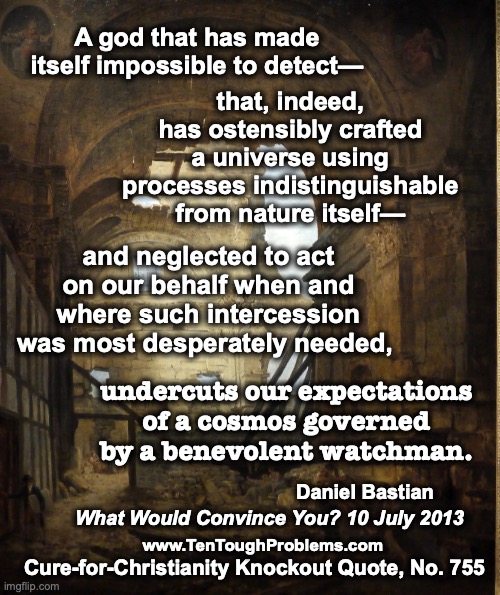
“A god that has made itself impossible to detect—that, indeed, has ostensibly crafted a universe using processes indistinguishable from nature itself—and neglected to act on our behalf when and where such intercession was most desperately needed, undercuts our expectations of a cosmos governed by a benevolent watchman.” 

David Madison was a pastor in the Methodist Church for nine years, and has a PhD in Biblical Studies from Boston University. He is the author of two books, Guessing About God, Volume 1 of Ten Tough Problems in Christian Belief  (2023) and Ten Things Christians Wish Jesus Hadn’t Taught: And Other Reasons to Question His Words (2021). The Spanish translation of this book is also now available. 

His YouTube channel is here. He has written for the Debunking Christianity Blog since 2016.

The Cure-for-Christianity Library©, now with more than 500 titles, is here. A brief video explanation of the Library is here