
Author: Richard L. Fricks
Writer. Observer. Builder. I write from a life shaped by attention, simplicity, and living without a script—through reflective essays, long-form inquiry, and fiction rooted in ordinary lives. I live in rural Alabama, where writing, walking, and building small, intentional spaces are part of the same practice.
The Boaz Stranger–Chapter 37

As promised, the back door was open. I wondered if Kyla’s late ‘need to use your bathroom’ trick was the reason.
I walked into a long narrow den overfilled with furniture.
Lillian followed. “Jane’s parents added the deck and this room when we were in high school.” I couldn’t help but think of Mom and Dad here two years ago.
I walked forward three steps and stopped, resting my hands on the top of a love seat. New Year’s Eve 2018 had been Blaine and Zadie Fordham’s turn. My parents and Jane’s folks had alternated hosting the end-of-year party for countless years. The thought of that happy and lighthearted evening was smothering. “This is like going back in time.”
Lillian stood beside me and rested her hand on mine. “It’s so sad. And to know that Blaine and Zadie would suffer the same fate.” I shook my head sideways and was reminded how unfair life can be. It was nigh unbelievable that the Fordham’s had died in a car accident mid-July 2019 while returning from a week’s vacation in Gulf Shores.
I didn’t need or want to think of death. Plus, Lillian and I had work to do. “Come on, let’s get with it.” I eased through the den, meandering around chairs, tables, and piles of books, magazines and newspapers.
“You’re headed to the kitchen. The bedrooms are this way.” I’d missed the sliding glass door to our right when we’d entered from the deck. Curtains hung from ceiling to floor.
“I want to see the entire house. This way probably ends up in the same spot.”
“Okay.” Lillian said, walking to me and the cased opening leading to the utility room. “Can you imagine living in one spot your entire life?”
“Jane?” I hadn’t thought about it. I knew she had never married, but I’d assumed she had moved back to her home place after her parents died.
“Yes. Jane’s been here for sixty-six years.” Lillian nudged me forward when I looked through a half-glassed door onto a carport.
“That too is sad.” The kitchen was a rectangle about as long as the add-on den but felt wider.
“This room used to be the kitchen and the den.” Lillian pointed to the far end. “During their remodel, they removed this wall.” She pointed as she walked to the other end of the room. “What used to be the living room is now the dining room.” I joined Lillian and saw a large table, a buffet, and a china cabinet. So far, the floors, except for the carpeted den, were cheap linoleum.
“I take it you came here a lot while growing up.” Lillian nodded affirmatively and disappeared into an adjoining hallway.
I almost opened the front door to my left but joined Lillian instead. By now, she was inside a bedroom at the end of the hall. There was a closed door to my left. “This was Blaine and Zadie’s bedroom.”
The room was small, just large enough for a regular size double bed, an upright chest of drawers, and a mismatched dresser with a cracked mirror. I walked inside and to my right, past a small bathroom and a narrow closet with its door wide-open. Nothing but clothes. “I don’t think we’ll find anything here.”
“Two more bedrooms. Come on.” Lillian walked back into the hall and turned right, opening a closed door as she moved forward. I heard the click of a light switch. Before I could exit the master, Lillian semi-yelled: “oh my god.”
I was equally shocked when I arrived. Photographs, large and small, and countless newspapers clippings, filled the back wall. We both eased forward like zombies. The only furniture was a small wooden desk and chair in the middle of the room. Along the walls to the right and left were three-foot-high narrow tables lined with books and supported by heavy angelic-looking bookends. They reminded me of Rachel’s Heavenly figurine collection. “Ray Archer,” I said before I reached the back wall.
It didn’t take Lillian but one visual pass across the huge montage to see something that caught her eye. “Damn, look at this.” I edged her way. “This has to be Ray and Jane at the Valentine’s Dance.” The photo was an eight by ten color photo of a tall, muscular Ray with a solemn face standing beside a skinny girl with a giant smile and heavily make-upped face. I hardly recognized her.
I gazed around the central photo. It was the only one that included Jane. All others were of Ray, including his senior portrait and several feature shots of him playing sports: football, basketball, and baseball. There was one of him standing outside his red Mustang. Newspaper articles encircled the photos. After a cursory glance, I concluded they dealt with Ray’s professional career. Those across the top and down the left side focused on his pharmacy empire, from the first operation on Mill Avenue to the last sale of 232 stores to Walgreen’s in 2015. The articles underneath and to the right concerned Rylan’s. In two of these articles, Jane, someone, highlighted several sentences. I chose not to read.
“God almighty, you got to see this.” Lillian snapped her fingers and head motioned me to her side. During my focus on Ray’s photographs and media coverage, she had slid to the left of the back wall’s central window. I had subconsciously assumed that half-wall contained more of the same. It didn’t.
Like the Valentine’s Dance photo of Ray and Jane, this wall contained a central feature. It was a young girl sitting upright in a metal bed. She was wearing a white tee-shirt or gown and was holding a baby, a very tiny baby. “Who’s that?” I asked, squinting my eyes while moving my head closer to the smaller picture. My conclusion shocked me.
I silently breathed to myself, that’s Rachel, the instant Lillian said, “She never had an abortion.” The words sounded like she spoke to them from a faraway foghorn, distorting enunciation and emphasis. I couldn’t tell if Lillian was making a statement or asking a question.
“Oh my God.” I asked Lillian to read the hand-printed text below the photo since I couldn’t.
“The chosen one. Elita Ann Kern. Born June 1, 1970.” Lillian started counting backwards, “May, April, March, February…” My mind and ears stopped working. It was like someone flipped the switch off. I backed myself to Jane’s desk and sat along the edge. I don’t know how many times Lillian said it, but I finally heard, “Lee, talk to me.”
She walked to me and took my face in her hands. “This is too much.” I’m sure I mumbled.
“It’s too shocking. Now I know for certain Rachel lied to me.” Her competing stories about the pistol seemed unimportant, nothing like the deception I’d just experienced. Lillian pulled me into her bosom and rubbed my head.
“Maybe she was trying to protect you.” Lillian’s words were the dumbest I’d ever heard. They made me mad. The hair on my neck bristled. My eyes shot poison rays towards the immoral woman in front of me. I stood, causing Lillian to stumble backwards.
“You can be so stupid. Rachel had a baby. She didn’t even know I existed.”
“Lee,” Lillian reached for my hand as I returned to the wall. “I’m sorry. My statement made no sense. What I should have said was that not telling you all your married life was her way of protecting you.”
“You’re right. And I’m sorry for my response. Come here.” We returned to Rachel’s picture. For the first time, I scanned the wall encircling the baby photo. Jane had covered the wall to the left of the window with newspaper clippings and hand-scribbled notes whose subject was Rachel Ann Kern, my deceased wife.
“Jane was not only obsessed with Ray, but Rachel also obsessed with her. Look here.” Lillian had removed the push pin holding a 4 by 6 card. “It’s yours and Rachel’s wedding invitation.” I ignored it and kept scanning the wall.
“Here’s the bulletin from mine and Rachel’s college graduation. How the heck did Jane get this? I sure don’t recall her coming to Charlottesville.”
“Jane must be omniscient.” Lillian said, repining the invitation and pointing to another picture. This one to her left and higher on the wall. “How did she get an article from Australia? Uncanny.” I moved next to her and started reading the text.
The Blue Mountains Gazette had chosen “Dream Comes True for Local Couple,” for the article’s title. Frank and Gina Packer had been home less than a week with their newly adopted daughter. The June 8th, 1970, story described the Packer’s long attempt to have children on their own. Two paragraphs on in vitro fertilization led to the end of the page. “Continued on Page 9” was italicized. Lillian flipped the semi-yellowed paper. There, in the lower right corner, was another photograph, no doubt showing the Packer’s, with Gina holding a pink clad little girl with two green ribbons tied to her jet-black hair. The caption underneath the photo said they took it at the couple’s Blue Mountains cabin. A newspaper used color photography over a half-century ago. Amazing.
Lillian and I finished the article, learning the Packer’s were prominent citizens of Sydney, and had made their fortune in iron ore mining. My guess is the couple was in their mid-forties. “What’s your conclusion?” I asked. I knew my own but wanted to hear Lillian’s.
“It’s not dispositive, but the Packers are the couple who adopted Rachel’s baby. Especially since Jane posted this clipping on ‘Rachel’s wall.’” Lillian handed me the article and used both hands to signal quotation marks.
While I kept staring at 16-year-old Rachel in the hospital bed holding her baby daughter, Lillian removed several newspaper clippings and returned to Jane’s desk. “I wonder if Rachel sent these.”
“To Jane? What are they?” I needed to stay near Rachel.
Lillian sat and paused a minute to review the articles. “All are from the New Haven Register. Two concerns. One’s about Rachel being teacher of the year at Amity High School. The other shows her with a student who made straight A’s her senior year.”
“2008. The student was Isabella Lopez, a special needs girl Rachel taught and tutored for three years.” The memory of a teacher and student spending hours on Saturdays in Rachel’s basement flooded my mind. “What about the others?”
“A group of cheerleaders, including Leah. One is dated May 18, 2004. The next one is Leah and three others winning the regional debate tournament.” I could see Lillian had stacked these to her left. She was staring at another photograph in the last article. “Lee, come here.” I guessed it might be Lyndell running track or pitching a baseball.
Lillian stood and clutched the article to her breast. She insisted I sit. I followed her instructions and again was shocked by what she laid on the desk in front of me. “Reward” blazoned across the top of a flier stapled to the newspaper clipping. I continued to read, searching for a date. There wasn’t one, but I soon figured it out. Fifteen-year-old Elita had run away. The Packer’s offered a million dollars for information that lead to her discovery and return.
Lillian leaned over my shoulder to read the smaller text below the teenager’s ninth grade school photo. “Elita was last seen by a driver for Maxi Cabs who dropped her off at Sydney Kingsford Smith Airport.”
My iPhone chirped the second I flipped back to the newspaper article. It was from Kyla. “We’re fifteen minutes from Jane’s. She’s stopped for gas. The movie was horrible, so she insisted we leave.”
“Change of plans. We need to go.” I showed Lillian the text.
“Quick. I’ll snap some photos and you explore Jane’s desk.” Lillian removed her iPhone from her jeans and returned to the back wall.
I rolled the chair backwards and opened the lower right drawer. As expected, stuffed with file folders. I read a few labels, Elita, Leah, Ray, The Packer’s, and decided it was time to leave. “Lillian, let’s go.”
“Just a minute.” I could tell she was video recording everything on both sides of the window. I stood and walked to the bookshelf closest to the bedroom door. After seeing half the books read ‘Diary’ on their spines, I whispered, “shit, shit, shit,” knowing that Lillian and I were likely leaving a ton of relevant information tucked inside this room.
When I backed the Hyundai onto King Street, Lillian ordered me to, “go back, we forgot.” I rejected her demand and drove north towards Summerville Road.
“It’s too risky.” I couldn’t believe we’d been so distracted and left the stack of newspaper articles on top of Jane’s desk.
08/23/23 Biking & Listening

Biking is something else I both love and hate. It takes a lot of effort but does provide good exercise and most days over an hour to listen to a good book or podcast. I especially like having ridden.
Here’s my bike, a Rockhopper by Specialized. I purchased it November 2021 from Venture Out in Guntersville; Mike is top notch! So is the bike, and the ‘old’ man seat I salvaged from an old Walmart bike.

Here’s a link to today’s bike ride.
Something to consider if you’re not already cycling.
I encourage you to start riding a bike, no matter your age. Check out these groups:
Cycling for those aged 70+(opens in a new tab)
Solitary Cycling(opens in a new tab)
Remember,
Listened to the novel, All Your Perfects, by Colleen Hoover
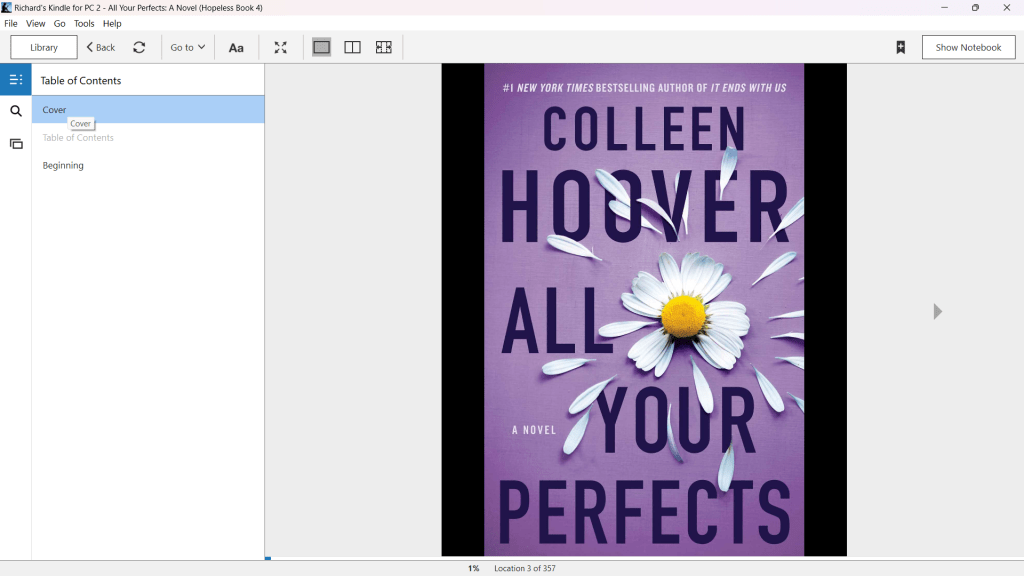
Amazon abstract:
INSTANT NEW YORK TIMES BESTSELLER
The #1 New York Times bestselling author of It Starts with Us and It Ends with Us—whose writing is “emotionally wrenching and utterly original” (Sara Shepard, New York Times bestselling author of the Pretty Little Liars series)—delivers a tour de force novel about a troubled marriage and the one old forgotten promise that might be able to save it.
Quinn and Graham’s perfect love is threatened by their imperfect marriage. The memories, mistakes, and secrets that they have built up over the years are now tearing them apart. The one thing that could save them might also be the very thing that pushes their marriage beyond the point of repair.
All Your Perfects is a profound novel about a damaged couple whose potential future hinges on promises made in the past. This is a heartbreaking page-turner that asks: Can a resounding love with a perfect beginning survive a lifetime between two imperfect people?
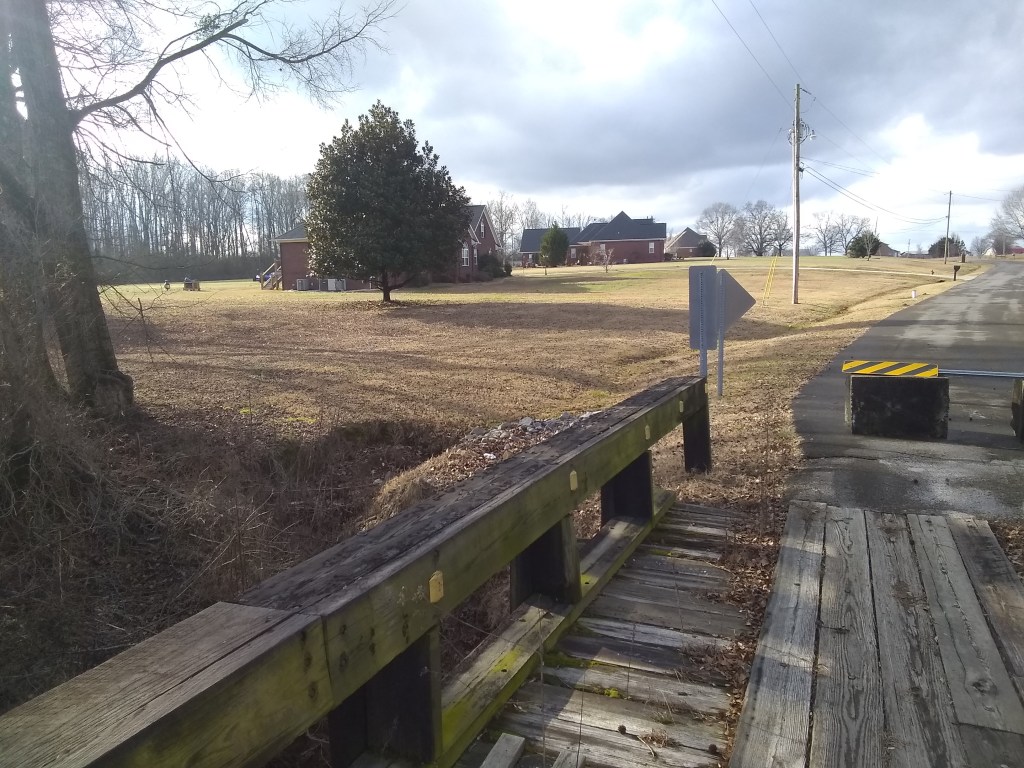
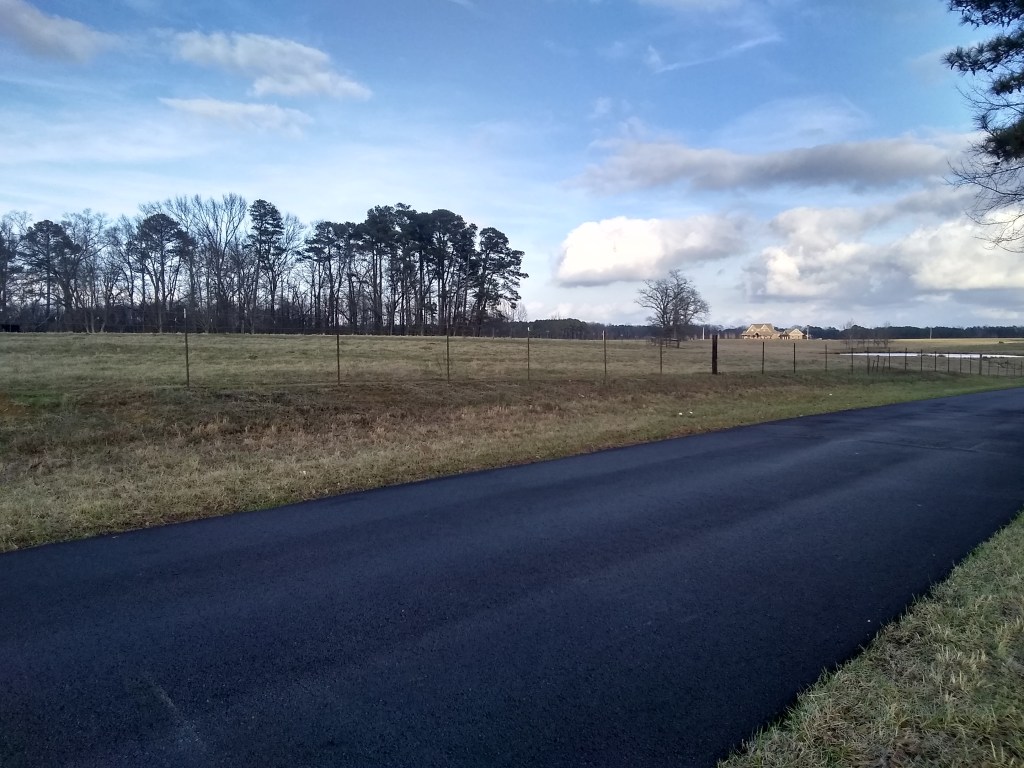
Here’s a few photos from along my pistol route:






















The Sweep and Force of Section Three
Why Donald J. Trump is disqualified to run for the presidency.
What is ‘woke’? It’s my trigger word
Here’s the link to this article.
 by
by AUG 19, 2023

Overview:
“Woke” is either the new “libtard” or it means nothing. Either way, it triggers me…
Reading Time: 7 MINUTES
Woke is the mot du jour. It’s everywhere. It’s what Tucker Carlson, formerly of Fox News, uses incessantly. It’s what presidential hopeful Ron DeSantis platforms against with his “anti-woke” campaign agenda. It’s what my father-in-law uses when he’s angry with, in his own mind, some new nonsense—“Oh what’s that word…yes, that’s it, bloody ‘woke’!” It’s what the Daily Mail rails against. It’s what the BBC supposedly is. Or Disney. Or Goodyear.
There is real confusion about what this now-surprisingly-common word actually means. So much so, indeed, that the conservative author Bethany Mandel recently had a car crash of an interview where she froze, completely unable to define what “woke” means. This is somewhat surprising given that she is an author of a book against “wokeism” (Stolen Youth: How Radicals Are Erasing Innocence and Indoctrinating a Generation) in which she attacks “wokeness” as “a new version of leftism that is aimed at your child.”
It seems commonplace that people on the right accuse the left of “wokeism” that underwrites a “cancel culture” instituted by the left. The reality is somewhat different, as I argued against evangelical Christian and 2016 presidential candidate David French on Premier Christian Radio.
Republican presidential candidate Ron DeSantis said in 2021, “What you see now with the rise of this woke ideology is an attempt to really delegitimize our history and to delegitimize our institutions, and I view the wokeness as a form of cultural Marxism. They really want to tear at the fabric of our society.”
I am probably the them to his us, the sort of person who wonders why “social justice” has become something bad to aspire to.
So what does “woke” actually mean?
In this general context, not what it originally did.
In its earliest iteration, woke was part of the phrase “stay woke”, being a phrase used within Black communities referring to being awake and “alert to the deceptions of other people.” It was “a basic survival tactic.” The phrase appeared in a 1938 song “Scottsboro Boys,” a protest song by blues musician Huddie Ledbetter (known as Lead Belly)—a reaction to nine Black teenagers accused of raping two white women. Lead Belly said of it, “I made this little song about down there. So I advise everybody, be a little careful when they go along through there—best stay woke, keep their eyes open.”
At the same time, “stay woke” also literally meant to stay awake, in Black vernacular. in 2008, R&B artist Erykah Badu released a politically themed album with the song “Master Teacher” that included the phrase being used in several different contextual meanings, bringing the phrase back to the fore.
Fast forward to 2014, when Michael Brown was shot by police in Ferguson, Missouri, and the phrase came back to life. Needs must.
The context of the subsequent Black Lives Matter movement saw the phrase, now shortened to “woke”, being associated with anything to do with racial equality. It was only a hop, skip, and a jump to it representing anything and everything liberal in the world.
Because racial equality is the purview only of the left?
A Black person on a BBC show where you might not expect to see them? Woke. (Think the new Little Mermaid film or the recent Lord of the Rings series.) Silicon Valley Bank collapsing? Woke. Yale physician advocating sensible Covid policies? Woke (a “mind virus attempting to destroy civilization,” according to Elon Musk). It’s rather dizzying, keeping an eye on the myriad uses of the term.
In fact, here linked are more than 200 things conservative TV channel Fox News has labeled as woke. A few examples might help to show how woke has become the bogeyman of the right. And it’s a little embarrassing now.
- Artificial intelligence: Turning Point USA founder Charlie Kirk declared that artificial intelligence will “become a woke super-weapon,” specifying that OpenAI’s ChatGPT will “make the left’s takeover of the West more efficient.” [Fox News, The Ingraham Angle, 2/21/23]
- Federal Reserve: Fox Business guest anchor David Asman said, “There’s a lot of pressure being put on banks by the already woke people in the Federal Reserve and other banking regulatory institutions not to give out loans to oil and gas companies.” [Fox News, The Story with Martha MacCallum, 3/31/22] And Fox Business host Charles Payne criticized the “woke Fed” for failing to raise interest rates to curb inflation. [Fox News, Your World with Neil Cavuto, 1/14/22]
- Economic policy: Fox Business host Larry Kudlow called the Biden administration’s economic policies, including the Child Tax Credit, “woke economics.” [Fox News, The Story with Martha MacCallum, 7/15/21]
- Rep. Cory Mills (R-FL) argued that since “the airline industry is so subsidized … they will always, you know, follow the woke method because they have no fear of going broke.” [Fox News, Gutfeld!, 1/11/22]
- Xbox: Fox & Friends host Ainsley Earhardt complained that Xbox’s new power-saving feature proved the company was “going woke … because of climate change.” [Fox News, Fox & Friends, 1/24/23]
- Covid: Former Fox contributor Lara Trump praised Florida Gov. Ron DeSantis for taking “a common sense approach to COVID” instead of “caving to the woke politics and saying, like, shut everything down.” [Fox News, Fox News Primetime, 4/12/21]
- Homosexuality: Fox host Kayleigh McEnany said Disney’s Toy Story spinoff Lightyear failed to impress at the box office because it was “a bit too woke.” She specifically mentioned its same-sex kiss scene, which “left some conservatives to blame what they call the movie’s woke agenda.” [Fox News, Outnumbered, 6/21/22]
- The military: Fox contributor Mollie Hemingway claimed that “woke generals” are “destroying” the military and represent an “existential threat to the country.” [Fox News, The Ingraham Angle, 6/22/22]
So on and so forth. It’s a long list. And when you look at every subject included in that list, you quickly realize that “woke” is a very large umbrella term. Gathered under the protection of this term is every single liberal. And every single centrist. And every single person who happens to hold an opinion that someone angrily hopping about on the far right doesn’t agree with.
When you use a term so much, in so many contexts, to attack so many ideas and so many people, it loses any coherent meaning or utility. In economics, this is the Law of Diminishing Returns. The first pint of water in the desert is very useful and rather refreshing. The 31st? Somewhat less so. We are now at a point that the term “woke” is empty, vacuous. It is the new “libtard”. If that’s where we are at, count me out.
It’s a very lazy term.
And the label now triggers me. If anyone mentions it, I take an instant dislike to their politics, to their morality. Because it says more about them than it does about me or their intended target. I can very often successfully sum up someone’s political positioning with their single use of that term in the same way that I can if they use the pejorative “libtard”. It carries about the same degree of nuance.
If you have issues with the use of pronouns and gender identity (and let’s face it, it’s something of a complex philosophical battlefield), then let’s have a reasonable debate. The same goes for climate change. And pandemic responses. And equality—racial, sexual, or otherwise. And…and…
However, if you are going to add into your debating rhetoric the use of the word “woke”, then you have lost me because not only is it completely simplistic, but it is a pejorative: It is used as a term to insult the opposition.
If I was to call every position or person I disagree with “fascist” or “Nazi” then these terms would lose their strength and utility and I would rightfully not be taken seriously. For “woke” I would prefer the term to be replaced with “progressive” in many of the cases because the intention of the target people or ideas is to make the world progressively better. The use of the word “woke” does a real disservice to the original meaning. When used as a pejorative like this, it becomes crass.
I am a socially liberal, economically centrist philosopher and politically motivated person. In the political psychology underwritten by the work of psychologists such as Jonathan Haidt (and his moral foundations theory), there are traits that are more associated with liberals than conservatives and vice versa. For example, liberals tend to be more inclined to an openness to new experiences, and fairness, whereas conservatives (the clue is in the name) tend towards conserving the status quo, being driven more by tradition.
We can see how some shifts in modern society might irk conservatives and motivate liberals. Some of these ideas are consistently seen as the beating heart of “wokeism”—perhaps gender identity, critical race theory and suchlike. (And so often, they are completely blown out of proportion.) Unfortunately, much of the problem comes when every other idea that (conservative) critics don’t agree with also get incorporated into the label.
We must remember that it is often ill-advised to listen to those with the loudest voices. The UK is following America’s lead when it comes to the right shouting about culture wars issues. All you need to know is that when politicians and pundits shout about the war on Christmas, or transgender restrooms, or political correctness gone mad, or the woke BBC, then they really have nothing substantial to talk about. Culture wars discussions belie a fundamental lack of policy.
We have seen this in successive US elections and it is starting to creep into UK campaigning. One side is serious about governing, and the other side has nothing in the locker but a woke checklist.
Do not be fooled.
The bandwidth of political discourse is being strangled with culture wars whinges about woke, and it helps nobody. We have existential crises facing us the likes and scale of which humanity has never faced: climate change and ravaging wildfires, the reignition of the Cold War into a very hot one, population, pandemics, wealth inequality, healthcare, and education. The list is long and worrying.
But when the right distract you with the woes of woke, they are deceiving you. They care little about these other topics, let alone have any actual workable policies on the matters.
There’s an awful lot of work to do without being misdirected by a shoddy magician’s sleight of hand.
It’s probably a tad inappropriate here, but the words of British comedian Kathy Burke (unlikely to be labeled “liberal elite”) are apropos: “I love being ‘woke’. It’s much nicer than being an ignorant fucking twat.”
If I was to be less abrasive and confrontational, I would simply say, “I’m woke. And?” Or, better still, “I’m nuanced. Challenge me on substance rather than throwing about lazy, childish labels.”
The progress towards a better future will be fraught with bumps in the road. We won’t always get things right, but shouting “woke” at anything and everything will end up throwing the baby out with the bathwater.
Simply put, if someone brings up wokeism at the beginning of a political discussion, then they have their priorities firmly in the wrong place.
The Boaz Stranger–Chapter 36
Lillian and I had given Kyla a half-hour head start. She was dropping by Jane’s house and the two of them were going to Gadsden to see a movie at the Gadsden Mall’s Pitman Theater.
I was proud of my sister. Unknown to me, she had been grooming a relationship with Jane. That’s why she had agreed to help her last night feed the Fusion youth group at First Baptist Church of Christ.
With my permission, Kyla had read and reread Rachel’s ‘wall’ diary. Until an hour ago, I was unaware she’d also read The Cost of Discipleship. Well, at least the penciled notes. I still felt guilty for holding on to a book that was so important to my mother-in-law. I’d flipped through it shortly after removing it from inside the Hunt House wall and concluded the hand-written notes were a mix of Rosa’s and Rachel’s. The one’s I’d read were comments on Bonhoeffer’s Christology. Since I no longer believed in God, my interest was non-existent.
However, Kyla was smarter and more adept at recognizing patterns than me. Her near-photographic brain was a resource I had always envied. It, and my curiosity, had triggered the idea of Lillian and me paying a visit to Jane’s house while she and Kyla were at the movies.
Besides a general feeling that Jane was pro-Ray Archer, two objects had motivated Kyla’s encouragement. One was a timing issue. The other was a coded note. The first one was more embarrassing.
Given my focus on the ‘wall’ diary’s shocking details about Kyle’s extortion attempts, his brutal murder, and Rachel’s surviving pregnancy, I’d overlooked an obvious issue: the writings covered the same period as the LONDON diary I’d found in our New Haven basement.
Kyla had been more observant. Before reading the ‘wall’ diary, I’d shared memories from the LONDON diary, including its time frame. Sis had instantly asked two opposing questions: 1) why had Rachel written two diaries covering the same six-month period? and 2) what if someone else had written the ‘wall’ diary? Naturally, I’d responded to 2) with, “only Rachel could have hidden The Cost of Discipleship inside the Hunt House wall.” In some ways, I was as quick as Kyla, but my reaction speed often revealed confusion. Sis got a laugh out of my illogic, offering several other possibilities for how Bonhoeffer’s book could have gotten inside the wall.
I could still kick myself for not bringing Rachel’s basement diaries with me to Alabama. Of course, they were now gone forever, given the New Haven burglary. I, like Kyla, was also questioning the credibility of the diary, now in the hands of Marshall County’s District Attorney.
Another object had caught Kyla’s attention. Scribbled inside The Cost of Discipleship, on page 118 and buried among Rosa and Rachel’s reactions to Bonhoeffer’s thoughts, was “38 to friend.” Kyla believed this referenced the murder weapon and the fact Rachel had given it to a friend.
Ultimately, I’d agreed with my brilliant sister, although I had vehemently argued we didn’t know what to believe, which of the two diaries held the truth. Nor did we think Rachel was referring to a pistol in her coded message inside the book. Come to think of it, we didn’t have clear evidence of who had written it, Rosa or Rachel. Their writing was eerily similar.
Regardless of my confusion (and possibly Kyla’s still-developing pattern), Lillian and I set sail for 282 King Street, our third break-in since forming our detective partnership.
***
It was the second time Lillian asked to drive the Hyundai. The first was early afternoon when the two of us had gone to Walmart for Kyla. “I don’t know why you’d ever get rid of the Aviator.” I’d already made a mental note to investigate a used one when I returned to New Haven. It was by far the most comfortable vehicle I’d ever driven, not to mention its luxuriousness.
Lillian paused halfway to Kyla’s mailbox to change her mirrors. “What’s your theory on Rachel’s diaries, the two with the same dates?”
“Hypothesis.”
“Uh?” Lillian turned right onto McVille Road. Sometimes I was too exacting.
“Never mind. Your guess is probably as good as mine, but I think it’s connected to the pistol.” The time on the dash was 6:35. Kyla should have sent a text by now if there was a problem. It was her first opportunity to go inside Jane’s and determine whether she had a security system. No text by 6:45 meant mine and Lillian’s visit was a go. I’d opted for the opposite: a text saying it was a go, but I’d let strong-willed sister win the argument.
“You’re saying that since it wasn’t the murder weapon, the diary likewise was a fake?” I stole a sideways view of Lillian as she asked her question and couldn’t help but inspect her cashmere sweater and tight jeans. I chose against asking her if she knew someone made her sweater from a goat.
I too-quickly responded. “That may be a shallow argument.” She glanced at me with raised eyebrows. “I mean, you stated what I’m thinking, but I could be wrong. One side of me wants to believe Rachel in the wall diary is being more detailed and open, certainly pointing the finger at Ray. My other side believes she was undecided, that she was torn over whether to reveal Ray’s crime.” The more I talked about the two 1969 diaries, the more confused I became.
“Whoa, I better slow down. I love this car. It sure didn’t feel like I was going seventy.”
“What’s your thoughts?” Lillian was smart and perceptive. More so than I’d believed when we were kids.
“Let me start with an assumption, I mean, one that Rachel had.”
“What’s that?”
“No one would find her basement diaries. To me, this gave her permission to disclose the Hunt House hiding place?”
“I see your point. Obviously, she was wrong.”
“About?”
“I found her diaries. Which, come to think of it, makes me think she wanted me to find them.”
Lillian turned left onto Highway 431. “What if, and you might not like this, what if Rachel was lying?” Wow, that felt like a drill bit piercing my ear. The words repulsed me.
“No way.” I said, recalling the sick feeling I’d already experienced over the fake pistol, and possibly Rachel’s abortion.
Again, Lillian glared at me. This time not raising her eyebrows but silently breathing a big ‘whoa.’ “Lee, I’m sorry this is so personal, but we promised to be open, even brutal, when dealing with the truth.” Lillian returned her gaze to the highway and laid a hand on my knee. “Baby, dear, Rachel took her life. She was troubled. And I doubt her story about Kyle’s death is all fiction.”
Lillian and I stayed silent as we passed Piggly Wiggly and Old Mill Park. She spoke when she stopped the Hyundai before crossing the railroad track. “Do you remember our first date?” I turned and looked at her, but she was looking south, toward First State Bank, like she was making sure a train wasn’t approaching.
I did not know why Lillian would ask, but I didn’t have any trouble recalling the tenth grade Valentine’s Dance, one of the most embarrassing scenes of my life. “How could I forget? Horrible.” My words didn’t match my intent.
“Uh? So it was that bad?” We continued to sit at the railroad tracks. Now Lillian was looking north. Past what I felt was my reddening face.
“No. I meant my dancing, in public. My homebound experiences didn’t translate well inside the school lunchroom.” I paused, wondering whether I should be completely open. Oh, why not. “Other than most everyone laughing at me, it was a wonderful night.”
“That’s better, old boy.” She started laughing as she eased forward across the less than smooth tracks. “Just so you know, I wanted to go steady with you before Ray spiked the punch bowl.”
Even though there wasn’t a red light, I looked both ways when we crossed Main Street. As usual, the downtown was dead. “I’m not sure that’s a compliment or simply a revelation of how tipsy you got.”
“Don’t you dare go there.” Before I could respond, Lillian asked me another question. “Do you think Ray spiked the punch?”
“Maybe. Probably. What makes you ask?” We passed Marshall-Dekalb Electric Coop. The remodeled office was impressive.
“To drown his sorrows, I guess.”
“Uh?”
“You must have forgotten. But let’s see. Who was Ray’s date that night?” I hoped the Boaz cops weren’t out. Lillian had a heavy foot.
Again, it was a crazy question. I guess she was killing time by making small talk. “You. In your dreams.”
“Oh, that hurts. Absolutely not. You still don’t know how much I liked you.”
“It’s getting deep in here. Don’t miss your turn.” We were approaching King Street and Lillian was still speeding up.
“Whoa Nellie.” The Hyundai’s brakes worked, and the tires squealed. I don’t know how she made the turn. “Jane Fordham.”
“Now I remember. No wonder Ray was downing so much punch.” I hadn’t thought in half a century about the weirdness of seeing Ray walk into the high school lunchroom with Jane on his arm.
“Talk about a mismatch. As far as I know, this was the only date Jane ever had.” Lillian fiddled with the air conditioner and fan when she slowed at Snellgrove Avenue. I guess her goat sweater, or something, was causing a hot flash.
“I see your point. Jane, like me, was born with brains and not beauty.”
“Funny. You’ve always been the most handsome geek in the world.”
“Here’s a thought. Maybe Ray was desperate for, well, you know.” I figured Ray would hump a pig if that was all he could get. The mental image was repulsive.
“According to Jane, that’s exactly what he wanted, but she had the self-control to make him wait.” I couldn’t tell if Lillian was speculating or revealing facts.
“What does that mean?” We crossed Short Creek Bridge and Jackie Frasier’s dilapidated mobile home came into view. A single naked bulb cast light above the newly constructed front porch.
“The next week after Fusion, I asked Jane how her date with Ray had gone. She pulled me aside and said something like, ‘I’m in love.’ What she said next brought clarity. She said it had been Rachel’s idea.”
I interrupted. “For Ray to take Jane to the Valentine’s Dance.” I stated without asking.
“Yep. Looking back, here’s what’s weird. Jane also said, ‘Ray didn’t have a choice but to take me to the dance, but now he does. I’ll keep him waiting.’”
We were almost to Pleasant Hill Road and Jane’s house. “I’m lost. Maybe I don’t have brains after all. What did Jane mean?”
“Given Jane’s look, double eye raise, I took her ‘wait’ statement to mean sexual. What I don’t know is how Rachel could make Ray take Jane to the dance. Of course, you know, that was a month and a half after Rachel left for China.”
“Park under that Weeping Willow tree at the side of the garage. It’ll hide the car.” Lillian did as instructed. We exited the Hyundai and walked to the back deck. I hoped Kyla had been right about Jane not having a security system.
08/22/23 Biking & Listening
Biking is something else I both love and hate. It takes a lot of effort but does provide good exercise and most days over an hour to listen to a good book or podcast. I especially like having ridden.
Here’s my bike, a Rockhopper by Specialized. I purchased it November 2021 from Venture Out in Guntersville; Mike is top notch! So is the bike, and the ‘old’ man seat I salvaged from an old Walmart bike.
Here’s a link to today’s bike ride.
Something to consider if you’re not already cycling.
I encourage you to start riding a bike, no matter your age. Check out these groups:
Cycling for those aged 70+(opens in a new tab)
Solitary Cycling(opens in a new tab)
Remember,
Listened to
Here’s a few photos from along my pistol route:
Can Christianity Survive—With So Many Problems and Scandals?
Here’s the link to this article.
By David Madison at 8/18/2023
2,000 years of momentum probably can’t save it
Surely the clergy, those most in tune with God, must be the happiest people on the planet: they enjoy a personal relationship with their creator, nurtured through years of prayer and pious study. How can their constant refrain not be, “This is the day which the Lord hath made; we will rejoice and be glad in it”? (Psalm 118:24) But this doesn’t seem to be the way things are working out. A few weeks ago I published an article here titled, The Morale of Christian Clergy Is Taking a Big Hit,
based partially on a study that many clergy aren’t doing so well. Then I came across this article, United Methodist pastors feel worse and worry more than a decade ago:
“A survey of 1,200 United Methodist clergy found that half have trouble sleeping, a third feel depressed and isolated, half are obese, and three-quarters are worried about money…[they] feel worse and worry more than they did a decade ago.”
I suspect that the vulnerability of Christianity might be a contributing factor—and its weaknesses had not been so openly discussed just a decade ago, although that discussion had been stimulated in 2001 with the publication of Richard Dawkins’ The God Delusion. Sam Harris followed in 2004 with The End of Faith, and Christopher Hitchens in 2009 with God Is Not Great: How Religion Poisons Everything. Never before had the Christian faith been critiqued so publicly, so devastatingly—and other secular authors have been encouraged to add their insights. There are now well more than five hundred books—most published since 1999—that explain, in detail, the falsification of theism, Christianity especially. And, of course, the Internet has provided a platform for atheist/secular thinkers to spread the word that belief in god(s) is hard to justify.

And the books keep coming. A few days ago, Robert Conner’s new book, The Death of Christian Belief was published. Do a search on Amazon for Robert Conner books to see his full output. I recommend especially The Jesus Cult: 2000 Years of the Last Days (2022) and Apparitions of Jesus: The Resurrection as Ghost Story (2018).
In this new book, Conner describes Christianity as we find it in the world today, but it’s not a pretty picture. In his opening chapter, Fade to Black—a theatrical term meaning that the lights go out at the end—Conner describes the struggle, the losing battle, of Christianity to survive in its traditional strongholds. In Europe, above all. This is hardly a mystery, since Europe was devastated by two world wars, with tens of millions of people killed—six million of whom were brutally murdered during the Holocaust. How can god-is-good theology maintain its grip in the face of such horrors?
Conner mentions watching the funeral of Queen Elizabeth II, with all the pageantry, ritual, and costuming that royal funerals entail—and the pious assurances that she must now be with God:
“Yet as I watched these solemn ceremonies, I wondered how many of those gathered really believed the queen had entered the Pearly Gates. Based on recent polling, almost certainly less than half—including the child choristers—at best. Some 2000 churches in the UK have closed in the past ten years and a recent survey paints a bleak picture of current Christian belief…church membership in the UK has plunged to less than ten percent…” (p. 7, Kindle)
Conner notes that, “Across most of western Europe the numbers are similarly grim.” (p. 8, Kindle) He provides statistics about the situation in Belgium, France, Spain, Ireland. Even in super-Catholic Poland there is slippage in belief. He also mentions the hit Catholicism has taken in Canada, in the wake of the residential schools scandal, which even prompted a papal visit to apologize for what had happened: “Priests and nuns from various religious orders systematically brutalized and sometimes raped these children, some 3000 of whom died of disease and neglect while in the custody of the Church.” (p. 11, Kindle) Connor mentions the dramatic decline in church membership and attendance in America as well.
In Conner’s giant Chapter Two, Death by a 1000 Cuts, he describes the really ugly manifestations of Christian belief. He lists the Seven Deadly Gospels, i.e., the gospels of hate, grift, lawlessness, lies, division, submission, and violence. Given the wealth of information that Conner provides here, it can surely come as no surprise to devout nice Christians that their church and their faith are in deep trouble.
For example, the gospel of hate has been horrifying, in our modern era demonstrated by Fred Phelps, founder of the Westboro Baptist Church:
“The Westboro Baptist’s ministry of hate rose to national attention in 1998 when Westboro members picketed the funeral of Matthew Shepard, a gay university student abducted, tortured, and left tied to a fence outside Laramie, Wyoming. Shepard died of his injuries in a hospital in Fort Collins, Colorado. Westboro Baptist, which preaches that AIDS represents God’s righteous judgment against homosexuals, often picketed the funerals of AIDS victims where members held up placards that displayed their trademark, GOD HATES FAGS.” (pp. 16-17, Kindle)
Just one more example, from the gospel of violence. There is quite enough in the New Testament to fuel violent behavior, including Jesus-script: “Do not think that I have come to bring peace to the earth; I have not come to bring peace but a sword.” (Matthew 10:34) This results in “Onward Christian soldiers, marching as to war…” and worse, as Conner notes:
“Gospel Jesus told his disciples, ‘You are the light of the world.’ (Matthew 5: 14) Sadly, there is little evidence from history to support that claim. Indeed, the history of Christianity is a nearly unbroken history of moral darkness. In the 1930s, Das Licht der Welt in Germany united behind an authoritarian regime that unleashed the darkest era in world history. The leading German theologians of the day threw their support behind Hitler’s rise to power, and soon German forces invaded their Christian neighbors, repeating a slogan from the Thirty Years War, Gott mit uns, ‘God with us.’” (p. 59, Kindle)
Perhaps Christianity has been losing ground because there is growing awareness that theology can manifest in such destructive ways. But die-hard believers tend to shy away from facing realities. And one of the major realities is that the New Testament itself is failed theology.
Conner deals with this in his Chapter 3: The Clothes Have No Emperor, which opens with the heading, “The New Testament isn’t history.” There is commonly a knee-jerk reaction among the pious to such an assertion: “Yes, it is—who in his right mind would make such a claim?” The blunt answer is: New Testament scholars themselves, many of them devout Christians. Conner traces some of the history of critical analysis of the gospels. He mentions Bart Ehrman, who has published so many books describing the faults and failures of the gospels especially (check out his list of books on Amazon).
For a long time, devout scholars have been trying to justify taking the gospels as history, but without much success. The first three gospels share so much in common, because Matthew and Luke copied so much from Mark. Conner points out that the author of John’s gospel added
“…a thick layer of theology to the stories, but we’re still left with a question that has no answer: where did Mark get his information? If Mark was written about 70 C.E. and Jesus died around 30 C.E., at least a generation passed before anyone thought to collect the stories about Jesus and put them into a gospel. To make matters worse, in the years between Jesus’ death and the writing of the first gospel we know a destructive war supervened that devastated the cities of Galilee and Judea, killed thousands, and scattered the survivors which presumably included potential witnesses to the career of Jesus.” (p. 73, Kindle)
Conner also discusses the confusion added by the apostle Paul, who never met Jesus, and bragged that he didn’t find out anything about Jesus from the disciples. His knowledge of Jesus came from his visions (= hallucinations). This undermines the claim that the New Testament is history.
The very helpful information in Chapter 3 is precisely what Christians don’t want to hear, acknowledge, or think about. When I was working on my first book (Ten Tough Problems in Christian Belief), I asked a few devout believers to review and critique a few of the chapters. Oh, no, they couldn’t do that! They had to focus on strengthening their faith. I sensed their doubts lurked just below the surface—and they didn’t want to check below the surface. I gave copies of my 2022 book, Ten Things Christians Wish Jesus Hadn’t Taught, to several Christian friends. The response was silence. They didn’t want to think about the issues I raised.
But they’re not alone, as Conner notes:
“In many cases the problem with Jesus Studies begins with scholars merely seeking confirmation for their presuppositions, but arguably in every case a related problem lies in the very nature of the evidence, evidence that has passed through multiple hands, is possibly (or definitely) corrupted, or evidence that it was simply a pious story to begin with.” (p. 81, Kindle)
I would say that Conner’s Chapter 3 is a must read—but I fear that devout readers will consider it a must not read.
In my article here next week, we’ll take a look at Conner’s next three chapters: Certifiably Crazy for Jesus, Where Christianity Goes to Die, and The Valley of Death.
By the way, I suggest that Conner’s book can be paired nicely with Tim Sledge’s book, Four Disturbing Questions with One Simply Answer: Breaking the Spell of Christian Belief. Of all the hundreds of books out there that make powerful cases against belief in the Jesus cult, these two deserve high ranking.
Full disclosure, by the way: I wrote the Foreword for The Death of Christian Belief, at Robert Conner’s invitation. He and I were interviewed together by Derek Lambert for a MythVision podcast. In his Chapter 3, he recommends my book, Ten Things Christians Wish Jesus Hadn’t Taught—as well as Seth Andrews’ brilliant Christianity Made Me Talk Like an Idiot.
No, not even 2,000 years of momentum can save the faith!
I’ll close today with this insight from Conner:
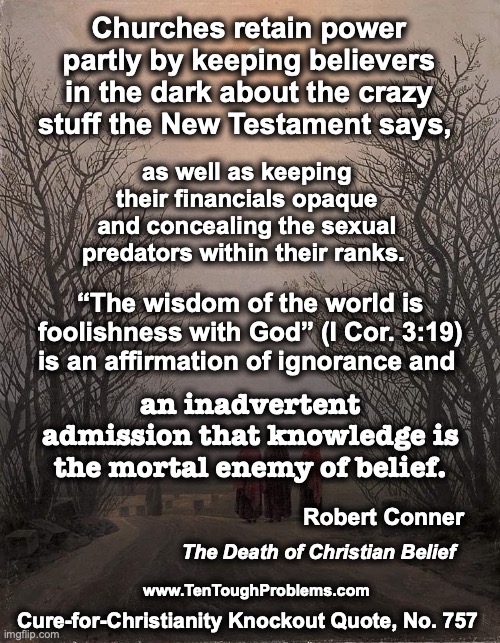
“Churches retain power partly by keeping believers in the dark about the crazy stuff the New Testament says, as well as keeping their financials opaque and concealing the sexual predators within their ranks. “The wisdom of the world is foolishness with God” (I Cor. 3:19) is an affirmation of ignorance and an inadvertent admission that knowledge is the mortal enemy of belief.” (p. 104, Kindle)
David Madison was a pastor in the Methodist Church for nine years, and has a PhD in Biblical Studies from Boston University. He is the author of two books, Ten ToughProblems in Christian Thought and Belief: a Minister-Turned-Atheist Shows Why You Should Ditch the Faith, now being reissued in several volumes, the first of which is Guessing About God (2023) and Ten Things Christians Wish Jesus Hadn’t Taught: And Other Reasons to Question His Words (2021). The Spanish translation of this book is also now available.
His YouTube channel is here. At the invitation of John Loftus, he has written for the Debunking Christianity Blog since 2016.
The Cure-for-Christianity Library©, now with more than 500 titles, is here. A brief video explanation of the Library is here.
The Boaz Stranger–Chapter 35
It was Thursday morning. Ray sat inside an attorney/client interview room next to Judge Broadside’s courtroom. Patience had always been an ephemeral idea, which, to Ray, made it a vice and not a virtue. Quick decisions and immediate actions were the stalwarts of his success. Or, so Ray believed.
It was ten minutes before his bond hearing and Morgan Selvidge was nowhere in sight. Ray’s attorney had not called or visited since Ray’s Tuesday afternoon arrest. Equally troubling was his cuffed hands and shackled feet. Apparently, the Deputy who walked him to the courthouse this morning hadn’t communicated with Deputy Jared. Thankfully, only his hands were cuffed in front and the shackles weren’t tight.
The Hearing was at 10:00. Ray countered his sweaty forehead and aching stomach by reflecting on the past forty hours inside Marshall County Jail.
Cell Block D had been worse than expected. Although the food was acceptable, the privacy was not. Unlike what Deputy Jared had promised, the jailer forced Ray to share an eight-foot by ten-foot cell with another inmate. Now, waiting at the courthouse for his defense attorney, Ray acknowledged things could have been worse.
The bad appeared shortly after breakfast yesterday morning. Ray had been told the visitor was his chef and kitchen manager. Neither were true. It was Billy James, Buddy’s brother, sitting opposite the thick plexiglass inside the visitor center. Ray couldn’t recall when he’d been so angry.
Billy demanded money, his share of ‘the job.’ Ray almost hung up the phone and called for the guard. What he learned from staying and listening confirmed the stupidity of what he’d done, the entire endeavor to burn the Hunt House for an estimated quarter million-dollar profit. The irony was that Buddy had disappeared with Ray’s hundred thousand dollars, leaving him zero profit, given the likelihood the insurance company would balk at paying the claim.
Another thing Ray had learned was that Eric Snyder, the man discovered in the ashes, had bragged about making a quick ten thousand dollars. Of course, Buddy had never paid him. This was the money Billy demanded. His twisted thinking convinced himself he deserved a share of Buddy’s windfall despite his lack of participation.
Before Billy left, Ray concocted a plan and promised he’d pay fifty thousand dollars, but it would have to wait until he was released. Billy left with a fist bump toward the plexiglass. Ray reciprocated with two hands for double assurance. Secretly, Ray knew he had no choice but to quiet the James brothers’ unpredictable tongues. They could no longer be trusted to protect him. How he could accomplish this goal was now merely an idea.
An unknown deputy entered the witness room and relayed to Ray that his attorney had called Judge Broadside and announced he was running fifteen minutes behind. After an affirmative head nod, Ray considered firing the uncommitted Morgan Selvidge and asking the Court for a continuance. Unfortunately, that would return him to his jail cell. Ray waited.
Orin Russell had been the good thing about Ray’s two-day stay inside the Marshall County Jail. By luck or the grace of God, Russell had the makings of a trainable and trustworthy replacement for the incompetent and disloyal James’s brothers.
Orin Russell was from Albertville, nineteen years old, and charged with the kidnapping and sexual assault of his stepmother’s 15-year-old daughter. The tall and muscular jail mate reminded Ray of his younger self. Both had been star athletes in high school and had dreamed of going all the way to the pros. Both had a commanding presence and an entitlement attitude. Like Ray, Orin had an insatiable appetite for women and wealth. Yet, he lacked a viable pathway forward, especially when considering his inept and lethargic court-appointed defense attorney. Last night, it had taken little for Ray to convince Orin his ticket to success lay with his sixty-seven-year-old jail mate.
Ray always believed he had the near-supernatural ability to discern real from fake. But he’d always been cautious to double-check and verify. So, Ray anchored his plan for him and Orin in high moral principles and undetectable coded language.
After an hour of Ray sharing a brief biography, his hopes and dreams for Rylan’s, and the name of a criminal defense attorney who’d be in touch, Orin had accepted Ray’s generous job offer. His primary responsibility would be to mirror Ray’s daily activities and learn the intricacies of real estate development. In sum, to perform duties as delegated by his boss. Like Ray, Orin had made good grades in school and learned quickly. He eagerly promised to devote “every waking hour to making Ray happy.” This morning, before the deputy arrived to walk Ray across the street to the courthouse, Orin had jotted down all his new boss’s contact information.
It was 10:20 AM when Morton Selvidge joined Ray inside the interview room. “Before you go ballistic on me, let me share the good news.”
Ray listened. He could always give his lackluster attorney a pink slip after leaving the Marshall County jail.
“The DA’s agreed to my offer.”
“And that is?” Ray would quickly agree to ten million dollars if that’s what it took. It was only money.
“A million-dollar cash bond and an ankle monitor.”
“I’d rather pay more money and keep my freedom.”
“I expected that. DA won’t have it. To her, you’re too much of a flight risk.”
After offering to put up ten million dollars, Ray asked for details concerning the ankle monitor, primarily whether he could leave the Lodge.
“Five-mile diameter. From your home. Otherwise, we’ll have to ask special permission.”
Ray finally agreed and Morton left to tell the DA and Judge.
***
What Ray didn’t know was that his jail mate hadn’t been completely truthful. Although he was Orin Russell, nineteen years old, and a former Albertville High School star athlete, he had already accepted another position working for private investigator Connor Ford. His assignment was to gain information. Ford hired Orin to snitch on Ray Archer.
The idea hadn’t originated with Connor. Last Saturday afternoon, Lee had received an email from Linda Smith, his former English teacher. As promised, she had sent a copy of Kyle’s tenth-grade essay, a complete manuscript. In it, Kyle had learned of Ray’s secret involvement with a girl he referred to as Babe 2. She had been a young and beautiful Albertville High School cheerleader. That was before she disappeared. Kyle had used this to persuade Brute to “do the right thing,” about not only Babe, but Babe 2’s family. To Lee, it strongly suggested Ray had learned Kyle had become a threat to his success, even his freedom. And this was before Lee had conducted any investigation.
Lee’s sources were the archives of the Sand Mountain Reporter and The Advertiser Gleam. Articles dated during the summer and fall of 1969 revealed the girl, a Sharon Teague, had disappeared after being raped and before she had disclosed to her mother the name of her attacker. From these definitive facts and Kyle’s nondescript essay, Lee framed the hypothesis that Ray killed Kyle to prevent the disclosure of his criminal actions.
Lee’s call to Micaden Tanner had triggered a causal reaction. Micaden shared Lee’s hypothesis with Connor Ford, who conferred with his longtime friend Mark Hale. Fortunately, Hale was privy to investigator Avery Proctor and the DA’s recent interest in cold cases. Proctor had revealed the name of Orin Russell, the grandson of Susan Vick, the late Sharon Teague’s sister.
Orin’s recent arrest was a fortunate occurrence, or a gift from the gods. To avoid future evidentiary reasons, the DA’s office had declined involvement. That hadn’t stopped Ford from meeting with Russell and motivating him to seek justice on behalf of his deceased great aunt, especially when the opportunity came with hopes of probation or a much-reduced sentence if convicted.
 Richard L. Fricks