Novel Excerpts–The Boaz Schoolteacher, Chapter 30

The primary aim of the "Novel Excerpts" blog category is to showcase my creative writing, specifically from the novels I've written. Hopefully, these posts will provide a glimpse into my storytelling style, themes, and narrative skills. It's an opportunity to share my artistic expressions and the worlds I've created through my novels.
The Boaz Schoolteacher, written in 2018, is my fifth novel. I'll post a chapter a day over the next few weeks.

Book Blurb

In the summer of 2017, Katie Sims and her daughter Cullie, moved from New York City to Katie’s hometown of Boaz, Alabama for her to teach English and for Cullie to attend Boaz High School .  Fifteen years earlier, during the Christmas holidays, five men from prominent local families sexually assaulted Katie.  Nine months later, Katie’s only daughter was born.

Almost from the beginning of the new school year, as Katie and fellow-teacher Cindy Barker shared English, Literature, and Creative Writing duties for more than 300 students, they became lifelong friends.  

For weeks, Katie and Cindy endured the almost constant sexual harassment at the hands of the assistant principal.  In mid-October, after Cindy suffered an attack similar to Katie’s from fifteen years earlier, the two teachers designed a unique method to teach the six predators a lesson they would never forget.  Katie and Cindy dubbed their plan, Six Red Apples.

Read this mystery-thriller to experience the dilemma the two teachers created for themselves, and to learn the true meaning of real justice.  And, eternal friendship. 

Chapter 30

I may have slept for a week but for Cindy.  At first, I thought I was dreaming.  I kept hearing, “oh Father, touch her, oh Father, show her your mighty power, oh Father, give her your peace, the peace that surpasses all understanding.  Oh Father, let her know we love her and that she can stay here but give her just the right home whereever that is.”  What scared me was the part where I was falling down an elevator shaft, the elevator was speeding just ahead of me and it was on fire.  The red flames were licking my face but not burning me.  A soft and gentle hand reached up and touched my face.  I awoke to Cindy’s flaming red hair and her adorable smile.  Our eyes met just as she completed her prayer.  I felt, or believed I felt, an electricity rush through my body.  Had God been so quick to answer Cindy’s prayer?

“I’m sorry to wake you but I was getting worried.  You’ve been asleep nearly twelve hours.  It’s six o’clock and I have supper ready.”  Cindy said, standing and pulling back a heavy quilt and blanket leaving me covered with only a sheet.  “Steve is an enigma.  He’s hot natured and can swim in the pool with snow on the ground but can’t go to sleep without a pile of covers.”

It was then I realized I must be in her and Steve’s bed.  Yet, the bed seemed small.  “I pictured you having a giant king-sized bed.”  I said.

“We used to until his mother gave him this bed.  He grew up sleeping in this oak oasis as he calls it.  I’ve gotten used to it and to sleeping in his arms.  He’s one who loves cuddling.  At first it wasn’t easy, I’m such a light sleeper.  The Ambien helps.”

I laughed to myself.  “You’re one lucky woman.  He worships you.”  For the first time in nearly fifteen years I wanted a man, not just any man, but one who would love me like Steve loved Cindy.  After the rape, I couldn’t stand the thoughts of being touched.  This revulsion had destroyed mine and Colton’s relationship.  We had remained friends, but no couple can survive without intimacy.

“Katie, I know you know this, but I have to say it.  I am so sorry for what happened.  I know how much you loved Nanny, and Sammie for that matter.  I can’t imagine what you are going through.”

“Actually, I haven’t been feeling much of anything.  Did you say I’ve been here for twelve hours?”

“Yes, no doubt it was the Valium.”

“What?  Valium?  You drugged me?”  I asked.

“No.  Dr. Landers did.  Don’t you remember going to the Sand Mountain Clinic?”

“No.”

“He is one of Steve’s fishing buddies.  On our drive back from your house, after the fire, Steve called and asked him if he would see you and Cullie.  Both of you were in shock or something like it.  Dr. Landers met us and examined both of you.  He said ya’ll needed to sleep so he prescribed one Valium each.  Yours worked better than Cullie’s.  She’s been up since noon.”

“How is she?”  I couldn’t believe I had lain in Cindy’s bed for half-a-day and not been taking care of Cullie.  She had just lost her great-grandmother and no doubt had to be reeling.

“She’s thankful to be alive.  She told us about Midnight.”

“Oh my gosh.  Midnight.  Did he make it out of the house?”  I hadn’t even thought about the beautiful black-as-night kitten that had touched Cullie so much she was dreaming about starting an animal shelter.

“No.  I’m sorry.  I guess we could say he sacrificed his life so you two could live.”

“I’m not following you.”

“Don’t you know?  Cullie said if it hadn’t been for Midnight she would have never woken up.  And, you probably wouldn’t be here right now.  Another few minutes and you two would have been overcome by the smoke.”

“Life sure is held together by a slender thread.  A stray kitten is adopted by a teenage girl who happened to stop at one of a dozen gas stations.  The kitten goes on to save its new owner and her mother from a raging fire.”

“A fire that was intentionally set.”  Cindy said, giving me a look that was at least a cousin to the one when confronted by Wilkins in his office.  “Katie, my dearest friend in the whole world.  Early this morning, someone tried to kill you and Cullie.  They succeeded in killing Nanny and Sammie.  And, Midnight.  How does that make you feel?  Or, are you still in so much shock you can’t feel anything?”

“My feelings are a jumbled mess right now, but my mind just woke up.  I know, and you know who did this.  There is no doubt in my mind it was the Faking Five.  They are the only ones who have any motive.  This changes everything.  I can take a lot of abuse, but they stepped across the last line when they attacked my family.  The idiots, they should know you don’t go fucking around with a mother bear when her cubs are around.”

“This is really not the time to ask but I know our friendship is strong.  Do you think you are ready for Six Red Apples?”  Cindy asked, pouring her green eyes into me, not cracking a smile.

“Hell yes.  Mama Bear is angry.”

Cullie and I stayed a week with Cindy and Steve and their family.  They helped us more than we could ever repay.  I think Cullie would have stayed forever.  She witnessed what a real father was all about.  Steve loved his wife and his three children.  He worked hard all day at his job but when he was off he invested full time talking, walking, playing, and fishing with the Barker tribe as he called them. 

Wednesday, after Nanny’s memorial service, Steve took Alysa and Cullie fishing in Guntersville.  I liked how he was a take-charge guy.  He had seen how distraught Cullie was at the funeral home.  It was something about not being able to see Nanny in her casket that had shaken Cullie to her core.  I think it was the fact that the State hadn’t been able to perform an autopsy.  She had overheard me talking on the phone with Dr. Vincent.  I had made the mistake of having him on speaker, not realizing that Cullie was listening from the hallway outside Steve and Cindy’s bedroom.  Dr. Vincent had said, “her body was too badly burned for us to conduct an autopsy.”   After the service, Steve had held her in his arms, told her he loved her, and said, “you need a change of scenery.  Alysa and I know just the spot.”  I will forever be grateful for the miracle he performed that afternoon.

Saturday night, almost a week after the fire, I sat out back on Steve and Cindy’s patio.  They had tried to get me to go with them to the Gadsden Mall, something to do I suppose to get out of the house that was growing smaller by the day, even though it was a sprawling ranch, with four bedrooms and a giant great-room/kitchen combination.  Cullie loved the idea and tried to persuade me to join them.  I couldn’t.  That place was too tied to the horrible memories of the worst night of my life.  I knew if I went all I would think would be, “I’m watching American Assassin and in six hours I will be nearly burning alive.”

After twenty minutes or so of wondering how, when, and where I would ever get back to writing, my iPhone vibrated in my pocket.  It was Sheriff Waldrup.  After his wife had given me his cell number I had entered it into my Contacts.

“Hello Sheriff.”

“Katie, can we talk?”  It was the second time I had talked to him since the fire.  Cindy had said that he had called Sunday afternoon, but she had told him I was in another world and needed to stay there.  Monday morning, after breakfast, he had called just to check on me and Cullie and to tell me how sorry he was for our loss.  That call had lasted just a couple of minutes.

“Yes.”

“Have you and Cullie made any plans about where you will be living?”

“We’ve been talking about it.  Cullie wants to stay here with Alysa.  Cindy and Steve are wonderful and said we could stay as long as we wanted but I can’t do that to them.  They have a large family and need their space.  I’m afraid of how us staying could eventually affect mine and Cindy’s relationship.”

“I have an idea, and please don’t think ill of me.”

“I doubt that will happen.”  I said, always thinking of Sheriff Walt Longmire every time I talked with Sheriff Waldrup.

“I have a place you can live until you decide what to do.  It’s in Smith’s Institute, right past Sardis City.”

“That’s very generous of you but we couldn’t do that to you and your wife.”  I said almost shocked that Walt, Wayne, would be so caring and generous to someone he barely knew.

“Uh, I’m not married.”

“That’s odd.  I talked to your wife last Friday night.  She told me you were in Atlanta.  She also gave me your cell number and said it had been hacked or something.”

“That was my sister.  She always comes and babysits my house when I’m out of town.  She lives in Rainbow City.”

“Oh, I’m sorry.  I just figured the very nice lady had to be your wife.”

“She is nice.  As was my dear wife.  Karen died five years ago.  Breast cancer.”

“I’m so sorry.  Sheriff, I do appreciate your offer but, quite frankly, it doesn’t seem right.”  I couldn’t quite figure out what to say or how to say it.  I couldn’t move in with a man, even a very nice man.  I had never even met him in person.  It would not be what Cullie needed. 

“It would seem wrong?  Is that what you’re trying to say?”

“Yes.”

“Let me see if I can be clearer.  You and Cullie could live in my house.  I wouldn’t be living there.  My two boys, both grown and gone, built a log cabin on the back side of our property when they were in high school.  It became their hangout.  It’s about a half-mile from mine and Karen’s house.  Way past the pond.  Quite frankly, I’d love living there for a while.  I’m rarely home and don’t need all this room.”

“We’ll take it.  Your house.  Under one condition.”  I said, not believing I had made such a big decision so quickly but feeling like Cullie and I had squatted at Cindy’s exactly the right amount of time.

“Okay, let me hear it.”

“You promise you will be honest with me, completely honest, and tell me if things are not working out.  Cullie and I do need a place to live for a few months.  We have pretty much decided to rebuild.  I simply cannot see buying or building anywhere else.”

“I promise to be completely honest.  Now, when do you want to see my place.  Don’t commit fully until you come to kick the tires.  You may not like it.  Please know you are not under any obligation to take it.”

“I expect it will be just fine.  For some reason, I have a feeling that you’re not a slob.”

“Thanks for the compliment but if it weren’t for my sister you might change your mind.  Ever since Karen died in 2012, my one and only sister has come to check on me at least once per week.  She is a perfectionist when it comes to housekeeping.”

“I promise to take care of your house.  Your sister can maintain your cabin.”

“Her name is Rhea. Rhea Armstrong.  You remind me of her.”

“How old is she.  Forty-six.  She’s ten years younger than me.”

“Thanks again for the offer Wayne, Sheriff.”  I said embarrassed that I had called him by his first name.

“Call me Wayne.  Now, when do you want to take a tour?”

“How about tomorrow afternoon after church, say 2:00 o’clock?”

“Sounds good.  If something comes up, I’ll call you.  The address is 8853 Sardis Road.  If you come to Leeth Gap Road you’ve come too far.  My place is the last one on the left before Leeth Gap.  It’s a one-story ranch with a red windmill in the pasture in front of the house.  You can’t miss it.”

“Cullie and I will see you at 2:00.  Thanks so much.”

“Sounds great. Bye.”

I walked around Cindy and Steve’s swimming pool three times after my call ended with Wayne.  All I could think of was Cindy’s prayer late Sunday afternoon.   She had asked God to give me, Cullie and me, just the right home.  Now, here I was with an offer of a place to live, a totally unsuspected offer.  Was it God’s will?  Had He answered Cindy’s prayer?  It sure looked like God was at work.  What else could it be?

The God Illusion: Megachurch Pastor Robert Morris accused of sexually abusing 12-year-old girl

Here’s the link to this article by Hemant Mehta.

JUN 16, 2024

Morris, a Donald Trump ally, admitted to “inappropriate sexual behavior” with a “young lady”


Robert Morris, a megachurch pastor who used his reputation to help Donald Trump get elected, admitted to sexually abusing a child for a “few years” beginning when she was only 12. He was in his twenties at the time of the attacks. Morris is now downplaying the severity of what he did by referring to it merely as “inappropriate sexual behavior with a young lady.”

Before going into the details of the allegations, it’s important to understand Morris’ standing in the evangelical world.

When Trump was trying to convince conservative Christians to support him in the summer of 2016, he released a list of his “evangelical executive advisory board,” a collection of mostly white, mostly male Christians who would be guiding him in the months ahead. That list included the likes of James DobsonJerry Falwell, Jr., and Ralph Reed.

It also included Robert Morris, the senior pastor of Gateway Church in Dallas, Texas.

Robert Morris preaching at Gateway Church (screenshot via YouTube)

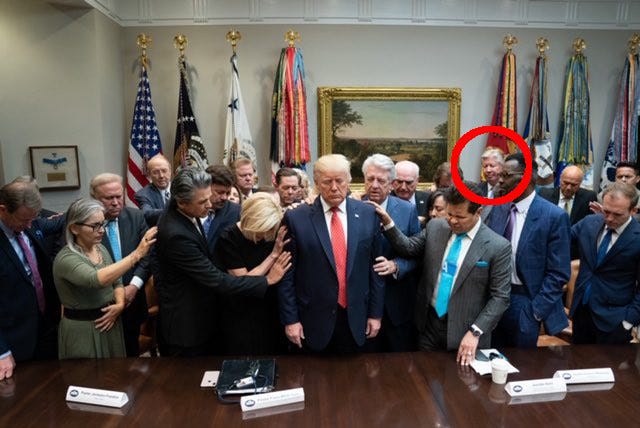
Morris is the sort of person who claims his prayers can cure women’s infertility and that it’s “scientifically impossible to be an atheist.” He even prayed over Trump in the White House in 2019.

In 2020, Trump visited Gateway Church for an event on race relations and the economy. During the event, he thanked Morris and other church leaders by saying they were “Great people with a great reputation.”

The reason Morris amassed the sort of power that allowed him to be that close to the president is because he was able to hide his own actions for decades.

According to the Wartburg Watch, which first broke this story, Morris was a traveling evangelist in 1981 when he visited Tulsa, Oklahoma and met a family with an 11-year-old daughter named Cindy Clemishire. (Because she’s gone public with her story, I’m naming her here.)

Morris, along with his wife and son, stayed with Cindy’s family frequently. They all became very close.

On Christmas Day, 1982, he allegedly invited Cindy to come to his bedroom where he proceeded to touch her beneath her clothing. He then told her, “Never tell anyone about this because it will ruin everything.”

As a little girl, she didn’t know any better.

Part of the reason Morris was able to get away with it, and the way he was able to get so much alone time with the child, was by telling his wife he was “counseling” the little girl.

This sort of behavior continued for years, through 1987.

At one point, Cindy told a friend what had happened and the news came back to her own father, who “demanded that Morris get out of ministry.” Morris stepped down for two years. When he finally returned to preaching, he began the church that would later become Gateway Church.

It wasn’t until Cindy was much older that she realized the extent to which she had been abused and just how inappropriate (and criminal) it was.

In 2005, she obtained an attorney to file a civil lawsuit. Robert Morris’s attorney responded by implying that they believed it was her fault because she was “flirtatious.” She asked for $50,000 (which was not much in my estimation.) They responded that they would give her $25,000 if she signed an NDA. She refused, so she can now tell her side of the story.

If that story is true, it’s appalling (but not surprising) that the attorney blamed the child for what Morris did to her. No 12-year-old girl can legally consent to sex with an adult. She was not flirting with him.

(Interestingly enough, in one of Morris’ books, he writes about how he stepped down from ministry in his mid-20s—a time period that coincides with when Cindy’s father demanded he get out. The book, however, says God told Morris to take time away from the pulpit to deal with his “pride.”)

When reporter Leonardo Blair of the Christian Post asked Morris for comment about these allegations, the church responded with a confession of sorts. But they’re all acting like it’s not that big of a deal.

“When I was in my early twenties, I was involved in inappropriate sexual behavior with a young lady in a home where I was staying. It was kissing and petting and not intercourse, but it was wrong. This behavior happened on several occasions over the next few years,” Morris said in a statement to The Christian Post after Gateway Church was asked about the allegations.

“In March of 1987, this situation was brought to light, and it was confessed and repented of. I submitted myself to the Elders of Shady Grove Church and the young lady’s father. They asked me to step out of ministry and receive counseling and freedom ministry, which I did. Since that time, I have walked in purity and accountability in this area,” Morris added.

He explained that he returned to ministry in March of 1989, two years after his abuse was exposed with the blessing of the survivor’s father and the elders of his church. He further noted that he and his wife met with the survivor and her family in October 1989.

“I asked their forgiveness, and they graciously forgave me,” Morris said.

She was not a “young lady.” She was a 12-year-old girl.

It wasn’t merely “inappropriate.” It was criminal.

It wasn’t just “kissing and petting.” According to Cindy, Morris “touch[ed] every part of my body and inserted his fingers into me.”

And Cindy’s father did not give Morris his blessings.

My father never ever gave his blessing on Robert returning to ministry! My father told him he’s lucky he didn’t kill him. I am mortified that he is telling the world my dad gave his blessing! Of course, we forgive because we are called to biblically forgive those who sin against us. But that does not mean he is supposed to go on without repercussions,” she said.

The statement from Gateway Church also included comment from the church’s elders, but it’s no better than anything Morris said.

“Pastor Robert has been open and forthright about a moral failure he had over 35 years ago when he was in his twenties and prior to him starting Gateway Church. He has shared publicly from the pulpit the proper biblical steps he took in his lengthy restoration process,” they said. 

“The two-year restoration process was closely administered by the Elders at Shady Grove Church and included him stepping out of the ministry during that period while receiving professional counseling and freedom ministry counseling,” they said. “Since the resolution of this 35-year-old matter, there have been no other moral failures. Pastor Robert has walked in purity, and he has placed accountability measures and people in his life. The matter has been properly disclosed to church leadership.

It wasn’t a “moral failure.” It was criminal sexual assault.

He didn’t share publicly from the pulpit why he needed any kind of “restoration.”

The fact that it happened 35 years ago is irrelevant largely because this was never made public until the survivor told her side of the story. (The Catholic Church learned the hard way that people won’t forgive them for clergy abuse that occurred decades ago.)

And no one should simply accept that Morris has had “no other moral failures” since that time because we already have evidence of this particular crime being covered up.

If “church leadership” knew all about what he did, what does it say about them that the congregation was never told Morris was a child sex predator? (In an internal Slack channel for Gateway, church staffers were given the same statement with no further details about how Morris sexually assaulted a child for many years.)

There’s simply no accountability of any kind happening here.

Morris is still, as of this writing, the senior pastor of Gateway. He’s not facing any punishments from his church, much less criminal charges. Hell, there’s a good chance he’ll downplay this story whenever he talks about it and receive a warm embrace from the people in the pews who he’s been lying to for all these years.

That’s what conservative Christians have a habit of doing whenever their pastors are forced to admit an incident of sexual assault that they thought they had swept under the rug. They do it so often that pastors have developed a playbook for these things. All they have to do is say they did something immoral, but it happened in the past, and they prayed on it, and God forgave them, and they’ve been doing great ever since. Rinse, lather, repeat.

There’s never any mention of all the people they hurt. There are never any details offered about the exact nature of their “immorality.” There are never any serious consequences for their actions.

The Dallas Morning News says that Morris wasn’t around on Saturday as this story began to spread:

Morris did not preach at the Southlake campus’ Saturday afternoon service, and the allegations were not addressed by pastors during the service. Several attendees either declined to comment or said they were unaware of the allegations.

It’s unclear if he’ll be in the pulpit today.

Morris has spent years preaching about sexual ethics and sin and consequences for one’s actions. During that time, he promoted a presidential candidate (and later president) who did all the things Morris urged people not to do because Christians like him love hypocrisy.

And all those years, he’s been hiding his own troubling secret. If the church’s initial response is any indication, they’re all still trying to bury the story.

Novel Excerpts–The Boaz Schoolteacher, Chapter 29

The primary aim of the "Novel Excerpts" blog category is to showcase my creative writing, specifically from the novels I've written. Hopefully, these posts will provide a glimpse into my storytelling style, themes, and narrative skills. It's an opportunity to share my artistic expressions and the worlds I've created through my novels.
The Boaz Schoolteacher, written in 2018, is my fifth novel. I'll post a chapter a day over the next few weeks.

Book Blurb

In the summer of 2017, Katie Sims and her daughter Cullie, moved from New York City to Katie’s hometown of Boaz, Alabama for her to teach English and for Cullie to attend Boaz High School .  Fifteen years earlier, during the Christmas holidays, five men from prominent local families sexually assaulted Katie.  Nine months later, Katie’s only daughter was born.

Almost from the beginning of the new school year, as Katie and fellow-teacher Cindy Barker shared English, Literature, and Creative Writing duties for more than 300 students, they became lifelong friends.  

For weeks, Katie and Cindy endured the almost constant sexual harassment at the hands of the assistant principal.  In mid-October, after Cindy suffered an attack similar to Katie’s from fifteen years earlier, the two teachers designed a unique method to teach the six predators a lesson they would never forget.  Katie and Cindy dubbed their plan, Six Red Apples.

Read this mystery-thriller to experience the dilemma the two teachers created for themselves, and to learn the true meaning of real justice.  And, eternal friendship. 

Chapter 29

Saturday, I stayed in the basement until early afternoon, coming upstairs only one time for Sammie’s glorious pancakes at 8:00 a.m.  I was thankful Papa had included a small bathroom downstairs.  I recall Nanny saying more than once during one of her regular strolls down memory lane that she had told him it was his bathroom and he had to keep it clean since he was the only one who needed a complete floor to house his hobby.  As far as I knew, other than my writing, the basement had never been used for anything other than storing junk.

I binge-wrote about once every six months.  I loved it and I hated it.  When I walked down the stairs a little after 4:30 this morning I hadn’t intended on staying more than a couple of hours, which was at least thirty minutes longer than I ever did during the school week.  It was something about the look on Cindy’s face when Wilkins caught her in his office.  He may not have noticed it, but I had.  For a split second, even from where I stood, I could see the animal that lies buried deep inside every human.  Technically, we are animals, just like chimpanzees and kittens.  Fortunately, millions of years of evolution has allowed us to realize survival depends on playing well together.  The old fight or flight gene lies dormant deep inside our psyche.  It stays that way until its owner’s back is against the wall.  It was something about Cindy’s stance and the look in her eye, for that split second, that I thought Wilkins was about to lose his own eyes.  For whatever reason, just as I suppose she acted when he had raped her, she had chosen to suppress the violence that is endemic in every human, given the right conditions.  That split-second visual had prompted me to delve deeper into my own protagonist’s willingness to confront her rapist with fire and venom.

By 3:30 p.m., Cindy and I were watching another movie at the Premiere Cinema 16 in the Gadsden Mall.  Cullie and Alysa were shopping.  I had wanted to see “Wilde Wedding,” but I was outvoted or overpowered by the cunning Cindy. She kept repeating American Assassin’s tagline, ‘Assassins aren’t born, they’re made.’  The thriller starred Michael Keaton, and Dylan O’Brien as Mitch Rapp, a young CIA black ops recruit.  His job was to assist a Cold War veteran in stopping the detonation of a rogue nuclear weapon. I thought the plot was rather mundane, clichéd, and missed several great opportunities to provide the audience with a few thrills, but it intrigued me enough to purchase novelist Vince Flynn’s book of the same name.  I had heard of this best-selling author but had never read a single book in his Mitch Rapp counter-terrorism thriller series.   Towards the end of the movie and after at least the tenth time Cindy had whispered ‘Assassins aren’t born, they’re made,’ she added, “you know Vince Flynn died of prostate cancer at the age of 47?”  Off and on for the rest of the movie and during our time eating and shopping at the Mall, all I could think was, ‘in two years I will be 47.’

After Cindy dropped Cullie and me off at home, she spent an hour modeling her new clothes for Nanny and Sammie.  I was surprised that Nanny had allowed Sammie to pause The Walton’s.  Last month’s Saturday shopping adventure in Gadsden had spawned an exciting and engaging look in Nanny’s eyes.  She had stood and talked with Cullie as she modeled jeans, blouses, tee-shirts, and boots.  I was surprised tonight that Cullie felt comfortable and confident enough to undress down to her bra and panties right in the den.  This thrilled Nanny and made Sammie fetch a few things from her bedroom that the two of them had purchased at Walmart a week ago today.  I don’t think I have ever laughed so much as Nanny and Cullie, pant-less and both with pink blouses strolled around the den.  Sammie whispered to me, “Nanny is reliving her youth.  This is the happiest I think I have ever seen her.”

At midnight I had to make Cullie pick up her scattered clothes and go to her bedroom.  I knew this adventure would turn into an all-nighter for Nanny who needed to stay on a strict schedule.  Midnight was already two hours past her routine bedtime.  Ten minutes after Cullie went upstairs and Sammie and I had restored the den from a modeling studio I visited Cullie as I often did, always hoping for a goodnight hug, maybe even a quick kiss.  “I want to do this every week, even if I don’t have new clothes.  I had no idea Nanny was so much fun.”  I went to bed thankful that Cullie was connecting with the woman I knew as a teenager and who had inspired me to reach for the stars.  I hated clichés but sometimes they were perfect.

At 2:45 a.m., I awoke to pounding on my bedroom door and a feeling I was suffocating.  I opened my eyes and could see my room was filled with smoke.  It was like a heavy fog had enveloped my room as I looked across to a bright light streaming in along the edge of my closed blinds.  “Mother, mother, get up, open the door, the house is on fire.”  Cullie screamed over and over.  At first, I thought I was dreaming, then the choking began.  I stood up and gasped.  I got down on the floor and crawled to the door.  I don’t know why it was locked.  I opened the door and Cullie was squatted down with a cloth over her mouth.  Here, she handed me a wet bath cloth.  “We have to get to Nanny and Sammie.”  I said.

“We’ll have to crawl to the top of the stairs.”  Cullie said.  I could barely see her but caught a glimpse of her hand motioning me to follow.   It seemed we were crawling on a reverse escalator.  The further we crawled the faster it seemed to slide us back in the opposite direction.  Finally, at the top of the stairs, we turned around and went down feet first with each of us using one hand to hold onto the hand-rail.  Cullie was the first one to the bottom.  I was still halfway up the stairs when she yelled.  “Hurry, we have to get outside, the kitchen is an inferno.”

Then, it hit me.  We are going to die.  If by some miracle Nanny and Sammie weren’t already outside there was no way to get to them.  Their suite was at the back of the house, down a long hallway from the kitchen, and there is no other route.  In the few seconds it took to reach the first floor, I also realized that something else was going on.  Just after Cullie and I had moved in at the end of July, I had bought six smoke detectors and installed two on each floor including the basement.  I had instructed Sammie to test them at least once per week.  As I turned towards the back of the house I didn’t hear the shrill sound of a single detector, but only the creaking, groaning, and popping of an old house that was being consumed by flames.  As Cullie was tugging on me and telling me we had to go out the front door, my attention was drawn to a single light coming from the door right outside the kitchen less than twenty feet away.  I started to crawl towards it and halfway there I was met with two things I will never forget.  The heat from the fire was what one feels when she’s stood too long in front of a fireplace and has almost caught her jeans on fire, and the second was the faint outline of a hand around the light-end of the flashlight.  It was either Sammie or Nanny, more likely Sammie.  She had tried to get out, tried to get help.  The kitchen was as far as she had gotten.  Then she collapsed.  The heat stopped me, and I retreated.  Cullie was already outside having had no choice but to exit the house. 

It took the firetruck another twenty minutes to reach us.  By that time the house had been completely engulfed in flames for nearly as long, ever since Cullie and I had escaped and retreated halfway to Bruce Road avoiding the heat.  It was the most helpless I had ever felt.  While waiting, Cullie and I had walked around the house, staying at least a hundred feet from the raging flames.  There had been no way to get to Nanny and Sammie, no door availed us.  Every entrance spewed fire like a dragon.

By daylight the firemen had the fire extinguished, neighbors had brought Cullie and me a set of clothes to cover our smoky and singed nightgowns, and I had given a statement to Troy Logan, the Boaz fire chief.  His final statement before Cindy and Steve took us home with them was, “I’ll be calling the District Attorney when I return to the Station, this appears to be arson.  We found empty gas cans throughout the first floor.”

I was glad our neighbor, Charles Fordham, had let me borrow his cell phone.  I had called Cindy and told her about half of what had happened, just enough for her to realize I was distraught.  I rarely cry but this morning I did.  It was so bad I couldn’t finish our conversation.  Within fifteen minutes her and Steve showed up.  They stayed with Cullie and me until the firemen recovered the bodies of the two dearest women I had ever known.  After the ambulance left and with the firemen promising to stay all day if it took it to ‘cold the fire’ as they put it, Cullie and I held hands in the back seat of Cindy’s Nissan Altima, with her crying and repeatedly asking me, “What are we going to do?  Where are we going to live?”  In between my times of trying to reassure her that we would be okay, maybe even rebuild, the only non-suffocating thought I could muster was a feeling of satisfaction for having rented a safety deposit box at Wells Fargo Bank the Friday before Labor Day and storing one horrible videotape and one copy of Darla’s two diaries that I still had not finished reading.

Sam Harris: The Anatomy of Embarrassment

Here’s the link to this article.

Poker anyone?

SAM HARRIS

Nature seems to have given us six primary emotions—happiness, sadness, fear, anger, surprise, and disgust. A glance at those cards suggests that the deck may be stacked against us. Only happiness seems worth wanting for its own sake. The rest, even the ambiguously valanced surprise, are generally unwelcome. Most of us regularly enjoy happiness, of course, and amusement, contentment, delight—even ecstasy—are among its many facets. But we must overcome countless forms of irritation and anguish to do so.  

Layered on top of the primary emotions, we find moral ones like pride, guilt, shame, empathy, gratitude, and outrage. Once again, it seems that anyone who simply wants to be happy in this world will find themselves at a disadvantage. If pride is good, it is so only for children. And, as Paul Bloom has noted, even empathy (in the emotional, rather than cognitive, sense) is overrated.

We begin to experience these moral emotions as toddlers, and their emergence very likely coincides with our ability to distinguish ourselves from others—not merely as separate bodies in space, but as independent beings capable of distinct states of mind. Leaving moral outrage aside, to feel pride, guilt, shame, empathy, or gratitude is to intuit, if only unconsciously, that other people have points of view, and that one’s own person is among the many things they might harbor views about. Each of us thereafter, as Sartre famously put it, becomes an object in the world for others.

Somewhere in the vicinity of guilt and shame we find further sources of comedy and tragedy—in particular, the acutely self-conscious states of embarrassment and humiliation. Telling these sisters apart is more art than science. Some use the terms interchangeably, or merely consider humiliation to be an extreme form of embarrassment. Both types of assault upon our self-esteem require the gaze of others—by whose light we see ourselves to have lost status in a social hierarchy. However, the experiences differ in at least one respect. As William Ian Miller observed in his book, Humiliation, we are often eager to describe our past embarrassments, as other people tend to find these stories quite funny. Not so with our genuine humiliations.

Let us now consider the happier sister—embarrassment:

The Oxford English Dictionary indicates that the term “embarrassment” was in use for nearly a century before it acquired its current, most common meaning:

Intense emotional or social discomfort caused by an awkward situation or by an awareness that one’s own or another’s words or actions are inappropriate or compromising, or that they reveal inadequacy or foolishness; awkwardness, self-consciousness… Typically distinguished from shame in being caused by something that is socially awkward or inappropriate rather than morally wrong or debasing.

It’s first known usage in this sense seems to have occurred in the year 1751:

She pretended to be with child by him… She brought a man whom she called uncle, to add weight to her threats; and these violent proceedings threw Mr. Baker under great embarrassment. He always was extreamly tender of his reputation with the world. (London Magazine April 198/2)

One wants to know more about this “uncle.” In any case, there is a Mr. Baker in each of us—running a frenzied circuit between the medial prefrontal cortex (self-reflection and self-evaluation), the anterior cingulate (error detection, emotional regulation, and awareness of physical and social pain), the insula (the perception of emotion and other internal states of the body), the amygdala (emotional salience and threat detection), and the temporal-parietal junction (understanding the mental states of others).

However, we live not merely in our brains, but in the world.

Imagine you’re at a party. Though you happen to be in an expansive mood and have met many interesting people, all your interactions have felt slightly off-kilter. Most conversations have terminated abruptly—as though your company was best appreciated in the act of leaving of it. After more than an hour of pointlessly caroming off strangers in this way, you go to the restroom to freshen up, only to discover a 5-carat booger prominently displayed in one of your nostrils.

Of course, the change in you is instantaneous—and yet your inner mixologist has been working for nearly a million years in evolutionary time to produce the precise cocktail of destructive emotions that you are now obliged to drink.

Though I am no psychologist, the resulting state of mind strikes me as right on the boundary between embarrassment and humiliation. Everything depends on whether you are viewed, by yourself and others, as an object of comedy or contempt—both in the moment and, most important, in the final analysis. It is the presence (or painful absence) of good-natured laughter—once you exit the bathroom, having restored a semblance of bodily integrity—that will determine on which side of this invisible frontier you will live out your days.

Think of the most embarrassing moment in your life. Surely a few stand out. Pick one, and bring this experience to mind as vividly as you can. I’m asking you to recall, not an experience that left you traumatized and pining for the scaffold, but one about which you can now laugh, no matter how complete a loss of face it entailed at the time. Think of the most embarrassing story you would be willing to tell another human being.

Ok, now that you’ve prepared, let’s play a game of poker. I believe that I hold the higher cards.

Want to bet?

It begins, as most great stories do, with a prostate exam…

I was nearly forty and decided that it was time for a checkup. My primary physician had recently retired, and so without giving the matter much thought, I scheduled an appointment with the doctor who had inherited his practice.

When booking this appointment, however, I learned that this new doctor was a woman. There was nothing surprising about this, of course. I’d seen several female doctors over the years for specialized concerns—dermatology, tropical medicine, ophthalmology. But I’d never had one as my primary physician.

When I told a friend about this impending encounter, I detected an unflattering gleam in his eye.

“So a woman is going to give you a prostate exam?” He said.

I admit that the prospect suddenly struck me as somehow uncanny. Pressing further, my friend suggested that it would stand to reason that having a prostate gland of one’s own might better qualify a person to perform this intimate procedure. I asked him how often he felt his own prostate and what exactly these adventures in proctology had qualified him for.

The appointed hour came soon enough, and I found myself standing face-to-face with my new physician. After a period of perfectly rational discussion and a few lesser intrusions—blood taken, reflexes checked, breathing analyzed—the moment foretold finally arrived:

“Ok, so now I need to check your prostate.” Her tone was matter-of-fact, but she might as well have added, “and you and I both know that you’ve thought about nothing else since you set foot in my office.”

The exam itself went without incident, and at no point did I have occasion to regret my choice of doctor—that is, until the final moment, when she stepped away from the exam table to record her findings.

It was then, with her back turned to me, that she spoke the following words:

“Your prostate is enlarged.”

A perfectly ordinary sentence.

But its meaning entered my brain with the force of incantation. As I rose to a sitting position at the end of the exam table—elevated, as I was about to learn, for the comfort of the working physician, not the safety of her patients—the idea that my prostate was “enlarged,” as opposed to “fine,” or “normal,” or indeed “the best I’ve ever known”—struck me with uncommon power. So much power, it seems, that it rendered me unconscious.

It is perhaps relevant at this point to confess that I had been, at various periods in my life, a committed martial artist. I had even trained in ninjitsu, the fabled art of the Ninja. I was also a decent marksman. Fighting with knives was a topic about which I had well-formed opinions. What I am trying to say is that I had prepared for most species of human violence—except, it would seem, the quiet violence of an unfavorable prostate exam.

The next thing I remember is the sound of a woman’s scream. Sometime later, I could faintly make out the desperate comings and goings of at least two people moving above me. Above me, of course, because I was now lying on the floor, having travelled there headfirst, as an intrepid diver might—who, with the assurance of deep water beneath him, could forego the protective use of his arms.

There can be no doubt that my arms had hung limply at my sides, as I pitched forward from that high table, and smashed my head against the wall, and then a helpless chair, and finally the floor. 

But the good doctor had been composing her notes and hadn’t seen me fall. She only heard the centripetal crashings of a man hurled to earth, his stout body smashing against every object in its path and then flopping, naked but for his blameless choice of Calvin Klein briefs in black, at her feet.

We have all be raised to believe that there are only four fundamental forces of Nature—the weak and strong nuclear forces, electromagnetism, and finally gravity—which had so suddenly declared itself my enemy. But there is a 5th force, which often works in direct opposition to gravity. That force is embarrassment.

We have all witnessed the effect—whether in real life or in videos online—when some hapless person slips on ice, or while attempting a silly stunt to amuse his friends. If they are not grievously injured, such people leap to their feet with astonishing speed. This force, which gives even an old woman sprawled among her groceries the sudden agility of an Olympic gymnast—this is the primordial spirit of embarrassment.

As I came to my senses and began to realize what had just happened, the fact that I had fainted at a mere rumor about the condition of my prostate gland (the very existence of which, I might add, remains little more than a rumor) and had collapsed with greater suddenness than any man felled in battle—for not even an arrow shot into a man’s heart is likely to bring him down with the full force of gravity—the knowledge that I had not managed so much as a shout or a stagger, but had been literally struck senseless by a mere utterance, as if by some witch’s curse, produced in me the first stirrings of that ancient feeling.

I was properly embarrassed. Which meant, as a wide literature will attest, that I understood that I had violated some basic norms of self-presentation by collapsing on my new doctor’s floor in a nearly-naked heap.

But my vision and hearing had returned, and my mind began to thrill to a new purpose—one that is all but encoded in the DNA of our species—to restore social cohesion. Yes, I needed to recapture the sense of decorum and feelings of fellowship that had prevailed up to and—a surprising fact this—even beyond the point that this strange woman, with whom I had just been discussing world affairs only moments prior, had inserted a gloved finger into my ass.

And so, sensing the vindication that would be mine the moment I was once again sitting, standing, and walking among the living, I began to get up.

Unfortunately, this brought me into immediate conflict with medical authority. My doctor, who had found nothing to do for me in my state of prostration, now applied all her skills to prevent my escaping it.

The case she made was simple: While she had heard all the violence I had meted out to her office, she had seen nothing. She was, therefore, unable to even speculate as to the immensity of my injuries. Even now, as she stood over me like some an avenging angel of medical reproach, she couldn’t say whether I was suffering a brain hemorrhage or a broken spine. Under no circumstances could she permit me to move.

You might have thought that a doctor’s office would be a better place than most to fall and hit your head, but you would be mistaken. In fact, your doctor is no more equipped to assess your injuries, much less to treat them, than a random tourist would be, should you lose consciousness at the zoo or on the floor of a casino. In fact, your own doctor, styled in a white lab coat and stethoscope and surrounded by framed degrees from the world’s finest medical institutions, can do nothing under the circumstances but call 911 and summon an ambulance.

And so it was that after I had been lying on the floor of my new doctor’s office for long enough to have run out of things to talk about—and for her to begin doing clerical work of some sort as I studied the acoustical tiles that lined her ceiling—four young firemen came hurtling into the room, bearing all the gear necessary to rescue me had I driven my car into a raging river.

I am happy to say that, staring up at their sunburned faces, I was granted a vision of the glory of youth. I knew at once that these young men could have saved me from any conceivable emergency. But as for the inconceivable—the 20-megaton sunburst of embarrassment that had by now detonated inside me, the blast wave from which seemed likely to bring down the very walls around us—they were powerless to intervene.

Nevertheless, these young heroes quickly secured the patient’s neck with a plastic collar, immobilized his spine by strapping him to a board, and then bore the fallen man in his underwear through a crowded reception area, out onto a once familiar street, and into a waiting ambulance, so that he could be driven scarcely 500 feet to the nearest emergency room.

To appreciate the roiling splendor of my embarrassment at this point, you must picture each station of the cross that was now mine to bear: You must see me meeting the ambulance crew proffering oxygen, and then the battle-hardened men and women who greeted me upon intake at the ER. You must picture every point of entanglement with the great machine of a modern hospital—each encounter with the orderlies, residents, doctors, and technicians that attended my triage, X-ray imaging, and physical exam—and you must, in the theater of your imagination, linger on those moments when I or the person then responsible for me had to give some account of what had happened. For while these medical professionals had seen and heard much, mine was a tale that none were expecting. Had I been in a car accident? Had I been physically attacked? Was I an athlete who had pushed his skills beyond their natural limit?

To understand my predicament, you really must see me as I lay supine upon that gurney, fully immobilized and merely able to cast sidelong glances at those in attendance. And then understand that over the course of several hours, I could think of nothing more dignified or exculpatory to say, again and again and again and again, than this: “It was only a prostate exam.”

My brain had not hemorrhaged. My spine was intact. But the fall seemed to have produced in me a form of extrasensory perception. I now find that if I listen closely, I can hear the faint, crackling sound that other minds emit when they struggle not to laugh.

What cards are you holding?

Subscribe to Sam Harris

Sam Harris is the author of five NYT bestsellers, host of the Making Sense podcast, and creator of the Waking Up app.

Snowflake Summaries–The Marlow Chronicles, by Lawrence Sanders

The primary aim of the "Snowflake Summaries" blog category is to showcase the creative writing of great authors. I use Randy Ingermanson's 'Snowflake' method to create these summaries. Here's a brief description of the one-sentence, one-paragraph, and one-page summary method.

Hopefully, these posts will motivate you to read great fiction and to write your own novel, whether your first or your fifteenth.

The first great novelist I'll start with is Lawrence Sanders. Here's a short biography.

The Marlow Chronicles, by Lawrence Sanders

**”The Marlow Chronicles” by Lawrence Sanders** is a dramatic and suspenseful tale that explores the complexities of a renowned actor who must confront his own mortality and dark secrets through his most challenging role.

### One Sentence Summary:

**”The Marlow Chronicles”** follows a famous actor who is compelled to enact his own death, unraveling a story filled with sex, suspense, revenge, and desire as he confronts personal and professional challenges.

### One Paragraph Summary:

In **”The Marlow Chronicles,”** Lawrence Sanders spins the tale of a distinguished actor thrust into the most demanding performance of his career—staging his own death. As he prepares for this final role, he navigates through layers of personal and professional entanglements, including tumultuous relationships, intense rivalries, and his own secretive past. Set against the backdrop of the glamorous yet cutthroat theater world, the actor’s journey is fraught with manipulative colleagues, mysterious threats, and romantic intrigues. This multifaceted narrative not only captures the essence of a life lived in the limelight but also explores the profound impacts of deception, the nature of reality versus performance, and the quest for authenticity.

### One Page Summary:

**”The Marlow Chronicles”** by Lawrence Sanders delves deep into the life of a renowned yet enigmatic actor, known for his compelling performances and complex personality. As he ages and reflects on his fading career, he receives a bizarre and unsettling offer: to act out his own death in what promises to be the pinnacle of his theatrical achievements. Intrigued and somewhat compelled by financial necessity and a desire for one last moment of fame, he accepts, setting the stage for a narrative rich in drama and suspense.

The preparation for his final act reveals much about the actor’s life, weaving through his past successes and failures, his relationships with other actors, directors, and lovers, and his internal battles with his own demons and fears. Each chapter peels back layers of his persona, revealing the vulnerabilities and strengths of a man who has spent his life embodying others but now must confront his true self.

As he delves into this ultimate role, the boundaries between his life and the character he plays blur, causing him to question not only his identity but also the motives of those around him. The actor finds himself entangled in a web of deception that involves his closest allies and his most hated rivals. The theater, a place where reality is perpetually in flux, becomes a mirror reflecting the darkest parts of his psyche and the industry he has served.

Throughout **”The Marlow Chronicles,”** Sanders expertly crafts a series of suspenseful and revelatory incidents that lead the actor to uncover secrets about his own life and the people in it. These discoveries are paralleled with intense rehearsals for his death scene, which are described in meticulous and dramatic detail, highlighting Sanders’ mastery of suspense and emotional complexity.

The climax of the novel is both a literal and metaphorical stage for the actor’s confrontation with his past, his critics, and himself. As the curtain rises on what is to be his final performance, the true nature of the plot against him is revealed, culminating in a shocking twist that redefines the earlier narrative and the actor’s understanding of his life and work.

In conclusion, **”The Marlow Chronicles”** is a compelling exploration of the art of performance, the inevitability of aging, and the pursuit of authenticity in a world rife with illusions. Sanders’ novel is a poignant commentary on the intersections of life and art, making a profound statement on the roles we play and the realities we create.

Novel Excerpts–The Boaz Schoolteacher, Chapter 28

The primary aim of the "Novel Excerpts" blog category is to showcase my creative writing, specifically from the novels I've written. Hopefully, these posts will provide a glimpse into my storytelling style, themes, and narrative skills. It's an opportunity to share my artistic expressions and the worlds I've created through my novels.
The Boaz Schoolteacher, written in 2018, is my fifth novel. I'll post a chapter a day over the next few weeks.

Book Blurb

In the summer of 2017, Katie Sims and her daughter Cullie, moved from New York City to Katie’s hometown of Boaz, Alabama for her to teach English and for Cullie to attend Boaz High School .  Fifteen years earlier, during the Christmas holidays, five men from prominent local families sexually assaulted Katie.  Nine months later, Katie’s only daughter was born.

Almost from the beginning of the new school year, as Katie and fellow-teacher Cindy Barker shared English, Literature, and Creative Writing duties for more than 300 students, they became lifelong friends.  

For weeks, Katie and Cindy endured the almost constant sexual harassment at the hands of the assistant principal.  In mid-October, after Cindy suffered an attack similar to Katie’s from fifteen years earlier, the two teachers designed a unique method to teach the six predators a lesson they would never forget.  Katie and Cindy dubbed their plan, Six Red Apples.

Read this mystery-thriller to experience the dilemma the two teachers created for themselves, and to learn the true meaning of real justice.  And, eternal friendship. 

Chapter 28

After Cindy’s screen-saver fiasco during lunch on Wednesday, I was encouraged.  Since she was caught red-handed in Wilkins’ office I felt sure she would abandon her Six Red Apples project.  I couldn’t have been more wrong.

We had decided the first phase of the mission would take place during lunch.  Cindy’s surveillance revealed that Wilkins and Greta Vickers, the school’s bookkeeper, typically stayed at their table in the lunchroom an extra five or ten minutes after the bell rang.  I had stood watch in the school’s office as Cindy entered Wilkins’ office.  We had guessed that he didn’t lock his office other than when he was assaulting Cindy or some other attractive female.  She had retrieved a set of keys from his desk and was about to insert the thumb-drive containing a photograph of a naked woman with the words set to scroll across his computer screen, ‘Run, run.  If you are a woman.  Or, I will rape you.’  At that second Wilkins had exited Principal Harrison’s office with Kathy McRae, who had recently begun volunteering.  Principal Harrison was in Montgomery at some conference for three days and Cindy and I hadn’t considered any interruption or obstacle from that source. Wilkins had seen Cindy standing behind his desk and questioned what she was doing.  Her quick thinking saved her, since I had been powerless to help.  Cindy told him she was about to write him a note about the recent Sunday School book order.  Something about wanting to order an extra fifty copies for the Young-But-Maturing department.  At least by the end of the day I had persuaded Cindy to abandon the second phase of our mission, which was Wilkins’ computer in his church office.  It seemed we were ill-prepared to begin our criminal career.  However, this hadn’t stopped her from telling me as we walked across the parking lot to our cars at the end of the school day, “we learned a valuable lesson today.  Pranks are for amateurs.”

Thursday morning classes were consumed discussing Homecoming Night. It was a short-story I had assigned to my first three classes two days before the Labor Day weekend.  Each student was to write a story that took place in a town of their choosing during the local high school’s homecoming.  I didn’t say or imply that it should be centered around a football game.  The focus of the assignment was the precariousness of life and particularly, how some innocent and fun activity could go horribly wrong.

It shouldn’t have come as a big surprise.  Most students in my first two classes had written about Ellijay, Georgia and Gilmer High School’s Friday night halftime activities celebrating homecoming during the Bobcats football game.  No doubt, the unofficial Facebook groups for the tenth and eleventh grade English classes were alive and well, feeding voraciously from the morsels that my five Creative Writing teams were disclosing as they had been developing the five assigned antagonistic characters.

One thing that impressed me was that each class had selected one of the five antagonists to write about.  The tenth grade English class had chosen Noah Fletcher.  The ninth, Daniel Taylor.  No doubt, Brent Davidson and Sonya Peters were exerting their leadership in guiding the two ragtag classes forward in their quest not to be outdone by my twenty Creative Writing students.

 The almost universal plot for each of the seventy-five tenth grade stories was that South Citizens Bank and Trust was the bank for Stella Gibson’s newspaper, the Times Courier, and that she and the Bank’s president, Noah Fletcher, were bitter enemies.  The reasons varied broadly but most of the students used a multi-generational hatred that was grounded in one ancestor killing another.  Homecoming night, Fletcher was scheduled to crown the new Miss Gilmer High during halftime ceremonies but was told at the last minute that Stella Gibson had offered to do so in exchange for a generous donation to the high school.  The focus was the heated conversation after the game between Stella and Noah, semi-alone in the parking lot with one of them being taken by ambulance to a local Emergency Room for an apparent heart attack.  A nice angle for the story was the reader was kept in the dark until the end as to what had happened and who was the patient.

The eleventh graders pursued a similar structure.  In the main.  Daniel Taylor and Stella Gibson had just begun an affair two weeks earlier.  Unfortunately, Daniel and his wife Rachel wound up sitting in front of Stella Gibson in the stadium at the football game.  The friendly conversations between Stella and Rachel became tense when she noticed Daniel leaning back into Stella’s knees three times before the end of the first half.  By the end of the story Rachel had thrown a cup of hot coffee on Stella and she had, later to her regret, made the remark, “I don’t need heating up, you’re the one out in the cold.”  At midnight, Rachel, with acrowbar in hand, was attempting to break into Stella’s apartment.

By Friday afternoon, it was becoming clear that the Real Justice novel project would include an unhealthy dose of sex.  Not explicit sexual language but inferential overtones, rather yet, undertones.  It seemed my twenty Creative Writing students all were heavily leaning towards using the male ego and sexual desire to develop sexual tension and competition between the story’s five antagonists.  I was both pleased and disappointed.  My own personal novel project no doubt involved sex, heck it was pretty much a mirror image of my own life’s story, particularly the gang-rape by the Faking Five.  I shouldn’t have been surprised that seventeen and eighteen-year-old teenagers were choosing to include the one characteristic common to every human.  However, I had hoped the twenty highly imaginative students would have pursued something more intellectual than sex.

Friday night I was once again watching several episodes of The Walton’s with Nanny and Sammie.  Cullie, as usual, was at Alysa’s.  However, tonight I was multitasking, something I had promised myself I wouldn’t do when I was with Nanny.  I didn’t normally scroll my Newsfeed on Facebook.  I used the program as a teaching tool and thought it otherwise a waste of time.  By the time John Walton found his daughter, Elizabeth, locked inside a trunk at a haunted house, I saw where Rhonda Hudgins, our ninth grade English teacher, had posted a prayer request for Glenda Williams.  Reading four of the comments to her post revealed that Ralph Williams, Glenda’s husband, had died in an accident.  It was the last comment that had turned my grief into outrage.  Glenda had found Ralph’s body in their barn underneath the rear axle of his tractor.  It seemed he had been attempting to remove both rear wheels when the tractor had fallen on him.  The world might never know, but my gut was telling me that Ralph Williams had been murdered.  

While Sammie and Nanny were eating popcorn, and immersed in their third episode of the night, I stepped out of the den and called Sheriff Waldrup.  I only reached his voicemail.  I walked in the kitchen and looked up his home number in the most recent phone book Nanny kept in a drawer under the landline phone on the wall.  There was no listing for Wayne Waldrup.  I was rewarded for checking the 2012 edition.  This was before he was elected Sheriff.  I was thankful Nanny had kept such an old phone book.  I reached his wife on the third ring and was told he was in Atlanta on business until Monday.  She offered to help me if it were an emergency, saying she would get word to him if it was urgent.  After I told her I had left a voicemail message she told me his cell phone account had been hacked or something and that I probably would have difficulty reaching him.  I thanked her and asked her to have him call me when he got back into town.

I went to bed early and didn’t awake until a few minutes before my 4:30 a.m. alarm went off.  My dream had startled me awake.  The noise wound up being Midnight scratching on my bedroom door.  My subconscious had thought it was Cullie and me locked in my car and the sound was our fingernails scraping across the inside top of my trunk lid.

The Marginalian: Ursula K. Le Guin on Being a Man

Here’s the link to this article.

BY MARIA POPOVA

Who are we when we, to borrow Hannah Arendt’s enduring words, “are together with no one but ourselves”? However much we might exert ourselves on learning to stop letting others define us, the definitions continue to be hurled at us — definitions predicated on who we should be in relation to some concrete or abstract other, some ideal, some benchmark beyond the boundaries of who we already are.

One of the most important authors of our time, Ursula K. Le Guin (October 21, 1929–January 22, 2018) has influenced such celebrated literary icons as Neil Gaiman and Salman Rushdie. At her best — and to seek the “best” in an altogether spectacular body of work seems almost antithetical — she blends anthropology, social psychology, and sheer literary artistry to explore complex, often difficult subjects with remarkable grace. Subjects, for instance, like who we are and what gender really means as we — men, women, ungendered souls — try to inhabit our constant tussle between inner and outer, individual and social, private and performative. This is what Le Guin examines in an extraordinary essay titled “Introducing Myself,” which Le Guin first wrote as a performance piece in the 1980s and later updated for the beautifully titled, beautifully written, beautifully wide-ranging 2004 collection The Wave in the Mind: Talks and Essays on the Writer, the Reader, and the Imagination (public library). To speak of a subject so common by birth and so minced by public discourse in a way that is completely original and completely compelling is no small feat — in fact, it is the kind of feat of writing Jack Kerouac must have had in mind when he contemplated the crucial difference between genius and talent.Ursula K. Le Guin by Laura Anglin

Le Guin writes:

I am a man. Now you may think I’ve made some kind of silly mistake about gender, or maybe that I’m trying to fool you, because my first name ends in a, and I own three bras, and I’ve been pregnant five times, and other things like that that you might have noticed, little details. But details don’t matter… I predate the invention of women by decades. Well, if you insist on pedantic accuracy, women have been invented several times in widely varying localities, but the inventors just didn’t know how to sell the product. Their distribution techniques were rudimentary and their market research was nil, and so of course the concept just didn’t get off the ground. Even with a genius behind it an invention has to find its market, and it seemed like for a long time the idea of women just didn’t make it to the bottom line. Models like the Austen and the Brontë were too complicated, and people just laughed at the Suffragette, and the Woolf was way too far ahead of its time.

Illustration from The Human Body (1959)

Noting that when she was born (1929), “there actually were only men” — lest we forget, even the twentieth century’s greatest public intellectuals of the female gender used the pronoun “he” to refer to the whole lot of human beings — Le Guin plays with this notion of the universal pronoun:

That’s who I am. I am the generic he, as in, “If anybody needs an abortion he will have to go to another state,” or “A writer knows which side his bread is buttered on.” That’s me, the writer, him. I am a man. Not maybe a first-rate man. I’m perfectly willing to admit that I may be in fact a kind of second-rate or imitation man, a Pretend-a-Him. As a him, I am to a genuine male him as a microwaved fish stick is to a whole grilled Chinook salmon.

Le Guin turns to the problem of the body, which is indeed problematic in the context of this Generic He:

I admit it, I am actually a very poor imitation or substitute man, and you could see it when I tried to wear those army surplus clothes with ammunition pockets that were trendy and I looked like a hen in a pillowcase. I am shaped wrong. People are supposed to be lean. You can’t be too thin, everybody says so, especially anorexics. People are supposed to be lean and taut, because that’s how men generally are, lean and taut, or anyhow that’s how a lot of men start out and some of them even stay that way. And men are people, people are men, that has been well established, and so people, real people, the right kind of people, are lean. But I’m really lousy at being people, because I’m not lean at all but sort of podgy, with actual fat places. I am untaut.

Illustration by Yang Liu from Man Meets Woman, a pictogram critique of gender stereotypes

For an example of someone who did Man right, Le Guin points to Hemingway, He with “the beard and the guns and the wives and the little short sentences,” and returns to her own insufficient Manness with a special wink at semicolons and a serious gleam at the significance of how we die:

I don’t have a gun and I don’t have even one wife and my sentences tend to go on and on and on, with all this syntax in them. Ernest Hemingway would have died rather than have syntax. Or semicolons. I use a whole lot of half-assed semicolons; there was one of them just now; that was a semicolon after “semicolons,” and another one after “now.”

And another thing. Ernest Hemingway would have died rather than get old. And he did. He shot himself. A short sentence. Anything rather than a long sentence, a life sentence. Death sentences are short and very, very manly. Life sentences aren’t. They go on and on, all full of syntax and qualifying clauses and confusing references and getting old. And that brings up the real proof of what a mess I have made of being a man: I am not even young. Just about the time they finally started inventing women, I started getting old. And I went right on doing it. Shamelessly. I have allowed myself to get old and haven’t done one single thing about it, with a gun or anything.

But between the half-assed semicolons and the guns lies the crux of the gender-imitation problem — the tyranny of how we think and talk about sex:

Sex is even more boring as a spectator sport than all the other spectator sports, even baseball. If I am required to watch a sport instead of doing it, I’ll take show jumping. The horses are really good-looking. The people who ride them are mostly these sort of nazis, but like all nazis they are only as powerful and successful as the horse they are riding, and it is after all the horse who decides whether to jump that five-barred gate or stop short and let the nazi fall off over its neck. Only usually the horse doesn’t remember it has the option. Horses aren’t awfully bright. But in any case, show jumping and sex have a good deal in common, though you usually can only get show jumping on American TV if you can pick up a Canadian channel, which is not true of sex. Given the option, though I often forget that I have an option, I certainly would watch show jumping and do sex. Never the other way round. But I’m too old now for show jumping, and as for sex, who knows? I do; you don’t.

Le Guin parlays this subtle humor into her most serious and piercing point, partway between the tragic and the hopeful — the issue of aging:

Here I am, old, when I wrote this I was sixty years old, “a sixty-year-old smiling public man,” as Yeats said, but then, he was a man. And now I am over seventy. And it’s all my own fault. I get born before they invent women, and I live all these decades trying so hard to be a good man that I forget all about staying young, and so I didn’t. And my tenses get all mixed up. I just am young and then all of a sudden I was sixty and maybe eighty, and what next?

Not a whole lot.

I keep thinking there must have been something that a real man could have done about it. Something short of guns, but more effective than Oil of Olay. But I failed. I did nothing. I absolutely failed to stay young. And then I look back on all my strenuous efforts, because I really did try, I tried hard to be a man, to be a good man, and I see how I failed at that. I am at best a bad man. An imitation phony second-rate him with a ten-hair beard and semicolons. And I wonder what was the use. Sometimes I think I might just as well give the whole thing up. Sometimes I think I might just as well exercise my option, stop short in front of the five-barred gate, and let the nazi fall off onto his head. If I’m no good at pretending to be a man and no good at being young, I might just as well start pretending that I am an old woman. I am not sure that anybody has invented old women yet; but it might be worth trying.

The Wave in the Mind, like Le Guin’s mind, is joltingly original in its totality, Chinook salmon in the wild. Complement this particular bit with Anna Deavere Smith on how to stop letting others define us.

Defend Democracy: A Little Civil Discourse

by Joyce Vance

Here’s the link to this article.

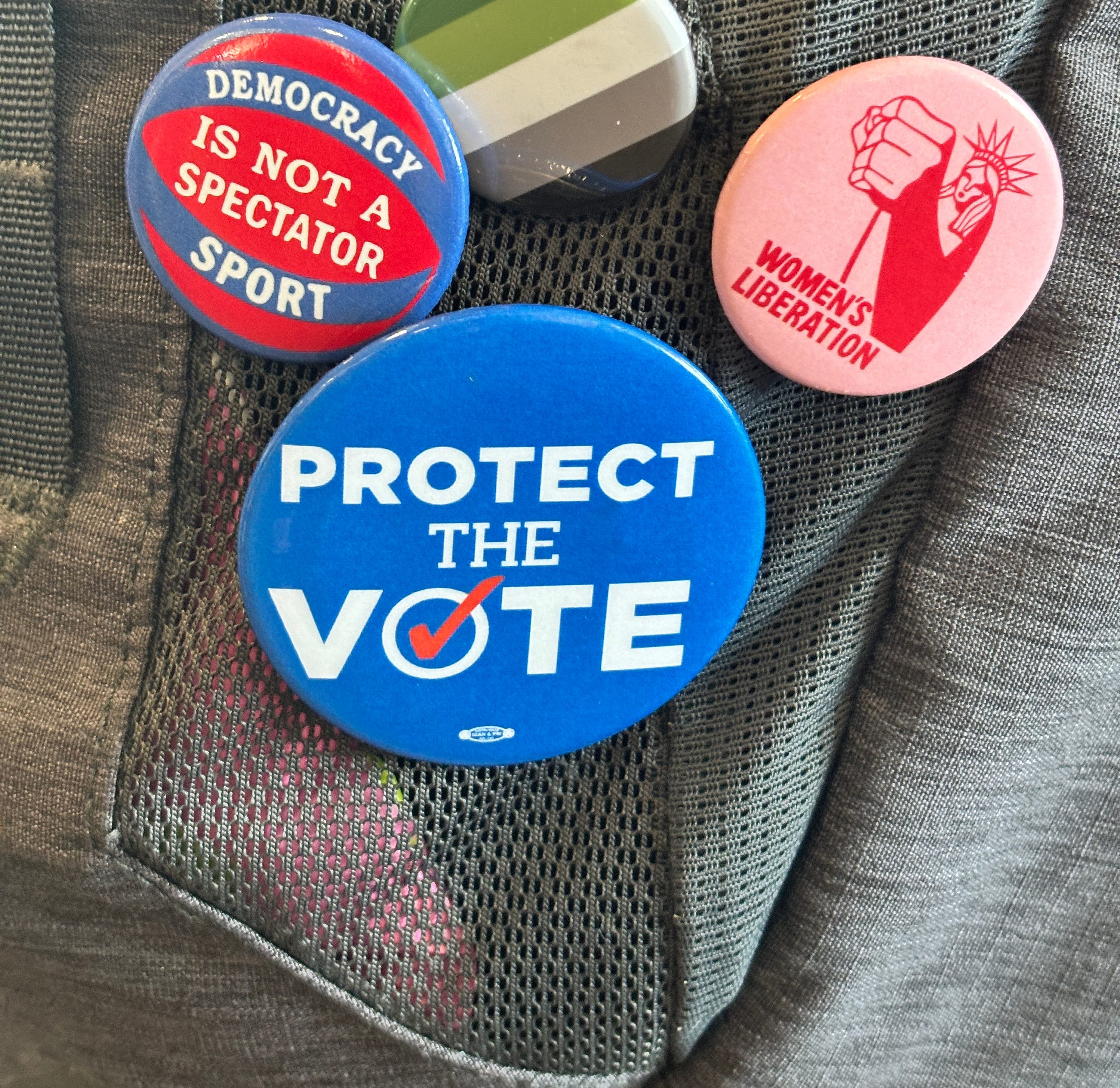
In the middle of all the high stakes political maneuvering going on in Washington, we shouldn’t overlook the importance of a little civil discourse in our own lives. Like the elegantly simple statement being made by the woman in front of me in line at the airport this morning who was nice enough to let me snap a photo.

These simple reminders help people who understand that democracy is on the ballot know that they aren’t alone. They are also seeds that we plant for people who are still trying to decide whether and how to vote.

It’s hard to understand how anyone could still be on the fence, but we don’t have to figure that out. What we need to understand is the importance of meeting people where they are and, rather than expressing surprise that they’re undecided, trying to counter some of the disinformation that’s circulating and may be keeping them on the ledge, with facts.

Last week, one of the favorite Republican political myths, that Biden is too old to be president while Trump is capable and vibrant, resurfaced.

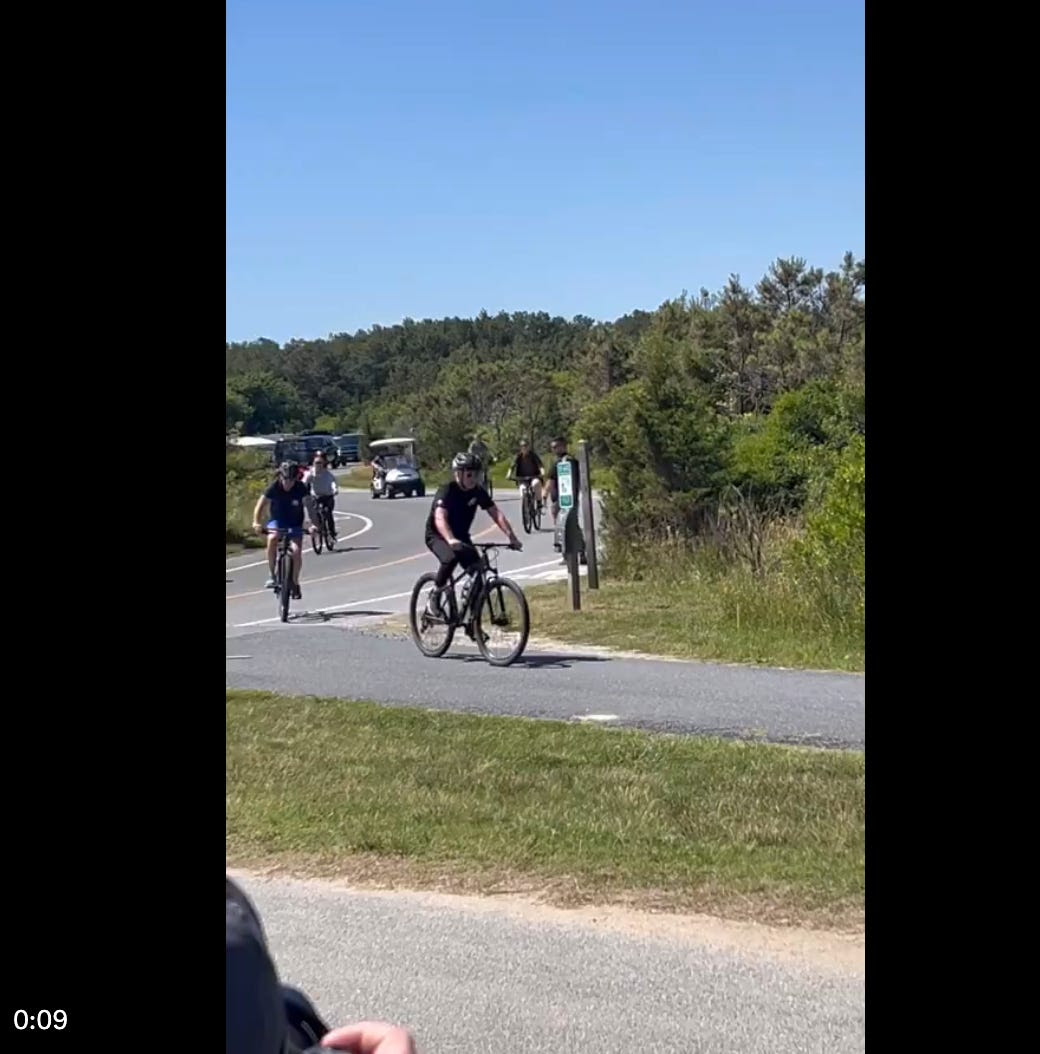
Joe Biden out for a ride on June 1, 2024 in Rehoboth, Delaware.

Seen Trump on a bicycle lately?

Biden is 81 years old. Trump turned 78 on Friday. It’s not a significant difference in age. While both of them occasionally have to reach for a word, as so many perfectly capable people do as they grow older, the similarities stop there. But the narratives being told about the candidates’ age and ability are very different and don’t match the reality that anyone who takes the time to can readily observe.

Biden flew to Europe for the D-Day anniversary, then home, then back to Europe for the G7 Summit, and held up to the rigors of travel well. His foreign policy expertise was on full display as he deftly handled key allies amid Putin’s war in Ukraine.

What did the President’s political opponents make of his trips? Right-wing media outlets circulated video, now all over social media, that makes it appear that Biden wandered off at the G7 summit while all the leaders were gathered. But that’s not what happened. The actual video shows Biden walking over to congratulate parachutists who were part of the celebration.

You might ask fence-sitters to consider, why would anyone do this? If Biden really isn’t up to the job, right-wingers wouldn’t have to make up a story, deceptively edit video, and push it out. If they’d make up a story like that, what else are they lying about? And perhaps most importantly, why are they lying to you?

What was Trump doing while Biden was supporting our key European alliances? His teleprompter went down during a campaign speech in Nevada with awkward results.

“I’ll take electrocution every single time,” Trump said. “I’m not getting near the shark.” Okay. I’ll take the guy who is handling American business over the guy babbling about sharks every time. And maybe if some of the folks who haven’t made up their minds yet knew about it, they would too.

It’s a good time to try out a little civil discourse and encourage people to look up the actual facts and video for themselves—they don’t have to take your word for it. You can explain what is actually happening to them, but tell them to check it out for themselves. One of the benefits of having truth on your side is that you can do that. Trump’s claims about Biden don’t withstand daylight.

The GOP is still beating the “Biden crime family” dead horse when in fact, their efforts to provoke criminal investigation or impeachment have all spectacularly and publicly failed. Their key witness lied to the FBI and faces prosecution—they seem to have forgotten his existence. And despite the strong push to “get” Hunter Biden, which produced the gun charges he was just convicted on and the tax charges he still faces, no evidence surfaced that implicated President Biden in international corruption or fraud schemes MAGA Republicans have been pushing. Last September, three-fifths of American voters believed the unproven but widely repeated allegations that Joe Biden was involved in corruption. Since then, those allegations have gone from being unproven to disproven. There were even suggestions that the failed GOP witness, Alexander Smirnov, was peddling lies for Russia.

Anyone who is turned off from voting because they hear Joe Biden was as corrupt as Trump? Turns out it was all a mirage, a very successful public relations coup for Republicans.

That’s an important point to share. Suggest that your friends examine what they see on social media carefully, because it’s not all true. Concerned about Gaza? It’s worth it for a voter for whom that issue is important to take a look at the differences between Biden’s and Trump’s positions and decide which they feel better serves their concerns. Worried about climate change? Trump’s recent meeting with Big Oil—the one where he asked them to to donate $1 billion to his campaign while promising he would terminate Biden’s policies on electric vehicles, wind energy, and other plans to decrease reliance on fossil fuels—is informative. Do they really want to trust the guy who is calling for a revenge presidency? The guy who blithely attacks Joe Biden for being old, while the press seems to give him a pass on far worse.

The key point is this: democracy is the system that unlocks all of our other rights. In its absence, those rights fade away. How you are able to live your life could come down to the whims of a ruler who has only his own self-interest in mind. People still get to vote this November. They should exercise that right carefully, and cherish it, especially if they want to be able to do it in the future.

A little civil discourse can go along way. Don’t hesitate to practice. And please share the newsletter—it’s free—with folks you think might benefit from being encouraged to think and fact check for themselves.

We’re in this together,

Joyce

Upgrade to paid

Share

The God Illusion: What we learned from the Southern Baptist Convention’s annual meeting

Here’s the link to this article.

Most delegates still oppose women pastors, IVF is evil, and abuse reform can wait. But at least the new president doesn’t wear jeans in the pulpit.

JUN 13, 2024


The Southern Baptist Convention, which has been dealing with a massive sexual abuse crisis for years now, finally got its priorities in order this week at its annual meeting… by threatening churches that believe women can serve as pastors and agreeing that in vitro fertilization is “dehumanizing” and must be opposed at all costs.

Let’s start with the sexism.

On Tuesday, delegates (“Messengers“) at the convention voted overwhelmingly (6,759-563) to expel Virginia’s First Baptist Church of Alexandria, a church that currently has a woman serving as “Pastor for Children and Women” and openly declares on its website that the Bible “not only permits women to serve in the offices of pastor and deacon but confirms this with examples by name.”

The church saw the writing on the wall two years ago when they were first ratted out for their disobedience. It didn’t matter that the church, which has existed for well over a century, donated millions of dollars to the SBC for missionary work. The Associated Press said that “the pastor of a neighboring church reported” them to the SBC after discovering they employed two women as pastors. (A man was still the “senior pastor,” but that was irrelevant.)

Their open belief that there’s nothing wrong with having women on staff as pastors is what pushed the SBC over the edge.

The vote came after the denomination’s credentials committee recommended earlier Tuesday that the denomination deem the church to be not in “friendly cooperation,” the formulation for expulsion, on the grounds that it conflicts with the Baptist Faith and Message. That statement of Southern Baptist doctrine declares only men are qualified for the role of pastor. Some interpret that only to apply to associate pastors as long as the senior pastor is male.

It would be unfair to call this church progressive given that it opposes same-sex marriage and denies the existence of transgender people, but even symbolic gender equality was a bridge too far for most Southern Baptists who voted.

The expulsion came a year after the SBC kicked out Rick Warren’s Saddleback Church for ordaining three female pastors.

But all of that was merely a prelude to what happened Wednesday when the SBC voted on a formal policy (called the “Law Amendment,” after the name of the person who proposed it) to banish any SBC church that placed women on the leadership hierarchy or openly supported that idea.

The policy, which needed two-thirds of the vote, two years in a tow, ultimately failed. They couldn’t get over the 67% threshold this time around.

Still, it’s hardly a victory when over 60% of SBC delegates support the Only-Men-In-Power doctrine. (Had this Amendment passed, the First Baptist Church of Alexandria would have been expelled from the SBC for having a female pastor and believing women can be co-equal leaders. As it stands, they were only kicked out for the latter offense.)

As reporter Kate Shellnutt of Christianity Today explained, the SBC will still be able to punish churches with “female lead pastors,” like they did with Saddleback, but they won’t have a zero tolerance policy for churches that place women in other leadership positions.

Had the Law Amendment passed, it could have led many churches to step out from under the SBC umbrella, as Bob Smietana noted at Religion News Service:

Southern Baptist churches have long relied on women to teach Sunday School, lead outreach ministries and do all the behind-the-scenes work to keep their congregations running smoothly. Southern Baptists also raise hundreds of millions of dollars every year in the names of legendary missionaries Lottie Moon and Annie Armstrong. But they have also banned women from the pastorate — especially serving as senior pastor of a church. 

… Passing this new rule, known as the “Law Amendment,” could lead to hundreds or thousands of churches leaving the SBC.   

Just because the vote failed, however, doesn’t mean those churches will stay put.

The fact that this rule—no women in church leadership!—was even an issue tells you a lot about where the SBC is at. They’re literally arguing about a mild version of gender equality while the rest of their house remains on fire. Sexual abuse runs rampant within the SBC but a large part of the focus this year was on whether a woman serving as associate pastor was substantially different from a woman serving as senior pastor. For the majority of delegates, it’s better to have women labeled as servants and let them keep doing the same work, I guess.

Had they chosen to expel churches that employ women as pastors, the expectation was that a lot of churches would quit before they could be fired. Some still may.

Some churches made the decision to leave before they might be asked.

The Rev. Christy McMillin-Goodwin, pastor of First Baptist Church in Front Royal, Virginia, said she was surprised to discover that another Virginia clergyperson had listed her church as an example of one whose clerical leader was “sinning against God.”

“Our church decided to take a vote last May (2023) and the decision was unanimous,” she said of the church that had long stopped sending donations to the SBC and is affiliated with the more moderate Cooperative Baptist Fellowship. “People actually yelled ‘Yes.’ It was very impassioned that we don’t want to be a part of an organization that does not fully support women in leadership in the church.”

They were proud to be part of a historically racist and currently anti-LGBTQ organization, but punishing churches that have women in leadership was a dealbreaker? Got it. (Someone make that make sense.)

It’s not just slightly progressive churches that need to decide their membership status. A lot of Black churches are making similar decisions, turning an organization that’s already known for its support of white Christian Nationalism into one that more closely looks the part.

When that happens, it will be a completely self-inflicted wound.

Telling women they’re equally capable of spreading the Gospel seems to be the sort of thing that would draw in more Christians than it alienates. But dogma, for many of these Southern Baptists, overrides common sense. The majority of Southern Baptists want to force underage girls to bear their rapists’ babies but they can’t handle a grown woman in the pulpit.

On top of that, the SBC also voted to oppose IVF treatments, even though plenty of white evangelicals have used the technology to have babies. While the vote wasn’t a surprise, it’s an extreme approach that may signal the next phase in the Christian Nationalist attack on reproductive rights.

IVF, of course, is a procedure in which a sperm and ova are joined outside the body, in a laboratory dish. It’s meant to help couples struggling with infertility or other health problems. The concern for anti-abortion extremists is that, in IVF, the embryos that aren’t implanted inside a uterus may be discarded or placed in a freezer. They believe that’s tantamount to murder. (Oklahoma State Senator Dusty Deevers has said parents who use IVF are “waging an assault against God.”)

If you cut through the fluff in the actual SBC amendment, these paragraphs are what it boils down to:

IVF destroys human life. IVF promotes eugenics. IVF will lead to the murder of millions of teeny tiny “human beings.” Therefore we must oppose IVF no matter what.

It’s a thoughtless statement from a heartless organization.

It’s also a slap in the face to all the Christian women who have used IVF to have babies because, without it, they were unable to have children.

While the resolution has no teeth, and people who use IVF will still be allowed to stay in their churches, it’s a signal that conservative Christians are not satisfied with the Supreme Court banning abortion rights and that they fully intend to support politicians who want to ban IVF, too. They will also use this vote to put more pressure on Republicans who support IVF because it’s overwhelmingly popular.

POLITICO puts it bluntly:

Though the resolution is nonbinding, nearly 13 million Southern Baptists across 45,000 churches may now face pressure from the pulpit or in individual conversations with pastors to eschew IVF.

The Southern Baptists’ Wednesday vote could encourage other evangelical denominations and churches to follow suit in declaring — or at least teaching about — their ethical concerns with IVF.

All of this is happening while membership in the SBC is at a 47-year low.

In 2003, the SBC had a record high 16.3 million members. In 2023, the number dropped to 12.99 million, continuing 17 straight years of declining membership.

Meanwhile, the sexual abuse crisis remains a massive problem for the SBC.

It all stems back to revelations from 2022 about the SBC, in which we learned that, over the previous decade, more than 250 SBC staffers or volunteers had been “charged with sex crimes” against more than 700 victims. We also learned in the SBC’s own investigation that a private list of alleged predators (that wasn’t shared with member churches) included “703 abusers, with 409 believed to be SBC-affiliated.” The situation was so bad that the Department of Justice announced it was investigating “multiple SBC entities,” though not specific individuals, about their mishandling of sexual abuse cases. Last month, a former seminary professor became the first person indicted in the investigation. (He has pleaded not guilty.)

This month, we got an update from the SBC as to how its internal investigations are going… and it was predictably disappointing. A volunteer task force that was supposed to implement reforms announced that it would close up shop. While they created some resources to help churches deal with the problem, the biggest reform they could have made was creating a database of abusers so that criminals and known problematic people couldn’t church-hop after getting kicked out of one place… but that “Ministry Check” never happened because of a lack of funding and fears over getting sued.

To date, no names appear on the “Ministry Check” website designed to track abusive pastors, despite a mandate from Southern Baptists to create the database. The committee has also found no permanent home or funding for abuse reforms, meaning that two of the task force’s chief tasks remain unfinished.

Because of liability concerns about the database, the task force set up a separate nonprofit to oversee the Ministry Check website. That new nonprofit, known as the Abuse Response Committee, has been unable to publish any names because of objections raised by SBC leaders.

The SBC raked in over $10 billion in 2023. They could fund abuse reforms if they really wanted to without even noticing a change in their bank account. They just don’t want to. They would rather form a task force with no teeth than risk the world finding out just how many of their leaders are alleged (or charged) abusers.

When Lifeway Christian Resources (an arm of the SBC) released the results of a survey of congregation leaders last month, they found that only 58% of them required background checks for staffers who work with kids. With the number that low, the abuse is bound to continue.

Lost in the shuffle of all these votes was the election of the SBC’s new president, Clint Pressley, a megachurch pastor from North Carolina who represents the more conservative wing of the already conservative denomination. (The Religion News Service article about his election says, in the first paragraph, that Pressley “does not wear jeans in the pulpit.” Because that would be heretical.)

Pastor Clint Pressley speaking at Hickory Grove Baptist Church in Charlotte (screenshot via YouTube)

Pressley supported the anti-women Law Amendment and had “questions” about the proposed database of abusers, in case you had any questions about where he stands. Oh. And a volunteer at his megachurch was arrested in May after being accused of sexually abusing his own daughter. (The church thankfully reported the man to secular authorities leading to his eventual arrest.)

Keep in mind that the second largest Protestant denomination recently voted to get rid of its anti-LGBTQ policies and allow gay clergy members.

The SBC, on the other hand, is still debating which way to rearrange deck chairs on the Titanic.

(Portions of this article were published earlier)


Please share this post on Reddit, Facebook, or the godawful X/Bird app.

Share

Subscribe to Friendly Atheist

By Hemant Mehta · Hundreds of paid subscribers

Commentary about religion and politics, centered around atheism.

Flash Fiction: Fences and Forgiveness

In the quiet suburb of Maplewood, the fences were high but the tensions were higher, especially between two neighbors: John Green and Rick Dale. Both had lived side by side for years without much interaction, their mutual disinterest a bridge too wide to cross. John, a meticulous gardener, took pride in his immaculate lawn and blooming flower beds. Rick, on the other hand, was the proud owner of a large, boisterous Rottweiler named Max, whose barks echoed through the neighborhood like rumbling thunder.

The uneasy peace shattered one sunny afternoon when Max managed to break through a weak spot in the fence and charged into John’s yard. John’s beloved Beagle, Toby, was enjoying the sunshine, and the intrusion ended in chaos. Toby was severely injured in the attack. Although he survived, the incident left him with lasting injuries and a palpable fear of other dogs.

Furious and heartbroken, John confronted Rick, demanding that he restrain Max and repair the fence. Rick, somewhat remorseful yet defensive, promised to fix the fence but shrugged off the severity of Toby’s injuries, chalking it up to animal instincts. The conversation ended with harsh words and heightened animosities, leaving John to stew in his anger as he cared for his recovering pet.

Over the following weeks, John watched as Rick made a half-hearted attempt to repair the fence but did nothing to train or better secure Max. The sight of Max roaming near the flimsy boundary fueled John’s resentment. Sleepless nights plotting revenge became his new routine. He imagined sabotaging Rick’s yard, lodging complaints with the homeowners’ association, or even letting Max out to get him impounded. Each scenario played out in his mind with a vindictive satisfaction.

One evening, as John sat on his porch, his plotting was interrupted by the sight of Toby, tail wagging, trying to peek through the fence at Max. Despite his fear, Toby’s curiosity about his neighbor seemed undiminished. It was then that John realized that his desire for revenge was poisoning him more than it was affecting Rick or Max. The sight of Toby, still gentle and forgiving, made John ashamed of his dark thoughts.

With a deep breath, John decided on a different course of action. The next morning, he invited Rick over for coffee. Rick, surprised by the gesture, accepted cautiously. Over cups of strong brew, John expressed his fears for Toby’s safety and his frustration with the ongoing situation. He proposed they jointly pay for a professional to reinforce the fence and even suggested they could share the costs of a trainer for Max.

To John’s surprise, Rick agreed, embarrassed by his previous neglect and moved by John’s change in approach. The men spent the next few Saturdays working on the fence, their cooperation awkward at first but gradually becoming more amicable. Max, under the guidance of a trainer, became less aggressive, and Toby slowly regained his confidence.

Months later, John and Rick, now on much friendlier terms, watched as Toby and Max cautiously sniffed each other through the secure fence. It wasn’t a perfect friendship, but it was a peace hard-earned and much preferred over the bitterness of revenge. In repairing the fence, they had also mended fences of a different sort, learning that forgiveness could be more satisfying than retribution.