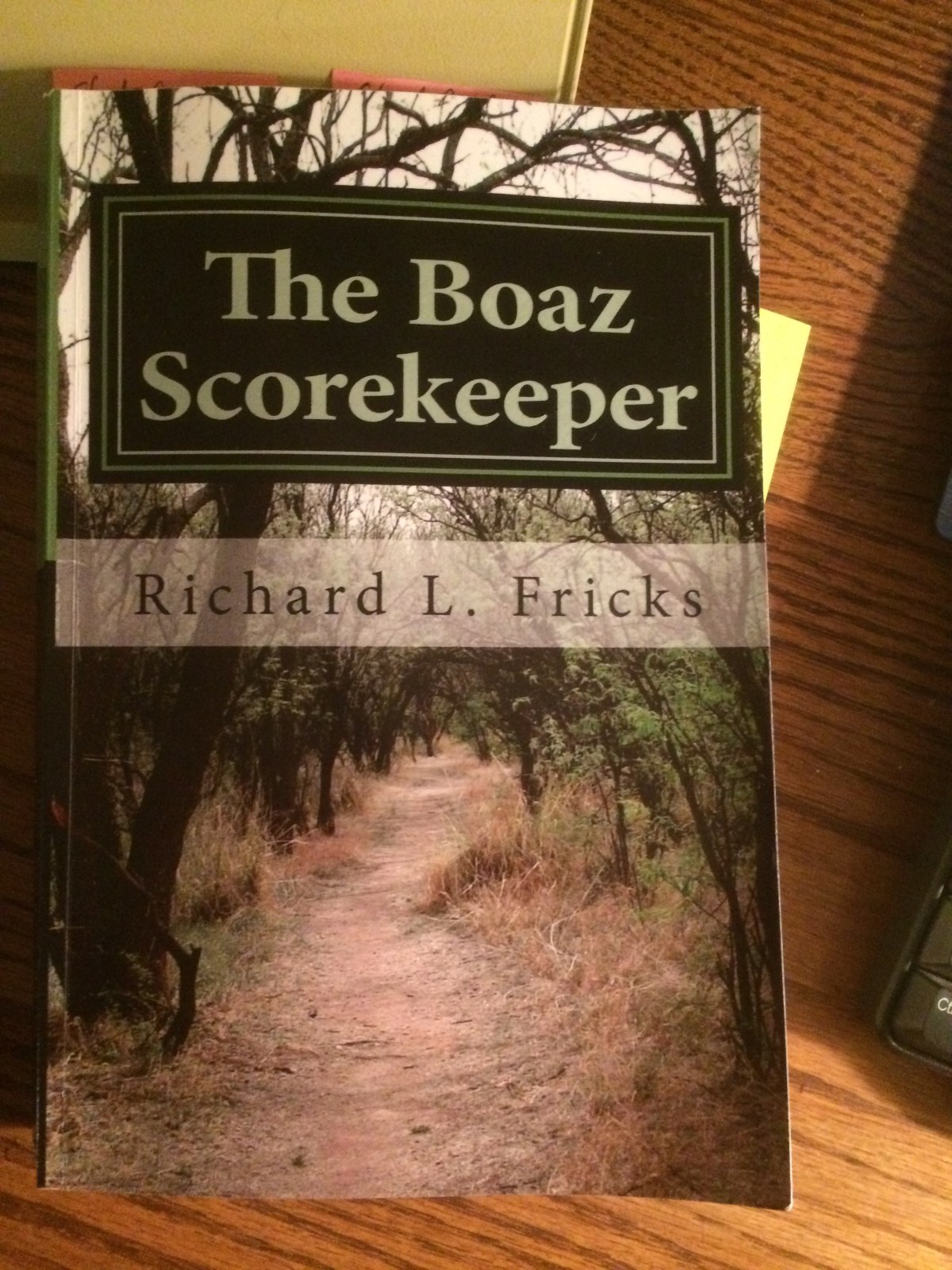
The Boaz Scorekeeper–Chapter 31

The Boaz Scorekeeper, written in 2017, is my second novel. I'll post it, a chapter a day, over the next few weeks.

I arrived home, unloaded the truck and set fire to the product of our day’s demolitions. Karla had cooked my favorite meal of pinto beans, cornbread, fried potatoes, and coconut pie.  Even though I was tired, after supper, Karla and I took turns playing chess with Lewis.  We were fortunate he was still at the age he would spend real quality time with his parents.

At 10:45 p.m., Lewis called it quits after capturing Karla’s King.  He went to bed and Karla started reading her Sunday School lesson.  I pulled my feet up in my lounging chair and dozed off.  At midnight, Karla kissed my forehead and said goodnight.  I got up and walked to the kitchen and saw Journal 15 laying on the counter.  I drank a glass of water and brought the journal back to my chair.  I was no longer sleepy.

All I knew before I started to read was Fitz and Harold were apparently friends and he was a bookkeeper at the Sand Mountain Bank.  And, according to Fitz, a very creative bookkeeper.  I assumed the letter had been written by Fitz Billingsley given the oddity of his first name.  I didn’t know Harold’s last name.  I was puzzled.  I had found Journal 15 in an old storage room, a hidden one at that, of the Sand Mountain Bank, Fitz’ First State Bank of Boaz only competitor.  I became even more puzzled when I read the first journal entry, dated January 21, 1946, one I assume was written by Harold:

Period: December 1945

Gross Wages $57,927.96

Tax $1,158.56

No. Workers 1049

Avg. No. Hours 227.28

Avg. Mo. Earnings $55.22

Avg. Hourly Rate $.2430

CE’s share $289.64

Tithe $28.96

This appeared to be some type of payroll tax report.  For some reason, I flipped to the back of the journal and in the middle of the next to the last page was this entry:

Period: November 1946

Gross Wages $60,374.18

Tax $1,207.48

No. Workers 1093

Avg. No. Hours 226.13

Avg. Mo. Earnings $55.22

Avg. Hourly Rate $.2442

CE’s share $301.87

Tithe $30.19

I flipped back to the front and was even more confused after reading the second journal entry.  It was dated February 3, 1946: “Vincent Prader opened acct. $1,200.00. Needs lesson.” 

Even though it was nearly 11:00 p.m., I called Matt and read him these three entries.  He had me calculate the tax as a percentage of the gross wages.  In both entries, it was 2%.  Matt said that sounded like the City’s occupational tax that started at the end of the war. I asked him did he have any idea who Harold was.  He didn’t even pause to think but said, “Harold Maples.  He is a landmark, worked 50 years at least for the Sand Mountain Bank. Started as a bookkeeper and stayed in that position all those years. The man has staying power that’s for sure.  I bet he is nearly a 100 years old.  As far as I know he still lives in the old home place where he grew up, down College Avenue.”

Matt and I speculated for a while about Harold and Fitz’ relationship. I told him it appeared that Journal 15 was personal to Harold and was not a part of the official banking records like the red and green journals I had found.  He asked why then was the black journal in with these official journals.  I said I didn’t have a clue.  We hung up, leaving me just as confused and aggravated that I hadn’t asked Matt about Vincent Prader. I called Matt back but he couldn’t remember.  I called it a night and went to bed.

Matt and I worked nearly all-day Sunday removing three layers of vinyl from the reception room floor.  We didn’t venture up into the upstairs storage room.

Monday, before going into the law office, I dropped by the library and had Barbara Mills, the head librarian since the Boaz Library was formed in 1929, show me how to use the microfiche machine.  I told her I wanted to review all issues of the 1945 and 1946 Sand Mountain Reporter, the oldest newspaper in the area.  After an hour or so I found an article with the headline, “Invincible Prader Returns a Hero.”  After reading the article I learned ‘Invincible’ was a nickname for Vincent Prader.  He was a highly decorated army hero who returned home in mid-December 1945.  Vincent had grown up south of Boaz in the Red Apple community and had graduated Boaz High School May 20, 1940, volunteering for the Army two days later.  The article went on to describe how Prader had single-handedly fought four Germans to save his friend Malcom Jackson of Memphis.  The article said Prader and his German born wife, Helga, were planning on opening a Volkswagen auto dealership in Boaz.

At 10:00 a.m., Barbara stuck her head in the cramped little media room and said that Matt had called and that my 10:30 appointment was already there.  I closed my notebook and turned off the microfiche machine.  When I was nearly to the Library exit, I turned and asked Barbara if she knew anything about a Vincent and Helga Prader.  She said, “yes, sadly so.  Vincent returned from World War II a hero and bought the Miller property on North Main to operate a Volkswagen dealership.  A few days before it opened, right after a load of Beetle cars were delivered, I think it was around Thanksgiving 1946, he and his wife went missing.  They never were found.  I can’t believe you don’t remember.  Oh, sorry.  That was before your time.  The bottom line is that story rocked Boaz for years.”

As I drove to the law office, I had a gut feeling that Fitz Billingsley and Harold Maples had taught Vincent and his wife a lesson.  If possible, I was going to pay Mr. Maples a friendly visit.

11/14/23 Biking & Listening

Here’s today’s bike ride.

Why I ride

Biking is something I both love and hate. The conflicting emotions arise from the undeniable physical effort it demands. However, this exertion is precisely what makes it an excellent form of exercise. Most days, I dedicate over an hour to my cycling routine, and in doing so, I’ve discovered a unique opportunity to enjoy a good book or podcast. The rhythmic pedaling and the wind against my face create a calming backdrop that allows me to fully immerse myself in the content. In these moments, the time spent on the bike seems worthwhile, as I can’t help but appreciate the mental and physical rewards it offers.

I especially like having ridden. The post-biking feeling is one of pure satisfaction. The endorphin rush, coupled with a sense of accomplishment, makes the initial struggle and fatigue worthwhile. As I dismount and catch my breath, I relish the sensation of having conquered the challenge, both physically and mentally. It’s a reminder that the things we sometimes love to hate can often be the ones that bring us the most fulfillment. In the end, the love-hate relationship with biking only deepens my appreciation for the sport, as it continually pushes me to overcome my own limitations and embrace the rewards that follow the effort.

My bike

A Rockhopper by Specialized. I purchased it November 2021 from Venture Out in Guntersville; Mike is top notch! So is the bike. The ‘old’ man seat was salvaged from an old Walmart bike (update: seat replaced, new photo to follow, someday).


Something to consider if you’re not already cycling.

I encourage you to start riding a bike, no matter your age. Check out these groups:

Cycling for those aged 70+(opens in a new tab)

Solitary Cycling(opens in a new tab)

Remember,

Photo by Suzy Hazelwood on Pexels.com


Novel I’m listening to:

The Last Thing He Told Me, by Laura Dave

Amazon abstract:

Don’t miss the #1 New York Times bestselling blockbuster and Reese Witherspoon Book Club Pick that’s sold over 2 million copies–now an Apple TV+ limited series starring Jennifer Garner!

The “page-turning, exhilarating” (PopSugar) and “heartfelt thriller” (Real Simple) about a woman who thinks she’s found the love of her life—until he disappears.

Before Owen Michaels disappears, he smuggles a note to his beloved wife of one year: Protect her. Despite her confusion and fear, Hannah Hall knows exactly to whom the note refers—Owen’s sixteen-year-old daughter, Bailey. Bailey, who lost her mother tragically as a child. Bailey, who wants absolutely nothing to do with her new stepmother.

As Hannah’s increasingly desperate calls to Owen go unanswered, as the FBI arrests Owen’s boss, as a US marshal and federal agents arrive at her Sausalito home unannounced, Hannah quickly realizes her husband isn’t who he said he was. And that Bailey just may hold the key to figuring out Owen’s true identity—and why he really disappeared.

Hannah and Bailey set out to discover the truth. But as they start putting together the pieces of Owen’s past, they soon realize they’re also building a new future—one neither of them could have anticipated.

With its breakneck pacing, dizzying plot twists, and evocative family drama, The Last Thing He Told Me is a “page-turning, exhilarating, and unforgettable” (PopSugar) suspense novel.


Podcasts I’m listening to:

Nothing today.

Waking Up app series/courses I’m listening to:

Life, Death, and Vipassana

Discover the freedom of simply staying with the sensations of life.

The Shape of Life

Learn to relax into the natural unfolding of existence.


Here’s a few photos from my pistol route:

The Boaz Scorekeeper–Chapter 30

The Boaz Scorekeeper, written in 2017, is my second novel. I'll post it, a chapter a day, over the next few weeks.

The 30th of December, four days after the Murray’s met with Walter Tillman and his lawyer Ralph Summerford, Matt and I purchased a building in old downtown Boaz.  When the Realtor first showed it to us in early November, neither Matt or I remembered that it was the building where the Sand Mountain Bank had started its business operations back in the early 1930’s.  The bank had moved in the late 70’s or early 80’s to a modern building on Broad Street.  Even though for the past 20 years or so the original building had been used as a beauty shop it still revealed the architecture and mystique of a depression era bank.  Matt and I both loved it from the very first visit even though it would require a lot of renovation to convert it into a workable law office.

The building’s owner was a bank out of Gadsden.  It had acquired it two years earlier through foreclosure.  After interviewing several contractors, we decided to take it slow and do some of the initial demolition work ourselves.  We felt the activity might be good for us since we spent most of our days either sitting behind a desk or standing in courtrooms. 

We decided to close Wednesday through Sunday to celebrate the New Year’s Holiday, but mostly to work tearing out a ceiling that had been installed after the bank had moved out.  The ceiling was less than eight feet high and we wanted a reception area with high ceilings that revealed the Bank’s original architecture.

By late Saturday afternoon, Matt and I were nearly exhausted and had just finished toting out another huge pile of ripped paneling and broken two-by-fours when we noticed a single piece of plywood nailed fifteen feet or so up the south wall that we had exposed when we tore out the false ceiling.  The remainder of this wall, that is, the part that we could see, was covered with beautiful pine boards, running vertically, each at least ten inches wide.  These boards came all the way down to the floor and they also were against the wall under the piece of plywood.

We placed our two extension ladders on either side of the piece of plywood, and with crowbars and hammers, removed the four by eight sheet of plywood. After Matt nearly tipped backwards off his ladder we slid the plywood gently down to the floor.  When we looked back up we saw what looked like a solid oak door, closed inside what had to be a hand-carved frame.  We went back up and the door knob resisted only minimally.  I pushed the door open and stepped off my ladder and inside to a dark and musty smelling room.

Matt went out to his truck and brought two flashlights.  We couldn’t believe what we saw.  There were dozens and dozens of cardboard boxes containing manila files.  The ones we opened mainly contained loan files: copies of promissory notes, deeds, mortgages, and sometimes hand-written notes setting out personal property items the borrower was putting up as collateral for the cash the bank was providing.  One note said, ‘Betsy, my finest cow,” and another one I could barely read said “my turning plow, my two and only middle buster plows, and my Georgia stock plow.”

There were two old ladder back chairs almost hidden against the side wall and buried under a pile of wooden boxes.  Each of these boxes had a metal clasp with a lock but none of them were fastened.  I opened one of the boxes and found twelve high-quality journal books, each with a red leather spine.  I glanced through a couple and saw listings of payments the bank had made.  This box contained one journal per month for the year 1938.  I opened several other wooden boxes and found more disbursement journals, but I also found boxes that contained journals with green leather spines.  Rightly so, these were receipts journals.  I looked through the February 1944 journal and saw daily listings of what appeared to be every deposit the bank took in for every day during this month.

After I moved thirty or so boxes from on top of, besides, and in front of the two ladder back chairs, I pulled them into the center of the room.  Matt sat in one and kept on infatuated with the handwritten notes he was finding in loan files. I pulled another wooden box over in front of me and sat down in the other chair.  It contained twelve journals with green spines representing January through December 1972.  There was another journal in this box.  As I removed it, I noticed it’s black leather spine. I opened it and saw an envelope taped to the inside front cover.  It contained a hand-written letter.  The letter was dated December 23, 1946 and read: “Harold, thanks for your friendship and being the most creative bookkeeper in the world.  I appreciate you. Merry Christmas,” signed “Fitz.”  Under the taped envelope and in big bold letters on the inside front cover was written, “Journal No. 15.”

“That’s enough cows, pigs, chickens, and plows for one day. I’m heading home.  You ready?” Matt said wiping his forehead with a blue and white checkered handkerchief.

I agreed, but carried the black-spine journal with me.  We turned off the lights, locked the door, and Matt drove off.  I tied down the pile of lumber and paneling on the back of my truck and headed home glancing down every few minutes to the journal beside me thinking, “red for cash paid out, green for cash taken in, and black for … what?”

11/13/23 Biking & Listening

Here’s today’s bike ride.

Why I ride

Biking is something I both love and hate. The conflicting emotions arise from the undeniable physical effort it demands. However, this exertion is precisely what makes it an excellent form of exercise. Most days, I dedicate over an hour to my cycling routine, and in doing so, I’ve discovered a unique opportunity to enjoy a good book or podcast. The rhythmic pedaling and the wind against my face create a calming backdrop that allows me to fully immerse myself in the content. In these moments, the time spent on the bike seems worthwhile, as I can’t help but appreciate the mental and physical rewards it offers.

I especially like having ridden. The post-biking feeling is one of pure satisfaction. The endorphin rush, coupled with a sense of accomplishment, makes the initial struggle and fatigue worthwhile. As I dismount and catch my breath, I relish the sensation of having conquered the challenge, both physically and mentally. It’s a reminder that the things we sometimes love to hate can often be the ones that bring us the most fulfillment. In the end, the love-hate relationship with biking only deepens my appreciation for the sport, as it continually pushes me to overcome my own limitations and embrace the rewards that follow the effort.

My bike

A Rockhopper by Specialized. I purchased it November 2021 from Venture Out in Guntersville; Mike is top notch! So is the bike. The ‘old’ man seat was salvaged from an old Walmart bike (update: seat replaced, new photo to follow, someday).


Something to consider if you’re not already cycling.

I encourage you to start riding a bike, no matter your age. Check out these groups:

Cycling for those aged 70+(opens in a new tab)

Solitary Cycling(opens in a new tab)

Remember,

Photo by Suzy Hazelwood on Pexels.com


Novel I’m listening to:

The Last Thing He Told Me, by Laura Dave

Amazon abstract:

Don’t miss the #1 New York Times bestselling blockbuster and Reese Witherspoon Book Club Pick that’s sold over 2 million copies–now an Apple TV+ limited series starring Jennifer Garner!

The “page-turning, exhilarating” (PopSugar) and “heartfelt thriller” (Real Simple) about a woman who thinks she’s found the love of her life—until he disappears.

Before Owen Michaels disappears, he smuggles a note to his beloved wife of one year: Protect her. Despite her confusion and fear, Hannah Hall knows exactly to whom the note refers—Owen’s sixteen-year-old daughter, Bailey. Bailey, who lost her mother tragically as a child. Bailey, who wants absolutely nothing to do with her new stepmother.

As Hannah’s increasingly desperate calls to Owen go unanswered, as the FBI arrests Owen’s boss, as a US marshal and federal agents arrive at her Sausalito home unannounced, Hannah quickly realizes her husband isn’t who he said he was. And that Bailey just may hold the key to figuring out Owen’s true identity—and why he really disappeared.

Hannah and Bailey set out to discover the truth. But as they start putting together the pieces of Owen’s past, they soon realize they’re also building a new future—one neither of them could have anticipated.

With its breakneck pacing, dizzying plot twists, and evocative family drama, The Last Thing He Told Me is a “page-turning, exhilarating, and unforgettable” (PopSugar) suspense novel.


Podcasts I’m listening to:


Here’s a few photos from along my pistol route:

The Boaz Scorekeeper–Chapter 29

The Boaz Scorekeeper, written in 2017, is my second novel. I'll post it, a chapter a day, over the next few weeks.

After Sara Adams’ deathbed confession I filed notice of my intent to take the deposition of David Carl Adams.  The next day his attorney, Tommy Brunner from Gadsden, called me.  He said, as a courtesy he was letting me know that he was filing a Motion to Strike since I had no reasonable expectation of discovering any relevant evidence and that I should know that the Alabama Rules of Civil Procedure did not allow mere fishing expeditions.  I thanked him for his call and asked whether he knew a good criminal defense attorney, that his client was going to need one.  He acted shocked.  I gave him the short version.  He argued that since Mrs. Adams was now dead that the Prosecutor could not use her testimony.  It would be hearsay.  I agreed with him but let him know that Drake vs. Allbright would allow my affidavit to serve as the needed stepping stone to David’s deposition in a civil case.  He said that I was correct if I had a corroborating witness that placed me and Mrs. Adams together at the time of the conversation.  I assured Tommy that Loree Neilson was that witness.

The day before David’s deposition I felt like fishing.  The kind Tommy Brunner spoke about.  For years I had wondered who owned Club Eden.  I felt David’s deposition might be a good opportunity to learn.  Even though the Club was relevant as to where the graduation party took place I had mixed feelings whether a question about its ownership could slip by and generate a response.  I thought it was worth a shot so I drove to the Etowah County Courthouse, Land Records Division, to see if I could develop a chain of title for Club Eden’s property at Aurora Lake.

I succeeded after two hours of reviewing plat maps, and with the help of Francis Frasier, an older heavy-set woman with silky red hair, who claimed to have worked in “these dusty dungeons” for over sixty years.  We found a March 1892 deed from Larson Kittle to a company named The Garden, Ltd.  The transfer included 288 acres along the south side of what became the Aurora Lake reservoir.  There was no way to tell who owned The Garden company.  Francis suggested I call the Secretary of State in Montgomery.  She let me borrow her phone and the nice lady who answered had me an answer in less than five minutes. 

The Garden, Ltd. was formed in 1890.  There were five shareholders: Earnest Adams, Morton Tillman, Samuel Radford, Franklin Billingsley, and Joseph Ericson.  I had no doubt these were the grandfathers, no, great grandfathers of the Flaming Five.

During David’s deposition, I had just explored Sara’s statements including the direct question whether he had killed Wendi Murray.  Of course, he denied any such thing. I asked him if Walter Tillman was with him when he killed her.  Again, he denied all involvement.  Out of the blue I asked David if he was a shareholder in The Garden, Ltd.  To my surprise he said yes.  Again, to my astonishment he answered every question I could pose related to the Aurora Lake real estate.  He said that he had inherited his shares from his father, Eugene, when he died in 1965. He also confirmed that the other shares were owned by Walter Tillman, Raymond Radford, Fitz Billingsley, and Franklin Ericson. When I asked about the name, The Garden, Ltd., and the purpose of this organization, David said he didn’t know.  He also denied any knowledge about Club Eden.

A short while later I ended the deposition feeling I had wasted my time. David had been well coached, maybe a little too well coached.  I couldn’t help but believe that he was lying.

I had dropped by the restroom on my way out of Tommy’s law office not wanting to engage in small talk as everyone was leaving.  When I came out, Ralph Summerford, Wade Tillman’s lawyer, asked if he could buy me a cup of coffee saying that he had something I would want to hear.

We walked around the corner to a little diner on Chestnut Avenue.  Ralph said that he was now representing Wade’s father, Walter, and wanted to make a deal.  I asked him what he had in mind.  Ralph said Walter would cooperate with me and Matt and pay $50,000 in exchange for confidentiality and an immunity agreement from the Prosecutor.  Ralph asked if we could talk off the record.  I agreed.  Walter had admitted that he was present when David ended Wendi’s life.  Ralph said that Walter had tried to stop David and encouraged him to go to the authorities before doing anything stupid. 

I told Ralph that he knew my clients could not grant Walter any type of immunity, that would have to come from the District Attorney.  Ralph said that he knew that but my encouragement might be enough to convince the DA, especially if Walter would agree to testify against David.  I asked Ralph what Walter could offer concerning my client’s wrongful death case.  If I took the deal, there would be no testimony from Walter Tillman but he would provide us with names and documents that would lead us to Club Eden and enough evidence that Matt and I should be able to tie David and the other three, Raymond Radford, Fitz Billingsley, and Franklin Ericson, and all members of the Flaming Five, to the deaths of Wendi and Cindi Murray. 

I told Ralph that if he would draft the agreement, including the exact evidence that Walter had, that Matt and I would discuss it.  I agreed with Ralph that if we failed to reach an agreement, Matt and I would treat these negotiations with strict confidence.

Two days later and right before 8:00 a.m., Ralph hand-delivered a packet to my office asking me to review the agreement draft and for an opportunity to meet before he drove back to Birmingham.  I told him I had a motion docket in Albertville at 9:00 and could meet with him after lunch.

When Ralph arrived at 1:30, Matt and I had spent nearly two hours reviewing the agreement along with several exhibits.  The first exhibit was a copy of the organizing document for Club Eden.  It was dated June 23, 1899.  The initial club members were Earnest Adams, Morton Tillman, Samuel Radford, Franklin Billingsley, and Joseph Ericson.  The Club was formed for promoting and directing business operations and community life in Boaz, Alabama, and to enhance fellowship and progress among members.  The second exhibit was a copy of Club Eden’s bylaws.  All members were required to take an oath swearing to never disclose Club “business or non-business, or anything even remotely related to the Club.”   Punishment included the branding of a cross on the forehead, and the option of death by hanging but only by unanimous decision. 

Another exhibit stated that The Garden, Ltd. was formed in 1890 to purchase and manage the real estate that would become the headquarters of Club Eden. The Club was not officially documented until 1899. 

Walter detailed the names and membership dates for all members since Club Eden was officially formed.  This list included five generations.  I quickly noticed that I was the only member from outside the Adams, Tillman, Radford, Billingsley, and Ericson families.  Also, I noted that the Flaming Five’s sons were now members having all taken the oath last year, 1996, when the oldest of the youngest generation was 15. 

Walter described in another exhibit that after each of their sons came home that Saturday morning that all ten of them met at the Church’s fellowship hall.  They drove three cars, Wade and John’s Blazers, and James’ van, to Little Cove Road.  The girls’ blue Plymouth was parked about 200 feet down a little lane, barely wide enough to ride a bicycle without scrapping outcropping limbs.  The two girls were another fifty feet or so down a ravine with limbs and leaves and rocks piled over and around them. David, Franklin, Raymond and Fitz carried the two girls up the embankment and down to James’ van.  That’s when they noticed one of the girls was still alive.  James said that it was Wendi.  Nothing was done to her there.  The rest of them wiped down the inside of the Plymouth with bleach and water that they had brought.  They piled into the three vehicles and drove to Franklin’s farm on Martin Road.

Walter then described how John had pulled a front-end loader out of the barn and Raymond and Fitz pulled the girls from the back of James’ van and put them in the front bucket of the loader. John drove the tractor to the backside of their property and David then dug a hole while the rest stood around watching.  When David finished, he motioned for Walter to come over.  They talked for quite a while about having a type of ceremony for the girls.  Walter finally agreed to say a prayer but he didn’t want everybody there.  David made everybody else go back to the barn and wait on him and Walter.  When they were gone Walter said a prayer and David smothered Wendi.  He used the front-end loader to push them into the hole and to pile dirt over them.  David also pushed a dead tree over the grave that was on the ground nearby.  They then scattered a ton of leaves over the grave.  David and Walter walked back to the barn and without another word being said all ten of them got in the three vehicles, drove to the Church, where they all went their separate ways.  

After reviewing all the exhibits, I noted a few discrepancies compared to statements made by Cynthia Radford and Sara Adams.  I chose to ignore them, and instead, to read the agreement.  It was simple.  In exchange for the information contained in the packet and $50,000, my clients would release Walter from all liability related to the deaths of Wendi and Cindi Murray.  Also, Matt and I would agree, on behalf of the Murrays, to encourage the District Attorney to grant Walter immunity from all prosecution in exchange for his truthful testimony.

I told Ralph that I felt like my clients would agree but obviously I had to have their approval.  I promised him that I would meet with them as soon as possible.  When Ralph was leaving, I told him that I had a question.  Without letting me finish, he said, “I know you want to know why Walter didn’t try to include his son Wade in these negotiations.”  I told him he was correct.  Ralph said that he and Walter had discussed it but both had quickly agreed that there was no way in Hell, those were Walter’s words per Ralph, that the Murrays would agree.  They would feel there was no amount large enough to appease for the actions of one of the five who had murdered their daughters.  And, Ralph said, Walter barely could barely scrape together the $50,000. 

Ralph left and I went to my office and stood by my window looking out at a mostly empty parking lot and a bubbling water fountain.  The sun was at just the right angle to refract colored lights through the spewing water.  I couldn’t help but associate water with life.  Jesus said He was the Bread of Life.  Wasn’t He also the Water of Life?  I became angry when I wondered where this Supernatural being, this all-powerful and all-loving God, had been when Wendi and Cindi needed Him the most.  Truthfully, if He is real, He was just as responsible for the deaths of those two precious girls as the Flaming Five and their fathers.  How dark and foreboding this little community in North Alabama seemed, after hearing Pastor Walter describe the horror he and other faithful members of the First Baptist Church of Christ had so quickly and easily managed.

11/12/23 Biking & Listening

Here’s today’s bike ride.

Why I ride

Biking is something I both love and hate. The conflicting emotions arise from the undeniable physical effort it demands. However, this exertion is precisely what makes it an excellent form of exercise. Most days, I dedicate over an hour to my cycling routine, and in doing so, I’ve discovered a unique opportunity to enjoy a good book or podcast. The rhythmic pedaling and the wind against my face create a calming backdrop that allows me to fully immerse myself in the content. In these moments, the time spent on the bike seems worthwhile, as I can’t help but appreciate the mental and physical rewards it offers.

I especially like having ridden. The post-biking feeling is one of pure satisfaction. The endorphin rush, coupled with a sense of accomplishment, makes the initial struggle and fatigue worthwhile. As I dismount and catch my breath, I relish the sensation of having conquered the challenge, both physically and mentally. It’s a reminder that the things we sometimes love to hate can often be the ones that bring us the most fulfillment. In the end, the love-hate relationship with biking only deepens my appreciation for the sport, as it continually pushes me to overcome my own limitations and embrace the rewards that follow the effort.

My bike

A Rockhopper by Specialized. I purchased it November 2021 from Venture Out in Guntersville; Mike is top notch! So is the bike. The ‘old’ man seat was salvaged from an old Walmart bike (update: seat replaced, new photo to follow, someday).


Something to consider if you’re not already cycling.

I encourage you to start riding a bike, no matter your age. Check out these groups:

Cycling for those aged 70+(opens in a new tab)

Solitary Cycling(opens in a new tab)

Remember,

Photo by Suzy Hazelwood on Pexels.com


Novel I’m listening to:

The Last Thing He Told Me, by Laura Dave

Amazon abstract:

Don’t miss the #1 New York Times bestselling blockbuster and Reese Witherspoon Book Club Pick that’s sold over 2 million copies–now an Apple TV+ limited series starring Jennifer Garner!

The “page-turning, exhilarating” (PopSugar) and “heartfelt thriller” (Real Simple) about a woman who thinks she’s found the love of her life—until he disappears.

Before Owen Michaels disappears, he smuggles a note to his beloved wife of one year: Protect her. Despite her confusion and fear, Hannah Hall knows exactly to whom the note refers—Owen’s sixteen-year-old daughter, Bailey. Bailey, who lost her mother tragically as a child. Bailey, who wants absolutely nothing to do with her new stepmother.

As Hannah’s increasingly desperate calls to Owen go unanswered, as the FBI arrests Owen’s boss, as a US marshal and federal agents arrive at her Sausalito home unannounced, Hannah quickly realizes her husband isn’t who he said he was. And that Bailey just may hold the key to figuring out Owen’s true identity—and why he really disappeared.

Hannah and Bailey set out to discover the truth. But as they start putting together the pieces of Owen’s past, they soon realize they’re also building a new future—one neither of them could have anticipated.

With its breakneck pacing, dizzying plot twists, and evocative family drama, The Last Thing He Told Me is a “page-turning, exhilarating, and unforgettable” (PopSugar) suspense novel.


Podcasts I’m listening to:


Here’s a few photos from along my pistol route:

H Is for Hawk: Helen Macdonald on Love, Loss, Time, and Our Improbable Allies in Healing

Here’s the link to this article.

BY MARIA POPOVA

H Is for Hawk: Helen Macdonald on Love, Loss, Time, and Our Improbable Allies in Healing

Every once in a while — perhaps thrice a lifetime, if one is lucky — a book comes along so immensely and intricately insightful, so overwhelming in beauty, that it renders one incapable of articulating what it’s about without contracting its expansive complexity, flattening its dimensional richness, and stripping it of its splendor. Because it is, of course, about everything — it might take a specific something as its subject, but its object is nothing less than the whole of the human spirit, mirrored back to itself.

H Is for Hawk (public library) by Helen Macdonald is one such book — the kind one devours voraciously, then picks up and puts down repeatedly, unsure how to channel its aboutness in a way that isn’t woefully inadequate.

For a necessary starting point, here’s an inadequate summation: After her father’s sudden and soul-splitting death, Macdonald, a seasoned falconer, decides to wade through the devastation by learning to train a goshawk — the fiercest of raptors, “things of death and difficulty: spooky, pale-eyed psychopaths,” capable of inflicting absolute gore with absolute grace. Over the course of that trying experience — which she chronicles by weaving together personal memory, natural history (the memory of our planet), and literary history (the memory of our culture) — she learns about love and loss, beauty and terror, control and surrender, and the myriad other dualities reconciling which is the game of life.

British goshawk by Archibald Thorburn, 1915 (public domain)

Macdonald writes:

Here’s a word. Bereavement. Or, Bereaved. Bereft. It’s from the Old English bereafian, meaning ‘to deprive of, take away, seize, rob.’ Robbed. Seized. It happens to everyone. But you feel it alone. Shocking loss isn’t to be shared, no matter how hard you try.

Out of that aloneness a singular and paradoxical madness is born:

I knew I wasn’t mad mad because I’d seen people in the grip of psychosis before, and that was madness as obvious as the taste of blood in the mouth. The kind of madness I had was different. It was quiet, and very, very dangerous. It was a madness designed to keep me sane. My mind struggled to build across the gap, make a new and inhabitable world… Time didn’t run forwards any more. It was a solid thing you could press yourself against and feel it push back; a thick fluid, half-air, half-glass, that flowed both ways and sent ripples of recollection forwards and new events backwards so that new things I encountered, then, seemed souvenirs from the distant past.

This discontinuity of time in the universe of grief recurs throughout the book:

The archaeology of grief is not ordered. It is more like earth under a spade, turning up things you had forgotten. Surprising things come to light: not simply memories, but states of mind, emotions, older ways of seeing the world.

Rippling through Macdonald’s fluid, immersive prose are piercing, short, perfectly placed deliverances, in both senses of the word: there is the dark (“What happens to the mind after bereavement makes no sense until later.”), the luminous (“I’d halfway forgotten how kind and warm the world could be.”), the immediate (“Time passed. The wavelength of the light around me shortened. The day built itself.”), the timeless (“Those old ghostly intuitions that have tied sinew and soul together for millennia.”), and the irrepressibly sublime (“Looking for goshawks is like looking for grace: it comes, but not often, and you don’t get to say when or how.”).

American goshawk by Robert Ridgway, 1893 (public domain)

Choosing a goshawk, a creature notoriously difficult to tame, became Macdonald’s way of learning to let grace come unbidden, a letting that demanded a letting go — of compulsive problem-solving, of the various control strategies by which we try to bend life to our will, of the countless self-contortion and self-flagellation techniques driving the machinery of our striving. Recounting the frustration of failing to get her goshawk, Mabel, to obey her commands — frustration familiar to anyone who has ever anguished over any form of unrequited intentionality — Macdonald writes:

I flew her later in the day. I flew her earlier. I fed her rabbit with fur and rabbit without. I fed her chicks that I’d gutted and skinned and rinsed in water. I reduced her weight. I raised it. I reduced it again. I wore different clothes. I tried everything to fix the problem, certain that the problem couldn’t be fixed because the problem was me. Sometimes she flew straight to my fist, sometimes straight over it, and there was no way of knowing which it would be. Every flight was a monstrous game of chance, a coin-toss, and what was at stake felt something very like my soul. I began to think that what made the hawk flinch from me was the same thing that had driven away the man I’d fallen for after my father’s death. Think that there was something deeply wrong about me, something vile that only he and the hawk could see.

Macdonald peers directly into the black hole of fury, a familiar rage directed as much at the rebuffer as at the rebuffed self:

The anger was vast and it came out of nowhere. It was the rage of something not fitting; the frustration of trying to put something in a box that is slightly too small. You try moving the shape around in the hope that some angle will make it fit in the box. Slowly comes an apprehension that this might not, after all, be possible. And finally you know it won’t fit, know there is no way it can fit, but this doesn’t stop you using brute force to try to crush it in, punishing the bloody thing for not fitting properly. That was what it was like: but I was the box, I was the thing that didn’t fit, and I was the person smashing it, over and over again, with bruised and bleeding hands.

And yet somehow, Macdonald unboxes herself as she trains Mabel into control and Mabel trains her into the grace of surrender, of resting into life exactly as it is rather than striving for some continually unsatisfying and anguishing version of how it ought to be. She captures this beautifully in the closing vignette — an earthquake, quite an uncommon occurrence in England, rattles her house and sends her panic-stricken into Mabel’s quarters, terrified at the thought that earthquakes alarm wildlife and often cause animals to flee. Macdonald writes:

I race downstairs, three steps at a time, burst through the door and turn on the light in her room. She is asleep. She wakes, pulls her head from her mantle-feathers and looks at me with clear eyes. She’s surprised to see me. She yawns, showing her pink mouth like a cat’s and its arrowhead tongue with its black tip. Her creamy underparts are draped right down over her feet, so only one lemony toe and one carbon-black talon are exposed. Her other foot is drawn high up at her chest. She felt the tremors. And then she went back to sleep, entirely unmoved by the moving earth. The quake brought no panic, no fear, no sense of wrongness to her at all. She’s at home in the world. She’s here. She ducks her head upside down, pleased to see me, shakes her feathers into a fluffy mop of contentment, and then, as I sit with her, she slowly closes her eyes, tucks her head back into her feathers, and sleeps. She is not a duke, a cardinal, a hieroglyph or a mythological beast, but right now Mabel is more than a hawk. She feels like a protecting spirit. My little household god. Some things happen only once, twice in a lifetime. The world is full of signs and wonders that come, and go, and if you are lucky you might be alive to see them. I had thought the world was ending, but my hawk had saved me again, and all the terror was gone.

H Is for Hawk is an unsummarizably spectacular read in its totality, the kind that lodges itself in your mind, heart, and spirit with equal gravity and grace. Complement it with these gorgeous 19th-century drawings of raptors, then revisit Sy Montgomery on how an octopus illuminates the wonders of consciousness and Maira Kalman on what a dog taught her about the meaning of human life.