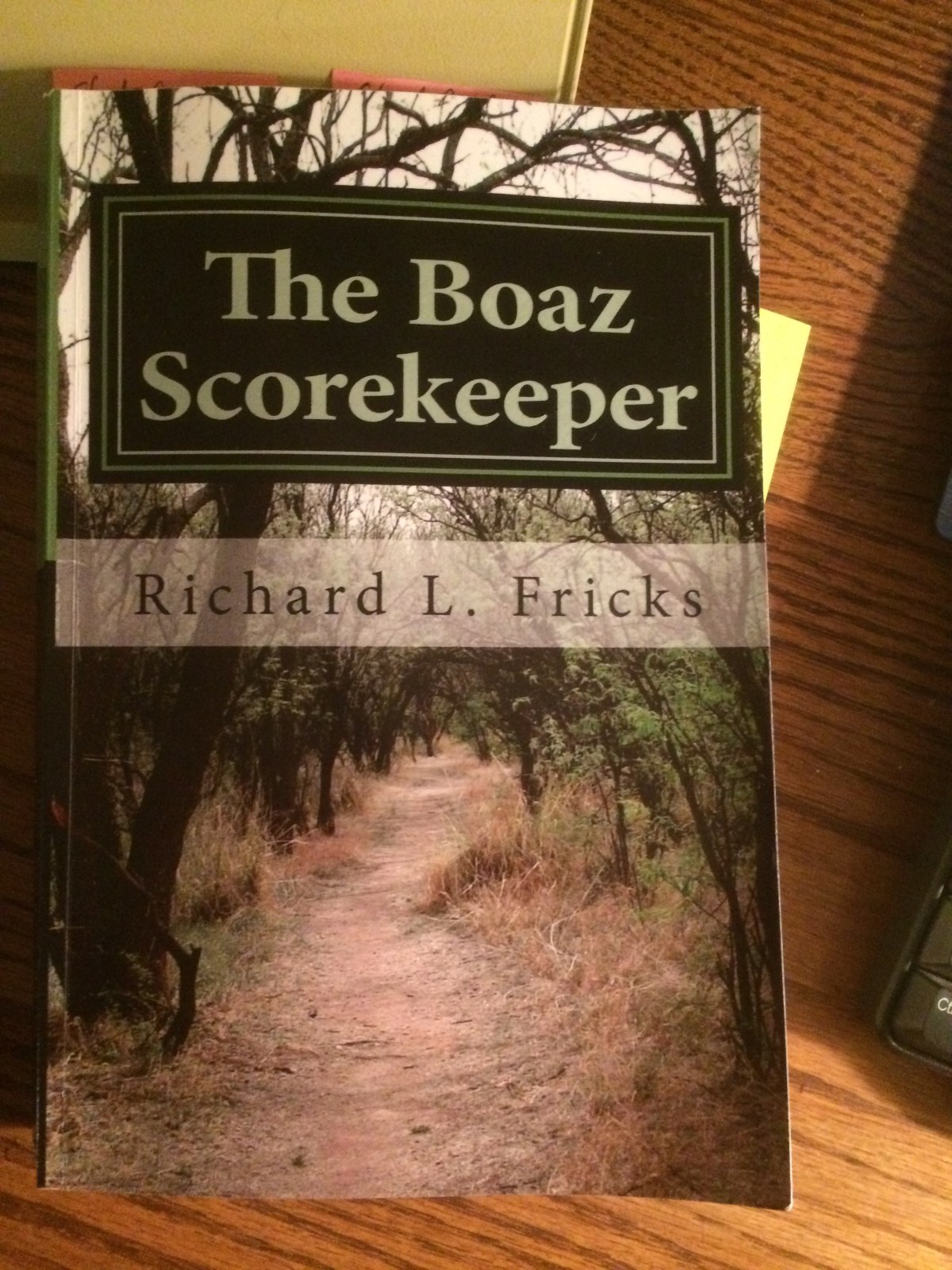
The Boaz Scorekeeper–Chapter 26

The Boaz Scorekeeper, written in 2017, is my second novel. I'll post it, a chapter a day, over the next few weeks.

In July, I was contacted by Nate Baker, a reporter with the New York Times.  He said that he was in town researching a follow-up story to the Times’ 1986 article, Designer Outlets Transform a Town.  Nate said the follow-up article had been scheduled for publication in early 1996 but the original reporter had both a personal and professional conflict.  With the research deadline approaching, the newspaper’s chief editor decided to change the deadline transforming the assignment into an eleven-year expanded feature. 

Nate asked if he could come by the office to discuss the Murray case.  He said two months ago when he was assigned the project he did some preliminary research, including reading several local and state newspapers, and had learned about the wrongful death lawsuit against the five most prominent families in Boaz.  He said he had decided to feature the 25-year unsolved case of Wendi and Cindi Murray alongside the devolution of the Boaz outlets.

I didn’t have any appointments and told Nate to come to the office. To my surprise, he had already spent six weeks in Boaz working on his story.  He gave me a copy of the Times’ 1986 article about how Boaz was transformed by the outlets.  I scanned the article and said I had vivid memories of visiting Boaz from my home in Atlanta during the late 1980s and seeing dozens and dozens of tour buses hauling in light-hearted folks with heavy pocketbooks to sometimes spend hundreds and even thousands of dollars each.  I also said it was a shame that pride, ego, and jealousy could not have been set aside for the greater good.  Nate asked me why I thought the outlets had failed.

I gave him my opinion.  Boaz had pretty much always been ruled by five families.  They were the only game in town, running things with a club mentality.  They were a club, it was known as Club Eden.  In the early to mid-80s club member Raymond Radford got a wild idea that Boaz needed to think outside the box so to speak and develop some type of unique draw for people far and wide.  For years the H.D. Lee Company had a plant in Boaz making mainly blue-jeans.  Radford did some research and learned that the Lee Company was owned by Vanity Fair and that it was planning on closing the Boaz sewing facility.  Vanity Fair was a huge retailer with dozens of stores.  Radford convinced the Club to develop an offer for Vanity Fair.  Mayor Adams, also a Club member, convinced the City Council to waive all city sales taxes for 15 years and to provide over $300,000 in renovation funds.  In exchange for these incentives, Vanity Fair would lease the twenty stores that surrounded its complex to the City.  The Club, along with the Executive Director of the Chamber of Commerce, flew to Denver to present their plan.  They were successful but someway the Club wound up controlling the outlying 20 stores which allowed it to re-lease them to manufacturer outlets.  All was great in Boaz for nearly two years.  Club Eden was in control, making thousands per month, and Boaz sales taxes from the 20 outlying stores were filling the City’s coffers with more sales taxes than all the other local retail merchants combined.

Club Eden was surprised in late 1987.  On Black Friday, the Birmingham News featured an article about Atlanta retail developer Carter Livingston’s plans to build a 200-unit retail facility just up the street from the Vanity Fair Complex.  The article said Livingston had already secured the 160-acre tract of land and would begin construction in early January 1987.  For nearly 100 years Club Eden had controlled Boaz. No business of any significance could open within the city limits of Boaz without the Club’s unofficial approval.  Those who had attempted to ignore the Club learned the hard way with several losing stores and inventories to unexplained fires.  At least two people had lost their lives, or so it seemed.

Carter Livingston was true to his word.  In record time, the Manufacturers’ Outlet Center of Boaz opened September 15, 1987 just one month before the stock market crash on October 19th.  But, this didn’t seem to stop or even decrease sales that quadrupled those of the Vanity Fair center.  This was great news for the City of Boaz bringing unimagined revenues from its 4% sales tax.  But, it was worse than death for Club Eden. There was nothing more important than power and control to these five families.  They would never accept defeat.  Success was the only acceptable result.  The short of it, over the next two years, Club Eden built six outlet shopping centers.  None of them were in Boaz.  The Club’s plan was truly long-term.  They knew that people came in droves to Boaz because of the great deals.  The Club also knew that all these thousands of customers were not loyal citizens of Boaz.  They would abandon Boaz in a heartbeat if they had another choice.  This is what Club Eden provided.  By the early 1990s, the Boaz outlets were struggling and dozens of stores were closing.  A skeleton of stores remained until mid-1995 when Carter Livingston bankrupted his Manufacturers’ Outlet Center of Boaz.

Nate thanked me for my detailed description of why the Boaz outlet phenomenon had failed.  We went to lunch and returned.  When we sat back down in the conference room, he asked me if I knew Clinton Murray?  I said I did, that he was a cousin of Wendi and Cindi Murray.  Nate said that when he first met with the Murray’s that Clinton was present but wouldn’t talk with him.  But, after several visits he apparently realized that Nate was serious about telling Wendi and Cindi’s story. 

Nate said that Clinton had found Cindi’s journal in 1996 when their parents finally decided to dismantle the twin’s bedroom.  Clinton, with Bill and Nellie’s permission, had shared it with Nate.  Apparently, Cindi had been to Club Eden once before the May 25, 1972 graduation party.  She wrote an entry dated May 11, 1972: “met Randall and James at the Boaz Dairy Queen.  We went to their clubhouse but I don’t know where it is since they made me wear a dark hood.  They built a fire and we sat around and talked.  They invited me to their graduation party in two weeks and asked if I could bring a girlfriend.  I told them I had a twin sister but she was shy and didn’t even date.  They said they would give me $200.00 if I brought Wendi with me.”

Nate also told me that he had five investigators working for him.  Each of them had been assigned to one of the Flaming Five and charged with watching and recording their every move.  Nate said that he was certain that every one of them except Wade Tillman was having an affair.  James Adams meets a Sherry Sampson at either the Day’s Inn or the Red Roof Inn in Gadsden every Thursday at 11:00 a.m.  Randall Radford goes either on Monday or Tuesday to a house on Pecan Avenue in Albertville to see Cissy Sprayberry.  Fred Billingsley meets his secretary, Judy Killian, at her house on Pleasant Grove Road at least twice a week—usually over a weekday lunch.  John Ericson is more discreet by meeting his housekeeper on Wednesday afternoon at his house while his wife makes her weekly shopping trip to Huntsville.  But, Nate said, here is where it gets interesting.  Wade’s wife Gina always goes to Huntsville on Wednesday with Ericson’s wife Judith.  Apparently, they have found some very interesting stores at the Huntsville Hilton.

After Nate filled me in on random and non-recurring trysts by the Flaming Five, he announced that his article was scheduled for publication the middle of October.

11/09/23 Biking & Listening

Here’s today’s bike ride.

Why I ride

Biking is something I both love and hate. The conflicting emotions arise from the undeniable physical effort it demands. However, this exertion is precisely what makes it an excellent form of exercise. Most days, I dedicate over an hour to my cycling routine, and in doing so, I’ve discovered a unique opportunity to enjoy a good book or podcast. The rhythmic pedaling and the wind against my face create a calming backdrop that allows me to fully immerse myself in the content. In these moments, the time spent on the bike seems worthwhile, as I can’t help but appreciate the mental and physical rewards it offers.

I especially like having ridden. The post-biking feeling is one of pure satisfaction. The endorphin rush, coupled with a sense of accomplishment, makes the initial struggle and fatigue worthwhile. As I dismount and catch my breath, I relish the sensation of having conquered the challenge, both physically and mentally. It’s a reminder that the things we sometimes love to hate can often be the ones that bring us the most fulfillment. In the end, the love-hate relationship with biking only deepens my appreciation for the sport, as it continually pushes me to overcome my own limitations and embrace the rewards that follow the effort.

My bike

A Rockhopper by Specialized. I purchased it November 2021 from Venture Out in Guntersville; Mike is top notch! So is the bike. The ‘old’ man seat was salvaged from an old Walmart bike (update: seat replaced, new photo to follow, someday).


Something to consider if you’re not already cycling.

I encourage you to start riding a bike, no matter your age. Check out these groups:

Cycling for those aged 70+(opens in a new tab)

Solitary Cycling(opens in a new tab)

Remember,

Photo by Suzy Hazelwood on Pexels.com


Novel I’m listening to:

The Last Thing He Told Me, by Laura Dave

Amazon abstract:

Don’t miss the #1 New York Times bestselling blockbuster and Reese Witherspoon Book Club Pick that’s sold over 2 million copies–now an Apple TV+ limited series starring Jennifer Garner!

The “page-turning, exhilarating” (PopSugar) and “heartfelt thriller” (Real Simple) about a woman who thinks she’s found the love of her life—until he disappears.

Before Owen Michaels disappears, he smuggles a note to his beloved wife of one year: Protect her. Despite her confusion and fear, Hannah Hall knows exactly to whom the note refers—Owen’s sixteen-year-old daughter, Bailey. Bailey, who lost her mother tragically as a child. Bailey, who wants absolutely nothing to do with her new stepmother.

As Hannah’s increasingly desperate calls to Owen go unanswered, as the FBI arrests Owen’s boss, as a US marshal and federal agents arrive at her Sausalito home unannounced, Hannah quickly realizes her husband isn’t who he said he was. And that Bailey just may hold the key to figuring out Owen’s true identity—and why he really disappeared.

Hannah and Bailey set out to discover the truth. But as they start putting together the pieces of Owen’s past, they soon realize they’re also building a new future—one neither of them could have anticipated.

With its breakneck pacing, dizzying plot twists, and evocative family drama, The Last Thing He Told Me is a “page-turning, exhilarating, and unforgettable” (PopSugar) suspense novel.


Podcasts I’m listening to:


Here’s a few photos from along my pistol route:

Achieving Perspective: Trailblazing Astronomer Maria Mitchell and the Poetry of the Cosmic Perspective (David Byrne Reads Pattiann Rogers)

Here’s the link to this article.

BY MARIA POPOVA

This is the third of nine installments in the animated interlude season of The Universe in Verse in collaboration with On Being, celebrating the wonder of reality through stories of science winged with poetry. See the rest here.

THE ANIMATED UNIVERSE IN VERSE: CHAPTER THREE

To be human is to live suspended between the scale of glow-worms and the scale of galaxies, to live with our creaturely limitations without being doomed by them — we have, after all, transcended them to unravel the molecular mystery of the double helix and compose the Benedictus and land a mechanical prosthesis of our curiosity on Mars. We have dreamt these things possible, then made them real — proof that we are a species of limitless imagination along the forward vector of our dreams. But we are also a species continually blinkered — sometimes touchingly, sometimes tragically — by our own delusions about the totality around us. Our greatest limitation is not that of imagination but that of perspective — our lens is too easily contracted by the fleeting urgencies of the present, too easily blurred by the hopes and fears of our human lives.

Two centuries ago, Maria Mitchell — a key figure in Figuring — understood this with uncommon poetry of perspective.Portrait of Maria Mitchell, 1840s. (Maria Mitchell Museum. Photograph: Maria Popova)

America’s first professional female astronomer, she was also the first woman employed by the federal government for a “specialized non-domestic skill.” After discovering her famous comet, she was hired as “computer of Venus,” performing complex mathematical calculations to help sailors navigate the globe — a one-woman global positioning system a century and a half before Einstein’s theory of relativity made GPS possible.

When Maria Mitchell began teaching at Vassar College as the only woman on the faculty, the college handbook mandated that neither she nor her female students were allowed outside after nightfall — a somewhat problematic dictum, given she was hired to teach astronomy. She overturned the handbook and overwrote the curriculum, creating the country’s most ambitious science syllabus, soon copied by other universities — including the all-male Harvard, which had long dropped its higher mathematics requirement past the freshman year.

Maria Mitchell’s students went on to become the world’s first class with academic training in what we now call astrophysics. They happened to all be women.

Maria Mitchell, standing at telescope, with her students at Vassar

Science was one of Maria Mitchell’s two great passions. The other was poetry.

At her regular “dome parties” inside the Vassar College Observatory, which was also her home, students and occasional esteemed guests — Julia Ward Howe among them — gathered to play a game of writing extemporaneous verses about astronomy on scraps of used paper: sonnets to the stars, composed on the back of class notes and calculations.

Mitchell taught astronomy until the very end of her long life, when she confided in one of her students that she would rather have written a great poem than discovered a great comet. But scientific discovery is what gave her the visibility to blaze the way for women in science and enchant generations of lay people the poetry of the cosmic perspective.

Art from What Miss Mitchell Saw

It was this living example that became Maria Mitchell’s great poem, composed in the language of being — as any life of passion and purpose ultimately becomes.

“Mingle the starlight with your lives,” she often told her students, “and you won’t be fretted by trifles.”

And yet here we are, our transient lives constantly fretted by trifles as we live them out in the sliver of spacetime allotted us by chance.

A century after Maria Mitchell returned her borrowed stardust to the universe that made it, the poet Pattiann Rogers extended a kindred invitation to perspective, untrifling the tender moments that make a life worth living.

Published in her collection Firekeeper (public library), it is read for us here by the ever-optimistic David Byrne, with original art by his ever-perspectival longtime collaborator Maira Kalman and original music by the symphonic-spirited Jherek Bischoff.

ACHIEVING PERSPECTIVE
by Pattiann Rogers

Straight up away from this road,
Away from the fitted particles of frost
Coating the hull of each chick pea,
And the stiff archer bug making its way
In the morning dark, toe hair by toe hair,
Up the stem of the trillium,
Straight up through the sky above this road right now,
The galaxies of the Cygnus A cluster
Are colliding with each other in a massive swarm
Of interpenetrating and exploding catastrophes.
I try to remember that.

And even in the gold and purple pretense
Of evening, I make myself remember
That it would take 40,000 years full of gathering
Into leaf and dropping, full of pulp splitting
And the hard wrinkling of seed, of the rising up
Of wood fibers and the disintegration of forests,
Of this lake disappearing completely in the bodies
Of toad slush and duckweed rock,
40,000 years and the fastest thing we own,
To reach the one star nearest to us.

And when you speak to me like this,
I try to remember that the wood and cement walls
Of this room are being swept away now,
Molecule by molecule, in a slow and steady wind,
And nothing at all separates our bodies
From the vast emptiness expanding, and I know
We are sitting in our chairs
Discoursing in the middle of the blackness of space.
And when you look at me
I try to recall that at this moment
Somewhere millions of miles beyond the dimness
Of the sun, the comet Biela, speeding
In its rocks and ices, is just beginning to enter
The widest arc of its elliptical turn.

Previously on The Universe in VerseChapter 1 (the evolution of flowers and the birth of ecology, with Emily Dickinson); Chapter 2 (Henrietta Leavitt, Edwin Hubble, and the age of space telescopes, with Tracy K. Smith).

The Christian nationalism is coming from inside the House

Here’s the link to this article.

Avatar photoby ADAM LEE NOV 02, 2023

Official portrait of Speaker Mike Johnson | The Christian nationalism is coming from inside the House

Overview:

Mike Johnson, the new Speaker of the House, is a radical Christian nationalist who opposes democracy—and he still might not be extreme enough for his own caucus.

Reading Time: 5 MINUTES

In 2023, Kevin McCarthy made ignominious history by becoming the first Speaker of the House in US history to be ejected by his own party.

It took multiple rounds of voting, with McCarthy groveling before his party’s most extreme members, before he got the job in the first place. But he lasted only a few months before enraging them by passing a bill to prevent a shutdown. For the grave sin of governing, he was kicked out of the speaker’s chair.

Several weeks of chaos and dysfunction ensued as various House Republicans stepped forward to run for speaker and others shot them down. Finally, the infighting exhausted them enough to coalesce around a new speaker, Louisiana Congressman Mike Johnson. (I wonder if Johnson won because his generic name made him seem unobjectionable.)

But despite his bland, forgettable demeanor, Johnson is no moderate. As the modern Republican Party keeps finding new depths of political nihilism to sink to, he may be the worst yet to hold the post.

A young-earth creationist

Johnson got his start working for the Alliance Defending Freedom, a right-wing legal group. He spent years arguing that abortion should be outlawed and that states should have the right to criminalize consensual same-sex relationships.

He’s also a young-earth creationist who’s represented Answers in Genesis in court to argue for tax exemptions for their Noah’s Ark theme park.

He believes that teaching evolution causes school shootings:

During a 2016 sermon at the Christian Center in Shreveport, Louisiana, Johnson said that a “series of cultural shifts” in the United States — led by “elites” and “academics” in the 1930s who were engaging with the theories of Charles Darwin — erased the influence of Christian thinking and creationism from society.

“People say, ‘How can a young person go into their schoolhouse and open fire on their classmates?’” Johnson asked the audience. “Because we’ve taught a whole generation — a couple generations now — of Americans, that there’s no right or wrong, that it’s about survival of the fittest, and [that] you evolve from the primordial slime. Why is that life of any sacred value? Because there’s nobody sacred to whom it’s owed. None of this should surprise us.”“New House Speaker Blamed School Shootings on Teaching Evolution and Abortion.” Nikki McCann Ramirez, Rolling Stone, 26 October 2023.

This feels almost quaint. It’s been a while since I’ve seen a young-earth creationist in the wild. I had assumed most of them had long since moved on to QAnon.

Needless to say, the idea that belief in God prevents violence is a blackly comical absurdity. Not only is that not true, it’s the flat opposite of the truth. Human history is a bloodstained chronicle of devout believers slaughtering each other for believing in the wrong god—or believing in the right god, but worshipping it in the wrong way. Just imagine trying to tell people from the era of the Inquisition or the Crusades that religion is a force for peace that teaches us to treat all life as sacred.

The Bible records a campaign of genocide enthusiastically carried out by the Hebrew tribes against their pagan enemies. Medieval Europe is an endless battle of Catholic-versus-Protestant warfare, Christian-versus-Muslim warfare, and everyone killing and persecuting Jews. Sunni and Shi’a Muslims have clashed again and again. Western nations have subjugated, colonized, enslaved and killed indigenous “heathens” from all over the world in the name of spreading the gospel. The ongoing Israel-Hamas war is a battle between two religious sects that both believe they have a God-given right to possess the same land.

In addition to his anti-evolution views, Johnson ticks every other box on the list of Christian “antis”. Like all fundamentalists, his worldview is defined by what he’s against: He is anti-abortion, anti-gay-rights, anti-feminism, anti-climate-science. He’s even anti-divorce—believing, as many religious conservatives are starting to, that it gives women too much power. In a bid to shore up the crumbling walls of patriarchy, he wants to abolish no-fault divorce so they’ll be forced to stay in unhappy or abusive marriages.

A Christian nationalist

But, above all else, Johnson is a Christian nationalist. Like all Christian nationalists, he believes (falsely, based on right-wing pseudo-history) that America was founded as a Christian nation, and therefore a Christian view of law and morality should rule.

It hardly needs emphasizing that, when Johnson and his ilk speak of a “Christian” view, they don’t mean a generically Christian, ecumenical, big-tent view. They mean their own interpretation—a hardcore right-wing, patriarchal, anti-science, literalist reading of the Bible. They believe that this fundamentalist theology should reign supreme over every other interpretation of Christianity, not to mention all the other religions, philosophies, and worldviews in our multicultural melting pot.

The most disturbing aspect of Johnson’s view is that, because he believes America is a Christian nation, he holds that evangelical Christians like himself are entitled to rule regardless of elections. That’s why he’s against democracy.

That’s not a polemical attack. He says so himself!

“We don’t live in a democracy, because democracy is two wolves and a lamb deciding what’s for dinner.”“He Seems to Be Saying His Commitment Is to Minority Rule.” Katelyn Fossett, Politico, 27 October 2023.

Yes, the Speaker of the House of Representatives, second in line to the presidency, is an avowed opponent of democracy.

These aren’t empty words. Johnson has acted in line with them. He was one of the Republicans who voted unsuccessfully to overturn the 2020 election. He wrote a brief in support of Texas’ toweringly arrogant lawsuit to throw out the results of elections in other states that voted differently. He spread bizarre conspiracy theories about Hugo Chavez writing voting machine software.

All of this isn’t an aberration. It flows from Johnson’s Christian nationalist theology. In this monarchical worldview, Christians like him get to be in charge, no matter what. If the voters say something different, too bad for them. He believes in throwing out the “wrong” votes and handpicking the person who “should” have won.


READChristian nationalists: Drop Mike, hold on to your Johnson


Johnson’s anti-democratic, election-denying views mirror the general trend toward authoritarianism among conservative Christians. They were only ever in favor of democracy as long as they thought they’d win every time. When that stopped being the case, they started wanting to change the rules to suit them. From Kristin Du Mez:

I think what has escalated things in the last decade or so is a growing alarm among conservative white Christians that they no longer have numbers on their side. So looking at the demographic change in this country, the quote-unquote “end of white Christian America” and there’s where you can see a growing willingness to blatantly abandon any commitment to democracy.

It’s really during the Obama presidency that you see the escalation of not just rhetoric, but a kind of desperation, urgency, ruthlessness in pursuing this agenda. Religious freedom was at the center of that. And it was, again, not a religious freedom for all Americans; it was religious freedom to ensure that conservative Christians could live according to their values. Because they could see this kind of sea change on LGBTQ rights, they could see the demographic changes, and inside their spaces, they have really played up this language of fear that liberals are out to get you, and you cannot raise your children anymore.“He Seems to Be Saying His Commitment Is to Minority Rule.” Katelyn Fossett, Politico, 27 October 2023.

For all the danger Johnson presents, the one thing he’s not is unusual. This election-denying, freedom-refuting ideology, once the fringe of the fringe, has swallowed the entire Republican party. Anyone the party might be expected to support would hold these same beliefs.

Johnson’s elevation isn’t an aberration, but a punctuation mark. It’s a sign that, for the foreseeable future, this is the course the Republican party has committed itself to. Elections in America are no longer a choice between two points on the same political spectrum. They’re a struggle for the continued existence of democracy over those who favor fascism and authoritarian rule.

Not extreme enough

As bad as that is, there are hints that even Johnson isn’t extreme enough for some members of his caucus.

For all his repugnant politics, he has an adopted Black son. Johnson has spoken frankly about the racism his son faces and said there’s a need for “systematic change”. He’s also said George Floyd was murdered by the police: “I don’t think anyone can view the video and objectively come to any other conclusion.”

For these remarks, perpetually-furious conservative pundits have already labeled Johnson a disgrace, a fraud and a secret Democrat. The right wing has done so much to nurture their own sense of grievance, there’s a chance that they’re truly ungovernable. No human being who could run for office and win could ever satisfy them.

If that’s true, then Johnson, for all his radicalism, might not end up enjoying a longer or easier tenure than his predecessor.

The Boaz Scorekeeper–Chapter 25

The Boaz Scorekeeper, written in 2017, is my second novel. I'll post it, a chapter a day, over the next few weeks.

I shouldn’t have been surprised that the Flaming Five continued to go about their daily lives as though success and happiness were as fixed and unchanging for them as gravity was for the rest of us mortals.

By 1997, Wade Tillman was, for all practical purposes, the lead pastor at First Baptist Church of Christ.  His father, Walter, had been pastor since the late 50s and was experiencing some serious health problems.  Wade was just as much a Christian fundamentalist as his father, believing with all his heart that the Bible was God’s inerrant, infallible Word.

Wade married Gina Culvert in August 1972.  Everyone in the community had been surprised.  This was understandable since it was common knowledge Gina had a reputation for having loose morals.  She was not prime wife material for a future pastor.  What the community didn’t know was what I learned during Gina’s deposition.  Once law enforcement began investigating the disappearance of Wendi and Cindi Murray, Gina’s mother, Beverly Culvert, pressured Gina into telling the truth about what happened at the graduation party.  Beverly saw an opportunity.  After Raymond Radford and David Adams had talked privately with Gina and offered her a free college education in exchange for her false testimony, she called Walter Tillman and said that Gina would tell the truth unless Wade married Gina. 

Beverly was smart.  She had audio-recorded the conversation Gina had with Raymond and David and told Walter that the tape was in a safety deposit box and only her attorney knew where it was.  Beverly had promised that if any harm came to either her or Gina that the tape would be released to the press.  She even wrote out the definition of ‘harm’ to include Wade initiating any type of separation or divorce from Gina.  Beverly made all parties sign the document she had a Birmingham attorney prepare.  Ultimately, Walter and Wade’s mother, Betty, realized that they had been outfoxed and had no choice but to demand that Wade marry Gina.  Wade also valued his freedom and consented to marrying Gina Renee Culvert on a rainy Saturday afternoon in late August 1972 at First Baptist Church of Christ among a small gathering of family and close friends.

Once again, the community was surprised that Wade and Gina adjusted well to married life, with both going to the University of Alabama for degrees, and on to Dallas, Texas where Wade earned his Master of Divinity diploma from the Southwest Theological Seminary.  Within two years after returning to Boaz, Wade and Gina were the proud parents of two children: Warren, born in 1981, and Grace, born in 1983.

After graduating from Auburn, James Adams had no problem reestablishing himself as a leader in the Boaz community.  He quickly put his marketing degree to good use in recommending and initiating a move of Adams Buick, Chevrolet & GMC from North Main Street to the intersection of Highways 431 and 168, a much more visible and accessible location.  James also joined the Rotary Club, the Lions Club, and First Baptist Church of Christ.  In September 1977, he married Rachel Carlisle, a young lady from Demopolis he met while at Auburn.  In 1979, Loree was born and in 1982 Rachel again gave birth, this time to a boy, Justin James Adams.

In 1992 James again motivated and directed another major building project.  This time, he and the other four members of the Flaming Five, spearheaded the creation of a campaign that raised cash and pledges of over $2,000,000 for the construction of the Faith and Family Life Center at First Baptist Church of Christ.  This facility, along with several large classrooms, included an Olympic size swimming pool, and a full-size gymnasium and basketball court.  The Flaming Five started an area youth league that focused on basketball and Bible.  The Center became a catalyst for new church members, drawing couples with children, both boys and girls, from as far away as Douglas and Crossville.  The modern facility was no doubt a drawing card but the real magnet was the vibrant reputation the Flaming Five had eternally etched into the minds and memories of basketball fans throughout North Alabama.

After a glorious career on the courts at Auburn University, Randall Radford returned to Boaz to join the family business—Radford Hardware & Building Supply.  Randall, like James, had not wasted his educational opportunities in college.  With a degree in Finance, Randall revolutionized how Radford Hardware & Building Supply made credit available to its customers.  Randall had learned that lowering credit requirements increased sales with very little decrease in collections.  Providing easy credit terms to most every customer also allowed Randall to keep prices at a premium.  Fred Billingsley at First State Bank of Boaz developed a factoring program for Radford Hardware that allowed Randall to inject cash into the operation when needed.  In 1978, Randall married Randi Bonds.  Randi was the younger sister of Ricki Bonds, Randall’s cheerleader classmate and frequent visitor to Camp Eden.  Randi had always been the studious daughter of Robert and Regina Bonds and had earned a pharmacy degree while at Auburn and now was a drug rep with Merck.  Randall and Randi had two children, Carrie born in 1980, and Clay born in 1982.  Randall was fully committed to Radford Hardware & Building Supply and dedicated at least 60 hours per week assuring that the fourth-generation business would continue for his son Clay, and hopefully his grandchildren.  However, Randall’s passion was ‘Double B’ as he called it: Basketball and Bible.  He worked tirelessly with James Adams to raise the money for the Faith and Family Life Center at First Baptist Church of Christ.  Now, Randall was spending every Tuesday and Wednesday evenings, and most Saturday afternoons, teaching and coaching teenagers from three counties—always with his 15-year-old son Clay by his side.  The sessions would start with a 45-minute Bible lesson in one of the modern high-media classrooms and then an hour on the basketball court.  Randall fully believed that a person could know Christ just as the disciples had known Him as they walked the dusty trails of Galilee over 2,000 years ago.

Fred Billingsley graduated from the University of Alabama with a degree in banking.  He returned to Boaz and went to work at First State Bank of Boaz where his father, Fitz, was now both President and Chief Executive Officer.  He also owned a controlling interest in the thriving bank.  Fred started off as a junior accountant but by 1997 was Vice-President of Operations.  Fred married Phyllis Taylor from Albertville in June 1980. They had two children, Fulton born in 1981, and Stella born in 1983.  Fred and Phyllis joined First Baptist Church of Christ in 1978 and were active members from the start.  Fred, although not as active as James and Randall, supported the basketball and Bible youth program.  Fred’s main interest was money and spent most of his time seeking out opportunities for Club Eden.

John Ericson graduated in 1979 from the University of Alabama with a Masters in Real Estate Development.  He and his wife Judith returned from Tuscaloosa to Boaz for John to join Ericson Real Estate & Property Development as Vice-President, focusing on high-end residential sales, and subdivision opportunities in Boaz, Albertville, and Guntersville.  John and Judith Harrington had met in the summer of 1970 at Camp Winnataska, a Christian youth camp in Birmingham. Judith was from Montgomery.  They continued to pursue their relationship when they returned to the camp in the summer of 1971.  The couple married in June 1974 while both were students at the University.  They had two children.  Bridget was born in 1977, and Danny in 1981.  John and Judith likewise joined First Baptist Church of Christ.  John was equally as active as Randall in the ‘Double B’ program. 

11/08/23 Biking & Listening

Here’s today’s bike ride.

Why I ride

Biking is something I both love and hate. The conflicting emotions arise from the undeniable physical effort it demands. However, this exertion is precisely what makes it an excellent form of exercise. Most days, I dedicate over an hour to my cycling routine, and in doing so, I’ve discovered a unique opportunity to enjoy a good book or podcast. The rhythmic pedaling and the wind against my face create a calming backdrop that allows me to fully immerse myself in the content. In these moments, the time spent on the bike seems worthwhile, as I can’t help but appreciate the mental and physical rewards it offers.

I especially like having ridden. The post-biking feeling is one of pure satisfaction. The endorphin rush, coupled with a sense of accomplishment, makes the initial struggle and fatigue worthwhile. As I dismount and catch my breath, I relish the sensation of having conquered the challenge, both physically and mentally. It’s a reminder that the things we sometimes love to hate can often be the ones that bring us the most fulfillment. In the end, the love-hate relationship with biking only deepens my appreciation for the sport, as it continually pushes me to overcome my own limitations and embrace the rewards that follow the effort.

My bike

A Rockhopper by Specialized. I purchased it November 2021 from Venture Out in Guntersville; Mike is top notch! So is the bike. The ‘old’ man seat was salvaged from an old Walmart bike (update: seat replaced, new photo to follow, someday).


Something to consider if you’re not already cycling.

I encourage you to start riding a bike, no matter your age. Check out these groups:

Cycling for those aged 70+(opens in a new tab)

Solitary Cycling(opens in a new tab)

Remember,

Photo by Suzy Hazelwood on Pexels.com


Novel I’m listening to:

The Last Thing He Told Me, by Laura Dave

Amazon abstract:

Don’t miss the #1 New York Times bestselling blockbuster and Reese Witherspoon Book Club Pick that’s sold over 2 million copies–now an Apple TV+ limited series starring Jennifer Garner!

The “page-turning, exhilarating” (PopSugar) and “heartfelt thriller” (Real Simple) about a woman who thinks she’s found the love of her life—until he disappears.

Before Owen Michaels disappears, he smuggles a note to his beloved wife of one year: Protect her. Despite her confusion and fear, Hannah Hall knows exactly to whom the note refers—Owen’s sixteen-year-old daughter, Bailey. Bailey, who lost her mother tragically as a child. Bailey, who wants absolutely nothing to do with her new stepmother.

As Hannah’s increasingly desperate calls to Owen go unanswered, as the FBI arrests Owen’s boss, as a US marshal and federal agents arrive at her Sausalito home unannounced, Hannah quickly realizes her husband isn’t who he said he was. And that Bailey just may hold the key to figuring out Owen’s true identity—and why he really disappeared.

Hannah and Bailey set out to discover the truth. But as they start putting together the pieces of Owen’s past, they soon realize they’re also building a new future—one neither of them could have anticipated.

With its breakneck pacing, dizzying plot twists, and evocative family drama, The Last Thing He Told Me is a “page-turning, exhilarating, and unforgettable” (PopSugar) suspense novel.


Podcasts I’m listening to:


Here’s a few photos from along my pistol route:

To Be a Person: Jane Hirshfield’s Playful and Poignant Poem About Bearing Our Human Condition

Here’s the link to this article.

BY MARIA POPOVA

To Be a Person: Jane Hirshfield’s Playful and Poignant Poem About Bearing Our Human Condition

A human being is a living constellation of contradictions, mostly opaque to itself. “Inward secret creatures,” Iris Murdoch called us in reckoning with the blind spots of our self-knowledge. “Humans are just the sort of organisms that interpret and modify their agency through their conception of themselves,” philosopher Amélie Rorty wrote as she examined what makes a person — a self-conception shaped by our astonishing evolutionary inheritance, which took us from bacteria to the Benedictus in a mere minute on the clock-face of the cosmos; a self-conception distorted by an ego that habitually confuses who we wish we were for who we are, redeemed only by the courage to know ourselves.

A generation after Maya Angelou captured these flickering contradictions in her poem “A Brave and Starling Truth,” which sailed into space to remind us that “we are neither devils nor divines,” Jane Hirshfield cracks open this eternal question of what it means to be a person in a lovely poem from her collection The Asking: New and Selected Poems (public library).

TO BE A PERSON
by Jane Hirshfield

To be a person is an untenable proposition.

Odd of proportion,
upright,
unbalanced of body, feeling, and mind.

Two predator’s eyes
face forward,
yet seem always to be trying to look back.

Unhooved, untaloned fingers
seem to grasp mostly grief and pain.
To create, too often, mostly grief and pain.

Some take,
in witnessed suffering, pleasure.
Some make, of witnessed suffering, beauty.

On the other side —
a creature capable of blushing,
who chooses to spin until dizzy,
likes what is shiny,
demands to stay awake even when sleepy.

Learns what is basic, what acid,
what are stomata, nuclei, jokes,
which birds are flightless.
Learns to play four-handed piano.
To play, when it is needed, one-handed piano.

Hums. Feeds strays.
Says, “All together now, on three.”

To be a person may be possible then, after all.

Or the question may be considered still at least open —
an unused drawer, a pair of waiting workboots.

Complement with Sylvia Plath on the pillars of personhood and philosopher Rebecca Goldstein on what makes you and your childhood self the same person despite a lifetime of physiological and psychological change, then revisit Jane Hirshfield’s wonderful poems “Optimism,” “The Weighing,” and “For What Binds Us,” and her uncommonly insightful prose meditation on how poetry transforms us.

Christianity’s Addiction to Magical Thinking

Here’s the link to this article.

By David Madison at 11/03/2023

Churchgoers don’t even notice or care 

A thousand years from now, will there be people—with as little grasp of history as contemporary Christians—who worship a goddess named Minerva, because they believe that Minerva McGonagall in the Harry Potter stories was real? What magical powers she had! She could change herself instantly into a cat, and multiply food supplies. Will there also be a goddess Hermione, based on Hermione Granger in Harry Potter, who created a magic potion that allows the person who drinks it to assume the physical appearance of another person? Will the Fairy God Mother in Cinderella be worshipped as well, because she used a magic spell to turn a pumpkin into a splendid coach?
 
 
The New Testament authors used exactly this kind of razzle-dazzle to bring converts to the Jesus cult. These authors borrowed freely from miracle folklore of the ancient world: they depicted Jesus healing a blind man by smearing mud on his eyes; a woman was healed by touching the hem of Jesus’ garment. He transferred demons from a man into pigs, fed thousands of people with just a few loaves and fish, turned water into wine, raised a man from the dead by voice command, recommended magic potions—drinking his blood and eating his flesh—to gain eternal life. He cured a paralytic by forgiving his sins. Jesus glowed on a mountaintop while chatting with Moses and Elijah—and the voice of Yahweh came from water vapor (a cloud). Jesus walked on water and controlled with weather. At the end of his story, he floated up and away, disappearing in the clouds. 
 
There’s magic as well in the letters of the apostle Paul. He taught that by believing in your heart—and saying with your lips—that Jesus was raised from the dead, “you will be saved.” That’s a magic spell. Paul also was sure your sexual desires are cancelled (or, as he put it, crucified) if you “belong to Jesus.” 
 
The New Testament is a handbook of magic. Any one of these Jesus stories told from the pulpit evokes a feeling of awe, “Wow, wasn’t Jesus wonderful!” But a responsible study/analysis of scripture means that even the most devout readers must consider probabilities, based on how we know the world works. Which is more likely—that Jesus did such awesome things, or that the gospel authors fashioned their stories from the fantasy folklore of the time? If your favorite priest or minister claims to have pulled off miracles similar to these Jesus-deeds in the gospels, only the most gullible would be convinced. In this era of cell-phones, many churchgoers would ask for evidence: “Let’s see the pictures.” But when they believe—and adore—the magic stories in the Bible, they waive the request for evidence. 
 
There is very little curiosity about what it was like to live at the time the New Testament was written, or a grasp of how little knowledge of the world and the universe most people at that time possessed, e.g., that we live on a planet whose crust consists of seven continents and vast oceans—with a molten core at its center; that we are in a solar system that orbits the galactic center, along with billions of other solar systems. The Bible authors didn’t even know what stars are. 
 
Nor is there much curiosity among the devout about the authors of the New Testament. Who were they, after all? But it is hard to satisfy this curiosity because the gospels were written anonymously, and so many of the epistles were forgeries. Because of the apostle Paul’s own seven authentic letters, we have an abundance of information about him—which, unfortunately, is not a good thing! But from what the New Testament authors wrote, we can figure out a lot about their mind-sets—which, also unfortunately, is not a good thing. The church has done a good cover-up job by positioning these authors as saints, and this has deflected attention from the superstitions and magical thinking that they embraced and promoted.  
 
Scholars have researched and debated these realities for a long time, with devout scholars trying to put the best possible spin on ancient beliefs that should be trashed. Religions have always thrived on the appeal to belief without evidence. That’s the whole point of the story of Doubting Thomas, found only in John’s gospel (20:24-29). When the other disciples told Thomas that the resurrected Jesus had appeared to them—Thomas wasn’t there when it happened—his skepticism kicked in. A week later, Thomas was present when Jesus showed up again. He invited Thomas to touch the sword wound in his side, and that convinced him: “My Lord and my God!” And then he got a scolding from Jesus: “Have you believed because you have seen me? Blessed are those who have not seen and yet have come to believe.” 

Religions rely on this gimmick: believe what the preachers claim to know about god(s).
 
For in depth study of this issue, I recommend an article published here last November by John Loftus, Paul’s Christianity: Belief in Belief Itself. This is actually the full version of the Foreword that Loftus wrote for Robert Conner’s excellent book, The Jesus Cult: 2000 Years of the Last Days.
 
What are we up against when we face belief-in-belief? Loftus reports this encounter: “I asked one woman whether she honestly wanted to know if her faith was false. She said she didn’t, that she was happy, and that was that. She knew the implications if she concluded it was false. It would involve some adverse social repercussions she didn’t want, so she chose not even to consider whether she was wrong.” 
 
Which means that most churchgoers would not want to deal with the issues that Loftus discusses in this article. He opens with a quote from the Conner book: “…the greatest threat is the core feature of the Christian cult: belief in belief, the conviction that the Christian narrative is literally its own proof.” (p. 2, The Jesus Cult)
 
Hence churchgoers today—like the woman Loftus mentions—couldn’t care less how Christian theology emerged in the ancient world; their simple answer is sufficient: “Jesus the son of God was born, did his magic tricks—proof for sure he had divine powers—was sacrificed to atone for our sins, rose from the dead. This is what we have to belief to live with Jesus forever.” The heavy magic component here isn’t noticed—or more correctly, it is embraced as willingly as Harry Potter fans cheer on their hero. Conner is blunt:
 
“Christianity was a cult as presently understood from its inception, a toxic brew of apocalyptic delusion, sexual phobias and fixations, and a hierarchy of control, control of women by men, of slaves by masters, and society by the church.” (p. 2, The Jesus Cult)
 
This toxic brew of apocalyptic delusion got a jump start in the writings/teachings of the apostle Paul. The devout don’t seem to notice how much their religion has been damaged by Paul’s bad theology. No surprise. If few Christians make a practice of reading the gospels with full curiosity and skepticism engaged, I suspect far fewer read Paul’s letters. The gospels at least have stories, but Paul wrote extensively about his theological certainties based on his visions. It is obvious he had little—if any—knowledge about Jesus of Nazareth. 
 
Why doesn’t this example of Paul’s bragging shock churchgoers: “For I want you to know, brothers and sisters, that the gospel that was proclaimed by me is not of human origin, for I did not receive it from a human source, nor was I taught it, but I received it through a revelation of Jesus Christ.” (Galatians 1:11-12)
 
So, Jesus spoke to Paul directly from the spiritual realm? Here we go again with magical thinking, similar to the commonly accepted notion that gods speak to humans via dreams. Loftus notes that this is detached from reality:
 
“Hearing and heeding imaginary voices in one’s head as if they came from someone else, a god, angel, or deity, is not the mark of a sane person. Period. This insanity should be acknowledged if the voices command things that are harmful and dangerous, deceptive and false, and control much of a person’s life. That’s what we see throughout the Bible, in both the Old and New Testaments.”
 
The Old Testament prophets claim that the word of Yahweh “came to them” and Joseph supposedly learned about Mary’s pregnancy in a dream. This is yet more magical thinking. 
 
There has been a lot written about Paul’s state of mind, and Loftus sums up the conclusions of many secular thinkers: “I can affirm with a great deal of confidence that Paul was functionally insane, if he were living among rational people. But in a rational society Paul wouldn’t function well at all. He would be that homeless guy on the city street corner who proselytized with bullhorns and signs to no one, calling on people to ‘REPENT! FOR THE END IS NEAR!’” 
 
Robert Conner also wrote an essay, “Paul’s Christianity,” for Loftus’ 2019 anthology, The Case Against Miracles. Conner’s conclusion, at the end of his 25-page essay: “A more mature modern psychology with superior investigative techniques and tools can now question whether Paul of Tarsus was functionally, if not clinically, insane—and whether the religion he championed is based on delusion.” (p. 545)

                                             Loftus draws attention to Gerd Ludemann’s book, Paul: The Founder of Christianity. This title might puzzle many of the devout, who don’t appreciate New Testament chronology. That is, Paul’s version of the faith was preached long before the gospels were written, and much of their content might, in fact, be derived from his thought. On this, see especially, Mark Dykstra’s book: Mark Canonizer of Paul.
 
I’ve just scratched the surface of Loftus’ essay. It is worth careful study, especially by Christians who are inclined to ignore the origins of their faith—to protect their beliefs. Their belief in belief. Loftus also references Richard Carrier’s article, Kooks and Quacks of the Roman Empire: A Look into the World of the Gospels, in which he states:


“From all of this one thing should be apparent: the age of Jesus was not an age of critical reflection and remarkable religious acumen. It was an era filled with con artists, gullible believers, martyrs without a cause, and reputed miracles of every variety. In light of this picture, the tales of the Gospels do not seem very remarkable. Even if they were false in every detail, there is no evidence that they would have been disbelieved or rejected as absurd by many people, who at the time had little in the way of education or critical thinking skills.”
 
Christianity’s addiction to magical thinking guarantees that its foundations are incredibly weak. 


David Madison was a pastor in the Methodist Church for nine years, and has a PhD in Biblical Studies from Boston University. He is the author of two books, Ten ToughProblems in Christian Thought and Belief: a Minister-Turned-Atheist Shows Why You Should Ditch the Faith, now being reissued in several volumes, the first of which is Guessing About God (2023) and Ten Things Christians Wish Jesus Hadn’t Taught: And Other Reasons to Question His Words (2021). The Spanish translation of this book is also now available. 
 
His YouTube channel is here. At the invitation of John Loftus, he has written for the Debunking Christianity Blog since 2016.
 
The Cure-for-Christianity Library©, now with more than 500 titles, is here. A brief video explanation of the Library is here