
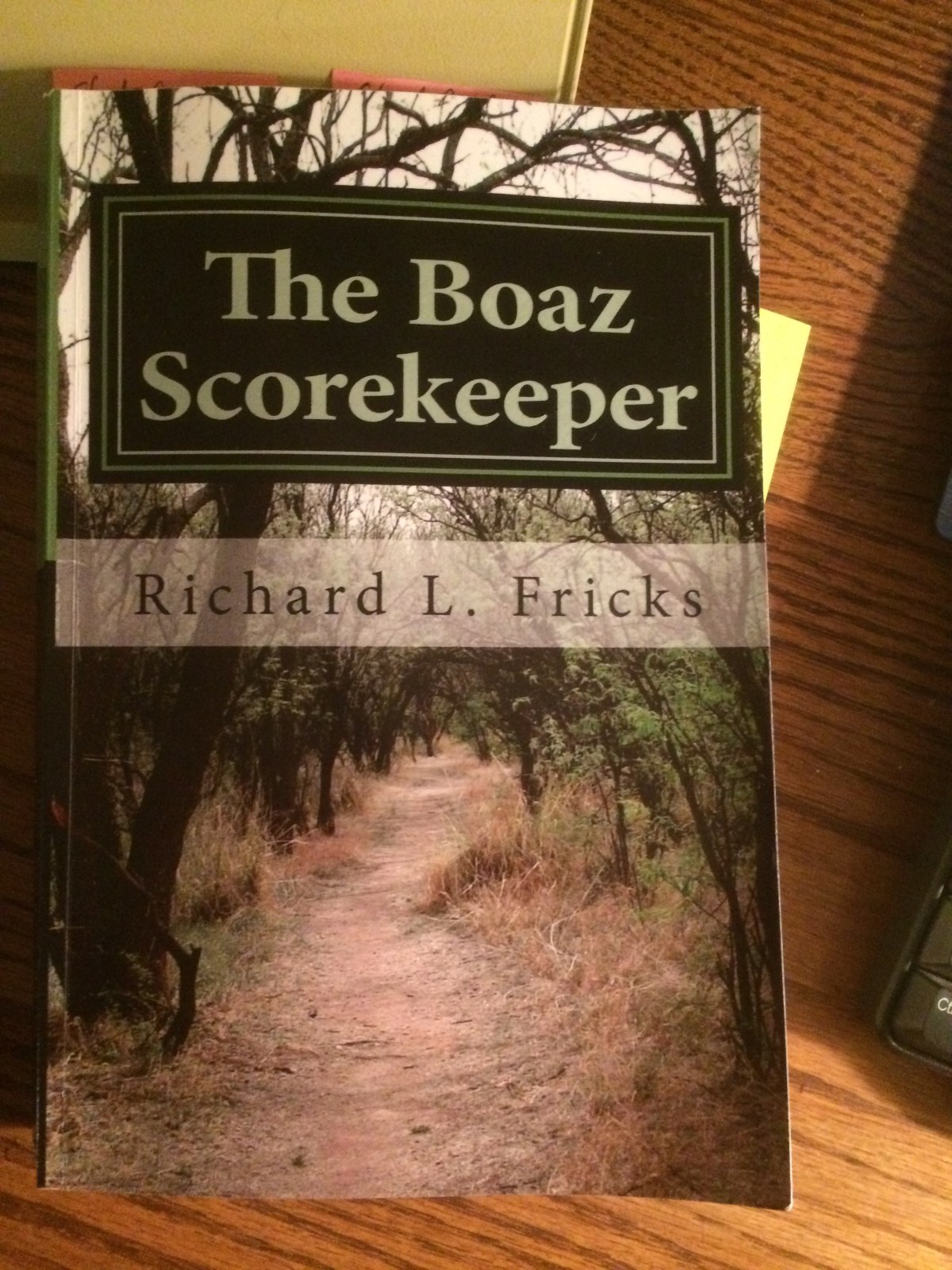
The Boaz Scorekeeper, written in 2017, is my second novel. I'll post it, a chapter a day, over the next few weeks.
I drove to the law office and sat at my desk for over an hour reviewing letters and motions received since I left. I had kept up with emails on my phone. I determined that nothing breathtaking had occurred. I made a pot of coffee and sat in the conference room. I took a blank yellow pad and pencil that always sat in the middle of the table and decided to brainstorm what I had learned from over thirty-six years of representing criminal defendants.
I figured the first thing to do was to make two lists. One would be a list of cases where the defendant was formally charged, tried, convicted, and spent time in prison. I labeled this column ‘Thoughtless.’ The other list would be cases where the defendant won his case. These cases would include an assortment of defendants: those who were questioned and released, those who were questioned, charged and released, those who were questioned, charged, tried and found not guilty, and finally, those who were questioned, charged, tried and were ultimately released (and not retried) because of a mistrial. I labeled this column ‘Thoughtful.’
Of course, there was a third list that I wanted and really needed to create but it was impossible. This third list would be my attempt to name criminals who never got caught. I imagined this list could be rather long. These were the guys and gals who were the smartest. But, again, this list would remain a secret.
The main thing I was after from the first list was things not to do, things NEVER to do. These were things that got the defendant in the cross hairs to begin with. I spent nearly two hours creating these two lists. To be thorough, I would have to review my work journals. From the first day, I had started practice at Downs, Gambol & Stevens in Atlanta, I had kept a personal journal listing every case I worked on, and including factual details, and instructive legal nuances and strategies. But I would not pursue this level of detail tonight. That could wait for another day. Tonight, I simply wanted to come up with two or three key principles my ‘successful’ clients had followed in avoiding prison or, in capital cases, the death penalty.
There were only five cases I could think of to include under ‘Thoughtful,’ and twelve for the ‘Thoughtless’ column. On a separate sheet of paper, I jotted down the main facts of each case. After pondering them for quite a while I wrote down related principles.
I came up with several ‘Thoughtful’ principles. It seemed the most common element in these five cases were the absence of a body. I found it nearly funny that all five cases I had listed were murder cases. I asked myself had I already decided to murder John Ericson. I let this thought pass through my mind and not take hold. In three of my five listed cases, the victim’s body was never found. I decided to engage in hypothetical thinking. Principle number one—the dead body disappears. In looking back over my statement of facts for my five ‘Thoughtful’ cases, I saw that in four of the cases there was not even a murder scene to be investigated. From a criminal’s standpoint, that certainly helped. In looking over my ‘Thoughtless’ cases, I easily concluded that murder scenes often led investigators to my client. With modern forensic tests and tools scientists could almost paint a picture of who committed the crime. From one hair, one footprint, one fingerprint, or a thousand other elements, forensic investigators fed law enforcement teams a rich and steady diet of reliable evidence to pursue one and only one suspect.
One other thing that jumped out at me. Eyewitnesses. Obviously, my ‘Thoughtless’ list included case after case where my client was convicted from the testimony of an eyewitness or a witness who possessed testimony that related to my client. Things such as a witness placing my client in a key location, or anchoring a time line that worked its magic against my client. But, from my ‘Thoughtful’ list I noted that eyewitnesses also had enabled several of these clients to avoid conviction and punishment. These cases included testimonies that gave my client an alibi. It never hurt to be able to verify where my client was, considering the prosecution’s uncertainty over the time of death, or the time the victim went missing. District Attorney’s always developed theories, and over the years I had learned the importance of countering their arguments with hard evidence, with some of the best being a witness that places my client in a time and position where it was impossible for him to have committed the subject crime.
By now it was nearly midnight and I was exhausted. I felt I was headed in the right direction. At a minimum, I had avoided the worst possible scenario, one where I acted spontaneously in meting out justice to John Ericson. I now knew I had to have a very detailed plan and this plan had to include the use of proven principles. I was proud that I had uncovered four of these key principles: there is no body discovered, there is no crime scene to investigate, there are no eyewitnesses to the murder, and there are eyewitnesses to testify to the whereabouts of the defendant.
I locked up the office and drove to Hickory Hollow to determine what type sleep a criminal in the making would experience the first night of his new life.

 Richard L. Fricks