
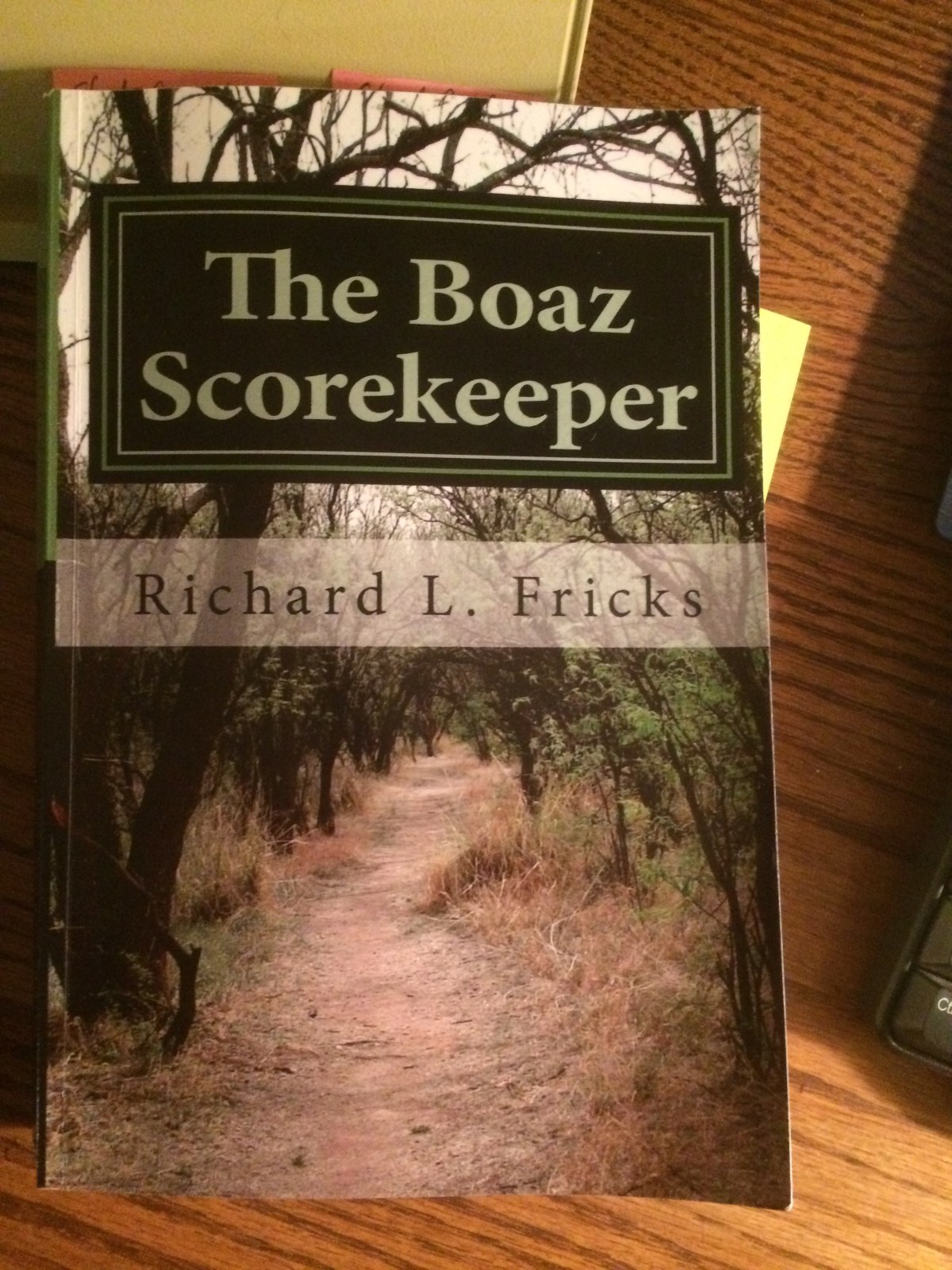
The Boaz Scorekeeper, written in 2017, is my second novel. I'll post it, a chapter a day, over the next few weeks.
I started Boaz Elementary School in mid-August 1960. I remember the first day. Mr. Chambers’ Bus #9 stopped at our mailbox at 6:30 a.m. and I stepped into another world. I had figured I might be one of the first on the bus since it was so early. I was wrong. Scattered around the front half of the bus were my neighborhood friends, all friendly, polite, clean-mouthed, and evidencing the six years of Bible teaching and tough love poured out on us by Brother G. The back half of the bus was overflowing with the heathen. I didn’t know any of them, but soon learned they all were sons and daughters of a group of tenant farmers just north of Double Bridges. From the front of the bus, I could see their dirty faces and torn clothing as they stood in the aisle way or sat on the back of the bench seats. And, the worst part, I could hear the filth spewing from their mouths, dirty words, half of which I had never heard. I was glad to find a seat beside Billy Baker in the front row right behind a bus-driver that seemed oblivious to everything around him.
I was lucky. Only one of the heathen clan wound up in Mrs. Gillespie’s first grade class. Frankie Olinger didn’t stand a chance against this beautiful soul who welded words like swords if the need arose. That first morning, before the first bell rang, this Godly saint had Frankie, with clean hands, arms, and face, facing the overgrown black-board, sitting straight-back in a student’s desk, right beside her own giant oak desk at the front of the room. I don’t know what she said to him in the coat room as she unwound his cockiness from the moment we all walked in from the bus. The other bus riders, being older than me, went to separate rooms. Only Billy Baker and myself, and Frankie Olinger, wound up in Mrs. Gillespie’s room. I quickly learned that the other 24 students were city kids who probably had never hoed a row of cotton, pulled an ear of corn, castrated a single pig, or eaten a boiled rabbit leg.
By the end of the first week, I knew I was already miles ahead of most everyone in the room when it came to reading and writing. Mother had made sure this would be the case. However, there was a group of five boys who ran a close second. It didn’t take long the first day of school for me to learn that they were from five prominent Boaz families. They made sure everyone around them knew their fathers were a big-church pastor, a home-owned bank president, a rich car-dealer, a more-rich hardware and building supply owner, and a most-rich real estate developer. By the end of the first week, these five, Wade Tillman, Fred Billingsley, James Adams, Randall Radford, and John Ericson, semi-included me in a group they were contemplating allowing in their small circle of friends. Including me, like anyone else, was strictly strategic. I was as big or bigger than any of them except Randall, and I was smart. Even at six years old these five had already learned the art of the deal from the feet of their fathers, the masters of a booming but clannish town. Out of this group, my pick was Fred Billingsley. He was the quietest of the bunch and seemed to appreciate me helping him solve a simple arithmetic problem after lunch on Thursday, our fourth day of carving out a new life. Several years later I would find out he was a little different from the other four members of his group.
Other than enduring the body odor and foul mouths of the Double Bridges gang during my bus rides to and from school, my life for the next five years was maybe the best time so far. I did extremely well in school. My faith in God grew by leaps and bounds all thanks to Brother G, and life at home with Dad and Mom, Mama El, and Gramp’s laid down deep abiding lessons of how a bi-vocational lower-income family could exchange touches of love amidst the long hours of caring for chickens, tending a gigantic garden, and cultivating 30 acres of corn and cotton.
My world came tumbling down at the end of my Fifth-grade year. It was during Spring Break. Gramp’s and I were fishing in our pond, one he had helped his father build with a pair of overgrown mules two years before the turn of the century. It was late afternoon and after we had caught a stringer full of Brim, everyone as big as one of Gramps’ hands. I was walking around the shallow end of the pond casting my line out into the middle without a float trying to snag a catfish laying on the bottom of the pond. Gramp’s was fishing from the center of the dam, sitting under the outstretched limbs of a hundred-year-old oak.
Just as the sun sank behind the row of Loblolly Pines on the west side of the pond my fishing pole jerked out of my hand. I had to scramble to keep from losing it. I grabbed it right before it slithered into the edge of the pond. It took me what seemed like an hour to haul in the ten-pound catfish. When I had it off my hook and safely away from the pond’s edge, I held it up and hollered, “Look Gramp’s, bet you never caught one this big.” For some reason, I had not looked over towards Gramp’s during the whole time I was dealing with the big Cat. When he didn’t respond to my ribbing was when I saw something I will never forget. Gramp’s was lying on his side with his face next to the water’s edge.
I dropped the Cat and raced to Gramp’s. When I reached him, I thought he had died. His face was towards me and his eyes were closed. I managed somehow to turn him over and around, with his head now higher than his feet. I remember I almost let him roll into the pond. I put my ear to his mouth and nose and could tell he was still breathing. Then, he opened his eyes. “Gramp’s, what’s wrong?” I said.
Barely audible he managed to say, “It’s my heart, I’m dying.”
“No Gramp’s you can’t die. I’m going to get help.”
“Micaden, it’s no use. Stay with me, please.” Gramp’s said with a tear running down his left cheek.
By now it was nearly dark. We had brought a kerosene lantern and I used a match from my pocket that Gramp’s always made me carry. The light revealed the hollowness and distance in his eyes. I was only eleven years old but had seen enough death in the eyes of piglets and calves, even rabbits and squirrels, to realize I was losing the one person who I loved more than anyone in the world. I almost felt ashamed thinking this because I dearly loved my Mom, my Dad, and my Mama El. Gramp’s and I had something unique. Dad didn’t have a lot of time for me with working two jobs. Gramp’s was always at home and it was there, at the house and farm, that we were together most every minute of the day when I wasn’t in school or in church.
“Don’t die Gramp’s. I can’t live without you.”
“Listen to me Micaden. You are stronger than you think. You can do whatever you set out to do, but stay true to God. Don’t go looking for trouble, it’ll find you. But, don’t run from it when it comes. Fight it head on. Don’t be fooled by the world. It might not be what you think it is.” It took Gramp’s five attempts and at least ten minutes to say these words.
“I promise you I will. Gramp’s, I need to get help.” I said, tears running down my cheeks, my heart racing with fear.
And, that was it. Gramp’s stopped breathing, his mouth fixed open like he was a baby bird waiting for its mother to drop in some food. But, it was his eyes that I will never forget. Still hollow, glassy, now lifeless. I sat and stared into his open eyes for minutes before running back across the knee-high corn, through the pasture gate, across the Bermuda pasture, and around the garden to the back porch of our house.
As I ran, I recall thinking that Gramps’ spirit was with Jesus. But, I hadn’t seen any sign of that when I considered his eyes and face. I had heard Brother G preach many a sermon on how at death the body returns to the dust of the ground but the soul is immediately in the presence of our living Savior. Just like the calf we had lost at birth only three weeks earlier, Gramp’s was dead. But, unlike that calf, someday, at Jesus’ Second Coming, Gramp’s would rise with a new body and fly to glory to be reunited with His spirit at the right hand of the Father. For now, and probably for the rest of my life, I would never walk alongside Gramp’s as he strolled through our two chicken houses looking for dead birds. I would never sit next to him at our oak dinner table. I would never watch him plant a garden or pull ten ears of corn to my one, even if he did have only one leg. Death had descended and Gramp’s was gone.
Mother and Mama El were both coming out the kitchen door onto the back porch when I screamed, “Gramp’s is dead.”

 Richard L. Fricks