08/22/23 Biking & Listening

Biking is something else I both love and hate. It takes a lot of effort but does provide good exercise and most days over an hour to listen to a good book or podcast. I especially like having ridden.

Here’s my bike, a Rockhopper by Specialized. I purchased it November 2021 from Venture Out in Guntersville; Mike is top notch! So is the bike, and the ‘old’ man seat I salvaged from an old Walmart bike.

Here’s a link to today’s bike ride.


Something to consider if you’re not already cycling.

I encourage you to start riding a bike, no matter your age. Check out these groups:

Cycling for those aged 70+(opens in a new tab)

Solitary Cycling(opens in a new tab)

Remember,

Photo by Suzy Hazelwood on Pexels.com

Listened to


Here’s a few photos from along my pistol route:

Can Christianity Survive—With So Many Problems and Scandals?

Here’s the link to this article.

By David Madison at 8/18/2023

2,000 years of momentum probably can’t save it

Surely the clergy, those most in tune with God, must be the happiest people on the planet: they enjoy a personal relationship with their creator, nurtured through years of prayer and pious study. How can their constant refrain not be, “This is the day which the Lord hath made; we will rejoice and be glad in it”? (Psalm 118:24) But this doesn’t seem to be the way things are working out. A few weeks ago I published an article here titled, The Morale of Christian Clergy Is Taking a Big Hit

based partially on a study that many clergy aren’t doing so well. Then I came across this article, United Methodist pastors feel worse and worry more than a decade ago:

“A survey of 1,200 United Methodist clergy found that half have trouble sleeping, a third feel depressed and isolated, half are obese, and three-quarters are worried about money…[they] feel worse and worry more than they did a decade ago.”

I suspect that the vulnerability of Christianity might be a contributing factor—and its weaknesses had not been so openly discussed just a decade ago, although that discussion had been stimulated in 2001 with the publication of Richard Dawkins’ The God Delusion. Sam Harris followed in 2004 with The End of Faith, and Christopher Hitchens in 2009 with God Is Not Great: How Religion Poisons Everything. Never before had the Christian faith been critiqued so publicly, so devastatingly—and other secular authors have been encouraged to add their insights. There are now well more than five hundred books—most published since 1999—that explain, in detail, the falsification of theism, Christianity especially. And, of course, the Internet has provided a platform for atheist/secular thinkers to spread the word that belief in god(s) is hard to justify.

And the books keep coming. A few days ago, Robert Conner’s new book, The Death of Christian Belief was published. Do a search on Amazon for Robert Conner books to see his full output. I recommend especially The Jesus Cult: 2000 Years of the Last Days (2022) and Apparitions of Jesus: The Resurrection as Ghost Story (2018).

In this new book, Conner describes Christianity as we find it in the world today, but it’s not a pretty picture. In his opening chapter, Fade to Black—a theatrical term meaning that the lights go out at the end—Conner describes the struggle, the losing battle, of Christianity to survive in its traditional strongholds. In Europe, above all. This is hardly a mystery, since Europe was devastated by two world wars, with tens of millions of people killed—six million of whom were brutally murdered during the Holocaust. How can god-is-good theology maintain its grip in the face of such horrors? 

Conner mentions watching the funeral of Queen Elizabeth II, with all the pageantry, ritual, and costuming that royal funerals entail—and the pious assurances that she must now be with God:

“Yet as I watched these solemn ceremonies, I wondered how many of those gathered really believed the queen had entered the Pearly Gates. Based on recent polling, almost certainly less than half—including the child choristers—at best. Some 2000 churches in the UK have closed in the past ten years and a recent survey paints a bleak picture of current Christian belief…church membership in the UK has plunged to less than ten percent…” (p. 7, Kindle)

Conner notes that, “Across most of western Europe the numbers are similarly grim.” (p. 8, Kindle) He provides statistics about the situation in Belgium, France, Spain, Ireland. Even in super-Catholic Poland there is slippage in belief. He also mentions the hit Catholicism has taken in Canada, in the wake of the residential schools scandal, which even prompted a papal visit to apologize for what had happened: “Priests and nuns from various religious orders systematically brutalized and sometimes raped these children, some 3000 of whom died of disease and neglect while in the custody of the Church.” (p. 11, Kindle) Connor mentions the dramatic decline in church membership and attendance in America as well. 

In Conner’s giant Chapter Two, Death by a 1000 Cuts, he describes the really ugly manifestations of Christian belief. He lists the Seven Deadly Gospels, i.e., the gospels of hate, grift, lawlessness, lies, division, submission, and violence. Given the wealth of information that Conner provides here, it can surely come as no surprise to devout nice Christians that their church and their faith are in deep trouble. 

For example, the gospel of hate has been horrifying, in our modern era demonstrated by Fred Phelps, founder of the Westboro Baptist Church: 

“The Westboro Baptist’s ministry of hate rose to national attention in 1998 when Westboro members picketed the funeral of Matthew Shepard, a gay university student abducted, tortured, and left tied to a fence outside Laramie, Wyoming. Shepard died of his injuries in a hospital in Fort Collins, Colorado. Westboro Baptist, which preaches that AIDS represents God’s righteous judgment against homosexuals, often picketed the funerals of AIDS victims where members held up placards that displayed their trademark, GOD HATES FAGS.” (pp. 16-17, Kindle)

Just one more example, from the gospel of violence. There is quite enough in the New Testament to fuel violent behavior, including Jesus-script: “Do not think that I have come to bring peace to the earth; I have not come to bring peace but a sword.” (Matthew 10:34) This results in “Onward Christian soldiers, marching as to war…” and worse, as Conner notes:

“Gospel Jesus told his disciples, ‘You are the light of the world.’ (Matthew 5: 14) Sadly, there is little evidence from history to support that claim. Indeed, the history of Christianity is a nearly unbroken history of moral darkness. In the 1930s, Das Licht der Welt in Germany united behind an authoritarian regime that unleashed the darkest era in world history. The leading German theologians of the day threw their support behind Hitler’s rise to power, and soon German forces invaded their Christian neighbors, repeating a slogan from the Thirty Years War, Gott mit uns, ‘God with us.’”   (p. 59, Kindle)

Perhaps Christianity has been losing ground because there is growing awareness that theology can manifest in such destructive ways. But die-hard believers tend to shy away from facing realities. And one of the major realities is that the New Testament itself is failed theology

Conner deals with this in his Chapter 3: The Clothes Have No Emperor, which opens with the heading, “The New Testament isn’t history.” There is commonly a knee-jerk reaction among the pious to such an assertion: “Yes, it is—who in his right mind would make such a claim?” The blunt answer is: New Testament scholars themselves, many of them devout Christians. Conner traces some of the history of critical analysis of the gospels. He mentions Bart Ehrman, who has published so many books describing the faults and failures of the gospels especially (check out his list of books on Amazon). 

For a long time, devout scholars have been trying to justify taking the gospels as history, but without much success. The first three gospels share so much in common, because Matthew and Luke copied so much from Mark. Conner points out that the author of John’s gospel added 

“…a thick layer of theology to the stories, but we’re still left with a question that has no answer: where did Mark get his information? If Mark was written about 70 C.E. and Jesus died around 30 C.E., at least a generation passed before anyone thought to collect the stories about Jesus and put them into a gospel. To make matters worse, in the years between Jesus’ death and the writing of the first gospel we know a destructive war supervened that devastated the cities of Galilee and Judea, killed thousands, and scattered the survivors which presumably included potential witnesses to the career of Jesus.” (p. 73, Kindle)       

Conner also discusses the confusion added by the apostle Paul, who never met Jesus, and bragged that he didn’t find out anything about Jesus from the disciples. His knowledge of Jesus came from his visions (= hallucinations). This undermines the claim that the New Testament is history

The very helpful information in Chapter 3 is precisely what Christians don’t want to hear, acknowledge, or think about. When I was working on my first book (Ten Tough Problems in Christian Belief), I asked a few devout believers to review and critique a few of the chapters. Oh, no, they couldn’t do that! They had to focus on strengthening their faith. I sensed their doubts lurked just below the surface—and they didn’t want to check below the surface. I gave copies of my 2022 book, Ten Things Christians Wish Jesus Hadn’t Taught, to several Christian friends. The response was silence. They didn’t want to think about the issues I raised. 

But they’re not alone, as Conner notes:

“In many cases the problem with Jesus Studies begins with scholars merely seeking confirmation for their presuppositions, but arguably in every case a related problem lies in the very nature of the evidence, evidence that has passed through multiple hands, is possibly (or definitely) corrupted, or evidence that it was simply a pious story to begin with.” (p. 81, Kindle)

I would say that Conner’s Chapter 3 is a must read—but I fear that devout readers will consider it a must not read.

In my article here next week, we’ll take a look at Conner’s next three chapters: Certifiably Crazy for Jesus, Where Christianity Goes to Die, and The Valley of Death.  

By the way, I suggest that Conner’s book can be paired nicely with Tim Sledge’s book, Four Disturbing Questions with One Simply Answer: Breaking the Spell of Christian Belief. Of all the hundreds of books out there that make powerful cases against belief in the Jesus cult, these two deserve high ranking.

Full disclosure, by the way: I wrote the Foreword for The Death of Christian Belief, at Robert Conner’s invitation. He and I were interviewed together by Derek Lambert for a MythVision podcast. In his Chapter 3, he recommends my book, Ten Things Christians Wish Jesus Hadn’t Taught—as well as Seth Andrews’ brilliant Christianity Made Me Talk Like an Idiot

No, not even 2,000 years of momentum can save the faith! 

I’ll close today with this insight from Conner:

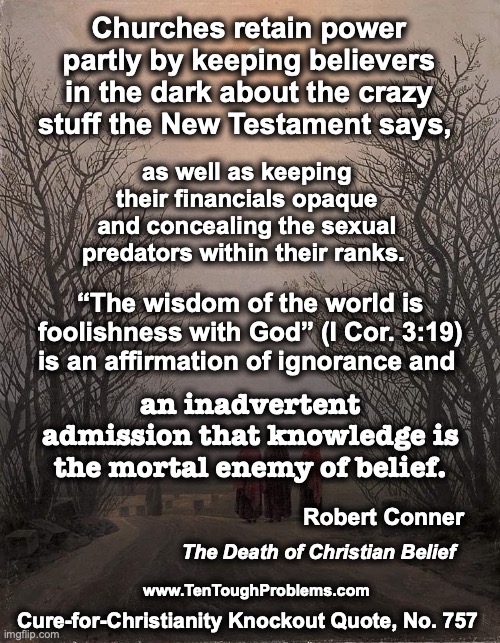
“Churches retain power partly by keeping believers in the dark about the crazy stuff the New Testament says, as well as keeping their financials opaque and concealing the sexual predators within their ranks. “The wisdom of the world is foolishness with God” (I Cor. 3:19) is an affirmation of ignorance and an inadvertent admission that knowledge is the mortal enemy of belief.” (p. 104, Kindle)

David Madison was a pastor in the Methodist Church for nine years, and has a PhD in Biblical Studies from Boston University. He is the author of two books, Ten ToughProblems in Christian Thought and Belief: a Minister-Turned-Atheist Shows Why You Should Ditch the Faith, now being reissued in several volumes, the first of which is Guessing About God (2023) and Ten Things Christians Wish Jesus Hadn’t Taught: And Other Reasons to Question His Words (2021). The Spanish translation of this book is also now available. 

His YouTube channel is here. At the invitation of John Loftus, he has written for the Debunking Christianity Blog since 2016.

The Cure-for-Christianity Library©, now with more than 500 titles, is here. A brief video explanation of the Library is here

The Boaz Stranger–Chapter 35

It was Thursday morning. Ray sat inside an attorney/client interview room next to Judge Broadside’s courtroom. Patience had always been an ephemeral idea, which, to Ray, made it a vice and not a virtue. Quick decisions and immediate actions were the stalwarts of his success. Or, so Ray believed.

It was ten minutes before his bond hearing and Morgan Selvidge was nowhere in sight. Ray’s attorney had not called or visited since Ray’s Tuesday afternoon arrest. Equally troubling was his cuffed hands and shackled feet. Apparently, the Deputy who walked him to the courthouse this morning hadn’t communicated with Deputy Jared. Thankfully, only his hands were cuffed in front and the shackles weren’t tight.

The Hearing was at 10:00. Ray countered his sweaty forehead and aching stomach by reflecting on the past forty hours inside Marshall County Jail.

Cell Block D had been worse than expected. Although the food was acceptable, the privacy was not. Unlike what Deputy Jared had promised, the jailer forced Ray to share an eight-foot by ten-foot cell with another inmate. Now, waiting at the courthouse for his defense attorney, Ray acknowledged things could have been worse.

The bad appeared shortly after breakfast yesterday morning. Ray had been told the visitor was his chef and kitchen manager. Neither were true. It was Billy James, Buddy’s brother, sitting opposite the thick plexiglass inside the visitor center. Ray couldn’t recall when he’d been so angry.

Billy demanded money, his share of ‘the job.’ Ray almost hung up the phone and called for the guard. What he learned from staying and listening confirmed the stupidity of what he’d done, the entire endeavor to burn the Hunt House for an estimated quarter million-dollar profit. The irony was that Buddy had disappeared with Ray’s hundred thousand dollars, leaving him zero profit, given the likelihood the insurance company would balk at paying the claim.

Another thing Ray had learned was that Eric Snyder, the man discovered in the ashes, had bragged about making a quick ten thousand dollars. Of course, Buddy had never paid him. This was the money Billy demanded. His twisted thinking convinced himself he deserved a share of Buddy’s windfall despite his lack of participation.

Before Billy left, Ray concocted a plan and promised he’d pay fifty thousand dollars, but it would have to wait until he was released. Billy left with a fist bump toward the plexiglass. Ray reciprocated with two hands for double assurance. Secretly, Ray knew he had no choice but to quiet the James brothers’ unpredictable tongues. They could no longer be trusted to protect him. How he could accomplish this goal was now merely an idea.

An unknown deputy entered the witness room and relayed to Ray that his attorney had called Judge Broadside and announced he was running fifteen minutes behind. After an affirmative head nod, Ray considered firing the uncommitted Morgan Selvidge and asking the Court for a continuance. Unfortunately, that would return him to his jail cell. Ray waited.

Orin Russell had been the good thing about Ray’s two-day stay inside the Marshall County Jail. By luck or the grace of God, Russell had the makings of a trainable and trustworthy replacement for the incompetent and disloyal James’s brothers.

Orin Russell was from Albertville, nineteen years old, and charged with the kidnapping and sexual assault of his stepmother’s 15-year-old daughter. The tall and muscular jail mate reminded Ray of his younger self. Both had been star athletes in high school and had dreamed of going all the way to the pros. Both had a commanding presence and an entitlement attitude. Like Ray, Orin had an insatiable appetite for women and wealth. Yet, he lacked a viable pathway forward, especially when considering his inept and lethargic court-appointed defense attorney. Last night, it had taken little for Ray to convince Orin his ticket to success lay with his sixty-seven-year-old jail mate.

Ray always believed he had the near-supernatural ability to discern real from fake. But he’d always been cautious to double-check and verify. So, Ray anchored his plan for him and Orin in high moral principles and undetectable coded language.

After an hour of Ray sharing a brief biography, his hopes and dreams for Rylan’s, and the name of a criminal defense attorney who’d be in touch, Orin had accepted Ray’s generous job offer. His primary responsibility would be to mirror Ray’s daily activities and learn the intricacies of real estate development. In sum, to perform duties as delegated by his boss. Like Ray, Orin had made good grades in school and learned quickly. He eagerly promised to devote “every waking hour to making Ray happy.” This morning, before the deputy arrived to walk Ray across the street to the courthouse, Orin had jotted down all his new boss’s contact information.

It was 10:20 AM when Morton Selvidge joined Ray inside the interview room. “Before you go ballistic on me, let me share the good news.”

Ray listened. He could always give his lackluster attorney a pink slip after leaving the Marshall County jail.

“The DA’s agreed to my offer.”

“And that is?” Ray would quickly agree to ten million dollars if that’s what it took. It was only money.

“A million-dollar cash bond and an ankle monitor.”

“I’d rather pay more money and keep my freedom.”

“I expected that. DA won’t have it. To her, you’re too much of a flight risk.”

After offering to put up ten million dollars, Ray asked for details concerning the ankle monitor, primarily whether he could leave the Lodge.

“Five-mile diameter. From your home. Otherwise, we’ll have to ask special permission.”

Ray finally agreed and Morton left to tell the DA and Judge.

***

What Ray didn’t know was that his jail mate hadn’t been completely truthful. Although he was Orin Russell, nineteen years old, and a former Albertville High School star athlete, he had already accepted another position working for private investigator Connor Ford. His assignment was to gain information. Ford hired Orin to snitch on Ray Archer.

The idea hadn’t originated with Connor. Last Saturday afternoon, Lee had received an email from Linda Smith, his former English teacher. As promised, she had sent a copy of Kyle’s tenth-grade essay, a complete manuscript. In it, Kyle had learned of Ray’s secret involvement with a girl he referred to as Babe 2. She had been a young and beautiful Albertville High School cheerleader. That was before she disappeared. Kyle had used this to persuade Brute to “do the right thing,” about not only Babe, but Babe 2’s family. To Lee, it strongly suggested Ray had learned Kyle had become a threat to his success, even his freedom. And this was before Lee had conducted any investigation.

Lee’s sources were the archives of the Sand Mountain Reporter and The Advertiser Gleam. Articles dated during the summer and fall of 1969 revealed the girl, a Sharon Teague, had disappeared after being raped and before she had disclosed to her mother the name of her attacker. From these definitive facts and Kyle’s nondescript essay, Lee framed the hypothesis that Ray killed Kyle to prevent the disclosure of his criminal actions.

Lee’s call to Micaden Tanner had triggered a causal reaction. Micaden shared Lee’s hypothesis with Connor Ford, who conferred with his longtime friend Mark Hale. Fortunately, Hale was privy to investigator Avery Proctor and the DA’s recent interest in cold cases. Proctor had revealed the name of Orin Russell, the grandson of Susan Vick, the late Sharon Teague’s sister.

Orin’s recent arrest was a fortunate occurrence, or a gift from the gods. To avoid future evidentiary reasons, the DA’s office had declined involvement. That hadn’t stopped Ford from meeting with Russell and motivating him to seek justice on behalf of his deceased great aunt, especially when the opportunity came with hopes of probation or a much-reduced sentence if convicted.

08/21/23 Biking & Listening

Biking is something else I both love and hate. It takes a lot of effort but does provide good exercise and most days over an hour to listen to a good book or podcast. I especially like having ridden.

Here’s my bike, a Rockhopper by Specialized. I purchased it November 2021 from Venture Out in Guntersville; Mike is top notch! So is the bike, and the ‘old’ man seat I salvaged from an old Walmart bike.

Here’s a link to today’s bike ride.


Something to consider if you’re not already cycling.

I encourage you to start riding a bike, no matter your age. Check out these groups:

Cycling for those aged 70+(opens in a new tab)

Solitary Cycling(opens in a new tab)

Remember,

Photo by Suzy Hazelwood on Pexels.com

Listened to


Here’s a few photos from along my pistol route:

Ten Commandments for Our Time

Here’s the link to this article.

Toward a Provisional Rational Decalogue

MICHAEL SHERMER

AUG 18, 2023

In my previous Skeptic column, Deconstructing the Decalogue, I offered a personal view on how to think about the Ten Commandments from the perspective of 3,000 years of moral progress since they were first presented in two books of the Old Testament (Exodus 20:1-17 and Deuteronomy 5:4-21). Here I would like to reconstruct them from the perspective of a science- and reason-based moral system, a fuller version of which I developed in my 2015 book The Moral Arc, from which this material is partially excerpted.

Note: This is a purely intellectual exercise. I am not a preacher or teacher of moral values, nor do I hold myself up as some standard-bearer of morality. Since I do not believe in God, nor do I think that there are any rational reasons to believe that morals derive from any source outside of ourselves, I feel the necessity to offer an alternative to religious- and faith-based morality, both descriptively (where do morals come from if not God?) and prescriptively (how should we act if there is no God?), which I have done in 30 years of publishing Skeptic magazine and in a number of my books, including How We Believe (1999), The Science of Good and Evil (2004), and the aforementioned The Moral Arc. Here I am building on the work of secular philosophers and scholars from the ancient Greeks through the Enlightenment and into the modern era where a massive literature exists addressing these deep and important matters.

Galileo Demonstrating the New Astronomical Theories at the University of Padua. Painting by Félix Parra, 1873. Museo Nacional de Arte, Mexico City.

Skeptic is a reader-supported publication. Your subscription goes to the Skeptics Society, a 501(c)(3) nonprofit. To receive new posts and support my work, consider becoming a free or paid subscriber.

Upgrade to paid

The problem with any religious moral code that is set in stone is just that—it is set in stone. Anything that can never be changed has within its DNA the seeds of its own extinction. A science-based morality has the virtue of having built into it a self-correcting mechanism that does not just allow redaction, correction, and improvement; it insists upon it. Science and reason can be employed to inform—and in some cases even determine—moral values.

Science thrives on change, on improvement, on updating and upgrading its methods and conclusions. So it should be for a science of morality. No one knows for sure what is right and wrong in all circumstances for all people everywhere, so the goal of a science-based morality should be to construct a set of provisional moral precepts that are true for most people in most circumstances most of the time—as assessed by empirical inquiry and rational analysis—but admit exceptions and revisions where appropriate. Indeed, as humanity’s concept of “who and what is human, and entitled to protection” has expanded over the centuries, so we have extended moral protection to categories once thought beneath our notice.

Here are some suggested commandments for our time. Feel free to add your own in the comments section below.

1. The Golden-Rule Principle: Behave toward others as you would desire that they behave toward you.

The golden rule is a derivative of the basic principle of exchange reciprocity and reciprocal altruism, and thus evolved in our Paleolithic ancestors as one of the primary moral sentiments. In this principle there are two moral agents: the moral doer and the moral receiver. A moral question arises when the moral doer is uncertain how the moral receiver will accept and respond to the action in question. In its essence this is what the golden rule is telling us to do. By asking yourself, “how would I feel if this were done unto me?” you are asking “how would others feel if I did it unto them?”

2. The Ask-First Principle: To find out whether an action is right or wrong, ask first.

The Golden Rule principle has a limitation to it: what if the moral receiver thinks differently from the moral doer? What if you would not mind having action X done unto you, but someone else would mind it? Smokers cannot ask themselves how they would feel if other people smoked in a restaurant where they were dining because they probably wouldn’t mind. It’s the nonsmokers who must be asked how they feel. That is, the moral doer should ask the moral receiver whether the behavior in question is moral or immoral. In other words, the Golden Rule is still about you. But morality is more than just about you, and the Ask-First Principle makes morality about others.

3. The Happiness Principle: It is a higher moral principle to always seek happiness with someone else’s happiness in mind, and never seek happiness when it leads to someone else’s unhappiness through force or fraud.

Humans have a host of moral and immoral passions, including being selfless and selfish, cooperative and competitive, nice and nasty. It is natural and normal to try to increase our own happiness by whatever means available, even if that means being selfish, competitive, and nasty. Fortunately, evolution created both sets of passions, such that by nature we also seek to increase our own happiness by being selfless, cooperative, and nice. Since we have within us both moral and immoral sentiments, and we have the capacity to think rationally and intuitively to override our baser instincts, and we have the freedom to choose to do so, at the core of morality is choosing to do the right thing by acting morally and applying the happiness principle. (The modifier “force or fraud” was added to clarify that there are many activities that do not involve morality, such as a sporting contest, in which the goal is not to seek happiness with your opponent’s happiness in mind, but simply to win, fairly of course.)

4. The Liberty Principle: It is a higher moral principle to always seek liberty with someone else’s liberty in mind, and never seek liberty when it leads to someone else’s loss of liberty through force or fraud.

The Liberty Principle is an extrapolation from the fundamental principle of all liberty as practiced in Western society: The freedom to think, believe, and act as we choose so long as our thoughts, beliefs, and actions do not infringe on the equal freedom of others. What makes the Liberty Principle a moral principle is that in addition to asking the moral receiver how he or she might respond to a moral action, and considering how that action might lead to your own and the moral receiver’s happiness or unhappiness, there is an even higher moral level toward which we can strive, and that is the freedom and autonomy of yourself and the moral receiver, or what we shall simply refer to here as liberty. Liberty is the freedom to pursue happiness and the autonomy to make decisions and act on them in order to achieve that happiness.

Only in the last couple of centuries have we witnessed the worldwide spread of liberty as a concept that applies to all peoples everywhere, regardless of their race, religion, rank or social and political status in the power hierarchy. Liberty has yet to achieve worldwide status, particularly among those states dominated by theocracies and autocracies that encourage intolerance, and dictate that only some people deserve liberty, but the overall trend since the Enlightenment has been to grant greater liberty, for more people, everywhere. Although there are setbacks still, and periodically violations of liberties disrupt the overall historical flow from less to more liberty for all, the general trajectory of increasing liberty for all continues, so every time you apply the liberty principle you have advanced humanity one small step forward.

5. The Fairness Principle: When contemplating a moral action imagine that you do not know if you will be the moral doer or receiver, and when in doubt err on the side of the other person.

This is based on the philosopher John Rawls’ concepts of the “veil of ignorance” and the “original position” in which moral actors are ignorant of their position in society when determining rules and laws that affect everyone, because of the self-serving bias in human decision making. Given a choice, most people who enact moral rules and legislative laws would do so based on their position in society (their gender, race, class, sexual orientation, religion, political party, etc.) in a way that would most benefit themselves and their kin and kind. Not knowing ahead of time how the moral precept or legal law will affect you pushes you to strive for greater fairness for all. A simpler version is in the example of cutting a cake fairly: if I cut the cake you choose which piece you want, and if you cut the cake then I choose which piece I want.

6. The Reason Principle: Try to find rational reasons for your moral actions that are not self-justifications or rationalizations by consulting others first.

Ever since the Enlightenment the study of morality has shifted from considering moral principles as based on God-given, Divinely-inspired, Holy book-derived, Authority-dictated precepts from the top down, to bottom-up individual-considered, reason-based, rationality-constructed, science-grounded propositions in which one is expected to have reasons for one’s moral actions, especially reasons that consider the other person affected by the moral act. This is an especially difficult moral commandment to carry out because of the all-too natural propensity to slip from rationality to rationalization, from justification to self-justification, from reason to emotion. As in the first commandment to “ask first,” whenever possible one should consult others about one’s reasons for a moral action in order to get constructive feedback and to pull oneself out of a moral bubble in which whatever you want to do happens to be the most moral thing to do.

7. The Responsibility and Forgiveness Principle: Take full responsibility for your own moral actions and be prepared to be genuinely sorry and make restitution for your own wrong doing to others; hold others fully accountable for their moral actions and be open to forgiving moral transgressors who are genuinely sorry and prepared to make restitution for their wrong doing.

This is another difficult commandment to uphold in both directions. First, there is the “moralization gap” between victims and perpetrators, in which victims almost always perceive themselves as innocent and thus any injustice committed against them must be the result of nothing more than evil on the part of the perpetrator; and in which perpetrators may perceive themselves to have been acting morally in righting a wrong, redressing an immoral act, or defending the honor of oneself or family and friends. The self-serving bias, the hindsight bias, and the confirmation bias practically ensure that we all feel we didn’t do anything wrong, and whatever we did was justified, and thus there is no need to apologize and ask for forgiveness.

As well, the sense of justice and revenge is a deeply evolved moral emotion that serves three primary purposes: (1) to right wrongs committed by transgressors, (2) as a deterrent to possible future bad behavior, (3) to serve as a social signal to others that should they commit a similar moral transgression the same fate of your moral indignation and revenge awaits them.

8. The Defend Others Principle: Stand up to evil people and moral transgressors, and defend the defenseless when they are victimized.

There are people in the world who will commit moral transgressions against us and our fellow group members. Either through the logic of violence and aggression in which perpetrators of evil always feel justified in their acts, or through such conditions as psychopathy, a non-negligible portion of a population will commit selfish or cruel acts. We must stand up against them.

9. The Expanding Moral Category Principle: Try to consider other people not of your gender, sexual orientation, class, family, tribe, race, religion, or nation as an honorary group member equal to you in moral standing.

We have a moral obligation not only to ourselves, our kin and kind, our family and friends, and our fellow in-group members; we also owe it to those people who are different from us in a variety of ways, who in the past have been discriminated against for no other reason than that they were different in some measurable way. Even though our first moral obligation is to take care of ourselves and our immediate family and friends, it is a higher moral value to consider the moral values of others, and in the long run it is better for yourself, your kin and kind, and your in-group to consider members of other groups to be honorary members of your own group, as long as they so honor you and your group (see #8 above).

10. The Biophilia Principle: Try to contribute to the survival and flourishing of other sentient beings, their ecosystems, and the biosphere as a whole.

Biophilia is the love of nature, of which we are a part. Expanding the moral sphere to include the environments that sustain sentient beings is the loftiest of moral commandments.

If by fiat I had to reduce these Ten Commandments to just one it would be this:

Try to expand the moral sphere and to push the arc of the moral universe just a bit further toward truth, justice, and freedom for more sentient beings in more places more of the time.

The Boaz Stranger–Chapter 34

“I have a theory,” was the only thing Lillian would say as she drove us to her place off Cox Gap Road.

For the fourth time, as she unlocked the back door, I repeated my response, “let’s hear it.”

Inside, she motioned me to sit at the kitchen table and said, “I’ll be right back.” I did as I was told and wondered if she was playing some silly game.

I waited several minutes. She finally yelled, “Lee, come in here.”

I stood and shook my head whispering to myself, “is Lillian playing a new version of hide-n-seek?”

She was sitting at a makeshift desk in the spare bedroom, half piled with unloaded boxes. “What you got?” I asked as she pulled two folders from an opened box.

Without introduction or pretext, Lillian announced: “Ray’s been paying Rob and Rosa for years. Grab a chair.” She pointed back toward the kitchen. I returned and sat beside her before an unlevel platform constructed from a weathered door and three semi-squished boxes on each end.

“What in Heaven’s name makes you say that?” Lillian had placed one folder on the desk and was rifling through another one lying across her lap. I could see the documents were bank statements.

“I’ve long wondered what this $2,500 was for.” Lillian pointed to a line item on a July 1990 First State Bank of Boaz account, and the same amount on the October 2020 statement she had removed from Ray’s study on Monday.

“I’m lost. What makes you think this monthly disbursement had anything to do with Rob and Rosa?”

“Two things.” Lillian flipped the 1990 statement over, revealing an index-sized hand-written note taped to the back. It read, ‘It’s your turn. I no longer will pay for your mistake. Pay or sink, your choice.’ It was signed, ‘Dad.’

“I’m guessing Dad is Ray’s father.”

“Right, and this is where the $2,500 per month draft started.” Lillian returned the older statement to its place in the folder and stared at the one she’d just stolen. “See, it continues.” She reached for a highlighter and swiped across the disbursement.

“Sorry, I’m not seeing the connection, but you said you had two reasons. What’s the other one?” I was thinking Lillian was trying to see a non-existent pattern.

She laid the thick folder on top of the other one and started clicking at her laptop. She must have turned it on when she first came in. After a couple of screen changes, I could tell she was at First State Bank of Boaz’ website. Two keystrokes later she said, “look here.”

“Okay, I see a bunch of debits and credits. Ray’s account?”

“Yes.” She scrolled the screen, stopped, and pointed to two withdrawals. “This is Ray’s discretionary account.” One is for $150,000, the other $100,000. “This one was for me.” Lillian pointed to the larger amount.

“What about the hundred thousand?”

“I bet the Aviator it’s what Ray paid Buddy James. Look at the date.” It was the 25th of November, the day before Thanksgiving and two days before the Hunt House exploded and burned the interior to a crisp.

My feelings were mixed. I was happy Lillian had ongoing access to Ray’s online banking but was frustrated by her interpretation. I couldn’t see any connection to Rob and Rosa other than the obvious property-destroying fire. “You’ve got me where you want me.” I said. Our eyes met. She smiled and nodded.

Lillian reopened the bank statement folder and removed a single sheet of letter sized paper with a large paper clip at the top. “Union Central Bank.” She handed it to me and pointed. The sheet contained a copy of both sides of a much smaller document, one the size of a personal check. “That’s both sides of the $2,500 draft I copied. Notice the bottom picture.” It appeared to be a rubber stamp. It read, ‘Union Central Bank, Roanoke, VA.’

Now I was catching up. “That’s odd and interesting.”

Lillian interrupted before I could continue. “Earlier, after you got off the phone with Rosa, you mentioned the cabin being in Roanoke. I didn’t know that, but when you said Rob and Rosa owned the place, I remembered this monthly draft going to a bank in the same city. Don’t you think that’s more than a coincidence?”

“Not sure. I’m skeptical of your conclusion. It appears unwarranted.” Lillian slapped my knee.

“You damn attorneys, needing to read the entire book, twice, before you fathom the ending. This all fits with Ray being Kyle’s murderer.”

“How so?”

“Remember, I told you Ray does nothing for free or out of generosity. When Rosa told you about the extra funds he’d paid Rob for the Hunt House, he got something in return. Now, I believe he, and his father before him, have been paying Rob and Rosa for years and years.”

It was now my turn to interrupt. “For what, Shirley Holmes?”

“Let me answer with a question. What subject would be so important to Ray, again assuming he killed Kyle, to motivate him and his father to pay a shit pot full of money over all these years?”

Lillian had a point, but I was nowhere ready to reach her conclusion. But I could craft a hypothesis. “What if Ray has paid all this money to Rob and Rosa in exchange for their silence?”

“Good boy.” Lillian swiveled toward me in her chair and nudged my knee with hers. I won’t say how I felt. “And, let me say it for you, what would your in-laws know that would motivate Ray to keep the money flowing?”

My legal hat nestled downward around my head. “Here’s another question. Would my in-laws, for any amount of money, keep quiet for Ray alone? Do they, did they, have another reason to keep quiet?” Lillian’s leg pressed against mine, easy, but firm.

“Let’s continue this discussion on the couch. This chair is hurting my butt.” I stood and caught the scent of lavender. Funny, I hadn’t noticed it before.

***

I followed Lillian to the den and to the couch. Just as we sat, she quickly stood and headed for the front door. “I’m expecting a package.” She walked outside and immediately yelled, “Lee, come here.”

The near pungent smell dominated the air. “Wow, I haven’t smelled chicken litter in a while.”

“Burning rubber?” Lillian reached for a small box seated in a rocking chair.

I looked across Alexander Road to the neighboring house. There was a streetlamp on the far side, maybe half a football field away. Smoke was circling the pole like a swarm of bees. “I don’t know if it’s rubber, but something is burning.” I pointed to the ghostlike figure.

“Oh yeah, I see. Let me grab my phone to call Neva. Do you think we need to walk over there?”

“We can.” I wasn’t too interested, given the cold. The wind had picked up, and the temperature had plunged since we arrived an hour earlier. At least it wasn’t raining.

Lillian was in and out of the house in no time. “Come on, I’ll call while we walk.” Again, I trailed along, wishing we’d grabbed our coats.

By the time we reached the far side of the Clifton’s house, we heard a fire truck’s siren, and saw the flames. Nestled between a detached garage and a six-bay clean-up shop was a large barn. They had stacked round hay bales three high as far as I could see. The fire had engulfed the far-right corner of the half-sided pole building.

“She’s at the fire,” Lillian said, pulling me forward. “Tony’s in Atlanta and Neva’s spraying water.” I marveled at how quickly Lillian had met her new neighbors. She’d already entered Neva’s phone number into her iPhone’s contacts.

The firetruck arrived as we rounded the corner at the clean-up shop. “There she is.” I saw a woman standing thirty feet from the barn arching a pencil size stream of water from a garden hose onto the chaotic flames.

Neva and Lillian exchanged a few words as the firefighters positioned their truck, and the heat from the growing flames grew.

“Stand back,” a big burly man with a thick gray beard said, unfolding a hose in our direction. I retreated toward the shop. “Ladies, please move.”

I grabbed Lillian by the elbow. “Come on, they’ve got this, and I’m freezing.” Once we circled the firetruck, I felt a shy hand engulf my own. Oddly, I seemed to forget the knifing wind and numbing cold as we scurried across the neighbor’s yard to the home of the woman who had broken my heart half-a-century ago.

Strangely, I did not disconnect hands during our entire walk. Lillian did that when we stepped onto her front porch, and she reached for her package. “Hurry, let’s get inside.” I opened the door, allowing her to go first. She set the box on the coffee table and hustled to a wall mounted gas heater I hadn’t noticed before. “I’m so glad I had AllGas install this. My central unit sucks.”

I asked for details. With no response forthcoming, I complied with Lillian’s head motion, ‘come here and warm.’ I stood beside her while we both held our hands close to the welcoming heat. In a minute, she pivoted her body to warm her backside while I continued to massage my hands.

I’m not sure how it happened. We both had pursued a pivot-and-warm routine at least three times. The last one was defective since we made it only halfway. Now, face to face, our hands reached out and pulled the other one close. I must admit I’d considered this moment since I’d laid eyes on Lillian two weeks ago at Old Mill Park. What had started as a fantasy had evolved into reality.

As Lillian laid her head on my shoulder and clutched both hands behind my back, she was the first to talk. “Lee, I’m so sorry. Please know I have always regretted what I did. Can you forgive me?”

I normally didn’t enjoy plowing the same ground more than once, but I sensed her seriousness and need for affirmation. I nuzzled my mouth close to her ear. The lavender scent grew stronger, triggering feelings I feared. “I know, and I forgive you. Ask me tomorrow and I’ll tell you the same.” I gave her a squeeze.

Lillian popped her head back and said, “are you being a smart ass?”

“Maybe, but a serious one.” She smiled and returned her head to my shoulder. Our bodies couldn’t have gotten a hair closer.

Without thinking, I brushed back her hair with my hand and kissed her neck. Once, twice, three times, each time exploring a unique spot. “Don’t stop,” she whispered.

By now, I was sweating. I manipulated us both a yard away from the heater. “Whew, I’m on fire.” Secretly, I laughed at my involuntary statement.

“Me too, for several reasons.” We untangled ourselves and what started quietly transformed into a knee-slapping roar. Finally, Lillian returned to the heater and dialed it down from HIGH to LOW.

Just as quickly, she returned to me and pulled my head to hers. The kiss was intense, inciting, and irresistible, a one-way ticket to her king-size bed.

It was after ten when we reassembled our clothing and exited her back porch. We said little during the drive to Kyla’s. Tonight, for me, was something I’d never experienced with Rachel. It really wasn’t the sex, although it was the most passionate I’d ever experienced. It was the time, touch, and talk we’d exchanged under the covers. This new road was going to be a leap into love or a stumble into the abyss. I hoped it was the former.


LETTERS FROM AN AMERICAN–08/19/23

Here’s the link to this article.

LETTERS FROM AN AMERICAN

August 19, 2023

HEATHER COX RICHARDSON

AUG 20, 2023


Various constitutional lawyers have been weighing in lately on whether former president Donald Trump and others who participated in the effort to overturn the results of the 2020 presidential election are disqualified from holding office under the Fourteenth Amendment to the Constitution. The third section of that amendment, ratified in 1868, reads: 

“No person shall be a Senator or Representative in Congress, or elector of President and Vice-President, or hold any office, civil or military, under the United States, or under any State, who, having previously taken an oath, as a member of Congress, or as an officer of the United States, or as a member of any State legislature, or as an executive or judicial officer of any State, to support the Constitution of the United States, shall have engaged in insurrection or rebellion against the same, or given aid or comfort to the enemies thereof. But Congress may by a vote of two-thirds of each House, remove such disability.”

On August 14 an article forthcoming from the University of Pennsylvania Law Review by William Baude of the University of Chicago Law School and Michael S. Paulsen of the University of St. Thomas School of Law became available as a preprint. It argued that the third section of the Fourteenth Amendment is still in effect (countering arguments that it applied only to the Civil War era secessionists), that it is self-executing (meaning the disqualification of certain people is automatic, much as age limits or residency requirements are), and that Trump and others who participated in trying to steal the 2020 presidential election are disqualified from holding office.

This paper was a big deal because while liberal thinkers have been making this argument for a while now, Baude and Paulsen are associated with the legal doctrine of originalism, an approach to the law that insists the Constitution should be understood as those who wrote its different parts understood them. That theory gained traction on the right in the 1980s as a way to push back against what its adherents called “judicial activism,” by which they meant the Supreme Court’s use of the law, especially the Fourteenth Amendment, to expand the rights of minorities and women. One of the key institutions engaged in this pushback was the Federalist Society, and both Baude and Paulson are associated with it. 

Now the two have made a 126-page originalist case that the Fourteenth Amendment prohibits Trump from running for president. Their interpretation is undoubtedly correct. But that interpretation has even larger implications than they claim.

Moderate Republicans—not “Radical Republicans,” by the way, which was a slur pinned on the Civil War era party by southern-sympathizing Democrats—wrote the text of the Fourteenth Amendment at a specific time for a specific reason that speaks directly to our own era. 

When John Wilkes Booth assassinated President Abraham Lincoln in April 1865, Congress was not in session. It had adjourned on the morning of Lincoln’s second inauguration in early March, after beavering away all night to finish up the session’s business, and congressmen had begun their long journeys home where they would stay until the new session began in December. 

Lincoln’s death handed control of the country for more than seven months to his vice president, Andrew Johnson, a former Democrat who wanted to restore the nation to what it had been before the war, minus the institution of slavery that he believed concentrated wealth and power among a small elite. Johnson refused to call Congress back into session while he worked alone to restore the prewar system, dominated by Democrats, as quickly as he could. 

In May, Johnson announced that all former Confederates except for high-ranking political or military officers or anyone worth more than $20,000 (about $400,000 today) would be given amnesty as soon as they took an oath of loyalty to the United States. He pardoned all but about 1,500 of that elite excluded group by December 1865.

Johnson required that southern states change their state constitutions by ratifying the Thirteenth Amendment prohibiting enslavement except as punishment for a crime, nullifying the ordinances of secession, and repudiating the Confederate war debts. Delegates did so, grudgingly and with some wiggling, and then went on to pass the Black Codes, laws designed to keep Black Americans subservient to their white neighbors. 

Under those new state constitutions and racist legal codes, southern states elected new senators and representatives to Congress. Voters put back into national office the very same men who had driven the rebellion, including its vice president, Alexander Stephens, whom the Georgia legislature reelected to the U.S. Senate. When Congress reconvened in December 1865, Johnson cheerily told them he had reconstructed the country without their help.

It looked as if the country was right back to where it had been in 1860, with legal slavery ended but a racial system that looked much like it already reestablished in the South. And since the 1870 census would count Black Americans as whole people for the first time, southern congressmen would have more power than before. 

But when the southern state delegations elected under Johnson’s plan arrived in Washington, D.C., to be seated, Republicans turned them away. They rejected the idea that after four years, 600,000 casualties, and more than $5 billion, the country should be ruled by men like Stephens, who insisted that American democracy meant that power resided not in the federal government but in the states, where a small, wealthy minority could insulate itself from the majority rule that controlled Congress. 

In state government a minority could control who could vote and the information to which those voters had access, removing concerns that voters would challenge their wealth or power. White southerners embraced the idea of “popular sovereignty” and “states’ rights,” arguing that any attempt of Congress to enforce majority rule was an attack on democracy.

But President LIncoln and the Republicans reestablished the idea of majority rule, using the federal government to enforce the principle of human equality outlined by the Declaration of Independence. 

And that’s where the Fourteenth Amendment came in. When Johnson tried to restore the former Confederates to power after the Civil War, Americans wrote into the Constitution that anyone born or naturalized in the U.S. was a citizen, and then they established that states must treat all citizens equally before the law, thus taking away the legal basis for the Black Codes and giving the federal government power to enforce equality in the states. They also made sure that anyone who rebels against the federal government can’t make or enforce the nation’s laws. 

Republicans in the 1860s would certainly have believed the Fourteenth Amendment covered Trump’s attempt to overturn the results of a presidential election. More, though, that amendment sought to establish, once and for all, the supremacy of the federal government over those who wanted to solidify their power in the states, where they could impose the will of a minority. That concept speaks directly to today’s Republicans.

In The Atlantic today, two prominent legal scholars from opposite sides of the political spectrum, former federal judge J. Michael Luttig and emeritus professor of constitutional law at Harvard Law School Laurence H. Tribe, applauded the Baude-Paulsen article and suggested that the American people should support the “faithful application and enforcement of their Constitution.” 

08/20/23 Biking & Listening

Biking is something else I both love and hate. It takes a lot of effort but does provide good exercise and most days over an hour to listen to a good book or podcast. I especially like having ridden.

Here’s my bike, a Rockhopper by Specialized. I purchased it November 2021 from Venture Out in Guntersville; Mike is top notch! So is the bike, and the ‘old’ man seat I salvaged from an old Walmart bike.

Here’s a link to today’s bike ride.


Something to consider if you’re not already cycling.

I encourage you to start riding a bike, no matter your age. Check out these groups:

Cycling for those aged 70+(opens in a new tab)

Solitary Cycling(opens in a new tab)

Remember,

Photo by Suzy Hazelwood on Pexels.com

Listened to


Here’s a few photos from along my pistol route:

Victory in Ohio: Issue 1 goes down in flames

Here’s the link to this article.

Avatar photoby ADAM LEE

AUG 17, 2023

Two "Vote" buttons on an American flag | When you can't win, change the rules: Abortion and Ohio's Issue 1
Credit: Shutterstock

Overview:

Issue 1, a cynical attempt to persuade Ohioans to vote away their own power, goes down to resounding defeat. The way is cleared for reproductive autonomy to become a protected right in the Buckeye State.

Reading Time: 3 MINUTES

[Previous: When you can’t win, change the rules]

Abortion rights extended their winning streak in Ohio this summer. Progressives and freethinkers have reason to cheer as Issue 1 went down to defeat.

In 2019, Ohio governor Mike DeWine signed a total ban on abortion, which went into effect when the right-wing Supreme Court repealed Roe. It’s this law that gave rise to the infamous case of a pregnant 10-year-old rape victim who had to go to Indiana for an abortion.

(When this story was first reported, right-wingers angrily insisted it must be a fabrication intended to make them look bad. When it was proven to be true, they went silent.)

Since then, Ohio’s abortion ban has been ping-ponging between state courts. It’s currently blocked again. However, pro-choice groups saw no reason to leave the final outcome up to the discretion of a judge. Polls show that abortion rights enjoy support from a majority of Ohio residents. So they gathered signatures to put a constitutional amendment on the ballot which would make reproductive choice a human right. It will go before the voters in November, and polls say it should pass easily.

Cynical and contemptuous tactics

Sensing their looming defeat, Ohio Republicans tried to cut it off at the knees. The legislature proposed their own constitutional amendment, Issue 1, which would have raised the threshold for passing future amendments from a simple majority to a 60% supermajority. It also would have made the process for getting an amendment on the ballot more arduous.

That was a cynical tactic, since polls showed support for abortion rights at just under 60% (literally, 59%). However, what they did next showed even more contempt for voters.

The legislature hastily scheduled Issue 1 for an August special election—historically, a time of rock-bottom turnout. As recently as January, those same legislators moved to outlaw August special elections on the grounds of low turnout, only to do an about-face. Clearly, Ohio Republicans were hoping that no one would pay attention and only their backers would show up.

Instead, in a classic case of the Streisand Effect, their efforts to ensure a low-turnout election ensured massive publicity and voter interest. It shone a spotlight on their scheme, and voters responded. It didn’t hurt that pro-choice advocates had tapes of Issue 1’s sponsors, including Ohio Secretary of State Frank LaRose, admitting that it was intended to forestall the abortion amendment.

More than 3 million voters cast ballots. That’s staggering turnout for a special election in the dog days of summer. It’s almost double the number of people who typically vote in Ohio primaries, and five times the number that showed up for the last August election.

When the votes were all in, Issue 1 lost by a resounding margin, 57% to 43%. As it turns out, citizens don’t want to vote away their own power. It’s a stinging rebuke to conservatives who are angling for permanent minority rule.

More dirty tricks thwarted

This wasn’t the only dirty trick that anti-choicers pulled to try to thwart the will of the people. They also filed a lawsuit to get the pro-abortion amendment stricken from the ballot on a technicality, arguing it should have explicitly listed the laws it would repeal. The Ohio Supreme Court unanimously rejected this argument. (The court answered one technicality with another: a constitutional amendment doesn’t “repeal” an existing law, it voids it.)

The defeat of Issue 1 is a bellwether for reproductive freedom in Ohio. It’s a sign to right-wing legislators that, for all their gerrymandering and voter suppression, they’re not above the will of the voters. They can’t expect to have their own way forever without the majority getting a chance to have its say.

It also clears the way for more progressive constitutional amendments. Next on tap in Ohio, there’s one to raise the minimum wage and another to create a bipartisan redistricting commission to fix gerrymandered congressional maps.

And more pro-choice constitutional amendments are coming soon in other states. From Politico:

Similar efforts to put abortion rights to a popular vote are also brewing in Arizona, Florida, Missouri, Nevada and South Dakota. Activists in many of these states are hoping to get the issue before voters in 2024, in which turnout will be especially high due to the presidential election.“Abortion rights won big in Ohio. Here’s why it wasn’t particularly close.” Madison Fernandez, Alice Ollstein and Zach Montellaro. Politico, 8 August 2023.

It’s now very clear that abortion is a winning issue for Democrats, even in red states. According to a PRRI poll from February 2023, almost two-thirds of Americans say abortion should be legal in all or most cases, including majorities in many traditionally red states. What’s more, abortion is a motivating issue. It energizes voters and drives huge turnout.

In their single-minded drive to ban abortion at all costs, Republicans are running directly against the will of the majority. They’re setting themselves up to lose in states where by all rights they should win. If they were willing to moderate their beliefs, they’d likely be able to win many of these voters back. Instead, they’re becoming more and more anti-democratic.