Is the Death of Christian Belief Coming Soon?

Here’s the link to this article.

By David Madison at 8/25/2023

Cheap knockoff superstitions are taking over

This really is a puzzle: why haven’t decent devout believers—by the millions—founded an organization called Christians Against Televangelism? They should be so appalled/enraged that televangelists have turned the faith into a showbusiness money-grab, enabling so many of them to become multi-millionaires. They’ve reimagined Jesus as big business, exploiting magical thinking found in the New Testament: believe in Jesus to get eternal life. This turned out to be a major made-for-TV gimmick. 

But televangelism is actually the crass culmination of the church’s centuries-long embrace of show business. Millions of churches have been built, the theatres—the stages—for performances. Among these are the spectacular cathedrals, with magnificent stained glass, paintings and sculptures. No one has been able to surpass the Catholic church, in terms of costuming, props, and ritual. All this makes it so easy to get away with magical thinking.

How long can this last? In his new book, The Death of Christian Belief, Robert Conner makes this point:

“If the history of religion teaches anything, it teaches that religions die. In the imagination of their adherents, religions are eternal, but they obviously aren’t—the world is strewn end to end with the temples, shrines, megalithic dolmens and stone circles, pyramids, inscriptions and images of hundreds of dead religions. No matter how completely religious belief and ritual command the present, there is never any guarantee they will command the future.” (Kindle, p. 68)

In my article here last week I commented on the first half of this excellent book, now let’s look at the last half. 

Chapter 4 is titled, Certifiably Crazy for Jesus, and at the outset, Conner observes:

“Speculation about the intersection of religion and insanity has obviously been around for a while and the connections (or lack thereof) continue to be vigorously debated in the present. Whether religious belief technically qualifies as psychosis we can leave to the professionals to thrash out, but it is beyond dispute that religious belief is—as often as not—functionally insane.”

Then he cites the horrible news from Kenya earlier this year that a cult had convinced people that starving to death for Jesus was a way to earn eternal life. Within a month it was determined that 201 people had died, and that 600 were missing. It’s not hard to figure out “…that literally anything—no matter how comically absurd, abysmally stupid, completely unhinged, or easily disproved—can be asserted under the aegis of ‘sincerely held religious belief’ clearly refutes any notion that religious belief is the product of common sense.” (p. 106, Kindle)

Conner notes that so many Jesus-believers “couldn’t pass a basic quiz about what the gospels say about Jesus.” (p. 106, Kindle) He points out that “the New Testament is a cookbook of crazy,” a primary example being Jesus-script in Matthew 18:3: “Truly I tell you, unless you change and become like children, you will never enter the kingdom of heaven.” This is typical cult technique: please don’t think about what we’re telling you—just take our word for it. One result of this approach is that so many laypeople don’t bother to read the gospels, and remain unaware of so much in the cookbook of crazy

Here’s a sample: In Mark, Jesus transfers (presumably by a magic spell) demons from a man into pigs; he glows on a mountaintop while god speaks from water vapor (a cloud); in Matthew, at the moment Jesus died, dead people came alive in their tombs, then on Easter morning walked around Jerusalem; in Luke, the resurrected Jesus appeared to two of his followers on their way to Emmaus—but they didn’t recognize him. At dinner, as he broke bread, they suddenly knew who he was, and—poof—he vanished. (See Conner’s book, Apparitions of Jesus: The Resurrection as Ghost Story) Luke also has the extreme cult teaching that hatred of family, and of life itself, is required for Jesus followers. In John, we find the ghoulish pronouncement that eternal life happens when cult members eat the flesh of Jesus, and drink his blood. 

This is just a sampling—and many more examples will jump out—the more folks read the gospels carefully, confirming Conner’s verdict that the New Testament offers “crazy with a side order of extra-crazy crazy.” (p. 120, Kindle)

Maybe the death of Christian belief is on the horizon because people are reading the cookbook of crazy. “In 2022, polling showed that ‘among all U.S. adults, only 20% say the Bible is the literal word of God, which is a historic low… A record 29% of Americans say the Bible is a collection of ‘fables, legends, history and moral precepts recorded by man.’ Only 30% of Protestants and 15% of Catholics currently believe the Bible is literally true.” (p. 114, Kindle)

In Chapter 5, Where Christianity Goes to Die, Conner provides a brutal dose of reality about the state of humanity. I remember reading, some twenty years ago, the prediction that by 2025 there would be a billion Pentecostals in the world. Much of the growth that it has experienced has been at the expense of the Catholic church. Conner quotes an article by David Masci of Pew Research:

“The music that you hear in Pentecostal churches has the same rhythms that people enjoy outside of church. In fact, in only a century, Pentecostalism has become indigenous, or ‘Latin Americanized,’ to a greater extent than Roman Catholicism has in four centuries in Latin America… And the Pentecostal preachers tend to sound more like their congregants. They are often unlettered, and they speak to their flock in the same way that people in Latin America speak to each other. They also tend to look like their congregants. So in Guatemala, many preachers are Mayan, and in Brazil they are Afro-Brazilian.” (pp. 122-123, Kindle)

They are often unlettered. This is emotion-based religion, fed by the cookbook of crazy. The crazy isn’t even noticed. I am reminded of Josiah Hesse’s experience, growing up in apocalyptic evangelism (my article here on 11 August was about his painful childhood):

“I would say that some of the most emotionally rapturous moments of my life were had in Pentecostal church services, where the loud and hypnotic music, speaking in tongues, primal dancing, shaking and collapsing to the ground, caused explosions of sensory transcendence in my little body. I’ve since had glimmers of these moments on a dance floor, a rock concert, or moments of exceptional sexual climax, but nothing has come close to the indescribable high of a frenetic religious service laced with an uncut dose of pure belief.”

But indescribable highs count for nothing when we’re trying to figure out how the cosmos works. For that we need reliable, verifiable, objective evidence. 

Earlier I mentioned Jesus transferring demons from a man to pigs—which we find in Mark 5. In fact, Mark’s gospel could be subtitled, Jesus and the Demons. Pentecostalism thrives on such superstitions. Conner describes the widespread belief in witch children, and the horrors they’ve suffered at the hands of exorcists. He quotes from an article by Cosima Lumley:

“Thousands of children every day are being branded witches and consequently tortured into confessing non-existent crimes, forced to undergo horrific ‘exorcisms’ by preachers, and even abandoned or killed by their own families or communities…The practice of branding children witches has also become a very lucrative one for Pentecostal preachers who are able to ‘exorcize’ children of the influence of Satan for a price, or as they call it, ‘enact deliverance.’” (p. 130, Kindle)

Conner also discusses the role that homophobia plays in the promoting of fanatical religion. American evangelicals have played a major role in stoking these hatreds in Africa especially. “Queerbaiting as a political tactic never seems to age. Fomenting hatred and violence is not a measure of last resort in societies where national politics is driven by religious fundamentalism. It’s their first move. It’s their path to power. To the extent this tactic loses traction in democratic countries, it must move to more hospitable climates to survive.” (p. 142, Kindle)

One of the major themes of Chapter 6, The Valley of Death, is the assumption among fanatics that climate change is real because it fits with apocalyptic doom scenarios. In other words, we shouldn’t even try to resist god’s plan—as outlined by the cookbook of crazy. Is such foolishness the fate of Christian belief? At the outset I asked why aren’t Christians furious with the corruption of their religion by televangelists. Likewise, Conner wants to know:

“When priests by the hundreds molest children and bishops cover it up, why aren’t Christians stunned? When Irish nuns raffle off the babies of unwed mothers, why aren’t Christians stunned? When unmarked graves of children are discovered around Canadian religious ‘schools,’ why aren’t Christians stunned? When embezzlement and sexual assault by preachers gets reported on an almost daily basis, why aren’t Christians stunned? When evangelical leaders gather to lay hands on figures like Donald Trump and Jair Bolsonaro, why aren’t Christian’s stunned?” (pp. 106-107, Kindle)

Given its ongoing degeneration, we can be sure that Christian belief will end up on the scrapheap of history:

“In the developed world, Christianity is losing traction for reasons that are now familiar: churches are dying because elderly Christians are dying, and Christian belief increasingly incorporates toxic elements of sexism, racism, and reactionary nationalism. But more importantly, the Christian gospel is simply irrelevant—thoughts and prayers don’t address poverty, discrimination, gun violence, failing government, or climate change.” (pp. 150-151, Kindle)

Here is the link to an interview that Robert Conner and I did together, with Derek Lambert of MythVision.

David Madison was a pastor in the Methodist Church for nine years, and has a PhD in Biblical Studies from Boston University. He is the author of two books, Ten ToughProblems in Christian Thought and Belief: a Minister-Turned-Atheist Shows Why You Should Ditch the Faith, now being reissued in several volumes, the first of which is Guessing About God (2023) and Ten Things Christians Wish Jesus Hadn’t Taught: And Other Reasons to Question His Words (2021). The Spanish translation of this book is also now available. 

His YouTube channel is here. At the invitation of John Loftus, he has written for the Debunking Christianity Blog since 2016.

The Cure-for-Christianity Library©, now with more than 500 titles, is here. A brief video explanation of the Library is here.

The Boaz Stranger–Chapter 42

By the time I approached Christiansburg thirty-five miles south, I was running on fumes.  My overindulgence of the food that friends and neighbors had brought to Kyla’s after the funeral no longer fueled my energy needs. I exited and pulled into a Citgo. After refilling, I bought a large coffee and two Little Debbie Honey Buns.

The only other stop I made during my return trip was a two-hour layover at the Tennessee Welcome Center in Bristol. My intermittent sleep in the reclined driver’s seat was fitful, but at least I got to rest my eyes.

Once again, from north of Knoxville to just south of Ft. Payne, Lillian was a soothing tonic. This time, I’d called her. We shared our hopes and dreams, our fears and foibles, and our investigative plans for my remaining days in Alabama. I’d driven, and she’d rested under a remarkably warm December sun in an Adirondack at the end of her pier.

I’d just exited at Collinsville when Lillian called again. “Lee, this is odd, and I’m scared.” Her voice, muffled, like she was trying to disappear into a crowd.

“What’s odd? What’s going on?”

“Ray just drove up, acting like he owns the place. He’s turning his Suburban around and backing to the barn.” I heard her footfalls on the wooden deck.

“Go inside and lock your doors. I don’t trust him at all.” I pushed the gas pedal to the floor and raced toward Crossville. Lillian had told me of a shortcut through Rodentown, but I was afraid I’d get lost and take even longer to get to her house.

 “Hey Lil, sorry to bother you.” I heard Ray in the background. His voice was friendly.

“He apparently has a key to the big door on the right. This is strange.”

“Lillian, did you hear me?”

“Uh?”

“Don’t approach Ray. Go inside. Now.” It was the safest plan. It was eerily comforting to remember Lillian kept a 32-caliber pistol in her bedroom’s nightstand.

“This is my place. He’s not welcome.” She paused, and I heard her open and shut the gate next to the driveway. “Lee, I’ll call you back in a few minutes.”

“No, Lillian. Lillian.” But she had already ended her call.

I met a State Trooper halfway up the winding road this side of Crossville. He flashed his blue lights but didn’t turn around. I was at least fifteen minutes, probably twenty, from Lillian’s. I had no choice but to slow to the speed limit.

It was the longest and worst time of my life, even worse than when I’d found Rachel hanging in the basement from an overhead beam. The memory of the tall and strong Ray pushing Lillian backwards onto his garage steps two weeks ago came rocketing across my mind. I shook my head to avoid even worse thoughts.

All the way to Kilpatrick, I tried to call Lillian. No luck. When I turned left on Hwy. 168, I called 911. After several requests, it felt like my pleading had fallen on deaf ears. The throaty sounding woman made no promises other than, “I’ll pass this along to the Sheriff’s Department.”

Based on what I knew about Ray Archer, there was nothing he wouldn’t do to protect himself, his reputation, and his sordid past.

After twenty terrifying minutes, I rounded the last curve before reaching Alexander Drive. There was no sign of Ray’s Suburban, and Lillian’s SUV was behind the house next to the back porch. I pulled to the far side of the Aviator and ran to the barn. I wasn’t sure why, other than this was the direction I’d imagined Lillian walking when she’d ended our conversation.

The right-side door was raised. I could see deep tire tracks just outside the bay. Lillian had mentioned a flatbed trailer. I went inside, saw nothing, and turned to the left. I loudly announced my presence, realizing the logical first thing to have done was to go inside the house. Why would Lillian still be out here?

I almost collapsed when I entered the room the neighbors had temporarily borrowed. Lillian was sitting upright on the ground, leaning against a tall stack of square bales. Her head slumped to her right.

“Lillian. Baby.” I took three steps and knelt beside her. Her neck revealed a pulse, but it was weak. “Talk to me.” I gently shook both shoulders without response. She was unconscious.

There were no visible signs of injury. Until I saw a pool of blood soaking the loose strands of hay on the barn’s dirt floor.

Struggling, I pulled her forward by her legs, allowing her to lie flat on her back. I lifted the hair on the right side of her head and saw a big gash just above the ear.

I again dialed 911, silently questioning whether I’d made the right decision to move Lillian’s body.

While I waited for the EMTs to arrive, I held my ear to Lillian’s face. Thankfully, she was still breathing, evidenced by the soft puffs emanating from her mouth.

When I heard a siren in the distance, I stood and edged myself through the corridor created by stacks of hay. I raised the overhead door, hoping help was only minutes away. The blue sky was beautiful, as clear as a glass of mountain water. The sky, sun, and temperature were perfect for a leisurely conversation sitting with Lillian at the end of the pier. Yet, reality had struck. Lillian’s coma like condition was no doubt the work of Ray Archer, the man I hated more every day.

The siren grew louder, and the ambulance appeared, rounding the last curve on Cox Gap Road. I walked outside ten feet and started waving both hands over my head.

The two men and one woman were fast and efficient. One man with a large medical bag and a woman followed my pointing while the other man removed a gurney. Within seconds, the woman assessed the situation with a stethoscope, pin light, and blood pressure band. She never looked at me while asking questions and ordering the two men to cradle Lillian into an immobilizing contraption before lifting her onto the gurney. “We’re headed to Marshall Medical Center South. You can follow but speak to Deputy Franklin first.”

An Etowah County Sheriff’s car pulled beside the ambulance as the female EMT walked away. “Miss. How is she? Will she make it?” It was something I had to ask.

The short, stocky redhead opened the van door and was intent on ignoring my question. Before sitting, she paused. I glimpsed a sympathetic eye. “She’s suffered a traumatic brain injury. She’s in a coma. It could go either way.” The redhead closed her door just as the male driver started backing toward the garage. The siren blared as the ambulance raced away. I’ve never felt so alone.

“Sir, I’m Deputy Franklin. This is Deputy Moore. Please tell us what happened and why you think a Mr. Ray Archer is involved.” Apparently, my first call to 911 had made its way to the Sheriff’s Department.

 I must have appeared weak or subject to fainting. Deputy Franklin took me by the elbow and walked me to the front fender of his patrol car. He let go as I leaned back. “Had you rather sit?”

“No. This is good.” I had trouble focusing on anything except Lillian. I needed to leave and head to the hospital, but with both deputies staring at me, I had to speak, or I’d be here all afternoon. “Lillian called me, not exactly in a panic but halfway there.”

“Where were you?” Deputy Franklin asked.

“I had just exited I-59 at Collinsville. I was returning from Roanoke, Virginia.”

“What did she say?”

“That Ray Archer had just arrived and was backing his Suburban toward the barn.” I pointed over my shoulder.

“Who is this Archer fellow?” Moore asked.

“He’s Lillian’s husband. They’re separated. He’s a dangerous man.”

“How so?” Franklin asked. I really didn’t want to get into the complete story. I chose my words carefully.

“He’s out on bond, recently charged with arson and murder.”

I was glad Franklin skipped forward in the chronology and took us in a new direction. “What was going on when you arrived?”

“There was no sign of Archer. Or Lillian. I found her collapsed inside the barn. She was barely breathing, unconscious.” I again pointed. This time toward the square bales.

“So, you’re saying you didn’t see Mr. Archer at all, certainly didn’t see him harm Lillian?”

I figuratively shook my head. I knew where this was headed. Either they would think I’d hurt Lillian or that it was an accident. “No, but how else can you explain that gash on her head?” This sounded intellectually silly, even to me.

After pleading for permission to leave, Deputy Franklin said I could and that he and Moore would drop by the hospital for me to sign a statement.

I thanked them, walked an unsteady path to the Hyundai, and headed to Marshall Medical Center South.

Before I reached the four-way stop at Johnson’s Builders, my mind was in a tug-of-war. One side pulled at the practical. On the other side, the emotional.

From a practical standpoint, it was only natural for me, an attorney, to favor a reasoned and logical approach to every issue. The big question, ‘what had happened to Lillian?’ was central. I had conducted a cursory search around Lillian’s body for a weapon, something solid Ray could have used to strike the side of her head. Nothing. I knew Ray was smart. How else could he have gotten away with a murder, maybe two, for over half a century? I then realized he would have taken the weapon with him—be it a pipe wrench, a baseball bat, or a shovel—intent on not leaving a trace of evidence. Turning onto Hwy. 431, I made quick disposal of the idea that Lillian’s condition was accidental.

Instead, my mind slid sideways into an emotional abyss. Lillian was about to die. Just when I had believed I was no longer jinxed and could experience contentment, happiness, even intimacy, fate had intervened (I dared not think it God’s will). Lillian’s death would return me to loneliness. Worse still, I had no one to blame but myself. I was defective. I was wholly incapable of taking care of the ones I loved.

I fought this battle all the way to the Emergency Room, surrendering to the dreadful thought that everyone I loved, Kyla, Leah and Lyndell and their spouses, and my four grandchildren, all were vulnerable, possibly each walking a tightrope above a raging and deadly sea.

Finally, after three hours of pacing the ER waiting room, and receiving repeated “she’s undergoing tests” update, a bulimic looking nurse approached and asked if I was Lillian Archer’s next of kin. I lied and said I was and wondered exactly how they’d determined the last name. The nurse advised me to go outside to the Ambulance entrance and talk with a Dr. Gerald Claburn who, of all things, was on a smoke break.

I did as instructed, thinking the doctor was a Clint Eastwood look-a-like as I approached. “How’s Lillian?” I asked as he gave me a slight head nod, crumbled a short, still-smoking butt into a disposal bin, and removed another cigarette from a pack of Winston’s he’d tucked inside his shirt pocket.

“Stable. She took a wicked lick on the side of her head, but no skull fracture. The CT scan shows no swelling or bleeding on the brain.”

He took a long pull on his cigarette. “Is she conscious?”

The double doors to the ER opened, and the same bulimic nurse motioned for Dr. Claburn. “No, and I do not know when she’ll return to us.” I thought that was a strange way to put it. I guessed the doc was some type of spiritualist.

He started backing towards the door and I followed him asking, “Give me your best guess, please.” I knew my request wasn’t meritorious. My feelings for Lillian now depended on guesswork.

“Doctor, come on.” The nurse announced, her face clearly unhappy.

I appreciated Dr. Claburn stopping and placing his hand on my shoulder. “It’s possible the blow to the head did not cause Lillian’s coma. Other possibilities are stroke or brain tumor. It’s simply too early to tell.”

With that, the doctor walked into the ER. I couldn’t have felt worse if I had fallen headfirst into a dark, heated tunnel.

I don’t know how long I stood blankly staring towards the sliding glass doors. The shrill sound of an approaching ambulance rocketed me to reality.

***

Before returning to the waiting room, I walked to my car and checked the trunk. The plastic-enclosed Chiefs Special was still wedged between a windbreaker and a pair of jeans inside my overnight bag. The sudden sound of a man’s voice behind me asking how I was doing shocked me. A quick turn convinced me he was no threat but a persuasive trigger that I had to deliver the murder weapon to either Micaden or the Marshall County District Attorney.

I chose the former, but not before calling and updating Kyla, and requesting she fill in for me while I ran an errand. She arrived in fifteen minutes and promised to call with any news.

Thankfully, a quick call verified Micaden was in his office, and not with a client. Tina was waiting by the outside door when I arrived and hustled me back to the conference room, where I found my attorney and Connor Ford.

After a head-nodding greeting from each of us, I placed my overnight bag on the table and removed the S & W. I had elected, for now, to stay mum about Lillian’s attack. Connor spoke first: a polite, thorough, and figurative dress-down of me inserting myself, once again, in the investigative role.

Before Connor finished speaking, Micaden was on the phone to the DA, but had to leave a message for her to call. “Assuming this is the pistol that killed Kyle Bennett, what do we have in order to conclude Ray pulled the trigger?”

I sat and said, “Rosa.” Connor held out his hand like a traffic cop. I didn’t heed his warning. “She says Rachel told her everything, including that Ray had shot Kyle, in her presence.”

“Inadmissible.” Connor said, fingering the weapon. Unfortunately, I had to admit to myself that he was probably correct.

“I’m afraid Ray is going to slip through the net once again unless we find Kyle’s body.” Micaden said, walking to the hallway to converse privately with Tina.

I couldn’t disagree with my colleagues. Short of an error by the trial judge (one certainly to be appealed), our evidence against Ray Archer was circumstantial. I felt like I’d been chasing a ghost. Just the moment I thought my hands were around its neck, the damn thing evaporated into thin air.

“Here’s some news.” Micaden said when he returned. “Maybe nothing. Tina’s niece works at The Shack. Seems that Billy and Buddy James didn’t show up for work yesterday or today. According to the niece, neither one has missed a day since the restaurant opened three years ago.”

Connor stood and announced he would deliver the pistol to the DA’s office. He abruptly left the room. I think he doesn’t like me.

“How’s Lillian?” Micaden asked. He obviously saw the confusion on my face. “Scanner.”

I delivered the short version. We spent another ten minutes brainstorming how we might precipitate another arrest of Ray Archer.

In the end, the best we could hope for was for Lillian to come out of her coma and tell us how Ray attacked her.

I returned to the ER and Kyla. The only news was that Lillian was now in the ICU and we could visit her for five minutes each.

08/28/23 Biking & Listening

Biking is something else I both love and hate. It takes a lot of effort but does provide good exercise and most days over an hour to listen to a good book or podcast. I especially like having ridden.

Here’s my bike, a Rockhopper by Specialized. I purchased it November 2021 from Venture Out in Guntersville; Mike is top notch! So is the bike, and the ‘old’ man seat I salvaged from an old Walmart bike.

Here’s a link to today’s bike ride.


Something to consider if you’re not already cycling.

I encourage you to start riding a bike, no matter your age. Check out these groups:

Cycling for those aged 70+(opens in a new tab)

Solitary Cycling(opens in a new tab)

Remember,

Photo by Suzy Hazelwood on Pexels.com

Novels listened to

The Count of Monte Cristo

Amazon abstract:

On the day of his wedding, Edmond Dantès is falsely accused of treason, arrested, and imprisoned without trial in a grim island fortress off Marseilles. A fellow prisoner inspires Dantès to escape and guides him to a fortune in treasure. Dantès returns home under the pseudonym of the mysterious Count of Monte Cristo, in order to avenge himself on the men who conspired to destroy him.

The Count of Monte Cristo takes place in France, Italy, and islands in the Mediterranean during the historical events of 1815-1839: the era of the Bourbon Restoration through the reign of Louis-Philippe of France. It begins just before the Hundred Days period (when Napoleon returned to power after his exile). The historical setting is a fundamental element of the book, an adventure story primarily concerned with themes of hope, justice, vengeance, mercy, and forgiveness. It centers around a man who is wrongfully imprisoned, escapes from jail, acquires a fortune, and sets about getting revenge on those responsible for his imprisonment. However, his plans have devastating consequences for the innocent as well as the guilty.


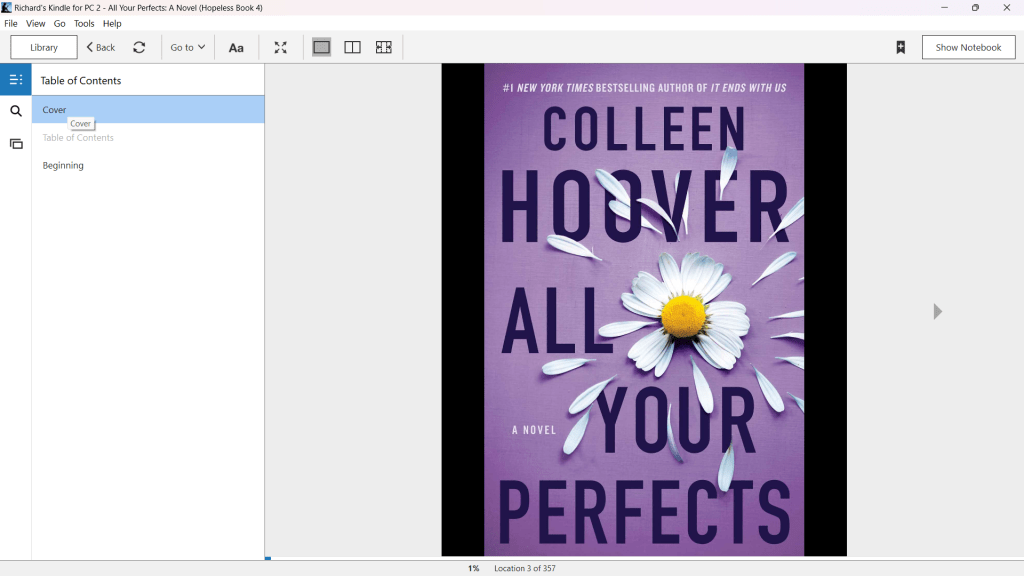
All Your Perfects, by Colleen Hoover


Amazon abstract:

INSTANT NEW YORK TIMES BESTSELLER

The #1 New York Times bestselling author of It Starts with Us and It Ends with Us—whose writing is “emotionally wrenching and utterly original” (Sara Shepard, New York Times bestselling author of the Pretty Little Liars series)—delivers a tour de force novel about a troubled marriage and the one old forgotten promise that might be able to save it.

Quinn and Graham’s perfect love is threatened by their imperfect marriage. The memories, mistakes, and secrets that they have built up over the years are now tearing them apart. The one thing that could save them might also be the very thing that pushes their marriage beyond the point of repair.

All Your Perfects is a profound novel about a damaged couple whose potential future hinges on promises made in the past. This is a heartbreaking page-turner that asks: Can a resounding love with a perfect beginning survive a lifetime between two imperfect people?


Podcasts listened to


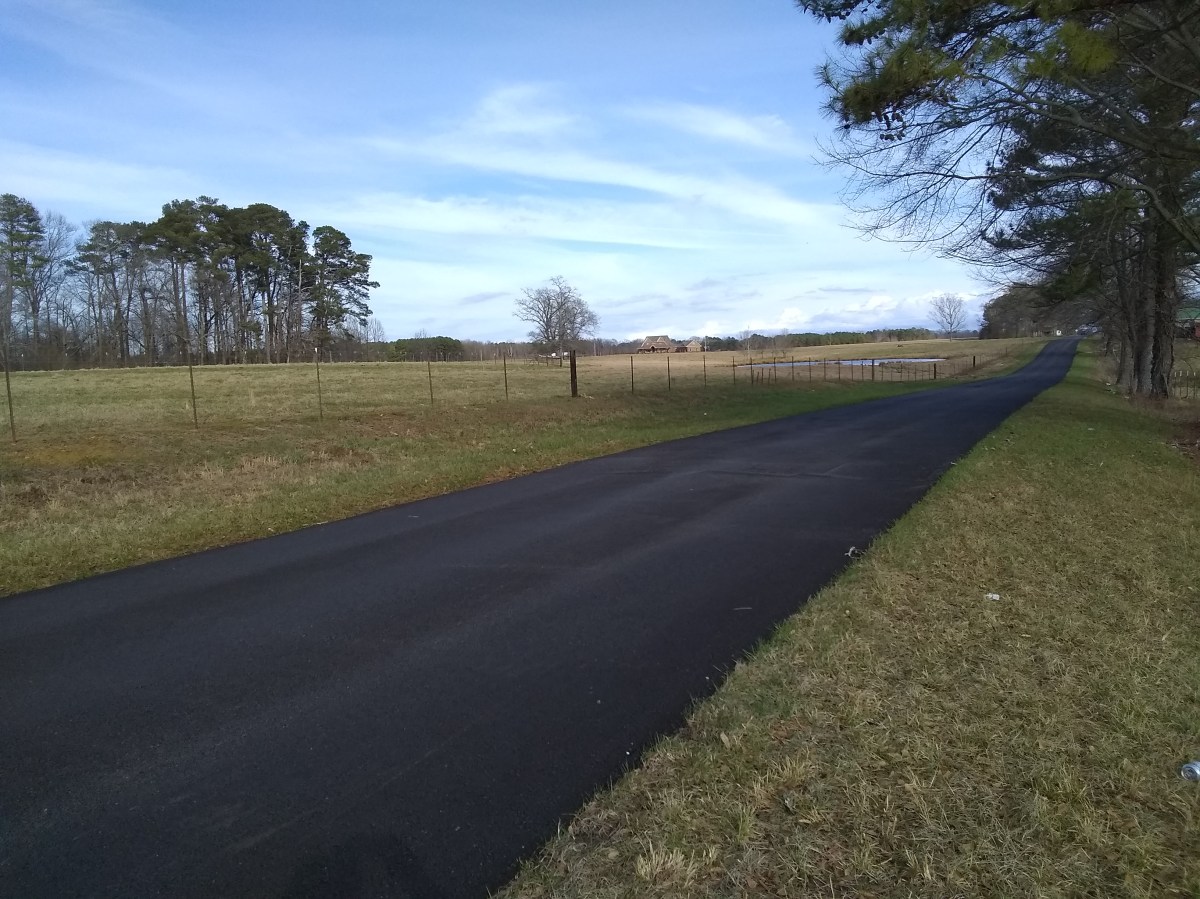
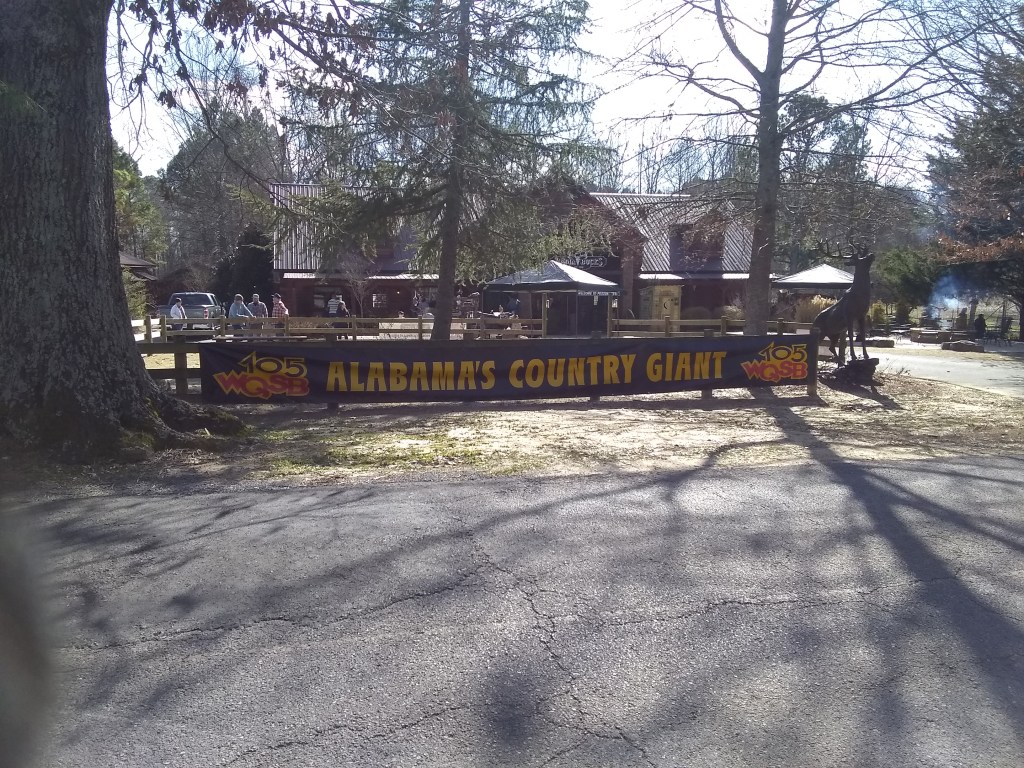
Here’s a few photos from along my pistol route:

The Boaz Stranger–Chapter 41

If it hadn’t been for Rob’s funeral, I think I would have struck out for Roanoke the moment I left Rosa and Bridgewood Gardens. I would have driven to Kyla’s for a change of clothes and toothbrush, quasi-argued with Lillian it was unnecessary for us both to go, and settled in for a fourteen-hour plus round-trip journey. Instead, I felt guilty and invoked a weird, maybe unnatural, combination of ease and duty. I’d opted to stay put.

A Southern Baptist funeral is predictable. The First Baptist Church of Christ sanctuary was abuzz with gospel songs, Rob-as-saint eulogies, and an unsurprising evangelistic sermon (including altar call). I’m confident I could have written Pastor T. J. Miller’s script: “Rob is now in a better place, one without pain and sorrow, and you can go there too, if you will believe in the name of Jesus Christ.” A too-long graveside service at Hillside Cemetery was a similar event, albeit with fewer warnings of Hell in the afterlife. Since college, I’d always been skeptical of the Christian story, but Rachel’s nonsensical death had tipped me sideways and triggered an intense search for the truth. So far, my transformation categorized the supernatural as pure conjecture.

I spent the rest of Sunday afternoon and evening at Kyla’s with her, my two children, and the four best grandchildren in the world. It was an enjoyable time and made my heart yearn for Rachel, regardless of everything I’d recently learned.

Things changed again at 9:00 PM. Lyndell and Leah were online looking at Google Maps to determine the best route by car to return to their homes in Exeter, New Hampshire. They discovered a near-certain snow and ice storm headed for the northeast. It was scheduled to hit early Tuesday morning. This news rescheduled their planned departure time to Monday morning. For me, unencumbered by a spouse or children, I opted to leave at 10:00 pm.

After a long game of Monopoly with Jackson and Jasper, I stood on the front porch with all four grands, each rustling for just one more hug. Finally, I retreated down the stairs blowing kisses with my left hand and holding my travel bag with my right. The dominating thought was how strikingly similar Ava and Amelia were to both Rachel and Leah. Climbing inside the Hyundai, I gave one last wave and chuckled out loud at the idea of miracles.

All the way to Collinsville, I contemplated alternative plans for when I would next travel to Exeter to spend time with the most wonderful kids who ever lived.

I filled up with gas at the BP and bought a cup of coffee. At 10:35 PM, I merged onto I-59, intending to drive nonstop to Roanoke other than one or two-bathroom breaks. Hopefully, I can make the 440 miles on one tank.

I had just passed the Hammondville/Valley Head exit sign when Lillian called. A lonely heart now regretted our Friday agreement to act like strangers while Leah, Lyndell, and their families were in town. Subconsciously, I knew my high school girlfriend and I were once again deeply connected. Sooner than later, I needed to share the good news with my dear children. “Hey you.”

“Still mad.” After my meeting with Rosa early this morning, I called Lillian and detailed what I’d learned. She’d agreed this was a huge break in our investigation and we needed to go to Roanoke as soon as possible. I had insisted I go alone since it was going to be a long, hard trip. Also, she and Kyla needed to develop a response to our little snafu at Jane’s house last Friday night.

I was a little surprised by my, “I’m mad at me too. I wish you were here straddling this console” response. We both had a pleasant laugh given my ill-imagined (and described) posture for the sixty-six-year-old beauty. “Will you forgive me?”

“What choice do I have? You forgave me for something far worse.” I paused before responding, asking myself what if I had refused three weeks ago to have anything to do with Lillian? I would have never experienced such joy, happiness, and peace. And all that had happened under the dark, foreboding sky of our current investigation. What might it be when Lillian and I are free to live a normal life, one free of her marriage to the murderous Ray and mine from the mysterious and lying Rachel?

I surprised myself. Again. “I’ve missed you like crazy and cannot wait until all this is over.”

“Good to hear. By the way, will you always try to keep me a secret from Leah and Lyndell?” I could picture exactly where Lillian was. The screen door on her back porch always squeaked when opening and closing.

“Oh, you naïve woman. Secret, what is there to keep secret? You are just one of dozens of gorgeous females stalking and luring me with their tantalizing charms. I certainly cannot tell my children about them all.”

“Dang, you’re in good spirits, albeit a little twisted. At least you’ve admitted I’m gorgeous.” The door squeaked again.

“Lillian, my dear, you know I’m kidding. By the way, what are you doing?”

“Unloading a few groceries and some cleaning supplies. This place is a mess.” I wondered why Lillian had waited until now to spruce up her cabin. She’d already spent two nights there.

“Promise me you’ll return to Kyla’s tomorrow and stay until I return. Agree?” It was the first time we’d been apart overnight since she’d learned Ray was a genuine threat to the two of us.

“Lee, can I ask a serious question?”

“Don’t do that. You know our promise to be fully open.”

“Do you ever consider how this is going to work out?” I heard dinging. Lillian was moving her Aviator.

“You mean Ray and our investigation?” A twinge of guilt ripped through me. This wasn’t what she was talking about.

“Yes, and us, afterwards.”

“I do, I’m ready for it all to be over.” I paused, trying to decipher Lillian’s barely audible words. Something about her garage door remote. “The investigation and your divorce.”

“Shit, my thing-a-ma-ding won’t work. Good thing I have another place to park given the possible snowstorm.”

“Uh?”

“I’m not pressing at all, but just need some hope. I’m interested in your mental wanderings.” Again, I heard the ding from an open door. “Hold on, let me check.” In a minute, she returned. “I can’t raise the door from the outside. Oh well.” The dinging stopped. “Your thoughts?”

“Okay, but first a question.”

“Always.”

“You realize I intend on staying at Yale, that I’m not ready to give up my teaching job?”

“I do, but I also know how difficult a long-distant relationship can be.” Again, the dinging. “Sorry, hold on again. I’ll be back in a jiffy.”

I merged into I-24. Time and miles were passing quickly. Maybe I’d talk to Lillian the entire trip.

“Shit, it’s locked.”

“What?”

“The roll-up door at the barn. I was going to park inside. That’s odd.”

“I thought it stayed open. At least that’s what I recall. Can’t you park on the other side?”

“I could, but I let Tony Clifton, my neighbor, store a bunch of square bales in there while he and Neva are rebuilding their barn.”

“Idea. Why don’t you go to Kyla’s? Since I’m not there, you won’t blow our cover. You’ll have to leave your Aviator outside, but you’ll be safe and won’t have to worry about moving it in the morning.”

“Thanks darling, but I’m waiting here until you return. I’ll give you three guesses why and the first two don’t count.”

Lillian and I talked all the way to Knoxville. Our discussion was excellent, other than her telling me she had seen Ray at Rob’s funeral. Mostly, we talked about our feelings for each other and the possibility of Lillian moving to New Haven as soon as her divorce was final.

After we hung up, I shook my head in amazement at how easy it was to be so open and intimate with a woman. Not since I’d become an adult had I ever experienced such chemistry. Certainly, Rachel and I had never entered this zone.

This thought, and a dozen more analyzing the possibilities of a life with Lillian, occupied my time until 4:30 AM when I pulled into the driveway of Rob and Rosa’s cabin. I had stopped one time to pee at a Mobil service station in Bull Gap two hundred miles south of Roanoke.

My ultimate destination was located halfway to Mason Cove to the northwest, on a heavily wooded lot at the dead end of Bluebird Lane. It wasn’t close to being a cabin, instead it was a split-level brick. From the outside, it appeared to be at least fifty years old, not decaying, but certainly weathered. The driveway led to a double garage with a walk-through door separating the two bays. I exited the Hyundai, verified these three doors were locked, and walked back to the front and up a steep stairwell leading to the front door.

I used the keys Rosa had given me to unlock the solid wood door that needed a fresh coat of stain and varnish. Inside was diametrically opposite my outside impression. From my viewpoint, inside a large foyer, Rob and Rosa had updated the den to my left and the kitchen farther back. Probably within the past few years.

I walked to the leather Lazy-Boy closest to the fireplace and imagined Rob sitting reading one of the many Christianity Today magazines nestled atop the nearby table. A fire and a nap were tempting, but I rejected the idea and walked into the kitchen, admiring the stainless-steel appliances. I explored three bedrooms at the back of the house, all located six steps higher than the main floor. The wood paneling in all three rooms was gorgeous. I again fought the urge to lie back and rest my eyes.

I kept going. The basement door was beside the laundry room. As I descended the crude stairwell, a damp, musty smell slithered inside my nostrils. It reminded me of the cellar at Harding Hillside and the slimy feeling I always felt when Mom made me fetch a jar of green beans or a half-dozen potatoes.

Rosa’s drawing was spot on. Straight across from the bottom step, maybe eight feet, was a four-foot fence like structure with a hinged door. All of this rested atop a cement wall that was a few inches taller than me.

I found a four-foot ladder and stepped onto the second rung. The deadbolt needed a little WD-40 but quickly surrendered to my initial tug. The faded white door creaked as I swung it towards the stairs. I eased upwards to the third rung and used my iPhone’s flashlight to peer over the cement wall. A section of plastic drainpipe was the only thing Rosa had not denoted. Thankfully, it lay undetached to anything and took little effort to toss onto the plastic ground cover beyond.

I refocused the light and barely caught the edge of a plastic Zip-lock bag. I had to lie across the wooden bottom plate of the door opening and nearly tilted my ladder. Holding my iPhone in my right hand, I had to stretch, but finally grabbed the bag. It took a little tugging, but it finally separated from the surrounding dirt. It was heavy, like steel. The plastic was almost opaque, but not enough to prevent discerning the clear outline of a pistol.

The ladder gave me a little trouble, but after rocking my body backwards enough for my feet to find the third rung, I descended to the second, closed and secured the door, and found solid footing on the concrete floor. I used a shop rag from a workbench at the back of the basement to remove the dirt and grime from the bag. Once clean, I could make out the Smith & Wesson lettering and the pistol’s serial number. I tried to verify the manufacture date, but my cell service was minimal.

I returned upstairs and sat at the breakfast nook table. Relieved, I learned the S & W pistol I was holding was manufactured in 1965. The website described it as “a Model 60, Stainless Steel Chiefs Special Revolver.”

“Surely, this was the weapon Ray Archer had used to kill Kyle.” I continued to sit and ponder, reliving wonderful memories of times spent at his house and along nearby Clear Creek. My thoughts transformed negatively when I recalled the smell of decomposing garbage wafting in through the half-rotted windows. I don’t know how long I dozed before my head jerked upwards, reminding me I needed to leave temptations of chair and beds, and once again continue my journey.

I quickly stood, clutched the plastic and steel package under my arm, and walked to the front porch. After locking the door, I paused to enjoy a moment of satisfaction. I realized I might be fooling myself, yet I felt emboldened. I quasi yelled as I descended the porch stairs: “Kyle, old buddy, I’m coming. I promise I’ll never abandon you again.”

08/27/23 Biking & Listening

Biking is something else I both love and hate. It takes a lot of effort but does provide good exercise and most days over an hour to listen to a good book or podcast. I especially like having ridden.

Here’s my bike, a Rockhopper by Specialized. I purchased it November 2021 from Venture Out in Guntersville; Mike is top notch! So is the bike, and the ‘old’ man seat I salvaged from an old Walmart bike.

Here’s a link to today’s bike ride.


Something to consider if you’re not already cycling.

I encourage you to start riding a bike, no matter your age. Check out these groups:

Cycling for those aged 70+(opens in a new tab)

Solitary Cycling(opens in a new tab)

Remember,

Photo by Suzy Hazelwood on Pexels.com

Podcasts listened to

Novel listened to: All Your Perfects, by Colleen Hoover


Amazon abstract:

INSTANT NEW YORK TIMES BESTSELLER

The #1 New York Times bestselling author of It Starts with Us and It Ends with Us—whose writing is “emotionally wrenching and utterly original” (Sara Shepard, New York Times bestselling author of the Pretty Little Liars series)—delivers a tour de force novel about a troubled marriage and the one old forgotten promise that might be able to save it.

Quinn and Graham’s perfect love is threatened by their imperfect marriage. The memories, mistakes, and secrets that they have built up over the years are now tearing them apart. The one thing that could save them might also be the very thing that pushes their marriage beyond the point of repair.

All Your Perfects is a profound novel about a damaged couple whose potential future hinges on promises made in the past. This is a heartbreaking page-turner that asks: Can a resounding love with a perfect beginning survive a lifetime between two imperfect people?


Here’s a few photos from along my pistol route:

Ken Burns on why the Republican Party completely changed

STEVE SCHMIDT: ” It was an absolute honor to talk to Ken Burns, famed documentarian and national treasure, to talk about the importance of telling America’s story. In this brief clip, we discuss what changed in the Republican party in the last 10-15 years and how we can fix it.”

The Boaz Stranger–Chapter 40

Sunday morning, I was still feeling guilty over what I’d done. Sometimes I talk when I should remain silent.

Rosa, Leah, Lyndell, and the four grands had arrived from Roanoke late Friday afternoon. The normal seven-hour drive had taken nearly ten hours, given Rosa’s urinary incontinence and young Jackson’s inner ear/motion sickness issues.

Yesterday, Leah and Lyndell had driven to the Birmingham airport to pick up their spouses, Dale and Olivia, and allow the females to indulge themselves at the Riverchase Galleria, one of the country’s largest malls.

Fortunately, this had provided a long overdue opportunity to spend time with my four grandchildren: Lyndell’s two boys, Jackson and Jasper, 7 and 6, and Leah’s two daughters, Ava and Amelia, 5 and 3. The five of us spent most of the day walking, talking, fishing, playing with the goats, and wrestling in the hay-filled barn loft. The weather had been warm but sunless, the fast-moving clouds foreboding the incoming rain.

The minute my children and their spouses arrived, I’d excused myself to my bedroom to call Rosa. I had been eager to talk with her ever since Lillian and I discovered Jane’s mystery wall. Proper respect probably required me to wait until after Rob’s funeral before confronting Rosa. But my attorney mind kept asking what respect she’d shown me all these years.

After arriving Friday night, Rosa had insisted on staying at her and Rob’s apartment at Bridgewood Gardens, the assisted living facility the couple had made their home for the past eight years. Unfortunately, Rosa had visitors and could not talk. Thankfully, she had insisted I come this morning.

I exited Woodham Drive into the Gardens’ parking lot at 6:50 AM. I’m not sure why Rosa insisted we meet so early. It probably had something to do with Rob’s 2:00 PM funeral at First Baptist Church of Christ.

There was no one manning the reception counter, but there was a sign on a glass wall requiring all visitors to sign in. The three-ring binder was open to the current page, revealing only one line available. I signed and scanned the other twenty-four names. The third one from the top was Ray Archer. He had been here Friday morning to see Ronald Archer. I assumed it was Ray’s father, but I did not know.

Per Leah’s directions, I walked to the end of a wide hallway and turned right into one much narrower. The cafeteria was on my left. After passing through two intersecting corridors, I turned right. According to a wall map, room 188 was straight ahead, at the dead end of Hallway G.

The door was cracked open three or four inches. I knocked, and Rosa immediately responded. “It’s open, come in.” I complied.

She was sitting in a small den on the far side of a rectangular room. I passed through a quasi-kitchen (a few cabinets, a sink, and a microwave) and ignored her non-verbal instruction to sit on a leather couch opposite her Lazy Boy chair. I eased to her, laid my hand on her shoulder and kissed her forehead. “How are you, Mom?” I had called her this since mine and Rachel’s wedding. Rosa had insisted. I retreated to the couch.

“Seen better days. How are you?” My mother-in-law had always been an elegant woman. She still is. Her graying hair looked like she’d just returned from the beauty shop. She wore a multi-colored silk housecoat. The deep rich red of her house shoes exuded refinement.

“Dreading this conversation.” I might as well be direct.

“Lee, before we jump into the abyss, please consider my love for Rachel, a mother’s love for her only daughter.” I kept listening, anticipating she knew why I was here. “And, just as important, I loved you. Still do.”
“Do you know why I’m here, what I want to talk about?”

“I think so. It’s long overdue and now that you’ve stumbled onto the truth, part of it, we need to air my dirty laundry.” I wanted to probe Rosa’s statement. How did she know I’d discovered the truth, or, as she said, ‘part of it?’

“Mom, I need you to be fully open with me. I need to know the truth.” As an afterthought, I added, “and no matter what it is, I will always love you, just like I will always love Rachel.”

“And I’ll always regret my decision to return to Alabama the summer of 1968. Rob had wanted to stay in China. Rachel and Randy were doing well in school, no indications or forewarning of trouble.” I was glad Rosa was starting at the beginning, even though I’d assumed the eighteen-month sabbatical was mutual with her husband.

My mother-in-law paused and closed the Bible that had been open on her lap. “What changed? I mean, what happened in Alabama?” I felt I knew but needed to hear it from Rosa.

“It was like a switch flipped. One inside Rachel’s head. I could blame it on her maturing puberty or approaching adolescence, but it also had to do with an evolving inquisitiveness about the world, including a rustling rebellion against Christianity, maybe authority.”

“The latter surprises me. Rachel never shared this phase with me.”

Rosa glanced at a digital clock on the table beside her chair. “Randy and Celia will be here between 8:30 and 9:00, but I want to answer all your questions. Since you’re the attorney, why don’t you guide our conversation.”

I smiled and nodded, thankful for Rosa’s apparent willingness to let the floodgates open. I figuratively stood erect and leaned forward into the deep darkness. “Why have the Archer’s, Ronald and Ray, been paying you and Rob all these years?” I’m not sure why I started here instead of with Rachel’s baby.

“Wow, you’ve looked behind the curtains.” Rosa paused again, lowered her footrest, stood, and walked to the back wall. She opened the blinds and stared into an overcast sky. Without turning, she said, “we would have done it without the money.”

“You and Rob?”

“Yes.”

“Done what?” I hoped she’d volunteer more details and transform her responses into an informative narrative.

“Keep our mouths shut.” I stayed silent, hoping Rosa would continue without prompting. Knocking and intrusion of a nurse’s aide delivering a half-dozen pills prolonged the wordless intermission. After we were again alone, Rosa continued. “Kyle’s accident and death came as a shock.”

At first, I thought I’d misheard. Accident? It didn’t take anything but a few seconds to realize Rosa believed a lie, probably a bag of lies. “Accident?” I almost said, ‘Ray murdered Kyle,’ but didn’t.

“Roland convinced me it was just as much Rachel’s fault as Ray’s, so Rob and I went along with the plan.”

“The plan? What plan?” I literally shook my head. Rosa turned in time to see my expression.

“Kyle had fallen and hit his head. He died almost instantly. The problem was that it had taken place during an altercation.”

“You mean a fight?” I didn’t stop for Rosa’s response. “Why not just tell the truth? Maybe it was simply Rachel at the wrong place at the wrong time.”

“Wouldn’t have worked. They, Ray and Rachel, had just learned what Kyle knew.”

“What was that?” Here comes the story of Rachel’s pregnancy.

“Somehow, Kyle discovered Ray had gotten an Albertville cheerleader pregnant. And, about that girl’s disappearance.” Rosa returned to her Lazy Boy but didn’t raise the footrest.

I might as well be proactive. “Did Kyle also know about Rachel’s pregnancy?”

Rosa didn’t verbally respond, but she did nod affirmatively.

“Tell me about the fight. Where Kyle fell.”

“He was trying to extort money from Ray and threatened to go public if he didn’t pay up. It happened at the creek, besides Kyle’s house.” From what I thought I knew, Rosa’s story was surreal.

“I’m sorry to say this, but there’s something obviously missing. Based on the fight, altercation as you call it, I don’t see a good reason for you and Rob to have stayed silent.” This time, I paused, considering my next thought. “Unless you needed the money, or, sorry to put it this way, were greedy and saw an easy way to line your pockets.”

“Lee, you know Rob and me better than to make that accusation. Please realize how difficult this is for me. I can’t stand speaking ill of my dearest Rachel.”

“Mom, remember, I need the truth.”

“Ronald made us believe it somehow involved Rachel. The disappearance of Sharon Teague.” The enunciation of the girl’s name triggered, at first, the sensation of ingesting a mouthful of spoiled milk, then a feeling of approaching nausea. Rosa knew some truthful facts.

“Did Rachel admit the same?” Rosa’s story seemed fanciful. “How had Ronald Archer been so persuasive?”

“She did but would never provide details. All she would say is, ‘Mom, Dad, I am responsible for Sharon’s death.’”

“Assuming all this was true, it seems more likely that Ronald would ask you and Rob to pay him. Did you not imagine that Ray was criminally at fault in Kyle’s death?” Rosa (and Rob) had either been naïve, or she was still concealing a mountain of relevant facts.

“To be blunt, and reveal our ignorance, we ignored everything but Rachel’s exposure. It wasn’t until later that we learned what Ray had done to Kyle.”

“And what was that?” I felt like a hamster on a treadmill.

“Ray had shot and killed Kyle. Intentionally.” I almost interrupted, but Rosa held out her hand. “To make matters worse, Rachel told us she had hidden the murder weapon.”

Another knock at the door provided an opportunity to frame my response. A tall and skinny young red-headed boy, maybe twenty, entered bearing Rosa’s breakfast: a bowl of oatmeal, a slice of unbuttered toast, an orange, a banana, a pint of milk, and a glass of what I assume was cranberry juice. Tad, per his name tag, set the tray on a TV stand and positioned it in front of Rosa. He left after wishing us both a nice day.

While Rosa ate, I talked, choosing my words carefully. I shared how Rachel had told me the reason she attempted suicide the first time was because of her abortion.

“She never had an abortion.” Rosa said without looking at me.

“I know that now, but before we talk about Elita Ann Kern…” This time, Rosa looked straight at me, her eyes distant. “Rachel wrote in her diary what happened the night of December 11, 1969.” I shared how she led me to believe she had hidden the murder weapon, a Smith & Wesson 38 caliber pistol, in an upstairs wall at the Hunt House. Rosa continued to eat as I summarized how I’d found a similar pistol, but it could not have been the murder weapon.

This is when everything changed. “Rachel moved it to the cabin. In Roanoke.” I thought of the ‘38 to friend’ note scribbled inside Rosa’s favorite book, The Cost of Discipleship.

My words failed. My mouth was like cotton. I stood and walked to the sink and ran a glass of water and drank half of it. On my way back to the couch, I finally spoke. “When did Rachel do that?”

“Before she killed herself.” At first, I thought Rosa was attempting some dark humor. “I mean during the six months before she hung herself.”

I had a dozen questions, including how Rachel could have pulled off this two-thousand-mile trip, and where she would have gotten the newer S&W she stuffed inside the Hunt House wall replacing the actual murder weapon. I silently laughed to myself, realizing I was citing facts I didn’t know were true. There was at least one thing I needed Rosa to answer. “How do you know the pistol in Roanoke is the murder weapon, the gun that Ray used to kill Kyle?” I was still making a couple of assumptions, but my awkward sentence generated a quick response.

“Rob. I always thought he would have made a better lawyer or detective than a missionary.”

“What did he do?” I was hoping Rosa would say Rob had someway engaged an expert who tied it via ballistics or fingerprints to Ray Archer. I was dreaming.

“He convinced Ronald Archer to verify it was his. The serial number matched.” It was a letdown. This was circumstantial.

Rosa took a bite of her banana and stared at me. “I see that look. Remember, Rob was sharp. He audio-taped a phone conversation with Ronald and Ray. The two finally admitted the pistol Rob was referring to had been used to shoot Kyle.”

“That doesn’t sound smart. Sorry, no disrespect to Rob. Why would he let Ray and his father know he had possession of the murder weapon?”

“Who said he did?” Obviously, I was confused. Rosa nodded and raised her eyebrows. “Rob lied. He made Ray and Ronald think he had a photograph of the pistol.”

I looked at my watch. It was after seven-thirty, and I had a ton more questions. “Where is the pistol now, the murder weapon?”

“Hand me that notebook.” Rosa pointed to a small desk beside her end table. “And a pencil.” I complied.

As instructed, I moved her breakfast tray to the kitchen while she sketched. When I returned, Rosa motioned me to stand beside and behind her while she drew and explained. “You know for sure it’s still there?” I had to ask.

“Unless it has been discovered and moved since late Thursday night when I checked.” Rosa circled an asterisk she had made along the basement’s rear wall. “There’s a crawl-through door here, but you can use a chair to reach inside behind the concrete wall. It’s protected by a zip-lock bag.”

After printing the cabin’s address in the lower right corner, Rosa removed the sheet and handed it to me. I returned to my spot on the couch. “I need to go to Roanoke. Is that okay with you?”

Rosa nodded affirmatively and reached to her left toward the floor. She fumbled in a large leather bag and tossed a set of keys my way. “Keep them. It will soon be yours and the kids.” I wondered if she was relaying the contents of Rob’s will, her intent to make a gift, or whether she was expecting her near-term death.

The land line phone on her end table rang as I slid the keys inside my jacket pocket. She let it ring several times. “Shouldn’t you answer that?”

“I’m sure it’s Stella Reed from 144. She calls about this time every Sunday morning. She can wait.” I offered encouragement through head and hand signals to answer, thinking another voice might give my mother-in-law a respite from our abyss-like discussion. After eight rings, she finally answered. “Hello.” A five second pause was followed by, “okay dear, love you.”

“I’m betting that was Randy.” I said, standing, acknowledging my desire to avoid my brother-in-law and his girlfriend in this setting. At the funeral home, small talk won’t be an issue.

“He’ll be here in fifteen or twenty minutes, just coming into Guntersville.”

That should be enough time to ask one more question. I stepped towards Rosa and knelt on one knee. “Mom, I need to be going, but I have one last question. Okay?” I took hold of her hands. Tears came to her eyes, and mine.

She again nodded up and down. “Rachel’s baby?”

I reciprocated the head movement.

“There was never a question. Rachel, or me and Rob only considered full term and adoption.”

“Did she promise Ray she would have an abortion?”

“Yes. No. Before we left for China, she told him she had the abortion.” Rosa looked to her right toward the open blinds. I imagined her thoughts transported her to another world, one half-a-century ago, probably to China and to the day baby Elita was born. Then she smiled. “Just to think Rob and I considered raising the precious little girl.”

That seemed reasonable, given the circumstances. “What stopped you?”

“Two things. The Mission Board and Rachel herself. Rob and I speculated about the Board’s reaction. Rob confided in a missionary friend, then retired, who had spent his last ten working years in Nashville as a compliance officer of some sort. His advice was to stay quiet and put the baby up for adoption. That, and Rachel’s plea on Elita’s behalf for her to have a normal life.”

“I guess I’ll never know why Rachel swore that her reason to attempt suicide was her abortion, one that she never had.” My last statement was confusing.

“My sweet daughter was beautiful inside and out, but she was also mysterious. You probably never realized she was a woman with many masks.”

I could have pursued that point several ways, but it was time to go. We released hands as I stood half erect and gave Rosa an awkward hug. “I’ll see you at the funeral.” She smiled and returned her gaze to the blinds, the gray sky, and likely, to a time and world long ended.

08/26/23 Biking & Listening

Biking is something else I both love and hate. It takes a lot of effort but does provide good exercise and most days over an hour to listen to a good book or podcast. I especially like having ridden.

Here’s my bike, a Rockhopper by Specialized. I purchased it November 2021 from Venture Out in Guntersville; Mike is top notch! So is the bike, and the ‘old’ man seat I salvaged from an old Walmart bike.

Here’s a link to today’s bike ride.


Something to consider if you’re not already cycling.

I encourage you to start riding a bike, no matter your age. Check out these groups:

Cycling for those aged 70+(opens in a new tab)

Solitary Cycling(opens in a new tab)

Remember,

Photo by Suzy Hazelwood on Pexels.com

Podcasts listened to

Novel listened to: All Your Perfects, by Colleen Hoover


Amazon abstract:

INSTANT NEW YORK TIMES BESTSELLER

The #1 New York Times bestselling author of It Starts with Us and It Ends with Us—whose writing is “emotionally wrenching and utterly original” (Sara Shepard, New York Times bestselling author of the Pretty Little Liars series)—delivers a tour de force novel about a troubled marriage and the one old forgotten promise that might be able to save it.

Quinn and Graham’s perfect love is threatened by their imperfect marriage. The memories, mistakes, and secrets that they have built up over the years are now tearing them apart. The one thing that could save them might also be the very thing that pushes their marriage beyond the point of repair.

All Your Perfects is a profound novel about a damaged couple whose potential future hinges on promises made in the past. This is a heartbreaking page-turner that asks: Can a resounding love with a perfect beginning survive a lifetime between two imperfect people?


Here’s a few photos from along my pistol route:

The Boaz Stranger–Chapter 39

At 7:00 PM, Ray backed the Suburban down the hill to the detached garage. Once the automatic door opened, he eased the overgrown vehicle halfway inside the bay opposite his Corvette. Everything he needed was stashed among the cluttered shelves: two camouflaged tarps, a six-box case of baking soda, four gallons of white vinegar, a four-pack of 3% Hydrogen Peroxide, a box of vinyl gloves, and a 9mm SIG Sauer P226 with titanium suppressor. Ray unlocked an adjoining storage room and slid an over-sized box of Christmas decorations out of the way. He removed a duffel bag stuffed with $110,000 of fake money and marveled at the Internet and the near infinite number of items that could be purchased with the click of an electronic mouse.

Ray exited and relocked the storage room and tossed the duffel into the Suburban. He closed the hatch and walked to the still open driver’s side door. Before sitting, he felt his iPhone vibrate in his jacket pocket. It was Ted King. “I’m here waiting.”

In ten minutes, Ray joined his best friend at their usual back wall table and ordered matching rib-eyes. Ted chose a glass of red wine. Ray opted for water. He needed to keep a clear head for the night’s mission.

After their food arrived, Ted couldn’t wait to ask. “Did she get everything moved?” Like Ray, Ted hated the nosy and manipulative Jane, but neither man, for now, could do without her skills and inner-circle connections.

“Everything is safe and sound, locked in a closet six feet behind my desk.”

“Downtown?” Ray had called Ted early this morning and relayed Jane’s suspicion that Lee and Lillian had burglarized her house last Thursday night while she and Kyla were at the movies in Gadsden.

“Yeah.” It was still shocking that nothing was missing. The only evidence anyone had been inside Jane’s house was a stack of newspapers lying on her desk. “We dodged a bullet, well, at least I did.”

“Rachel’s diaries?” Ted knew Ray had been right in his first statement. If not for Ted, Jane wouldn’t be reviewing Rachel’s basement diaries. A friend who owed the mayor a favor had driven to New Haven, Connecticut, and broken into Lee’s home. But the actual hero was Jane and her former relationship with Rachel. The two shared everything, including their daily diary writing ritual.

“I’ve got bigger problems, at least potentially.” Ray said, devouring a fresh roll.

“What?” Ted braced himself for the news, yet not expecting a surprise.

“It seems Rachel lied once again. This time, about the 38.”

“The murder weapon?”

“Yeah, she didn’t hide it at the Hunt House.” Ray took a big bite of rib-eye and marveled at the taste. Best steak imaginable and available every day at The Shack.

“So, where is it? Where did Rachel hide it?” Ted knew he had nothing to do with Kyle Bennett’s death, other than his half-century silence. However, he feared Rachel’s diaries as much as Ray. Ted’s appetite waned as he thought about how he had helped Rachel to cover up a totally different crime.

“Roanoke. Rosa’s had it all these years. I just don’t know if she knows it.”

By 9:30, Ray had fielded all the questions he could take. He had more pressing things to do. Although it was over two hours before Billy and Buddy arrived, Ray pulled the Suburban inside the barn’s hallway a few minutes before 10:00.

He grabbed a flashlight, stuck the SIG at his back inside his waistband, and explored a long-abandoned cattle stall. This would be a perfect place to hide the supplies, better than overhead in the loft. Ray didn’t trust the rickety ladder hanging from the hallway’s wall.

After removing and concealing the supplies (other than the duffel of fake money), Ray walked outside, disgruntled over the rain. It had drizzled as he pulled into The Shack’s parking lot. Now, it was approaching a downpour. Ray returned to the Suburban and pulled it forward another six feet. He wanted plenty of room for him and the James twins to conduct business in the dry, at least in the first phase.

At 11:30, a set of flashing lights behind him aroused Ray from a semi-slumber. He had sat the last hour on a too-heated front seat and broken his number one rule: to stay alert.

Ray turned off the Suburban and slid out the driver’s side door. By the time he turned, Billy and Buddy had exited their vehicle and raced inside the barn. “Shitty weather.” Billy said, taking in a panorama view of the barn’s hallway.

Buddy’s face was mixed. Ray couldn’t figure if his squinting eyes were from his truck’s headlights glaring off the rear bumper of the Suburban, or from his skepticism about meeting this late and at this god-forsaken spot. “I almost called to reschedule, but I was already here before the bottom fell out.” Ray thought his statement would cause Billy to relax a little.

“What’s the new job?” Buddy asked, easing closer to the unhinged gate Ray had leaned against the opening to the converted cattle stall. Ray wished he’d opted for the loft despite the questionable ladder.

“Abduct Lillian and bring her to me. She and I need to have a little talk.” Ray opened the Suburban’s rear hatch, tired and eager to get on with things.

“That’ll cost extra, given the risk.” Billy and Buddy saw the duffel and edged forward, revealing their curiosity.

“That’s a hundred and ten thousand. Half.” Ray chose not to delineate the specifics.

Billy took another step forward and leaned into the Suburban, pulling the duffel towards him. “You promised two hundred.”

“I did, half up front, the other half upon job completion.” By now, Buddy and Billy were both reaching in and removing bundles of cash.

Buddy fanned through one bundle, then another, laying each on the carpet beside the duffel. “Add an extra hundred up front and an extra fifty on the back end.”

Billy was about to say something when the first bullet entered his left ear. He started falling to his right, into Buddy. Ray’s second shot hit Buddy in the heart a micro-second after turning toward his falling twin. Two seconds later, both men sprawled in the hallway’s dirt, Billy’s head lying across Buddy’s stomach. Ray shot each man once again, this time between the eyes. Just to make sure.

He had to hurry. The decision not to use the suppressor might be Ray’s undoing. After arrival and storage of the supplies, he’d decided the extra length on the P226 could cause handling problems if stuck inside his pants. Now he needed to hurry. The deafening noise could carry at least as far as the nearest house.

Ray tossed the SIG inside the duffel along with ten bundles of fake cash. He moved the gate, walked to the far back corner, and grabbed the two tarps. He lowered the third-row bench seat and made a camouflaged bed for Billy and Buddy. After removing his coat and donning a pair of coveralls stuffed behind the driver’s seat, Ray removed a pair of vinyl gloves and stretched them over his hands. He then returned to the dead and rolled Billy over. Though the twins were not half Ray’s size, their lifeless bodies were heavy. It took three times to position himself. First, he sat Billy upright on his butt and leaned behind him, inserting his arms underneath the dead man’s armpits. Clutching his own hands around Billy’s chest, he stood him straight up and leaned him inside the Suburban. After two tries, Ray shifted Billy’s center of gravity forward enough to twist the legs and push him forward to the rear of the second row’s bucket seats. Ray repeated the exercise with Buddy.

Ray returned to the cattle stall and removed the baking soda, the four gallons of white vinegar, and the four-pack of Hydrogen Peroxide. He quickly poured each over the bloody mess that saturated the soil where the two men had fallen. After tossing the empty containers inside with Buddy and Billy, Ray lowered the hatch and walked to the still-running pickup.

It took ten minutes longer than he’d estimated, given the rain. He repositioned Buddy’s vehicle and nearly got stuck connecting the Suburban to the flatbed trailer hidden behind the barn. One loading ramp gave Ray a fit, but he finally managed to lower it, and drive the truck onto the trailer. Thoughts of how close he had come to forgetting two chains and come-a-longs made Ray realize how easily things can go astray when you’re committing crimes.

It was twelve-thirty-five when Ray turned right onto Cox Gap Road. Phase one was complete. Phase two was just beginning. Even though it would take between three and four hours to deliver Buddy’s truck and the dead bodies, Ray was thankful for the rain. Even though wet and sloppy, it made for an excellent cover.

After two days of careful research, Ray had decided on Horse Pens 40 as the drop-off point for Buddy’s pickup. His thinking was that it would add a layer of mystery, including an alternate direction for law enforcement officers to begin their search once they found the truck. Horse Pens 40 is an outdoor nature park and campground nestled atop Chandler Mountain, thirty-two miles southwest of Ronald Archer’s Dogwood Trail farm.

Ray soaked but satisfied, did not see a sole after unloading Buddy’s truck beside the campground’s bathhouse. Again, thankful for the rain, but also for Jane’s hacking skills in accomplishing what most believed impossible. She had removed his ankle bracelet without triggering an alarm. A literal roll in the hay with the least desirable woman was a small price to pay for his eventual freedom.

***

The trip to the chosen dead body disposal site took seventy-five minutes. The location wouldn’t have occurred to Ray if it hadn’t been for pastor T. J. Miller. He often spoke of the Holy Spirit’s powerful movement during two revivals he’d preached in 2012 and 2013 at Valley Head Baptist Church.

Just as Google Maps had revealed, Church Street turned into Hammond Street. Ray made the ninety-degree turn to the left. In five seconds, he saw the Southern Properties Realty sign on the right in front of an unoccupied house that held the key to Ray’s success in disposing of Billy and Buddy’s bodies.

The driveway was narrow. Once again, Ray was thankful. This time for having temporarily parked his twenty-foot flatbed trailer behind the body shop of McLarity Ford in Fort Payne. Otherwise, he’d be stuck and unable to turn his rig around.

The owners nestled the house along the edge of a multi-thousand-acre span of forest that ran north and south along the west side of Highway 117. That thick forest engulfed the home of Alister and Gaynell Fortson. The Southern Properties listing had mentioned hiking as a valuable benefit that accompanied the Fortson’s home. This had led Ray to discover, via Google Maps, a beaten path up the mountain from the home’s detached garage. Ray hoped it was wide enough for his Suburban.

Fortunately, it was. In fact, it was wide enough to turn the vehicle around after reaching the crest of the mountain. At two minutes before 2:00 am, Ray removed the bodies and drug each southward fifty feet over the ridgeline toward Hwy. 117, hoping scavengers would do their thing before the twins were discovered. Of course, even if law enforcement found Billy and Buddy tomorrow, they wouldn’t find a clue that would implicate Ray Archer.

A hot shower couldn’t come too soon. At 3:35 AM Ray pulled his Suburban into the Lodge’s garage. He sat and reviewed his mental checklist to verify he hadn’t forgotten a thing. Buddy’s truck hidden. Check. Billy and Buddy’s bodies secreted miles from the truck. Check. The two camouflaged tarps dropped at five-mile intervals along I-59 north of Fort Payne. Check. The bag of fake money (and a host of empty cleaning containers) tossed in a garbage bin at a Jack’s Restaurant at the Collinsville exit. Check. The SIG Sauer lay at the bottom of Lillian’s pond. Check. The flatbed trailer parked inside the barn behind Lillian’s cabin (with the roll-up door closed). Check.

Phase Two was complete. Ray stayed in the shower for almost an hour.