Magical Thinking Is Christianity’s Biggest Mistake

Here’s the link to this article.

By David Madison at 7/14/2023

There are plenty of other mistakes as well

If I were asked to debate a flat-earther, Holocaust denier, or someone who is convinced the moon landings were faked, I would decline the invitation. Nor would I debate an astrologer, the local store-front medium who tells futures using a crystal ball, or anyone who believes in chem-trails. All of these folks have been groomed in one way or another, by various kooks and quacks. 

They haven’t done/ refuse to do /don’t know how to do the study/research to find out how wrong they are.

Then there are those who have been groomed to believe in ancient superstitions about a god who keeps a close watch on every person, and whose anger about human sin was modified by a human sacrifice—who, in fact, was this god’s only son, “the lamb of God who takes away the sins of the world.” (John 1:29) 

How can we get people to just say NO? This is pathetic magical thinking, that derives from the belief that killing an animal was a method for making a god less angry that you’ve done something wrong. This practice is on full view in the Old Testament. Check out the first chapter of Leviticus, vv. 4-5: 

“You shall lay your hand on the head of the burnt offering, and it shall be acceptable on your behalf as atonement for you. The bull shall be slaughtered before the Lord, and Aaron’s sons the priests shall offer the blood, dashing the blood against all sides of the altar…”

Before the Jerusalem temple was destroyed in 70 CE, this was still common practice, as we find in Jesus-script in Mark 1:44. After Jesus had healed a man with a skin disease, he ordered him: 

 “See that you say nothing to anyone, but go, show yourself to the priest, and offer for your cleansing what Moses commanded as a testimony to them.” 

This ancient superstition thrives today because there’s a huge bureaucracy dedicated to keeping it going, with one big change. The early Jesus cult was convinced that a single human sacrifice had replaced animal sacrifices. Among other things, this bureaucracy has been obsessed with building, and many of these structures are filled with splendid works of art, e.g., paintings, sculpture, stained glass—truly, wonders to behold. But the rituals practiced in these places of worship often represent the worst of ancient superstitions: drinking the blood and eating the flesh of the human sacrifice. Religion thriving on magic potions as well as magical thinking. (John 6:53-57) When I was growing up, this was communion—across town at the Catholic church it was the miracle of the Mass. It was naïvely accepted. We had been trained to be gullible.

Another example of Christian magical thinking: if the thoughts bouncing around in your head are the right thoughts—well, guess what: you win eternal life! Belief in Jesus happens to be one of those right thoughts, but woe to you if you’ve not been convinced: 

John 3:18: “Those who believe in him are not condemned, but those who do not believe are condemned already because they have not believed in the name of the only Son of God.”

John 3:36: “Whoever believes in the Son has eternal life; whoever disobeys the Son will not see life but must endure God’s wrath.”

Mark 16:16: “The one who believes and is baptized will be saved, but the one who does not believe will be condemned.”

Romans 10:9: “…if you confess with your mouth that Jesus is Lord and believe in your heart that God raised him from the dead, you will be saved.”

In Meredith Wilson’s classic show, The Music Man, the con man professor Harold Hill was finally held accountable on his promise to teach the kids how to play the instruments he sold. Under duress, he takes the conductor’s podium, and pleads with those seated in front of him, holding their instruments: “Now, think men, think.” He has bragged about his Think System: if you think hard about the tune, it’ll just happen when you blow into the instrument. But the result is noise. 

Christian theology is a variation on the Think System: If you’ve got it in your head that Jesus is lord and savior, you’ll produce the perfect result—the most pleasing tune imaginable—salvation. Harold Hill’s version of magical thinking didn’t work. There is no reason whatever to suppose theology’s version actually does the trick.

The ecclesiastical bureaucracy employs professional apologists ( = excuse makers) who work hard to position these ancient superstition in a positive light, to make them appear intellectually respectable. Their task is especially difficult because (1) In our modern world—if you’re trying to make the case with people who think—magical thinking is hard to defend; (2) the theology of the New Testament is incoherent, i.e., there is so much disagreement in these documents about how to get right with god; (3) the supposed teachings of Jesus include so many quotes that are bad, mediocre, and alarming (here’s a list of 292 of them). Yes, there are Christians who seek to downplay human sacrifice, and ask people to focus on the wonderful life of Jesus, their great moral teacher. But when people actually read the gospels, the wonderful great moral teacher turns out to be pretty elusive.

Why do the apologists even try? For one thing, it’s how they make a living. But more critically, belief in Jesus is their way to secure eternal life: they want their think system to work. Hence the supreme effort to convince others as well as themselves. But to the extent that magical thinking survives and thrives, human well-being is in jeopardy. 

In my article here last week, I mentioned John’s Loftus’ high praise for Daniel Bastian’s 2013 essay, What Would Convince You? in which Bastian lists twenty reasons for not taking Christianity seriously. “Read ’em and weep Christians,” Loftus said, “Ya got nothing. You’ll have to whine about something else from now on.”  Christianity is perfect storm of magical thinking, a giant mess of bad theology. Bastian’s essay is indeed essential homework. Study it carefully, ponder all of the issues he describes in detail.

Consider especially his issue Number 11: Infant Mortality Rates. This alone is a fatal blow to theism. How can it possibly be argued that god is paying attention to what’s going on? So much heartache for parents throughout millennia. God couldn’t be bothered? Bastian points out:

“Two hundred years ago, there was a 50 percent chance of your child not surviving past its first year. By 1850, IMR for babies born in America was 217 per 1,000 for whites and 340 for African Americans. By 1950, global IMR was down to 152 per 1,000 babies born (15.2 percent). 

“It is thanks to advancements in medicine and biomedical science that these numbers have been reduced to 4.3 percent today and continue to fall…New life is still shuttered at staggering rates across the third world from malnutrition, infectious diseases, and a miscellany of genetic factors. One can only imagine how high these numbers have climbed historically, prior to when these types of records were kept. Salvation of these newborns has clearly been delivered by the hands of science, not by any god or goddess.”

Tim Sledge, in his book, Four Disturbing Questions, with One Simple Answer: Breaking the Spell of Christian Belief, has a chapter titled, “The Germ Warfare Question.” How can believers not be stumped that, in a thousand-age book of revealed truths, the god who supposedly inspired it decided it was okay not to mention germs? Instead of the tedious book of Leviticus, why not a long lesson on how to detect and fight germs? Sledge notes the irony: “Not only did Jesus fail to mention germs, but he steered his listeners in the wrong direction when he told him not to worry about washing their hands” (p. 41). And Jesus healed a blind man by smearing mud on the guy’s eyes. Yet another example of magical folklore—and shame on god for presenting this as a way to cure blindness.     

In his issue Number 17, Bastian notes a major flaw in the argument that the Bible qualifies as the word of God:

“Most Christians assume their nicely printed and bound book, conveniently translated into modern English idiom, contains the pure, unvarnished words passed down from their time of origin. This could not be further from the truth…What survives are copies of the originals several centuries removed from their point of provenance…these texts have been edited, revised, and redacted down through the centuries, often by way of mistake but also for theological and political motives…If God deemed it prudent to deliver us a textbook of instruction, then why was the same care not taken in preserving it for us?

Save the link to Bastian’s essay, keep it handy to pass on to devout folks who show a willingness to study and learn. He ends with an appropriate summary of the twenty issues he describes:

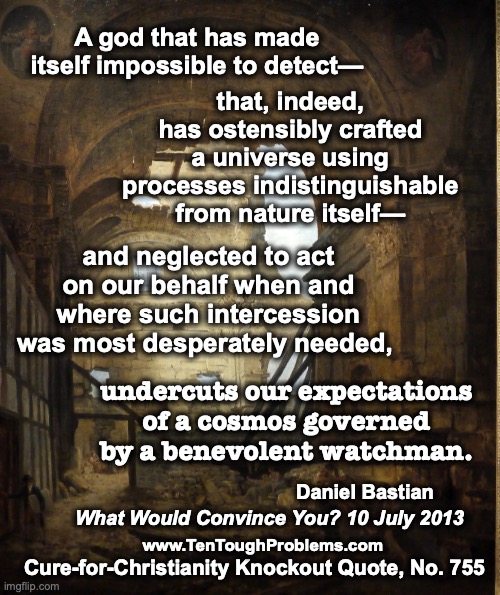
“A god that has made itself impossible to detect—that, indeed, has ostensibly crafted a universe using processes indistinguishable from nature itself—and neglected to act on our behalf when and where such intercession was most desperately needed, undercuts our expectations of a cosmos governed by a benevolent watchman.” 

David Madison was a pastor in the Methodist Church for nine years, and has a PhD in Biblical Studies from Boston University. He is the author of two books, Guessing About God, Volume 1 of Ten Tough Problems in Christian Belief  (2023) and Ten Things Christians Wish Jesus Hadn’t Taught: And Other Reasons to Question His Words (2021). The Spanish translation of this book is also now available. 

His YouTube channel is here. He has written for the Debunking Christianity Blog since 2016.
The Cure-for-Christianity Library©, now with more than 500 titles, is here. A brief video explanation of the Library is here

The Boaz Stranger–Chapter 4

I was in no mood for a salad. After one look, I closed the Styrofoam lid and stuck it in the fridge. Rachel and Gina my teaching assistant for ten years, had conspired against me. Mesclun greens, an assorted mix of lettuce, are high in vitamin A and C. Late this afternoon, I’d asked Gina to order me an Angus Burger from Bella’s. The salad was unrequested.

I returned to the kitchen table and ate my burger. Since Rachel’s death, this had been my Monday night routine: leave my office, walk twenty minutes to Bella’s, pick up my takeout order, and drive home. The twice a day walk was becoming as bad as the Mesclun greens, tomatoes, red onions, olives, and peppers. Gina had made it even worse with that damn balsamic vinaigrette. I made a mental note to set the rabbit food on her desk first thing in the morning.

The Bears were just receiving the Patriot’s opening kick when I sat in my Lazy boy in the den. Like my feelings toward the salad, I wasn’t much in the mood for football, but I knew it was the best sleeping pill I possessed. Like last week, I’d rest here most of the night, turning the TV off when I made my predawn trip to the bathroom.

Nick Foles threw an interception on second down. I liked the 6-foot 6-inch kid, but he was a slow-starter and prone to turn-overs. And he didn’t have Mitch Trubisky’s running and scrambling ability. I muted the sound when a Lumen dating commercial appeared. That seemed an odd choice for the NFL.

A dating APP for those over fifty. It would have been more natural to think of myself, but strangely, my mother-in-law came to mind. It might be because the older woman, jogging, reminded me of a much younger Rosa. My broken promise also came to mind.

Saturday, after exiting Bella’s, I’d promised Rosa I’d take another look for her second most treasured book, after the Bible, of course. I’d spent the balance of Saturday mowing the yard the last time for the year and reviewing several emails from my friend and associate Professor Stallings. Mostly, I’d moped around the house and napped. I spent yesterday at school, prepping for this week’s lectures.

***

I switched off the TV and headed to the basement. My guilt gave me no other choice, even though I’d prefer a very long nap.

The fifteen minutes I spent Saturday morning before meeting Rob and Rosa for breakfast, were the first time I’d made it more than halfway down the stairs since Rachel had killed herself. There were simply too many reminders of my beautiful and brilliant wife.

She had aptly named the twenty-by-twenty-foot space “The Cave,” after we’d moved here mid-summer 2000. By the following January, she’d secured a job at Amity Regional High School and hired the carpenter husband of the school’s secretary. The man, Carlton I believe, had done an excellent job building and installing hundreds of feet of shelving on the four walls inclusive of a built-in desk. A few months later, Rachel had Carlton return and build waist-high cabinets topped with a basic Formica countertop. She naturalized the room by hanging a dozen landscape paintings along the unobstructed paneled walls above the countertops.

Other than a single, chain-pull bulb dangling from the center of the room’s ceiling, the only other light was a three-foot double fluorescent hanging low above her narrow desk and secured by the shelf above. Just like Saturday, I’d brought my flashlight to scan the fully stocked shelves.

After pulling the chain and flipping the fluorescent toggle switch, I sat at Rachel’s desk. Her chair was cloth, maroon-colored, and cheap. It was mobile, with a set of three rollers attached to the base. The seat and back were soft and adjustable. I tried to recall the last time I’d seen her sitting here. I fought sadness and a low rumbling portent of sickness when I recalled it was less than two weeks until the first anniversary of her death. It was the day after Thanksgiving, truly Black Friday. I literally shook my head, refusing to go there.

I rolled her chair back from her desk and switched on my flashlight. I pointed it to three shelves above her desk. Nothing but literature, textbooks and teaching guides, one set for each year she’d taught English at Amity Regional.

I stood, realizing I needed to conduct my search methodically. Each shelf deserved special attention. Before departing Saturday, Rosa had shown me an Amazon photo of Bonhoeffer’s book, including a colorful cover. However, according to Rosa, the book itself was solid gray other than the author’s name and book title on the spine, which were in a light-colored gold. Rosa remembered packing the book and bringing it along while traveling. She thought the cover had gotten torn during a return voyage from China and that she’d kept it tucked inside the book when she’d shipped it to Rachel a few years ago.

My plan was to work from top to bottom, shelf by shelf. I’d start in the far corner at the front of the house. But first, I needed something to stand on. Rachel’s rolling chair would be an accident waiting to happen. My body was stiff enough as it was, even considering my most recent two-mile walk. I made a quick trip upstairs for the stepstool stored in the utility room closet.

The top two shelves contained nothing but works of literature, single and multi-volume. There were works of many famous authors: Jane Austen, William Blake, Geoffrey Chaucer, Charles Dickens, John Donne, and dozens more, all neatly arranged with their spines flushed to the edge of the wood shelves. The stepstool was unnecessary. Thank goodness. With the flashlight, I could easily see the titles, even though they were two feet above my head.

This changed three-quarters of the way down the second shelf. Rachel had stacked the books horizontally, from bottom to top. Some stacks were tightly wedged, leaving at most a hair’s distance from the last one to the underside of the next shelf. But there was a problem. Even though the spine of each book aligned perfectly, Rachel had pushed each row farther back, making it harder to read each stack’s first few books, given the depth of the wooden shelves. I climbed onto the top run of the stepstool and continued using my flashlight. If I heard trickling water, I’d think I was in a cave.

Again, no luck. I conducted my second scan of the seven stacks, seeing only one gray-sided spine, The Mill on the Floss, by George Eliot. It was next to the bottom on the last stack before the ninety-degree turn toward the backyard. I lowered myself to the first step and paused, quickly returning to the top rung. I held my flashlight out as far as I could. There was something beyond the last horizontal stack. It couldn’t be a book, but given my angle, my brain foisted a figurine. Probably one of the Heavenly hosts Rachel collected. The intersection of these two shelves, tucked virtually out of sight, seemed an odd place to feature the harp clad angel. Especially one captured behind a thick bookend that began Rachel’s self-help book collection.

I should have been more careful stepping off the stool. The sole of my right foot slid off the first step. I think I would have fallen if I hadn’t grabbed a bookshelf. Unfortunately, I dropped my flashlight. It broke and was dead the second it hit the floor. I walked upstairs and found an older one in the pantry, but its batteries were too weak to be helpful.

It took fifteen minutes to walk to the garage and extract the portable tripod light-stand from a tangled web of Christmas decorations, ancient sections of gutter, and a rotting, unfolded tarp. I consumed most of this time replacing two halogen bulbs.

The Patriots were up by ten when I passed through the den. I carefully descended the stairs, clumsily tilting the tripod to my left overhanging the basement floor. I don’t know why we never installed an outer handrail.

I plugged in the tripod and focused before climbing onto the stepstool. Removal of the last horizontally stacked literature hardbacks, half-a-dozen self-help paperbacks, and the heavy book end required three round trips down and up the stool. These efforts cleared my way to Michael the Archangel (per the tiny gold label at its base). I was careful to hold the ceramic being in one hand and hold on to the bookcase with my left as I again descended the stepstool. At Rachel’s desk, with the aid of her overhead light, a small key hanging like a backwards necklace around Michael’s neck caught me by surprise.

After removing the tiny key, I tugged on Rachel’s top left drawer. It opened freely. I had always known she kept copies of IEP (Individual Education Plans) for the dozen Special Education students scattered across her roster. She was always serious about each person and their individual learning. The drawer was empty, but I tried the key, anyway. It didn’t fit.

Now, I was curious. I made a quick trip to the utility room upstairs for an extension cord. I moved the tripod to the basement front and focused both lights towards the third shelf. For the first three feet, literature continued. Then there was what appeared to be geography. The upright spine of the first, rather thick book read, “LONDON.” These continued for another two dozen international locations, although two were American cities, Chicago and New York. I adjusted the tripod again and saw that Biographies were next. As far as I could see, each of them was by a famous author, virtually repeating the names of the writers from shelf one and two.

I felt something was odd. But that’s nothing new for me. And most every attorney I suspect. Law school, law practice, and especially law teaching, caused an almost biological gene mutation. The gene for “Distinction.” Or better understood, “Hairsplitting.” I retrieved the stepstool and sat gazing at Rachel’s bookshelves, focusing on the third row from the top, and more particularly the city volumes. After five minutes, I concluded Rachel misfiled them. No wonder lawyers aren’t the life of a party.

However, Rachel was an organizational nut. She was anal about everything: her kitchen, the laundry room, her flower beds, everything school related, not even considering our bedroom closet. For example: clothes categorized by days of the week, and color coordinated. It got worse, the first week of the month, Wednesday’s dominant color was green, second week, red. But everything somehow ignored the garage. She said that was my domain and insisted I keep the roll-ups closed.

There had to be a reason Rachel inserted the city volumes where she had. The only reason had to be a connection between the LIT writers and their domicile, or possibly where they had been born, if different. I moved the stool closer and balanced myself on the second step. I removed LONDON, surprised it wasn’t heavier. My shock came when I saw the small keyhole on the far-right edge of the front cover. LONDON wasn’t really about London, it was a locking book safe, a place where you store (or hide) stuff.

I retreated to Rachel’s desk. The florescent light highlighted the front cover. It was an expert painting of London Bridge, or Tower Bridge, I’m not sure. But after close inspection, one thing was certain, the safe was well crafted and durable.

Of course, I had to try the key. This time it worked. I opened the hinged cover, surprised again. Inside was a slightly smaller book embossed on the soft red cover with “Diary.” I looked inside at the front page. Rachel (I assume) had printed on the From and To lines: “07/01/69 through 12/31/69.” I almost closed the lid and returned LONDON to its third shelf home. Instantly, I recognized the time. It was the final six months she had lived in Boaz, the fall months being our tenth-grade year. I didn’t know for sure, but I believe the 31st was the day Rachel and her family flew from Atlanta to Miami, where they took an ocean liner to Hong Kong.

***

Instead of returning LONDON to its home, I removed the Diary and walked upstairs. After muting the TV, I sat in my Lazy Boy and closed my eyes. Was I really going to jump off this cliff? I couldn’t imagine any narrative that would relieve my pain. After a long minute of pondering, I opened my eyes and turned to page one. My plan was to read a few paragraphs, hoping Rachel’s words were light and happy, simple accountings extracted from her slow-paced days living in the Hunt House with little brother Randy, and a mom and dad who were busy sharing their China adventures with a host of local churches.

Rachel’s first entry was July 3rd. She had printed “World Events,” and underlined it, then listed “1. Prince Charles became Prince of Wales.” And “2. Car crash. John Lennon and Yoko Ono admitted to hospital.”

Then my dear wife started a new section, also underlined, “Local Events.” Other than watching the train and going to Phil’s Pharmacy on Main Street for a cherry-coke float, not much else happened.

Rachel was sporadic in her journal postings. I continued to peruse and saw the same categorization of events on each of her four July entries. The most interesting international event occurred on July 20th: “Neil Armstrong became the first man to walk on the moon. Ray and I watched it on TV at his house.”

I noted she spoke often of a girl named Jane. I didn’t recall such a person. Penciled boldly at the bottom of the July 30th entry was “Miss Ray.”

I kept reading but was growing bored fast. Glancing at the TV, the Bears were making a comeback. I didn’t need the volume to know that. On August 3rd, “Ray returned.” Rachel didn’t say where he’d gone, but took half a page, making a point she could have made in two words. “Missed Ray.” It was hard to say, looking back fifty years, whether it was love or lust that she had longed for.

This was disgusting on several levels, none of which I intended to explore. I hastened my scan. The once or twice week postings were all basically the same; they all concerned either Jane or Ray. I noted an odd word at the end of each entry, “close.” I didn’t have a clue. My first guess was that Rachel was expecting her return to China, that it was close, or was rapidly approaching. By now it was mid-August and school, tenth grade, was in full swing. Nothing interesting was happening on the world stage, but locally Rachel was enjoying Friday night football and times with Ray. “Close.”

Enough. I closed the Diary and set it on the end table. That’s when I noticed what looked like a wooden Popsicle stick two-thirds of the way inside. I couldn’t resist. The bookmark wasn’t a Popsicle stick, it was wider, like those flat wooden object’s doctors used to stick down your throat and ask you to say “ahh.” Written in dark pencil along one side was October 11, 1969. The identically labeled entry started on the left side of the journal. Rachel’s first words, before international news or local events, were, “I’m two months pregnant.”

These four words weren’t really news, but they were. After Rachel’s first suicide attempt 18 months ago, she’d finally confessed to this, and a later abortion. What was news was the details, the context of her entire ordeal. These specifics meant she had gotten pregnant around August 11th, 1969.

I kept reading, assuming I’d happen upon Rachel’s declaration that she had an abortion; it was a fact she and her family had left for China shortly before January 1, 1970. No abortion before their departure would mean the baby would be in its twentieth week. I now wish I’d taken a different tack when Rachel made her confession. Instead of refusing to ask questions—something diametrically opposed to every fiber of my being—I now could kick myself. My next thought was a shocker. Contrary to what I’d assumed, what if Rachel had not had her abortion until after she and her family arrived in Hong Kong? I knew I was correct in concluding that she had simply said, “when I was in the tenth grade, I got pregnant and had an abortion.” Her statement was certainly open to multiple interpretations, especially the time frame.

I fell asleep in my Lazy Boy after reading Rachel’s Thanksgiving weekend entries. There were two, and they were routine. Ray this, Ray that, Jane this and Jane that, half a page about America’s first settlers and their happy meal with the Indians, and finally, a summary of a Walter Cronkite segment: “Betsy Aardsma, 22, student, stabbed and murdered inside the Penn State University library while doing her schoolwork.” Another certainty, Rachel consistently watched the CBS Evening News.

It was 4:45 a.m. when I awoke and had to pee. I made a dash to the bathroom, flipped on the coffeemaker, and returned to the den. I wanted to finish Rachel’s reporting before showering and leaving for the law school.

The first entry since her Thanksgiving accounting brought back a mix of happy and sad memories. She dated it the fifteenth of December and covered two weeks of activities. It was one of Rachel’s longest postings. Friday the twelfth was the Boaz Christmas Parade. During that entire week, freshmen through seniors had built floats. Tenth graders conducted operations from a warehouse across from the Hunt House. I’m pretty sure the property was owned by the Young Supply Company, a hardware and construction materials outfit beside the railroad track. I couldn’t help but recall Kyle Bennett, my closest and best childhood friend. We were both shy and behind-the-scenes type of guys.

If it hadn’t been for the two of us, our Santa with reindeer float would have never materialized. The other students who showed up, other than a girl named Lillian (that’s a different story), were goof-offs and were more interested in flirting and sharing a nightly bottle of Jack Daniels someone had absconded from a parent, than doing any actual work. The float, complete with a high-quality PA system (a loan from First Baptist Church of Christ via Ray Archer’s father), propelled us into a second-place finish.

Kyle and I had attended the parade and watched from the second floor of Fred King’s Clothing Store (Lillian worked there part time and gained access via permission from the owners). As the last high school band and float disappeared, Kyle and I started our return walk to the warehouse. Halfway there, Kyla, my sister, approached and said Mother had ordered us home. “Now.” I think she had somehow caught wind of the drinking and smoking at the warehouse. I argued I had promised to help remove and return the PA system. About that time, Mother, out of the blue, appeared and enforced her order. Kyle told me not to worry, he’d take care of things. That was the last time I ever saw my best friend.

The first three sentences of Rachel’s fourth paragraph literally made me yell in horror and disbelief. “Ray shot and killed Kyle after the three of us dropped the PA system off at the church. Kyle knew too much and was sure to talk. Ray made me hide his father’s pistol at the Hunt House while he disposed of Kyle’s body.”

This had to be a joke. Rachel’s words read so normal, even trite. Her tone did not differ from a description of the turkey and dressing meal she and her family enjoyed Thanksgiving Day.

I was out of time. I laid the Diary on the end table and headed to the master to shower and dress. Professor Stallings and I planned our 7:00 AM meeting a week ago. I made a mental note to unlock and inspect the other book safes when I returned home tonight.

These Christians took preacher Robin D. Bullock seriously. Now they’re screwed.

Here’s the link to this article by Hemant Mehta.

This is the tragic story of what happens when a YouTube ministry becomes real life

HEMANT MEHTA

JUL 21, 2023


One of the reasons websites like Right Wing Watch track the deranged statements of certain Christian preachers is because those comments often have real world consequences.

When someone like hate-preacher Greg Locke falsely claims children with autism actually suffer from demon possession, for example, he’s not just some fringe pastor saying something virtually no one will hear. He’s a preacher with a large online following and plenty of connections to prominent Republicans saying something that could impact his followers’ lives in a bad way.

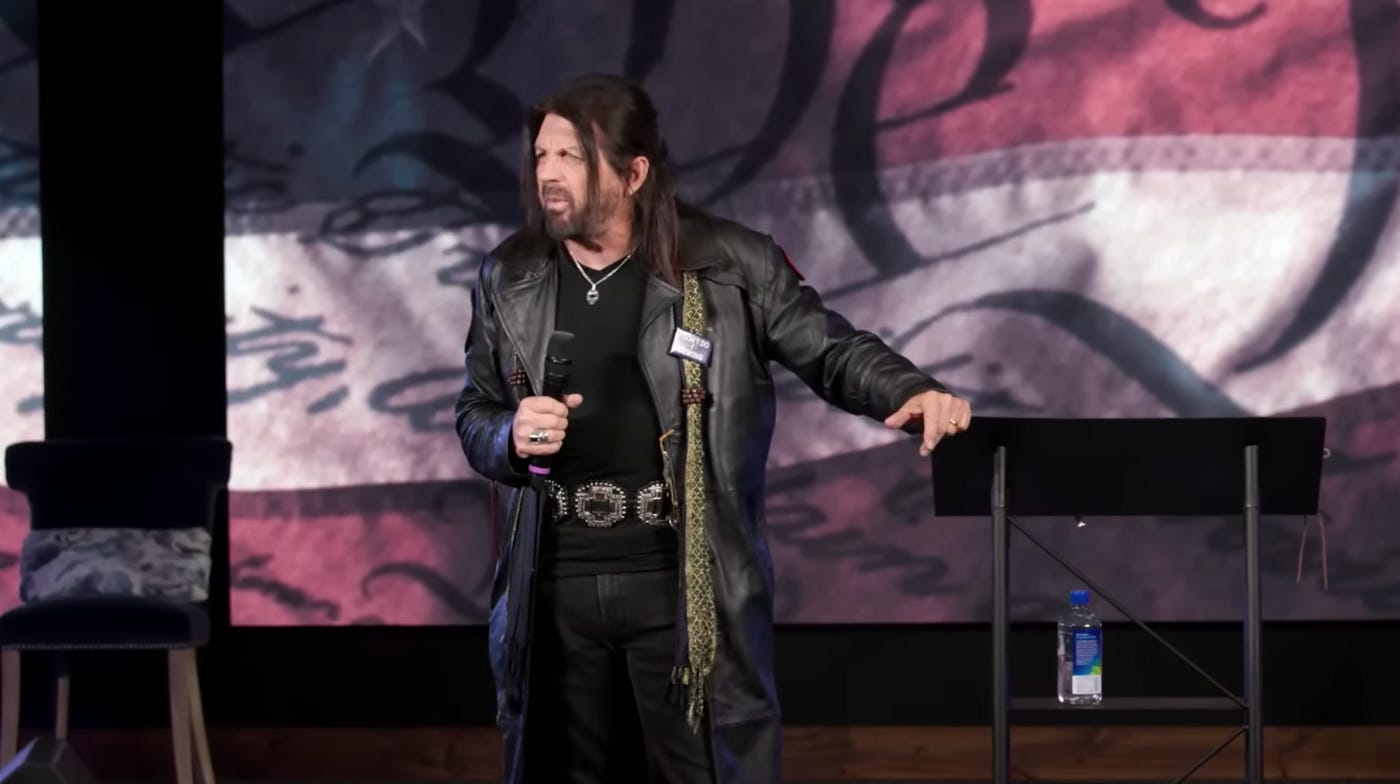
Robin D. Bullock is another one of those right-wing preachers whose clips evoke more laughter than fear. He’s claimed, among other things, that he saw a dinosaur in Heaven, that Jesus had five houses, and that God lives inside a cube of gelatin.

Preacher Robin D. Bullock, wearing his usual church clothes (screenshot via YouTube)

His leather jacket and wig-like long hair and faux rock-star vibes don’t help his credibility.

But Bullock makes plenty of political and theological statements, too, from his perch at Church International in Warrior, Alabama. So when he spreads conspiracy theories about President Joe Biden and COVID vaccines, and says God wants people to join his church, that message actually gets through to people who watch his services online.

Reporter Lee Hedgepeth recently published a truly disturbing article about one Ohio family—Jacob and Tammy Partlow and their two children—that literally sold their house to move closer to Bullock and his Alabama church. They discovered rather quickly, however, that Bullock functions as more of a cult leader who puts himself above God rather than a preacher who can convey biblical messages in an effective way. Once Bullock realized they weren’t interested in worshiping him, he effectively shunned the family, leaving them with nothing to show for their faith.

Now, the Partlows have found themselves rising to challenges made all the more difficult by their experience with the Warrior church. The family, which had been able to make ends meet in Ohio, has found it hard to get by in Alabama, a state whose social safety net has holes so large it’s easy to fall through. Tammy, for example, found out she suffers from multiple sclerosis (MS), a degenerative disease that has already made it difficult for her to walk. And the diagnosis, she said, has become a financial albatross in a state that has refused to expand Medicaid for low-income Alabamians.

The Partlows had stepped out in faith, they told Tread. Now, they’re struggling for food.

The Partlows, we’re told, saw Bullock’s services on YouTube and became hooked. They quickly became donors, giving the church “hundreds and hundreds and hundreds and hundreds of dollars.”

During a recent trip to Florida, they stopped by the church and met Bullock, who told them God wanted them to move to Warrior. So they did. They began attending services in person. That’s when they realized Bullock wasn’t just preaching the Bible.

Bullock would sometimes go on tangents the family felt didn’t have any Biblical basis, for one — “prophetic” visions, he would often explain.

And sometimes, the family said, Bullocks’ long-winded, winding sermons would devolve into diatribes of paranoia and hate.

That’s what happened during the Sunday service that would ultimately lead to the end of the family’s relationship with Church International.

Being in the room that day, Jacob said, it quickly became clear that Bullock has an obsession with power.

“He wants to be completely in control,” he said. “That’s obvious.”

When Bullock later claimed people were trying to divide his church, the Partlows felt he was speaking directly to (and about) them. They needed to get out. But where would they go? They gave up their Ohio home and are now living in a rural part of a red state that’s not about to assist with the family’s medical issues.

(Incidentally, Greg Locke pulled the same trick, accusing some members of his church of being “witches” and threatening to out them if they didn’t leave his church.)

“Robin Bullock caused me to come here and lose everything,” Tammy Partlow told Tread. “I don’t even know if I have enough gas money to get home. I don’t even have money to buy food. And before I moved here, I was okay.”

It’s such a depressing story. It’s not an isolated one either. In fact, Hedgepeth also reported on another woman who moved to Warrior a couple of months ago… only to find herself on the outs with Bullock. 82-year-old Janet Ndegwa moved to Alabama from Pomona, California all because she felt God was calling her to do that. Bullock literally urged viewers to do that in a sermon.

But when she arrived at Church International earlier this week, Ndegwa did not find the open arms she’d expected. Instead, as the sun set over Warrior, the 82-year-old curled up under a street lamp in front of the church with only the concrete to comfort her.

Thankfully, Warrior’s police chief made sure she had shelter when the temperatures dropped to below freezing. Because she wasn’t going anywhere on her own, the cop threatened to arrest her in order to get her to go indoors instead of staying in the church’s parking lot. (To their credit, Bullock and his wife offered to put Ndegwa up in a hotel, but she refused.)

The biggest concern, though, is that Bullock urged viewers to pack up and move and join his church with no plan in place to help anyone who took him seriously. A 911 dispatcher that Hedgepeth spoke to said there were six or seven people who slept outside the church in a similar way; sometimes it was the church itself calling police to take care of the situation.

If that’s the case, it suggests Bullock will make all kinds of prophetic declarations with no regard for people who actually listen to him. Instead of restraining himself from saying those things, he just continues doing it, because that’s what it takes to get views and keep the money rolling in. (Enough money to purchase more and more property in the area.)

Preachers like Bullock say increasingly outlandish things because it brings in the views, which brings in the money, but the consequence of having a YouTube ministry is that some people want to make it their in-person church home. Instead of welcoming those people, Bullock is treating at least some of them like agents of Satan eager to cause harm.

He’s leaving the people who trust him behind while continuing to elevate himself.


07/21/23 Biking & Listening

Biking is something else I both love and hate. It takes a lot of effort but does provide good exercise and most days over an hour to listen to a good book or podcast. I especially like having ridden.

Here’s my bike, a Rockhopper by Specialized. I purchased it November 2021 from Venture Out in Guntersville; Mike is top notch! So is the bike, and the ‘old’ man seat I salvaged from an old Walmart bike.

Here’s a link to today’s bike ride.


Something to consider if you’re not already cycling.

I encourage you to start riding a bike, no matter your age. Check out these groups:

Cycling for those aged 70+(opens in a new tab)

Solitary Cycling(opens in a new tab)

Remember,

Photo by Suzy Hazelwood on Pexels.com

I listened to Sean Carroll’s Mindscape podcast


Here’s a few photos from along my pistol route:

Asking for EVIDENCE for God: Why Is that So Hard to Grasp?

Here’s the link to this article.

By David Madison at 7/07/2023

Sentiments about Jesus do not qualify

According to the devout, evidence for their god is so obvious, “I feel Jesus in my heart!” “Just open the Bible, it’s right there.” “People all over the world have seen visions of the Virgin Mary.” “Every day I receive guidance from my god in prayer.” “The holy spirit fills me with joy during Sunday worship.” 

Please note these claims are usually made by people who have been groomed from a very young age to accept what they’re been told by preachers and priests. Or maybe they converted to Christianity as adults—which is no surprise, since the marketing of Jesus is a multi-billion-dollar business. There are thousands of churches ready to welcome converts into their grooming communities.

It doesn’t take much thought to see the doubtful quality of these pretend examples of evidence. Devout Jews and Muslims, for example, don’t feel Jesus in their hearts—they were trained much differently. Nor do devout Jews or Muslims see much evidence for god in the New Testament—it fails utterly as their scripture. It’s very common for Protestants to ridicule the very idea of the Virgin Mary showing up around the world: all those visions are obviously Catholic delusions. Devout theists of so many varieties receive very different “guidance” during their prayer experiences; for example, on any major social issue, theists will tell us their god has offered conflicting advice. And the joy derived from worship services? That especially is derived from years of careful grooming and conditioning. 

So what’s going on here? Theists themselves deny/doubt the “evidence” that other theists brag about! In fact, there is scandalous disagreement about god among the world’s most devout, fervent theists—because they’re not using valid data in depicting their god. Full Stop: when we ask for evidence for god(s), we want to see reliable, verifiable, objective evidence. Sentiments about Jesus, confidence in the Bible, visions, prayers, worship emotion simply do not qualify.  

Reliance on the Bible is especially misplaced. In an article published here on 30 June, What Would Convince Us Christianity Is True?, John Loftus asks readers to consider the problems historians face when they evaluate Matthew’s account of the Virgin Birth. Here’s what we read in Matthew 1:18-20:

“When his mother Mary had been engaged to Joseph, but before they lived together, she was found to be pregnant from the Holy Spirit. Her husband Joseph, being a righteous man and unwilling to expose her to public disgrace, planned to divorce her quietly. But just when he had resolved to do this, an angel of the Lord appeared to him in a dream and said, ‘Joseph, son of David, do not be afraid to take Mary as your wife, for the child conceived in her is from the Holy Spirit.’” 

How would the author of Matthew’s gospel—writing perhaps eighty years after the conception of Jesus—know any of this information? What were his sources? Historians look for contemporaneous documentation, i.e., records that were made very close to the time of events described. My question has always been: did Joseph keep a diary—in which he wrote about his dreams—and, if so, how could Matthew have accessed such a diary? It’s much more likely that Matthew belonged to a community of Jesus believers in which this tale had been handed down for a couple of generations. Loftus correctly calls this “2nd 3rd 4th 5th handed down testimony.” And this is crucial, as Loftus points out: 

“Christian believers are faced with a serious dilemma. If this is the kind of research that went into writing the Gospel of Matthew—by taking Mary’s word and Joseph’s dream as evidence—then we shouldn’t believe anything else we find in that Gospel without corroborating objective evidence. The lack of evidence for Mary’s story speaks directly to the credibility of the Gospel narrative as a whole.”

Moreover, dreams fail utterly as reliable, verifiable evidence. Loftus quotes the skepticism voiced by Thomas Hobbs (1588-1679): “For a man to say God hath spoken to him in a Dream, is no more than to say he dreamed that God spake to him; which is not of force to win belief from any man.”

It’s also just a fact that the virgin birth of Jesus is a minority opinion in the New Testament. It’s not found in Mark’s gospel, and the author of John’s gospel probably saw no need for it whatever. His Jesus had been present at creation, so his divine status was beyond reproach. Nor do we find virgin birth mentioned in the epistles. Would it have meant anything at all to the apostle Paul, for whom the resurrection was essential event? 

Since virgin birth—that is, a woman impregnated by a god—was a common theme in myths about heroes in the ancient world, we can suspect that Matthew and Luke thought that virgin birth would give a boost to their hero. 

No matter where we turn in the gospels, we run into the lack of contemporaneous documentation, a missing element that doesn’t seem to bother lay people at all: they’ve been trained not to evaluate the gospels critically, skeptically. Question everything is not what they’ve been taught. The clergy know very well there’s too much danger in that approach. 

Loftus forcefully drives home the point:

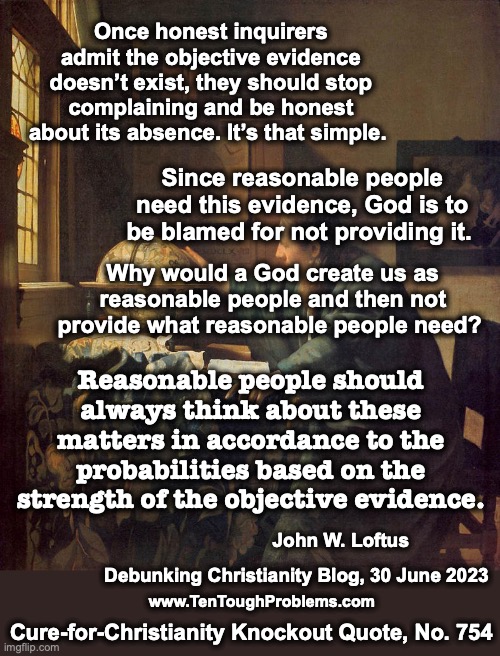
“Once honest inquirers admit the objective evidence doesn’t exist, they should stop complaining and be honest about its absence. It’s that simple. Since reasonable people need this evidence, God is to be blamed for not providing it. Why would a God create us as reasonable people and then not provide what reasonable people need? Reasonable people should always think about these matters in accordance to the probabilities based on the strength of the objective evidence.” 

Loftus also provides a link in this article to one he wrote in 2017, What Would Convince Atheists to Become Christians: Four Definitive Links! Here he calls believers to account for not believing in gods other than their own, for example Allah or the ancient Jewish god, Adonai—precisely because there’s no evidence for them. Years ago, in conversation with a Catholic friend, he protested that he wasn’t an atheist. I pointed out that he indeed was. Did he believe in Neptune or Poseidon, gods of seas? No, he had been groomed to believe in Yahweh—although Christianity has abandoned that name for the god of the Bible.  

On top of this huge embarrassment—that verifiable, reliable, objective evidence is missing—there have been so many tragic events that reduce the probability of a caring, powerful god to zero, as Loftus notes:

“God could’ve stopped the underwater earthquake that caused the 2004 Indian Ocean tsunami before it happened, thus saving a quarter of a million lives. Then, with a perpetual miracle God could’ve kept it from ever happening in the future. If God did this, none of us would ever know that he did. Yet he didn’t do it. Since there are millions of clear instances like this one, where a theistic God didn’t alleviate horrendous suffering even though he could do so without being detected, we can reasonably conclude that a God who hides himself doesn’t exist. If nothing else, a God who doesn’t do anything about the most horrendous cases of suffering doesn’t do anything about the lesser cases of suffering either, or involve himself in our lives.

Devout believers may be absolutely sure that their god involves himself in their lives, but without reliable, verifiable, objective evidence that this is the case, we are entitled to suspect pathetic wishful thinking. And some of the devout who get hit hard by life may come to doubt it themselves. Seventy-nine years ago, 462 women and children were murdered in a church in the village Oradour-sur-Glane in rural France, causing major slippage in belief in a good, caring god. Such a horror just didn’t make sense in the context of Christian theology.  

The wars of the last century totally destroy god-is-good theology. Tens of millions of people were killed—on the battlefields and in cities that were heavily bombed during the Second World War, e.g., the blitz in England, the fire-bombing of Dresden, the atomic bombs dropped on Hiroshima and Nagasaki. In December 1941, 50,000 people starved to death during the siege of Leningrad, six million people were murdered in the Holocaust, one of the most thoroughly documented crimes in

human history. How does god-is-good theology survive? Primarily, I suppose, because the devout aren’t supposed to think about these events—nor are they asked to consider the devastating implications. 

In his 2017 essay, Loftus provided the link to an essay by Daniel Bastian, What Would Convince You? Loftus describes this “as the most comprehensive list of answers I’ve found”—that is, reasons for giving up god-belief. Bastian’s essay is indeed worth careful study and reflection. Just a couple of excerpts: 

“In a world where Christians and other monotheists profess belief in a meddler god who influenced ancient texts, answers prayers, appoints semi-sane politicians to run for office, and worked all manner of miracles throughout history, the utter vacuum of evidence for such assertions begins to speak volumes.”

“…given the extraordinary claims made on its behalf, the Bible should exhibit an ethical blueprint that transcends the rate of cultural evolution observed across history. Yet on issues such as slavery, the status of women, penalties for various innocuous (and imaginary) crimes, and the treatment of unbelievers, the biblical texts are found to be par for the Bronze Age course.” 

Bastian also takes aim at the weaknesses of the gospels, i.e., their failure to provide credible information about Jesus. Why couldn’t a competent god have done better?  

As a preface to his presentation of twenty realities that undermine theism, Bastian notes: “My personal view is that a wider appreciation of reality reveals a universe that does not appear the way we would expect if theism were true, leaving non-belief as a supremely rational position to hold.”

The impact of all twenty is devastating, or as Loftus puts it: “Read ’em and weep Christians. Ya got nothing. You’ll have to whine about something else from now on.”  

What do Christians claim as the One True Faith? That their god required a human sacrifice to enable him to forgive sin, and that magic potions play a role in winning eternal life, i.e., eating the flesh of the human sacrifice and drinking his blood (see John 6:53-56). How crazy can you get? Loftus quotes anthropology professor James T. Houk, “Virtually anything and everything, no matter how absurd, inane, or ridiculous, has been believed or claimed to be true at one time or another by somebody, somewhere in the name of faith.”   

Loftus’ parting shot: “This is exactly what we find when Christians believe on less than sufficient objective evidence.” 

David Madison was a pastor in the Methodist Church for nine years, and has a PhD in Biblical Studies from Boston University. He is the author of two books, Ten Tough Problems in Christian Thought and Belief: a Minister-Turned-Atheist Shows Why You Should Ditch the Faith, (2016; 2018 Foreword by John Loftus)now being reissued in a new series titled, Ten Tough Problems in Christian Belief, Book 1: Guessing About Godand Ten Things Christians Wish Jesus Hadn’t Taught: And Other Reasons to Question His Words (2021). The Spanish translation of this book is also now available. 

His YouTube channel is here. He has written for the Debunking Christianity Blog since 2016.

The Cure-for-Christianity Library©, now with more than 500 titles, is here. A brief video explanation of the Library is here

The Boaz Stranger–Chapter 3

Inside her bathroom, upstairs, Lillian removed the sales tag from a new jogging suit. She laughed to herself, returning the scissors to the top drawer, and stealing a quick glance in the large mirror above the vanity. “Oh boy, I needed that,” she whispered to herself. “Aging is a bitch.” She was naked other than a bikini bra and panties. Stepping into her sweatpants, she moved closer to the mirror. Gone were the firm boobs and abs. Gone was her curvaceous figure of long ago. Even her bright blue eyes were growing darker, sadder. “I need to jog for sure, maybe begin with a daily walk down Skyhaven Drive. Sixty-six is not too late for some radical change.” Again, whispering aloud, then standing mum. She imagined it would take weeks before she could jog back to the Lodge from the foot of the Drive. Hate was the only word she could think of to describe how she felt about the Lodge and Skyhaven.

After dressing, she combed her silky brown hair (Camilla, her hairdresser, hid the gray) and heard the front door chime. Ray’s voice thundered and floated upwards throughout the great room and its twenty-four feet ceiling. It also slithered through the opened bathroom door. “Let’s have a drink.” She knew he had been at Attorney Wright’s office all day with the real estate closings, even though it wasn’t necessary. Archer, Inc. was leasing the property from the City. 

But she didn’t want a drink. She’d rather, well, what? Take a jog? A walk would be more practical. Anything except playing happy with Ray. A second before announcing her declination, Lillian heard a second voice.

“How about some bourbon? We deserve an entire bottle.” It had to be Mayor King. He, like Ray, had spent all day in Guntersville, just to make sure none of the property owners got cold feet. They hadn’t. All had gone as planned. Attorney Wright had even said he was certain Judge Broadside would grant the City’s motion. Clearing the way to acquire the Hunt House.

“Jack and Coke, okay?” Ray’s favorite. Lillian eased to the bathroom door. If he stayed downstairs, he couldn’t see her. She wondered if he knew she was home. But how could he? An hour ago, she had dropped off her Lincoln Aviator at Alexander Ford for service and to investigate that strange grinding noise when she braked. Kyla, her friend, had driven her home and had left only a few minutes ago, after coming inside to borrow Lillian’s copy of Grisham’s new book.

“Where’s Lillian?” Ted didn’t care for Ray’s wife, but he certainly cared about privacy.

“She must still be with Kyla. She’s not here. Her car wasn’t in the driveway or garage.” Ray said from the bar, ice cubes clattering.

“Is she liking this place any better?” Ray had shared Lillian’s dissatisfaction over their move six months ago from their home in Country Club. He knew it was the Lodge’s history. Two years ago, local entrepreneur and City council member Wiley Jones was murdered upstairs inside his study. Lillian was standing less than twenty-five feet from where it happened. A door on the other side of her bathroom led inside a walk-in closet and on to another door and secret room, one Mr. Jones had used as a private office. His wife, Linda, had found him tied to his desk chair, his brains everywhere.

“Not really. I’m hoping the renovation of Wiley’s hideaway will solve the problem.” It will, Lillian thought, anything to have her own space: large bath and bedroom with private balcony, and the huge hideaway where she could read and scribble. And anything to avoid sleeping with Ray in the giant master bedroom downstairs.

Lillian eased through the bathroom door onto the landing. She peeked over the railing and saw Ray sitting in his favorite chair with Ted standing, backed up to the dormant fireplace. She quickly retreated when she imagined Ted’s eyes looking straight at her.

“We still set to sign on the fifteenth?” Ted was excited. Ray’s in-progress development was the City’s fifth major project since he’d become mayor in 2016. Old Mill Park, the new recreational center, the downtown renovation, and the high school’s Fine Arts Center were the other four (although the school board was due more credit for the latter). Once completed, Ray’s development, Rylan’s, with its thirty retail stores, would be the most expensive investment in Boaz since the outlets in the late 80s.

“Probably. My attorney’s reviewing the lease agreement. He says it’s imperative we wait until the city acquires the Hunt House. None of my cajoling has changed his mind.” The attorney wasn’t the only holdout. Ray himself had no interest in going forward unless he controlled the entire block.

“That’s nearly two weeks. Rob will sign the deed. He’ll have no choice.”

“You’re assuming the Judge will get on board.”

“I don’t think he has a choice either. I assume you’ve been reading the community anger from the Reporter’s article. Lillian had read every letter to the editor and Facebook comment since last Thursday’s newspaper. She was angry the Sand Mountain Reporter had been so open about Rob and Rosa’s opposition. Many online commenters expressed their thoughts with vitriolic terms: “the Kern’s don’t love Boaz”; “they are greedy”, and on and on with the same negative theme. But Lillian knew the true reason Rob was so adamant, even if every other citizen except Ray didn’t have a clue. Now that Ray’s mother was dead, the group who knew about Ray and Rachel’s pregnancy and abortion grew even smaller: Ray, his semi-senile father, Rob and Rosa, and possibly Lee. But he was just a guess. The group’s remaining member was herself, but that was her secret.

For the next several minutes, Ted responded to Ray’s question concerning additional parking. The mayor was confident the city would find the funding needed to acquire the block due west of Rylan’s. The deteriorating property contained one abandoned residence and three buildings whose glory had long passed. Built in the mid-fifties, Cox Chevrolet, and Jack Oliver Ford had once been the heartbeat of North Main Street. Now, the crumbling buildings barely survived. The old Ford place was now a warehouse of sorts, mostly junk. A Hispanic church and a Mexican restaurant leased the two Cox buildings from an out-of-town great-granddaughter. Making the City more ‘American,’ as Ted described it, had been a vibrant but unspoken goal of the four-year mayor.

Lillian got bored and retreated inside the bath. She lowered the commode lid and sat. She could still hear voices but was free of words. The two egoists were reviling for many reasons, least of which was their hypocrisy. She wasted thoughts comparing the Sunday Ray with the every-other-day Ray. Chairman of Deacons and Men’s Sunday School teacher at First Baptist Church of Christ. That’s Sunday Ray. Chasing women and money was the every-other-day Ray.

Finally, a Crimson Tide ring tone erupted. It had to be Ted’s cell. Ray normally set his to vibrate. Another minute, more voices, and the front door chime. Lillian rose and walked to the landing. Both men were walking outside. This was her chance. She hurried down the winding staircase, across the great room, and out the back door. A few seconds later, she descended eight steps, turned left to the patio and outdoor kitchen, and sat in a chaise lounge.

***

Lillian dialed Kyla, but the call went to voice mail. Before the Facebook APP opened, Ray descended the back porch stairs.

“I didn’t know you were here.”

“Kyla dropped me off. I came here to read and enjoy the view.” Lillian kept a novel or two in a bottom cabinet next to the char grill. The Lodge, constructed of cypress wood, river rock, and glass, sat perched atop the highest point in the county, just beyond the dead end of Skyhaven Drive. The valley below was all forest. It had been a brilliant fall. Red, yellow, brown, and orange still glowed, even glistened, for miles and miles.

“I’ll grill some steaks.” Ray said, walking to the refrigerator, satisfied with Lillian’s response. 

“Sounds good. I’m hungry. If it’s okay, let’s eat inside. I’m freezing.” It was early November and one week into daylight savings time. It would be dark in twenty minutes.

Lillian’s cell beeped with a text notification. “I’m putting up groceries. Will call in a few. I hate Walmart.” Kyla had seen the missed call. 

“Wait thirty minutes. I’m about to eat dinner. With Ray.” Lillian responded, regretting not having her car, but resigning herself to an evening spent upstairs, talking with her childhood friend.

Kyla Harding was Lee’s younger sister. By one year. Lillian and Kyla had been virtually inseparable until she went away to college and a career in marketing. Six weeks ago, the Coca Cola corporation executive retired and returned to Boaz, to Kyla and Lee’s home place. It had been a tough decision for the never-married Kyla. Not that she didn’t love the cozy farmhouse, barn, and pond centered on forty acres off McVille Road. It was the death of her and Lee’s parents that haunted her. No one, especially an eighty-five-year-old couple, should die in a car wreck.

“You want a salad?” One good thing about Ray was his cooking skills. He fashioned himself a chef. The Lodge’s outdoor kitchen was another reason he’d bought the Lodge. It provided a powerful daily temptation. The kitchen’s semi-circle design displayed a combination of cypress cabinets and ten stainless appliances: two stoves, three grills, an offset smoker, a warming cabinet, a double-door refrigerator, a single door freezer, and a custom designed ten-foot steam table. The lone non-stainless grill was a Blackstone. This eccentric home setup had always motivated Ray to keep a generous supply of pork, beef, chicken, fish, and lamb either fresh or frozen. When he was in town, he grilled something every day, some days he even cooked breakfast on the Blackstone.

“Caesar’s. With Vinaigrette.” Ray nodded his head and turned his attention back to the steaks. The days were long gone when she would have gotten up and walked over and wrapped her arms around the tall and dark-haired man with muscular arms and ribbed abs. Now, it wasn’t just the extra pounds and semi-bent back (post, 2 surgeries). It was the barren desert that lay between them. Lillian pushed aside memories of Ray’s multiple affairs and her own midnight investigations.

Inside, after the rib-eye and salad, and a painfully slow glass of white wine, Lillian excused herself to read and walked upstairs. If she had to hear more about the Rylan’s chain, she would puke.

Lillian lay across her bed, opened The Pelican Brief, and adjusted her reading lamp. It was John Grisham’s third novel, first published in 1994. Darby Shaw was an amazing woman, albeit wholly fictional. Three weeks ago, Lillian had started re-reading her favorite author’s novels. She had already read A Time to Kill and The Partner. It would take her months before she’d need A Time for Mercy, the latest novel she’d loaned Kyla.

It was almost seven-thirty before her cell vibrated. “Hey girl, thought you’d forgot to call.” Lillian laid Pelican aside and stood. The jogging suit was hot. She walked to the doorway and flipped on the ceiling fan.

“Sorry, the goat man came. I thought he was coming tomorrow. He was half-drunk, but I love my Nubians.” 

“What?” Lillian wasn’t a farm girl and didn’t understand or appreciate Kyla’s interest in country life. She’d spent forty-plus years in a Buckhead suburb.

“That’s the breed. Anglo-Nubian.”

“How many did you buy?” 

“Five. Four females, all pregnant, and one male. They’re beautiful and adorable. Like pets.”

“What color?”

“The male is mostly black. One female is solid brown. The others are a mix of brown and white spots. They all have pendulous ears.” Lillian didn’t ask.

“And you’re really going to milk them?” Lillian remembered visiting Kyla’s home and farm during their high school days. Then, Kyla was naturally smart but country, an outdoor, tom-boyish girl with a distinctive southern twang. Now, and most all her years since college in Atlanta, she was cultured, exuding confidence with her coherent speech, anything but a slow drawl.

“And make cheese.” The sounds that followed Kyla’s statement had to be the bleating of goats.

“You still outside?”

“I’m headed in. I’m leaving them in the barn’s hallway. You should come see them tomorrow when I let them out to pasture.”

“Don’t forget, I’m hoofing it. I’ll be climbing the walls by Friday, assuming my car’s ready by then.”

“I can come get you. Oh, this’ll pick you up. Guess who I talked to?”

“George Clooney? Did you give him my number?”

“Ha. Not George, but the next best thing. For you that is.”

“And who would that be?”

“My brother.” Kyla had always thought Lillian and Lee would get back together. They had dated in the eleventh grade and gone steady throughout their senior year. The bust-up had occurred during Lillian’s freshman year in Tuscaloosa at the University of Alabama. Ray Archer had swooped in and snatched her up, promising a leisure life with travel, money, and none of the headaches of working. It had been the hardest thing she’d ever done, calling Lee at the University of Virginia and giving him the news. Looking back, it was the worst decision Lillian had ever made.

“Is he retiring? Coming to see you?” Lillian crossed the room and opened the sliding door to the balcony. She needed some cool air. The moon cast its soft light across the narrow porch. She took three steps and looked skyward. The full moon was so close she could touch it, so she imagined.

“Don’t you wish?” Kyla and Lillian shared every secret, well, almost everyone. For sure, through the years, Kyla had listened to her best friend, as her marriage crumbled. To start, the sex had been passionate and frequent, but without intimacy, it was only a quick thrill. Kyla knew Lillian had stayed for the money, not the love. Anyway, what would she do now? She had never worked a day in her life, although there had been that tenth grade Christmas job at Fred King’s, a clothing store in downtown Boaz.

“Is he any better?” Kyla had shared how devastated Lee was over Rachel’s suicide, that he was seeing a counselor, and spending most of his time teaching, advising students, and researching. Except for Saturdays, he was rarely at home.

“Maybe a little. I’m hopeful. He called to ask if Rachel had loaned me a book, one by Dietrich Bonhoeffer. You know, the Lutheran preacher who the Nazi’s hanged during World War II.”

“I think there’s a copy in the church library, but I’ve never read it.”

“No surprise there. I’m hoping this is a sign Lee is rekindling his love for Jesus. His searching for this book is encouraging.”

“It’s probably not what you think. I doubt he’d change his mind. Lee’s too smart.” Lillian remembered her and Lee’s high school conversations, and his surprise she believed the Jesus story.

“Oh, please. Let’s not go there.”

“Alright but tell me when Lee’s going to pay you a visit.” Lillian’s mind was flying at warp speed, trying to figure out a believable way for her to pop in after Lee arrived.

“I don’t see that happening. You know he hasn’t been to Boaz since 2002, our thirty-year class reunion.” Even though Kyla was a year younger than Lee, they were in the same grade. She academically had been smarter than the very smart Lee, skipping third grade to join her brother, Lillian, Rachel, and a hundred others in the class that would change the world. Or so Mrs. Sims, the high school counselor, had claimed.

 Kyla and Lillian talked and giggled another forty-five minutes before Ray pecked on her closed bedroom door. “I’ve got to go out. Do you need anything?” Lillian stood and semi-panicked, remembering she’d flipped the lock. She knew he’d be mad if he tried the doorknob. Even after their agreement, he was always in the mood. Charming, he thought. 

“No, I’m good. You be careful,” she said as she slowly unlocked and pulled open the door. Ray’s aftershave wafted inside the bedroom, drawn by the draft from the balcony. “I’m talking with Kyla.” Lillian whispered and pointed to her upheld iPhone.

Ray gave her that curled lip of a smile and delivered his usual salutation as he descended the stairs. “Don’t wait up for me.” 

A smart-ass remark almost followed. Lillian kept it to herself. She had wanted to say, “Tell Karen, or Cindy, or Brenda, whoever she is, that she can have you.”

Lillian closed her door and returned to the balcony. And Kyla’s patient ears.

07/20/23 Biking & Listening

Biking is something else I both love and hate. It takes a lot of effort but does provide good exercise and most days over an hour to listen to a good book or podcast. I especially like having ridden.

Here’s my bike, a Rockhopper by Specialized. I purchased it November 2021 from Venture Out in Guntersville; Mike is top notch! So is the bike, and the ‘old’ man seat I salvaged from an old Walmart bike.

Here’s a link to today’s bike ride.


Something to consider if you’re not already cycling.

I encourage you to start riding a bike, no matter your age. Check out these groups:

Cycling for those aged 70+(opens in a new tab)

Solitary Cycling(opens in a new tab)

Remember,

Photo by Suzy Hazelwood on Pexels.com

I listened to The Origins Podcast with Lawrence Krauss


Here’s a few photos from along my pistol route:

Q&A on the Nature of Miracles and Evidence

Here’s the link to this article.


What’s a miracle, and how would we know if we found one?


Here’s my submission to John Loftus’ call for responses to a Q&A in an upcoming Christian documentary on miracles and the evidence thereof. What follows is probably not sound-bitey enough to be used, but I was on a roll and couldn’t stop. Do take note of (7), as it draws from personal experience growing up as a fundamentalist Christian.

(1) Why do you believe I should not believe in God?

You’re welcome to believe whatever you want, and in any god of your choosing. But whatever you believe should be preceded by honest engagement with the evidence, defensible by way of rational argument, and continually challenged and interrogated in the form of skeptical inquiry. That last bit is critical. After all, if your beliefs can’t stand up to scrutiny, the scrutiny is not the problem. And regularly having to explain away inconvenient evidence is a good sign that your beliefs are ready for revision. Such insights can and should be exported far beyond the matter of belief in God.

(2) What’s a miracle?

This is less a historical or scientific question than a philosophical or metaphysical question. How to approach miracles and the supernatural in a formal sense remains a methodological challenge upon which none of us wholly agree. One commonly given definition of a ‘miracle’ is that it is a suspension of the natural order or the known laws of physics, often attributed to supernatural as opposed to natural agencies. This definition places the referent outside historical and scientific methods.

For example, the question of whether Jesus was born of a virgin, walked on water, and raised bodily from the dead; whether the angel Moroni appeared before Joseph Smith; whether the prophet Muhammad split the moon in two and ascended to heaven on a winged horse — conventionally these aren’t questions that either historians or scientists are methodologically equipped to answer. Rather, these are theological questions with philosophical underpinnings that go beyond what the historian can attest.

The reasons being that (1) these disciplines lack the critical methods to resolve questions of metaphysical complexity and (2) such questions imply certain realities that run counter to the factual uniformity of nature and our current rational scientific understanding. While we hang a question mark over miracle claims of the past, we do acknowledge the presence of theological elements and incorporate how beliefs about the supernatural operated within their historical context. That is, we can still attest to how common such beliefs were at the time, what effects they had on society and the surrounding culture, and how those effects informed, set the stage for, and enabled us to make better sense of later events, without rendering a verdict on individual theological perspectives.

The important point is that answers to questions about the supernatural cannot rest on historical or scientific evidence alone. As Dr. James Tabor writes:
 

“As far as the subjects of the miraculous and the supernatural, historians of religions remain observers. The fact is we do not exclude religious experience in investigating the past–far from it. We actually embrace it most readily. What people believe or claim to have experienced becomes a vital part of our evidence…Historians likewise deal with “beliefs” about the afterlife and the unseen world beyond, but without asserting the historical reality of these notions or realms. We can evaluate what people claimed, what they believed, what they reported, and that all becomes part of the data, but to then say, “A miracle happened” or this or that “prophet” was truly hearing from God, as opposed to another who was utterly false prophecy, goes beyond our accessible methods.”

(3) What is knowledge?

Another philosophical question with few convergent answers. One definition which gained steam during the Enlightenment, and may date as far back as Plato, is this notion of ‘justified true belief’. This formulation calls for a belief to be true insofar as one’s belief that it is true is justified, either by evidence, argument or otherwise.

I will typically simplify things by saying that one’s claim to knowledge is justified provided it adheres to one or more basic standards of intellectual honesty: namely that we proportion our beliefs to the evidence and adjust our conclusions to the strength of that evidence. Echoing the late philosopher John Dewey, the idea is not to invoke beliefs we merely wish to be true, or latch onto any compelling or fanciful notion that comes our way, but rather to withhold judgment until justifying reasons are found.

(4) Under what circumstances would it be rational to believe a healing miracle occurred? When would it not be rational?

The latter question is easier than the former. It would not be rational to accept claims of healing miracles for which perfectly reasonable natural explanations are readily available. For example, appealing to supernatural agency to explain the recovery of a cancer patient is not rational since we know that spontaneous remission from cancer is a natural process that occurs with some regularity.

Miracle claims associated with Lourdes are of this variety, as Michael Nugent has pointed out. Of the 200 million or so people who’ve traveled to Lourdes, there have been 69 recognized miracles since the Middle Ages — a 1 in 3 million chance of being cured. That’s considerably less than the natural rate of recovery for common illnesses like cancer. It’s also difficult to explain, by way of supernatural agency, why 90% of those cured happen to be women.

A circumstance in which an amputee regrows a lost limb would constitute more compelling evidence that a miracle claim had occurred, since this is not known to happen among primates. This is just one example that could meet certain criteria for a healing miracle. For a comprehensive exploration of what evidence for the supernatural might look like more generally, see my essay What Would Convince You in which I outline the kinds of claims I would find convincing, regardless of whether they terminate in the God of Christianity or any of the other deities to which humans have ascribed such claims.

That said, the bar for validating claims associated with miracles and supernatural meddling should be tremendously high at this point in human history, owing, among other things, to their historically fraught track record. No examples exist of phenomena once explained by science that were later found to be better explained by the supernatural, but plenty of examples exist in reverse. It’s no accident that as science marched ahead, miracle claims took a nosedive.

As William Inge writes in Christian Ethics and Modern Problems (1930, p. 198):
 

“Spinoza, who identified the divine will and natural law, had to pronounce miracles a priori impossible: but the Rationalist, who does not see the logic of believing in an omnipotent power and then limiting its capabilities, makes it entirely a question of evidence. There is no more sound evidence of such things at Lourdes than in the Middle Ages or ancient Judaea, and the fact that they were once understood to happen daily, and to have decreased with the progress of exact inquiry, is significant enough.”

 
Were we presented with observational evidence more denotative of supernatural as opposed to natural phenomena, would it then be within reason to lend credence to the miracle claim? Well, maybe, maybe not. It would depend on the specifics of any single occurrence. But in practice, how would we know what to look for?

And therein lies the dilemma. The abstract nature of the “supernatural” as a concept beleaguers our ability to intelligibly discuss it. Since the referent(s) the term is meant to describe has never been quantified in any formal sense, it’s doubtful we would possess the means to identify such a thing were it to occur. And even if we did, we’d still have little reason to opt for the supernatural explanation over the natural one given our vast capacity for error on this score. Absent any especial characteristics, we would always be left with the nagging suspicion that anything attributed to supernatural causes would inevitably fall prey to Clarke’s Third Law, destined to serve as yet another placeholder for a more informed appreciation of the natural world.

(5) Why should I have a bias against supernatural claims?

See (4) above. Rather than “bias,” I prefer to say that any claims of the miraculous or supernatural ought to be taken with a healthy dose of skepticism simply due to the longrunning trajectory of mistakenly ascribing phenomena to non-natural and religious explanations only to later be accounted for by natural processes. Scientific discovery has consistently raised the curtain on our intuitions and our hard-wired predispositions to patternicity and agenticity, among other ornaments of human cognition.

Put simply, when we lacked answers, we invented our own. Science offered a way forward by testing the received wisdom against observation. But old habits die hard.

As Sean Carroll has put it:
 

“There is no way of proving once and for all that the world is not magic; all we can do is point to an extraordinarily long and impressive list of formerly-mysterious things that we were ultimately able to make sense of. There’s every reason to believe that this streak of successes will continue, and no reason to believe it will end.”

 
In the natural sciences, we tend to adhere to a rubric known as methodological naturalism (MN). This is not necessarily taken a priori but it is one that gradually caught fire in the scientific community because we found that invoking the supernatural didn’t aid in our ability to do science. That such explanations didn’t augment the scientific process in any way — that they didn’t help us in understanding how the universe works. Our theories work just fine without them.

Of course, the ultimate irony lies with those who in one breath decry MN and in the next declare that miracles, gods, and the like are questions that lie outside of science. That can’t be right.

(6) What are natural occurrences that people often mistake for miracles?

See (4) above. The tendency to assign ordinary workings of the universe and the human body to supernatural causation is ancient, and observed as far back as we have historical evidence. A return to health after suffering illnesses from which people naturally recover — from cancer to the common cold — are often attributed to divine intervention. Fundamentalist types take seemingly every opportunity to ascribe natural disasters like hurricanes and earthquakes to God’s wrath or vengeance. This is perhaps a slight improvement over pre-Socratic Greece, where earthquakes were pinned on Poseidon stomping around like a madman drunk with rage — or maybe just drunk.

Another example would be “close calls,” as exemplified by one of the characters in the recent Netflix original drama series Ozark. Jason Bateman’s character meets a pastor who recounts a harrowing story that ultimately led to his religious conversion. Years earlier he had waltzed into a convenience store in the midst of being robbed. The thief had a gun, and shot him in the chest. The bullet narrowly missed his critical arteries and he survived. Only a heavenly Providence could explain this apparent miracle that allowed him to survive while two others bled out on the floor around him.
 

Oldie but a goodie.

(7) What advice would you give people in the Pentecostal/Charismatic tradition?

As someone who grew up in the Charismatic tradition of Pentecostal Christianity, I would encourage people to question the teachings and those who offer them. Question your youth leaders and question your pastors. Engage your peers in theological discourse. Pose skeptical questions and counterarguments. Esteem your beliefs by challenging them. Put the doctrines and dogmas of your church under the microscope and ask whether they pass logical and moral muster. Evaluate whether they can be squared with a rational understanding of the physical world. Research, research, research. Subject your faith to a skeptical examination of the Bible — its origins, authorship, composition, and preservation. Study up on other world religions and their sacred texts.

Pursue knowledge for its own sake. Be open and willing to revise those beliefs that fall astride of the facts. Learn to favor doubt and residual uncertainty, to resist blind dogmatism and stubborn absolutism. Seek out democratic discussion over echo chambers free of dissent. Step out of your ideological comfort zone, thrust yourself into new contexts, and seek out people of differing perspectives and worldviews. If you only entertain views you already agree with, you will be ill-equipped to make an informed decision. Making an informed decision only works when you have alternatives to choose from.

Never suppress the urge to question or pass up an opportunity to critically examine your beliefs. Wield skepticism like the virtue it is, and steer clear of those who condemn you for it. Refuse to accept convenient answers and recycled rationalizations that only validate your existing biases and deeply held convictions. Follow the evidence.
 

Joel Osteen is an anti-intellectual demagogue. Don’t be like Joel Osteen.

Above all else, stay curious. As Arnold Edinborough once wrote, “Curiosity is the very basis of education and if you tell me that curiosity killed the cat, I say only the cat died nobly.”


Further reading:

Feature image credit: Supernatural, Sn. 9. Credit: Diyah Pera/The CW © 2013 The CW Network. All Rights Reserved

The Boaz Stranger–Chapter 2

I was late for breakfast, even though it had taken less than ten minutes to drive to Bella’s in downtown New Haven. I found my in-laws in a corner booth and kissed Rosa on the cheek, apologizing profusely. Rob’s smile-less face appeared angry, semi-confirming my belief he blamed me for his daughter’s death.

“Sorry, I spent too much time looking for your book.” The Cost of Discipleship by Dietrich Bonhoeffer was a “loan” to Rachel several years ago. She’d encouraged me to read it, but I’d stuck with my law books and novels instead. The Lutheran preacher’s autographed book was given to Rosa in the late sixties by the author’s twin sister, Sabine Leibholz, at a Christian conference she had spoken to in Berlin. I don’t recall how Sabine had received signed copies of her brother’s books twenty-plus years after the Nazis hung him in 1945.

“Rachel would have prized it. And protected it. It’s there, in her library, somewhere.” I said, embarrassed, knowing my failure to find would be one more reason for Rob’s disgust. 

Rosa, at eighty-five, was still attractive and elegant. Like Rachel, she had high cheekbones. Unlike my wife, Rosa wore a constant smile. Her happiness was always on display, which amplified her refined facial structure.

“I’ll keep looking, but you know you’re always welcome to visit. Why don’t you two follow me home and stay a few days? I’m sure you’ll find your book.” I said, looking at Rosa, and avoiding Rob across the table.

“We can’t. I want to be in Boston by sundown.” Rob laid aside his laminated menu, his voice unusually gruff.

The server came and took our orders. Rosa and I opted for oatmeal and fruit. Rob stuck with Southern tradition: eggs, biscuits, grits, bacon and sausage, and a large orange juice. The young girl left, and an older man appeared to refill our coffee cups. I turned mine over. “Half a cup, please.” I had already had enough caffeine.

***

Rosa didn’t contest Rob’s plans, instead stayed on safe ground. “How do you know about this place? Did you and Rachel come here?”

“No, but she would have loved it, with these booths nestled against the walls, the long counter with evenly spaced stools. Even these laminated menus.” I handed mine to Rosa for her to store with the others inside the wire rack next to the salt and pepper shakers.

“So, how did you find it?” Rob jumped in. I’d ignored Rosa’s first question.

“It’s about a twenty-minute walk to the law school. I’d parked across the street at Edgewood Park, not noticing Bella’s at first. That was before Rachel.” I paused. “Died. She was after me about exercising. Said I needed to abandon the faculty parking lot and take a long walk, both before and after my workday. I took her advice and have been parking across the street ever since. I come in here for dinner if I work late.”

Neither Rob nor Rosa responded. The silence grew stressful. Finally, the server delivered our food.

With a mouth full of food, Rob surprised me. “We need some legal advice. That’s why we’re here.” The latter statement wasn’t a surprise. The former was. Randy, their son, Rachel’s younger brother, and my brother-in-law, was also an attorney. Rob had always called on him, although the need for legal advice was rare for a missionary couple.

I shouldn’t have responded with my disinterested tone. “Where’s Randy?”

“Hiking. Again.” Rob stuffed a whole slice of bacon in his mouth. Randy had recently retired as general counsel for a large construction company in Chicago. He’d always had a passion for the outdoors. 

“Appalachian Trail?” I was aware he’d made the fifteen-hundred-mile trek at least twice. Rosa offered her pineapple. “Thanks.”

Rosa held out her palm and stopped Rob from speaking. “Rob’s mad at Randy. He took Celia with him.” Celia was the twenty-five-year-old daughter of the construction company’s chairperson and majority stockholder. She’d snared the fifty-nine-year-old Randy at a company picnic three years ago. This had cost my brother-in-law his marriage. The two lovebirds were now living in the Winnebago Randy had purchased with the bonus he’d received at retirement. I guessed it paid to sleep with the King’s daughter.

“What’s your legal issue?” I asked, thinking it would detour the conversation away from a dissertation on adultery. 

Rob took the bait. “You ever heard of eminent domain?” The server returned and took another order for bacon. I wondered how long it would be until my father-in-law died of a heart attack.

“I have. Studied it a little in law school forty years ago.”

“They’re going to take it unless you do something.” Rob was good at confusing statements. I’d heard him preach enough to know that.

“Who’s they and what are they taking?” I switched plates, pushing my oatmeal away and pulling my fruit forward.

Rosa offered help. “The City of Boaz is condemning our house on Thomas.”

“You mean the Hunt House?” Rob’s rich banker brother, a bachelor all his brief life, had left the historic home for Rob and Rosa. That was in the early sixties when Randall died. He had died of a heart attack at age forty-four. I wondered if he loved bacon.  

“You know in our will we give that place to Rachel and Randy. I’m about ready to cut Randy out and leave him a dollar. You can have Rachel’s part, shit, the whole place. If you can save it.” Obviously, Rob opposed his son’s shacked-up lifestyle.

“Why is the city wanting your property?” I knew little about real estate law and virtually nothing about the doctrine of eminent domain. But I recalled it prevented the government from using the condemned property for private purposes.

“Damn Ray Archer and one of his mega-centers.” I almost blew out a mouthful of cantaloupe. Sweat spread across my forehead. Ray Archer was the only person in the world I hated. It was impossible not to blame him for Rachel’s death half-a-century after he got her pregnant.

Rosa noticed how upset I was. “See, I told you this was a bad idea.” Rob stared while Rosa talked. I didn’t hear her last three statements. 

“Can we stop it?” Rob kept going as though Rosa wasn’t present. “I’d love to kill the son-of-a-bitch but I’m afraid of prison. He took Rachel from us. He’s not taking the only home in the states she knew.” I’d never heard him cuss.

“While she was growing up.” Rosa was always clarifying Rob’s broad statements.

I took a sip of water. “How would I know?” I said, staring at Rob.

“You’re a lawyer, aren’t you?” I had forgotten what an asshole Rob could be, even if he didn’t normally cuss. In my world, it didn’t seem to fit a Southern Baptist Missionary.

“Sorry to not be clairvoyant. I need more facts, and a lot of time to research, but my guess is that the City’s attorneys have fully explored this.”

“You better hurry. There’s not a lot of time. Word is the city has already asked a court to sanctify its offer. From what I hear, the bulldozers will start before Christmas.” I could have asked Rob a dozen questions. But I didn’t. Instead, I pondered Rob’s reasoning to reject the City’s offer. It could be the money, but I’d bet it was simple revenge.

“We’re the only holdouts.” Rosa added, offering her pears and kiwi slices. I declined, wishing for Pepto Bismol instead. “They’re taking the entire block, from Thomas to Sparks, from Brown to Darnell.” 

I could picture the entire block, surrounded by these four streets. “Dang, aren’t there a dozen or more houses, and what about the church?”

“Julie Street Methodist. It’s already in need of extensive repairs. It’s a blessing to the members. They’re going to build a new facility.” Rosa always looked for the good.

“How much is the city offering for your place?” The amount should be a sizable sum. The giant home was a landmark, included in the Historic Register. A man named Whitman built it in the 1920s, I believe. His family sold it to a Dr. Hunt, maybe in the late forties or early fifties. I recalled Rachel saying her Uncle Randall had bought it at an auction and she, Randy and her parents, had first lived there in the late sixties when they returned from China on furlough.

“Half a million.” Rob interjected, having finished his food, and was now devouring the rest of Rosa’s fruit. It couldn’t be the money. Rob was out for revenge.

“That seems like a fair price, maybe above market, but I’m just guessing.” I figured Ray Archer could afford twice that amount. After Rachel died, I did a little research. I had hoped to discover the son-of-a-bitch had terminal cancer, or a shark had eaten him. My findings were the opposite. In his thirties and forties, Ray had built a profitable chain of stores that served triple duty: pharmacies, groceries, and housewares. He’d later bought out his brother and then sold the entire chain to Walgreen’s, for somewhere around a billion dollars. Since the late nineties, Archer’s focus was on a development known as Rylan’s. It’s a chain of farm and ranch stores structured like Tractor Supply. The only difference is that Ray includes them in a much larger development of stores, none of which are owned by him. Obviously, Rachel’s abortion had affected her much worse than her teenage lover.

After the server and Rob exchanged paper and credit card, my attention waned. My in-laws reported in much detail what Rylan’s was all about. Thursday, they visited one while passing through Knoxville, Tennessee. My thoughts turned to Boaz, Alabama, when Rob began describing Ruth’s Christ, a Christian bookstore idea Ray was trying.

I hadn’t returned to Boaz since 2002 when Rachel insisted we attend my thirty year high school reunion. It was her graduating class too, if she’d stayed past Christmas of her tenth-grade year. Instead, she and her family were in China for the May 1972 ceremonies.

That 2002 weekend was also the first time I’d ever been inside the Hunt House. It was Rachel’s idea. She had only lived there a year and a half but felt the need to visit her upstairs bedroom. The Kern’s had long leased the place to a woman named Barbara. I forgot her last name. She had converted the place to a bed-and-breakfast.

The place was magnificent, unmatched architecture for Boaz, anywhere really. It was a brick Craftsman-style home. I particularly liked its tiled roof and porch with heavy brick columns. I think I recall exposed rafter ends, and rectilinear fireplace mantles. Inside, I recalled three floors with a ton of built-ins and even a secret passageway or two. 

“Lee, Lee Harding, are you listening?” Rob had raised his voice. I don’t know why he said my full name. Rosa was patting me on my right hand.

“Huh? Sorry, I was daydreaming, I guess. What’d you say?” My listening skills were declining.

“You’ll help us?” Rob’s question was mostly command.

I hesitated, but felt I had little choice. It really wouldn’t be that difficult. And I could do it from here, the law school, assuming Alabama was like every other state. Now, they all keep court records online. “I’ll investigate it. At least check out the City’s court filing. Maybe talk to the city attorney.” Rob sat straighter, leaning a little more towards me, maybe expecting me to assure him of a coming victory. It was important that I keep him grounded. “Rob, there’s probably little I can do to stop the demolition.”

Without framing his thoughts, Rob blurted: “Give’em hell, that’s all I ask.” I didn’t respond. So much for keeping Rob grounded.

Trump is in big trouble

Here’s the link to this article.

STEVE SCHMIDT

JUL 19, 2023


Al Drago/Bloomberg/Getty Images

Donald Trump, the greatest failure in American history, betrayed the United States of America and desecrated the presidential oath of office.

Twice impeached and charged with 37 felony counts over his alleged misconduct involving the nation’s most sensitive secrets, Donald Trump will soon be held accountable for inciting an insurrection against the US Constitution and trying to take political power illegally. He attempted to incite a coup d’état. It was planned, organized and executed from within his White House. It was seditious and criminal.

There is no betrayal against the American flag that equals Trump’s since the Civil War. His treachery equals that of Jefferson Davis. He attacked what he swore to preserve, protect and defend. He assaulted the sacrifices and memory of 250 years of patriots who built the United States with his outlandish misconduct. His presidency was a national humiliation without respite.

His current candidacy is our national herpes. He is America’s loathsome canker and most exquisite scum bag. He is rotten, dishonest, staggeringly corrupt, bombastic, ignorant and cruel. He combines imbecility and arrogance into a potent weapon, which for some reason has found appeal among America’s vast taker and victim classes. Wherever grievance is a virtue and self-pity heroic, a Trump flag will be flying high. The pathetic and weak need their heroes too, after all.

All of the graves in the American cemetery that lies above Omaha Beach face west, back across the Atlantic Ocean towards the United States. The graves are laid out in perfect symmetry. It is an American army at permanent rest. Each died in combat against a profound evil. They died so that darkness would not fall over the world. How are we measuring up?

Donald Trump is a criminal and an abomination. He is a grotesquerie. He tried to burn America down. What he did was criminal, and no one is above the law in America. He is a shameful man and his bill has come due — finally.