How to Change the Minds of Believers

Here’s the link to this article.

John W. Loftus | January 31, 2023 | Editor’s ChoiceKiosk Article


After spending nearly two decades trying to change the minds of Christian believers—my focus in what follows—I still don’t fully know how to do it. Regardless, I’ll share ten helpful tips for readers who, like me, want to bang their heads against a wall. I think that it’s worth doing despite the low odds of success, for any success helps rid the world of the harms of religion. Besides, one of the greatest challenges is to change minds, and I like challenges. Plus, I’ve learned a great deal by attempting this important underappreciated task.

If you choose to follow in my footsteps, begin where you are. You may not feel qualified. But you can question. If you do that, you’ll do well. Nonbelievers are first and foremost questioners, doubters, skeptics. We are nonbelievers because we are more willing than most to question everything. You can’t go wrong in doing that. There are plenty of beliefs that are not just wrong, but palpably wrong. Question them. As you get better at asking questions, learn to use the Socratic method. Use leading questions to help believers begin to doubt their certainties.[1]

I understand the cognitive bias known as the backfire effect. It shows that challenging believers with facts makes most of them dig in deeper, causing them to double down in defense of their faith. If their faith survives, their faith is strengthened. While ridicule and satire have an effect on groups of people[2], keeping personal encounters friendly will be more effective with people that you talk to. We never know if the seed sown might eventually blossom into a changed mind. Most believers cannot be reasoned out of their faith because they were never reasoned into it, but this is still the best that we can do. With enough encounters it might have a cumulative effect, especially if the believer experiences a crisis in his/her life.[3]

Belief is a product of ignorance in varying degrees. So there’s much to inform them about. As you proceed, inform them about what you know, whatever that is. You will learn as you go. Study as you go, too. The more that you know, the better that you’ll do.

(1) I would start in some cases by informing believers of the role cultural indoctrination plays in the adoption of Christianity, and why it’s an unreliable guide for adopting the correct religious faith, if there is one. Given the accidents of when and where we were born, and how we were raised, our religious faith was unthinkingly adopted just as surely as was our nationality and preferred cuisine. So at least once in their lives, believers should seriously question what they believe. Consider it a rite of passage to adulthood if nothing else.

(2) I would inform believers how hard it is to break free from one’s cultural indoctrination, like quitting smoking but much harder. Research professor of psychology Jonas Kaplan did a study of the human brain and concluded: “The brain can be thought of as a very sophisticated self-defense machine.” He added: “If there is a belief that the brain considers part of who we are, it turns on its self-defense mode to protect that belief.” Accordingly, “the brain reacts to belief challenges in the same way that it reacts to perceived physical threats.”[4] To honestly seek the truth we must determine to disarm the brain. Analogous to Alcoholics Anonymous, the first step to recovery is to recognize that we have a brain problem. It won’t allow us to entertain facts that disrupt our comfort zone, our tribalistic beliefs. It will do everything it can to reject them.

(3) I would inform believers about the cognitive biases that act like viruses on our brains. They adversely affect the ability of our brains to honestly evaluate our religious cultural indoctrination. Just knowing this is significant. Knowledge serves as a vaccine. It helps disarm the brain.

Confirmation bias is the mother of all cognitive biases. We are in constant search of confirmation; hardly ever do we seek disconfirmation. We reject and dismiss out of hand what does not comport to existing beliefs, and easily embrace that which does. There are other relevant biases, like anchoring bias, in-group bias, belief blind spot bias, belief bias effect, illusory truth effect, agent detection bias, objectivity illusion bias, the ostrich effect, hindsight bias, and so on.

These biases lead us to reason fallaciously. Believers are susceptible to fallacies like tu quoque (“You too!”—an appeal to hypocrisy/whataboutism), possibiliter ergo probabiliter (“possibly, therefore probably”), straw man/person, argument from ignorance, appeal to popularity (ad populum), equivocation, false analogy, post hoc ergo propter hoc (Latin for “after this, therefore because of this”), cherry picking, hasty generalization, circular reasoning, red herring, non sequitur, and especially special pleading.

(4) I would inform believers that the only way to disarm the brain (yes, basically the only way) is to adopt the perspective of a nonbeliever, an outsider to our indoctrinated religious beliefs. More than anything else, this can help the brain avoid cognitive biases in the honest search for truth. It will help force the believer’s brain to follow the objective evidence wherever it leads. Treat your own religion the way that you treat all other religions, with no double standards and no special pleadings. Assume that your own religion has the burden of proof. See if your faith survives.[5]

(5) At this point inform believers about their holy book and the theologies built on it. Most believers don’t read their Scriptures, or understand the doctrines of their sect-specific faiths. So encourage Christians to read the Bible. Have them read Judges 19-21 to see what the god of the Old Testament instructed the Hebrews to do. Then ask why anyone should trust anything that these bloodthirsty barbarians wrote down. Also ask them why that god commanded genocide and child sacrifice.[6]

The Bible debunks itself.[7] It contains forgeries and borrowed pagan myths, and is inconsistent within itself. It tells a plethora of ancient superstitious tales that don’t make any sense at all. It has a god that evolved from a polytheistic one who lives in the sky above the Earth, who does both good and bad, who makes room for both angels and demons, and who thinks that a god/human blood sacrifice can magically ransom us from the grip of the Devil (the first widely accepted atonement theory).

(6) Inform believers about the Church. The history of the Church, and of the people claiming to have the alleged Holy Spirit inside of them, reveals a continuous spectacle of atrocities such that its history is a damning indictment upon the god that they profess to believe in.[8]

(7) Inform believers about science and how it works. It’s answering the very mysteries that produce religious belief in the first place. The fewer mysteries that we have in the world, then the less we feel the need to believe.[9] The crowning discovery of science is evolution. On this issue, as with everything that I’m saying, it helps to provoke believers to do further research. Ask them what would make Richard Dawkins say:

Evolution is a fact. Beyond reasonable doubt, beyond serious doubt, beyond sane, informed, intelligent doubt, beyond doubt evolution is a fact…. It is the plain truth that we are cousins of chimpanzees, somewhat more distant cousins of monkeys, more distant cousins still of aardvarks and manatees, yet more distant cousins of bananas and turnips … continue the list as long as desired…. It didn’t have to be true, but it is. We know this because a rising flood of evidence supports it. Evolution is a fact…. No reputable scientist disputes it.[10]

Be sure to point out the implications of evolution: that there was no Adam & Eve, no original sin, and no need for a savior.

(8) Inform believers about the need for objective evidence in support of the miracle claims in the Bible.[11] There is no objective evidence for any of them, just a few ancient testimonies that we cannot verify.[12]

The way to honestly evaluate miracle claims is to focus on clearly obvious concrete test cases like a virgin-birthed deity.[13] It’s not to construct hypothetical miracle scenarios, to wrestle with questions over what we consider to be objective evidence, or to specify the exact demarcation point between ordinary claims and extraordinary ones.

For instance, believers will claim that nonbelievers have no objective criteria for what counts as extraordinary evidence. To cut to the chase, I respond that I know what does not count as extraordinary evidence. Second-, third-, or fourth-hand hearsay testimonial evidence doesn’t count, nor does circumstantial evidence or anecdotal evidence as reported in documents that are centuries later than the supposed events, which were copied by scribes and theologians who had no qualms about including forgeries. I also know that subjective feelings or experiences or inner voices don’t count as extraordinary evidence; nor do tales told by someone who tells others that his writings are inspired; nor does putative divine communication through dreams or visions. Once these facts are acknowledged, call on believers to do the math. Just subtract and see what’s left.

(9) Inform believers about statistics. Statistician David Hand shows us that “extraordinarily rare events are anything but. In fact, they’re commonplace. Not only that, we should all expect to experience a miracle roughly once every month.” He is not a believer in supernatural miracles, though. “No mystical or supernatural explanation is necessary to understand why someone is lucky enough to win the lottery twice, or is destined to be hit by lightning three times and still survive. All we need is a firm grounding in a powerful set of laws: the laws of inevitability, of truly large numbers, of selection, of the probability lever, and of near enough.”[14] There is a growing list of books making this same point. Extremely rare events are not miracles. Period. We should expect extremely rare events in our lives many times over. No gods made these events happen.

(10) Inform believers about the problem of horrendous suffering. This evidence is as close to a refutation of an omnipotent, omniscience, omnibenevolent God as is possible.[15] The way to honestly evaluate the compatibility of God and horrific suffering is not to specify the exact demarcation point when the suffering in our world is too much to coexist with a perfect deity. Nor is it to fuss much about whether God and horrendous suffering are logically impossible. Those questions are interesting, but in order to honestly evaluate this difficulty, the best arguments are evidential ones about clearly obvious concrete test cases like the Holocaust, or the massive numbers of children who suffer from malnutrition and die every year, or the kill or be killed law of predation in the animal world.

Notes

[1] See Peter Boghossian, A Manual for Creating Atheists (Durham, NC: Pitchstone Publishing, 2013). Anthony Magnabosco does this on a regular basis.

[2] See John W. Loftus, “On Justifying the Use of Ridicule and Mockery” (January 17, 2013). Debunking Christianity blog. <https://www.debunking-christianity.com/2013/01/on-justifying-use-of-ridicule-and.html&gt;.

[3] This is one of five factors that can change minds. See Loftus, “Five Factors that Cause Christians to Lose Their Faith” (December 9, 2010). Debunking Christianity blog. <https://www.debunking-christianity.com/2010/12/five-factors-that-cause-christians-to.html&gt;.

[4] See Loftus, “The Brain Treats Questions about Beliefs like Physical Threats. Can We Learn to Disarm It?” (January 14, 2018). Debunking Christianity blog. <https://www.debunking-christianity.com/2018/01/the-brain-treats-questions-about.html&gt;.

[5] See Loftus (ed.), The Outsider Test for Faith: How to Know Which Religion is True (Amherst, NY: Prometheus Books, 2013).

[6] See Loftus, “The Hebrew Bible’s Disturbing Attitude Towards Human Sacrifice” (April 16, 2015). Debunking Christianity blog. <https://www.debunking-christianity.com/2015/04/the-hebrew-bibles-disturbing-attitude.html&gt;.

[7] See Loftus, “The Bible Debunks Itself” (March 5, 2008). Debunking Christianity blog. <https://www.debunking-christianity.com/2008/03/bible-debunks-itself-part-1.html&gt;.

[8] This is amply documented in Loftus (ed.), Christianity is not Great: How Faith Fails (Amherst, NY: Prometheus Books, 2014).

[9] See Loftus (ed.), Christianity in the Light of Science: Critically Examining the World’s Largest Religion (Amherst, NY: Prometheus Books, 2016).

[10] Richard Dawkins, The Greatest Show on Earth: The Evidence for Evolution (New York, NY: Free Press, 2009), pp. 8–9.

[11] See Loftus (ed.), The Case against Miracles (United States: Hypatia Press, 2019).

[12] See Loftus, “What’s Wrong with Using Bayes’ Theorem on Miracles?” (January 25, 2022). The Secular Web. <https://infidels.org/kiosk/article/whats-wrong-with-bayes-theorem/&gt;.

[13] See Loftus, “The Gateway to Doubting the Gospel Narratives is the Virgin Birth Myth” (March 5, 2008). Debunking Christianity blog. <https://www.debunking-christianity.com/2020/06/the-gateway-to-doubting-gospel.html&gt;.

[14] David J. Hand, The Improbability Principle: Why Coincidences, Miracles, and Rare Events Happen Every Day (New York, NY: Scientific American/Farrar, Straus and Giroux, 2014), pp. 197-199.

[15] See Loftus (ed.), God and Horrendous Suffering (Denver, CO: Global Center for Religious Research, 2021).

06/25/23 Biking & Listening to The Dictionary of Lost Words

Biking is something else I both love and hate. It takes a lot of effort but does provide good exercise and most days over an hour to listen to a good book or podcast. I especially like having ridden.

Here’s my bike, a Rockhopper by Specialized. I purchased it November 2021 from Venture Out in Guntersville; Mike is top notch! So is the bike, and the ‘old’ man seat I salvaged from an old Walmart bike.

Here’s a link to today’s bike ride.


Something to consider if you’re not already cycling.

I encourage you to start riding a bike, no matter your age. Check out these groups:

Cycling for those aged 70+(opens in a new tab)

Solitary Cycling(opens in a new tab)

Remember,

Photo by Suzy Hazelwood on Pexels.com

Here’s what I’m listening to: The Dictionary of Lost Words, by Pip Williams

I’m on my second listen, not sure exactly why.

Amazon abstract:

NEW YORK TIMES BESTSELLER • REESE’S BOOK CLUB PICK • “Delightful . . . [a] captivating and slyly subversive fictional paean to the real women whose work on the Oxford English Dictionary went largely unheralded.”—The New York Times Book Review

“A marvelous fiction about the power of language to elevate or repress.”—Geraldine Brooks, 
New York Times bestselling author of People of the Book

Esme is born into a world of words. Motherless and irrepressibly curious, she spends her childhood in the Scriptorium, an Oxford garden shed in which her father and a team of dedicated lexicographers are collecting words for the very first Oxford English Dictionary. Young Esme’s place is beneath the sorting table, unseen and unheard. One day a slip of paper containing the word bondmaid flutters beneath the table. She rescues the slip and, learning that the word means “slave girl,” begins to collect other words that have been discarded or neglected by the dictionary men.

As she grows up, Esme realizes that words and meanings relating to women’s and common folks’ experiences often go unrecorded. And so she begins in earnest to search out words for her own dictionary: the Dictionary of Lost Words. To do so she must leave the sheltered world of the university and venture out to meet the people whose words will fill those pages.

Set during the height of the women’s suffrage movement and with the Great War looming, The Dictionary of Lost Words reveals a lost narrative, hidden between the lines of a history written by men. Inspired by actual events, author Pip Williams has delved into the archives of the Oxford English Dictionary to tell this highly original story. The Dictionary of Lost Words is a delightful, lyrical, and deeply thought-provoking celebration of words and the power of language to shape the world.

WINNER OF THE AUSTRALIAN BOOK INDUSTRY AWARD


Here’s a few photos from along my pistol route:

06/24/23 Biking & Listening to Science & Survival

Biking is something else I both love and hate. It takes a lot of effort but does provide good exercise and most days over an hour to listen to a good book or podcast. I especially like having ridden.

Here’s my bike, a Rockhopper by Specialized. I purchased it November 2021 from Venture Out in Guntersville; Mike is top notch! So is the bike, and the ‘old’ man seat I salvaged from an old Walmart bike.

Here’s a link to today’s bike ride.


Something to consider if you’re not already cycling.

I encourage you to start riding a bike, no matter your age. Check out these groups:

Cycling for those aged 70+(opens in a new tab)

Solitary Cycling(opens in a new tab)

Remember,

Photo by Suzy Hazelwood on Pexels.com

Here’s what I’m listening to: Science & Survivial

From the Making Sense Podcast

JUNE 22, 2023

Sam Harris speaks with Martin Rees about the importance of science and scientific institutions. They discuss the provisionality of science, the paradox of authority, genius, civilizational risks, pandemic preparedness, artificial intelligence, nuclear weapons, the far future, the Fermi problem, the  prospect of a “Great Filter”, the multiverse, string theory, exoplanets, large telescopes, improving scientific institutions, wealth inequality, atheism, the conflict between science and religion, moral realism, and other topics.

Martin Rees is the UK’s Astronomer Royal. He is based at Cambridge University where he is a Fellow (and Former Master) of Trinity College. He is a former President of the Royal Society and a member of many foreign academies. His research interests include space exploration, high-energy astrophysics, cosmology, and exobiology. He is co-founder of the Centre for the Study of Existential Risks at Cambridge University (CSER) and has served on many bodies connected with education, space research, arms control, and international collaboration in science. He is a member of the UK’s House of Lords. In addition to his research publications, he has written many general articles and ten books including On the Future: Prospects for HumanityThe End of Astronauts, and If Science is to Save Us.

Twitter: @lordmartinrees

Website: www.martinrees.uk

Learning how to train your mind is the single greatest investment you can make in life. That’s why Sam Harris created the Waking Up app. From rational mindfulness practice to lessons on some of life’s most important topics, join Sam as he demystifies the practice of meditation and explores the theory behind it.


Here’s a few photos from along my pistol route:

If We Can Know the “Gist” of What Jesus Said and Did … What’s the Gist?

Here’s the link to this article by Bart Ehrman.

June 10, 2023

I’m going to be discussing soon some of the things that appear to be “misremembered” about Jesus in our early sources, but first it’s important to emphasize some of the hugely critical positive things about memory – like, that most of the time we get it basically right.  Depending, of course, on what “basically” means!

Here’s how I discuss the matter in Jesus Before the Gospels (HarperOne, 2016).

*******************

Remembering the Gist?

Let me make a point that may not be clear from what I have said so far about the psychology of memory.  In stressing the fact – which appears to be a fact – that memories are always constructed and therefore prone to error, even when they are quite vivid, I am not, I am decidedly not, saying that all of our memories are faulty or wrong.   Most of the time we remember pretty well, at least in broad outline.   Presumably, so too did eyewitnesses to the life of Jesus.  As did the person who heard a story from an eyewitness may well have remembered in broad outline he was told.   And the person who heard a story from a neighbor whose cousin was married to a man whose father told him a story that he heard from a business associate whose wife once knew someone who was married to an eyewitness.   Probably in the latter case – which, as far-fetched as it sounds, may be pretty close to how most people were hearing stories about Jesus – a lot more would have been changed than in the case of an eyewitness telling someone the day after he saw something happen.   But my basic point here is that despite the faults of memory, we do obviously remember a lot of things, and the fundamental memories themselves can often be right.
This is a commonplace in the psychological study of memory.  We tend to remember the “gist” of an experience pretty well, even if the details get messed up.    You may not remember correctly (despite what you think) where, when, with whom, or how you heard about the Challenger explosion, or the results of the O. J. Simpson trial, or even (this is harder to believe, but it appears to be true) the attacks of 9/11.  But you do remember that you heard about the events, and you remember that they happened.

As we will see, this is an important point, because there are gist memories of Jesus recorded in the New Testament Gospels that are almost certainly accurate.  At the same time, there are a lot of details – and in fact entire episodes – that are almost certainly not accurate.   These are “memories” of things that didn’t actually happen.  They are distorted memories.

Still, many of the broad outlines that are narrated in the Gospels certainly  happen.  Much of the gist is correct.  One big question, then, is just how broad does a memory have to be in order to be considered a gist memory?   Different scholars may have different views about that.

John Dean as a Test Case

A famous example can demonstrate my point.   There is a much cited study done of both detailed and gist memories of a person who claimed to have, and was generally conceded to have, a very good memory:  John Dean, White House Counsel to Richard Nixon from July 1970 to April 1973.

During the Watergate hearings Dean testified in detail about dozens of specific conversations he had during the White House cover up.  In the course of the hearings he was asked how he could possibly remember such things.  He claimed to have a good memory in general.  But he also indicated that he had used later newspaper clippings about events in the White House to refresh his memory and to place himself back in the context of the events that were described.  It was after he publicly described his conversations with Nixon that the White House tapes were discovered.  With this new evidence of what was actually said on each occasion, one could look carefully at what Dean had earlier remembered as having been said, to see if he recalled both the gist and the details correctly.

That’s exactly what the previously mentioned Ulric Neisser did, in an intriguing article called “John Dean’s Memory: A Case Study.”  Neissser examined two specific conversations that took place in the Oval office, one on September 15, 1972 and the other on March 21, 1973, by comparing the transcript of Dean’s testimony with the actual recording of the conversation.  The findings were striking.[1]  Even when he was not elevating his own role and position (as he did), Dean got things wrong.  Lots of things wrong.  Even big things.

For example, the hearing that involved the September 15 conversation occurred nine months later.  The contrast between what Dean claimed was said and what really was said was sharp and striking.  In Neisser’s words:

Comparison with the transcript shows that hardly a word of Dean’s account is true.  Nixon did not say any of the things attributed to him here…. Nor had Dean himself said the things he later describes himself as saying…. His account is plausible but entirely incorrect…. Dean cannot be said to have reported the ‘gist’ of the opening remarks; no count of idea units or comparison of structure would produce a score much above zero.[2]

It should be stressed the Neisser does not think Dean was lying about what happened in the conversation in order to make himself look good:  the conversation that really happened and the one he described as happening were both highly incriminating.  So why is there a difference between what he said was said and what was really said? Neisser argues that it is all about “filling in the gaps,” the problem I mentioned earlier with respect to F. C. Bartlett.   Dean was pulling from different parts of his brain the traces of what had occurred on the occasion and his mind, unconsciously, filled in the gaps.  Thus, he “remembered” what was said when he walked into the Oval Office based on the kinds of things that typically were said when he walked into the Oval Office.   In fact, whereas they may have been said on other occasions, they weren’t on this one.  Or he might have recalled how his conversations with Nixon typically began and thought that that was the case here as well, even though it was not.   Moreover, almost certainly, whether intentionally or sub-consciously, he was doing what all of us do a lot of the time: he was inflating his own role in and position in the conversation:  “What his testimony really describes is not the September 15 meeting itself but his fantasy of it: the meeting as it should have been, so to speak….  By June, this fantasy had become the way Dean remembered the meeting.”[3]

Neisser sums up his findings like this:  “It is clear that Dean’s account of the opening of the September 15 conversation is wrong both as to the words used and their gist.  Moreover, cross examination did not reveal his errors as clearly as one might have hoped…..   Dean came across as a man who has a good memory for gist with an occasional literal word stuck in, like a raisin in a pudding.  He was not such a man.”[4]

And so, whether Dean had a decent gist memory probably depends on how broadly one defines “gist.”  He knew he had a conversation with Nixon.  He knew what the topics were.  Nonetheless, he appears not to have known what was actually said, either by Nixon or himself.

In this instance we are talking about an extraordinarily intelligent and educated man with a fine memory, trying to recall conversations from nine months before.  What would happen if we were dealing with more ordinary people with average memories, trying to recall what someone said maybe two years ago?  Or twenty?  Or forty?  Try it for yourself: pick a conversation that you had two years ago with someone – a teacher, a pastor, a boss.   Do you remember it word for word?  Even if you think you do (sometimes we think we do!) is there any actual evidence that you do?   It is important to emphasize what experts have actually learned about memory, and distorted memories.  Leading memory expert Elizabeth Loftus and her colleague Katherine Ketcham reflect on this issue:  “Are we aware of our mind’s distortions of our past experiences?  In most cases, the answer is no.  As time goes by and the memories gradually change, we become convinced that we saw or said or did what we remember.”[5]

These comments are dealing with just our own personal memories.  What about a report, by someone else, of a conversation that a third person had, written long afterwards?  What are the chances that it will be accurate, word for word?   Or even better, what about a report written by someone who had heard about the conversation from someone who was friends with a man whose brother’s wife had a cousin who happened to be there – a report written, say, several decades after the fact?   Is it likely to record the exact words?  In fact, is it likely to remember precisely even the gist?   Or the topics?

Jesus’ Sermon on the Mount in Matthew chapters 5-7 was recorded about fifty years after he would have delivered the sermon.  But can we assume he delivered it?  If he did so, did he speak the specific words now found in the Sermon (all three chapters of them) while sitting on a mountain addressing the crowds? On that occasion did he really say, “Blessed are the poor in spirit, for theirs is the Kingdom of Heaven,” and “Beware of false prophets, who come to you in sheep’s clothing but inwardly are ravenous wolves,” and “Everyone who hears these words of mind and does them will be like a wise man who built his house on a rock”?  Or did he say things sort of like that on the occasion?  Or did he say something sort of like that on some other occasion – any occasion at all?  Which is the gist and which is the detail?[6]

Or what about episodes from Jesus’ life, recorded, say, forty years later?  Was Jesus crucified between two robbers who both mocked him before he died six hours later?   Are those details correct?   Or is the gist correct?  But what is the gist?  Is it that Jesus was crucified with two robbers?  Is it that Jesus was crucified?  Is it that Jesus died?

[1] Ulric Neisser, “John Dean’s Memory:  A Case Study,” Cognition 9 (1981) 1-22.

[2] “John Dean’s Memory,” p. 9.  Italics his.

[3] “John Dean’s Memory,” p. 10

[4] “John Dean’s Memory,” p. 13.

[5] Elizaeth Loftus and Katherine Ketcham, Witness for the Defense: The Accused, the eyewitness, and the Expert who Puts Memory on Trial (New York: St. Martin’s Press, 1991), p. 20.

[6] See my discussion of the sermon on pp. xxx.

06/23/23 Biking & Listening to The Dictionary of Lost Words

Biking is something else I both love and hate. It takes a lot of effort but does provide good exercise and most days over an hour to listen to a good book or podcast. I especially like having ridden.

Here’s my bike, a Rockhopper by Specialized. I purchased it November 2021 from Venture Out in Guntersville; Mike is top notch! So is the bike, and the ‘old’ man seat I salvaged from an old Walmart bike.

Here’s a link to today’s bike ride.


Something to consider if you’re not already cycling.

I encourage you to start riding a bike, no matter your age. Check out these groups:

Cycling for those aged 70+(opens in a new tab)

Solitary Cycling(opens in a new tab)

Remember,

Photo by Suzy Hazelwood on Pexels.com

Here’s what I’m listening to: The Dictionary of Lost Words, by Pip Williams

Amazon abstract:

NEW YORK TIMES BESTSELLER • REESE’S BOOK CLUB PICK • “Delightful . . . [a] captivating and slyly subversive fictional paean to the real women whose work on the Oxford English Dictionary went largely unheralded.”—The New York Times Book Review

“A marvelous fiction about the power of language to elevate or repress.”—Geraldine Brooks, 
New York Times bestselling author of People of the Book

Esme is born into a world of words. Motherless and irrepressibly curious, she spends her childhood in the Scriptorium, an Oxford garden shed in which her father and a team of dedicated lexicographers are collecting words for the very first Oxford English Dictionary. Young Esme’s place is beneath the sorting table, unseen and unheard. One day a slip of paper containing the word bondmaid flutters beneath the table. She rescues the slip and, learning that the word means “slave girl,” begins to collect other words that have been discarded or neglected by the dictionary men.

As she grows up, Esme realizes that words and meanings relating to women’s and common folks’ experiences often go unrecorded. And so she begins in earnest to search out words for her own dictionary: the Dictionary of Lost Words. To do so she must leave the sheltered world of the university and venture out to meet the people whose words will fill those pages.

Set during the height of the women’s suffrage movement and with the Great War looming, The Dictionary of Lost Words reveals a lost narrative, hidden between the lines of a history written by men. Inspired by actual events, author Pip Williams has delved into the archives of the Oxford English Dictionary to tell this highly original story. The Dictionary of Lost Words is a delightful, lyrical, and deeply thought-provoking celebration of words and the power of language to shape the world.

WINNER OF THE AUSTRALIAN BOOK INDUSTRY AWARD


Here’s a few photos from along my pistol route:

Eyewitness Testimony: The Importance of Actual Expertise

Here’s the link to this article by Bart Ehrman.

June 7, 2023

It is flat-out amazing to me how many New Testament scholars talk about the importance of eyewitness testimony to the life of Jesus without having read a single piece of scholarship on what experts know about eyewitness testimony.  Some (well-known) scholars in recent years have written entire books on the topic, basing their views on an exceedingly paltry amount of research into the matter.  Quite astounding, really.  But they appear to have gone into their work confident that they know about how eyewitness testimony works, and didn’t read the masses of scholarship that shows they simply aren’t right about it.

Here’s how I begin to talk about eyewitness scholarship in my book Jesus Before the Gospels (HarperOne, 2016).

******************************

In the history of memory studies an important event occurred in 1902.[1]   In Berlin, a well-known criminologist named von Liszt was delivering a lecture when an argument broke out.  One student stood up and shouted that he wanted to show how the topic was related to Christian ethics.  Another got up and yelled that he would not put up with that.   The first one replied that he had been insulted.  A fight ensued and a gun was drawn.  Prof. Liszt tried to separate the two when the gun went off.

The rest of the students were aghast.  But Prof. von Liszt informed them that the event had been staged.

He chose a group of the students to write down an exact account of what they had just seen.  The next day, other students were instructed to write down what they recalled, others a week later.  The results of these written reports were surprising and eye-opening.  This was one of the first empirical studies of eyewitness testimony.

Prof. Liszt broke down the sequence of events, which had been carefully planned in advance, into a number of stages.  He then calculated how accurately the students reported the sequence, step-by-step.   The most accurate accounts were in error in 26% of the details the reported.  Others were in error in as many as 80%.

As you might expect, research on the reliability of eyewitness testimony has developed significantly over the years since this first rather crude attempt to establish whether it can be trusted to be reliable.  Scholarship in the field has avalanched in recent decades.   But the findings are consistent in one particularly important respect.  A report is not necessarily accurate because it is delivered by an eyewitness.   On the contrary, eyewitnesses are notoriously inaccurate.

There have been many books written about whether the Gospels were written by eyewitnesses or by authors relying on eyewitnesses.  Some of these books are written by very smart people.  It is very odd indeed that many of them do not appear to be particularly concerned with knowing what experts have told us about eyewitness testimony.[2]

This chapter is focused on two questions.  Are the Gospels based on stories about Jesus that had been passed around, changed, and possibly invented by Christian storytellers for decades before being written down, or were they written by eyewitnesses?  If they were written by eyewitnesses , would that guarantee their essential accuracy?  We will deal with the second question first.

Research on Eyewitness Testimony

Psychological studies of eyewitness testimony began to proliferate in the 1980s, in part because of two important phenomena related to criminal investigations.   The first is that people started recalling ugly, painful, and criminal instances of sexual abuse when they were children.[3]  These recollections typically surfaced during the process of therapy, especially under hypnosis.   Both those who suddenly remembered these instances and the therapists treating them often maintained that these repressed memories explained why the patients had experienced subsequent psychological damage.   Some of these reports involved incest committed by relatives, especially parents; others involved abuse by other adults, for example in child care centers.   As reports of such memories began to proliferate, some psychologists started to wonder if they could all be true.   Some were obviously real memories of real events.   But was it possible that others were not true memories at all, but false memories that had been unconsciously implanted during the process of therapy?    It turns out that the answer is a resounding yes, which creates enormous complexities and problems for all parties: the victim or alleged victim, the therapist, the accused adults, and the judges and juries of the legal system.

The other phenomenon involved the use of DNA evidence to overturn criminal convictions.  Once DNA became a reliable indicator of an accused person’s direct involvement in serious crimes, such as murder or rape,  a large number of previous convictions were brought back for reconsideration.   Numerous convictions were overturned.  As Harvard psychologist Daniel Schacter has recently indicated, in about 75% of these reversed judgments, the person charged with the crime was convicted solely on the basis of eyewitness testimony.[4]   What is one to make of such findings?  In the words of a seminal article in the field:  “Reports by eyewitnesses are among the most important types of evidence in criminal as well as in civil law cases…  It is therefore disturbing that such testimony is often inaccurate or even entirely wrong.”[5]

This particular indictment emerged out of a study unrelated to DNA evidence.  It involves an interesting but tragic case.  On October 4, 1992, an El Al Boeing 707 that had just taken off from Schipfol Airport in Amsterdam lost power in two engines.  The pilot tried to return to the airport but couldn’t make it.  The plane crashed into an eleven-story apartment building in the Amsterdam suburb of Bijlmermeer.   The four crew members and thirty-nine people in the building were killed.   The crash was, understandably, the leading news story in the Netherlands for days.

Ten months later, in August 1993, Dutch psychology professor Hans Crombag and two colleagues gave a survey to 193 university professors, staff, and students in the country.  Among the questions was the following:  “Did you see the television film of the moment the plane hit the apartment building?”  In their responses 107 of those surveyed (55%) said Yes, they had seen the film.  Sometime later the researchers gave a similar survey with the same question to 93 law school students.  In this instance, 62 (66%) of the respondents indicated that they had seen the film.  There was just one problem.  There was no film.

These striking results obviously puzzled the researchers, in part because basic common sense should have told anyone that there could not have been a film.  Remember, this is 1992, before cell phone cameras.  The only way to have a film of the event would have been for a television camera crew to have trained a camera on this particular apartment building in a suburb of Amsterdam at this exact time, in expectation of an imminent crash.  And yet, between half and two-thirds of the people surveyed – most of them graduate students and professors – indicated they had seen the non-existent film.  Why would they think they had seen something that didn’t exist?

Even more puzzling were the detailed answers that some of those interviewed said about what they actually saw on the film, for example, whether the plane crashed into the building horizontally or at vertical and whether the fire caused by the plane started at impact or only later.  None of that information could have been known from a film, because there was no film.  So why did these people remember, not only seeing the crash but also details about how it happened and what happened immediately afterward?

Obviously they were imagining it, based on logical inferences (the fire must have started right away) and on what they had been told by others (the plane crashed into the building as it was heading straight down).  The psychologists argued that these people’s imaginations became so vivid, and were repeated so many times, that they eventually did not realize they were imagining something.  They thought they were remembering it.  They really thought that.  In fact they did remember it.  But it was a false memory.  Not just a false memory one of them had.  A false memory most of them had.

The researchers concluded:  “It is difficult for us to distinguish between what we have actually witnessed, and what common sense inference tells us that must also have been the case.”   In fact, commonsense inference, along with information we get by hearsay from others, together “conspire in distorting an eyewitness’s memory.”   Indeed “this is particularly easy when, as in our studies, the event is of a highly dramatic nature, which almost by necessity evokes strong and detailed visual imagery.”[6]

The witnesses to the life of Jesus certainly were recalling events “of a highly dramatic nature” – Jesus’ walking on the water, calming the storm with a word, casting out a demon, raising a young girl back to life.  Moreover, these stories certainly evoked “strong and detailed visual imagery.”  Even if such stories were told by eyewitnesses, could we trust that they were necessarily accurate memories?

[1] This episode is recounted in Elizabeth F. Loftus, Eyewitness Testimony, 2nd ed.  (Cambridge, MA: Harvard University, 1996) pp. 20-21.

[2] The best known and very large study is Richard Bauckham, Jesus and the Eyewitnesses: The Gospels as Eyewitness Testimony (Grand Rapids: Eerdmans, 2006).

[3] See Richard J. McNally, Remembering Trauma (Cambridge, Mass: Harvard University Press, 2003).

[4] Daniel L. Schacter, “Constructive Memory: Past and Future,” Dialogues in Clinical Neuroscience 14 (2012) 7-18.

[5] Hans F. M. Crombag, Willem A. Wagenaar, Peter J. Van Koppen, “Crashing Memories and the Problem of ‘Source Monitoring,’” Applied Cognitive Psychology 1 (1996) p. 95.

[6] “Crashing Memories,” p. 103.

A Field Guide to Getting Lost: Rebecca Solnit on How We Find Ourselves

Here’s the link to this article.

“The things we want are transformative, and we don’t know or only think we know what is on the other side of that transformation… Never to get lost is not to live.”

BY MARIA POPOVA

“On how one orients himself to the moment,” Henry Miller wrote in reflecting on the art of living“depends the failure or fruitfulness of it.” Indeed, this act of orienting ourselves — to the moment, to the world, to our own selves — is perhaps the most elusive art of all, and our attempts to master it often leave us fumbling, frustrated, discombobulated. And yet therein lies our greatest capacity for growth and self-transcendence.

Rebecca Solnit, whose mind and writing are among the most consistently enchanting of our time, explores this tender tango with the unknown in her altogether sublime collection A Field Guide to Getting Lost (public library).

Solnit writes in the opening essay:

Leave the door open for the unknown, the door into the dark. That’s where the most important things come from, where you yourself came from, and where you will go. Three years ago I was giving a workshop in the Rockies. A student came in bearing a quote from what she said was the pre-Socratic philosopher Meno. It read, “How will you go about finding that thing the nature of which is totally unknown to you?” I copied it down, and it has stayed with me since. The student made big transparent photographs of swimmers underwater and hung them from the ceiling with the light shining through them, so that to walk among them was to have the shadows of swimmers travel across your body in a space that itself came to seem aquatic and mysterious. The question she carried struck me as the basic tactical question in life. The things we want are transformative, and we don’t know or only think we know what is on the other side of that transformation. Love, wisdom, grace, inspiration — how do you go about finding these things that are in some ways about extending the boundaries of the self into unknown territory, about becoming someone else?

Illustration from ‘Where You Are: A Collection of Maps That Will Leave You Feeling Completely Lost.’ Click image for details.

The inquiry itself carries undertones of acknowledging the self illusion, or at the very least brushing up against the question of how we know who “we” are if we’re perpetually changing. But for Solnit, as for Rilke, that uncertainty is not an obstacle to living but a wellspring of life — of creative life, most of all. Bridging the essence of art with the notion that not-knowing is what drives science, she sees in the act of embracing the unknown a gateway to self-transcendence:

Certainly for artists of all stripes, the unknown, the idea or the form or the tale that has not yet arrived, is what must be found. It is the job of artists to open doors and invite in prophesies, the unknown, the unfamiliar; it’s where their work comes from, although its arrival signals the beginning of the long disciplined process of making it their own. Scientists too, as J. Robert Oppenheimer once remarked, “live always at the ‘edge of mystery’ — the boundary of the unknown.” But they transform the unknown into the known, haul it in like fishermen; artists get you out into that dark sea.

But unlike the dark sea, which obscures the depths of what is, of what could be seen in the present moment, the unknown spills into the unforeseen. Solnit turns to Edgar Allan Poe, who argued that “in matters of philosophical discovery … it is the unforeseen upon which we must calculate most largely,” and considers the deliberate juxtaposition of the rational, methodical act of calculation with the ineffable, intangible nature of the unforeseen:

How do you calculate upon the unforeseen? It seems to be an art of recognizing the role of the unforeseen, of keeping your balance amid surprises, of collaborating with chance, of recognizing that there are some essential mysteries in the world and thereby a limit to calculation, to plan, to control. To calculate on the unforeseen is perhaps exactly the paradoxical operation that life most requires of us.

The poet John Keats captured this paradoxical operation elegantly in his notion of “negative capability,” which Solnit draws on before turning to another literary luminary, Walter Benjamin, who memorably considered the difference between not finding your way and losing yourself — something he called “the art of straying.” Solnit writes:

To lose yourself: a voluptuous surrender, lost in your arms, lost to the world, utterly immersed in what is present so that its surroundings fade away. In Benjamin’s terms, to be lost is to be fully present, and to be fully present is to be capable of being in uncertainty and mystery. And one does not get lost but loses oneself, with the implication that it is a conscious choice, a chosen surrender, a psychic state achievable through geography. That thing the nature of which is totally unknown to you is usually what you need to find, and finding it is a matter of getting lost.

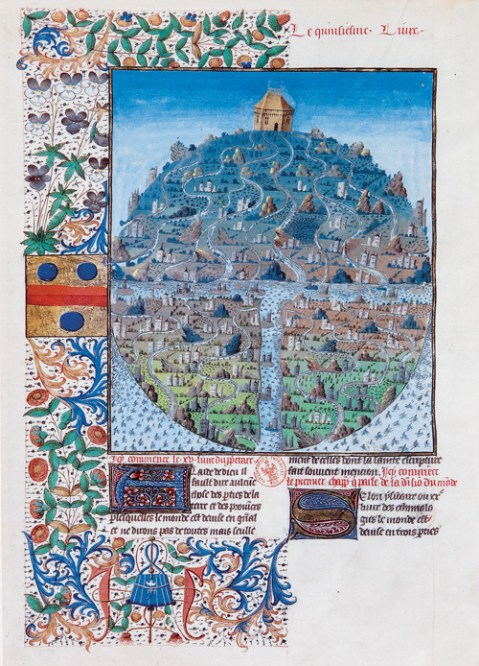
T and O map by Bartholomaeus Angelicus, 1392, from Umberto Eco’s ‘The Book of Legendary Lands.’ Click image for details.

Even the word itself endured an unforeseen transformation, its original meaning itself lost amidst our present cult of productivity and perilous goal-orientedness:

The word “lost” comes from the Old Norse los, meaning the disbanding of an army, and this origin suggests soldiers falling out of formation to go home, a truce with the wide world. I worry now that many people never disband their armies, never go beyond what they know. Advertising, alarmist news, technology, incessant busyness, and the design of public and private space conspire to make it so.

Taking back the meaning of lost seems almost a political act, a matter of existential agency that we ought to reclaim in order to feel at home in ourselves. Solnit writes:

There’s another art of being at home in the unknown, so that being in its midst isn’t cause for panic or suffering, of being at home with being lost.

[…]

Lost [is] mostly a state of mind, and this applies as much to all the metaphysical and metaphorical states of being lost as to blundering around in the backcountry.

The question then is how to get lost. Never to get lost is not to live, not to know how to get lost brings you to destruction, and somewhere in the terra incognita in between lies a life of discovery.

Illustration for ‘Mapping Manhattan.’ Click image for details.

During a recent vacation, I went horseback riding on a California ranch, home to a tight-knit equine community. Midway along the route, my horse glimpsed his peer across the field, carrying another rider on a different route, and began neighing restlessly upon the fleeting sight. Our guide explained that the horses, despite being extraordinarily intelligent beings, had a hard time making sense of seeing their friends appear out of nowhere, then disappear into the distance. Falling out of sight held the terror of being forever lost. My horse was calling out, making sure his friend was still there — that neither was lost. Underneath the geographic disorientation, one can imagine, lies a primal fear of losing control.

Despite the evolutionary distance, this equine disposition bears a disorienting similarity to the duality of our own relationship to the concept of lost — losing something we care about, losing ourselves, losing control — which Solnit captures beautifully:

Lost really has two disparate meanings. Losing things is about the familiar falling away, getting lost is about the unfamiliar appearing. There are objects and people that disappear from your sight or knowledge or possession; you lose a bracelet, a friend, the key. You still know where you are. Everything is familiar except that there is one item less, one missing element. Or you get lost, in which case the world has become larger than your knowledge of it. Either way, there is a loss of control. Imagine yourself streaming through time shedding gloves, umbrellas, wrenches, books, friends, homes, names. This is what the view looks like if you take a rear-facing seat on the train. Looking forward you constantly acquire moments of arrival, moments of realization, moments of discovery. The wind blows your hair back and you are greeted by what you have never seen before. The material falls away in onrushing experience. It peels off like skin from a molting snake. Of course to forget the past is to lose the sense of loss that is also memory of an absent richness and a set of clues to navigate the present by; the art is not one of forgetting but letting go. And when everything else is gone, you can be rich in loss.

A Field Guide to Getting Lost is a sublime read in its entirety. Complement it with Where You Are, an exploration of cartography as wayfinding for the soul, then revisit Anaïs Nin on how inviting the unknown helps us live more richly.

The Power of Prayer, Part Two.

Here’s the link to this article.

Avatar photoby CAPTAIN CASSIDY

JUN 02, 2013

pray all you want, the results are the same
Sure, why not? (Dennis JarvisCC-SA.)

I was reeling from so many sources by now. I’d just graduated from college and had a nice shiny degree that was more or less useless by itself. I was married to a handsome and impossibly fervent minister husband who had some measure of respect in our denomination. I had a decent little job doing something I enjoyed tolerably enough. I was a busy bee all right. But beneath that surface happiness, tension roiled like a stormcloud and nothing was what it seemed. I needed answers about prayer, and I needed them now.

pray all you want, the results are the same
Sure, why not? (Dennis JarvisCC-SA.)

We all have a number of props and supports for our religious ideas. Mine were as varied as anybody else’s. But they were getting knocked out from under me at a frightening pace.

Probably the very last one I had was that the Bible’s god was faithful to his people and an omnimax being who loved us (“omnimax” means omnipotent, omnipresent, omniscient, and omnibenevolent–omni-everything, if you will). And the best way for me to evaluate that claim was to examine my god’s response to prayer.

God loves prayer. All through the Bible, his people are told to pray and God listens to those prayers. We are also told that God uses prayers as a barometer of our needs and desires, and responds to those prayers in ways that will benefit his followers. Among many other exhortations, we have Jesus in Luke 18:1 telling us that we should always be praying. Out of every single thing that a Christian is almost always totally sure of, it’s that his or her god hears those prayers and cares about each and every one. If I found out that prayer wasn’t what it seemed, not much was going to be left.

The Bible Verses

First we’ll lay out the verses:

Mark is usually thought to be the first Gospel written (see Markan Priority), though this isn’t a totally universal idea. I think it’s first, so I’m starting there. In Mark, we see these passages:

Mark 11:23-4: Whosoever shall say unto this mountain, Be thou removed, and be thou cast into the sea; and shall not doubt in his heart, but shall believe that those things which he saith shall come to pass; he shall have whatsoever he saith. Therefore I say unto you, What things soever ye desire, when ye pray, believe that ye receive them, and ye shall have them.” There’s a bit of weaseling and fine print here (the stipulation is that the praying person have absolute faith that he or she will receive whatever is requested) that is absent in later-written Matthew, but overall the intention seems clear: if you just believe enough, you’ll get whatever you want.

Mark 16:17 follows up the general trend this way: “These signs shall follow them that believe; in my name shall they cast out devils; they shall speak with new tongues; they shall take up serpents; and if they drink any deadly thing, it shall not hurt them; they shall lay hands on the sick, and they shall recover.” So about those snake handlers who keep dying of snake bites… In my church, we regarded ourselves as a bit more sophisticated than that. My first Pentecostal pastor (remember, the good egg who discouraged Biff from running off to Waco) refused to handle snakes, and refused to let anybody in the congregation do it either. And I never once saw or heard of any group out there deliberately drinking poisons just to show the miraculous power of God, which if you think about it is *way* more impressive than handling snakes which might or might not bite. Why was that, I wondered that night as I pored over my study Bible? Why wasn’t snake handling and poison-drinking more popular? Why didn’t anybody do it in perfect safety, knowing the Bible flat-out said they could do this as a specific sign and testament given by Jesus Christ himself? (Now I know this passage is in all likelihood a later addition to Mark and as likely to have been said by Jesus himself as a Transformers quote, but at the time, I took it all as one big piece.)

Matthew 7 has Jesus telling us all about how we will be given whatever we ask for: “Ask and it shall be given you; seek, and ye shall find; knock, and it shall be opened unto you. For every one that asketh receiveth; and he that seeketh findeth, and to him that knocketh it shall be opened.” Well, that sounds really strong, doesn’t it? No less than the savior of humankind is saying that whatever we want, we’ll get, and he isn’t using any fine print here at all. (HelLO prosperity gospel! We’ll be discussing this concept in detail at some point.)

In Matthew 17, Jesus expands on this mysticism thusly: “If ye have faith as a grain of mustard seed, ye shall say unto this mountain, Remove hence to yonder place; and it shall remove; and nothing shall be impossible unto you.” Well, that sounds pretty positive too, doesn’t it? He doubles down on it in Matthew 21 when he’s just gotten done cursing that fig tree (you know, the one that wasn’t doing anything wrong at all except being out of season when Jesus had a major munchie fit for figs): “If ye have faith, and doubt not, ye shall not only do this which is done to the fig tree, but also if ye say unto this mountain, Be thou removed, and be thou cast into the sea; it shall be done. And all things, whatsoever ye shall ask in prayer, believing, ye shall receive.” Now, note that the fig tree cursing is a specific power he’s telling believers they’ll have. So all those Christians saying a prayer didn’t get answered because it was “selfish” have some explaining to do.

In Matthew 18:18-20, we even get a look at how powerful groups of Christians are (is there a word for a group of Christians, like a flock of geese or a lamentation of swans? “Congregation” is too specifically churchy): “Whatsoever ye shall bind on earth shall be bound in heaven: and whatsoever ye shall loose on earth shall be loosed in heaven. Again I say unto you, That if two of you shall agree on earth as touching any thing that they shall ask, it shall be done for them of my Father which is in heaven. For where two or three are gathered together in my name, there am I in the midst of them.” So whatever the magic power is of one Christian praying, it’s even more powerful when more than one gets together and prays. In almost every one of the church services I attended throughout the Protestant system, this verse got invoked, by the way–especially when the church prayed for one particular thing (like that pastor’s healing of brain cancer).

John’s probably the last of the gospels, and it has the strongest of all the assurances. In John 14, we see this: “He that believeth on me, the works that I do shall he do also; and greater works than these shall he do; because I go unto my Father. And whatsoever ye shall ask in my name, that will I do, that the Father may be glorified in the Son. If ye shall ask any thing in my name, I will do it.” Straightforward enough.

But now let’s look at the weaseling out of these strong assurances in the rest of the Bible:

1 John 3:22: “Whatsoever we ask, we receive of him, because we keep his commandments, and do those things that are pleasing in his sight.” So a Christian who sins won’t get what’s requested. Well, that’s about all of us, because nobody’s righteous but Jesus (Romans 3:10, but see this writeup which mysteriously we didn’t know about as Christians).

Philippians 4:19: “But my God shall supply all your need according to his riches in glory by Jesus Christ.” Well, that implies that if we don’t need it, we won’t get it.

James 1:5-7: “If any of you lack wisdom, let him ask of God, that giveth to all men liberally, and upbraideth not; and it shall be given him. But let him ask in faith, nothing wavering. For he that wavereth is like a wave of the sea driven with the wind and tossed. For let not that man think that he shall receive any thing of the Lord.” Another one that implies that faith is required. All right.

James 4:3: “Ye ask, and receive not, because ye ask amiss, that ye may consume it upon your lusts.” If you don’t get what you asked for, you probably were asking in the wrong spirit–you just wanted it out of some selfish or sinful impulse (you know, like wanting figs out of season). So it’s your fault. That does kind of knock the prosperity gospel Christians right in the nads and it’s definitely not in keeping with Jesus’ earlier assurances that he’d do whatever we asked, especially if we asked in groups, but it’s a pretty standard deflection I heard to explain away the problem.

James 5:13-18:” Is any among you afflicted? Let him pray. Is any merry? Let him sing psalms. Is any sick among you? Let him call for the elders of the church; and let them pray over him, anointing him with oil in the name of the Lord: and the prayer of faith shall save the sick, and the Lord shall raise him up; and if he have committed sins, they shall be forgiven him. . .  The effectual prayer of a righteous man availeth much.” This one predicts healings aplenty and reaffirms that righteousness is required. Seems like a poisoned well excuse, doesn’t it? If someone doesn’t get what was requested, there’s probably some taint involved.

The only requirements I can see in the Gospels is that whoever’s praying for something needs to be very very fervent in believing that whatever is being requested will happen. The later books of the New Testament add a few stipulations, but overall, the insistence is there that yes, God answers prayers.

The Reality of the Bible Verses.

But that’s not how it works.

That’s not how it works at all.

And this “yes/no/later” thing that Christians repeat like a mantra isn’t mentioned in any of these verses. Ever. I didn’t even see how such a concept could be inferred from these verses. Either God answered the prayer every single time by giving the praying person what was requested, or in the later weasel words, God flat refuses due to some inadequacy on the part of the petitioner–not out of the person’s best interest, but out of inadequacy. What I’d been told about prayer just wasn’t true if the Bible was any kind of guide in the matter.

As I studied, I wondered again to myself: just when had I stopped asking for anything really supernatural? Every time I got in my car, I prayed that I’d get to my destination “safely and unharmed,” as I had learned from the older members of my church. When I went to the mall with Christian friends, they prayed that we’d get a good parking spot (and one year, on Christmas Eve, we did! Right up front! It was a miracle!). I prayed that work would go smoothly, that God would bless me in general, that God would bring my errant family to salvation (not a single one was saved yet).

But when I prayed for specific things, did I really get them? No, not normally, not any more than I might get them with random chance or my own hard work. Were parking spots really a miracle? Why would God let me get to work without a car accident when tons of other people, many who presumably prayed the same sort of way, did not get to their destinations safely? When Biff had invaded Pastor Daniel’s deathbed vigil, I tell you he’d have been quite positive he could bring about Daniel’s healing–but he got thrown out by the very people who should have most known that prayer worked. And I can tell you that thousands upon thousands of Christians banded together to beg God for Daniel’s healing, only to be denied. Are we to assume that they were all inadequate in some way?

Forget all the rationalizations. Forget all the fine print (because whoa Nelly there is a lot of fine print). Forget all the justifications for why. Just look at the situation.

The god this Bible described says over and over again that he is a wonder-working god. This god says he listens to prayer. He answers prayer. No “yes/no/later” bullshit. Yes. If you believe, yes. The later books of the Bible, written long after Jesus didn’t return as he’d said he would, were clearly scrambling for explanations for why prayers weren’t getting answered (and settled on the approach Christians would use for centuries to come: “It’s all your fault”).

I never once while a Christian ever heard of any supernatural answer to prayer that was accompanied by credible, objective evidence for the claim. I never saw evidence of supernatural healing. I never saw any mountains moved. I never experienced a single “answered prayer” that couldn’t be explained easily by some other means. And 2000 years after these promises were made, we’ve still got slavery, murder, disease, and a host of other things that prayer was specifically said to be able to stop. Not a single mountain has been moved. Nobody’s ever documented any big-time healing. No amputees have been regenerated. No missing eyeballs brought back. No dead people raised. No poison drunk safely. Reality simply did not conform to what the Bible promised.

When had I stopped bothering to ask for anything that big? I already suspected in my heart of hearts, I realized as I studied, that prayer was a waste of time. Once I’d been positive about it, yes. I knew that. But somewhere along the way I learned the hard lessons that all Christians learn, and I’d internalized those doublespeak arguments meant to stop my thinking about it and make me content to labor in delusion. Now that I wasn’t bound by those old thought-stoppers, I could think about the matter honestly for the first time.

And I rejected it all in one fell swoop. It made no sense, and I was not obligated to keep twisting and contorting my mind to accept all these contradictions and complete fallacies. Nothing held me anymore–there was no fear left in me, and whatever love I’d felt had dissolved over time and with repeated disappointments (something that was happening simultaneously with my “godly” marriage).

With the sadness of a mourner at a funeral, I closed my Bible. Biff would be home soon from his lying–er, witnessing session at the Crisis Pregnancy Center. Tomorrow was Sunday. I didn’t know what I was going to do at this point. I couldn’t just not go–I was a minister’s wife. But I couldn’t hold the truth in any longer. My eyes had been opened. I’d made my saving roll to disbelieve at last, at last, at last. I couldn’t force myself to believe again any more than you, reader, could force yourself to believe once more in Santa. I’d seen too much, learned too much, suffered too much. This religion was not true (the question of “well, is it valid then at least?” hadn’t occurred to me), and I would no longer ally myself with lies.

A Long and Scary Night.

I was in bed by the time Biff got home. I don’t remember talking to him or anything else that happened. I don’t think I slept a wink all night. I didn’t weep, though; I was out of tears. I had spent them all earlier that night. I was over Christianity, and just as you know when a romantic relationship is well and truly over, I knew this “relationship” I’d built in my own head was over too.

All night long, I tossed and turned. Later I would read about the philosopher Epicurus who presented a dilemma called “The Problem of Evil” that illustrated perfectly what was going on in my head in a far more primitive and less eloquent form. If God really was omnipotent, then he certainly could easily do anything one of his followers asked. If he really were omnibenevolent, then I couldn’t see any rational reason why he wouldn’t do simple things like heal disease or end war or violence that might hurt his children (and “well you know God, he’s just so confusing sometimes” thought terminators didn’t cut it anymore, remember?). If he really were omniscient, then it didn’t make sense why he even needed his beloved spouse to even need to ask him for anything–he should know already. The truth was clear: there was no way that the god I’d worshiped all this time was omnimax. I couldn’t trust the Bible’s history or science, and I couldn’t trust Christianity’s assertions about his power, love, or grace. I wasn’t that sad by the time morning came, really; I felt a curious sense of detachment from myself that liberated me and freed me. I felt like I hadn’t eaten in many days and had hit that stage in starvation when the human body just doesn’t feel hungry anymore.

I felt gaunt and wrung-out. But I also felt a strange exhilaration. I didn’t have to bash my brains out trying to reconcile those things which are not by their nature reconcilable. I no longer had to struggle to understand that which makes no sense whatsoever. Slowly I began to feel strength coursing back into my body as my liberation became more and more clear. I was free. And I would never be enslaved again.

As the grey morning light began its creep across my bedroom floor toward the bed, I realized I could just not go to church. I could just skip out. I could just quit going. And nobody could make me go if I didn’t want to go. That is where you first joined me in this blog, dear reader; this very bedroom and this very dawn is where you first met me. I had just closed an old book full of mold and fungus and rot, and I’d just made a new beginning that was fresh and clean and full of hope. And this new beginning is where we shall start our journey together. Thank you for making it with me.

XXX

This was a huge post for me, and like all big projects, it didn’t happen without help. I’d like to give a grateful tip of the hat to Why Won’t God Heal Amputees?, which very devastatingly and sensitively covers the argument against prayer’s effectiveness in greater (and probably way more eloquent and relevant) detail. I used the site as a gathering-point for many of the Bible verses as I don’t pretend to remember them all now. I’d also like to thank Skeptic’s Annotated Bible, which has such a great search function and such helpful collections of the Bible’s various flaws and absurdities. I wish these sites had existed when I was a Christian; their existence would have made my transition a lot easier and faster. I encourage those who question and doubt to check those sites out.

06/22/23 Biking & Listening to The Dictionary of Lost Words

Biking is something else I both love and hate. It takes a lot of effort but does provide good exercise and most days over an hour to listen to a good book or podcast. I especially like having ridden.

Here’s my bike, a Rockhopper by Specialized. I purchased it November 2021 from Venture Out in Guntersville; Mike is top notch! So is the bike, and the ‘old’ man seat I salvaged from an old Walmart bike.

Here’s a link to today’s bike ride.


Something to consider if you’re not already cycling.

I encourage you to start riding a bike, no matter your age. Check out these groups:

Cycling for those aged 70+(opens in a new tab)

Solitary Cycling(opens in a new tab)

Remember,

Photo by Suzy Hazelwood on Pexels.com

Here’s what I’m listening to: The Dictionary of Lost Words, by Pip Williams

Amazon abstract:

NEW YORK TIMES BESTSELLER • REESE’S BOOK CLUB PICK • “Delightful . . . [a] captivating and slyly subversive fictional paean to the real women whose work on the Oxford English Dictionary went largely unheralded.”—The New York Times Book Review

“A marvelous fiction about the power of language to elevate or repress.”—Geraldine Brooks, 
New York Times bestselling author of People of the Book

Esme is born into a world of words. Motherless and irrepressibly curious, she spends her childhood in the Scriptorium, an Oxford garden shed in which her father and a team of dedicated lexicographers are collecting words for the very first Oxford English Dictionary. Young Esme’s place is beneath the sorting table, unseen and unheard. One day a slip of paper containing the word bondmaid flutters beneath the table. She rescues the slip and, learning that the word means “slave girl,” begins to collect other words that have been discarded or neglected by the dictionary men.

As she grows up, Esme realizes that words and meanings relating to women’s and common folks’ experiences often go unrecorded. And so she begins in earnest to search out words for her own dictionary: the Dictionary of Lost Words. To do so she must leave the sheltered world of the university and venture out to meet the people whose words will fill those pages.

Set during the height of the women’s suffrage movement and with the Great War looming, The Dictionary of Lost Words reveals a lost narrative, hidden between the lines of a history written by men. Inspired by actual events, author Pip Williams has delved into the archives of the Oxford English Dictionary to tell this highly original story. The Dictionary of Lost Words is a delightful, lyrical, and deeply thought-provoking celebration of words and the power of language to shape the world.

WINNER OF THE AUSTRALIAN BOOK INDUSTRY AWARD


Here’s a few photos from along my pistol route:

The Power of Prayer, Part One

Here’s the link to this article.

Avatar photoby CAPTAIN CASSIDY

MAY 25, 2013

A month or two after the David Koresh compound went up in smoke, my church got some horrible, horrible news. Our co-pastor had late-stage brain cancer.

Daniel was an awesome man (our sign-language ministry even had a sign for him–the “D” symbol run over the top of the head like a lion’s mane). His wife was the lead pastor’s daughter, a slender and beautiful young woman, and they had two generally fervent sons in their teens who didn’t show any signs of becoming stereotypically rebellious “preacher’s kids.” When our lead pastor began to feel like he was getting a bit old to be doing all-night prayer meetings, he asked Daniel to come in to help lessen the burden. He’d only been our co-pastor for a short while, maybe six months or a year, before out of nowhere we learned he had cancer. And it was that super-fast-moving sort too. Immediately he went into treatment, with surgery and all that, and just as immediately the “prayer wagon” got rolling.

It’s not an exaggeration to say that tens of thousands, if not hundreds of thousands of people were praying for his recovery. As I’ve mentioned, our pastor was one of the Big Name Fans in our denomination; we had ties to mission churches all over the world as well. I was one of the people who spent quite some time on her knees praying for Daniel’s recovery. Even Biff, who very rarely prayed anywhere but in church, prayed for him. We were absolutely convinced that God would heal him. Why wouldn’t he? Daniel was doing marvelous things for God; he had a family to support; he was an amazing person in every single way.

C’mon. You don’t need to ask what happened next. Daniel died a miserable death from cancer. Of course he did. What were you expecting? If there’s any disease worse than cancer, if there’s any disease that proves there can’t possibly be a loving god in this universe with ultimate power, I don’t know what else it might be if it isn’t this one (well, okay, maybe filoviruses, but still, cancer is horrible). Daniel left behind a grieving widow and two confused sons, and a world full of fundamentalists scrambling to explain why God hadn’t answered our prayers. This scrambling for the contortions required to make it totally okay that God had let Daniel die so horribly was even worse for me  than the fear of his death, the crushing disappointment when he died, and the mourning for his remaining family and friends. I’d never lost anybody before, so Daniel’s death hit me hard. And I couldn’t accept the doublespeak. As Calvin said in Calvin and Hobbes, “Either it’s mean or it’s arbitrary, and either way, it gives me the heebie-jeebies.”

At this point I noticed something strange. I’d pretty much stopped asking God for anything. Anything at all. Until I was asked specifically to pray for Daniel, it’d been a long time since I’d actually petitioned or beseeched God for anything. I praised him, yes. I told him about my day and explored my thoughts with him. I thanked him for things I thought he’d done (a minister told me once that I had the most thankful and grateful spirit he’d ever encountered). I felt what I thought was his presence in me. But I did not usually ask him for anything. Why should I, I thought? Either what I wanted was God’s will anyway, in which case it was going to happen regardless of what I said about the matter, or else it wasn’t, in which case I sure wasn’t going to strong-arm God into doing something that wasn’t his will. I perceived that God didn’t care about popularity contests or even very sincere petitioning; he was going to do whatever he thought best anyway. And it seemed hugely immoral of a “parent” to demand his “children” ask him for the basics of their lives–what father demands his children beg him for dinner every day before they’re allowed food to eat? Or for healthcare? Or for their very lives or those of their own children? Or to spare them from car accidents or abuse? Any deity who values and encourages those sorts of supplications now seems downright malevolent to me. At the time it just seemed pointless at best and a setup for disappointment at worst. If God’s will was so totally unknowable and mysterious, there seemed to be no way whatsoever to know if a request was actually in his plan or not.

I’d begun to perceive that Christians tend to treat God like a combo ATM machine and errand boy, ordering him around and demanding stuff of him. Even worse, I’d begun to see how hugely impotent preachers looked when they triumphantly shouted “I claim a healing in the name of Jesus Christ!” when they didn’t know even the tiniest bit about whether or not that healing was going to happen at all. It sounded mighty fine, yes, but the results were decidedly not supernatural in the least. When the healing didn’t happen, or it only sort of half-happened if you squinted and tilted your head and looked at it just the right way, they either ignored that they’d ever made the claim, I mean completely ignored it like it never happened as the soul-sick bunnies at Strawberry’s warren did in Watership Down, or else blew it up into some huge evidence of their god’s “wonder-working” power. The whole predatory charade was starting to sicken me and make me question just how much else in this religion was a charade.

Right after Daniel’s death, Biff told me we were going to start attending another pastor’s church. Brother Gene had just gotten married for the first time rather late in life to a sweet older lady who’d also “saved herself” until rather late in life, and they’d decided to start a little storefront church. They needed parishioners, and Gene had asked my husband to please consider joining up. Their church was in our general stomping grounds and we were on friendly terms with both of them, so it seemed like a no-brainer. I was not consulted about this move, but I didn’t especially care where I went to church by this time. Plus, I really liked Gene and his wife, who were nice folks who were obviously in love. I was content to let Biff dictate this move.

It was a pretty little church. Obviously the pastor’s wife had decorated it; she’d used the most tasteful and popular hues of the day: dusty rose carpet, cream walls, and pink chairs, with periwinkle accents all over and artificial flowers everywhere. It looked a bit like a wedding reception hall. I don’t think the congregation got bigger than about 20 people all told in the year or two we attended, but I liked the place and the people involved with it.

About six months later, when Biff and I attended our original church for a revival, though, I got a big shock.

He was off doing his usual bombastic routine at the altar and I was in the pew clapping to the music and enjoying the wash of emotions and goodwill from all the people up at the front, when a woman came up to me. I vaguely knew her by sight; she was an older woman in the inner circle of the Cool Kids’ Club. She wasn’t someone I normally talked to because of our age difference and the simple fact that I didn’t think she approved of me much. She began to make friendly conversation with me about Gene’s church before dropping a bombshell.

“I guess I’m not surprised you two went there, after what Biff did at Daniel’s deathbed vigil.”

I stopped cold and stared at her. “What do you mean?” I asked, a lump forming in my stomach.

She looked surprised. “He didn’t tell you? He invaded Daniel’s hospital room with a bottle of oil and wanted to pray over him for healing the night he died.” She went on to share that Biff’s demands had really disturbed and rattled the lead pastor and his wife (Daniel’s in-laws, remember) and Daniel’s distraught family. They’d more or less thrown him out on his ear. That night Daniel had died. The very next Sunday we were at Gene’s church.

Somehow Biff hadn’t told me about this incident.

The world froze. We talk about it as a metaphor, but it really felt like the world froze right then as I absorbed her words.

I looked up toward the altar where Biff was praying with people and babbling in “tongues.” He was already glistening with sweat from his exertions as he rocked someone back and forth who was about to get “infilled” as dozens of Christians surrounded them both and prayed over Biff’s victim. This command performance was his favorite part of going to church, but he never got to do that at Gene’s church; everybody there was already Christian, and Gene wasn’t that kind of emotional pastor. Plus, the sort of emotional catharsis that feels wonderful in big crowds feels a bit bizarre in small ones. Biff also fancied himself a “youth minister,” but Gene’s church only had two kids in it. In a flash of insight I realized what a mismatch Biff was for Gene’s church, yet my husband never complained or suggested returning to our original church home. Now I understood why that might be.

Biff hadn’t told me about going to Daniel’s hospital room at all. He’d never even mentioned it. He hadn’t said a word. He’d gone to the church that night, he’d said, while I stayed home studying. He’d presented our move to Gene’s church as just a logical step to support our friends in their effort to plant a new church.

I wasn’t that angry about his deception–remember, I liked Gene and his wife and that little church, and I had known for quite some time that Biff was a deceiver and liar; it wasn’t shocking at all that he might omit important details if those details made him look really bad. But I was more disturbed than I could say about one thing that loomed in my mind above all else.

Of all people, the pastor and his wife, Daniel’s in-laws, Daniel’s wife, Daniel’s kids, they should have known that prayer worked. Of all people, they above all should have welcomed a man of deep faith and conviction coming in to anoint a sick man to heal him. Whatever else you could say about Biff, and believe me you could say a lot about him that wasn’t really complimentary, he was so far past “rock-solid” in this religion thing that he probably wouldn’t even register on the scales of sincerity. But the people in that room had thrown him out.

Now I see that of course they reacted that way. Biff’s behavior was hugely disrespectful at a time when they were trying to say goodbye in as dignified a manner as they could to a much-beloved friend and family member. I knew exactly how Biff would have stomped in there and how dramatically he’d have declared his intentions. It would have been a Hollywood-worthy scene. My “now” eye sees the scene and cringes, and I totally understand why they did what they did. But at the time, their reaction destroyed something I’d been clinging to very hard.

When push came to shove, the people who preached the most about the power of prayer didn’t really believe prayer worked. They knew Biff’s actions wouldn’t heal Daniel and they knew that Daniel was doomed despite all their prayers and “claims of healing” of God. Just as every other sane person in the world did, they lived their actual everyday lives with all the human assurances necessary to get through the day: insurance, medicine, jobs, etc. We all talked a really big game about prayer and what it could do, but none of us really believed it. Not even me; I hadn’t even bothered asking for some time. When people actually tried to live the words out by refusing medical care for themselves or something, we rightly called those people nutbars and made sure their kids at least weren’t suffering for their parents’ zealotry.

I saw these things in a split-second while the church lady prattled on in fake sympathy about how embarrassed everybody had been for Biff, and how happy they all were to see Biff back here to make up with Daniel’s family, and of course nobody held it against him that he’d tried his best to help. I don’t even remember what-all she said specifically. I was dazed–shell-shocked. I wonder today if she knows how much she had to do with my later deconversion; even today I have no idea whatsoever just what her goal was in telling me what she did. (If you have a reasonable guess, you’re welcome to comment it. You know as much about the situation now as I ever did.)

On the way home, I decided that it was high time I did a Bible study asking for discernment regarding prayer, and soon you will hear what led me to decide not to go back to church on that fateful morning not long after this day.

Oh, and I asked Biff about what’d happened at Daniel’s deathbed vigil, but I could tell this was a really tender, sore topic for my husband. I very quickly dropped it, and we never mentioned it again, not even in fights, not even at the peak of my apostasy. I understood completely and even today don’t hold against him that he didn’t want to discuss the matter.

Some stuff you just don’t talk about.