Biking is something else I both love and hate. It takes a lot of effort but does provide good exercise and most days over an hour to listen to a good book or podcast. I especially like having ridden.
Here’s my bike, a Rockhopper by Specialized. I purchased it November 2021 from Venture Out in Guntersville; Mike is top notch! So is the bike, and the ‘old’ man seat I salvaged from an old Walmart bike.
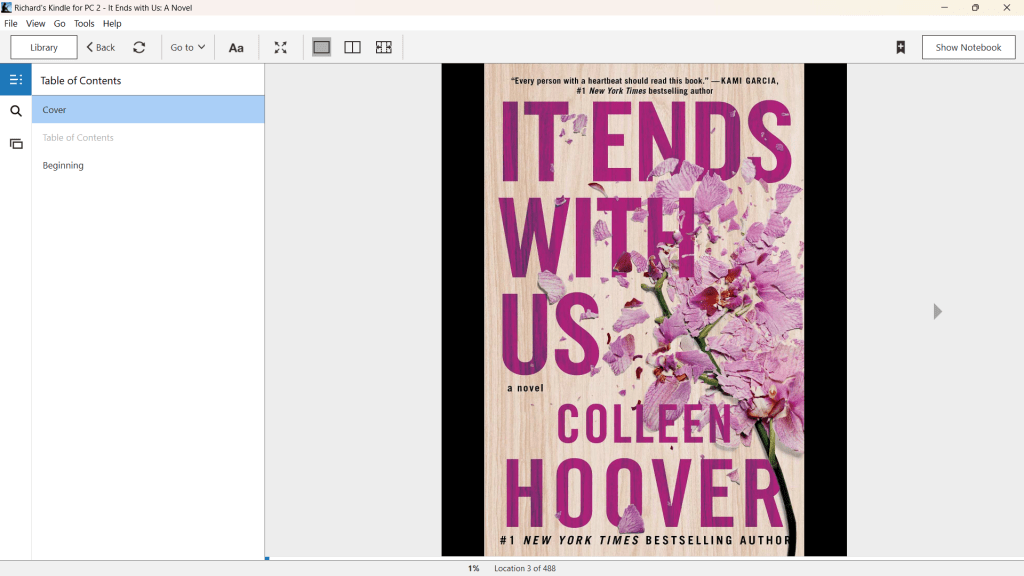
Here’s what I’m listening to: It Ends With Us, by Colleen Hoover
Amazon abstract:
In this “brave and heartbreaking novel that digs its claws into you and doesn’t let go, long after you’ve finished it” (Anna Todd, New York Times bestselling author) from the #1 New York Times bestselling author of All Your Perfects, a workaholic with a too-good-to-be-true romance can’t stop thinking about her first love.
Lily hasn’t always had it easy, but that’s never stopped her from working hard for the life she wants. She’s come a long way from the small town where she grew up—she graduated from college, moved to Boston, and started her own business. And when she feels a spark with a gorgeous neurosurgeon named Ryle Kincaid, everything in Lily’s life seems too good to be true.
Ryle is assertive, stubborn, maybe even a little arrogant. He’s also sensitive, brilliant, and has a total soft spot for Lily. And the way he looks in scrubs certainly doesn’t hurt. Lily can’t get him out of her head. But Ryle’s complete aversion to relationships is disturbing. Even as Lily finds herself becoming the exception to his “no dating” rule, she can’t help but wonder what made him that way in the first place.
As questions about her new relationship overwhelm her, so do thoughts of Atlas Corrigan—her first love and a link to the past she left behind. He was her kindred spirit, her protector. When Atlas suddenly reappears, everything Lily has built with Ryle is threatened.
An honest, evocative, and tender novel, It Ends with Us is “a glorious and touching read, a forever keeper. The kind of book that gets handed down” (USA TODAY).
Here’s the link to this article by Bart Ehrman, May 9, 2023.
On my podcast this past week (Misquoting Jesus with Bart Ehrman) someone asked me if I thought any of the Gospels of the NT were influenced by Paul. It’s an interesting question that I should post on (my view: Mark, maybe; Luke, unexpectedly and oddly not; John, I doubt it; Matthew?)
Ah, Matthew. As it turns out, I think Matthew shows a rather obvious and ironic connection with Paul. Did he know Paul’s writings? I have no idea. Did he know about Paul? Same, no idea. Did he oppose a major feature of Paul’s gospel message? Sure looks like it!! (I’m trying to say that he could be opposed to Paul’s views without necessarily knowing Paul’s writings; the views may have been more widely spread than just by Paul. In fact, they almost certainly were.
Here’s how I’ve discussed the matter once when I was reflecting at greater length in the issue:
Paul certainly had opponents in his lifetime: “Judaizers,” as scholars call them — that is, Christian teachers who maintained that followers of Jesus had to follow the Jewish Law: Men were to be circumcised to join the people of God; men and women were, evidently, to adopt a Jewish lifestyle. Presumably that meant keeping kosher, observing the Sabbath, and so on. Anyone who didn’t do this was not really a member of the people of God, since to be one of God’s people meant following the law that God had given.
In Paul’s letter to the Galatians in particular he shows that he was thoroughly incensed at this interpretation of the faith and insisted with extraordinary vehemence that it was completely wrong. The gentile followers of Jesus were not, *absolutely* not, supposed to become Jewish. Anyone who thought so rendered the death of Jesus worthless. It was only that death, and the resurrection, that made a person right with God. Nothing else. Certainly not following the Torah.
I really don’t see how Paul and the author of the Gospel of Matthew could have gotten along.
Some background: Matthew’s Gospel was probably written about thirty years after Paul wrote his letter to the Galatians; Galatians is usually dated to the mid 50s, Matthew to around 80-85 CE. We don’t know who the author of Matthew was, apart from the fact that he was obviously a highly educated Greek-speaking Christian living outside of Palestine. His book is often located to Antioch Syria, but in my view that is simply a guess based on flimsy evidence. Still, it certainly *may* have been written Antioch, a city with a large Jewish population and a burgeoning Christian church.
Matthew, like the other Gospel writers, did not produce his account simply out of antiquarian interests, to inform his readers what happened 55 years earlier in the days of Jesus. His is not a disinterested biography or an objective history. It is a “Gospel.” In other words, it is intended to proclaim the “good news” about Jesus and the salvation that he brings. When Jesus teaches something in this Gospel, Matthew expects that the teaching will be relevant to his readers, that they will want to do what Jesus says.
There is no doubt that Matthew would agree with Paul that it was the death and resurrection of Jesus that brought salvation to the world. The Gospel is not *entirely* about Jesus’ death and resurrection. But it is largely about that. It is 28 chapters long, and the last 8 chapters are focused exclusively on what happened during the last week of Jesus’ life in Jerusalem, including the crucifixion and resurrection. This is clearly the climax of the story. And for Matthew, as for his predecessor Mark, the death of Jesus is seen as “a ransom for many” (Matt. 20:28). It is through his death that he “will save his people from their sins” (Matt. 1:21).
So Matthew would agree with Paul there. But so would Paul’s Judaizing opponents in Galatia. The controversy with the Galatian opposition was not over whether Jesus’ death brings salvation. It was over whether the followers of Jesus, who accept that death, need to keep the Jewish law. And it does seem to me that this is where Paul and Matthew split company. Again, remember that when Matthew decides what to present about Jesus’ life in the Gospel it is not simply so that people can know “what really happened” in the past. It is so that the life and teachings of Jesus can direct the lives of his followers in the present.
And what does Jesus say about the Jewish law in Matthew? He says that his followers have to keep it. One of the key passages is something that you will NEVER find in the writings of Paul.
Do not suppose that I came to destroy the law or the prophets. I came not to destroy but to fulfil. For truly I say to you, until heaven and earth pass away not one iota or one stroke of a letter will pass away from the law until all is fulfilled. And so, whoever looses one of the least of these commandments and teaches others in this way will be called least in the kingdom of God, but whoever does and teaches the law will be called great in the kingdom of heaven. For I say to you that if your righteousness does not exceed that of the scribes and Pharisees, you will not enter into the kingdom of heaven. (Matt 5:17-20).
This is a really interesting passage. Does it contradict Paul that the followers of Jesus were *not* to keep the law? It certainly seems to.
Now someone *could* say that here Jesus is saying simply that the entire law has to be in effect until he dies (“until all is fulfilled”). But Jesus is saying more than that. His followers must do and teach the law. None of it will pass away until the world is destroyed (“till heaven and earth pass away”). Again, Matthew is not saying this so his readers will have a good history lesson about the Savior of the world and what he taught his disciples. He is including this passage for the same reason he includes all his passages, to teach his readers how they are to believe and live. Jesus in this passage does *not* say, “Keep the law until I die.” He says he did not come to destroy the law. It is still in effect. And will be as long as the earth lasts. His followers have to keep it.
After this Jesus launches into his “antitheses,” where he indicates what the law says and explains its fuller, deeper meaning. The law says don’t kill; to fulfill it you should not engage someone with wrath. The law says not to take someone’s spouse; to fulfill it you should not want to do so. The law says to make punishments fit the crimes (an eye for an eye a tooth for a tooth; not a head for an eye or a body for a tooth); to fulfill it you should show extreme mercy and not punish another for harm done to you. And so on.
I think that Matthew’s Jesus really meant what he says (NOTE: I’m talking about Jesus as he is portrayed in Matthew, NOT about Jesus’ own historical views). He gives no hint that following the law this closely is impossible to do. He seems to think it is possible. God gave a law. You should follow it. Scrupulously. Even more scrupulously than the righteous scribes and Pharisees. If you don’t, you will not enter the kingdom of heaven.
That’s a tall order. And in my judgment it seems very much opposed to Paul’s views, who insists that *his* readers not think that they must follow the law. Pretty big difference. In fact, Paul says anyone is cursed who disagrees with his view of the matter (Gal. 1: 6-9). Surely Matthew disagreed.
“Faith is the willingness to give ourselves over, at times, to things we do not fully understand… the full engagement with this strange and shimmering world.”
BY MARIA POPOVA
“If we ever reach the point where we think we thoroughly understand who we are and where we came from,” Carl Sagan wrote in his timeless meditation on science and religion, “we will have failed.” It’s a sentiment that dismisses in one fell Saganesque swoop both the blind dogmatism of religion and the vain certitude of science — a sentiment articulated by some of history’s greatest minds, from Einstein to Ada Lovelace to Isaac Asimov, all the way back to Galileo, and one that Sagan echoed a decade later, three months before his death, writing: “The notion that science and spirituality are somehow mutually exclusive does a disservice to both.” Yet centuries after Galileo and decades after Sagan, humanity remains profoundly uneasy about reconciling these conflicting frameworks for understanding the universe and our place in it.
In the foreword, Lightman recounts attending a lecture by the Dalai Lama at MIT, “one of the world’s spiritual leaders sitting cross-legged in a modern temple of science,” and hearing about the Buddhist concept of sunyata, translated as “emptiness” — the notion that objects in the physical universe are vacant of inherent meaning and that we imbue them with meaning and value with the thoughts of our own minds. From this, Lightman argues while adding to history’s finest definitions of science, arises a central challenge of the human condition:
As a scientist, I firmly believe that atoms and molecules are real (even if mostly empty space) and exist independently of our minds. On the other hand, I have witnessed firsthand how distressed I become when I experience anger or jealousy or insult, all emotional states manufactured by my own mind. The mind is certainly its own cosmos. As Milton wrote in Paradise Lost, “[The mind] can make a heaven of hell or a hell of heaven.” In our constant search for meaning in this baffling and temporary existence, trapped as we are within our three pounds of neurons, it is sometimes hard to tell what is real. We often invent what isn’t there. Or ignore what is. We try to impose order, both in our minds and in our conceptions of external reality. We try to connect. We try to find truth. We dream and we hope. And underneath all of these strivings, we are haunted by the suspicion that what we see and understand of the world is only a tiny piece of the whole.
[…]
Science does not reveal the meaning of our existence, but it does draw back some of the veils.
This tension between internal and external reality is also what lies at the root of the age-old tension between science and religion. In one of the best essays in the collection, titled “The Spiritual Universe,” Lightman sets out to lift the veil of this immutable inquiry. He cites a discussion that took place at a monthly gathering of scientists and artists at MIT, aimed at exploring the interplay of science and art, wherein a playwright proposed that science is the religion of our century. Lightman considers the inherent challenges to this notion:
If science is the religion of the twenty-first century, why do we still seriously discuss heaven and hell, life after death, and the manifestations of God? Physicist Alan Guth, another member of our salon, pioneered the inflation version of the Big Bang theory and has helped extend the scientific understanding of the infant universe back to a trillionth of a trillionth of a trillionth of a second after t = 0. A former member, biologist Nancy Hopkins, manipulates the DNA of organisms to study how genes control the development and growth of living creatures. Hasn’t modern science now pushed God into such a tiny corner that He or She or It no longer has any room to operate—or perhaps has been rendered irrelevant altogether? Not according to surveys showing that more than three-quarters of Americans believe in miracles, eternal souls, and God. Despite the recent spate of books and pronouncements by prominent atheists, religion remains, along with science, one of the dominant forces that shape our civilization. Our little group of scientists and artists finds itself fascinated with these contrasting beliefs, fascinated with different ways of understanding the world. And fascinated by how science and religion can coexist in our minds.
As a scientist and self-professed humanist himself, Lightman exorcises his lifelong struggle to reconcile these conflicting worldviews by proposing a set of criteria for the kind of religious belief that would be compatible with rather than contradictory to science:
The first step in this journey is to state what I will call the central doctrine of science: All properties and events in the physical universe are governed by laws, and those laws are true at every time and place in the universe. Although scientists do not talk explicitly about this doctrine, and my doctoral thesis adviser never mentioned it once to his graduate students, the central doctrine is the invisible oxygen that most scientists breathe. We do not, of course, know all the fundamental laws at the present time. But most scientists believe that a complete set of such laws exists and, in principle, that it is discoverable by human beings, just as nineteenth-century explorers believed in the North Pole although no one had yet reached it.
[…]
Next, a working definition of God. I would not pretend to know the nature of God, if God does indeed exist, but for the purposes of this discussion, and in agreement with almost all religions, I think we can safely say that God is understood to be a Being not restricted by the laws that govern matter and energy in the physical universe. In other words, God exists outside matter and energy. In most religions, this Being acts with purpose and will, sometimes violating existing physical law (that is, performing miracles), and has additional qualities such as intelligence, compassion, and omniscience.
Starting with these axioms, we can say that science and God are compatible as long as the latter is content to stand on the sidelines once the universe has begun. A God that intervenes after the cosmic pendulum has been set into motion, violating the physical laws, would clearly upend the central doctrine of science. Of course, the physical laws could have been created by God before the beginning of time. But once created, according to the central doctrine, the laws are immutable and cannot be violated from one moment to the next.
With these criteria in mind, he offers a taxonomy of religious beliefs, based on the degree of control they assign to their highest deity: At the extreme end, denying the existence of a God, is atheism; up the sliding scale of faith is deism, whose God created the universe but has not interfered since that initial spark — a favorite model in the 17th and 18th centuries, with such prominent proponents as Voltaire; then comes immanentism with yet more divine intervention, which holds that God created the physical universe and its laws, and continues to propel it but only through the stringent and consistent application of these permanent laws; at the other extreme end, opposite atheism, is interventionism — God created the universe and its laws, and can occasionally interfere with their predictable function to produce unpredictable results, commonly called miracles. Because most major religions — including Christianity, Judaism, Islam, and Hinduism — are built upon an interventionist view of God, Lightman points out that they are incompatible with science and observes the logical conclusion:
Except for a God who sits down after the universe begins, all other Gods conflict with the assumptions of science.
The situation is further muddled by the fact that the majority of laypeople who are both religious and understand the value of science don’t subscribe to its central doctrine — that same logical foundation that renders an interventionist God impossible. Lightman cites a sociological study which found that 25% of scientists at elite American universities believe in the existence of God and don’t consider science the only framework for explaining the world. Lightman, who considers himself an atheist, illustrates the conundrum with his own beliefs and points to the humanities — that essential anchor of the human experience — as the spiritual complement to science:
I completely endorse the central doctrine of science. And I do not believe in the existence of a Being who lives beyond matter and energy, even if that Being refrains from entering the fray of the physical world. However, I certainly agree with [such scientists] that science is not the only avenue for arriving at knowledge, that there are interesting and vital questions beyond the reach of test tubes and equations. Obviously, vast territories of the arts concern inner experiences that cannot be analyzed by science. The humanities, such as history and philosophy, raise questions that do not have definite or unanimously accepted answers.
This is where Lightman’s exquisite touch as both an essayist and a humanist springs so vibrantly alive:
There are things we take on faith, without physical proof and even sometimes without any methodology for proof. We cannot clearly show why the ending of a particular novel haunts us. We cannot prove under what conditions we would sacrifice our own life in order to save the life of our child. We cannot prove whether it is right or wrong to steal in order to feed our family, or even agree on a definition of “right” and “wrong.” We cannot prove the meaning of our life, or whether life has any meaning at all. For these questions, we can gather evidence and debate, but in the end we cannot arrive at any system of analysis akin to the way in which a physicist decides how many seconds it will take a one-foot-long pendulum to make a complete swing. The previous questions are questions of aesthetics, morality, philosophy. These are questions for the arts and the humanities. These are also questions aligned with some of the intangible concerns of traditional religion.
Reflecting on his early days as a physics grad student, where he was taught that the concept of a “well-posed problem” — a question stated so clearly that it would guarantee an answer — he turns to Rilke’s famous wisdom and considers both the difference and the margin of complement between art and science:
At any moment in time, every scientist is working on, or attempting to work on, a well-posed problem, a question with a definite answer. We scientists are taught from an early stage of our apprenticeship not to waste time on questions that do not have clear and definite answers.
But artists and humanists often don’t care what the answer is because definite answers don’t exist to all interesting and important questions. Ideas in a novel or emotion in a symphony are complicated with the intrinsic ambiguity of human nature. … For many artists and humanists, the question is more important than the answer. As the German poet Rainer Maria Rilke wrote a century ago, “We should try to love the questions themselves, like locked rooms and like books that are written in a very foreign tongue. Then there are also the questions that have definite answers but which we cannot answer. The question of the existence of God may be such a question.
As human beings, don’t we need questions without answers as well as questions with answers?
Faith, in its broadest sense, is about far more than belief in the existence of God or the disregard of scientific evidence. Faith is the willingness to give ourselves over, at times, to things we do not fully understand. Faith is the belief in things larger than ourselves. Faith is the ability to honor stillness at some moments and at others to ride the passion and exuberance that is the artistic impulse, the flight of the imagination, the full engagement with this strange and shimmering world.
Once again, Lightman envelops us in his enchanting storytelling to make this point as dimensional as it is when it manifests in life: He tells the story of a family of ospreys that nested near his home in Maine for many years, arriving from South America each spring to lay eggs, then raising their babies until the little ones took their first flight in late summer. Lightman and his wife recorded these cycles of life obsessively year after year in their “osprey journals” filled with notes, photographs, and lovingly collected data on that “small part of the universe.”Osprey and young from Richard Lydekker’s 19th-century natural history encyclopedia of birds of prey. (Available as a print.)
But while Lightman might describe himself as a humanist, this final anecdote exposes him as a true “creaturist” who lives with remarkable respect for non-human beings and our shared existence:
One August afternoon, the two baby ospreys of that season took flight for the first time as I stood on the circular deck of my house watching the nest. All summer long, they had watched me on that deck as I watched them. To them, it must have looked like I was in my nest just as they were in theirs. On this particular afternoon, their maiden flight, they did a loop of my house and then headed straight at me with tremendous speed. My immediate impulse was to run for cover, since they could have ripped me apart with their powerful talons. But something held me to my ground. When they were within twenty feet of me, they suddenly veered upward and away. But before that dazzling and frightening vertical climb, for about half a second we made eye contact. Words cannot convey what was exchanged between us in that instant. It was a look of connectedness, of mutual respect, of recognition that we shared the same land. After they were gone, I found that I was shaking, and in tears. To this day, I do not understand what happened in that half second. But it was one of the most profound moments of my life.
Adult and baby ospreys in nest, Maine, 2007. (Photograph courtesy of Alan Lightman)
Lightman closes the chapter with a beautiful meditation on where all of this leaves us:
Some people believe that there is no distinction between the spiritual and physical universes, no distinction between the inner and the outer, between the subjective and the objective, between the miraculous and the rational. I need such distinctions to make sense of my spiritual and scientific lives. For me, there is room for both a spiritual universe and a physical universe, just as there is room for both religion and science. Each universe has its own power. Each has its own beauty, and mystery. A Presbyterian minister recently said to me that science and religion share a sense of wonder. I agree.
The Accidental Universe is a sublime, mind-bending, soul-expanding read in its entirety, exploring such magnificent mysteries of our world and the cosmos as dark matter, multiverses, and the arrow of time, all considered through the dimensional lens of a mind at once voracious for knowledge and at peace with the unknown. Complement it with Dorion Sagan, son of Carl, on why science and philosophy need each other.
Biking is something else I both love and hate. It takes a lot of effort but does provide good exercise and most days over an hour to listen to a good book or podcast. I especially like having ridden.
Here’s my bike, a Rockhopper by Specialized. I purchased it November 2021 from Venture Out in Guntersville; Mike is top notch! So is the bike, and the ‘old’ man seat I salvaged from an old Walmart bike.
Here’s what I listened to today: I Will Find You, by Harlan Coben
Amazon abstract:
Five years ago, an innocent man began a life sentence for murdering his own son. Today he found out his son is still alive.
David Burroughs was once a devoted father to his three-year-old son Matthew, living a dream life just a short drive away from the working-class suburb where he and his wife, Cheryl, first fell in love–until one fateful night when David woke suddenly to discover Matthew had been murdered while David was asleep just down the hall.
Half a decade later, David’s been wrongly accused and convicted of the murder, left to serve out his time in a maximum-security prison—a fate which, grieving and wracked with guilt, David didn’t have the will to fight. The world has moved on without him. Then Cheryl’s younger sister, Rachel, makes a surprise appearance during visiting hours bearing a strange photograph. It’s a vacation shot of a bustling amusement park a friend shared with her, and in the background, just barely in frame, is a boy bearing an eerie resemblance to David’s son. Even though it can’t be, David just knows: Matthew is still alive.
David plans a harrowing escape, determined to achieve the impossible – save his son, clear his own name, and discover the real story of what happened. But with his life on the line and the FBI following his every move, can David evade capture long enough to reveal the shocking truth?
Harlan Coben can spin a yarn! Once again he has proven that in I Will Find You. This intricate plot is populated by a colorful and interesting cast of characters, especially the two FBI Special Agents, Max and Sarah, assigned to this case. They provide the comic relief in an otherwise very serious story of murder and a missing child. While cracking wise to each other they manage to cut through the distractions provided by Coben’s other characters and home in the most important issues.
David Burroughs is accused and convicted of killing his three year old son. While in prison he learns the son might still be alive, a scenario which makes no sense as the son’s body was found in his bed, beaten to death. In order to find out if that is true David must find a way to get out of prison and find his son.
The story is compelling and moves swiftly with lots of suspense and things that keep the reader guessing. If there is any flaw, there are parts of the plot which sound more like a soap opera rather than a murder mystery. That didn’t detract from my enjoyment of the book. I recommend this to all who enjoy a good mystery/thriller.
The story begins with David Burroughs five years into serving a life sentencing for murdering his son. He feels his life his over and never fought his conviction since he felt his life was over without his son. He never felt he would have murdered his own son but he had no memory of the night in question. David refused visitors in his first years at the prison until one day when his sister-in-law, Rachel, shows up requesting to see him. The visit causes him to question if his son is actually still alive. The book is an another great by Harlan Coben! I couldn’t put it down until the last page. I highly recommend this book and this author.
I Will Find You has a premise which I have not found in another novel. A man convicted of murdering his child, who thinks that he may have done it in a drunken moment of hysteria, finds out that the murdered child in his house that evening was not his son and that his son is still alive. Great idea for a book. How will Harlan Coben bring the pieces together so that it makes sense and gives the reader a thrilling ride? I will divulge nothing other than Harlan Coben did a really nice job of giving me the ride that I was hoping for. Is the book perfect? Am I still a little confused by the ending? Yes. Does it matter? No. The book is a roller coaster ride which you should take if you like thrillers or you have read everything that Coben has ever written. His best book ever was The Boy From The Woods. By far, that book was perfect and exceptional. This book is right up there and worth your time.
Wow! The storyline in this book is beyond! I didn’t know if I even wanted to know the truth behind how it happened, but I had to know! That is what makes Harlan Coben a standout beyond all the rest! The characters, as usual, you will fall in love with and some you will love to hate! His style of writing is the reason I love to read! I would recommend this book to anyone and everyone! I already recommended it before I even finished it myself! I gave this book a five-star rating because Harlan Coben gets an A+ and every area of his writing! The plot, the characters, his style of writing the mystery! He has ramped up the edginess in this one!
When you’ve been nurtured on ideas since early childhood—they’re a source of comfort and derive from adults whom you trust—it can be hard to see that some of the ideas may be truly weird. This is especially true of the gospels, which remain, for far too many of the faithful, unexplored territory. There may be passing familiarity with gospel stories, based on texts read from the pulpit and heard in ritual. Of course, Christian children’s books have played a major role in making the best Jesus-script well-known, e.g., in the parable of the Good Samaritan (Luke 10:29-37), and “God so loved the world…” (John 3:16, may or may not be Jesus-script: there was no punctuation in the Greek manuscripts.)
But outside of fundamentalist/evangelical circles, I suspect it’s not all that common for laypeople to really dig into the gospels. With so many other entertainment options these days—movies, TV, sports—picking up the Bible and actually studying the gospels carefully doesn’t hold strong appeal. There’s also this factor: it’s unsettling to discover theweirdstuff that priests and preachers seldom mention from the pulpit. There’s quite a lot of weird stuff in the Jesus-script, which prompts even devout folks to admit, “No, that can’t be right.” But they seldom stand up and declare, “Well, I don’t agree with Jesus on this!” However, our understanding of life, and our knowledge of how the world works, leads to the suspicion that a lot of Jesus-script is justplainwrong.
Mark, commonly accepted as the first gospel written, provides several examples.
In chapter 2 we find the famous story of the paralytic who was lowered through the roof, so that he could get access to miracle-working Jesus. Indeed, Jesus heals the man—no surprise that this story gets into children’s Bible books—but what he says doesn’t sound right at all: Jesus heals him by forgiving his sins. This angers the religious bureaucrats present, because they’re sure that onlyGod can forgive sins. This Jesus-script is based on the assumption that diseaseis causedbysin (vv. 9-12):
“Which is easier: to say to the paralytic, ‘Your sins are forgiven,’ or to say, ‘Stand up and take your mat and walk’? But so that you may know that the Son of Man has authority on earth to forgive sins’—he said to the paralytic— ‘I say to you, stand up, take your mat, and go to your home.’ And he stood up and immediately took the mat and went out before all of them, so that they were all amazed and glorified God, saying, ‘We have never seen anything like this!’”
The author of Mark’s gospel was pressing his theology here, i.e., Jesus has authority, just as much as god does, to forgive sins. But how much damage has this text caused? We can be sure that many devout folks have been convinced that their sins have caused illness to themselves and loved ones. But pathologists who study paralysis know for sure that sin has nothing to do with it. Maybe the guy took a bad fall, or suffered from a genetic disease. No doctor who is trying to help a paralyzed patient will ask for a list of sins the person has committed—to figure out what went wrong. Superstitious thinkers of the ancient world would have blamed sin, but we know better. If modern readers think it through, they realize that this Jesus-script is wrong.
One of the strangest texts in Mark is 4:10-12:
“When he was alone, those who were around him along with the twelve asked him about the parables. And he said to them, ‘To you has been given the secret [or mystery] of the kingdom of God, but for those outside everything comes in parables,in order that ‘they may indeed look but not perceive, and may indeed hear but not understand; so that they may not turn again and be forgiven.’”
What was Mark thinking? The parables are meant to prevent people from repenting? That makes no sense in the context of his own gospel: Jesus appeared to “preach the good news” about his god’s kingdom. Devout New Testament scholars have been struggling with this text for a long time. Verse 12 seems to be a quote from a sinister text, Isaiah 6:9-10, but we still are left to puzzle over why Mark chose to use it. Perhaps Mark was influenced by a desire to align the Christian cult with other mystery cults of the time, in which folks in the inner circle were privy to precious sacred secrets: “…to you has been given the secret/mystery…” I suspect that many Christians today would agree that this Jesus-script can’t be right.
Devout Christians have always cherished the parables, e.g. the Good Samaritan, the Prodigal Son, the Mustard Seed, precisely because they convey important lessons. Later in chapter 4 we find this text (vv. 33-34), which compounds the problem: “With many such parables he spoke the word to them as they were able to hear it; he did not speak to them except in parables, but he explained everything in private to his disciples.”
“…he did not speak to them except in parables…” These words are contradicted massively by John’s gospel, in which Jesus doesn’t teach in parables at all.
This is another occasion, by the way, to point out that the popular MessageBible specialized in lying. This is how it renders Mark 4:10-12:
“He told them, ‘You’ve been given insight into God’s kingdom—you know how it works. But to those who can’t see it yet, everything comes in stories, creating readiness, nudging them toward a welcome awakening. These are people—Whose eyes are open but don’t see a thing, Whose ears are open but don’t understand a word, Who avoid making an about-face and getting forgiven.”
There is nothing whatever in these verses in Mark about “…creating readiness, nudging them toward a welcome awakening.” This is cringe-worthy theology designed to make Jesus look good.
In Mark 10:29-30 we find Jesus-script that makes even less sense than the claim in Mark 4 about the purpose of parables:
“Jesus said, ‘Truly I tell you, there is no one who has left house or brothers or sisters or mother or father or children or fields for my sake and for the sake of the good newswho will not receive a hundredfold now in this age—houses, brothers and sisters, mothers and children, and fields, with persecutions—and in the age to come eternal life.’”
This qualifies as cult babble! We see a religious hero who considers it routine that his followers will leave their possessions and families “for his sake,” and for the sake of his message. Cult fanatics throughout history have urged the same level of loyalty and commitment. But here in this Jesus-script a huge reward is promised: you’ll get all your stuff back—families and possessions—a hundredfold! What can that possibly mean? How can anyone get their families back, a hundred times over? Maybe it’s just a metaphor? That excuse might be used today, but how was it understood in Mark’s time? Even the devout who think about this carefully, would have to grant that this Jesus-script should just be ignored. Notice that the promise of eternallife was tacked on as well, which is a classic gimmick of cult leaders.
At Mark 10:30 we find another text that should set off alarms: “…you shall love the Lord your God with all your heart and with all your soul and with all your mind and with all your strength.” Those of us who grew up in the church are so used to hearing these words. Butwhodoesthat? Most of the Christians I know have full, busy lives, their energies devoted to their families, jobs, hobbies, sports, etc. By no means is “all their, mind, soul, strength” focused on loving God. If held accountable to this text, they would admit that they don’t measure up, that this is Jesus-script that sounds nice—but doesn’t apply to how they actually live. Of course, there are Christians who aim for this, by becoming priests and nuns, joining various holy orders—to “devote their lives” to their god. But this all–all–all–all level of commitment is a mark of cult mentality.
I want to mention two examples of Jesus-script in Matthew that do not fit well with how Christians get along in the world. Both of them are in the Sermon on the Mount.
In Matthew 5:17-19, the author appears to resist Paul’s downgrading of the importance of Old Testament law. There is a lot in this ancient version of scripture that Christians find distasteful and even abhorrent, hence their common way of dodging the older “word of God”: “…but that’s in the Old Testament…the New Testament, focused on Jesus, has moved beyond that.” But this Jesus-script in Matthew won’t allow this excuse:
“Do not think that I have come to abolish the Law or the Prophets; I have come not to abolish but to fulfill. For truly I tell you, until heaven and earth pass away, not one letter, not one stroke of a letter, will pass from the law until all is accomplished. Therefore, whoever breaks one of the least of these commandments and teaches others to do the same will be called least in the kingdom of heaven, but whoever does them and teaches them will be called great in the kingdom of heaven.”
There is somewhat similar Jesus-script in Luke 16:16-17, but this only adds confusion: “The Law and the Prophets were until John came; since then the good news of the kingdom of God is being proclaimed, and everyone tries to enter it by force. But it is easier for heaven and earth to pass away than for one stroke of a letter in the law to be dropped.”
It’s hard to resist the conclusion that the gospel writers invented Jesus-script as they saw fit, but so many contemporary Christians tend to reject “words of Jesus” aimed at preserving/honoring the archaic laws found in the Old Testament.
In Matthew 6:25-33, we find an eloquent text that fails utterly in its description of human existence. It’s too long to include here, but these are the highlights: don’t worry about getting enough food and drink—just look at birds: God feeds them. Don’t worry about clothing—just look at how beautiful lilies are; that’s God’s handiwork: so God will provide you with clothes. The conclusion: “…seek first the kingdom of God…and all these things will be given to you as well.” (6:33)
Many thousands of humans starve to death every day. Is that because they’re not seeking the kingdom? But aside from that stark reality, how many contemporary Christians don’t get up and go to work, to make sure their families have enough food and clothing? “Let’s just seek the kingdom, and everything will fall into place.” And, by the way, I know devout churchgoers who care very much about fashion trends and their wardrobes. There is no way at all that they identify with this Jesus-script in Matthew 6:25-33. Here the author urges his readers to be overwhelmingly focused on “the kingdom.” This is script written by a gospel author who was sure that the kingdom—with Jesus arriving on the clouds—was about to happen. So indeed, why worry about food and clothing? That’s not how most of the faithful manage their lives today.
Of course, preachers, priests, and apologists do their very best to make Jesus-script look good. All of these texts must be given a positive spin, to keep Jesus, LordandSavior intact. But they can never be clever enough to disguise the plain meaning of the texts. They specialize in game-playing. Earlier this month, on this blog, John Loftus summed up this game perfectly:
“Unfortunately, when it comes to the Bible, Christians take it literally until such time as the literal interpretation becomes indefensible. Then they find some other meaning, no matter how strange. In other words, it says what it says until refuted by reason, morality, and/or science, then it says something other than what it says.”
A mind-bending new understanding of our basic existential anchor.
BY MARIA POPOVA
“The fate of the world depends on the Selves of human beings,” pioneering educator Annemarie Roeper wrote in her meditation on how poorly we understand the self. Indeed, while philosophers may argue that the self is a toxic illusion and psychologists may insist that it’s forever changing, we tend to float through life anchored by a firm conviction that the self is our sole constant companion. But when psychologist David DeSteno asks “Can the present you trust the future you?” in his fantastic exploration of the psychology of trust, the question leaves us — at least, leaves me — suddenly paralyzed with the realization that the future self is in many ways fundamentally different from the present self. Our emotions and beliefs and ideals are constantly evolving — Anaïs Nin put it perfectly: “I am a series of moods and sensations. I play a thousand roles… My real self is unknown.” — and even biologically, most cells in the our bodies are completely renewed every seven years. How, then, do we know how “we” are? How do we hold the “self” with any sense of firmness?
Over the past decade, the emerging field of experimental philosophy — a discipline that pursues inquiries about the human condition traditionally from the realm of philosophy with the empirical methods of psychology — has tackled this paradox, along with its many fringe concerns spanning morality, happiness, love, and how to live. In this fascinating video from the 2013 HeadCon seminar shot by TED Talks film director Jason Wishnow, Yale University professor and experimental philosopher Joshua Knobe, editor of the anthology Experimental Philosophy (public library), takes us through some mind-bending, soul-deconstructing thought experiments that push our notions of the self to the limit and past it, into a new understanding of our basic existential anchor.
Illustration by Mimmo Paladino for a rare edition of James Joyce’s Ulysses. Click image for more.
Although the full talk is remarkable in its entirety and is well worth the watch, here is what I find to be Knobe’s most poignant pause-giver:
One specific thing [has] really been exploding in the past couple of years and this is experimental philosophy work on the notion of the self. This is work on questions about what is the self, how does the self extend over time, is there a kind of essence of the self, how do we know what falls inside or outside the self?…
Philosophers have called [this] the “question of personal identity.” It’s a question in philosophy that goes back, at least, to the time of John Locke. It’s one that philosophers are still talking about up until the present day. You can get a sense for the question pretty easily just by thinking about a certain kind of initial question, and it’s this:
Imagine how the world is going to be a year from now. A year from now there are going to be all these people in this world, and one of those people is going to have a very special property. That person is going to be you. So, with any luck a year from now, there’ll be someone out there who’s you. But what is it about that person that makes that person you?
At this moment you have a certain kind of body, you have a certain kind of goals, and beliefs, and values, you have certain emotions. In the future there are going to be all these other people that are going to have certain bodies, they’re going to have certain goals, certain beliefs, certain emotions. Some of them are going to be, to varying degrees, similar and, to varying degrees, different from yours; and one of those people is going to be you. So, what makes that person you?
[…]
Imagine what things are going to be like in 30 years. In 30 years, there’s going to be a person around who you might normally think of as you — but that person is actually going to be really, really different from you in a lot of ways. Chances are, a lot of the values you have, a lot of the emotions, a lot of the beliefs, a lot of the goals are not going to be shared by that person. So, in some sense you might think that person is you, but is that person really you? That person is like you in certain respects, but … you might think that person is kind of not me anymore.
Once you start to reflect on that, you might start to have a really different feeling about that person — the person you’re going to turn into. You might even start to feel a little bit competitive with that person. Suppose you start saving money right now. You are losing money and he or she is the one gaining the money. The money is being taken away from the person who has the values, the emotions, and the goals that you really care about and going to this other person.
Be sure to watch the full talk — you’ll be glad you did — and dive deeper into this fascinating fledgling field with Knobe’s second volume of Experimental Philosophy, featuring fourteen of the most influential recent essays and articles at this illuminating intersection of philosophy and psychology.
Biking is something else I both love and hate. It takes a lot of effort but does provide good exercise and most days over an hour to listen to a good book or podcast. I especially like having ridden.
Here’s my bike, a Rockhopper by Specialized. I purchased it November 2021 from Venture Out in Guntersville; Mike is top notch! So is the bike, and the ‘old’ man seat I salvaged from an old Walmart bike.
Here’s what I listened to today: I Will Find You, by Harlan Coben
Amazon abstract:
Five years ago, an innocent man began a life sentence for murdering his own son. Today he found out his son is still alive.
David Burroughs was once a devoted father to his three-year-old son Matthew, living a dream life just a short drive away from the working-class suburb where he and his wife, Cheryl, first fell in love–until one fateful night when David woke suddenly to discover Matthew had been murdered while David was asleep just down the hall.
Half a decade later, David’s been wrongly accused and convicted of the murder, left to serve out his time in a maximum-security prison—a fate which, grieving and wracked with guilt, David didn’t have the will to fight. The world has moved on without him. Then Cheryl’s younger sister, Rachel, makes a surprise appearance during visiting hours bearing a strange photograph. It’s a vacation shot of a bustling amusement park a friend shared with her, and in the background, just barely in frame, is a boy bearing an eerie resemblance to David’s son. Even though it can’t be, David just knows: Matthew is still alive.
David plans a harrowing escape, determined to achieve the impossible – save his son, clear his own name, and discover the real story of what happened. But with his life on the line and the FBI following his every move, can David evade capture long enough to reveal the shocking truth?
Harlan Coben can spin a yarn! Once again he has proven that in I Will Find You. This intricate plot is populated by a colorful and interesting cast of characters, especially the two FBI Special Agents, Max and Sarah, assigned to this case. They provide the comic relief in an otherwise very serious story of murder and a missing child. While cracking wise to each other they manage to cut through the distractions provided by Coben’s other characters and home in the most important issues.
David Burroughs is accused and convicted of killing his three year old son. While in prison he learns the son might still be alive, a scenario which makes no sense as the son’s body was found in his bed, beaten to death. In order to find out if that is true David must find a way to get out of prison and find his son.
The story is compelling and moves swiftly with lots of suspense and things that keep the reader guessing. If there is any flaw, there are parts of the plot which sound more like a soap opera rather than a murder mystery. That didn’t detract from my enjoyment of the book. I recommend this to all who enjoy a good mystery/thriller.
The story begins with David Burroughs five years into serving a life sentencing for murdering his son. He feels his life his over and never fought his conviction since he felt his life was over without his son. He never felt he would have murdered his own son but he had no memory of the night in question. David refused visitors in his first years at the prison until one day when his sister-in-law, Rachel, shows up requesting to see him. The visit causes him to question if his son is actually still alive. The book is an another great by Harlan Coben! I couldn’t put it down until the last page. I highly recommend this book and this author.
I Will Find You has a premise which I have not found in another novel. A man convicted of murdering his child, who thinks that he may have done it in a drunken moment of hysteria, finds out that the murdered child in his house that evening was not his son and that his son is still alive. Great idea for a book. How will Harlan Coben bring the pieces together so that it makes sense and gives the reader a thrilling ride? I will divulge nothing other than Harlan Coben did a really nice job of giving me the ride that I was hoping for. Is the book perfect? Am I still a little confused by the ending? Yes. Does it matter? No. The book is a roller coaster ride which you should take if you like thrillers or you have read everything that Coben has ever written. His best book ever was The Boy From The Woods. By far, that book was perfect and exceptional. This book is right up there and worth your time.
Wow! The storyline in this book is beyond! I didn’t know if I even wanted to know the truth behind how it happened, but I had to know! That is what makes Harlan Coben a standout beyond all the rest! The characters, as usual, you will fall in love with and some you will love to hate! His style of writing is the reason I love to read! I would recommend this book to anyone and everyone! I already recommended it before I even finished it myself! I gave this book a five-star rating because Harlan Coben gets an A+ and every area of his writing! The plot, the characters, his style of writing the mystery! He has ramped up the edginess in this one!






























 Richard L. Fricks