Biking is something else I both love and hate. It takes a lot of effort but does provide good exercise and most days over an hour to listen to a good book or podcast. I especially like having ridden.
Here’s my bike, a Rockhopper by Specialized. I purchased it November 2021 from Venture Out in Guntersville; Mike is top notch! So is the bike, and the ‘old’ man seat I salvaged from an old Walmart bike.
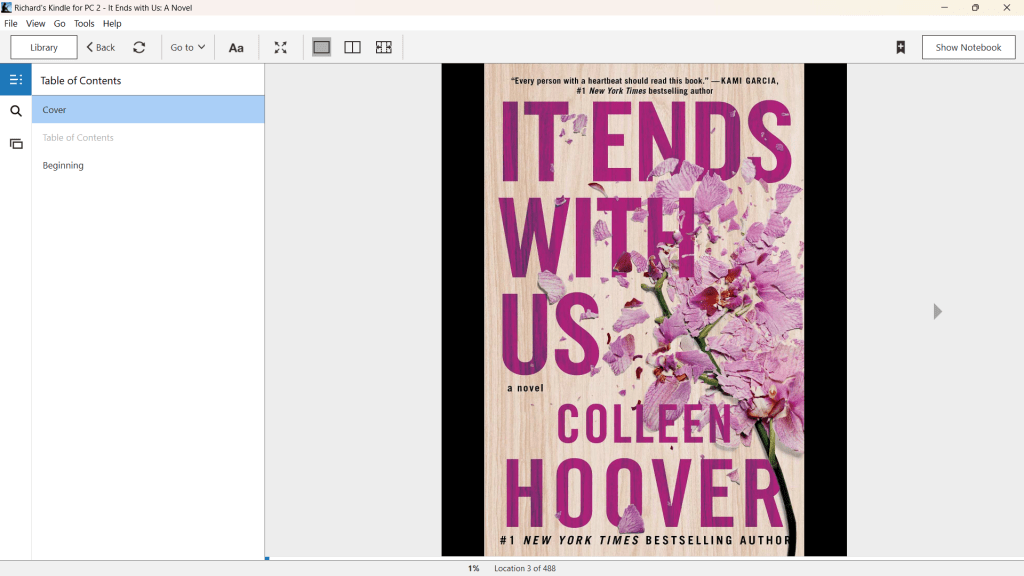
Here’s what I’m listening to: It Ends With Us, by Colleen Hoover
Amazon abstract:
In this “brave and heartbreaking novel that digs its claws into you and doesn’t let go, long after you’ve finished it” (Anna Todd, New York Times bestselling author) from the #1 New York Times bestselling author of All Your Perfects, a workaholic with a too-good-to-be-true romance can’t stop thinking about her first love.
Lily hasn’t always had it easy, but that’s never stopped her from working hard for the life she wants. She’s come a long way from the small town where she grew up—she graduated from college, moved to Boston, and started her own business. And when she feels a spark with a gorgeous neurosurgeon named Ryle Kincaid, everything in Lily’s life seems too good to be true.
Ryle is assertive, stubborn, maybe even a little arrogant. He’s also sensitive, brilliant, and has a total soft spot for Lily. And the way he looks in scrubs certainly doesn’t hurt. Lily can’t get him out of her head. But Ryle’s complete aversion to relationships is disturbing. Even as Lily finds herself becoming the exception to his “no dating” rule, she can’t help but wonder what made him that way in the first place.
As questions about her new relationship overwhelm her, so do thoughts of Atlas Corrigan—her first love and a link to the past she left behind. He was her kindred spirit, her protector. When Atlas suddenly reappears, everything Lily has built with Ryle is threatened.
An honest, evocative, and tender novel, It Ends with Us is “a glorious and touching read, a forever keeper. The kind of book that gets handed down” (USA TODAY).
Very much not in the spirit of “just asking questions,” which is so pervasive among creationists, climate deniers, anti-vaxxers, 9/11 Truthers, Obama Birthers, QAnoners and many others that it has its own skeptical descriptor—JAQing off—I present here some challenging questions for Christians and other religious believers.
I realize that faith doesn’t always open itself to rational inquiry and empirical testing, otherwise it wouldn’t be faith, or “the assurance of things hoped for, the conviction of things unseen” (Hebrews 11:1). But in this age of science and rationality—the twin pillars of Enlightenment humanism—a great many Christians and members of other faiths contend that their claims are true, not in the mythic or metaphorical sense, but in the literal sense.
Skeptic is a reader-supported publication. All monies go to the Skeptics Society, a 501(c)(3) nonprofit. To receive new posts and support my work, consider becoming a free or paid subscriber.
Upgrade to paid
There really is a God called Yahweh. God really created the universe and everything in it. God really vouchsafed to us humans consciousness, morality, and meaning. God really performs miracles. God really grants everlasting life after the provisional proscenium of this world. And so forth.
For over four decades—after my own seven-year stint as an evangelical Christian—I have engaged believers in countless conversations and dozens of formal debates, so I can assure readers that for a great many religious people their beliefs are literally true, in the Enlightenment sense of knowledge as justified true belief. That is, they believe that there are arguments and evidence for religious claims substantial enough to be considered “true,” which I define (in Why People Believe Weird Things) as: a claim for whichthe evidence is so substantial it would be reasonable to offer one’s provisional assent.
I rarely hear such sentiments as “this is my faith—I’m not claiming that it is literally true.” Or “this is just what I believe and I’m not trying to convince you that you should believe it too.” Or “this is what people of my faith believe but people in other faiths believe something different and all are equally true.” Such qualifiers are rare enough in my world that I can (and have) identified who declared them. The renowned biologist Ken Miller is one, a self-declared Catholic who nevertheless isn’t claiming the central tenets of which are scientific conclusions.
Another is Martin Gardner, one of the founders of the modern skeptical movement and a debunker of all forms of flimflam and flapdoodle, who nevertheless declared himself a philosophical theist, or sometimes a fideist—someone “who believes something on the basis of emotional reasons rather than intellectual reasons,” as he told me in an interview:
People think that if you don’t believe Uri Geller can bend spoons then you must be an atheist. But I think these are two different things. I call myself a philosophical theist in the tradition of Kant, Charles Peirce, William James, and especially Miguel Unamuno, one of my favorite philosophers. As a fideist I don’t think there are any arguments that prove the existence of God or the immortality of the soul. Even more than that, I agree with Unamuno that the atheists have the better arguments. So it is a case of quixotic emotional belief that is really against the evidence and against the odds. The classic essay in defense of fideism is William James’ The Will to Believe. James’ argument, in essence, is that if you have strong emotional reasons for a metaphysical belief, and it is not strongly contradicted by science or logical reasons, then you have a right to make a leap of faith if it provides sufficient satisfaction.
It makes the atheists furious when you take this position because they can no more argue with you than they can argue over whether you like the taste of beer or not. To me it is entirely an emotional thing.
I pressed Martin to expand on his comment that atheists’ arguments are better than theists’ arguments:
Well, they are better in the sense that the theist has a tremendous problem of explaining the existence of evil, and to me that is the strongest argument against God. If there is a God and he is all powerful and all good, why does he allow evil into the world? Evil exists, so is God all good but not all powerful? Or is he all powerful but not all good? That is a very powerful argument and I don’t know of any good way to answer it.
What about the afterlife, I inquire?
If you believe in God at all, I think you have to believe in a personal God, in a sense. That is, you have to assign to God something analogous to human mind because that is the highest type mind we are acquainted with. If God is just another name for nature then I think it is more honest just to say we are humanists.
Indeed, this is why I call myself a humanist, or more specifically an Enlightenment humanist, but this is not what most people believe by “God”, which Gardner acknowledged:
No, and of course if you do believe in a personal God it is in an analogical sense, so I sometimes like to call myself a theological positivist because I agree completely with Carnap that metaphysical questions are meaningless—if you can’t get at it by logic or by science you really can’t say anything at all about the question.
If you ask me for details about the nature of God I would have to answer “I don’t know.” The kind of God I believe in is so completely transcendent and so wholly Other that you really can’t say anything about God’s nature. To ask, for example, whether God is inside or outside of time, I have no idea what this means or how to reply to it. I can understand arguments saying he is in time, coming from the process theologians; on the other hand I can understand the arguments that place God completely outside of time, in some sort of realm in which time has no meaning. But these are metaphysical arguments and Carnap would say they are meaningless questions, and I would agree to that.
If this is what you believe, that is, you are a philosophical theist in this pragmatic fideist tradition, then the following questions are not for you. If you are a religious believer in the more traditional sense, or if you know people who are, then these questions may prove challenging. (In appreciation and acknowledgment of my friend and colleague Michael Aisner for the inspiration for this exercise.) If you would like to provide answers to or comment on any of these questions feel free to use the Comments section below.
* * *
Given that there dozens of major religions, hundreds of minor religions, and thousands of religious sects, that they often differ substantially in their core beliefs does this suggest one of them is the “right religion” and all the rest are “wrong” (in some epistemological sense), or could it be that they are all human constructions and none of them are right (in an ontological sense)?
If you were raised in a different religion, do you think you would now belong to that religion instead and believe it as much as you do your current religion?
If you pray and hear the voice of God in your head, how can you tell that it is God talking to you or just the normal voices in the head that we all experience?
If that voice of God commanded you to do something immoral or illegal, would you do it? That is, if the voices in your head are a form of evidence for God’s providence, how do you decide which commandments to follow and which to reject?
The bible and other holy books are chockablock full of moral prescriptions (what we should do) and proscriptions (what we shouldn’t do), but they often contradict one other (do I love my neighbor as myself or should I smite them as moral enemies) or are in conflict with modern morals and laws (slavery, torture, capital punishment), so how do you decide which ones to obey and which to ignore?
Echoing Plato’s “Euthyphro’s dilemma” (“whether the pious or holy is beloved by the gods because it is holy, or holy because it is beloved of the gods?”), does God embrace moral principles naturally occurring and external to Him because they are sound (“holy”) or are these moral principles sound only because God says that they are sound or otherwise they wouldn’t be? If moral principles hold value only because we believe that God created them, then what is their value if there is no God? Do we really need God to tell us that murder, rape, slavery, torture, pedophilia, lying, and stealing are wrong?
If God is omniscient, omnipotent, and omnibenevolent, and thus he knows what is in your heart and mind, why does he require you to demonstrate your faith by worshiping him? In any case, why would such a being need to be worshipped? Isn’t worshipfulness a human desire often affiliated with dictators, demagogues, and authoritarians of all stripes?
If God is omniscient, omnipotent, and omnibenevolent, why do holy books describe him as surprised or angered by the actions of humans? Shouldn’t he have known what was going to happen?
If God is omniscient, omnipotent, and omnibenevolent, then how can Jesus be his son and God at the same time? Doesn’t this violate Aristotle’s Law of Identity, or A is A, or “everything is the same as itself and different from another” (Metaphysics IV, 3)?
If God is Jesus is vice versa, then the Christian claim that one must accept Jesus as one’s savior from original sin in order to have everlasting life (and not spend an eternity in hell), doesn’t this mean that God sacrificed…himself…to himself…to save us from himself?
When did Jesus become a capitalist? Didn’t he caution his followers about the dangers of wealth and the worship of money, didn’t he admonish the money changers, and didn’t he preach that it would be easier “for a camel to go through the eye of a needle than for someone who is rich to enter the kingdom of God” (Matthew 19:23)?
If missionaries from your religion are sent to evangelize and convert people in other countries, should missionaries from other religions be sent to your country for the same reason?
When you declare a miracle, does this mean you understand everything that is possible in nature? Could it be that the said miracle is just something that happened for which you have no explanation (the argument from ignorance, or the God of the Gaps argument)?
If God answers prayers and sometimes they seem to come true—say, the healing of someone’s cancer, recovery from a horrific accident, or survival in a seemingly deadly situation—what about all the devout believers who (and whose devout families) fervently prayed for them and they nevertheless died or suffered unmercifully?
If God can heal cancers, cure deadly diseases, enable pregnancies, and perform countless signs and miracles, why can’t he grow new limbs on Christian soldiers maimed in battle? Salamanders can grow new limbs, so why can’t God do that for his faithful and worshipful followers?
Can a mass murderer, serial killer, or child abuser go to heaven if, just before death, he accepts Jesus as his savior? Wouldn’t it be more just if he burned in hell for eternity for his deeds? In other words, don’t works matter more than words?
Do the mass murdering and torturing Crusaders and Inquisitors make it into the Christian heaven if they accepted Jesus as their savior?
If aliens exist on other worlds and they have never heard of your God, what happens to them? Does Jesus visit all exo-planets that contain sentient beings? Are there the equivalent of alien Romans who torture and murder Jesus, who rises from the dead to atone for their original alien sins?
* * *
I have many more such questions, but that should suffice for now to (hopefully) at least give Christians and other religious believers pause in their confidence in the verisimilitude of their knowledge assertions. Perhaps—and here hope springs eternal—religious believers might consider the skeptical admonitions of Oliver Cromwell in his letter to the general assembly of the Church of Scotland on August 3, 1650:
Is it therefore infallibly agreeable to the Word of God, all that you say? I beseech you, in the bowels of Christ, think it possible you may be mistaken.
Skeptic is a reader-supported publication. All monies go to the Skeptics Society, a 501(c)(3) nonprofit. To receive new posts and support our work, consider becoming a free or paid subscriber.
We’ve all heard about the importance of finding your voice as a writer. Maybe you’ve had a critique from an editor who felt the narrative voice wasn’t sharp enough. Or maybe a critique mentioned the author’s voice creeping into the narrative and you found yourself thinking, huh? Isn’t that the voice I worked so hard to develop in the first place?
Well, yes. And no.
We each have a voice that we write in, and it’s as individual as a fingerprint. A novel by Margaret Atwood will sound different than one by Stephen King, and while this might be related to both genre and characters, there’s an ineffable quality to each author’s voice that seeps into their work regardless of how hard they might try to keep it out.
The trick is not to let that voice break the fictional dream you’ve created in your work.
This can happen in several ways: when the author has an agenda they’re trying to slip into the story; when they inadvertently break the POV by stepping in to comment on something; and when they succumb to the temptation to use what Elmore Leonard calls hooptedoodle.
Having an Agenda
When we write a novel, we often (hopefully) have something to say. Let’s call it a theme, the answer to the dreaded so what? question. The line between theme and message, however, is a thin one, and if you’re not subtle enough about your intentions, your reader will sense you’re trying to teach them something and will back away.
Having something to say should not be the same as telling readers what to think.It’s always better to give readers questions to ponder rather than answers to swallow. So, if you have an agenda, shelve it. Give us something to think about. But don’t tell us we have to think like you.
As Ursula le Guin so elegantly puts it, a story’s job is to achieve meaning; it’s a door that opens onto a new world. Messages are for sermons. If all you see in The Hobbit is a message about greed, you’ve missed the magic.
Let the Narrator Narrate
When the author’s voice creeps into a defined POV, you pull your reader out of the fictional dream. It’s jarring. In fact, this gets to the heart of POV, where consistent character voice is crucial to reader immersion.
In any deep POV you choose, you’ll be seeing the world through someone else’s eyes. That means everything—from what they notice to the analogies they draw—must be filtered through a lens that is not your own. Douglas Glover calls this language overlay, and it’s one of the most useful POV pointers I’ve ever come across. A sailor will not think the same way as a baker, and this difference can run deep. As an example, the sailor might always have one eye on the weather; a baker might be perpetually attuned to smells. Your teen narrator who suddenly knows the Latin names of plants will pull readers out of the story scratching their heads and wondering how this narrator has such easy access to this specialized information. Not to say it can’t work. If the narrator’s mother is a botanist and has been teaching him the Latin names of plants from the time he was a toddler, it will add another layer to his character. But that has to be established in the story.
An objective POV is all about what can be seen on the surface, so the author’s voice definitely shouldn’t be part of that. And in omniscience, there is still a narrator—but unless it’s you, the reader shouldn’t hear your voice.
Avoid Hooptedoodle
Our name might be on the cover of the book we’ve written, but we should never take center stage in our novel unless we’re doing something funky with metafiction. One of the ways we sneak ourselves into our work is with fancy writing that calls attention to itself for no other reason than to wave a flag and say look what I can do.
I’m a huge fan of poetic writing, but I’m also a firm believer in the importance of double duty. Every element in a novel should do more than one thing. A pretty description of the weather should also be a reflection of mood or an ironic foreshadowing or whatever else you have up your sleeve. If you’ve written a whole paragraph about the dark billowing sky, let it also reflect a building dread in the narrator or allow it to serve as a reminder that the body he dropped into the lake might not have been weighted down with enough rocks.
But if that billowing sky is only there for the reader to admire, then it sounds like writing. And as Elmore Leonard also said: “If it sounds like writing, I rewrite it.”
Do your readers a favor: either take it out or give it a second job.
Finding Your Voice
The notion of finding your voice has never made sense to me. Your voice is who you are. No matter whose shoes you’re wearing in a particular novel, your voice will come through. If you don’t believe that, try reading one author’s entire body of work. You’ll meet a room full of characters who might all sound different, but there will also be something humming beneath them that they share: the person who created them.
You don’t have to find your voice. You are your voice.
What you have to do is write. A lot. Learn how to handle POV so that you, the author, remain the silent partner in this weird agreement you make with your readers when you bring a world to life. Don’t remind the reader that they’re reading a story. Allow them to believe in the dream.
As for crafting a character’s voice, well… that’s a topic that deserves its own post. Which it will have next time you see me here.
Michelle Barker is an award-winning author, editor, and writing teacher who lives in Vancouver, BC. Her newest novel My Long List of Impossible Things, came out in 2020 with Annick Press. It was a finalist for the Vine Awards and is a Junior Library Guild gold standard selection. She is the author of The House of One Thousand Eyes, which was named a Kirkus Best Book of the Year and won numerous awards including the Amy Mathers Teen Book Award. She’s also the author of the historical picture book, A Year of Borrowed Men, as well as the fantasy novel, The Beggar King, and a chapbook, Old Growth, Clear-Cut: Poems of Haida Gwaii. Her fiction, non-fiction and poetry have appeared in literary reviews around the world.
Michelle holds an MFA in creative writing from UBC and has been a senior editor at The Darling Axe since its inception, though she’s been editing and teaching creative writing for decades. She loves working closely with writers to hone their manuscripts and discuss the craft.
“We live and move by splitting the light of the present, as a canoe’s bow parts water.”
BY MARIA POPOVA
“To die is different from what any one supposed, and luckier,” wrote Walt Whitman a century and a half before Richard Dawkins considered the luckiness of death as a radiant token of the improbable odds of having lived at all. Death — the harrowing fact of our mortality — is the central animating force of life, the one great terror for which we have devised the coping mechanisms of love and art. Everything we make, everything we do, is a bid for bearing our transience. And yet this is the native poetry of the cosmos — in a universe churned by entropy, the very fact of our impermanence is life’s most enduring source of meaning.
That is what the uncommonly poetic and penetrating Annie Dillard explores throughout her book For the Time Being (public library), published in the final year of the world’s deadliest century.
With an eye to sand — Earth’s emissary of deep time, builder and dismatler of civilizations — Dillard writes:
Since sand and dirt pile up on everything, why does it look fresh for each new crowd? As natural and human debris raises the continents, vegetation grows on the piles. It is all a stage set — we know this — a temporary stage on top of many layers of stages, but every year fungus, bacteria, and termites carry off the old layer, and every year a new crop of sand, grass, and tree leaves freshens the set and perfects the illusion that ours is the new and urgent world now. When Keats was in Rome, he saw pomegranate trees overhead; they bloomed in dirt blown onto the Colosseum’s broken walls. How can we doubt our own time, in which each bright instant probes the future? We live and move by splitting the light of the present, as a canoe’s bow parts water.
In every arable soil in the world we grow grain over tombs — sure, we know this. But do not the dead generations seem to us dark and still as mummies, and their times always faded like scenes painted on walls at Pompeii?
We live on mined land. Nature itself is a laid trap. No one makes it through; no one gets out.
Art from Duck, Death and the Tulip by Wolf Elbruch — a German picture-book about making sense of death
“You don’t have to think very hard to realize that our dread of both relationships and loneliness,” David Foster Wallace wrote as he reckoned with mortality and redemption, “has to do with angst about death, the recognition that I’m going to die, and die very much alone, and the rest of the world is going to go merrily on without me.” In consonance with Wallace, Dillard writes:
Are we ready to think of all humanity as a living tree, carrying on splendidly without us? We easily regard a beehive or an ant colony as a single organism, and even a school of fish, a flock of dunlin, a herd of elk. And we easily and correctly regard an aggregate of individuals, a sponge or coral or lichen or slime mold, as one creature — but us? When we people differ, and know our consciousness, and love? Even lovers, even twins, are strangers who will love and die alone. And we like it this way, at least in the West; we prefer to endure any agony of isolation rather than to merge and extinguish our selves in an abstract “humanity” whose fate we should hold dearer than our own. Who could say, I’m in agony because my child died, but that’s all right: Mankind as a whole has abundant children? The religious idea sooner or later challenges the notion of the individual. The Buddha taught each disciple to vanquish his fancy that he possessed an individual self. Huston Smith suggests that our individuality resembles a snowflake’s: The seas evaporate water, clouds build and loose water in snowflakes, which dissolve and go to sea. The simile galls. What have I to do with the ocean, I with my unique and novel hexagons and spikes? Is my very mind a wave in the ocean, a wave the wind flattens, a flaw the wind draws like a finger?
We know we must yield, if only intellectually. Okay, we’re a lousy snowflake. Okay, we’re a tree. These dead loved ones we mourn were only those brown lower branches a tree shades and kills as it grows; the tree itself is thriving. But what kind of tree are we growing here, that could be worth such waste and pain? For each of us loses all we love, everyone we love. We grieve and leave.
Biking is something else I both love and hate. It takes a lot of effort but does provide good exercise and most days over an hour to listen to a good book or podcast. I especially like having ridden.
Here’s my bike, a Rockhopper by Specialized. I purchased it November 2021 from Venture Out in Guntersville; Mike is top notch! So is the bike, and the ‘old’ man seat I salvaged from an old Walmart bike.
Here’s what I’m listening to: It Ends With Us, by Colleen Hoover
Amazon abstract:
In this “brave and heartbreaking novel that digs its claws into you and doesn’t let go, long after you’ve finished it” (Anna Todd, New York Times bestselling author) from the #1 New York Times bestselling author of All Your Perfects, a workaholic with a too-good-to-be-true romance can’t stop thinking about her first love.
Lily hasn’t always had it easy, but that’s never stopped her from working hard for the life she wants. She’s come a long way from the small town where she grew up—she graduated from college, moved to Boston, and started her own business. And when she feels a spark with a gorgeous neurosurgeon named Ryle Kincaid, everything in Lily’s life seems too good to be true.
Ryle is assertive, stubborn, maybe even a little arrogant. He’s also sensitive, brilliant, and has a total soft spot for Lily. And the way he looks in scrubs certainly doesn’t hurt. Lily can’t get him out of her head. But Ryle’s complete aversion to relationships is disturbing. Even as Lily finds herself becoming the exception to his “no dating” rule, she can’t help but wonder what made him that way in the first place.
As questions about her new relationship overwhelm her, so do thoughts of Atlas Corrigan—her first love and a link to the past she left behind. He was her kindred spirit, her protector. When Atlas suddenly reappears, everything Lily has built with Ryle is threatened.
An honest, evocative, and tender novel, It Ends with Us is “a glorious and touching read, a forever keeper. The kind of book that gets handed down” (USA TODAY).
In 1959, Carl Jung first popularized the idea of archetypes—”universal images that have existed since the remotest times.” He posited that every person is a blend of these 12 basic personalities. Ever since then, authors have been applying this idea to fictional characters, combining the different archetypes to come up with interesting new versions. The result is a sizable pool of character tropes that we see from one story to another.
Archetypes and tropes are popular storytelling elements because of their familiarity. Upon seeing them, readers know immediately who they’re dealing with and what role the nerd, dark lord, femme fatale, or monster hunter will play. As authors, we need to recognize the commonalities for each trope so we can write them in a recognizable way and create a rudimentary sketch for any character we want to create.
But when it comes to characters, no one wants just a sketch; we want a vibrant and striking cast full of color, depth, and contrast. Diving deeper into character creation is especially important when starting with tropes because the blessing of their familiarity is also a curse; without differentiation, the characters begin to look the same from story to story.
But no more. The Character Type and Trope Thesaurus allows you to outline the foundational elements of each trope while also exploring how to individualize them. In this way, you’ll be able to use historically tried-and-true character types to create a cast for your story that is anything but traditional.
Explorer Archetype
DESCRIPTION Explorers thrive on adventure and discovery. These trailblazers are unafraid of new experiences or challenges, and boldly moving into the unknown is a part of their identity.
FICTIONAL EXAMPLES: Indiana Jones (Indiana Jones Series), Captain Picard (Star Trek), Lara Croft (Tomb Raider), Evelyn O’Connell (The Mummy Franchise)
ASSOCIATED ACTIONS, BEHAVIORS, AND TENDENCIES Nomadic tendencies (being on the move, never staying too long in one place) Not needing much in the way of creature comforts Having fewer attachments (to things, people, places) Having a broad understanding of people, cultures, and customs Knowing more than one language Being highly spontaneous Being a ‘figure it out as I go’ sort of person Having a strong sense of purpose and a clear goal at all times Able to think on their feet and adapt to changing circumstances Being able to learn the rules of a new environment quickly Excellent survival and navigation skills Recovering from disappointments quickly and moving on Being drawn in by stories Being curious about people, places, and experiences A desire to see and experience things first hand Always being up for a trip, outing, or adventure Being unafraid of new circumstances or challenges Being a thrill-seeker Not being turned off by danger or risk More likely to act on instinct rather than through a deep analysis The ability to size people up quickly Needing to be talked out of things, rather than talked into them Preferring their own company to the company of others A tendency to believe the ends justify the means (when they believe in the cause) Being a lifelong learner Focusing on the journey, not the goal A tendency to push to find their own limits (and then push to challenge them further) Fearing a boring life more than anything else
SITUATIONS THAT WILL CHALLENGE THEM Having no choice but to wait because another is in control of when things happen Having to adhere to a routine Being unable to travel (due to illness, legal restrictions, an injury, family responsibilities, etc.) Being anchored by duty (becoming a caregiver to an elderly parent, having to run a family business, raising a child, etc.) Being bound by rules and limitations Having to give up personal freedom to serve the greater good Being stuck in a single place for too long Finding time for healthy, two-way relationships Finding someone to talk through their feelings or struggles because while they may know a lot of people, few are close enough for those type of conversations Being around people who are closed-minded and see the world in absolutes
INNER STRUGGLES TO GIVE THEM DEPTH Feeling selfish for wanting to be out discovering new things when it means others must stay behind and pick up the slack Wanting to have relationships but knowing the other party will only end up feeling neglected Feeling guilt for abandoning people when the next adventure calls Guilt over risk-taking that impacts others negatively Regret over what they chose to give up (possibly a place to call home, close family bonds, a life partner, etc.) Knowing the personal growth they seek may come at the price of a lonely life
TWIST THIS TROPE WITH A CHARACTER WHO… Finds ways to be dependable while making room for adventure Gives back as a teacher or leader who encourages others to embrace open-mindedness Becomes a role model to someone who is dependent or insecure, showing them how to become more independent Is an explorer who is unselfish, putting the needs of others first
CLICHÉS TO BE AWARE OF
The “lone wolf” adventurer
The explorer who inspires deep loyalty despite never being around to nurture relationships
The adventurer who only travels to far off, obscure places
Being a collector of antiquities and objects when the lifestyle doesn’t support materialism
Other Type and Trope Thesaurus entries can be found here.
Need More Descriptive Help?
While this thesaurus is still being developed, the rest of our descriptive collection (16 unique thesauri and growing) is accessible through the One Stop for Writers THESAURUS database.
If you like, swing by and check out the video walkthrough for this site, and then give our Free Trial a spin.
Angela is a writing coach, international speaker, and bestselling author who loves to travel, teach, empower writers, and pay-it-forward. She also is a founder of One Stop For Writers, a portal to powerful, innovative tools to help writers elevate their storytelling.
“Because mystery is horrible to us, we have agreed for the most part to live in a world of labels; to make of them the current coin of experience, and ignore their merely symbolic character, the infinite gradation of values which they misrepresent.”
BY MARIA POPOVA
The great paradox of consciousness is that it constitutes both our entire experience of reality and our blindfold to reality as it really is. Forever trapped within it, we mistake our concepts of things for the things themselves, our theories for the universe, continually seeing the world not as it is but as we are. The supreme frontier of human freedom may be the ability to accept that something exists beyond understanding, that understanding is a machination of the mind and not a mirror of the world — that the world simply is, and our consciousness is a participant in its being but not a creator of it.
The English poet, novelist, mystic, and peace activist Evelyn Underhill (December 6, 1875–June 15, 1941) explores how to do that in her 1914 book Practical Mysticism (public library | public domain) — a field guide to mystical experience that is secular rather than religious, the product of “ordinary contemplation” springing from the very essence of human nature, available to all.
Evelyn Underhill
Acknowledging what modern cognitive scientists well know — that our attention is “an intentional, unapologetic discriminator” — Underhill observes that “only a few amongst the wealth of impressions we receive are seized and incorporated into our picture of the world,” and reflects on the spiritual significance of this tendency to mistake representation for reality:
The distinction between mystic and non-mystic is not merely that between the rationalist and the dreamer, between intellect and intuition. The question which divides them is really this: What, out of the mass of material offered to it, shall consciousness seize upon — with what aspects of the universe shall it “unite”?
It is notorious that the operations of the average human consciousness unite the self, not with things as they really are, but with images, notions, and aspects of things. The verb “to be,” which [the self] uses so lightly, does not truly apply to any of the objects amongst which the practical man supposes himself to dwell. For him, the hare of Reality is always ready-jugged [jugged hare is a traditional English dish of hare marinated in wine and juniper berries, cooked in the animal’s blood]: he conceives not the living, lovely, wild, swift-moving creature which has been sacrificed in order that he may be fed on the deplorable dish which he calls “things as they really are.” So complete, indeed, is the separation of his consciousness from the facts of being, that he feels no sense of loss. He is happy enough “understanding,” garnishing, assimilating the carcass from which the principle of life and growth has been ejected, and whereof only the most digestible portions have been retained.
This, Underhill observes, is the opposite of the mystical orientation, which opens us up to a kind of knowledge beyond understanding — the kind that Elizabeth Bishop invoked in her astonishing poem “At the Fishhouses,” consonant with the notion of adaequatio and kindred to Maurice Bucke’s notion of cosmic consciousness.
Five years earlier, Underhill had voiced these existential reckonings through the heroine of her novel The Column of Dust:
She had seen, abruptly, the insecurity of those defences which protect our illusions and ward off the horrors of truth. She had found a little hole in the wall of appearances; and peeping through, had caught a glimpse of that seething pot of spiritual forces whence, now and then, a bubble rises to the surface of things.
That bubble, she intimates in Practical Mysticism, is what mysticism as “the art of union with Reality” surfaces in us. She writes:
Because mystery is horrible to us, we have agreed for the most part to live in a world of labels; to make of them the current coin of experience, and ignore their merely symbolic character, the infinite gradation of values which they misrepresent. We simply do not attempt to unite with Reality. But now and then that symbolic character is suddenly brought home to us. Some great emotion, some devastating visitation of beauty, love, or pain, lifts us to another level of consciousness; and we are aware for a moment of the difference between the neat collection of discrete objects and experiences which we call the world, and the height, the depth, the breadth of that living, growing, changing Fact, of which thought, life, and energy are parts… Then we realise that our whole life is enmeshed in great and living forces; terrible because unknown… The more sacred plane of life and energy which seems to be manifested in the forces we call “spiritual” and “emotional” — in love, anguish, ecstasy, adoration — is hidden from us too. Symptoms, appearances, are all that our intellects can discern: sudden irresistible inroads from it, all that our hearts can apprehend. The material for an intenser life, a wider, sharper consciousness, a more profound understanding of our own existence, lies at our gates. But we are separated from it, we cannot assimilate it; except in abnormal moments, we hardly know that it is.
Those who bridge the separation, Underhill argues, are the mystics. Pointing to Walt Whitman as one such secular mystic — a person who “has achieved a passionate communion with deeper levels of life than those with which we usually deal” — she invites a layered understanding of what this notion of practical mysticism means:
The visionary is a mystic when his vision mediates to him an actuality beyond the reach of the senses. The philosopher is a mystic when he passes beyond thought to the pure apprehension of truth. The active man is a mystic when he knows his actions to be a part of a greater activity. Blake, Plotinus, Joan of Arc, and John of the Cross — there is a link which binds all these together: but if he is to make use of it, the inquirer must find that link for himself.
This practical mysticism, she argues as she contrasts it with an “indolent and useless mysticality,” is available to the ordinary person as an invitation “to a training of his latent faculties, a bracing and brightening of his languid consciousness, an emancipation from the fetters of appearance, a turning of his attention to new levels of the world.” She offers a sentiment of winged assurance:
As the beautiful does not exist for the artist and poet alone — though these can find in it more poignant depths of meaning than other men — so the world of Reality exists for all; and all may participate in it, unite with it, according to their measure and to the strength and purity of their desire.
Underhill considers the ultimate reward of practical mysticism:
Mysticism [is] the art of union with Reality [and], above all else, a Science of Love. Hence, the condition to which it looks forward and towards which the soul of the contemplative has been stretching out, is a condition of being, not of seeing. As the bodily senses have been produced under pressure of man’s physical environment, and their true aim is not the enhancement of his pleasure or his knowledge, but a perfecting of his adjustment to those aspects of the natural world which concern him — so the use and meaning of the spiritual senses are strictly practical too. These, when developed by a suitable training, reveal to man a certain measure of Reality: not in order that he may gaze upon it, but in order that he may react to it, learn to live in, with, and for it; growing and stretching into more perfect harmony with the Eternal Order, until at last, like the blessed ones of Dante’s vision, the clearness of his flame responds to the unspeakable radiance of the Enkindling Light.
The attitude which it involves is an attitude of complete humility and of receptiveness; without criticism, without clever analysis of the thing seen. When you look thus, you surrender your I-hood; see things at last as the artist does, for their sake, not for your own. The fundamental unity that is in you reaches out to the unity that is in them: and you achieve the “Simple Vision” of the poet and the mystic — that synthetic and undistorted apprehension of things which is the antithesis of the single vision of practical men. The doors of perception are cleansed, and everything appears as it is. The disfiguring results of hate, rivalry, prejudice, vanish away. Into that silent place to which recollection has brought you, new music, new colour, new light, are poured from the outward world. The conscious love which achieves this vision may, indeed must, fluctuate… But the will which that love has enkindled can hold attention in the right direction. It can refuse to relapse to unreal and egotistic correspondences; and continue, even in darkness, and in the suffering which such darkness brings to the awakened spirit, its appointed task, cutting a way into new levels of Reality.



























 Richard L. Fricks