Biking is something else I both love and hate. It takes a lot of effort but does provide good exercise and most days over an hour to listen to a good book or podcast. I especially like having ridden.
Here’s my bike, a Rockhopper by Specialized. I purchased it November 2021 from Venture Out in Guntersville; Mike is top notch! So is the bike, and the ‘old’ man seat I salvaged from an old Walmart bike.
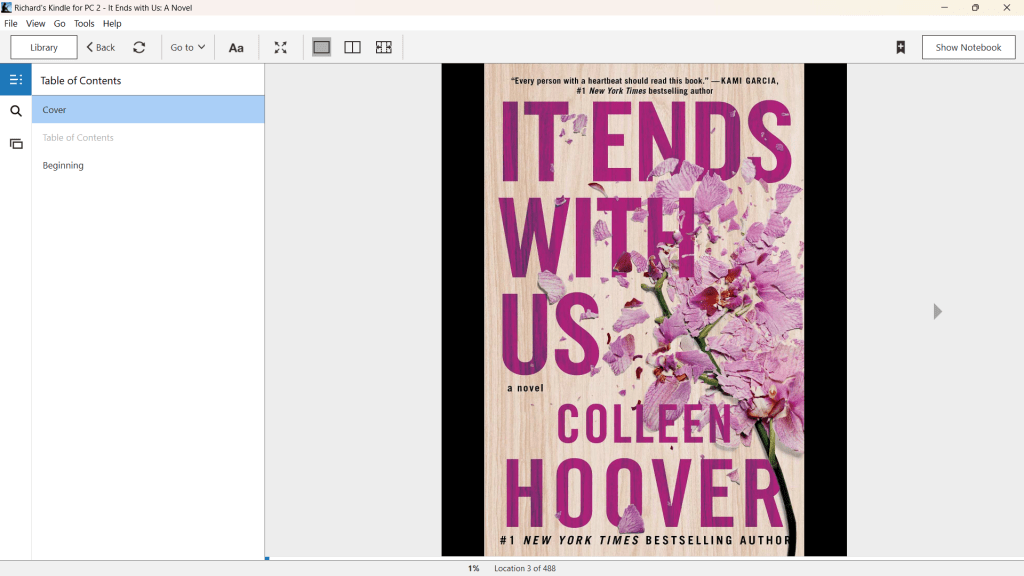
Here’s what I’m listening to: It Ends With Us, by Colleen Hoover
Amazon abstract:
In this “brave and heartbreaking novel that digs its claws into you and doesn’t let go, long after you’ve finished it” (Anna Todd, New York Times bestselling author) from the #1 New York Times bestselling author of All Your Perfects, a workaholic with a too-good-to-be-true romance can’t stop thinking about her first love.
Lily hasn’t always had it easy, but that’s never stopped her from working hard for the life she wants. She’s come a long way from the small town where she grew up—she graduated from college, moved to Boston, and started her own business. And when she feels a spark with a gorgeous neurosurgeon named Ryle Kincaid, everything in Lily’s life seems too good to be true.
Ryle is assertive, stubborn, maybe even a little arrogant. He’s also sensitive, brilliant, and has a total soft spot for Lily. And the way he looks in scrubs certainly doesn’t hurt. Lily can’t get him out of her head. But Ryle’s complete aversion to relationships is disturbing. Even as Lily finds herself becoming the exception to his “no dating” rule, she can’t help but wonder what made him that way in the first place.
As questions about her new relationship overwhelm her, so do thoughts of Atlas Corrigan—her first love and a link to the past she left behind. He was her kindred spirit, her protector. When Atlas suddenly reappears, everything Lily has built with Ryle is threatened.
An honest, evocative, and tender novel, It Ends with Us is “a glorious and touching read, a forever keeper. The kind of book that gets handed down” (USA TODAY).
“Hence both in space and time, we seem to be brought somewhat near to that great fact—that mystery of mysteries—the first appearance of new beings on this earth.” —Charles Darwin, Journal of Researches, 1845
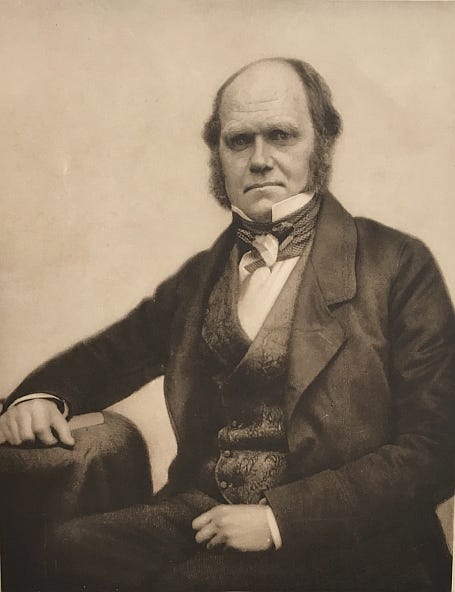
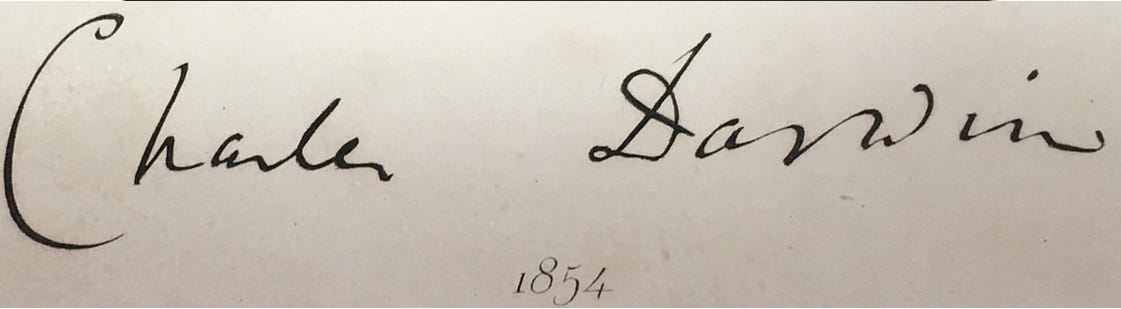
Today, February 12, 2023, is International Darwin Day, the 214th anniversary of the birth of Charles Darwin, the co-discoverer (along with Alfred Russel Wallace—see my biography In Darwin’s Shadow) of evolution by natural selection, and one of the most influential scientists in history. To honor the sage of Down I have pieced together excerpts from my 2006 book Why Darwin Matters, which attempts to answer the title question (and is my only book cover featuring full frontal nudity). His influence only continues to grow as the years pile up after his death on April 19, 1882 (age 73). (Photographs within courtesy of The Complete Photographs of Darwin by John van Wyhe, part of the Darwin Online project.)
Skeptic is a reader-supported publication. All monies go to the Skeptics Society, a 501(c)(3) nonprofit. To receive new posts and support my work, consider becoming a paid subscriber.
Upgrade to paid
The Myth of Darwin in the Galapagos
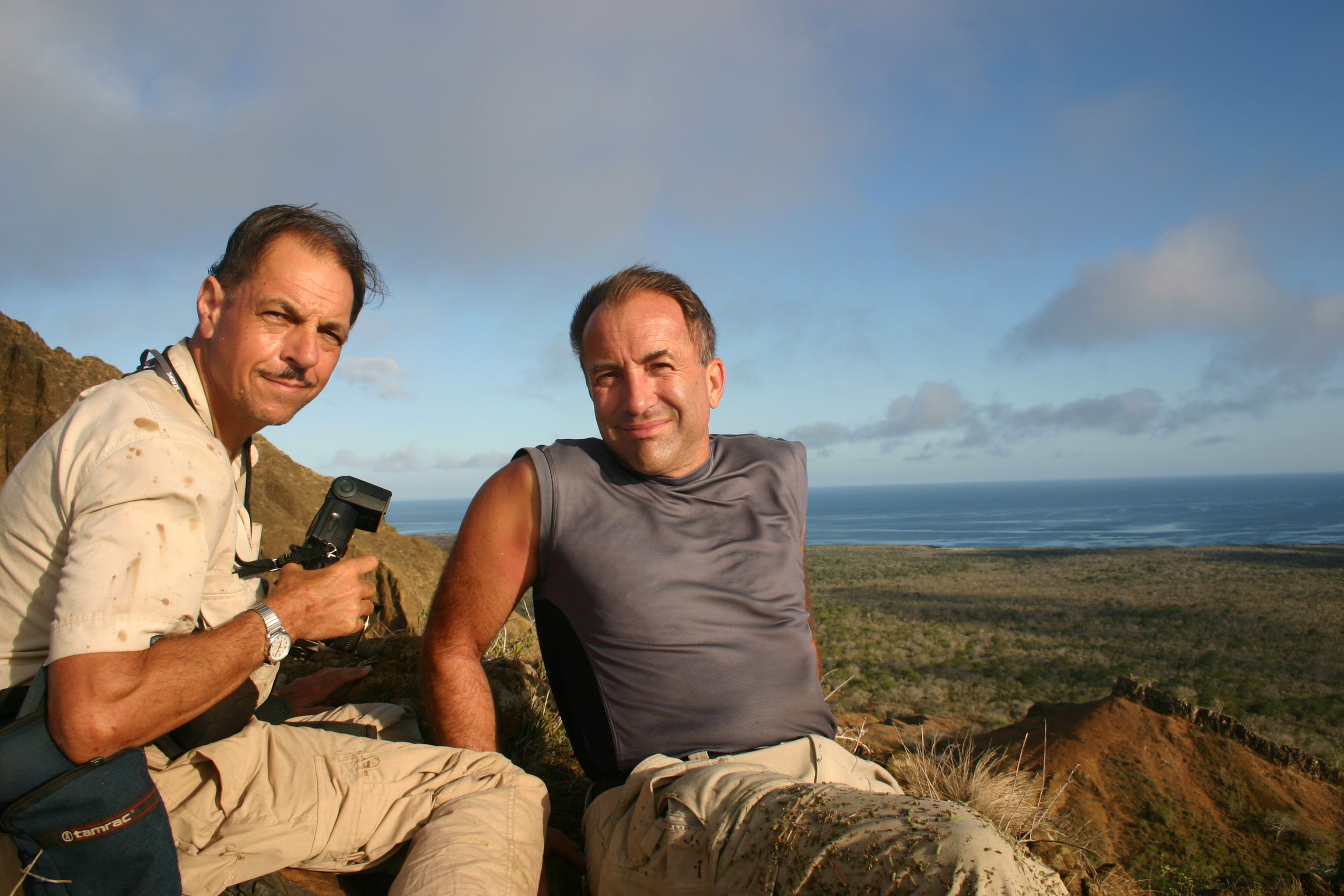
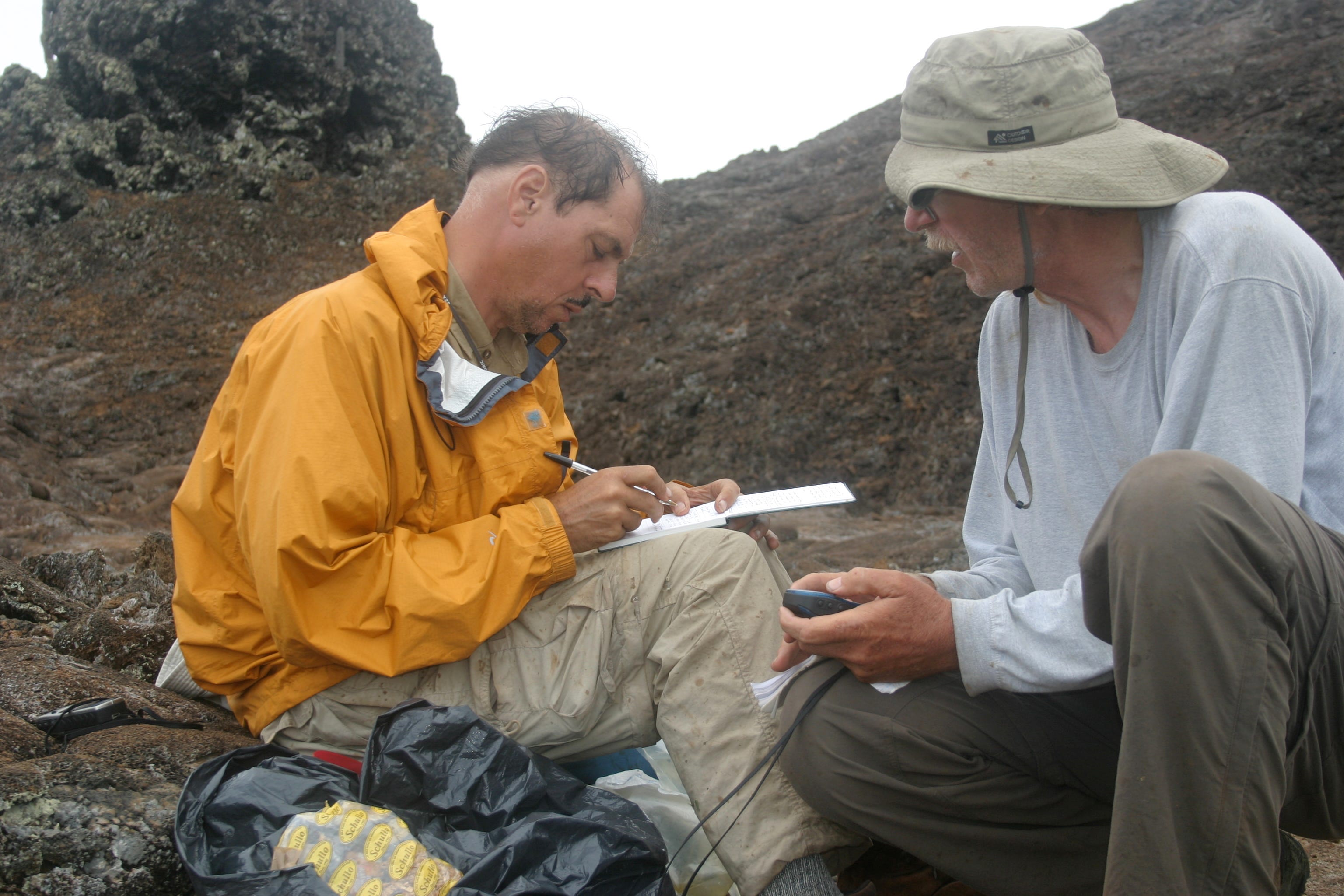
In June of 2004, historian of science Frank Sulloway and I began a month-long expedition to retrace Charles Darwin’s footsteps in the Galápagos Islands. The myth Frank set out to investigate years before was that Darwin became an evolutionist in the Galápagos when he discovered natural selection operating on finch beaks and tortoise carapaces, each species uniquely adapted by food type or island ecology. (Photos in this section from the author’s collection.)
The legend endures, Sulloway notes, because of its elegant fit into a Joseph Campbell-like tripartite myth of the hero who (1) leaves home on a great adventure (Darwin’s five-year voyage on the Beagle), (2) endures immeasurable hardship in the quest for noble truths (Darwin suffered seasickness and other maladies), and (3) returns to deliver a deep message (evolution). The myth is ubiquitous, appearing in everything from biology textbooks to travel brochures, the latter of which inveigle potential customers to come walk in the footsteps of Darwin. (See Sulloway’s papers: “Darwin and His Finches: The Evolution of a Legend.” Journal of the History of Biology, 15 (1982):1-53; “Darwin’s Conversion: The Beagle Voyage and Its Aftermath.” Journal of the History of Biology, 15 (1982):325-96; “The Legend of Darwin’s Finches.” Nature, 303 (1983):372; “Darwin and the Galapagos.” Biological Journal of the Linnean Society, 21 (1984):29-59.)
The Darwin Galápagos legend is emblematic of a broader myth that science proceeds by select eureka discoveries followed by sudden revolutionary revelations, where old theories fall before new facts. Not quite. Paradigms power percepts. Nine months after departing the Galápagos, Sulloway discovered, Darwin made the following entry in his ornithological catalogue about his mockingbird collection:
When I see these Islands in sight of each other, & possessed of but a scanty stock of animals, tenanted by these birds, but slightly differing in structure & filling the same place in Nature, I must suspect they are only varieties.
Similar varieties of fixed kinds, not evolution of separate species. Darwin was still a creationist! This explains why Darwin did not even bother to record the island locations of the few finches he collected (and in some cases mislabeled), and why these now-famous birds were never specifically mentioned in the Origin of Species.
Through careful analysis of Darwin’s notes and journals, Sulloway dates Darwin’s acceptance of evolution to the second week of March, 1837, after a meeting Darwin had with the eminent ornithologist John Gould, who had been studying his Galápagos bird specimens. With access to museum ornithological collections from areas of South America that Darwin had not visited, Gould corrected a number of taxonomic errors Darwin had made (such as labeling two finch species a “Wren” and “Icterus”), and pointed out to him that although the land birds in the Galápagos were endemic to the islands, they were notably South American in character.
Darwin left the meeting with Gould, Sulloway concludes, convinced “beyond a doubt that transmutation must be responsible for the presence of similar but distinct species on the different islands of the Galápagos group. The supposedly immutable ‘species barrier’ had finally been broken, at least in Darwin’s own mind.” That July, 1837, Darwin opened his first notebook on Transmutation of Species. By 1844 he was confident enough to write in a letter to his botanist friend and colleague Joseph Hooker:
I was so struck with distribution of Galapagos organisms &c &c, & with the character of the American fossil mammifers &c &c, that I determined to collect blindly every sort of fact which cd bear any way on what are species. At last gleams of light have come, & I am almost convinced, (quite contrary to opinion I started with) that species are not (it is like confessing a murder) immutable.
Like Confessing a Murder
Dramatic words for something as seemingly innocuous as a technical problem in biology: the immutability of species. But it doesn’t take a rocket scientist—or an English naturalist—to understand why the theory on the origin of species by means of natural selection would be so controversial: if new species are created naturally—not supernaturally—what place, then, for God? No wonder Darwin waited twenty years before publishing his theory.
From the time of Plato and Aristotle in ancient Greece to the time of Darwin and Wallace in the nineteenth century, nearly everyone believed that a species retained a fixed and immutable “essence.” A species, in fact, was defined by its very essence—the characteristics that made it like no other species. The theory of evolution by means of natural selection, then, is the theory of how kinds can become other kinds, and that upset not only the scientific cart, but the cultural horse pulling it. The great Harvard evolutionary biologist, Ernst Mayr, stressed just how radical was Darwin’s theory (in his 1982 book Growth of Biological Thought):
The fixed, essentialistic species was the fortress to be stormed and destroyed; once this had been accomplished, evolutionary thinking rushed through the breach like a flood through a break in a dike.
The dike, however, was slow to crumble. Darwin’s close friend, the geologist Charles Lyell, withheld his support for a full nine years, and even then hinted at a providential design behind the whole scheme. The astronomer John Herschel called natural selection the “law of higgledy-piggledy.” And Adam Sedgwick, a geologist and Anglican cleric, proclaimed that natural selection was a moral outrage, and penned this ripping harangue to Darwin:
There is a moral or metaphysical part of nature as well as a physical. A man who denies this is deep in the mire of folly. You have ignored this link; and, if I do not mistake your meaning, you have done your best in one or two cases to break it. Were it possible (which thank God it is not) to break it, humanity, in my mind, would suffer a damage that might brutalize it, and sink the human race into a lower grade of degradation than any into which it has fallen since its written records tell us of its history.
In a review in Macmillan’s Magazine, Henry Fawcett wrote of the great divide surrounding On the Origin of Species:
No scientific work that has been published within this century has excited so much general curiosity as the treatise of Mr. Darwin. It has for a time divided the scientific world with two great contending sections. A Darwinite and an anti-Darwinite are now the badges of opposed scientific parties.
Darwinites and anti-Darwinites. Although the scientific community is now united in agreement that evolution happened, a century and a half later the cultural world is still so divided. According to a 2005 poll by the Pew Research Center: 42 percent of Americans hold strict creationist views that “living things have existed in their present form since the beginning of time” while 48 percent believe that humans “evolved over time.” More to the point of why evolution has been in the news of late, the survey also found that 64 percent said they were open to the idea of teaching creationism in addition to evolution in public schools, while 38 percent said they think evolution should be replaced by creationism in biology classrooms. (Recent polls find the acceptance of the theory of evolution in the US increasing and creationism decreasing, but a 54% acceptance rate for the theory is not exactly a mandate for science.)
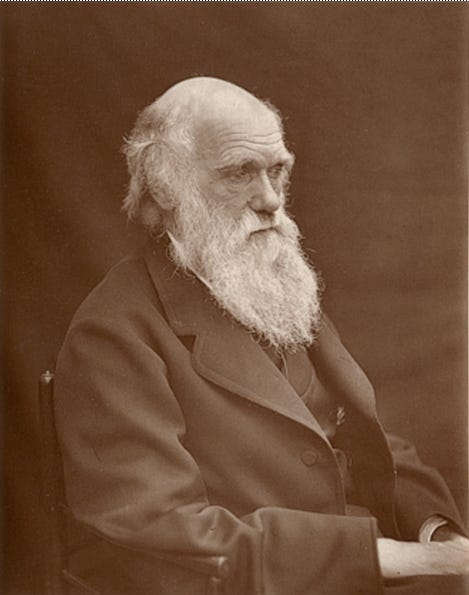
1878a Three-quarter right profile, seated in a Down House chair (according to some sources), by Leonard Darwin.
Why Evolution Matters
The influence of the theory of evolution on the general culture is so pervasive it can be summed up in a single observation: we live in the age of Darwin. Arguably the most culturally jarring theory in the history of science, the Darwinian revolution changed both science and culture in ways immeasurable, as Ernst Mayr summarized (in my own wording):
1. The static creationist model of species as fixed types, replaced with a fluid evolutionary model of species as ever-changing entities.
2. The theory of top-down intelligent design through a supernatural force, replaced with the theory of bottom-up natural design through natural forces.
3. The anthropocentric view of humans as special creations above all others, replaced with the view of humans as just another animal species.
4. The view of life and the cosmos as having design, direction, and purpose from above, replaced with the view of the world as the product of bottom-up design through necessitating laws of nature and contingent events of history.
5. The view that human nature is infinitely malleable and primarily good, replaced with the view of a constraining human nature in which we are good and evil.
In the memorable observation by Theodosius Dobzhansky: “Nothing in biology makes sense except in the light of evolution.”
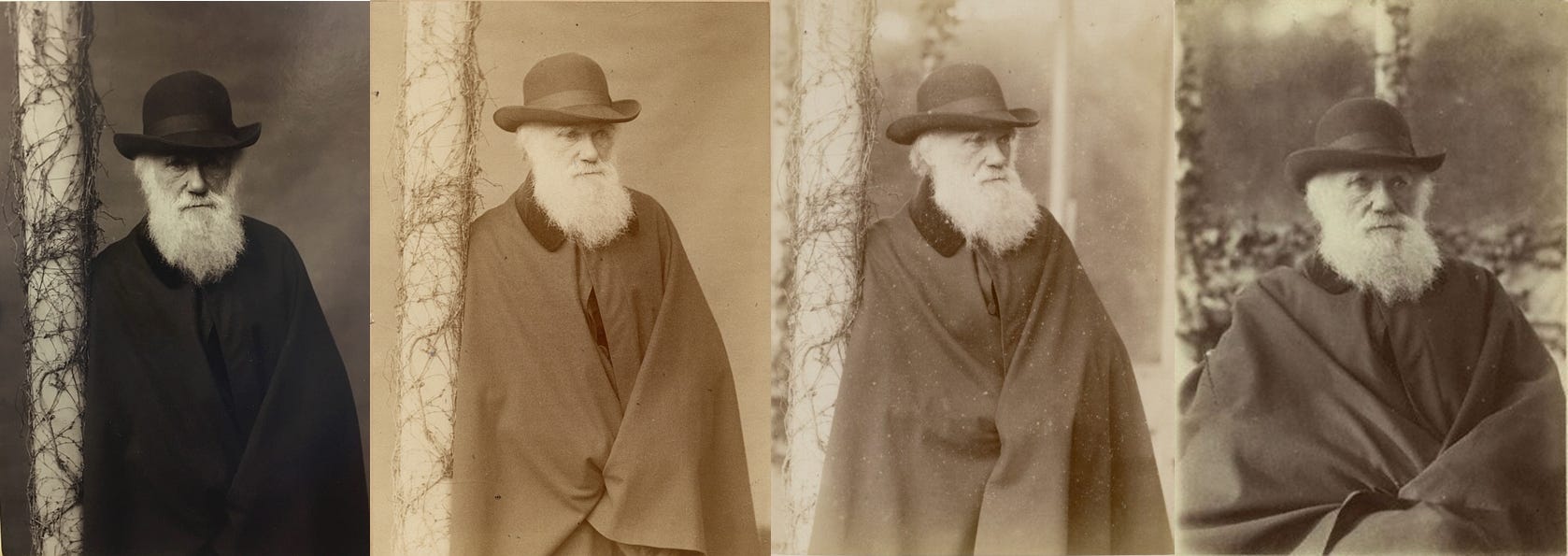
1881 Four photographs by Elliott & Fry. This well-known sitting includes the only known photographs of Darwin standing.
Skeptic is a reader-supported publication. All monies go to the Skeptics Society, a 501(c)(3) nonprofit. To receive new posts and support my work, consider becoming a paid subscriber.
Upgrade to paid
Darwin’s God and the Devil’s Chaplain
Darwin matriculated at Cambridge University in theology, but he did so only after abandoning his medical studies at the Edinburgh University because of his distaste for the barbarity of surgery. Darwin’s famous grandfather Erasmus, and his father Robert, both physicians by trade who were deeply schooled in natural history, were also confirmed freethinkers, so there was no doctrinaire pressure on the young Charles to choose theology.
In point of fact, Darwin’s selection of theology as his primary course of study allowed him to pursue his passion of natural history through the academic justification of studying “natural theology”—he was far more interested in God’s works (nature) than God’s words (the Bible). Besides, theology was one of only a handful of professions that a gentleman of the Darwin family’s high social position in the landed gentry of British society could choose. Finally, although Darwin belonged to the Church of England, membership was expected of someone in his social class.
Still, Darwin’s religiosity was not entirely utilitarian. He began and ended his five-year voyage around the world as a creationist, and he regularly attended services on board the Beagle, and even during some land excursions in South America. It was only upon his return home that his loss of his faith came about, that that loss happened gradually—even reluctantly—over many years.
Nagging doubts about the nature and existence of the deity chipped away at his faith from his studies of the natural world, particularly the cruel nature of many predator-prey relationships. “What a book a Devil’s Chaplain might write on the clumsy, wasteful, blundering low & horridly cruel works of nature!” Darwin harped in an 1856 letter to his botanist mentor Joseph Hooker. In 1860 he wrote to his American colleague, the Harvard biologist Asa Gray, about a species of wasp that paralyzes its prey (but does not kill it), then lays its eggs inside the paralyzed insect so that upon birth its offspring can feed on live flesh:
I cannot persuade myself that a beneficent God would have designedly created the Ichneumonidae with the express intention of their feeding within the living bodies of Caterpillars, or that a cat should play with mice. Not believing this, I see no necessity in the belief that the eye was expressly designed.
Pain and evil in the human world made Darwin doubt even more. “That there is much suffering in the world no one disputes,” he wrote to a correspondent. “Some have attempted to explain this with reference to man by imagining that it serves for his moral improvement. But the number of men in the world is as nothing compared with that of all other sentient beings, and they often suffer greatly without any moral improvement.” Which is more likely, that pain and evil are the result of an all-powerful and good God, or the product of uncaring natural forces? “The presence of much suffering agrees well with the view that all organic beings have been developed through variation and natural selection.” The death of Darwin’s beloved ten-year-old daughter Anne put an end to whatever confidence he had in God’s benevolence, omniscience, and thus existence. According to the great Darwin scholar and biographer Janet Browne: “This death was the formal beginning of Darwin’s conscious dissociation from believing in the traditional figure of God.”
Throughout most of his professional career, however, Darwin eschewed the God question entirely, choosing to focus instead on his scientific studies. Toward the end of his life Darwin received many letters querying him on his religious attitudes. His long-silence gave way to a few revelations. In one letter penned in 1879, just three years before he died, Darwin explained: “In my most extreme fluctuations I have never been an Atheist in the sense of denying the existence of God. I think that generally (and more and more as I grow older), but not always, that an Agnostic would be the more correct description of my state of mind.”
A year later, in 1880, Darwin clarified his reasoning to the British socialist Edward Aveling, who solicited Darwin’s endorsement of a group of radical atheists by asking his permission to dedicate a book Aveling edited entitled The Student’s Darwin, a collection of articles discussing the implications of evolutionary theory for religious thought. The book had a militant antireligious flavor that Darwin disdained and he declined the offer, elaborating his reason with his usual flare for quotable maxims:
It appears to me (whether rightly or wrongly) that direct arguments against christianity & theism produce hardly any effect on the public; & freedom of thought is best promoted by the gradual illumination of men’s minds which follow[s] from the advance of science. It has, therefore, been always my object to avoid writing on religion, & I have confined myself to science.
Darwin then appended an additional hint about a personal motive: “I may, however, have been unduly biased by the pain which it would give some members of my family, if I aided in any way direct attacks on religion.” Darwin’s wife Emma was a deeply religious woman, so out of respect for her he kept the public side of his religious skepticism in check, an admirable feat of self-discipline by a man of high moral character.
Why Darwin Matters
As pattern-seeking, storytelling primates, to most of us the pattern of life and the universe indicates design. For countless millennia we have taken these patterns and constructed stories about how life and the cosmos were designed specifically for us from above. For the past few centuries, however, science has presented us with a viable alternative in which the design comes from below through the direction of built-in self-organizing principles of emergence and complexity. Perhaps this natural process, like the other natural forces of which we are all comfortable accepting as non-threatening to religion, was God’s way of creating life. Maybe God is the laws of nature—or even nature itself—but this is a theological supposition, not a scientific one.
What science tells us is that we are but one among hundreds of millions of species that evolved over the course of three and a half billion years on one tiny planet among many orbiting an ordinary star, itself one of possibly billions of solar systems in an ordinary galaxy that contains hundreds of billions of stars, itself located in a cluster of galaxies not so different from millions of other galaxy clusters, themselves whirling away from one another in an expanding cosmic bubble universe that very possibly is only one among a near infinite number of bubble universes. Is it really possible that this entire cosmological multiverse was designed and exists for one tiny subgroup of a single species on one planet in a lone galaxy in that solitary bubble universe? It seems unlikely.
Herein lies the spiritual side of science—sciencuality, if you will pardon an awkward neologism but one that echoes the sensuality of discovery. If religion and spirituality are suppose to generate awe and humility in the face of the creator, what could be more awesome and humbling than the deep space discovered by Hubble and the cosmologists, and the deep time discovered by Darwin and the evolutionists?
Darwin matters because evolution matters; evolution matters because science matters. Science matters because it is the preeminent story of our age, an epic saga about who we are, where we came from, and where we are going.
###
Skeptic is a reader-supported publication. All monies go to the Skeptics Society, a 501(c)(3) nonprofit. To receive new posts and support my work, consider becoming a paid subscriber.
It was almost 4:00 PM when Colton drove across the George Washington bridge into Manhattan. Two things had delayed them by four hours.
Swapping vehicles had cost them over three hours. Unfortunately, a direct trade, or a sale and repurchase weren’t feasible given the lack of title for Mildred’s Mercedes. At Exit 260B they’d detoured and taken I-81 North to Scranton, Pennsylvania to purchase a 2011 Ford E-Series E-250 Cargo Van they’d found on the Internet. The cash price, after a little negotiating, was $19,800. From there, after another Google search, they’d driven both vehicles fifteen miles northeast to Jermyn Self-Storage in a town of the same name and spent $1,300 to hide the Sprinter for a year. Unlike the business where they’d stored Colton’s RAM in Rockford, Jermyn didn’t provide an APP or any other service for offsite viewing and inspecting their vehicle.
Then luck or fate had intervened to offer a flat tire on the Ford. This had caused another forty-minute delay. It had happened on I-80 in Teterboro, New Jersey. Thankfully, a tire repair outfit located at a local truck stop quickly responded and had Colton and Sandy back on the road less than a half-hour ago.
As they exited the bridge, Sandy noticed a small metal sign for The Little Red Lighthouse. During the flat tire incident he’d learned the place he and his family had visited on vacation while he was just a kid, although decommissioned, was still open to visitors. The Lighthouse was underneath the bridge on the eastern shore of the Hudson River. “Take the next right, the tour will take thirty minutes and I’ll check it off my bucket list.”
However, the visit was not to be. Colton quashed the idea, preferring not to waste any more time. Plus, he wanted to arrive at Millie’s place before dark. Sandy didn’t articulately respond, instead mumbled something under his breath.
Colton continued east on I-95, crossed the Harlem River, and slowed to a near crawl as he navigated the loop before merging onto I-87 South. The traffic was heavy, and, along with two tolls, consumed another thirty-five minutes before the pair reached The Allendale building in Jackson Heights, a Brooklyn suburb. Eighty-second street was one-way but thankfully, there was an open parking spot in front of the six story, well-kept Co-Op.
Sandy noticed two middle-aged women approaching on the sidewalk, heads buried in their cell phones. They walked up the stairs to the Allendale door, entered a code on an electronic keypunch pad, allowed the double doors to open automatically, and walked inside. “Okay, Mr. Brainiac, what do we do now?” Sandy asked an anxious Colton.
“Wait” was all he said as he opened the driver’s side door and exited the vehicle. He walked to the front bumper and stared upwards and across the beautiful brick building. From its architecture, including equally separated brick columns built into the facade, it was reasonable to conclude there were four apartments on each floor. Sandy joined him, and watched as Colton walked the sidewalk to the corner of the building.
He stood, stared, and concluded the Co-Op was deep enough for a total of eight, equal-sized apartments per floor. With six floors, that meant he and Sandy might have to knock on a maximum of forty-eight doors before finding Molly and Millie. Time-consuming, but doable.
Colton continued to ponder. There might be another option. If there was an intercom panel in the first floor foyer they could use it to call each unit, assuming they weren’t labeled with the resident’s name which was unlikely for Millie and Molly’s apartment buzzer since they’d just moved in a few days ago. Either way, Colton didn’t like this contact method. Millie would recognize either his or Sandy’s voice. This would cause panic and likely a quick reaction. She probably would call the police before Colton and Sandy could reach her and Molly’s apartment.
Of course, both contact methods—knocking on doors throughout the building and using the intercom system to call the apartments—assumed Colton and Sandy could gain access through the exterior door to begin with.
After ten minutes of Colton’s staring at the Allendale and leaning against the hood of the van, Sandy walked up the stairs to the main entrance. “Here’s an idea. We watch someone enter their code, write it down, wait a few minutes, then use it to gain access.”
Colton was surprised that he hadn’t thought about that. So far, his best idea was to use Google to learn if there are any apartments for sale within The Allendale. Then, hopefully tomorrow, gain access with the help of a local realtor who would show-up thinking he had a potential buyer. Colton nodded at Sandy who was returning to the van. “Not bad. Let’s give it a try.”
They both retook their respective seats. “Even a blind hog finds an acorn every once in a while.” Sandy said, proud of himself.
“Okay Mr. Hog, go back to the door and pretend you are entering your code. I want to see if your idea will work and whether we need to move the van a little.” Sandy did as instructed while Colton reached behind him and retrieved a pair of binoculars from a duffel. He’d had them for years, often using them for closeups of pretty women traversing a college campus or a mall parking lot. After a few minutes, and backing the van one parking spot, Colton motioned Sandy to return. “Now, we just need someone to be our guinea pig.” Sandy said, wondering why the address Ray in Perrysburg had given them didn’t include an apartment number.
“Maybe we’ll get lucky and Millie and Molly will show up after a leisurely stroll.” Colton said, looking up 82nd street through the binoculars.
At 8:00 PM, a short oriental man crossed the street in front of the van and approached the Allendale. “Here we go,” Sandy said. They’d spent the past two hours being bored but studying a drawing of the keypad Colton had made in a notebook. The numbers were laid out the same way as his iPhone, which was the opposite of the old adding machine he used at work. Obviously, there were ten options: 0, 1, 2, 3, 4, 5, 6, 7, 8, & 9. The numbers, one, two, and three were left to right and at the top of the keypad; four, five and six filled the second row; and seven, eight, and nine completing the third row. The zero occupied the center spot in the fourth row at the bottom.
Colton watched as the man quickly used his right index finger to press four buttons. Per agreement, Sandy’s assignment was to use a second drawing of the keypad to record the keystrokes themselves. That is, the sequence and exact movement of the oriental man’s hands. Colton’s job was to focus on the numbers, more particularly, the numbers that appeared in the small rectangular window directly above the keypad.
The doors opened and the short man went inside. Colton and Sandy conversed and finally agreed the man had entered 3 6 1 9.
They waited five minutes and walked to the Allendale’s front door. Colton noted there were no intercom system built into the exterior wall beside the entrance, unlike some buildings he’d visited in Chicago. He turned his focus to the keypad. His first attempt failed. As did his second: 3 6 1 6. Success came on the third try. The correct code was 3 6 1 8. Both he and Sandy had been wrong but, surprisingly, by only one digit.
The double doors swung open. They were in.
Colton and Sandy passed through a small, unadorned foyer into the hallway. To their left was a bank of post office boxes, forty-eight to be exact. They paused and noted that underneath each five-inch by five-inch box was an apartment number; no names at all. “That narrow, single-door to the left of the main entrance must be for the mailman.” Colton said, turning to continue the walk to a bank of two elevators straight ahead, located approximately in the center of the building.
While waiting in the van, Sandy had conducted research on the Allendale. From its website, he’d confirmed Colton’s thesis that there were forty-eight units (the post office boxes confirmed this). Sandy also learned each unit had the same floor plan, except possibly for the first floor apartment that had given up square footage for the mail room. He concluded the hallways and the space for the elevator shafts were extra space, making the building larger to begin with, and hadn’t come at the expense of any of the apartments.
In addition, the website briefly described the apartment numbering scheme. The first digit for each apartment represented the floor number. The second and third digits represented the individual apartment number. Per the site’s example, apartment 317 was on the third floor, which indicated the forty-eight apartments were numbered sequentially (the first two floors would contain sixteen apartments, eight per floor).
After Sandy and Colton walked to the elevators, they noticed one was marked Service Elevator, and the other, Resident Elevator. They also saw the intercom system wedged between the elevators. There were eight rows of six buttons. Thankfully, all but four of the apartment buttons had a small bronze plate underneath containing a first initial and a last name, likely representing the apartment’s owner. Both men stared at the rows and bronze plates.
“I bet apartments 212, 429, 538, and 644 are empty.” Sandy said.
“Or, they have new residents and the building super hasn’t updated the plates.” Colton quickly added. He removed his iPhone and snapped a photo of the intercom wall while Sandy heard a door closing to their right.
The two men waited until a roundish woman wearing a tan toboggan exited an apartment. She walked their way and completely ignored them as she continued to the main entrance. After she departed, they walked the hallway toward where she’d originated and noted apartment numbers 103 and 104. These were closer to 82nd Avenue and the front of the building, while apartments 107 and 108 were directly across, towards the rear of the building. They returned to the elevators and continued walking down the opposite hallway, this time noticing the two front apartments were number 101 and 102, with the latter closest to the elevator. Directly across from these were apartment numbers 105 and 106, again, with the latter closest to the elevator.
“Now, I think we know, apartment 212 is on the second floor, toward the front and down this hallway.” Colton pointed toward the roundish woman’s apartment.
Sandy chimed in and followed the same logic and mentally located apartment numbers 429, 538, and 644. “Do we intercom these or knock on their doors?” He asked as Colton scanned the bronze plates underneath the buttons.
“Before we do anything, see if you can determine if any of these four are for sale. The website might say.”
It didn’t take Sandy two minutes to discover the answer. The website had a menu item labeled “Apartments For Sale.” Numbers 212 and 538 were the only two listed. “Looks like 429 and 644 are our best bet. They’re not listed for sale. Seems reasonable to conclude they have new residents.
Sandy stared at Colton as to say, ‘well, do we use the intercom or head on up?’
“I think it’s a no brainer. Using the intercom will give Millie more time to react.” Colton pressed the ‘Resident Elevator’ button and the door opened. Inside Sandy pressed button number four.
The older sounding woman in Apartment 429 would not open the door, but did answer, in the negative, Colton’s question whether she knew Millie Anderson. Surprisingly, under Sandy’s ruse of being a plumber and asking if she was having any problem with hot water, the patient woman announced the kitchen sink and bathroom laboratory were fine but since moving in two days ago she hadn’t tried the shower.
Sandy and Colton fared a little better at Apartment 644. Better and worse. A middle-aged man opened the door in response to Sandy’s knock, but, he too, didn’t know a Millie Anderson. They didn’t bother with the hot water ruse but asked how long he’d lived here. He’d responded by asking if they were cops or just casing the joint. His seriousness had quickly turned light. He finally admitted he wasn’t the owner but just a father helping his daughter move from Topeka, Kansas to New York City. The pair arrived last Monday.
Sandy and Colton returned to the elevator and descended to the first floor. They walked to the main entrance but stopped for Colton to snap a photo of the post office boxes. “Let’s go find a hotel. Tomorrow we’ll confirm whether 212 and 538 are truly unoccupied and for sale. Then, we’ll return and watch the building all day.”
Sandy said what Colton was feeling. “Are you starting to think we’ve been snookered, that the nice couple in Perrysburg gave us the wrong address?”
“Shit, shit, shit. You might be right. Come on.” Colton couldn’t believe he’d been so dumb, and so overconfident after he’d used restraint, only politely threatening Ray and his wife to handover Millie’s address. Now, it looked like the young, prosperous couple had outsmarted him and Sandy.
Why prestige is the enemy of passion, or how to master the balance of setting boundaries and making friends.
BY MARIA POPOVA
“Find something more important than you are,” philosopher Dan Dennett once said in discussing the secret of happiness, “and dedicate your life to it.” But how, exactly, do we find that? Surely, it isn’t by luck. I myself am a firm believer in the power of curiosity and choice as the engine of fulfillment, but precisely how you arrive at your true calling is an intricate and highly individual dance of discovery. Still, there are certain factors — certain choices — that make it easier. Gathered here are insights from seven thinkers who have contemplated the art-science of making your life’s calling a living.
PAUL GRAHAM ON HOW TO DO WHAT YOU LOVE
Every few months, I rediscover and redevour Y-Combinator founder Paul Graham’s fantastic 2006 article, How to Do What You Love. It’s brilliant in its entirety, but the part I find of especial importance and urgency is his meditation on social validation and the false merit metric of “prestige”:
What you should not do, I think, is worry about the opinion of anyone beyond your friends. You shouldn’t worry about prestige. Prestige is the opinion of the rest of the world.
[…]
Prestige is like a powerful magnet that warps even your beliefs about what you enjoy. It causes you to work not on what you like, but what you’d like to like.
[…]
Prestige is just fossilized inspiration. If you do anything well enough, you’ll make it prestigious. Plenty of things we now consider prestigious were anything but at first. Jazz comes to mind—though almost any established art form would do. So just do what you like, and let prestige take care of itself.
Prestige is especially dangerous to the ambitious. If you want to make ambitious people waste their time on errands, the way to do it is to bait the hook with prestige. That’s the recipe for getting people to give talks, write forewords, serve on committees, be department heads, and so on. It might be a good rule simply to avoid any prestigious task. If it didn’t suck, they wouldn’t have had to make it prestigious.
Alain de Botton, modern philosopher and creator of the “literary self-help genre”, is a keen observer of the paradoxes and delusions of our cultural conceits.
In The Pleasures and Sorrows of Work, he takes his singular lens of wit and wisdom to the modern workplace and the ideological fallacies of “success.”
One of the interesting things about success is that we think we know what it means. A lot of the time our ideas about what it would mean to live successfully are not our own. They’re sucked in from other people. And we also suck in messages from everything from the television to advertising to marketing, etcetera. These are hugely powerful forces that define what we want and how we view ourselves. What I want to argue for is not that we should give up on our ideas of success, but that we should make sure that they are our own. We should focus in on our ideas and make sure that we own them, that we’re truly the authors of our own ambitions. Because it’s bad enough not getting what you want, but it’s even worse to have an idea of what it is you want and find out at the end of the journey that it isn’t, in fact, what you wanted all along.
HUGH MACLEOD ON SETTING BOUNDARIES
Cartoonist Hugh MacLeod is as well-known for his irreverent doodles as he is for his opinionated musings on creativity, culture, and the meaning of life. In Ignore Everybody: and 39 Other Keys to Creativity, he gathers his most astute advice on the creative life. Particularly resonant with my own beliefs about the importance of choices is this insight about setting boundaries:
16. The most important thing a creative person can learn professionally is where to draw the red line that separates what you are willing to do, and what you are not.
Art suffers the moment other people start paying for it. The more you need the money, the more people will tell you what to do. The less control you will have. The more bullshit you will have to swallow. The less joy it will bring. Know this and plan accordingly.
Later, MacLeod echoes Graham’s point about prestige above:
28. The best way to get approval is not to need it.
This is equally true in art and business. And love. And sex. And just about everything else worth having.”
In this excerpt, originally featured here in January, Hyde articulates the essential difference between work and creative labor, understanding which takes us a little closer to the holy grail of vocational fulfillment:
Work is what we do by the hour. It begins and, if possible, we do it for money. Welding car bodies on an assembly line is work; washing dishes, computing taxes, walking the rounds in a psychiatric ward, picking asparagus — these are work. Labor, on the other hand, sets its own pace. We may get paid for it, but it’s harder to quantify… Writing a poem, raising a child, developing a new calculus, resolving a neurosis, invention in all forms — these are labors.
Work is an intended activity that is accomplished through the will. A labor can be intended but only to the extent of doing the groundwork, or of not doing things that would clearly prevent the labor. Beyond that, labor has its own schedule.
…
There is no technology, no time-saving device that can alter the rhythms of creative labor. When the worth of labor is expressed in terms of exchange value, therefore, creativity is automatically devalued every time there is an advance in the technology of work.
Psychologist Mihaly Csikszentmihalyi has a term for the quality that sets labor apart from work: flow — a kind of intense focus and crisp sense of clarity where you forget yourself, lose track of time, and feel like you’re part of something larger. If you’ve ever pulled an all-nighter for a pet project, or even spent 20 consecutive hours composing a love letter, you’ve experienced flow and you know creative labor.
STEVE JOBS ON NOT SETTLING
In his now-legendary 2005 Stanford commencement address, an absolute treasure in its entirety, Steve Jobs makes an eloquent case for not settling in the quest for finding your calling — a case that rests largely on his insistence upon the power of intuition:
Your work is going to fill a large part of your life, and the only way to be truly satisfied is to do what you believe is great work. And the only way to do great work is to love what you do. If you haven’t found it yet, keep looking. Don’t settle. As with all matters of the heart, you’ll know when you find it. And, like any great relationship, it just gets better and better as the years roll on. So keep looking until you find it. Don’t settle.
ROBERT KRULWICH ON FRIENDS
Robert Krulwich, co-producer of WNYC’s fantastic Radiolab, author of the ever-illuminating Krulwich Wonders and winner of a Peabody Award for broadcast excellence, is one of the finest journalists working today. In another great commencement address, he articulates the infinitely important social aspect of loving what you do — a kind of social connectedness far more meaningful and genuine than those notions of prestige and peer validation.
You will build a body of work, but you will also build a body of affection, with the people you’ve helped who’ve helped you back. This is the era of Friends in Low Places. The ones you meet now, who will notice you, challenge you, work with you, and watch your back. Maybe they will be your strength.
…
If you can… fall in love, with the work, with people you work with, with your dreams and their dreams. Whatever it was that got you to this school, don’t let it go. Whatever kept you here, don’t let that go. Believe in your friends. Believe that what you and your friends have to say… that the way you’re saying it — is something new in the world.
THE HOLSTEE MANIFESTO
You might recall The Holstee Manifesto as one of our 5 favorite manifestos for the creative life, an eloquent and beautifully written love letter to the life of purpose. (So beloved is the manifesto around here that it has earned itself a permanent spot in the Brain Pickings sidebar, a daily reminder to both myself and you, dear reader, of what matters most.)
This is your life. Do what you love, and do it often. If you don’t like something, change it. If you don’t like your job, quit. If you don’t have enough time, stop watching TV. If you are looking for the love of your life, stop; they will be waiting for you when you start doing things you love.
The Holstee Manifesto is now available as a beautiful letterpress print, a 5×7 greeting card printed on handmade paper derived from 50% elephant poo and 50% recycled paper, and even a baby bib — because it’s never too early to instill the values of living from passion.
Biking is something else I both love and hate. It takes a lot of effort but does provide good exercise and most days over an hour to listen to a good book or podcast. I especially like having ridden.
Here’s my bike, a Rockhopper by Specialized. I purchased it November 2021 from Venture Out in Guntersville; Mike is top notch! So is the bike, and the ‘old’ man seat I salvaged from an old Walmart bike.
Here’s what I’m listening to: It Ends With Us, by Colleen Hoover
Amazon abstract:
In this “brave and heartbreaking novel that digs its claws into you and doesn’t let go, long after you’ve finished it” (Anna Todd, New York Times bestselling author) from the #1 New York Times bestselling author of All Your Perfects, a workaholic with a too-good-to-be-true romance can’t stop thinking about her first love.
Lily hasn’t always had it easy, but that’s never stopped her from working hard for the life she wants. She’s come a long way from the small town where she grew up—she graduated from college, moved to Boston, and started her own business. And when she feels a spark with a gorgeous neurosurgeon named Ryle Kincaid, everything in Lily’s life seems too good to be true.
Ryle is assertive, stubborn, maybe even a little arrogant. He’s also sensitive, brilliant, and has a total soft spot for Lily. And the way he looks in scrubs certainly doesn’t hurt. Lily can’t get him out of her head. But Ryle’s complete aversion to relationships is disturbing. Even as Lily finds herself becoming the exception to his “no dating” rule, she can’t help but wonder what made him that way in the first place.
As questions about her new relationship overwhelm her, so do thoughts of Atlas Corrigan—her first love and a link to the past she left behind. He was her kindred spirit, her protector. When Atlas suddenly reappears, everything Lily has built with Ryle is threatened.
An honest, evocative, and tender novel, It Ends with Us is “a glorious and touching read, a forever keeper. The kind of book that gets handed down” (USA TODAY).
Was the account of creation found in Genesis comparable to (or even borrowed from?) other ancient accounts in scattered throughout the world at the time?
Here now is a second and equally interesting post dealing with stories from ancient Memphis Egypt (not Tennessee!)!
This is the topic of his lecture course for the Great Courses/Wondrium, “Creation Stories of the Ancient World” (links at bottom)
****************************
In my last blog entry, I offered a brief description of the Babylonian Creation Epic, Enuma Elish, and reflected on how one might imagine its relationship to the seven-day creation story of Genesis 1. In this post, I turn to an enigmatic but fascinating text from ancient Egypt known as the Memphite Theology that has also been compared with Genesis 1, though in this case I would argue that no direct connection exists between the two texts. Instead, what we see in the Memphite Theology is an alternative expression of the idea of a supreme and intentional creator deity that is reminiscent of (and roughly contemporaneous with) Genesis 1.
The text of the Memphite Theology is preserved on a rectangular stone slab now known as the Shabako Stone, named for the Egyptian Pharaoh Shabako under whom the text was promulgated in approximately 710 BCE. The stone was subsequently converted for use as a lower millstone, which effaced a significant portion of the writing (see the British Museum photo here: https://www.britishmuseum.org/collection/object/Y_EA498). Nonetheless, the portions that remain reveal an idiosyncratic picture of creation centering on a god named Ptah, a deity associated with the city of Memphis (hence the “Memphite Theology”), one that departs from a dominant understanding of creation in ancient Egypt associated with another ancient city, Heliopolis. In fact, there is evidence to suggest that the Memphite Theology was written precisely to supplant the earlier traditional understandings. The following passage from near the beginning of the text is revealing (translation here taken from Miriam Lichtheim, Ancient Egyptian Literature, vol. I):
“This writing was copied out anew by his majesty in the House of his father Ptah-South-of-his-Wall, for his majesty found it to be a work of the ancestors which was worm-eaten, so that it could not be understood from beginning to end. His majesty copied it anew so that it became better than it had been before…”
What we have here is a trope that is found with some regularity in the ancient world—that of the “discovery” or “recovery” of an even more ancient text as a way of conferring legitimacy to what was in fact a new literary creation from the writer’s own time. (The most famous example of this is the “discovery” of the Book of the Law in the time of the biblical king Josiah in 2 Kings 22, which is widely regarded by scholars as representing the context of the promulgation of the Book of Deuteronomy.) Applying this assumption to the Memphite Theology helps to explain its contents, because the primary focus of the text is the exaltation of the god Ptah over an earlier creator deity named Atum (of the tradition of Heliopolis) by re-envisioning Atum and the other gods as proceeding from Ptah himself. This tendency can be observed in the following key passage (again, based on Lichtheim’s translation):
“There took shape in the heart, there took shape on the tongue the form of Atum. For the very great one is Ptah, who gave life to all the gods and their kas through this heart and through this tongue, in which Horus had taken shape as Ptah, in which Thoth had taken shape as Ptah…. Sight, hearing, breathing—they report to the heart, and it makes every understanding come forth. As to the tongue, it repeats what the heart has devised. Thus all the gods were born and his Ennead was completed.”
Although some of the language in this passage is obscure, it is clear that the god Ptah is at the top of the divine hierarchy that the text envisions. Ptah is “the very great one,” the one who gives life to all the other gods, and important gods such as Atum, Horus, and Thoth are all subordinated to Ptah in different ways. Since Atum is, in the Heliopolis tradition, the original creator deity and the one who gives birth to the other members of the core group of nine deities (the “Ennead”), to subordinate Atum to Ptah is to elevate Ptah to the primary role.
What is also notable about this passage, and what makes it distinctive among the conceptions of creation we encounter in ancient Egypt, is the manner in which these primordial acts of creation are described. The “heart” and the “tongue” of Ptah are both crucial in this process, with the heart being the ultimate source (“they report to the heart… as to the tongue, it repeats what the heart has devised”). While the interpretation of this language is difficult, I would take the heart to represent the seat of the will or of intention, an idea that is characteristic of many ancient forms of understanding. While today we tend to associate emotions with the heart, in ancient cultures the heart encompasses faculties that we would attribute to the brain, such as thinking, deciding, and desiring. As for the tongue, I would take that to symbolize speech as an expression of an act of thought or intention. Thus, what we have is a fascinating conception of creation as a sort of mental act of Ptah with multiple stages: the heart devises, the tongue speaks it forth, and the result is various manifestations in the form of the gods and, in fact, all things. This idea is elaborated further in the text:
“Thus all the faculties were made and all the qualities determined, they that make all foods and all provisions, through this word… Thus all labor, all crafts are made, the action of the hands, the motion of the legs, the movements of all the limbs, according to this command which is devised by the heart and comes forth on the tongue and creates the performance of every thing.”
This passage applies this heart-tongue concept to the creation of a range of other elements in the world—from food, to crafts, to bodily movement, to all things. While it’s difficult to pinpoint exactly why these elements are mentioned and not others, it does suggest that the heart’s devising leading to creative speech is envisioned in this text as a fundamental means by which the world comes into being.
In light of these passages in the Memphite Theology, the parallels to Genesis 1 are evident in that the biblical creation in seven days also takes place by means of a creator deity speaking the elements of the world into existence. One should note that in Genesis, explicit language about the “heart” or other descriptions of intention (before the act) are missing, though God does “see” the things that are created and subsequently declares them to be “good.” But the underlying conceptions of the creative process in the two texts, insofar as they both reside in the will of a specific creator god, are similar enough to warrant describing them as expressions of a common tendency emerging in the middle of the first millennium BCE.
In these two short blog posts, I have discussed two creation texts, one from Mesopotamia and one from Egypt, that in different ways illuminate the background to the creation narrative in Genesis 1. While these posts have been brief, I hope I have managed to illustrate the compelling nature of the numerous creation stories we possess from the ancient Near East. If you are interested in learning more, see my course for Wondrium/The Great Courses:
Reflections on how to keep the center solid as you continue to evolve.
BY MARIA POPOVA
UPDATE: The fine folks of Holstee have turned these seven learnings into a gorgeous letterpress poster inspired by mid-century children’s book illustration.
On October 23, 2006, I sent a short email to a few friends at work — one of the four jobs I held while paying my way through college — with the subject line “brain pickings,” announcing my intention to start a weekly digest featuring five stimulating things to learn about each week, from a breakthrough in neuroscience to a timeless piece of poetry. “It should take no more than 4 minutes (hopefully much less) to read,” I promised. This was the inception of Brain Pickings. At the time, I neither planned nor anticipated that this tiny experiment would one day be included in the Library of Congress digital archive of “materials of historical importance” and the few friends would become millions of monthly readers all over the world, ranging from the Dutch high school student who wrote to me this morning to my 77-year-old grandmother in Bulgaria to the person in Wisconsin who mailed me strudel last week. (Thank you!) Above all, I had no idea that in the seven years to follow, this labor of love would become my greatest joy and most profound source of personal growth, my life and my living, my sense of purpose, my center. (For the curious, more on the origin story here.)
Illustration by Maurice Sendak from ‘I’ll Be You and You Be Me’ by Ruth Krauss, 1954. Click image for more.
Looking back today on the thousands of hours I’ve spent researching and writing Brain Pickings and the countless collective hours of readership it has germinated — a smile-inducing failure on the four-minute promise — I choke up with gratitude for the privilege of this journey, for its endless rewards of heart, mind and spirit, and for all the choices along the way that made it possible. I’m often asked to offer advice to young people who are just beginning their own voyages of self-discovery, or those reorienting their calling at any stage of life, and though I feel utterly unqualified to give “advice” in that omniscient, universally wise sense the word implies, here are seven things I’ve learned in seven years of making those choices, of integrating “work” and life in such inextricable fusion, and in chronicling this journey of heart, mind and spirit — a journey that took, for whatever blessed and humbling reason, so many others along for the ride. I share these here not because they apply to every life and offer some sort of blueprint to existence, but in the hope that they might benefit your own journey in some small way, bring you closer to your own center, or even simply invite you to reflect on your own sense of purpose.
Illustration from ‘Inside the Rainbow: Russian Children’s Literature 1920-35.’ Click image for more.
Allow yourself the uncomfortable luxury of changing your mind. Cultivate that capacity for “negative capability.” We live in a culture where one of the greatest social disgraces is not having an opinion, so we often form our “opinions” based on superficial impressions or the borrowed ideas of others, without investing the time and thought that cultivating true conviction necessitates. We then go around asserting these donned opinions and clinging to them as anchors to our own reality. It’s enormously disorienting to simply say, “I don’t know.” But it’s infinitely more rewarding to understand than to be right — even if that means changing your mind about a topic, an ideology, or, above all, yourself.
Do nothing for prestige or status or money or approval alone. As Paul Graham observed, “prestige is like a powerful magnet that warps even your beliefs about what you enjoy. It causes you to work not on what you like, but what you’d like to like.” Those extrinsic motivators are fine and can feel life-affirming in the moment, but they ultimately don’t make it thrilling to get up in the morning and gratifying to go to sleep at night — and, in fact, they can often distract and detract from the things that do offer those deeper rewards.
Be generous. Be generous with your time and your resources and with giving credit and, especially, with your words. It’s so much easier to be a critic than a celebrator. Always remember there is a human being on the other end of every exchange and behind every cultural artifact being critiqued. To understand and be understood, those are among life’s greatest gifts, and every interaction is an opportunity to exchange them.
Build pockets of stillness into your life. Meditate. Go for walks. Ride your bike going nowhere in particular. There is a creative purpose to daydreaming, even to boredom. The best ideas come to us when we stop actively trying to coax the muse into manifesting and let the fragments of experience float around our unconscious mind in order to click into new combinations. Without this essential stage of unconscious processing, the entire flow of the creative process is broken.Most importantly, sleep. Besides being the greatest creative aphrodisiac, sleep also affects our every waking moment, dictates our social rhythm, and even mediates our negative moods. Be as religious and disciplined about your sleep as you are about your work. We tend to wear our ability to get by on little sleep as some sort of badge of honor that validates our work ethic. But what it really is is a profound failure of self-respect and of priorities. What could possibly be more important than your health and your sanity, from which all else springs?
When people tell you who they are, Maya Angelou famously advised, believe them. Just as importantly, however, when people try to tell you who you are, don’t believe them. You are the only custodian of your own integrity, and the assumptions made by those that misunderstand who you are and what you stand for reveal a great deal about them and absolutely nothing about you.
Presence is far more intricate and rewarding an art than productivity. Ours is a culture that measures our worth as human beings by our efficiency, our earnings, our ability to perform this or that. The cult of productivity has its place, but worshipping at its altar daily robs us of the very capacity for joy and wonder that makes life worth living — for, as Annie Dillard memorably put it, “how we spend our days is, of course, how we spend our lives.”
“Expect anything worthwhile to take a long time.” This is borrowed from the wise and wonderful Debbie Millman, for it’s hard to better capture something so fundamental yet so impatiently overlooked in our culture of immediacy. The myth of the overnight success is just that — a myth — as well as a reminder that our present definition of success needs serious retuning. As I’ve reflected elsewhere, the flower doesn’t go from bud to blossom in one spritely burst and yet, as a culture, we’re disinterested in the tedium of the blossoming. But that’s where all the real magic unfolds in the making of one’s character and destiny.
One of Maurice Sendak’s vintage posters celebrating the joy of reading. Click image for more.
Then, just for good measure, here are seven of my favorite pieces from the past seven years. (Yes, it is exactly like picking your favorite child — so take it with a grain of salt.)
Biking is something else I both love and hate. It takes a lot of effort but does provide good exercise and most days over an hour to listen to a good book or podcast. I especially like having ridden.
Here’s my bike, a Rockhopper by Specialized. I purchased it November 2021 from Venture Out in Guntersville; Mike is top notch! So is the bike, and the ‘old’ man seat I salvaged from an old Walmart bike.
Here’s what I’m listening to: It Ends With Us, by Colleen Hoover
Amazon abstract:
In this “brave and heartbreaking novel that digs its claws into you and doesn’t let go, long after you’ve finished it” (Anna Todd, New York Times bestselling author) from the #1 New York Times bestselling author of All Your Perfects, a workaholic with a too-good-to-be-true romance can’t stop thinking about her first love.
Lily hasn’t always had it easy, but that’s never stopped her from working hard for the life she wants. She’s come a long way from the small town where she grew up—she graduated from college, moved to Boston, and started her own business. And when she feels a spark with a gorgeous neurosurgeon named Ryle Kincaid, everything in Lily’s life seems too good to be true.
Ryle is assertive, stubborn, maybe even a little arrogant. He’s also sensitive, brilliant, and has a total soft spot for Lily. And the way he looks in scrubs certainly doesn’t hurt. Lily can’t get him out of her head. But Ryle’s complete aversion to relationships is disturbing. Even as Lily finds herself becoming the exception to his “no dating” rule, she can’t help but wonder what made him that way in the first place.
As questions about her new relationship overwhelm her, so do thoughts of Atlas Corrigan—her first love and a link to the past she left behind. He was her kindred spirit, her protector. When Atlas suddenly reappears, everything Lily has built with Ryle is threatened.
An honest, evocative, and tender novel, It Ends with Us is “a glorious and touching read, a forever keeper. The kind of book that gets handed down” (USA TODAY).
My colleague Joseph Lam is an expert on the languages and texts of the Ancient Near East, including the Hebrew Bible. In terms of languages, he not only teaches ancient Hebrew, but also (brace yourself), Ugaritic, Akkadian, Syriac, Semitic linguistics, and, well, so on. He is particularly expert in the relationship of the texts and myths other Ancient Near Eastern religions with those of the Hebrew Bible.
Joseph is also a superb teacher, and so he was invited to to a course for the Great Courses (Wondrium) called “Creation Stories of the Ancient World.” The course just came out, and so I have asked Joseph to do a couple of blog posts for us, to introduce all of you to the kinds of things he covers there. Here are the links to his course and, then, his first post:
Creation stories tell us who we are, where we came from, and where we are going. They not only describe the origins of the world in a distant past, but they encapsulate a culture’s self-understanding in story form, offering insight into how different societies made sense of the human condition across history. In my new course for Wondrium/The Great Courses, titled “Creation Stories of the Ancient World,” I explore a range of creation stories from the great literate civilizations of the ancient Near East and the Mediterranean world in order to illuminate the underlying conceptions they describe—from the nature of reality, to the identity of the gods, to the role of humans in the created order. Among the texts I discuss are myths from Mesopotamia, such as the Babylonian Creation Epic (Enuma Elish) and the Atrahasis Epic; literary traditions from ancient Egypt, including the Pyramid Texts, Coffin Texts, and the Memphite Theology; an early Greek view of creation as represented in Hesiod’s Theogony; lesser known texts such as the Hurro-Hittite Kumarbi Cycle and the Ugaritic Baal Cycle; and, of course, the biblical creation accounts of Genesis 1 and 2.
As an example of the kinds of insights that one can glean from these stories, consider the opening lines of the Babylonian Creation Epic, known in antiquity as Enuma Elish (translation is mine):
When the heavens above had not been named,
nor the earth beneath been called by name,
there was Apsu, the pre-eminent, their begetter,
and creator Tiamat, who bore them all;
they mixed their waters together,
before pastures had formed and reed thickets had appeared.
When none of the gods had been made manifest,
nor been called by name, nor destinies decreed,
the gods were created in the midst of them.
Those who are familiar with the biblical account of creation in seven days (Genesis 1) may already recognize certain broad similarities, such as the pairing of “heaven” and “earth,” the idea of naming as synonymous with creation itself (compare how God speaks things into existence and names them in Genesis 1), and the presence of water in the initial state of the universe. Indeed, on this last point, the two primordial deities in this tale, the male god Apsu and the female goddess Tiamat, are both personifications of water, with Apsu representing the fresh waters and Tiamat representing the salt waters. Note that the name “Tiamat” is actually related to the Hebrew word for “deep” or “abyss” in Genesis 1:2 (Hebrew tehom).
Dr. Joseph Lam
But, while these similarities might suggest that the Mesopotamian and Israelite accounts share a common cultural vocabulary for speaking about creation, they do not imply that the same story is being told. In Enuma Elish, after the gendered pair of Apsu and Tiamat begins the process of procreation of the gods, the story proceeds to describe the two major rounds of conflict that take place among the gods. The resulting battles lead to the deaths of both Apsu and Tiamat—the latter at the hand of Marduk (technically their great-great-grandson), the patron god of Babylon who is proclaimed supreme over the divine pantheon. After Tiamat’s defeat, Marduk severs Tiamat’s body in two in order to make heaven and earth respectively; he also establishes the stars and planets to mark time as well as the other familiar features of the physical world, from mountains to springs to the weather. Most importantly, creation culminates in the founding of the city of Babylon itself as an earthly abode for the gods to be venerated regularly. Humankind is then formed from the body of a sacrificed god—specifically, the god who induced Tiamat to confront Marduk to begin with—in order to alleviate the work of the gods and to maintain the activities of divine worship. Finally, as thanks to Marduk for his lordship, the rest of the gods build the Esagila, Marduk’s temple, in the midst of Babylon. In these ways, Enuma Elish can be seen as an encapsulation of the major points of ancient Babylonian religious and political ideology. It is not surprising, then, that we have evidence that this text was recited as part of the most important festival in Babylon, the spring New Year celebration called the Akitu festival.
By contrast, Genesis 1 describes creation not as a series of battles between the gods but rather as the activity of a single god (Hebrew elohim) establishing an ordered world over the course of six days. Any potentially competing divine forces—whether the “waters” or the “deep” in 1:2, or the sun/moon/stars in 1:16, or the “great sea monsters” in 1:21—are subordinated to this one creator god. In modern times, by virtue of its prominent placement at the beginning of the Bible, this text is often read as a timeless description of how the world came to be. But it would be a mistake to overlook the strong polemical force of the story. I would argue that Genesis 1 is just as historically situated as Enuma Elish, and that its historical setting goes a long way toward explaining the emphases of the story itself. In particular, if we posit the time of the Babylonian exile to be the background for the story, two major features of the text come into alignment. First, its many allusions to Enuma Elish can be explained not only as general reflections of common ancient Near Eastern creation imagery (though that is still a useful fundamental assumption) but specifically as an effort by the Judean literary elite, living as exiles in Babylonia, to articulate an alternative vision of creation in line with their traditions. Second, the lack of an overt mention of a temple in Genesis 1 could be seen as an attempt to make sense of the aftermath of the destruction of the Jerusalem Temple: the Israelite Elohim does not necessarily need a temple, for the entirety of heaven and earth are Elohim’s abode! Moreover, just as every ancient Mesopotamian temple had a cult image of the deity residing in it, so human beings are the “image” (Gen. 1:26-27) of Elohim in the newly-established cosmos.
In my next blog entry, I will introduce another ancient Near Eastern creation text that has often been compared with Genesis 1—the Egyptian text known as the Memphite Theology.


























 “Find something more important than you are,” philosopher Dan Dennett once said in discussing
 PAUL GRAHAM ON HOW TO DO WHAT YOU LOVE
 ALAIN DE BOTTON ON SUCCESS
 HUGH MACLEOD ON SETTING BOUNDARIES
 LEWIS HYDE ON WORK VS. LABOR
 STEVE JOBS ON NOT SETTLING
 ROBERT KRULWICH ON FRIENDS
 THE HOLSTEE MANIFESTO
 On October 23, 2006, I sent a short email to a few friends at work — one of the four jobs I held while paying my way through college — with the subject line “brain pickings,” announcing my intention to start a weekly digest featuring five stimulating things to learn about each week, from a breakthrough in neuroscience to a timeless piece of poetry. “It should take no more than 4 minutes (hopefully much less) to read,” I promised. This was the inception of Brain Pickings. At the time, I neither planned nor anticipated that this tiny experiment would one day be included in the Library of Congress digital archive of “materials of historical importance” and the few friends would become millions of monthly readers all over the world, ranging from the Dutch high school student who wrote to me this morning to my 77-year-old grandmother in Bulgaria to the person in Wisconsin who mailed me strudel last week. (Thank you!) Above all, I had no idea that in the seven years to follow, this labor of love would become my greatest joy and most profound source of personal growth, my life and my living, my sense of purpose, my center. (For the curious, more on the origin story



 Richard L. Fricks