Biking is something else I both love and hate. It takes a lot of effort but does provide good exercise and most days over an hour to listen to a good book or podcast. I especially like having ridden.
Here’s my bike, a Rockhopper by Specialized. I purchased it November 2021 from Venture Out in Guntersville; Mike is top notch! So is the bike, and the ‘old’ man seat I salvaged from an old Walmart bike.
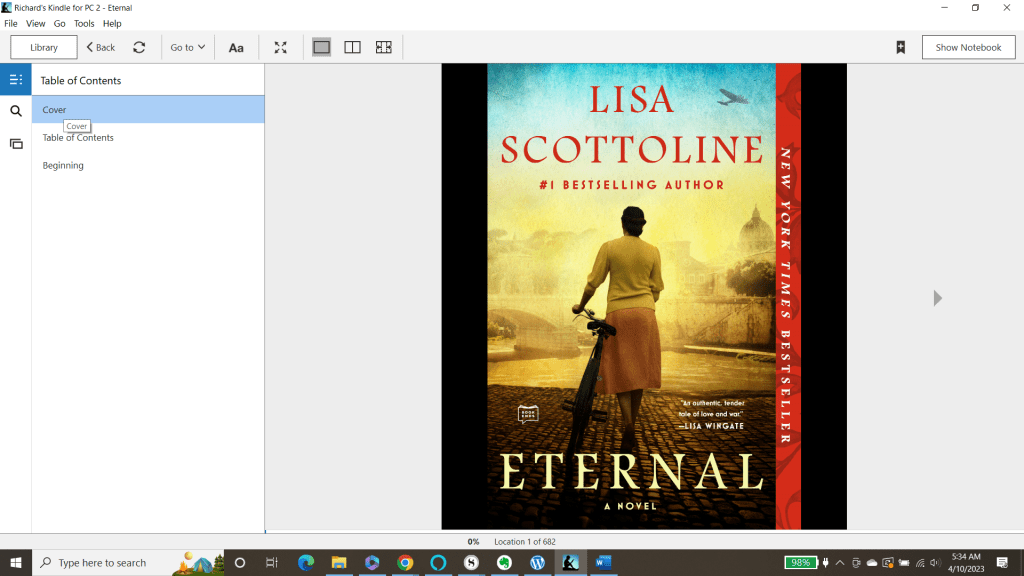
#1 bestselling author Lisa Scottoline offers a sweeping and shattering epic of historical fiction fueled by shocking true events, the tale of a love triangle that unfolds in the heart of Rome…in the creeping shadow of fascism.
What war destroys, only love can heal.
Elisabetta, Marco, and Sandro grow up as the best of friends despite their differences. Elisabetta is a feisty beauty who dreams of becoming a novelist; Marco the brash and athletic son in a family of professional cyclists; and Sandro a Jewish mathematics prodigy, kind-hearted and thoughtful, the son of a lawyer and a doctor. Their friendship blossoms to love, with both Sandro and Marco hoping to win Elisabetta’s heart. But in the autumn of 1937, all of that begins to change as Mussolini asserts his power, aligning Italy’s Fascists with Hitler’s Nazis and altering the very laws that govern Rome. In time, everything that the three hold dear–their families, their homes, and their connection to one another–is tested in ways they never could have imagined.
As anti-Semitism takes legal root and World War II erupts, the threesome realizes that Mussolini was only the beginning. The Nazis invade Rome, and with their occupation come new atrocities against the city’s Jews, culminating in a final, horrific betrayal. Against this backdrop, the intertwined fates of Elisabetta, Marco, Sandro, and their families will be decided, in a heartbreaking story of both the best and the worst that the world has to offer.
Unfolding over decades, Eternal is a tale of loyalty and loss, family and food, love and war–all set in one of the world’s most beautiful cities at its darkest moment. This moving novel will be forever etched in the hearts and minds of readers.
Wisdom on overcoming the greatest human frustration from the pioneer of Eastern philosophy in the West.
BY MARIA POPOVA
“How we spend our days is, of course, how we spend our lives,” Annie Dillard wrote in her timeless reflection on presence over productivity — a timely antidote to the central anxiety of our productivity-obsessed age. Indeed, my own New Year’s resolution has been to stop measuring my days by degree of productivity and start experiencing them by degree of presence. But what, exactly, makes that possible?
This concept of presence is rooted in Eastern notions of mindfulness — the ability to go through life with crystalline awareness and fully inhabit our experience — largely popularized in the West by British philosopher and writer Alan Watts (January 6, 1915–November 16, 1973), who also gave us this fantastic meditation on the life of purpose. In the altogether excellent 1951 volume The Wisdom of Insecurity: A Message for an Age of Anxiety (public library), Watts argues that the root of our human frustration and daily anxiety is our tendency to live for the future, which is an abstraction. He writes:
If to enjoy even an enjoyable present we must have the assurance of a happy future, we are “crying for the moon.” We have no such assurance. The best predictions are still matters of probability rather than certainty, and to the best of our knowledge every one of us is going to suffer and die. If, then, we cannot live happily without an assured future, we are certainly not adapted to living in a finite world where, despite the best plans, accidents will happen, and where death comes at the end.
Alan Watts, early 1970s (Image courtesy of Everett Collection)
What keeps us from happiness, Watts argues, is our inability to fully inhabit the present:
The “primary consciousness,” the basic mind which knows reality rather than ideas about it, does not know the future. It lives completely in the present, and perceives nothing more than what is at this moment. The ingenious brain, however, looks at that part of present experience called memory, and by studying it is able to make predictions. These predictions are, relatively, so accurate and reliable (e.g., “everyone will die”) that the future assumes a high degree of reality — so high that the present loses its value.
But the future is still not here, and cannot become a part of experienced reality until it is present. Since what we know of the future is made up of purely abstract and logical elements — inferences, guesses, deductions — it cannot be eaten, felt, smelled, seen, heard, or otherwise enjoyed. To pursue it is to pursue a constantly retreating phantom, and the faster you chase it, the faster it runs ahead. This is why all the affairs of civilization are rushed, why hardly anyone enjoys what he has, and is forever seeking more and more. Happiness, then, will consist, not of solid and substantial realities, but of such abstract and superficial things as promises, hopes, and assurances.
Watts argues that our primary mode of relinquishing presence is by leaving the body and retreating into the mind — that ever-calculating, self-evaluating, seething cauldron of thoughts, predictions, anxieties, judgments, and incessant meta-experiences about experience itself. Writing more than half a century before our age of computers, touch-screens, and the quantified self, Watts admonishes:
The brainy modern loves not matter but measures, no solids but surfaces.
[…]
The working inhabitants of a modern city are people who live inside a machine to be batted around by its wheels. They spend their days in activities which largely boil down to counting and measuring, living in a world of rationalized abstraction which has little relation to or harmony with the great biological rhythms and processes. As a matter of fact, mental activities of this kind can now be done far more efficiently by machines than by men — so much so that in a not too distant future the human brain may be an obsolete mechanism for logical calculation. Already the human computer is widely displaced by mechanical and electrical computers of far greater speed and efficiency. If, then, man’s principal asset and value is his brain and his ability to calculate, he will become an unsaleable commodity in an era when the mechanical operation of reasoning can be done more effectively by machines.
[…]
If we are to continue to live for the future, and to make the chief work of the mind prediction and calculation, man must eventually become a parasitic appendage to a mass of clockwork.
To be sure, Watts doesn’t dismiss the mind as a worthless or fundamentally perilous human faculty. Rather, he insists that it if we let its unconscious wisdom unfold unhampered — like, for instance, what takes place during the “incubation” stage of unconscious processing in the creative process — it is our ally rather than our despot. It is only when we try to control it and turn it against itself that problems arise:
Working rightly, the brain is the highest form of “instinctual wisdom.” Thus it should work like the homing instinct of pigeons and the formation of the fetus in the womb — without verbalizing the process or knowing “how” it does it. The self-conscious brain, like the self-conscious heart, is a disorder, and manifests itself in the acute feeling of separation between “I” and my experience. The brain can only assume its proper behavior when consciousness is doing what it is designed for: not writhing and whirling to get out of present experience, but being effortlessly aware of it.
And yet the brain does writhe and whirl, producing our great human insecurity and existential anxiety amidst a universe of constant flux. (For, as Henry Miller memorably put it, “It is almost banal to say so yet it needs to be stressed continually: all is creation, all is change, all is flux, all is metamorphosis.”) Paradoxically, recognizing that the experience of presence is the only experience is also a reminder that our “I” doesn’t exist beyond this present moment, that there is no permanent, static, and immutable “self” which can grant us any degree of security and certainty for the future — and yet we continue to grasp for precisely that assurance of the future, which remains an abstraction. Our only chance for awakening from this vicious cycle, Watts argues, is bringing full awareness to our present experience — something very different from judging it, evaluating it, or measuring it up against some arbitrary or abstract ideal. He writes:
There is a contradiction in wanting to be perfectly secure in a universe whose very nature is momentariness and fluidity. But the contradiction lies a little deeper than the mere conflict between the desire for security and the fact of change. If I want to be secure, that is, protected from the flux of life, I am wanting to be separate from life. Yet it is this very sense of separateness which makes me feel insecure. To be secure means to isolate and fortify the “I,” but it is just the feeling of being an isolated “I” which makes me feel lonely and afraid. In other words, the more security I can get, the more I shall want.
To put it still more plainly: the desire for security and the feeling of insecurity are the same thing. To hold your breath is to lose your breath. A society based on the quest for security is nothing but a breath-retention contest in which everyone is as taut as a drum and as purple as a beet.
He takes especial issue with the very notion of self-improvement — something particularly prominent in the season of New Year’s resolutions — and admonishes against the implication at its root:
I can only think seriously of trying to live up to an ideal, to improve myself, if I am split in two pieces. There must be a good “I” who is going to improve the bad “me.” “I,” who has the best intentions, will go to work on wayward “me,” and the tussle between the two will very much stress the difference between them. Consequently “I” will feel more separate than ever, and so merely increase the lonely and cut-off feelings which make “me” behave so badly.
Happiness, he argues, isn’t a matter of improving our experience, or even merely confronting it, but remaining present with it in the fullest possible sense:
To stand face to face with insecurity is still not to understand it. To understand it, you must not face it but be it. It is like the Persian story of the sage who came to the door of Heaven and knocked. From within the voice of God asked, “Who is there” and the sage answered, “It is I.” “In this House,” replied the voice, “there is no room for thee and me.” So the sage went away, and spent many years pondering over this answer in deep meditation. Returning a second time, the voice asked the same question, and again the sage answered, “It is I.” The door remained closed. After some years he returned for the third time, and, at his knocking, the voice once more demanded, “Who is there?” And the sage cried, “It is thyself!” The door was opened.
We don’t actually realize that there is no security, Watts asserts, until we confront the myth of fixed selfhood and recognize that the solid “I” doesn’t exist — something modern psychology has termed “the self illusion.” And yet that is incredibly hard to do, for in the very act of this realization there is a realizing self. Watts illustrates this paradox beautifully:
While you are watching this present experience, are you aware of someone watching it? Can you find, in addition to the experience itself, an experiencer? Can you, at the same time, read this sentence and think about yourself reading it? You will find that, to think about yourself reading it, you must for a brief second stop reading. The first experience is reading. The second experience is the thought, “I am reading.” Can you find any thinker, who is thinking the thought, I am reading?” In other words, when present experience is the thought, “I am reading,” can you think about yourself thinking this thought?
Once again, you must stop thinking just, “I am reading.” You pass to a third experience, which is the thought, “I am thinking that I am reading.” Do not let the rapidity with which these thoughts can change deceive you into the feeling that you think them all at once.
[…]
In each present experience you were only aware of that experience. You were never aware of being aware. You were never able to separate the thinker from the thought, the knower from the known. All you ever found was a new thought, a new experience.
What makes us unable to live with pure awareness, Watts points out, is the ball and chain of our memory and our warped relationship with time:
The notion of a separate thinker, of an “I” distinct from the experience, comes from memory and from the rapidity with which thought changes. It is like whirling a burning stick to give the illusion of a continuous circle of fire. If you imagine that memory is a direct knowledge of the past rather than a present experience, you get the illusion of knowing the past and the present at the same time. This suggests that there is something in you distinct from both the past and the present experiences. You reason, “I know this present experience, and it is different from that past experience. If I can compare the two, and notice that experience has changed, I must be something constant and apart.”
But, as a matter of fact, you cannot compare this present experience with a past experience. You can only compare it with a memory of the past, which is a part of the present experience. When you see clearly that memory is a form of present experience, it will be obvious that trying to separate yourself from this experience is as impossible as trying to make your teeth bite themselves.
[…]
To understand this is to realize that life is entirely momentary, that there is neither permanence nor security, and that there is no “I” which can be protected.
And therein lies the crux of our human struggle:
The real reason why human life can be so utterly exasperating and frustrating is not because there are facts called death, pain, fear, or hunger. The madness of the thing is that when such facts are present, we circle, buzz, writhe, and whirl, trying to get the “I” out of the experience. We pretend that we are amoebas, and try to protect ourselves from life by splitting in two. Sanity, wholeness, and integration lie in the realization that we are not divided, that man and his present experience are one, and that no separate “I” or mind can be found.
To understand music, you must listen to it. But so long as you are thinking, “I am listening to this music,” you are not listening.
The Wisdom of Insecurity is immeasurably wonderful — existentially necessary, even — in its entirety, and one of those books bound to stay with you for a lifetime.
Biking is something else I both love and hate. It takes a lot of effort but does provide good exercise and most days over an hour to listen to a good book or podcast. I especially like having ridden.
Here’s my bike, a Rockhopper by Specialized. I purchased it November 2021 from Venture Out in Guntersville; Mike is top notch! So is the bike, and the ‘old’ man seat I salvaged from an old Walmart bike.
#1 bestselling author Lisa Scottoline offers a sweeping and shattering epic of historical fiction fueled by shocking true events, the tale of a love triangle that unfolds in the heart of Rome…in the creeping shadow of fascism.
What war destroys, only love can heal.
Elisabetta, Marco, and Sandro grow up as the best of friends despite their differences. Elisabetta is a feisty beauty who dreams of becoming a novelist; Marco the brash and athletic son in a family of professional cyclists; and Sandro a Jewish mathematics prodigy, kind-hearted and thoughtful, the son of a lawyer and a doctor. Their friendship blossoms to love, with both Sandro and Marco hoping to win Elisabetta’s heart. But in the autumn of 1937, all of that begins to change as Mussolini asserts his power, aligning Italy’s Fascists with Hitler’s Nazis and altering the very laws that govern Rome. In time, everything that the three hold dear–their families, their homes, and their connection to one another–is tested in ways they never could have imagined.
As anti-Semitism takes legal root and World War II erupts, the threesome realizes that Mussolini was only the beginning. The Nazis invade Rome, and with their occupation come new atrocities against the city’s Jews, culminating in a final, horrific betrayal. Against this backdrop, the intertwined fates of Elisabetta, Marco, Sandro, and their families will be decided, in a heartbreaking story of both the best and the worst that the world has to offer.
Unfolding over decades, Eternal is a tale of loyalty and loss, family and food, love and war–all set in one of the world’s most beautiful cities at its darkest moment. This moving novel will be forever etched in the hearts and minds of readers.
A heartening perspective on mortality by way of the physics of the cosmos and the poetics of the night-blooming cereus cactus.
BY MARIA POPOVA
“We suffer from a hallucination, from a false and distorted sensation of our own existence as living organisms,” Alan Watts wrote in contemplating how our ego keeps us separate from the universe. “It is almost banal to say so,”Henry Miller observed, “yet it needs to be stressed continually: all is creation, all is change, all is flux, all is metamorphosis.” But banal as it may be, it is also intolerably discomfiting to accept, which is why we retreat into our hallucination — we resist change, we long for immortality, and we cling to the notion of the self, despite its ever-changing essence, as anxious assurance of our own permanence in an impermanent universe.
Lightman begins with the bittersweet beauty of a deeply human rite of passage: As he walked his eldest daughter down the aisle, “radiant in her white dress, a white dahlia in her hair,” she asked to hold his hand and something else, something heavy yet inescapable, gripped Lightman’s heart. He writes:
It was a perfect picture of utter joy, and utter tragedy. Because I wanted my daughter back as she was at age ten, or twenty. As we moved together toward that lovely arch that would swallow us all, other scenes flashed through my mind: my daughter in first grade holding a starfish as big as herself, her smile missing a tooth; my daughter on the back of my bicycle as we rode to a river to drop stones in the water; my daughter telling me the day after she had her first period. Now she was thirty. I could see lines in her face.
Aware of both the absurdity and the humanity of his feelings in that moment, Lightman considers the root of that wistfully familiar existential unease:
I don’t know why we long so for permanence, why the fleeting nature of things so disturbs. With futility, we cling to the old wallet long after it has fallen apart. We visit and revisit the old neighborhood where we grew up, searching for the remembered grove of trees and the little fence. We clutch our old photographs. In our churches and synagogues and mosques, we pray to the everlasting and eternal. Yet, in every nook and cranny, nature screams at the top of her lungs that nothing lasts, that it is all passing away. All that we see around us, including our own bodies, is shifting and evaporating and one day will be gone. Where are the one billion people who lived and breathed in the year 1800, only two short centuries ago?
Nature, he argues, is unambiguous in her message — from the mayflies that “drop by the billions within twenty-four hours of birth” to the glaciers that “slowly but surely grind down the land” to our own flesh, just as slowly and surely sagging into agedness, order, with all its comforting familiarity, steadily descends into chaos. It is, after all, one of the laws of the universe:
Physicists call it the second law of thermodynamics. It is also called the arrow of time. Oblivious to our human yearnings for permanence, the universe is relentlessly wearing down, falling apart, driving itself toward a condition of maximum disorder. It is a question of probabilities. You start from a situation of improbable order, like a deck of cards all arranged according to number and suit, or like a solar system with several planets orbiting nicely about a central star. Then you drop the deck of cards on the floor over and over again… Order has yielded to disorder. Repeated patterns to change. In the end, you cannot defeat the odds. You might beat the house for a while, but the universe has an infinite supply of time and can outlast any player.
The Cat’s Eye Nebula, one of the first planetary nebulae discovered, from ‘Hubble: Imaging Space and Time.’ Click image for more.
Lightman offers an example elemental to our embodied existence — our skeletal muscles:
With age, muscles slacken and grow loose, lose mass and strength, can barely support our weight as we toddle across the room. And why must we suffer such indignities? Because our muscles, like all living tissue, must be repaired from time to time due to normal wear and tear. These repairs are made by the mechano growth factor hormone, which in turn is regulated by the IGF1 gene. When that gene inevitably loses some tines … Muscle to flab. Vigor to decrepitude. Dust to dust.
And yet something about the human experience — the human condition, with its implied pathology of consciousness — causes us to tense against this natural progression with anguishing anxiety rather than resting into it with calm acceptance:
We continue to strive for youth and immortality, we continue to cling to the old photographs, we continue to wish that our grown daughters were children again.
This resistance to change, which takes on the proportions of agonizing aversion, isn’t reserved just for our physical bodies — we loathe the redesign of our favorite sites, the reorganization of our companies, the disposal of our childhood toys. This is also, perhaps, why a gobsmacking percentage of people refuse to believe Earth is more than 6,000 years old — something about the notion of all that has been and no longer is feels unbearable in its implicit testament to our own impending non-existence. And yet change is in the fundamental building block of Earth’s DNA. Lightman traces this back to the stars:
Over its 4.5-billion-year history, our own planet has gone through continuous upheavals and change. The primitive Earth had no oxygen in its atmosphere. Due to its molten interior, our planet was much hotter than it is now, and volcanoes spewed forth in large numbers. Driven by heat flow from the core of the Earth, the terrestrial crust shifted and moved. Huge landmasses splintered and glided about on deep tectonic plates. Then plants and photosynthesis leaked oxygen into the atmosphere. At certain periods, the changing gases in the air caused the planet to cool, ice covered the Earth, entire oceans may have frozen. Today, the Earth continues to change. Something like ten billion tons of carbon are cycled through plants and the atmosphere every few years — first absorbed by plants from the air in the form of carbon dioxide, then converted into sugars by photosynthesis, then released again into soil or air when the plant dies or is eaten. Wait around a hundred million years or so, and carbon atoms are recycled through rocks, soil, and oceans as well as plants.
[…]
At some point in the future, new stars will cease being born. Slowly but surely, the stars of our universe are winking out. A day will come when the night sky will be totally black, and the day sky will be totally black as well. Solar systems will become planets orbiting dead stars. According to astrophysical calculations, in about a million billion years, plus or minus, even those dead solar systems will be disrupted from chance gravitational encounters with other stars. In about ten billion billion years, even galaxies will be disrupted, the cold spheres that were once stars flung out to coast solo through empty space.
In his characteristically elegant trapeze act of swinging between science and the humanities, Lightman turns to the Buddhist notion of anicca to make sense of our paradoxical predicament in the face of such cosmic evidence:
In Buddhism, anicca is one of the three signs of existence, the others being dukkha, or suffering, and anatta, or non-selfhood. According to the Mahaparinibbana Sutta, when the Buddha passed away, the king deity Sakka uttered the following: “Impermanent are all component things. They arise and cease, that is their nature: They come into being and pass away.” We should not “attach” to things in this world, say the Buddhists, because all things are temporary and will soon pass away. All suffering, say the Buddhists, arises from attachment.
Wryly adding that if he could “detach” from his daughter, he might feel better, Lightman considers the uncomfortably palpitating heart of the matter — the choice each of us has to make in contemplating change and eternity:
To my mind, it is one of the profound contradictions of human existence that we long for immortality, indeed fervently believe that something must be unchanging and permanent, when all of the evidence in nature argues against us. I certainly have such a longing. Either I am delusional, or nature is incomplete. Either I am being emotional and vain in my wish for eternal life for myself and my daughter (and my wingtips), or there is some realm of immortality that exists outside nature.
The first option only offers one possible course of action — come to terms with it, and move on. It’s an unfair proposition, no doubt, but not a particularly difficult one — for, as Lightman puts it, “the human mind has a famous ability to create its own reality.” The second — the idea of nature’s incompleteness, perhaps even negligence — is the hotbed of many religious explanations. Lightman, who explored the tension between science and spirituality with unparalleled grace in another essay, writes:
Despite all the richness of the physical world — the majestic architecture of atoms, the rhythm of the tides, the luminescence of the galaxies — nature is missing something even more exquisite and grand: some immortal substance, which lies hidden from view. Such exquisite stuff could not be made from matter, because all matter is slave to the second law of thermodynamics. Perhaps this immortal thing that we wish for exists beyond time and space. Perhaps it is God. Perhaps it is what made the universe.
Of these two alternatives, I am inclined to the first. I cannot believe that nature could be so amiss. Although there is much that we do not understand about nature, the possibility that it is hiding a condition or substance so magnificent and utterly unlike everything else seems too preposterous for me to believe. So I am delusional. In my continual cravings for eternal youth and constancy, I am being sentimental. Perhaps with the proper training of my unruly mind and emotions, I could refrain from wanting things that cannot be. Perhaps I could accept the fact that in a few short years, my atoms will be scattered in wind and soil, my mind and thoughts gone, my pleasures and joys vanished, my “I-ness” dissolved in an infinite cavern of nothingness. But I cannot accept that fate even though I believe it to be true. I cannot force my mind to go to that dark place. “A man can do what he wants,” said Schopenhauer, “but not want what he wants.
To alleviate the weight of this insurmountable impossibility, Lightman proposes that we should reframe the question rather than lament the answer:
If against our wishes and hopes, we are stuck with mortality, does mortality grant a beauty and grandeur all its own? Even though we struggle and howl against the brief flash of our lives, might we find something majestic in that brevity? Could there be a preciousness and value to existence stemming from the very fact of its temporary duration? And I think of the night-blooming cereus, a plant that looks like a leathery weed most of the year. But for one night each summer its flower opens to reveal silky white petals, which encircle yellow lacelike threads, and another whole flower like a tiny sea anemone within the outer flower. By morning, the flower has shriveled. One night of the year, as delicate and fleeting as a life in the universe.
The Accidental Universe is absolutely spectacular in its entirety, each essay its own poetic whirlwind of physics and philosophy. Complement it with another Alan — Watts — on our illusory reality.
Biking is something else I both love and hate. It takes a lot of effort but does provide good exercise and most days over an hour to listen to a good book or podcast. I especially like having ridden.
Here’s my bike, a Rockhopper by Specialized. I purchased it November 2021 from Venture Out in Guntersville; Mike is top notch! So is the bike, and the ‘old’ man seat I salvaged from an old Walmart bike.
#1 bestselling author Lisa Scottoline offers a sweeping and shattering epic of historical fiction fueled by shocking true events, the tale of a love triangle that unfolds in the heart of Rome…in the creeping shadow of fascism.
What war destroys, only love can heal.
Elisabetta, Marco, and Sandro grow up as the best of friends despite their differences. Elisabetta is a feisty beauty who dreams of becoming a novelist; Marco the brash and athletic son in a family of professional cyclists; and Sandro a Jewish mathematics prodigy, kind-hearted and thoughtful, the son of a lawyer and a doctor. Their friendship blossoms to love, with both Sandro and Marco hoping to win Elisabetta’s heart. But in the autumn of 1937, all of that begins to change as Mussolini asserts his power, aligning Italy’s Fascists with Hitler’s Nazis and altering the very laws that govern Rome. In time, everything that the three hold dear–their families, their homes, and their connection to one another–is tested in ways they never could have imagined.
As anti-Semitism takes legal root and World War II erupts, the threesome realizes that Mussolini was only the beginning. The Nazis invade Rome, and with their occupation come new atrocities against the city’s Jews, culminating in a final, horrific betrayal. Against this backdrop, the intertwined fates of Elisabetta, Marco, Sandro, and their families will be decided, in a heartbreaking story of both the best and the worst that the world has to offer.
Unfolding over decades, Eternal is a tale of loyalty and loss, family and food, love and war–all set in one of the world’s most beautiful cities at its darkest moment. This moving novel will be forever etched in the hearts and minds of readers.


























 Richard L. Fricks