Some Christian lawyers—some eminent and stupid judges—have said and still say, that the Ten Commandments are the foundation of all law.
Nothing could be more absurd. Long before these commandments were given there were codes of laws in India and Egypt—laws against murder, perjury, larceny, adultery and fraud. Such laws are as old as human society; as old as the love of life; as old as industry; as the idea of prosperity; as old as human love.
All of the Ten Commandments that are good were old; all that were new are foolish. If Jehovah had been civilized he would have left out the commandment about keeping the Sabbath, and in its place would have said: “Thou shalt not enslave thy fellow-men.” He would have omitted the one about swearing, and said: “The man shall have but one wife, and the woman but one husband.” He would have left out the one about graven images, and in its stead would have said: “Thou shalt not wage wars of extermination, and thou shalt not unsheathe the sword except in self-defence.”
If Jehovah had been civilized, how much grander the Ten Commandments would have been.
All that we call progress—the enfranchisement of man, of labor, the substitution of imprisonment for death, of fine for imprisonment, the destruction of polygamy, the establishing of free speech, of the rights of conscience; in short, all that has tended to the development and civilization of man; all the results of investigation, observation, experience and free thought; all that man has accomplished for the benefit of man since the close of the Dark Ages—has been done in spite of the Old Testament.
Let me further illustrate the morality, the mercy, the philosophy and goodness of the Old Testament:
The Story of Achan
Joshua took the City of Jericho. Before the fall of the city he declared that all the spoil taken should be given to the Lord.
In spite of this order Achan secreted a garment, some silver and gold.
Afterward Joshua tried to take the city of Ai. He failed and many of his soldiers were slain. Joshua sought for the cause of his defeat and he found that Achan had secreted a garment, two hundred shekels of silver and a wedge of gold. To this Achan confessed.
And thereupon Joshua took Achan, his sons and his daughters, his oxen and his sheep—stoned them all to death and burned their bodies.
There is nothing to show that the sons and daughters had committed any crime. Certainly, the oxen and sheep should not have been stoned to death for the crime of their owner. This was the justice, the mercy, of Jehovah!
After Joshua had committed this crime, with the help of Jehovah he captured the city of Ai.
The Story of Elisha
“And he went up thence unto Bethel, and as he was going up by the way there came forth little children out of the city and mocked him, and said unto him, “Go up, thou baldhead.””
“And he turned back and looked at them, and cursed them in the name of the Lord. And there came forth two she-bears out of the wood and tore forty and two children of them.”
This was the work of the good God—the merciful Jehovah!
The Story of Daniel
King Darius had honored and exalted Daniel, and the native princes were jealous. So they induced the king to sign a decree to the effect that any man who should make a petition to any god or man except to King Darius, for thirty days, should be cast into the den of lions.
Afterward these men found that Daniel, with his face toward Jerusalem, prayed three times a day to Jehovah.
Thereupon Daniel was cast into the den of lions; a stone was placed at the mouth of the den and sealed with the king’s seal.
The king passed a bad night. The next morning he went to the den and cried out to Daniel. Daniel answered and told the king that God had sent his angel and shut the mouths of the lions.
Daniel was taken out alive and well, and the king was converted and believed in Daniel’s God.
Darius, being then a believer in the true God, sent for the men who had accused Daniel, and for their wives and their children, and cast them all into the lions den.
“And the lions had the mastery of them, and brake all their bones in pieces, or ever they came at the bottom of the pit.”
What had the wives and little children done? How had they offended King Darius, the believer in Jehovah? Who protected Daniel? Jehovah! Who failed to protect the innocent wives and children? Jehovah!
The Story of Joseph
Pharaoh had a dream, and this dream was interpreted by Joseph.
According to this interpretation there was to be in Egypt seven years of plenty, followed by seven years of famine. Joseph advised Pharaoh to buy all the surplus of the seven plentiful years and store it up against the years of famine.
Pharaoh appointed Joseph as his minister or agent, and ordered him to buy the grain of the plentiful years.
Then came the famine. The people came to the king for help. He told them to go to Joseph and do as he said.
Joseph sold corn to the Egyptians until all their money was gone—until he had it all.
When the money was gone the people said: “Give us corn and we will give you our cattle.”
Joseph let them have corn until all their cattle, their horses and their flocks had been given to him.
Then the people said: “Give us corn and we will give you our lands.”
So Joseph let them have corn until all their lands were gone.
But the famine continued, and so the poor wretches sold themselves, and they became the servants of Pharaoh.
Then Joseph gave them seed, and made an agreement with them that they should forever give one fifth of all they raised to Pharaoh.
Who enabled Joseph to interpret the dream of Pharaoh? Jehovah! Did he know at the time that Joseph would use the information thus given to rob and enslave the people of Egypt? Yes. Who produced the famine? Jehovah!
It is perfectly apparent that the Jews did not think of Jehovah as the God of Egypt—the God of all the world. He was their God, and theirs alone. Other nations had gods, but Jehovah was the greatest of all. Be hated other nations and other gods, and abhorred all religions except the worship of himself.
We were having one war after another — first we had the First World War, then we had the Second World War and I just couldn’t see any point to the whole thing. So I wrote him a letter and I said, “What’s the point of living with what we’re going through here — having one war after another?”
Lo and behold, Einstein wrote back. While short, his letter extends with exquisite precision both the answer to the question about the meaning of life and his views on religion:
Biking is something else I both love and hate. It takes a lot of effort but does provide good exercise and most days over an hour to listen to a good book or podcast. I especially like having ridden.
Here’s my bike, a Rockhopper by Specialized. I purchased it November 2021 from Venture Out in Guntersville; Mike is top notch! So is the bike, and the ‘old’ man seat I salvaged from an old Walmart bike.
Today, I listened to the following Making Sense Podcast episode: What Do We Know About Our Minds? A Conversation with Paul Bloom
Here’s the link. A subscription is required to listen to the entire episode.
APRIL 20, 2023
Sam Harris speaks with Paul Bloom about the state of psychological science. They discuss fiction as a window onto the mind, recent developments in AI, the tension between misinformation and free speech, bullshitting vs lying, truth vs belonging, reliance on scientific authority, the limits of reductionism, consciousness vs intelligence, Freud, behaviorism, the unconscious origins of behavior, confabulation, the limitations of debate, language, Koko the gorilla, mental health, happiness, behavioral genetics, birth-order effects, living a good life, the remembered and experiencing selves, and other topics.
Paul Bloom is Professor of Psychology at the University of Toronto, and Brooks and Suzanne Ragen Professor Emeritus of Psychology at Yale University. Paul Bloom studies how children and adults make sense of the world, with special focus on pleasure, morality, religion, fiction, and art. He has won numerous awards for his research and teaching. He is past-president of the Society for Philosophy and Psychology, and co-editor of Behavioral and Brain Sciences. He has written for scientific journals such as Nature and Science, and for popular outlets such as The New York Times, The Guardian, The New Yorker, and The Atlantic Monthly. He is the author of seven books, including his latest Psych: The Story of the Human Mind.
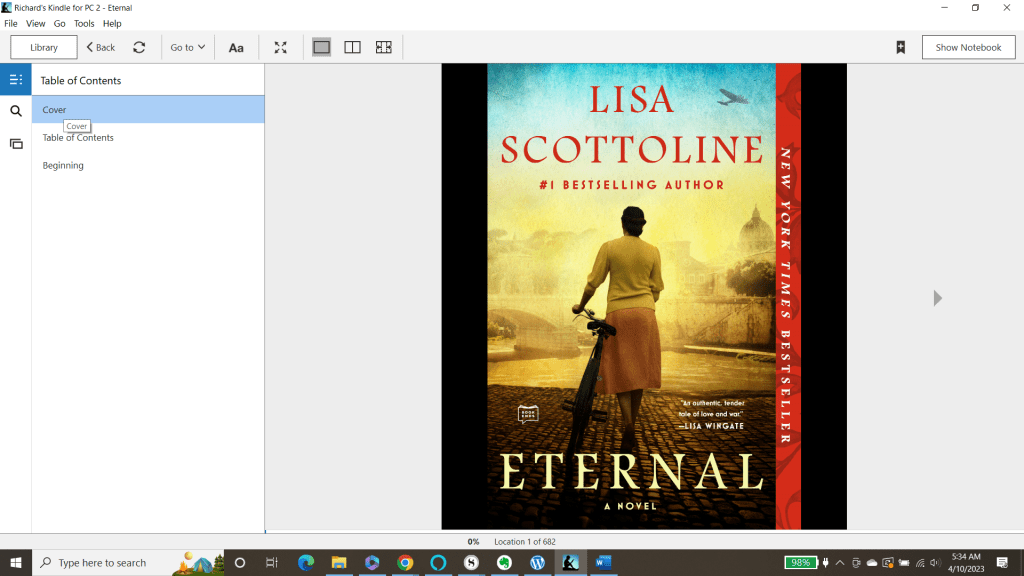
Tomorrow, I’ll continue listening to Eternal, by Lisa Scottoline:
Amazon Abstract
NEW YORK TIMES BESTSELLER
#1 bestselling author Lisa Scottoline offers a sweeping and shattering epic of historical fiction fueled by shocking true events, the tale of a love triangle that unfolds in the heart of Rome…in the creeping shadow of fascism.
What war destroys, only love can heal.
Elisabetta, Marco, and Sandro grow up as the best of friends despite their differences. Elisabetta is a feisty beauty who dreams of becoming a novelist; Marco the brash and athletic son in a family of professional cyclists; and Sandro a Jewish mathematics prodigy, kind-hearted and thoughtful, the son of a lawyer and a doctor. Their friendship blossoms to love, with both Sandro and Marco hoping to win Elisabetta’s heart. But in the autumn of 1937, all of that begins to change as Mussolini asserts his power, aligning Italy’s Fascists with Hitler’s Nazis and altering the very laws that govern Rome. In time, everything that the three hold dear–their families, their homes, and their connection to one another–is tested in ways they never could have imagined.
As anti-Semitism takes legal root and World War II erupts, the threesome realizes that Mussolini was only the beginning. The Nazis invade Rome, and with their occupation come new atrocities against the city’s Jews, culminating in a final, horrific betrayal. Against this backdrop, the intertwined fates of Elisabetta, Marco, Sandro, and their families will be decided, in a heartbreaking story of both the best and the worst that the world has to offer.
Unfolding over decades, Eternal is a tale of loyalty and loss, family and food, love and war–all set in one of the world’s most beautiful cities at its darkest moment. This moving novel will be forever etched in the hearts and minds of readers.
If it is, it should be a book that no man—no number of men—could produce.
It should contain the perfection of philosophy.
It should perfectly accord with every fact in nature.
There should be no mistakes in astronomy, geology, or as to any subject or science.
Its morality should be the highest, the purest.
Its laws and regulations for the control of conduct should be just, wise, perfect, and perfectly adapted to the accomplishment of the ends desired.
It should contain nothing calculated to make man cruel, revengeful, vindictive or infamous.
It should be filled with intelligence, justice, purity, honesty, mercy and the spirit of liberty.
It should be opposed to strife and war, to slavery and lust, to ignorance, credulity and superstition.
It should develop the brain and civilize the heart.
It should satisfy the heart and brain of the best and wisest.
It should be true.
Does the Old Testament satisfy this standard?
Is there anything in the Old Testament—in history, in theory, in law, in government, in morality, in science—above and beyond the ideas, the beliefs, the customs and prejudices of its authors and the people among whom they lived?
Is there one ray of light from any supernatural source?
The ancient Hebrews believed that this earth was the center of the universe, and that the sun, moon and stars were specks in the sky.
With this the Bible agrees.
They thought the earth was flat, with four corners; that the sky, the firmament, was solid—the floor of Jehovah’s house.
The Bible teaches the same.
They imagined that the sun journeyed about the earth, and that by stopping the sun the day could be lengthened.
The Bible agrees with this.
They believed that Adam and Eve were the first man and woman; that they had been created but a few years before, and that they, the Hebrews, were their direct descendants.
This the Bible teaches.
If anything is, or can be, certain, the writers of the Bible were mistaken about creation, astronomy, geology; about the causes of phenomena, the origin of evil and the cause of death.
Now, it must be admitted that if an infinite Being is the author of the Bible, he knew all sciences, all facts, and could not have made a mistake.
If, then, there are mistakes, misconceptions, false theories, ignorant myths and blunders in the Bible, it must have been written by finite beings; that is to say, by ignorant and mistaken men.
Nothing can be clearer than this.
For centuries the church insisted that the Bible was absolutely true; that it contained no mistakes; that the story of creation was true; that its astronomy and geology were in accord with the facts; that the scientists who differed with the Old Testament were infidels and atheists.
Now this has changed. The educated Christians admit that the writers of the Bible were not inspired as to any science. They now say that God, or Jehovah, did not inspire the writers of his book for the purpose of instructing the world about astronomy, geology, or any science. They now admit that the inspired men who wrote the Old Testament knew nothing about any science, and that they wrote about the earth and stars, the sun and moon, in accordance with the general ignorance of the time.
It required many centuries to force the theologians to this admission. Reluctantly, full of malice and hatred, the priests retired from the field, leaving the victory with science.
They took another position;
They declared that the authors, or rather the writers, of the Bible were inspired in spiritual and moral things; that Jehovah wanted to make known to his children his will and his infinite love for his children; that Jehovah, seeing his people wicked, ignorant and depraved, wished to make them merciful and just, wise and spiritual, and that the Bible is inspired in its laws, in the religion it teaches and in its ideas of government.
This is the issue now. Is the Bible any nearer right in its ideas of justice, of mercy, of morality or of religion than in its conception of the sciences? Is it moral?
It upholds slavery—it sanctions polygamy.
Could a devil have done worse?
Is it merciful?
In war it raised the black flag; it commanded the destruction, the massacre, of all—of the old, infirm. and helpless—of wives and babes.
Were its laws inspired?
Hundreds of offenses were punished with death. To pick up sticks on Sunday, to murder your father on Monday, were equal crimes. There is in the literature of the world no bloodier code. The law of revenge—of retaliation—was the law of Jehovah. An eye for an eye, a tooth for a tooth, a limb for a limb.
This is savagery—not philosophy.
Is it just and reasonable?
The Bible is opposed to religious toleration—to religious liberty. Whoever differed with the majority was stoned to death. Investigation was a crime. Husbands were ordered to denounce and to assist in killing their unbelieving wives.
It is the enemy of Art. “Thou shalt make no graven image.” This was the death of Art.
Palestine never produced a painter or a sculptor.
Is the Bible civilized?
It upholds lying, larceny, robbery, murder, the selling of diseased meat to strangers, and even the sacrifice of human beings to Jehovah.
Is it philosophical?
It teaches that the sins of a people can be transferred to an animal—to a goat. It makes maternity an offence for which a sin offering had to be made.
It was wicked to give birth to a boy, and twice as wicked to give birth to a girl.
To make hair-oil like that used by the priests was an offence punishable with death.
The blood of a bird killed over running water was regarded as medicine.
Would a civilized God daub his altars with the blood of oxen, lambs and doves? Would he make all his priests butchers? Would he delight in the smell of burning flesh?
You’ll need pen, paper, and a silencer for cynicism.
BY MARIA POPOVA
“When [a man] has fair health, a fair fortune, a tidy conscience and a complete exemption from embarrassing relatives,”Henry James wrote in his diary, “I suppose he is bound, in delicacy, to write himself happy.” More than a mere philosophical contemplation, however, James’s observation presages the findings of modern psychology in the quest to reverse-engineer the art-science of happiness. No one has addressed the eternal question of what begets happiness with more rigor and empirical dedication than Dr. Martin Seligman, founding father of Positive Psychology — a movement premised on countering the traditional “disease model” of psychology, which focuses on how to relieve suffering rather than how to amplify well-being. Seligman, whom I first had the pleasure of encountering at my alma mater, the University of Pennsylvania, and who was once elected President of the American Psychological Association by the largest vote in the organization’s history, remains one of the most influential psychologists in the study of happiness. In his excellent and highly revisitable book Flourish: A Visionary New Understanding of Happiness and Well-being (public library), Seligman offers a simple practice that promises to enhance your well-being and lower your depression — the “Gratitude Visit.” Though to the cynical eye the exercise might appear both old-fashioned and overly self-helpy, it is rooted in decades of Seligman’s acclaimed research and brings to practical life some of modern psychology’s most important findings. Seligman takes us through the practice:
Close your eyes. Call up the face of someone still alive who years ago did something or said something that changed your life for the better. Someone who you never properly thanked; someone you could meet face-to-face next week. Got a face?
Gratitude can make your life happier and more satisfying. When we feel gratitude, we benefit from the pleasant memory of a positive event in our life. Also, when we express our gratitude to others, we strengthen our relationship with them. But sometimes our thank you is said so casually or quickly that it is nearly meaningless. In this exercise … you will have the opportunity to experience what it is like to express your gratitude in a thoughtful, purposeful manner.
Your task is to write a letter of gratitude to this individual and deliver it in person. The letter should be concrete and about three hundred words: be specific about what she did for you and how it affected your life. Let her know what you are doing now, and mention how you often remember what she did. Make it sing! Once you have written the testimonial, call the person and tell her you’d like to visit her, but be vague about the purpose of the meeting; this exercise is much more fun when it is a surprise. When you meet her, take your time reading your letter.
This somewhat self-consciousness-inducing exercise, Seligman promises, will make you happier and less depressed a mere month from now.
He then suggests a complementary second practice — the “What-Went-Well Exercise,” also known as “Three Blessings” — based on the interventions he and his team at the Positive Psychology Center and the University of Pennsylvania have validated in the random-assignment, placebo-controlled experiments they have been conducting since 2001 to study changes in life-satisfaction and depression levels. He contextualizes the value of this exercise amidst our worry-culture and age of anxiety:
We think too much about what goes wrong and not enough about what goes right in our lives. Of course, sometimes it makes sense to analyze bad events so that we can learn from them and avoid them in the future. However, people tend to spend more time thinking about what is bad in life than is helpful. Worse, this focus on negative events sets us up for anxiety and depression. One way to keep this from happening is to get better at thinking about and savoring what went well.
For sound evolutionary reasons, most of us are not nearly as good at dwelling on good events as we are at analyzing bad events. Those of our ancestors who spent a lot of time basking in the sunshine of good events, when they should have been preparing for disaster, did not survive the Ice Age. So to overcome our brains’ natural catastrophic bent, we need to work on and practice this skill of thinking about what went well.
He then offers his empirically tested antidote:
Every night for the next week, set aside ten minutes before you go to sleep. Write down three things that went well today and why they went well. You may use a journal or your computer to write about the events, but it is important that you have a physical record of what you wrote. The three things need not be earthshaking in importance (“My husband picked up my favorite ice cream for dessert on the way home from work today”), but they can be important (“My sister just gave birth to a healthy baby boy”).
Next to each positive event, answer the question “Why did this happen?” For example, if you wrote that your husband picked up ice cream, write “because my husband is really thoughtful sometimes” or “because I remembered to call him from work and remind him to stop by the grocery store.” Or if you wrote, “My sister just gave birth to a healthy baby boy,” you might pick as the cause … “She did everything right during her pregnancy.”
Writing about why the positive events in your life happened may seem awkward at first, but please stick with it for one week. It will get easier.
For those of us able to quiet our inner culturally-conditioned cynic who judges and dismisses such practices, Seligman promises that we’ll be “less depressed, happier, and addicted to this exercise six months from now.”
Biking is something else I both love and hate. It takes a lot of effort but does provide good exercise and most days over an hour to listen to a good book or podcast. I especially like having ridden.
Here’s my bike, a Rockhopper by Specialized. I purchased it November 2021 from Venture Out in Guntersville; Mike is top notch! So is the bike, and the ‘old’ man seat I salvaged from an old Walmart bike.
#1 bestselling author Lisa Scottoline offers a sweeping and shattering epic of historical fiction fueled by shocking true events, the tale of a love triangle that unfolds in the heart of Rome…in the creeping shadow of fascism.
What war destroys, only love can heal.
Elisabetta, Marco, and Sandro grow up as the best of friends despite their differences. Elisabetta is a feisty beauty who dreams of becoming a novelist; Marco the brash and athletic son in a family of professional cyclists; and Sandro a Jewish mathematics prodigy, kind-hearted and thoughtful, the son of a lawyer and a doctor. Their friendship blossoms to love, with both Sandro and Marco hoping to win Elisabetta’s heart. But in the autumn of 1937, all of that begins to change as Mussolini asserts his power, aligning Italy’s Fascists with Hitler’s Nazis and altering the very laws that govern Rome. In time, everything that the three hold dear–their families, their homes, and their connection to one another–is tested in ways they never could have imagined.
As anti-Semitism takes legal root and World War II erupts, the threesome realizes that Mussolini was only the beginning. The Nazis invade Rome, and with their occupation come new atrocities against the city’s Jews, culminating in a final, horrific betrayal. Against this backdrop, the intertwined fates of Elisabetta, Marco, Sandro, and their families will be decided, in a heartbreaking story of both the best and the worst that the world has to offer.
Unfolding over decades, Eternal is a tale of loyalty and loss, family and food, love and war–all set in one of the world’s most beautiful cities at its darkest moment. This moving novel will be forever etched in the hearts and minds of readers.
Somebody ought to tell the truth about the Bible. The preachers dare not, because they would be driven from their pulpits. Professors in colleges dare not, because they would lose their salaries. Politicians dare not. They would be defeated. Editors dare not. They would lose subscribers. Merchants dare not, because they might lose customers. Men of fashion dare not, fearing that they would lose caste. Even clerks dare not, because they might be discharged. And so I thought I would do it myself.
There are many millions of people who believe the Bible to be the inspired word of God—millions who think that this book is staff and guide, counselor and consoler; that it fills the present with peace and the future with hope—millions who believe that it is the fountain of law, Justice and mercy, and that to its wise and benign teachings the world is indebted for its liberty, wealth and civilization—millions who imagine that this book is a revelation from the wisdom and love of God to the brain and heart of man—millions who regard this book as a torch that conquers the darkness of death, and pours its radiance on another world—a world without a tear.
They forget its ignorance and savagery, its hatred of liberty, its religious persecution; they remember heaven, but they forget the dungeon of eternal pain. They forget that it imprisons the brain and corrupts the heart. They forget that it is the enemy of intellectual freedom. Liberty is my religion. Liberty of hand and brain—of thought and labor, liberty is a word hated by kings—loathed by popes. It is a word that shatters thrones and altars—that leaves the crowned without subjects, and the outstretched hand of superstition without alms. Liberty is the blossom and fruit of justice—the perfume of mercy. Liberty is the seed and soil, the air and light, the dew and rain of progress, love and joy.
I: The Origin of the Bible
A few wandering families—poor, wretched, without education, art or power; descendants of those who had been enslaved for four hundred years; ignorant as the inhabitants of Central Africa, had just escaped from their masters to the desert of Sinai. Their leader was Moses, a man who had been raised in the family of Pharaoh and had been taught the law and mythology of Egypt. For the purpose of controlling his followers he pretended that he was instructed and assisted by Jehovah, the God of these wanderers.
Everything that happened was attributed to the interference of this God. Moses declared that he met this God face to face; that on Sinai’s top from the hands of this God he had received the tables of stone on which, by the finger of this God, the Ten Commandments had been written, and that, in addition to this, Jehovah had made known the sacrifices and ceremonies that were pleasing to him and the laws by which the people should be governed.
In this way the Jewish religion and the Mosaic Code were established.
It is now claimed that this religion and these laws were and are revealed and established for all mankind.
At that time these wanderers had no commerce with other nations, they had no written language, they could neither read nor write. They had no means by which they could make this revelation known to other nations, and so it remained buried in the jargon of a few ignorant, impoverished and unknown tribes for more than two thousand years.
Many centuries after Moses, the leader, was dead many centuries after all his followers had passed away—the Pentateuch was written, the work of many writers, and to give it force and authority it was claimed that Moses was the author.
We now know that the Pentateuch was not written by Moses.
Towns are mentioned that were not in existence when Moses lived.
Money, not coined until centuries after his death, is mentioned.
So, many of the laws were not applicable to wanderers on the desert—laws about agriculture, about the sacrifice of oxen, sheep and doves, about the weaving of cloth, about ornaments of gold and silver, about the cultivation of land, about harvest, about the threshing of grain, about houses and temples, about cities of refuge, and about many other subjects of no possible application to a few starving wanderers over the sands and rocks.
It is now not only admitted by intelligent and honest theologians that Moses was not the author of the Pentateuch, but they all admit that no one knows who the authors were, or who wrote any one of these books, or a chapter or a line. We know that the books were not written in the same generation; that they were not all written by one person; that they are filled with mistakes and contradictions. It is also admitted that Joshua did not write the book that bears his name, because it refers to events that did not happen until long after his death.
No one knows, or pretends to know, the author of Judges; all we know is that it was written centuries after all the judges had ceased to exist. No one knows the author of Ruth, nor of First and Second Samuel; all we know is that Samuel did not write the books that bear his name. In the 25th chapter of First Samuel is an account of the raising of Samuel by the Witch of Endor.
No one knows the author of First and Second Kings or First and Second Chronicles; all we know is that these books are of no value.
We know that the Psalms were not written by David. In the Psalms the Captivity is spoken of, and that did not happen until about five hundred years after David slept with his fathers.
We know that Solomon did not write the Proverbs or the Song; that Isaiah was not the author of the book that bears his name; that no one knows the author of Job, Ecclesiastes, or Esther, or of any book in the Old Testament, with the exception of Ezra.
We know that God is not mentioned or in any way referred to in the book of Esther. We know, too, that the book is cruel, absurd and impossible.
God is not mentioned in the Song of Solomon, the best book in the Old Testament.
And we know that Ecclesiastes was written by an unbeliever.
We know, too, that the Jews themselves had not decided as to what books were inspired—were authentic—until the second century after Christ.
We know that the idea of inspiration was of slow growth, and that the inspiration was determined by those who had certain ends to accomplish.
What language and symbolism have to do with mood and how light exposure and sleep shape our mental health.
BY MARIA POPOVA
“Depression is a disorder of the ‘I,’ failing in your own eyes relative to your goals,” legendary psychologist Martin Seligman observed in his essential treatise on learned optimism. But such a definition of depression, while true, appears somehow insufficient, overlooking the multitude of excruciating physical and psychological realities of the disease beyond the sense of personal failure. Perhaps William Styron came closer in his haunting memoir of depression, Darkness Visible, where he wrote of “depression’s dark wood,” “its inexplicable agony,” and the grueling struggle of those afflicted by it who spend their lives trying to trudge “upward and outward out of hell’s black depths.” And yet for all their insight into its manifestations, both the poets and the psychologists have tussled rather futilely to understand depression’s complex causes and, perhaps most importantly in terms both scientific and humanistic, its cures.
That’s precisely what psychologist Jonathan Rottenberg sets out to do in The Depths: The Evolutionary Origins of the Depression Epidemic (public library) — an ambitious, rigorously researched, and illuminating journey into the abyss of the soul and back out, emerging with insights both practical and conceptual, personal and universal, that shed light on one of the least understood, most pervasive, and most crippling pandemics humanity has ever grappled with. (A sobering note to the hyperbole-wary: At any given point, 22% of the population exhibit at least one symptom of depression and the World Health Organization projects that by 2030, depression will have led to more worldwide disability and lives lost than any other affliction, including cancer, stroke, heart disease, accidents, and even war.)
Rottenberg takes a radical approach to depression based not on a disease model of the mind but on the evolutionary science of mood — a proposition that flies in the face of our cultural assumptions that have rendered the very subject of depression a taboo. He puts this bind in perspective:
Because depression is so unpleasant and so impairing, it may be difficult to imagine that there might be another way of thinking about it; something this bad must be a disease. Yet the defect model causes problems of its own. Some sufferers avoid getting help because they are leery of being branded as defective. Others get help and come to believe what they are repeatedly told in our system of mental health: that they are deficient.
[…]
People still feel inclined to whisper when they talk about depression. Depression has no “Race for the Cure”; this condition rarely spawns dance marathons, car washes, or golf tournaments. Consequently, the lacerating pain of depression remains uncomfortably private.
Rather than subscribing to this broken deficiency model of depression, Rottenberg argues that affective science — the empirical study of mood — lies at the heart of understanding the condition. Defining moods as “internal signals that motivate behavior and move it in the right direction,” he argues that our bodies are “a collection of adaptations, evolutionary legacies that have helped us survive and reproduce in the face of uncertainty and risk” and paints the backdrop of understanding depression:
The mood system … is the great integrator. It takes in information about the external and internal worlds and summarizes what is favorable or unfavorable in terms of accomplishing key goals related to survival and reproduction.
[…]
Once a goal is embarked upon, the mood system monitors progress toward its attainment. It will redouble effort when minor obstacles arise. If progress stops entirely because of an insuperable obstacle, the mood system puts the brakes on effort.
Under this model, mood has an evolutionary function as a mediator of survival strategies. Rottenberg cites a number of experiments, which have indicated that negative mood incites one’s psychoemotional arsenal when a task becomes too challenging. For instance, when study participants are deliberately put in a negative mood and asked to perform a difficult task, their blood pressure spikes — a sign that the body is being mobilized for extra alertness and effort. But if the task is made insurmountably difficult, so much so that success stops being possible, the spike no longer occurs and the mood system dials down the effort. In that sense, mood — the seedbed of depression — isn’t an arbitrary state that washes over us in a whim, but a sieve that separates the goals worth pursuing from those guaranteed to end in disappointment.
Rottenberg argues that our relationship to the mood system is shaped by the way we talk about it and is mired in toxic cultural constructs that bleed into our language:
One of the amazing things about the mood system is how much of it operates outside of conscious awareness. Moods, like most adaptations, developed in species that had neither language nor culture. Yet words are the first things that come to mind when most people think about moods. We are “mad,” we are “sad,” we are “glad.” So infatuated are we with language that both laypeople and scientists find it tempting to equate the language we use to describe mood with mood itself.
This is a big mistake. We need to shed this languagecentric view of mood, even if it threatens our pride to accept that we share a fundamental element of our mental toolkit with rabbits and roadrunners. Holding to a myth of human uniqueness puts us in an untenable position. For one thing, it would mean that we deny mood to those humans who have not yet acquired mood language (babies) or have lost mood language (Alzheimer’s patients). Toddlers, goats, and chimps all lack the words to describe the internal signals that track their efforts to find a mate, food, or a new ally; their moods can shape behavior without being named. Language is not required for moods. All that is needed is some capability for wakeful alertness and conscious perception, including the perception of pain and pleasure, which is certainly present in all mammals.
Still, Rottenberg cautions, “what we say about our feelings is only one window on mood” — we need, instead, to examine a variety of evidence in the mind, brain, and behavior to paint a dimensional picture of mood and depression. In fact, part of the puzzle lies in the crucial difference between feelings, or emotions, and moods — emotions are more instantaneous and short-lived responses compared to moods, which take longer to germinate and longer to wither out. Moods, Rottenberg explains, “are an overall summary of the various cues around us [and usually] are harder to sort out.” Our deeper reliance on moods rather than feelings is one of the things that make us human and different from other species, a difference empowered by our use of language and symbolism:
Our heavy reliance on symbolic representation also makes the precipitants of low mood more idiosyncratic in our species than in others. We become sad because Bambi’s mother dies, because there are starving people a continent away, because of a factory closing, because of a World Series defeat in extra innings. Though there is a core theme of loss that cuts across species, humans’ capacity for language enables a larger number of objects to enter, and alter, the mood system.
And yet for all our emotional sophistication, we remain strikingly blind to many of the real triggers and causes of moods, instead falling back on our penchant for psychological storytelling. Rottenberg ties this back to depression:
Despite our deep yearning to explicate moods, the average person cannot see many of the most important influences on mood. As the great integrator, the mood system is acted on by many potential objects, and many of the forces that act on mood are hidden from conscious awareness (such as stress hormones or the state of our immune system). Left to our own devices, the stories we tell ourselves about our moods often end up being just that. Stories.
[…]
We must understand the ultimate sources of depression if we are ever to get it under control. To do so, we need to step back and replace the defunct defect model with a completely different approach. The mood science approach will be both historical and integrative: historical because we cannot understand why depressed mood is so prevalent until we understand why we have the capacity for low mood in the first place, and integrative because a host of different forces (many hidden) simultaneously act on people to impel them into the kinds of low moods that breed serious depression.
But before we are tempted to file away low moods as an affliction to be treated, Rottenberg offers a necessary neutrality disclaimer, pointing out that both high and low moods have their advantages and disadvantages:
We are born with the capacity for both high and low moods because each has, on average, presented more fitness benefits than costs. Just as being warm blooded can be a liability, high moods are increasingly understood as having a “dark side,” sometimes enabling rash, impulsive, and even destructive behavior. Likewise the capacity for low mood is accompanied by a bundle of benefits and costs. Seen this way, depression follows our adaptation for low mood like a shadow — it’s an inevitable outcome of a natural process, neither wholly good nor entirely bad.
So what might be the evolutionary advantages of low moods? Several theories exist. One proposes that low moods help dampen agitation in confrontation, thus de-escalating conflicts — when a loser yields rather than fighting to the death, he or she is able to survive rather than perish. Another paints low mood as a “stop mechanism” that, just like the task studies suggested, prevent the person from exerting effort towards a goal that is either unattainable or dangerous. A different theory conceptualizes low mood as a tool for making better decisions, putting us in more contemplative mindsets better suited for analyzing our environment and solving particularly hard problems.
In fact, the latter is something repeatedly confirmed by experiments, most notably in the pioneering work of psychologists Lyn Abramson and Lauren Alloy, who termed this role of low mood depressive realism. Their work has inspired multiple other experiments, including this 2007 study:
Australian psychologist Joseph Forgas found that a brief mood induction changed how well people were able to argue. Compared to subjects in a positive mood, subjects who were put in a negative mood (by watching a ten-minute film about death from cancer) produced more effective persuasive messages on a standardized topic such as raising student fees or aboriginal land rights. Follow-up analyses found that the key reason the sadder people were more persuasive was that their arguments were richer in concrete detail [suggesting that] sad mood, at least of the garden variety, makes people more deliberate, skeptical, and careful in how they process information from their environment.
These positive uses of negative moods may seem at first counterintuitive, but Rottenberg reminds us that “multiple utilities are the hallmark of an adaptation.” He puts things in perspective:
One way to appreciate why these states have enduring value is to ponder what would happen if we had no capacity for them. Just as animals with no capacity for anxiety were gobbled up by predators long ago, without the capacity for sadness, we and other animals would probably commit rash acts and repeat costly mistakes.
In support of this conception, Rottenberg cites a wonderfully poetic passage by Lee Stringer from his essay “Fading to Gray,” found in the altogether fantastic 2001 volume Unholy Ghost: Writers on Depression:
Perhaps what we call depression isn’t really a disorder at all but, like physical pain, an alarm of sorts, alerting us that something is undoubtedly wrong; that perhaps it is time to stop, take a time-out, take as long as it takes, and attend to the unaddressed business of filling our souls.
(What gorgeous language, “the unaddressed business of filling our souls” — rather than an affliction, isn’t that the ever-flowing lifeblood of human existence?)
Still, Rottenberg is careful to point out that severe depression, far from being evolutionarily beneficial, is absolutely crippling, marked by “distorted thinking that appears to be the polar opposite of depressive realism.” In fact, what is perhaps most perplexing about the condition is that scientists don’t yet have a litmus test for when low mood tips over from beneficial to perilous, no point on the mood spectrum that clearly delineates the normal from the diseased. Rottenberg proposes that mood science is the key to honoring the nuance of that spectrum. He differentiates between milder periods of low mood, which he terms shallow depression, and periods wherein the low mood is both long-lasting and severe, which he calls deep depression, and writes:
Shallow depression is adaptive, whereas deep depression is a maladaptive disease.
The strongest evidence for this spectrum model, rather than a binary division between wellness and disease, comes from the fact that shallow and deep depression share a set of risk factors, suggesting that mood, which varies along a continuum of intensity, is the common denominator. Rottenberg puts it elegantly:
Ignoring this would be like a weather forecaster using separate models to predict warm days and very hot days rather than considering general factors that predict temperature.
So what, exactly, seeds low mood? Rottenberg points to three distinct but interconnected triggers: explainability, evolutionary significance, and timing. He writes:
Modern psychological theories postulate that we recover more quickly from a bad event if we can readily explain it. We would expect, then, that events that generate mixed feelings and/or confusing thoughts would be a powerful impetus toward persistent low mood.
[…]
Events that present irresolvable dilemmas on themes that have evolutionary significance — like mate choice — are fertile seeds for low mood.
When the bad things happen also matters. Extensive research demonstrates that early life traumas, such as physical or sexual abuse, lay the groundwork for a slow creep of depression and anxiety.
He cites the example of a middle-aged woman suffering from lifelong “low-grade depression” and anxiety, who grew up with an alcoholic father in a household that vetoed any discussion of feelings. When a neighbor molested her at the age of thirteen, she kept the trauma to herself, believing that her mother would blame her and her father would explode in a rage. Rottenberg explains how these early experiences provide the psychoemotional backdrop for our adult lives:
Jan’s chronic feelings of anxiety and sadness are natural, the product of an intact mood system. In a world in which a child’s primary attachment figures — parents — are emotionally unavailable and unable to help when a trusted neighbor turns into an attacker, the mood system is ever forward looking. It assumes that, if the worst has already happened, it can and will happen again. Best to be prepared. Anxious moods scanning for danger (especially in relationships) and sad moods analyzing what was lost and why serve as the last lines of defense against further ruin.
Triggers notwithstanding, Rottenberg points out that individual temperament is an essential component in people’s mood responses to the same events. He cites a study conducted after the 9/11 attacks which found that a month later Lower Manhattan residents who had been there on September 11 experienced wildly different degrees of depressive symptoms, ranging from crippling major depression to hardly any symptoms compared to their respective state on September 10.
This variation, once more, can be traced back to early childhood. Rottenberg cites the work of psychologist Jerome Kagan who has spent decades studying infants and found that temperament can be detected as early as in nine-month-olds, who exhibit “reasonably consistent and strong fear reactions to a variety of potentially threatening situations.” These early differences in temperament, Rottenberg argues, are likely to be heavily influenced by genes.
And yet, just like the mood spectrum, temperament isn’t a black-and-white game but an evolutionarily wise strategy:
Experiments by evolutionary biologist David Sloan Wilson also demonstrate that there is no “single best temperament.” In one condition, Wilson dropped metal traps into a pond containing pumpkinseed sunfish. A subset of the fish showed boldness and interest in investigating a novel object. This was a really bad move, as they were immediately caught, and had Dr. Wilson been a real predator, it would have meant the end of their genes. Another group of fish were wary and stayed back from the traps; they were not caught. This situation favored the wary fish.
In a subsequent condition, all the fish were scooped up, brought into a new environment, and then carefully observed. Here the previously wary fish had great difficulty adapting to novelty. They were slower than their bold compatriots to begin feeding, taking five more days to start eating. In this situation the survival of the bold fish was favored.
Noting that the single most indicative depression-prone personality trait is neuroticism, Rottenberg adds:
Like depression itself, temperaments that seed depression are neither wholly good nor wholly bad.
Pointing to two distinct sets of influences on mood — forces that make us vulnerable to long periods of shallow depression and ones that deepen existing shallow depression — Rottenberg makes a poignant observation about our culture’s growing fetishism of happiness:
Our expectations about happiness have changed dramatically, and as they rise, ironically, are making low moods harder to bear than ever before.
Mood is about the mundane. Day-to-day routines — how we spend our time, how we care for our bodies and minds — continually shape our moods and can have a strong influence on whether low mood persists. Routines that build up physical and mental resources can raise mood. Other routines, woven into the fabric of modern life, are grossly misaligned with evolutionary imperatives and have the potential to seed low mood. Many of our most familiar routines seem almost perversely designed to wreak havoc on the mood system.
One mundane influence on mood is daily light exposure. After all, mood evolved in the context of a rotating earth, with its recurrent twenty-four-hour cycle of light and dark phases. Our species is diurnal, and the best chance of finding sustenance and other rewards was in the light phase (think about the challenge of identifying edible berries or stalking a mammoth). Consequently, we are configured to be more alert during the day than at night. Consistent with the link between light and mood, some clinically serious low mood is triggered by the seasonal change of shorter daylight hours. The onset of seasonal affective disorder, a subtype of mood disorder, is usually in winter.
Our newfound reliance on indoor light has effectively turned most people into cave dwellers. Artificial light is much fainter and provides fewer mood benefits than sunlight. When small devices that measure light exposure and duration were attached to adults in San Diego, one of the sunniest cities in the United States, it was discovered that the average person received only fifty-eight minutes of sunlight a day. What’s more, those San Diegans who received less light exposure during their daily routines reported more symptoms of depression.
(My reliance on this light-therapy device, which has gotten me through many dreary New York winters, suddenly seems less trivial and less of a placebo effect.)
As a champion of sleep, I especially appreciate the sobering evidence Rottenberg cites from a number of sleep studies:
Mood is lower after even one night of sleep deprivation. Moreover, brief experimental sleep restriction induces bodily changes that mimic some aspects of depression. It’s important to ponder the consequences of sleep deprivation now happening on a mass scale: more than 40 percent of Americans between the ages of thirteen and sixty-four say they rarely or never get a good night’s sleep on weeknights, and a third of young adults probably have long periods of at least partial sleep deprivation on an ongoing basis. Over the last century average nightly sleep duration has fallen. In 1910 Americans slept an average of approximately nine hours; that average had dropped to seven hours by 2002.
Part of the answer to the riddle of low mood, then, lies in contemporary routines that increasingly feature less light, less rest, and more activities that are out of kilter with the body’s natural rhythm.
In the rest of The Depths, Rottenberg, who has battled depression himself for much of his life, goes on to explore how the multiple seeds of the condition cross-pollinate each other, why other species may hold the key to understanding human depression, and what we can do, both as a culture and as individuals, to loosen the grip of this unrelenting oppressor. Complement it with this simple and effective exercise to increase your well-being and lower depression from Martin Seligman, founding father of Positive Psychology, then revisit this provocative read on how antidepressants affect identity-formation.

 Given my soft spot for





























 Richard L. Fricks