Maya Angelou on Identity and the Meaning of Life

Here’s the link to this article.

“Life loves the liver of it. You must live and life will be good to you.”

BY MARIA POPOVA

The light of the world has grown a little dimmer with the loss of the phenomenal Maya Angelou (April 4, 1928–May 28, 2014), but her legacy endures as a luminous beacon of strength, courage, and spiritual beauty. Angelou’s timeless wisdom shines with unparalleled light in a 1977 interview by journalist Judith Rich, found in Conversations with Maya Angelou (public library) — the same magnificent tome that gave us the beloved author’s conversation with Bill Moyers on freedom — in which Angelou explores issues of identity and the meaning of life.

Reflecting on her life, Angelou — who rose to cultural prominence through the sheer tenacity of her character and talent, despite being born into a tumultuous working-class family, abandoned by her father at the age of three, and raped at the age of eight — tells Rich:

I’ve been very fortunate… I seem to have a kind of blinkers. I just do not allow too many negatives to soil me. I’m very blessed. I have looked quite strange in most of the places I have lived in my life, the stages, spaces I’ve moved through. I of course grew up with my grandmother: my grandmother’s people and my brother are very very black, very lovely. And my mother’s people were very very fair. I was always sort of in between. I was too tall. My voice was too heavy. My attitude was too arrogant — or tenderhearted. So if I had accepted what people told me I looked like as a negative yes, then I would be dead. But I accepted it and I thought, well, aren’t I the lucky one.

She later revisits the question of identity, echoing Leo Buscaglia’s beautiful meditation on labels, as she reflects on the visibility her success granted her and the responsibility that comes with it:

What I represent in fact, what I’m trying like hell to represent every time I go into that hotel room, is myself. That’s what I’m trying to do. And I miss most of the time on that: I do not represent blacks or tall women, or women or Sonomans or Californians or Americans. Or rather I hope I do, because I am all those things. But that is not all that I am. I am all of that and more and less. People often put labels on people so they don’t have to deal with the physical fact of those people. It’s easy to say, oh, that’s a honkie, that’s a Jew, that’s a junkie, or that’s a broad, or that’s a stud, or that’s a dude. So you don’t have to think: does this person long for Christmas? Is he afraid that the Easter bunny will become polluted? … I refuse that… I simply refuse to have my life narrowed and proscribed.

To be sure, beneath Angelou’s remarkable optimism and dignity lies the strenuous reality she had to overcome. Reflecting on her youth, she channels an experience all too familiar to those who enter life from a foundation the opposite of privilege:

It’s very hard to be young and curious and almost egomaniacally concerned with one’s intelligence and to have no education at all and no direction and no doors to be open… To go figuratively to a door and find there’s no doorknob.

And yet Angelou acknowledges with great gratitude the kindness of those who opened doors for her in her spiritual and creative journey. Remembering the Jewish rabbi who offered her guidance in faith and philosophy and who showed up at her hospital bedside many years later after a serious operation, Angelou tells Rich:

The kindnesses … I never forget them. And so they keep one from becoming bitter. They encourage you to be as strong, as volatile as necessary to make a well world. Those people who gave me so much, and still give me so much, have a passion about them. And they encourage the passion in me. I’m very blessed that I have a healthy temper. I can become quite angry and burning in anger, but I have never been bitter. Bitterness is a corrosive, terrible acid. It just eats you and makes you sick.

Painting by Basquiat from Angelou’s ‘Life Doesn’t Frighten Me.’ Click image for more.

At the end of the interview, Angelou reflects on the meaning of life — a meditation all the more poignant as we consider, in the wake of her death, how beautifully she embodied the wisdom of her own words:

I’ve always had the feeling that life loves the liver of it. You must live and life will be good to you, give you experiences. They may not all be that pleasant, but nobody promised you a rose garden. But more than likely if you do dare, what you get are the marvelous returns. Courage is probably the most important of the virtues, because without courage you cannot practice any of the other virtues, you can’t say against a murderous society, I oppose your murdering. You got to have courage to do so. I seem to have known that a long time and found great joy in it.

The totality of Conversations with Maya Angelou is a powerful portal into the beloved writer’s soul. Complement it with Angelou on home, belonging, and (not) growing up, her children’s verses about courage illustrated by Basquiat, and her breathtaking reading of “Phenomenal Woman.”

04/26/23 Biking & Listening

Biking is something else I both love and hate. It takes a lot of effort but does provide good exercise and most days over an hour to listen to a good book or podcast. I especially like having ridden.

Here’s my bike, a Rockhopper by Specialized. I purchased it November 2021 from Venture Out in Guntersville; Mike is top notch! So is the bike, and the ‘old’ man seat I salvaged from an old Walmart bike.

Here’s today’s ride.

Here’s a few photos taken along my route:

A few days ago I started listening to The Witch Trials of J.K. Rowling

Here’s the show link on Spotify.

Here’s the link to the episode I listened to today.


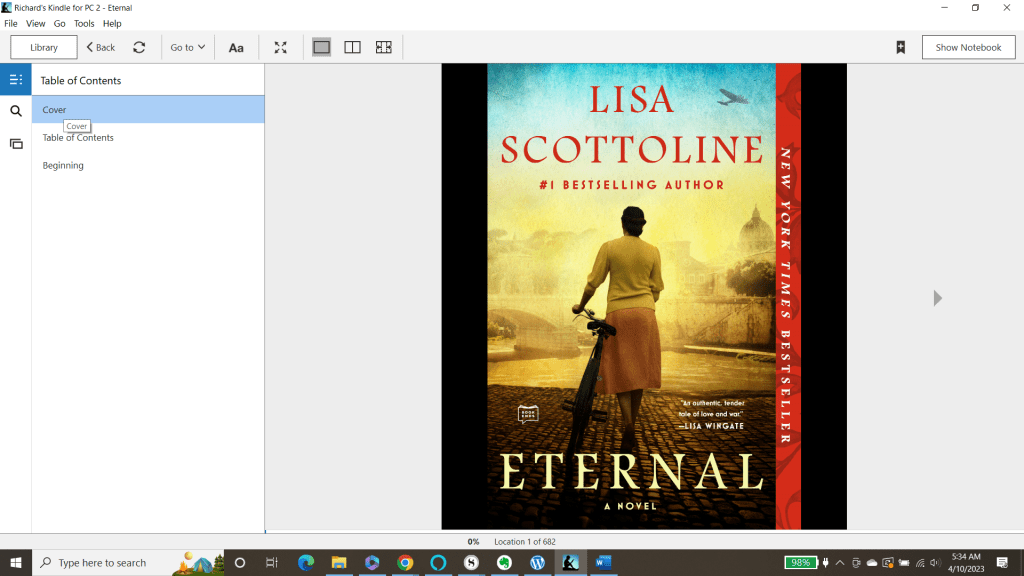
I’m also listening to Eternal, by Lisa Scottoline:

Amazon Abstract

NEW YORK TIMES BESTSELLER
 
#1 bestselling author Lisa Scottoline offers a sweeping and shattering epic of historical fiction fueled by shocking true events, the tale of a love triangle that unfolds in the heart of Rome…in the creeping shadow of fascism.


What war destroys, only love can heal.

Elisabetta, Marco, and Sandro grow up as the best of friends despite their differences. Elisabetta is a feisty beauty who dreams of becoming a novelist; Marco the brash and athletic son in a family of professional cyclists; and Sandro a Jewish mathematics prodigy, kind-hearted and thoughtful, the son of a lawyer and a doctor. Their friendship blossoms to love, with both Sandro and Marco hoping to win Elisabetta’s heart. But in the autumn of 1937, all of that begins to change as Mussolini asserts his power, aligning Italy’s Fascists with Hitler’s Nazis and altering the very laws that govern Rome. In time, everything that the three hold dear–their families, their homes, and their connection to one another–is tested in ways they never could have imagined.

As anti-Semitism takes legal root and World War II erupts, the threesome realizes that Mussolini was only the beginning. The Nazis invade Rome, and with their occupation come new atrocities against the city’s Jews, culminating in a final, horrific betrayal. Against this backdrop, the intertwined fates of Elisabetta, Marco, Sandro, and their families will be decided, in a heartbreaking story of both the best and the worst that the world has to offer.

Unfolding over decades, Eternal is a tale of loyalty and loss, family and food, love and war–all set in one of the world’s most beautiful cities at its darkest moment. This moving novel will be forever etched in the hearts and minds of readers.

About the Holy Bible, by Robert G. Ingersoll (1894): Part VI: Jehovah’s Administration

This is a very long article. I’ll post it by part.

Here’s the link to the full article.

VI: Jehovah’s Administration

He created the world, the hosts of heaven, a man and woman—placed them in a garden. Then the serpent deceived them, and they were cast out and made to earn their bread.

Jehovah had been thwarted.

Then he tried again. He went on for about sixteen hundred years trying to civilize the people.

No schools, no churches, no Bible, no tracts—nobody taught to read or write. No Ten Commandments. The people grew worse and worse, until the merciful Jehovah sent the flood and drowned all the people except Noah and his family, eight in all.

Then he started again, and changed their diet. At first Adam and Eve were vegetarians. After the flood Jehovah said: “Every moving thing that liveth shall be meat for you”—snakes and buzzards.

Then he failed again, and at the Tower of Babel he dispersed and scattered the people.

Finding that he could not succeed with all the people, he thought he would try a few, so he selected Abraham and his descendants. Again he failed, and his chosen people were captured by the Egyptians and enslaved for four hundred years.

Then he tried again—rescued them from Pharaoh and started for Palestine.

Then he changed their diet, allowing them to eat only the beasts that parted the hoof and chewed the cud. Again he failed. The people hated him, and preferred the slavery of Egypt to the freedom of Jehovah. So he kept them wandering until nearly all who came from Egypt had died. Then he tried again—took them into Palestine and had them governed by Judges.

This, too, was a failure—no schools, no Bible. Then he tried kings, and the kings were mostly idolaters.

Then the chosen people were conquered and carried into captivity by the Babylonians.

Another failure.

Then they returned, and Jehovah tried prophets—howlers and wailers—but the people grew worse and worse. No schools, no sciences, no arts, no commerce. Then Jehovah took upon himself flesh, was born of a woman, and lived among the people that he had been trying to civilize for several thousand years. Then these people, following the law that Jehovah had given them in the wilderness, charged this Jehovah-man—this Christ—with blasphemy; tried, convicted and killed him.

Jehovah had failed again.

Then he deserted the Jews and turned his attention to the rest of the world.

And now the Jews, deserted by Jehovah, persecuted by Christians, are the most prosperous people on the earth. Again has Jehovah failed.

What an administration!

Tolstoy Reads from His ‘Calendar of Wisdom’ in a Rare Recording Shortly Before His Death

Here’s the link to this article.

The beloved Russian author, shortly before his death, on the object of life.

BY MARIA POPOVA

“I’m only interested in people engaged in a project of self-transformation,” Susan Sontag famously confessed in her collected meditations on love. And yet, one some level, in ways both resolute and subtle, almost all of us are on a constant quest to get better at life.

In March of 1884, Leo Tolstoly (September 9, 1828–November 20, 1910) began what became his A Calendar of Wisdom: Daily Thoughts to Nourish the Soul, Written and Selected from the World’s Sacred Texts (public library) — a Tumblr-like compendium of notable ideas about the meaning of life, which took him twenty years to complete. In this rare audio from 1909, recorded four years after the book was finalized and a year before Tolstoy passed away, the beloved author reads a passage from the book that bespeaks that universal pursuit of self-improvement:

https://w.soundcloud.com/player/?visual=true&url=https%3A%2F%2Fapi.soundcloud.com%2Ftracks%2F77798820&show_artwork=true&maxheight=1000&maxwidth=680

That the object of life is self-perfection, the perfection of all immortal souls, that this is the only object of my life, is seen to be correct by the fact alone that every other object is essentially a new object. Therefore, the question whether thou hast done what thou shoudst have done is of immense importance, for the only meaning of thy life is in doing in this short term allowed thee, that which is desired of thee by He who or That which has sent thee into life. Art thou doing the right thing?

Imbibe some of the wisdom Tolstoy collected in the book, including his own meditations on knowledge and life, here, then revisit his journey of finding meaning in a meaningless world.

04/25/23 Biking & Listening

Biking is something else I both love and hate. It takes a lot of effort but does provide good exercise and most days over an hour to listen to a good book or podcast. I especially like having ridden.

Here’s my bike, a Rockhopper by Specialized. I purchased it November 2021 from Venture Out in Guntersville; Mike is top notch! So is the bike, and the ‘old’ man seat I salvaged from an old Walmart bike.

Here’s today’s ride.

Here’s a few photos taken along my route:

A few days ago I started listening to The Witch Trials of J.K. Rowling

Here’s the show link on Spotify.

Here’s the link to the episode I listened to today.


I’m also listening to Eternal, by Lisa Scottoline:

Amazon Abstract

NEW YORK TIMES BESTSELLER
 
#1 bestselling author Lisa Scottoline offers a sweeping and shattering epic of historical fiction fueled by shocking true events, the tale of a love triangle that unfolds in the heart of Rome…in the creeping shadow of fascism.


What war destroys, only love can heal.

Elisabetta, Marco, and Sandro grow up as the best of friends despite their differences. Elisabetta is a feisty beauty who dreams of becoming a novelist; Marco the brash and athletic son in a family of professional cyclists; and Sandro a Jewish mathematics prodigy, kind-hearted and thoughtful, the son of a lawyer and a doctor. Their friendship blossoms to love, with both Sandro and Marco hoping to win Elisabetta’s heart. But in the autumn of 1937, all of that begins to change as Mussolini asserts his power, aligning Italy’s Fascists with Hitler’s Nazis and altering the very laws that govern Rome. In time, everything that the three hold dear–their families, their homes, and their connection to one another–is tested in ways they never could have imagined.

As anti-Semitism takes legal root and World War II erupts, the threesome realizes that Mussolini was only the beginning. The Nazis invade Rome, and with their occupation come new atrocities against the city’s Jews, culminating in a final, horrific betrayal. Against this backdrop, the intertwined fates of Elisabetta, Marco, Sandro, and their families will be decided, in a heartbreaking story of both the best and the worst that the world has to offer.

Unfolding over decades, Eternal is a tale of loyalty and loss, family and food, love and war–all set in one of the world’s most beautiful cities at its darkest moment. This moving novel will be forever etched in the hearts and minds of readers.

Flannery O’Connor on Dogma, Belief, and the Difference Between Religion and Faith

Here’s the link to this article.

“For me a dogma is only a gateway to contemplation and is an instrument of freedom and not of restriction.”
BY MARIA POPOVA

As humans, we are wired to cling tightly to our beliefs, even the most delusional, and to automatically dismiss conflicting evidence. This is especially true in areas where our beliefs are particularly charged, such as politics and religion. For those of us skeptical of organized religion, who find transcendence in nature and spirituality in science, who fall closer to the atheism end of the belief spectrum, it’s especially challenging to consider perspectives on faith that come from the other end. But something magical happens when we allow the walls of the psyche to soften and become permeable, if only for a moment, to another’s experience of the world — little compares to the self-transcendence that such receptivity invites.

One of the most extraordinary meditations on religion and the role of spirituality in society comes from beloved author Flannery O’Connor (March 25, 1925–August 3, 1964), whose writing blended her Catholic faith with strong secular themes of ethics and moral philosophy, and nowhere does her singular spirit shine more luminously than in The Habit of Being: Letters of Flannery O’Connor (public library).

In July of 1955, when she was thirty, O’Connor received a letter from a young woman, initially unknown to her, who later chose to remain anonymous upon the publication of the letters. Both hungry for conversation and intrigued by the woman’s intensity of conviction, the author felt compelled to reply, and so began a nine-year epistolary friendship that continued until O’Connor’s death in 1964 from complications due to lupus. The letters to “A.” are among the most extraordinary in the collection, exploring with remarkable dignity and dimensionality matters of faith and religion, the difference between the two, and the role of spirituality in O’Connor’s writing and her personhood.

Flannery O’Connor by De Casseres

In her first letter to the young woman, dated July 20, 1955, O’Connor writes:

I am very pleased to have your letter. Perhaps it is even more startling to me to find someone who recognizes my work for what I try to make it than it is for you to find a God-conscious writer near at hand. The distance is 87 miles but I feel the spiritual distance is shorter.

I write the way I do because (not though) I am a Catholic. This is a fact and nothing covers it like the bald statement. However, I am a Catholic peculiarly possessed of the modern consciousness, that thing Jung describes as unhistorical, solitary, and guilty. To possess this within the Church is to bear a burden, the necessary burden for the conscious Catholic. It’s to feel the contemporary situation at the ultimate level. I think that the Church is the only thing that is going to make the terrible world we are coming to endurable; the only thing that makes the Church endurable is that it is somehow the body of Christ and that on this we are fed. It seems to be a fact that you have to suffer as much from the Church as for it but if you believe in the divinity of Christ, you have to cherish the world at the same time that you struggle to endure it. This may explain the lack of bitterness in the stories.

Lamenting the triteness of reviews that call A Good Man Is Hard to Find “brutal and sarcastic,” O’Connor wryly notes:

The stories are hard but they are hard because there is nothing harder or less sentimental than Christian realism. I believe that there are many rough beasts now slouching toward Bethlehem to be born and that I have reported the progress of a few of them, and when I see these stories described as horror stories I am always amused because the reviewer always has hold of the wrong horror.

In the next letter, dated August 2, O’Connor apologizes for responding so promptly that it forces a pace beyond her correspondent’s time budget, then arms up the conversation with a similarly sweet and self-deprecating remark about the creative life:

I myself am afflicted with time, as I do not work out on account of an energy-depriving ailment and my work in, being creative, can go on only a few hours a day. I live on a farm and don’t see many people. My avocation is raising peacocks, something that requires everything of the peacock and nothing of me, so time is always at hand.

Flannery O’Connor and her peacocks

She then resumes the question of “Christian realism,” about which her correspondent seems to feel particularly strongly:

I believe too that there is only one Reality and that that is the end of it, but the term, “Christian Realism,” has become necessary for me, perhaps in a purely academic way, because I find myself in a world where everybody has his compartment, puts you in yours, shuts the door and departs. One of the awful things about writing when you are a Christian is that for you the ultimate reality is the Incarnation, the present reality is the Incarnation, and nobody believes in the Incarnation; that is, nobody in your audience. My audience are the people who think God is dead. At least these are the people I am conscious of writing for.

In considering the misinterpretation and misapplication of dogma, O’Connor makes an allusion that would later inspire the title of the fantastic posthumous collection of her essays and writings, Mystery and Manners:

Dogma can in no way limit a limitless God. The person outside the Church attaches a different meaning to it than the person in. For me a dogma is only a gateway to contemplation and is an instrument of freedom and not of restriction. It preserves mystery for the human mind. Henry James said the young woman of the future would know nothing of mystery or manners. He had no business to limit it to one sex.

O’Connor has a way of letting her subtle wit slip in through the backdoor of even her most serious convictions:

I won’t ever be able entirely to understand my own work or even my own motivations. It is first of all a gift, but the direction it has taken has been because of the Church in me or the effect of the Church’s teaching, not because of a personal perception or love of God. For you to think this would be possible because of your ignorance of me; for me to think it would be sinful in a high degree. I am not a mystic and I do not lead a holy life. Not that I can claim any interesting or pleasurable sins (my sense of the devil is strong) but I know all about the garden variety, pride, gluttony, envy and sloth, and what is more to the point, my virtues are as timid as my vices. I think sin occasionally brings one closer to God, but not habitual sin and not this petty kind that blocks every small good. A working knowledge of the devil can be very well had from resisting him.

However, the individual in the Church is, no matter how worthless himself, a part of the Body of Christ and a participator in the Redemption. There is no blueprint that the Church gives for understanding this. It is a matter of faith and the Church can force no one to believe it. When I ask myself how I know I believe, I have no satisfactory answer at all, no assurance at all, no feeling at all. I can only say with Peter, Lord I believe, help my unbelief. And all I can say about my love of God, is, Lord help me in my lack of it. I distrust pious phrases, particularly when they issue from my mouth. I try militantly never to be affected by the pious language of the faithful but it is always coming out when you least expect it. In contrast to the pious language of the faithful, the liturgy is beautifully flat.

In another letter from a week later, O’Connor writes:

In the face of anyone’s experience, someone like myself who has had almost no experience, must be humble. I will never have the experience of the convert, or of the one who fails to be converted, or even in all probability of the formidable sinner; but your effort not to be seduced by the Church moves me greatly. God permits it for some reason though it is the devil’s greatest work of hallucination. Fr. [Jean] de Menasce told somebody not to come into the Church until he felt it would be an enlargement of his freedom. This is what you are doing and you are right, but do not make your feeling of the voluptuous seductive powers of the Church into a hard shell to protect yourself from her. I suppose it is like marriage, that when you get into it, you find it is the beginning, not the end, of the struggle to make love work.

She adds:

I think most people come to the Church by means the Church does not allow, else there would be no need their getting to her at all. However, this is true inside as well, as the operation of the Church is entirely set up for the sinner; which creates much misunderstanding among the smug.

Cartoon by Flannery O’Connor. Click images for details.

O’Connor ends with an intimation that not only bespeaks her lucid, intelligent approach to the subject, but also calls to mind Buckminster Fuller’s scientific revision of The Lord’s Prayer with a sentiment that would’ve gladdened Carl Sagan:

I have some long and tall thoughts on the subject of God’s working through nature, but I will not inflict them on you now. I find I have a habit of announcing the obvious in pompous and dogmatic periods. I like to forget that I’m only a storyteller.

The Habit of Being: Letters of Flannery O’Connor is a gorgeous and revelational read in its totality, emanating the timeless beauty of an inner life cut tragically short by an untimely death. Complement it with O’Connor on why the grotesque appeals to us and her little-known satirical cartoons.