Is the Bible Perfect?

Here’s the link to this article by Merle Hertzler.

Before reading Hertzler’s article, look carefully at what the Southern Baptist Convention says about the Holy Bible:

I. The Scriptures

The Holy Bible was written by men divinely inspired and is God’s revelation of Himself to man. It is a perfect treasure of divine instruction. It has God for its author, salvation for its end, and truth, without any mixture of error, for its matter. Therefore, all Scripture is totally true and trustworthy. It reveals the principles by which God judges us, and therefore is, and will remain to the end of the world, the true center of Christian union, and the supreme standard by which all human conduct, creeds, and religious opinions should be tried. All Scripture is a testimony to Christ, who is Himself the focus of divine revelation.

(excerpted from the Baptist Faith & Message 2000, here) :

And, read what a local church, Mount Vernon Baptist says about the Bible:

The Holy Bible was written by men divinely inspired and is God’s revelation of Himself to man. It is a perfect treasure of divine instruction. It has God for its author, salvation for its end, and truth, without any mixture of error, for its matter. Therefore, all Scripture is totally true and trustworthy. It reveals the principles by which God judges us, and therefore is, and will remain to the end of the world, the true center of Christian union, and the supreme standard by which all human conduct, creeds, and religious opinions should be tried. All Scripture is a testimony to Christ, who is Himself the focus of divine revelation. 

Church website, here.

They’re the same. Right? Now, look under the hood by reading Hertzler’s article.
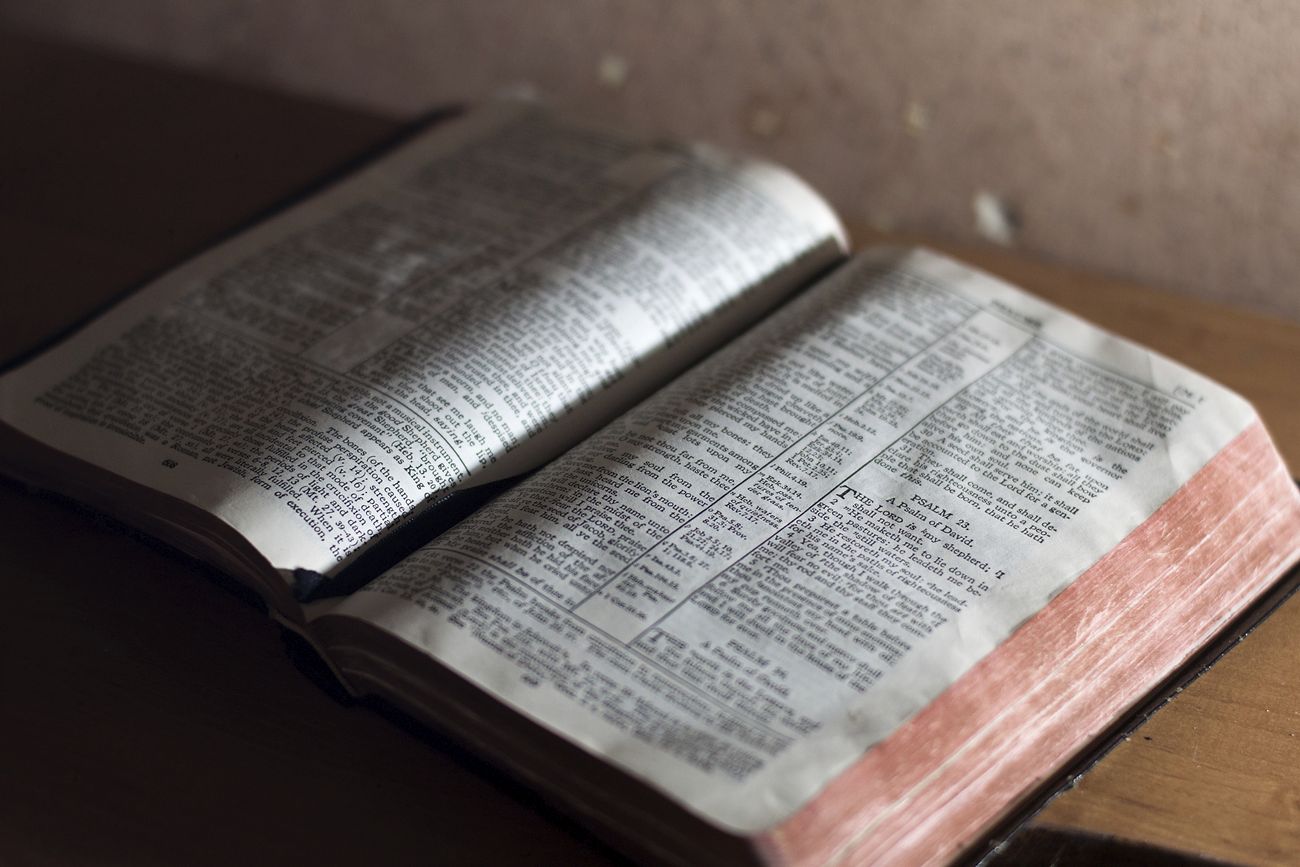
Old vintage bible with worn

We have seen how I have come to the conclusion that the earth is billions of years old, and that we humans are the product of evolution. Many of you might see the value of my arguments from science, but you keep wondering how this all fits in with the Bible. Does not the Bible teach specific creation in 6 days? Well, yes, it does. That is literally what it says.

In response, many have found ways to interpret the Bible in a way that is consistent with evolution. I have read their arguments and somehow, I am not convinced. It seems to me that Genesis conflicts with science. So, I turn now to another question: “Is it possible that the Bible is mistaken about creation?”

Now I am sure that this question raises a few eyebrows. How dare I question the Bible? Is not the Bible infallible?

I am sorry, but it does seem like a good question to ask. So let us ask it. After all, if we were to declare all questions about the Bible to be off limits, how would we ever know how the book would stand if questioned? If the book is indeed inerrant, shouldn’t the case for the book be even stronger after it is questioned and found to stand firm?

Similarly, some have told me that the Quran is without errors. Should I accept what they say, and never question the assertion? Surely it must be okay to question the Quran. If I may question the Quran or the Book of Mormon, then why would you object to me questioning the Bible?

And so, rather than resolving the conflict between Genesis and science by creative reinterpretation of scripture, perhaps we could ask if Genesis could be mistaken. It is a good question. And I see no harm in asking. Could the Bible have some errors? If it does, then perhaps Genesis 1 is in error.

Errors?

I have read the entire Bible six times. Whenever I read the Bible, it does not take long to find something that does not look right to me. By example, Lev. 11:4-6 says, “‘Nevertheless, you are not to eat of these, among those which chew the cud…the camel…the rabbit also, for though it chews cud, it does not divide the hoof, it is unclean to you.”

Wait, what? Rabbits don’t chew their cud. Something is wrong here. Have we found a mistake?

Believers will argue that this passage is not mistaken. Some have told me that rabbits can ingest their feces, and this has some similarities to chewing the cud. Well, perhaps, but this verse does not say that rabbits do an action similar to chewing the cud. It says they chew the cud. And the original Hebrew is even stronger. The words literally mean, “bring up the cud,” In no sense does a rabbit bring up the cud.

Nope. He is not chewing his cud.

Others have told me that rabbits move their mouth to look like they are chewing the cud, and this is what the verse means. If this is the case, then the writer is mistaken. He doesn’t say they look like they chew the cud. He says they chew their cud. This statement would not be true if they merely looked like they were chewing the cud.

Others have suggested that this refers to an extinct rabbit that used to chew its cud. But we find no evidence for such a rabbit. If the writer intended modern readers to read this verse, wouldn’t he explain that he is referring to an extinct animal that is not to be confused with modern rabbits?

Not only does the verse appear to be wrong, but it appears to be rather pointless. Why do we need a verse forbidding rabbit stew? Hunters simply ignore this command. Why does the Bible condemn rabbit stew?

But some will look at these verses and explain to me that this is one small detail that we do not understand. They will tell me that God knows the solution, and that I should move past this small question to get into the big truths of the Bible.

Now if this was the only such problem, explanations like this might be acceptable. But alas, I find many similar problems in the Bible. In addition, when I look at the explanations that believing scholars have offered to defend these verses, I find much of their reasoning is just as contrived as the explanations for the rabbit verse.

Now if I am to believe that the Bible is inerrant, I must either believe such wild explanations in every case, or I must accept that at least one error could exist in the Bible.

Let’s look at another example of an apparent error. I Kings 4:26 says Solomon had 40,000 stalls of horses for his chariots, and 12,000 horsemen.”

But II Chronicles disagrees. It tells us, “Now Solomon had 4,000 stalls for horses and chariots and 12,000 horsemen.” (II Chronicles 9:25 )

So was it 4000 stalls, or 40,000? One of these verses must be wrong. Do you agree?

Granted, these issues seem trivial. Who cares how many stalls Solomon had? Who cares if rabbits actually chew their cud? What does it matter?

It matters to me. In each case, at least one of these verses must be wrong. If these are in error, then the Bible is not inerrant, and it is not perfect. If one of these verses is in error, we would need to conclude that the Bible we are reading is imperfect.

Errant Copies

However, some of you will not agree. You will tell me that God inspired the writers of the Bible to write his perfect word. Even if one believes this, he does not necessarily need to believe that the Bible he holds has no errors. After all, he is not holding the original copy that was said to be inspired.

In fact, leading Evangelical scholars often admit that the Bibles they hold may have errors.

For instance, the conservative Chicago Statement on Biblical Inerrancy affirms that the scriptures are the authoritative Word of God, but includes this caveat: “Copies and translations of Scripture are the Word of God to the extent that they faithfully represent the original.”

Do you see what these authorities are saying? You may hold a copy or a translation of the original in your hands. But you do not hold the original. They declare such copies are the authoritative Word of God only to the extent that they faithfully represent the original. In other words, they are admitting that the copy you hold in your hands might not always faithfully represent the original. Where your copy differs from the original, it might not be authoritative; it might not be inerrant; and it might not be the exact Word of God. This caveat blows the whole claim of inerrancy wide open. The copy you hold in your hands might be mistaken.

Surely this is a reason to question claims of inerrancy. Nobody has the originals. Nobody knows what was written there. Yes, one can claim that the originals were perfect, but we can never test that claim unless we were to see an exact representation of the original. If we cannot test the claim, nobody can be sure it is true. So, we will have to settle for the copies that we have, and they might be flawed. If your copy does not faithfully represent the original, then most Evangelical scholars would say your copy could be in error at that point.

Nobody knows exactly where her copy differs from the original. Therefore, nobody knows for sure if what she is reading might be mistaken.

Now let’s look at how those errors might have gotten there.

Translation Errors

First, translation errors have occurred. After all, we have many translations and they sometimes conflict with each other. Are all of those translations perfect? I doubt that anybody makes that claim. Are some of those translations perfect? If one was, how would we know it?

Most Christians acknowledge that all the translators are human. They may have made a few mistakes. Your translation may have errors.

Text Selection

The problem goes deeper. Which text are we going to translate from? There are thousands of manuscript copies, with thousands of differences. There are 1438 significant disputed readings in the New Testament alone, not including spelling errors. [1] No two manuscripts of any significant length agree on everything. So which manuscript will you select? Why should we use the one that you choose? If they all differ, and you have no good reason for declaring one to be perfect, then the one you select probably has errors.

Most translations recognize that no manuscript is perfect, so they use a document that is a combination of many texts. Scholars analyze the passages that differ and try to select the reading that has the greatest support in the available manuscripts. Do you know if they have made the right choices? They probably have good reasons for their choices. That is not the question. Are they perfect in their choices? Probably not.

For example, in II Sam 21:8, some translations speak of the five sons of Saul’s daughter Merab. Other translations translate it as the sons of a different daughter, Michal. Why the difference? Some translations have a footnote explaining this. For instance, the English Standard Version tells us that two Hebrew manuscripts and the Greek Septuagint support the reading Merab. But it also notes that most Hebrew manuscripts read Michal. Which is correct? How would you possibly know?

The difference is important. Why? Because II Samuel 6:23 tells us that “Michal the daughter of Saul had no child to the day of her death.” So, if chapter 21 is indeed telling us that Michal had 5 children, how can she have had no children to the day of her death? The reading Michal in chapter 21 is supported by the most manuscripts. But if that reading is correct, then we have a contradiction with chapter 6.

You see the issue. Translators could either follow the majority of manuscripts, and translate II Sam 21:8 as Michal. But then they have a contradiction with chapeter 6. Or they could follow the 2 manuscripts that say Merab in chapter 21. Presto! Contradiction gone. But is the choice Merab justified based on only 2 manuscripts?

Regardless of which word choice is correct, we all can see the dilemma. The translators had to choose between the available manuscripts. Do they follow the majority of manuscripts that say Michal, or do they follow the few that say Merab? If they choose wrong, the Bible they give us is not matching what the original said.

So, a possible source of error is that translators selected the wrong manuscripts.

Possibly they even followed the temptation to deliberately choose the less supported reading in order to put the Bible in its best light. After all, if they wanted to sell Bibles, they would need to consider that their readers wanted a version without this contradiction in it. Did this bias affect the manuscripts they chose?

Your Bible may sometimes be using the wrong source.

Copies of Copies

How did all of those differences end up in the various manuscripts? Well, first there are copying errors. Scribes copied documents by hand, and sometimes made mistakes.

But there is another reason that the copies differ. Perhaps the scribes were not honest. Perhaps they changed the text on purpose.

For instance, it looks like 1 John 5:7 was inserted many years later. How do we know this? No Greek manuscript before 1500 AD had this verse. None. It appears certain that this verse was added after that date. Was it an accident? I doubt it. How does one accidentally insert a whole verse into the Bible? Most likely somebody did it on purpose. The verse became popular and was included in many copies, eventually becoming incorporated into the King James Version. But modern scholars do not recognize it. If you have a modern translation, that verse is probably missing, or a footnote indicates that it is doubtful. Somebody inserted it years later.

Another example is Mark 16:9-20. These verses do not appear in the earliest manuscripts we have. Were they added later? Again, modern Bibles indicate they probably were. They suggest that somebody came along and added 12 verses to Mark. Now, when I was growing up, these 12 verses were still in the Bible. Preachers preached that it was wrong to remove these verses from the Bible. Now we carry around Bibles that say they probably don’t belong. Times have changed.

All of this causes me to question. What other insertions have been made to the Bible? We don’t know. The above insertions can be detected because they were made many years after the Bible was written. Other copies existed when the change was made, and so we now have copies that differ. But what about changes that were made before copies were widely distributed? It would have been easy to make changes the first couple of times that the book was copied, and such changes might appear in all surviving manuscripts. You may think that people had too much respect for the Bible to alter it, but the examples above indicate otherwise. People have tinkered with the Bible.

Will our grandchildren find that additional verses in our copies need to be deleted or changed? Will they delete those verses just like we have deleted the ending of Mark; the ending that our grandparents thought surely belonged there?

In conclusion, it seems we need to admit that things have been added to the Bible. This is another source of error.

The Canon

There are other reasons that errors might be there. Even if we assume that God has specifically inspired books of the Bible to be error-free, how do we know which books he has selected to be part of that error-free Bible? Do Hebrews and Revelation belong there? How about Macabees? The Shepherd of Hermas? The Epistle of James? The Epistle of Barnabas? Daniel? These books were all disputed for years. There were many books to choose from. Which ones belong?

The Protestant Bible with its 66 books is so familiar, it is easy to assume that these books were always joined together as one book. They were not. Christians have had many canons (the collection of inspired books). Which canon is correct? Are you sure you are using the right one?

We find no reference to a specific set of books anywhere in the writings of the church before 140 AD. We find only scattered references to tradition and to some of the books. Nobody seems to have gathered the inspired books into a common collection. Why not? Would not the followers of Peter and Paul want to gather the inspired writings together? Would not someone make a list of these books? Would not the Christians want to know which were genuine, which were inspired, and which were not? We find no such list.

In fact, many of the books of the New Testament are almost completely unknown before 100 AD. It appears that the early Christians did not think that these were special, inspired books. Clement of Rome, for instance, a leader in the Church at Rome at the end of the 1st century, appears to be completely unaware of the four gospels. Apparently, the whole idea of recognizing an authoritative set of books–the “canon”–did not occur until years later.

Marcion wrote the first surviving New Testament canon around 150 AD. It consisted of one gospel, the Diatessaron, (which we no longer have) and ten epistles. Was he mistaken? But his is the earliest canon on record. How do you know that the later canons are better?

Around 200 AD, the scholarly Clement of Alexandria recognized Matthew, Mark, Luke, John, the Gospel of the Hebrews, the Traditions of Matthias, Hermas, the Epistle of Barnabas, the Apocalypse of Peter, the Didakhe, Acts, 1 Peter, 1 John, Revelation, and various oral traditions. This is quite different from the modern list. Was he wrong?

Then there was the Muratorian Canon (date unknown) which lists the 4 gospels, Acts, the Apocalypse of John (not to be confused with Revelation), the Apocalypse of Peter, the Book of Wisdom, and all the epistles accepted today except for Hebrews, James, 1 Peter, 2 Peter, and 3 John. Once again, this is far from the list that is recognized today. What is wrong? Why are we finding no lists that look close to today’s lists?

Then there was a list from around 300 AD. It includes the four gospels, Acts, the Acts of Paul, 10 of Paul’s 13 epistles, 1 Peter, 2 Peter, James, Jude, 1,2, and 3 John, Barnabas, Hermas, Apocalypse of John, and the Apocalypse of Peter. Again, we find many books that modern Christians exclude. Many books from today’s list are missing.

The lists differ. Modern Christians say none of these lists are correct.[2 ] How is it that none of these early Christians got it right? None of the canons from the first 3 centuries is close to ours.

Later developments of the canon began to approach the list we now recognize. In 327 AD Eusebius recognized the four gospels, Acts, the Epistles of Paul (possibly including Hebrews), 1 Peter, 1 John, and the (now unrecognized) Apocalypse of John. He lists some texts separately as disputed texts including the now accepted books of James, Jude 2 Peter, 2 John, and 3 John. He also lists as “disputed” the Acts of Paul, Hermas, Apocalypse of Peter, Epistle of Barnabas, Gospel of Hebrews, Teachings of the Apostles, and the Apoclypse of John, none of which we recognize today. (Confusingly he lists the Apocalypse of John in both lists.)

The Codex Sinaiticus, a surviving manuscript of the whole New Testament from that period–possibly by Eusebius himself–includes the 27 books we now recognize, as well as the Epistle of Barnabas and Hermas. The surviving document ends in the middle of Hermas, so we don’t know if it originally included any other books.

In 350 AD Bishop Cyril issued an official pronouncement declaring that there were 26 books in the New Testament. He did not include Revelation. So, by 350 AD we are finding canons that are very close to modern canons, but still nobody has yet mentioned the exact list we have today. And this is over 300 years after the reported life of Christ.

All of these canons consist of the opinion of one person only. We do not have a single list that was published by a council of leading church officials before 363 AD, when the Synod of Laodicea decreed that there were 26 books in the New Testament. They excluded Revelation. So, we finally have a group pronouncement. But modern Christians would say they got it wrong! Their list differs from today’s list, for it leaves out Revelation. Do you think they made the wrong decision? If so, how do you know that you are right, and they were wrong?

In 367 AD Athanasius declared that there were not 26, but 27 books in the New Testament. His list matches the list that we have today. Finally! But it is only the stated opinion of one man. No church organization has yet endorsed this list as the correct one.

Finally, in 393AD, 397 AD, and 419 AD three councils met and confirmed this list. These councils represented the hierarchy of the Catholic Church, which had taken control. They were able to force their will over most of Christendom. Does that make them right? No? So why does your Bible use their list of 27 books, and not use one of the earlier lists? [2]

Flaws in the Process

Some may argue that it took time to sort things out, and that the surviving books are the ones that truly belong. But one needs only to look at the process to see how wrong this view is. Look at the reasoning that was used to put the canon together.

Irenaeus, for instance, decreed that there must be exactly four gospels, for there are four directions and four principal winds. Uh, no, that is not sound reasoning.

The Muratorian Canon says it rejected the Apocalypse of Peter because church leaders did not want its disturbing descriptions read aloud. Does that prove anything? Can we throw out a book simply because it is disturbing to read?

Eusebius writes that he accepted those books that were accepted by every orthodox leader he knew. Who was orthodox in his view? Of course, it was the ones that agreed with him! He ignored the lists of leaders like Marcion with whom he disagreed. So, we find that everyone that agreed with the list of Eusebius agreed with the list of Eusebius. Yes, indeed. What does that prove?

The New Testament canon selected by the councils at the end of the fourth century was accepted by most later Christians, but it was far from final. Martin Luther, for instance, did not accept Hebrews, James, Jude or Revelation. The Syrian Orthodox Church still does not accept the book of Revelation. And Catholics accept a number of books written before the New Testament–known as the Apocrypha–that Protestants do not accept.

The Formation of the New Testament Canon Excellent!
The Canon of the Bible Are you sure that all of these books belong?

Links on the Canon

Perhaps our list is wrong. We really don’t know which books, if any, God has selected. So this is another source of error. Perhaps an errant book has somehow slipped into the Bible. After all, an unauthorized ending was apparently appended to Mark. How do we know that nobody ever inserted a whole book that didn’t belong? Perhaps James or even Genesis doesn’t belong there. If they don’t belong, then they might be in error.

Some might suggest that Genesis definitely belongs because other books quote it. What does that prove? Jude quotes the book of Enoch, but we do not include that book in the Bible.

Perhaps you would argue that God guided the process. How so? If God was selecting the books, how did he allow so many differences in the early lists?

Perhaps your parents or church or denomination have told you that the books in their Bible are the correct ones. If you agree with them, then you must think that all lists that differ with yours are wrong. What reason do you have for believing that your list is right, and other lists are wrong?

If there is one thing that my years of debate have taught me, it is that we had better have a good reason for telling another person he is wrong. One cannot simply go to somebody and tell them that their list is wrong.

The fact that your pastor or mother agree with you is not sufficient reason. After all, a Mormon’s mother might agree with him. Does that prove that he is right and that you are wrong? No? It is not sufficient to say that many people agree with you. More people reject your list of books than accept it. If we go by a popular vote, you lose.

If we cannot think of a convincing reason for people to accept your list, then it seems to me that you ought to admit that your list might possibly be wrong. And if your list might be wrong, then you could be carrying around books in your Bible that don’t belong there and are in error.

In conclusion, we may have some misplaced books in our Bible. We have another possible source of error.

Errant Originals

There is one other error source that we need to consider. How do you know that the originals had no errors? Even if you believe that God inspired the originals (a claim we will examine later) isn’t it possible that the original writers got some words wrong? Isn’t it possible to be inspired yet fallible? Most evangelical scholars think the current versions of the Bible are inspired yet have errors. And they believe God can still use them. So, if you think that God uses these books today, even if they have errors in them, couldn’t he have used errant originals?

And so, even if God’s Spirit told the original writers what to write (a claim I will critique later), we would still have many possible sources of error. There may be translation errors, manuscript selection errors, copying errors, deliberate insertions or changes, wrong selection of books to include in the Bible, and misunderstandings by the original authors as to what the Spirit was saying. Even if you do not agree with all of these sources, if you agree to at least one, you agree that the Bible may be mistaken.

Contradictions

With this in mind, let’s look at some of the claimed errors. Let us not approach the problems with the attitude that the Bible cannot possibly be wrong, for we have found good reasons to believe that the copies we hold in our hand may be wrong. So perhaps, when we examine the claimed errors in the Bible, we will find that there are indeed real errors. Here is a table showing some examples, but there are many, many more.

SELECTED BIBLE CONTRADICTIONS

Who was Joseph’s father?

Matthew 1:16 Jacob was the father of Joseph the husband of Mary, by whom Jesus was born, who is called the Messiah.

Vs.

Luke 3:23 When He [Jesus] began His ministry, Jesus Himself was about thirty years of age, being, as was supposed, the son of Joseph, the son of Eli,


How did Judas die?

Mt.27:5 And he [Judas] threw the pieces of silver into the temple sanctuary and departed; and he went away and hanged himself.

Vs.

Acts 1:18 (Now this man [Judas] acquired a field with the price of his wickedness, and falling headlong, he burst open in the middle and all his intestines gushed out.


Has anyone seen God?

Gen.12:7 The LORD appeared to Abram and said, ” To your descendants I will give this land.” So he built an altar there to the LORD who had appeared to him.

Gen.32:30 So Jacob named the place Peniel, for he said, ” I have seen God face to face, yet my life has been preserved.”

Ex.33:11 Thus the LORD used to speak to Moses face to face, just as a man speaks to his friend. When Moses returned to the camp, his servant Joshua, the son of Nun, a young man, would not depart from the tent.

Vs.

Jn.1:18 No one has seen God at any time; the only begotten God who is in the bosom of the Father, He has explained Him.

1 Tim.6:16 who alone possesses immortality and) dwells in unapproachable light, whom no man has seen or can see. To Him be honor and eternal dominion! Amen.

1 Jn.4:12 No one has seen God at any time; if we love one another, God abides in us, and His love is perfected in us.


To whom did God speak at Jesus’ baptism?

Mk.1:11 and a voice came out of the heavens: ” You are My beloved Son, in You I am well-pleased.”

Lk.3:22 and the Holy Spirit descended upon Him in bodily form like a dove, and a voice came out of heaven, “You are My beloved Son, in You I am well-pleased.” Vs.

Mt.3:17 and behold, a voice out of the heavens said, “This is My beloved Son, in whom I am well-pleased.”


Is it permitted to divorce an unchaste partner?

Mk.10:11 And He said to them, “Whoever divorces his wife and marries another woman commits adultery against her;

Lk.16:18 Everyone who divorces his wife and marries another commits adultery, and he who marries one who is divorced from a husband commits adultery.

Vs.

Mt.5:32 but I say to you that everyone who divorces his wife, except for the reason of unchastity, makes her commit adultery; and whoever marries a divorced woman commits adultery.

Mt.19:9 “And I say to you, whoever divorces his wife, except for immorality, and marries another woman commits adultery.”


Was David alone when he asked for holy bread?

1 Sam.21:1,6 Then David came to Nob to Ahimelech the priest; and Ahimelech came trembling to meet David and said to him, “Why are you alone and no one with you?” 6 So the priest gave him consecrated bread; for there was no bread there but the bread of the Presence which was removed from before the LORD, in order to put hot bread in its place when it was taken away.

Vs.

Mt.12:3-4 But He said to them, “Have you not read what David did when he became hungry , he and his companions, 4 how he entered the house of God, and they ate the consecrated bread, which was not lawful for him to eat nor for those with him, but for the priests alone?


When did the cursed fig tree die?

Mt.21:19-20 Seeing a lone fig tree by the road, He came to it and found nothing on it except leaves only; and He said to it, “No longer shall there ever be any fruit from you.” And at once the fig tree withered. 20 Seeing this, the disciples were amazed and asked, “How did the fig tree wither all at once?”

Vs.

Mk.11:13-14, 20-21 Seeing at a distance a fig tree in leaf, He went to see if perhaps He would find anything on it; and when He came to it, He found nothing but leaves, for it was not the season for figs. 14 He said to it, “May no one ever eat fruit from you again!” And His disciples were listening. 20 As they were passing by in the morning, they saw the fig tree withered from the roots up. 21 Being reminded, Peter said to Him, “Rabbi, look, the fig tree which You cursed has withered.”


How should parents be treated?

Ex.20:12 Honor your father and your mother, that your days may be prolonged in the land which the LORD your God gives you.

Vs.

Lk.14:26 If anyone comes to Me, and does not hate his own father and mother and wife and children and brothers and sisters, yes, and even his own life, he cannot be My disciple.


Did Jesus come to bring peace?

Lk.2:14 Glory to God in the highest, And on earth peace among men with whom He is pleased.”

Vs.

Mt.10:34 Do not think that I came to bring peace on the earth; I did not come to bring peace, but a sword.


How many years of famine were offered to David?

II Samuel 24:13 So Gad came to David and told him, and said to him, “Shall seven years of famine come to you in your land? Or will you flee three months before your foes while they pursue you? Or shall there be three days’ pestilence in your land? Now consider and see what answer I shall return to Him who sent me.”

Vs.

I Chronicles 21:11-12 So Gad came to David and said to him, “Thus says the LORD, ‘Take for yourself 12 either three years of famine, or three months to be swept away before your foes, while the sword of your enemies overtakes you, or else three days of the sword of the LORD, even pestilence in the land, and the angel of the LORD destroying throughout all the territory of Israel.’ Now, therefore, consider what answer I shall return to Him who sent me.”


Should children be punished for the sins of their fathers?

Isaiah 14:21 Prepare for his sons a place of slaughter Because of the iniquity of their fathers. They must not arise and take possession of the earth And fill the face of the world with cities.

Exodus 20:5 You shall not worship them or serve them; for I, the LORD your God, am a jealous God, visiting the iniquity of the fathers on the children, on the third and the fourth generations of those who hate Me,

Vs.

Deut. 24:16 Fathers shall not be put to death for their sons, nor shall sons be put to death for their fathers; everyone shall be put to death for his own sin.

Ezek.18:20 “The person who sins will die. The son will not bear the punishment for the father’s iniquity, nor will the father bear the punishment for the son’s iniquity; the righteousness of the righteous will be upon himself, and the wickedness of the wicked will be upon himself.


Is salvation by faith alone?

John 5:24 Truly, truly, I say to you, he who hears My word, and believes Him who sent Me, has eternal life, and does not come into judgment, but has passed out of death into life.

John 6:47 Truly, truly, I say to you, he who believes has eternal life.

John 6:28-29 Therefore they said to Him, “What shall we do, so that we may work the works of God?” Jesus answered and said to them, “This is the work of God, that you believe in Him whom He has sent.”

Vs.

( Matt 19: 16-21 ) 16 And someone came to Him and said, “Teacher, what good thing shall I do that I may obtain eternal life?” 17 And He said to him, “Why are you asking Me about what is good? There is only One who is good; but if you wish to enter into life, keep the commandments.” 18 Then he said to Him, “Which ones?” And Jesus said, ” YOU SHALL NOT COMMIT MURDER; YOU SHALL NOT COMMIT ADULTERY; YOU SHALL NOT STEAL; YOU SHALL NOT BEAR FALSE WITNESS; 19 HONOR YOUR FATHER AND MOTHER; and YOU SHALL LOVE YOUR NEIGHBOR AS YOURSELF.” 20 The young man said to Him, “All these things I have kept; what am I still lacking?” 21 Jesus said to him, “If you wish to be complete, go and sell your possessions and give to the poor, and you will have treasure in heaven; and come, follow Me.”

Bible Numerical Problems
Old Testament Problems
New Testament Problems
Skeptic’s Annotated Bible: Contradictions By Steven Wells. Why isn’t the Bible consistent?
Are There Contradictions in the Bible? by Bruce Gerencser

Links on Contradictions

Notice that the last contradiction mentioned is a very serious one. The Bible is not even consistent on the way of salvation. In some places the Bible says salvation is by faith alone. But in other places, it declares that one must do certain works to obtain salvation. In the passage quoted from Matthew, Jesus is given the chance to settle the matter. His answer is the opposite of what the Bible declares elsewhere. He declares that salvation is based on keeping commandments and giving to the poor. ( Matt 19: 16-21) And so we find that the Bible is not even consistent on important issues, such as the way of salvation.

Apologist Responses

Apologists have many clever ways of explaining away the contradictions mentioned above. For instance, they will tell me that Luke is talking about Mary’s father, not Joseph’s. Hence, there is no contradiction with Matthew. But that is a totally unsupported assertion. Anyone can see that the passage refers to Joseph’s father, not Mary’s.

And apologists will argue that Judas died in a bizarre combination of hanging and a fall, thus making both accounts true. But their account, in which the rope broke, and Judas fell off a cliff, doesn’t really match either passage.

Likewise, they will tell me that the command to hate parents does not really mean hate. Silly translators! If it doesn’t mean “hate”, why did they translate it that way?

The list of explanations is endless. Are the explanations credible? It can be quite eye-opening to see the contortions that some go through to explain away the contradictions.

Now if we had to buy only one of their clever stories in order to believe in inerrancy, it might be possible. But when we see long lists of implausible explanations, what is the chance that every one of those excuses is true? The skeptic must show only one error to prove that the Bible is not perfect.

I cannot escape the conclusion that the Bible is not only occasionally mistaken but is quite frequently mistaken.

Conclusion

We have been dealing only with the copies of the Bible and have shown reasons to think that the copies we have today have errors. We cannot prove that the originals truly had errors. However, the extent of the errors that have been found in the copies have convinced many that the originals also must have had errors.

So, let’s get back to Genesis 1. When I look at the scientific errors in Genesis 1 when read literally, I do not need to develop an elaborate scheme of how it can be interpreted consistent with the findings of modern science. There may be a much simpler solution. Perhaps Genesis is mistaken.

You may not like to think about mistakes in the Bible. You would like to have a perfect book that tells you exactly what to do. That may well be what you want, but we are not here to discuss what we want. We are here to discuss what is true. It will do us no good to pretend the Bible is perfect. It appears it is not.

Notes

1. Aland, Barbara et al, The Greek New Testament, 4th rev. ed., United Bible Societies, 1994, p. 2. Cited by Richard Carrier

2. See The Formation of the New Testament Canon by Richard Carrier for more information on the canon.

Copyright Merle Hertzler 2002, 2004, 2005, 2022. All rights reserved.

Writing Journal—Tuesday writing prompt

Your character is on a dive trip while on vacation. When he surfaces, he discovers that the boat is gone. He’s alone. Describe what happens next. 


One Stop for Writers

Here’s five story elements to consider:

  • Character
  • Setting
  • Plot
  • Conflict
  • Resolution

Never forget, writing is a process. The first draft is always a mess.

The first draft of anything is shit.

Ernest Hemingway

03/20/23 Biking & Listening

Biking is something else I both love and hate. It takes a lot of effort but does provide good exercise and most days over an hour to listen to a good book or podcast. I especially like having ridden.

Here’s my bike, a Rockhopper by Specialized. I purchased it November 2021 from Venture Out in Guntersville; Mike is top notch! So is the bike, and the ‘old’ man seat I salvaged from an old Walmart bike.

Here’s a link to today’s bike ride. This is my pistol ride.

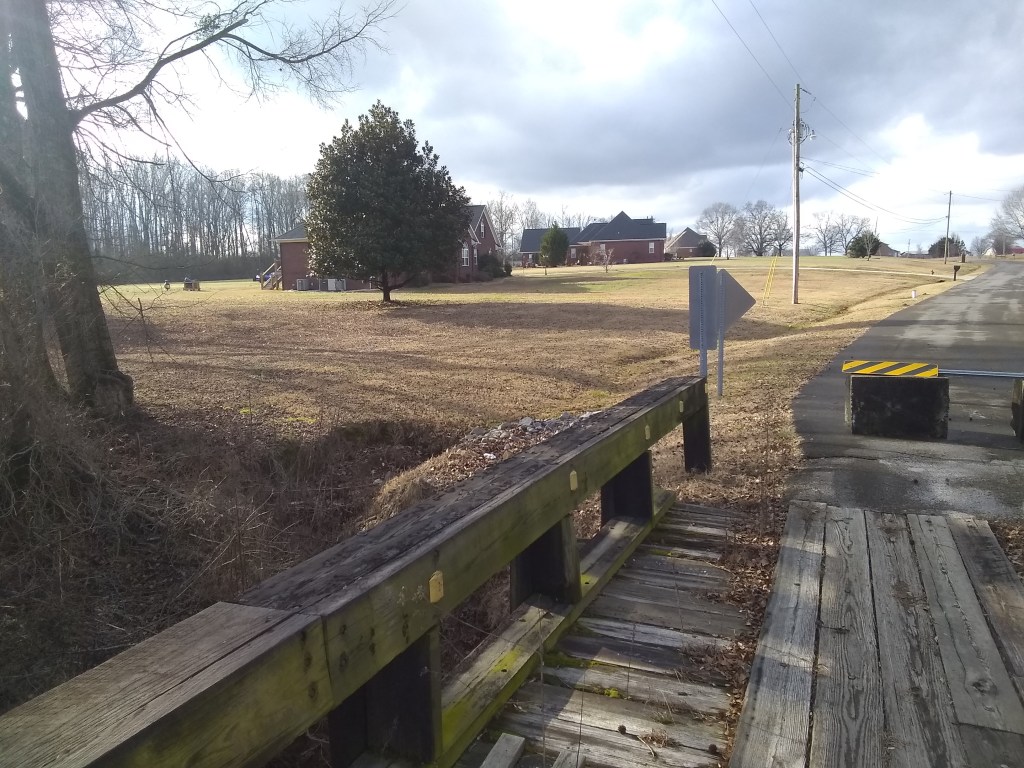
Here’s a few photos taken along my route:

Here’s what I’m currently listening to:

Here’s the link at Sam’s website. You can also listen on Spotify (full episode requires subscription to Sam’s podcast).

SERIES OVERVIEW

This series is designed for long-time fans, newcomers, haters, lovers, critics, and curious dabblers in the philosophy and works of Sam Harris. Each episode in the series is structured as a guided tour through one of Sam’s specific areas of interest: Artificial Intelligence, Consciousness, Violence, Belief, Free Will, Morality, Death, and more. We’ve plunged into the Making Sense archive dating back over 10 years, and surfaced crucial exchanges with incredible guests to dissect Sam’s evolving stances — along with various explorations, approaches, agreements, disagreements, and pushbacks. We’ve crafted and juxtaposed these clips with original writing and analysis into brand-new audio documentaries.

You’ll be introduced (or re-introduced) to fantastic thinkers, and we’ll help illuminate your intellectual journey with plenty of recommendations, which range from fun and light to densely academic.

The writer and producer of this series is filmmaker, author, and podcaster Jay Shapiro, whose credits include the documentary adaptation of Sam Harris’s dialogue Islam and Future of Tolerance. Jay writes essays at whatjaythinks.com and hosts the Dilemma Podcast.

The voice of the series is author Megan Phelps-Roper. Megan was born into the extremist Westboro Baptist Church, where she was a member and spokesperson before leaving the group in 2012. She has since published a memoir, Unfollow, and works as a producer, writer, and speaker. She has twice appeared as a guest on Making Sense.

MARCH 17, 2023

In this episode, we examine a series of Sam’s conversations centered around religion, atheism, and the power of belief. 

First, we hear the stories of three guests who have fled their respective oppressive religious organizations. We begin with Sarah Hairder, founder of the advocacy group Ex-Muslims of North America, who details how her encounters with militant atheists catalyzed her journey to secularism. Then our narrator, Megan Phelps-Roper, walks us through her story of abandoning the Westboro Baptist Church. Finally, Yasmine Mohammed presents her harrowing account of escaping fundamentalist Islamism and Sam’s role in inspiring her public advocacy work.

We then tackle the concept of belief more broadly, diving into Sam’s understanding of atheism and what sets it apart from the views of other atheist thinkers like Matt Dillahunty and Richard Dawkins. We also revisit an infamous conversation between Sam and Jordan Peterson, wherein they attempt to come to some universal definition of the word “truth.”

The episode concludes with two Q&A portions from life events in which Sam addresses some real concerns about purpose and meaning in the absence of religion.

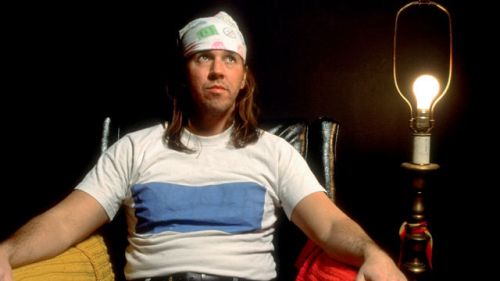
The Nature of the Fun: David Foster Wallace on Why Writers Write

Here’s the link to this article.

“Fiction becomes a weird way to countenance yourself and to tell the truth instead of being a way to escape yourself or present yourself in a way you figure you will be maximally likable.”

BY MARIA POPOVA

On the heels of the highly anticipated new David Foster Wallace biography comes Both Flesh and Not: Essays (public library) — a collection spanning twenty years of Wallace’s nonfiction writing on subjects as wide-ranging as math, Borges, democracy, the U.S. Open, and the entire spectrum of human experience in between. Among the anthology’s finest is an essay titled “The Nature of the Fun” — a meditation on why writers write, encrusted in Wallace’s signature blend of self-conscious despondency, even more self-conscious optimism, and overwhelming self-awareness. It was originally published in 1998 in Fiction Writer and also included in the wonderful 1998 anthology Why I Write: Thoughts on the Craft of Fiction.

After offering an extended and rather gory metaphor for the writer’s creative output and a Zen parable about unpredictability, he gets to the meat of things:

In the beginning, when you first start out trying to write fiction, the whole endeavor’s about fun. You don’t expect anybody else to read it. You’re writing almost wholly to get yourself off. To enable your own fantasies and deviant logics and to escape or transform parts of yourself you don’t like. And it works – and it’s terrific fun. Then, if you have good luck and people seem to like what you do, and you actually start to get paid for it, and get to see your stuff professionally typeset and bound and blurbed and reviewed and even (once) being read on the a.m. subway by a pretty girl you don’t even know it seems to make it even more fun. For a while. Then things start to get complicated and confusing, not to mention scary. Now you feel like you’re writing for other people, or at least you hope so. You’re no longer writing just to get yourself off, which — since any kind of masturbation is lonely and hollow — is probably good. But what replaces the onanistic motive? You’ve found you very much enjoy having your writing liked by people, and you find you’re extremely keen to have people like the new stuff you’re doing. The motive of pure personal starts to get supplanted by the motive of being liked, of having pretty people you don’t know like you and admire you and think you’re a good writer. Onanism gives way to attempted seduction, as a motive. Now, attempted seduction is hard work, and its fun is offset by a terrible fear of rejection. Whatever “ego” means, your ego has now gotten into the game. Or maybe “vanity” is a better word. Because you notice that a good deal of your writing has now become basically showing off, trying to get people to think you’re good. This is understandable. You have a great deal of yourself on the line, writing — your vanity is at stake. You discover a tricky thing about fiction writing; a certain amount of vanity is necessary to be able to do it all, but any vanity above that certain amount is lethal.

Here, Wallace echoes Vonnegut, who famously advised“Write to please just one person. If you open a window and make love to the world, so to speak, your story will get pneumonia.” Indeed, this lusting after prestige and approval is a familiar detractor of creative purpose in any endeavor. Wallace goes on:

At some point you find that 90% of the stuff you’re writing is motivated and informed by an overwhelming need to be liked. This results in shitty fiction. And the shitty work must get fed to the wastebasket, less because of any sort of artistic integrity than simply because shitty work will cause you to be disliked. At this point in the evolution of writerly fun, the very thing that’s always motivated you to write is now also what’s motivating you to feed your writing to the wastebasket. This is a paradox and a kind of double-bind, and it can keep you stuck inside yourself for months or even years, during which period you wail and gnash and rue your bad luck and wonder bitterly where all the fun of the thing could have gone.

He adds to literary history’s most famous insights on the relationship between truth and fiction:

The smart thing to say, I think, is that the way out of this bind is to work your way somehow back to your original motivation — fun. And, if you can find your way back to fun, you will find that the hideously unfortunate double-bind of the late vain period turns out really to have been good luck for you. Because the fun you work back to has been transfigured by the extreme unpleasantness of vanity and fear, an unpleasantness you’re now so anxious to avoid that the fun you rediscover is a way fuller and more large-hearted kind of fun. It has something to do with Work as Play. Or with the discovery that disciplined fun is more than impulsive or hedonistic fun. Or with figuring out that not all paradoxes have to be paralyzing. Under fun’s new administration, writing fiction becomes a way to go deep inside yourself and illuminate precisely the stuff you don’t want to see or let anyone else see, and this stuff usually turns out (paradoxically) to be precisely the stuff all writers and readers everywhere share and respond to, feel. Fiction becomes a weird way to countenance yourself and to tell the truth instead of being a way to escape yourself or present yourself in a way you figure you will be maximally likable. This process is complicated and confusing and scary, and also hard work, but it turns out to be the best fun there is.

He concludes on a Bradbury-like note:

The fact that you can now sustain the fun of writing only by confronting the very same unfun parts of yourself you’d first used writing to avoid or disguise is another paradox, but this one isn’t any kind of bind at all. What it is is a gift, a kind of miracle, and compared to it the rewards of strangers’ affection is as dust, lint.

Both Flesh and Not is excellent in its entirety and just as quietly, unflinchingly soul-stirring as “The Nature of the Fun.”

Did We Evolve?

Here’s the link to this article by Merle Hertzler.

Years ago, people began to study the rocks. They noticed something they did not expect. They found fossils in the rocks that were the remains of plants and animals that were quite different from the life that we know today. The lower the rock layer, the more unusual the fossils became. People began to identify different layers that they had observed in the ground. Each layer had distinct characteristics and distinct fossils.

They discovered that, when the layers overlapped, they consistently appeared in the same order wherever they looked. It occurred to them that these layers might represent distinct time periods, with each being the result of the accumulation of sediments in a particular timeframe. The layers that are always lower must surely be the oldest, and the layers that are always higher must be younger. These explorers identified the different layers and put together what is known as the geologic column.

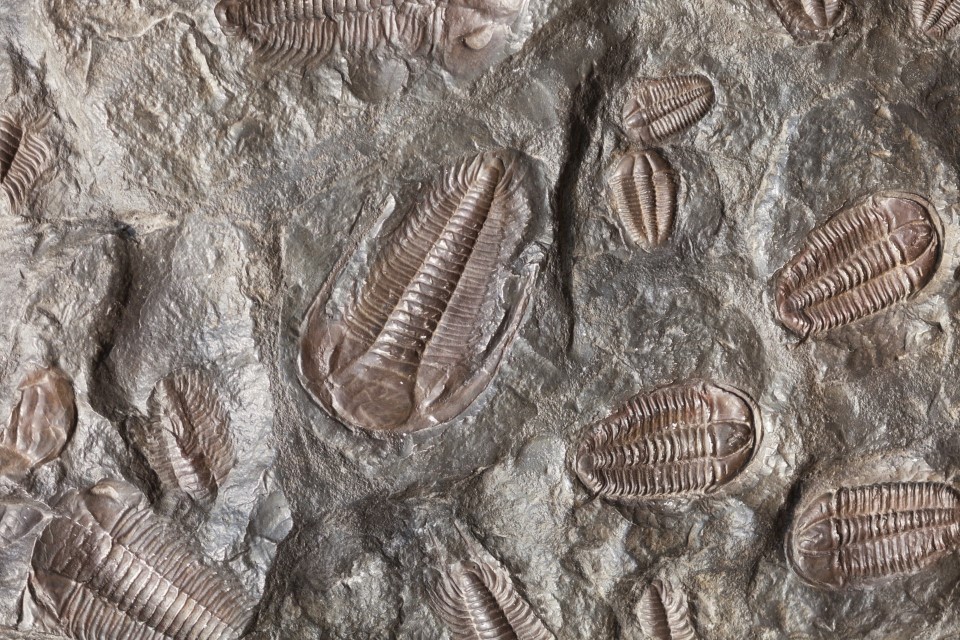
When I was an ardent defender of young-earth creationism, the geologic column began to trouble me. Why do we find nothing close to a modern mammal in layers older than the Quaternary and Tertiary periods (last 65 million years)? Why are no trilobites ever found after the Permian period (248 million years ago)? Why does every dinosaur fossil date at least 60 million years older than every human fossil? How can a creationist explain it?

Discovery of the Geologic Column

The geologic column was not invented to prove evolution. Creationists discovered it before Darwin. They simply put together what they could see in the rocks. These explorers were not evolutionists. Adam Sedgwick, for example, discovered the Cambrian and Devonian periods, and believed that God had created life. When Darwin later came along and presented his theory, Sedgwick disagreed. But he did not dispute the geologic column. He could see that life was quite different in the past.

These men had developed a viewpoint known as Catastrophism. They believed that God had created a strange world system with strange life a long time ago. They called it the Cambrian period. It seemed to them that God must have wiped out the Cambrian life in a catastrophe, for the Cambrian life was no longer found in the layers above it. So perhaps Cambrian life had been catastrophically wiped out, and God had re-created the world with different species. This they called the Ordovician period.

But as one went up from the Ordovician layer, he would again find another distinct layer. Well then, these men concluded, another catastrophe must have ended the Ordovician period, and the Creator had produced yet another world, the Silurian.

Each of the periods, in turn, was wiped out only to be replaced by something new. Finally, the current time period–the Quaternary–was reached. After each catastrophe life was created that was somewhat different from the life in the previous world.

Adam Sedgwick A creationist who helped develop the geologic column before Darwin.
How Good Are Those Young-Earth Arguments? By Dave E. Matson. More on the history of the discovery of the geologic column.
Geological Time Machine Learn more about the geologic column

Geologic Column links

Catastrophism

How could they fit this idea with the Bible? Well, folks “found” a convenient gap in Genesis 1. In Gen.1:1 we are told that God created the heavens and the earth. And people decided there was a large gap between verse 1 and verse 2. In this gap, the Cambrian, Ordovician, Silurian, Devonian, and all of the other ancient periods, took place.

Finally, the last catastrophe occurred, wiping out the Neogene Period. As a result of this last catastrophe the earth was without form and void once again until God would re-create the earth one last time. These men wrote that Genesis 1:2 picks up the story after the last period had been wiped out, making the earth void–“And the earth was without form and void”–and a new creation was ready to begin. The story of this last creation is supposedly told in the remainder of Genesis 1. So, all of these periods and catastrophes were supposedly hidden between Genesis 1:1 and 1:2. Thus, people were able to fit these geological observations with the Bible.

I think that, perhaps, their creative insertion of a gap into Genesis 1 did not do justice to the text, but we digress.

Science has advanced since the early 1800’s when this view was prevalent. Yes, science still believes there were catastrophes in the past, but these catastrophes did not actually wipe out all of life. We always find life forms that survived through the transition to the next period. We cannot explain the whole fossil record by resorting to catastrophes and new creations.

The Progression of Life

The discovery of radiometric dating has greatly increased our understanding of the geologic column. We are now able to determine the dates of rock layers that fossils are buried in and are able to track when different life forms came into existence and when they died off. We discover that new creatures were not introduced all at once at the beginning of each period. Rather, new species have been continually introduced into the environment throughout time.

This last point is troubling for creationists. For how did each of these new species emerge? How, for instance, did the Mesohippus–an early species of horse– come into existence? Imagine that you are walking through a meadow when suddenly–BOOM–an adult Mesohippus pair materializes out of nowhere right in front of your eyes. Are we to believe that this is the way God created? And did God continually create millions of species throughout the ages, always resorting to this spectacular out-of-nothing creation? BOOM! There is a new species of horse. BOOM! A new monkey. BOOM! God just decided to create a new kind of rat. Look! Right at your feet. BOOM! A lion. BOOM! Watermelon. BOOM! T Rex. BOOM! Is this even plausible?

Such creation events violate the laws of nature including the laws of conservation of mass, thermodynamics, and biogenesis. Did God suspend these laws many millions of times in order to complete these many acts of creation?

The facts are beginning to get difficult for Creationists. Now, when earth history was thought to consist of a series of creations and catastrophes, one might be able to suggest that these were magical intervals where God stepped in and re-created the world. But are we to believe that God repeated these little acts of special creation many, many millions of times?

Not only do we find that new species have repeatedly been introduced into the world, but we find an interesting thing when we arrange the fossils in the order that they first appear. We find an uncanny consistency with evolution theory. At the bottom we find simple life forms. As we move up, the fossil record begins to diversify, and includes fish, then reptiles, then mammals, and finally, humans.

My Epiphany

Years ago, I was fighting the good fight of creation on the Internet. I argued that evolution was impossible, for it required that the genetic code had to be changed to make new kinds of animals. It did not seem feasible to me that evolution could do this. I argued in the CompuServe debate forum, basing my arguments on Michael Denton’s Evolution: A Theory in Crises.

My favorite illustration was the difference between mammals and reptiles. The differences between living mammals and reptiles are substantial. Mammals all have hair, mammary glands, a four-chambered heart, and the distinct mammalian ear, with three little bones inside. These features are found in no living reptiles. I argued that this is because there is no viable intermediate between the two, that an animal could have either the reptile genetic code or the mammal code but could not be in the middle.

An evolutionist disagreed with me. He told me that in the past there had been many intermediates. He said that there were animals that, for instance, had jaw and ear bones that were intermediate between reptiles and mammals. How did he know this? He gave a reference to an essay in Stephen Gould’s Ten Little Piggies. I wrote back that since the local library had a large collection of children’s books, I should be able to find that book. (I thought that was quite a zinger.)

I borrowed the book and found an interesting account of how bones in the reptile jaw evolved and changed through millions of years to become the mammals’ ear. That sounded like such a clever tale. How could Gould believe it? Perhaps he made it up. But there was one little footnote, a footnote that would change my life. It said simply, “Allin, E. F. 1975. Evolution of the Mammalian Middle Ear. Journal of Morphology 147:403-38.” That’s it. That’s all it said. But it was about to make a huge impact on me.

You see, I had developed this habit of looking things up, and had been making regular trips to a university library. I was getting involved in some serious discussions on the Internet and was finding the scientific journals to be a reliable source of information. Well, I couldn’t believe that a real scientific journal would take such a tale seriously. But wait. Before I would declare victory, I needed to check it out.

On my next trip to the library, I found my way to the biomedical journal archive. I retrieved the specified journal and started to read. I could not believe my eyes. There were detailed descriptions of many intermediate fossils. The article described in detail how the bones evolved from reptiles to mammals through a long series of mammal-like reptiles.

I paged through the volume in my hand. There were hundreds of pages, all loaded with information. I looked at other journals. I found page after page describing transitional fossils. More significantly, there were all of those troublesome dates. If one arranged the fossils according to date, one could see how the bones changed with time. Each fossil species was dated at a specific time range. It all fit together.

I didn’t know what to think. Could all of these fossil drawings be fakes? Could all of these dates be pulled out of a hat? Did these articles consist of thousands of lies? All seemed to indicate that life evolved over many millions of years. Were all of these thousands of “facts” actually guesses?

I looked around me. The room was filled with many bookshelves; each was filled with hundreds of bound journals. Were all of these journals drenched with lies?

Several medical students were doing research there. Perhaps some day they would need to operate on my heart or fight some disease. Was I to believe that these medical students were in this room filled with misinformation, and that they were diligently sorting out the evolutionist lies while learning medical knowledge? How could so much error have entered this room? It made no sense.

The Evolution of the Mammalian Middle Ear by Edgar F. Allin. The paper that initiated my journey.
Taxonomy, Transitional Forms, and the Fossil Record By Keith B. Miller. A good overview with illustrations.
Transitional Vertebrate Fossils FAQ By Kathleen Hunt. Lists many transitionals (this link is to the mammal-like reptile section of that file)
Jaws to Ears in the Ancestors of Mammals at UC Museum of Paleontology Understanding Evolution website.

Transitional Fossil Links

How can you explain those mysterious mammal-like reptiles? Reptiles and mammals today are quite distinct from each other. Mammalian features include differentiated teeth (incisors, canines, premolars, molars), double rooted teeth, a distinct jaw joint, three bones in the ear (stapes, incus, malleus), the diaphragm, limbs under the body, a different arrangement of toe bones, and a braincase that is firmly attached to the skull. No reptile has these features. But when we look at ancient fossils, we find a strange series of animals with features in the middle.

They begin 300 Ma (million years ago) in the Pennsylvanian. It was a different world. There were no mammals, flowering plants, or even dinosaurs. According to the fossil record, these would all come later. The world belonged to amphibians and reptiles. Early Synapsids such as Haptodus appeared. Their dentary jaw bones rose in the place where later animals would have a new jaw joint–the mammalian joint.

Then advanced pelycosaurs (270 Ma) like the Dimetrodon had signs of a bony prong for the eardrum. Later, cynodonts like the Procynosuchus (236 Ma) had jawbones more similar to mammals, but they still had the reptile’s jaw hinge.

The Probainognathus (238 Ma) and the Thrinaxodons (227 Ma) have signs of two distinct jaw joints, the reptilian and the mammalian. This allowed some of the bones that had been part of the reptile’s jaw to transmit vibrations to the ear. This was the beginning of the special mammalian ear bones.

By the time the Sinoconodon appears (208 Ma) the mammalian jaw joint predominates, and the reptilian jaw joint is small.

The Morganucodon (205 Ma) has teeth like a mammal, a distinct mammalian jaw joint, and only a tiny remnant of the reptile’s jaw. It’s malleus and incus ear bones remain attached to the jaw.

 © UC Museum of Paleontology Understanding Evolution, www.understandingevolution.org.

By the late Cretaceous period (80 Ma) early placental mammals like the Asioryctes had jaws and ears that were transformed to the mammalian type. Two of the reptile’s jaw bones, the quadrate and the articular were no longer part of the jaw. Instead, they had become parts of the middle ear, the malleus and incus.

This is only a brief overview of these strange creatures. In fact, there are thousands of species that span many millions of years, with many intermediate stages of many different features.

Now what on earth was God doing? Why was he slowly introducing mammalian features into the fossil record? Why did he progressively change the design of the jaw, ear, teeth, and limbs until the animals look more and more like mammals? Should I just shrug my shoulders? “God moves in mysterious ways.” Problem resolved? No, I shall ask why.

Did God learn from experience and introduce new creatures with improvement every several thousand years or so? Creationists would cringe at that suggestion. Then why do we find this progression? It is difficult to escape the all-too-obvious conclusion: God must have allowed the first mammal to evolve from reptiles through a process involving many millions of years.

As a Creationist, I finally came to the point where I considered that possibility. It instantly become apparent that this would be a huge change in worldview. For if the first mammal evolved from reptiles, then where did the second mammal come from? If God used thousands of transitions to evolve the first mammal, did he then just copy that design to create the second and third mammals? That makes no sense. These mammals must have evolved also.

In fact, we would need to conclude that all mammals have evolved from these mammal-like reptiles. Think for a minute of all the varieties of mammals that you know–elephants, tigers, mice, dogs, and whales, to name a few. Did all of these descend from a sequence of mammal-like reptiles? Is there any other way to explain all these intermediates?

The impact of that day in the library was truly stunning. I didn’t know what to say. I could not argue against the overwhelming evidence for mammal evolution. That was hopeless. But neither could I imagine believing it. Something had happened to me. My mind had begun to think. It was becoming free. And it was not about to be stopped. Oh no. There is no stopping the mind set free.

I went to the library and borrowed a few books on evolution and creation–diligently studying both sides of the argument. I started to read the evolutionist books with amazement. I had thought that evolutionists taught that floating cows had somehow turned into whales; that hopeful monsters had suddenly evolved without transitions; that one must have blind faith since transitional fossils did not exist; that one must simply guess at the dates for the fossils; and that one must ignore all of the evidence for young-earth creation. I was surprised to learn what these scientists actually knew about the Creationist teachings of flood geology, of the proposed young-earth proofs, and of the reported problems of evolution.

And I was surprised at the convincing answers that they had for these Creationist arguments. I was surprised to see all the arguments they had for evolution. I read with enthusiasm. I learned about isochrons, intermediate fossils, the geologic column, and much, much more.

I would never see the world in the same light. Several weeks later I found myself staring at the fossil of a large dinosaur in a museum. I stared with amazement. I looked at the details of every bone in the back. I wondered if a design so marvelous could really have evolved. But I knew that someone could show me other animals that had lived earlier that had transitional features to this dinosaur. And I knew that one could trace bones back through the fossil record to illustrate the broad path through which this creature had evolved. I stared and I pondered. And then I pondered some more.

Within days, I had lost interest in fighting evolution. I began to read more and write less. When I did debate, I confined my arguments to the issue of the origin of life. But I could no longer ignore what I had learned. Several months later I first sent out an email with probing questions to a creationist who had arrived on the scene. He never responded. I have not stopped questioning.

Horse sense

A funny thing happened to me on the way to the debate forum. I was asked to sit on the wrong side. By this time, I was no longer identifying myself as a creation apologist, but as an explorer, a questioner, a fence sitter. That’s when I met Jim. Jim arrived on the debate scene filled with his message, that of Intelligent Design (ID). The ID viewpoint concedes that the earth might be billions of years old, but stresses that life forms required specific design. I liked the concept–it was my only option beside evolution.

I explained that I was sitting on the fence and could not make up my mind. Jim informed me that evolution was believed only by people that had been biased by methodological naturalism (the scientific method of looking for natural causes for everything). Me? Biased by naturalism? I, who was grasping desperately for any option but evolution? I, who had invested so much of my time fighting evolution? I, who had given thousands of dollars to creationist organizations? Me? How could it be that I was biased for naturalism?

No, I explained, it was not my bias that brought me where I was, it was the evidence that was bothering me.

“What evidence?” Jim asked.

I wrote back, explaining the strength of the evolutionary viewpoint. First there were all of those intermediate fossils. Then there was the evidence of embryology, comparative anatomy, and the geographic distribution of animals. The more I wrote, the more it all seemed to fit together. Jim disagreed.

29+ Evidences for Macroevolution by Douglas Theobald, PhD.
Horse Evolution by Kathleen Hunt
Science and Creationism: A View from the National Academy of Sciences This book helped me find my way out of Creationism.

Evolution Links

The discussion quickly centered on the well-known horse series. According to evolutionary understanding, the modern horse, donkey, and zebra evolved from something like the fox-sized creature known as hyracotherium. There are hundreds of intermediate horse fossils of dozens of species that have been found between these two extremes. Jim conceded that all of those intermediates might have indeed existed at the times claimed but insisted that the horses did not evolve from one type to another. Instead, he claimed that each new kind of horse was created unique. Apparently, God kept rolling out a new horse model every million years or so.

How did these new horses come into existence? Did a pair of adult horses suddenly materialize out of nowhere? Was God still creating horses this way today? Could I be walking through a meadow some day and suddenly have a new kind of adult horse materialize before my eyes? As a young-earth creationist, I would have envisioned creation something like that. But I would have seen it as a one-time miracle in which everything was created in one week. I could always argue that creation week was a magical week, and that things were very different then. But now I was being asked to see this as an ongoing process for millions of years. It seemed so implausible. Was Jim insisting that this is the way it happened? No, Jim had no comment on how new species came into existence. He just knew it wasn’t by evolution.

But why couldn’t it be by evolution? God could certainly do it that way, couldn’t he? After all, don’t you believe that he creates humans by allowing them to grow from a fertilized egg to a fetus to a baby to an adult? If he allows us to “evolve” from a fetus to an adult, perhaps that is the way he created animals in the first place.

I could not conceive of another way of creating new creatures that was consistent with the fossil record and made sense. Did God create an endless series of animals that popped up out of nowhere? It’s not very likely. Could he have used organic material that was in the ground from previous life forms? After all, Genesis says that he used the dust of the ground to make man. Is it evil to suggest that God could have used organic material in the ground to form the next horse in the series? I didn’t think so. But if we concede this as a possibility, can we allow that God could have used the raw material of an existing horse embryo and modified it to make the next kind of horse inside a mare’s womb? Could God have used a Mesohippus embryo to form the first Miohippus inside a Mesohippus? Would it be evil to suggest that? I didn’t think so. It does make more sense than zapping it into existence out of nowhere. Right? Could God have allowed the genetic material of one species of horse to become modified so that it became the next kind? Could he have made many small changes through many generations until the next species appeared?

As I continued to press Jim for an answer, I observed that I was now arguing for evolution– theistic evolution, yes, but definitely for evolution.

Jim was somewhat with me to the last step, but he could not make that leap to evolution. But to me, it did not seem evil to take that step. The best explanation for the horse series was that the modern horse evolved from something like the Hyracotherium. And the Hyracotherium evolved from the first mammals, which evolved from the mammal-like reptiles. And these must surely have evolved from animals similar to reptiles, which evolved from primitive animals, which evolved from one-celled creatures. The first horse evolved from a microbe. I now believed in evolution.

Human Evolution

Then there was that final hurdle, the hardest one. If God allowed a speck of life to evolve into a reptile, which evolved into mammals, which then evolved into apes, did he stop there? Where did humans come from? Is it possible that God evolved everything up to ape, and then instantly created man with the same organs that had evolved for years? Did he develop the mammal’s ear over time, and then suddenly create a human from scratch with the same ear design that had taken millions of years to evolve? Somehow that didn’t seem consistent. It sure was hard to admit that. But the facts were clear. The ear design that had surely evolved was also in me.

Martin Lubenow had written a book called Bones of Contention. It was my last hope. It argued that there was no evidence for the evolution of humans. His strongest argument, to my mind, was that fully human bones had been found which were more than 1.5 million years old, older than many of the reported transitional fossils between ape and man. This would have ruled out those creatures as direct ancestors of humans, for humans existed before them. I knew I had better not parrot what I had heard until I looked at the other side. I had seen postings on the web from a Harvard anthropology professor, Greg Laden. So, I asked him what he thought about these ancient human fossils.

“What fossils?” he wanted to know.

I told him that Lubenow had listed fossil KNM-ER 1470 in his book as a very old human fossil. I didn’t know what those numbers meant, but Greg knew.

He told me that he had used a cast of that very fossil skull in his classroom and explained in detail how the features were intermediate between humans and apes.

The creationist argument evaporated. This supposed human fossil wasn’t even human. It had many ape-like features. What was this strange creature, with characteristics of both man and ape? Many similar creatures have been found. Did God create a series of intermediate creatures between ape and man before he finally got it right? Or did he allow man to evolve? I could see only one option– evolution.

​ Fossil Hominids: The evidence for human evolution. By Jim Foley
KNM-ER 1470 Creationists can’t decide if this homo habilis is a man or an ape.

Hominid Fossil Links

What about God?

We have come a long way. Did we eliminate God? Many people think not. They have found that they can believe in both evolution and God. Could not God have used evolution as his tool? If you believe that God allowed you to grow from a single fertilized egg to a fetus to an adult, why could he not have allowed the whole human race to evolve from a single cell? Some say that God did exactly this, that he started the process of evolution and let it proceed. Others say he nudged it along as it progressed. There is nothing within the concept of evolution that eliminates God.

I will hold off discussing the existence of God until later. First, we have a more pressing concern. Perhaps you understand the evidence for evolution, but your knowledge of the Bible makes it difficult for you to accept it. So, we need to next take a close look at the Bible.

Yes, lets look at the Bible,


Addendum: Q&A

WASN’T DARWIN JUST TRYING TO GET AWAY WITH SIN?

A reader, JB, wrote that, perhaps, Darwin’s sin “was the reason for his search to find a supposed reasonable alternative”.

I recommend that JB read Darwin’s book, The Origin of the Species. This book presents the reasons for Darwin’s conclusion. The book has nothing to do with wanting to find a way to get away with sin. It involves solid reasoning. Don’t believe me? Read it for yourself.

I think JB would search long and hard to find a better explanation for the available data then the Theory of Evolution.

WHAT MAKES THINGS EVOLVE?

This question, and the ones that follow, were asked by another reader.

Animals and plants evolve because their bodies are controlled by genes which occasionally experience random changes known as mutations. Some of these changes are good for survival, some are not. The creatures that have the most favorable genes are more likely to survive and pass their genes to the next generation. This causes creatures to gradually change into a form that best allows them to survive in their environment.

WHY DID MAN DEVELOP, AND YET MONKEYS STILL EXIST?

Actually, we really didn’t come from monkeys. Rather, monkeys, apes, and humans all descended from a common ancestor (which, incidentally, was probably close to modern monkeys). The various offspring of this ancestor ended up exploiting various niches of nature to earn their survival. And so, they diversified into many species, each with its own niche. Monkeys continue to survive in the tops of the jungles, finding plenty of food up there and quickly scrambling from tree to tree to escape predators. Humans would not do good in that environment. So, we have both humans and monkeys, each surviving in a different way in a different environment. See a discussion of this at this thread.  I also discuss this in more detail later in this series.

ARE WE TRULY JUST AN ACCIDENTAL MUTATION, OR DO OTHER FORCES CAUSE SUCH CHANGES?

The mutations are random. However, the forces of selection for survival drive the creatures to survive in their niche.

WHY DO SOME ANIMALS LIKE CROCODILES STAY THE SAME FOR HUNDREDS OF THOUSANDS OF YEARS?

Once an animal has become well established in a large niche, if that environment remains stable, the physical changes to that creature often become small. Thus, since sharks and crocodiles have evolved to be well adapted to certain stable roles in the environment, they have little need of further change. Their genes continue to mutate, but the forces of natural selection hold the physical forms of the creatures stable with time.

SCIENTISTS DO ADMIT THAT IT SEEMS THERE WERE EVOLUTIONARY JUMPS FROM ONE SPECIES TO ANOTHER, SO WHAT MAKES THIS HAPPEN?

Jumps occur when isolated populations find themselves in a different environment. Creatures sometimes change “rapidly” to meet the new requirements. These changes take thousands of years, but compared to the age of the earth, the change is relatively rapid. A good picture of how this happens can be seen in the various dog breeds. Most of these breeds developed in the last several thousand years as humans guided their environment and selected those that they wanted to breed. Thus in a few thousand years, we see great differences in the dogs. Should this breeding continue, we will one day have many different species of dogs with different characteristics.

WILL WE HUMANS EVOLVE INTO SOMETHING ELSE IN A MILLION YEARS, AND IF SO WHAT DRIVES IT?

Certainly human genes will be different in a million years. The extent and direction of the changes depend on the environment. Interestingly, we as humans can affect our environment, and thus can influence the future or our species.

IS THERE ONE OR TWO BOOKS THAT COULD EXPLAIN EVOLUTION FOR ME, IN SIMPLE TERMS?

I would begin at the Talk.Origins Archive. Also, many have found The Selfish Gene and The Blind Watchmaker by Richard Dawkins to be good introductory books to the mechanisms of evolution.

Copyright Merle Hertzler 2002, 2005, 2022. All rights reserved.
Writing Journal—Monday writing prompt

Your character wakes up in the middle of the night. As she resettles in bed to return to sleep, something moves in the shadows. Write the scene, focusing on showing those visceral sensations as fear slams into her. 

One Stop for Writers

Here’s five story elements to consider:

  • Character
  • Setting
  • Plot
  • Conflict
  • Resolution

Never forget, writing is a process. The first draft is always a mess.

The first draft of anything is shit.

Ernest Hemingway

Random reading/listening–03/18/23 & 03/19/23

“Scientist argues that both science and faith play a role.” Part I. Here’s the link.

“Do science and faith share curiosity and a comprehensible Nature?” Part II. Here’s the link.

“Do science and faith share humility and service?” Part III. Here’s the link.

“Christian crusaders are winning battles but losing the war.” Here’s the link.

“‘How is it possible that I cannot believe!’ An atheist in the Inquisitor’s net.” Here’s the link.

“Draft bill bans everything but ‘scientific fact’ in Montana’s science classes.” Here’s the link.

“Inside the Payoff to a Porn Star That Could Lead to Trump’s Indictment.” Here’s the link.

“A Sandwich Shop, a Tent City and an American Crisis.” Here’s the link.

“The Essential Agatha Christie.” Here’s the link.

Drafting–Colton & Sandy dispose of Mildred, and make key discovery

Colton, Sandy, and Mildred had spent all of Sunday and most of Monday at O’Hare International Airport, nestled inside Parking Lot C along with hundreds of other vehicles. To Colton, it was a place they would be invisible until he could make three significant decisions.

While Sandy and Mildred stayed in the back, sitting or lying on separate couches, visiting the tiny bathroom, or trying to prepare edible food from the groceries they’d grabbed from Mildred’s pantry and refrigerator, Colton sat in the drivers seat and contemplated.

The first decision wasn’t so much whether to rid themselves of Mildred, he’d already committed to that, but where to dispose of her body. The second issue was her money, more particularly, the $700 plus thousand dollars sitting inside three banks. And, the third was who would be the next person he and Sandy would confront concerning Millie’s whereabouts.

With the aid of a near-extinct item—AKA Rand McNally Road Atlas that Colton had purchased at an Elk Grove Shell station—he’d located Schiller Woods, a deeply-forested area just a few miles to southeast of the Airport.

It was early Monday afternoon when Colton decided they should return to Rolling Meadows and have Mildred, along with Sandy, politely rob three banks, all with the once-in-a-lifetime cover of the one who owned the money.
After successfully cashing out one CD from First American Bank, Colton abruptly changed his mind. The dumb-ass Sandy wouldn’t see a tiger if it was right in front of him; Mildred could write out a damn note and hand it to the banker and Sandy would miss it.
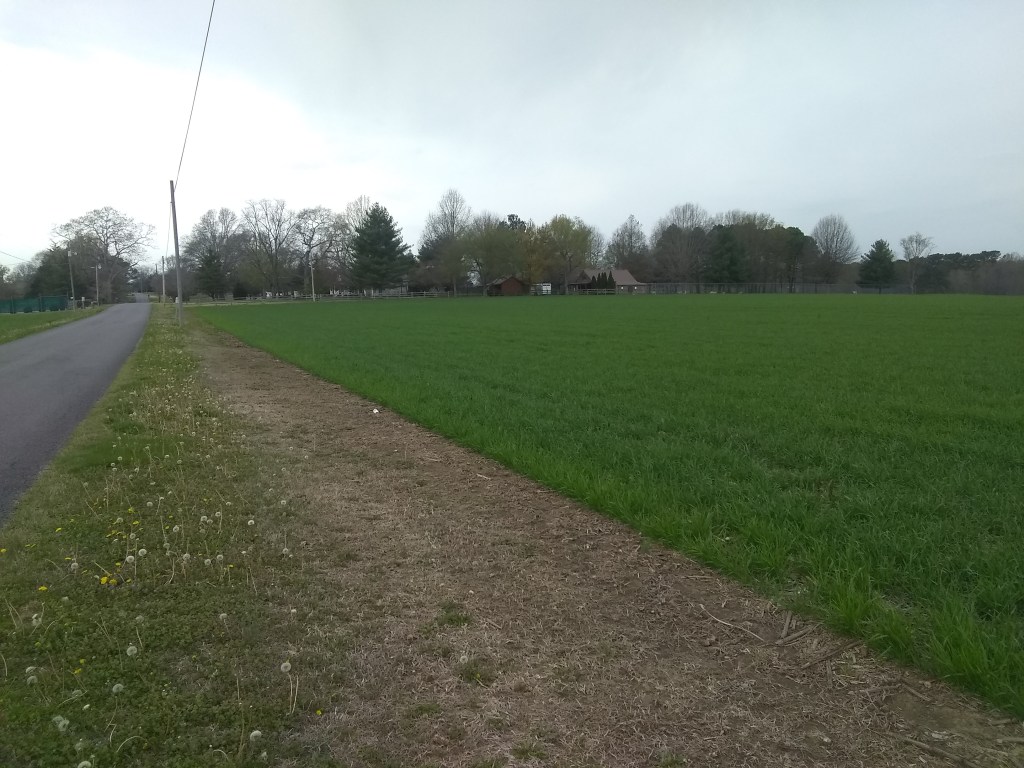
The moment Mildred and Sandy returned to the van, Colton drove away, never to attempt such a foolhardy venture again. The money simply wasn’t worth the risk. Even if they were successful and cashed in the entire lot of CDs, and hide the money so no one could ever find it, what did that get them if he and Sandy were locked away for life in prison? Colton, silently screamed to himself, “how in hell could I have been so dumb?” His thoughts continued: all banks have security cameras. First American Bank now had not only Mildred and Sandy, together, inside the bank, but her Sprinter van in the parking lot, with possibly a closeup of his face nervously watching the front door. Well, at least the return to Rolling Meadows hadn’t been a total bust, he thankfully had remembered to drop by Phone Mart and pickup his and Sandy’s new cell phones, paying the balance with some of Mildred’s cash.

After returning to Parking Lot C, Sandy and Mildred had whipped up a double-batch of Hamburger Helper. Both men had gorged themselves while Mildred had only nibbled, likely pondering her fate.

Monday night was one of the longest Colton ever experienced. The van was too small for three to sleep comfortably. Although the couch along the rear doors transformed into a double there was no way he was going to lay that close to Sandy. At 9:00 PM, Colton reclined in the driver’s side captain’s chair, while Sandy and Mildred stretched out on the two couches.

There was no way Colton could sleep, especially with so much to contemplate. Unknown to Sandy, with the aid of his new, untraceable cell phone, he’d decided the three of them would arrive at Schiller Woods before dawn and park at a picnic area Google Maps labeled, ‘Grove 5.’ He had little doubt that they’d have the place to themselves. From there, Colton, with Sandy’s assistance, would secure Mildred’s hands and stuff a sock in her mouth. Sandy would stay inside the van while Colton led her north into the woods several hundred feet. There, he would take Mildred’s life with one massive blow with a rock, hoping and intending she’d die instantly. He had no plan to bury or otherwise hide her body. Nature would take care of that, with everything from dogs, cats, rodents, coyotes, opossums, raccoons, skunks, and birds devouring her corpse and scattering her bones throughout the thick forest.

That venture was a long seven hours away. Now, unable to sleep, Colton pondered who would be the best person to intimidate and convince that he or she should share Millie and Molly’s current location. Top of the list was Matt Canna. Colton knew beyond a shadow of a doubt that he was involved and knew the answer to Colton’s question. But, Matt was a stout guy, both mentally and physically. It might take some time to break him, and that meant a possibly worse scenario than the one with Mildred. And, this ignored the risk of confronting and abducting the six-foot two, two-hundred pound former athlete. Colton gave the Matt option a solid 8 out of a possible 10 for risk.
That left Alisha Maynard as Colton’s second possibility. Again, he had little doubt Molly’s best friend would know most everything, especially since they’d been sharing secrets since Kindergarten. Colton knew from two years of living with Millie and Molly, that the two six-graders were as intimate with their words as two romantic adults.

On the plus side of this option, Alisha would be a push-over as far as strength needed for an abduction, but there was a downside. She’s a twelve-year old child and would be better protected than Matt; she’d rarely be without adult supervision. Colton knew they’d have to get creative to develop a plan to kidnap her without being seen.

Colton reclined the captain’s chair as far as it would go and closed his eyes, wishing he hadn’t eaten an extra helping of Hamburger Helper. But, that wasn’t what was making him nauseous, it was the idiocy of committing murder and kidnapping in order to avoid a lifetime of prison for murder and kidnapping, not to mention the arson. Finally, surprisingly, Colton dosed and fell into a deep sleep, just to be awakened several hours later by Sandy nudging his shoulder. As planned, the two had agreed to swap places during the middle of the night.
However, Mildred’s every half-hour trip to the bathroom, and the slowly emerging smell of strong pee, prompted Colton to get up, go outside, and take a long walk around Parking Lot C. Four AM could not come quick enough.

When he returned to the van, Sandy was again on the rear couch, laying on his back, snoring like Hunter, a bulldog Colton had when he was a kid. Mildred was between trips to the bathroom, staring sadly at him as she inched her way back to the other couch.

Colton reconfigured the driver’s side captain’s chair and activated his new cell. It was 2:30 AM and he was wide awake. He inclined his seat and searched for the Spyware APP for the camera he’d hidden inside Molly’s black lama. He knew the battery was long dead but the prior recordings were safely stored in the cloud. The last recording of the two young girls still troubled him. Who were they? What in hell had become of Molly’s stuffed animals?

The APP was simple. As long as the camera had power—whether from a wall plug or its tiny battery, the motion-activated recordings were captured. If there was an available, non-password protected WiFi, the APP uploaded the recordings to a secure server.

Colton clicked on “Prior Recordings” and activated the most recent one. After turning up the volume and listening to the two curly-headed girls he guessed were five or six years old, to his surprise he was able to zoom in touching the screen with his thumb and forefinger and slowly spreading them apart. Earlier, he’d seen the white board on the wall in the background and that’s where he’d seen “Ray’s Garage.” This had prompted his search which ultimately had been a complete waste of time, an abrupt dead end, finding hundreds of Ray’s Garages throughout the country.

Now, with the APP’s new feature, he could make out what was clearly a row of crayon sketches taped side-by-side along the bottom of the board. None of the seven or eight interested Colton; they were all rudimentary drawings of sunsets, farm animals, pets including a dog, a cat, and a turtle, and, one each, of ‘Mom,’ and ‘Dad.’

What caught Colton’s attention was a flyer next to ‘Rufus’ the dog in the lower right corner of the white board. It was professionally done, at least compared to the girls’ sketches, in black and gold that announced an end-of-day school program last Friday where the Kindergarten students read their letters to Santa. At the bottom of the flyer, next to what had to be the school systems mascot, a yellow jacket, was printed in large letters: Fort Meigs Elementary School. The wording included a street address, along with the city, a place called Perrysburg, Ohio. “Bingo,” Colton said so loud that it disturbed the rhythm of Sandy’s snoring.

It took Colton less than a minute to type his Google query: “Ray’s Garage in Perrysburg, Ohio.” The first result read, “Auto Repair | Ray’s Service Center & Towing in Perrysburg, OH.” He clicked the link and after ignoring several customer reviews at the top of the page, read the following aloud, but softly: “Welcome to Ray’s Service Center & Towing, your car service in Perrysburg, OH!”

Colton smiled, although still confused. He asked himself, why would the black lama be here? His answer came quickly. The only logical explanation, given this place worked on dysfunctional vehicles, is that Millie’s Sentra had broken down. After locating Perrysburg on Google Maps, Colton announced to everyone within ear shot, “Shit, I bet the two escapees broke down on I-94 and had old Ray come get them with his tow truck.”

Nothing seemed to awaken the two snoring zombies as Colton continued to dissect what he’d discovered, At 4:00 AM he still hadn’t figured out why the black lama camera had captured the scene inside Ray’s office.

Stepping outside the van, all Colton could think was that he’d just experienced a miracle. It might have come from God but he doubted it. One thing was for sure, his and Sandy’s luck had just changed. For the better.

“Get up.” He said, opening the sliding side door. “We’ve got a full day ahead of us.”

It took fifteen-minutes to drive to Schiller Woods and Grove 5. Neither man had seen a single vehicle since passing the Dunkin coffee shop at the North River Road intersection, but what worried Colton the most was his stupidity—he’d failed to plan for the two I-90 toll booths, with both likely having cameras.
He eased the van off the cemented, circular drive and into the thick woods, just enough to be hidden. Mildred, still laying on her couch, was humming what had to be a gospel song. From his mother, Sandy knew it to be “Victory in Jesus.” He looked at Colton and shook his head sideways, making one final attempt to dissuade his best friend from taking yet another life.

It didn’t work. “Wake up mama, let’s take a little walk.” The lumberjack icon said as he exited the van.

By the time Colton reached the sliding door, Mildred was sitting up and buttoning her coat. She stuffed both hands in pockets as he motioned her to follow.

They slowly marched fifteen minutes due north with Mildred in the lead listening to her killer. Instead of his words, “right,” “left,” along the way her mind leaped eighty years past to her father plowing his mule with occasional “gee” and “haw” commands to guide old Sally alongside the rows of corn.
“Okay, stop here.” Colton said after they crossed a narrow stream of snow-melt alongside an outcropping of rocks ten feet ahead.

“Whoa,” thought Mildred. She listened for “come up” or a cluck for get going but heard only a sigh from her killer. Turning just enough to see Colton out of the corner of her eye, she saw he was staring at his cell phone.

Mildred squeezed her right hand around the handle of the only boning knife she carried in the van. Neither Sandy nor Colton had thought she might have a weapon, much less have the guts to use it. She withdrew her hand clutching the knife and fell to the ground resting on her knees, leaning forward with only her left hand visible. “Ooooh, she screamed.” Her plan, her hope, was that Colton would either kill her instantly with a rock or limb, or he’d try to make her stand. He might even kneel beside her and ask what was wrong. The latter, she doubted, but he might grab an arm and start pulling her upward. If she didn’t die from a hard blow to the head, she might get her chance.

“What the fuck?” Colton turned back toward the little creek. Mildred caught his movement in the corner of her eye. He found a rock bigger than his hand and walked toward her.

As luck or fate would have it, Colton’s first strike missed Mildred’s head and landed between her neck and shoulder. Miraculously, she spun on her knees to her left and brought her right arm and hand upwards as hard as she could. The blade penetrated his left thigh, just above the knee on the inner side.

Fortunately for Colton, the knife missed his femoral artery by an inch.
“You fucking bitch.” The second blow struck the left side of Mildred’s head, just above the ear. With a groan she slumped sideways onto the snow-soaked ground. Colton watched for what seem like several minutes before she took her last breath.

He quickly unbuckled his pants and slid them down to his knees to look at the wound. There wasn’t much blood. Thankfully, it was a flesh wound, above the thigh bone. Regardless, Colton used a bandanna to make a tourniquet.

Before returning to the van, he eyed the scene and saw the knife half submerged in mud lying beside Mildred’s body. Apparently, after the scuffle and during his wound inspection, he’d stepped on the six-inch blade.

After searching the dead woman’s pockets, Colton returned to the van and a sad-faced Sandy who’s voice trembled as he asked, “is she gone?”

Colton nodded, opened the driver’s side door, and tucked the knife underneath the seat fully intending to toss it out the window somewhere in between Chicago and Perrysburg. “Come on.” He hollered at Sandy who was slouching toward the van.

Why I Write: Joan Didion on Ego, Grammar, and the Creative Impulse

Here’s the link to this article.

“Had I been blessed with even limited access to my own mind there would have been no reason to write.”

BY MARIA POPOVA

Why I Write: Joan Didion on Ego, Grammar, and the Creative Impulse

The question of what propels creators, especially great creators, is the subject of eternal fascination and cultural curiosity. In “Why I Write,” originally published in the New York Times Book Review in December of 1976 and found in The Writer on Her Work, Volume 1 (public library), Joan Didion — whose indelible insight on self-respect is a must-read for all — peels the curtain on one of the most celebrated and distinctive voices of American fiction and literary journalism to reveal what it is that has compelled her to spend half a century putting pen to paper.

Portrait of Joan Didion by Mary Lloyd Estrin, 1977

Didion begins:

Of course I stole the title for this talk, from George Orwell. One reason I stole it was that I like the sound of the words: Why I Write. There you have three short unambiguous words that share a sound, and the sound they share is this:
I
I
I
In many ways writing is the act of saying I, of imposing oneself upon other people, of saying listen to me, see it my way, change your mind. It’s an aggressive, even a hostile act. You can disguise its qualifiers and tentative subjunctives, with ellipses and evasions — with the whole manner of intimating rather than claiming, of alluding rather than stating — but there’s no getting around the fact that setting words on paper is the tactic of a secret bully, an invasion, an imposition of the writer’s sensibility on the reader’s most private space.

She goes on to attest to the character-forming importance of living the questions and trusting that even the meaningless moments will add up to one’s becoming:

I had trouble graduating from Berkeley, not because of this inability to deal with ideas — I was majoring in English, and I could locate the house-and-garden imagery in The Portrait of a Lady as well as the next person, ‘imagery’ being by definition the kind of specific that got my attention — but simply because I had neglected to take a course in Milton. I did this. For reasons which now sound baroque I needed a degree by the end of that summer, and the English department finally agreed, if I would come down from Sacramento every Friday and talk about the cosmology of Paradise Lost, to certify me proficient in Milton. I did this. Some Fridays I took the Greyhound bus, other Fridays I caught the Southern Pacific’s City of San Francisco on the last leg of its transcontinental trip. I can no longer tell you whether Milton put the sun or the earth at the center of his universe in Paradise Lost, the central question of at least one century and a topic about which I wrote 10,000 words that summer, but I can still recall the exact rancidity of the butter in the City of San Francisco’s dining car, and the way the tinted windows on the Greyhound bus cast the oil refineries around Carquinez Straits into a grayed and obscurely sinister light. In short my attention was always on the periphery, on what I could see and taste and touch, on the butter, and the Greyhound bus. During those years I was traveling on what I knew to be a very shaky passport, forged papers: I knew that I was no legitimate resident in any world of ideas. I knew I couldn’t think. All I knew then was what I couldn’t do. All I knew then was what I wasn’t, and it took me some years to discover what I was.

Which was a writer.

By which I mean not a ‘good’ writer or a ‘bad’ writer but simply a writer, a person whose most absorbed and passionate hours are spent arranging words on pieces of paper. Had my credentials been in order I would never have become a writer. Had I been blessed with even limited access to my own mind there would have been no reason to write. I write entirely to find out what I’m thinking, what I’m looking at, what I see and what it means. What I want and what I fear. Why did the oil refineries around Carquinez Straits seem sinister to me in the summer of 1956? Why have the night lights in the bevatron burned in my mind for twenty years? What is going on in these pictures in my mind?

She stresses the power of sentences as the living fabric of literature:

Grammar is a piano I play by ear, since I seem to have been out of school the year the rules were mentioned. All I know about grammar is its infinite power. To shift the structure of a sentence alters the meaning of that sentence, as definitely and inflexibly as the position of a camera alters the meaning of the object photographed. Many people know about camera angles now, but not so many know about sentences. The arrangement of the words matters, and the arrangement you want can be found in the picture in your mind. The picture dictates the arrangement. The picture dictates whether this will be a sentence with or without clauses, a sentence that ends hard or a dying-fall sentence, long or short, active or passive. The picture tells you how to arrange the words and the arrangement of the words tells you, or tells me, what’s going on in the picture. Nota bene.

It tells you.
You don’t tell it.

Didion concludes with a quick shot of her signature wry wit:

Let me tell you one thing about why writers write: had I known the answer to any of these questions I would never have needed to write a novel.

For more timeless wisdom on writing, see Zadie Smith’10 rules of writingKurt Vonnegut’8 guidelines for a great storyDavid Ogilvy’10 no-bullshit tipsHenry Miller’11 commandmentsJack Kerouac’30 beliefs and techniquesJohn Steinbeck’6 pointersNeil Gaiman’8 rules, and Susan Sontag’synthesized learnings.

You Have No Right To Question Why You Suffer. What???

Here’s the link to this article by Bart Ehrman.

March 18, 2023

We come now to the conclusion of the dialogues of Job.   His friends have stridently insisted that he is suffering because he has sinned.  He vehemently argues he has not.  As it turns out, he’s right.  Then why is God making him suffer?  Here God himself appears to explain.  Or rather, to insist that he is not going to explain and that Job has no right to ask him to.

Is this an answer to suffering?  Or, well, a satisfactory one?  We can’t even ask?

Decide for yourself.  Here’s how I explain the climax of the book of Job in my book God’s Problem (HarperOne, 2008).

******************************

Job has no time – or need – to reply to this restatement of his friends’ views.  Before he can respond, God himself appears, in power, to overwhelm Job with his presence and to cow him into submission in the dirt.  God does not appear with a still, small voice from heaven, or in human guise, or in a comforting dream.  He sends a violent and terrifying whirlwind, and speaks to Job out of it, roaring out his reprimand:

Who is this that darkens council by words without knowledge?

Gird up your loins like a man,

I will question you, and you shall declare to me.

Where were you when I laid the foundation of the earth?

Tell me, if you have understanding.

Who determined its measurements – surely you know!

Or who stretched the line upon it?

On what were its bases sunk,

or who laid its cornerstone

when the morning stars sang together

and all the heavenly beings shouted for joy?… (38:2-7)

In his anger, God reproves Job for thinking that he, a mere mortal, can contend with the one who created the world and all that is in it.  God is the Almighty, unanswerable to those who live their petty existence here on earth.  He asks Job a series of impossible questions, meant to grind him into submission before his divine omnipotence:

Have you commanded the morning since your days began,

and caused the dawn to know its place?….

Have you entered into the springs of the sea,

or walked in the recesses of the deep?

Have the gates of death been revealed to you,

or have you seen the gates of deep darkness?

Have you comprehended the expanse of the earth?

Declare if you know this….

Have you entered the storehouses of the snow,

or have you seen the storehouses of the hail?…

Do you know the ordinances of the heavens?

Can you establish their rule on the earth?

Can you lift up your voice to the clouds,

so that a flood of waters may cover you?

Can you send forth lightnings, so that they may go,

and say to you, “Here we are”?

Is it by your wisdom that the hawk soars,

and spreads its wings toward the south?

Is it at your command that the eagle mounts up

and makes its nest on high? (38:12, 16-18; 22, 33-35; 39:26-27)

This demonstration of raw divine power – it is God, not Job, who is the creator and ruler of this world — leads to the natural conclusion.  If God is Almighty and Job is a pathetically weak mortal, who is he to contend with God? (40:1-2).  Job submits in humility (40:3-4).  But God is not finished with him.  He speaks a second time from the whirlwind:

Then the LORD answered Job out of the whirlwind:

Gird up your loins like a man;

I will question you, and you declare to me.

Will you even put me in the wrong?

Will you condemn me that you may be justified?

Have you an arm like God,

and can you thunder with a voice like his? (40:6-9)

No, obviously not.  Job had predicted that if God ever were to appear to him, he would be completely overpowered by his divine majesty and driven to submit before him, whether innocent or not.  And that’s exactly what happens.  When God’s thundering voice is finally silent, Job repents and confesses:

I know that you can do all things,

and that no purpose of yours can be thwarted….

I had heard of you by the hearing of the ear,

but now my eye sees you;

therefore I despise myself,

and repent in dust and ashes. (42:2, 5-6)

Readers have read this climax to the poetic dialogues in a variety of ways.  Some think that Job got everything that he wished for – a divine audience – and that he was satisfied with that.  Others think that Job came to realize his inherent guilt before the Almighty.  Others think that once Job has recognized the enormity of God’s creation, he can put his individual suffering in a cosmic perspective.  Yet others think that the point is that God has far too much on his hands – the governance of the entire universe, after all – to be all that concerned about Job’s quibbles about innocent suffering.

I don’t think any of these answers is right.  Job did want a divine audience, but that was so he could declare his innocence before God – and he is never given a chance to get a word in.  Nor is there any sense in which Job comes to realize that in fact he was guilty before God after all: when he “repents” he does not repent of any wrongdoing (he was, after all, completely innocent!); he repents of having thought that he could make his case before the Almighty.  Nor does it seem fair to relativize a person’s suffering because the world is, after all, a very big and amazing place. And it can’t be true that the Lord God has too many other things to worry about than Job’s miserable little life: the entire point of Job’s speeches is not that God is absent from his life but that he is far too present, in punishing him in ways that make no sense, since he has done nothing wrong.

It cannot be overlooked that in the divine response from the whirlwind to Job’s passionate and desperate plea for understanding why he, an innocent man, is suffering so horribly, no answer is in fact given.  God does not explain why Job suffers.  He simply asserts that he is the Almighty and, as such, cannot be questioned.  He does not explain that Job committed sins of which he was simply unaware.  He does not say that the suffering did not come from him but from other humans (or demonic beings) who were behaving badly towards Job.  He does not indicate that it has all been a test to see if he would remain faithful.  His only answer is that he is the Almighty who cannot be questioned by mere mortals, and that the very quest for an answer, the very search for truth, the very impulse to understand is an affront to his Powerful Being.  God is not to be questioned and reasons are not to be sought.  Anyone who dares to challenge God will be withered on the spot, squashed into the dirt by his overpowering presence.  The answer to suffering is that there is no answer, and we should not look for one.  The problem with Job is that he expects God to deal rationally with him, to give him a reasonable explanation of the state of affairs; but God refuses to do so.  And he is, after all, God.  Why should he have to answer to anybody?  Who are we, mere mortals, to question GOD?

This response of God from the whirlwind seems to get God off the hook for innocent suffering – he can do whatever he pleases, since he is the Almighty and is not accountable to anyone.  On the other hand, does it really get him off the hook?  Doesn’t this view mean that God can maim, torment, and murder at will and not be held accountable?  As human beings, we’re not allowed to get away with that.  Can God?  Does the fact that he’s Almighty give him the right to torment innocent souls and murder children?  Does might make right?

Moreover, if the point is that we cannot judge the cruel acts of God by human standards (remember: Job was innocent!), where does that leave us?  In the Bible, aren’t humans made in the very image of God?  Aren’t human standards given by God?  Doesn’t he establish what is right and fair and just?  Aren’t humans to be like him in how they treat others?  If we don’t understand God by human standards (which he himself has given), how can we understand him at all, since we’re human?  Isn’t this explanation of God’s justice, at the end of the day, simply a cop out, a refusal to think hard about the disasters and evils in the world as having any meaning whatsoever?

I’m happy to know what you think.