Your character finds an odd wooden cube in an antique store, which she obtains at a good price because the owner is unable to open it. Something rattles inside, and after some time studying the box’s markings, your heroine finds the catch that opens the box.
Biking is something else I both love and hate. It takes a lot of effort but does provide good exercise and most days over an hour to listen to a good book or podcast. I especially like having ridden.
Here’s my bike, a Rockhopper by Specialized. I purchased it November 2021 from Venture Out in Guntersville; Mike is top notch! So is the bike, and the ‘old’ man seat I salvaged from an old Walmart bike.
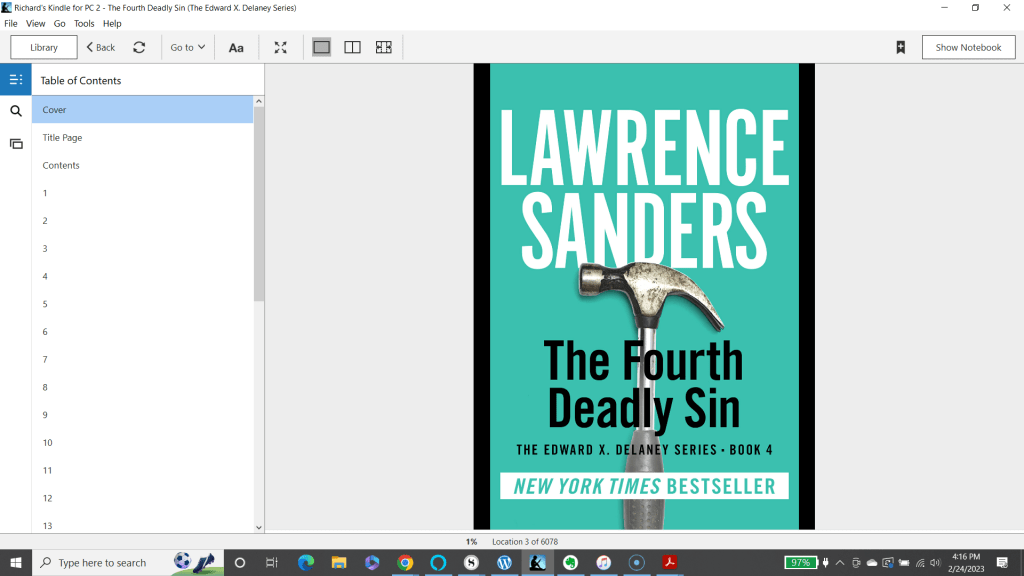
Here’s what I’m currently listening to: The Fourth Deadly Sin, by Lawrence Sanders
Sanders was a tremendously talented writer.
Amazon abstract:
When a Manhattan psychiatrist is murdered, a retired detective returns to the job, in a thriller by the #1 New York Times–bestselling “master of suspense” (The Washington Post).
On a rainy November night, Dr. Simon Ellerbee stares out the window of his Upper East Side psychiatry office, miserably wishing he could seek counseling for the problems in his seemingly perfect life. He hears the door buzzer and goes to answer it, but flinches when he sees his unexpected guest. Minutes later, he’s dead, his skull crushed by repeated blows from a ball-peen hammer. Once the doctor was down, the killer turned over the body and smashed in Ellerbee’s eyes. With no leads and a case getting colder by the hour, the New York Police Department calls in former chief Edward Delaney. His search for the truth raises more questions than answers: Who had Ellerbee let into his office? Why were there two sets of wet footprints on the carpeting of the doctor’s townhouse? What caused Ellerbee’s odd personality transformation over the past year? And who murdered, then symbolically mutilated, the prominent Manhattan psychiatrist?
If you’re tired of streaming or cleaning for the moment and need to pass some time, you won’t go wrong with the four Deadly Sins series from Lawrence Sanders. I zip through all of them every other year, in sequence. They’re great reads, and I’ve always pictured George C. Scott as Edward X. Delaney (Frank Sinatra in the movie version of the First in pretty insipid, but apparently he owned the rights).
The Fourth is the murder is Dr Simon Ellerbee, you get the usual palette of suspects, and retired Chief of Detectives gets his crew and does his stuff. If Hemingway wrote crime suspense set in NYC, it’d be like this. I love short descriptive sentences. Not sure I recall seeing “ears like slabs of veal” in this one. If you love New York, Mr Sanders captures its essence like a great musical conductor. The “Sins” series is the best, followed by the “Commandments.” The Arch McNally stuff which followed that is okay, even though they kept the series going after Mr Sanders died in 1998. I just find that disrespectful. I only regret there wasn’t a Fifth Deadly Sin.
In the second chapter of Acts we find the story of Peter preaching about Jesus, with dramatic results: “So those who welcomed his message were baptized, and that day about three thousand persons were added” (v. 41). Most New Testament scholars grant that the Book of Acts was written decades after events depicted, all but conceding that authentic history is hard to find here; sources are not mentioned, and the case for Jesus is made primarily by quoting from the Old Testament. Moreover, the fantasy factor is pretty high, e.g., an angel helps Peter escape from prison: “Suddenly an angel of the Lord appeared. A light shone in the prison cell. The angel struck Peter on his side. Peter woke up. ‘Quick!’ the angel said. ‘Get up!’ The chains fell off Peter’s wrists” (Acts 12:7).
The early Christians were a small breakaway Jewish sect, but there’s an attempt here to exaggerate its success: three thousand were baptized when they heard Peter speak. How would an author writing decades after the “event” have been able to verify that figure? And are modern readers supposed to be impressed that three thousand people signed up because they heard the words of a preacher? Throughout the ages many cults have gathered the gullible in exactly this way.
Scripture’s First Big Mistake
But catastrophic damage has been done by this text—and many others—by positioning the Jews as the bad guys, the enemies of God and Christ. Verse 23: “…this man, handed over to you according to the definite plan and foreknowledge of God, you crucified and killed by the hands of those outside the law.” The Christians set themselves apart from Judaism by claiming that Jesus was the messiah, and it was but a small step to assume that evil was behind the denial of this status to Jesus.
This finds expression in the nasty verse in John’s gospel (8:44)—which John presents as Jesus-script, addressed to the Jews: “You are from your father the devil, and you choose to do your father’s desires. He was a murderer from the beginning and does not stand in the truth because there is no truth in him. When he lies, he speaks according to his own nature, for he is a liar and the father of lies.” This is pretty bad: “You Jews, your god is the devil.”
In Paul’s letter to the Thessalonians (called I Thessalonians; II Thessalonians is widely regarded as a forgery), in chapter 2 we find these verses, 14-16:
“For you, brothers and sisters, became imitators of the churches of God in Christ Jesus that are in Judea, for you suffered the same things from your own compatriots as they did from the Jews who killed both the Lord Jesus and the prophets and drove us out; they displease God and oppose everyoneby hindering us from speaking to the gentiles so that they may be saved. Thus they have constantly been filling up the measure of their sins, but wrath has overtaken them at last.”
There was been debate among scholars about this text—is it an interpolation? —but there it is in the New Testament, with plenty of devout Christians over the centuries willing to help overtake Jews with wrath. This has to be counted as one of Christianity’s biggest sins, which resulted in the Holocaust. Hector Avalos makes the case for this in his essay, “Atheism Was Not the Cause of the Holocaust,” in John Loftus’ 2010 anthology, The Christian Delusion: Why Faith Fails.
He quotes Catholic historian, José M. Sánchez: “There is little question that the Holocaust had its origins in the centuries-long hostility felt by Christians against Jews.” (p. 70, in Sánchez’s 2002 book, Pious XII and the Holocaust: Understanding the Controversy)
Centuries-long hostility. In his essay, Avalos provides details of Martin Luther’s ferocious hatred of Jews, and William Shirer, in his classic work, The Rise and Fall of the Third Reich, notes that “…in his utterances about the Jews, Luther employed a coarseness and brutality of language unequaled in German history until the Nazi time” (p. 236). This is the holy hero so revered for launching the Reformation, and for whom a major denomination is named. It would seem that far too many Christians have failed to study church history. They fail to see this horribly ugly impact of verses in the New Testament. The willing, and in many cases, enthusiastic embrace of anti-Semitism is one of Christianity’s biggest sins.
Scripture’s Second Big Mistake
Another one is just as grotesque. A few days ago PBS broadcast the 2000 documentary, From Swastika to Jim Crow—which describes the expulsion of Jewish scholars from Nazi Germany, many of whom ended up in the United States. But they faced heavy anti-Jewish sentiment, anti-German prejudice here as well; most of them were shunned by major universities in northern states. They were hired by Black colleges in southern states, with largely positive outcomes. The Jewish professors could identify with their Black students who faced the brutal reality of segregation. The South lost the Civil War, slavery was ended, but the loathing of Black people did not diminish; if not loathing, then keeping them in their place away from white people. Generations of southern white folks have preserved and nurtured these attitudes, resentful that their way of life—founded on slavery—had been shattered.
And, of course, they could look to the Bible for support. There are no Bible texts at all that prohibit slavery, or call for its abolition. Many serious thinkers have noted that this in one of major flaws of the Ten Commandments, and it would take a long time for ethical sensibilities to evolve to the point of seeing the horrors of slavery. The movement to end slavery gradually gathered strength. Those fighting to end this brutal form of human oppression encountered stiff resistance from those found their world view in the Bible.
Is this the way Christianity is supposed to work?
From Swastika to Jim Crow draws dramatic attention to how “Christian” nations fail to notice the poisonous hatreds they embrace. Love your neighbor and love your enemies have no appeal, no traction at all. The Christian advocates fail to see the dangers of relying on an ancient book that champions a vengeful god. Jesus-script includes mention of punishment by eternal fire, a coming kingdom of god that will see millions of humans killed. One of the constant themes in the apostle Paul’s letter is god’s wrath. This kind of we’ll-get-revenge thinking encourages devout people to take a severe approach toward their perceived enemies. Hence Christians in Germany and the U.S. could justify hatred of Jews, and those in the U.S. could justify hatred of Black people—were lynchings anything other than this? Laws were enacted to keep the races separate, and were enforced ruthlessly. Yes, in, of all places, the Bible Belt. What does that tell us about Bible Values? How can this not be an example of failed Christian theology?
Moreover, it certainly shows the incompetence of the Christian god. How could a powerful, wise, all-knowing god not have noticed—not have foreseen—the consequences of the dreadful Bible verses mentioned above? When this god inspired the author of John’s gospel, surely verse 8:44 would have been erased from John’s brain before he wrote it down. Surely this wise god would have added “you shall not enslave other human beings” to the Big Ten list given to Moses—and have realized that the first two or three on the list were about the divine ego, reflecting this tribal god’s jealousy, and were not all that necessary for human happiness and well-being.
One more thing to be said about the Holocaust. Religious indoctrination can play evil tricks on the human brain. Events that undermine or shatter faith can be ignored and denied, especially episodes of inexplicable suffering and death. Theologians and clergy try their best to explain what obviously seems like god’s indifference or incompetence: he works in mysterious ways, or has a bigger plan that we can’t know about or understand. This is actually an appeal to stop thinking about it, because there are no rational explanations. But still the games go on.
The argument goes that a good god could not possibly have let six million of his people be killed—intentionally murdered—during World War II. Some make this argument to protect their theologies, their conception of god; for some it is an extension of anti-Semitism. Hence we see Holocaust denialism.
Hitler’s anti-Semitism was part of public policy, and his obsession to rid Germany and the world of Jews was clear from the mid-1930s on. The bureaucracy for mass killing was put into place. Hitler hired those who were fiercely committed to this goal. They thought they were doing a great service to the world, hence kept careful records, documenting their accomplishments. Twitter is actually one way to access what we know, through the presence there of Holocaust Education, Auschwitz Memorial, MajdanekMemorial, US Holocaust Museum, Auschwitz Exhibition. The website of the US Holocaust Museum is especially helpful, including its treatment of denialism, here and here. Also, do a Google search for Holocaust memoirs. There are so many of them; those who survived or escaped felt the need to tell their stories of loss, grief, and trauma—and courage. Holocaust deniers would have us believe they’re all liars.
When we closely examine slavery and anti-Semitism, there is simply no way to let Christianity and the New Testament off the hook for these huge sins. In his essay, Hector Avalos argues that “Hitler’s holocaust…is actually the most tragic consequence of a long history of Christian anti-Judaism and racism. Nazism follows principles of killing people for their ethnicity or religion annunciated in the Bible” (p. 369).
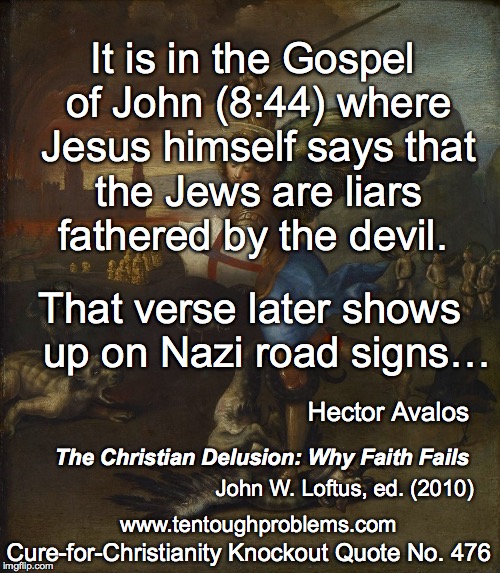
And shame on Jesus too—for those who believe that John quoted him correctly. Hector Avalos: “It is in the Gospel of John (8:44) where Jesus himself says that the Jews are liars fathered by the devil. That verse later shows up on Nazi road signs…” (p. 378)
Can we trust a source such as Papias on the question of whether our Gospel of Matthew was written by the disciple Matthew and that our Gospel of Mark was written by Mark, the companion of the disciple Peter?
It is interesting that Papias tells a story that is recorded in our Matthew but tells it so completely differently that it appears he doesn’t know Matthew’s version. And so when he says Matthew wrote Matthew, is he referring to *our* Matthew, or to some other book? (Recall, the Gospel he refers to is a collection of Jesus’ sayings in Hebrew; the Gospel of Matthew that *we* have is a narrative, not a collection of sayings, and was written in Greek.) If he *is* referring to our Matthew, why doesn’t he see it as an authoritative account?
Here’s the conflicting story. It involves the death of Judas. And it’s quite a story! Here is my translation of it from my edition, The Apostolic Fathers (Loeb Classical Library, vol. 1; 2004).
But Judas went about in this world as a great model of impiety. He became so bloated in the flesh that he could not pass through a place that was easily wide enough for a wagon – not even his swollen head could fit. They say that his eyelids swelled to such an extent that he could not see the light at all; and a doctor could not see his eyes even with an optical device, so deeply sunken they were in the surrounding flesh. And his genitalia appeared more disgusting and greater than all formlessness, and he bore through them from his whole body flowing pus and worms, and to his shame shame, he emitted pus and worms that flowed through his entire body.
And they say that after he suffered numerous torments and punishments, he died on his own land, and that land has been, until now, desolate and uninhabited because of the stench. Indeed, even to this day no one can pass by the place without holding their nose. This was how great an outpouring he made from his flesh on the ground.” [Apollinaris of Laodicea]
You gotta love it. But, well, what does one make of it? Matthew’s Gospel – the one we have in the New Testament – also describes the death of Judas. But it is not like this at all. According to Matthew, Judas hanged himself (Matt. 27:5). If Papias saw Matthew’s Gospel as an eyewitness authority to the life of Jesus and those around him, why didn’t he accept its version of Judas’s death?
Another alternative is that when Papias describes a Gospel written by Matthew, he isn’t actually referring to the Matthew that we now have. Recall: Papias says two things about the “Matthew” he is familiar with: it consists only of sayings of Jesus and it was composed in Hebrew. Neither is true of our Matthew, which does have sayings of Jesus, but is mainly composed of stories about Jesus. Moreover, it was not composed in Hebrew but in Greek.[1]
It is possible, of course, that like other early Christian scholars, Papias thought Matthew was originally composed in Hebrew when it was not. But it is also possible that these later writers thought Matthew was written in Hebrew because they knew about Papias’s comment and thought he was referring to our Gospel. But he appears not to be: Matthew is not simply a collection of Jesus’ sayings; and in the only place that Papias’s comments overlap with (our) Matthew’s account (the death of Judas), he doesn’t appear to know (our) Matthew.
If Papias was not talking about our Matthew, was he talking about our Mark? As Papias’s quotation about Mark that I cited yesterday indicates, he considered “his” Mark to be problematic because of its disorderly arrangement: that’s why he says that the preaching of Peter was not given “in order.” But that somewhat negative remark in itself is odd, because he doesn’t make the same comment about Matthew, even though the narrative outline of our Matthew is pretty much the same as our Mark – with additional materials added in.
Apart from that, Papias indicates that Mark’s Gospel gives an exhaustive account of everything Peter preached and that it gives it without changing a thing. The reality is that there is no way that anyone could think that the Gospel of Mark in our Bibles today gives a full account of Peter’s knowledge of Jesus. Our Gospel of Mark takes about two hours to read. Are we to think that after spending months (years?) with Jesus, Peter had no more than two hours’ worth of memories?
Of course it may be that Papias is exaggerating for effect. But even so, since he does not appear to be referring to the book we call Matthew, why should we think that he is referring to the book we call Mark? And that, therefore (as Papias indicates) Mark’s Gospel is actually a transcription of Peter’s version of what Jesus said and did?
Despite repeated attempts over the centuries by readers to show that Mark’s Gospel is “Peter’s perspective,” the reality is that if you simply read it without any preconceptions, there is nothing about the book that would make you think, “Oh, this is how Peter saw it all.” Quite the contrary – not only does Peter come off as a bumbling, foot-in-the-mouth, and unfaithful follower of Jesus in Mark (see Mark 8:27-32; 9:5-6; 14:27-31), but there are all sorts of stories – the vast majority – that have nothing to do with Peter or that betray anything like a Petrine voice.
There is, though, a still further and even more compelling reason for doubting that we can trust Papias on the authorship of the Gospels. It is that that we cannot really trust him on much of anything. That may sound harsh, but remember that even the early Christians did not appreciate his work very much and the one comment we have about him personally from an educated church father is that he was remarkably unintelligent.
It is striking that some modern authors want to latch on to Papias for his claims that Matthew and Mark wrote Gospels, assuming, as Bauckham does, that he must be historically accurate, when they completely overlook the other things that Papias says, things that even these authors admit are not and cannot be accurate. If Papias is not reliable about anything else he says, why does anyone think he is reliable about our Gospels of Matthew and Mark? The reason is obvious. It is because readers want him to be accurate about Matthew and Mark, even though they know that otherwise you can’t rely on him for a second.
Does anyone think that Judas really bloated up larger than a house, emitted worms from his genitals, and then burst on his own land, creating a stench that lasted a century? No, not really. But it’s one of the two Gospel traditions that Papias narrates. Here is the only other one. This is the only saying of Jesus that is preserved from the writing of Papias. Papias claims that it comes from those who knew the elders who knew what the disciple John the Son of Zebedee said that Jesus taught:
Thus the elders who saw John, the disciple of the Lord, remembered hearing him say how the Lord used to teach about those times, saying:
The days are coming when vines will come forth, each with ten thousand boughs; and on a single bough will be ten thousand branches. And indeed, on a single branch will be ten thousand shoots and on every shoot ten thousand clusters; and in ever cluster will be ten thousand grapes, and every grape, when pressed, will yield twenty-five measures of wine. And when any of the saints grabs hold of a cluster, another will cry out, ‘I am better, take me, bless the lord through me.” (Eusebius, Church History, 3.39.1)
Really? Jesus taught that? Does anyone really think so? No one I know. Does Papias think Jesus said this? Yes, he absolutely does. Here is what Papias himself says about the traditions of Jesus he records in his five-volume book, in Bauckham’s own translation:
I will not hesitate to set down for you along with my interpretations everything I carefully learned from the elders and carefully remembered, guaranteeing their truth.”
So, can we rest assured about the truth of what Papias says, since he can provide guarantees based on his careful memory? It doesn’t look like it. The only traditions about Jesus we have from his pen are clearly not accurate. Why should we think that what he says about Matthew and Mark are accurate? My hunch is that the only reason readers have done so is because they would like him to be accurate when he says things they agree with, even when they know he is not accurate when he says things they disagree with.
However one evaluates the overall trustworthiness of Papias, in my view he does not provide us with clear evidence that the books that eventually became the first two Gospels of the New Testament were called Matthew and Mark in his time.
[1] That is obvious If Matthew was based in large part on the Gospel of Mark, as is almost everywhere conceded. Matthew agrees with the Greek text of Mark verbatim throughout his account. The only way that would be possible is if he was copying the Greek text into his Greek text.
Your character is inspecting his recently purchased property when he falls through a rotten well cover. While he’s unhurt save for cuts and scrapes, no one knows he’s there, so he must get out on his own. Write his escape.
I have begun to discuss the evidence provided by the early church father Papias that Mark was actually written by Mark. He appears to be the first source to say so. Does he? And if so, is he right?
Here’s how I begin to discuss these matters in my book Jesus Before the Gospels (edited a bit here).
******************************
Papias is often taken as evidence that at least two of the Gospels, Matthew and Mark, were called by those names already several decades after they were in circulation.
Papias was a Christian author who is normally thought to have been writing around 120 or 130 CE. His major work was a five-volume discussion of the teachings of Jesus, called Exposition of the Sayings of the Lord. [1] It is much to be regretted that we no longer have this book. We don’t know exactly why later scribes chose not to copy it, but it is commonly thought that the book was either uninspiring, naïve, or theologically questionable. Later church fathers who talk about Papias and his book are not overly enthusiastic. The “father of church history,” the fourth-century Eusebius of Caesarea, indicates that, in his opinion, Papias was “a man of exceedingly small intelligence” (Church History, 3.39).
Our only access to Papias and his views are in quotations of his book in later church fathers, starting with the important author Irenaeus around 185 CE, and including Eusebius himself. Some of these quotations are fascinating and have been the subject of intense investigation among critical scholars for a very long time. Of relevance to us here is what he says both about the Gospels and about the connection that he claims to have had to eyewitnesses to the life of Jesus.
In one of the most famous passages quoted by Eusebius, Papias indicates that instead of reading about Jesus and his disciples in books, he preferred hearing a “living voice.” He explains that whenever knowledgeable people came to visit his church, he talked with them to ask what they knew. Specifically he spoke with people who had been “companions” of those whom he calls “elders” who had earlier been associates with the disciples of Jesus. And so Papias is not himself an eyewitness to Jesus’ life and does not know eyewitnesses. Writing many years later (as much as a century after Jesus’ death), he indicates that he knew people who knew people who knew people who were with Jesus during his life. So it’s not like having firsthand information, or anything close to it. But it’s extremely interesting and enough to make a scholar sit up and take notice.
Richard Bauckham [In his book Jesus and the Eyewitnesses] is especially enthusiastic about Papias’s testimony, in part because he believes that Papias encountered these people long before he was writing, possibly as early as 80 CE, that is, during the time when the Gospels themselves were being composed [Papias himself, as you can probably guess, says nothing of the sort]. Bauckham does not ask whether Papias’ memory of encounters he had many decades earlier was accurate. But as that is our interest here, it will be important to raise the questions ourselves.
Two passages from Papias are especially important, as Bauckham and others have taken them to be solid evidence that the Gospels were already given their names during the first century. At first glance, one can see why they might think so. Papias mentions Gospels written both by Mark and by Matthew. His comments deserve to be quoted here in full. First on a Gospel written by Mark.:
This is what the elder used to say, “when Mark was the interpreter [Or: translator] of Peter he wrote down accurately everything that he recalled of the Lord’s words and deeds – but not in order. For he neither heard the Lord nor accompanied him; but later, as I indicated, he accompanied Peter, who used to adapt his teachings for the needs at hand, not arranging, as it were, an orderly composition of the Lord’s sayings. And so Mark did nothing wrong by writing some of the matters as he remembered them. For he was intent on just one purpose: not to leave out anything that he heard or to include any falsehood among them.” (Eusebius, Church History, 3. 39)
Thus, according to Papias, someone named Mark was Peter’s interpreter or translator (from Aramaic?) and he wrote down what Peter had to say about Jesus’ words and deeds. He did not, however, produce an orderly composition. Still, he did record everything he ever heard Peter say and he did so with scrupulous accuracy. We will see that these claims are highly problematic, but first consider what Papias says also about a Gospel by Matthew:
And so Matthew composed the sayings in the Hebrew tongue, and each one interpreted [Or: translated] them to the best of his ability. (Eusebius, Church History, 3. 39)
There are numerous reasons for questioning whether these passages – as quoted by Eusebius — provide us solid evidence that the New Testament Gospels were given their names in the late first or early second century.
First, it is somewhat curious and certainly interesting that Eusebius chose not to include any quotations from Papias about Luke or John. Why would that be? Were Papias’s views about these two books not significant? Were they unusual? Were they contrary to Eusebius’s own views? We’ll never know.
Second, it is important to stress that in none of the surviving quotations of Papias does he actually quote either Matthew or Mark. That is to say, he does not give a teaching of Jesus, or a summary of something he did, and then indicate that he found it in one of these Gospels. That is unfortunate, because it means that we have no way of knowing for certain that when he refers to a Gospel written by Mark he has in mind the Gospel that we now today call the Gospel of Mark. In fact there are reasons for doubting it, as I will show in my next post.
[1] See the Introduction and the collection of all the fragments of Papias that I give in The Apostolic Fathers, vol. 2 pp. 85-118.
Your character wants to infiltrate a cult in order to lure his teenage daughter away from them. Write the scene where your character is interviewed by the cult leader to see if he’s a suitable candidate for membership.
Did Mark write Mark? A couple of weeks ago I did an eight-lecture course on the Gospel of Mark for my separate (unrelated to the blog) venture, a series of courses on “How Historians Read the Bible” (the courses are available on my website: www.bartehrman.com). It was a blast. One of the things I loved about doing it was that I was able to read and reread scholarship on Mark and I learned some things I had long wondered about, and re-learned other things that I used to know.
One of the things I had to think seriously about for the first time in some years was the question of why church fathers in the second century (but when?) began claiming that our second Gospel was written by John Mark, allegedly a secretary for the apostle Peter. That took me straight back to the question of the reliability of an early Christian writer named Papias (writing around 120 or 130 CE?).
Papias gets used all the time as proof that Mark wrote Mark. Conservative Christian scholars cite him on the point as “gospel truth.” But for the past 30 years I’ve found the evidence unconvincing. I’ve written about the issue briefly on the blog before, but I decided to look up my lengthiest discussion of the matter in my book Jesus Before the Gospels (HarperOne, 2016) and lo and behold, I made some points there that I didn’t remember!
I thought it would be worthwhile to present that discussion here. It tries to show why Papias’ witness is so problematic for establishing the authorship of both Mark and Matthew, the only two Gospels he mentions in the snippets of his writings we still have. This will take three posts.
In this one I give the backdrop to the testimony of Papias.
******************************
The Gospel writers are all anonymous. None of them gives us any concrete information about their identity. So when did they come to be known as Matthew, Mark, Luke, and John? We might begin by considering the earliest references to the books, which occur in a group of authors who were writing, for the most part, immediately after the New Testament period. These are the so-called “Apostolic Fathers.” That term is not meant to indicate that these authors themselves were apostles, but that, in scholarly opinion starting hundreds of years ago (though no longer), they were companions of the apostles. Theirs are among our earliest non-canonical writings.[1]
In the various Apostolic Fathers there are numerous quotations of the Gospels of the New Testament, especially Matthew and Luke. What is striking about these quotations is that in none of them does any of these authors ascribe a name to the books they are quoting. Isn’t that a bit odd? If they wanted to assign “authority” to the quotation, why wouldn’t they indicate who wrote it?
Almost certainly the first apostolic father is the book of 1 Clement, a letter from the church of Rome to the church of Corinth written around 95 CE (and so, before some of the last books of the New Testament) and traditionally claimed to have been composed by the third bishop of Rome, Clement. Scholars today widely reject that claim, but for our purposes here it does not much matter. Just to give an example of how the Gospels are generally treated in the Apostolic Fathers, I quote one passage from 1 Clement:
We should especially remember the words the Lord Jesus spoke when teaching about gentleness and patience. For he said: “Show mercy, that you may be shown mercy; forgive, that it may be forgiven you. As you do, so it will be done to you; as you give, so it will be given to you; as you judge, so you will be judged; as you show kindness, so will kindness be shown to you; the amount you dispense will be the amount you receive.” (1 Clement 13:1-2)
This is an interesting passage, and fairly typical, because it conflates a number of passages from the Gospels, containing lines from Matthew 5:7; 6:14-15; 7:1-2, 12; Luke 6:31, and 36-38. But the author does not name the Gospels he has taken the texts from, and certainly doesn’t attribute them to eyewitnesses. Instead, he simply indicates that this is something that Jesus said.
The same is true of other Apostolic Fathers. In chapter one of the intriguing book known as the Didache, which contains a set of ethical and practical instructions to the Christian churches, the anonymous writer quotes from Mark 12, Matthew 5 and 7; and Luke 8. But he never names these Gospels. Later he cites the Lord’s prayer, virtually as it is found in Matthew 6; again he does not indicate his source.
So too, as a third example, Ignatius of Antioch clearly knows Matthew’s story of the star of Bethlehem (Ignatius, Ephesians 19) and Matthew’s story of Jesus’ baptism which was undergone “in order to fulfill all righteousness” (Smyrneans 1). But he doesn’t mention that the account was written by Matthew. Similarly, Polycarp of Smyrna quotes Matthew chapters 5, 7, and 26 and Luke 6, but he never names a Gospel.
This is true of all of our references to the Gospels prior to the end of the second century. The Gospels are known, read, and cited as authorities. But they are never named or associated with an eyewitness to the life of Jesus. There is one possible exception: the fragmentary references to the Gospels of Matthew and Mark in the writings of the church father, Papias.
[1] For a translation of their writings, with introductions, see Bart D. Ehrman, The Apostolic Fathers, 2 vols. (Cambridge, Mass.: Harvard University Press, 2003). I have used this translation for all my quotations.
Your character lives in a world where marriage is prized, and rare, as only soulmates may marry. Soulmates bear the same birthmark. Describe the scene when your character discovers her worst enemy bears a birthmark identical to her own.




























 Richard L. Fricks