Writing Journal—Tuesday writing prompt

At a rock concert, your protagonist is mistaken for someone associated with the band and is given a backstage pass. What happens next?  

One Stop for Writers

Guidance & Tips

Write the scene of discovery (i.e., tell a story), or brainstorm and create a list of related ideas.

Here’s five story elements to consider:

  • Character
  • Setting
  • Plot
  • Conflict
  • Resolution

Never forget, writing is a process. The first draft is always a mess.

The first draft of anything is shit.

Ernest Hemingway

03/06/23 Biking & Listening

Biking is something else I both love and hate. It takes a lot of effort but does provide good exercise and most days over an hour to listen to a good book or podcast. I especially like having ridden.

Here’s my bike, a Rockhopper by Specialized. I purchased it November 2021 from Venture Out in Guntersville; Mike is top notch! So is the bike, and the ‘old’ man seat I salvaged from an old Walmart bike.

Here’s a link to today’s bike ride. This is my pistol ride.

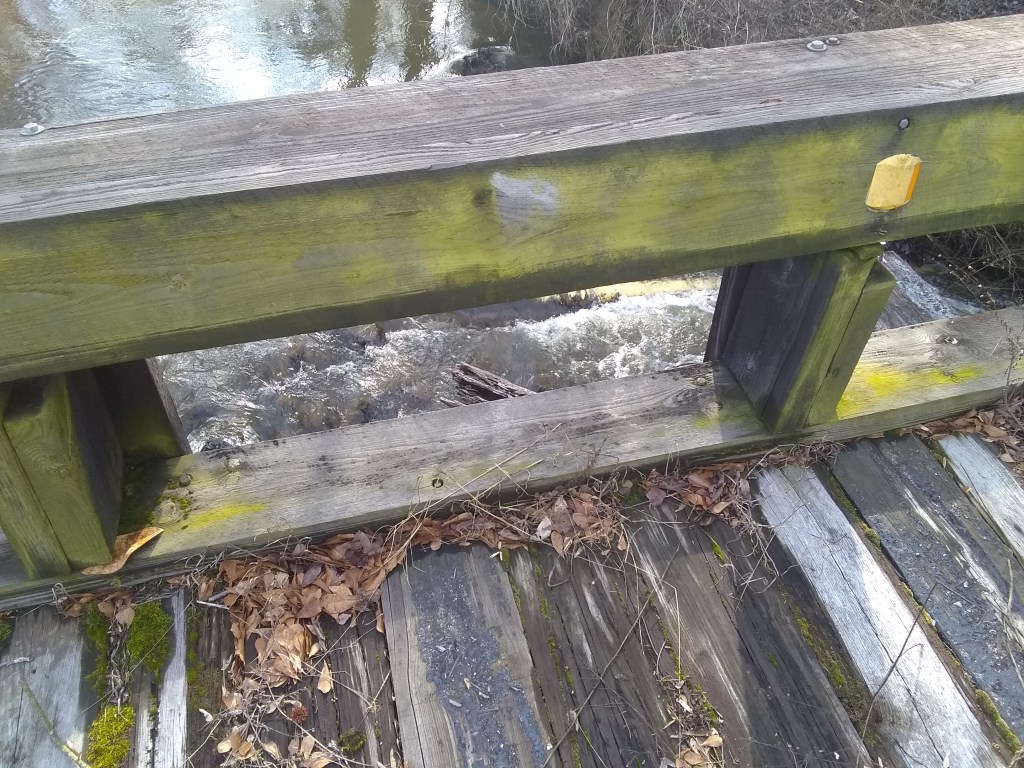
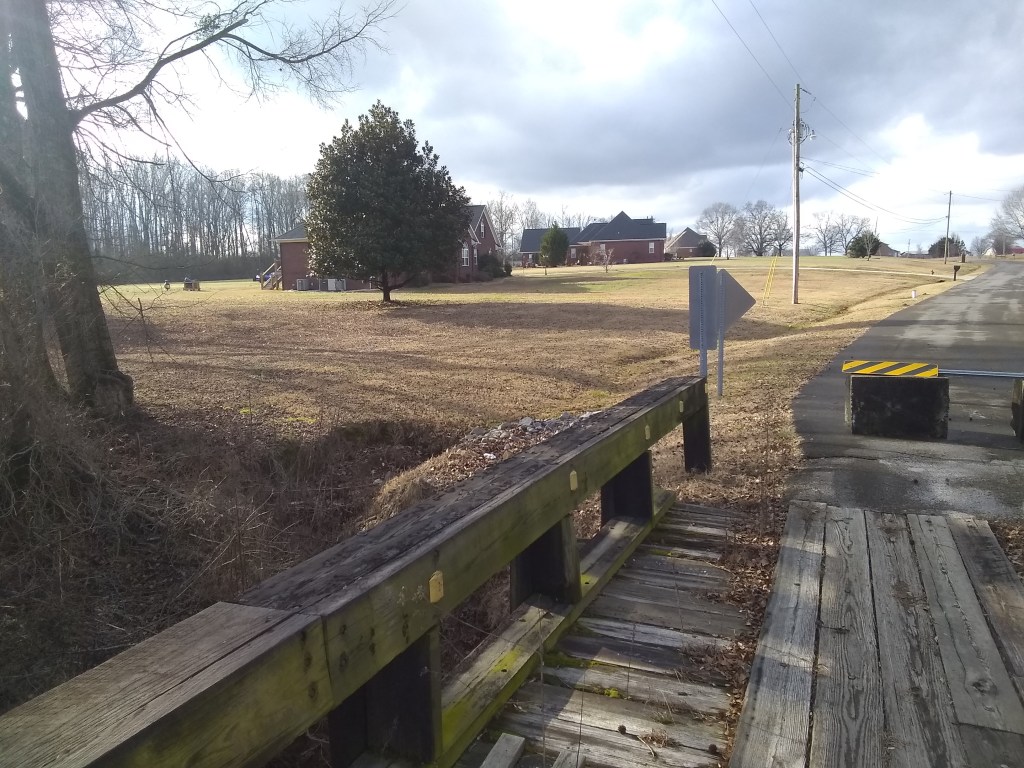
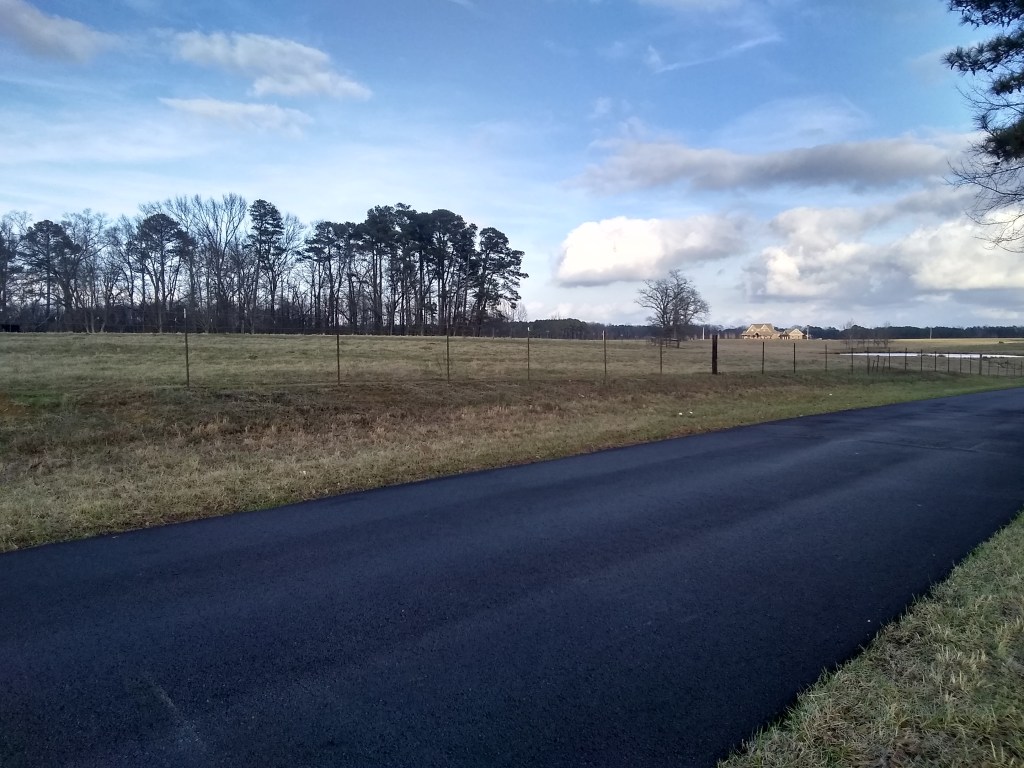
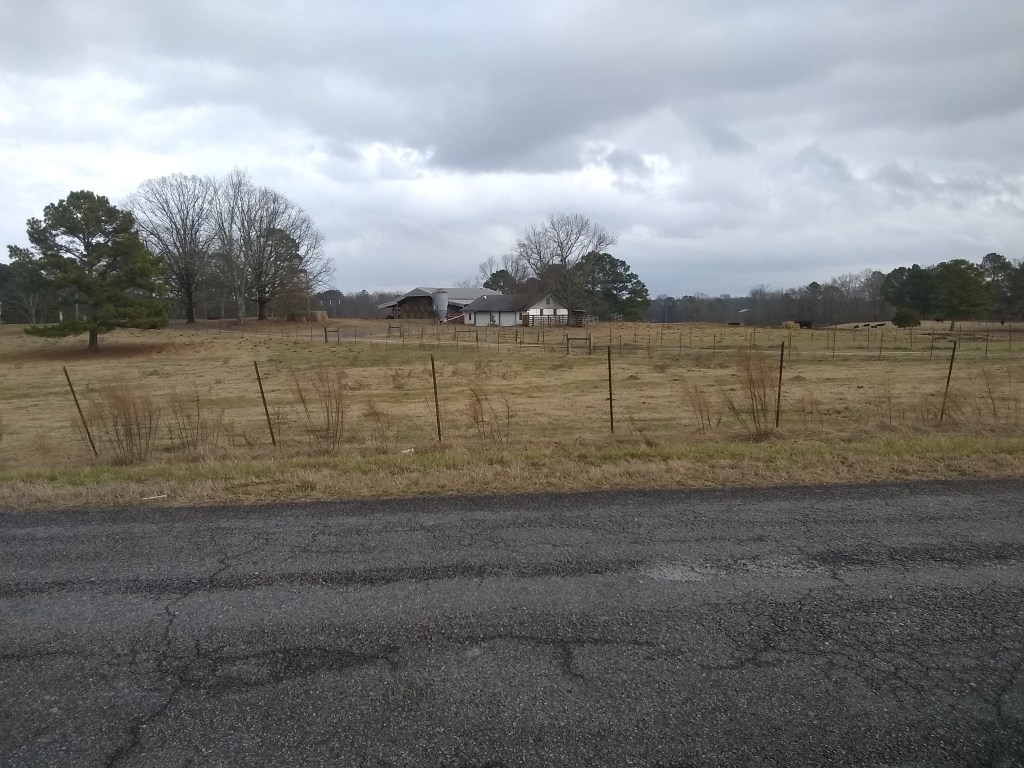
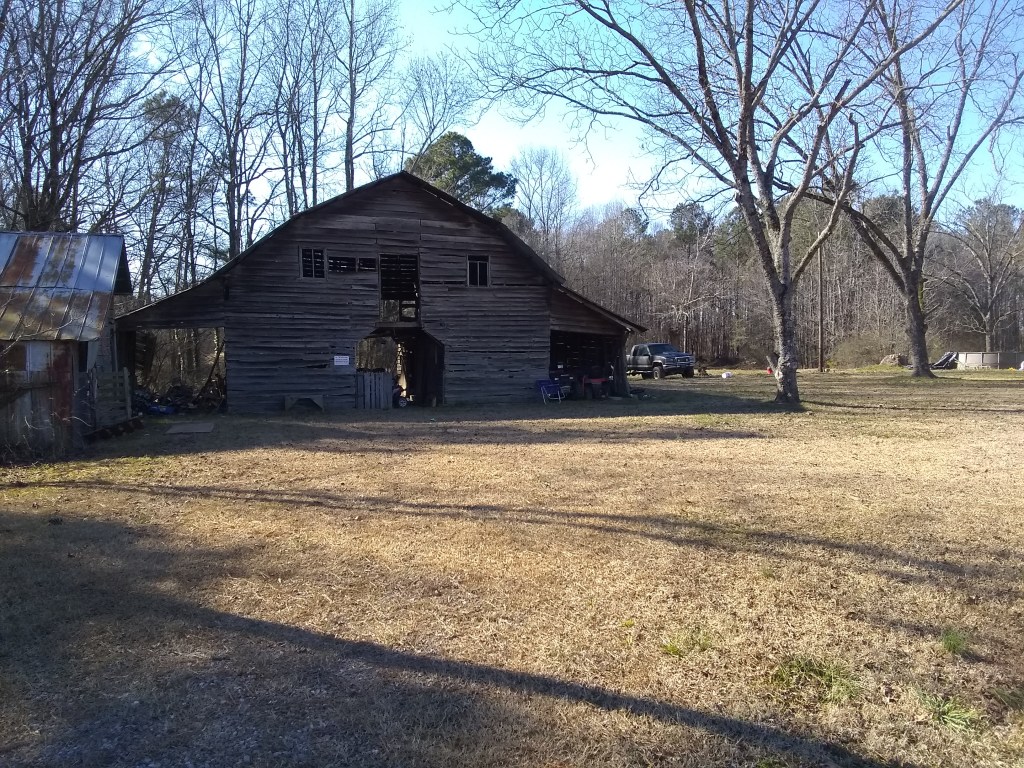
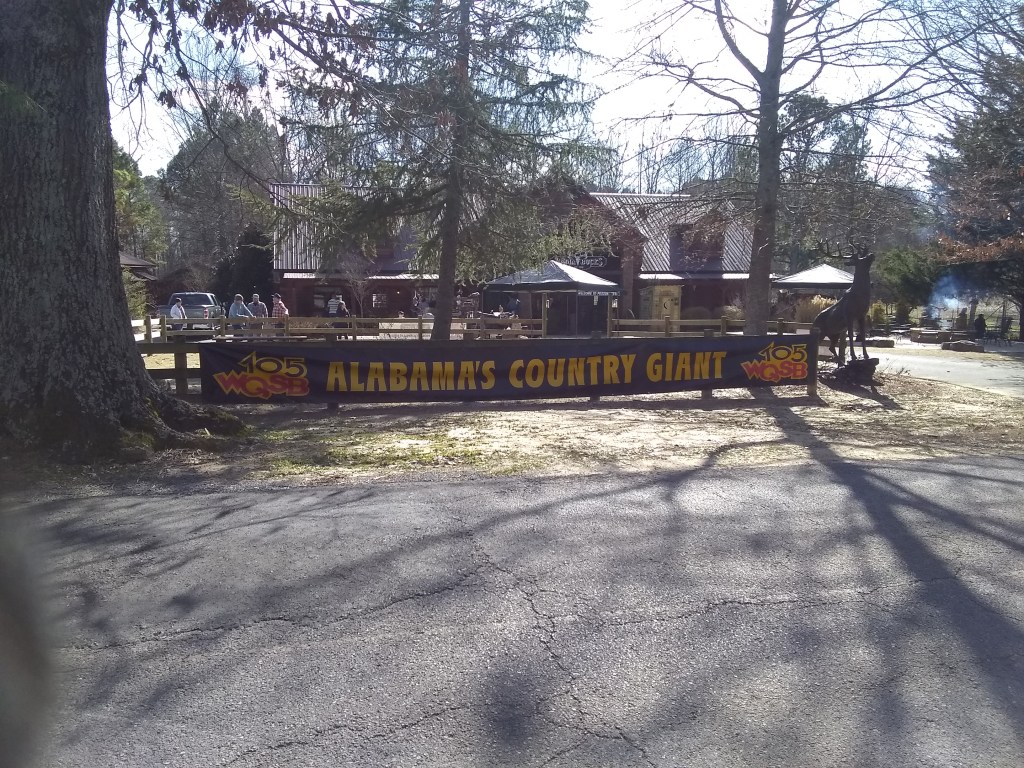
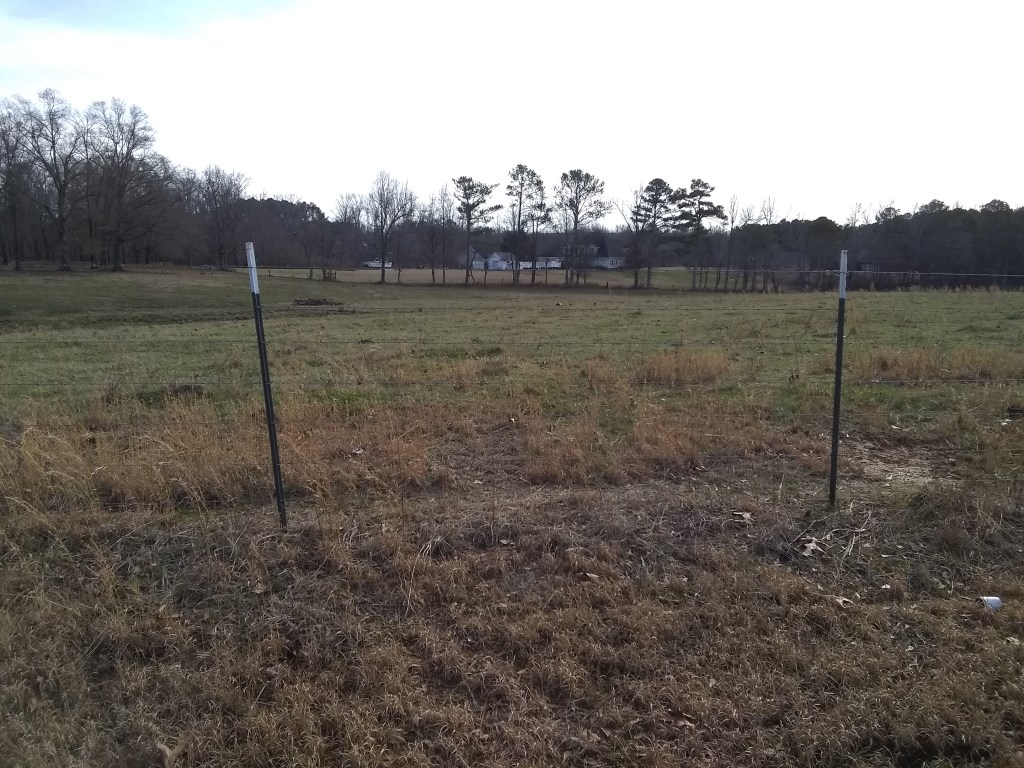
Here’s a few photos taken along my route:

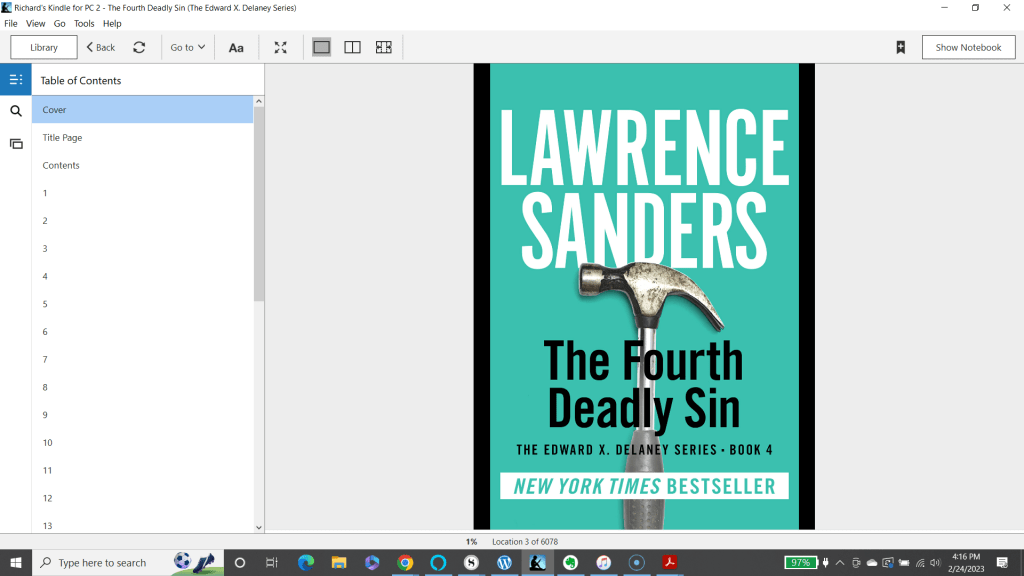
Here’s what I’m currently listening to: The Fourth Deadly Sin, by Lawrence Sanders

Sanders was a tremendously talented writer.

Amazon abstract:

When a Manhattan psychiatrist is murdered, a retired detective returns to the job, in a thriller by the #1 New York Times–bestselling “master of suspense” (The Washington Post).

On a rainy November night, Dr. Simon Ellerbee stares out the window of his Upper East Side psychiatry office, miserably wishing he could seek counseling for the problems in his seemingly perfect life. He hears the door buzzer and goes to answer it, but flinches when he sees his unexpected guest. Minutes later, he’s dead, his skull crushed by repeated blows from a ball-peen hammer. Once the doctor was down, the killer turned over the body and smashed in Ellerbee’s eyes.  With no leads and a case getting colder by the hour, the New York Police Department calls in former chief Edward Delaney. His search for the truth raises more questions than answers: Who had Ellerbee let into his office? Why were there two sets of wet footprints on the carpeting of the doctor’s townhouse? What caused Ellerbee’s odd personality transformation over the past year? And who murdered, then symbolically mutilated, the prominent Manhattan psychiatrist?

A Sample Five Star Review

Errol Mortland

5.0 out of 5 stars The Best Bubble Gum Ever!

Reviewed in the United States on August 6, 2017

If you’re tired of streaming or cleaning for the moment and need to pass some time, you won’t go wrong with the four Deadly Sins series from Lawrence Sanders. I zip through all of them every other year, in sequence. They’re great reads, and I’ve always pictured George C. Scott as Edward X. Delaney (Frank Sinatra in the movie version of the First in pretty insipid, but apparently he owned the rights).

The Fourth is the murder is Dr Simon Ellerbee, you get the usual palette of suspects, and retired Chief of Detectives gets his crew and does his stuff. If Hemingway wrote crime suspense set in NYC, it’d be like this. I love short descriptive sentences. Not sure I recall seeing “ears like slabs of veal” in this one. If you love New York, Mr Sanders captures its essence like a great musical conductor. The “Sins” series is the best, followed by the “Commandments.” The Arch McNally stuff which followed that is okay, even though they kept the series going after Mr Sanders died in 1998. I just find that disrespectful. I only regret there wasn’t a Fifth Deadly Sin.

Writing Journal—Monday writing prompt

Your protagonist is shopping in the narrow aisles of a dusty bookstore when an old door catches his eye. It’s blocked by piles of books and clearly isn’t meant for customer use. But something on the other side calls to him, and before he can think about what he’s doing, he’s twisting the knob. What does he find on the other side? 

One Stop for Writers

Guidance & Tips

Write the scene of discovery (i.e., tell a story), or brainstorm and create a list of related ideas.

Here’s five story elements to consider:

  • Character
  • Setting
  • Plot
  • Conflict
  • Resolution

Never forget, writing is a process. The first draft is always a mess.

The first draft of anything is shit.

Ernest Hemingway

03/05/23 Biking & Listening

Biking is something else I both love and hate. It takes a lot of effort but does provide good exercise and most days over an hour to listen to a good book or podcast. I especially like having ridden.

Here’s my bike, a Rockhopper by Specialized. I purchased it November 2021 from Venture Out in Guntersville; Mike is top notch! So is the bike, and the ‘old’ man seat I salvaged from an old Walmart bike.

Here’s a link to today’s bike ride. This is my pistol ride.

Here’s a few photos taken along my route:

Here’s what I’m currently listening to: The Fourth Deadly Sin, by Lawrence Sanders

Sanders was a tremendously talented writer.

Amazon abstract:

When a Manhattan psychiatrist is murdered, a retired detective returns to the job, in a thriller by the #1 New York Times–bestselling “master of suspense” (The Washington Post).

On a rainy November night, Dr. Simon Ellerbee stares out the window of his Upper East Side psychiatry office, miserably wishing he could seek counseling for the problems in his seemingly perfect life. He hears the door buzzer and goes to answer it, but flinches when he sees his unexpected guest. Minutes later, he’s dead, his skull crushed by repeated blows from a ball-peen hammer. Once the doctor was down, the killer turned over the body and smashed in Ellerbee’s eyes.  With no leads and a case getting colder by the hour, the New York Police Department calls in former chief Edward Delaney. His search for the truth raises more questions than answers: Who had Ellerbee let into his office? Why were there two sets of wet footprints on the carpeting of the doctor’s townhouse? What caused Ellerbee’s odd personality transformation over the past year? And who murdered, then symbolically mutilated, the prominent Manhattan psychiatrist?

A Sample Five Star Review

Errol Mortland

5.0 out of 5 stars The Best Bubble Gum Ever!

Reviewed in the United States on August 6, 2017

If you’re tired of streaming or cleaning for the moment and need to pass some time, you won’t go wrong with the four Deadly Sins series from Lawrence Sanders. I zip through all of them every other year, in sequence. They’re great reads, and I’ve always pictured George C. Scott as Edward X. Delaney (Frank Sinatra in the movie version of the First in pretty insipid, but apparently he owned the rights).

The Fourth is the murder is Dr Simon Ellerbee, you get the usual palette of suspects, and retired Chief of Detectives gets his crew and does his stuff. If Hemingway wrote crime suspense set in NYC, it’d be like this. I love short descriptive sentences. Not sure I recall seeing “ears like slabs of veal” in this one. If you love New York, Mr Sanders captures its essence like a great musical conductor. The “Sins” series is the best, followed by the “Commandments.” The Arch McNally stuff which followed that is okay, even though they kept the series going after Mr Sanders died in 1998. I just find that disrespectful. I only regret there wasn’t a Fifth Deadly Sin.

Drafting–Hearing on District Attorney’s motion to revoke Colton & Sandy’s bonds

“The court calls The State of Illinois vs. Colton Lee Atwood.” The bailiff announced with a deep voice, scanning the courtroom, and registering four people present other than himself, the judge, and the court reporter. Three of the four were attorneys, two sitting to his right at the defense table, the other was the assistant district attorney, looming large at the prosecutor’s table to his left. The fourth was Andrew Spivey in the galley, the Chicago Tribune reporter who was always present for the criminal motions docket.

The bailiff handed the court file to the judge who started slowly reading the incident and offense reports, and the indictment.

Assistant District Attorney George Hooks stood from the prosecutor’s table. “Your honor, the State asks this case and the case of State of Illinois vs. J. Sanford Brown be heard together. They’re companion cases and are both set for today on the State’s motions to revoke bond. And, as the file indicates, Judge Stewart granted my office’s joinder motion.” Hooks was a giant, six foot seven, and had played center for the national champion Kentucky Wildcats in the late nineties; his weight now approached three-hundred pounds. His bald head, long neck, and appetite for devouring defendants, most of whom suffer from the delusion they are still alive, had earned him the nickname, the vulture. His eighty-six inch wingspan and octupus-like fingers intimidated the toughest defense attorney, not only when standing next to him before the bench, but also by teasing their heads with the metaphorical thought Hooks could secretly reach inside the inner pages of their files and strategies.

“I’ll allow it.” Judge Joe Rhodes, a thick man with a mass of thick gray curls hanging to his shoulders and concealing much of his face, was sitting on his perch fiddling with his glasses, and sucking on an unlit cigar.

The court reporter handed the Brown file to the bailiff who handed it to the judge.

Defense attorney Cliff Blackwell leaned toward Sandy’s attorney, Patrick Meyers, and whispered. “Where in hell are these bastards?” Earlier today, both defense attorneys had attempted to call their clients to remind them their appearance in court this morning was mandatory. The two calls had gone to voicemail. And, late Saturday afternoon, and three times yesterday, Blackwell had dialed Millie Anderson’s cell. These calls too had gone to voicemail. He had wanted her in court as a backup strategy, knowing she was the key to Atwood’s hope of surviving the indictment but also knowing that revealing her as an alibi at this stage would take away the benefit of surprise she would be at the actual trial, and give ADA Hooks and his investigative team ample time to microscopically inspect the truth or falseness of Millie’s statement.

The judge looked toward the defense table and saw two familiar faces, but not the defendants. Quickly, he asked the bailiff to summon the court clerk from her office, who, after appearing, assured the judge written notices had been mailed to both defendant’s. He dismissed her and said, “Mr. Hooks, I see we’re here today on your motion to revoke bond. What say you?” Rhodes was newly appointed and had spent the prior twenty-years as a prosecutor, often trying cases in this very courtroom.

Hooks stood. “Your Honor, it should be clear why the defendants aren’t here this morning. They know they’ve been skating on thin ice every since Judge Stewart granted their bond for $50,000. With no disrespect for your predecessor, the horror of these crimes mandates one response: jail, without bail.” Hooks paused, not wanting to get long-winded without Judge Rhoades permission.

The judge inhaled a long draw of his unlit cigar. “Continue.”

Hooks glanced at the defense table and then back to Judge Rhoades. “The defendants kidnapped and raped two University of Chicago students, and in an effort to destroy evidence torched the young ladies’ home. One victim, Ms. Ellen Heppner, died in the fire. The other, Ms. Gina Patton, barely escaped and still suffers greatly, including having to quit school. She’s now undergoing deep therapy and living with her parents. We ask this court to revoke the defendants’ bond and incarcerate them until trial.” The ADA sat, then quickly re-stood. “One final thing your honor, our investigation has revealed that defendant Atwood has on more than one occasion, one within the past six weeks, physically abused the woman he lives with. Plus, she has a twelve-year-old daughter living in the same household. The State contends Atwood is a threat to not only to his girlfriend, Ms. Millie Anderson, and her daughter, but potentially to Ms. Patton herself since her testimony is critical to this case. Thank you your honor.”

Attorney Meyers continued to doodle on his yellow legal pad, thankful Blackwell had agreed to take the lead and speak on behalf of both defendants. It was good Colton hadn’t confessed, unlike Sandy. “I’m limited in what I can say on my client’s behalf,” is all Meyers had relayed to Blackwell when they’d received copies of the State’s motion to revoke bond. Now, drawing a hangman’s noose, he swore to himself he would never accept another murder case. And, it wasn’t for lack of financial resources. Both Sandy and his sister had signed promissory notes, and pledged their grandfather’s estate as collateral. Plus, the sister had paid twenty thousand dollars toward the fifty-thousand retainer. Meyers problem was the approaching storm. Blackwell was a good friend but that didn’t dissipate the duty to represent his client. At some point, Meyers knew he had to negotiate a deal on behalf of Brown. This meant offering Brown’s testimony of Colton’s guilt in exchange for a lesser sentence. This would have been so much easier if Brown hadn’t described in detail what had gone that horrible night. It would have been easier if he hadn’t revealed that he and Colton had no alibi, that he was forcing Millie Anderson to testify falsely. Meyers drew a larger noose underneath the small one at the top of the page, wondering if his client and Colton were now on the run, and, for the second time today, wondered if Colton was a physical threat to his client.

“I assume the defendants have something to say.” Judge Rhoades lay his unlit cigar aside and poured himself a cup of coffee from an old green thermos.

Attorney Cliff Blackwell stood, glancing down at the two nooses Meyers had drawn. Blackwell comes from a long line of lawyers. His grandfather had started the firm in 1925. His father had joined the firm in 1954, after Harvard law school, and a two-year stint in the Army. Cliff had become a partner in 1984 after graduating Harvard Law School, clerking at the U.S. Supreme Court, and five years as an FBI agent. “Thank you your Honor. I admit I do not know where the defendants are at the present moment but there are certain things in their favor we do know. First, there isn’t a shred of physical evidence tying my client or Mr. Meyers’ client to the charged crimes. We’re here because of the slender reed of Ms. Patton’s testimony. In that, she admits the perpetrators wore masks. At best, she contends her and Ms. Heffener’s attackers could have been the men they partied with at Mitchell’s Tab. As to Mr. Hooks’ allegation my client has abused his girlfriend, unsurprisingly, there’s no evidence for that either, no police reports, no eyewitness testimony. Further, the defendant’s are both gainfully employed and have deep ties to the community, both having lived in Chicago all their lives. They have no reason to avoid the workings of this court. In the event this Court grants the State’s motion I would ask on behalf of both defendants that it be a conditional order, that Mr. Meyers and I be given ten business days to present them to this court, and, in that event, the Court would void it’s order. Finally, Mr. Meyers and I need easy and frequent access to our clients to assist in the preparation of their defense. Thank you your Honor.”

Judge Rhoades used both hands to push back his gray curls from his narrow face. “Let’s take a fifteen minute break while I ponder my ruling.” The three attorneys stood while the judge and the court reporter retreated to chambers. Blackwell and Meyers stared at each other and shook their heads, knowing what was coming. ADA Hooks turned and raced outside the courtroom with iPhone to his ear, and motioning Reporter Spivey to join him.

After the courtroom emptied, Meyers decided there would be no better time than the present to tell Blackwell what he’d decided. “Cliff, I have no choice but to file a motion to sever.” Severance is a legal term and is used to separate defendants, giving them each their own trial, their own jury, their own opportunity to defend themselves without appearing as one with their co-defendant. For one less guilty, it provides a way to remove the taint of association with one more likely to be convicted.

Cliff took the news better than Patrick imagined. “Do what you got to do. As you know, my client has an alibi, he has never wavered from that.” Cliff personally believed his client had lied to him but since he didn’t have contradictory proof, he had a legal obligation to go forward with his client’s set of facts. “And, don’t worry about cutting a deal with the vulpine Hooks. Just remember, I’ll cross-examine your client if he testifies against mine.”

Meyers sat, picked up his pencil, and started writing something on his legal pad. “Vulpine?” How do you spell that. Blackwell responded, saying the letters slowly. “Never heard that word. What does it mean?”

“Relates to a fox. In our context, it means Hooks is clever, cunning, shrewd, wily. You know, wily as a fox.”

Just then Judge Rhoades, his court reporter, and the bailiff rushed back into the courtroom from chambers. Patrick joined Cliff in standing. “I have a family emergency so let’s make this quick. Where’s Hooks?”

It took less than a minute for the bailiff to retrieve Hooks from the hallway. “Sorry, your honor.” Cliff sighed to himself, and whispered, “the bastard is always sucking up to the judge.”

“Gentlemen, I’ve made my ruling. I hereby revoke the defendants’ bond and order warrants for their immediate arrest. They will be incarcerated until trial.” The bailiff walked up the steps toward the judge and handed him a note. He paused and read for ten seconds. “I have an update. The clerk has sent word that neither defendant showed for work today. But, I will say this. If either defense attorney can provide me a justifiable reason his client could not be here, for example, they were in a car wreck with injuries and taken to the hospital, I will rescind my order, at least temporarily. Now, I have to go. This hearing is adjourned.”

Cliff replayed in his head what the judge had just said. He couldn’t make sense of it. If good cause for not appearing was presented why not rescind the revocation order entirely. The only thing Cliff could figure was the judge believed the defendants were dangerous and belonged in jail. The damn judge was simply trying to placate, trying to appear fair to both sides. To Cliff, nothing was further from the truth. Judge Rhoades was a diehard pro-prosecution judge.

Reporter Spivey followed ADA Hooks outside the George N. Leighton Criminal Court Building. “Mr. Hooks, may I have a quick word?” The ADA was in a hurry to return to his office to meet with Todd Lacey his chief investigator.

“You have as long as it takes for me to hail a cab.” Hooks hated driving, always preferring to work on cases, either reading files or talking on his cell with investigators, witnesses, and associates.

Spivey stood beside Hooks on South California Avenue feeling like a midget. Although he was a little over six feet tall himself, the ADA’s height and heft flooded his mind with a wave of weakness. “Let’s deal. I get the inside scoop on the Atwood & Brown case and I’ll keep you up-to-date on Millie Anderson.”
“Who?” Hooks temporarily forgot the name of Defendant Atwood’s girlfriend.
“I guess you know she’s left town.” Spivey had interviewed Sandy Brown shortly after the indictments were released. He’d let it slip that he and Atwood had an alibi.

“How the hell do you know that?” Hooks waved a long arm toward a passing cab. To no avail.

“I’ve been stalking her. Legally. My sources say she was seen last Friday morning, along with her daughter, heading east on I-90. Plus, I’ve verified she wasn’t at work that day, nor has she been seen coming or going from her house on Princeton Avenue since early Friday morning. I suspect there’s a story there.”

A cab stopped and Hooks opened the door. Before contorting his huge frame into the back seat he looked down at Spivey. “You got a deal but I warn you. No bullshit.”

As the cab drove away, the reporter clinched his right hand into a fist and quickly pulled it to his side. “Yes.”

Life after Death: Examining the Evidence by D. Victor J. Stenger

I recently read the above-titled essay in The End of Christianity (here’s the link to the book on Amazon).

Here’s the book’s Amazon abstract: In this successor to his critically acclaimed anthology, The Christian Delusion: Why Faith Fails, a former minister and now leading atheist spokesperson has assembled a stellar group of respected scholars to continue the critique of Christianity begun in the first volume. Contributors include Victor Stenger, Robert Price, Hector Avalos, Richard Carrier, Keith Parsons, David Eller, and Taner Edis. Loftus is also the author of the best-selling Why I Became an Atheist: A Former Preacher Rejects Christianity. Taken together, the Loftus trilogy poses formidable challenges to claims for the rationality of the Christian faith. Anyone with an interest in the philosophy of religion will find this compilation to be intellectually stimulating and deeply thought provoking.

Here’s how Stenger’s essay begins:

INTRODUCTION

Dinesh D’Souza is a well-known right-wing policy analyst and author who recently has taken on the role of Christian apologist. He has a degree in English from Dartmouth. From 1985 to 1987, he was editor of Policy Review, a conservative journal published by the Heritage Foundation, now part of the Hoover Institution. He served as a policy adviser to the Reagan administration until 1988 and followed this with stints as a fellow for the American Enterprise Institute and the Hoover Institution. D’Souza has summed up the cause of Christianity with books, speeches, and high-profile debates with famous atheists such as Christopher Hitchens, Daniel Dennett, Peter Singer, Michael Shermer, Dan Barker, and John Loftus. His recent books include What’s So Great About Christianity1 and—the primary reference for this essay—Life After Death: The Evidence? In Life After Death, D’Souza insists that he is making the case for an afterlife purely on the basis of science and reason and not relying on any spooky stuff. He promises “no ghosts, no levitations, no exorcisms, no mediums, no conversations with the dead” and a case that “is entirely based on reasoned argument and mainstream scholarship.”3 Although he does not always stick to this promise, he does give a good summary of arguments for life after death, some of which I had not heard before. So the book provides a framework from which to discuss both evidentiary claims and claims that rely more on extrapolations from observed facts. D’Souza revels in his role as a “Christian cage fighter,” challenging “the honest and thoughtful atheist to consider the possibility of being wrong, and…open his mind to persuasion by rational argument.”4 I am perfectly happy to accept that challenge. Life after death can be identified with the ancient notion that the human mind is not purely a manifestation of material forces in the brain but has a separate, immaterial component called the soul that survives the death of the brain along with the rest of the body. This is a hypothesis that can be scientifically tested. Evidence for its validity could be provided by a verifiable glimpse of a world beyond obtained while communicating with the dead or during a religious experience. All the believer claiming such knowledge has to do is provide some knowledge that neither she nor anyone else could have previously known and have that information later confirmed. Let us investigate whether such evidence has been produced.


Hopefully, it’s obvious that my purpose here is to whet your appetite to dig deeper into this/these subjects, which means to ‘read-to-death’ any false positions you may hold.

How to Survive Hopelessness

Here’s the link to this article. Definitely worth your time!

“You can expect good and bad luck, but good or bad judgment is your prerogative.”

BY MARIA POPOVA

How to Survive Hopelessness

Dougal Robertson (January 29, 1924–September 22, 1991) was still a teenager, the youngest of a Scottish music teacher’s eight children, when he joined the British Merchant Navy. After a Japanese attack on a steamship during WWII killed his wife and young son, he left the navy and moved to Hong Kong, where he eventually met and married a nurse.

Together, they began a new life as dairy farmers in the English countryside, on a farm without electricity or running water. Eventually, they had a daughter, then a son, then a pair of twins.

After nearly two decades on the farm, the family had an unorthodox idea for how to best educate their children, how to show them what a vast and wondrous place the world is, full of all kinds of different people and all kinds of different ways of living: They sold everything they had, bought a schooner, and set out to sail around the world, departing on January 27, 1971.

The Robertson family

After more than a year at sea, just as they were rounding the tip of South America to begin their Pacific crossing, killer whales attacked the schooner 200 miles off the coast of Galapagos, sinking it in less than a minute. They piled into the inflatable life-raft, managed to grab a piece of sail from the water, and rigged it to the 9-foot dinghy they had on board to use it as a tugboat for the raft now housing six human beings.

Suddenly, they were a tiny speck in Earth’s largest ocean, enveloped by the vast open emptiness of infinite horizons. With no nautical instruments or charts, powered only by their makeshift sail, they had no hope of reaching land. Their only chance was rescue by a passing vessel. Given the immensity of the Pacific Ocean, it was an improbability bordering on a miracle.

The Great Wave off Kanagawa by Japanese artist Hokusai, 1831. (Available as a print and as a face mask, benefitting The Nature Conservancy.)

Seventeen days into their life as castaways, the raft deflated. All they had now was the narrow fiberglass dinghy, its rim barely above the water’s edge with all the human cargo.

By that blind resilience life has of resisting non-life, they persisted, eating turtle meat and sweet flying fish that landed in the bottom of the boat, drinking rainwater and turtle blood. Storms lashed them. Whales menaced them. Thirst and hunger subsumed them. Their bodies were covered in salt-water sores. Enormous ships passed within sight, missing their cries for help. But they pressed on, hoping against hope, toiling in every conceivable way to keep the spark of life aflame.

After 37 days as castaways, chance smiled upon them — a Japanese fishing boat spotted their distress flare and came to their rescue. Their tongues were so swollen from dehydration that they could hardly thank their saviors.

Restaging of the rescue, demonstrating how the family fit inside the dinghy.

Throughout it all, Dougal kept a journal in case they lived — an act itself emblematic of that touching and tenacious optimism by which they survived. He later drew on it to publish an account of the experience, then distilled his learnings in Sea Survival: A Manual (public library).

Nested amid the rigorously practical advice is a poetic sentiment that applies not only to survival at sea but to life itself — a soulful prescription for what it takes to live through those most trying periods when you feel like a castaway from life, beyond the reach of salvation, depleted of hope.

He writes:

I have no words to offer which may comfort the reader who is also a castaway, except that rescue may come at any time but not necessarily when you expect it; and that even if you give up hope, you must never give up trying, for, as the result of your efforts, hope may well return and with justification.

Echoing Einstein’s views on free will and personal responsibility, he adds:

You can expect good and bad luck, but good or bad judgment is your prerogative, as is good or bad management.

This simple advice reads like a Zen koan, to be rolled around the palate of the mind, releasing richer and richer meaning, deeper and deeper assurance each time.

Complement with John Steinbeck on the true meaning and purpose of hope, Jane Goodall on its deepest wellspring, and some thoughts on hope and the remedy for despair from Nick Cave and Gabriel Marcel, then zoom out to the civilizational scale and revisit Road to Survival — that wonderful packet of wisdom on resilience from the forgotten visionary who shaped the modern environmental movement.

Thanks, Nina