03/09/23 Biking & Listening

Biking is something else I both love and hate. It takes a lot of effort but does provide good exercise and most days over an hour to listen to a good book or podcast. I especially like having ridden.

Here’s my bike, a Rockhopper by Specialized. I purchased it November 2021 from Venture Out in Guntersville; Mike is top notch! So is the bike, and the ‘old’ man seat I salvaged from an old Walmart bike.

Here’s a link to today’s bike ride. This is my pistol ride.

Here’s a few photos taken along my route:

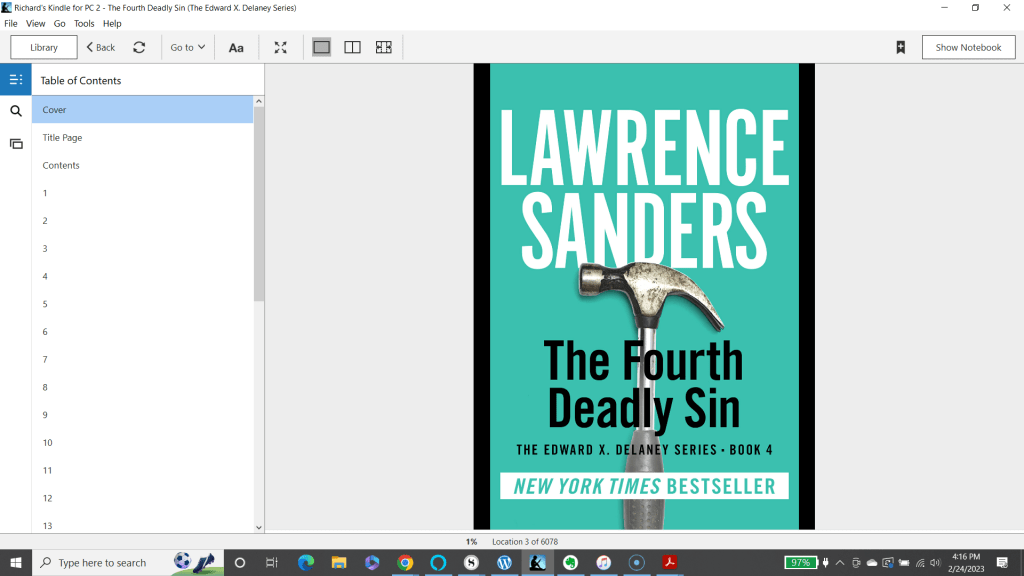
Here’s what I’m currently listening to: McNally’s Secret, by Lawrence Sanders

He was a tremendously talented writer.

Amazon abstract:

First in the series starring the sleuthing Palm Beach playboy from the #1 New York Times–bestselling and Edgar Award–winning author.
 Inveterate playboy Archy McNally gets paid to make discreet inquiries for Palm Beach’s power elite. But keeping their dirty little secrets buried will take some fancy footwork in McNally’s latest case. A block of priceless 1918 US airmail stamps has gone missing from a high-society matron’s wall safe. Lady Cynthia Horowitz, now on her sixth husband, is a nasty piece of work who lives in a mansion that looks like Gone With the Wind’s Tara transplanted to southern Florida. McNally’s search takes him into a thickening maze of sex, lies, scandal, and blackmail. When passion erupts into murder and McNally must dig even deeper to uncover the truth, he unearths a shocking secret that could expose his own family’s skeletons.  

Top reviews from the United States

Linda G. Shelnutt

5.0 out of 5 stars Cure Cultural Volcanics with Bubbling Champagne. Design Life To Suit Taste & Times.

Reviewed in the United States on May 21, 2006

Verified Purchase

This book didn’t merely capture my reading interest. It became a book of my heart…

In McNally’s SECRET, the pilot to this series, we’re informed that the pater McNally is not an “old-money” man. Okay. I get that and I like it. (That’s not the secret.)

Having reviewed 4 of the original 7 McNally books by Lawrence Sanders, I had accepted the face value (not realizing the facade) of the Palm Beach mansion and the genteel lifestyle of pater Prescott McNally, Yale graduate, leather-bound-Dickens-reading, attorney-at-law. Upon reading (in McNally’s Secret) the illuminating passages of Archy’s grandparent’s ways into money, I began to wonder what other Secrets this novel might expose.

Usually, if possible, I prefer to read a series in order, pilot first. I can’t explain why, but, in this case I’m glad I read 4 of the original 7 McNally’s prior to reading SECRET (though I believe this series can be satisfyingly read in any order).

The opening of this novel was classic, and felt to be the initiation of what Sanders was born and itching to write, beyond the sagas of his other fine works. The introductory remarks were exquisite in mapping the reasons for, “Can’t you ever be serious, Archy?” I’d love to quote that paragraph, but maybe I should allow you to read it with the book in hand. I will quote a few other passages, however, which might serve as appropriate appetizers to this banquet of a book.

Comparing himself to S. Holmes, Archy says:

“I can’t glance at a man and immediately know he’s left-handed, constipated, has a red-headed wife, and slices lox for a living. I do investigations a fact at a time. Eventually they add up – I hope. I’m very big on hope.”

Archy’s description of the start up of the Pelican Club were the best type of soul food. This is how and why such a club should be started (then survive through a near hit of Chapter 7). Of course you really should read the book to get the whole of that brief history, but here’s a prime paring:

“We were facing Chapter 7 when we had the great good fortune to hire the Pettibones, an African-American family who had been living in one of the gamier neighborhoods of West Palm Beach and wanted out.”

They “wanted out” and they deserved a chance where their skills could and would save not only themselves, but those who hired them. Isn’t that the type of win/win the world needs now?

I almost sobbed at the below passage, I felt such a deep surge of “right on” (definitely did a breath-catch hiccup and heart moan):

“… we formed a six-piece jazz combo (I played tenor kazoo), and we were delighted to perform, without fee, at public functions and nursing homes. A Palm Beach critic wrote of one of our recitals, `Words fail me.’ You couldn’t ask for a better review than that.”

Yep. This is a book of my heart. Words don’t often fail me in reviews; too much the contrary. But I’m getting better at refraining from using my critic hat with a steel-studded-bat accessory, which is what Archy was getting at.

Some might wonder why a person in my position, with my un-hidden agendas, would take so much time to write raves on a series by a deceased author. Mostly, I love Archy. But, possibly the live spirits of the dead are sometimes more able to be helpful than dead souls of the living? Keeping my tongue in cheek, I might add that freed spirits probably have better connections for helping an author into the right publishing contacts for a character series with ironic assonance with this one.

Moving quickly onward and upward, though not with wings attached yet…

In contrast to the other 4 I’ve read, I noticed that this Archy is less bubbly-buffoonish (though the buffoon is always endearing) and slightly more serious, sensitive, and quietly contemplative. I like both versions of Archy, though I prefer the slight edge of peaceful acquiescence in the pilot, and I can’t help but wonder, as I do with all series, how much reader feedback, and editor/agents’ interpretation of it, directed the progression of balance of certain appealing or potentially irritating qualities. I wonder how each series would have progressed if the feedback had been balanced and pure (as a species, we’re not there yet, but forward motion is perceptible), rather than inevitably polluted by the “life happens” part of the sometimes perverted, capricious tastes of us squeaky wheels, and the healthy ego needs of professionals in positions of swallow and sway.

I’m still trying to understand why honesty is the most appealing human quality to me, yet honest criticism does not speak to my heart, nor to my soul, not even to my head. Often, though, it does speak in perfect pitch to my funny bone. And, of course true Honesty (with the capital “H”) leaps beyond speaking the “truth” as one happens to “see” it on a good or bad day. Cultural honesty, of the type dramatized by Stephen King, Lawrence Sanders, Tamar Myers, Barbara Workinger, Joanne Pence, Sue Grafton, (and others) is what most often pushes me to stand up and cheer.

Somewhere.

One of the best spots I’ve found is on the edge of the clear cliff of ozone found in Amazon’s sacred forum of Customer Reviewers.

Of course the first lines in SECRET, the sipping of champagne from a belly button would snag the attention of even the most sexually skittish reader of the nose-raised, neck-cricked, personality persuasion. But, truly and honestly, what sunk me with every hook were the few lines exposing why Archy could never be serious. I know I said I wouldn’t, but I have to quote this passage, beginning on page 1 chapter 1. For me, it’s one of the main selling points of the series:

“I had lived through dire warnings of nuclear catastrophe, global warming, ozone depletion, universal extinction via cholesterol, and the invasion of killer bees. After a while my juices stopped their panicky surge and I realized I was bored with all these screeched predictions of Armageddon due next Tuesday. It hadn’t happened yet, had it? The old world tottered along, and I was content to totter along with it.”

I’d bet my fortune (which is based on a skill of “make do”; there are no bananas in it) that the above passage is what captured a collection of readers so absolutely in a “right on” agreement that this series spanned the grave of the author and is still spewing pages and stretching shelves. And, of course, this attitude of “if you can’t lick `em; flick `em” which Archy aimed toward “kvetch-ers” as he terms them, continues from the above, with relish accumulating, throughout the book.

Archy is a rare sane person swimming along nicely within the insanity of a last-gasp-culture (which is “drowning in The Be Careful Sea” as I described and termed that syndrome in one of my sci fi manuscripts titled MORNING COMES).

To Jennifer, of the champagne sea in her belly button, Archy answered why he wasn’t an attorney:

“Because I was expelled from Yale Law for not being serious enough. During a concert by the New York Philharmonic I streaked across the stage, naked except for a Richard M. Nixon mask.”

That answer brought to mind the bright side of Howard Roark (from Ayn Rand’s FOUNTAINHEAD, see my review posted 10/14/05) who was arrogantly unconcerned about his and the Dean’s reasons for Roark’s being expelled from architectural school. You’d be right to wonder where I got that comparison, since Roark could never be accused of being anything but serious. Syncopated irony? Assonance?

You be the judge. Get the SECRET of the McNally collection.

As I relished the final chapters and pages of SECRET, I had a thought about the beauty, warmth, lovely literary melancholy, and subtly complex richness radiating from those concluding textual treasures:

In retrospect, this novel doesn’t feel like a planned pilot to a mystery series. It feels to be a singular novel, like but not like, the ones Sanders had written prior to it. What it feels like to me is that Lawrence hit upon a “soul speak” story which couldn’t halt the cultural conversation it had initiated, however serendipitous that initiation may have been.

Yes, I do recall that in some of my other reviews (“reveries” according to my Amazon Friend, L.E. Cantrell) I speculated on something which could seem contradictory to the above mentioned “thought.” I had wondered if Parker’s Senser series might have been somehow a spark for this McNally series. I continued to see references to Boston in this book (as in other McNally’s I’ve reviewed), which, of course, is the city for which Spenser did the Walkabout. So possibly SECRET was somewhat an antithetical homage to Spenser, possibly even a hat “doff” with a friendly, competitive “one-better” attempt, meant only to be a single novel rather than a never-die series.

Based on Agatha Christie’s official web site, Miss Marple was not originally intended to be another Poirot, and look what happened there (see my Listmania of the Miss Marple series).

To me, Archy appears to be a gatekeeper for pure and primal, hidden wishes and dreams. Living home comfortably, guiltlessly at 37, on the top floor of his parent’s mansion in Palm Beach; eating drool-food from a house chef; having established a club like The Pelican as a side atmosphere to partake in daily; working at a cushy, just challenging enough, engaging career for discreet inquiries … If an author’s (or reader’s) going to retire that would be da place (or at least an entertaining option).

It’ll be interesting to see if/how I’m able to bridge the gap from Lawrence Sanders’s Archy to Vincent Lardo’s. I’d love to know how that bridge was built and continues to be maintained.

Though a perfectly acceptable, gorgeous reprint in a mass market paperback was (probably still is) available on Amazon’s Super Saver Special, I felt lucky to find a vender on Amazon (a-bookworm2) holding a used G. P. Putnam’s Sons hardcover of this novel, a first printing of the 1992 copyright. What an honor it will be to have this version of the pilot of such an auspicious series from such a life-perceptive author, Lawrence Sanders. The glossy-black jacket provides a luscious background for the name and title printed in thick, gleaming, copper ink, with the artwork of an antique magnifying glass and fancy-brass scissors weighing down the million-dollar-valued, 1918 US Stamp of the Inverted Jenny.

This pilot is a rare find in a rare series.

Linda G. Shelnutt

Why Religious Experience Cannot Justify Religious Belief

Here’s the link to this article by David Kyle Johnson.

April 30, 2021


(2020)

[This article was originally published in Socio-Historical Examination of Religion and Ministry, Vol. 2, No. 2 (Fall 2020), pp. 26-46.]

As [Paul] was traveling, it happened that he was approaching Damascus, and suddenly a light from heaven flashed around him; and he fell to the ground… (Act 9:3-4, NASB)

In Chapter 9 of their 1999 book, Phantoms in the Brain, entitled “God and the Limbic System,” neuroscientist V. S. Ramachandran and Sandra Blakeslee told the story of a patient named Paul—a Goodwill store assistant manager who has been blessed—or haunted—by intense religious experiences all his life. Ironically, Paul’s experiences mirror, almost exactly, those of his biblical namesake: the Apostle Paul. “I remember seeing a bright light before I fell on the ground and wondering where it came from.”[1] Like the Apostle, Paul’s experiences completely changed his life, and he goes on to write, at great length, about the profundities of religious truths—”an enormous manuscript … [that] set out his views on philosophy, mysticism and religion; the nature of the trinity; the iconography of the star of David; elaborate drawings depicting spiritual themes, strange mystical symbols, and maps.”[2] But unlike the Apostle’s, Paul’s brain can be directly observed by modern science—and we now know what causes his religious experiences: focal seizures in his temporal lobe. Each one coincides with a religious experience and produced in Paul what has come to be known as “temporal lobe personality.”

Similar experiences happen to individuals of every religion, yet they teach those individuals vastly different, even contradictory, things. The Apostle Paul’s experience, for example, taught him that Jesus was the Messiah, the son of God, and (arguably) that he was identical to God himself.[3] Muhammad’s religious experiences, which inspired his writing of the Qur’an, taught him the exact opposite—that Jesus was “no more than a messenger” (Q al-Ma’idah 5:75), that “[i]t is not befitting to (the majesty of) God that He should beget a son” (Q Maryam 19:30-35), and that it would have been blasphemy for Jesus to have claimed to be God (Q al-Ma’idah 5:116-117). Of course, similar disparities among those who have religious experiences abound. A Buddhist’s religious experience will likely teach him that there is no God, no persons, and no afterlife, whereas a Christian’s will teach him that there is a God and if a person worships him properly, one can enter Heaven.

These facts seem to raise serious doubts about the ability of religious experiences to justify religious beliefs, especially for the modern academic theist who is aware of them. Why this is true, however, has not yet been clearly identified. To be sure, many have attempted to argue that these facts do not threaten the justificatory power of religious experience; but those say they do have yet to accurately articulate why.[4] It is the goal of this essay to do so. The author will argue that, at least for those aware of such facts, such as the modern academic theist, the diversity of religious experience and the existence of neurological explanations for religious experience entail that religious experience cannot justify religious belief. First, the author will define and identify the significance of religious experience. Then, the author will argue that the diversity of religious experience establishes its unreliability, rendering its justificatory value moot. Lastly, the author will argue that modern scientific explanations for religious experiences do the same by presenting an alternative and preferable natural explanation of those experiences. The author will do so utilizing two epistemic theories that are prized by theistic philosophers of religion: reliabilism and virtue epistemology.

Defining and Using Religious Experience

Before establishing that religious experience cannot justify religious belief, it is important to define religious experience and the role theists claim it plays in justifying their belief. Religious experiences can be defined as encounters with “the divine” that are ultimately caused by the divine—in which “the divine” is broadly defined to encompass as many religious notions as possible (e.g., the Christian God, the Hindu Brahman, and the Buddhist Void). Some are professed to be visual or auditory experiences not brought about by the ordinary senses; others are simply intellectual realizations (without accompanying experiences). Still others are reactions to worldly stimuli—perhaps an ordinary stimulus (e.g., seeing God in a sunset) or a seemingly miraculous stimulus (e.g., witnessing a faith-healing)—while others are what one might call mystical experiences, which William James said were ineffable (i.e., they cannot be accurately described).[5] Most are likely passive (one cannot will them to occur) and transitive (they only occur for a short period of time). And while most are also noetic (convey insights into deep truths), others may simply consist in what Jonathan Haidt called “uplift” (something one might feel while singing a hymn at church).[6] It is difficult to say more than that but, presumably, that does not matter—because, supposedly, when one has a religious experience, one will know it.[7]

Religious experience has played a significant role in justifying religious belief throughout the history of religion. In addition to the aforementioned role it played in the production of both Christian and Islamic texts, religious experiences appear in Scripture as well: Moses, via his burning bush experience, comes to believe that he should lead the Israelites out of Egypt. Mary and Joseph, via angelic announcement, learn of Jesus’ miraculous conception. The apostles, in Acts 2, after receiving the Holy Spirit, learn how to speak in different languages. Nonbiblical religious experiences include the conversion of C. S. Lewis and the visions of Bernadette Soubirous.[8] The political and historic significance of religious experience also cannot be forgotten. The Roman Emperor Constantine converted to Christianity after a religious experience and tried to influence the entire empire to do likewise. In 2005, George W. Bush told Palestinian ministers that a religious experience inspired him to invade Afghanistan and Iraq.[9]

The role that religious experience plays in justifying religious belief is probably most clearly made by the Christian philosopher Alvin Plantinga. In his 2000 book, Warranted Christian Belief, when articulating his “Aquinas/Calvin (A/C) model,” Plantinga spoke of humans possessing a sixth sense, the sensus divinitatis, which is attuned to the divine. Through it, the Holy Spirit can instigate beliefs in selected believers through what amounts to a religious experience. As an example, Plantinga has spoken of looking upon a mountain vista and coming to believe that it, and the universe, was designed by God.[10] According to Plantinga, such beliefs are “properly basic.” They are justified (even though they are not based on evidence), not because the religious experience provides “evidence” for the belief in question (which it does not), but because it justifies theistic belief in the same way that seeing a tree can justify one’s belief that a tree exists.[11] In fact, most defenses of religious experience’s ability to justify religious belief rely on some kind of “sense of sight” analogy.[12]

The ability of religious experience to justify religious belief is important because many theists (although not all) admit that evidence for God’s existence, and other religious beliefs, can be found nowhere else.[13] The classic arguments for God’s existence, for example, fail. The justification provided by religious experience can also help theists who admit to having no good answer to the evidential problem of evil. Plantinga has even argued that beliefs instigated by religious experience are immune to evidential challenge.[14] But let the reader now consider two arguments that religious experience cannot justify religious belief for the modern academic theist—an inductive argument based on religious diversity and another derived from natural explanations for religious experience.

The Diversity of Religious Experience

The fact that devotees of different religions have religious experiences that lead them to contradictory conclusions seems to threaten the ability of religious experience to provide justification for religious belief. But exactly how this threat should be understood is not straightforward. David Silver articulates it in terms of the individual; the justification that X is true provided by one person’s religious experiences can be nullified by the trustworthy testimony of a friend who also had a religious experience but instead came to believe ~X.[15] But there are a few flaws with his account.

First, it is not clear that even trustworthy testimony can “transfer” the justification provided to someone who has a religious experience to someone else. William James, for example, would argue that the friend’s religious experience can only provide justification for the friend’s religious belief—not the original person’s.[16] So the original person may still have more reason to believe X than ~X and thus not be in the epistemic bind Silver describes. More importantly, Silver’s individualistic account does not seem to fully appreciate the threat posed by the realization that there are millions of epistemically virtuous, morally upstanding people, who belong to other religions and have religious experiences that teach lessons contrary to one another. Lastly, Silver’s argument does not show that religious experience fails to provide justification for religious belief. It just shows that the evidence initially provided by a religious experience can be counteracted by contrary evidence, leaving one in an epistemically neutral position. The problem that arises from the diversity of religious experience, however, seems to entail something more: that religious experience cannot provide justification for religious belief in the first place.

Theistic philosophers, like Plantinga, are fond of reliabilism—the notion that beliefs are justified if they are produced by “reliable processes” (i.e., processes that are trustworthy, that usually lead to true belief). This is why Plantinga, for example, thinks that his religious experiences justify his religious belief—because they were processes instigated by the Holy Spirit, and any such process must be truth-preserving. But the diversity of religious experience calls into question the reliability of religious experience itself.

To understand why, suppose there are only two religions in the world, with half the world’s population belonging to each, and that the religions are mutually exclusive (only one can be true). Suppose also that religious experiences, which tell the experiencer that their religion is true, are had by adherents of both. Since both religions cannot be true, the religious experiences of at least half the world’s population are leading them astray— producing false belief. Consequently, one must conclude that religious experience is not reliable; half of the time, it results in incorrect conclusions. In such a situation, one could not be justified by a religious experience to believe what it suggests is true; it is just as likely, as not, that it is leading the experiencer astray.

The problem, of course, is that the conditions in the real world are even less favorable. There are five major world religions, only one of which can be true, and there is at least one major split in each. So, without adjusting for the popularity of certain religions, religious experience produces wrong belief 90% of the time. And even taking popularity into account, and assuming the best case scenario in which the most adhered to religion (Christianity at 31%) is true, and the generous assumption that Christian religious experiences are uniform, religious experience still leads the experiencer astray two-thirds of the time. That hardly makes it a reliable truth-preserving process.[17] So, since the diversity of religious experience entails that religious experience is not a reliable truth-preserving process, and if it is not it cannot justify religious belief, the diversity of religious experience entails that religious experience cannot justify religious belief.

To respond, one cannot merely claim one’s religious experience is stronger than someone else’s; no one has access to how strong the religious experiences of others are. In fact, the others could simply in turn claim that theirs is stronger—and that leads right back to the same problem.

One might also try to divide religious experience into different kinds, and claim that one kind—one’s own kind—is reliable. Unfortunately, attempts to do so will either beg the question (one cannot claim to know so via one’s religious experience) or undermine the epistemic authority of the kind of religious experience being argued for. For example, if one provides additional evidence for the beliefs produced by a certain kind of religious experience (to show that kind of religious experience reliably leads to true beliefs), then it will be that evidence—not the religious experience—that is doing the justificatory work for the beliefs in question.

Erik Baldwin and Michael Thune, defenders of Silver’s thesis, point out that theists fond of Plantinga’s A/C model are likely to respond to threats posed to the reliability of religious experiences by observing, “If indeed one’s religious experience is reliable, then the belief is still justified.”[18] But, although that conditional is true, it does not help one defend religious experience’s ability to justify religious belief. As already shown, there is good reason to think the antecedent of this conditional is false—and if it is false, there is no good reason to think that religious experience can justify religious belief. Indeed, there is good reason to think that it cannot. Because religious experience leads the experiencer astray at least two-thirds of the time, one knows it is not an accurate determiner of religious truth.

The truth of this conditional does entail that, for any given process that justifies a belief, one does not need to know that process is trustworthy (what Plantinga would call “reliable”) in order for it to justify the belief in question. For example, even if one does not know that one’s faculty of sight is trustworthy—after all, one might be dreaming—if it is indeed trustworthy, then it does in fact reliably produce true belief and thus can justify one’s belief that the world is real (at least according to reliabilism). But if one’s faculty of sight is not in fact untrustworthy—suppose it regularly produces hallucinations—then it cannot justify one’s belief. What’s more, if one has good reason to think that it is untrustworthy (suppose one knows that it produces hallucinations two-thirds of the time), then it certainly cannot justify one’s belief! And in such a situation, pointing out “if it were reliably accurate, it would justify belief” does not change this fact, nor does it make one’s sight-based beliefs justified.

Perhaps one might continue the point further, suggesting: Even though the diversity of religious experience provides evidence that religious experience is untrustworthy, it still might be that one’s religious experience is reliably accurate—maybe one’s religious belief really is instigated by the Holy Spirit—and thus, contrary to the claim of this paper, it is at least possible that religious experience can justify religious belief despite the diversity of religious experience. But this seems patently false. To see why, consider another analogy with sight.

If one has good reason to think their faculty of sight is untrustworthy (perhaps one has good reason to believe one is living in a computer simulation), even if it turns out their sight is accurate (one is, in fact, not in a computer simulation), one’s doubt about the trustworthiness of one’s senses erases any justification that their faculty of sight can provide. In fact, if one has good reason to doubt their sight, one should not believe what it tells them, even if it is telling them the truth. In the same way, even if it turns out that one happens to belong to the one true religion and their religious beliefs were bestowed by God via a religious experience (and they are thus reliable), the diversity of religious experience still gives one good reason to doubt the reliability of the religious experience. Thus, it cannot justify one’s religious belief, and one should not believe what it purports to be true.

If one is unaware of the reasons to question the trustworthiness of religious experience (e.g., the diversity of religious experience) and it also happens that one has the kind of religious experience that is accurate (e.g., an experience caused by God)—in that very special circumstance, religious experience would likely justify religious belief. But this will not help the academic theist (or anyone reading this paper) for they cannot claim such ignorance. Thus, the paper’s thesis still stands.

The other solution to this problem is to look for overlap to thus defend “the unanimity thesis”: Yes, the doctrines supported by religious experience throughout the world’s religions are contradictory, but that is because people interpret their religious experiences through the lens of their culture and religious traditions. A Christian will see Jesus; a Hindu, Brahman. But the “core” of all religious experience is the same: it is an encounter with an indescribable reality (often called “the Real”) which gives rise to feelings of peace and blessedness that tends to make one less selfish. So, while religious experience may be untrustworthy as a means to true belief about specific religious doctrines, it does reliably produce accurate beliefs regarding these “core” elements. So, religious experience can justify those beliefs.

The idea that there is a common core of religious experience has been defended by Peter Byrne, Aldous Huxley, Bertrand Russell, C. D. Broad, and John Hick (just to name a few).[19] Ironically, however, their accounts of this core are largely incompatible. For example, Hick claims that “the Real” is indescribable and incomprehensible by human language and understanding, while Byrne says it can be described and understood by human concepts both negatively and relationally.[20] By itself, this fact seems to refute the unanimity thesis. But even setting such disagreements aside, another problem remains. To sensibly claim that such a core is common amongst those who have religious experiences, the phrases used to describe this supposed “core” are so amorphous and ambiguous that they are meaningless. “A distinction-less reality gave me a feeling of peace and made me less selfish.” This could mean so many different things that two people could have two completely different experiences, which share no core at all, yet describe them in exactly this way.

But even if one is willing to concede that all religious experiences have a common core and justify such beliefs, this paper’s thesis is only slightly weakened. It is still the case that religious experience cannot justify most of the religious beliefs that religious adherents claim they do—beliefs specific to their particular brand of religion. What’s more, the fullest version of the author’s thesis can still be defended because even those defending the unanimity thesis will not be able to avoid the objection of the next section: the problem of natural explanations for religious experience.

Natural Explanation for Religious Experience

Readers saw, in the introduction, a natural explanation for some religious experiences: focal seizures within the temporal lobe. This has actually helped identify the part of the brain responsible for the production of religious experiences. But epilepsy is not the only way one’s temporal lobe can become appropriately stimulated to produce religious experiences. Fasting, illness, meditation, stress, sleeplessness, drugs—even expectation and the right circumstances (e.g., going to church camp) will alter one’s temporal lobe and produce a religious experience. Michael Persinger has even invented a transcranial magnetic stimulator that, when applied to one’s temporal lobe, reportedly produced religious experiences in his test subjects. His device has come to be known as “The God helmet.”

To understand the argument of why potential natural explanations for religious experience reduce their justificatory power, let one consider the case of someone who had a religious experience while wearing the God helmet and subsequently came to believe in the existence of “the Real” based on that experience.[21] Would one say that belief was justified? Of course not. Why? Because in order for it to reliably convey accurate knowledge about the Real, and be genuine, the religious experience must ultimately be caused by the Real. Yet the idea that it was caused by Persinger’s God helmet is a much better explanation (most notably, it is more parsimonious since it does not invoke any extra entities or assumptions) and is, thus, the explanation that a rational person should prefer.

Notice that it will not do to suggest the subject coincidentally happened to have a religious experience that was caused by the Real while wearing the God helmet, and that the God helmet did not play a causal role in producing the religious experience. This is clearly just an unfalsifiable ad hoc excuse to save the religious experience’s justificatory power. Notice also that it will not do to suggest that the Real somehow used the God helmet to produce the religious experience, thus actually being its ultimate cause. Not only is this explanation also ad hoc, and not only is its explanatory power low—because it invokes the inexplicable and raises more questions than it answers—but it also multiplies entities unnecessarily by invoking extra outside influences when none are needed.[22] One need not invoke the Real to explain the experience; the God helmet alone will do. In addition, “the Real” explanation also contradicts known physical laws—like the causal closure of the physical, the conservation of energy, and the conservation of momentum—by having a nonphysical entity interact with the physical world. As Ted Schick, author of How To Think About Weird Things, would undoubtedly point out: The purely natural explanation should be preferred because it is more “adequate.” It has wider “scope” (because it explains more), it is “simpler” (because it requires fewer assumptions and entities), and is more “conservative” (because it does not conflict with established facts).[23] Given that one should conclude that the Real was not involved in the production of the experience, one should conclude that the religious experience was not genuine and thus does not justify the belief it produces.[24]

All this makes abundantly clear why the religious experiences of Paul, the Goodwill store assistant manager, cannot justify religious belief. Since one has good reason to think that religious experiences can be produced by temporal lobe seizures, and one knows that Paul has temporal lobe epilepsy, temporal lobe seizures are the best explanation for the religious experiences he has. Invoking God as an explanation of the seizures would, for the same reasons as above, be a less parsimonious, less wide scoping, and less conservative ad hoc excuse.

But what about religious experiences in other circumstances when one is not wearing the God helmet or does not have temporal lobe epilepsy, so one does not have direct awareness of what is going on inside the experiencer’s brain at the time of the experience? Should one still favor the natural explanation? Of course. Consider someone who has a religious experience of the Real while fasting, meditating, highly stressed, ill, on drugs, or depriving themselves of sleep. For example, when I attended Southern Nazarene University, a chapel speaker once said that, after not eating for two weeks, he saw Jesus walk through a wall and convey divine truths to him. Sure, one cannot directly observe what their brain was doing at the time of the experience, but one can still ask, “What is the best explanation for the cause of their experience?” Has their physical condition altered their brain and produced the experience, or has the Real reached down from the great beyond to teach them a lesson? The latter multiplies entities beyond necessity, raises more questions than it answers, invokes the inexplicable, and is not conservative. The natural explanation, on the other hand, is quite simple, coheres with how the brain works (and malfunctions), and offers a robust explanation. And it will not do well to suggest that God somehow “used” the altered physical state to produce the experience, for the same reason it will not do to suggest that God used Paul’s seizures, or the Real used the God helmet. Clearly the natural explanation should be preferred.

This is true even for the spontaneous religious experience that one has merely in a conducive environment, such as church camp or a church service. Although it is possible that the Real reached down from outside the physical realm to bestow knowledge of its existence, it is still more likely that one’s own expectations and environment overstimulated their temporal lobe or otherwise influenced their brain to cause the experience.[25] The latter explanation should be preferred, and as such, the religious experience in question cannot justify the belief it produces.

Of course, one cannot prove that the religious explanation is false, but that something cannot be proven false is no reason to think it is true. That would be an appeal to ignorance. In the absence of proof, the best explanation should be preferred, and clearly the natural explanation will always be the best since it will always be simpler, have wider scope, and be more conservative. If a religious experience is produced by purely natural means, it is not a genuine religious experience and cannot justify religious belief. So, in short, since the academic theist can likely never be justified in believing that a religious experience is genuine, religious experience can likely never justify their religious belief.

To reinforce this line of reasoning, consider phlogiston—a substance that was once thought to account for heat by flowing in and out of objects as they became hotter and cooler. Once it was discovered that heat is merely a result of the movement of molecules, it became irrational to believe in phlogiston. One could invoke phlogiston to explain the movement of the molecules, but doing so is less simple, less explanatory, not conservative, and the movement of the molecules can be accounted for without it. If one can explain something with less, one should. Likewise, since one can explain religious experiences with less, one should.

Understanding this argument reveals why the most famous attempts to circumvent the problem of natural explanation for religious experience are insufficient. For example, Robert Ellwood argues that identifying the neural correlate of a religious experience cannot establish it is illusory; if it did, then identifying the parts of the brain responsible for visual sensations would force one to conclude that everything one sees is illusory.[26] But the argument that has been presented by this paper does not merely identify a neural correlate of a religious experience. It also identifies the cause of the experience as something else besides what must cause it in order for the experience to be genuine—a seizure, drugs, or the environment. Yes, the realization that visual sensations are correlated with activity in the visual cortex does not give one reason to think that they are illusions; but that is because this realization does not give one reason to think that visual sensations are not ultimately caused by the objects they are reported to be of. If one found out, however, that the most likely ultimate explanation of a visual sensation was something besides the objects one was apparently perceiving—for example, suppose one realized that the best explanation for why one was seeing pink elephants was the work of alcohol on one’s visual cortex—then one should conclude that their visual sensation was illusory. In that case, one would not be justified in believing in the existence of what one’s visual sensations were suggesting was there (in this case, pink elephants). Potential natural explanations for religious experiences provide a better explanation for religious experience that is not ultimately caused by the object that the experience is reportedly of. Since to be genuine (and to justify belief) a religious experience must be caused by the object that the experience is reportedly of, natural (neural) explanations make religious experiences incapable of justifying that belief.

C. D. Broad argues that the fact that altered physical states correlate with religious experiences does not mean they are illusory because:

[If] there is an aspect of the world which remains altogether outside the ken of ordinary persons…. It seems very likely that some degree of mental and physical abnormality would be a necessary condition for getting sufficiently loosened from the objects of ordinary sense perception to enter into cognitive contact with this aspect of reality. Therefore, the fact that those persons who claim this peculiar kind of cognition generally exhibit certain mental and physical abnormalities is rather what might be anticipated if their claims were true. One might need to be slightly “cracked” in order to have some peep-holes into the super sensible world.[27]

There are a few problems with this argument, however. First, as Jeff Jordon argues, it seems quite odd to suggest that there are necessary conditions for having a religious experience.[28] Divine presence is a divine prerogative. But in addition, as a response to the argument presented, Broad’s critique is insufficient. While it is possible that temporal lobe seizures open up a cognitive gateway to the great beyond, that explanation is not more adequate than the purely natural one for all the reasons cited above: it is a less simple, nonconservative explanation with narrow scope.

But what if there is not an immediately available natural explanation? What if there was no fasting, meditating, or anything else that one can think of which could alter the brain in the right way? Can one conclude, in such a situation, that one had a genuine religious experience? No. The fact that one cannot think of a natural explanation is not reason to think that there is not one; again, that would be an appeal to ignorance. It is more likely that one’s inability to think of a natural explanation is due to one’s ignorance than it is to there being no natural explanation. This is akin to reasoning made by medical doctors when they cannot diagnose a disease. Their inability to come up with a natural explanation is not good reason to appeal to divine wrath or demonic possession; it is much more likely that the natural explanation is just hidden because of their lack of knowledge. Besides, something like undiagnosed temporal lobe seizures will always be a better (simpler, wider scoping, more conservative) hypothesis than a supernatural one.

But what if one does not know that religious experiences have potential natural explanations? What if one is ignorant of the developments of neuroscience? Can one be justified in believing their religious experience has a supernatural origin then? Perhaps, but this is not going to help the modern academic theist justify their religious belief via religious experience. First, the author doubts many actually are ignorant of such things. Second, even if they are, this does not allow them to justify their religious belief in this way. Why? The answer lies in an epistemic theory often defended by theists: virtue epistemology. To see why, return once again to the disease analogy.

Suppose that an academic theist has somehow remained ignorant of the germ theory of disease. He then contracts the flu but does not understand why, and does not even know that there are natural explanations for such illnesses. Can he justifiably believe that the infection is caused by a demon? No, for even though he does not know there are natural explanations, he should. By remaining ignorant of the germ theory of disease, he has neglected his epistemic duty. He is epistemically blameworthy and, as a result, his ability to be justified in this belief is nonexistent.

In the same way, an academic theist who has remained ignorant of the natural explanations for religious experiences cannot hide behind this ignorance. He should be aware of such things; at the least, it is his duty to learn about things directly relevant to his theistic belief—and this is obviously one of them. He has neglected his epistemic duty. He is thus epistemically blameworthy, and his ability to be justified in this belief is nonexistent.

Interestingly, however, religious experience might have been able to justify religious belief in earlier times. If natural explanations are not completely available (e.g., undiscovered), one cannot be expected to know about them and, thus, be derelict in one’s epistemic duty. The Apostle Paul, for example, could have been justified in thinking that disease was caused by demons and that his religious experience on the road to Damascus was one of supernatural origin. But if he were alive today, he could not—for he should know the germ theory of disease and that his conversion experience mirrors exactly the symptoms of temporal lobe epilepsy.

So perhaps the Apostle Paul could have been justified, by his religious experience, in believing that Jesus was the Messiah. He did not know about the better natural explanations for his experience, nor could he have been expected to. But an academic theist cannot be so justified, either by their own religious experience (they should be aware of the better natural explanations) or by relying on Paul’s (for one knows it is much more likely that Paul was a temporal lobe epileptic). And the same holds for all religious experiences; they cannot, for the modern academic theist, justify religious belief.

Conclusion

Ramachandran, in his chapter about Paul the Goodwill store assistant manager, essentially dodges the obvious questions regarding the legitimacy of Paul’s religious experience: “But why do patients like Paul have religious experiences?….One [possibility] is that God really does visit these people. If that is true, so be it. Who are we to question God’s infinite wisdom? Unfortunately, this can be neither proved nor ruled out on empirical grounds.”[29] While he is right that it can neither be proved nor disproved that God visits Paul (because nothing in science can be proved or disproved), it would be an appeal to ignorance to suggest this is a reason to accept the hypothesis that God does. It also does not mean that evidence and scientific reasoning cannot be brought to bear on the question, nor does it mean that there is not good reason to reject this possibility. And clearly, since the neurological explanations for religious experience are more adequate, they should be preferred. To not accept them is unscientific and irrational, just as it would be to think that demons cause disease. As seen, one could lump God on as an additional causal mechanism, where God is the cause of the neurological state, but this is unnecessary. Such states can be, and are, accounted for completely by natural mechanisms—the effects of God helmets, seizures, drugs, fasting, illness, stress, and even the environment—on one’s brain. Lumping God onto the explanation makes it less simple, raises more questions than it answers, invokes the inexplicable, and conflicts with existing knowledge. Therefore, it should be avoided.

Ramachandran also wrote that natural explanations for religious experience have no bearing on whether or not God exists: “My goal as a scientist … is to discover how and why religious sentiments originate in the brain, but this has no bearing one way or the other on whether God exists or not.”[30] However, again, while it is true that neurological explanations for religious experience do not disprove God’s existence, it is clearly false that they have no bearing on it since natural explanations for religious experiences negate their ability to provide evidence for God’s existence. If one relies on religious experience to provide justification for one’s belief in God, as many theists do, clearly discovering natural explanations for religious experiences has great bearing on one’s justification for belief in God. In addition, if it can be effectively argued that belief in God (or religious belief in general) originally arose because of religious experience, but religious experience has a purely naturalistic cause, then significant doubt arises about God’s existence.

One might reply that such reasoning commits the genetic fallacy, but such a reply misunderstands that fallacy. The genetic fallacy entails that one cannot dismiss evidence for a theory by identifying the origin of that theory. For example, one cannot dismiss the hypothesis that the structure of Benzene is circular (“ring shaped”) based on the fact that the idea came to Kekule in a dream because the subsequent evidence that he was right is insurmountable. But the genetic fallacy does not mean that the origin story of a thing is irrelevant to whether or not that thing exists. One could, for example, provide good reason for not believing in El Chupacabra by pointing out that the myth started when Madelyne Tolentino confabulated a story after watching the movie “Species” in 1995.[31] Identifying the belief’s origin cannot be used to dismiss the subsequent “evidence” for El Chupacabra (there are other ways of doing that); but the fact that belief in El Chupacabra does not actually originate from an genuine sighting of a blood-sucking, goat-killing cryptocreature—but instead from a confabulated story—is good reason to think that there is no such thing. Likewise, without good evidence for God’s existence—something that many who rely on religious experience admit—the fact that belief in God does not originate in God, but instead in naturally caused religious experiences, would be good reason to think that there is no God.

Swinburne has defended the ability of religious experience to justify religious belief with the “principle of credulity”: “(in the absence of special considerations), if its seems (epistemically) to a subject that x is present (and has some characteristic), then probably x is present (and has that characteristic).”[32] In other words, unless there is some reason to think otherwise, if a person has an experience which seems to be of x, then it is rational to believe that x exists. This paper has not argued that this principle is false. It has shown why (when x = God), there are indeed “special considerations.” The diversity of religious experience and the existence of natural explanations for religious experience entail that, when it comes to whether religious experiences are genuine, there is always some reason to think otherwise.[33]

See article for Notes and References.

What’s the Difference Between an Editor and a Book Coach?

Here’s the link to this article.

March 7, 2023 by LISA POISSO – Resident Writing Coach 5 Comments

If you’re all about Mark Zuckerberg’s famous credo “move fast and break things,” you may feel confident diving from writing into self-revision and then editing. But if you like to get the lay of the land before trying new things, or if you’d appreciate having an experienced guide to call on as you’re writing, a book coach could be just what you need.

A book coach shows you the ropes from start to finish. Book coaches have been described as consultants, mentors, teachers, and personal trainers for your writing.

Book Coaching Vs. Editing

Book coaching shares a lot in common with developmental and line editing, especially from experienced editors who provide customized approaches beyond critiques or edits. Generally speaking, book coaching is more ongoing and interactive than editing, but one-to-one comparisons don’t paint the entire picture.

Editing provides feedback and guidance once the writing is complete.
Coaching provides feedback and guidance as the writing progresses.

Editing happens in stages, one person at a time: the writer writes, then the editor edits, then the writer revises, then the editor reviews …
Coaching happens collaboratively as the project progresses, with regular, real-time check-ins.

Editing is primarily text-based, using editing and written feedback.
Coaching frequently occurs via Zoom and email as well as written feedback and editing.

Editing is generally considered a distinct, one-time service for hire.
Coaching is more like short-term consulting or a long-term mentorship.

Editing seeks to identify and course-correct issues in a manuscript.
Coaching seeks to prevent issues from creeping into the manuscript to begin with.

Editing guides writers to improve their work in progress.
Coaching guides writers to improve their work in progress and develop long-term mastery.

But just because book coaching covers a lot of ground, don’t look for a book coach who claims to do it all. A jack of all trades is master of none—the best book coaches specialize.

Book coaches who specialize—certain genres (upmarket and literary fiction, SFF, historical fiction), certain types of clients (debut writers, memoirists, women, experts in a professional field), or specific tasks like self-publishing or marketing—possess a deep understanding of their fields and can offer nuanced and tailored feedback.

Coaches who claim to do it all may lag behind in rapidly evolving areas such as self-publishing or marketing. They may not edit frequently enough to stay fluent in the minutiae of copy editing. Yet when coaching companies spread these tasks across multiple points of contact, the carefully nurtured collaborative spirit of the client–coach relationship is diluted.

What Book Coaches Do

Book coaches typically lean into one or two of the following broad areas.

Story coaches help you develop and write your story. They’ll help you deepen your concept and plot and cultivate richer characters and themes. They’ll teach you how to use story form and structure to support your story. They’ll help you outline your book, and they’ll nudge your output as you write to keep it on track. They’ll help you define your genre, readers, and comp titles. These coaches are personal alpha readers, editors, and storytelling gurus rolled into one.

Support coaches focus on motivation, accountability, and emotional support for the writing journey. These coaches are like personal trainers, keeping you moving and helping you maintain a healthy outlook during the notoriously roller coaster experience of writing a novel. They’ll help you develop and stick to a writing schedule and keep you accountable for turning in pages regularly. Most book coaching encompasses at least some elements of support by virtue of regular communication and one-on-one focus.

Writing coaches are more like teachers, mentors, and editors. Their feedback may include story issues but often focuses on how authors express themselves on the page. Writing coaches will steer you through tricky narrative choices like point of view and help you master narrative techniques like narrative distance and dialogue before you’ve baked problems into the entire manuscript.

Publishing coaches are like project managers for writers. You may hear them referred to as book shepherds or book sherpas, publishing guides or consultants, or book consultants. These coaches may personally provide self-publishing or marketing services such as cover design, ebook formatting, website design, and marketing plans, or they may steer you toward reputable providers.

What Book Coaches Don’t Do

As versatile as book coaches are, you’ll want to hire other specialists for some tasks.

  • Ghostwriting If you want someone else to write your book for you, you deserve a dedicated, experienced ghostwriter.
  • Book doctoring To have someone rebuild an unsuccessful story from the ground up, doing most of the heavy lifting themselves, hire a book doctor.
  • Editing Completing your manuscript under the eyes of a book coach won’t necessarily prepare your manuscript for querying or publication. Coaching is not a form of incremental book editing. Talk to your coach about the next steps for your book, and don’t be surprised if that includes editing.

Steer clear of book coaches who promise to get you an agent or publisher as part of their services. Legitimate professionals do not guarantee representation or publication for your book.

Book Coaching Benefits

Why would someone work with a book coach? To get the jump on things. Coaching accelerates your creative development as a novelist. Think of it as professional training or a start-up cost for your writing career.

The benefits you reap from coaching begin immediately and last long after this book is out the door. Your book gets intensive one-on-one development, and you finish with storytelling and writing skills you’ll use the rest of your writing career.

What To Look for In A Book Coach

When you’re ready to work with a book coach, identify your priorities. Do you want help with story development, writing technique, accountability and support, or publishing and marketing? You can have more than one of those things, but you probably can’t have them all from one person.

Check out coaching programs from bigger companies, but keep in mind that their standardized, one-size-fits-most methods may not work for you and your book. In programs that emphasize teaching and group feedback, you might not get as much one-on-one time with the coach. Some programs use proprietary software or methods to analyze your work and guide your revisions, which may not fit your writing or work style.

When coaches advertise themselves as certified or trained in a specific methodology, recognize that they’re referring to completion of a certificate program and not a professional certification. There are no professional boards or organizations that certify book coaches. Certificates indicate the coach has completed a paid training program with a company or trainer, not that they are certified by a professional or occupational board or organization.

How Much Does Coaching Cost?

Individual coaching sessions start around $60 an hour at the low end, climbing to a more typical $100 to $150 an hour. Rates for one-time consultations are often significantly higher, due to the prep time required.

Competitive coaching programs can cost $2,000 to $3,000 for several months of coaching. Bespoke packages or plans from independent coaches who provide frequent one-on-one face time or personally handle self-publishing or marketing tasks can approach $10,000.

Hiring a book coach is a smart move if you want to improve your writing and storytelling skills while developing and polishing your work in progress. With the help of a coach to keep you on track and offer support along the way, you’ll write more efficiently, effectively, and confidently, and you’ll optimize your book’s potential to connect with readers.

Tip: If you’re looking for a great coach or editor…check out our amazing
Resident Writing Coaches!
We also list some more under Editing & Formatting Services in this post.

Here are some other helpful posts:

Feedback and Editing: The Right Eyes at the Right Time
When Are You Ready for Professional Editing?
Best Practices for Working with an Independent Editor
“Perfect to Me”: How Self-Editing Can Take Your Novel to the Next Stage

LISA POISSO – Resident Writing Coach

Lisa Poisso specializes in working with new and emerging authors. As a classically trained dancer, her approach to coaching and editing is grounded in form and technique as the doorway to freedom of movement on the page. Writers have referred to her Plot Accelerator/Story Incubator coaching as an indispensable “pre-edit in a bottle.” Find Lisa (and her industrious team of #45mphcouchpotato retired greyhounds) at LisaPoisso.com, and hop over to her Linktree to get her newsletter, download a free Manuscript Prep guide, and more.

Suffering in the Two Books of Job. Two Books?

Here’s the link to this article by Bart Ehrman.

March 8, 2023

After I finished my short thread of posts about the problem of suffering a couple of weeks ago, I realized that it might be helpful for me to discuss one or two of the books of the Bible that deal with the issue head-on — in part because many people don’t read these books much, even if they know about them, and in part because many people who *do* read them don’t know how expert interpreters have explained them.

For no book is this more true that that gem in the Hebrew Bible, the book of Job.  Or rather those two books, the two books of Job.

To talk about Job and what it is really about will require several posts.  This is the first, an introduction to the single most important issue connected with the book that most people have never heard and that completely affects how the book is to be interpreted.

This is how I discuss it in my book God’s Problem: How the Bible Fails to Answer Our Most Important Question — Why We Suffer (HarperOne, 2008).

The Book of Job: An Overview

Most people who read Job do not realize that the book as it has come down to us today is the product of  different authors, and that these different authors had different, and contradictory, understandings of why it is that people suffer.  Most important, the way the story begins and ends – with the prose narrative of the righteous suffering of Job, whose patient endurance under duress is rewarded by God – stands at odds with the poetic dialogues that take up most of the book, in which Job is not patient but defiant, and in which God does not reward the one he has made to suffer but overpowers him and grinds him into submission.  These are two different views of suffering, and to understand the book we have to understand its two different messages.[i]

As it now stands, with the prose narrative and the poetic dialogues combined into one long account, the book can be summarized as follows: it begins with a prose description of Job, a very wealthy and pious man, the richest man in the eastern world.  The action moves up to heaven, where God speaks with “the Satan” – the Hebrew word means “the adversary” – and commends Job to him.  The Satan claims that Job is pious toward God only because of the rewards he gets for his piety. God allows the Satan then to take away all Job has: his possessions, his servants, and his children; then, in a second round of attacks, his own health.  Job refuses to curse God for what has happened to him.  Three friends come to visit him and comfort him; but it is cold comfort indeed.  Throughout their speeches they tell Job that he is being punished for his sins (that is, they take the “classical” view of suffering, that sinners get what they deserve).  Job continues to insist on his innocence and pleads with God to allow him to present his case before him.  At the end of the dialogues with the friends (which take up most of the book), God does show up, and overwhelms Job with his greatness, forcefully reproving him for thinking that he, God, has anything to explain to Job, a mere mortal.  Job repents of his desire to make his plea before God.  In the epilogue, which reverts to prose narrative, God commends Job for his upright behavior, and condemns the friends for what they have said.  He restores to Job all of his wealth, and more; he provides him with another batch of children, and Job lives out his life in prosperity, dying at a ripe old age.

Some of the basic discrepancies between the prose narrative with which the book begins and ends (just under three chapters) and the poetic dialogues (which take up nearly forty chapters) can be seen just from this brief summary.  The two sources that have been spliced together to make the final product are written in different genres: a prose folktale and a set of poetic dialogues.  The writing styles are different between these two genres.  Closer analysis shows that the names for the divine being are different in the prose (where the name Yahweh is used) and the poetry (where the divinity is named El, Eloah, and Shaddai).  Yet more striking, the portrayal of Job differs in the two parts of the book: in the prose he is a patient sufferer, in the poetry he is thoroughly defiant, and anything but patient.  Correspondingly he is commended in the prose but rebuked in the poetry.  Moreover, the prose folktale indicates that God deals with his people according to their merit, whereas that the entire point of the poetry is that he does not do so – and is not bound to do so.  Finally, and most important, the view of why the innocent suffer differs between the two parts of the book: in the prose narrative, suffering comes as a test of faith; in the poetry, suffering remains a mystery that cannot be fathomed or explained.

To deal adequately with the book of Job, then, we need to look at the two parts of the book separately, and explore at greater length its two explanations for the suffering of the innocent.

[i].  As you might imagine, the literature on Job is vast.  For introduction to some of the most important critical issues, see the discussions and bibliographies in Collins, Hebrew Bible, 505-17; Coogan, Old Testament, pp. 479-89; and James Crenshaw, “Job, Book of” in Freedman,  Anchor Bible Dictionary, vo. 3, pp. 858-68.

Writing Journal—Thursday writing prompt

Your wild and rebellious character has been forced to spend his summer with his elderly aunt and uncle on their farm. Seeking an escape from the laundry list of chores that fill each waking hour, he hides out in the locked-up barn the one place he’s forbidden to go. What he finds inside fills him with terror. 

One Stop for Writers

Guidance & Tips

Write the scene of discovery (i.e., tell a story), or brainstorm and create a list of related ideas.

Here’s five story elements to consider:

  • Character
  • Setting
  • Plot
  • Conflict
  • Resolution

Never forget, writing is a process. The first draft is always a mess.

The first draft of anything is shit.

Ernest Hemingway

03/08/23 Biking & Listening

Biking is something else I both love and hate. It takes a lot of effort but does provide good exercise and most days over an hour to listen to a good book or podcast. I especially like having ridden.

Here’s my bike, a Rockhopper by Specialized. I purchased it November 2021 from Venture Out in Guntersville; Mike is top notch! So is the bike, and the ‘old’ man seat I salvaged from an old Walmart bike.

Here’s a link to today’s bike ride. This is my pistol ride.

Here’s a few photos taken along my route:

Here’s what I’m currently listening to: McNally’s Secret, by Lawrence Sanders

He was a tremendously talented writer.

Amazon abstract:

First in the series starring the sleuthing Palm Beach playboy from the #1 New York Times–bestselling and Edgar Award–winning author.
 Inveterate playboy Archy McNally gets paid to make discreet inquiries for Palm Beach’s power elite. But keeping their dirty little secrets buried will take some fancy footwork in McNally’s latest case. A block of priceless 1918 US airmail stamps has gone missing from a high-society matron’s wall safe. Lady Cynthia Horowitz, now on her sixth husband, is a nasty piece of work who lives in a mansion that looks like Gone With the Wind’s Tara transplanted to southern Florida. McNally’s search takes him into a thickening maze of sex, lies, scandal, and blackmail. When passion erupts into murder and McNally must dig even deeper to uncover the truth, he unearths a shocking secret that could expose his own family’s skeletons.  

Top reviews from the United States

Linda G. Shelnutt

5.0 out of 5 stars Cure Cultural Volcanics with Bubbling Champagne. Design Life To Suit Taste & Times.

Reviewed in the United States on May 21, 2006

Verified Purchase

This book didn’t merely capture my reading interest. It became a book of my heart…

In McNally’s SECRET, the pilot to this series, we’re informed that the pater McNally is not an “old-money” man. Okay. I get that and I like it. (That’s not the secret.)

Having reviewed 4 of the original 7 McNally books by Lawrence Sanders, I had accepted the face value (not realizing the facade) of the Palm Beach mansion and the genteel lifestyle of pater Prescott McNally, Yale graduate, leather-bound-Dickens-reading, attorney-at-law. Upon reading (in McNally’s Secret) the illuminating passages of Archy’s grandparent’s ways into money, I began to wonder what other Secrets this novel might expose.

Usually, if possible, I prefer to read a series in order, pilot first. I can’t explain why, but, in this case I’m glad I read 4 of the original 7 McNally’s prior to reading SECRET (though I believe this series can be satisfyingly read in any order).

The opening of this novel was classic, and felt to be the initiation of what Sanders was born and itching to write, beyond the sagas of his other fine works. The introductory remarks were exquisite in mapping the reasons for, “Can’t you ever be serious, Archy?” I’d love to quote that paragraph, but maybe I should allow you to read it with the book in hand. I will quote a few other passages, however, which might serve as appropriate appetizers to this banquet of a book.

Comparing himself to S. Holmes, Archy says:

“I can’t glance at a man and immediately know he’s left-handed, constipated, has a red-headed wife, and slices lox for a living. I do investigations a fact at a time. Eventually they add up – I hope. I’m very big on hope.”

Archy’s description of the start up of the Pelican Club were the best type of soul food. This is how and why such a club should be started (then survive through a near hit of Chapter 7). Of course you really should read the book to get the whole of that brief history, but here’s a prime paring:

“We were facing Chapter 7 when we had the great good fortune to hire the Pettibones, an African-American family who had been living in one of the gamier neighborhoods of West Palm Beach and wanted out.”

They “wanted out” and they deserved a chance where their skills could and would save not only themselves, but those who hired them. Isn’t that the type of win/win the world needs now?

I almost sobbed at the below passage, I felt such a deep surge of “right on” (definitely did a breath-catch hiccup and heart moan):

“… we formed a six-piece jazz combo (I played tenor kazoo), and we were delighted to perform, without fee, at public functions and nursing homes. A Palm Beach critic wrote of one of our recitals, `Words fail me.’ You couldn’t ask for a better review than that.”

Yep. This is a book of my heart. Words don’t often fail me in reviews; too much the contrary. But I’m getting better at refraining from using my critic hat with a steel-studded-bat accessory, which is what Archy was getting at.

Some might wonder why a person in my position, with my un-hidden agendas, would take so much time to write raves on a series by a deceased author. Mostly, I love Archy. But, possibly the live spirits of the dead are sometimes more able to be helpful than dead souls of the living? Keeping my tongue in cheek, I might add that freed spirits probably have better connections for helping an author into the right publishing contacts for a character series with ironic assonance with this one.

Moving quickly onward and upward, though not with wings attached yet…

In contrast to the other 4 I’ve read, I noticed that this Archy is less bubbly-buffoonish (though the buffoon is always endearing) and slightly more serious, sensitive, and quietly contemplative. I like both versions of Archy, though I prefer the slight edge of peaceful acquiescence in the pilot, and I can’t help but wonder, as I do with all series, how much reader feedback, and editor/agents’ interpretation of it, directed the progression of balance of certain appealing or potentially irritating qualities. I wonder how each series would have progressed if the feedback had been balanced and pure (as a species, we’re not there yet, but forward motion is perceptible), rather than inevitably polluted by the “life happens” part of the sometimes perverted, capricious tastes of us squeaky wheels, and the healthy ego needs of professionals in positions of swallow and sway.

I’m still trying to understand why honesty is the most appealing human quality to me, yet honest criticism does not speak to my heart, nor to my soul, not even to my head. Often, though, it does speak in perfect pitch to my funny bone. And, of course true Honesty (with the capital “H”) leaps beyond speaking the “truth” as one happens to “see” it on a good or bad day. Cultural honesty, of the type dramatized by Stephen King, Lawrence Sanders, Tamar Myers, Barbara Workinger, Joanne Pence, Sue Grafton, (and others) is what most often pushes me to stand up and cheer.

Somewhere.

One of the best spots I’ve found is on the edge of the clear cliff of ozone found in Amazon’s sacred forum of Customer Reviewers.

Of course the first lines in SECRET, the sipping of champagne from a belly button would snag the attention of even the most sexually skittish reader of the nose-raised, neck-cricked, personality persuasion. But, truly and honestly, what sunk me with every hook were the few lines exposing why Archy could never be serious. I know I said I wouldn’t, but I have to quote this passage, beginning on page 1 chapter 1. For me, it’s one of the main selling points of the series:

“I had lived through dire warnings of nuclear catastrophe, global warming, ozone depletion, universal extinction via cholesterol, and the invasion of killer bees. After a while my juices stopped their panicky surge and I realized I was bored with all these screeched predictions of Armageddon due next Tuesday. It hadn’t happened yet, had it? The old world tottered along, and I was content to totter along with it.”

I’d bet my fortune (which is based on a skill of “make do”; there are no bananas in it) that the above passage is what captured a collection of readers so absolutely in a “right on” agreement that this series spanned the grave of the author and is still spewing pages and stretching shelves. And, of course, this attitude of “if you can’t lick `em; flick `em” which Archy aimed toward “kvetch-ers” as he terms them, continues from the above, with relish accumulating, throughout the book.

Archy is a rare sane person swimming along nicely within the insanity of a last-gasp-culture (which is “drowning in The Be Careful Sea” as I described and termed that syndrome in one of my sci fi manuscripts titled MORNING COMES).

To Jennifer, of the champagne sea in her belly button, Archy answered why he wasn’t an attorney:

“Because I was expelled from Yale Law for not being serious enough. During a concert by the New York Philharmonic I streaked across the stage, naked except for a Richard M. Nixon mask.”

That answer brought to mind the bright side of Howard Roark (from Ayn Rand’s FOUNTAINHEAD, see my review posted 10/14/05) who was arrogantly unconcerned about his and the Dean’s reasons for Roark’s being expelled from architectural school. You’d be right to wonder where I got that comparison, since Roark could never be accused of being anything but serious. Syncopated irony? Assonance?

You be the judge. Get the SECRET of the McNally collection.

As I relished the final chapters and pages of SECRET, I had a thought about the beauty, warmth, lovely literary melancholy, and subtly complex richness radiating from those concluding textual treasures:

In retrospect, this novel doesn’t feel like a planned pilot to a mystery series. It feels to be a singular novel, like but not like, the ones Sanders had written prior to it. What it feels like to me is that Lawrence hit upon a “soul speak” story which couldn’t halt the cultural conversation it had initiated, however serendipitous that initiation may have been.

Yes, I do recall that in some of my other reviews (“reveries” according to my Amazon Friend, L.E. Cantrell) I speculated on something which could seem contradictory to the above mentioned “thought.” I had wondered if Parker’s Senser series might have been somehow a spark for this McNally series. I continued to see references to Boston in this book (as in other McNally’s I’ve reviewed), which, of course, is the city for which Spenser did the Walkabout. So possibly SECRET was somewhat an antithetical homage to Spenser, possibly even a hat “doff” with a friendly, competitive “one-better” attempt, meant only to be a single novel rather than a never-die series.

Based on Agatha Christie’s official web site, Miss Marple was not originally intended to be another Poirot, and look what happened there (see my Listmania of the Miss Marple series).

To me, Archy appears to be a gatekeeper for pure and primal, hidden wishes and dreams. Living home comfortably, guiltlessly at 37, on the top floor of his parent’s mansion in Palm Beach; eating drool-food from a house chef; having established a club like The Pelican as a side atmosphere to partake in daily; working at a cushy, just challenging enough, engaging career for discreet inquiries … If an author’s (or reader’s) going to retire that would be da place (or at least an entertaining option).

It’ll be interesting to see if/how I’m able to bridge the gap from Lawrence Sanders’s Archy to Vincent Lardo’s. I’d love to know how that bridge was built and continues to be maintained.

Though a perfectly acceptable, gorgeous reprint in a mass market paperback was (probably still is) available on Amazon’s Super Saver Special, I felt lucky to find a vender on Amazon (a-bookworm2) holding a used G. P. Putnam’s Sons hardcover of this novel, a first printing of the 1992 copyright. What an honor it will be to have this version of the pilot of such an auspicious series from such a life-perceptive author, Lawrence Sanders. The glossy-black jacket provides a luscious background for the name and title printed in thick, gleaming, copper ink, with the artwork of an antique magnifying glass and fancy-brass scissors weighing down the million-dollar-valued, 1918 US Stamp of the Inverted Jenny.

This pilot is a rare find in a rare series.

Linda G. Shelnutt

Inference to the Best Explanation and Rejecting the Resurrection

Here’s the link to this article by David Kyle Johnson–December 31, 2021


(2021)

[This article was originally published in Socio-Historical Examination of Religion and Ministry, Vol. 3, No. 1 (Summer 2021), pp. 26-52. The version presented here has been slightly modified.]

William Lane Craig has argued that it is rational to believe that God raised Jesus from the dead because the hypothesis that such an event happened provides the best explanation of the available evidence (e.g., the biblical witness and the martyrdom of the apostles).[1] According to Craig, if you consider what an explanation must do—the criteria it should meet—the resurrection hypothesis meets them better than its naturalistic competitors. Robert Cavin and Carlos Colombetti, however, very skillfully refuted his argument by revealing not only the problems with Craig’s criteria and his criteria-based approach, but also how the resurrection hypothesis actually fails to meet the criteria Craig proposed.[2]

Later, in the pages of SHERM Journal, Stephen T. Davis tried to defend Craig’s argument[3], but Cavin and Colombetti (again, in SHERM Journal) not only refuted his argument as well, but fully explained why the resurrection hypothesis cannot be the best explanation.[4] The standard model of physics “entails that God never supernaturally intervenes in the affairs of the universe that lie within its scope”[5], and thus the resurrection hypothesis is necessarily implausible and has low explanatory power. They even go on to give a rigorous Bayesian analysis of why the legend hypothesis—the idea that “the New Testament Easter traditions that relate group appearances of the Risen Jesus did not originate on the basis of eyewitness testimony but arose, rather, as legend”[6]—is a much better explanation of the available evidence than the resurrection hypothesis.

Their argument is devastating for those who claim to believe in the Resurrection because it is the best explanation of the evidence. From start to finish, however, the debate between Craig, Davis, and Cavin and Colombetti is difficult to follow—most definitely for the lay person, and even for some professional philosophers. Not everyone is familiar with the relevant nuances of inference to the best explanation and philosophy of science, and Bayesian analysis can go over the head of even analytically trained philosophers. It is the goal of this essay, therefore, to explain in more easily understandable terms why the resurrection hypothesis cannot be the best explanation for the evidence that those like Craig and Davis offer in its favor. To do so, I am going to use a method of reasoning, a version of inference to the best explanation, I teach to college students every semester—one popularized by Theodore Schick, Jr. and Lewis Vaughn in their textbook How To Think About Weird Things. They call it the SEARCH method. I will explain the criteria it utilizes and how the method works before going on to apply it to the resurrection hypothesis and its competitors.

In doing so, I do not take myself to be breaking new ground, or even presenting an argument that is immune to objection. Indeed, while Cavin and Colombetti would undoubtedly agree with the conclusion of my argument, they would also point to shortcomings of the SEARCH method and argue for the superiority of the Bayesian approach. I would not presume to argue that they are wrong (although, as I will explain, I do not think the shortcomings prevent my argument from establishing its conclusion). But I believe that the following is an argument that the average person, and average philosopher, can more easily wrap their head around—and having such an argument, clearly articulated, is not only useful, but can do nothing but provide further reason to think that Cavin and Colombetti are right. The resurrection hypothesis not only fails to be the best explanation, but it is not even a good one.

Abduction and Inference to the Best Explanation

The procedure for identifying and embracing the best explanation for something is very appropriately named: “inference to the best explanation” (IBE). When employing IBE, one compares multiple possible explanations for something, and then infers (i.e., accepts) what is determined to be the best one. In the literature, IBE is often equated with “abduction,” but as William H. B. Mcauliffe explained in “How did Abduction Get Confused with Inference to the Best Explanation?,” the person who coined the term abduction, C. S. Peirce, did not originally conceive of abduction as IBE.[7]

As Mcauliffe demonstrates, according to Peirce, abduction is the process by which one generates hypotheses or explanations to be tested, considered, or compared. Now, as Harry Frankfurt points out, the process Peirce describes does not actually generate any new ideas; and what Peirce is most concerned with are the criteria by which one can determine which hypotheses we should bother to consider or test (once they have been generated).[8] Peirce did argue that “the only way to discover the principles upon which anything ought to be discovered is to consider what is to be done with the constructed thing after it is constructed”[9], so perhaps “the problem of constructing a good hypothesis is … analogous to the problem of choosing a good hypothesis.”[10] But, strictly speaking, the actual formulation or creation of hypotheses to explain certain phenomena does not really follow a pattern; it must truly be creative, like art.[11] Nevertheless, since some of the criteria Peirce described are also useful for determining which explanation is the best one, later philosophers like Harman[12], Lipton[13], and Thagard[14], folded those criteria into their articulations of IBE, and also used the term “abduction” to refer to IBE.[15]

One shortcoming of IBE is the so-called “best of a bad lot” problem; if the list of hypotheses you are considering does not include the true one, determining which among them is the best cannot reveal the truth.[16] This is where recognizing and developing what Peirce called abduction could be very useful; a process aimed at generating hypotheses that are likely to be true would make “bad lots” less of a threat. Fortunately, however, for our purposes, we do not have to worry about this. Not only are the hypotheses we will consider already generated—they are already discussed in the literature and even anticipated by some of the Gospel authors—but to prove that the belief in the resurrection hypothesis is irrational, all we have to do is find one that is better. It need not even be true. If even one possible explanation that we consider is better than the resurrection hypothesis, we will have shown belief in the Resurrection to be irrational.

In my opinion, the clearest, easiest to understand, and most useful articulation of IBE belongs to Theodore Schick, Jr. and Lewis Vaughn. In their book How To Think About Weird Things, they divide IBE into steps that they call the SEARCH method. State the claim. Examine the evidence for the claim. Consider Alternative hypotheses. Rate, according to the Criteria of adequacy, each Hypothesis.[17] Because I take this to be relatively easy to understand, this is what we shall use. Before we begin, however, it will be useful to clarify each step.

When stating a claim, one needs to be as specific and precise as possible. This will make clearer what evidence should be considered. When evaluating the evidence for the claim, one must determine whether the cited evidence is relevant and then bring to bear all the critical thinking lessons that philosophers should know (and that Schick and Vaughn teach in their book). What is the nature and limit of the evidence? Could the shortcomings of our perception and memory be at work? Are there logical fallacies involved? Are there probabilistic or statistical errors? One must be very careful to not be fooled by bad evidence. Considering alternative hypotheses really involves two steps: stating alternative hypotheses and evaluating the evidence for them as well. A person can state one, or many, but of course, it is most efficient to restrict oneself to the hypotheses that are most likely. And when rating the hypotheses, to figure out which one is the best, one must use the criteria of adequacy.

The criteria of adequacy are what a good explanation should be (or do), by definition. A good explanation should:

  1. be testable: make novel predictions by which the explanation can be falsified.
  2. be fruitful: get the novel predictions it makes right.
  3. be wide-scoping: explain a variety of phenomena without raising unanswerable questions or replacing one unexplained thing with another.
  4. be simple/parsimonious: not make more (especially existential) assumptions than are necessary.
  5. be conservative: cohere with that which we already have good reason to believe (e.g., established scientific knowledge).

Now a good, or even the best explanation, need not always be or do all these things. Indeed, scientific revolutions happen when nonconservative explanations become accepted because they proved themselves to be more testable, fruitful, wide-scoping, and simpler than their “established” competitor. Einstein’s theory of relativity, for example, was not conservative when it was first proposed because it contradicted Newton’s, which was the established theory at the time. But relativity proved itself by being testable, more fruitful,[18], wide-scoping[19], and simple[20] than Newton’s theory. Or take the germ theory of disease. It introduced new entities, and thus was not simple, but it proved itself by successfully predicting things like the efficacy of handwashing[21], vaccines[22], and explaining how diseases spread.

That is also not to say that there cannot be ties. In my opinion, this is why it is currently impossible to delineate between the major interpretations of quantum mechanics. For example, neither David Bohm’s pilot wave theory nor Hugh Everett’s multiverse theory make any new novel predictions; and both seem to have the same explanatory power. But whereas Everett’s multiverse interpretation is not simple (because it requires the existence of multiple universes), Bohm’s interpretation is not conservative (because it violates relativity by requiring faster than light signaling). Which is better? It is a matter of preference. Which do you think is more valuable: simplicity or conservatism?

But the fact that there can be ties does not mean that, when there is not, one explanation is not the best. If you compare competing hypotheses according to the criteria, and one clearly turns out to adhere to them the most, then that is the best explanation and it is irrational to embrace the others. You might refrain from endorsing it, in hopes of an even better one coming along, but that possibility cannot make embracing the worse hypotheses rational. Or, alternately, if one hypothesis does not emerge as the best, but others are clearly demonstrated to be inferior, embracing the inferior one(s) cannot be rational. And as we shall now see, among the proposed explanations for the cited evidence of Jesus’ resurrection, the resurrection hypothesis is the worst. Thus, it cannot be rationally accepted.

State the Claim and Evaluate the Evidence

In the case of Jesus’ resurrection, stating the hypothesis that we need to evaluate first, clearly and precisely, seems easy enough to do: “God supernaturally raised Jesus from the dead.”[23] But Craig also believes that Jesus’ postresurrection body was a “soma pneumatikon” (spirit body image) that was immortal, imperishable, and able to de- and re-materialize. So, to align with Schick’s suggestion that one should state the hypothesis as precisely as possible, it should be stated like this:

The resurrection hypothesis: A first-century Palestinian apocalyptic preacher named Jesus was crucified and then raised from the dead; this was accomplished by the supernatural powers of a supernatural being we now call “God,” who gave him a spiritual body that was immortal, imperishable, and able to de- and re-materialize.

In other words, Jesus’ resurrection happened pretty much as the Bible described. Evaluating the evidence for this claim, however, is a bit more complicated than stating it.

The first piece of evidence is the biblical account itself, and its report that Jesus was crucified, died, was placed in a tomb which was later found empty, and then appeared to the apostles (by, for example, just appearing out of thin air in a room they were in). But this piece of evidence must be rated as low, given that the Bible is in no way a reliable historical document. For example, scholars generally agree that the Old Testament is mostly ahistorical[24]; neither Abraham, nor Moses, or even King David, for example, likely ever existed.[25] The New Testament does not fare much better. Even if one sets aside the (often convincing but unpopular) view that Jesus never existed either, the New Testament is not considered by most biblical scholars to be historically reliable.[26] Indeed, it is especially unreliable when it comes to the details of Jesus’ life. It is full of historical contradictions. The two nativity stories in Luke and Matthew, for example, are impossible to reconcile historically.[27] And the same is true for the different gospels’ accounts of Jesus’ crucifixion and resurrection.

The latter is worth elaboration. The Gospels say two things about when Jesus was crucified. Mark (Mark 14:12Mark 15:25) says he was crucified on the day of Passover at the third hour, but John (19:14-16) says it was the day before Passover at the sixth hour.[28] In the synoptic Gospels (Mark 15:23Matt. 27:48Luke 23:36), Jesus refuses to drink while on the cross, but in John (19:29-30) he does not refuse. Historically, the Romans usually did not crucify thieves—crucifixion was reserved for enemies of the state—but the synoptics say the men crucified with Jesus were thieves. Additionally, those the Romans did crucify were not taken down and put into a grave but were instead left up to rot and later thrown into a pit.[29] Indeed, the list of discrepancies in the story is vast and numerous.[30] More importantly, for our purposes, discrepancies also exist in the biblical account of the Resurrection.[31] How many people saw the resurrected Jesus, for example? Paul says it was over 500 (1 Corinthians 15:6), but the Gospels never mention this crucial event. Were the women joyful or sad? Could the apostles touch Jesus, or not? Was he recognizable? Did he appear in Galilee or Jerusalem? Different gospels say different things. If two people told you so such wildly conflicting stories about anything, you would know that one is lying, and would not be able to believe either without corroborating evidence.

Such discrepancies are not surprising given that we now know the Gospels were not written by followers of Jesus named Matthew, Mark, Luke, and John right after the events happened—but instead by noneyewitnesses decades after Jesus would have lived.[32] (The first clue was that the Gospels are written in Greek and the apostles and other followers of Jesus would have spoken Aramaic.) Mark was written first, and whoever wrote Matthew and Luke used it as source material, but John was written independently—that is why it is so different and contradictory. Therefore, the resurrection accounts in the Gospels cannot be considered a reliable account of what happened after Jesus’ death because the people who wrote them were not around when Jesus’ resurrection supposedly happened. The Gospel accounts, therefore, do not provide good evidence that a resurrection occurred.[33]

Of course, some have claimed that the Gospels are simply written accounts of oral traditions that were started by the apostles and perfectly preserved by the Christian community. But as Bart Ehrman proves in his book Jesus Before the Gospels[34], there is no way that actually happened.[35] Oral traditions are no different than rumors; all research suggests that they change and are added to drastically as they are passed on. Add to that how unreliable our senses and memories are to begin with, and we have every reason to not take this notion seriously.[36] To put it simply, I would not believe my neighbor if he said he saw someone raise from the dead with his own eyes yesterday—and justifiably so. How much less should I believe noneyewitness accounts passed through multiple languages for 2000 years?

Outside the biblical witness, proponents of the Resurrection will often cite other factors—like the tradition that the apostles died as martyrs for their faith. “Why would they be willing to do that,” the argument goes, “if they were not convinced the Resurrection happened?” But there are two things to say in response.

First, the evidence that the apostles actually died for their faith is poor. In his book, The Fate of the Apostles, Sean McDowell lays out the evidence and argues that (at best) Peter, Paul, James (son of Zebedee), and Jesus’ brother (James) were martyred.[37] But even the evidence he mentions for their martyrdom was written down decades after it would have happened—which means the stories would have been preserved by oral tradition and thus are not reliable. It is just as likely that all such stories are Church traditions that were invented to try to convince skeptics. Indeed, as we shall soon see, Christians confabulating stories to convince skeptics was quite common.

Second, and more importantly, the apostles being convinced that the Resurrection occurred would not be good evidence that it happened—even if they were so convinced that they were willing to die for it.[38] Some people are convinced Elvis still lives, and people in cults die for (demonstrably and obviously) false things they are convinced are true all the time.[39] Again, as we shall soon see, there are many (more likely) reasons the apostles could have been that convinced that Jesus rose, even though he did not.

Something similar could be said about the “success” of Christianity. The fact that Christianity spread and is still thriving today is not a testament to the fact that Jesus indeed rose—any more than the fact that Islam is thriving today is testament to the fact that Muhamad was Allah’s prophet and rode a flying horse named Buraq up to Heaven. Religions succeed or fail primarily because of historical accident (e.g., the conversion of Constantine), not because they are (or are not) rooted in historical events. Besides, to think that something is true because it has been believed by a lot of people for a long time is a doubly fallacious argument: one that combines “appeal to tradition” with “appeal to the masses.”

So the evidence for the resurrection hypothesis is not convincing.

Consider Alternative Hypotheses

To consider an alternative hypothesis is to state it and to evaluate the evidence for and against it. Of course, given how far back in the past the Resurrection would have occurred, no evidence we will consider here will deductively settle the matter. But the discussion will be very useful when comparing the hypothesis to the criteria of adequacy in the next step.

The obvious alternative hypothesis is that Jesus did not actually raise from the dead, but people ended up believing that he did anyway. But that is far from specific, as there are a number of ways that could have happened. So, let us consider the four specific hypotheses that seem to be the most likely.

The lie hypothesis: The apostles lied and said that Jesus rose; they knew he did not but made it seem like he did. The disciples stole his body out of his tomb and buried it somewhere else, so that the women who went to the tomb on Sunday morning would find it empty and conclude that Jesus rose from the dead. People believed them, and the story grew.

The best reason to doubt this hypothesis is the suggestion that the disciples were martyred; although it’s not impossible, it seems unlikely that they would be willing to die for a lie that they knowingly told. But, as was mentioned above, the evidence for the suggestion that the disciples died as martyrs is unreliable, and so this cannot be a reason to dismiss this hypothesis.

The best evidence for this hypothesis is the fact that the author of Matthew felt it necessary to try to knock it down.

While the women were on their way, some of the guards went into the city and reported to the chief priests everything that had happened. When the chief priests had met with the elders and devised a plan, they gave the soldiers a large sum of money, telling them, “You are to say, ‘His disciples came during the night and stole him away while we were asleep.’ If this report gets to the governor, we will satisfy him and keep you out of trouble.” So the soldiers took the money and did as they were instructed. And this story has been widely circulated among the Jews to this very day. (Matthew 28:11-15, NIV)

Given the low historical value of the Gospels, and since there is no way the author of Matthew could have been privy to this secret meeting[40], these verses cannot be good evidence against this theory. Indeed, clearly the idea that this meeting took place was invented by the author to “shoot down” this alternative explanation. As the author makes clear, “the disciples stole the body” was a retort that early Christians often heard when they tried to convince people that Jesus rose from the dead. So this passage actually provides at least some reason to think this hypothesis is true.

At the same time, however, the mere fact people were saying the disciples stole the body is not good evidence that they did. It probably just occurred to people as a better explanation for the stories about an empty tomb. And we will have to wait until later in this process to determine whether it actually is.

One thing this does demonstrate, however, is that elements that seem to have been added to the story—like secret meetings and the guards and stone in front of the tomb—which were clearly designed to “head off” objections or alternate explanations, do not actually provide good evidence against the alternative explanations in question (and thus for the resurrection hypothesis). Yes, it is possible that there was a giant boulder in front of Jesus’ tomb, but it is at least equally possible (indeed it is more likely) that such notions were fabricated by someone in response to people saying that the apostles lied. As Christian origins scholar James Tabor put it, “What is clearly the case is that neither Matthew nor Luke are relating history, but writing defenses against charges that are being raised by opponents who are denying the notion that Jesus literally rose from the dead.”[41]

The second alternative explanation would be along these lines.

The coma hypothesis: Jesus did not die on the cross, but was sent into a temporary coma due to his wounds. This was mistaken for death, and he later awoke and left his tomb, leaving it empty.

This hypothesis is sometimes chidingly called the swoon theory, but the condition described would be much more serious than Jesus simply passing out.

The evidence usually cited against it is actually, once again, some evidence for it: the part of the crucifixion story where the soldiers at the cross do not break Jesus’ legs to hasten his death, but instead stick a spear in his side to confirm he already died. This bit appears nowhere else but in the Gospel of John, the last and least historically reliable gospel to be written. It is, therefore, more likely that it was added to the story as a way to head off reasons people were giving at the time to doubt the resurrection hypothesis. After all, even given the story they were told, people at the time had good reason to suspect that Jesus did not actually die on the cross. It usually took most who were crucified days to die, and even those who were nailed to a cross would likely live up to 24 hours; and even according to those telling the story, Jesus was only on a cross for a few hours.[42] Moreover, it is not like Roman guards usually stuck around and made sure people who were crucified actually died; again, the crucified were usually just left to die (and then tossed into a mass grave if wild animals did not get to them first).

One might argue that comas are never as short as 36 hours (roughly the time that passes between Friday evening and Sunday morning). But (a) I was unable to find any evidence that comas cannot last this long, and (b) this hypothesis does not require that the time between the crucifixion and finding the empty tomb was 36 hours. It could have actually taken much longer, and the “3 days” part of the story was added later.

Evidence that such things happened in first-century Palestine is bolstered by the fact that they still happen today. Consider the many stories from the modern world where even medical professionals thought someone was dead when they were not[43]—like 29-year-old Gonzalo Montoya Jiménez, who was declared dead by 3 separate doctors before later awakening and completely recovering (even after being in cold storage).[44] How much more common must mistaking a coma (or illness) for death have been in the ancient world? How much more unqualified (than modern medical doctors) to tell whether someone was really dead must the illiterate apostles have been? The fact that Jesus’ inerudite apostles thought Jesus had died and then been raised would not be a valid reason to think that he had. (Notice that Christians would be very quick to embrace this hypothesis to explain non-Christian resurrection stories, like that of Mr. V. Radhakrishna.)[45]

The coma hypothesis does raise questions, however. For example, if Jesus did not die, and walked away from the tomb, what happened to him afterwards? Well, it is possible such an event would have convinced Jesus himself that he had risen from the dead. If so, things could have unfolded basically as the Gospels suggest: the women found the empty tomb, Jesus appeared to them and the apostles, he and they believed he had risen, and he sent them to convert the nations. But it is just as likely that Jesus simply went on to die of his wounds somewhere else, and his body was never found or identified. (It would likely have been eaten by animals and left unrecognizable.) And then the merely empty tomb convinced the apostles that he had risen.

But if Jesus did die (whether on the cross or after) but did not rise, this makes one wonder about all those postdeath appearances. How do we account for those? This brings us to our last two alternate hypotheses: the imposter hypothesis and the legend hypothesis. Let us deal with the former first.

The imposter hypothesis: Jesus died but the apostles came to believe that he rose because they came to believe that a different (live) person was Jesus.

There are a number of ways this could be true, so this hypothesis is not as specific as it should be; but the different possibilities are all about equally likely, so that should not matter for our purposes here.

On this hypothesis, the disciples may not have even known where Jesus was buried. Again, victims of crucifixion were usually just thrown in mass graves. If so, perhaps other people later claimed to be the resurrected Jesus, and without a way to prove them wrong with a body, people (including the apostles) believed it. After all, apocalyptic preachers were common at the time; and claiming to be Jesus could have been an easy way to gain a following—like gurus in India today often claim to be reincarnations of Vishnu, or others (like Texas’ David Koresh and Siberia’s Sergey Torop) claim to be Jesus.[46] Such persons could have easily excused away why they looked different. “The Resurrection changed me.” But perhaps they did not need to because Jesus had a doppelganger (or even twin brother) that people mistook for Jesus, after his death. We know that twins exist, and even unrelated doppelgangers are not that uncommon.[47] Any of these possibilities could very easily make sense of the strange biblical story (from Luke 24) where two apostles, on the road to Emmaus, did not quite recognize the person they were talking to “as Jesus” until after he was gone.

On this view, all the subsequent details—like the empty tomb, and doubting Thomas story where Thomas sticks his fingers in Jesus’ side, which were obviously later added to the story to squelch doubts—were fabricated after the fact. But this is not unreasonable at all. As we have already seen (and biblical scholars agree), those who passed them on, whether in written or oral form, embellished the Gospel stories readily, and for this very purpose. And the doubting Thomas story only appears in the latest and least historical of the Gospels: John. But that brings to mind the possibility that the entire story was fabricated, and leads us to our final hypothesis:

The legend hypothesis: The idea that a man named Jesus rose from the dead is a complete fabrication, a legend that arose in 1st-century Palestine—one that people, like the apostle Paul, came to believe, and that later inspired the writings of the Gospels, and the religion of Christianity.

One way that this hypothesis would be true is if Jesus never existed at all, and his entire story is legend—especially the part about his crucifixion and resurrection, which bears certain resemblance to the stories of other resurrected deities. On this view, Christianity was essentially invented by Paul, which accounts for why he (and not any eyewitness) was the first to write about it. Although it is not mainstream, a number of scholars have argued for this idea; as such, all the evidence they present would be evidence for this theory.[48]

The (arguably) more conservative interpretation of the legend hypothesis, however, is that an apocalyptic preacher named Jesus did exist, and was crucified and died—but that his followers were so distraught as a result that they simply began to believe that he had resurrected out of despair. Because of this belief, “sightings” occurred and oral legends emerged—and they, in turn, were believed by Paul[49], later embellished by the Gospel writers (who, again, were not apostles), and believed by the early Church.

That such a thing can and does happen, especially in cults of personality, is not uncommon. Indeed, there are modern-day examples. It could have been that the disciples, much like fans of Elvis, despite the obvious evidence, simply could not accept his death and began to believe they saw him alive as a result. Such rumors spreading (especially among illiterate first-century Palestinians) would have made “sightings” more frequent, and easily laid the groundwork for a widespread belief that Jesus was still alive. From this, the stories about an empty tomb, his subsequent appearances, and even his early miracles, could have easily emerged.

Direct evidence that any of these things happened is, of course, as impossible to obtain as direct evidence that a resurrection occurred. However, there is one bit of indirect evidence that favors the legend hypothesis over all the others: the amount of time it took for the belief in Jesus’ resurrection to take hold, to be professed in writing (by Paul), and to later be written in the Gospels. On the liecoma, and imposter hypotheses, belief in Jesus’ resurrection would have risen immediately because the evidence (faulty as it was) would have been obvious and available. The empty tomb, the postcoma Jesus, or the imposter, would have been right there! You would have therefore expected a written account of it within a year, and for the Church to have preserved such an important document.[50] As it stands, we do not get even a bare-bones statement of the Resurrection until the writings of Paul, which were written at best 20 years later (ca. 50 CE), and the subsequent accounts proceed just as legends do: they become more grandiose over time.[51]

This last point is worth some elaboration. From Paul we just get a creed: “That Christ died for our sins according to the Scriptures, and that He was buried, and that He was raised on the third day according to the Scriptures” (1 Corinthians 15:3-4, NASB).[52] He mentions earlier in the letter that Jesus died by crucifixion (1 Corinthians 2:1-2), but that is it.[53] It is not until twenty years later (ca. 70 CE, at least 40 years after Jesus would have died) that the author of Mark adds details to the crucifixion (Ch. 15) and resurrection story (Ch. 16). But even then, we do not get much; after the crucifixion, Jesus never physically appears again. The women just meet a young man who tells them Jesus was raised.[54] Not until still another 20 years later (ca. 90 CE), after all the eyewitnesses would have been dead, do we get Matthew’s and Luke’s accounts about the crucifixion and personal appearances made by Jesus to eyewitnesses, which add even more (divergent) details to the resurrection story. And then, as much as 20 years after that (ca. 110), we get John’s gospel, which not only neglects many details in Luke’s and Matthew’s gospels, but adds many more of its own. This is exactly how legends develop; it decidedly is not how history is accurately preserved.

Indeed, James Tabor has argued that how the stories developed indicates that the earliest Christians did not believe that Jesus was physically raised and physically appeared to the disciples, but instead that Jesus was “‘lifted up’ or ‘raised up’ to the right hand of God,” and that his followers merely experienced “epiphanies of Jesus once they returned to Galilee after the eight-day Passover festival and had returned to their fishing in despair.”[55] Only decades later, after all the original followers had died, did the belief that Jesus physically resurrected become common.[56] This comports precisely with the legend hypothesis.

According to the Criteria of Adequacy, Rate Each Hypothesis

We have five hypotheses: resurrectionliecomaimposter, and legend. The fact that there is no way to directly test any of these hypotheses, since they deal with far, distant beliefs and actions of first-century Palestinians, might lead one to think that we are forced to just shrug our shoulders and say we cannot know what happened. “You cannot prove one hypothesis over the other, so it is just a matter of faith.” But there are two important responses here. First, knowledge does not require proof. If one hypothesis can be shown to be much more likely than the others, belief in it will at least be justified, if not be knowledge. Second, knowing what happened is not the issue here. The question is whether the resurrection hypothesis is, as Davis and Craig suggest, the best explanation; and we can determine that even if we are not able to directly test any of the hypotheses, or even know exactly what happened.

We can do so because testability and fruitfulness—the only criteria that deal with whether a hypothesis makes correct, novel, observable predictions—are only two of the five criteria of adequacy. We can still use the other three: scope, simplicity, and conservatism. If I go downstairs to find my TV missing, but have no video surveillance or way to lift fingerprints, I can do no testing… But I can still know that “I was robbed” is a better explanation than “a ghost took my TV.” Why? Because the former is simpler, more conservative, and has wider scope. The former does not require ghosts to exist, does not contradict the laws of physics and facts of neuroscience, and does not raise unanswerable questions about how nonmaterial objects can move TVs. We can do something very similar with the above five hypotheses.

That said, testability and fruitfulness are still somewhat relevant. Although you cannot test any of the hypotheses in a lab—as I mentioned in the previous section—on the legend hypothesis, one would expect the development of Jesus’ crucifixion and resurrection story to develop a certain way: to become more elaborate over decades. That type of development is not what to expect on the resurrectionliecoma, or imposter hypotheses. Since that is what happened, the legend hypothesis is more fruitful. Indeed, since such hypotheses have been around for centuries, but only until relatively recently (historically speaking) did we date and order the letters of Paul and the Gospels, and discover that the Gospels were written decades later by noneyewitnesses, we could even say that the legend hypothesis made a novel prediction that turned out to be right.

The simplicity of the hypotheses is much easier to compare. The resurrection hypothesis requires the existence of a supernatural entity operating with supernatural powers. That is two enormous, grandiose assumptions that none of the other hypotheses have to make. Thus, it is the least simple. (And the fact that it says Jesus was given a unique spiritual body makes it even less simple.) Yes, the liecomaimposter, and legend hypotheses also make certain kinds of assumptions—but they do not assume the existence of an entirely new kind of force, entity, or body. We know that lies, comas, imposters, and legends exist. Indeed, scholars already know that additions were made to Jesus’ story, how legends develop, and that misdiagnoses of death readily occurred before the advent of modern medicine.

Granted, the imposter hypothesis requires the existence of an imposter/doppelganger, and the lie hypothesis requires a bit of a conspiracy[57]; and that does make them less simple than the coma or legend hypothesis. But even the imposter and lie hypotheses are simpler than the resurrection hypothesis. At least we know that doppelgangers, twins, and conspiracies can and do exist. If Princess Diana appeared on TV tomorrow claiming to be back from the dead, saying that she had faked her death or had a long-lost twin would both be simpler explanations than, say, “aliens resurrected her corpse with advanced technology.” None of this entails that the other hypotheses we have considered are contrary to belief in God. Indeed, even if we granted that God exists, since such explanations do not require God or his supernatural powers to exist, by definition, they are simpler than the resurrection hypothesis.

The scope of the hypotheses is also easy to compare. The resurrection hypothesis has little scope because it invokes the inexplicable: an infinite, incomprehensible being who uses unknown, un-understandable powers, to create a body made of an inexplicable substance that has mysterious magic powers. As Schick might point out, this is a bit like trying to explain why a bridge collapsed by saying “a mysterious gremlin zapped it with a magical ray gun.” Such explanations actually explain nothing. (Notice that the alien explanation would not help you build a more stable bridge next time). To paraphrase Plato, to say “the gods did it” is not to offer an explanation, but to just offer an excuse for not having one.

The legend hypothesis, however, has very wide scope because it can explain not only the evidence cited for the Resurrection, but a vast number of other phenomena, like other legends, and things like Elvis and Hitler sightings.[58] It explains the contradictions in the biblical accounts of the Resurrection, and why those accounts were written so much later than the events they purport to relay by noneyewitnesses. It could even explain a host of other religious beliefs about the Resurrection of other supposedly dead persons (although the liecoma, and imposter hypotheses could also explain those as well).[59]

The legend hypothesis is also monumentally conservative because it conflicts with nothing that we know is true. We know that (and how and why) false beliefs, even in the face of contrary evidence, can arise—even the belief that someone who has died is still living (again, like Elvis and Hitler).[60] It coheres with what we know about how and who the Romans crucified, how long it took those they crucified to die, and how the Romans disposed of their bodies. It even aligns with what Bart Ehrman revealed about how unreliable group memories and “oral traditions” are. (Even the liecoma, and imposter theories require the unlikely assumption that the stories about Jesus’ “resurrection” were reliably preserved orally for decades.)

Most notably, however, all but the resurrection hypothesis aligns with perhaps one of the most established facts there is: the dead stay dead. And this brings us back around to Cavin and Colombetti. They argue that, regardless of whether God exists, the resurrection hypothesis is contrary to the Standard Model of physics. Defenders of the Resurrection, like Davis and Craig, argue that the Standard Model comes with a proviso: the laws operate as usual unless there is divine intervention. They thus argue that the Resurrection is not scientifically impossible. But, as Cavin and Colombetti very skillfully explain, such a proviso is either superfluous or “renders [the] laws untestable metaphysical pseudo-science.”[61] Consequently, the Standard Model “entails that God never supernaturally intervenes in the affairs of the universe that lie within its scope.”[62] And that would include raising Jesus from the dead.[63]

In other words, the Standard Model of physics—along with all of the research that has established it over the years—is in direct conflict with the resurrection hypothesis. The Standard Model thus entails that the Resurrection did not happen. This means that the resurrection hypothesis is practically as nonconservative as a hypothesis can be—not only less conservative than the liecomaimposter, and legend hypotheses, but even less conservative than creationism, geocentrism, and the flat Earth theory. It is contrary to all of science.

The Verdict

This, by all accounts, is one reason Cavin and Colombetti’s paper is so devastating to the resurrection hypothesis; it is its death nail. The unconservative nature of the resurrection hypothesis that Cavin and Colombetti reveal puts an evidential burden on it that it cannot overcome. If the resurrection hypothesis could prove itself—by being vastly more fruitful, simpler, and wider scoping than its competitors—it might have a fighting chance. As we have seen, that is how unconservative scientific theories win scientific revolutions. But (also as we have seen), the resurrection hypothesis is none of those things; indeed, by its very nature, it cannot be. It invokes inexplicable entities, acting in the unobservable and inexplicable ways; it is untestable, cannot be fruitful, has virtually no explanatory power (i.e., scope), and is, by definition, not simple. Even the ridiculous idea that Jesus had a long-lost twin brother who just happened to show up three days after Jesus was crucified would be a better explanation.

But, of course, as we saw above, the most likely explanation is the legend hypothesis. It is not only simpler than the resurrection hypothesis, but is also simpler than the liecoma, and imposter hypotheses. It was more successful in predicting what we discovered about how Jesus’ story evolved over time, is more consistent with what we know about the reliability of oral traditions, and what the early Christians seemed to have believed. It is therefore, by definition, the best explanation of the evidence that Davis, Craig, and others cite for the resurrection hypothesis. That does not necessarily mean that the legend hypothesis is true; perhaps there is an even better explanation out there that we have not considered. But it certainly is better than the resurrection hypothesis, and thus belief in the resurrection hypothesis is irrational.

As I mentioned in the introduction, Cavin and Colombetti would undoubtedly point out the shortcomings of the SEARCH method and argue for the superiority of their Bayesian approach. For example, the SEARCH method does not show how the criteria of adequacy “fit” together or when and how one criterion should take precedence over another. What do you do in in case of ties, where one hypothesis is simpler, but another has wider scope? By factoring in conservatism and simplicity into prior probability, and scope and fruitfulness being a factor of Bayesian likelihood, the Bayesian approach can potentially answer these kinds of questions.[64] But this shortcoming of the SEARCH method in no way affects the strength of the argument I have presented here because there is not a tie. The legend hypothesis is the best explanation is every respect; and the resurrection hypothesis is the worst in every respect. There is no tie for the Bayesian approach to break.

But none of this should be surprising. Supernatural explanations never fare well against their competitors because, by their very nature, they do not meet the criteria of adequacy—they do the exact opposite of what good explanations must, by definition, do.[65] They invoke inexplicable, extra, supernatural assumptions that are contrary to the laws of science and are thus, by definition, nonsimple, unconservative, and cannot have scope. Indeed, Schick has argued that “God did it” can never be an adequate explanation of anything[66], and I have argued that the same is true for “a miracle occurred.”[67] Since the Resurrection would have been a miracle caused by God, it is no wonder that it fails so monumentally at being a good explanation.

See article for notes and references.

Writing Journal—Wednesday writing prompt

A storm catches your protagonist off guard, forcing him to seek shelter. Where is he and where does he go? Describe the scene, and layer the weather elements with rich, sensory details. 


One Stop for Writers

Write the scene of discovery (i.e., tell a story), or brainstorm and create a list of related ideas.

Here’s five story elements to consider:

  • Character
  • Setting
  • Plot
  • Conflict
  • Resolution

Never forget, writing is a process. The first draft is always a mess.

The first draft of anything is shit.

Ernest Hemingway

03/07/23 Biking & Listening

Biking is something else I both love and hate. It takes a lot of effort but does provide good exercise and most days over an hour to listen to a good book or podcast. I especially like having ridden.

Here’s my bike, a Rockhopper by Specialized. I purchased it November 2021 from Venture Out in Guntersville; Mike is top notch! So is the bike, and the ‘old’ man seat I salvaged from an old Walmart bike.

Here’s a link to today’s bike ride. This is my pistol ride.

Here’s a few photos taken along my route:

Here’s what I’m currently listening to: The Fourth Deadly Sin, by Lawrence Sanders

Sanders was a tremendously talented writer.

Amazon abstract:

When a Manhattan psychiatrist is murdered, a retired detective returns to the job, in a thriller by the #1 New York Times–bestselling “master of suspense” (The Washington Post).

On a rainy November night, Dr. Simon Ellerbee stares out the window of his Upper East Side psychiatry office, miserably wishing he could seek counseling for the problems in his seemingly perfect life. He hears the door buzzer and goes to answer it, but flinches when he sees his unexpected guest. Minutes later, he’s dead, his skull crushed by repeated blows from a ball-peen hammer. Once the doctor was down, the killer turned over the body and smashed in Ellerbee’s eyes.  With no leads and a case getting colder by the hour, the New York Police Department calls in former chief Edward Delaney. His search for the truth raises more questions than answers: Who had Ellerbee let into his office? Why were there two sets of wet footprints on the carpeting of the doctor’s townhouse? What caused Ellerbee’s odd personality transformation over the past year? And who murdered, then symbolically mutilated, the prominent Manhattan psychiatrist?

A Sample Five Star Review

Errol Mortland

5.0 out of 5 stars The Best Bubble Gum Ever!

Reviewed in the United States on August 6, 2017

If you’re tired of streaming or cleaning for the moment and need to pass some time, you won’t go wrong with the four Deadly Sins series from Lawrence Sanders. I zip through all of them every other year, in sequence. They’re great reads, and I’ve always pictured George C. Scott as Edward X. Delaney (Frank Sinatra in the movie version of the First in pretty insipid, but apparently he owned the rights).

The Fourth is the murder is Dr Simon Ellerbee, you get the usual palette of suspects, and retired Chief of Detectives gets his crew and does his stuff. If Hemingway wrote crime suspense set in NYC, it’d be like this. I love short descriptive sentences. Not sure I recall seeing “ears like slabs of veal” in this one. If you love New York, Mr Sanders captures its essence like a great musical conductor. The “Sins” series is the best, followed by the “Commandments.” The Arch McNally stuff which followed that is okay, even though they kept the series going after Mr Sanders died in 1998. I just find that disrespectful. I only regret there wasn’t a Fifth Deadly Sin.

Evolution by Natural Selection Better Explains All Current Life

Chapter 12 of John Loftus’ book, The End of Christianity, is titled: “Neither Life nor the Universe Appear Intelligently Designed.” It’s written by Richard Carrier, a brilliant scholar known worldwide. Here is an excerpt from Carrier’s essay.

Bool: The End of Christianity, edited by John W. Loftus

Ever since Charles Darwin proposed the theory over a century and a half ago, science has multiply confirmed in countless ways that the apparent design of all current life is wholly explained by a process of evolution by natural selection carried out on a vast time scale.10 And that is not NID [nonterrestrial intelligent design/AKA God]. All of this evidence is vast, and vastly improbable on any other theory, to the point that now it’s simply an established fact in our background knowledge. So the complexity of current life shouldn’t even make anyone’s list of candidates for NID. Nevertheless, antiestablishment diehards persist in insisting the contrary.

I’ll set aside ignoramuses who don’t know what they’re talking about and don’t even try to know (like young-earth creationists who think the Kentucky Creation Museum isn’t lying to them), and consider only actual scholars with PhDs in some relevant field who insist some current life proves NID. All their arguments amount now to various iterations of the same general claim: that there are at least a few biological structures that can’t have been formed even by evolution, and thus must have been formed by NID. Their argument is covertly Bayesian: they are saying the probability that that evidence would exist on a hypothesis of evolution is so small (whereas the probability that it would exist on a hypothesis of design is so high), that this overcomes any prior probability to the contrary. The most famous and representative example is Michael Behe’s claim that the flagellar propulsion system of the E. coli bacterium is irreducibly complex and thus cannot have evolved.11

These critics know (and when honest, admit) that many actual instances of very elegant and complex design in living things are not the product of intelligence but are fully and most credibly explained as the outcomes of gradual evolution by nonintelligent selection.12 Their existence is thus highly probable on the hypothesis of evolution, and in fact routinely far more probable than on NID—not only when considering their design flaws (which are fully explicable on evolution but less so on NID), but also considering what is far more commonly observed: evidence of DNA ancestry. That God would allow common descent and just “tweak” DNA here and there to build new parts and systems and species out of what’s already there, and piecemeal bit by bit over vast spaces of time, is certainly “possible” but is not even remotely what we would normally expect. The probability that a god would effect his designs that way, instead of any number of countless more direct and obvious ways (like simply creating all life tout court right at once, or just generating new species sui generis when it suited him), is certainly low, whereas the probability that this is what we would observe if evolution explained it all is fully 100 percent. Even Behe cannot deny this.

But the evidence weighs even more strongly against NID. Because our “evidence” includes the fact that life began as a single-celled organism, which continued evolving for over three billion years before it ever struck upon the notion of combining forces with other single cells to make a multicellular life-form. Once life chanced upon that innovation, all sorts of new opportunities arose, and life exploded into many different pathways of multicellular organization, yet even that took over a hundred million years to develop and finally settle on a few best patterns. It took hundreds of millions of years more for these rudimentary life-forms to evolve into the much more developed forms we see all around us now, and fully five hundred million years altogether for this meandering evolution of multicellular organisms to finally chance upon becoming a human being. And throughout this process, an initially simple chemistry of relatively common chemicals (just four nucleotide molecules) underlies the entire process with purely mechanical computer programs (strings of DNA) running everything and, as a result, frequently crashing or malfunctioning and acquiring bugs and garbage code and being copied incorrectly, and so on, all without any established sign of any intelligent programmer being around to fix or prevent all this, or even tending it in any way at all.

If there is no NID, all this is the only known way life could exist at all, the only known way we could exist at all. There is no other pathway by which random chance and natural forces could go from commonplace chemistry to human beings. Thus, given that we exist (which is a well-established fact in our background knowledge), the probability that we would observe the history and structure of life to be this way if evolution is how we got here is virtually 100 percent. But if NID caused life, then this is not the only known way life could exist. Quite the contrary, there are countless other ways life could exist and be structured and tended—not least being the most obvious: instantaneous creation of uniform bodies free of needless imperfections. Unless you can prove that no “very powerful self-existent being who creates things by design” would ever create life in any other way (in any other way) than exactly the same way that happens to be exactly the only way it would be done if there were no “very powerful self-existent being who creates things by design” to begin with, you must concede that the probability that such a God would do it that way, as opposed to some other, is less than 100 percent. Indeed, quite a lot less.

We must ask, for example, why plants and animals are constructed from colonies of single-celled organisms rather than uniform tissues. Evolution makes sense of the accumulation of cooperating cells, because any other pathway to current life is absurdly improbable. But if life is intelligently designed, why did the designer need to build tissues out of cells, each one identical to an autonomous single-celled organism, complete with a full set of DNA, merely programmed to act like it’s part of a system of many such cells together? And why such a slow, gradual process of development? Why have microbes inhabited the planet six times longer than multicelled plants and animals? Not only as opposed to all life appearing at once (again the most obvious thing we should expect on NID), but even the relative timeline makes no sense: again, single-celled life has been here, evolving, six times longer than all other life. As a product of NID, this makes next to no sense at all. God doesn’t need to wait. He has no thumbs to twiddle. But as a product of evolution, this is exactly what we must expect to see: because multicellular life then requires such an advanced development of cellular machinery, only an extremely long period of evolution could get life to that stage, thereby making multicellular organisms possible. Thus all this evidence is 100 percent expected on evolution. But its probability on NID is nowhere near that.

The nail in the coffin is Behe’s ill-advised emphasis on the flagellum of the E. coli bacterium. That flagellum actually belongs to lethal varieties of E. coli, an infamously deadly pathogen. We also have benevolent forms of E. coli in our guts, but even that becomes deadly if it gets into our bloodstream. Since the flagellum Behe says must have been intelligently designed is what gives this bacteria the ability to move around, it actually greatly magnifies its lethality to humans. In fact, that’s pretty much all it does—which means that’s what it’s for. In other words, Behe is essentially saying that someone genetically engineered bacteria specifically to kill us. This should be extremely alarming. If Behe wasn’t so obsessed with “liking God” for no good reason, he would be lobbying Congress to form a national defense plan against the terrorist threat he just discovered. We should be mobilizing to identify and protect ourselves from this unknown enemy filling the earth with deviously engineered weapons of mass destruction. That’s what any rational person would conclude from making such a discovery. But more to the present point, we must ask, why do bacteria even exist at all? Why have diseases of any sort, much less lethal ones so small we can’t even see them to defend ourselves? Evolution makes this observation 100 percent expected. The God hypothesis does not make it 100 percent expected—as if we could deduce with absolute certainty from the premise “there is a very powerful self-existent being who creates things by design” that “that being would try to kill us with genetically engineered bioweapons” (and yet still not do a very good job at it).

Behe would respond by insisting that, nevertheless, the existence of the flagellum is just too improbable on the assumption that evolution produced it. But it isn’t. And he hasn’t shown it to be. Because to this very day, he has never checked. He always counts up the parts of the machine itself, yet neglects to mention that the probability of those parts existing in that arrangement is fully 100 percent…given the arrangement of the DNA that codes for its construction (because the chemistry that ensues always produces that result mechanically from its coded input, no special intelligence required). And he can’t know if that code is improbable if he never even bothers to find out what it is. He has never engaged any scientific research to locate that code or determine its length or complexity. He has done nothing to find out if the genes comprising that code also already do other things in the same bacterium besides build the flagellum. He has done nothing to locate all the correlating genes in other microbes, microbes that also have flagella and microbes that don’t (as well as duplicate ancestral genes in the same microbe)—to see, for example, if there is any evidence of stepwise evolution in those genes across species, both in the ongoing evolution of the flagellum and in its evolution from prior organs or functions. He has never tried knocking out any of the genes or nucleotides in that code to see what happens or changing them to see how much variation is possible while still producing flagella or what such variations cause to happen other than the construction of flagella (which could be a clue to what that flagellum evolved from).

The fact of the matter is, the bacterial flagellum, though composed of barely thirty parts, is actually six times more evolved than the human hand (having had three billion years to our hand’s mere half billion), which is composed of billions of parts. Yet scientists have reconstructed a very obvious and well-confirmed pathway of small stepwise evolution from simple amorphous appendages to fully complex hands. If we can get to a billion intricately arranged parts from just one, using miniscule random steps, why does Behe think we can’t get to just thirty? Since there has been a vastly longer span of time for bacteria to evolve highly efficient organs like the flagellum, which, again, are actually vastly simpler than the organs we’ve evolved in just half a billion years, Behe has a long way to go before he can prove this couldn’t have happened. Thus, in actual fact, there is no evidence of his irreducible complexity. Because Behe has never even tried to find any, much less actually done so. No one has.13 So we’re left with all that other evidence, which is evidence we actually do have. And yet on any one of those points just surveyed, and far more so on all of them together, the probability that we would have the evidence we actually have is effectively 100 percent if evolution is true, but vanishingly small if NID is true.

Certainly, no rational person can honestly believe the latter probability is anything above 50 percent. There is simply no way the odds are “50-50” that “a very powerful self-existent being who creates things by design” would create current life that way, exactly the same way evolution would on its own, rather than any other way that’s far more sensible and expected. Yet that entails the Bayesian conclusion that the probability that God intelligently designed current life cannot be any higher than 15 percent (and is almost certainly a great deal less than that).14 That means no rational person can believe the probability that God intelligently designed current life is any better than 1 in 6. Which means every rational person must conclude God probably didn’t do that. Current life thus does not appear to be intelligently designed.