Commentary on D. James Kennedy’s book Why I Believe–Introduction & Chapter 1

Here are the links to the articles included in this post. Author’s outline. Introduction. Chapter 1.

D. James Kennedy is the founder of Coral Ridge Ministries in Florida. A television show exists by the same name, although I have not seen it. Dr. Kennedy is an evangelical Christian who has written several books, including Evangelism Explosion and Why I Believe. The latter book was given to me by a friend in an effort to explain to me her reasons for holding to her faith.

Why I Believe is a concise, easy-to-read book containing most of the typical Christian arguments about the subjects below, in one convenient place – making it an excellent instrument for use as a jumping-off point for critical and honest commentaries on these subjects.

Introduction

Chapter 1. Why I Believe in the Bible

Chapter 2. The Stones Cry Out

Chapter 3. Why I Believe in God

Chapter 4. Why I Believe in Creation

Chapters 5-6. Why I Believe in Heaven/ Hell

Chapter 7. Why I Believe in Moral Absolutes

Chapters 8-13

Conclusion

Appendices

The Fabulous Prophecies of the Messiah (1993) by Jim Lippard

Analysis of the Teleological Argument by Eric Sotnak

Five Major Misconceptions about Evolution by Mark Isaac (Off Site)

Frequently Asked But Never Answered Questions” [about creationism] (2003) by Tom Scharle (Off Site)

“A Parable” [about the deity of Jesus] (1909) by M. M. Mangasarian

Introduction

“Anachronist”

This book inspired me to embark on a long search for knowledge and truth. I studied books on history, theology, and the sciences, researching many things Dr. Kennedy considered and many other issues he ignored; I examined some of his references; and I engaged in lengthy electronic debates with several learned individuals. In this series of commentaries, I present some of the things I learned in my quest. As with the book’s chapters, each successive commentary builds on the previous ones. Many of the chapter commentaries include a separate appendix. These appendices consist of supporting material not written by me.

A word about my point of view: I am nonreligious, and I can be classified as “weak atheist” in the sense that my mind harbors no beliefs regarding deities; however, I personally do not reject out-of-hand everything spiritual. Therefore, an atheist might object to my attempt in chapter 1 at formulating a rationale for liking the Bible, or to my proposing reincarnation in chapter 5 as an alternative to Kennedy’s Heaven/Hell argument. In the former case, I merely try to show how Kennedy could have made a more bulletproof argument without resorting to doubtful examples prophecy. In the latter case I simply discuss the plausibility of an alternative which Kennedy ignores, especially because the references he cites do mention it (and one actually advocates this alternative).

A Christian, on the other hand, might object to my heathen’s point of view. Even so, I believe that no honest Christian can object to my treatment of Dr. Kennedy and his book.

Originally I wrote this commentary for my own benefit, and as a result, it may not be as “scholarly” as I’d like for general worldwide distribution; nevertheless I do cite many references and in some cases make suggestions for further reading.

Before I begin with chapter 1, let me say that I loved the introduction to Why I Believe. D. James Kennedy said in a concise way things I have often tried to articulate in the past. Stand ready with reason for your beliefs. Examine the evidence on all sides, and hold fast to that which is good. This captures, in part, the essence of how I try to live my life! With this heartening advice in mind, I plunged into the book.

CHAPTER 1: WHY I BELIEVE IN THE BIBLE

(Composition Argument)

Dr. Kennedy begins his book with a chapter on the why he believes the Bible. I must say, a right proper beginning. After all, the Bible forms the whole basis for his beliefs; therefore he must establish the validity of this basis. Before I even opened the book I was most curious about how he would go about doing this.

I found it interesting that he relies on fulfilled prophecies as a foundation for his belief in the Bible. He makes a good case, but one can’t help feeling uneasy about it. Prophecy is an area so full of snakes that it’s hardly a strong point for the faithful. It’s almost a skeptic’s paradise; nearly everything that can go wrong could easily have gone wrong in terms of provability of the Bible. Kennedy wrote his book to provide believers with “ammunition” to counter challenges from nonbelievers, but intelligent skeptics, or even Biblical scholars, can easily dismiss many of the examples he presents.

I think I can provide a better rationale for believing in the Bible, which may stand up to challenge better. I will try to do so later.

The Bible does indeed contain many fulfilled prophecies. It contains both hits and misses, however, but Dr. Kennedy doesn’t say so. In this chapter he relies on a logical pitfall known as the “fallacy of composition”; i.e., assuming that a property shared by parts of something must apply to the whole. In other words, he implies that if some things in the Bible are demonstrably true, then that is sufficient reason for trusting the soundness of the entire book. Unfortunately the converse is equally valid, so this kind of “ammunition” does not convince.

Examples of prophecy in chapter 1

Let’s get on to the interesting stuff: the prophecies. There are many the author could have selected as examples. He chose first Ezekiel’s prophecies concerning the destruction of the city of Tyre, so I will do the same. I must confess amazement at the use of Ezekiel 26-28 as an example here, since it is in fact an excellent instance of unfulfilled prophecy. Here’s the account in an old standard textbook, Introduction to the Old Testament, by R. H. Pfeiffer:

In a series of oracles against Tyre (26-28), Ezekiel in 585 BC anticipated its capture by Nebuchadnezzar (26:7-14). In reality, Josephus, quoting Philostratus . . . and Phoenician sources report that Nebuchadnezzar vainly besieged Tyre for thirteen years. . . . Accordingly, a later oracle dated in 571, when Nebuchadnezzar had abandoned the siege, states that as a reward for his services against Tyre, for which he had received no wages, the Babylonian king would conquer Egypt (29:17-20; cf. 30:10-12). This Babylonian conquest of the Valley of the Nile, anticipated also by Jeremiah (43:10-13), remained a dream. . . . the victory of Nebuchadnezzar over Amasis did not result in a conquest of Egypt; at most it barred the Pharaoh from interference in Palestine.[1]

Why does Kennedy consider this prophecy about Tyre a hit rather than a miss? Ezekiel predicts disaster, sacking of the city, etc. by Nebuchadnezzar, but after 13 years (or 15, depending on which Bible you have), the city wasn’t sacked. He reached a settlement with Tyre instead, so the terrible destruction in Ezekiel 26 and 27 was a bit less than predicted (the siege probably did great harm, but Tyre had put up with this sort of thing off and on throughout its history). God relents in Ezekiel 29 and gives Nebuchadnezzar Egypt as a consolation prize for trying to do God’s will. In reading the prophecy, however, one gets the distinct impression that Tyre would be taken, sacked; the prediction is long, poetic, but also impossible to mistake. It just didn’t happen, and the Bible even admits this. Perhaps Ezekiel’s prediction simply illustrates his overenthusiastic loyalty to Babylon (he said nothing against Babylon, only against its enemies including Judah).[2] In the grips of nationalist pride, a prophet could make mistaken predictions.

But Kennedy insists that this prophecy was fulfilled after all, 250 years later when Alexander the Great came through and leveled the newer island city of Tyre after building a road using the ruins of the old mainland city of Tyre. This is irrelevant. Ezekiel quite plainly named the conqueror, saying of Tyre (26:7-12) that Nebuchadnezzar and his troops would bring down its towers, enter its gates, kill its people, and break down its walls. That did not happen, as we know from other sources including a later statement by Ezekiel himself. What Alexander may have done two and a half centuries later has no bearing on it. It’s like predicting that the President will die this year of liver disease. If he actually dies of a heart attack fifty years from now, that does not “fulfill” the prediction.

More serious, though, is something easily missed: Dr. Kennedy misrepresents Alexander’s conquest of Tyre. Let me sketch a bit of the city’s history. There’s a whole book about it, by W. B. Fleming; for Alexander’s siege, there are several ancient sources, notably Diodorus.[3]

This walled city stood on an island; it also controlled some territory on the mainland coast, about a half mile away. It passed peacefully into Persian control before 500 BC. After Alexander defeated the Persian king Darius at Issus (late 333 BC), he turned south toward Egypt, and Tyre held out against him. Unwilling to leave hostile forces in his rear, he laid siege to Tyre. He adopted the unprecedented stratagem of using stone and wood from the mainland to build a wide path to the island, and he conquered the city within less than a year. Women and children had long since been evacuated, but he did sack the city, and a good part of it burned. He then marched on south.

Alexander used stone from the mainland to build the path to the island. But of course it wasn’t rocks from the actual walls of Tyre; these were on the island, and Alexander hadn’t yet conquered it when he built the path. Furthermore, we know that the city not only recovered quickly but was being besieged again (by Antigonus) less than 20 years later – proof that the walls still stood! In fact, Tyre remained a major city for another millennium and a half. Thus Dr. Kennedy’s defense of the prophecy is not only illogical but depends on an outright falsehood.

Kennedy also mentions Micah’s predictions of doom for Jerusalem around 700 BC (the date is identifiable from the kings mentioned). These predictions also were not realized. In fact, this example became famous, and a century later Jeremiah refers to it, quoting Micah 3:12 and adding the “explanation” that “the LORD repented of the evil which he had pronounced against them.”

A fundamental problem exists with prophecies of a regime’s downfall: they are generally self-fulfilling, and therefore can’t be considered as bona-fide prophecies, especially when they don’t give dates. Look how easily the downfall of a regime can be predicted:

I hereby prophesy that the United States of America will be on the ash-heap of history.

Sad to say, it will, hopefully centuries hence and only because we dream up something better. Civilizations come and go, governments come and go, countries come and go, borders change. There’s nothing remarkable about this example, but by the standards of many believers, one would call it a “hit.”

You might ask, what about those truly clear prophecies that require no force-fitting? Surely they cannot all be lucky guesses. Well, chance is underrated by most observers. I find that most people seem a little too eager to claim “hits” that don’t withstand skeptical scrutiny. Perhaps as important, “misses” are either ignored or explained away.

Some prophecies not mentioned [4]

Let’s begin with Daniel. The book describes a figure with a head of gold, upper body of silver, lower body of brass, legs of iron and feet of iron and clay. The Bible says that these all represent four kingdoms from “gold” to “iron,” each inferior to its predecessor, and then goes on to make various predictions about their fates.

The trouble is, scholars throughout history have been force-fitting this into several lists of governments. They do this because the time-frames for these four kingdoms are vague and to the extent they are specific, no one has tied them convincingly to world events. They argue over which four kingdoms are meant and arguments are taken largely on the grounds of making the prophecy look good or look bad, or at least match one’s own view of history, depending on one’s preconceptions.

Or take Jeremiah; possibly the best example of a false prophet. In Jeremiah 22:24-30, Jeconiah was cursed of God. According to Jeremiah, God had doomed Jeconiah to childlessness. Yet according to I Chronicles 3:17-18, Jeconiah did indeed have children. In Jeremiah 34:45, Jeremiah predicts that King Zedekiah would die in peace. In reality, his son was killed before his eyes, he himself was blinded, and he apparently died while languishing in a Babylonian prison (II Kings 25:7). Finally, Jeremiah 29:10 predicts that the Exile would last 70 years. It actually lasted 48.

How about Matthew? Thomas Paine, one of our country’s founding fathers, went through all of Matthew looking for passages that were claimed to be fulfillment of prophecy, and debunked each one (see the chapter 1 appendix for a more in-depth exploration of messianic prophecy[5]). One example is Matthew 2:23, “He shall be called a Nazarene.” Paine writes: “Here is good circumstantial evidence that Matthew dreamed, for there is no such passage in all the Old Testament; and I invite the bishop and all the priests in Christendom, including those of America, to produce it.” [6]

Now let’s look at the Ten Lost Tribes of Israel. This is a spectacularly undiscussed topic. In fact, there were two exiles. The first, the Assyrian, deported 27,000 Israelites, traditionally known as the Ten Tribes, into another part of Assyria. The Judeans were left in charge, probably because they didn’t oppose the Assyrians. These inhabitants of Judah were exiled two centuries later. It was touch and go, but in the end the Judeans survived.

The Assyrians were brutal and heavy-handed. The ten tribes they took ended up disappearing from history. However, the Bible is full of prophecy that assumes and presumes they will someday return in spite of their apostasy. Or, at least, a lot of folks over a lot of centuries expected them to return; the sanest story comes from the Jewish historian Josephus who reported that the Ten Tribes existed as a powerful nation beyond the Euphrates. Most likely the Ten Tribes intermarried with the people of a new region and vanished by assimilation.

In any case, their disappearance raises many difficult problems that are not easy to explain or resolve even if one takes the standard line that they got the covenant curses they deserved. So did the Judeans, but they somehow survived. What the difference was isn’t really clear, because the Judeans weren’t really any more pious monotheists than the Israelites.

See how pliable Biblical prophecy can be? In short, it’s a lot less impressive than it looks. I am told that these critiques are well-known in seminaries but seldom seen or heard outside of them.

General problems with prophecy

Self-fulfillment has already been discussed above in relation to predictions of ruined regimes; also vagueness in the case of Daniel. In general, prophecy supplies fertile ground for the proliferation of other quandaries:

1. Uncertain time periods.

Isaiah is often regarded as two or even three different individuals, separated by a significant amount of time and space. This is not so odd as it sounds. There are many ancient manuscripts which purport to be by Moses or some other ancient worthy, but which are so obviously written later in time. Older books of the Bible had ample opportunity for such accretions, because the most ancient Bibles we have are circa 150 BC (i.e. the Masoretic texts for the Old Testament) and even these aren’t the source of most modern translations. Much of one’s view of Biblical prophecy could hinge on whether one takes Isaiah in particular at face value. Many scholars do not, but traditionalists do.

2. Shrewd predictions.

A wag once wrote “If you must predict, predict often.” What is needed is a demonstration that prophecy works on a level that cannot be explained by chance. Note that if someone predicted the fall of Fidel Castro “within five years,” that would be a reasonably specific prophecy, but the odds of it coming true are better than 50/50, too. We must not discount ordinary shrewdness in the matter.

Long-range prophecy presents problems; it’s hard to find a genuinely convincing unarguable hit. For closer-range prophecy, one has the problem that it’s not always correct (see Tyre for a splendid example) or that it’s often a pretty shrewd bet. So, distinguishing it from chance is not an easy proposition.

3. Non-fulfillment or allegorical fulfillment.

Much of what is touted as prophecy sometimes comes true and sometimes does not; hardly a proof of anything. Kennedy contends that Biblical prophecy is absolutely reliable. But, there are many prophecies in the Bible that have not come true or did not in the time frame one would expect, reading the text straightforwardly. It is not convincing to argue that these will come true later on or did come true later in some allegorical sense. And in some cases, there is no real evidence that the predicted event ever happened at all (for example, the casting of lots for Jesus’s clothes at the Crucifixion).

4. Intentional fulfillment.

Biblical prophecy also stumbles against the fact that people of various cultures paid some attention to divination in those days (astrologers frequently held powerful positions in government) and they may have tried to fulfill known prophecies. It could hardly hurt for a politician to fulfill cheerfully a well-known old prophecy, since this might demoralize his political opponents. Possibly the Three Wise Men came, not necessarily because they were Jews (they probably weren’t) but because as scholars in foreign parts, they studied everyone’s prophecies. These things are hard to prove or disprove, but undeniably, there’s nothing remarkable about people of those times paying attention to the prophetic literature of others.

5. After-the-fact editing.

The above discussion and examples highlight some difficulties with Biblical prophecy without even mentioning the painful possibility that a prophecy was made to look good after the fact! Ample scope for tampering clouds the credibility of Biblical prophecy. Our earliest Old Testament texts date to circa 150 BC, centuries after what appears to have been the original era in which they were first written. Our current reverence for antiquity was not yet fully developed in this age, and in the Bible, signs of a certain amount of editing abound, if you go by the average scholar. The most accessible is the book of Jeremiah; the Septuagint text varies substantially from the Masoretic text, in sequence and even in the number of chapters.[7] Another example is a prophecy concerning Josiah in I Kings 13:2, but evidence inside the Bible itself indicates that much of the Old Testament was not written until the time of Josiah (II Kings 22:8+, in which the book of the Law is conveniently “found” in the temple, and contains some laws that nobody had heard of before). Another example: the end of the Book of Mark has or has not the last chapter, depending on which ancient manuscript one uses. Certainly, when one looks at 20th century prophetic claims, the same sort of problems (vagueness, after-the-fact “improvements”) occur.

Let’s look at Daniel again. The Book of Daniel contains outright errors about its own time-frame, supposedly contemporaneous to “Darius the Mede” (who was actually Persian, not Median, and who was preceded by Cyrus, not the other way round as written in Daniel), and also contains apparent confusion about the historical relationship of Chaldeans and Medians. However, it makes some stunningly accurate prophecies about the future. How is it that Daniel is so fuzzy about its own “present” and so accurate about the “future”? Well, there are clues (such as referring to angels by name) that the book was actually written in what it claims is the future, and contains a hazy history as the “present.” The clues indicate that the writer was probably a man of Greek times. In fairness, I doubt that the book disguises history as prophecy with intent to deceive. In this view, it was likely never meant as it is so often taken today, but rather as stories to comfort the Jews in more modern times.

It should be obvious by now that one cannot possibly regard prophecy fulfillment as a validation of the Bible. Too many uncertainties, unanswered questions, and examples of non-fulfillment clutter the Biblical prophecy landscape.

Other issues related to chapter 1

In reading his book, I noticed that Kennedy sometimes succumbs to another major pitfall, or fallacy, of logical argument by citing Scripture as proof of concepts originating in Scripture. This is known as circulus in demonstrando, or circular reasoning, in which a premise is used as the conclusion one wishes to reach, as in “Biblical prophecy is true because God says so in the Bible. And the Bible is true because it is the word of God.”

Fundamentalist Christians go one step further by insisting on the inerrancy of the Bible. Lloyd Averill (Professor of Theology and Preaching at Northwest Theological Union in Seattle) describes it like this:

What the Bible says is true without exception.

One of the things it says is that it is errorless.

The Bible must therefore be errorless because it says it is.

However much that flawed syllogism may read like a caricature, it is not. There is no need to caricature what is already so egregious that its exaggeration cannot be improved upon.[8]

The Bible is inerrant? Kennedy appears to think so, although he doesn’t actually say it outright. He is very selective in what he presents to support his reasoning, and he completely ignores the abundance of Biblical inconsistencies that have jumped right out at me. Because he says he wrote the book to help Christians deal with challenges from unbelievers, and the Bible is often challenged on its inconsistencies, I ardently hoped he would address them somehow. Contradictions are understandable for a hodgepodge collection of documents, but not for a carefully constructed treatise reflecting a well-thought-out plan. Here are just a few Biblical inconsistencies; those that relate specifically to God I will leave for a later chapter:

  • Were man and woman created after all other creatures (Genesis 1), or was man first and woman last with all other creatures in between (Genesis 2)? And how can there be light and days before the Sun was made?
  • After young Joseph was thrown into a pit by his brothers because they resented their father’s favoritism toward him, did his brothers draw him out and sell him (Genesis 37:23-27), or (in the very next verses) did his brothers leave him in the pit to die where he was rescued by a band of merchants who happened along?
  • Did Jesus drive the money changers from the Temple at the end of his public ministry (Matthew, Mark, Luke), or did this occur at the beginning of that ministry (John)?
  • How long did Jesus stay in Jerusalem, a couple of days or a whole year? (John vs. the other three)
  • When Mary Magdalene and the other Mary entered Jesus’s tomb (all the gospels disagree on how many women were there), did they find it occupied by one Angel (Matthew 28, Mark 16), or rather, were two angels on guard? (Luke 24) Did the women share with the disciples a message from the Angel(s) (Matthew 28, Luke 24), or did they really say “nothing to anyone”? (Mark 16)
  • Is it true that the disciples wouldn’t let Paul join them until Barnabas interceded and “brought him to the apostles” (Acts 9:26), or did Paul instead spend 15 days alone with Peter but saw no other apostles save James? (Galatians 1:18-19)
  • How many of each kind of animal were brought into the Ark? One pair of each or seven pairs each of the “clean” ones?
  • What is the ancestry of Jesus, the one given in Matthew or in Luke? Both trace back to David, but the lists of names are quite different in length and very few names are common to the two lists. The usual explanation of identifying one genealogy as Mary’s fails to explain the convergences and divergences in the two lists, or why one list is twice as long as the other, or why Mary’s parents Joachim and Anna (according to Catholics) aren’t there at all.
  • What about the virgin birth? As a physiological fact, it fails from the weight of scriptural evidence and the test of Christian orthodoxy. Consider:
    • In only one place the New Testament reports unambiguously the miraculous birth of Jesus. In Matthew, Mary was found to be with child by the Holy Spirit. Matthew associated this condition with Isaiah’s prophecy that “a virgin shall conceive and bear a son.” But he used the Septuagint version of Isaiah, a Greek translation prepared for non-Hebrew-speaking Jews, which mistranslated the original Hebrew word meaning only “young woman” to the Greek word for “sexually innocent female.” Matthew made a mistake. Isaiah knew the Hebrew word for “virgin” for he used it elsewhere in his writings.
    • Luke’s account is ambiguous. He doesn’t eliminate the possibility that Joseph could have impregnated Mary (only that the Holy Spirit will “come upon” her, and the power of God will “overshadow” her). Nor does he say if Joseph was embarrassed that his betrothed had become pregnant without his help. Neither Luke nor Matthew mention the birth again, and Mark and John say nothing about it at all, a strange omission for such a miracle. Paul’s close association with Luke should imply that Paul knew of it, but he obviously thought it unimportant.
    • The people around Jesus were not led to expect anything unusual about him. Matthew, Mark, and Luke make it clear that Jesus performed miracles only reluctantly, lest the sensation-seeking crowds miss his great spiritual message. Word of his own miraculous birth would have drawn those crowds just to see the human oddity rather than to hear his words.
    • Mary and many others considered Jesus mad, probably because he spent much of his life roaming around in the desert as a holy man. But such behavior would be expected for a “son of God.” Furthermore, if Mary ever told anyone of his miraculous birth and was believed, Jesus would have had followers since birth — but he had none until he acquired some from John the Baptist.
    • From the beginnings of the early post-New Testament church, Christian orthodoxy insisted that God’s gift is trivialized if either the divine or the human character of Jesus is weakened. Hope for humankind’s redemption could be realized only if God really revealed himself in real man, and the church considered as heresy anything that made Jesus less than human. And it’s impossible to affirm full humanhood for one who was born as no other man has come forth.[9]

The Virgin Birth story was almost certainly inspired by the numerous tales of pagan gods making mortal women pregnant. Even such historical people as Pythagoras, Plato, and Alexander the Great were imagined to have divine paternity – Apollo for the first two and Zeus for the third.

How did Judas die? What were Jesus’s dying words? So many incongruities! I’m getting into too much detail here and feel the urge to run off on tangents. I’d better stop now. Even the great 3rd century church father Origen declared that some passages in the Bible “are not literally true but absurd and impossible.”[10] An exhaustive list of all the inconsistencies would require a whole book (and such a book does exist: The Bible Handbook by W. P. Ball and G. W. Foote, though I haven’t seen it myself).

A Better Approach to Challenges

Despite the way it’s advertised, Why I Believe fails to supply adequate answers to challenges from nonbelievers. I would like to suggest an answer the specific question “Why do you believe in the Bible?” that a skeptic would have more difficulty arguing with. There is a price, however; although honest Christians should not find it too steep: One must admit that the Bible is imperfect. If the documentation I have presented so far seems antagonistic, let me first offer more palatable evidence based on the Bible’s own witness to itself:

The Bible does not witness to its own inerrancy. The author of 2 Timothy wrote about “all scripture” being “inspired by God.” This does not apply to the New Testament. Keep in mind that the Old Testament was the only scripture that existed for Christians at the time (the term translated as “scripture” in 2 Timothy was commonly used among Greek-speaking Jews to refer to the Old Testament). Similarly, the passage in 2 Peter that speaks of the “prophecy of scripture” clearly refers only to the Old Testament messianic anticipations. Also, 2 Peter itself was not originally part of the New Testament in the second century when many churches came to accept a Christian canon of 20 books. Neither passage speaks to the issue of scriptural inerrancy, but rather only to that of scriptural inspiration and authority.

As far as the Old Testament goes, Jesus himself was clearly not tied to the reliability of the Jewish scriptures, although he revered them. Averill writes:

He felt free to differ from their precepts when he thought them wrong, and to urge upon his followers similar nonconformity (healing on the sabbath, gathering food on the sabbath, refraining from ceremonial cleansing before meals, for example). Even more, he declared unequivocally the inadequacy of some Old Testament moral teaching (“You have heard it was said to the men of old . . . . But I say unto you. . . .”). From his teaching we must conclude that he found the Law and the Prophets to be insufficient in themselves. . . . The best evidence that Jesus differed from the prevailing scriptural view of his time lies in the fact that his interpretation of that scripture resulted in the charge of blasphemy leveled against him by religious authorities.

Even if one accepts “Thus saith the Lord” as authentic communication from God, that doesn’t guarantee the accuracy Leviticus’s endless legalisms or the Chronicles’ monotonous begats. And Paul makes it clear four times in 1 Corinthians that what he is writing is not the word of God but rather his own opinion (7:6, 12, 25, 40). Lastly, there’s the issue of begging the question: One cannot claim that the Bible is in all respects true because the Bible says it is, since the truth of what the Bible says is precisely the thing to be proved.

Now, to answer the question “Why do you believe in the Bible?” Remember, the discussion so far has been restricted to belief in the Bible, without addressing the related issues of belief in God or Christianity. Those beliefs are more difficult for me to justify. For the Bible, here is an answer I, as a nonbeliever, propose would satisfy a skeptic better than any other:[11]

I believe the Bible expresses higher truth than literal history or science. What the Bible has to say about the meaning of our human existence is not tied to having all of its facts straight about the structure of our human existence.

I believe that the main business of the Bible is to deliver an authoritative message. That message stands independently of whether or not there was such a man as Bildad the Shuhite; whether or not Daniel actually wrote the book that bears his name; whether or not the original creation was accomplished by God in six 24-hour days; whether or not a flood covered the earth, whether or not Revelations has any truth to it, or whether or not God inspired every word. I understand and accept the flaws in the Bible, but those things only distract, not detract, from its message.

The Bible has much to say on the nature of humanity, which makes it a book worth reading, enjoying, and learning from. The central message, embodied in the life, ministry, and teaching of Jesus, is that we are made by Love for love. About that, historical and scientific scholarship are silent and unknowing.

In other words, stick to the main message; the rest is excess baggage. Just as important, those who make this argument should make their views explicit, should not try to defend the Bible as history or the literal word of God, and should not complain about criticisms of it as such. Besides, considering the Bible as sacred and perfect amounts to idolatry, and isn’t that a sin?

My proposal is far from perfect. A Jew might make the above statement more easily than a Christian. The main message, or fundamental core of worth, might be disputed. You are likely to receive objections to this answer: Why the Bible then? Why not some other book that expresses higher truth? Can you prove that universal truth cannot exist independently of God? What is the Bible’s real core of worth? These are extremely difficult questions to answer. But at least it moves the debate to a deeper level, into a more constructive direction than bickering over historical accuracy, unfulfilled prophecies, and contradictions.

I can suggest possible answers to some of these deeper questions.

Q. Why the Bible then? I can get the same message from the writings of other religions.

A1. Why not? As long as it fulfills my needs, I’m satisfied.

A2. If you want, I can show you how it has helped me. . . .

Q. Why not some other book that expresses higher truth?

A1. They don’t appeal as strongly.

A2. Why do you use what you use?

A3. I do use other books. For example. . . .

Q. Can you prove that universal truth cannot exist independently of God?

A1. I didn’t claim that I could know, absolutely, the Universal Truth (which I believe does exist). The Bible, however, seems like it should be close enough, however short it might fall.

A2. I didn’t claim the existence of a universal truth. The Bible provides a subjective truth to which I can relate personally and intensely. This I consider to be more important than a Quixotic quest for a Universal Truth.

A3. What if Universal Truth does exist independently of God? What does that mean for the Bible? The answer is “not much.” [But it might mean something for the nature of God.]

A4. [A nonbeliever’s answer] I don’t need to believe in the God of the Bible, or any personal God for that matter, in order to have my life enriched by the spiritual truths I find in the Bible. The Bible and its teachings gives my life more meaning here and now.

The subjective basis of believing in the Bible, or for adhering to any belief system, is unavoidable. It is important to deal with this by pointing out how a belief system, in this case the Bible, can give life meaning where history and science might not. If you want meaning in life, you’ll have to develop it somehow, get it somewhere. If meaning is not objective, but subjective, then the Bible is as good a place as any, depending upon how it affects your life. If meaning is objective and not subjective, then it’s still impossible to prove that this meaning is not in the Bible somewhere.

It is important to remember that belief systems are essentially subjective. Choosing one or another depends upon personal tastes, circumstances and goals. Aside from healthy objective skepticism, there is no objective reason for preferring strong atheism to theism, or vice versa, only subjective reasons (however, those who have no belief at all, one way or the other, will argue that their system is most objective). If you take the position that beliefs are subjective, you do not need to provide independent confirmation for a “personal experience with God.” Instead, you need only point out that it is a part of your own belief system and that you have made your choice, despite the possibility of alternate interpretations. Taking this position does not require you to prove that the Bible is right with any of these “higher truths,” but merely requires you to show how you are better off for believing in them.


An Unexpected Intimacy, by Joyce Carol Oates

This is a must read for all writers, and especially for those even faintly considering this life-changing art.

Here’s the link to this article. Click here for more by this master-writer.

Some Thoughts on Writing Through the Decades

Joyce Carol Oates

Edited and arranged by Robert Friedman


If you are a writer you locate yourself behind a wall of silence and wherever you are—in public, in solitude, in motion, utterly still—you can still be writing, because you are in that private space.

My “study” in Berkeley—at one end of the sofa in a large living room; my late husband Charlie had a desk in a farther corner at a window overlooking San Francisco bay in the distance. Photo by Henri Cole.

When writing goes with painstaking slowness—frustration, dismay—then naturally one ought to continue with the work; it would be cowardly to retreat. But when writing goes smoothly—why then one certainly should keep on working, since it would be very foolish to stop. Consequently one is always writing.

Genius is not a gift, but the way a person invents in desperate circumstances. —Sartre

(My epigraph for “Blonde” which is the innermost truth of my heart.)

Be daring, take on anything. Don’t labor over little cameo works in which every word is to be perfect. Technique holds a reader from sentence to sentence, but only content will stay in his mind.


I tell my students to write of their true subjects. How will they know when they are writing of their true subjects? By the ease with which they write. By their reluctance to stop writing. By the headachy, even guilty, joyous sensation of having done something that must be done, having confessed emotions thought unconfessable, having said what had seemed should remain unsaid. If writing is difficult, stop writing. Begin again with another subject. The true subject writes itself, it cannot be silenced. Give shape to your dreams, your day-dreams, cultivate your day-dreams and their secret meanings will come out.

Life and Biography – Celestial Timepiece
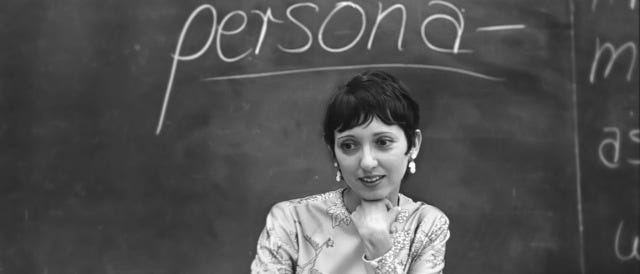
A long-ago photo of me with what appears to be a “pixie” haircut, teaching an introductory literature course at the University of Detroit

Writing is a consequence of being “haunted” by material.  You know that you are “haunted” when nothing else can retain your attention—when your thoughts swerve, in obedience to an inner gravity, to the one true subject that will bring terror and comfort.


I have forced myself to begin writing when I’ve been utterly exhausted, when I’ve felt my soul as thin as a playing card…and somehow the activity of writing changes everything.


“We work in the dark—we do what we can—we give what we have. Our doubt is our passion, and our passion is our task. The rest is the madness of art.”Henry James


The ideal art, the noblest of art: working with the complexities of life, refusing to simplify, to “overcome” doubt.


Fiction that adds up, that suggests a “logical consistency,” or an explanation of some kind, is surely second-rate fiction; for the truth of life is its mystery.


I’m drawn to failure—stories of struggle, failure, even defeat—and the aftermath of defeat. For only someone who attempts something beyond their reach can “fail.” There can be nobility in this,  a strange sort of dignity. Never having failed means never having tried.  Subscribe


Writing a first draft is like pushing a peanut with your nose across a very dirty floor.  Only when you get to the farther side of the room do you see where you were going—now, you can try again, and you will move much more swiftly!


Revising is the blissful state subsequent to the circle of Hell that is the “first draft.”


I am drawn to write about rural and small-town upstate New York in the way in which a dreamer’s recurring dreams are likely to be set in childhood places. Our oldest memories are the most deeply imprinted in our brains—the first to be absorbed into our physical being, in neurons; the last to be lost, as consciousness fades to black.

Beset by economic crises, as by extremes of weather, upstate New York is emblematic of much of American life in the present day: its urban centers are relatively prosperous, educated, “liberal”—its rural areas, much the greater part of the state, are relatively impoverished, under-educated, “conservative.”

https://upload.wikimedia.org/wikipedia/commons/thumb/0/08/Lockport_New_York_-_Erie_Canal_Locks_34_35_-_%22siamese_twins%22%2C_where_the_upper_door_of_Lock_34_is_also_the_lower_door_of_Lock_35_-_Flickr_-_Onasill_~_Bill_-_103_Million_Views_-_Thank_You.jpg/640px-thumbnail.jpg
Erie Canal locks, Lockport, New York

The secret of being a writer: not to expect others to value what you’ve done as you value it. Not to expect anyone else to perceive in it the emotions you have invested in it. Once this is understood, all will be well. (She wants to think!)


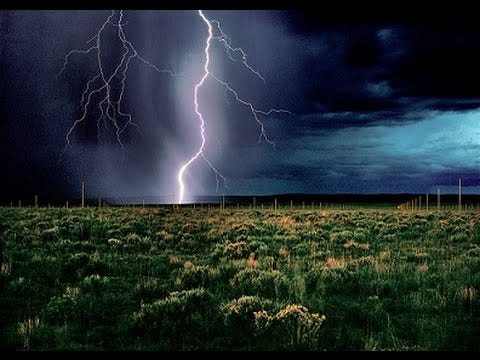
Starting a novel is like standing in a field and waiting for lightning to strike…

The Lightning Field, Catron County, New Mexico

I encourage my students to write a great deal. Keep a journal. Take notes. Write when you are feeling wretched, when your mind is about to break down…who knows what will float up to the surface? I am an unashamed believer in the magical powers of dreams; dreams enhance us. Even nightmares may be marketable—there is something to be said for the conscious, calculating exorcism of nightmares, if they give to us such works as those of Dostoyevsky, Celine, Kafka. So the most important thing is to write, and to write every day, in sickness and in health: who knows but there will come a time when you reread what you have written, not as the writer but as a reader, and a revelation comes to you in a flash—So this is what it has meant!  Now, you can begin.


I’ve never thought of writing as the mere arrangement of words on the page but the embodiment of a vision; a complex of emotions; raw experience. The effort of memorable art is to evoke in the reader or spectator emotions appropriate to that effort.


Critics sometimes appear to be addressing themselves to works other than those I remember writing.

The crucial difference between the critic and the reviewer is: one takes time, the other must meet a deadline.  


Words are like wild birds—they will come when they wish, not when they are bidden. And they may suddenly explode into the air—and disappear.

https://upload.wikimedia.org/wikipedia/commons/thumb/5/58/British_Wildlife_Centre_Apr_2015_-_Geese_%2817169605088%29.jpg/640px-British_Wildlife_Centre_Apr_2015_-_Geese_%2817169605088%29.jpg
Photo by Garry Knight

I am not conscious of working especially hard, or of “working” at all. Writing and teaching have always been, for me, so richly rewarding that I don’t think of them as work in the usual sense of the word.  


It’s up to the writer and the artist to give voice to these people. There are two impulses in art: one is rebellious and transgressive—you explore regions in which you are not wanted, and you will be punished for that. But the other is a way of sympathy—evoking sympathy for people who may be different from us—whom we don’t know. Art is a way of breaking down the barriers between people—these two seemingly antithetical impulses toward rebellion and toward sympathy come together in art.


My belief is that art should not be comforting; for comfort, we have mass entertainment and one another. Art should provoke, disturb, arouse our emotions, expand our sympathies in directions we may not anticipate and may not even wish.


To be entranced, to be driven, to be obsessed, to be under the spell of an emerging, not quite fully “comprehended” narrative—this is the greatest happiness of the writer’s life even as it burns us out and exhausts us, unfitting us for the placid contours of “normality.”


There are those—a blessed lot—who can experience life without the slightest glimmer of a need to add anything to it—any sort of “creative” effort; and there are those—an accursed lot?—for whom the activities of their own brains and imaginations are paramount. The world for these individuals may be infinitely rich, rewarding and seductive—but it is not paramount. The world may be interpreted as a gift, earned only if one has created something over and above the world.


A literary work is a kind of nest: an elaborately and painstakingly woven nest of words incorporating chunks and fragments of the writer’s life in an imagined structure, as a bird’s nest incorporates all manner of items from the world outside our windows, ingeniously woven together in an original design.

File:Bird nest srilanka 001.jpg

I believe that art is the highest expression of the human spirit. I believe that we yearn to transcend the merely finite and ephemeral; to participate in something mysterious and communal called “culture”—and that this yearning is as strong in our species as the yearning to reproduce the species.

https://www.kwls.org/wp-content/uploads/2016/01/Oates-Joyce-Carol-cr-Beth-Garrabrant-cr-Brydges-Mackinney-Agency-crop.jpg
Photo by Beth Gabbert

Through the local or regional, through our individual voices, we work to create art that will speak to others who know nothing of us. In our very obliqueness to one another, an unexpected intimacy is born.

Subscribe to Joyce Carol Oates: A Writer’s Journal

Launched a year ago

On writing, living with cats, being a widow, movies, running, my current workshops & what we are reading, books, comedy, nature, gardening, friendship, more.Subscribe

Writing Journal—Saturday writing prompt

Your protagonist is a serial killer on the hunt for a new victim. Write the scene from his point of view as he homes in on a target and prepares for the abduction. 

One Stop for Writers

Guidance & Tips

Write the scene of discovery (i.e., tell a story), or brainstorm and create a list of related ideas.

Here’s five story elements to consider:

  • Character
  • Setting
  • Plot
  • Conflict
  • Resolution

Never forget, writing is a process. The first draft is always a mess.

The first draft of anything is shit.

Ernest Hemingway

Mind Games to Protect Almighty (?) God

Here’s the link to this article.

By David Madison, 03/10/2023

The vulnerability of god is the biggest mystery

In a few of my article here I have mentioned one of the worst mind games ever used to defend god. A few days after the 2012 murder of 20 children at the Sandy Hook School in Connecticut, a devout woman was sure it had happened because “God must have wanted more angels.” Clergy and theologians know better than to say anything so blatantly grotesque, yet they feel the same obligation to get god off the hook. Why is there is so much suffering, cruelty, agony on a planet supposedly under the care of an omni-god: all good, all wise, all powerful? “This is my father’s world”—so they say. Our awareness of the everyday reality disconfirms this suggestion—at least it disconfirms the idea that a caring father-god is paying attention.

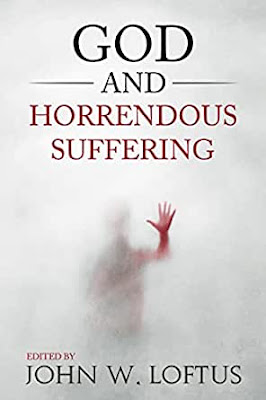
Professional theologians work hard at devising excuses to explain the obvious absence of god, and secular authors come right back at them to puncture their arguments. In John Loftus’ 2021 anthology, God and

Horrendous Suffering, there are two essays that describe some of these efforts, David Kyle Johnson’s “Refuting Skeptical Theism,” and Robert M. Price’s “Theodicy: The Idiocy.” 

At first glance, skeptical theism might sound like a step in the right direction. Johnson points out that we may be tempted to assume that it means believers edging toward agnosticism, or those who “barely believe.” But No, skeptical theism is a clumsy attempt to rule out evil and suffering as a reason for denying that a good god is in charge. Johnson sums it up this way:

“The problem of evil suggests that the seemingly unjustified (i.e., senseless or gratuitous) evils that exist in the world serve as evidence against god’s existence. But since god is so much ‘bigger’ than us—more wise and powerful and perfect—he could have reasons for allowing such evils that we simply cannot see or comprehend. Consequently, no evil, no matter how gratuitous it seems, can serve as evidence against god’s existence. 

“In other words, because we should be skeptical of our ability to fathom god’s reasoning (hence ‘skeptical theism’), the problem of suffering is no problem at all. For all we know, god has a reason to allow evil, and thus the existence of evil cannot bolster the atheist’s argument” (p. 212).

So the skeptical theist argues that we should be skeptical about our knowledge of god, who is assumed to be “more wise and powerful and perfect” than we are. But this is tiresome theobabble: theological assumptions—actually guesswork—the product of speculation for thousands of years, based on no hard data whatever.  

Among devout believers there is a tendency to embrace possibilities instead of probabilities. Especially when they’re trying to defend miracles: because their god has such extraordinary power, it has to be possible that the many divine wonders reported in the Bible actually happened, whether it’s Jesus turning water into wine, or feeding thousands of people with just a few loaves and fishes. But what is more probable? That such things actually happened, or that such stories derive from magical folklore of the ancient world—about which most laypeople seem to be unaware? If critical thinking skills are locked in neutral, of course it’s easy to take these things on faith—as devout have been trained to do since childhood. But the laws of probability don’t go away. Johnson devotes six pages to a section of the essay titled, “Skeptical Theism Is Logically and Mathematically Invalid.” There you will find what he identifies as a Simple Version of the math, then the Bayesian Version.  

The math may be daunting for many people, but the facts of evil should be even more daunting. But I suspect that the full scale of evil falls outside the horizon of awareness of most humans—except for evils that affect them directly. 

A careful study of history can be a cure for lack of awareness. 

The current issue of BBC History Magazine (Vol. 24, No. 2) includes an article by John Bulgin, titled, “How the Holocaust Began,” pp. 46-51. We read this:

“Within a matter of weeks, the targets of this mass murderer moved from military-aged men to include women, children, and the elderly. Children were spared none of the horror. Mothers were required to hold babies in their arms as both were shot, sometimes with the same bullet. 

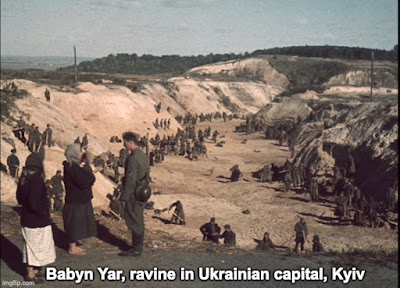
“By the end of September 1941 the massacres reached an appalling


apex at Babyn Yar, a ravine in the Ukrainian capital, Kyiv. Over the course of two days, the Einsatzgruppen and their collaborators murdered more than 33,000 people in a single Aktion. Each consecutive group was marched to the murder site and forced to lie on top of the still-warm bodies of those who had just been killed before they were shot themselves” (p. 50).

Bulgin notes that “Senior Nazis became concerned about the emotional burden the killings were placing on their own men” (p. 50). 

Clergy and theologians also are aware of the emotional burden on believers that acute awareness of evil and suffering would bring. So this becomes the strategy: divert attention, obfuscate, come up with shallow excuses that might convince those who have already been deceived by doctrine. John Bulgin has pointed out that more than 33,000 people were murdered in two days at a ravine on Ukraine. “Oh, but god must have had some greater good in mind—he’s much wiser than we are—so hold onto your faith no matter what!” 

This provokes utter confusion, not clarity, however, as Johnson explains:

“…because people everywhere profess to have moral knowledge—to know that some things are morally good and others are morally bad. Indeed, if I can’t know that the murder of six million Jews in the Holocaust was a morally bad thing, what can I know? If I can’t lament the 2004 Indian Tsunami which killed an estimated 230,000 people in one day (because, for all I know, somehow it inexplicably prevented even more deaths), then I can lament nothing. In short, my objection here goes like this: 1. If the argument of the skeptical theist is sound, then moral knowledge is impossible. 2. Moral knowledge is possible. 3. Thus skeptical theism is not sound” (p. 222).

Skeptical theism is based on deity inflation: god is so much bigger, better, wiser than we are—his ways, his ultimate goals, are beyond our understanding (but again, please show us the data to justify this claim). 

Johnson drives home the point:

“If…god has different moral standards that make him conclude that genocide, burned fawns, and raped children are acceptable, our terms ‘loving’ and ‘moral good’ cannot apply to him—at all! Indeed, it would seem that the only words that would apply are those like ‘deplorable’” (p. 224).

“If god really is too big to understand—so big that we cannot even know whether he condemns child rape—then we really should profess to know nothing about him at all, including whether he exists” (p. 228).

“…the skeptical theist would not only have to admit that moral knowledge is impossible, but also that skeptical theism is hypocritical, irrationally unfalsifiable, and entails (at best) religious agnosticism and (at worst) global skepticism” (p. 229).

To even try to make a case that 33,000 people murdered by Nazis in two days can’t be called evil, because a god will see to it that a greater good will eventually emerge, is a foul mind game; it is just as grotesque as “God must have wanted more angels.”   

It was a smart move by the editor of the anthology to place Robert Price’s essay, “Theodicy: The Idiocy” right after the Johnson essay. It’s an additional slam-dunk—in just ten pages. Price notes that theodicy was Gottfried Leibniz’s word (coined in 1710) to describe the attempt to “vindicate God’s supposed goodness in spite of all appearances.” Price says that “the real game is to protect one’s faith in God at all costs, and that cost is great indeed” (p. 233). 

Theologians are up against the wild incoherence in Christian belief, and so many incriminating Bible stories. Price includes unanswered prayer in his discussion, since Jesus-script in Mark 11:24 presents a major challenge: does god keep his word? “I tell you, whatever you ask in prayer, believe that you will receive it, and you will.” Don’t we hit a brick wall here in protecting faith? How can this not be awkward for sincerely devout folks? Price refers to it as “… a peculiar condition of having to deal with the failure of expected divine intervention. Why has not God blessed me as I asked? Did not Jesus promise that he would? You see, here we have an unstable combination of magic and religion” (p. 235). Oh, that the devout could see to what a sweeping extent their beliefs derive from ancient magic, e.g. eat this, drink that (the eucharist) to get right with god—these are magic potions. How could a good, wise god have invented or approved of such superstitions?

The apostle Paul was a master of bad theology, and Price calls attention to that. The Old Testament vividly depicts the wrath of god on those who disobey his laws. Paul savored the wrath of his god (I Corinthians 10:6-11):

“Now these things occurred as examples for us, so that we might not desire evil as they did. Do not become idolaters as some of them did, as it is written, ‘The people sat down to eat and drink, and they rose up to play.’  We must not engage in sexual immorality, as some of them did, and twenty-three thousand fell in a single day. We must not put Christ to the test, as some of them did, and were destroyed by serpents. And do not complain, as some of them did, and were destroyed by the destroyer. These things happened to them to serve as an example, and they were written down to instruct us, on whom the ends of the ages have come.” 

Paul was a master at mind games: if you put Christ to the test, you might get destroyed by serpents; shape up, maintain your personal purity—by no means should you eat, drink, and rise up to play—because the “end of the age has come.” Well, No it didn’t, and theologians and clergy who aren’t looking to the sky for the kingdom to come have to invent even more mind games. How tiresome, as Price notes: “It is so very ironic that the massacre stories present a stumbling block only to biblical literalists who are stuck believing that every story in the Bible must be true. Everyone else can breathe a sigh of relief!” (p. 241)

Yes, of course, many devout Christians don’t engage their minds with such issues. As Price kindly puts it at the end of the essay, “…they are too busy attending to good humanitarian works of mercy in the name of their faith to waste time with theodicy…” (p. 243) Unfortunately the incoherence of their faith falsifies the entire belief system. In a footnote at the end of essay, John Loftus notes the challenge that Christopher Hitchens presented to believers: “…come up with one moral action they could do that nonbelievers could not also do…” (p. 243)

Loftus also points to a stark, cruel reality: “If readers want a complete picture of the deeds of Christians then seriously consider the many morally atrocious deeds their faith-based morals have caused. Christianity is red with blood in tooth and in claw. Throughout most of its history violence was its theme, its program, and its method for converting people and keeping believers in the fold. Its history is a history of violence. There is no escaping this” (p. 243).

Which begs the further question: How can all of this grievous Christian misbehavior have been tolerated by a good, powerful god? It seems especially grotesque to argue that it has all been part of this god’s bigger plan that we’re incapable of grasping.

David Madison was a pastor in the Methodist Church for nine years, and has a PhD in Biblical Studies from Boston University. He is the author of two books, Ten Tough Problems in Christian Thought and Belief: a Minister-Turned-Atheist Shows Why You Should Ditch the Faith (2016; 2018 Foreword by John Loftus) and Ten Things Christians Wish Jesus Hadn’t Taught: And Other Reasons to Question His Words (2021). The Spanish translation of this book is also now available. 

His YouTube channel is here. He has written for the Debunking Christianity Blog since 2016.

The Cure-for-Christianity Library©, now with more than 500 titles, is here. A brief video explanation of the Library is here.

03/10/23 Biking & Listening

Biking is something else I both love and hate. It takes a lot of effort but does provide good exercise and most days over an hour to listen to a good book or podcast. I especially like having ridden.

Here’s my bike, a Rockhopper by Specialized. I purchased it November 2021 from Venture Out in Guntersville; Mike is top notch! So is the bike, and the ‘old’ man seat I salvaged from an old Walmart bike.

Here’s a link to today’s bike ride. This is my pistol ride.

Here’s a few photos taken along my route:

Here’s what I’m currently listening to: McNally’s Secret, by Lawrence Sanders

He was a tremendously talented writer.

Amazon abstract:

First in the series starring the sleuthing Palm Beach playboy from the #1 New York Times–bestselling and Edgar Award–winning author.
 Inveterate playboy Archy McNally gets paid to make discreet inquiries for Palm Beach’s power elite. But keeping their dirty little secrets buried will take some fancy footwork in McNally’s latest case. A block of priceless 1918 US airmail stamps has gone missing from a high-society matron’s wall safe. Lady Cynthia Horowitz, now on her sixth husband, is a nasty piece of work who lives in a mansion that looks like Gone With the Wind’s Tara transplanted to southern Florida. McNally’s search takes him into a thickening maze of sex, lies, scandal, and blackmail. When passion erupts into murder and McNally must dig even deeper to uncover the truth, he unearths a shocking secret that could expose his own family’s skeletons.  

Top reviews from the United States

Linda G. Shelnutt

5.0 out of 5 stars Cure Cultural Volcanics with Bubbling Champagne. Design Life To Suit Taste & Times.

Reviewed in the United States on May 21, 2006

Verified Purchase

This book didn’t merely capture my reading interest. It became a book of my heart…

In McNally’s SECRET, the pilot to this series, we’re informed that the pater McNally is not an “old-money” man. Okay. I get that and I like it. (That’s not the secret.)

Having reviewed 4 of the original 7 McNally books by Lawrence Sanders, I had accepted the face value (not realizing the facade) of the Palm Beach mansion and the genteel lifestyle of pater Prescott McNally, Yale graduate, leather-bound-Dickens-reading, attorney-at-law. Upon reading (in McNally’s Secret) the illuminating passages of Archy’s grandparent’s ways into money, I began to wonder what other Secrets this novel might expose.

Usually, if possible, I prefer to read a series in order, pilot first. I can’t explain why, but, in this case I’m glad I read 4 of the original 7 McNally’s prior to reading SECRET (though I believe this series can be satisfyingly read in any order).

The opening of this novel was classic, and felt to be the initiation of what Sanders was born and itching to write, beyond the sagas of his other fine works. The introductory remarks were exquisite in mapping the reasons for, “Can’t you ever be serious, Archy?” I’d love to quote that paragraph, but maybe I should allow you to read it with the book in hand. I will quote a few other passages, however, which might serve as appropriate appetizers to this banquet of a book.

Comparing himself to S. Holmes, Archy says:

“I can’t glance at a man and immediately know he’s left-handed, constipated, has a red-headed wife, and slices lox for a living. I do investigations a fact at a time. Eventually they add up – I hope. I’m very big on hope.”

Archy’s description of the start up of the Pelican Club were the best type of soul food. This is how and why such a club should be started (then survive through a near hit of Chapter 7). Of course you really should read the book to get the whole of that brief history, but here’s a prime paring:

“We were facing Chapter 7 when we had the great good fortune to hire the Pettibones, an African-American family who had been living in one of the gamier neighborhoods of West Palm Beach and wanted out.”

They “wanted out” and they deserved a chance where their skills could and would save not only themselves, but those who hired them. Isn’t that the type of win/win the world needs now?

I almost sobbed at the below passage, I felt such a deep surge of “right on” (definitely did a breath-catch hiccup and heart moan):

“… we formed a six-piece jazz combo (I played tenor kazoo), and we were delighted to perform, without fee, at public functions and nursing homes. A Palm Beach critic wrote of one of our recitals, `Words fail me.’ You couldn’t ask for a better review than that.”

Yep. This is a book of my heart. Words don’t often fail me in reviews; too much the contrary. But I’m getting better at refraining from using my critic hat with a steel-studded-bat accessory, which is what Archy was getting at.

Some might wonder why a person in my position, with my un-hidden agendas, would take so much time to write raves on a series by a deceased author. Mostly, I love Archy. But, possibly the live spirits of the dead are sometimes more able to be helpful than dead souls of the living? Keeping my tongue in cheek, I might add that freed spirits probably have better connections for helping an author into the right publishing contacts for a character series with ironic assonance with this one.

Moving quickly onward and upward, though not with wings attached yet…

In contrast to the other 4 I’ve read, I noticed that this Archy is less bubbly-buffoonish (though the buffoon is always endearing) and slightly more serious, sensitive, and quietly contemplative. I like both versions of Archy, though I prefer the slight edge of peaceful acquiescence in the pilot, and I can’t help but wonder, as I do with all series, how much reader feedback, and editor/agents’ interpretation of it, directed the progression of balance of certain appealing or potentially irritating qualities. I wonder how each series would have progressed if the feedback had been balanced and pure (as a species, we’re not there yet, but forward motion is perceptible), rather than inevitably polluted by the “life happens” part of the sometimes perverted, capricious tastes of us squeaky wheels, and the healthy ego needs of professionals in positions of swallow and sway.

I’m still trying to understand why honesty is the most appealing human quality to me, yet honest criticism does not speak to my heart, nor to my soul, not even to my head. Often, though, it does speak in perfect pitch to my funny bone. And, of course true Honesty (with the capital “H”) leaps beyond speaking the “truth” as one happens to “see” it on a good or bad day. Cultural honesty, of the type dramatized by Stephen King, Lawrence Sanders, Tamar Myers, Barbara Workinger, Joanne Pence, Sue Grafton, (and others) is what most often pushes me to stand up and cheer.

Somewhere.

One of the best spots I’ve found is on the edge of the clear cliff of ozone found in Amazon’s sacred forum of Customer Reviewers.

Of course the first lines in SECRET, the sipping of champagne from a belly button would snag the attention of even the most sexually skittish reader of the nose-raised, neck-cricked, personality persuasion. But, truly and honestly, what sunk me with every hook were the few lines exposing why Archy could never be serious. I know I said I wouldn’t, but I have to quote this passage, beginning on page 1 chapter 1. For me, it’s one of the main selling points of the series:

“I had lived through dire warnings of nuclear catastrophe, global warming, ozone depletion, universal extinction via cholesterol, and the invasion of killer bees. After a while my juices stopped their panicky surge and I realized I was bored with all these screeched predictions of Armageddon due next Tuesday. It hadn’t happened yet, had it? The old world tottered along, and I was content to totter along with it.”

I’d bet my fortune (which is based on a skill of “make do”; there are no bananas in it) that the above passage is what captured a collection of readers so absolutely in a “right on” agreement that this series spanned the grave of the author and is still spewing pages and stretching shelves. And, of course, this attitude of “if you can’t lick `em; flick `em” which Archy aimed toward “kvetch-ers” as he terms them, continues from the above, with relish accumulating, throughout the book.

Archy is a rare sane person swimming along nicely within the insanity of a last-gasp-culture (which is “drowning in The Be Careful Sea” as I described and termed that syndrome in one of my sci fi manuscripts titled MORNING COMES).

To Jennifer, of the champagne sea in her belly button, Archy answered why he wasn’t an attorney:

“Because I was expelled from Yale Law for not being serious enough. During a concert by the New York Philharmonic I streaked across the stage, naked except for a Richard M. Nixon mask.”

That answer brought to mind the bright side of Howard Roark (from Ayn Rand’s FOUNTAINHEAD, see my review posted 10/14/05) who was arrogantly unconcerned about his and the Dean’s reasons for Roark’s being expelled from architectural school. You’d be right to wonder where I got that comparison, since Roark could never be accused of being anything but serious. Syncopated irony? Assonance?

You be the judge. Get the SECRET of the McNally collection.

As I relished the final chapters and pages of SECRET, I had a thought about the beauty, warmth, lovely literary melancholy, and subtly complex richness radiating from those concluding textual treasures:

In retrospect, this novel doesn’t feel like a planned pilot to a mystery series. It feels to be a singular novel, like but not like, the ones Sanders had written prior to it. What it feels like to me is that Lawrence hit upon a “soul speak” story which couldn’t halt the cultural conversation it had initiated, however serendipitous that initiation may have been.

Yes, I do recall that in some of my other reviews (“reveries” according to my Amazon Friend, L.E. Cantrell) I speculated on something which could seem contradictory to the above mentioned “thought.” I had wondered if Parker’s Senser series might have been somehow a spark for this McNally series. I continued to see references to Boston in this book (as in other McNally’s I’ve reviewed), which, of course, is the city for which Spenser did the Walkabout. So possibly SECRET was somewhat an antithetical homage to Spenser, possibly even a hat “doff” with a friendly, competitive “one-better” attempt, meant only to be a single novel rather than a never-die series.

Based on Agatha Christie’s official web site, Miss Marple was not originally intended to be another Poirot, and look what happened there (see my Listmania of the Miss Marple series).

To me, Archy appears to be a gatekeeper for pure and primal, hidden wishes and dreams. Living home comfortably, guiltlessly at 37, on the top floor of his parent’s mansion in Palm Beach; eating drool-food from a house chef; having established a club like The Pelican as a side atmosphere to partake in daily; working at a cushy, just challenging enough, engaging career for discreet inquiries … If an author’s (or reader’s) going to retire that would be da place (or at least an entertaining option).

It’ll be interesting to see if/how I’m able to bridge the gap from Lawrence Sanders’s Archy to Vincent Lardo’s. I’d love to know how that bridge was built and continues to be maintained.

Though a perfectly acceptable, gorgeous reprint in a mass market paperback was (probably still is) available on Amazon’s Super Saver Special, I felt lucky to find a vender on Amazon (a-bookworm2) holding a used G. P. Putnam’s Sons hardcover of this novel, a first printing of the 1992 copyright. What an honor it will be to have this version of the pilot of such an auspicious series from such a life-perceptive author, Lawrence Sanders. The glossy-black jacket provides a luscious background for the name and title printed in thick, gleaming, copper ink, with the artwork of an antique magnifying glass and fancy-brass scissors weighing down the million-dollar-valued, 1918 US Stamp of the Inverted Jenny.

This pilot is a rare find in a rare series.

Linda G. Shelnutt

Tenacity, the Art of Integration, and the Key to a Flexible Mind: Wisdom from the Life of Mary Somerville, for Whom the Word “Scientist” Was Coined

Here’s the link to this article.

Inside the hallmark of a great scientist and a great human being — the ability to hold one’s opinions with firm but unfisted fingers.

BY MARIA POPOVA

This essay is adapted from my book Figuring

A middle-aged Scottish mathematician rises ahead of the sun to spend a couple of hours with Newton before the day punctuates her thinking with the constant interruptions of mothering four children and managing a bustling household. “A man can always command his time under the plea of business,” Mary Somerville (December 26, 1780–November 28, 1872) would later write in her memoir; “a woman is not allowed any such excuse.”

Growing up, Somerville had spent the daylight hours painting and playing piano. When her parents realized that the household candle supply had thinned because Mary had been staying up at night to read Euclid, they promptly confiscated her candles. “Peg,” she recalled her father telling her mother, “we must put a stop to this, or we shall have Mary in a strait jacket one of these days.” Mary was undeterred. Having already committed the first six books of Euclid to memory, she spent her nights adventuring in mathematics in the bright private chamber of her mind.

Mary Somerville (Portrait by Thomas Phillips)

Despite her precocity and her early determination, it took Somerville half a lifetime to come abloom as a scientist — the spring and summer of her life passed with her genius laying restive beneath the frost of the era’s receptivity to the female mind. When Somerville was forty-six, she published her first scientific paper — a study of the magnetic properties of violet rays — which earned her praise from the inventor of the kaleidoscope, Sir David Brewster, as “the most extraordinary woman in Europe — a mathematician of the very first rank with all the gentleness of a woman.” Lord Brougham, the influential founder of the newly established Society for the Diffusion of Useful Knowledge — with which Thoreau would take issue thirty-some years later by making a case for “the diffusion of useful ignorance,” comprising “knowledge useful in a higher sense” — was so impressed that he asked Somerville to translate a mathematical treatise by Pierre-Simon Laplace, “the Newton of France.” She took the project on, perhaps not fully aware how many years it would take to complete to her satisfaction, which would forever raise the common standard of excellence. All great works suffer from and are saved by a gladsome blindness to what they ultimately demand of their creators.

As the months unspooled into years, Somerville supported herself as a mathematics tutor to the children of the wealthy. One of her students was a little girl named Ada, daughter of the mathematically inclined baroness Annabella Milbanke and the only legitimate child of the sybarite poet Lord Byron — a little girl would would grow to be, thanks to Somerville’s introduction to Charles Babbage, the world’s first computer programmer.

When Somerville completed the project, she delivered something evocative of the Nobel Prize-winning Polish poet Wisława Szymborska’s wonderful notion of “that rare miracle when a translation stops being a translation and becomes… a second original” In The Mechanism of the Heavens, published in 1831 after years of work, Somerville hadn’t merely translated the math, but had expanded upon it and made it comprehensible to lay readers, popularizing Laplace’s esoteric ideas.

Solar System quilt by Ellen Harding Baker, begun in 1869 and completed in 1876 to teach women astronomy when they were barred from higher education in science. Available as a print and a face mask. (Smithsonian)

The book was an instant success, drawing attention from the titans of European science. John Herschel, whom Somerville considered the greatest scientist of their time and who was soon to coin the word photography, wrote her a warm letter she treasured for the rest of her days:

Dear Mrs. Somerville,

I have read your manuscript with the greatest pleasure, and will not hesitate to add, (because I am sure you will believe it sincere,) with the highest admiration. Go on thus, and you will leave a memorial of no common kind to posterity; and, what you will value far more than fame, you will have accomplished a most useful work. What a pity that La Place has not lived to see this illustration of his great work! You will only, I fear, give too strong a stimulus to the study of abstract science by this performance.

Somerville received another radiant fan letter from the famed novelist Maria Edgeworth, who wrote after devouring The Mechanism of the Heavens:

I was long in the state of the boa constrictor after a full meal — and I am but just recovering the powers of motion. My mind was so distended by the magnitude, the immensity, of what you put into it!… I can only assure you that you have given me a great deal of pleasure; that you have enlarged my conception of the sublimity of the universe, beyond any ideas I had ever before been enabled to form.

Edgeworth was particularly taken with a “a beautiful sentence, as well as a sublime idea” from Somerville’s section on the propagation of sound waves:

At a very small height above the surface of the earth, the noise of the tempest ceases and the thunder is heard no more in those boundless regions, where the heavenly bodies accomplish their periods in eternal and sublime silence.

Years later, Edgeworth would write admiringly of Somerville that “while her head is up among the stars, her feet are firm upon the earth.”

Milky Way Starry Night by Native artist Margaret Nazon, part of her stunning series of astronomical beadwork.

In 1834, Somerville published her next major treatise, On the Connexion of the Physical Sciences — an elegant and erudite weaving together of the previously fragmented fields of astronomy, mathematics, physics, geology, and chemistry. It quickly became one of the scientific best sellers of the century and earned Somerville pathbreaking admission into the Royal Astronomical Society the following year, alongside the astronomer Caroline Herschel — the first women admitted as members of the venerable institution.

When Maria Mitchell — America’s first professional female astronomer and the first woman employed by the U.S. government for a professional task — traveled to Europe to meet the Old World’s greatest scientific luminaries, her Quaker shyness could barely contain the thrill of meeting her great hero. She spent three afternoons with Somerville in Scotland and left feeling that “no one can make the acquaintance of this remarkable woman without increased admiration for her.” In her journal, Mitchell described Somerville as “small, very,” with bright blue eyes and strong features, looking twenty years younger than her seventy-seven years, her diminished hearing the only giveaway of her age. “Mrs. Somerville talks with all the readiness and clearness of a man, but with no other masculine characteristic,” Mitchell wrote. “She is very gentle and womanly… chatty and sociable, without the least pretence, or the least coldness.”

Months after the publication of Somerville’s Connexion, the English polymath William Whewell — then master of Trinity College, where Newton had once been a fellow, and previously pivotal in making Somerville’s Laplace book a requirement of the university’s higher mathematics curriculum — wrote a laudatory review of her work, in which he coined the word scientist to refer to her. The commonly used term up to that point — “man of science” — clearly couldn’t apply to a woman, nor to what Whewell considered “the peculiar illumination” of the female mind: the ability to synthesize ideas and connect seemingly disparate disciplines into a clear lens on reality. Because he couldn’t call her a physicist, a geologist, or a chemist — she had written with deep knowledge of all these disciplines and more — Whewell unified them all into scientist. Some scholars have suggested that he coined the term a year earlier in his correspondence with Coleridge, but no clear evidence survives. What does survive is his incontrovertible regard for Somerville, which remains printed in plain sight — in his review, he praises her as a “person of true science.”Phases of Venus and Saturn by Maria Clara Eimmart, early 1700s. Available as a print.

Whewell saw the full dimension of Somerville’s singular genius as a connector and cross-pollinator of ideas across disciplines. “Everything is naturally related and interconnected,” Ada Lovelace would write a decade later. Maria Mitchell celebrated Somerville’s book as a masterwork containing “vast collections of facts in all branches of Physical Science, connected together by the delicate web of Mrs. Somerville’s own thought, showing an amount and variety of learning to be compared only to that of Humboldt.” But not everyone could see the genius of Somerville’s contribution to science in her synthesis and cross-pollination of information, effecting integrated wisdom greater than the sum total of bits of fact — a skill that becomes exponentially more valuable as the existing pool of knowledge swells. One obtuse malediction came from the Scottish philosopher Thomas Carlyle, who proclaimed that Somerville had never done anything original — a remark that the young sculptor Harriet Hosmer, herself a pioneer who paved the way for women in art, would tear to shreds. In a letter defending Somerville, she scoffed:

To the Carlyle mind, wherein women never played any conspicuous part, perhaps not, but no one, man or woman, ever possessed a clearer insight into complicated problems, or possessed a greater gift of rendering such problems clear to the mind of the student, one phase of originality, surely.

Somerville’s uncommon gift for seeing clearly into complexity came coupled with a deep distaste for dogma and the divisiveness of religion, the supreme blinders of lucidity. She recounted that as religious controversies swirled about her, she had “too high a regard for liberty of conscience to interfere with any one’s opinions.” She chose instead to live “on terms of sincere friendship and love with people who differed essentially” in their religious views. In her memoir, she encapsulated her philosophy of creed: “In all the books which I have written I have confined myself strictly and entirely to scientific subjects, although my religious opinions are very decided.”

Above all, Somerville possessed the defining mark of the great scientist and the great human being — the ability to hold one’s opinions with firm but unfisted fingers, remaining receptive to novel theories and willing to change one’s mind in light of new evidence. Her daughter recounted:

It is not uncommon to see persons who hold in youth opinions in advance of the age in which they live, but who at a certain period seem to crystallise, and lose the faculty of comprehending and accepting new ideas and theories; thus remaining at last as far behind, as they were once in advance of public opinion. Not so my mother, who was ever ready to hail joyfully any new idea or theory, and to give it honest attention, even if it were at variance with her former convictions. This quality she never lost, and it enabled her to sympathise with the younger generation of philosophers, as she had done with their predecessors, her own contemporaries.

Shortly after the publication of Somerville’s epoch-making book, the education reformer Elizabeth Peabody — who lived nearly a century, introduced Buddhist texts to America, and coined the term Transcendentalism — echoed the sentiment in her penetrating insight into middle age and the art of self-renewal.

Why (Almost All) Cosmologists are Atheists

Here’s the link to this article by Sean M. Carroll.


(2003)

[This essay was originally presented as a talk at the “God and Physical Cosmology: Russian-Anglo American Conference on Cosmology and Theology” at Notre Dame in January/February 2003 and subsequently published in Faith and Philosophy 22(5), pp. 622-640, in 2005.]

Abstract

Science and religion both make claims about the fundamental workings of the universe. Although these claims are not a priori incompatible (we could imagine being brought to religious belief through scientific investigation), I will argue that in practice they diverge. If we believe that the methods of science can be used to discriminate between fundamental pictures of reality, we are led to a strictly materialist conception of the universe. While the details of modern cosmology are not a necessary part of this argument, they provide interesting clues as to how an ultimate picture may be constructed.

1. Introduction

2. Worldviews

3. Theory Choice

4. Cosmology and Belief

5. Conclusions

1. Introduction

One increasingly hears rumors of a reconciliation between science and religion. In major news magazines as well as at academic conferences, the claim is made that that belief in the success of science in describing the workings of the world is no longer thought to be in conflict with faith in God. I would like to argue against this trend, in favor of a more old-fashioned point of view that is still more characteristic of most scientists, who tend to disbelieve in any religious component to the workings of the universe.

The title “Why cosmologists are atheists” was chosen not because I am primarily interested in delving into the sociology and psychology of contemporary scientists, but simply to bring attention to the fact that I am presenting a common and venerable point of view, not advancing a new and insightful line of reasoning. Essentially I will be defending a position that has come down to us from the Enlightenment, and which has been sharpened along the way by various advances in scientific understanding. In particular, I will discuss what impact modern cosmology has on our understanding of these truly fundamental questions.

The past few hundred years have witnessed a significant degree of tension between science and religion. Since very early on, religion has provided a certain way of making sense of the world–a reason why things are the way they are. In modern times, scientific explorations have provided their own pictures of how the world works, ones which rarely confirm the preexisting religious pictures. Roughly speaking, science has worked to apparently undermine religious belief by calling into question the crucial explanatory aspects of that belief; it follows that other aspects (moral, spiritual, cultural) lose the warrants for their validity. I will argue that this disagreement is not a priori necessary, but nevertheless does arise as a consequence of the scientific method.

It is important from the outset to distinguish between two related but ultimately distinct concepts: a picture of how the world works, and a methodology for deciding between competing pictures. The pictures of interest in this paper may be labeled “materialism” and “theism.” Materialism asserts that a complete description of nature consists of an understanding of the structures of which it is comprised together with the patterns which those structures follow, while theism insists on the need for a conscious God who somehow rises above those patterns[1]. Science is most often associated with a materialist view, but the essence of science lies as much in a methodology of reaching the truth as in any view of what form that truth might ultimately take. In particular, the scientific method is an empirical one, in contrast to appeals to pure reason or to revelation. For the purposes of this paper I will assume the validity of the scientific method, and simply ask what sorts of conclusions we are led to by its application.

Within this framework, there are two possible roads to reconciliation between science and religion. One is to claim that science and religion are not incompatible because they speak to completely distinct sets of questions, and hence never come into conflict. The other is to assert that thinking scientifically does not lead to rejection of theism, but in fact that religious belief can be justified in the same way that any scientific theory might be. I will argue that neither strategy succeeds: science and religion do speak to some of the same questions, and when they do they get different answers. In particular, I wish to argue that religious belief necessarily entails certain statements about how the universe works, that these statements can be judged as scientific hypotheses, and that as such they should be rejected in favor of alternative ways of understanding the universe.

Probably nothing that I say will be anything you have not heard elsewhere. My goals here are simply to describe what I think a typical scientist has in mind when confronted with the question of science vs. religion, even if the scientists themselves have not thought through these issues in any detail.

2. Worldviews

One of the most difficult tasks in discussing the relationship between science and religion is to define the terminology in ways that are acceptable to everyone listening. In fact, it is likely impossible; especially when it comes to religion, the terminology is used in incompatible ways by different people. I will therefore try to be as clear as possible about the definitions I am using. In this section I want to carefully describe what I mean by the two competing worldviews, materialism and theism, without yet addressing how to choose between them.

The essence of materialism is to model the world as a formal system, which is both unambiguous and complete as a description of reality. A materialist model may be said to consist of four elements. First, we model the world as some formal (mathematical) structure. (General relativity describes the world as a curved manifold with a Lorentzian metric, while quantum mechanics describes the world as a state in some Hilbert space. As a more trivial example, we could imagine a universe which consisted of nothing other than an infinitely long list of “bits” taking on the values 0 or 1.) Second, this structure exhibits patterns (the “laws of nature”), so that the amount of information needed to express the world is dramatically less than the structure would in principle allow. (In a world described by a string of bits, we might for example find that the bits were an infinitely repeated series of a single one followed by two zeroes: 100100100100…) Third, we need boundary conditions which specify the specific realization of the pattern. (The first bit in our list is a one.) Note that the distinction between the patterns and their boundary conditions is not perfectly well-defined; this is an issue which becomes relevant in cosmology, and we’ll discuss it more later. Finally, we need a way to relate this formal system to the world we see: an “interpretation.”

The reader might worry that we are glossing over very subtle and important issues in the philosophy of science; they would be correct, but needn’t worry. Philosophy of science becomes difficult when we attempt to describe the relationship of the formalism to the world (the interpretation), as well as how we invent and choose between theories. But the idea that we are trying, in principle, to model the world as a formal system is fairly uncontroversial.

The materialist thesis is simply: that’s all there is to the world. Once we figure out the correct formal structure, patterns, boundary conditions, and interpretation, we have obtained a complete description of reality. (Of course we don’t yet have the final answers as to what such a description is, but a materialist believes such a description does exist.) In particular, we should emphasize that there is no place in this view for common philosophical concepts such as “cause and effect” or “purpose.” From the perspective of modern science, events don’t have purposes or causes; they simply conform to the laws of nature. In particular, there is no need to invoke any mechanism to “sustain” a physical system or to keep it going; it would require an additional layer of complexity for a system to cease following its patterns than for it to simply continue to do so. Believing otherwise is a relic of a certain metaphysical way of thinking; these notions are useful in an informal way for human beings, but are not a part of the rigorous scientific description of the world. Of course scientists do talk about “causality,” but this is a description of the relationship between patterns and boundary conditions; it is a derived concept, not a fundamental one. If we know the state of a system at one time, and the laws governing its dynamics, we can calculate the state of the system at some later time. You might be tempted to say that the particular state at the first time “caused” the state to be what it was at the second time; but it would be just as correct to say that the second state caused the first. According to the materialist worldview, then, structures and patterns are all there are–we don’t need any ancillary notions.

Defining theism is more difficult than defining materialism, for the simple reason that theist belief takes many more forms that materialist belief, and the same words are often taken to mean utterly different things. I will partially avoid this difficulty by not attempting a comprehensive definition of religion, but simply taking belief in the existence of a being called “God” as a necessary component of being religious. (Already this choice excludes some modes of belief which are sometimes thought of as “religious.” For example, one could claim that “the laws of physics, and their working out in the world, are what I hold to be God.” I am not sure what the point of doing that would be, but in such a case nothing that I have to say would apply.)

The subtlety has therefore been transferred to the task of defining “God.” I will take it to mean some being who is not bound by the same patterns we perceive in the universe, who is by our standards extremely powerful (not necessarily omnipotent, although that would count), and in some way plays a crucial role in the universe (creating it, or keeping it going, etc.). By a “being” I mean to imply an entity which we would recognize as having consciousness–a “person” in some appropriately generalized sense (as opposed to a feature of reality, or some sort of feeling). A rather concrete God, in other words, not just an aspect of nature. This notion of God need not be interventionist or easy to spot, but has at least the capability of intervening in our world. Even if not necessarily omnipotent, the relevant feature of this conception is that God is not bound by the laws of physics. In particular, I don’t include some sort of superhero-God who is bound by such laws, but has figured out how to use them in ways that convey the impression of enormous power (even if it is hard to imagine ultimately distinguishing between these two possibilities). When I say that God is not bound by the laws of physics, I have in mind for example that God is not limited to moving more slowly than the speed of light, or that God could create an electron without also creating a corresponding positively charged particle. (We are not imagining that God can do the logically impossible, just violate the contingent patterns of reality that we could imagine having been different.) Of course these are meager powers compared to most conceptions of God, but I am taking them to be minimal criteria. There are various types of belief which are conventionally labeled as religious, but inconsistent with my definition of God; about these I have nothing to say in this paper.

It should be clear that, by these definitions, materialism and theism are incompatible, essentially by definition. (The former says that everything follows the rules, the second says that God is an exception.) It does not immediately follow that “science” and “religion” are incompatible; we could follow the scientific method to conclude that a materialist description of the world was not as reasonable as a theist one. On the other hand, it does follow that science and religion do overlap in their spheres of interest. Religion has many aspects, including social and moral ones, apart from its role in describing the workings of the world; however, that role is a crucial one, and necessarily speaks to some of the same issues as science does. Suggestions that science and religion are simply disjoint activities[2] generally rely on a redefinition of “religion” as something closer to “moral philosophy.” Such a definition ignores crucial aspects of religious belief.

In judging between materialism and theism, we are faced with two possibilities. Either one or the other system is logically impossible, or we need to decide which of the two conceivable models better explains the world we experience. In my view, neither materialism nor theism is logically impossible, and I will proceed on the idea that we have to see which fits reality better. Of course arguments against materialism have been put forward which do not rely on specific observed features of our world, but instead on either pure reason or revelation; I won’t attempt to deal with such arguments here.

3. Theory Choice

Given this understanding of materialism and theism, how are we to decide which to believe? There is no right answer to this question, and sensible arguments can only be made after we agree on some basic elements of how we should go about choosing a theory of the world. For example, someone could insist on the primacy of revelation in understanding deep truths; in response, there is no logical argument which could prove such a person wrong. Instead, I would like to ask what conclusion we should reach by employing a more empirical technique of deciding between theories. In other words, we address the choice between materialism and theism as a scientist would address the choice between any two competing theories.

The basic scientific assumption is that there is exists a complete and coherent description of how the world works. (This need not be a purely materialist description, in the language of the previous section; simply a sensible description covering all phenomena.) Although we certainly don’t yet know what this description might be, science has been extremely successful at constructing provisional theories which accurately model some aspects of reality; this degree of success thus far convinces most scientists that there really is a comprehensive description to be found. This underlying assumption plays a crucial role in determining how scientists choose between competing theories which are more modest in their goals, attempting to model only some specific types of phenomena–in a nutshell, scientists choose those models which they feel are more likely to be consistent with the true underlying unified description.

We can make such a sweeping statement with some confidence, only because it avoids all the hard questions. In particular, how do we go about deciding whether a theory is more or less likely to be consistent with a single coherent description of nature? It is at this point that the judgment of the individual scientist necessarily plays a crucial role; the process is irreducibly nonalgorithmic. A number of criteria are employed, including fit to experiment, simplicity, and comprehensiveness. No one of these criteria is absolute, even fit to experiment; after all, experiments are sometimes wrong.

Let me give an example to illustrate the different criteria employed by scientists to judge theories. When we observe the dynamics of galaxies, we find that the apparent gravitational force exerted by the galaxy on particles orbiting far around it is inevitably much larger than we would expect by taking into account the combined mass of all the visible material in the galaxy. A straightforward and popular hypothesis to explain this observation is the idea of “dark matter,” the notion that most of the mass in galaxies is not in stars or gas, but rather in some new kind of particle which has not yet been observed directly, and which has an average mass density in the universe which is approximately five times greater than that of ordinary matter. But there is a competing idea: that our understanding of gravity (through Einstein’s general relativity) breaks down at the edges of galaxies, to be replaced by some new gravitational law. Such a law has actually been proposed by Milgrom, under the name of “Modified Newtonian Dynamics,” or MOND[3]. At this point we don’t know for certain whether the dark matter hypothesis or the MOND hypothesis is correct, but it is safe to say that the large majority of scientific experts come down in favor of dark matter. Why is that? On the one hand, there is a sense in which MOND is more compact and efficient: it has been demonstrated to accurately describe the observations of a wide set of galaxies, with only a single free parameter, while the dark matter idea is somewhat less predictive on this score. But there are two features working strongly in favor of dark matter. First, it makes detailed predictions for a wide class of phenomena, well outside the realm of individual galaxies: clusters of galaxies, gravitational lenses, large-scale structure, the cosmic microwave background, and more, while MOND is completely silent on these issues (there is no prediction to verify or disprove). The second (closely related) point is that MOND is not really a complete theory, or even a theory at all, but simply a suggested phenomenological relation that is supposed to hold for galaxies. Nobody understands how to make it part of a larger consistent framework. Therefore, despite the greater predictive power of MOND within its domain of validity, most scientists consider it to be a step backward, as it seems less likely to ultimately be part of a comprehensive description. (Nobody can say for sure, so the issue is still open, but the majority has a definite preference.)

It should be clear why choosing between competing theories is difficult–it’s a matter of predicting the future, not of applying a set of unambiguous criteria. Nevertheless, it’s not completely arbitrary, either; it’s simply a matter of applying a set of somewhat ambiguous standards. Fortunately, cases in which a certain theory would be favored by applying one reasonable criterion while a different theory would be favored by applying a different reasonable criterion are both rare and typically short-lived; the acquisition of additional experimental input or increased theoretical understanding tends to ultimately resolve the issue relatively cleanly in favor of one specific model.

According to this description, the evaluation of a scientific theory involves both a judgment about the theory itself and about the more comprehensive theory which would ultimately describe nature. While a number of disparate factors are applied to concrete theories, the criteria relevant to judging competing comprehensive theories are much more straightforward: among every possible model which fits all of the data, we choose the simplest possible one. “Simplicity” here is related to the notion of “algorithmic compressibility”: the simplicity of a model is judged by how much information is required to fully specify the system. There is no a priori reason why nature should be governed by a comprehensive model which is at all simple; but our experience as scientists convinces us that this is the case.

It should be clear how these considerations relate to the choice between materialism and theism. These two worldviews offer different notions of what form a comprehensive description will take. Acting as scientists, it is our task to judge whether it seems more likely that the simplest possible comprehensive theory which is compatible with what we already know about the universe will turn out to be strictly materialistic, or will require the introduction of a deity.

4. Cosmology and Belief

If we accept the scientific method as a way to determine the workings of reality, are we led to a materialist or theist conclusion? Naïvely, the deck seems to be stacked against theism: if we are looking for simplicity of description, a view which only invokes formal structures and patterns would appear to be simpler than one in which God appeared in addition. However, we are constrained to find simple descriptions which are also complete and consistent with experiment. Therefore, we could be led to belief in God, if it were warranted by our observations–if there were evidence (direct or otherwise) of divine handiwork in the universe.

There are several possible ways in which this could happen. Most direct would be straightforward observation of miraculous events that would be most easily explained by invoking God. Since such events seem hard to come by, we need to be more subtle. Yet there are still at least two ways in which a theist worldview could be judged more compelling than a materialist one. First, we could find that our best materialist conception was somehow incomplete–there was some aspect of the universe which could not possibly be explained within a completely formal framework. This would be like a “God of the gaps,” if there were good reason to believe that a certain kind of “gap” were truly inexplicable by formal rules alone. Second, we could find that invoking the workings of God actually worked to simplify the description, by providing explanations for some of the observed patterns. An example would be an argument from design, if we could establish convincingly that certain aspects of the universe were designed rather than assembled by chance. Let’s examine each of these possibilities in turn.

We turn first to the idea that there is something inherently missing in a materialist description of nature. One way in which this could happen would be if there were a class of phenomena which seemed to act without regard to any patterns we could discern, something that stubbornly resisted formalization into a mechanistic description. Of course, in such a case it would be hard to tell whether an appropriate formalism actually didn’t exist, or whether we just hadn’t yet been clever enough to discover it. For example, physicists have tried for most of the last century to invent a theory which described gravity while being consistent with quantum mechanics. (String theory is the leading candidate for such a theory, but it has not yet been fully developed to the point where we understand it well enough to compare it to experiment.) It is hard to know at what point scientists would become sufficiently frustrated in their attempts to describe a phenomenon that they would begin to suspect that no formal description was applicable. However, it is safe to say that such a point has not been reached, or even approached, with any of the phenomena of current interest to physicists. Although there are undoubtedly unsolved problems, the rate at which successful theoretical explanations are proposed for these problems is well in accordance with expectation. In other words, there does not seem to be any reason to suspect that we have reached, or are about to reach, the fundamental limits of our ability to find rules governing nature’s behavior.

A more promising place to search for a fundamental incompleteness in the materialist program would be at the “boundaries” of the universe. Recall that a complete mechanistic picture involves not only patterns we discern in nature, but some boundary condition which serves to choose a particular realization of all the possible configurations consistent with such a pattern. In the realm of science, this is an issue of unique concern to cosmology. In physics, chemistry, or biology, we imagine that we can isolate systems in whatever initial state we like (within reason), and observe how the rules governing the system play themselves out from that starting point. In cosmology, in contrast, we are faced with a unique universe, and must face the issue of its initial conditions. One could certainly imagine that something like a traditional religious conception of God could provide some insight into why the initial state was the particular one relevant to our universe.

In classical cosmology initial conditions are imposed at the Big Bang, a singular region in space-time out of which our universe was born. More carefully, if we take our current universe and run it back in time, we reach a point where the density and curvature of space-time become infinite, and our equations (gravity described by Einstein’s general relativity, and other fields described by the standard model of particle physics) cease to make sense. This initial moment must apparently be treated as a boundary to space-time. (A boundary in the past, not in any direction in space.) As we now recognize, the conditions near the Big Bang are by no means generic; the curvature of space (as opposed to that of space-time) was extremely close to zero, and widely separated parts of the universe were expanding at nearly identical rates. What made it this way? Do we need to accept the imposition of certain boundary conditions as an irreducible part of our worldview, or is there some way of arguing within a bigger picture that these conditions were somehow natural? Or do we simplify our description by invoking a God who brought the universe into existence in a certain state?

Nobody knows the answers with any certainty. The best we can do is to extrapolate from what we think we do know. In this context, modern cosmology does have something to teach us. In particular, we now know that the issue of boundary conditions is more complicated than it might appear at first. Indeed, we now understand that, despite appearances, the universe might not have a boundary at all. This could happen in one of two ways: either the Big Bang might actually be smooth and nonsingular, or it might represent a transitional phase in a universe which is actually eternal.

The first possibility, that the Big Bang is actually nonsingular, was popularized by the Hartle-Hawking “no boundary” proposal for the wave function of the universe[4]. Discussions of this proposal can be somewhat misleading, in that they frequently refer to the idea that the universe came into being out of nothing. This would be hard to understand, if true; what is this “nothing” that the universe purportedly came out of, and what caused it to come out? A much better way of putting the Hartle-Hawking idea into words would be to say that the apparent “sharp point” at the beginning of space-time is smoothed out into a featureless surface. The mechanism by which the smoothing purportedly happens involves technical details of the geometry of the space-time metric, and in all honesty the entire proposal is very far from being well-formulated. Nevertheless, the lesson of the Hartle-Hawking work is that we don’t necessarily have to think of the Big Bang as an “edge” at which space-time runs into a wall; it could be more like the North Pole, which is as far north as you can possibly go, without actually representing any sort of physical boundary of the globe. In other words, the universe could be finite (in time) and yet be unbounded.

The other way to avoid a boundary is more intuitive: simply imagine that the universe lasts forever. Like the Hartle-Hawking proposal, the idea of an eternal universe requires going beyond our current well-formulated theories of general relativity and particle physics. In the context of classical four-dimensional gravitation, it is well known that the conditions which we believe obtained in the very early universe must have originated from a singularity. Extensions of this picture, however, can in principle allow for smooth continuation through the veil of the Big Bang to an earlier phase of the universe. Within this scenario there are two possibilities: either what we see as the Big Bang was a unique event, about which the universe expands indefinitely in either direction in time; or it was one occurrence in an infinitely repeating cycle of expansions and recontractions. Both possibilities have been considered for a long time, but have received new attention thanks to recent work by Veneziano and collaborators (the “pre-Big-Bang” model[5]) and Steinhardt, Turok, and collaborators (the “cyclic universe” model[6]).

In either case, an attempt is made to circumvent traditional singularity theorems by introducing exotic matter fields, extra dimensions of space, and sometimes “branes” on which ordinary particles are confined. For example, in the model of a cyclic universe advocated by Steinhardt and Turok, our universe is a three-brane (three spatial dimensions, evolving in time, for a total of four space-time dimensions) embedded in a background five-dimensional space-time. Motion in the extra dimension, it is suggested, can help resolve the apparent Big-Bang singularity, allowing a contracting universe to bounce and begin expanding into a new phase, before eventually recollapsing and starting the cycle over again.

I don’t want to discuss details of either the pre-Big-Bang scenario or the cyclic universe; for one thing, the details are fuzzy at best and incoherent at worse. Neither picture is completely well-formulated at this time. But the state of the art in early-universe cosmology is not the point; the lesson here is that we are not forced to think of boundary conditions being imposed arbitrarily at the earliest times. In any of the scenarios mentioned here, the issue of initial conditions is dramatically altered from the classical Big-Bang scenario, since there is no edge to the universe at which boundary conditions need to be arbitrarily imposed. Thus, one cannot argue that we require the initial state of the universe to be specified by the conscious act of a deity, or that the universe came into existence as the result of a single creative act. This is by no means a proof that God does not exist; God could be responsible for the universe’s existence, whether it is boundaryless or not. But these theories demonstrate that a distinct creation event is not a necessary component of a complete description of the universe. Although we don’t know whether any of these models will turn out to be part of the final picture, their existence allows us to believe that a simple materialist formalism is sufficient to tell the whole story.

Being allowed to believe something, of course, is not the same as having good reasons for doing so. This brings us to the second possible way in which scientific reasoning could lead us to believe in God: if, upon constructing various models for the universe, we found that the God hypothesis accounted most economically for some of the features we found in observed phenomena. As noted, this kind of reasoning is a descendant of the well-known argument from design. A few centuries ago, for example, it would have been completely reasonable to observe the complexity and subtlety exhibited in the workings of biological creatures, and conclude that such intricacy could not possibly have arisen by chance, but must instead be attributed to the plan of a Creator. The advent of Darwin’s theory of evolution, featuring descent with modification and natural selection, provided a mechanism by which such apparently improbable configurations could have arisen via innumerable gradual changes.

Indeed, modern science has provided plausible explanations for the origin of all the complex phenomena we find in nature (given appropriate initial conditions, as we just discussed). Nevertheless, these explanations rely on the details of the laws of physics, as exemplified in general relativity and the standard model of particle physics. In particular, when we consider carefully the particular laws we have discovered, we find them to be specific realizations of more general possible structures. For example, in particle physics we have various kinds of particles (fermions, gauge bosons, a hypothetical Higgs boson), as well as specific symmetries among their interactions, and particular values for the parameters governing their behavior. Given that the universe is made out of fermions and bosons with particular kinds of interactions, to the best of our current knowledge we do not understand why we find the particular particles we do, or the particular symmetries, or the particular parameters, rather than some other arrangement. Is it conceivable that in the particular realization of particles and forces of our universe we can discern the fingerprints of a conscious deity, rather than simply a random selection among an infinite number of possibilities?

Well, yes, it is certainly conceivable. In fact, the argument has been made that the particles and interactions we observe are not chosen at all randomly; instead, they are precisely tuned so as to allow for the existence of human life (or at least, complex structures of the kind we consider to be necessary for intelligent life).

In order for this argument to have force, we must believe both that the physical laws are finely tuned to allow for life (i.e., that the complexity required for life to form is not a robust feature, and would generally be absent for different choices of particles and coupling constants), and that there is no simpler alternative explanation for this fine-tuning. I will argue that neither statement is warranted by our current understanding, although both are open questions; in either case, there is not a strong reason for invoking the existence of God.

Let’s turn first to the fine-tuning of our observed laws of nature. It is certainly true that the world we observe depends sensitively on the particular values of the constants of nature: for example, the strength of the electromagnetic and nuclear forces. If the strong nuclear force had a slightly different value, the balance which characterizes stable nuclei would be upset, and the periodic table of the elements would be dramatically altered[7]. We could imagine (so the argument goes) values for which hydrogen were the only stable element, or for which no carbon was formed in the life cycle of stars. In either case it would be difficult or impossible for life as we know it to exist.

But there are two serious holes in this argument, at least at our current level of expertise: we don’t really know what the universe would look like if the parameters of the standard model were different, nor do we know what are the necessary conditions for the formation of intelligent life. (Both of these claims are open to debate, and there are certainly scientists who disagree; but if nothing else these are the conservative positions.)

To appreciate the difficulty of reliably determining what the universe would be like if the constants of nature took on different values, let us imagine trying to figure out what our actual universe should look like, if we were handed the laws of subatomic physics but had no direct empirical knowledge of how particles assembled themselves into more complex structures. A fundamental obstacle arises immediately, since quantum chromodynamics (the theory of quarks and gluons, which gives rise to the strong nuclear force) is a strongly coupled theory, so that our most straightforward and trustworthy techniques (involving perturbation theory in some small parameter, such as the fine-structure constant of electromagnetism) are worthless. We would probably be able to conclude that quarks and gluons were bound into composite particles, and could even imagine figuring out that the lightest nearly stable examples were protons and neutrons (and their antiparticles). It would be very hard, without experimental input, to calculate reliably that protons were lighter than neutrons, but it might be possible. It would be essentially impossible to determine accurately the types of stable nuclei that protons and neutrons would be able to form. We would have no chance whatsoever of accurately predicting the actual abundance of heavy nuclei in the universe, as these are formed in stars and supernovae whose evolution we don’t really understand even with considerable observational input. Most embarrassingly, we would never have predicted that there was a significant excess of matter over antimatter, since the process by which this occurs remains a complete mystery (there are numerous plausible models, but none has become commonly accepted[8]). So we would predict a world in which there were almost no nuclei at all, the nucleons and antinucleons having annihilated long ago, leaving nothing but an inert gas of photons and neutrinos. In other words, a universe utterly inhospitable to the existence of intelligent life as we know it. Of course, perhaps life could nevertheless exist, of a sort radically different than we are familiar with. As skeptical as I am about the ability of physicists to accurately predict gross features of a universe in which the laws of nature are different, I am all the more skeptical of the ability or biologists (or anyone else) to describe the conditions under which intelligence may or may not arise. (Cellular automata, the simple discrete systems popularized by Wolfram and others[9], provide an excellent example of how extreme complexity can arise out of fundamentally very simple behaviors.) For this reason, it seems highly presumptuous for anyone to claim that the laws of nature we observe are somehow delicately adjusted to allow for the existence of life.

But in fact there is a better reason to be skeptical of the fine-tuning claim: the indisputable fact that there are many features of the laws of nature which don’t seem delicately adjusted at all, but seem completely irrelevant to the existence of life. In a cosmological context, the most obvious example is the sheer vastness of the universe; it would hardly seem necessary to make so many galaxies just so that life could arise on a single planet around a single star. But to me a more pointed observation is the existence of “generations” of elementary particles. All of the ordinary matter in the universe seems to be made out of two types of quarks (up and down) and two types of leptons (electrons and electron neutrinos), as well as the various force-carrying particles. But this pattern of quarks and leptons is repeated threefold: the up and down quarks are joined by four more types, just as the electron and its neutrino are joined by two electron-type particles and two more neutrinos. As far as life is concerned, these particles are completely superfluous. All of the processes we observe in the everyday workings of the universe would go on in essentially the same way if those particles didn’t exist. Why do the constituents of nature exhibit this pointless duplication, if the laws of nature were constructed with life in mind?

Beyond the fact that the constants of nature do not seem to be chosen by any intelligent agent, there remains the very real possibility that parameters we think of as distinct (for example, the parameters measuring the strength of the electromagnetic and nuclear forces) are actually calculable from a single underlying parameter. This speculative proposal is the goal of so-called grand unified theories, for which there is already some indirect evidence. In other words, it might turn out to be that the constants of nature really couldn’t have had any other values. I don’t think that, if we discovered this to be the case, it would count as evidence against the existence of God, only because I don’t think that our present understanding of these parameters counts as evidence in favor of God.

But perhaps the parameters are finely tuned; we might imagine that our understanding of physics, biology, and complexity some day will increase to a degree where we can say with confidence that alternative values for these parameters would not have allowed intelligent life to evolve. Even in that case, the existence of God is by no means the only mechanism for explaining this apparently unlikely state of affairs; a completely materialist scenario is provided by the well-known anthropic principle. Imagine that what we think of as the “constants of nature” are merely local phenomena, in the sense that there are other regions of the universe where they take on completely different values. This is a respectable possibility within our current conception of particle physics and cosmology. The idea that there are different, inaccessible regions of the universe is consistent with the theory of “eternal inflation,” in which space-time on large scales consists of innumerable distinct expanding universes, connected by regions of space driven to hyperexpansion by an incredibly high-energy field[10]. Within each of these separate regions, we can imagine that the matter fields settle into one of a large number of distinct metastable states, characterized by different values of all the various coupling constants. (Such a scenario is completely consistent with current ideas from string theory[11], although it is clearly at odds with the idea from the previous paragraph that all of the coupling constants might be uniquely calculable. The truth is that either scenario is possible, we just don’t know enough at this point to say with confidence which, if either, is on the right track.)

In a universe comprised of many distinct regions with different values of the coupling constants, it is tautologous that intelligent observers will only measure the values which obtain in those regions which are consistent with the existence of such observers. This is nothing more fancy than the reason why nobody is surprised that life arose on the surface of the Earth rather than the surface of the Sun, even though the surface area of the Sun is so much larger: the Earth is simply a much more hospitable environment. Therefore, even if we were to be confident that tiny alterations in the particles and couplings we observe in our universe would render life impossible, we would by no means need to invoke intelligent design as an explanation.

5. Conclusions

The question we have addressed is, “Thinking as good scientists and observing the world in which we live, is it more reasonable to conclude that a materialist or theist picture is most likely to ultimately provide a comprehensive description of the universe?” Although I don’t imagine I have changed many people’s minds, I do hope that my reasoning has been clear. We are looking for a complete, coherent, and simple understanding of reality. Given what we know about the universe, there seems to be no reason to invoke God as part of this description. In the various ways in which God might have been judged to be a helpful hypothesis–such as explaining the initial conditions for the universe, or the particular set of fields and couplings discovered by particle physics–there are alternative explanations which do not require anything outside a completely formal, materialist description. I am therefore led to conclude that adding God would just make things more complicated, and this hypothesis should be rejected by scientific standards. It’s a venerable conclusion, brought up to date by modern cosmology; but the dialogue between people who feel differently will undoubtedly last a good while longer.

See article for Notes and References.

How to Ask for Book Reviews (& Why You Should)

Here’s the link to this article.

March 9, 2023 by Guest Contributor 6 Comments

By Liz Alterman

You’ve written a book. Congratulations! Now for the next hurdle—gathering those all-important ratings and reviews.

When my novel, The Perfect Neighborhood, was released last July, I quickly learned how critical these are. Leading up to my launch, I reached out to a nearby library to see if they’d consider it for their book club. Before I could even offer to donate copies or attend the meeting, I was promptly told to call back when I had more than one hundred, four-star ratings. Ouch!

For many authors, myself included, knowing that people took the time to read your words feels like a gift in itself. Can you really ask them to take more time out of their busy lives to write and post a review? Yes, you can, and here’s why you must.

First, reviews and ratings serve as a form of social proof. The more you have—especially positive ones—the more likely readers are to give your book a try.

As Scott Blackburn, author of the southern crime thriller It Dies With You, pointed out, publishers are doing less and less promotional work in an increasingly crowded market, making book reviews crucial—especially for debut authors.

Even now, I often find myself scrolling Goodreads and Amazon, looking for new material to read, and more times than not, the quality and quantity of a book’s reviews will guide my decision on what to buy,” said Blackburn. “Do those criteria mean a book will be a guaranteed hit? Absolutely not. That’s all subjective. Did those reviews help the authors behind those books? Most definitely.” 

Second, while having plenty of reviews and ratings may encourage readers to take a chance on your book, there’s another reason they’re important.

“In order to qualify for certain promotions on Amazon and BookBub, you need to have 50 or 100 reviews on Amazon,” explained Andrea J. Stein, author of the novel Typecast, and a book publicist by profession. “Also, the more reviews you have, the more the algorithm will promote your book.”

So, How Do You Make the Ask?

For plenty of authors, asking readers for reviews and ratings can feel awkward, almost like fishing for compliments.

“Many authors struggle with this aspect of self-promotion because they feel rude or pushy when asking for reviews,” said Blackburn. “If this is the case for you, keep this in mind: in a world where a majority of shopping is done online, people encounter reviews and ratings on a daily basis, which means they understand why those things are so important.” 

So how does Blackburn handle it? Approach these requests with kindness and professionalism, he advised.

“Simply let people know how much reviews help and how appreciative you are to get them,” he said. “This could be done in a blanket post on social media or in a casual conversation with a reader.”

His go-to script? “If you have time, I’d really appreciate a review.”

“If the person you ask isn’t comfortable with—or simply doesn’t know how—to write a book review, it’s good to remind them that clicking a star rating only takes seconds, and those can be just as helpful,” Blackburn added.

Stein offered her strategy. “Whenever someone tells me they loved my book, my immediate response is to ask if they could post a review on Amazon,” she said. “If it’s in response to an email, I’ll tell them that they can just use the same text they used in the email as their review.”

You can also ask that they paste that same text on various retailer and review sites to boost your book on multiple platforms.

Stein added that she’s never had anyone say anything but “yes,” and most often, they keep their word.

“When I send an ARC to a potential reviewer, I simply thank them for their interest and wish them ‘happy reading!’” she said. “I then follow up to confirm they’ve received the ARC and to ask if they know when they’ll be able to read/review the book. I always point out that reviews can be short. I don’t want people to feel they’re expected to write an essay.”

Blackburn offered additional strategies, such as creating a social media post like: “I’m sitting at 97 reviews. If you read my novel, I’d love for you to help me reach 100 reviews.”

“I’ve had success with similar posts,” he said. “At minimum, it’s a reminder to readers to leave a review, and more than that, people love to be a part of a milestone. I’ve even seen authors host giveaways when they hit review milestones.” 

Author and humorist Julie Vick shared an innovative, quieter but just as effective strategy.

To spread the word about her book, Babies Don’t Make Small Talk (So Why Should  I?): The Introvert’s Guide to Surviving Parenthood, Vick connected with stewards of Little Free Libraries (LFL) and also left her book in LFLs in her area. In each copy, she placed a sticker encouraging readers to leave a review. She shared the text she included:  

“This book was donated to a Little Free Library for you to enjoy. If you enjoyed reading it, I would love it if you could leave a review on a retailer’s site or Goodreads (you don’t have to have bought a book there to leave a review).”

If friends or family haven’t had a chance to read your book yet, they can still give the work a boost by marking it “to-read” on Goodreads. How does it help? When someone checks that box, all of their Goodreads friends will see your book on their homepages, increasing its free exposure.

Courtesy Counts

Vick said that as she asked readers to rate her book, she was always conscious to “not bombard people with requests.”

Blackburn agreed there’s a line between being persistent and being pushy and said there’s no need to publicly seek reviews daily, but if you’ve recently launched a book or your reviews begin to slow, don’t be afraid to ask.

“I’ve also tried to just be a good literary citizen in terms of reviewing other authors’ books,” said Vick. “So when I read a book that I enjoy, I try to review it on one of the sites. This can often lead to reciprocal reviews from other authors you know without you having to ask.” 

Blackburn echoed the importance of returning the favor. “If you’re asking for reviews,” he said, “make sure you’re leaving reviews for your fellow authors.”

If you’re not seeing those reviews and ratings pile up, don’t panic.

“It’s also important to keep in mind that less than 15% (often less than 10%) of people review or rate the books they read, so there’s no need to panic if you’ve sold 500 books and you’re nowhere near 100 reviews,” said Blackburn. That’s totally normal.” 

While asking for ratings and reviews may feel uncomfortable, much like writing itself, once you’ve done it you’ll be glad you did. Chances are, they’ll help your book find more readers and, ultimately, isn’t that what writers want?


Liz Alterman is the author of the suspense novel, The Perfect Neighborhood. the young adult novel, He’ll Be Waiting, and the memoir, Sad Sacked. Liz lives in New Jersey with her husband and three sons. When she isn’t writing, Liz spends most days reading, microwaving the same cup of coffee, and looking up synonyms.

The Story of the Righteous Job and His Righteous God

Here’s the link to this article written by Bart Ehrman.

March 9, 2023

In my previous post I explained how the book of Job comprises both a folk-tale written in prose about a righteous man named Job (chs. 1-2; 42) and a set of dialogues written in poetry between Job, his so-called friends, and eventually God (chs. 3-42).   These are two different compositions with two different authors living at two different times with two different understandings of why Job and people like him suffer.

To unpack these understandings, I begin with the folktale as discussed in my book God’s Problem (HarperOne, 2008).

******************************

The Folktale: The Suffering of Job as a Test of Faith

The action of the prose folktale alternates between scenes on earth and in heaven.  It begins by indicating that Job lived in the land of Uz; usually this is located in Edom, to the southeast of Israel.  Job, in other words, is not an Israelite.  As a book of “wisdom,” this account is not concerned with specifically Israelite traditions: it is concerned with understanding the world in ways that should make sense to everyone living in it.  In any event, Job is said to be “blameless and upright, one who feared God and turned away from evil” (1:1). We have already seen that in other books of wisdom, such as Proverbs, wealth and prosperity come to those who are righteous before God; here this dictum is borne out.  Job is said to be enormously wealthy, with 7000 sheep, 3000 camels, 500 yoke of oxen, 500 donkeys, and very many servants.  His piety is seen in his daily devotions to God: early every morning he makes a burnt offering to God for all his children, seven sons and three daughters, in case they have committed some sin.

The narrator then moves to a heavenly scene in which the “heavenly beings” (literally: the sons of God) appear before the Lord, “the Satan” among them.  It is important to recognize that the Satan here is not the fallen angel who has been booted from heaven, the cosmic enemy of God.  Here he is portrayed as one of God’s divine council members, a group of divinities who regularly report to God and, evidently, go about the world doing his will.  Only at a later stage of Israelite religion (as we will see in chapter 7), does “Satan” become “the Devil,” God’s mortal enemy.  The term “the Satan” here in Job does not appear to be a name so much as a description of his office: it literally means “the Adversary” (or the Accuser).  But he is not an adversary to God: he is one of the heavenly beings who reports to God.  He is the adversary who plays “devil’s advocate,” as it were, who challenges conventional wisdom in order to try to prove a point.  In the present instance his challenge has to do with Job.  The Lord brags to the Satan about Job’s blameless life and the Satan challenges God about it: Job is upright only because he is so richly blessed in exchange.  If God were to take away what he has, the Satan insists, Job would “curse you to your face” (1:11).  God doesn’t think so, and gives the Satan authority to take everything away from Job.  In other words, this is to be a test of Job’s righteousness: can he have a disinterested piety, or does his pious relationship to God depend entirely on what he manages to get out of the deal?

The Satan attacks Job’s household.  In one day, the oxen are stolen away, the sheep are burned up by fire from heaven, the camels are raided and carried off, all the servants are killed, and even the sons and daughters are mercilessly destroyed by a storm that levels their house.  Job’s reaction?  As God predicted, he does not utter curses for his misfortune: he goes into mourning:

Job arose, tore his robe, shaved his head, and fell on the ground and worshiped.  He said, “Naked I came from my mother’s womb, and naked shall I return there; the LORD gave, and the LORD has taken away; blessed be the name of the LORD.” (1:20)

The narrator assures us that in all this “Job did not sin or charge God with wrongdoing” (1:22).   One might wonder what “wrongdoing” God could possibly do, if robbery, destruction of property, and murder is not wrong.  But in this story, at least, for Job to preserve his piety means for him to continue trusting God, whatever God does to him.

The narrative then reverts to a heavenly scene of God and his divine council.  The Satan appears before the Lord, who once again brags about his servant Job.  The Satan replies that of course Job has not cursed God – he has not himself been afflicted with physical pain.  But, he tells God, “stretch out your hand now and touch his bone and his flesh and he will curse you to your face” (2:5).  God allows the Satan to do so, with the proviso that he not take away Job’s life (in part, one might suppose, because it would be hard to evaluate Job’s reaction were he not alive to have one).  The Satan then afflicts Job with “loathsome sores…from the sole of his foot to the crown of his head” (2:7).  Job sits on a pile of ashes and scrapes his wounds with a potsherd.  His wife urges on him the natural course, “Do you still persist in your integrity? Curse God and die.”  But Job refuses, “Shall we receive the good at the hand of God and not receive the bad”? (2:10).  In all this Job does not sin against God.

Job’s three friends then come to him – Eliphaz the Temanite, Bildad the Shuhite, and Zophar the Naamathite.  And they do the only thing true friends can do in this kind of situation, they weep with him, mourn with him, and sit with him, not saying a word.  What sufferers need is not advice, but a comforting human presence.

It is at this point that the poetic dialogues begin, in which the friends do not behave like friends, much less like comforters, insisting that Job has simply gotten what he has deserves.  I will talk about these dialogues later, as they come from a different author from the prose narrative.  The folktale is not resumed until the very conclusion of the book at the end of chapter 42.  It is obvious that a bit of the folktale has been cut out in the process of combining it with the poetic dialogues: for when it resumes, God indicates that he is angry with the three friends for what they have said, in contrast to what Job has said.  This cannot very well be a reference to what the friends and Job said in the poetic dialogues, because there it is the friends who defend God and Job who accuses him.  And so a portion of the folktale must have been cut off when the poetic dialogues were added.  What the friends said that offended God cannot be known.

But what is clear is that God rewards Job for passing the test: he has not cursed God.  Job is told to make a sacrifice and prayer on behalf of his friends, and he does so.  God then restores everything that had been lost to Job, and even more: 14,000 sheep, 6000 camels, 1000 yoke of oxen, and 1000 donkeys.  And he gives him another seven sons and three daughters.  Job lives out his days in peace and prosperity surrounded by children and grandchildren.

This is an intriguing understanding of why there is suffering — it comes as a test.  It is not the view you find in the other part of Job, the forty chapters of poetic dialogue between Job and his “friends.”  But what do you think of it as an evaluation for why people (even the Jobs of the world) suffer?  I’ll explain what I think of it in the next post.

Writing Journal—Friday writing prompt

Your protagonist wakes in the dark, her body contorted and in pain. She can’t remember what happened, but as the fog lifts, she realizes she is in the trunk of a moving car. Write the scene, along with her eventual escape. 

One Stop for Writers

Guidance & Tips

Write the scene of discovery (i.e., tell a story), or brainstorm and create a list of related ideas.

Here’s five story elements to consider:

  • Character
  • Setting
  • Plot
  • Conflict
  • Resolution

Never forget, writing is a process. The first draft is always a mess.

The first draft of anything is shit.

Ernest Hemingway