02/15/23 Biking & Listening

Biking is something else I both love and hate. It takes a lot of effort but does provide good exercise and most days over an hour to listen to a good book or podcast. I especially like having ridden.

Here’s my bike, a Rockhopper by Specialized. I purchased it November 2021 from Venture Out in Guntersville; Mike is top notch! So is the bike, and the ‘old’ man seat I salvaged from an old Walmart bike.

Here’s a link to today’s bike ride. I obviously favor my pistol route.

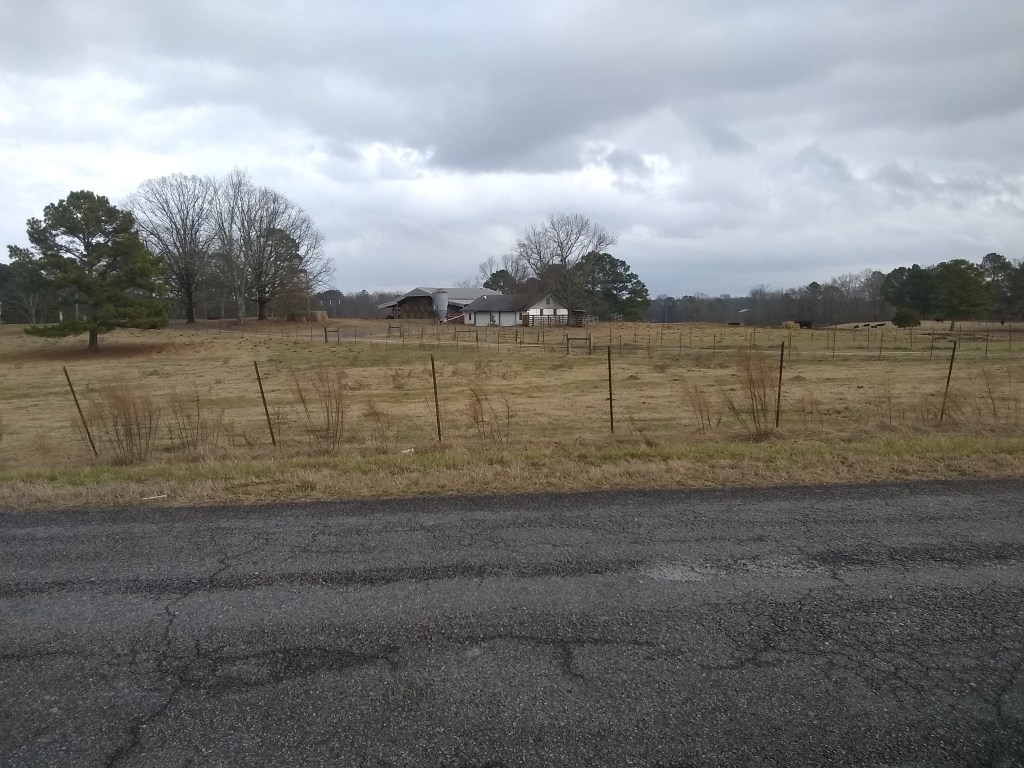
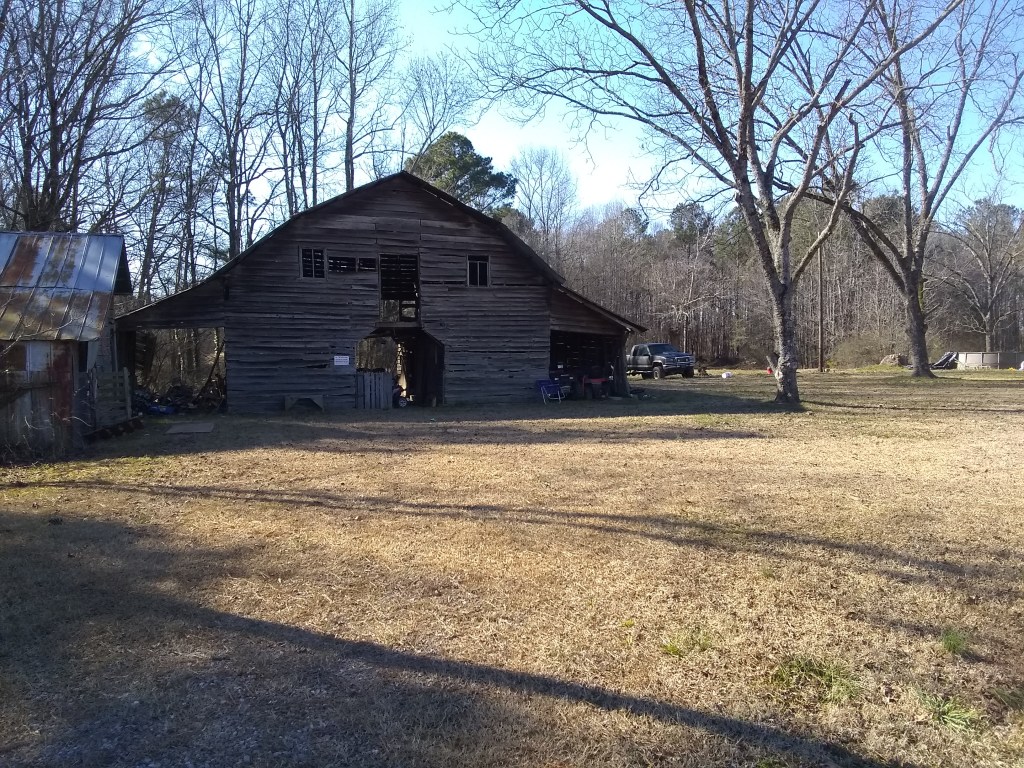
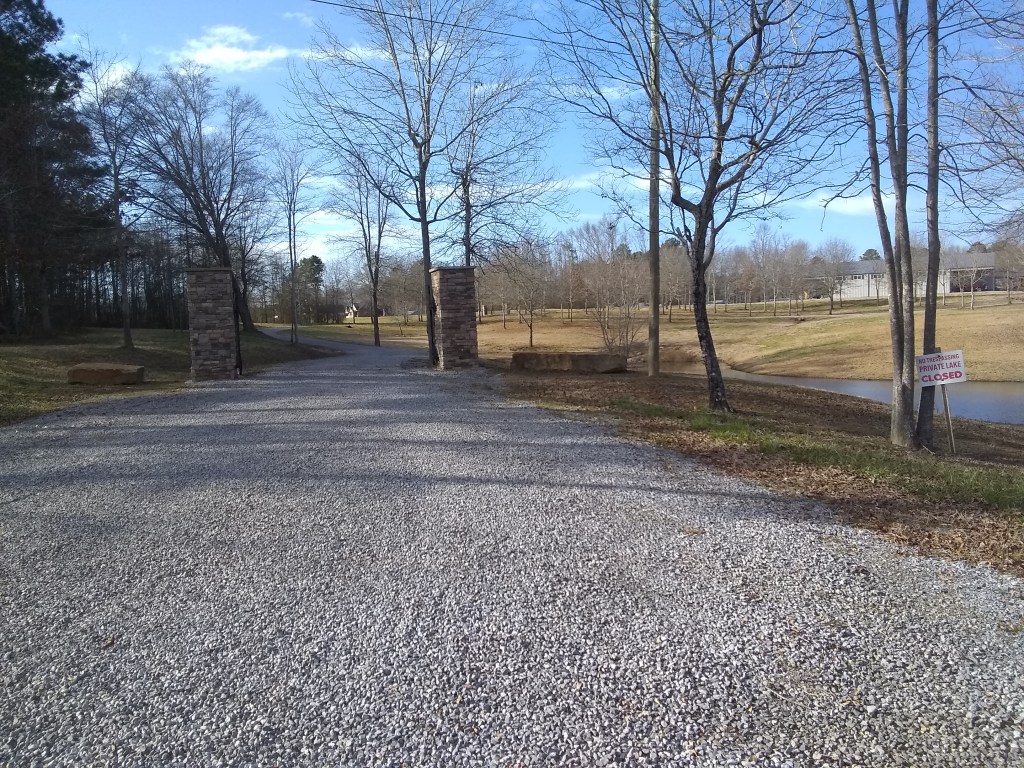
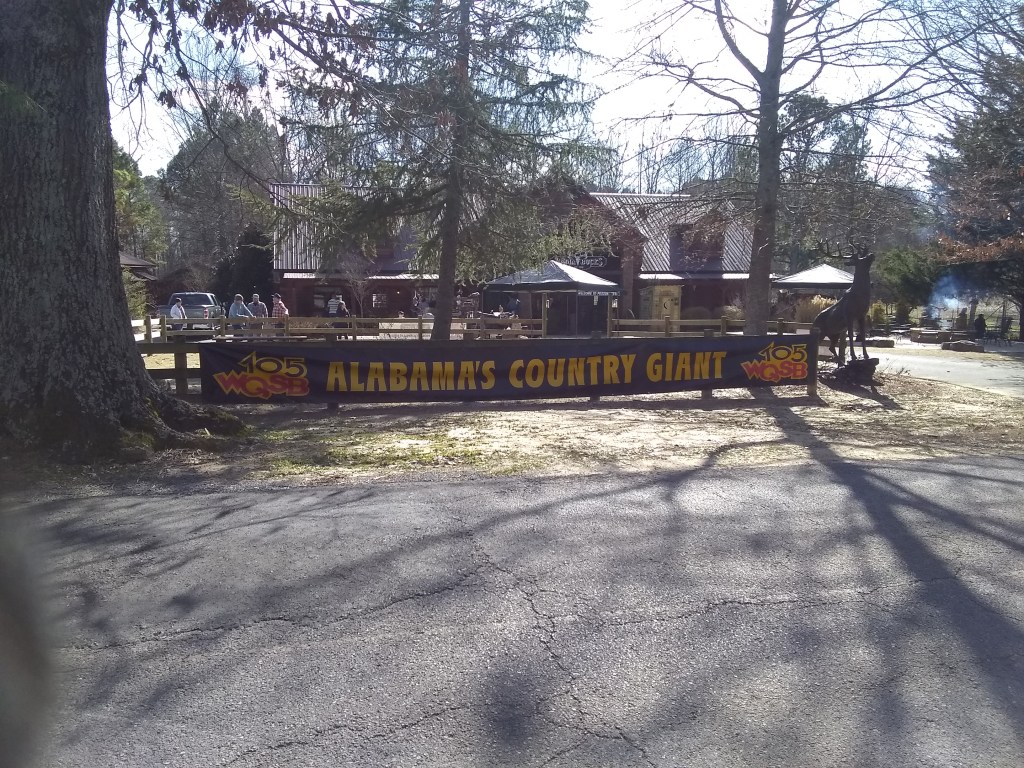
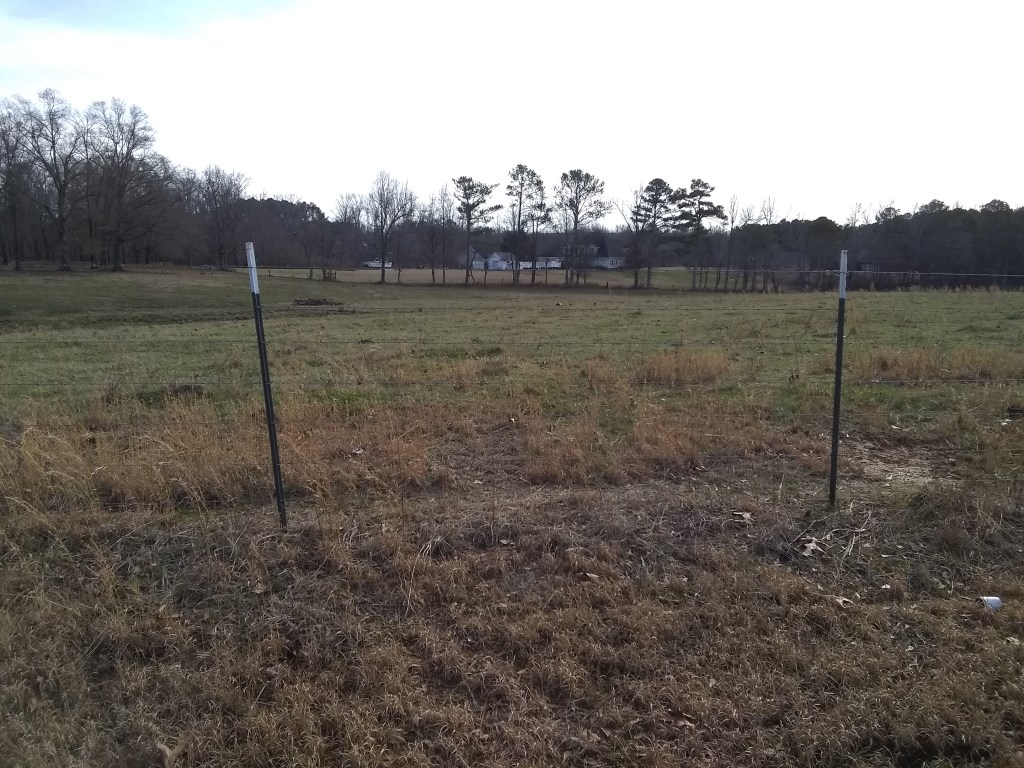
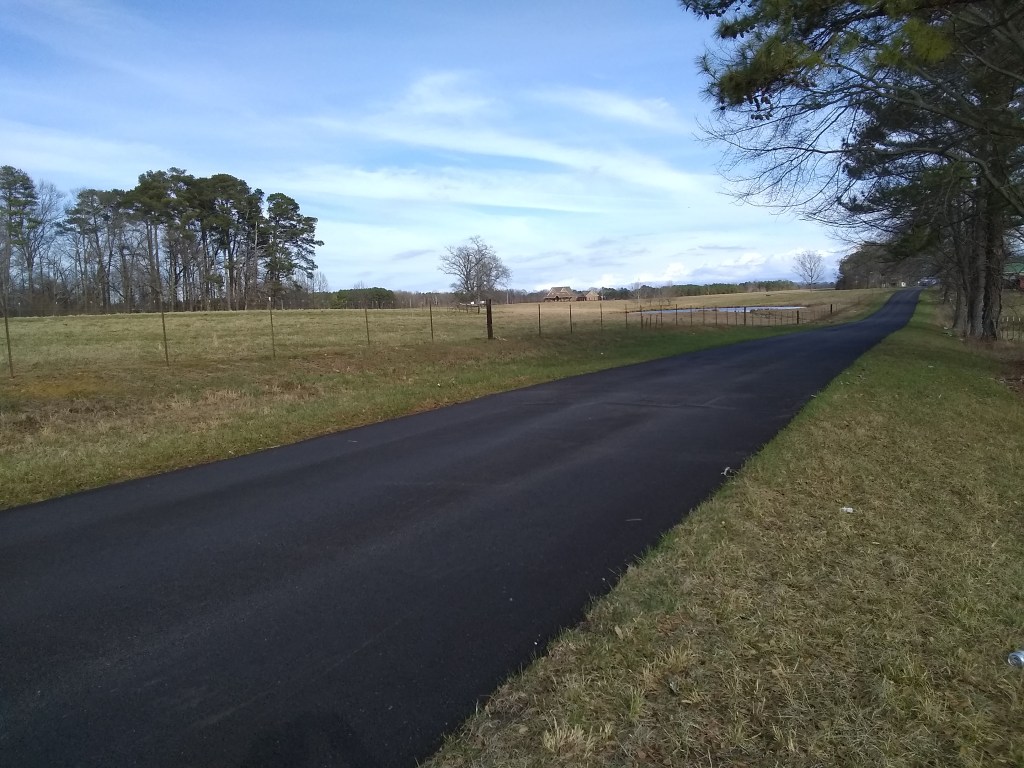
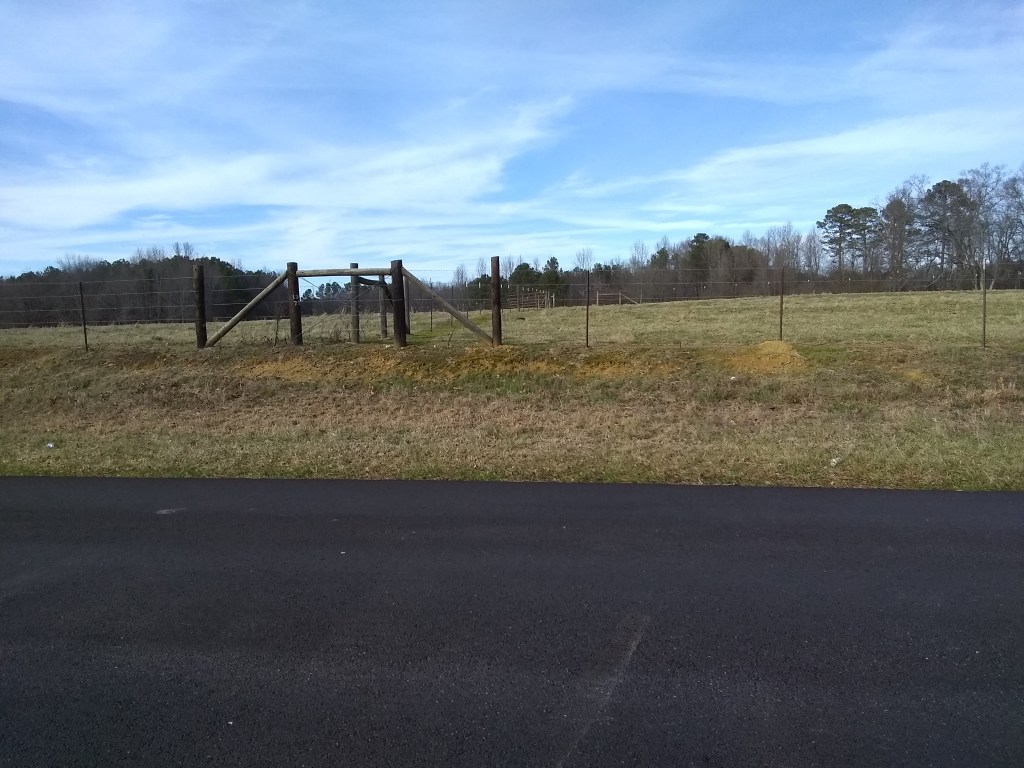
Here’s a few photos taken along my route:

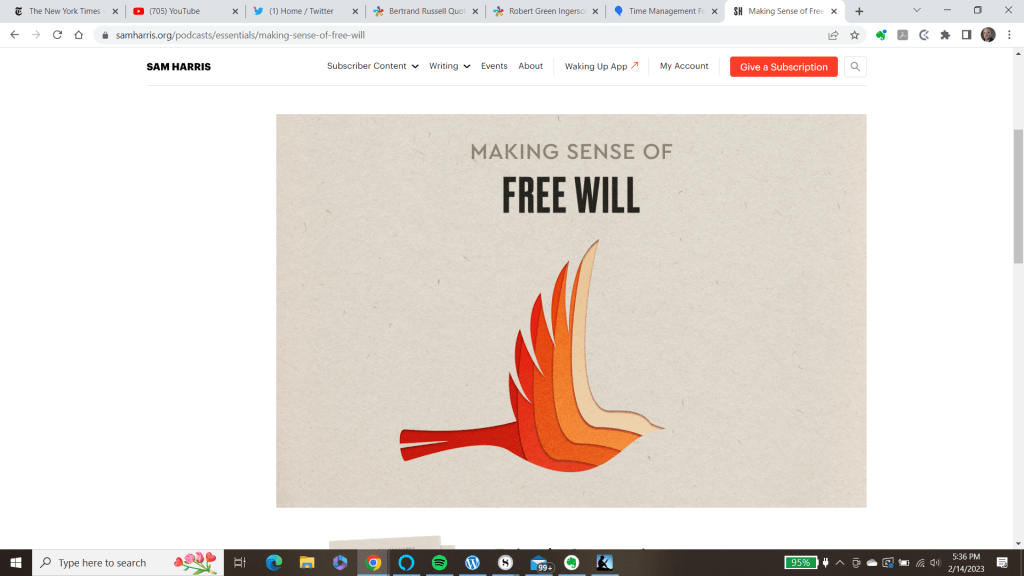
Here’s what I’m currently listening to (via Spotify):

MAKING SENSE OF FREE WILL–Episode 5 of The Essential Sam Harris

Here’s a link to this podcast.

Here’s another link to this podcast.

Abstract:

February 14, 2023

In this episode, we examine the timeless question of “free will”: what constitutes it, what is meant by it, what ought to be meant by it, and, of course, whether we have it at all. We start with the neuroscientist Robert Sapolsky who begins to deflate the widely held intuition and assumption of “libertarian free will” by drawing out a mechanistic and determined description of the universe.

We then hear from the philosopher who has long been Sam’s intellectual wrestling opponent on this subject, Daniel Dennett. Dennett and Sam spar about definitional and epistemological frameworks of what Dennett insists is “free will,” and what Sam contends could never be.

The author and physicist Sean Carroll then engages Sam with more attempts to find a philosophically defensible notion of free will by leaning on the unknowable nature of the universe revealed by quantum mechanics. We then listen in on Sam’s engagement with the mathematician and author Judea Pearl who focuses on matters of causation to tease out a freedom of will.

After a historical review of Princess Elizabeth’s famous exchanges with Rene Descartes, we hear from the biologist Jerry Coyne, who firmly agrees with Sam that a deterministic picture of reality leaves absolutely no room for anything like free will.

We then hear from the curiously entertaining mind of comedian and producer Ricky Gervais who was thinking about free will while taking a bath when he decided to phone Sam.

We conclude with Sam’s own response to concerns that an erasure of free will inevitably result in fatalism, loss of meaning, and passive defeat. Sam insists that the loss of free will actually pushes us in the opposite direction where we begin to see hatred and vengeance as incoherent and start to connect with a deeper and truer sense of genuine compassion.

Writing Journal—Wednesday writing prompt

Your character broke both legs in a water skiing accident and is bedridden for the next month. Bored with TV, she sets up her telescope to watch the happenings in her neighborhood and witnesses a crime in the home across the street. 

 Guidance & tips

One Stop for Writers

Write the scene of discovery (i.e., tell a story), or brainstorm and create a list of related ideas.

Here’s five story elements to consider:

  • Character
  • Setting
  • Plot
  • Conflict
  • Resolution

Never forget, writing is a process. The first draft is always a mess.

The first draft of anything is shit.

Ernest Hemingway

The Beginning and the End: Robinson Jeffers’s Epic Poem About the Interwoven Mystery of Mind and Universe

Here’s the link to this article.

“Pleasure and pain, wonder, love, adoration, hatred and terror: how do these thing grow from a chemical reaction?”

BY MARIA POPOVA

The Beginning and the End: Robinson Jeffers’s Epic Poem About the Interwoven Mystery of Mind and Universe

“We forget that nature itself is one vast miracle transcending the reality of night and nothingness,” the anthropologist and philosopher of science Loren Eiseley wrote in his poetic meditation on life in 1960. “We forget that each one of us in his personal life repeats that miracle.”

The history of our species is the history of forgetting. Our deepest existential longing is the longing for remembering this cosmic belonging, and the work of creativity is the work of reminding us. We may give the tendrils of our creative longing different names — poetry or physics, music or mathematics, astronomy or art — but they all give us one thing: an antidote to forgetting, so that we may live, even for a little while, wonder-smitten by reality.

In the same era, the science-inspired poet Robinson Jeffers (January 10, 1887–January 20, 1962) took up this reckoning in the final years of his life in an immense and ravishing poem that became the title of his collection The Beginning and the End (public library | free ebook), published the year after his death.

Robinson Jeffers by Edward Weston

Jeffers was not only an exquisite literary artist, but a visionary who bent his sight and insight far past the horizon of his time — he wrote about climate change long before it was even a tremor of a worry in the common mind, even though he died months before Rachel Carson published her epoch-making Silent Spring, which awakened the human mind from its ecological somnolence and seeded the environmental movement. But although he is celebrated as one of the great environmental poets, he was as enchanted by the wonders of nature on Earth as beyond it, for he understood better than any artist since Whitman that these are parts of a single and awesome reality, and we are part of it too — not as spectators, not as explorers, but as living stardust.

Born into an era when the atom was still an exotic notion for the average person and molecules a mystifying abstraction, Jeffers drew richly on the fundamental realities of nature — in no small part because his brother, Hamilton Jeffers, was one of the era’s most esteemed astronomers, having gotten his start at the Lick Observatory — the world’s first real mountaintop observatory, where the first new moon of Jupiter since the Galilean four had been discovered months before Hamilton was born.

Jupiter and its then-four moons by the self-taught 17th-century astronomer and artist Maria Clara Eimmart

Jeffers wrote about black holes and the Big Bang, about amino acids and novae, about the indivisibility of it all — nowhere more beautifully than in “The Beginning and the End.”

Sixty springs after he returned his borrowed stardust to the universe, his eternal poem came alive in a redwood-nested amphitheater down the mountain from the Lick Observatory, as the opening poem of the fifth annual Universe in Verse, read by my darling astronomer friend Natalie Batalha, who led the epoch-making discovery of more than 4,000 potential cradles for life by NASA’s Kepler mission and now continues her work on the search for life beyond our solar system with the astrobiology program at UC Santa Cruz.

As usual, Natalie prefaced her reading with a poignant reflection that is itself nothing less than a prose poem about the nature of life and its responsibility to nature — that is, to itself:

We are Earth. We are the planet. We are the biosphere. We are not distinct from nature.

Yet, at the same time, we are, as life — as living things: ourselves, the redwoods, the birds overhead — we are the pinnacle of complexity in the universe, from the Big Bang until now. It took 13.7 billion years for the atoms to come together to form this portal of self-awareness that is you.

[…]

Given this ephemeral existence that we have, of self-awareness, what are you going to do with your moment? What are we, as a species, going to do with our moment?

https://w.soundcloud.com/player/?visual=true&url=https%3A%2F%2Fapi.soundcloud.com%2Ftracks%2F1287039406&show_artwork=true&maxheight=1000&maxwidth=680

Excerpts from “THE BEGINNING AND THE END”
by Robinson Jeffers

The unformed volcanic earth, a female thing,
Furiously following with the other planets
Their lord the sun: her body is molten metal pressed rigid
By its own mass; her beautiful skin, basalt and granite and the lighter elements,
Swam to the top. She was like a mare in her heat eyeing the stallion,
Screaming for life in the womb; her atmosphere
Was the breath of her passion: not the blithe air
Men breathe and live, but marsh-gas, ammonia, sulphured hydrogen,
Such poison as our remembering bodies return to
When they die and decay and the end of life
Meets its beginning. The sun heard her and stirred
Her thick air with fierce lightnings and flagellations
Of germinal power, building impossible molecules, amino-acids
And flashy unstable proteins: thence life was born,
Its nitrogen from ammonia, carbon from methane,
Water from the cloud and salts from the young seas,
It dribbled down into the primal ocean like a babe’s urine
Soaking the cloth: heavily built protein molecules
Chemically growing, bursting apart as the tensions
In the inordinate molecule become unbearable —
That is to say, growing and reproducing themselves, a virus
On the warm ocean.

Time and the world changed,
The proteins were no longer created, the ammoniac atmosphere
And the great storms no more. This virus now
Must labor to maintain itself. It clung together
Into bundles of life, which we call cells,
With microscopic walls enclosing themselves
Against the world. But why would life maintain itself,
Being nothing but a dirty scum on the sea
Dropped from foul air? Could it perhaps perceive
Glories to come? Could it foresee that cellular life
Would make the mountain forest and the eagle dawning,
Monstrously beautiful, wings, eyes and claws, dawning
Over the rock-ridge? And the passionate human intelligence
Straining its limits, striving to understand itself and the universe to the last galaxy.

[…]

What is this thing called life? — But I believe
That the earth and stars too, and the whole glittering universe, and rocks on the mountain have life,
Only we do not call it so — I speak of the life
That oxydizes fats and proteins and carbo-
Hydrates to live on, and from that chemical energy
Makes pleasure and pain, wonder, love, adoration, hatred and terror: how do these thing grow
From a chemical reaction?

I think they were here already. I think the rocks
And the earth and the other planets, and the stars and galaxies
Have their various consciousness, all things are conscious;
But the nerves of an animal, the nerves and brain
Bring it to focus

[…]

The human soul.
The mind of man…
Slowly, perhaps, man may grow into it —
Do you think so? This villainous king of beasts, this deformed ape? — He has mind
And imagination, he might go far
And end in honor. The hawks are more heroic but man has a steeper mind,
Huge pits of darkness, high peaks of light,
You may calculate a comet’s orbit or the dive of a hawk, not a man’s mind.

Complement with other highlights from The Universe in Verse — including readings and reflections by Rebecca Solnit, Yo-Yo Ma, Patti Smith, and more — then savor Jeffers’s breathtaking letter to the principal of an all-girls Catholic school about moral beauty and the interconnectedness of the universe.

02/14/23 Biking & Listening

Biking is something else I both love and hate. It takes a lot of effort but does provide good exercise and most days over an hour to listen to a good book or podcast. I especially like having ridden.

Here’s my bike, a Rockhopper by Specialized. I purchased it November 2021 from Venture Out in Guntersville; Mike is top notch! So is the bike, and the ‘old’ man seat I salvaged from an old Walmart bike.

Here’s a link to today’s bike ride. I obviously favor my pistol route.

Here’s a few photos taken along my route:

Here’s what I’m currently listening to (via Spotify):

MAKING SENSE OF FREE WILL–Episode 5 of The Essential Sam Harris

Here’s a link to this podcast.

Here’s another link to this podcast.

Abstract:

February 14, 2023

In this episode, we examine the timeless question of “free will”: what constitutes it, what is meant by it, what ought to be meant by it, and, of course, whether we have it at all. We start with the neuroscientist Robert Sapolsky who begins to deflate the widely held intuition and assumption of “libertarian free will” by drawing out a mechanistic and determined description of the universe.

We then hear from the philosopher who has long been Sam’s intellectual wrestling opponent on this subject, Daniel Dennett. Dennett and Sam spar about definitional and epistemological frameworks of what Dennett insists is “free will,” and what Sam contends could never be.

The author and physicist Sean Carroll then engages Sam with more attempts to find a philosophically defensible notion of free will by leaning on the unknowable nature of the universe revealed by quantum mechanics. We then listen in on Sam’s engagement with the mathematician and author Judea Pearl who focuses on matters of causation to tease out a freedom of will.

After a historical review of Princess Elizabeth’s famous exchanges with Rene Descartes, we hear from the biologist Jerry Coyne, who firmly agrees with Sam that a deterministic picture of reality leaves absolutely no room for anything like free will.

We then hear from the curiously entertaining mind of comedian and producer Ricky Gervais who was thinking about free will while taking a bath when he decided to phone Sam.

We conclude with Sam’s own response to concerns that an erasure of free will inevitably result in fatalism, loss of meaning, and passive defeat. Sam insists that the loss of free will actually pushes us in the opposite direction where we begin to see hatred and vengeance as incoherent and start to connect with a deeper and truer sense of genuine compassion.

Drafting–Over steak dinner, Colton explains to Sandy why Mildred Simmons must ‘go’

It was almost six when Colton was awakened by Sandy’s yelling, “dinner’s served.” By the tone of his voice, this wasn’t the first time he’d broadcast the announcement.

Colton reached to the bedside table and activated his iphone. It was almost 6:00 PM. A sudden wave of nausea roiled his stomach as he recalled reinserting the SIM card and searching for Ray’s Garage. The results had been disappointing. It seemed every state had a dozen or more similarly-named shops, with half the major cities having at least one or two. Plus, there were countless ‘Ray’s Garage,’ ‘Ray’s Automotive,’ ‘Ray’s Auto Repair,’ and ‘Ray’s whatever’ in small towns scattered across the country. What pissed Colton nearly as much, now, was he’d failed to remove the card after his research. “Damn, all we need is the law showing up.”

He sat up along the side of his bed and removed the SIM card from his iPhone, reminded there were more pressing matters to attend to. Although finding Molly and Millie were critical, if Mildred Simmons connected a couple of dots, she likely would report Colton’s and Sandy’s whereabouts to the police. Then, they’d be arrested, and likely never experience another day of freedom. The bottom line, at least to Colton, was that Mildred had to disappear. And, this needed to take place no later than noon Monday, a time when the Chicago Tribune or some other newspaper, TV or radio station, or an online site published their failure to appear.

Colton stood and slipped his feet into his boots and headed to the kitchen, two things pressed his mind. First, was simply an acknowledgment Pop’s place was a good place to hideout. Second, he had to convince Sandy that Mildred had to go.

“I like your hair.” Colton commented as he plopped down at the dining room table. Sandy was managing his long, reddish-blond curls with a black nylon hairnet, one he’d found tucked inside the towel drawer where Pop had kept them.

At first, Sandy didn’t respond but kept pouring tea in two glasses. “House rule from as long as I can remember. Pop hated finding a hair in his food.”

The table clearly revealed one of Sandy’s primary passions. The food was a thing of beauty, like a painting created by a talented artist. At two place-settings, were large, still steaming, rib-eyes on crystal platters. On smaller plates were baked potatoes already prepped with butter, sour-cream, cheddar, and topped with chopped chives, and bacon bits. Nearby were small bowls of corn and black beans; optional for the stuffed potatoes. To Colton, his salad looked like it had been created by a five-star chef. He was no expert but concluded the greens were romaine lettuce, spinach, and kale. Mixed within were sweet peppers, cherry tomatoes, and snap peas. Along the edges were small slices of carrots, cucumbers, and apples. There was a thick dusting of feta and bleu cheese across the entire salad. The dressings were in eight-ounce clear glass dispenser bottles, each labeled in Sandy’s scrawl. One read balsamic vinegar, the other balsamic vinaigrette. Colton didn’t know the difference, and didn’t care, having always chosen Ranch or Thousand Island.

“Got any other salad dressing? What about steak sauce?” Colton asked, taking a sip of sweetened tea.

“Might have known you wouldn’t be satisfied.” Sandy walked to the refrigerator and returned with bottles of Ranch, Bleu Cheese, Heinz 57, and Worcestershire. “Good thing Pop’s not here, he’d make you eat on the porch.”

“I bet he was one of those ‘good steak doesn’t need any sauce’ types.” Colton added, happy he’d never met Pop.

“You got it.” Sandy took his love for cooking from his mother. The two had spent most of their spare time in the kitchen, and had talked of starting their own restaurant. Money had been the biggest roadblock, but now that Pop had died and left his grandson a respectable nest egg, Sandy was imagining a life free from prison, and enslaved to a commercial kitchen.

Both men began eating as though they were starving. Colton’s habit was to eat one thing at a time, starting with his steak, then intermittently devour potato and salad until he was stuffed. “Where’s the bread?” He was a sopper, as in after eating a plate of food, he’d sop up what’s left with a piece of bread.

Sandy used his steak knife and cut his potato crosswise in half. “Another house rule. Bread and potatoes are carbohydrates, Pop wouldn’t allow both at the same meal.”

Colton forked another slice of steak, stood, and walked to the kitchen. He’d seen a vintage bread box while bringing in the groceries. Inside, he found a loaf of Wonder Bread. Just as he was unwinding the tie, there was a knock at the back door.

“Come in.” Sandy stood and half-ran to greet Mildred. He looked at Colton, shaking his head sideways, and pulling pinched fingers across his lips as though zipping his mouth closed.

“Hey gents, I brought you a loaf of my sour-dough bread.”

“Here’s your salad.” Sandy said removing from the refrigerator a platter piled high.

Colton returned to the table with three slices of white bread and continued eating his steak. Mildred and Sandy exchanged comments about the easing storm before she left.

Before Sandy could complete two steps toward Colton exploded. “What the flying fuck?”

After Sandy explained why he called Mildred and offered a salad—as a thank-you for the coconut cake—Colton slammed his fist on the table nearly knocking over his tea. “You need to wake the fuck up. How many times do we need to plow this same ground. Your friendly-as-cancer-neighbor is going to be our downfall if we don’t act and act matter-of-fact.”

“Hold your damn horses. I’ve already acted. I talked to her about our predicament.” Sandy continued eating, fully trusting the wrinkled-faced woman would do as instructed.

“What exactly did you tell her?” Colton’s mind was racing. He imagined Sandy as the enemy, although they’d been friends over half their lives.

“I assumed she’d read the papers you left in plain sight and told her we were innocent but the DA was determined to convict someone, anyone for those brutal crimes, and send them to prison for the rest of their lives. I told her we needed a place to hide and that’s why we’re hanging out here at Pop’s place.”

Colton couldn’t believe Sandy was so stupid. “Congratulations, you couldn’t have done a better job if you’d called the DA and given him our address. You’ve just guaranteed our failure.”

The men sat silent for several minutes, continuing to eat but with fading appetites. Especially for Colton.

“What do we do?” This was Sandy’s common attempt at regaining credibility with his friend Colton. He’d screw up, often acting without any thought whatsoever, then somehow, realizing his mistake, he’d turn to Colton for answers and direction.

It wasn’t easy but he knew it was necessary. “Mildred has to go.” Colton said in his most definitive and persuasive tone. “It’s her or us.”

Sandy retorted, clearly revealing his conscience was more sensitive than Colton’s. “What if we asked her for help? Now, before you blow up, listen. What if we put her to the test? I’m thinking we tease her.”

“I don’t have a clue what you’re saying.” Colton finished his steak and forked a bite of potato dipping it in a pile of Ranch dressing he’d poured at the edge of his salad.

“Say we feed her an article, after Monday, that states we failed to appear and now warrants have been issued for our arrest. Then, we watch her. To see what she does. I’m thinking and hoping she’d do nothing or come to us, maybe offering to help.”

“What are we going to do, move in with her so we can watch her every minute, or, do you propose, we act as peeping toms and stand outside her window?”

During the next twenty minutes, Colton used his best scare tactics, emphasizing in detail a life-inside-a-prison scenario to persuade Sandy what had to be done. It hadn’t been easy, especially given his intelligent retort, “if Mildred disappears, somebody will eventually notice. Seems to me that guarantees the police will come snooping around. What then?”

That’s when Colton thought of Mildred Simmons’ like-new Sprinter van.

Writing Journal—Tuesday writing prompt

Your protagonist is flipping through a book at the library when a note falls out. It contains a message from someone begging for help, along with an address. What does your character do? 

One Stop for Writers

 Guidance & tips

Write the scene of discovery (i.e., tell a story), or brainstorm and create a list of related ideas.

Here’s five story elements to consider:

  • Character
  • Setting
  • Plot
  • Conflict
  • Resolution

Never forget, writing is a process. The first draft is always a mess.

The first draft of anything is shit.

Ernest Hemingway

02/13/23 Biking & Listening

Biking is something else I both love and hate. It takes a lot of effort but does provide good exercise and most days over an hour to listen to a good book or podcast. I especially like having ridden.

Here’s my bike, a Rockhopper by Specialized. I purchased it November 2021 from Venture Out in Guntersville; Mike is top notch! So is the bike, and the ‘old’ man seat I salvaged from an old Walmart bike.

Here’s a link to today’s bike ride. Four and a half hours dealing with a plumbing issue limited today’s ride.

Here’s a few photos taken along my route:

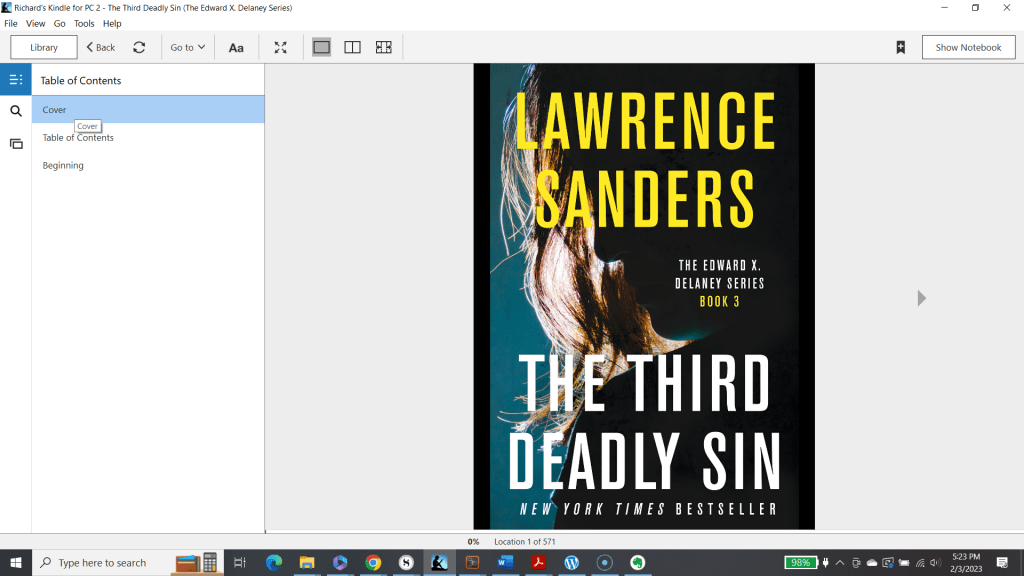
Here’s what I’m currently listening to: The Third Deadly Sin, by Lawrence Sanders

Sanders was a tremendously talented writer.

Amazon abstract:

New York Times Bestseller: A retired cop hunts for a female serial killer no one would suspect in this “first-rate thriller . . . as good as you can get” (The New York Times).

By day, she’s a middle-aged secretary no one would look at twice. But by night, dressed in a midnight-black wig, a skin-tight dress, and spike heels, she’s hard to miss. Inside her leather shoulder bag are keys, cash, mace, and a Swiss Army knife. She prowls smoky hotel bars for prey. The first victim—a convention guest at an upscale Manhattan hotel—is found with multiple stab wounds to the neck and genitals. By the time retired police detective chief Edward Delaney hears about the case from an old colleague, the Hotel Ripper has already struck twice. Unable to resist the puzzle, Delaney follows the clues and soon realizes he’s looking for a woman. As the grisly slayings continue, seizing the city in a chokehold of panic, Delaney must stop the madwoman before she kills again.

A Sample Five Star Review

M. G Watson

VINE VOICE

5.0 out of 5 stars Third Time’s the Charm

Reviewed in the United States on May 15, 2015

Verified Purchase

It is arguable that Lawrence Sanders never rose to greater heights as a prose stylist, suspense-writer or storyteller than he did with THE THIRD DEADLY SIN, the penultimate novel in his “deadly sin” series of books and the fourth of five to feature crusty, sandwich-obsessed Edward X. Delaney as a protagonist. Though once referred to as “Mr. Bestseller” and nearly as prolific in his day as Stephen King, Sanders seems to be forgotten now, except for his “McNally” series which was hardly representative of his best work; but at his best he was both compulsively readable and immensely satisfying, and this novel is both.

Zoe Kohler is the world’s most boring woman. Hailing from a small town somewhere in the Midwest, divorced from a husband who treated her like she was invisible, virtually friendless, and stuck in a mindless, dead-end job in the security office of an old hotel in Manhattan, she worries incessantly about her health and indulges in only one hobby: murder. Sexing herself up every Friday night, Zoe picks up unsuspecting businessmen attending conventions in different hotels around town, and delivers to each the same grisly fate: a Swiss Army knife, first to the throat and then to the jewels. But because nobody ever notices the world’s most boring woman, nobody suspects her, leaving Zoe free to indulge her hobby — over and over and over again.

Edward X. Delaney used to be a cop — and not just any cop, but the NYPD’s Chief of Detectives. Now, of course, he’s just a bored retiree, living in a Manhattan brownstone with this second wife. So when his former “rabbi” in the Department, Deputy Commissioner Ivar Thorsen, asks him to help investigate a series of baffling murders being committed in hotels around the city, Delaney agrees, but has little idea what he’s getting into: a search for a faceless, motiveless “repeater” (1970s slang for serial killer) whose vicious talents with a short-bladed knife are wreaking havoc with New York’s once-thriving convention trade. Acting as an unofficial adviser to the “Hotel Ripper” task force, Delaney begins to suspect that male prejudices, including his own, may be blinding his fellow detectives to the possibility of that the Ripper may not be a man. But he has no suspects, no witnesses, no fingerprints, and no hard evidence. Only instincts. And a growing pile of victims.

THE THIRD DEADLY SIN is a very attractive suspense novel for many reasons. Aside from Sanders prose style, which is beautiful, memorable and incredibly evocative, it works on multiple levels. Firstly, the character of Zoe Kohler. She is at once both a pitiable loser, struggling with health problems and sexist attitudes at work a burgeoning relationship with a sweet and unsuspecting man…and a remorseless, relentless killer, who hunts men for the sheer thrill of it. Second, Edward X. Delaney. This crusty, hard-nosed, sandwich-obsessed detective is neither sexy, flashy, nor gifted with any great deductive genius: he’s simply like a boulder that, starting slowly, gathers investigative momentum until he crushes just about everyone in his path, yet at the same time possesses a sensitivity — largely through his wife’s softening influence — that allows him more nuances than a typical, cigar-chewing, old school detective. And this leads me to the books third major strength, which is its examination of sexual attitudes, gender roles and (unintentionally) police procedure during the period it was written — about 35 years ago. At that time the pathology of serial killers was scarcely understood, forensic science still in its infancy, and the idea of gender equality more of a punchline than a serious idea. Delaney, an aging Irish cop with flat feet, is both brimming with cheauvanistic, patronizing, old-school attitudes and open to the possibility that those attitudes may be wrong.

No novel is perfect, of course, and this one is no exception. Sanders sometimes makes small but basic errors in matters of police procedure, slang and etiquette; the sort of mistakes which are the result of never having been a cop himself. Occasionally he tries too hard to make characters colorful, giving them a contrived rather than a naturalistic feel; and sometimes his dialogue and description betray his overwhelming love of the English language and end up sounding pretentious or, coming out of the mouths of certain characters, simply unrealistic. (This also leads him to over-write scenes with minor characters, such as Zoe’s doctor.) Most of the criticisms I can mount a this book, however, fall in the “nitpicking” category, and even when taken in the aggregate fail to outweigh all of its many pleasures.

THE THIRD DEADLY SIN may or may not have been Sanders’ best book (you could make a case for THE SIXTH COMMANDMENT or THE SECOND DEADLY SIN or THE ANDERSON TAPES or various others). It may not even be his best suspense novel. But for my money it is not merely a good read but equally satisfying upon each subsequent reading, which is about the highest praise I can give to an author’s work. So: buy it, make yourself a sandwich, and sit down to this half-forgotten but deservedly remembered author. Murder and mayhem have never been so fun.

To the Young Who Want to Die: Roxane Gay Reads Gwendolyn Brooks’s Lifeline of a Poem

Here’s the link to this article.

“The gun will wait. The lake will wait. The tall gall in the small seductive vial will wait will wait.”

BY MARIA POPOVA

“There is but one truly serious philosophical problem, and that is suicide,” Albert Camus wrote in one of the most provocative opening sentences in all of literature, unspooling into one of the most daring works of philosophy. “Judging whether life is or is not worth living amounts to answering the fundamental question of philosophy. All the rest — whether or not the world has three dimensions, whether the mind has nine or twelve categories — comes afterwards.”

Camus was both very right and very wrong, the way only a great mind can be, because the fundamentals of philosophy come after, not before, the fundamentals of physics.

Art by Valerio Vidali from The Shadow Elephant by Nadine Robert — a soulful illustrated fable about depression and how the will for light returns

By the time we can even begin answering for ourselves the question of whether or not is worth living, myriad things have been answered for us by the fundamental forces that have conspired into the confluence of chance that is our self. None of us choose the bodies or brains or neurochemistries we are born with, the time and place we are deposited into, the parents we are raised by, the culture we are cultured in. Any sense of choice we might have is already saturated with these chance inheritances and is therefore, as James Baldwin so astutely observed, part illusion and part vanity.

And yet live we must, with the cards we have been dealt, daily answering Camus’s question with our pre-answered fundaments of chaos and chance.

On those days when we are so life-weary, so defeated by the chance-circumstance of our situation, so tempted to answer in the negative, the smallest gesture of kindness can be nothing less than a lifeline. That is what Gwendolyn Brooks (June 7, 1917–December 3, 2000) realized over breakfast at a hotel one day in her late sixties, when the young waiter met her simple bright “Good morning!” with a gasp on the verge of tears: “Oh, thank you, thank you!”

She wondered what he must be living through, if so early in life and so early in the day he was already so heavy with despair, so grateful for the salvation of a simple smile from a stranger. (One such smile had saved Little Prince author Antoine de Saint-Exupéry’s life half a century earlier.)

One of teenage artist Virginia Frances Sterrett’s 1920 illustrations for old French fairy tales. (Available as a print.)

Out of that compassionate wonderment came Brooks’s lifeline of a poem “To the Young Who Want to Die,” which appeared in her 1987 collection The Near-Johannesburg Boy and Other Poems (public library), dedicated to the students of the Gwendolyn Brooks Junior High School, published by the imprint she had founded and named after her father, the janitor of a music company.

At the 2022 Universe in Verse, themed What Is Life?Roxane Gay brought the poem to life, prefaced with a poignant personal reflection on the poem in the context of the devastating loss of her brother:

https://w.soundcloud.com/player/?visual=true&url=https%3A%2F%2Fapi.soundcloud.com%2Ftracks%2F1310138059&show_artwork=true&maxheight=1000&maxwidth=680

TO THE YOUNG WHO WANT TO DIE
by Gwendolyn Brooks

Sit down. Inhale. Exhale.
The gun will wait. The lake will wait.
The tall gall in the small seductive vial
will wait will wait:
will wait a week: will wait through April.
You do not have to die this certain day.
Death will abide, will pamper your postponement.
I assure you death will wait. Death has
a lot of time. Death can
attend to you tomorrow. Or next week. Death is
just down the street; is most obliging neighbor;
can meet you any moment.

You need not die today.
Stay here — through pout or pain or peskyness.
Stay here. See what the news is going to be tomorrow.

Graves grow no green that you can use.
Remember, green’s your color. You are Spring.

Complement with Galway Kinnell’s kindred poem “Wait,” composed to keep a young friend from taking his own life, then revisit Gwendolyn Brooks on the vivifying power of books and Audre Lorde, in a wonderful anthology edited by Roxane Gay, on poetry as an instrument of change and courage.

Writing Journal—Monday writing prompt

As he’s taking out his garbage before work, a neighbor kicks your protagonist’s dog. In a twist of fate, the neighbor forgets to close his garage door as he drives off. How might your character get revenge?

One Stop for Writers

 Guidance & tips

Write the scene of discovery (i.e., tell a story), or brainstorm and create a list of related ideas.

Here’s five story elements to consider:

  • Character
  • Setting
  • Plot
  • Conflict
  • Resolution

Never forget, writing is a process. The first draft is always a mess.

The first draft of anything is shit.

Ernest Hemingway

A Language for the Exhilaration of Being Alive: The Poetic Physicist Alan Lightman on Music and the Universe

Here’s the link to this article.

“Nowhere is the joy of existence so apparent as in music… Intelligent life-forms have created a multitude of sounds that express their exhilaration at being alive.”

BY MARIA POPOVA

A Language for the Exhilaration of Being Alive: The Poetic Physicist Alan Lightman on Music and the Universe

“Matter delights in music, and became Bach,” Ronald Johnson wrote in his stunning 1980 prose poem about music and the mind. This may be why music so moves and rearranges and harmonizes us, why in it we become most fully ourselves — “atoms with consciousness,” axons with feeling. When music courses through us, we are reminded that the mind and the body are one, and that the body — like music, like feeling, like the universe itself — is made of matter and time. It may even be that music is the language of time, mathematics its alphabet; that Margaret Fuller was right when she insisted two centuries ago that “all truth is comprised in music and mathematics”; that, as the cosmologist and jazz saxophonist Stephon Alexander observed in our own century, “it is less about music being scientific and more about the universe being musical.”

That is what the poetic physicist Alan Lightman explores with great subtlety and splendor throughout his conceptual masterpiece Mr g: A Novel About the Creation (public library), which reads like one long prose poem and which also gave us the transcendent science of what actually happens when you die.

Composition 8 by Wassily Kandinsky, 1920s, inspired by the artist’s experience of listening to a symphony. (Available as a print.)

Through his protagonist — the young creator Mr. g, bored and unsure of himself (“unlimited possibilities bring unlimited indecision”) as he spins a baby universe out of the Void while his aunt and uncle watch on with approving, critical, and sage pronouncements — Alan envisions the realities, as theorized by our current science, of how the universe began, punctuating them with fundaments of our humanity, none more elemental than the soul-resonance of music:

Then there was music. The Void had always vibrated with the music of my thoughts, but before the existence of time the totality of sounds occurred simultaneously, as if a thousand thousand notes were played all at once. Now we could hear one note following another, cascades of sound, arpeggios and glissades. We could hear melodies. We could hear rhythms and metrical phrases gathering up time in lovely folds of sound. Duples and triples and offbeat syncopations. As we moved through the Void [we] were transfixed by the most exquisite sounds, the tender and melodic and rapturous oscillations of the Void.

As Mr. g proceeds with his rapturous experiment, most of the music he makes follows a Pythagorean scale, because “chords based on these scales were pleasing to hear,” but he also tinkers with asymmetrical and nonharmonic ratios, which “also produced beautiful music as long as two different notes were not sounded together.” (These, of course, are allusions to the Western and non-Western music traditions.) He writes:

In every place and in every moment, we were wrapped and engulfed in music. At times, the music poured forth in fierce heaving swells. At other times, it advanced in the softest little steps, delicate as a fleeting veil in the Void. Music clung to our beings as parcels of emptiness had in the past. Music went inside us. I had created music, but now music created; it lifted and remade and formed a completeness of being.

One of William Blake’s paintings for The Book of Job, 1806. (Available as a print.)

In consonance with philosopher Susanne Langer’s lovely formulation of music as “our myth of the inner life,” he adds:

Nowhere is the joy of existence so apparent as in music… Intelligent life-forms have created a multitude of sounds that express their exhilaration at being alive.

At the 2022 Universe in Verse, I invited Alan — a passionate pianist himself — to reflect on the personal and universal power of music and its abiding relationship to physics before reading an excerpt from Robert Johnson’s epic poem:

https://w.soundcloud.com/player/?visual=true&url=https%3A%2F%2Fapi.soundcloud.com%2Ftracks%2F1324673122&show_artwork=true&maxheight=1000&maxwidth=680

When I sit down at the piano, I enter two different realms: one conscious and one unconscious. The conscious realm is one in which I think about the notes I’m going to play, and the timing and the rhythm and the intensity; and the unconscious is when I just let go and float with the sound. Music is an expression both of the orderly discipline of science and the unfettered flight of the human spirit.

Complement with violinist Natalie Hodges on the poetic science of feeling in sound and composer Caroline Shaw’s transcendent musical inspiriting of classic poetry, then revisit Alan Lightman on time and the antidote to our existential anxiety.