Puncturing the God Fallacy, Repeatedly and Thoroughly

By David Madison at 2/17/2023

Here’s the link to this article.

Religion’s greatest harm: “…the subversion of clear thinking…”

“I’m mad as hell, and I’m not going to take it anymore.” This famous line from the 1976 film, Network, reflects the approach of so many secular/atheist writers of our time. Outrage is reignited, continually.

This headline caught my attention a few days ago: Thousands of children abused by members of Portugal’s Catholic Church over 70 years. At the top of the article:

“At least 4,815 children were sexually abused by members of the Portuguese Catholic Church – mostly priests – over the past 70 years, a report by the commission investigating the issue said on Monday, adding the findings are the tip of the iceberg.” Child psychiatrist Pedro Strecht said “the 4,815 cases were the ‘absolute minimum’ number of victims of sexual abuse by clergy members in Portugal since 1950…Most perpetrators (77%) were priests and most of the victims were male…they were abused in Catholic schools, churches, priests’ homes, confessionals, among other locations.”

Such scandals have come to the public’s attention repeatedly, worldwide. We are entitled to wonder: Why isn’t membership in the Catholic Church down to zero by now? Systemic sexual abuse also has come to light in Protestant denominations as well. It would seem that the apostle Paul misjudged the impact of believing in Jesus: “…those who belong to Christ have crucified the flesh with its passions and desires” (Galatians 5:24).

If we’re surveying damage done by religion, sex-obsessed clergy is just the tip of the iceberg—and there are a lot of other icebergs. Christopher Hitchens provided a comprehensive overview in his book, God Is Not Great: How Religion Poisons Everything. Given this reality, theology is overwhelmingly incoherent, but folks keep showing up for church because they’ve perfected the fine art of tuning out. They cling to doctrines and ritual by ignoring solid arguments against god-beliefs: “Oh no, we can’t listen to that!” “Oh no, we don’t want to think about the challenges to faith!” We can suspect that such alarm is based on doubts that lurk just below the surface; they’re afraid—they know all too well—that faith is easily punctured.  

There has been a long tradition of exposing the flaws of theism, especially the Christian version, e.g. Robert Ingersoll, Mark Twain, H. L. Mencken, Bertrand Russell, to name but a few. But the faith-motivated horrors of 9/11 prompted what I have called the atheist publishing surge: so many serious thinkers raising their voices because they’re mad as hell. The case against theism has been made so thoroughly, so convincingly. Of course, Christian apologists have been fighting back—there is so much at stake, above all, the hope of winning eternal life. But on the more practical, political level: they have a vested interest in the colossal Christian bureaucracy, spread over thousands of denominations: exactly what the world doesn’t need. All the more reason to expose Christianity’s fatal flaws. 

We have the Debunking Christianity Blog because of the focus and determination of John W. Loftus, who has also been busy for quite a few years publishing books on the falsification of Christianity. To see them all at a glance, visit his Amazon Author Page. This is a good place to start in appreciating how thoroughly Christian theology has been smashed. Many of Loftus’ works are anthologies, and are thus helpful portals for finding books by multiple atheist authors.  

I’m always on the lookout for concise refutations of theological pretense, and I found an especially good one a few years ago in S. T. Joshi’s book, God’s Defenders: What They Believe and Why They are Wrong. Among the god-defenders he takes aim at are William F. Buckley, Jr., Jerry Falwell, and C. S. Lewis. Today I want to draw attention, however, to his 18-page Introduction, a scathing rebuke of theism. He explains precisely why religions have been successful; they have been “…perpetuated not through the accumulation of additional evidence that validated their tenants, but through the systematic indoctrination of peoples into religious dogma from infancy onward, generation after generation” (p. 12).

“The dominant question thus becomes not why religion has not died away but why it continues to persist in the face of monumental evidence to the contrary. To my mind, the answer can be summed up in one straightforward sentence: People are stupid. The fundamental fact of human history is that people in the mass are irremediably ignorant” (p. 12). 

Stupidity and ignorance. Certainly this is not a good place to start when I engage with devout Christians: “Oh my, how stupid you are!” “How have you managed to stay so ignorant?”  There’s a better way to go about it. I ask questions about their understanding of Christian origins, their knowledge of the four gospels and how they relate. Mostly commonly, I find that their grasp of such things hovers near zero. How do stupidity and ignorance relate? Joshi suggests this:

“When I declare that religion is so widespread because people in the mass are stupid, I assert that they lack the information needed to make a well-informed evaluation of the truth-claims of religion” (p. 13).

Perhaps refusal to seek important information is one of the fundamentals of stupidity: the brain is stuck in a very bad place: the lack of curiosity, not wanting to learn, the refusal to learn—even contempt for learning, e.g.: 

As the U.S. is caught up in an ongoing epidemic of mass shootings, we see members of congress wearing assault-rifle shaped lapel pins; Lauren Boebert released a photo of her four sons holding rifles, standing in front of a Christmas tree.     

The Nazis kept very careful records of the Holocaust, because they were confident that killing Jews benefited humanity. In fact the Holocaust is one of the most thoroughly documented events in history. In the face of all this, there are Holocaust deniers. Certainly stupidity plays a role here, as well as arrogant and aggressive ignorance. 

These factors are heavily in play when we look at the common reasons advanced for belief in god, but these arguments don’t work, as Joshi points out: “The standard ‘proofs’ for the existence of God—arguments that have held sway throughout the medieval period and well into the nineteenth century—have all been destroyed and are now discarded even by most theologians” (p.16). He mentions five of them.

The First Cause

When Christian defenders have their backs against the wall—because theology is hobbled by so many flaws—they feel confident that there had to have been a creator. And they assume that this creator god is Bible-god, apparently giving no thought whatever to how they would know this: how was it that the ancient tribal deity, Yahweh—imagined by humans who knew nothing about the Cosmos—was present at creation? And it’s risky business indeed, since Bible-god is an authoritarian bully, although this oh-so-obvious fact is usually camouflaged with feel-good Bible verses. In their confidence in the first cause argument, they neglect to consult cosmologists, the scientists who are truly curious and determined in their hunt to discover cosmic origins. Joshi points out the complications:

“…there is no reason to postulate a single First Cause: given the multiplicity of phenomenon throughout the universe, there is no logical reason for assuming that there could not be two, three, or many First Causes…It could always be asserted that God himself caused the Big Bang, but God’s existence must be established independently before one can assume that he triggered the Big Bang” (pp. 16-17). 

The “Consensus of Mankind”

For millennia humans have believed in gods. How could they be wrong about these spiritual intuitions? Charles Darwin once wondered if lightening hadn’t given birth to religion: there’s an angry power in the sky. Now we know it’s a matter of electrical charges. And the diversity of guesses about the gods makes us suspicious, as Joshi notes:

“…comparative religion has shown that conceptions of godhead differ so widely from culture to culture—even from individual to individual within a given culture—that it becomes preposterous to assume that these people are believing in the same or even an approximately similar god” (p. 17). 

John C. Wathey has demonstrated that the impulse to believe is not based on mysteries residing in the sky. See his two books, The Illusion of God’s Presence: The Biological Origins of Spiritual Longing and The Phantom God: What Neuroscience Reveals about the Compulsion to Believe.

The Argument from Design

This continues to have enormous appeal—“Look how wonderfully the world is put together!”—and derives in part from William Paley’s (1743-1805) analogy of the watchmaker. If you find a watch on the ground while out for a walk, of course you know there was a clever designer/maker who created it. But, again, how do you connect this designer with Bible-god? If anyone wants to make the case for this, Joshi notes the major impediment:

“…there is the plain fact that many things do not seem well designed: if the divine purpose of existence is the fostering of life, then the exact function of diseases, earthquakes, typhoons, and other such embarrassment is, to put it mildly, problematic” (p. 18).

Abby Hafer has made this case in detail: The Not-So-Intelligent Designer: Why Evolution Explains the Human Body and Intelligent Design Does Not

The Argument from Feelings

It bears repeating that feeling Jesus—or any other deity—in your heart, is evidence for what you’re feeling. The chances you’re picking up vibes about how the Cosmos runs are slim to none—unless you can provide reliable, verifiable, objective data to back up the claim. It’s not hard to locate the source of intense feelings, as Joshi notes: “…it can be demonstrated that in the great majority of cases their ‘feelings’ are the result of prior religious indoctrination” (p. 18).

The Moral Argument

“This argument is probably the weakest of all, for it does not even seek to prove that a god exists but merely that it is socially beneficial for the people to believe in a god…” (p. 19). Joshi notes that people who aren’t religious follow high moral standards, and while many devout people don’t. He also points out that so many of the “moral” teachings found in various scriptures are “the products of barbarism, are unsuited for a civilized society…” (p. 19). The list of barbarisms is obvious, including the acceptance of slavery and misogyny. And we all know the horrors committed by Christian fanatics for centuries: the Crusades, the Inquisition, virulent anti-Semitism.  

While Joshi’s focus in this Introduction is exposing the weaknesses of common arguments for god, he mentions briefly the problem of evil that has “dogged religious thinkers for centuries” (p. 24). And indeed this problem abolishes the credibility of theism. Major and minor catastrophes, which have caused so much suffering for millennia, rule out the Christian claim that there is a caring, attentive, competent god. Here’s another headline that caught my attention this week: Robert Hébras, last survivor of World War II Oradour-sur-Glane massacre, has died. 

This another case of Christians tuning out: Oradour-sur-Glane is far beyond their horizon of awareness. On 10 June 1944, German troops retreating from France vented their rage on this small village, killing 643 people: the men had been herded into barns, shot, and then the barns were burned. The women and children were locked in the church and machine-gunned to death. In the church. Robert Hébras was shot several times, but managed to crawl out from under corpses and escape. He dedicated much of his life to telling the story of the massacre, and working for French-German reconciliation. The ruins of the village are preserved as a memorial.

Without resorting to “god works in mysterious ways” and “god has a bigger plan that we don’t know”—both of which are techniques for not thinking—Christians need to always keep Oradour-sur-Glane in mind: women and children massacred in the church. Their god just watched.

 S. T. Joshi has called it correctly:

“…it is plain that the battle against religious obscurantism must and will continue. The moment one folly is snuffed out, another and still greater folly seems to emerge to take its place. The greatest harm that religion has done, and continues to do…is the subversion of clear thinking” (p. 26). 

David Madison was a pastor in the Methodist Church for nine years, and has a PhD in Biblical Studies from Boston University. He is the author of two books, Ten Tough Problems in Christian Thought and Belief: a Minister-Turned-Atheist Shows Why You Should Ditch the Faith (2016; 2018 Foreword by John Loftus) and Ten Things Christians Wish Jesus Hadn’t Taught: And Other Reasons to Question His Words (2021). The Spanish translation of this book is also now available. 

His YouTube channel is here. He has written for the Debunking Christianity Blog since 2016.

The Cure-for-Christianity Library©, now with more than 500 titles, is here. A brief video explanation of the Library is here
Please support us at DC by commenting on and by sharing our posts, or subscribing,donating, or buying our books at Amazon.

What is Christianity?

This is a good place to start. This podcast reveals many truths about Christianity that most folks don’t know or don’t want to know.

Listen to the chat between Sam Harris and Bart Ehrman.

Click here: https://www.samharris.org/podcasts/making-sense-episodes/what-is-christianity

Here’s the episode description:

May 1, 2018

Sam Harris speaks to Bart Ehrman about his experience of being a born-again Christian, his academic training in New Testament scholarship, his loss of faith, the most convincing argument in defense of Christianity, the status of miracles, the composition of the New Testament, the resurrection of Jesus, the nature of heaven and hell, the book of Revelation, the End Times, self-contradictions in the Bible, the concept of a messiah, whether Jesus actually existed, Christianity as a cult of human sacrifice, the conversion of Constantine, and other topics.

Bart D. Ehrman is the author or editor of more than thirty books, including the New York Times bestsellers Misquoting Jesus and How Jesus Became God. Ehrman is a professor of religious studies at the University of North Carolina, Chapel Hill, and a leading authority on the New Testament and the history of early Christianity. He has been featured in TimeThe New Yorker, and The Washington Post, and has appeared on NBC, CNN, The Daily Show with Jon Stewart, The History Channel, National Geographic, BBC, major NPR shows, and other top print and broadcast media outlets. His most recent book is The Triumph of Christianity.

Mental Meanderings—A Look-Back at Yesterday (Sunday–021923)

Note, this is a good way to get some words on paper (or computer). It’s a lot like free-writing.

Most of us DO things and THINK thoughts. Both the doing and the thinking occur in consciousness.

Here’s what I recall DOING yesterday:
Alarm at 3:55 AM
Bathroom
Kitchen for coffee
Desk
Meditation—waking up app
Worked on Millie’s story
Outside to let dogs out/fed & watered dogs
Grabbed breakfast bar
Return to desk
Wandered around internet
Administrative work on website
Email
Kindle reading
Breakfast—oatmeal, banana, OJ
TV–Watched episode of Hanna (growing less interested)
Semi-napping in lazy boy
Trip to tractor supply (with Eddie/lab rescue)
Return/work on electric fence
Semi-napping in lazy boy
Biking & listening
Reading
Difficulty focusing/understanding a Marginalian article
Supper
TV—lost all interest in Hanna; watched law and order
Bed at 8:15 PM
Read chapter in ‘Stranger
Wasted ten minutes on Twitter
Sleep
Dream

I’ve listed yesterday’s DOINGs, what about yesterday’s thoughts?

I’ll start with last night’s dream. There were four characters: me, my dad (he died in 2012), and two unidentified women.

Apparently the setting was a huge house I’d acquired that was in great need of renovation. I was showing my dad a task I wanted/needed him to perform. It was a wall with missing boards, boards that needed cutting (2 x 4s), short pieces.
Then, there was a high ledge occupied by several items that were similar to garden tillers. The two women were on the ledge (20 or 30). I recall telling my dad we needed to go up there and help lower those items to the ground. Before we could act, the two women had tied a rope to each ‘tiller’ and were lowering them to the ground.

I also recall thinking there was a large section of the house that was missing.

What a dream. Where did it come from? From my subconscious? Yes, I suppose, but it entered my consciousness or I wouldn’t have ever been aware of it.

I’d like to know how many other thoughts I had yesterday. We all likely can agree that we have many, and some of them are strange. Where in heck do they come from? And, by the way, random thoughts also appear while we’re DOING things. For example, do you ever have a thought while your washing the dishes?

Thoughts just appear. We don’t create them; something else (the physics of the universe?) causes them. We, no I, better speak only for myself even though I suspect it’s the same for you.

I’ll try to recall some of yesterday’s thoughts but I’m more confident to speak broadly, of what subjects I commonly think about.

But first, try this with me. Sit still, close your eyes, and focus your attention on your breathing. Don’t do anything else for five minutes. I’ll bet you a Big Mac or a Whopper you couldn’t do it WITHOUT becoming lost in thought. If you can, jot down a few.

Notice, what likely happened with each one. They unraveled, especially if you reminded yourself to return to focusing on your breath.

The point is. It takes effort to NOT get lost in thought. The automatic operation of your minds is to become lost in thought.

In a real sense, we don’t have control over the appearance of our thoughts. They just appear in consciousness, unravel at some point, and disappear (I guess making room for another random thought).

Now, to those things that seem to routinely appear in my thoughts—including yesterday I suppose. I’ll speak broadly to not incriminate anyone—including myself.

The past. As an example, every night after I’ve removed my nightly meds from the corner nightstand I pass a framed photo of my maternal grandmother, and another one of my parents. I touch their face and tell them I love them. This is both doing and thinking. There always arises a memory of a past event that involves one or all of them. And, there’s more past thoughts. Regrets—things I wished I done, done differently, or never done.

The present. The thought of extending my daily bike ride, which, selfishly, would give me more time to listen to a podcast (I normally listen to a novel). Fact, yesterday, during my ride I had the thought of biking to Tractor Supply for an electric fence tester but chose not to—lazy I guess. And, there’s more present thoughts. I’ll just label them ‘issues.’ Things that bother me, some BIG TIME.

The future. Health, books I hope to write, family, family health issues, finances, selling restaurant building and Jonathan and I building a place here at Hickory Hollow, and road trips to out-of-state biking trails, or in-state for that matter. And, on and on.

What about you? What thoughts did you have yesterday?

Idea. Why not, at least for a while, start keeping a journal of our thoughts. I anticipate that will be rather difficult, cumbersome to say the least.

Okay, enough mental meanderings. Question: did everything I just wrote appear in my brain before it did in my consciousness? If not, do I consciously think before I think? I guess the former.

Writing Journal—Monday writing prompt

Your character undergoes hypnotherapy and uncovers one of her past lives. Write the scene as this happens. 

One Stop for Writers

Guidance & Tips

Write the scene of discovery (i.e., tell a story), or brainstorm and create a list of related ideas.

Here’s five story elements to consider:

  • Character
  • Setting
  • Plot
  • Conflict
  • Resolution

Never forget, writing is a process. The first draft is always a mess.

The first draft of anything is shit.

Ernest Hemingway

02/19/23 Biking & Listening

Biking is something else I both love and hate. It takes a lot of effort but does provide good exercise and most days over an hour to listen to a good book or podcast. I especially like having ridden.

Here’s my bike, a Rockhopper by Specialized. I purchased it November 2021 from Venture Out in Guntersville; Mike is top notch! So is the bike, and the ‘old’ man seat I salvaged from an old Walmart bike.

Here’s a link to today’s bike ride. This is my pistol ride.

Here’s a few photos taken along my route:

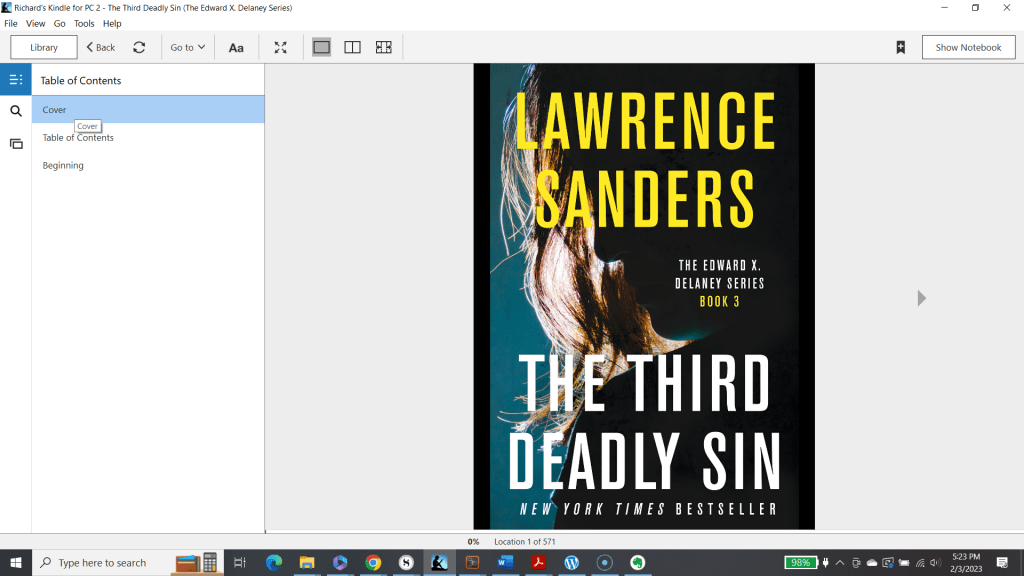
Here’s what I’m currently listening to: The Third Deadly Sin, by Lawrence Sanders

Sanders was a tremendously talented writer.

Amazon abstract:

New York Times Bestseller: A retired cop hunts for a female serial killer no one would suspect in this “first-rate thriller . . . as good as you can get” (The New York Times).

By day, she’s a middle-aged secretary no one would look at twice. But by night, dressed in a midnight-black wig, a skin-tight dress, and spike heels, she’s hard to miss. Inside her leather shoulder bag are keys, cash, mace, and a Swiss Army knife. She prowls smoky hotel bars for prey. The first victim—a convention guest at an upscale Manhattan hotel—is found with multiple stab wounds to the neck and genitals. By the time retired police detective chief Edward Delaney hears about the case from an old colleague, the Hotel Ripper has already struck twice. Unable to resist the puzzle, Delaney follows the clues and soon realizes he’s looking for a woman. As the grisly slayings continue, seizing the city in a chokehold of panic, Delaney must stop the madwoman before she kills again.

A Sample Five Star Review

M. G Watson

VINE VOICE

5.0 out of 5 stars Third Time’s the Charm

Reviewed in the United States on May 15, 2015

Verified Purchase

It is arguable that Lawrence Sanders never rose to greater heights as a prose stylist, suspense-writer or storyteller than he did with THE THIRD DEADLY SIN, the penultimate novel in his “deadly sin” series of books and the fourth of five to feature crusty, sandwich-obsessed Edward X. Delaney as a protagonist. Though once referred to as “Mr. Bestseller” and nearly as prolific in his day as Stephen King, Sanders seems to be forgotten now, except for his “McNally” series which was hardly representative of his best work; but at his best he was both compulsively readable and immensely satisfying, and this novel is both.

Zoe Kohler is the world’s most boring woman. Hailing from a small town somewhere in the Midwest, divorced from a husband who treated her like she was invisible, virtually friendless, and stuck in a mindless, dead-end job in the security office of an old hotel in Manhattan, she worries incessantly about her health and indulges in only one hobby: murder. Sexing herself up every Friday night, Zoe picks up unsuspecting businessmen attending conventions in different hotels around town, and delivers to each the same grisly fate: a Swiss Army knife, first to the throat and then to the jewels. But because nobody ever notices the world’s most boring woman, nobody suspects her, leaving Zoe free to indulge her hobby — over and over and over again.

Edward X. Delaney used to be a cop — and not just any cop, but the NYPD’s Chief of Detectives. Now, of course, he’s just a bored retiree, living in a Manhattan brownstone with this second wife. So when his former “rabbi” in the Department, Deputy Commissioner Ivar Thorsen, asks him to help investigate a series of baffling murders being committed in hotels around the city, Delaney agrees, but has little idea what he’s getting into: a search for a faceless, motiveless “repeater” (1970s slang for serial killer) whose vicious talents with a short-bladed knife are wreaking havoc with New York’s once-thriving convention trade. Acting as an unofficial adviser to the “Hotel Ripper” task force, Delaney begins to suspect that male prejudices, including his own, may be blinding his fellow detectives to the possibility of that the Ripper may not be a man. But he has no suspects, no witnesses, no fingerprints, and no hard evidence. Only instincts. And a growing pile of victims.

THE THIRD DEADLY SIN is a very attractive suspense novel for many reasons. Aside from Sanders prose style, which is beautiful, memorable and incredibly evocative, it works on multiple levels. Firstly, the character of Zoe Kohler. She is at once both a pitiable loser, struggling with health problems and sexist attitudes at work a burgeoning relationship with a sweet and unsuspecting man…and a remorseless, relentless killer, who hunts men for the sheer thrill of it. Second, Edward X. Delaney. This crusty, hard-nosed, sandwich-obsessed detective is neither sexy, flashy, nor gifted with any great deductive genius: he’s simply like a boulder that, starting slowly, gathers investigative momentum until he crushes just about everyone in his path, yet at the same time possesses a sensitivity — largely through his wife’s softening influence — that allows him more nuances than a typical, cigar-chewing, old school detective. And this leads me to the books third major strength, which is its examination of sexual attitudes, gender roles and (unintentionally) police procedure during the period it was written — about 35 years ago. At that time the pathology of serial killers was scarcely understood, forensic science still in its infancy, and the idea of gender equality more of a punchline than a serious idea. Delaney, an aging Irish cop with flat feet, is both brimming with cheauvanistic, patronizing, old-school attitudes and open to the possibility that those attitudes may be wrong.

No novel is perfect, of course, and this one is no exception. Sanders sometimes makes small but basic errors in matters of police procedure, slang and etiquette; the sort of mistakes which are the result of never having been a cop himself. Occasionally he tries too hard to make characters colorful, giving them a contrived rather than a naturalistic feel; and sometimes his dialogue and description betray his overwhelming love of the English language and end up sounding pretentious or, coming out of the mouths of certain characters, simply unrealistic. (This also leads him to over-write scenes with minor characters, such as Zoe’s doctor.) Most of the criticisms I can mount a this book, however, fall in the “nitpicking” category, and even when taken in the aggregate fail to outweigh all of its many pleasures.

THE THIRD DEADLY SIN may or may not have been Sanders’ best book (you could make a case for THE SIXTH COMMANDMENT or THE SECOND DEADLY SIN or THE ANDERSON TAPES or various others). It may not even be his best suspense novel. But for my money it is not merely a good read but equally satisfying upon each subsequent reading, which is about the highest praise I can give to an author’s work. So: buy it, make yourself a sandwich, and sit down to this half-forgotten but deservedly remembered author. Murder and mayhem have never been so fun.

User-Friendly Self-Deception: Philosopher Amélie Rorty on the Value of Our Delusions and the Antidote to the Self-Defeating Ones

Here’s the link to this article.

“The question is: how can we sustain the illusions essential to ordinary life, without becoming self-damaging idiots?”

BY MARIA POPOVA

“Life is a dream. ‘Tis waking that kills us. He who robs us of our dreams robs us of our life,” Virginia Woolf wrote as she considered how our illusions keep us alive, shining a sidewise gleam on an elemental fact of human nature: We are touchingly prone to mistaking our models of reality for reality itself, mistaking the strength of our certainty for the strength of the evidence, thus moving through a dream of our own making that we call life. It can only be so — given how many parallel truths comprise any given situation, given how multifarious the data points packed into any single experience, given that this very moment “you are missing the vast majority of what is happening around you,” we are simply not capable of processing the full scope of reality. Our minds cope by choosing fragments of it to the exclusion, and often to the erasure, of the rest.

Art by Dorothy Lathrop, 1922. (Available as a print and as stationery cards.)

But what we choose and how we choose it defines the measure of our sanity, and how we go about choosing our adaptive delusions over the maladaptive ones defines our fitness for life. That is what philosopher Amélie Rorty (May 20, 1932–September 18, 2020) explores in a marvelous 1994 paper in the Journal of the Royal Institute of Philosophy, marvelously titled User-Friendly Self-Deception.

Recognizing that “many varieties of self-deception are ineradicable and useful,” Rorty writes:

We should not wish to do without the active, self-induced illusions that sustain us. Nor can we do without second order denials that they are illusions, the second order and regressive strategies that we self-deceptively believe rationalize our various self-deceptive activities. The question is: how can we sustain the illusions essential to ordinary life, without becoming self-damaging idiots? Are there forms of user-friendly self-deception that do not run the dangers that falsity, irrationality and manipulation are usually presumed to bring?

Self-deception, she notes, has various “cousins and clones” — among them “compartmentalization, adaptive denials, repressed conflicts and submerged aggressions, false consciousness, sublimation, wishful thinking, suspiciously systematic errors in self-reflection” — some of which are socially rewarded for their adaptive value in helping us attain our goals:

When we admire persistent and dedicated single-minded attention that systematically resists the distraction of fringe phenomena, we call it courage or purposeful resolution.

But as much as self-deception might animate our own inner lives, with our reflexive tendency to mistake self-righteousness for morality, we too readily indict with self-delusion anyone whose model of reality differs from ours:

The person who does not have our favoured reactions is open game for the charge of self-deception, if not of a more serious form of psychological abnormality.

One necessity of self-deception is the paradox of the self in time: We must each answer the question of what makes us and our childhood selves the “same” person despite a lifetime physical and psychological change, and we can only do so with a certain measure of self-deception, because, of course, in some essential sense we are not the same person — our personhood is pocked by inconstancy and inner contradiction, unstable across time. As Iris Murdoch reminds us, “the self, the place where we live, is a place of illusion” — the fundamental illusion upon which the structure of human life is built.

One of teenage artist Virginia Frances Sterrett’s 1920 illustrations for old French fairy tales. (Available as a print.)

Rorty considers the psychological roots and mechanisms of self-deception:

Like deception, self-deception is a species of rhetorical persuasion; and like all forms of persuasion, it involves a complex, dynamic and co-operative process. Successful deceivers are acute rhetoricians, astute seducers who know how to co-opt the psychology of their subjects. They begin with minute and subtle interactions designed to establish trust, with a manner of approach, certain gestures and intonation patterns, intimations of directed and redirected attention.

With an eye to the social dimension of all deception, she adds:

Deception and self-deception are not merely detached conclusions of invalid arguments: they are interactive processes with a complex cognitive and affective aetiology.

[…]

The canny self-deceiver puts herself in situations where her deflected attention will be strongly supported by her fellows.

[…]

It is extremely difficult to sustain self-deception without a little help from our friends, often rendered by observant but tactful silence.

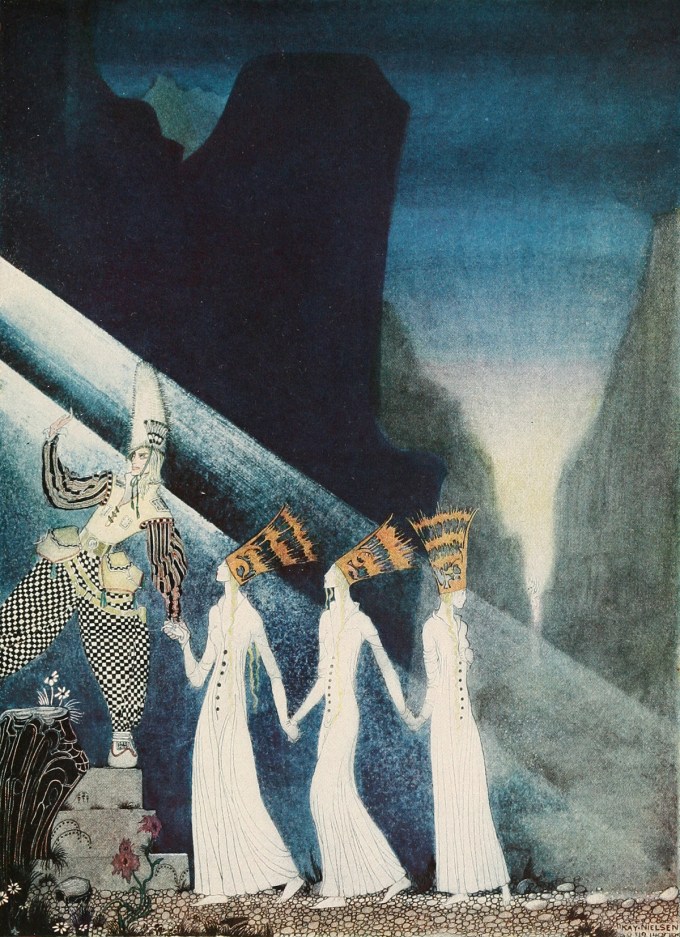
Art by Kay Nielsen from East of the Sun and West of the Moon, 1914. (Available as a print and as stationery cards.)

This very fact points at the best antidote to harmful self-deception:

Since we are highly susceptible to socially induced self-deception, the wisest practical course is to be very careful about the company we keep… Unfortunately self- deception is just the thing that prevents us from seeking its best therapy: it does not know when to expand, and when to limit its epistemological company. Fortunately, we have many other kinds of reasons for being astute about the company we keep. With luck, a canny self-deceiver’s other psychological and intellectual habits — a taste for astringency and a distrust of hypocrisy, for instance — can prevent the wild imperialistic tendencies of self-deception from becoming entrenched and ramified.

Much self-deception, Rorty observes, is not a matter of outright lying to oneself, but of selective attention and fragmentation of truth:

Self-deception need not involve false belief: just as the deceiver can attempt to produce a belief which is — as it happens — true, so too a self-deceiver can set herself to believe what is in fact true. A canny self-deceiver can focus on accurate but irrelevant observations as a way of denying a truth that is importantly relevant to her immediate projects.

This is something that stems from the psychological machinery of all deception, possible because “any experience is open to an indefinite number of true and even relatively salient descriptions”:

Clever deceivers rarely tell outright falsehoods. It’s too risky. The art of deception is closely related to the magician’s craft: it involves knowing how to draw attention to a harmless place, to deflect it away from the action. Deeply entrenched patterns of perceptual, emotional and cognitive dispositions serve as instruments of deception. A skilled deceiver is an illusionist who knows how to manipulate the normal patterns of what is salient to their audience. He places salient markers — something red, something anomalous, something desirable — in the visual field, to draw attention just where he wants it. The strategy of perceptual self-deception is identical: the trick is to place oneself where patterns of salience are likely to deflect attention away from what we do not wish to see.

But for all of its pitfalls, and for all the urgency of continually questioning when it becomes self-defeating, self-deception can be greatly beneficent in our endeavors of self-transformation and growth, offering assurance that bolsters our will and an antidote to the “generalized uncertainty about the worth of our projects.” Rorty writes:

By convincing themselves that a desired self-transformation is within relatively easy reach, canny self-improvers can use self-deception as an energizing instrument.

Art by Dorothy Lathrop, 1922. (Available as a print and as stationery cards.)

Self-deception is also necessary in propping up the precarious pillar of modern life in this century of selfing — identity:

We invent something we call our identity, resting our self-respect on our engaging in its projects, independently of any other measure of their merits.

But perhaps the most essential function of healthy self-deception is in allaying our ambivalence about projects and life-choices that bring us tremendous rewards, but also have tremendous personal costs, an accurate assessment of which might undermine our willingness to undertake them:

Without some species of self-deception, our dedications, our friendships, our work, our causes would collapse. In deciding to have children, we ignore the travails of parents, obliterating our otherwise keen awareness of the typical relations among parents and children; in devoting ourselves to writing philosophy, we conveniently forget how little philosophy we are willing to read; in the interest of sanity and joy, we sidestep our deep ambivalences about our kith and kin.

[…]

Disguising and submerging the ambivalence that is natural to most of our enterprises not only brings us the energy, verve, style and ease that successful action requires; it also helps to assure the social co-operation that is equally essential to our individual and collective projects. A good deal of the polite conversation of social life, — the public description of the joys of our social roles and functions (friend, mother, teacher, scholar) — channels and streams us to play our parts without the mess, confusion and upheaval that would occur if we openly expressed our natural and sensible ambivalence about these roles. It is virtually impossible to imagine any society that does not systematically and actively promote the self-deception of its members, particularly when the requirements of social continuity and cohesion are subtly at odds with one another and with the standard issue psychology of their members. Socially induced self-deception is an instrument in the preservation of social co-operation and cohesion.

Complement with Walter Lippmann’s superb century-old anatomy of deception and self-delusion, then revisit Rorty on what makes a person: the seven layers of identity, in literature and life.

Drafting–Colton and Sandy inspect Mildred’s van inside the detached garage

Colton and Sandy waited until 9:00 PM to walk to the detached garage and inspect Mildred’s van. Sandy new from his younger days that she was an early-to-bed, early-to rise woman. Pop had always said Mildred was like a chicken at night, taking to her roost fifteen to thirty minutes before sunset. But, in the mornings, she was up by 4:00 AM, a good two to three hours before sunrise, the normal chicken-rising time. Mildred no longer had chickens but Sandy and Colton doubted she’d changed her habits.

The dark gray, almost black, van was a 2017 Mercedes-Benz Sprinter 2500 4×4. According to paperwork in the console, Mildred had purchased the like-new RV for $79,000 from a man named Angelo Danesi out of Marietta, Georgia. He had bought the Sanctuary model from Thor Motor Coach in Elkhart, Indiana.

To say the van was luxurious was a gross understatement. It had everything two people would need to comfortably travel year round, even off-road. Up front were two ergonomic captain chairs facing a high-tech dashboard. Behind them was the well-designed living quarters, accessible directly from the captain chairs or via the exterior sliding door located behind the passenger seat.

As Sandy walked around the van marveling the sleek design, Colton inspected the well-equipped rolling apartment. At dinner, while considering whether the van might provide a better option than Pop’s house, he’d inventoried what a mobile set-up should include. The van more than met his expectations: inside the living quarters was a two-burner stove and sink (outside, he’d noticed an attached grill toward the right rear side), a refrigerator, a microwave oven, a surprisingly large shower/commode bathroom combination, two couches that made into beds, and plenty of storage.

Sandy joined Colton in the other captain’s chair. “Sorry, but I’m still confused. Won’t getting rid of Mildred and stealing her van just put us more in the cross-hairs than getting rid of her and using Pop’s as our command center?”

It wasn’t a bad way to frame the central issue but Colton had a twist. “Here’s a third option. Before we get rid of Mildred we use her to eliminate us from the cross-hairs you mention, the one you think is based on her missing van.”

Sandy reached to the steering column and turned the key but stopped short of starting the engine. He then fiddled with the large computerized touch screen in the center of the dash. “Explain. What do you mean, ‘use her’?”

“We make her do the normal things she would otherwise do if she were about to take a trip. Things like withdraw money, pack her bags, maybe call a neighbor to collect her mail and watch the house.” Colton lowered his left hand and felt the seat controls. He activated each one, sequentially. “Unbelievable. My seat will do everything but make coffee.”

“That’s like a horse and wagon compared to this thing.” Sandy said, scrolling through FaceBook. “Mildred must have a data-plan.”

“Maybe it’s connected to WiFi.” Colton added. “Question. Does Mildred have children?” It was something he hadn’t considered until now.

“One, a son, Mason, but they’ve been estranged since I was a kid.”

“Why? What happened?” Colton knew that if the two reconciled, a problem for him and Sandy was certain to arise.

“Not sure. I’d guess it had to do with Mason’s father. I only met him a time or two but Pop said the man was crazy. Anyway, the son left after high school and probably never returned.”

Colton used his fingers to calculate Mason’s age. “Mildred is eighty-five. Son would be sixty-five. Seventy?”

“Sounds about right. I’d say he could care less what’s going on with his mother, but Alice is another matter.” Whether he knew it or not, Sandy was offering valuable assistance.

“Who’s Alice?” Colton hoped Mildred didn’t have a close friend.

“Best friend and neighbor. Lives right over there.” Sandy pointed diagonally to his left into the dark, and looked at Colton. “Don’t you dare say, she has to go.”
“No stupid, but Mildred will have to call her. And, convince her she’s taking a trip.”

“I can’t wait to see that. Plus watch her withdraw money from her bank.” Sandy turned up the volume on a YouTube he’d found tauting the benefits of an air-fryer.

Colton looked at the computer screen, saw it was 9:45, and wondered where Millie was and what her and Molly were doing. Damn, why hadn’t he installed the new GPS car tracker Thursday night. “Let’s get some rest. Tomorrow we need to nail down all the details to enable us to pull this off Monday morning.”

Sandy could be hopeless in his predictions. “So, we’re going to kidnap Mildred and take her along to God know’s where?”

Colton pushed a button on the dash to his left marked, ‘Reset seat.’ “You’re right about the kidnapping part, but her ride will only be as long as needed to find a secluded spot to dump her body.” He turned off the key and exited the van fully aware Sandy wasn’t convinced what they were about to do would help keep them out of prison.

“Shit, shit, shit.” Is all Sandy could say as they closed the garage door and trod back to Pop’s house.

Writing Journal—Sunday writing prompt

After a big argument with his spouse, your character goes for a walk and witnesses a crime. Describe your character’s dilemma choosing between doing something to stop what’s happening or remaining hidden to stay safe.

One Stop for Writers

Guidance & Tips

Write the scene of discovery (i.e., tell a story), or brainstorm and create a list of related ideas.

Here’s five story elements to consider:

  • Character
  • Setting
  • Plot
  • Conflict
  • Resolution

Never forget, writing is a process. The first draft is always a mess.

The first draft of anything is shit.

Ernest Hemingway