I encourage you to listen to these two brilliant men. Prepare to be humbled by your level of knowledge, but by paying close attention, pausing when needed, you will learn.
Sam Harris speaks with Sean Carroll about our understanding of reality. They discuss consciousness, quantum mechanics, the arrow of time, free will, facts and values, and other topics.
Sean Carroll is a theoretical physicist at CalTech. He received his PhD from Harvard University. He has worked on the foundations of quantum mechanics, the arrow of time, and the emergence of complexity. Carroll has been awarded prizes and fellowships by the National Science Foundation, NASA, the Alfred P. Sloan Foundation, the David and Lucile Packard Foundation, the American Physical Society, the American Institute of Physics, and the Royal Society of London. He frequently serves as a science consultant for film and television. He is the author of The Biggest Ideas in the Universe: Time, Space, and Motion.
Your character is enjoying Chinese food with friends, and when the fortune cookies are opened, the predictions seem to have specific meaning to each person. Within twenty-four hours, each prediction comes to pass. Write the scene as your character’s paper future becomes reality.
Biking is something else I both love and hate. It takes a lot of effort but does provide good exercise and most days over an hour to listen to a good book or podcast. I especially like having ridden.
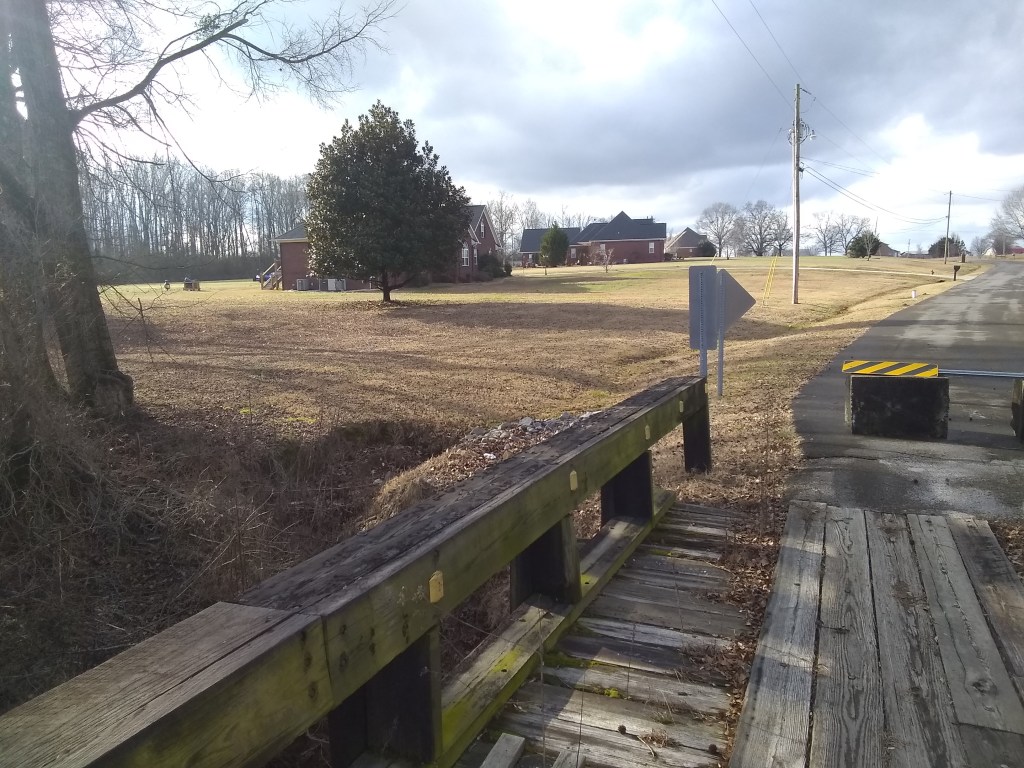
Here’s my bike, a Rockhopper by Specialized. I purchased it November 2021 from Venture Out in Guntersville; Mike is top notch! So is the bike, and the ‘old’ man seat I salvaged from an old Walmart bike.
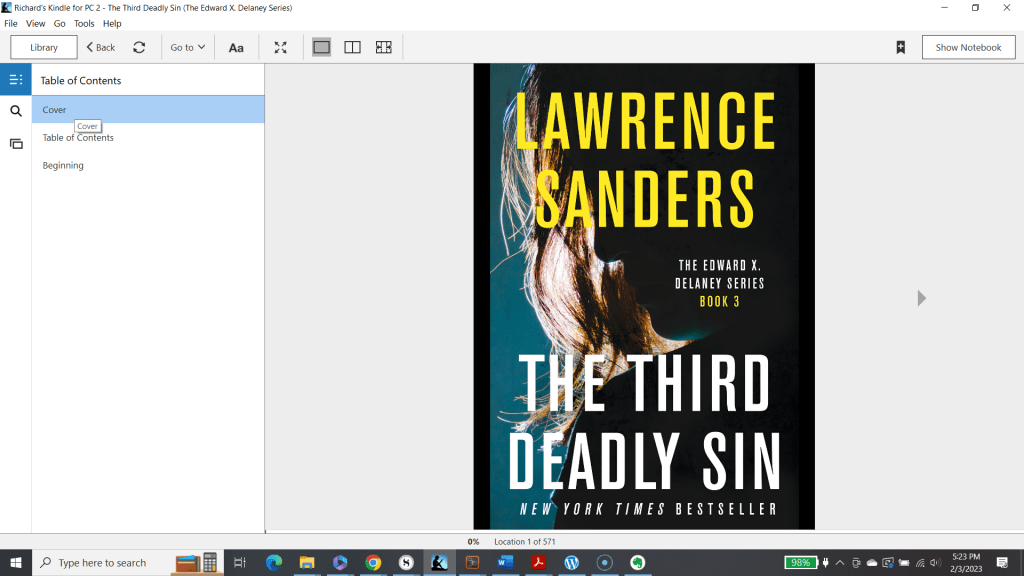
Here’s what I’m currently listening to: The Third Deadly Sin, by Lawrence Sanders
Sanders was a tremendously talented writer.
Amazon abstract:
New York Times Bestseller: A retired cop hunts for a female serial killer no one would suspect in this “first-rate thriller . . . as good as you can get” (The New York Times).
By day, she’s a middle-aged secretary no one would look at twice. But by night, dressed in a midnight-black wig, a skin-tight dress, and spike heels, she’s hard to miss. Inside her leather shoulder bag are keys, cash, mace, and a Swiss Army knife. She prowls smoky hotel bars for prey. The first victim—a convention guest at an upscale Manhattan hotel—is found with multiple stab wounds to the neck and genitals. By the time retired police detective chief Edward Delaney hears about the case from an old colleague, the Hotel Ripper has already struck twice. Unable to resist the puzzle, Delaney follows the clues and soon realizes he’s looking for a woman. As the grisly slayings continue, seizing the city in a chokehold of panic, Delaney must stop the madwoman before she kills again.
It is arguable that Lawrence Sanders never rose to greater heights as a prose stylist, suspense-writer or storyteller than he did with THE THIRD DEADLY SIN, the penultimate novel in his “deadly sin” series of books and the fourth of five to feature crusty, sandwich-obsessed Edward X. Delaney as a protagonist. Though once referred to as “Mr. Bestseller” and nearly as prolific in his day as Stephen King, Sanders seems to be forgotten now, except for his “McNally” series which was hardly representative of his best work; but at his best he was both compulsively readable and immensely satisfying, and this novel is both.
Zoe Kohler is the world’s most boring woman. Hailing from a small town somewhere in the Midwest, divorced from a husband who treated her like she was invisible, virtually friendless, and stuck in a mindless, dead-end job in the security office of an old hotel in Manhattan, she worries incessantly about her health and indulges in only one hobby: murder. Sexing herself up every Friday night, Zoe picks up unsuspecting businessmen attending conventions in different hotels around town, and delivers to each the same grisly fate: a Swiss Army knife, first to the throat and then to the jewels. But because nobody ever notices the world’s most boring woman, nobody suspects her, leaving Zoe free to indulge her hobby — over and over and over again.
Edward X. Delaney used to be a cop — and not just any cop, but the NYPD’s Chief of Detectives. Now, of course, he’s just a bored retiree, living in a Manhattan brownstone with this second wife. So when his former “rabbi” in the Department, Deputy Commissioner Ivar Thorsen, asks him to help investigate a series of baffling murders being committed in hotels around the city, Delaney agrees, but has little idea what he’s getting into: a search for a faceless, motiveless “repeater” (1970s slang for serial killer) whose vicious talents with a short-bladed knife are wreaking havoc with New York’s once-thriving convention trade. Acting as an unofficial adviser to the “Hotel Ripper” task force, Delaney begins to suspect that male prejudices, including his own, may be blinding his fellow detectives to the possibility of that the Ripper may not be a man. But he has no suspects, no witnesses, no fingerprints, and no hard evidence. Only instincts. And a growing pile of victims.
THE THIRD DEADLY SIN is a very attractive suspense novel for many reasons. Aside from Sanders prose style, which is beautiful, memorable and incredibly evocative, it works on multiple levels. Firstly, the character of Zoe Kohler. She is at once both a pitiable loser, struggling with health problems and sexist attitudes at work a burgeoning relationship with a sweet and unsuspecting man…and a remorseless, relentless killer, who hunts men for the sheer thrill of it. Second, Edward X. Delaney. This crusty, hard-nosed, sandwich-obsessed detective is neither sexy, flashy, nor gifted with any great deductive genius: he’s simply like a boulder that, starting slowly, gathers investigative momentum until he crushes just about everyone in his path, yet at the same time possesses a sensitivity — largely through his wife’s softening influence — that allows him more nuances than a typical, cigar-chewing, old school detective. And this leads me to the books third major strength, which is its examination of sexual attitudes, gender roles and (unintentionally) police procedure during the period it was written — about 35 years ago. At that time the pathology of serial killers was scarcely understood, forensic science still in its infancy, and the idea of gender equality more of a punchline than a serious idea. Delaney, an aging Irish cop with flat feet, is both brimming with cheauvanistic, patronizing, old-school attitudes and open to the possibility that those attitudes may be wrong.
No novel is perfect, of course, and this one is no exception. Sanders sometimes makes small but basic errors in matters of police procedure, slang and etiquette; the sort of mistakes which are the result of never having been a cop himself. Occasionally he tries too hard to make characters colorful, giving them a contrived rather than a naturalistic feel; and sometimes his dialogue and description betray his overwhelming love of the English language and end up sounding pretentious or, coming out of the mouths of certain characters, simply unrealistic. (This also leads him to over-write scenes with minor characters, such as Zoe’s doctor.) Most of the criticisms I can mount a this book, however, fall in the “nitpicking” category, and even when taken in the aggregate fail to outweigh all of its many pleasures.
THE THIRD DEADLY SIN may or may not have been Sanders’ best book (you could make a case for THE SIXTH COMMANDMENT or THE SECOND DEADLY SIN or THE ANDERSON TAPES or various others). It may not even be his best suspense novel. But for my money it is not merely a good read but equally satisfying upon each subsequent reading, which is about the highest praise I can give to an author’s work. So: buy it, make yourself a sandwich, and sit down to this half-forgotten but deservedly remembered author. Murder and mayhem have never been so fun.
On aligning the things we make with basic human values for an enduring world.
BY MARIA POPOVA
“No one is fated or doomed to love anyone,” the philosopher-poet Adrienne Rich wrote, “the accidents happen.”
What is true of interpersonal love is also true of our labors of love — creative accidents are a mighty instrument of art, often steering entire trajectories of expression and endeavor in directions we could not have willed.
That is what the visionary ceramicist Edith Heath (May 24, 1911–December 27, 2005) explores in a previously unpublished lecture titled “The Creative Accident.”
Edith Heath at the wheel, 1960. (UC Berkeley Environmental Design Archives.)
Heath discovered art while studying to become a schoolteacher, then fell in love with the particular creative potential of clay. Largely self-taught, she spent WWII foraging materials from defunct clay pits closed during the war — brick clay from the Bay Area, talc from Southern California, fire clays from the Sierra Nevada foothills. In the final years of the war, she learned ceramic chemistry from an émigré physicist, then went on to revolutionize pottery with her alchemical approach to clay and glaze, becoming ceramicist and chemist, designer and inventor, idealist and entrepreneur, using the principles of science to place everyday beauty within reach of the working class. She lived nearly a century as an unstoppable creative force, touching millions of lives with her work that endures as the iconic Heath Ceramics.
At the heart of Heath’s creative practice was the element of fire, reminding her always of a time when “the Earth was a red-hot molten mass of chemicals and minerals,” primordial and uncontrollable. Seeing in fire a parallel of the creative force itself, Heath argues that at the center of art lies a kind of “acceptance of the accidental” that is counter to the basic human instinct for controlling chaos. The artist then emerges as a kind of shaman of the accidental, dancing between its acceptance and its control.
She writes:
Perhaps the artist has been trying to do both — accept the accident through finding meaning in it. And in finding meaning in it, it is no longer accidental and disquieting, but rather presents a state of equilibrium. This equilibrium manifests in the controlled accident of a work of art may be symbolic of all the controlled accidents that non-artists accept every day.
We accept the accidents of economics that necessitates (designing for obsolescence in order to maintain high employment and high standard of living). We accept the accident of over-production of food stuff in this country — setting a ceiling on what can be grown — while millions of people go hungry in other countries. We accept the accident that more natural resources are wasted in the United States than almost anywhere else in the world and proceed to waste them with no guilty conscience… We accept the accident that some people are born with dark skin, or are born to wealth of poverty, with high or low IQs.
By “accident,” of course, she means outcomes beyond the reach of our individual control — functions of a confluence of chance and choice on behalf of forces far larger than us, operating on time scales far beyond our individual lifetimes. She observes:
We can safely refer to these happenstances as accidents, for certainly no one would say they were “planned”. Certainly an error in judgment in diplomacy is not intentional. Planned obsolescence is intentional but it is nevertheless a negative solution to the unpredictability of economic forces. The farmer did not know he would be growing too much food. Our forefathers did not know this land would be filled with natural resources. Since nature bestowed them upon us, why shouldn’t we exploit them? Race, color, creed, intelligence and national pride too are accidents of heritage over which the individual had no control.
Heath was far ahead of her time in her understanding of cultural dynamics and civilizational urgencies. Observing that, historically, creative breakthroughs have come far more frequently from individuals than from groups, she presages that a great impending calamity — atomic destruction in her day, climate catastrophe in ours — has the power of fomenting extraordinary collective creativity:
Because we are teetering on the probability of the most terrible accident in history… it may force more individuals to become creative as a group. In other words, terrible accidents motivate group actions toward creative solution. Potential accident is not a good motivating force, just as capital punishment does not deter crime. Real accidents, however, do in time motivate a group.
An epoch before the term “sustainability” came to bear its ecological connotations, and long before the world awoke to the hazard of climate change, Heath — whose working ethos was to “use the Earth to save the Earth” — adds:
Design for obsolescence as well as depletion of natural resources are real accidents of history that do exist today, which are beginning to compel creative people to design for more basic human values than superficial “styling.” The designer sees in these two accidents of economy a new potential for genuine development in… our whole way of life around the world.
With the depletion of natural resources, we will begin to make and build things to last. Since they must last longer, they must… take on a timeless quality.
This timeless quality, she argues, must be cultivated in all creative works — “whether a painting, a house, a piece of music, a car, or a piece of pottery.” With an eye to her own field, she offers five pillars of timelessness that a maker must follow:
TRUTH — to materials, method, use. Materials not faked to look like something else. Respect material and let it state its unique esthetic… Method of production should not simulate or be imitative of another process — respect the handmade — respect the machine-made — each has its own beauty.
USE — does it function well? Does it please the senses as well as the mind?
SENSE OF EVOLUTION — does it reflect a concept of evolution? In other words, does it give one a sense of well-being because it has evolved through man’s search for new understanding of materials, processes, and a good way of life?
SPIRIT — does it make you feel snobbish or superior or does it excite and exalt you to the point where you want to share the experience with others? In other words, does it ignoble or demean or does it bring dignity and pleasure to you and your fellow-man?
PERSPECTIVE — does it recognize relevance, relationship? Does it exist harmoniously in relationship to other things? Is it too dominant, too weak, too trite, or does it function genuinely, lively, appropriately?
Special thanks to Sarah C. Rich at Heath Ceramics and Jennifer Volland at the UC Berkeley Environmental Design Archives for granting me access to Edith Heath’s unpublished manuscripts.
Between 10:00 and 12:00 AM yesterday, Jonathan, Donna, and I applied a first coat of sealer to the roof of Jeremy’s travel trailer. During this time, while I moved ladders and rolled on the thick white substance, my mind just up and left. Without asking for permission or saying a word of explanation, he got in his car and rode away. I was washing out paint brushes, rollers, and trays when he returned. Again, no word of apology or what he’d been doing for over two hours. The only hint I had came later when I found an empty McDonald’s sack in the floorboard of the Nissan Sentra.
This act of defiance made me mad so later in the afternoon I thought, “old boy, you’re not the only one who can pull that trick.” So, I got on my bicycle and left my mind at home. During the next hour I pedaled as hard as I could, burned at least a thousand calories, and obviously didn’t listen to my Lawrence Sanders book since my mind was elsewhere.
Well, by now, you’ve sensed something’s wrong about my little story, about what happened to me/with me yesterday. I’ll go ahead and admit, I made it up, everything except the roof sealer activity.
What’s my point? You know, our minds and bodies are connected, physically, but that doesn’t mean one or both don’t occasionally disappear into the forest. Most times, some of us, maybe most of us, are lost in thought. Our minds have wandered off, not physically, but mentally, into some wasteland.
What I need to do, what I want to do, what I’m trying to do is learn the art of paying attention. Some call this the art of choice. You’ve heard the following: Bill attended the meeting but he wasn’t really there. Or, Cindy’s father arrived late for her fifth birthday party, but it was as though he was in another world. Choices. Bill and Cindy’s father were physically in one place but mentally somewhere else, maybe half-way around the world.
No doubt, we live in our minds. No matter whether we’re alone or with family or friends, one person, two persons, or a crowd, we’re alone with our minds. We cannot escape it. Well, we can but I don’t like that option. We might as well conclude we are all alone to choose what to pay attention to.
Yesterday, during my 80-90 minute bike ride I listened, via Audible, to Lawrence Sanders’ The Third Deadly Sin. However, don’t assume I listened perfectly, because I didn’t. Often, a thought would appear: “I wonder what the man who lives in that older house does for a living? I only see his car there on the weekends; “Here’s where I first saw that poor stray dog. I should have rescued it,” or “why didn’t I play basketball in high school?” Of course, there were worse thoughts!
Here’s a question I’m asking myself: is attention my true source of wealth? If so, I need to ‘spend’ it wisely, and not squander it on worthless drivel.
Paying attention is a call to Bill, Cindy’s father, myself, and you, to being present, right now, right here and paying close attention to what someday we’ll clearly realize was most important. Let’s keep in mind there will be a last time for a hike in the woods with family or friends, a last time for reading, for biking, for moving ladders and rolling sealer, for slow-smoking ribs, and for every thing else we choose to do.
Your gamer protagonist discovers that the person he’s been talking to in a chat room is a murderer. Worse, the person seems to know his real name. Write the exchange and your protagonist’s reactions and thoughts.
Biking is something else I both love and hate. It takes a lot of effort but does provide good exercise and most days over an hour to listen to a good book or podcast. I especially like having ridden.
Here’s my bike, a Rockhopper by Specialized. I purchased it November 2021 from Venture Out in Guntersville; Mike is top notch! So is the bike, and the ‘old’ man seat I salvaged from an old Walmart bike.
Here’s what I’m currently listening to: The Third Deadly Sin, by Lawrence Sanders
Sanders was a tremendously talented writer.
Amazon abstract:
New York Times Bestseller: A retired cop hunts for a female serial killer no one would suspect in this “first-rate thriller . . . as good as you can get” (The New York Times).
By day, she’s a middle-aged secretary no one would look at twice. But by night, dressed in a midnight-black wig, a skin-tight dress, and spike heels, she’s hard to miss. Inside her leather shoulder bag are keys, cash, mace, and a Swiss Army knife. She prowls smoky hotel bars for prey. The first victim—a convention guest at an upscale Manhattan hotel—is found with multiple stab wounds to the neck and genitals. By the time retired police detective chief Edward Delaney hears about the case from an old colleague, the Hotel Ripper has already struck twice. Unable to resist the puzzle, Delaney follows the clues and soon realizes he’s looking for a woman. As the grisly slayings continue, seizing the city in a chokehold of panic, Delaney must stop the madwoman before she kills again.
It is arguable that Lawrence Sanders never rose to greater heights as a prose stylist, suspense-writer or storyteller than he did with THE THIRD DEADLY SIN, the penultimate novel in his “deadly sin” series of books and the fourth of five to feature crusty, sandwich-obsessed Edward X. Delaney as a protagonist. Though once referred to as “Mr. Bestseller” and nearly as prolific in his day as Stephen King, Sanders seems to be forgotten now, except for his “McNally” series which was hardly representative of his best work; but at his best he was both compulsively readable and immensely satisfying, and this novel is both.
Zoe Kohler is the world’s most boring woman. Hailing from a small town somewhere in the Midwest, divorced from a husband who treated her like she was invisible, virtually friendless, and stuck in a mindless, dead-end job in the security office of an old hotel in Manhattan, she worries incessantly about her health and indulges in only one hobby: murder. Sexing herself up every Friday night, Zoe picks up unsuspecting businessmen attending conventions in different hotels around town, and delivers to each the same grisly fate: a Swiss Army knife, first to the throat and then to the jewels. But because nobody ever notices the world’s most boring woman, nobody suspects her, leaving Zoe free to indulge her hobby — over and over and over again.
Edward X. Delaney used to be a cop — and not just any cop, but the NYPD’s Chief of Detectives. Now, of course, he’s just a bored retiree, living in a Manhattan brownstone with this second wife. So when his former “rabbi” in the Department, Deputy Commissioner Ivar Thorsen, asks him to help investigate a series of baffling murders being committed in hotels around the city, Delaney agrees, but has little idea what he’s getting into: a search for a faceless, motiveless “repeater” (1970s slang for serial killer) whose vicious talents with a short-bladed knife are wreaking havoc with New York’s once-thriving convention trade. Acting as an unofficial adviser to the “Hotel Ripper” task force, Delaney begins to suspect that male prejudices, including his own, may be blinding his fellow detectives to the possibility of that the Ripper may not be a man. But he has no suspects, no witnesses, no fingerprints, and no hard evidence. Only instincts. And a growing pile of victims.
THE THIRD DEADLY SIN is a very attractive suspense novel for many reasons. Aside from Sanders prose style, which is beautiful, memorable and incredibly evocative, it works on multiple levels. Firstly, the character of Zoe Kohler. She is at once both a pitiable loser, struggling with health problems and sexist attitudes at work a burgeoning relationship with a sweet and unsuspecting man…and a remorseless, relentless killer, who hunts men for the sheer thrill of it. Second, Edward X. Delaney. This crusty, hard-nosed, sandwich-obsessed detective is neither sexy, flashy, nor gifted with any great deductive genius: he’s simply like a boulder that, starting slowly, gathers investigative momentum until he crushes just about everyone in his path, yet at the same time possesses a sensitivity — largely through his wife’s softening influence — that allows him more nuances than a typical, cigar-chewing, old school detective. And this leads me to the books third major strength, which is its examination of sexual attitudes, gender roles and (unintentionally) police procedure during the period it was written — about 35 years ago. At that time the pathology of serial killers was scarcely understood, forensic science still in its infancy, and the idea of gender equality more of a punchline than a serious idea. Delaney, an aging Irish cop with flat feet, is both brimming with cheauvanistic, patronizing, old-school attitudes and open to the possibility that those attitudes may be wrong.
No novel is perfect, of course, and this one is no exception. Sanders sometimes makes small but basic errors in matters of police procedure, slang and etiquette; the sort of mistakes which are the result of never having been a cop himself. Occasionally he tries too hard to make characters colorful, giving them a contrived rather than a naturalistic feel; and sometimes his dialogue and description betray his overwhelming love of the English language and end up sounding pretentious or, coming out of the mouths of certain characters, simply unrealistic. (This also leads him to over-write scenes with minor characters, such as Zoe’s doctor.) Most of the criticisms I can mount a this book, however, fall in the “nitpicking” category, and even when taken in the aggregate fail to outweigh all of its many pleasures.
THE THIRD DEADLY SIN may or may not have been Sanders’ best book (you could make a case for THE SIXTH COMMANDMENT or THE SECOND DEADLY SIN or THE ANDERSON TAPES or various others). It may not even be his best suspense novel. But for my money it is not merely a good read but equally satisfying upon each subsequent reading, which is about the highest praise I can give to an author’s work. So: buy it, make yourself a sandwich, and sit down to this half-forgotten but deservedly remembered author. Murder and mayhem have never been so fun.
Christianity has a brand problem. If it were a corporation, brand managers would be scrambling to scrub public image—maybe by greenwashing or with corporate diversity trainings or by renaming their product, say natural gas instead of methane, or by coming up with a new catchy slogan. Or they might actually do something substantive, like ceasing to “gift” baby formula to poor moms or to use child labor in their factories. There are many ways to polish brand.
Christianity’s recently launched He Gets US campaign—millions of people got a dose during the Superbowl—tells us two things: 1. Conservative Evangelical Christians care about their brand problem. 2. Some major Christian donors have decided, to the tune of $100 million apparently, to go with the greenwashing strategy rather than substantive change. And that combination provides a possible avenue for fighting back against some of the ugly objectives and tactics of the Religious Right.
The people paying for this ad campaign are the same ones promoting homophobia, advocating against reproductive healthcare for women, and funding politicians to protect the good old pecking orders: rich over poor, men over women, pasty white people over everyone with more melanin.
Losing customers Back when the world and I were young, Evangelical Christians were a politically diverse group. But Republican strategists recognized them as a potential political voting block. Hierarchical social structures within churches meant the strategists had to recruit only Church leaders, and those leaders would bring along their congregations. It worked for the Republican party, but at an enormous cost to Christianity as an institution. That is because right wing operatives were spending down Christianity’s good name by merging its brand with their own. The more Christianity came to be associated with ugly political priorities—and then crass power grab-‘em-by-the-pussies—the more young people fled the Church. By the millions. (Tangentially, Islam faces a similar brand problem and deconversion pattern wherever the Mullahs wield political force. Almost half of Iranians say they used to be religious.)
Losing money Losing customers by the millions would be a problem for any corporate body—especially one with a product that people realize they don’t need when they actually take a good look. When there are better options, in this case secularism, people rarely go back to the same-old-same-old. The financial impact of deconversion is potentially huge. The Mormon Church may coerce tithes with visits from elders who review a family’s finances, but most protestant and Catholic sects rely on more subtle social and emotional pressures. Either way, market share requires mindshare. You have to get people in the door before you can pass the basket.
Losing prospects But this isn’t merely a financial calculus. At some point, brand damage becomes a threat to identity. Evangelicals are evangelical. It’s part of the ideology. Go into all the world and make disciples of every creature. Unlike Judaism or Hinduism, Christianity is a proselytizing religion. Proselytizing (ok, coupled with colonization and holy wars) has been the strategy that allowed Christianity to spread across the planet. Missionaries may not explicitly recognize that they are recruiting paying customers who will trade cash for club benefits and afterlife services, but they do recognize that “harvesting souls” is a central commandment of their faith. For many, this mandate—called the Great Commission—is their version of praying five times facing Mecca. For some, it becomes an underlying feature in virtually every relationship: All non-Christians are potential converts; friendliness becomes friendship missions; feeding the poor becomes first-and-foremost a path to winning their souls. Evangelicals are a sales force, and as their brand becomes more and more soiled, it gets harder to do their job.
In need of a savior Having spent down Christianity’s brand, the patriarchs of the religious right are uncomfortable with how far that has gone—the image, that is, not the substance. Most Americans used to think of the Bible as The Good Book, but not anymore. Most Americans used to think of Christianity (and religion more broadly) as benign, but not anymore. Jesus, though—the image of Jesus is relatively untainted. Even those who don’t buy into the idea of him being the perfect human sacrifice who saves our souls (Are you washed in the blood?) tend to believe that he was a good, wise, loving man. They think we know a lot more about him than we do, and what they think we know is positive. So, it totally makes sense that a $100 million rebranding and recruiting effort would center on the person of Jesus. Much of Christian theology is nasty, and the Iron Age texts in the Bible contradict what we now know about science, anthropology and—well, pretty much every other field of modern scholarship. This iconic personal Jesus is all they have left.
The fact that conservative Christians are spending $100 million on marketing Jesus means they are bad off and know it. It means they recognize the deterioration in their brand, and they feel desperate to turn it around. They have made the mistake of letting that desperation slip out, and those of us who would rather not return to the good old dark ages when the Church ruled the world can exploit that vulnerability. Their product sucks, and we need to keep saying so in every way possible. We need to make sure the general public keeps associating Christianity with what Christians are doing, not what they are saying: Those anti-abortion centers that dupe women into keeping pregnancies aren’t Crisis Pregnancy Centers, they are Church Pregnancy Centers. Fetal personhood isn’t a philosophical debate, it’s theology. Denying rights to queer folks and women isn’t conservative, it’s theocracy.
When people do ugly things that are motivated by religious dogma, we should name what’s going on. Conservative Christians are telling us that they can’t afford more brand damage. And maybe if their bad works keep getting exposed they will realize that the answer isn’t Jesus-washing; it’s substantive change.
_________________________________
Valerie Tarico is a psychologist and writer in Seattle, Washington. She is the author of Trusting Doubt: A Former Evangelical Looks at Old Beliefs in a New Light and Deas and Other Imaginings. Her articles about religion, reproductive health, and the role of women in society have been featured at sites including The Huffington Post, Salon, The Independent, Quillette, Free Inquiry, The Humanist, AlterNet, Raw Story, Grist, Jezebel, and the Institute for Ethics and Emerging Technologies. Subscribe at ValerieTarico.com.
May Sarton (May 3, 1912–July 16, 1995) was thirty-three when she left Cambridge for Santa Fe. She had just lived through a World War and a long period of personal turmoil that had syphoned her creative vitality — a kind of deadening she had not experienced before. Under the immense blue skies that had so enchanted the young Georgia O’Keeffe a generation earlier, she started coming back to life. Her white-washed room at the boarding house had mountain views, a rush of sunlight, and a police dog and “a very nice English teacher” for neighbors. As the sun rose over the mountains, she woke up each morning “simply on fire” with poetry — new poems she read to the English teacher, not yet knowing she was falling in love with her. Judy would become her great love, then her lifelong friend and the closest she ever had to family.
Among the constellation of Santa Fe poems composed during this creative renaissance is an especially beguiling reflection on the relationship between presence, solitude, and love, soon published in Sarton’s 1948 poetry collection The Lion and the Rose (public library) — her first in a decade — and read here for us by my longtime poetry co-invocator Amanda Palmer in her lovely oceanic voice:































 Richard L. Fricks