Here’s What’s Wrong with Three Favorite Bible Texts

Here’s the link to this article.

By David Madison on 02/10/23

Psalm 23, the Lord’s Prayer & John 3:16

Sunday School and Catechism exist because the clergy know that certain articles of faith must be established as early as possible: capture young minds and hold them forever—at least that’s the hope. One of these articles of faith is that the clergy are custodians of truth about the god/gods they proclaim, so just accept what they tell you. A second article is that if certain scripture texts are recited frequently, endlessly, from the earliest years, they become part of life, fundamental truths not to be questioned. Remembering them, reciting them, are sources of comfort. Hence it would never cross the minds of many adult churchgoers to question—to critically examine—the Bible texts they’ve known and loved from an early age. They are disinclined to ask: Do these texts make sense? Do they fit with what we know about our world after a few hundred years of science and discovery?

Psalm 23

This certainly qualifies as escape-from-reality scripture. Christians cherish it especially because Jesus is presented in John’s gospel as The Good Shepherd: so, the shepherd presented in the 23rd Psalm is the way they want their Jesus to be. One of the tricks that Bible translators have pulled is the camouflaging of the divine name. In the ancient world gods had names, and the god of the Hebrew Bible was named Yahweh. But not too many Christians go around proclaiming their love for Yahweh; that would sound just too strange. So translators have spared them this embarrassment: be on the lookout, in the Old Testament, for Lord spelled with all-caps: LORD. This is a replacement for Yahweh.

So “the LORD is my shepherd” is actually, “Yahweh is my shepherd.” And although this is an escape-from-reality text, we do have to admire the author for expressing a dissenting opinion about Yahweh. For the most part in the Old Testament, Yahweh is depicted as a rampaging, angry deity, a demanding bully of a god. We see this full strength in the Noah flood story—a horrifying tale of genocide; also in Yahweh’s targeted murder of children in his epic struggle with Egypt’s pharaoh. Anyone who ventures through the Old Testament can only be shocked at this god’s murderous behavior (see especially, Steve Wells, Drunk with Blood: God’s Killings in the Bible). 

The author of Psalm 23 envisioned a kinder, gentler theology. I won’t quote the entire psalm here, since it’s so easy to find, but here are three key sentiments that the devout today find so appealing:

“The LORD is my shepherd; I shall not want. He maketh me to lie down in green pastures: he leadeth me beside the still waters. He restoreth my soul…”

Churchgoers want continual assurance that the god who runs the Cosmos knows about them, cares about them; is looking out for their well-being. It’s a calming thought that a god walks with us near “still waters,” and restores our souls. But I do wonder if this escape-from-reality text really does help ordinary folks as they grapple with what life throws at them. Do they experience serenity any more than people who don’t know/believe in the theology behind this text? In the midst of personal pain and tragedy, does this text come to the rescue? This is theology designed to divert attention from what the real world throws at us: Yahweh and Jesus love you: hold on to that thought!

“Yea, though I walk through the valley of the shadow of death, I will fear no evil: for thou art with me; thy rod and thy staff they comfort me.”

The image here is of the shepherd protecting his flock, equipped with rod and staff, to scare off predators. But is it the case that devout Christian folks don’t fear evil? As they face dangers that evoke this image of the “valley of the shadow of death,” are they certain that Jesus is their constant, reliable protector? No: life happens, and everyone—no matter their religious beliefs—gets smacked by horrible, even deadly events. Hence this is an escape-from-reality text. Some believers refuse to accept the grim truth, e.g., there’s been a serious house fire, killing a member of the family, but…the Bible was untouched by the flames: praise god…or rather, Yahweh!

The shallow theology—it sounds nice, but that’s about all—continues: “Surely goodness and mercy shall follow me all the days of my life: and I will dwell in the house of the LORD forever.” When I looked at the news today, the death toll from the Turkey/Syria earthquake has surpassed 21,000. Where were god’s goodness and mercy? It seems he was behaving in mysterious ways once again.

The Lord’s Prayer

“Our Father which art in heaven, hallowed be thy name. Thy kingdom come, thy will be done in earth, as it is in heaven.Give us this day our daily bread. And forgive us our debts, as we forgive our debtors. And lead us not into temptation, but deliver us from evil: For thine is the kingdom, and the power, and the glory, forever. Amen.”   (Matthew 6:9-13, KJV)

The very first sentence captures so much of the narrow, superstitious ancient world view, tainted with patriarchal bias. Our father: So much damage has been caused by identifying god as male, but this derives from the old god Yahweh being modeled on tribal chieftains. Surely, upon reflection, it cannot possibly be argued that a creator-god in charge of billions of galaxies possesses gender as understood by our species. Which art in heaven: thought to be a few miles overhead, which meant that holy men could get closer to god by going to mountaintops. And the story of Jesus ascending to heaven (Acts 1) made perfectly good sense at the time. Even my devout mother had figured out that heaven couldn’t be up there. She told me it is a state of being in the presence of god. But the Lord’s Prayer is rooted in the ancient cosmology.

Hallowed be thy name. Why would a god need to be reminded, assured by humans, that its name is holy? Has god benefitted from being given this ego boost for hundreds of years? If god is already all-powerful, how does this make sense? Moreover, assuming that a name is holy is an aspect of magical thinking. The name has to be protected, hence the warning: “You shall not make wrongful use of the name of Yahweh your God, for Yahweh will not acquit anyone who misuses his name.” (Exodus 20:7) This, above all, is an example of laypeople being disinclined to ask: Do these texts make sense?

Thy kingdom come, thy will be done in earth, as it is in heaven. This line seems to derive from the primary message of Mark’s gospel that the kingdom of god was imminent—there is an any-day-now feel to it—hence in this Jesus-script, the faithful are urged to keep reminding god to get the job done. Does he ever get annoyed with this continual pestering? Here’s a another issue: Do those who routinely recite these words today give any thought to what the arrival of the kingdom supposedly will entail? In other Jesus-script we find the prediction that it will bring as much suffering as happened in the time of Noah, i.e., most of the people on earth were killed. Thy kingdom come, in fact, reflects the naïve apocalypticism that the early church accepted—and that was simply wrong. For more on this see John Loftus’ essay, “At
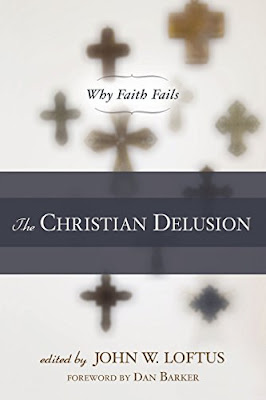

Best Jesus Was a Failed Apocalyptic Prophet,” in his 2010 anthology, The Christian Delusion: Why Faith Fails. There is so much in the New Testament that is absolutely awful. 

John 3:16

Those of us raised in Christianity know it by heart: “For God so loved the world that he gave his only Son, so that everyone who believes in him may not perish but may have eternal life.” Anyone who has read the Bible—and studied history—knows that this claim, god so loves the world, has been falsified. Consider just the problem of horrendous human and animal suffering—and there has been plenty written about that here on this blog. Chalk this claim up to John’s tedious habit of theological exaggeration—what I sometimes have called theology inflation. But John immediately undermines this claim with what can be called the exclusionary clauses. The overwhelming majority of people who have ever lived have not believed in Jesus—so they’re out of luck. And this is stated bluntly in John 3:18: “Those who believe in him are not condemned, but those who do not believe are condemned already because they have not believed in the name of the only Son of God.” John 3:36 is even meaner: “Whoever believes in the Son has eternal life; whoever disobeys the Son will not see life but must endure God’s wrath.” This theology is a mark of cult fanaticism: if you’re not a member of our in-group, god will smash you. Notice as well the magical thinking here: it’s important to believe in the name.

We can be suspect that the folks who rave about John 3:16 pay little heed to John 3:14-15: “And just as Moses lifted up the serpent in the wilderness, so must the Son of Man be lifted up, that whoever believes in him may have eternal life.”

What’s that about? The serpent in the wilderness? The god who so loves the world was in a nasty mood, as mentioned in Numbers 21:5-9, which is worth quoting in full:

“The people spoke against God and against Moses, ‘Why have you brought us up out of Egypt to die in the wilderness? For there is no food and no water, and we detest this miserable food.’Then Yahweh sent poisonous serpents among the people, and they bit the people, so that many Israelites died. The people came to Moses and said, ‘We have sinned by speaking against Yahweh and against you; pray to Yahweh to take away the serpents from us.’ So Moses prayed for the people. And Yahweh said to Moses, ‘Make a poisonous serpent and set it on a pole, and everyone who is bitten shall look at it and live.’ So Moses made a serpent of bronze and put it upon a pole, and whenever a serpent bit someone, that person would look at the serpent of bronze and live.” 

Pay attention: This god arranged for snakes to bite people? And John is comparing Jesus on the cross to a bronze serpent hanging on a pole. If you’ve been bitten by a poisonous serpent, but look at the serpent on the pole, you won’t die. And if you’ve been bitten by sin, you will get eternal life if you believe in Yahweh’s son hanging on the cross. These are both examples of naïve magical thinking: look at something, believe in something: you’ll be cured. Do the devout ever bother to analyze such goofiness? People who have walked away from Christianity have commonly done so because there is so much in the Bible, especially the gospels, that defies a sane and healthy approach to the world. 

It doesn’t require too much effort to see that Psalm 23 is delusional, shallow piety; that key elements in the Lord’s Prayer make sense only in the context of ancient cosmology and superstitions about gods; that the faulty sentiment of John 3:16 is embedded in a chapter crippled by vindictive theology. Sad to say, these texts are honored and celebrated in Christian ritual—pushed by the clergy who don’t want them to be scrutinized. 

But the advice still stands: Pay attention, question everything.

David Madison was a pastor in the Methodist Church for nine years, and has a PhD in Biblical Studies from Boston University. He is the author of two books, Ten Tough Problems in Christian Thought and Belief: a Minister-Turned-Atheist Shows Why You Should Ditch the Faith (2016; 2018 Foreword by John Loftus) and Ten Things Christians Wish Jesus Hadn’t Taught: And Other Reasons to Question His Words (2021). The Spanish translation of this book is also now available. 

His YouTube channel is here. He has written for the Debunking Christianity Blog since 2016.

The Cure-for-Christianity Library©, now with more than 500 titles, is here. A brief video explanation of the Library is here

Mental Meanderings—A Look-Back at Yesterday (Wednesday–022223)

It has been very windy the past several days, especially yesterday. This has made my daily biking more difficult. I’ve had to concentrate—to avoid being swept sideways into the other lane and oncoming traffic—and use more energy and strength to pedal and oppose the persistent force. In sum, I’ve been in a battle having to use my mind and body to resist the unrelenting power of the wind.

Resistance is a common word, easily understood. It is a noun, because it is a person, place, or thing. I’ll provide the relevant definition anyway: “the action of opposing something that you disapprove or disagree with.”

I think I could say that resistance is a two-way street. I resisted the wind. The wind resisted me. The two forces, me and the wind, were in a battle. I wanted to safely complete my route. The wind wanted to stop me. Please don’t think I’m giving agency to the wind. I resist that!

The wind isn’t the only thing I resist. In fact, most everywhere I go, everywhere I look, I encounter “something that [I] disapprove or disagree with.” It might be the many and sundry excuses that slither inside my head every time I sit down to work on my novel in progress. These are forces that I try to resist, but I don’t always win.

To some degree, I find something that opposes every thing I want to do. Thankfully, most of these are relatively powerless and can be easily overcome. I just noticed these forces are also present when I need to do something. I was thinking of washing the dishes. I really don’t want to do this. But, I need to. Yet, resistance is present either way. I have to oppose the force (the thing, the thought, the excuse, whatever you call it) that’s trying to stop me from washing the dishes.

Question. Would life be easier if we never encountered “something that [we] disapprove or disagree with”? In a way, it might. Let’s say, you approve of every thing you read, hear, or see. You simply believe the person who wrote what you’re reading, spoke what you’re hearing, or otherwise created what you are seeing.

If I were this person, I suspect I would be a rare and strange person. I suspect I would be a person naked of curiosity. I would be a person who didn’t read very broadly, wasn’t the least bit skeptical. I would be a person who doesn’t care much about reality, how the world really works. I would be something akin to a zombie.

I definitely wouldn’t be the person I am. And, yes, I just looked up zombie in the dictionary. Here’s what I consider the relevant definition: “a dead body that has been brought back to life by a supernatural force.”

Okay, I admit, I misspoke. If I never disapproved or disagreed with anything, I wouldn’t be a zombie because I don’t believe in anything supernatural. Bingo. I oppose belief in that. Why? I’ve never been presented with sufficient, credible evidence such a thing exists (but, I’m still open if presented with such evidence).

My conclusion here is that neither you or I would want to be a non-resisting person. Life would be far less interesting, would have little meaning, and would likely provide a water-slide environment for bad ideas—they’d rapidly flow downward and ultimately make a big splash, maybe one destructive to civilization itself.

I suspect that without resistance our society wouldn’t be as well off as it is. We might still believe epilepsy was caused by demons. But, I digress, which, come to think of it, is fit for Mental Meanderings.

Oh well, maybe the wind will be calm today.

Writing Journal—Thursday writing prompt

Your character is inspecting his recently purchased property when he falls through a rotten well cover. While he’s unhurt save for cuts and scrapes, no one knows he’s there, so he must get out on his own. Write his escape. 

One Stop for Writers

Here’s five story elements to consider:

  • Character
  • Setting
  • Plot
  • Conflict
  • Resolution

Never forget, writing is a process. The first draft is always a mess.

The first draft of anything is shit.

Ernest Hemingway

Is Suffering a “Problem” for Believers?

Here’s the link to this article written by Bart Ehrman on February 22, 2023.

This past week I had a long talk with one of my bright undergraduates, a first-year student who had been raised in a Christian context but had come to have serious doubts driven in large part by the difficulty she had understanding how there could be suffering in a world controlled by an all-knowing and all-powerful God.  I naturally resonated with the question, since this is why I myself left the Christian faith.

I get asked about that transition a lot, and it’s been five or six years since I’ve discussed it at any length on the blog.  So I thought I might return to it.  The one and only time I”ve talked about it at length is in my book God’s Problem: How the Bible Fails to Answer our Most Important Question – Why We Suffer (Oxford University Press, 2008).  Here is how I discuss it there, slightly edited.  (This will take several posts)

*******************************

I think I know when suffering started to become a “problem” for me.  It was while I was still a believing Christian – in fact, it was when I was pastoring the Princeton Baptist Church in New Jersey.  It was not the suffering that I observed and tried to deal with in the congregation that prompted my questioning – failed marriages, economic hardship, the suicide of a teenage son.  It was in fact something that took place outside of the church, in the academy.  At the time I was writing my PhD dissertation and – in addition to working in the church – was teaching part time at Rutgers University.

One of the classes that I taught that year was a new one for me.  Before this I had mainly been teaching courses on the Hebrew Bible, the New Testament, and the writings of Paul.  But I had been asked to teach a course called “The Problem of Suffering in the Biblical Traditions.”  I welcomed the opportunity because it seemed to me to be an interesting way to approach the Bible, by examining the different responses given by biblical authors to the question of why there is suffering in the world, in particular among the people of God.

It was my belief then, and continues to be my belief now, that different biblical authors had different solutions to the question of why God’s people suffer: some (such as the prophets) thought that suffering came from God as a punishment for sin; others thought that suffering came from God’s cosmic enemies, who inflicted suffering precisely because people tried to do what was right before God; others thought that suffering came as a test to see if people would remain faithful despite suffering; others thought that suffering was a mystery and that it was wrong even to question why God allowed it; others thought that this world was just an inexplicable mess and that we should “eat, drink, and be merry” while we can.  And so on.

It seemed to me that one of the ways to see the rich diversity of the Scriptural heritage of Jews and Christians was to see how different authors responded to this fundamental question of suffering..

For the class I had students do a lot of reading throughout the Bible, as well as of popular books that discuss suffering in the modern world, for example Elie Wiesel’s classic Night,[i]  which describes his horrifying experiences in Auschwitz as a teenager, Rabbi Harold Kushner’s very popular book When Bad Things Happen to Good People,[ii]  and the much less read but thoroughly moving story of Job as rewritten by Archibald Macleish, in his play J.B.[iii]

I began the semester by laying out for the students the classical “problem” of suffering and explaining what is meant the technical term “theodicy.”  Theodicy is a word invented by one of the great intellectuals and polymaths of the seventeenth century, Gottfried Wilhelm Leibniz, who wrote a lengthy treatise trying to explain how and why there can be suffering in the world if God is all powerful and wants the absolute best for people.[iv]  The term is made up of two Greek words: theos, which means “God,” and dikē, which means “justice.”  Theodicy, in other words, refers to the problem of how God can be “just” or “righteous” given the fact there is so much suffering in the world that he created and is allegedly sovereign over.

As philosophers and theologians have discussed theodicy over the years, they have devised a kind of logical problem that needs to be solved to explain the suffering in the world.  This problem involves three assertions which all appear to be true, but if true appear to contradict one another.  The assertions are these:

God is all-powerful.

God is all-loving.

There is suffering.

How can all three be true at once?  If God is all powerful, then he is able to do whatever he wants (and can therefore remove suffering).  If he is all loving, then he obviously wants the best for people (and therefore does not want them to suffer).  And yet people suffer.  How can that be explained?

Some thinkers have tried to deny one or the other of the assertions.  Some, for example, have argued that God is not really all powerful – this is ultimately the answer given by Rabbi Kushner in his book When Bad Things Happen to Good People.  For Kushner, God wishes he could intervene to bring your suffering to an end, but his hands are tied.  And so he is the one who stands beside you to give you the strength you need to deal with the pain in your life, but he can’t do anything to stop the pain.  For other thinkers this is to put a limit on the power of God and is, in effect, a way of saying that God is not really God.

Others have argued that God is not all loving, at least in any conventional sense.  This is more or less the view of those who think God is at fault for the terrible suffering that people incur – a view that seems close to what Elie Wiesel asserts, when he expresses his anger at God and declares him guilty for how he has treated his people.  Others, again, object and claim that if God is not love, again he is not God.

There are some people who want to deny the third assertion; they claim that there is not really any suffering in the world.  But these people are in the extreme minority and have never been very convincing to most of us, who prefer looking at the world as it is to hiding our heads in the sand like ostriches.

******************************

I will continue next time from here.  (You may want to hold off explaining to us all why there is suffering until I finish with the thread; at that point I’ll be asking you what you yourself think)

Most people who wrestle with the problem want to say that all three assertions are true, but that there is some kind of extenuating circumstance that can explain it all.  For example, in the classical view of the prophets of the Hebrew Bible, as we will see at length in the next couple of chapters, God is certainly all powerful and all loving; one of the reasons there is suffering is because his people have violated his law or gone against his will, and he is bringing suffering upon them in order to force them to return to him and lead righteous lives.  This kind of explanation works well so long as it is the wicked who are the ones who suffer.  But what about the wicked who prosper while the ones who try to do what is right before God are wracked with interminable pain and unbearable misery?  How does one explain the suffering of the righteous?  For that another explanation needs to be used (for example, that it will all be made right in the afterlife – a view not found in the prophets but in other biblical authors).  And so it goes.

[i]. A new translation is now available by Wiesel’s wife, Marion Wiesel; Night (New York: Hill and Wang, 2006).

[ii]. Harold S. Kushner, When Bad Things Happen to Good People (New York: Anchor, 1981).

[iii]. Archibald MacLeish, J.B.: A Play in Verse.  (Boston: Houghlin Mifflin, 1957).

[iv].  G. W. Leibniz, Theodicy: Essays on the Goodness of God and the Freedom of Man and the Origin of Evil (Chicago: Open Court, 1985).

02/22/23 Biking & Listening

Biking is something else I both love and hate. It takes a lot of effort but does provide good exercise and most days over an hour to listen to a good book or podcast. I especially like having ridden.

Here’s my bike, a Rockhopper by Specialized. I purchased it November 2021 from Venture Out in Guntersville; Mike is top notch! So is the bike, and the ‘old’ man seat I salvaged from an old Walmart bike.

Here’s a link to today’s bike ride. This is my pistol ride.

Here’s a few photos taken along my route:

Here’s what I’m currently listening to: The Third Deadly Sin, by Lawrence Sanders

Sanders was a tremendously talented writer.

Amazon abstract:

New York Times Bestseller: A retired cop hunts for a female serial killer no one would suspect in this “first-rate thriller . . . as good as you can get” (The New York Times).

By day, she’s a middle-aged secretary no one would look at twice. But by night, dressed in a midnight-black wig, a skin-tight dress, and spike heels, she’s hard to miss. Inside her leather shoulder bag are keys, cash, mace, and a Swiss Army knife. She prowls smoky hotel bars for prey. The first victim—a convention guest at an upscale Manhattan hotel—is found with multiple stab wounds to the neck and genitals. By the time retired police detective chief Edward Delaney hears about the case from an old colleague, the Hotel Ripper has already struck twice. Unable to resist the puzzle, Delaney follows the clues and soon realizes he’s looking for a woman. As the grisly slayings continue, seizing the city in a chokehold of panic, Delaney must stop the madwoman before she kills again.

A Sample Five Star Review

M. G Watson

VINE VOICE

5.0 out of 5 stars Third Time’s the Charm

Reviewed in the United States on May 15, 2015

Verified Purchase

It is arguable that Lawrence Sanders never rose to greater heights as a prose stylist, suspense-writer or storyteller than he did with THE THIRD DEADLY SIN, the penultimate novel in his “deadly sin” series of books and the fourth of five to feature crusty, sandwich-obsessed Edward X. Delaney as a protagonist. Though once referred to as “Mr. Bestseller” and nearly as prolific in his day as Stephen King, Sanders seems to be forgotten now, except for his “McNally” series which was hardly representative of his best work; but at his best he was both compulsively readable and immensely satisfying, and this novel is both.

Zoe Kohler is the world’s most boring woman. Hailing from a small town somewhere in the Midwest, divorced from a husband who treated her like she was invisible, virtually friendless, and stuck in a mindless, dead-end job in the security office of an old hotel in Manhattan, she worries incessantly about her health and indulges in only one hobby: murder. Sexing herself up every Friday night, Zoe picks up unsuspecting businessmen attending conventions in different hotels around town, and delivers to each the same grisly fate: a Swiss Army knife, first to the throat and then to the jewels. But because nobody ever notices the world’s most boring woman, nobody suspects her, leaving Zoe free to indulge her hobby — over and over and over again.

Edward X. Delaney used to be a cop — and not just any cop, but the NYPD’s Chief of Detectives. Now, of course, he’s just a bored retiree, living in a Manhattan brownstone with this second wife. So when his former “rabbi” in the Department, Deputy Commissioner Ivar Thorsen, asks him to help investigate a series of baffling murders being committed in hotels around the city, Delaney agrees, but has little idea what he’s getting into: a search for a faceless, motiveless “repeater” (1970s slang for serial killer) whose vicious talents with a short-bladed knife are wreaking havoc with New York’s once-thriving convention trade. Acting as an unofficial adviser to the “Hotel Ripper” task force, Delaney begins to suspect that male prejudices, including his own, may be blinding his fellow detectives to the possibility of that the Ripper may not be a man. But he has no suspects, no witnesses, no fingerprints, and no hard evidence. Only instincts. And a growing pile of victims.

THE THIRD DEADLY SIN is a very attractive suspense novel for many reasons. Aside from Sanders prose style, which is beautiful, memorable and incredibly evocative, it works on multiple levels. Firstly, the character of Zoe Kohler. She is at once both a pitiable loser, struggling with health problems and sexist attitudes at work a burgeoning relationship with a sweet and unsuspecting man…and a remorseless, relentless killer, who hunts men for the sheer thrill of it. Second, Edward X. Delaney. This crusty, hard-nosed, sandwich-obsessed detective is neither sexy, flashy, nor gifted with any great deductive genius: he’s simply like a boulder that, starting slowly, gathers investigative momentum until he crushes just about everyone in his path, yet at the same time possesses a sensitivity — largely through his wife’s softening influence — that allows him more nuances than a typical, cigar-chewing, old school detective. And this leads me to the books third major strength, which is its examination of sexual attitudes, gender roles and (unintentionally) police procedure during the period it was written — about 35 years ago. At that time the pathology of serial killers was scarcely understood, forensic science still in its infancy, and the idea of gender equality more of a punchline than a serious idea. Delaney, an aging Irish cop with flat feet, is both brimming with cheauvanistic, patronizing, old-school attitudes and open to the possibility that those attitudes may be wrong.

No novel is perfect, of course, and this one is no exception. Sanders sometimes makes small but basic errors in matters of police procedure, slang and etiquette; the sort of mistakes which are the result of never having been a cop himself. Occasionally he tries too hard to make characters colorful, giving them a contrived rather than a naturalistic feel; and sometimes his dialogue and description betray his overwhelming love of the English language and end up sounding pretentious or, coming out of the mouths of certain characters, simply unrealistic. (This also leads him to over-write scenes with minor characters, such as Zoe’s doctor.) Most of the criticisms I can mount a this book, however, fall in the “nitpicking” category, and even when taken in the aggregate fail to outweigh all of its many pleasures.

THE THIRD DEADLY SIN may or may not have been Sanders’ best book (you could make a case for THE SIXTH COMMANDMENT or THE SECOND DEADLY SIN or THE ANDERSON TAPES or various others). It may not even be his best suspense novel. But for my money it is not merely a good read but equally satisfying upon each subsequent reading, which is about the highest praise I can give to an author’s work. So: buy it, make yourself a sandwich, and sit down to this half-forgotten but deservedly remembered author. Murder and mayhem have never been so fun.

Faith vs. Fact, by Jerry Coyne. Reading Session #5 (Chapter 2, What’s Incompatible?)

This is a great book. Eye-opening, especially to those who’ve never considered the incompatibility of science and religion.

I encourage you to watch my computer screen, listen, and think as I read aloud the words written by the brilliant evolutionary biologist Jerry Coyne.

Click the link below to begin Reading Session #5. It starts at the beginning of Chapter 2.

Reading Session #4, #3, 2, and 1 can be found here, here, here, and here.

https://screencast-o-matic.com/watch/c0n30jVyvwa

Teachings of Jesus that Christians Dislike and Ignore, Number 1

By David Madison at 2/03/2023

Here’s the link to this article.

They just say NO to their Lord and Savior 

Nothing undermines Christianity more than taking a close look at the teaching attributed to Jesus in the gospels—and, well, taking a close look at Christian history. Even some of the Jesus-script that deserves a high-rating reveals how far short this religion falls in real life. Moreover, there are many sayings of Jesus that would make many laypeople uneasy—they would even find them appalling—if they took the time to think about them carefully. My own list of questionable Jesus sayings comes to 292, which I’ve broken down into four categories: (1) Preaching about the end times; (2) Scary extremism; (3) Bad advice and bad theology; (4) The unreal Jesus of John’s gospel. 

This article begins a new series in which we’ll take a close look at some of the Jesus-script that many Christians themselves resist and reject—but would be reluctant to say so out loud.

Let’s begin with a Jesus quote that most Christians would endorse enthusiastically, Matthew 18:21-22: “Then Peter came and said to him, ‘Lord, if my brother or sister sins against me, how often should I forgive? As many as seven times?’ Jesus said to him, ‘Not seven times, but, I tell you, seventy-seven times.’” Some translations render the Greek as “seventy-times seven.” These words echo that line from the Lord’s Prayer, Matthew 6:12, “Forgive us our trespasses, as we forgive those who trespass against us.”  

We find similar sentiments in the Sermon on the Mount, Matthew 5:23-24: “So when you are offering your gift at the altar, if you remember that your brother or sister has something against you, leave your gift there before the altar and go; first be reconciled to your brother or sister, and then come and offer your gift.”

Let’s look at Matthew 18:21-22 from three perspectives.

ONE

Has this very generous level of forgiveness been standard Christian behavior? Do most of the faithful even aspire to it? When I served two Methodist parishes, I soon discovered, in each one of them, the factions and frictions: the people who just didn’t get along. In fact, there were toxic rivalries. There was no such thing as “a big happy family” because forgiveness wasn’t a top priority. I thought of this many years later when I read Tim Sledge’s book, Four Disturbing Question with One Simple Answer: Breaking the Spell of Christian Belief. While I was in a middle-of-the-road Protestant denomination, Tim Sledge was not, and saw what happens with evangelicals:

“Take a group of these born-again, new creations in Christ—to whom God is giving directions and guidance for day-to-day life—put them in a church and wait. Eventually, some of them will get into a disagreement about something. Sometimes they work it out, but often, no matter how much prayer takes place, one group gets angry and leaves, often to start another congregation. Wait a little longer, and the process will repeat—over and over—and that’s one reason we have not only thousands of churches, but thousands of Christian denominations.” (p. 16)

“…one group gets angry and leaves…” So here are super-Christians who fail utterly at forgiving seventy-times-seven. Egos, personal ambitions, and theological arrogance play far bigger roles than forgiveness. And what a scandal: Christians have failed so dramatically at forgiving that there are now many thousands of Christian brands. 

At one of my jobs a few years back, two of my colleagues were devout Catholic women. But one of them hated the other one, based I suspect on envy and jealousy. I saw no evidence whatever of any degree of Christian forgiveness. It never entered her mind. 

And here’s a headline that caught my attention this weekFirst Baptist Church members must now sign sexuality oath opposing LGBTQ freedomsThe opening sentence:

JACKSONVILLE, Fla. — Calling the “sexual revolution” a “threat to our church,” First Baptist Church in Jacksonville will now require congregants to sign a statement affirming their opposition to LGBTQ+ freedoms if they want to remain members.

Here again: super-Christians who banish Matthew 18:21-22 from their thinking as they devise policy about how to treat LGBTQ people. We can be sure there are gay people in that congregation. If Matthew 18:21-22 are authentic words of their Lord and Savior, we wonder What Would Jesus Do?

So much of Christian history demonstrates that Matthew 18:21-22 has failed to gain traction: the horrors of the Inquisition and the Crusades come to mind. The New Testament itself has fueled virulent anti-Semitism, and this emerged full strength in the rantings of Martin Luther. He suggested seven steps be taken against the Jews—the list is here on Wikipedia—and the first two set the tone: “First, to set fire to their synagogues or schools … This is to be done in honor of our Lord and of Christendom, so that God might see that we are Christians …” “Second, I advise that their houses also be razed and destroyed.”                                                                         

These were the folks who didn’t agree that Jesus was the messiah, so no mercy, no forgiveness whatever for them. 

TWO                                                                                                                                                                                                                        

Inexplicably, the Christian god himself is not held to this high moral standard. Jesus makes his grand pronouncement about forgiveness in Matthew 18:21-22, and then illustrates his point with the parable of the unforgiving slave: a king wanted to get rid of a slave who owed him a lot of money, i.e. he planned to sell the slave and his family. But the slave begged him not to, promising to pay him all the money he owed: “And out of pity for him, the lord of that slave released him and forgave him the debt” (v. 27). But that same slave was brutal toward another slave who owed him money, throwing “him into prison until he would pay the debt” (v. 30). When the king heard about this, he was enraged: “‘You wicked slave! I forgave you all that debt because you pleaded with me. Should you not have had mercy on your fellow slave, as I had mercy on you?’ And in anger his lord handed him over to be tortured until he would pay his entire debt’” (vv.32-34). 

We sometimes wonder what was going on inside Matthew’s head. This parable does not illustrate abundance of forgiveness. The slave whom the king had forgiven screws up badly, and gets tossed into jail. For the parable to be an illustration of Matthew 18:21-22, the king would have taken him aside and offered guidance on how to treat people better. “Okay, I forgive you for the way you treated your fellow slave, so let’s try this again. Let’s see if you can do better.” But Matthew makes an even bigger mistake, derailing into really bad theology:

“Should you not have had mercy on your fellow slave, as I had mercy on you?” And in anger his lord handed him over to be tortured until he would pay his entire debt. So my heavenly Father will also do to every one of you, if you do not forgive your brother or sister from your heart.”  (Matthew 18:34-35)

Yes, you read that right: Jesus says that the heavenly father will hand every one of you over to be tortured if you don’t forgive. Even the most pious believers should be horrified by this text. Of course this doesn’t match the cherished ideas about a loving-father-god that the church promotes. But it does match the angry, wrathful god we find portrayed in scripture. For more on this, see my article Bible god is Not a god ANYONE Would Want.

The authors of the New Testament based their theologies on the bad-tempered god of the Old Testament, hence it’s no surprise to find a carry-over of vindictive theology. There are other texts in Matthew where generous forgiveness plays no part

“I tell you, on the day of judgment you will have to give an account for every careless word you utter, for by your words you will be justified, and by your words you will be condemned” (12:36-37).

In Matthew’s famous Last Judgement scene (25:31-46) we read that those who fail to show sufficient compassion will “… depart from me into the eternal fire prepared for the devil and his angels…”(v. 41)

When Jesus sent his disciples out to preach, he advised them not to waste time on those who wouldn’t listen: “If anyone will not welcome you or listen to your words, shake off the dust from your feet as you leave that house or town. Truly I tell you, it will be more tolerable for the land of Sodom and Gomorrah on the day of judgment than for that town” (Matthew 10:14-15).

As has been the case with cults throughout the millennia, early Christian thought-leaders insisted that correct belief was a qualification for belonging. If you failed at this, you were condemned—with no generous forgiveness in sight. We have no idea who wrote the forged ending of Mark’s gospel, but he reflected this intolerance: “The one who believes and is baptized will be saved, but the one who does not believe will be condemned.” (16:16)

This strident intolerance is also found in that Bible chapter in which the devout find their favorite verse, i.e., John 3. Verse 16 states that god “so loved the world,” but we find this brutality in verse 18: “Those who believe in him are not condemned, but those who do not believe are condemned already because they have not believed in the name of the only Son of God.” And the last verse of the chapter (v. 36) reinforces this failure to forgive: “Whoever believes in the Son has eternal life; whoever disobeys the Son will not see life but must endure God’s wrath.”  

The devout who truly believe these bits of scripture were inspired by the Christian god—whom they adore, worship, sing songs to—have they made any effort to wrap their minds around these cruel, unforgiving texts? 

THREE

New Testament scholars are aware of the fundamental problem with Matthew 18:21-22—as with any text in which Jesus is quoted: how do we know if Jesus actually said any such thing? There is actually no way to find this out, which is why it is appropriate to use the term Jesus-script. It looks very much like the gospel authors imagined what they thought Jesus might have said as they created their stories. Matthew 18:21-22 is found in no other gospel. The closest parallel we find is in Luke 17:3-4: “Be on your guard! If a brother or sister sins, you must rebuke the offender, and if there is repentance, you must forgive. And if the same person sins against you seven times a day and turns back to you seven times and says, ‘I repent,’ you must forgive.” Moreover, the other gospels do not have the parable that follows, about the king and his slaves. 

We cannot take seriously the argument that these must be the words of Jesus because they’re in the Bible, which was inspired the Christian god. This is an article of faith; writing authentic history has to be based on documentary evidence, not on what the faithful hope/wish is true. The gospels fail as documentary evidence because they were written decades after the death of Jesus—and their authors never mention credible sources, i.e., sources that would satisfy secular historians. 

Add to this problem the troublesome fact that Jesus-script, just as presented in Matthew, is incoherent, as the quotes above indicate: the generous forgiveness in Matthew 18:21-22 is ignored even in the parable that follows, as well as in the texts about condemnation and eternal punishment by fire. Was it Jesus who was hopelessly confused—or did Matthew fail to think things through? I discussed this at length in my article here, Who the Hell Hired Matthew to Write a Gospel? In the following centuries, Christian theologians—of so many different varieties—have added substantially to the confusion and incoherence.  

A major contributor to the confusion and incoherence is Jesus-script itself, so much of which falls far short of being great moral teaching. We’ll get into more detail on this in the articles to come. 

David Madison was a pastor in the Methodist Church for nine years, and has a PhD in Biblical Studies from Boston University. He is the author of two books, Ten Tough Problems in Christian Thought and Belief: a Minister-Turned-Atheist Shows Why You Should Ditch the Faith (2016; 2018 Foreword by John Loftus) and Ten Things Christians Wish Jesus Hadn’t Taught: And Other Reasons to Question His Words (2021). The Spanish translation of this book is also now available. 

His YouTube channel is here. He has written for the Debunking Christianity Blog since 2016.

The Cure-for-Christianity Library©, now with more than 500 titles, is here. A brief video explanation of the Library is here
Please support us at DC by commenting on and by sharing our posts, or subscribing,donating, or buying our books at Amazon.

The Southern Baptist Convention’s move to expel Saddleback Church will backfire

Here’s an email I received today from Hemant Mehta. It clearly reveals why I’m thankful I escaped Southern Baptist fundamentalism.

Here’s the link to this article.

The church founded by Rick Warren was kicked out of the SBC for having a woman pastor


The Southern Baptist Convention, which failed to kick out churches that employed sexual predators, has now expelled its most famous church for having a female pastor.

Saddleback Church, founded by Rick Warren, is no longer welcome in the SBC, after the Executive Committee decided it was no longer adhering to the He-Man Woman-Haters Club rule:

The Executive Committee’s motion said that Saddleback “has a faith and practice that does not closely identify with the Convention’s adopted statement of faith, as demonstrated by the church having a female teaching pastor functioning in the office of pastor.”

Saddleback has the right to appeal the decision at the Southern Baptists’ next annual meeting, scheduled for New Orleans in June. It did not respond immediately to requests for comment on the Executive Committee decision.

The decision comes years after Warren ordained three female pastors (for roles not quite at the top of the hierarchy). The problem now is that Stacie Wood, the wife of Andy Wood, the man replacing the now-retired Warren, is serving as a teaching pastor.

(Screenshot via YouTube)

Wood told The Associated Press last year that the Bible “teaches that men and women were given spiritual gifts by God.” His wife has served as teaching pastor for Saddleback.

“The church should be a place where both men and women can exercise those spiritual gifts,” Wood said. “My wife has the spiritual gift of teaching and she is really good. People often tell me she’s better than me when it comes to preaching, and I’m really glad to hear that.”

In a normal world, none of this would be controversial. We could argue over the content of the sermons rather than the drama involving the person delivering them. But Southern Baptists aren’t known for taking the rational approach. And they certainly aren’t interested in maintaining camaraderie with a church that threatens their entire business model.

The SBC has sometimes booted churches for sensible reasons like being too racist or harboring sexual predators. They’ve also expelled churches that were too LGBTQ-friendly, which is idiotic but at least in line with conservative Christian bigotry. But it’s a lot harder to justify to potential converts why they’re kicking out one of the largest megachurches in the country for elevating a woman to a position of authority.

Keep in mind that Andy Wood himself is transphobic and was oblivious to the spiritual abuse of self-appointed alpha preachers like Mark Driscoll. There were allegations of his own abusive ways:

Andy Wood also was the subject of a separate inquiry ordered by Saddleback after allegations surfaced of him being an abusive leader at his previous church. In July, the megachurch’s elders announced after investigations by two firms that they determined “there is no systemic or pattern of abuse under Andy’s leadership, nor was there an individual that we felt was abused.”

There are so many good reasons to criticize Wood and the church! A woman preaching isn’t one of them.

This is all coming at a time when the SBC’s public image is in ruins and membership is in steep decline. Back in October, the new SBC president even appeared on 60 Minutes to defend an organization whose member churches are currently being investigated by the Department of Justice for their mishandling of sexual abuse cases.

For all of Rick Warren’s faults—and there are plenty—telling women they’re capable of spreading the Gospel seems to be the sort of thing that would draw in more Christians than it alienates. No wonder the SBC can’t handle it. They’re experts at finding new ways to push people out of the faith.

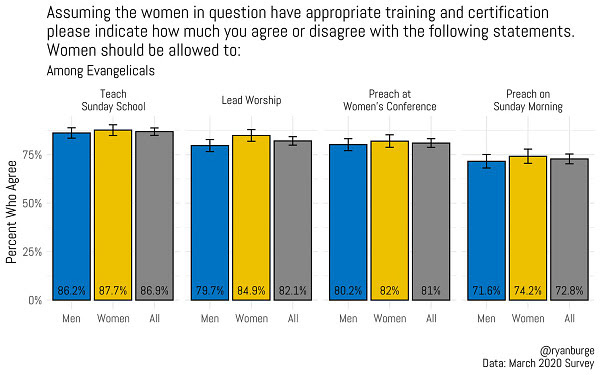
As sociologist Ryan Burge pointed out, most evangelicals have no problem with a woman preaching:

Ryan Burge @ryanburge

According to survey data from 2020, nearly three quarters of evangelicals support a woman preaching on Sunday morning. It’s honestly hard to find a combination of factors (attendance, age, partisanship) that drive support below 50%. christianitytoday.com/ct/2020/june-w…

Image

Twitter avatar for @RNS

Religion News Service@RNS

Breaking: Saddleback Church, the megachurch long led by Rick Warren, has been ousted from the Southern Baptist Convention for naming a woman to its pastoral team, against SBC teaching. https://t.co/CHqxuKt334

If you belong to an organization that wants to force underage girls to bear their rapists’ babies but can’t handle a grown woman in the pulpit, then you’re part of the problem.

Saddleback should be celebrating their expulsion. Without even really trying, they managed to get rid of the worst aspect of their church: the affiliation with the SBC. The members of Saddleback had no problem with female pastors. It’s not like the megachurch will suffer as a result of yesterday’s decision.

This is just another self-inflicted wound by SBC leaders who care more about defending patriarchal traditions than possibly bringing new members into the fold.

© 2023 Hemant Mehta
Hemant Mehta c/o Friendly Atheist P.O. Box 9734 Naperville, IL 60567

Drafting–Colton and Sandy abduct Mildred and steal her van

Colton awoke Sunday morning at 3:00 AM in a cold sweat. For a minute the dream or whatever it was didn’t stop. The picture in his head was threatening and foreboding. After Mildred had left last night she’d gone straight to Alice’s house across the street. She’d told her everything. Alice had insisted they call the police. Mildred had agreed but wanted to talk with Sandy first; she knew him and believed she had an obligation to Pop to try and protect his only grandson, plus, Sandy had been kind and nice to her. However, the monster named Colton had treated her with disdain. Anyone could tell he was the devil, mean as hell, and therefore should be locked up.

Still in his underwear, Colton went to the bathroom, then the kitchen to make coffee. He had no doubt they had to act today, as soon as possible. Waiting until tomorrow would give Mildred time to slip a noose around their necks. Hopefully, she hadn’t already.

He drank coffee at the dining room table and pondered a hurried plan before waking Sandy. Colton tip-toed into his friend’s bedroom and with a deep and powerful tone meant to imitate a pro-prosecution judge’s voice, announced, “Sanford Brown, I hereby sentence you to life in prison.”

Sandy’s eyes popped open instantly. He plopped up on his elbows. “What the fuck are you doing?”

“Reality check my friend. Get up. No time to waste.”

After peeing and slipping on yesterday’s clothes Sandy joined Colton over coffee at the dining room table. “Man, I’d just fell asleep when you shouted in my ear. The thought of killing Mildred is wrong and I can’t be a part of it.”

Colton was the master at manipulating Sandy. Okay, pack your bags and take Pop’s Buick back home to South Farrell Street. And, don’t forget to be at court tomorrow morning at 10:00 AM. Do you want me to give you a wake-up call? Oh, by the way, tell the DA and the judge I said hi.” Sarcasm seemed to always work.

“Shit man, stop that. You know I don’t want to go to jail, but there’s got to be another way.”

“I’m listening. Take your best shot, naming at least one other, workable, alternative.” Colton knew Sandy had no viable idea.

Sandy walked to the kitchen and returned with the near-empty coffee pot. He poured it into Colton’s cup. “I’ll make some more.”

“Thanks.” Against his better judgment, Colton decided to give Sandy some rope. “I tell you what. Why don’t you go see Mildred and be totally honest with her, don’t hold back. Tell her what we’re planning unless she cooperates.”
Sandy interrupted from the kitchen. “Man, that’s not being honest, you said we were going to kill her.”

It was time for some lying. “Okay, I’ll change my mind if you can convince Mildred to fully cooperate. But, just know, the van is going to get awfully small with her tagging along.”

Sandy poured water into the coffee maker, then leaned against the sink. “You’re not pulling my leg are you?”

“Hell no. I’m trying to do everything I can to save our asses.”

“Money, luggage, Alice. What else does Mildred need to do to cooperate?” Sandy started to ask Colton how he planned on withdrawing money at her bank without being video-recorded, but let it slide.

“Don’t worry, I’ve made a list and will explain it to her if you convince her to cooperate. But, here’s the deal, either way, you do not leave Mildred alone. Just send me a text of her decision and I’ll walk over. Again, don’t let her out of your sight. Agreed?”

“Agreed.” Sandy said, wishing he’d never met Colton Lee Atwood.

At 6:00 AM Sandy knocked on Mildred’s back door. As expected, she was already up, in the kitchen, washing the breakfast dishes.

She walked to the door. Sandy saw her worried face and forced smile. She didn’t unlock and open the door but stared through the glass panels. “Good morning. What you got?” Sandy had brought a frozen Caramel Apple Creme Pie he’d purchased at Walmart.

“Got you a pie. You can share with Alice if you want.” He didn’t know why he’d brought Alice into the conversation. Maybe as a subtle threat but that was more Colton’s style, not his.

For a minute, Mildred, her face expressionless, didn’t move. However, probably unaware, she mumbled, “uhhhhhhh.”

“Mildred, we need to talk. I promise it’s in your best interest.” An icy wind was wearing on Sandy’s patience. As the wrinkled-faced woman continued staring, he wondered what he would do if she turned and walked away. Return to Pop’s? No, Colton said this was life or death. He had the answer, he’d bust the door down. That would show Colton he was serious.

The dead-bolt clicked and the door opened. “Come in. Have you had breakfast?” Mildred couldn’t resist being nice.

Sandy rejected Mildred’s offer, sat her across from him in the den and played good cop to Colton’s bad cop. Surprisingly, after repeating the offer and highlighting Colton’s propensity to violence, Mildred relented. “I’ll do whatever you ask me to do. I may be old but I’m no idiot, and I’m not ready to die.”

Sandy sent Colton a text: “she’s agreed to help.”

Colton immediately responded. “Don’t let her out of your sight. I’ll be there in fifteen to twenty minutes. I’m packing and bringing the van.”

Sandy and Mildred were sitting at the kitchen table when Colton walked in. After removing his jacket, he didn’t waste any time. “We need all your cash. Where is it?”

The old woman stared at the table weighing her options. None were good.
“Damn it, look at me.” The pistol stuck inside Colton’s belt caught her eye. Mildred complied. “That’s your one and only break. From now on, when I ask you something, if you hesitate, I’ll punish you.”

“Come on man, she’s agreed to help.” Sandy stood and faced Colton, but knew better. “Hey man, did you bring my electric toothbrush?”

Colton ignored Sandy’s question and inched forward toward Mildred, removing his Sig Sauer P226. “This is your last chance old lady, where’s your cash?” Colton was confident Mildred would have hidden some amount of legal tender, probably in two or three places.

This time, Mildred stood. “I’ll show you. Follow me.” Colton complied.

Three thousand dollars was in her late husband’s shaving bag hidden behind a dozen pairs of shoes at the bottom of her closet. Sixteen hundred dollars was stuffed inside a Raggedy Ann doll sitting at the center of her chest-of-drawers. A thousand dollars was in a zip-lock bag floating inside the toilet tank in the hall bathroom. The mother load was ten thousand dollars Mildred had ignored until Colton had bored his dark eyes into and asked if she had a safe.

Cash wasn’t the only thing she kept locked in the old Mosler floor safe hidden behind a row of long dresses in the master bedroom’s walk-in-closet. Colton ignored Mildred’s last will and testament, two deeds, and a burial policy. What caught his attention was the folder containing copies of twenty-eight Certificates of Deposit. They were purchased from three local banks: First American Bank, Palatine Bank & Trust, and Ben Franklin Bank of Illinois. Colton used his phone’s calculator to add the face values of the twenty-eight CDs: seven hundred twenty nine thousand dollars. None had the same maturity date. The closest was February 15th, the longest was July 1st, 2024.

“We can go tomorrow and I’ll cash them in. But, there’ll be an early withdrawal penalty on each of them.” Mildred said, standing in the closet doorway. To Colton, the old lady was being too cooperative. She knows if we let her inside a bank she’ll be able to signal for help. Yet, three-quarters of a million dollars was tempting. Colton made a mental note to work on a plan to steal this money.

“Sandy, help Mildred pack two suitcases. I’ll be at the kitchen table writing out a script.” Both men believed it necessary for her to call Alice and tell her she’d had enough of the snow and cold and was going on a trip, probably to Florida.

To Sandy and Colton’s surprise, the old woman was convincing, both on the phone and when Alice came to say goodbye. With the men hiding in the pantry, Mildred had calmly resisted her friend’s attempt to come in for a short visit and a cup of coffee. “Dear, you know I’d like to but Rev. Mahonge has agreed to meet me for confession at 7:00, and I’ve still got a ton of things to do.” Alice would know the reverend since both women were members of St. Colette Parish.

“I understand. Now, you be careful. Call me at least once a week, and know I love postcards.” Colton thought Mildred was bolting when she opened the back door. Instead, she gave the obese, half-bald Alice a long hug. Hopefully, she hadn’t whispered something in her ear.

Mildred did equally well on three short audio recordings. When Alice requested the weekly calls, Sandy had whispered, “use voice memos to record Mildred calling Alice and leaving a message.” Colton had liked the idea, which, to him, meant Sandy assumed Alice wouldn’t be alive to make the calls.

Sandy shut off the lights, locked the back door, and loaded two suitcases in the rear of the van while directing Mildred to buckle-up in one of the two couches.

After stashing the bag of cash in an overhead compartment, Colton steered the van onto Ruskin Drive, wondering how in Hell he’d gotten into such a fucking mess.

Mental Meanderings—A Look-Back at Yesterday (Tuesday–022123)

While biking I normally listen to either a novel or a podcast. Yesterday was the tenth session inside Lawrence Sanders’ book, The Third Deadly Sin. Sanders is a magnificient writer, and puts me to absolute shame. Another thing is clear, listening to a book isn’t nearly as good as reading the book.

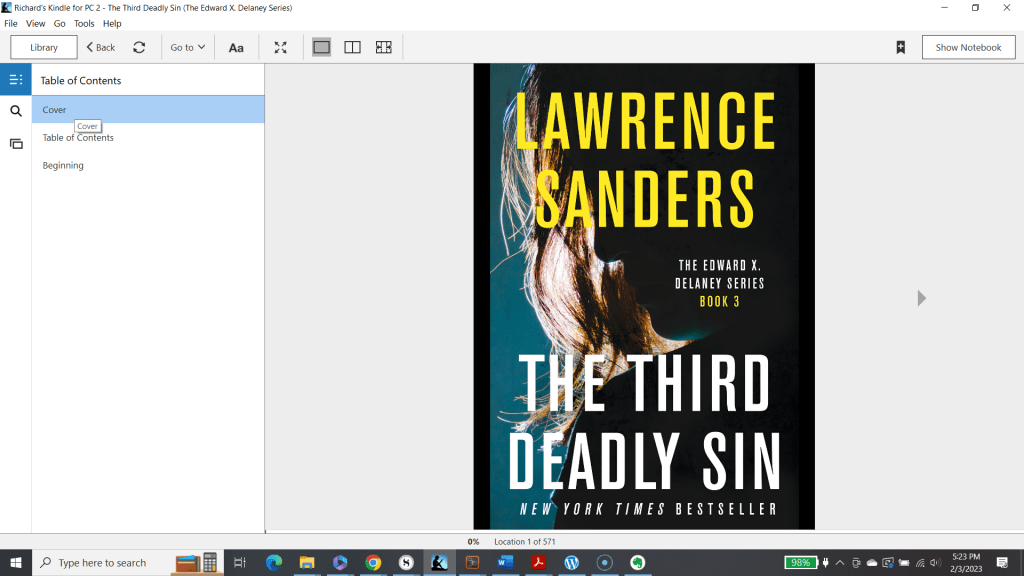
Earlier this morning, I opened this book in Kindle and started to reread part of what I’d listened to yesterday. I began in Chapter 10. Here’s the first few paragraphs (all description):

THURSDAY, JUNE 5TH …
“All right,” Sergeant Abner Boone said, flipping through his notebook, “here’s what we’ve got.”
Standing and sitting around the splintered table in Midtown Precinct North. All of them smoking: cigarettes, cigars, and Lieutenant Crane chewing on a pipe. Emptied cardboard coffee cups on the table. The detritus of gulped sandwiches, containers of chop suey, a pizza box, wrappers and bags of junk food.
Air murky with smoke, barely stirred by the air conditioner. Sweat and disinfectant. No one commented or even noticed. They had all smelled worse odors. And battered rooms like this were home, familiar and comfortable.

Sanders, Lawrence. The Third Deadly Sin (The Edward X. Delaney Series) (p. 312). Open Road Media. Kindle Edition.


My thoughts, but first I’ll state my conclusion: You and I may not be a Lawrence Sanders, but that doesn’t mean we cannot write SOMETHING. Here’s the kicker, if we want to, and try, simply “do what you can, with what you have, where you are.” Note, many attribute my quote to Theodore Roosevelt. Whoever said it, it is good, meaningful, always appropriate.

Back to my thoughts on Sanders’ writing. He is detailed (often, I think too detailed).

Boone speaks, “All right, … here’s what we’ve got.” Then, Sanders launches into description. He wants us to form a mental image. Why? To bring us there. For us to sense the very room in which a scene will take place.

Notice, the first sentence of his descriptive paragraph: “Standing and sitting around the splintered table in Midtown Precinct North.” What jumps out at you? For me, this is not a grammatically correct sentence. There’s no subject. The not-present subject is not acting. But, there are verbs, standing and sitting. However, the sentence is good. We can assume there are others present. If not, why would Boone say, “here’s what we’ve got.”

That non-subject sentence makes more sense when we combine it with the next. “Standing and sitting around the splintered table in Midtown Precinct North. All of them smoking: cigarettes, cigars, and Lieutenant Crane chewing on a pipe.”

The last sentence here deals with smoking. Notice, this is a simple sentence. In fact they all are. You and I can write a sentence like this. “Bill, George, and Tommy were seated around the dented table. All except George were smoking cigars. He was chewing on the stem of his pipe.”
Let me say one more thing about the above passage. If you don’t know a word, then look it up. I was familiar with “detritus” but wanted a refresher. Here’s where/how Sanders used it: “The detritus of gulped sandwiches, containers of chop suey, a pizza box, wrappers and bags of junk food.” And, here’s the definition: “Noun–the remains of something that has been destroyed or broken up; loose material (stone fragments and silt etc) that is worn away from rocks.”

Ask yourself, “what is my mind seeing?” One thing’s for sure, the tabletop is messy. And, what is chop suey? “chop suey, noun, a dish prepared chiefly from bean sprouts, bamboo shoots, water chestnuts, onions, mushrooms, and meat or fish and served with rice and soy sauce.” I’m not sure I want a dish of chop suey.

Here’s the last paragraph from above: “Air murky with smoke, barely stirred by the air conditioner. Sweat and disinfectant. No one commented or even noticed. They had all smelled worse odors. And battered rooms like this were home, familiar and comfortable.”

I can see it, sense it with my nose, my eyes, even my ears (the room is silent for now, except for the drone of the A/C). The air is foggy with smoke. One or more of those present has been sweating or is sweating. Maybe this insinuates BO. Maybe someone, Boone (?) has sprayed the room with Lysol.

The room is anything but inviting. Take note of the first sentence. I’d probably have written: “The air was murky with smoke, the air conditioner couldn’t keep up [or, the air conditioner failing to do its job].” Too wordy, not nearly as taut as Sanders’ writing. Notice no “was” in, “Air murky with smoke….”

I like Sanders’ final sentence in this focal passage. “And battered rooms like this were home, familiar and comfortable.” No doubt “battered” is a familiar word, but let’s look closer, just as a reminder.


Definitions for battered: “Adjective” 1. damaged by blows or hard usage; Examples: a battered old car; the beaten-up old Ford; 2. damaged especially by hard usage; Example: his battered old hat.

One final thought/question. Sanders often uses his description of settings to establish mood, and to be a predictor of what’s about to happen. If you haven’t read this book you might not have an opinion, but here, is Sanders implying the murder investigation is tired, the detectives are desperate, and they’ve been battered by all their hard-tiresome work to date? I think the answer is yes.

In sum, I might have been frustrated yesterday. Dang, I was frustrated with my listening while biking, feeling my writing was so poor. However, this morning, looking at the words, contemplating the words, gives me a little hope.

I simply have to, “do what I can, with what I have, where I’m at.”

And, so do you.