Drafting–The six hour wait

Millie was surprised to learn the bus station served both Greyhound and Amtrak. The decision was easy given the goal of being as frugal as reasonably possible. The Sentra’s death had heightened both Millie and Molly’s desire to conserve cash.

The next available Amtrak departed at 11:49 PM and arrived at Penn Station in New York City at 6:50 PM Saturday night. Although that was six plus hours faster than the scheduled bus ride, the trip would cost an extra $150, and that was for coach only, two-seats. A private room would cost an additional $348. Two-hundred thirty-eight dollars to Greyhound for two seats was their only viable option.

The next six hours were long and difficult, made more so by Molly’s incessant request to “get out and do something, and I’ll pay.” She used her own phone to develop a multi-hour itinerary: walk to nearby Middleground Metro Park and enjoy the half-mile walking trail, then walk two blocks to the highly rated San Marcos Mexican Restaurant on Summit Avenue, then, for desert, venture south to the The Original Sub for a slice of their Chocolate strawberry olive oil cake with orange whipped cream and crushed fruit, and finally, take an Uber to the Cinemark theater and watch the 6:45 PM showing of “Little Women.”

Reluctantly and regrettably, Millie vetoed Molly’s plan, took another Depakote, and slept on the furtherest bench from the station entrance until 8:45. When she awoke, Molly was reading Where the Red Fern Grows, the second book she’d failed to return to the Harvard Elementary School’s library.

After a quick trip to the restroom, Molly suggested they eat at the in-house Subway. She again offered to pay. Molly was such a loving and forgiving child, and did her best over the next ninety minutes to encourage Millie who seemed anxious, and depressed.

The bus was ten minutes early and departed on time. From their seats toward the rear, Molly squeezed Millie’s hand and whispered, “Cleveland, Ohio, here we come.” Millie managed a smile and planted a soft kiss on her daughter’s forehead.

01/10/23 Biking & Listening

Biking is something else I both love and hate. It takes a lot of effort but does provide good exercise and most days over an hour to listen to a good book or podcast. I especially like having ridden.

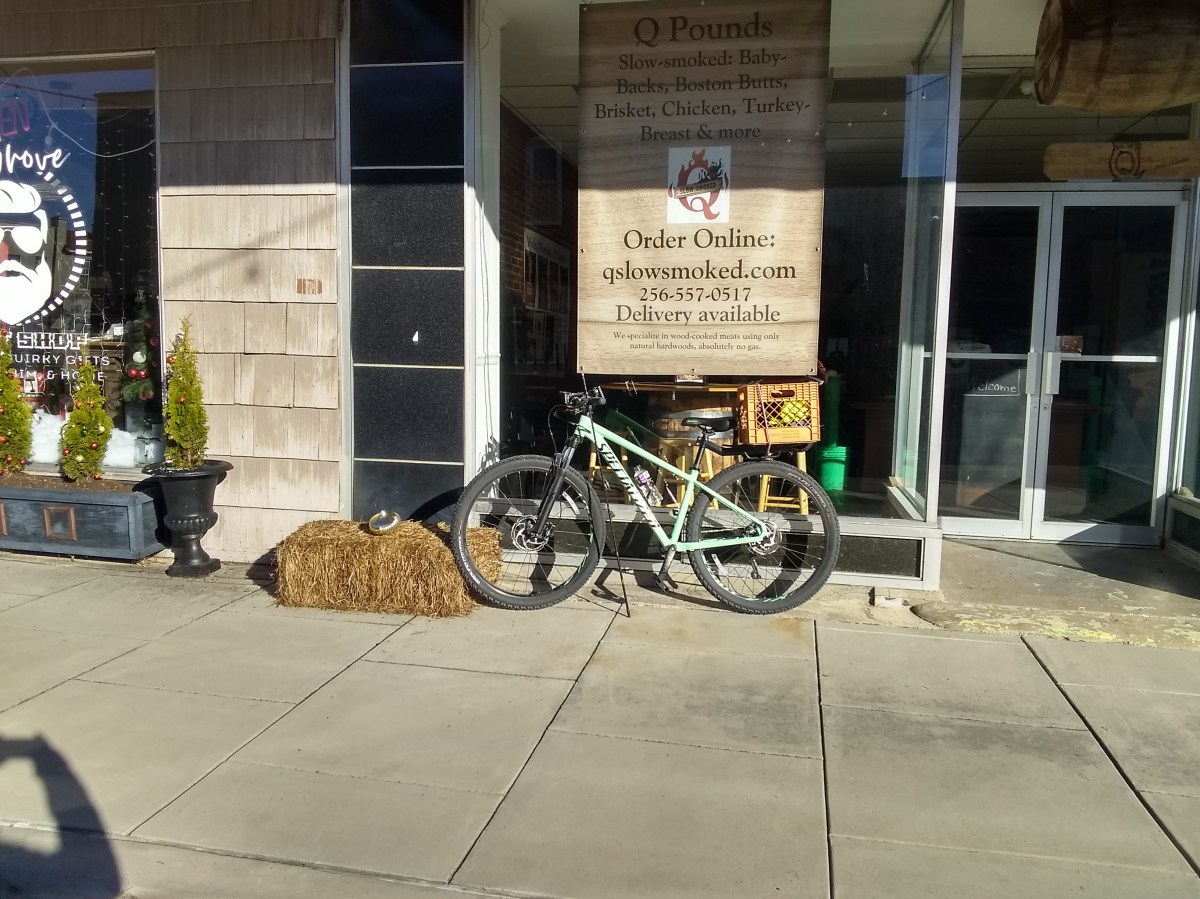
Here’s my bike, a Rockhopper by Specialized. I purchased it November 2021 from Venture Out in Guntersville; Mike is top notch! So is the bike, and the ‘old’ man seat I salvaged from an old Walmart bike.

Here’s a link to today’s bike ride. It’s what I call my pistol route, which is my goal every day. But, sometimes cold weather says otherwise.

Here’s what I’m currently listening to: The First Deadly Sin, by Lawrence Sanders

Sanders was a tremendously talented writer.

Amazon abstract:

The #1 New York Times–bestselling author introduces readers to “a great detective, a detective’s detective,” New York cop Edward X. Delaney (Kirkus Reviews).

New York Police Department Captain Edward Delaney is called to the scene of a brutal murder. A Brooklyn councilman was struck from behind, the back of his skull punctured and crushed with an unknown weapon. The victim wasn’t robbed, and there’s no known motive. The commissioner appoints Delaney to head up a clandestine task force, but soon this effort ignites an internecine war of departmental backstabbing.   Distracted by the serious illness of his wife, Barbara, Delaney begins his secret investigation. Then the killer claims another victim—slain in the exact same way, leaving the strange puncture wound. As more young men are found murdered, Delaney starts putting the pieces together. Soon, he’s faced with a cop’s dilemma: He knows who the killer is, but the man is untouchable. That’s when Delaney lays a trap to bring a monster to justice . . .

Learn more–read this great review on Amazon by Pennydreadful

I feel I may have cheated when reading this book because I read it in gosh, too many years ago to count. However, Sanders’s Deadly Sin series were the first stories that put my heart to pounding and made me wish I could write. Recently, I wanted to see if that belief was still true, and darned if it isn’t.

Lawrence Sanders quite simply is a master. Of characterization, of research, of police procedure, of getting inside the characters’ (and readers’ heads). His set up might indeed be frowned upon today. He starts the book with several chapters surrounding the antagonist, and then we meet Captain Edward X. Delaney and several chapters pertain to him and the politics surrounding a police captain with a critically ill wife.

But a killer is on the streets of New York City, and soon Captain Delaney is torn. Torn between sitting by his wife’s bedside and putting a madman away. Naturally it’s not as simple as that because politics and a power struggle are afoot, and a new kind of police reorganization affects the department all the way to the mayors’ office.

Edward X Delaney’s wife takes a turn for the worse, and he tries to resign. A police commissioner persuades him to take a leave of absence. But in the midst of all the politics and turmoil affecting the police department, the commissioner convinces Delaney to work in secret and independently while using his years of detective experience to find the killer who is walking the streets of New York and murdering unsuspecting men with an ice ax.

To accomplish this private investigation, Captain Delaney must do much of the leg work and research himself. To do this he recruits civilians to aid him in this quest, including a bedridden mountain climber, a 70+ retired curator dying to be of assistance and the widow of one of Blank’s victims [Blank is the suspect]. Much of the case is done thanks to these people when the city is in a full-blown panic because of the new administrations’ blunders and inability to catch the killer.

Captain Delaney is called back to work. And with police resources given him, he makes every effort to stop a killer from killing again.

A masterpiece of writing.

01/09/23 Biking & Listening

Biking is something else I both love and hate. It takes a lot of effort but does provide good exercise and most days over an hour to listen to a good book or podcast. I especially like having ridden.

Here’s my bike, a Rockhopper by Specialized. I purchased it November 2021 from Venture Out in Guntersville; Mike is top notch! So is the bike, and the ‘old’ man seat I salvaged from an old Walmart bike.

Here’s a link to yesterday’s bike ride. It’s what I call my pistol route, which is my goal every day. But, sometimes cold weather says otherwise.

Here’s what I’m currently listening to: The First Deadly Sin, by Lawrence Sanders

Sanders is a tremendously talented writer.

Amazon abstract:

The #1 New York Times–bestselling author introduces readers to “a great detective, a detective’s detective,” New York cop Edward X. Delaney (Kirkus Reviews).

New York Police Department Captain Edward Delaney is called to the scene of a brutal murder. A Brooklyn councilman was struck from behind, the back of his skull punctured and crushed with an unknown weapon. The victim wasn’t robbed, and there’s no known motive. The commissioner appoints Delaney to head up a clandestine task force, but soon this effort ignites an internecine war of departmental backstabbing.   Distracted by the serious illness of his wife, Barbara, Delaney begins his secret investigation. Then the killer claims another victim—slain in the exact same way, leaving the strange puncture wound. As more young men are found murdered, Delaney starts putting the pieces together. Soon, he’s faced with a cop’s dilemma: He knows who the killer is, but the man is untouchable. That’s when Delaney lays a trap to bring a monster to justice . . .

Learn more–read this great review by Pennydreadful

I feel I may have cheated when reading this book because I read it in gosh, too many years ago to count. However, Sanders’s Deadly Sin series were the first stories that put my heart to pounding and made me wish I could write. Recently, I wanted to see if that belief was still true, and darned if it isn’t.

Lawrence Sanders quite simply is a master. Of characterization, of research, of police procedure, of getting inside the characters’ (and readers’ heads). His set up might indeed be frowned upon today. He starts the book with several chapters surrounding the antagonist, and then we meet Captain Edward X. Delaney and several chapters pertain to him and the politics surrounding a police captain with a critically ill wife.

But a killer is on the streets of New York City, and soon Captain Delaney is torn. Torn between sitting by his wife’s bedside and putting a madman away. Naturally it’s not as simple as that because politics and a power struggle are afoot, and a new kind of police reorganization affects the department all the way to the mayors’ office.

Edward X Delaney’s wife takes a turn for the worse, and he tries to resign. A police commissioner persuades him to take a leave of absence. But in the midst of all the politics and turmoil affecting the police department, the commissioner convinces Delaney to work in secret and independently while using his years of detective experience to find the killer who is walking the streets of New York and murdering unsuspecting men with an ice ax.

To accomplish this private investigation, Captain Delaney must do much of the leg work and research himself. To do this he recruits civilians to aid him in this quest, including a bedridden mountain climber, a 70+ retired curator dying to be of assistance and the widow of one of Blank’s victims [Blank is the suspect]. Much of the case is done thanks to these people when the city is in a full-blown panic because of the new administrations’ blunders and inability to catch the killer.

Captain Delaney is called back to work. And with police resources given him, he makes every effort to stop a killer from killing again.

A masterpiece of writing.

Drafting–Sentra gives up the ghost

After some discussion and a little negotiating, Millie and Molly decided to alter their decision of stopping every hour or so and instead to take a longer break in Perrysburg. It was the approximate midpoint between South Bend and Youngstown, their ultimate goal for the day. The only exception would be if either of them had to go to the restroom.

Two and a half hours later, with a sleeping Molly in the back seat, Millie decided to bypass Perrysburg and continue on. She thought to herself: “Like, miraculously, I’d know how to resolve the grinding sound I’ve been hearing for the past hour every time I speed up to pass someone.” Although she was torn whether to return to Chicago and accept Matt’s Tahoe offer, it seemed best to continue on and contact an auto repair shop when they arrived in Youngstown. Maybe, all the Sentra needs is a transmission flush like Colton had mentioned.

Fifteen minutes later the twenty-year old Nissan had other plans. The moment it entered the long bridge across the Maumee River, the grinding noise doubled, the entire car began shaking, and the burning smell became so bad Millie thought her first and only new car might catch fire. She quickly realized with the cars and eighteen wheelers whizzing by that their progress was slowing. In a quarter mile the car lurched forward one final time, just enough for Millie to steer to her right and stop within an inch of the metal guard rail that separated them from the dark, murky water below.

“Molly, wake up.” Millie turned and reached over the seat and shook her daughter’s leg. “We’re stuck. We need to get out of the car and watch traffic.” The latter sounded silly but Millie knew they didn’t need to risk being hit from the rear. At least outside, they could walk east and away from the car enough to hopefully escape death if a car or truck creeped to the right and rammed the Sentra.

“What’s wrong?” Molly sat sideways in the seat with her back to the door. She looked behind and watched the passing traffic. “Why’d you stop here.”

“Come on, I’ll explain. Be careful, watch for cars.”

It was almost two hours before the wrecker arrived. Millie had Googled and found two auto repair shops in Perrysburg. She didn’t know why but she’d chosen Ray’s Service Center & Towing over Steve’s Family Auto.

“Are you Ray?” Millie asked as the short and stocky man in a greasy red hat exited the blue and white vehicle and approached the two stranded females.

“Nope. I’m Bobby. You got car troubles?” Bobby was perceptive. Millie described the Sentra’s problems, detailing each symptom and her in vain efforts to patch things up with extra fluids.

“You need a transmission. That’ll cost you.”

“How much?” Molly interjected but Millie closed her eyes and shook her head sideways.

“Never mind. Just give us a tow back to your shop and we can talk about it there.” Millie said, resigned to forking over thousands, her skin tingling. Not good.

It was a quarter past noon when Bobby turned right off Louisiana Avenue and pulled the wrecker alongside a neat and modern three-bay metal building. Millie opened the passenger door and Molly slide out beside her. The two had held a hand across their noses and mouths to ward off Bobby’s BO. The wafting smell coming from Perry’s Burgers across the parking lot was welcoming and prevented both from gagging or throwing up.

“Ray’s at lunch. You girls can sit inside.” Bobby pointed toward a side door with a sign that read, “Welcome.” Thankfully, he walked inside the shop, selected some tools from a giant red box, and hid himself underneath the hood of a late model Camaro.

The waiting room was small with six stiff chairs and two vending machines: one supplied by Coca Cola, the other filled with an assortment of candy bars, gum, granola bars, chips & pretzels, cookies, and crackers. Millie bought a Diet Coke for herself and a Sprite for Molly who returned to the Sentra for a bag of snacks they’d purchased at Walmart.

Ray and a woman, possibly his wife, returned at 1:15. To Millie and Molly’s surprise, the two were the total opposite of Bobby. They were dressed in neat, casual clothes, and were odorless. The woman retreated to a room marked “Office” and Ray approached and held out a hand. “I’m Ray. Sorry about your troubles. Bobby tells me it sounds like transmission issues.”

Ray led them inside the office and pointed to two chairs in front of the room’s second desk. Millie didn’t hesitate, thinking she might as well hear the bad news. “What will a new one cost?”

After detailing the options to replace the Sentra’s transmission—new one, used one with minimal guarantee, and a rebuilt one with extended warranty—and the range of costs—$1600 to $3200—Ray announced an equally troubling fact. It would take a week to diagnose the true problem, and if that’s what the doctor ordered, to secure a transmission from either option, would take at least five or six work days, given their current work orders.

Millie and Molly walked outside and pondered their options. Molly suggested calling Matt and figuring out a plan to unite them with his Tahoe. That seemed like defeat, something like a dog returning to its vomit. Millie rejected that and instead Googled the nearest Greyhound Bus station.

By 3:00 PM Millie had learned the nearest Greyhound was fifteen to twenty minutes away in Toledo and there was a bus departing for New York City at 10:30 tonight. The decision was made, with Molly reluctantly agreeing. The cost to repair the Sentra was just too much, given its age and market value, not even considering the near-week delay.

After paying Ray a hundred-twenty dollars in cash for their tow bill, Millie convinced him to ship Molly’s stuffed animals to their new apartment. The thing that felt bad was giving Ray their new address, but given their importance to Molly and the limited options, she finally convinced herself the risk was minimal. She handed Ray another twenty-dollar bill, and Googled a taxi service.

At 3: 55 PM, the Uber driver delivered them to the Emerald Avenue bus station in Toledo. Another twenty-six dollars down and all Millie and Molly had to do now was wait six and a half-hours before they were back on their journey to New York City.

Joan Didion on Keeping a Notebook

“We are well advised to keep on nodding terms with the people we used to be, whether we find them attractive company or not.”

Joan Didion is always worth a read, as is Maria Popova. Here’s the link to this article.

BY MARIA POPOVA

As a lover — and keeper — of diaries and notebooks, I find myself returning again and again to the question of what compels us — what propels us — to record our impressions of the present moment in all their fragile subjectivity. From Joan Didion’s 1968 anthology Slouching Towards Bethlehem (public library) — the same volume that gave us her timeless meditation on self-respect — comes a wonderful essay titled “On Keeping a Notebook,” in which Didion considers precisely that. Though the essay was originally written nearly half a century ago, the insights at its heart apply to much of our modern record-keeping, from blogging to Twitter to Instagram.

Portrait of Joan Didion by Mary Lloyd Estrin, 1977

After citing a seemingly arbitrary vignette she had found scribbled in an old notebook, Didion asks:

Why did I write it down? In order to remember, of course, but exactly what was it I wanted to remember? How much of it actually happened? Did any of it? Why do I keep a notebook at all? It is easy to deceive oneself on all those scores. The impulse to write things down is a peculiarly compulsive one, inexplicable to those who do not share it, useful only accidentally, only secondarily, in the way that any compulsion tries to justify itself. I suppose that it begins or does not begin in the cradle. Although I have felt compelled to write things down since I was five years old, I doubt that my daughter ever will, for she is a singularly blessed and accepting child, delighted with life exactly as life presents itself to her, unafraid to go to sleep and unafraid to wake up. Keepers of private notebooks are a different breed altogether, lonely and resistant rearrangers of things, anxious malcontents, children afflicted apparently at birth with some presentiment of loss.

[…]

The point of my keeping a notebook has never been, nor is it now, to have an accurate factual record of what I have been doing or thinking. That would be a different impulse entirely, an instinct for reality which I sometimes envy but do not possess.

To that end, she confesses a lifelong failure at keeping a diary:

I always had trouble distinguishing between what happened and what merely might have happened, but I remain unconvinced that the distinction, for my purposes, matters.

What, then, does matter?

How it felt to me: that is getting closer to the truth about a notebook. I sometimes delude myself about why I keep a notebook, imagine that some thrifty virtue derives from preserving everything observed. See enough and write it down, I tell myself, and then some morning when the world seems drained of wonder, some day when I am only going through the motions of doing what I am supposed to do, which is write — on that bankrupt morning I will simply open my notebook and there it will all be, a forgotten account with accumulated interest, paid passage back to the world out there: dialogue overheard in hotels and elevators and at the hat-check counter in Pavillon (one middle-aged man shows his hat check to another and says, ‘That’s my old football number’); impressions of Bettina Aptheker and Benjamin Sonnenberg and Teddy (‘Mr. Acapulco’) Stauffer; careful aperçus about tennis bums and failed fashion models and Greek shipping heiresses, one of whom taught me a significant lesson (a lesson I could have learned from F. Scott Fitzgerald, but perhaps we all must meet the very rich for ourselves) by asking, when I arrived to interview her in her orchid-filled sitting room on the second day of a paralyzing New York blizzard, whether it was snowing outside. I imagine, in other words, that the notebook is about other people. But of course it is not. I have no real business with what one stranger said to another at the hat-check counter in Pavillon; in fact I suspect that the line ‘That’s my old football number’ touched not my own imagination at all, but merely some memory of something once read, probably ‘The Eighty-Yard Run.’ Nor is my concern with a woman in a dirty crepe-de-Chine wrapper in a Wilmington bar. My stake is always, of course, in the unmentioned girl in the plaid silk dress. Remember what it was to be me: that is always the point.

It is a difficult point to admit. We are brought up in the ethic that others, any others, all others, are by definition more interesting than ourselves; taught to be diffident, just this side of self-effacing. (‘You’re the least important person in the room and don’t forget it,’ Jessica Mitford’s governess would hiss in her ear on the advent of any social occasion; I copied that into my notebook because it is only recently that I have been able to enter a room without hearing some such phrase in my inner ear.) Only the very young and the very old may recount their dreams at breakfast, dwell upon self, interrupt with memories of beach picnics and favorite Liberty lawn dresses and the rainbow trout in a creek near Colorado Springs. The rest of us are expected, rightly, to affect absorption in other people’s favorite dresses, other people’s trout.

Once again, Didion returns to the egoic driver of the motive to write:

And so we do. But our notebooks give us away, for however dutifully we record what we see around us, the common denominator of all we see is always, transparently, shamelessly, the implacable “I.” We are not talking here about the kind of notebook that is patently for public consumption, a structural conceit for binding together a series of graceful pensées; we are talking about something private, about bits of the mind’s string too short to use, an indiscriminate and erratic assemblage with meaning only for its maker.

Ultimately, Didion sees the deepest value of the notebook as a reconciliation tool for the self and all of its iterations:

I think we are well advised to keep on nodding terms with the people we used to be, whether we find them attractive company or not. Otherwise they turn up unannounced and surprise us, come hammering on the mind’s door at 4 a.m. of a bad night and demand to know who deserted them, who betrayed them, who is going to make amends. We forget all too soon the things we thought we could never forget. We forget the loves and the betrayals alike, forget what we whispered and what we screamed, forget who we were.

[…]

It is a good idea, then, to keep in touch, and I suppose that keeping in touch is what notebooks are all about. And we are all on our own when it comes to keeping those lines open to ourselves: your notebook will never help me, nor mine you.

The rest of Slouching Towards Bethlehem is brimming with the same kind of uncompromising insight, sharp and soft at the same time, on everything from morality to marriage to self-respect. Complement this particular portion with celebrated writers on the creative benefits of keeping a diary.


Here’s a copy of Didion’s On Keeping a Notebook.

Drafting–The South Bend Exit 72 break

“Code A,” Millie announced as Molly rushed away for the restroom. This was Millie’s oft-repeated plea for Molly to be observant, to always be aware of what was happening around her.

Without thinking, Millie opened the Sentra’s gas tank door and removed a debit card from her pant’s pocket. “Whoa.” She said aloud causing the man at the other side of the pump to look her way.

Earlier, before leaving home, Millie had removed the card from her wallet and stuck it inside her front right pocket. She’d meant to cut it up with scissors before leaving the house but had forgotten. “You dumb ass. That’s all we need, a trail of breadcrumbs scattered from Chicago to New York City, all showing on Colton’s next bank statement.”

The actual plan was to use cash to pay for expenditures along the eight-hundred mile journey. Shortly after arriving in New York City, Millie would find a conveniently located bank and open a new account. A quick call or text to Matt would initiate the transfer of money he was holding for her that she’d withdrawn from her 401K account. Another reason to be thankful. For the eight years she’d worked for Quinn Law she’d had the payroll clerk deduct $30 per week. That, along with the firm’s one-hundred percent matching, had grown to $32,468.28, including interest and market growth. Not much to start a new life in New York City especially after paying taxes and penalties, but she smiled as she thought about the good job Matt had gotten her.

Millie walked inside and scoured the store for the automotive section. After paying cash for two quarts of oil, two quarts of transmission fluid, and ten gallons of gas, she returned to the Sentra. She inserted the hose and raised the hood, breathing out and struggling to forget the mistake she’d made in refusing to accept Matt’s Tahoe offer.

Inside, Molly washed her hands and returned to the store. A rack of cards caught her attention. She was staring at the front cover of a Hallmark depicting pencil drawn dogs of every shape, size, and color centered around a five word congratulatory declaration: “Yah! Your new best friend!” Molly imagined receiving the card from Alisha three days after the late night phone call announcing the adoption of a black Lab or Golden Retriever.

“Stay put while I go to the bathroom.” Millie told Molly in passing.

Inside, she washed her hands, and swallowed a 500 mg Depakote pill. It was half of what Dr. Maharaja had prescribed but the full load always caused extreme drowsiness. Millie would take the other half tonight in Youngstown where Molly had begged to spend the night. The curious twelve-year-old hated riding and wanted to break up the long drive and hopefully take a long walk.

Millie locked herself in a private stall and peed. She closed her eyes and realized this was the third day she’d been so euphoric, so energized. No doubt, the reason why she’d slept so little last night.

As soon as she stood and snapped her pants, the image reappeared. It had been the same one for a week. Millie was in the clouds walking toward New York City along a square-tiled pathway, each one three feet apart. And, it was the same song—“Everyone Hurts,” by R.E.M.— playing as she carefully stepped from one tile to the next.

The slamming of the stall door next to her’s snapped Millie back to reality. “Hang on, hang on,” she kept telling herself, ignoring the lavatory, and exiting the restrooms. Molly was still at the card stand but now talking with a white-haired, bearded man leaning on a cane. So much for Code A.

The next few minutes didn’t register with Millie. Somehow, her and Molly had returned to the Sentra and ridden away, and were now passing Exit 77. Molly was stretched out in the back seat reading The Wind in the Willows.


Here’s “Everybody Hurts” if you want to listen.

Looking back

I’m looking back fifty-four years. It’s Wednesday, January 8, 1969. I was fourteen and in the ninth grade at Boaz High School. I wouldn’t be fifteen until August the 13th. I was shy and had little confidence and was impressionable, probably easily manipulated. Girls were foreigners. I’d never had a girlfriend. I was a pretty good student because Mother wanted me to go to college. Church had always been a big part of my life. Again, Mother. She saw to it I believed what our Southern Baptist preacher said. Did I say I was impressionable?

Forty-five years, two months, and four days later–March 12, 2014–I was sitting in my bedroom chair having my early morning devotion and prayer time. Somehow, frustrated, I realized I had been mislead. I slung my Bible and Oswald Chambers’ My Utmost for His Highest across the room. My prayers were nothing more than me talking to myself. There was no one listening. I was alone. There was no one coming to save me. It was time to ask questions.

It’s been a nine year reading, researching, relating and recording journey. I wouldn’t trade it for the world. I no longer believe what the Southern Baptist preacher says. I’m no longer superstitious. I no longer believe in the supernatural.

It’s simple really. Faith is belief in the absence of evidence, more specifically, it’s belief in the face of contrary evidence. If there was credible evidence, I wouldn’t need faith, I’d have proof.

That’s the problem. There’s insufficient, credible evidence to support faith. Until its discovered, I’ll remain unconvinced.

However, I have to admit the Bible is a great work of fiction.


Read this and think about it.

Biking and stuffed animals

Yesterday, I rode my bike for the first time since December 27th. I was crossing the old wooden bridge at Short Creek when out of the blue I had a strange thought. It was actually a question: what will happen to Molly’s stuffed animals when her and Millie abandon their Sentra?

Here’s what I had written several days earlier.

Millie took ten minutes to eat a cold slice of last night’s pizza and drink a large cup of coffee. Out of habit, she poured the remaining coffee from the pot into the sink and dumped the coffee grounds and filter into the trash. “Okay, okay,” she said aloud if answering the voice in her head that asked, “what are you doing?” Habits were hard to break.

She walked back up stairs, this time taking two steps at a time. It took ten-minutes to pack two duffel bags with an assortment of clothes and toiletries, and toss all of Molly’s stuffed animals into a large trash bag. Whatever else they needed, they could purchase down the road or in New York City.

Millie skipped a shower and changed into jeans and a sweatshirt, and removed Colton’s S & W 357 pistol from his nightstand. Although the theft would send Colton into a rage Millie believed she had no choice. They were hitting the road and would face all types of danger. Simply put, the pistol was for protection, her’s and Molly’s. Plus, the S & W was her only choice, since Colton kept his other guns locked in the giant safe at the end of the hall. Millie stuffed the gun into her duffel and transported everything outside to the twenty-year old Sentra.

from Millie’s Story

When the thought appeared I wasn’t thinking about my story. But, apparently my subconscious was. It recognized there might be an issue, or it was trying to make a mountain out of a mole hill (sorry!). When I pedaled ahead and pondered the issue the only thing I could come up with was the Toledo bus station might have some old suitcases to sell (maybe they’d been abandoned by prior customers), and the stuffed animals would tag along underneath the bus all the way to New York City.

But, this morning at my desk, I did some more brainstorming and decided Millie will ask Ray (from Ray’s Service Center) if he will ship the stuffed animals to Molly in New York City (she already has their apartment’s address).

I don’t have a clue where thoughts come from. The thought at the old bridge just appeared, out of the blue. My thoughts since then about how to handle this issue appear more self-directed. But, are they? Did they too just appear? One would think they’re caused by something, but what?

I’m pretty sure I don’t consciously choose my thoughts. As Sam Harris says, “we cannot choose what we choose.” I think he means they appear, otherwise we’d have to think them before we think them.

This is a little deep for me so, for now, I’m going to blame Millie. She’s the one who tossed Molly’s stuffed animals into a trash bag and carried them to the Sentra.

Drafting–Maumee River Breakdown

When was the last time you drove your car (or, you were a passenger) from Chicago to New York City? Ever?

Me?

No. Never.

But, that’s what Millie was doing at the end of yesterday’s scene. Well, her and daughter Molly were starting that journey having just merged onto I-90.

Four hours later their always-before-now trusty 1999 Sentra balks on I-80 while crossing the Maumee River just east of Perrysburg, Ohio. The high mileage Nissan calls it quits before exiting the quarter-mile causeway.

This imaginary event came to mind during this morning’s planning. Initially, I knew today’s writing objective—and probably tomorrow’s and maybe even Sunday’s—was to draft the details of Millie and Molly’s near-800 mile journey. In part, I wanted it to be especially memorable for Molly, Millie’s precocious twelve-year-old.

In an earlier scene I’d mentioned Millie’s vehicle so today I felt it realistic for it to develop some mechanical issues, even breakdown. I supposed I likened the twenty-year-old Sentra to Chekhov’s gun. “If in the first act you have hung a pistol on the wall, then in the following one it should be fired. Otherwise don’t put it there.”

My auto breakdown idea was all I knew about this scene (now, I’m thinking it’s going to take several scenes). This is inherent in being a pantser. Even if I were a plotter, I suspect its impossible to know everything before the drafting process begins.

My type of scene planning always involves brainstorming. No different today. In deciding where the breakdown would take place (my decision, not Millie’s!) I used Google Maps and found a city around four hours ‘down the road.’ There was some trial and error. I saw Perrysburg, OH along the route and plugged it into the Directions feature (FROM Chicago, TO Perrysburg). I then scanned the Map using satellite view and spotted the Maumee River east of Perrysburg. Magic.

The next question was easy. What would Millie do? Note, it’s important to ‘become’ the main character. What would she do? Not necessarily what you the author would do. Her answer, she would call for help. After a quick Google search, “auto repair/road service near Perrysburg, OH,” she chose Ray’s Service Center & Towing over Steve’s Family Auto. Obviously, these are real places. It’s okay to use them fictionally. Ray’s tows the Sentra to his garage in Perrysburg.

Once he diagnoses the car’s problem, Millie has another question to answer. She’s just learned the cost to repair her Sentra is more than its worth. Recall, she and Molly are fleeing a bad situation in Chicago. Millie is committed to leaving Colton behind. Forever. She ultimately concludes her and Millie will take Greyhound bus to New York City. A couple of Google searches reveal the nearest bus station is in Toledo, fifteen miles away, and an Uber service is available to take them there.

At this point, I (as author) need to obtain details about the Greyhound bus ride. Fortunately, their website supplied all I needed. I believe it is important to discover the logistics, to learn what my characters will have to deal with. Greyhound’s site allowed me—without registering or anything–to plug in the desired departure time and location, and the destination. It even provided a detailed itinerary showing arrival and departure times at every stop along the way, which are, in order: Cleveland, Akron, and Youngstown, OH; Pittsburgh, Midway Plaza, Harrisburg, Norristown King Prussia E., and Philadelphia, PA; Camden, Mt. Laurel, and Newark, NJ; and, New York George Washington Bridge in New York City. Doesn’t this twenty-one hours and five-minute journey sound fun?

There’s still a lot of brainstorming to do, but this is a start.

Drafting–From Millie’s Story

You might not write well every day, but you can always edit a bad page. You can’t edit a blank page.

Jodi Picoult

Here’s my attempt today to avoid a blank page:

The moment the school’s front door closed behind them, Molly grabbed Millie’s hand. “Stop, tell me what happened. What did he hit you with this time?” The twelve-year-old knew good and well her mother’s blackening eye and three-inch stitching wasn’t from an accident.

“I will, but come on. There’s probably cameras out here.”

Molly descended the stairs and raced to the parked Sentra. After tossing her book bag in the rear seat she waited on her mother thankful their nightmare was ending. “Did you call the police?” Now, she wished she hadn’t spent the night with Alisha.

“Hop in.” The scene from Thanksgiving flashed across Millie’s mind.

The drive to Walmart took five minutes. Thankfully, the traffic on S. Vincennes was light. By the time they arrived Millie had shared a detailed account of what had happened the night before, leaving out the main reason Colton had become enraged.

“If I’d been there I would have killed him.”

“Molly, don’t say that. I’ve taught you better. Think.” They exited the car and headed to the main entrance. “What would have happened to you, to us, if you had shot Colton?”

“Did I say I would have shot him?”

“You know what I mean.” Millie was proud that her daughter was as open as she was, especially after what they’d been through the past year.

“Maybe me in prison or a group home but you would at least have your freedom.” Molly grabbed a buggy as they entered Walmart.

Millie lay an arm across Molly’s shoulder and gave her a squeeze. “Dear, that wouldn’t be freedom for either of us.” They paused to disinfect their hands.

“Here’s a better idea. Why don’t we take a road trip and never come back.”
“Deal.” Mother and daughter fist-bumped and headed to Electronics.

By 10:15 Millie and Molly had purchased two new cell phones and an assortment of snacks at Walmart, withdrawn eighteen hundred forty six dollars and twenty-eight cents from their secret account at the 83rd Street Bank of America, swung by That’s-a-Burger, and merged onto I-90E.

“New York City, here we come.” Molly screamed into the cold air rushing in from her lowered window before cramming a giant bite of turkey burger in her mouth.