Let There Always Be Light: Dark Matter and the Mystery of Our Mortal Stardust

(Patti Smith Reads Rebecca Elson)

Here’s the link to this article.

“For this we go out dark nights, searching… for signs of unseen things… Let there be swarms of them, enough for immortality, always a star where we can warm ourselves.”

BY MARIA POPOVA

This is the fourth of nine installments in the animated interlude season of The Universe in Verse in collaboration with On Being, celebrating the wonder of reality through stories of science winged with poetry. See the rest here.

THE ANIMATED UNIVERSE IN VERSE: CHAPTER FOUR

Months before Edwin Hubble finally published his epoch-making revelation about Andromeda, staggering the world with the fact that the universe extends beyond our Milky Way galaxy, a child was born under the star-salted skies of Washington, D.C., where the Milky Way was still visible before a century’s smog slipped between us and the cosmos — a child who would grow up to confirm the existence of dark matter, that invisible cosmic glue holding galaxies together and pinning planets to their orbits so that, on at least one of them, small awestruck creatures with vast complex consciousnesses can unravel the mysteries of the universe.

Night after night, Vera Rubin (July 23, 1928–December 25, 2016) peered out of her childhood bedroom and into the stars, wondersmitten with the beauty of it all — until she read a children’s book about the trailblazing astronomer Maria Mitchell, who had expanded the universe of possibility for half of our species a century earlier. The young Vera was suddenly seized with a life-altering realization: Not only was there such a thing as a professional stargazer, but it was a thing a girl could do.

Vera Rubin as an undergraduate at Vassar, 1940s

In 1965 — exactly one hundred years after Maria Mitchell was appointed the first professor of astronomy at Vassar, which Vera Rubin had chosen as her training ground in astronomy — she became the first woman permitted to use the Palomar Observatory. Peering through its colossal eye — the telescope, devised the year Rubin was born, had replaced the one through which Hubble made his discovery as the world’s most powerful astronomical instrument — she was just as wondersmitten as the little girl peering through the bedroom window, just as beguiled by the beauty of the cosmos. “I sometimes ask myself whether I would be studying galaxies if they were ugly,” she reflected in her most personal interview. “I think it may not be irrelevant that galaxies are really very attractive.”

Galaxies had taken Rubin to Palomar, and galaxies — the riddle of their rotation, which she had endeavored to solve — became the key to her epochal confirmation of dark matter. One of the most mesmerizing unsolved puzzles in astronomy, dark matter had remained only an enticing speculation since the Swiss astrophysicist Fritz Zwicky had first theorized it when Vera was five.

A generation later, a small clan of astronomers at Cambridge analyzed the deepest image of space the Hubble Space Telescope had yet captured — that iconic glimpse of the unknown, revealing a universe “so brutal and alive it seemed to comprehend us back” — to discern the origin of the mysterious dark matter halo enveloping the Milky Way. Spearheading the endeavor was an extraordinary young astronomer back to work during a remission of a rare terminal blood cancer ordinarily afflicting the elderly.

Rebecca Elson, 1987

Nursed on geology and paleontology on the shores of a prehistoric lake, Rebecca Elson (January 2, 1960–May 19, 1999) was barely sixteen and already in college when she first glimpsed Andromeda through a telescope. Instantly dazzled by its “delicate wisp of milky spiral light floating in what seemed a bottomless well of empty space,” she became a scientist but never relinquished the pull of the poetic dimensions of reality. During her postdoctoral work at Princeton’s Institute for Advanced Study, Elson found refuge from the narrow patriarchy of academic science in a gathering of poets every Tuesday evening. She became a fellow at a Radcliffe-Harvard institute for postgraduate researchers devoted to reversing “the climate of non-expectation for women,” among the alumnae of which are Anne Sexton, Alice Walker, and Anna Deavere Smith. There, in a weekly writing group, she met and befriended the poet Marie Howe, whose splendid “Singularity” became the inspiration for this animated season of The Universe in Verse.

It was then — twenty-nine and newly elected the youngest astronomer in history to serve on the Decennial Review committee steering the course of American science toward the most compelling unsolved questions — that Elson received her terminal diagnosis.

Throughout the bodily brutality of her cancer treatment, she filled notebooks with poetic questions and experiments in verse, bridging with uncommon beauty the creaturely and the cosmic — those eternal mysteries of our mortal matter that make it impossible for a consciousness born of dead stars to fathom its own nonexistence.

Rebecca Elson lived with the mystery for another decade, never losing her keen awareness that we are matter capable of wonder, never ceasing to channel it in poetry. When she returned her borrowed stardust to the universe, a spring shy of her fortieth birthday, she left behind nearly sixty scientific papers and a single, splendid book of poems titled A Responsibility to Awe (public library) — among them the staggering “Theories of Everything” (read by Regina Spektor at the 2019 Universe in Verse) and “Antidotes to Fear of Death (read by Janna Levin at the 2020 Universe in Verse).

Permeating Elson’s poetic meditations, the mystery of dark matter culminates in one particular poem exploring with uncommon loveliness what may be the most touching paradox of being human — our longing for the light of immortality as creatures of matter in a cosmos governed by the dark sublime of dissolution.

Bringing Elson’s masterpiece to life for this series is Patti Smith (who read Emily Dickinson’s pre-atomic ode to particle physics at the 2020 Universe in Verse), with animation by Ohara Hale (who animated Emily Dickinson’s pre-ecological poem about ecology in Chapter One of this experimental season of The Universe in Verse) and music by Zoë Keating (who read Rita Dove’s paleontological poem at the 2018 Universe in Verse).

LET THERE ALWAYS BE LIGHT (SEARCHING FOR DARK MATTER)
by Rebecca Elson

For this we go out dark nights, searching
For the dimmest stars,
For signs of unseen things:

To weigh us down.
To stop the universe
From rushing on and on
Into its own beyond
Till it exhausts itself and lies down cold,
Its last star going out.

Whatever they turn out to be,
Let there be swarms of them,
Enough for immortality,
Always a star where we can warm ourselves.

Let there be enough to bring it back
From its own edges,
To bring us all so close we ignite
The bright spark of resurrection.

Previously on The Universe in VerseChapter 1 (the evolution of life and the birth of ecology, with Joan As Police Woman and Emily Dickinson); Chapter 2 (Henrietta Leavitt, Edwin Hubble, and the human hunger to know the cosmos, with Tracy K. Smith); Chapter 3 (trailblazing astronomer Maria Mitchell and the poetry of the cosmic perspective, with David Byrne and Pattiann Rogers).

Drafting–Colton & Sandy go off-grid

“Turn right on Biesterfield Road. It’s about a quarter mile.” Sandy said from the front passenger seat of Colton’s crew cab Ram truck. The two had spent the past ninety minutes heading west to a house along the southern edge of the Busse Woods Forest Preserve, located just south of Rolling Meadows. Their quest to disappear had led them here.

It seemed their best option. Certainly, they couldn’t stay at Colton’s on S. Princeton, or Sandy’s on S. Farrell St. These places would be the first locations Chicago Police would look once the arrest warrants were issued. Neither man doubted that’s what would happen in court shortly after 10:00 AM on Monday. Hell, the whole purpose of the hearing was to determine whether the defendants would appear in court to face their charges. The judge, the new pro-prosecution judge, would order both men be immediately arrested and held in jail awaiting trial.

Colton turned right, and momentarily squeezed his eyes shut. Why hadn’t he seen this coming? Why wasn’t he more prepared? Why did the damn bank only allow a maximum daily ATM withdrawl of $300.00?

Sandy tried to think of the last time he’d been to Pop’s place. The best he could recall it was three or four years ago. Pop was the only father-figure he’d ever really known, since his biological father had died in his mid-twenties when Sandy was only three. James Todd Hickman was his maternal grandfather, who’d once owned two-hundred acres south of the the Busse Woods Preserve. Over the years he’d made a fortunate selling off twenty to forty acre tracts to eager developers. Now, Pop was gone, as was his only daughter, Sandy and Sarah’s mother, who’d died last February of a brain aneurysm. Any day now, his mother’s estate, which included most of Pop’s estate she had inherited, would be distributed to Sandy and his sister.

Sandy stared at Seibert Landscaping on his right and remembered the physically-exhausting summer he’d worked there. Pop’s had said it would show him what real work was like, and motivate him to do better in school. The only good thing to come out of the three-month torture was the owner’s daughter, the deeply-tanned and delectably toned thirteen year old Rachel Duncan. Oh my, Sandy whispered to himself wondering what might have been if his mother had let him live with Pop year-round.

“What if Sarah reneges?” It was the third time Colton had mentioned the agreement. Although Stella Hickman Brown had left everything in equal shares to Sandy and Sarah, the two had supposedly reached an agreement whereby Sandy would own the Busse Woods home outright, with Sarah receiving an extra $150,000 from Pop’s cash assets for her half of the real estate.

“Again, she lives in Phoenix and has no need or desire for sticks and stones in Rolling Meadows. Oh shit, turn left, right here. Beisner Road.”

“What about the contents. You said Pop’s had a lot of antiques, and several expensive paintings.”

“Get off of it, will you? It’s all in the agreement. That’s where the extra $50,000 comes in.” Sandy pointed ahead. “Slow down. Right on Winston.”

The idea had been Sandy’s. After him and Colton met at Mitchell’s Tap, they’d sat in his truck and brainstormed the safest place to setup base-camp as Sandy called it. After listing a few not-so-desirous spots—including an abandoned warehouse close to Lincoln Park Zoo owned by Colton’s immediate supervisor at work—Sandy had suggested Pop’s house. The only negative being it was ninety minutes from either one of their houses. Colton had reluctantly agreed but was worried that cops or bounty hunters could likely discover the link in Sandy’s ancestral chain.

“Left on Ruskin Drive. About a block.” Pop’s place was the thirteenth house on the left, and backed up to the 3,500 acre nature preserve. Sandy’s mind returned to Rachel Duncan and the summer night they’d hiked to Busse Lake and gone skinny-dipping. Where had his life gone so horribly wrong? Such promise, including an all-expense college education compliments of Pop’s. But, such disappointment? Beginning in the eleventh grade in Chicago. Drugs and stealing had led to juvenile detention and eventually to dropping out of high school. “Here it is, 622 Ruskin Drive.” The last account Sandy had of Rachel was she was married to a Dallas, Texas gynecologist. “Fitting,” he said aloud.

“Uh.” Colton said stopping in front of the two-car garage.

01/23/23 Biking & Listening

Biking is something else I both love and hate. It takes a lot of effort but does provide good exercise and most days over an hour to listen to a good book or podcast. I especially like having ridden.

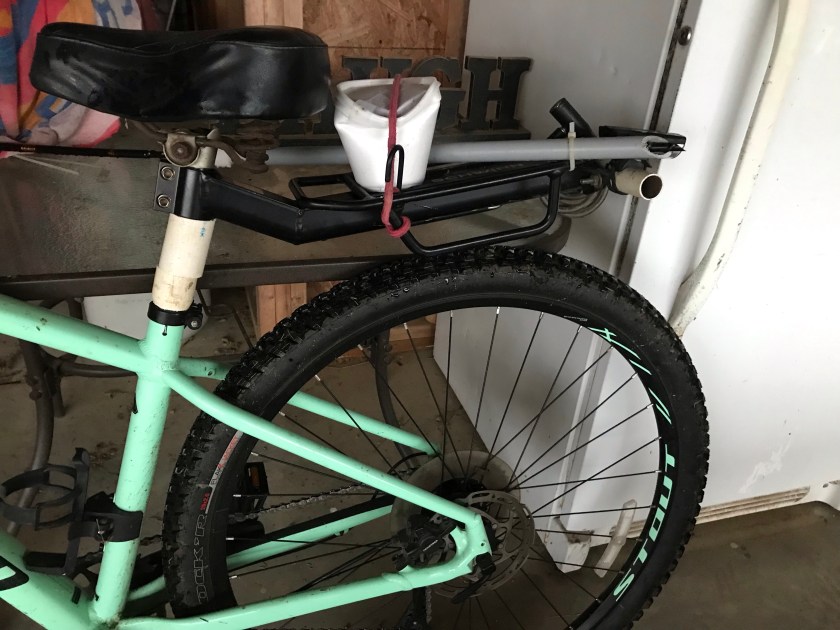
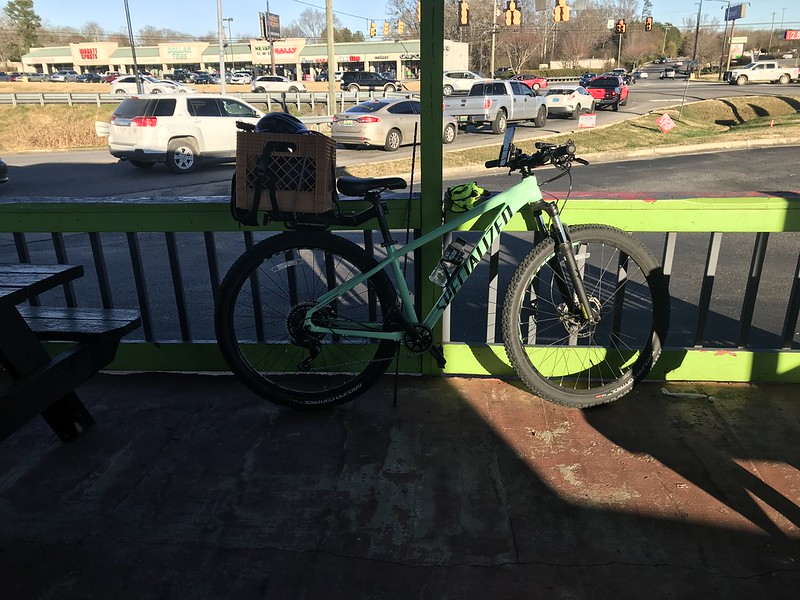
Here’s my bike, a Rockhopper by Specialized. I purchased it November 2021 from Venture Out in Guntersville; Mike is top notch! So is the bike, and the ‘old’ man seat I salvaged from an old Walmart bike.

Here’s a link to today’s bike ride. It’s what I call my pistol route, which is my goal every day. But, sometimes cold weather says otherwise.

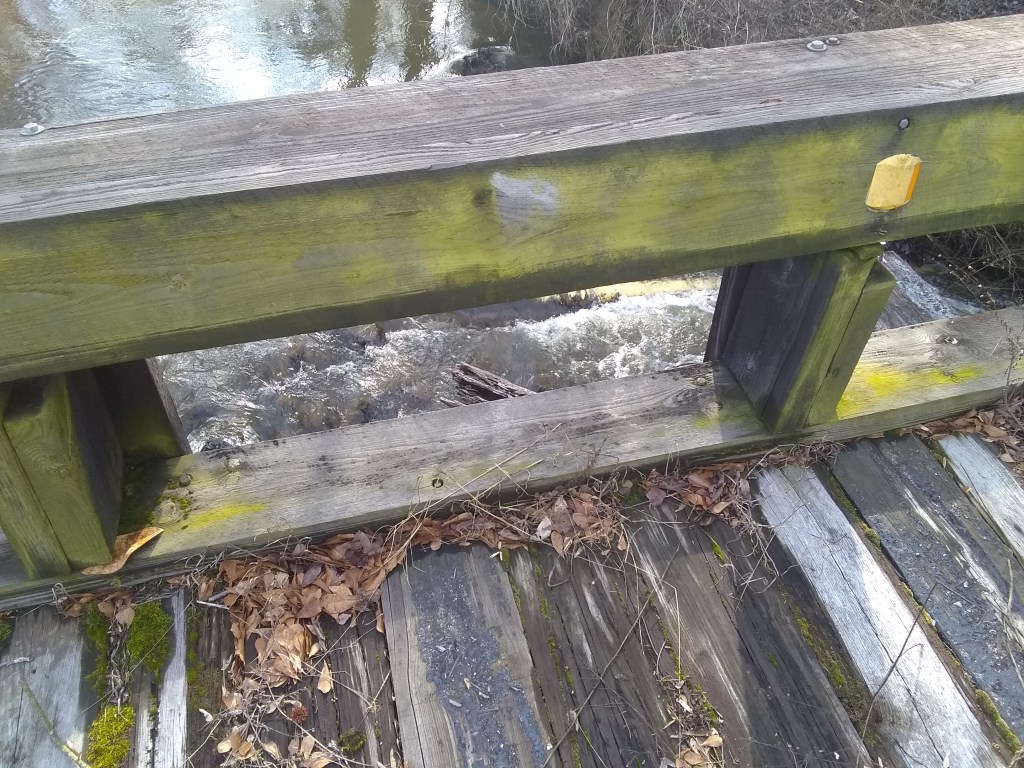
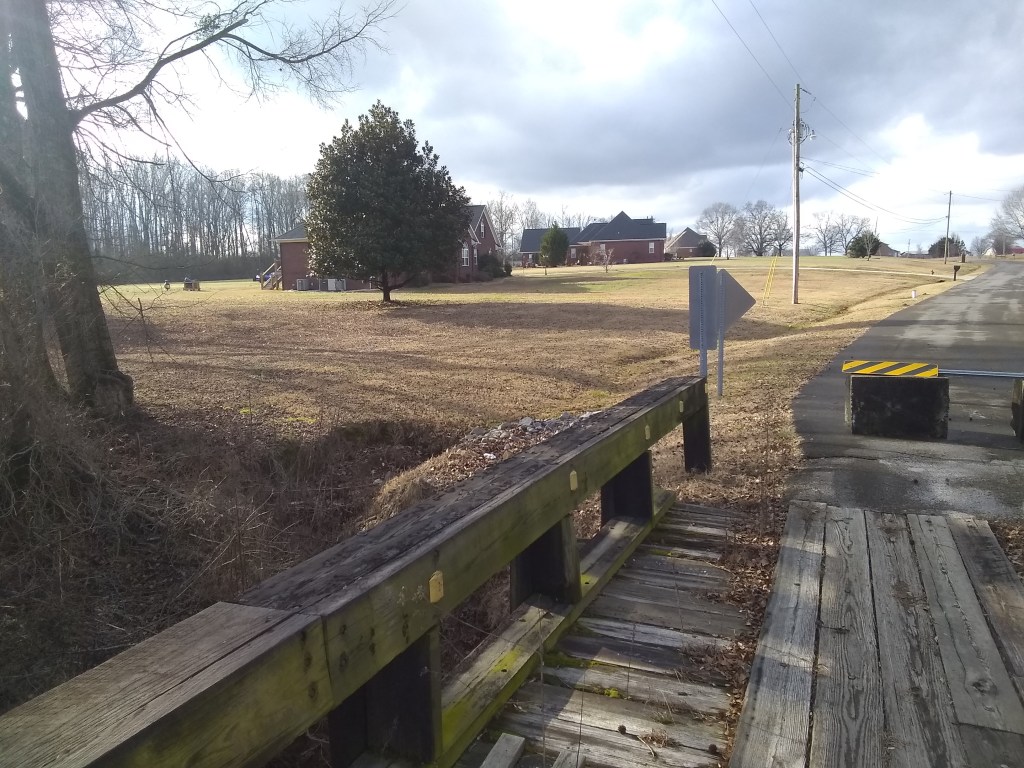
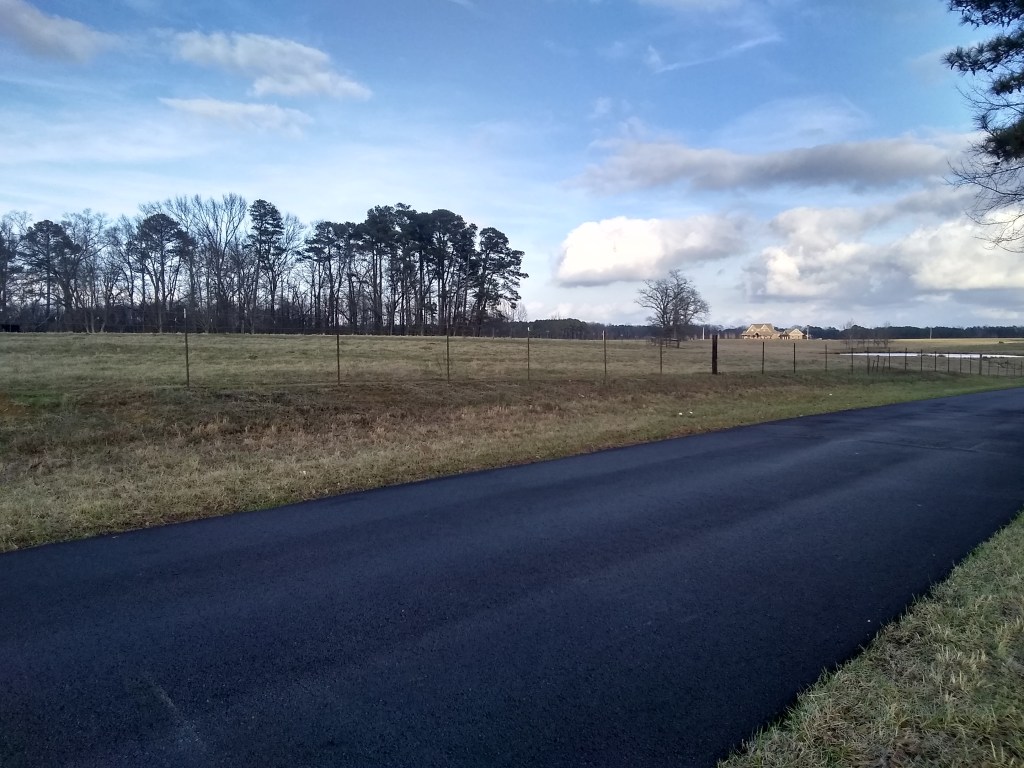
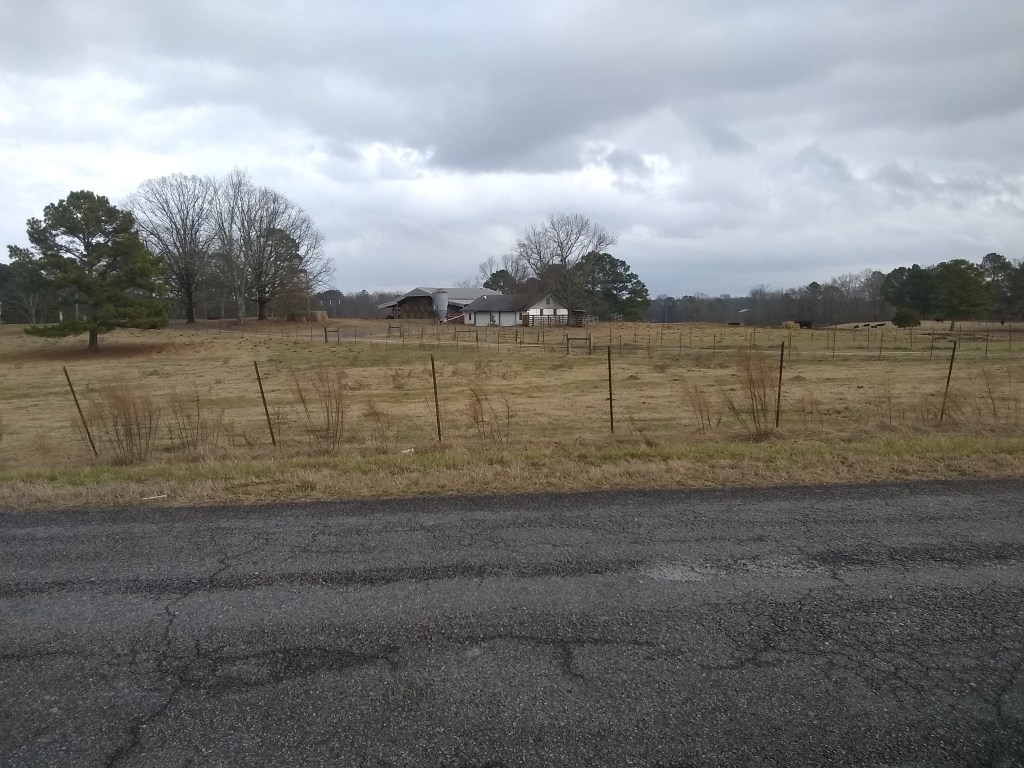
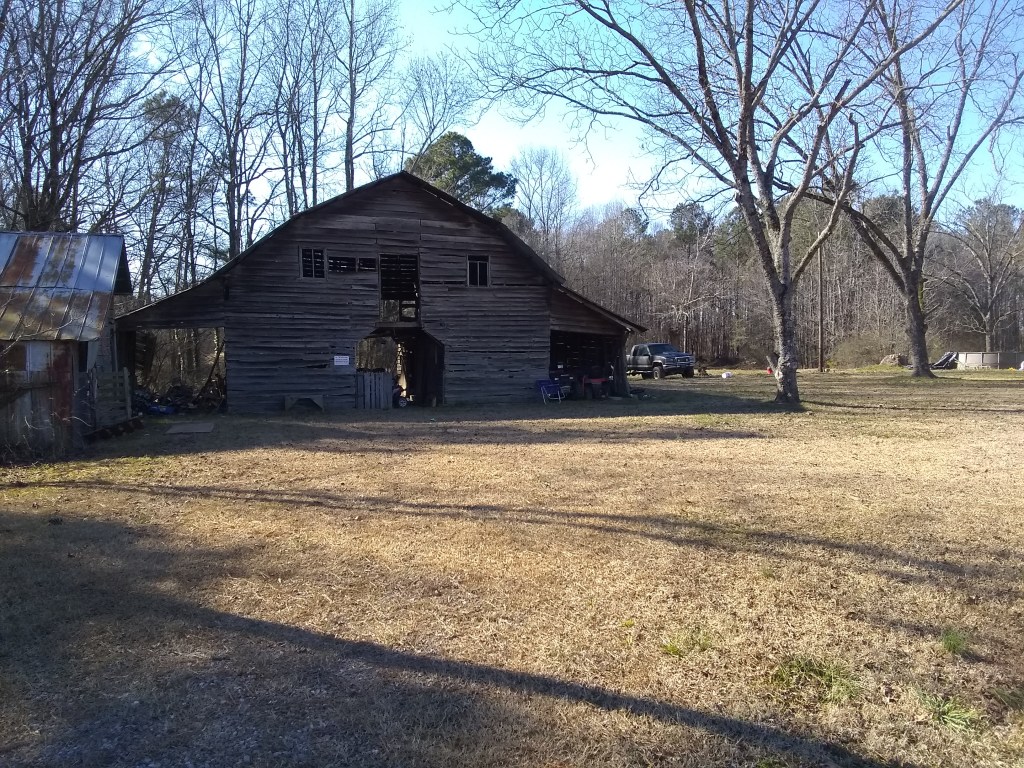
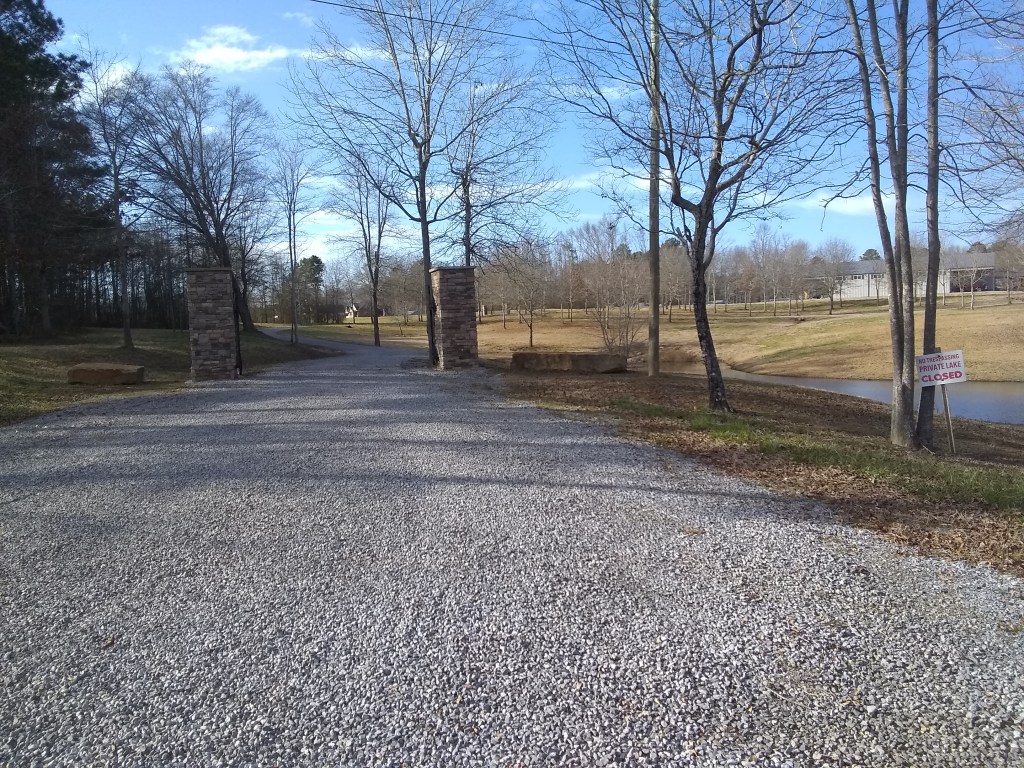
Here’s a few photos taken along my route:

Here’s what I’m currently listening to: The Second Deadly Sin, by Lawrence Sanders

Sanders was a tremendously talented writer.

Amazon abstract:

A police detective must find out who murdered a world-famous artist in a thriller by the #1 New York Times–bestselling “master of suspense” (The Washington Post).

A month ago, world-renowned artist Victor Maitland was found dead in his Mott Street studio—stabbed repeatedly in the back. With no clear leads or suspects, the New York Police Department calls Chief Edward Delaney out of retirement. Delaney is still adjusting to life on the outside, and he’s bored by his free time. He welcomes the chance to put his well-honed investigative skills to the test once again. To investigate the case, Delaney plunges into Maitland’s rarefied orbit. Following a winding path of avarice, deception, and fraud, Delaney uncovers a long line of suspects that includes Maitland’s wife, son, and mistress. When a second murder rocks Manhattan’s art world, Delaney moves closer to the truth about what kind of a man—or monster—Victor Maitland really was. But which of the artist’s enemies was capable of killing him and leaving no trail?

My lingering guilt

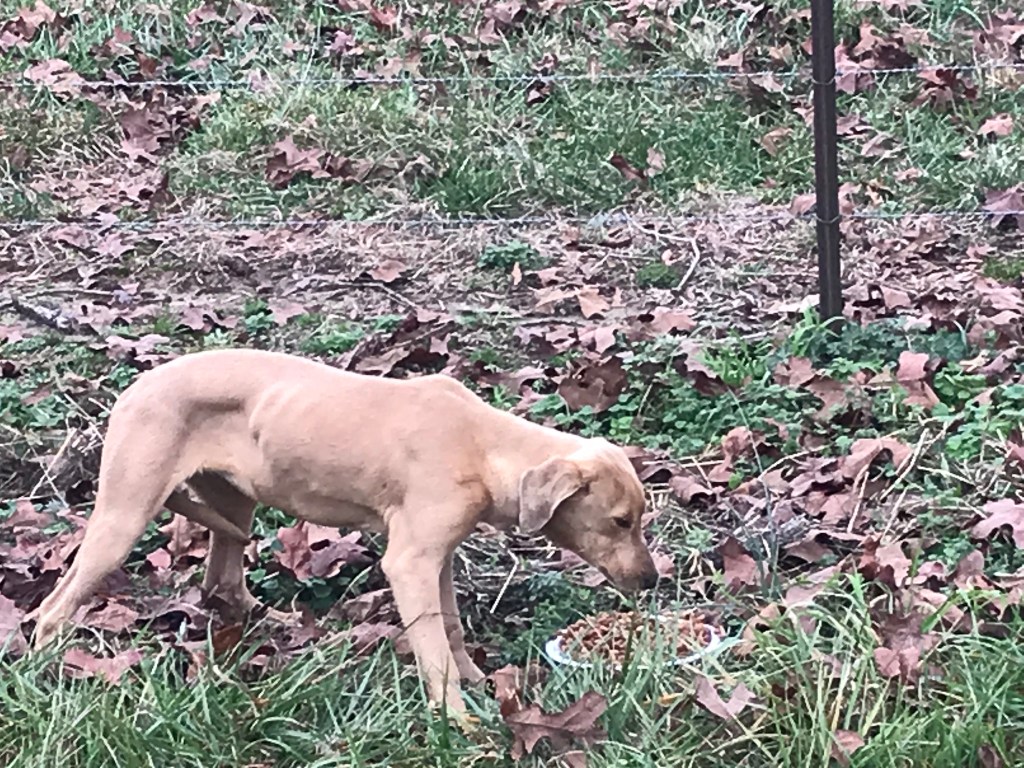
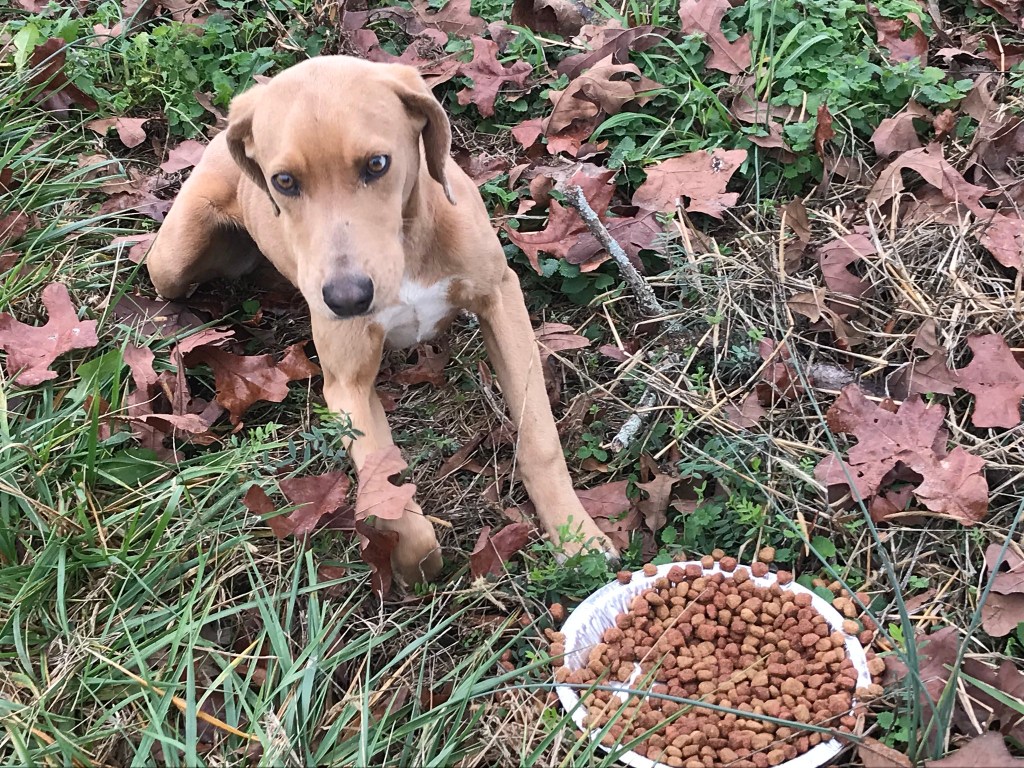
It was December the 12th, last year. I was on my bike, riding Son Johnson Road, and this beautiful pup approached the blacktop from a fenced in pond to my right. I made a clicking sound, just to say hi. That’s all it took. The needy creature followed me almost a mile running along beside me at times until three dogs came running from a house and turned the skinny pup away. I continued.

Thoughts of the exposed-ribbed dog haunted me during the night and the next day. I returned to Son Johnson Road via car carrying an aluminum pie-pan and quart of dog food. Luckily I found him. He looked worse than the day before. From his looks, he was on the verge of starving. I made pictures, petted him, and shared loving thoughts as dog-lovers do. To my eternal regret, I left the precious pup, thinking ‘we don’t need another dog’ (I’d rescued Eddie, the black tornado, this past May, and there was Shadow, the graying ‘Heinz’ our oldest son had rescued in 2014). I returned home rationalizing, stupidly, “hopefully, somebody along this rode will take him in.”

I never saw the sad-eyed pup again. For two weeks, I returned via car with a quart or more of dog food hoping by chance I’d once again see this gorgeous creature. If I was so lucky, I would never leave him again. I’d carry him home and love and care for him like I/we do Eddie (and of course, Shadow). These trips were in addition to an almost-daily bike ride inclusive of Son Johnson Road.

After I stopped the daily trips via car, I opted to carry a pint of dog food on my bike. I continue to do that to this day.

I’ve spent a lot of time wishing I could go back and change what happened. I often brood over my failure to act when I had the perfect opportunity to relieve that precious being’s suffering. My thoughts have more than once contemplated what pain I could have stopped.

If I done what I should, he would now have a good home, with plenty of food, two playful canine friends, almost smothery attention from me, and hopefully many years of joy and happiness.

Now, all I can do is keep looking, and keep saying, “I’m sorry I let you down.”

01/22/23 Biking & Listening

Biking is something else I both love and hate. It takes a lot of effort but does provide good exercise and most days over an hour to listen to a good book or podcast. I especially like having ridden.

Here’s my bike, a Rockhopper by Specialized. I purchased it November 2021 from Venture Out in Guntersville; Mike is top notch! So is the bike, and the ‘old’ man seat I salvaged from an old Walmart bike.

Here’s a link to today’s bike ride. It’s what I call my pistol route, which is my goal every day. But, sometimes cold weather says otherwisee.

Here’s a few photos taken along my route:

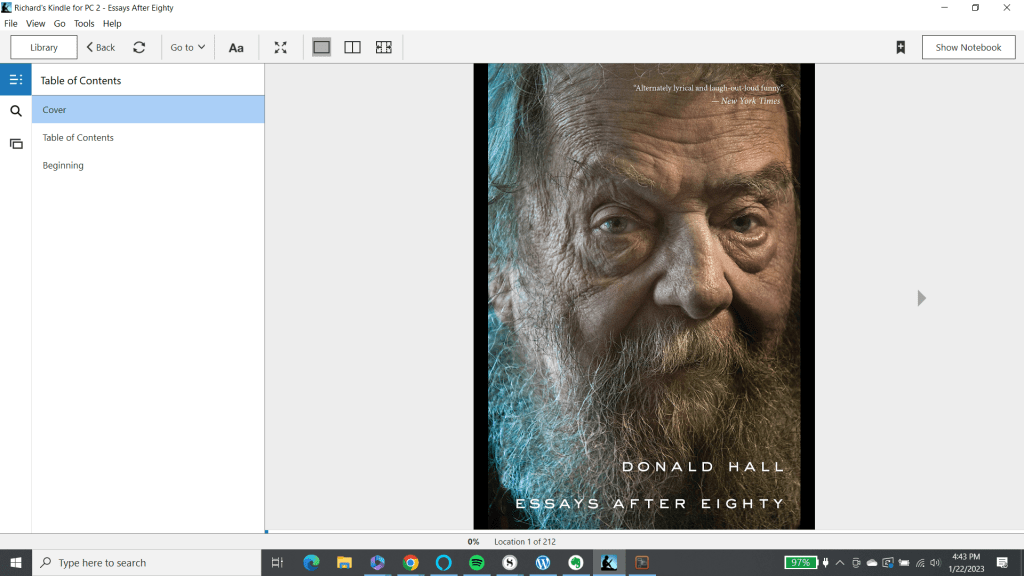
Here’s what I’m currently listening to: Essays After Eighty by Donald Hall

Amazon abstract

The former US Poet Laureate contemplates life, death, and the view from his window in these “alternately lyrical and laugh-out-loud funny” essays (New York Times).

His entire life, Donald Hall dedicated himself to the written word, putting together a storied career as a poet, essayist, and memoirist. Here, in the “unknown, unanticipated galaxy” of very old age, his essays startle, move, and delight.

In Essays After Eighty, Hall ruminates on his past: “thirty was terrifying, forty I never noticed because I was drunk, fifty was best with a total change of life, sixty extended the bliss of fifty . . .” He also addresses his present: “When I turned eighty and rubbed testosterone on my chest, my beard roared like a lion and gained four inches.”

Most memorably, Hall writes about his enduring love affair with his ancestral Eagle Pond Farm and with the writing life that sustains him every day: “Yesterday my first nap was at 9:30 a.m., but when I awoke I wrote again.”

“Alluring, inspirational hominess . . . Essays After Eighty is a treasure . . . balancing frankness about losses with humor and gratitude.”—Washington Post

“A fine book of remembering all sorts of things past, Essays After Eighty is to be treasured.”—Boston Globe

Achieving Perspective: Trailblazing Astronomer Maria Mitchell and the Poetry of the Cosmic Perspective

Here’s the link to this article.

“Mingle the starlight with your lives, and you won’t be fretted by trifles.”

BY MARIA POPOVA

This is the third of nine installments in the animated interlude season of The Universe in Verse in collaboration with On Being, celebrating the wonder of reality through stories of science winged with poetry. See the rest here.

THE ANIMATED UNIVERSE IN VERSE: CHAPTER THREE

To be human is to live suspended between the scale of glow-worms and the scale of galaxies, to live with our creaturely limitations without being doomed by them — we have, after all, transcended them to unravel the molecular mystery of the double helix and compose the Benedictus and land a mechanical prosthesis of our curiosity on Mars. We have dreamt these things possible, then made them real — proof that we are a species of limitless imagination along the forward vector of our dreams. But we are also a species continually blinkered — sometimes touchingly, sometimes tragically — by our own delusions about the totality around us. Our greatest limitation is not that of imagination but that of perspective — our lens is too easily contracted by the fleeting urgencies of the present, too easily blurred by the hopes and fears of our human lives.

Two centuries ago, Maria Mitchell — a key figure in Figuring — understood this with uncommon poetry of perspective.Portrait of Maria Mitchell, 1840s. (Maria Mitchell Museum. Photograph: Maria Popova)

America’s first professional female astronomer, she was also the first woman employed by the federal government for a “specialized non-domestic skill.” After discovering her famous comet, she was hired as “computer of Venus,” performing complex mathematical calculations to help sailors navigate the globe — a one-woman global positioning system a century and a half before Einstein’s theory of relativity made GPS possible.

When Maria Mitchell began teaching at Vassar College as the only woman on the faculty, the college handbook mandated that neither she nor her female students were allowed outside after nightfall — a somewhat problematic dictum, given she was hired to teach astronomy. She overturned the handbook and overwrote the curriculum, creating the country’s most ambitious science syllabus, soon copied by other universities — including the all-male Harvard, which had long dropped its higher mathematics requirement past the freshman year.

Maria Mitchell’s students went on to become the world’s first class with academic training in what we now call astrophysics. They happened to all be women.

Maria Mitchell, standing at telescope, with her students at Vassar

Science was one of Maria Mitchell’s two great passions. The other was poetry.

At her regular “dome parties” inside the Vassar College Observatory, which was also her home, students and occasional esteemed guests — Julia Ward Howe among them — gathered to play a game of writing extemporaneous verses about astronomy on scraps of used paper: sonnets to the stars, composed on the back of class notes and calculations.

Mitchell taught astronomy until the very end of her long life, when she confided in one of her students that she would rather have written a great poem than discovered a great comet. But scientific discovery is what gave her the visibility to blaze the way for women in science and enchant generations of lay people the poetry of the cosmic perspective.

Art from What Miss Mitchell Saw

It was this living example that became Maria Mitchell’s great poem, composed in the language of being — as any life of passion and purpose ultimately becomes.

“Mingle the starlight with your lives,” she often told her students, “and you won’t be fretted by trifles.”

And yet here we are, our transient lives constantly fretted by trifles as we live them out in the sliver of spacetime allotted us by chance.

A century after Maria Mitchell returned her borrowed stardust to the universe that made it, the poet Pattiann Rogers extended a kindred invitation to perspective, untrifling the tender moments that make a life worth living.

Published in her collection Firekeeper (public library), it is read for us here by the ever-optimistic David Byrne, with original art by his ever-perspectival longtime collaborator Maira Kalman and original music by the symphonic-spirited Jherek Bischoff.

ACHIEVING PERSPECTIVE
by Pattiann Rogers

Straight up away from this road,
Away from the fitted particles of frost
Coating the hull of each chick pea,
And the stiff archer bug making its way
In the morning dark, toe hair by toe hair,
Up the stem of the trillium,
Straight up through the sky above this road right now,
The galaxies of the Cygnus A cluster
Are colliding with each other in a massive swarm
Of interpenetrating and exploding catastrophes.
I try to remember that.

And even in the gold and purple pretense
Of evening, I make myself remember
That it would take 40,000 years full of gathering
Into leaf and dropping, full of pulp splitting
And the hard wrinkling of seed, of the rising up
Of wood fibers and the disintegration of forests,
Of this lake disappearing completely in the bodies
Of toad slush and duckweed rock,
40,000 years and the fastest thing we own,
To reach the one star nearest to us.

And when you speak to me like this,
I try to remember that the wood and cement walls
Of this room are being swept away now,
Molecule by molecule, in a slow and steady wind,
And nothing at all separates our bodies
From the vast emptiness expanding, and I know
We are sitting in our chairs
Discoursing in the middle of the blackness of space.
And when you look at me
I try to recall that at this moment
Somewhere millions of miles beyond the dimness
Of the sun, the comet Biela, speeding
In its rocks and ices, is just beginning to enter
The widest arc of its elliptical turn.

Previously on The Universe in VerseChapter 1 (the evolution of flowers and the birth of ecology, with Emily Dickinson); Chapter 2 (Henrietta Leavitt, Edwin Hubble, and the age of space telescopes, with Tracy K. Smith).

Drafting–Pittsburgh>King of Prussia—Molly

The driver kept pointing to his watch-less wrist as Molly, Tracey, and Millie filed onto the bus. “Thirty more seconds and you’d be walking.” The gruff older man with graying hair and beard announced at 6:01 AM according to the digital clock above the door at the rear of the bus. Without response, they’d walked the aisle and returned to their seats.

After returning to the bus station, the three had gone to the Ladies room. Millie had closed herself in a private stall and lingered. And, lingered. She’d taken another Depakote and hoped for a bowel movement. Molly and Tracey had done their business and waited outside in the lobby. After five minutes Molly had returned and retrieved Millie after considerable prodding.

As the bus rolled forward, Molly and Millie exchanged seats, at the younger’s insistence. She wanted to continue talking to Tracey. For three reasons. She wasn’t sleepy nor did she want to listen to music. Second, it was Saturday and therefore too early to text with Alisha. Third, she was intrigued with what Tracey had said at breakfast. Something like, “I’m amazed and disappointed that schools don’t teach young people anything remotely related to mindfulness.”

Before Molly could think of a way to reignite her and Tracey’s conversation, Millie gently elbowed her arm and pointed to the half-page flyer the ticket clerk had given them in Toledo. “I’m impressed with Greyhound. They’re sticking to the schedule like glue. It looks like we should be in New York right around 7:30.”

Molly turned and looked at the digital clock. “That’s thirteen and a half hours. A lifetime.” One thing was certain, she had done everything she could to change her mother’s mind about fleeing to New York City. “Why not go to the DA and tell him the truth?” “Why not just move and get one of those restraining orders you’ve talked about?” “Why don’t we borrow one of Colton’s guns, go on a picnic, and kill the bastard?” Molly had only thought the latter idea and dared not say it aloud, although she was convinced she could pull the trigger.

“We’ll make it.” Millie said it because that’s what any good mother would say, though, right now, there was an energy inside her itching to explode. “Why don’t you listen to some music? Matt wants me to call him.” Millie removed her phone from her purse and dialed.

Molly kept staring across the aisle to a closed-eyed Tracey who had leaned her seat back and was clutching a small leather-looking journal in her hands. The bus hit a pot hole and Molly kept staring. Tracey’s pose didn’t change. So peaceful and content, not a worry in the world, Molly thought now noticing for the first time a beautiful necklace around Tracey’s neck. The beads looked like pearls except they were brown, maybe made from wood. At the end of the long thread-looking chain, was a lighter-colored tassel.

“If you’re mother doesn’t mind, come sit by me. We can continue our chat.” Tracey said, opening her eyes ever so slight. Molly was embarrassed, her face turning a pinkish red.

Millie was talking with Matt and looking away, through the window at a landscape of passing houses, what Molly figured were similar to theirs on S. Princeton Avenue. She unbuckled her seat belt and eased across the aisle and in front of Tracey who inclined her seat. “Thanks for inviting me.” Millie had always stressed good manners.

Molly followed Tracey’s lead in reclining her seat. Not knowing what to do, Molly sat and pondered. Finally, she decided Tracey wouldn’t have asked her over unless she was willing to talk. “I’m sorry for being so dumb and asking a stupid question.”

Tracey turned her head toward Molly and smiled. “You’re as far from dumb as Albert Einstein, and there’s no stupid questions. How else are we to learn?”

Molly, relieved, returned the smile. “Thanks, so, why are you so skinny?” The twelve year old was certainly uninhibited.

Tracey leaned her head back and snorted, “wow, I asked for that. You go girl.”

“If that’s too personal.”

Tracey interrupted. “No, I’m not anorexic. It’s my metabolism. I eat constantly but have trouble gaining weight.” Molly thought it would be great to be able to eat all she wanted but knew that wasn’t herself. During the second part of fourth grade and all of fifth she’d overeaten and become rather pudgy. She eventually learned it was a response to her mother letting Colton move in, and his subsequent abuse of the two of them. “Anyway, looks are not everything.”

Easy for her to say, Molly thought. In her eyes, Tracey was a beautiful woman. Silky Auburn hair, penetrating green eyes, a perfect oval face, and symmetrical lower and upper lips. Plus, to be so skinny, models would kill to have her height and body shape.

“You said you were headed home. To New York City. Where do you live?” Molly felt free to change the subject.

“At The Stratford. It’s an apartment house on the Upper East Side.” Tracey inclined her chair and opened her journal. “What about you guys?”

Molly hesitated and recalled her mother’s words, ‘we have to be careful who we talk to and what we say.’ “Well, uh, I’m not sure of the address. Somewhere in Manhattan and it’s a studio apartment, but we haven’t seen it yet.”

Tracey closed her journal without writing anything. “No problem.” She paused, and then asked, “do you know where you’ll be going to school?” Again, Molly paused, but this time told herself Tracey was safe, there was no way she was or could be connected to Colton, and now, glancing across the aisle, saw her mother was sleeping.

“It’s Robert Wagner, Robert Wagner Middle School. I’ve already been accepted and start January the 6th.”

“That’s a great school. Matter of fact, it’s only a ten minute walk from my apartment.” Tracey leaned forward and removed a large leather bag from beneath her seat. “Would you like a snack?” She removed two large red Delicious apples.

Molly smiled, still full from breakfast. “No, I’m good thanks.”

Tracey continued, “I’m trying to persuade Mr. Waldeck, the 6th grade principal, to let me teach a class. Meditation for Children is what I call it.”

Molly knew very little about meditation. “What would that do for the students?” That seemed like a logical question.

“Whether we are young or old, our minds are where we live, where we experience everything. My goal for my clients and likewise for the students is to show them how meditation can initiate moments of calm, bring about self-awareness, and to begin connecting their mind and body.”

“Oh,” is all Molly said.

Tracey laughed and took a bite of her apple. “Let me be clear, I’m not into religion or anything metaphysical. But, I am all in for learning more about how our minds work.”

Molly was a little confused. “What do you mean by megaphysical?”

“Metaphysical.” Sorry, I spoke with a mouth full. “As you know, physical refers to the natural world, metaphysical goes beyond that, beyond the physical world. It attempts to transcend the laws of nature, which, to me, makes it wholly abstract and overly theoretical. I think it’s pure woo-woo. But, get this, my brother’s position is 180 degrees the opposite.”

Molly pondered what she believed. Ever since her and her mother started attending St. Paul Missionary Baptist Church, she’d felt loved, appreciated, safe, but was troubled over what she heard from the teachers and pastor. Now, with Tracey’s definition, Molly concluded what St. Paul taught was, at a minimum, difficult to understand. Maybe it was woo-woo, but she wasn’t sure.

During the remainder of the ride to King of Prussia, Tracey responded to Molly’s question about her personal life: where she’d grown up, whether she had siblings, where she’d gone to school, whether she was married (or had been).

As the bus rolled to a stop, Molly felt encouraged by Tracey’s story, how someone could survive heartache and traumatic events, and still go on to live a satisfying and rewarding life.

Tracey had grown up in Harrison, Arkansas in a happy family of five: mother, father, brother, and a twin sister. The happiness evaporated when mother and sister were killed when the twins were twelve. What had made the tragedy even more tragic was the mother was killed in a head-on collision while she was driving home to meet the school bus delivering her daughters. Tracey’s sister had been killed thirty minutes later when she stepped into the path of an oncoming car. The tragedy had nearly destroyed Tracey, her brother, and her father. Two years later, the three had moved to New York City.

Tragedy again revisited their lives the night Tracey graduated from high school. Her father was shot and killed at a convenience store after attending the school ceremony.

Tracey, 33, and Aaron, 35, had stayed in New York City, graduated college but had taken opposite paths with their lives. Tracey had become a Zen master, and established a meditation center. Aaron had become a Southern Baptist preacher and founded Faith Haven Church. The siblings relationship had deteriorated over the years to the point they now rarely spoke. However, Tracey’s life, at least as it sounded to Molly, was rich and rewarding.

The bus driver’s gruff voice interrupted Molly’s thoughts. “Folks, just a reminder this is a quick stop. Keep your seats. No exiting. You’ll have a forty minute rest stop in Philadelphia, and that’s only fifty minutes away.”

Tracey stood and removed a bag from the overhead rack. “This is my stop.” She noticed Molly staring at her with a ‘deer in the headlights’ look. “I have a client here and will be taking the 5:30 bus. You take care.”

Molly was disappointed but didn’t want to seem rude. “Okay. It was nice to meet you.”

“Oh, here.” Tracey removed a card from her small bag. “This is my contact information. Feel free to call me anytime.” Tracey turned to leave and glanced at Millie, who was waving but talking on her phone.


01/21/23 Biking & Listening

Biking is something else I both love and hate. It takes a lot of effort but does provide good exercise and most days over an hour to listen to a good book or podcast. I especially like having ridden.

Here’s my bike, a Rockhopper by Specialized. I purchased it November 2021 from Venture Out in Guntersville; Mike is top notch! So is the bike, and the ‘old’ man seat I salvaged from an old Walmart bike.

Here’s a link to today’s bike ride. It’s what I call my pistol route, which is my goal every day. But, sometimes cold weather says otherwisee.

Here’s a few photos taken along my route:

Here’s what I’m currently listening to: The Second Deadly Sin, by Lawrence Sanders

Sanders was a tremendously talented writer.

Amazon abstract:

A police detective must find out who murdered a world-famous artist in a thriller by the #1 New York Times–bestselling “master of suspense” (The Washington Post).

A month ago, world-renowned artist Victor Maitland was found dead in his Mott Street studio—stabbed repeatedly in the back. With no clear leads or suspects, the New York Police Department calls Chief Edward Delaney out of retirement. Delaney is still adjusting to life on the outside, and he’s bored by his free time. He welcomes the chance to put his well-honed investigative skills to the test once again. To investigate the case, Delaney plunges into Maitland’s rarefied orbit. Following a winding path of avarice, deception, and fraud, Delaney uncovers a long line of suspects that includes Maitland’s wife, son, and mistress. When a second murder rocks Manhattan’s art world, Delaney moves closer to the truth about what kind of a man—or monster—Victor Maitland really was. But which of the artist’s enemies was capable of killing him and leaving no trail?

Drafting–Pittsburgh>King of Prussia—Molly (partial)

The driver kept pointing to his watch-less wrist as Molly, Tracey, and Millie filed onto the bus. “Thirty more seconds and you’d be walking.” The gruff older man with graying hair and beard announced at 6:01 AM according to the digital clock above the door at the rear of the bus. Without response, they’d walked the aisle and returned to their seats.

After returning to the bus station, the three had gone to the Ladies room. Millie had closed herself in a private stall and lingered. And, lingered. She’d taken another Depakote and hoped for a bowel movement. Molly and Tracey had done their business and waited outside in the lobby. After five minutes Molly had returned and retrieved Millie after considerable prodding.

As the bus rolled forward, Molly and Millie exchanged seats, at the younger’s insistence. She wanted to continue talking to Tracey. For three reasons. She wasn’t sleepy nor did she want to listen to music. Second, it was Saturday and therefore too early to text with Alisha. Third, she was intrigued with what Tracey had said at breakfast. Something like, “I’m amazed and disappointed that schools don’t teach young people anything remotely related to mindfulness.”

Before Molly could think of a way to reignite her and Tracey’s conversation, Millie gently elbowed her arm and pointed to the half-page flyer the ticket clerk had given them in Toledo. “I’m impressed with Greyhound. They’re sticking to the schedule like glue. It looks like we should be in New York right around 7:30.”

Molly turned and looked at the digital clock. “That’s thirteen and a half hours. A lifetime.” One thing was certain, she had done everything she could to change her mother’s mind about fleeing to New York City. “Why not go to the DA and tell him the truth?” “Why not just move and get one of those restraining orders you’ve talked about?” “Why don’t we borrow one of Colton’s guns, go on a picnic, and kill the bastard?” Molly had only thought the latter idea and dared not say it aloud, although she was convinced she could pull the trigger.

“We’ll make it.” Millie said it because that’s what any good mother would say, though, right now, there was an energy inside her itching to explode. “Why don’t you listen to some music? Matt wants me to call him.” Millie removed her phone from her purse and dialed.

Molly kept staring across the aisle to a closed-eyed Tracey who had leaned her seat back and was clutching a small leather-looking journal in her hands. The bus hit a pot hole and Molly kept staring. Tracey’s pose didn’t change. So peaceful and content, not a worry in the world, Molly thought now noticing for the first time a beautiful necklace around Tracey’s neck. The beads looked like pearls except they were brown, maybe made from wood. At the end of the long thread-looking chain, was a lighter-colored tassel.

“If you’re mother doesn’t mind, come sit by me. We can continue our chat.” Tracey said, opening her eyes ever so slight. Molly was embarrassed, her face turning a pinkish red.

Millie was talking with Matt and looking away, through the window at a landscape of passing houses, what Molly figured were similar to theirs on S. Princeton Avenue. She unbuckled her seat belt and eased across the aisle and in front of Tracey who inclined her seat. “Thanks for inviting me.” Millie had always stressed good manners.


A few notes I made toward the end of today’s drafting

Did tracey lose a daughter, a sister (her twin?)?
Was necklace Tracey’s sister’s?

That death, triggered the eruption in her and her brother’s relationship.
He’d turned to God?
She’d turned to Zen?

01/20/23 Biking & Listening

Biking is something else I both love and hate. It takes a lot of effort but does provide good exercise and most days over an hour to listen to a good book or podcast. I especially like having ridden.

Here’s my bike, a Rockhopper by Specialized. I purchased it November 2021 from Venture Out in Guntersville; Mike is top notch! So is the bike, and the ‘old’ man seat I salvaged from an old Walmart bike.

I rode the complete pistol route today (11.8 miles). Unfortunately, I trouble with my biking APP– RidewithGPS–and cannot include a link.

Here’s a few photos taken along my route:

Here’s what I’m currently listening to: The First Deadly Sin, by Lawrence Sanders

Today, I completed this book. I rate it five stars. Tomorrow I plan on starting The Second Deadly Sin.

Sanders was a tremendously talented writer.

Amazon abstract:

The #1 New York Times–bestselling author introduces readers to “a great detective, a detective’s detective,” New York cop Edward X. Delaney (Kirkus Reviews).

New York Police Department Captain Edward Delaney is called to the scene of a brutal murder. A Brooklyn councilman was struck from behind, the back of his skull punctured and crushed with an unknown weapon. The victim wasn’t robbed, and there’s no known motive. The commissioner appoints Delaney to head up a clandestine task force, but soon this effort ignites an internecine war of departmental backstabbing.   Distracted by the serious illness of his wife, Barbara, Delaney begins his secret investigation. Then the killer claims another victim—slain in the exact same way, leaving the strange puncture wound. As more young men are found murdered, Delaney starts putting the pieces together. Soon, he’s faced with a cop’s dilemma: He knows who the killer is, but the man is untouchable. That’s when Delaney lays a trap to bring a monster to justice . . .

Learn more–read this great review on Amazon by Pennydreadful

I feel I may have cheated when reading this book because I read it in gosh, too many years ago to count. However, Sanders’s Deadly Sin series were the first stories that put my heart to pounding and made me wish I could write. Recently, I wanted to see if that belief was still true, and darned if it isn’t.

Lawrence Sanders quite simply is a master. Of characterization, of research, of police procedure, of getting inside the characters’ (and readers’ heads). His set up might indeed be frowned upon today. He starts the book with several chapters surrounding the antagonist, and then we meet Captain Edward X. Delaney and several chapters pertain to him and the politics surrounding a police captain with a critically ill wife.

But a killer is on the streets of New York City, and soon Captain Delaney is torn. Torn between sitting by his wife’s bedside and putting a madman away. Naturally it’s not as simple as that because politics and a power struggle are afoot, and a new kind of police reorganization affects the department all the way to the mayors’ office.

Edward X Delaney’s wife takes a turn for the worse, and he tries to resign. A police commissioner persuades him to take a leave of absence. But in the midst of all the politics and turmoil affecting the police department, the commissioner convinces Delaney to work in secret and independently while using his years of detective experience to find the killer who is walking the streets of New York and murdering unsuspecting men with an ice ax.

To accomplish this private investigation, Captain Delaney must do much of the leg work and research himself. To do this he recruits civilians to aid him in this quest, including a bedridden mountain climber, a 70+ retired curator dying to be of assistance and the widow of one of Blank’s victims [Blank is the suspect]. Much of the case is done thanks to these people when the city is in a full-blown panic because of the new administrations’ blunders and inability to catch the killer.

Captain Delaney is called back to work. And with police resources given him, he makes every effort to stop a killer from killing again.

A masterpiece of writing.