Click the following link to view and listen to today’s recording (sorry about the quality of today’s video–I had trouble with the Screencast-O-Matic software).
Reading the Bible to spot the incoherence of theology
Many years ago I met a young man who had been raised in an evangelical Bible-belt family. He told me that a common way to greet friends was, “How is your walk with the Lord going today?” Perhaps this derives from the old hymn, I Come to the Garden Alone, with the lyrics, “And he walks with me, and he talks with me, and he tells me I am his own…” They know that Jesus is their friend. Since the Bible is god’s own word—without error or flaw—these are the Christians most likely to actually read the Bible. Inevitably, however, they run into Bible verses and stories that undermine, and even destroy, the Jesus-is-my-friend concept. Hence there are thousands of Christian apologists—including some very famous ones—whose mission in life is to spin the alarming Bible texts in the most positive ways, making everything “come out okay.”
There are also so many Christians for whom Bible reading/study is not a priority. Surveys have shown that they can’t be bothered, probably because so much of the Bible is tedious and obscure. Their embrace of Jesus is based on his depiction in ritual, worship, stained glass—and on carefully chosen Bible texts read and preached about from the pulpit. “Take this Jesus on faith,” they are told by priests and ministers; they commonly recite ancient creeds that secure the sanctity of their Jesus, which doesn’t require much thought, and certainly no curiosity.
I suspect it’s rare for a priest or minister, from the pulpit, to given study assignments. For example: “I want you all, before next Sunday, to read the gospel of Mark carefully—yes, ALL of it—and write down your questions and concerns, the things you find troubling, and bring them for me to read.” That’s asking for trouble! One of my motivations for devising these Pop-Quizzes for Christians is to push them into Bible study: be curious, ask questions, find out that so much in the New Testament doesn’t make sense.
So here are a few questions that require looking beneath the neat packaging offered by the clergy. Let’s start with a question about science, one that has high impact on belief in the Bible god.
Question One:
Why is this one of the most important photographs ever taken? Who took it, marking what important discovery? What are the possible implications of this discovery for belief in a personal god? —that is, a god who watches everything that every human being does. Hint: to learn about this photo, do a Google search: Edwin Hubble Andromeda VAR
Question Two:
Why is the virgin birth of Jesus a minority opinion in the New Testament? Name the only places it is mentioned in the New Testament.
Question Three:
What conclusion may we draw from reading Acts 9:26-28 and Galatians 1:15-20 back-to-back?
Acts:
“When he had come to Jerusalem, he attempted to join the disciples, and they were all afraid of him, for they did not believe that he was a disciple. But Barnabas took him, brought him to the apostles, and described for them how on the road he had seen the Lord, who had spoken to him, and how in Damascus he had spoken boldly in the name of Jesus.So he went in and out among them in Jerusalem, speaking boldly in the name of the Lord.”
Galatians:
“But when the one who had set me apart before I was born and called me through his grace was pleased to reveal his Son to me, so that I might proclaim him among the gentiles, I did not confer with any human, nor did I go up to Jerusalem to those who were already apostles before me, but I went away at once into Arabia, and afterward I returned to Damascus.Then after three years I did go up to Jerusalem to visit Cephas and stayed with him fifteen days,but I did not see any other apostle except James the Lord’s brother.In what I am writing to you, before God, I do not lie!”
Question Four:
Where do we find the story of the conversion of the apostle Paul to Christianity? Hint: it’s never mention in Paul’s letters. Why is it missing there?
Question Five:
In Romans 13, Paul claims that all government leaders are appointed by God. Can you spot two major embarrassments in Paul’s argument that have long vexed Christian theologians?
Question Six:
The apostle Paul claimed, “And those who belong to Christ Jesus have crucified the flesh with its passions and desires.” (Galatians 5:24) Do married Christians pay attention to this? Why not, if the Bible is God’s Word? Paul was certainly the champion missionary of his time. How can his opinion be ignored?
Answers and Comments
Question One:
In 1920, at the Smithsonian Museum of Natural History, astronomers Harlow Shapley and Curtis Heber debated the size of the universe. Shapley argued that our galaxy was the whole universe, while Heber suggested that distant smudges of light were actually other galaxies far beyond our own. About four years later, Edwin Hubble, using one of the most powerful telescopes of the time, identified Cepheid Variable stars (which allow correct calibrations of distance) in what we now know as the Andromeda galaxy. This was dramatic proof that our Milky Way galaxy is one of many galaxies—in fact, as we now know—one of hundreds of billions of galaxies. This is why Hubble’s photographic plate with “VAR!” written on it, is indeed one of the most important photos ever taken. For the first time ever, our position, our status in the Cosmos was known.
Thus the Cosmos imagined by the authors of the Bible was disproved, i.e., our planet as the center of a god’s attention, with that god located above the clouds—and dominating a spiritual realm located below the moon. This god was close enough to savor the aroma of burnt animal sacrifices, and to watch everything every human did; it even knew all human thoughts, and was ready to punish. It would be so cool if Hubble’s VAR! photograph could be mounted beside every picture of Jesus holding a lamb, beside every crucifix—as a reminder that the Bible god cannot be rescued from its ancient past.
Question Two:
Today, especially in Catholic brands of Christianity, the Virgin Mary remains high profile and big business. She’s Queen of Heaven and has put in thousands of appearances around the globe. But in the very earliest days of Jesus belief, she wasn’t even on the map. In all of Paul’s letters—and in those forged in his name—the virgin birth of Jesus is not mentioned; these are the oldest Christian documents we have. The author of Mark’s gospel apparently knew nothing about it, and the author of John’s gospel—who surely was familiar with the earlier gospels—didn’t feel it was worth mentioning.
So it is a minority opinion, found only in Matthew and Luke. And just exactly how would they have known that Jesus was virgin-born? Matthew says that Joseph got this information in a dream—how’s that for credible evidence! —and Luke imagined that an angel brought the news to Mary. Curious readers, those inclined to critical thinking, know this doesn’t work. John Loftus, on Christmas day in 2016, wrote on this blog:
“How might anonymous gospel writers, 90+ years later, objectively know Jesus was born of a virgin? Who presumably told them? The Holy Spirit? Why is it that God always speaks to individuals in private, subjective, unevidenced whispers? Those claims are a penny a dozen.”
Question Three:
Yes, do please compare Acts 9:26-28 and Galatians 1:15-20. These Galatians verses are Paul’s own words about the aftermath of his conversion. The text in Acts was written decades later by an author who created narrative to portray the event—or more correctly, to dramatize the event. He was an early expert in special effects, e.g., blinding lights and voices from the sky, with Paul being struck blind. None of which is reported by Paul in Galatians, or anywhere else in his letters. Critical historians have long been skeptical about the Book of Acts. The author never mentions his sources, and there are too many elements of fantasy literature, i.e., roles given to holy spirits and angels. Moreover, the author depicts Paul being welcomed by the original disciples, while Paul is emphatic that this didn’t happen. When Acts 9 and Galatians 1 are read back-to-back, it’s clear someone is lying.
Question Four:
The dramatic narrative of Paul’s conversion “on the road to Damascus” is found in Acts 9, 22, and 26—and these don’t all agree on the details, which has provoked considerable scholarly debate. But in all of his writings, Paul doesn’t include this event. He mentions going to Arabia after his conversion, then returning to Damascus. So his being in Damascus seems authentic, which makes it even more puzzling that he never wrote about the very public revelation of Jesus “on the road” described in Acts. Again, we can chalk this up to author’s fantasy-writing skills. Moreover, a competent historian would have cited his sources, e.g., did he have access to diaries or letters that the other witnesses may have written?
Question Five:
The Christianity advocated by Paul is not the one that is embraced by so many of the devout today. Our response to so much that he wrote must be, “What was he thinking?” The first four verses of Romans 13 are a shock:
“Let every person be subject to the governing authorities, for there is no authority except from God, and those authorities that exist have been instituted by God. Therefore whoever resists authority resists what God has appointed, and those who resist will incur judgment. For rulers are not a terror to good conduct but to bad. Do you wish to have no fear of the authority? Then do what is good, and you will receive its approval,for it is God’s agent for your good. But if you do what is wrong, you should be afraid, for the authority does not bear the sword in vain! It is the agent of God to execute wrath on the wrongdoer.”
So, no matter who has risen to power, God arranged it? We have the long perspective of history to know how wrong this is. But, poor Paul, he thought history was about to end with the arrival of Jesus on the clouds. For anyone with the slightest sympathies for democracy—respect for the “will of the people”—finds this blanket endorsement of those in power an embarrassment. And here’s a second embarrassment: Paul seems not to have known that the Roman authorities executed Jesus! “…for the authority does not bear the sword in vain! It is the agent of God to execute wrath on the wrongdoer.” So that was the case with Jesus, executed by the wrath of God? Throughout his letters, Paul shows so little awareness of the life of Jesus; he cared only for what he received from his private “revelations.” He seems to have missed the detail about Jesus being put to death by Roman officials.
Question Six:
I’m sure this is another example of Paul’s version of Christianity being out of sync with how the devout behave today. “And those who belong to Christ Jesus have crucified the flesh with its passions and desires.” So married Christians have to be talked into having sex because they’re no longer interested, since they believe in/belong to Jesus? Do Christian marriage counselors have to think of ways to overcome lack of sexual desire that has been crucified? Again, poor Paul, he was clueless: the only thing he cared about was getting ready to meet Jesus in the air when he arrived on the clouds (see I Thessalonians 4:17). If you belong to Jesus, nothing else matters, especially sex.
Yes, what a great thing Bible study is! When done honestly—with curiosity and critical thinking fully engaged—the incoherence of Christian theology is not at all hard to spot. Which has kept the professional apologists busy for centuries.
This is a great book. Eye-opening, especially to those who’ve never considered the incompatibility of science and religion.
I encourage you to watch my computer screen, listen, and think as I read aloud the words written by the brilliant evolutionary biologist Jerry Coyne.
Click the link below to begin Reading Session #3 (sorry, but I think I refer to this session as Session #2). This session starts at Kindle Page 11, Location 500.
Wouldn’t it be cool if Christians could settle their differences? What an embarrassment that they can’t agree on what their god is like and how he/she wants to be worshipped? Isn’t 30,000-plus different Christian brands a scandal? I’ve known strident evangelicals who are certain that Catholics are their worst enemy.
Wouldn’t it be cool if Christians could suppress their urge to build more churches? Does the world really need more? There is so much hunger and poverty: why not put funds where they’re desperately needed? Yes, Jesus was a carpenter—supposedly—but was that an endorsement of construction-without-end?
Wouldn’t it be cool if Christians were in the habit of binge-reading their Bibles? Aren’t the gospels, especially, supposed to be the word of their god? If the devout really believed that, wouldn’t they be able to quote wide swaths of Matthew, Mark, Luke, and John by heart?
We know for sure that Christian bickering over who is right will never end, nor will the building of new churches cease—even as congregations die out and old churches are converted for other uses. But is it futile to hope that churchgoers can be coaxed to read their Bibles? My ulterior motive, of course, is that careful Bible-reading can do as much as anything else to undermine faith. If people really think about what they’re reading, and are provoked to serious study—to question everything—the Bible takes a big hit. Its status as the Word of God loses credibility.
I’ve created these Pop-Quizzes for Christians in the hope they’ll be seen by churchgoers who don’t make a habit of Bible reading. The questions are meant to provoke suspicions: “Gee, I never realized that,” and “How does that possibly make sense?” But I’m just quoting the Bible, folks!
There are thousands of genetic disorders/diseases—glitches and goofs as genes are passed along—that cause horrendous human suffering. What are the implication of this for the claim that human life was intelligently designed by an all-powerful, loving god?
Question 2:
Let’s continue with the issue of illness. Do Christians today commonly assume that illness is a way that their god punishes people? My guess is that they don’t. If a friend or relative gets sick—especially something like cancer—our first impulse is not to ask, “What horrible sins has he/she committed.” Yet we find the illness/sin link in Jesus script. In Mark’s gospel (2:1-12) Jesus heals a paralytic—by forgiving his sins. In John 5:2-18, Jesus heals a man who had been sick for 38 years: “…you have been made well! Do not sin any more, so that nothing worse happens to you.” (v. 14) Are you okay with this idea that the god of Jesus gets even with sin by inflicting illness? How does that work in your theology?
Question 3:
The consensus of mainstream Bible scholars is that the letters of the apostle Paul were written well before the gospels. His first letter to the Corinthians can perhaps be dated to 53-54 CE. The gospel of Mark—chronologically the first of the four in the NT—seems to have been written in the wake of the first Jewish-Roman War that ended in 73 CE. Please compare the words of the Eucharist found in 1 Corinthians 1:11 with those reported in Mark, which was written twenty years later:
Corinthians 1, 11:23-26:
“For I received from the Lord what I also handed on to you, that the Lord Jesus on the night when he was betrayed took a loaf of bread,and when he had given thanks, he broke it and said, ‘This is my body that is for you. Do this in remembrance of me. In the same way he took the cup also, after supper, saying, ‘This cup is the new covenant in my blood. Do this, as often as you drink it, in remembrance of me.’ For as often as you eat this bread and drink the cup, you proclaim the Lord’s death until he comes.”
Mark 14:22-25:
“While they were eating, he took a loaf of bread, and after blessing it he broke it, gave it to them, and said, ‘Take; this is my body.’ Then he took a cup, and after giving thanks he gave it to them, and all of them drank from it. He said to them, ‘This is my blood of the covenant, which is poured out for many.Truly I tell you, I will never again drink of the fruit of the vine until that day when I drink it new in the kingdom of God.’”
Paul never met Jesus, he was not at the last supper; he claimed that he received these words “from the Lord”—by which he meant his visions of Jesus. What are the implications when we see these texts side-by-side? What conclusions can we draw from these words of Paul predating the gospels?
Question 4:
The Christian Bible contains both the Old and New Testament. The whole thing is God’s Word. But because of the terrible temper the Old Testament god—and great stretches of rules for sacrificing animals the right way—it is quite common for the devout to claim that the New Testament is their primary guide to life. But explain how that is possible, when there’s Jesus script forbidding this attitude:
“Do not think that I have come to abolish the Law or the Prophets; I have come not to abolish but to fulfill. For truly I tell you, until heaven and earth pass away, not one letter, not one stroke of a letter, will pass from the law until all is accomplished.Therefore, whoever breaks one of the least of these commandments and teaches others to do the same will be called least in the kingdom of heaven, but whoever does them and teaches them will be called great in the kingdom of heaven. For I tell you, unless your righteousness exceeds that of the scribes and Pharisees, you will never enter the kingdom of heaven.” (Matthew 5:17-20)
Answers and Comments
Question 1:
When believers pray for their god to heal someone—and even organize prayer marathons to be more effective—the assumption must be that their god can work on the cellular level in the human body to knock out illness. If that is so, we have to wonder how an all-knowing god is so negligent. Why isn’t god paying close attention to all the glitches and goofs that cause genetic disorders/diseases—and using his almighty power to clean them up, before they can do damage? The claim that our bodies have been intelligently designed by a loving creator doesn’t make sense when we see that genetic glitches happen, and cause so much suffering. But, full stop: the errors in human anatomy have been well documented, which destroys the intelligent-design claim. For example, see Abby Hafer’s book, The Not-So-Intelligent Designer: Why Evolution Explains the Human Body and Intelligent Design Does Not.
Question 2:
“Are you okay with this idea that the god of Jesus gets even with sin by inflicting illness? How does that work in your theology?” We have all seen really nice, good people who have suffered terribly from horrible diseases. The devout commonly retreat to “it’s a mystery” —rather than speculate on the terrible hidden sins the person must have committed. But the truly honest approach would include admitting that the gospels—with the Jesus-scripts I quoted—reflect first century superstitions about illness and sin: a god is going to get even with you for sinning. Such superstitions had deep roots in the ancient thinking. The prophet Isaiah had no patience with the sinful pride of high society ladies: “…the Lord will afflict with scabs the heads of the daughters of Zion, and the Lord will lay bare their scalps and heads.” (Isaiah 3:17)
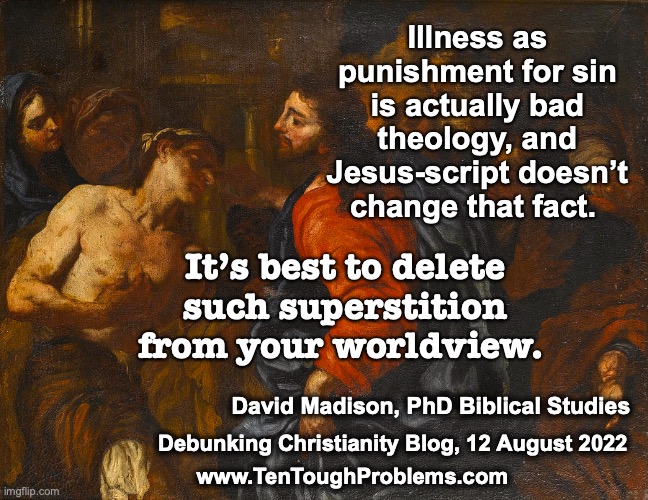
By the way, unless the god is right there (whispering in your ear?) to explain which sins caused the suffering, what’s the point? Illness as punishment for sin is actually bad theology, and Jesus-script doesn’t change that fact. It’s best to delete such superstition from your worldview.
Question 3:
The eucharist is described in 1 Corinthians 11 and Mark 14. “What are the implications when we see these texts side-by-side? What conclusions can we draw from the words of Paul predating the gospels?” Yes, this requires study and extra effort. Curiosity has to kick in: when were these two documents written? How might they be related? Since none of the gospels had been written when Paul was so active in his promotion of the new Jesus sect, how did he find out about Jesus? What did he find out? Not much, apparently; we search in vain in his letters for details about the life, ministry, preaching, and miracles of Jesus of Nazareth. He even brags about not consulting the people who had actually known Jesus:
“For I want you to know, brothers and sisters, that the gospel that was proclaimed by me is not of human origin, for I did not receive it from a human source, nor was I taught it, but I received it through a revelation of Jesus Christ.” (Galatians 1:11-12)
And he tells his readers exactly how he found out the wording of the eucharist: “For I received from the Lord what I also handed on to you…” That is, by way of his private revelations/visions (we could call them hallucinations) of Jesus, whom he was confident was not dead, but alive. Hardly a surprise at a time when there were other ancient cults that believed in dying-and-rising gods.
Given Paul’s intensive missionary zeal, which included writing long letters advocating the faith, it’s not a stretch to suppose that Mark had Paul’s text of the eucharist in 1 Corinthians 11—which he didn’t learn from any human source—in front of him when he wrote his gospel. This is one of the implications of the side-by-side comparison of these texts. Mark wasn’t writing history at all; he was passing along Paul’s theology. Mark added the setting, i.e., a last supper, with Jesus surrounded by disciples; that part was missing in Paul’s vision. Here’s some important homework on this issue: Tom Dykstra’s book, Mark Canonizer of Paul: A New Look at Intertexuality in Mark’s Gospel(2012).
Readers have to pay close attention to notice such things; they have to be curious, and be willing to question everything. New Testament scholars—both devout and secular—have sharpened these skills. But most of the laity, as surveys have shown, read the Bible casually, if at all. They are trained by priests and preachers not to question everything. Thus they miss important clues that the New Testament itself plays a major role in falsifying Christianity.
Question 4:
“…it is quite common for the devout to claim that the New Testament is their primary guide to life. But explain how that is possible, when there’s Jesus script forbidding this attitude…”
Supposedly, for Christians the Bible is the holy word of their god. In fact, there are many texts in both the Old and New Testament that the faithful wish were not there. But it just won’t do to rank the Old Testament as inferior. God’s genocide in the Noah story? Jesus promised that, at the coming of the kingdom of god, there will be as much suffering as at the time of Noah. How is that better? The god of the Old Testament promised to punish and wipe out those who broke his laws. The god of the New Testament added eternal fire after death as punishment. How is that better?
Matthew’s Jesus-script includes the insistence that “not one stroke of a letter, will pass from the law…” But we can see Matthew’s motivation: almost from the beginning of the Jesus sect, there were those who wanted it to remain a Jewish sect—Matthew was so inclined. The apostle Paul thought otherwise, and preached to the Gentiles. He downplayed the importance of the law, one primary example being the elimination of circumcision as a condition for converting to Christ. In the long run, Paul’s side won that battle.
But it won’t do to downgrade the Old Testament—how dare you anyway if it’s still part of god’s holy word? It’s right there on the church altar every Sunday! This amounts to picking and choosing what you like, depending on your own religious sensibilities. That is, you are judging the Holy Bible, you are deciding which parts are holy. Bear this in mind, however: even those early Christians who downplayed the law looked to the Old Testament to prove that Jesus was the messiah. They hunted for texts they were sure applied to Jesus, even though there is no mention whatever of a Jesus of Nazareth who would one day be the messiah. Nevertheless, so many stories of Jesus in the gospels are based on Old Testament models. The apostle Paul especially scoured the ancient texts for proof of his version of the Christ.
As I’ve said many times, the Bible—especially the gospels—is a minefield. Every step you take, the ground under your feet may explode. Which is why I say to Christians, “How about we go for a walk?”
So far I have posted three Pop-Quizzes for Christians here on the DC Blog (OneTwoThree). My motive has been to coax, to prod Christians to read the Bible, to study the gospels especially. Surveys have shown that most can’t be bothered. I encourage readers to share these pop-quizzes with their church-going friends and relatives.
A few weeks after Pop-Quiz Number 3 was posted, a Christian who identifies as Oreo Pagus offered his comments on the post. The first question on the quiz is about science: What was Carl Sagan referring to when he described The Pale Blue Dot. Oreo Pagus gave the correct answer: Planet Earth, about which Sagan had observed:
“Our posturings, our imagined self-importance, the delusion that we have some privileged position in the Universe, are challenged by this point of pale light. Our planet is a lonely speck in the great enveloping cosmic dark. In our obscurity, in all this vastness, there is no hint that help will come from elsewhere to save us from ourselves.”
Oreo quoted the last sentence, then added this observation: “Perhaps our planet’s small size and apparent isolation in the universe may actually point to its vast importance, negating Sagan’s observation while validating the Christian worldview.”
Apparent isolation? Earth’s vast importance? Validating the Christian worldview? How is our isolation “apparent”? It would take more that 80,000 years for a spacecraft from earth—traveling at the speed of earth satellites, i.e., 18,000 mph—to reach the star nearest our sun. It would have been appropriate for Oreo to provide the precise data demonstrating that earth’s “vast importance” is based on its small size, and how this validates “the Christian worldview.”
But no, Oreo picked up on these words in the Sagan quote: “…there is no hint that help will come from elsewhere to save us from ourselves.” From this he switched directly to Jesus:
“The New Testament more than hints that we can’t save ourselves. Jesus of Nazareth said human conflict would one day get to the point of crisis that if he didn’t return to Earth, there would be no one left alive! The current number of nuclear weapons certainly have the ability to destroy all life on Earth many times over.”
He added Jesus-script found in Matthew 24:22, “If those days had not been cut short, no one would survive, but for the sake of the elect those days will be shortened.” Oreo then included a list of nine nations possessing nuclear weapons.
And he provided a link to a statement by theologian Krista Bontrager, who counters Sagan with—wait for it—Bible quotes, e.g.,
Genesis 1:16: “God made the two great lights—the greater light to rule the day and the lesser light to rule the night—and the stars.”
Psalm 8:3: “When I look at your heavens, the work of your fingers, the moon and the stars that you have established…”
Isaiah 45:12: “I made the earth and created humankind upon it; it was my hands that stretched out the heavens, and I commanded all their host.”
Bontrager concludes her argument: “The Creator’s interventions implies [sic] not only that our planet is the result of purposeful design, but also that the Earth itself has a meaning and purpose by providing a home for humanity. It also furnishes the venue for the Creator to bring about the salvation of His creation.”
Why These Answers Get a Flunking Grade
1. It’s quite a shock that Oreo would turn to perhaps the worst theology in the New Testament to make his case for Christianity. Matthew 24, which he quotes, is based on Mark 13, and is a brutal promise—a frightful prediction—that god plans to get even with sinners, i.e., most of humanity. It will be a time of panic and terror. In Matthew 24:37-39, Jesus promises there will be as much suffering when he come as there was at the time of Noah.
Oreo wrote that Jesus said “…human conflict would one day get to the point of crisis that if he didn’t return to Earth, there would be no one left alive!” But he ignores the timing promised in the texts. In Mark 14:62—script created by Mark—Jesus promised at his trial that those attending would see him coming on the clouds. At the end of Mark 13, we find this urgent warning: “But about that day or hour no one knows, neither the angels in heaven nor the Son, but only the Father. Beware, keep alert, you do not know when the time will come….And what I say to you I say to all: Keep awake.” In other words, god’s revenge would happen soon, and the apostle Paul was just as confident about this. These ancient authors would have been stunned to know that Christians two thousand years later are still waiting!
So is planet Earth “vastly important” to god because there are billions of humans here to punish? Is that good theology? And, by the way, is that the Christian worldview? We can suspect that many devout Christians would like to distance themselves from Mark 13 and Matthew 24. They find ways to tone down these texts, change them into metaphors—or something—toavoid such horrible theology, i.e., most of humanity will be obliterated while the Christian remnant survives.
2. Oreo seems unaware that Jesus-script in the gospels cannot be taken at face value, that is, as actual words of Jesus. We have no way at all to verify any of the deeds or words of Jesus mentioned in the gospels. So it’s no use to point to any verse and claim, “This is what Jesus said, that settles it.”
Devout New Testament scholars have indulged in endless speculation about how to figure out which “words of Jesus” might be authentic. Which words could have derived from eyewitnesses, which might have been based on “reliable” oral tradition? But all this remains speculation. There is no contemporaneous documentation at all (e.g., letters, diaries, transcriptions) by which to verify anything reported in the gospels, written decades after the events depicted. Scholars have suggested various “criteria of authenticity,” but these too are speculation, and have been disputed. It does no good to claim authenticity because the gospels were inspired by a god: so they must be true. Other religions—those that Christians ignore and don’t believe in—justify their “truths” on exactly the same basis. Christian scriptures must be critiqued as rigorously as any other documents from the ancient world, and when that is done, we can see how far short they fall as history.
3. Krista Bontrager has given us theobabble. In the form, first of all, of Bible quotes, which will appeal to clueless lay readers. There are many creation myths from the ancient world; would she quote from any of them to prove the existence of the other gods? What feeble, amateurish methodology! Then she wrote that god’s interventions imply “…not only that our planet is the result of purposeful design, but also that the Earth itself has a meaning and purpose by providing a home for humanity.”
Her god’s interventions have been hit-and-miss. Was this god busy elsewhere in the galaxy when the Holocaust happened—to his chosen people?
So many critics have pointed out the lack of purposeful design (see especially, Abby Hafer’s The Not-So-Intelligent Designer: Why Evolution Explains the Human Body and Intelligent Design Does Not). What is the “meaning and purpose” of a home for humanity that is filled with ongoing terrors? Hurricanes, tornadoes, volcanoes, earthquakes, tsunamis, thousands of genetic diseases, virulent microbes, and plagues have ravaged humans for millennia. A god is to be congratulated for setting things up this way? (See also, John Loftus’ essay, “On Making Excuses for God,” in his 2021 anthology, God and Horrendous Suffering.) Bontrager heightens her theobabble with the claim that earth provides “the venue for the Creator to bring about the salvation of His creation.” How can the massacre of most of humanity—when Jesus arrives to bring his kingdom—be construed as “the salvation of his creation”? If creation had been set up properly to begin with, why would it even need salvation?
More Reasons for the Flunking Grade
Surely any student who answers just one question—and poorly at that—while ignoring all the other questions, deserves a big fat F. There are four more questions on Pop Quiz 3, all about the gospels, but Oreo declined to answer them. Again, my primary purpose in these pop quizzes is to prod Christians to study—bring critical thought—to the gospels.
Question 2 is about a few questionable things in Mark’s gospel, and one part especially applies to Oreo’s approach: “How do you incorporate the theology of Mark, Chapter 13 into your understanding of a loving God?” The devout have to carefully cherry-pick Bible texts to argue that their god is loving. Even John 3 is a minefield, i.e., after verse 16, “God so loved the world…” we find verse 18, “those who do not believe are condemned already” and verse 36, “whoever disobeys the Son will not see life but must endure God’s wrath.” As we have seen, Mark 13 is brutal theology, and many Christians just turn their backs on it, dismissing it any way they can.
Question 3 is about Matthew’s very bad habit of misquoting Old Testament texts, wanting to convince/fool his readers that they apply to Jesus. These are an embarrassment to even devout scholars, but lay people are almost never alerted to Matthew’s faulty approach by priests and preachers.
Questions 4 and 5 are about two post-resurrection Jesus episodes, the Emmaus Road story, found only in Luke; and the Doubting Thomas story, found only in John. I asked in each case: “Discuss the elements in the story that don’t look like history—and the factors that rule out its status as history.” Believes should try to grasp exactly why historians are reluctant to take these accounts seriously. Again: Christian scriptures are not exempt from the rules that historians use to establish authenticity. I also asked, “How do these stories conflict with the apostle Paul’s understanding of resurrection?” They are problematic even theologically.
Oreo chose not to engage on these issues. Instead he came up with a Pop Quiz for Atheists:
1. Are you a hard/strong/positive atheist or a soft/weak/negative atheist? Why that type of atheist? 2. What kind of evidence (s) would you need to even consider the possibility that the Triune God of the Bible really exists? 3. What kind of evidence (s) would you need to even consider the possibility that Jesus of Nazareth really was “God manifest in the flesh” (I Timothy 3:16) when he was living on earth?
I’m happy to take Oreo’s pop quiz.
1. Are you a hard/strong/positive atheist or a soft/weak/negative atheist? Why that type of atheist?
I am a hard/strong/positive atheist. In my 2016 book, Ten Tough Problems in Christian Thought and Belief, I address the many problems that hobble Christianity; any one of them is enough to falsify the faith. Taken together the case against it is overwhelming. The books by John Loftus, especially the one mentioned above, God and Horrendous Suffering, show that belief in an omni-god is not sustainable. Here’s the positive: Anything that can help people escape belief in ancient superstitions (e.g., eat Jesus and you get eternal life, John 6:53-57) is positive, hence we should also encourage those who point out how silly astrology is—and belief in fortune telling and contacting the dead through séances.
2. What kind of evidence (s) would you need to even consider the possibility that the Triune God of the Bible really exists?
It would be a good idea to address this question first to other devout theists, such as Jews and Muslims, who despite their deep piety, do not believe in a Triune God. Our request to Christians remains the same: please show us where we can find reliable, verifiable, objective data about god(s), and theists must agree, “Yes, that’s where to find it.” This never happens, because theists have never been able to agree on whose scriptures, visions, mediations are genuinely from god(s). Are Christians willing to expand their Bibles to include the Qur’an and the Book of Mormon? Indeed, do they embrace the accounts about their god in the Old Testament (of course they don’t).
3. What kind of evidence (s) would you need to even consider the possibility that Jesus of Nazareth really was “God manifest in the flesh” (I Timothy 3:16) when he was living on earth?
It’s basically the same answer: “Please show us where we can find reliable, verifiable, objective data about god(s), and theist must agree, “Yes, that’s where to find it.” But also, the many negatives about Jesus in the gospels would have to explained, removed, discounted. A “god manifest in the flesh” would not have been wrong about so much; see my website, BadThingsJesusTaught, which includes a list of 292 bad, mediocre, and alarming Jesus quotes in four categories: (1) preaching about the end time, (2) scary extremism, (3) bad advice and bad theology, and (4) the unreal Jesus of John’s gospel. Moreover, “when he was living on earth” begs the question: did Jesus really exist? Instead of a knee-jerk reaction, “Of course he did, don’t be silly,” Christians should inform themselves on the substantial reasons why there is doubt—many of them based on the New Testament itself.
And, by the way, I Timothy 3:16 qualifies fully as theobabble. It says that their god-in-the-flesh was “…seen by angels,proclaimed among gentiles, believed in throughout the world, taken up in glory.”
In the next month or so, I’ll published Pop Quiz for Christian, Number 4. What’s the harm in trying to get Christians to read the gospels? In the hope, of course, that they’ll see the incoherence of Christian theology. It didn’t work with Oreo—at least he refused to rise of the challenge of honestly facing the issues that critical Bible study presents.




 Richard L. Fricks