Write to Life blog

The Marginalian: A Spell Against Stagnation: John O’Donohue on Beginnings

Here’s the link to this article.

BY MARIA POPOVA

A Spell Against Stagnation: John O’Donohue on Beginnings

There are moments in life when we are reminded that we are unfinished, that the story we have been telling ourselves about who we are and where our life leads is yet unwritten. Such moments come most readily at the beginning of something new.

To begin anything — a new practice, a new project, a new love — is to cast upon yourself a spell against stagnation. Beginnings are notation for the symphony of the possible in us. They ask us to break the pattern of our lives and reconfigure it afresh — something that can only be done with great courage and great tenderness, for no territory of life exposes both our power and our vulnerability more brightly than a beginning.

One of English artist Margaret C. Cook’s illustrations for a rare 1913 edition of Walt Whitman’s of Leaves of Grass. (Available as a print.)

How to leap into the thrilling and terrifying unknowns of the possible is what the Irish poet and philosopher John O’Donohue (January 1, 1956–January 4, 2008) explores in a chapter of his parting gift to the world, To Bless the Space Between Us: A Book of Blessings (public library), which also gave us his luminous meditation on kindling the light between us and within us.

He begins by telescoping into deep time, reminding us that we are but a small and new part of something ancient and immense — a vast totality that holds us in our incompleteness, in our existential loneliness, in the vulnerability of our self-creation:

There are days when Conamara is wreathed in blue Tuscan light. The mountains seem to waver as though they were huge dark ships on a distant voyage. I love to climb up into the silence of these vast autonomous structures. What seems like a pinnacled summit from beneath becomes a level plateau when you arrive there. Born in a red explosion of ascending fire, the granite lies cold, barely marked by the millions of years of rain and wind. On this primeval ground I feel I have entered into a pristine permanence, a continuity here that knew the wind hundreds of millions of years before a human face ever felt it.

When we arrive into the world, we enter this ancient sequence. All our beginnings happen within this continuity. Beginnings often frighten us because they seem like lonely voyages into the unknown. Yet, in truth, no beginning is empty or isolated. We seem to think that beginning is setting out from a lonely point along some line of direction into the unknown. This is not the case. Shelter and energy come alive when a beginning is embraced… We are never as alone in our beginnings as it might seem at the time. A beginning is ultimately an invitation to open toward the gifts and growth that are stored up for us. To refuse to begin can be an act of great self-neglect.

[…]

Our very life here depends directly on continuous acts of beginning.

Wanderer above the Sea of Fog (Der Wanderer über dem Nebelmeer) by Caspar David Friedrich, circa 1817. (Available as a print and as stationery cards.)

Just as our lives are shaped by those necessary endings — by what we choose to let go — they are shaped by what we choose to begin, however precarious the precipice of the new.

A century after Van Gogh exulted in risk as the crucible of the creative life and a decade after David Bowie urged young artists to “always go a little further into the water than you feel you’re capable of being in,” O’Donohue adds:

Perhaps the art of harvesting the secret riches of our lives is best achieved when we place profound trust in the act of beginning. Risk might be our greatest ally. To live a truly creative life, we always need to cast a critical look at where we presently are, attempting always to discern where we have become stagnant and where new beginning might be ripening. There can be no growth if we do not remain open and vulnerable to what is new and different. I have never seen anyone take a risk for growth that was not rewarded a thousand times over.

Art by Dorothy Lathrop, 1922. (Available as a print and as stationery cards.)

And yet we are homeostasis machines, our very organism oriented toward maintaining the status quo of comfort and predictability, which every beginning inevitably disrupts with its fulcrum of change and its brunt of uncertainty. O’Donohue considers what it takes to override our creaturely reflex for habituation:

Sometimes the greatest challenge is to actually begin; there is something deep in us that conspires with what wants to remain within safe boundaries and stay the same… Sometimes a period of preparation is necessary, where the idea of the beginning can gestate and refine itself; yet quite often we unnecessarily postpone and equivocate when we should simply take the risk and leap into a new beginning.

He renders the vulnerability and redemption of that leap in a poem — a kind of self-blessing to consecrate the courage of beginning:

FOR A NEW BEGINNING
by John O’Donohue

In out-of-the-way places of the heart,
Where your thoughts never think to wander,
This beginning has been quietly forming,
Waiting until you were ready to emerge.

For a long time it has watched your desire,
Feeling the emptiness growing inside you,
Noticing how you willed yourself on,
Still unable to leave what you had outgrown.

It watched you play with the seduction of safety
And the gray promises that sameness whispered,
Heard the waves of turmoil rise and relent,
Wondered would you always live like this.

Then the delight, when your courage kindled,
And out you stepped onto new ground,
Your eyes young again with energy and dream,
A path of plenitude opening before you.

Though your destination is not yet clear
You can trust the promise of this opening;
Unfurl yourself into the grace of beginning
That is at one with your life’s desire.

Awaken your spirit to adventure;
Hold nothing back, learn to find ease in risk;
Soon you will be home in a new rhythm,
For your soul senses the world that awaits you.

Art by Sophie Blackall from Things to Look Forward to — an illustrated celebration of living with presence in uncertain times.

Sometimes — in fact, often — beginnings are tucked into endings. In consonance with his philosopher-poet friend David Whyte’s poignant reflection on ending love and beginning love, O’Donohue writes:

Often when something is ending we discover within it the spore of new beginning, and a whole new train of possibility is in motion before we even realize it. When the heart is ready for a fresh beginning, unforeseen things can emerge. And in a sense, this is exactly what a beginning does. It is an opening for surprises. Surrounding the intention and the act of beginning, there are always exciting possibilities.

Paying attention to those portals of possibility is both an act of self-respect and a reverence of life:

Part of the art of living wisely is to learn to recognize and attend to such profound openings in one’s life.

Complement with poet Pattiann Rogers’s stunning ode to our ongoing self-creation and the poetic psychoanalyst Allen Wheelis on how people change, the revisit John O’Donohue on why we fall in lovethe essence of friendship, and how we bless each other.

Defend Democracy: Painting the Picture of a Rural Progressive

Here’s the link to this article.

An article on activism in rural spaces

JESS PIPER

Back in 2020, while still a high school teacher, I was contacted by Andrew Wegley, the Editor of Northwest Missouri State University’s newspaper. Andrew asked to write a piece that ultimately changed my life.

This is my origin story.

Jess Piper 1
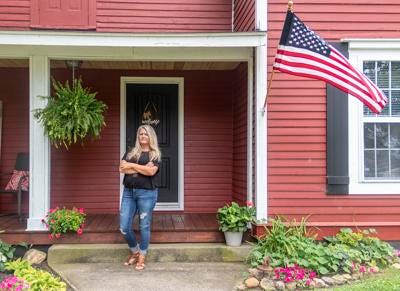
Jess Piper, a Maryville High School American literature teacher and an advocate for social justice, stands in front of her family’s farmhouse. Piper said her husband bought the house and five acres practically on accident three years ago after he “literally went out for milk.” ANDREW WEGLEY | @andrewwegley

MISSOURI. — The path between Maryville and the land on which Jess Piper lives stretches close to 20 miles, cutting through the vast fields of row crop and hoards of windmills that surround Missouri Route 148. There are grain silos and industrial-sized tractors among the rolling hills. There are signs for political candidates, almost none of whom are Democrats. There are more cornfields than houses, it seems. More shipping trucks pass through this stretch of Route 148 each day than there are residents with addresses on the roadway.

Between the “Randy Strong for Sheriff” signs and those promoting Gov. Mike Parson’s election campaign, there aren’t many inklings of liberal views, save for a “YES on Amendment 2” sign along one cornfield, nearly 5 miles away from Hopkins, Missouri. The same scenery persists once in the rural town of 532 residents.

The stretch of road that leads to Piper’s gravel driveway takes drivers by a Baptist church, a profane Trump sign and to a brick-red farmhouse on 5 acres of land, where bypassers might see Piper’s well-maintained flowerbed, the American flag she flies proudly, her overgrown vegetable garden or the two Joe Biden signs stuck firmly in her front lawn.

This is where Piper, an American Literature teacher at Maryville High School and an advocate for social justice, lives: in a picture-eqsue farmhouse near the outskirts of a conservative community where the Biden signs planted in her freshly-trimmed front yard separate her from many of her neighbors, perhaps as much as Piper’s politics do.

“I think I probably stand out because I am rural,” she said, sitting in a wooden chair underneath the shade of a tall Oak tree in her front lawn, steps away from the sidewalk, covered in grass clippings, that leads to her family’s front door. Piper tapped her right foot as she talked, flattening the grass beneath it a little more each time. She wore fashionable sandals and canary yellow toenail polish, a shade that matched her chandelier earrings and her facemask. “I am, you know, not your typical liberal.

Piper, 44, is the card-carrying, door-knocking type of Democrat who hasn’t supported a Republican presidential candidate since George Bush, when she was still stuck to the ideology she was taught growing up. Raised in a conservative household and brought up in Fundamentalist Baptist churches scattered across the South, Piper has emerged as an unlikely voice in an unlikely place.

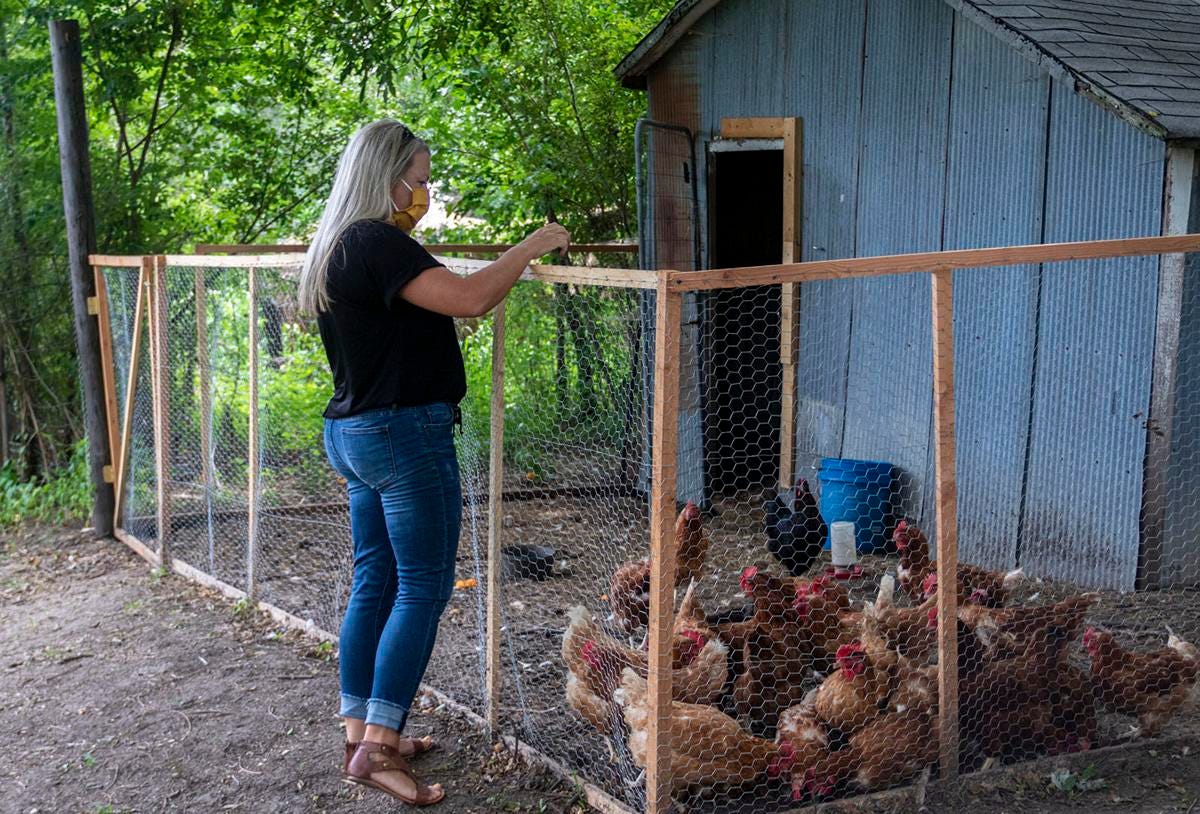
From Louisiana to Mississippi to Arkansas, Piper has lived in the most conservative corners of some of the country’s reddest states, and now she’s helping man the progressive front of a nationwide culture war in rural Nodaway County, where row crop is king and where conservatives win in landslides and where Piper raises cattle and chickens and children and fights for what she believes in every chance she gets.

“I can’t stand back while people are actually harmed,” said Piper, who has grown increasingly vocal since casting a fruitless vote for Hillary Clinton in the 2016 election. In the 43 months since President Donald Trump took office, Piper has started carrying poster boards and sharpies in the trunk of her Volkswagen Passat, never unprepared for a protest. She’s knocked doors for candidates like Claire McCaskill and Henry Martin — both of whom lost to Republicans in 2018. Her Twitter following has grown from less than 20 to more than 8,000 as Piper speaks up, louder now than ever.

“We’ve seen policies before that could harm people,” she said, critiquing the Trump Administration’s actions and inactions, both in the last four months and the last four years. “But this is a — it’s like purposeful to hurt people. … It’s that weird culture war. It’s just things meant to harm other people — especially people who are already oppressed.”

Born on a military base in Louisiana to conservative parents who would later divorce, Piper grew up dirt-poor while moving across the South — the kind of poor that left Piper and her sister without food often, that left Piper behind on class field trips, that left her searching and voting for causes and candidates that supported people like her. Piper grew up in the kind of poverty that made her different, she said. It made her want to fight.

But if it was poverty and hunger that lit a fire in Piper, it was Trump’s election that fanned the flame, or perhaps more accurately, doused the flame with gasoline. Piper has lived in Hopkins for three years, though the changes she’s seen since 2016 have extended far beyond the city limits of the place she calls home now and far beyond the state of Missouri.

Piper is used to conservative rhetoric, of course. But what she’s seen and heard in the 1,300-something days since Trump took office is different than what she used to see and hear.

“I can’t stand back while people are actually harmed.”

There have been friends and even family members who Piper thought were decent people who have grown into something she doesn’t recognize, touting racist ideology and spreading views Piper isn’t really sure they even believe, she said. She has an uncle who has stopped speaking to her since Election Day 2016. Her stepfather won’t let her into her own mother’s home. She didn’t talk to her dad for much of two years.

And the rhetoric aside — although it never really is — the disconnect between Piper, a self-described moderate and sensible Democrat, and those on the other side of the aisle has only grown in the COVID-19 era. She has watched as elected leaders at the state and federal levels have been slow to action as the COVID-19 pandemic has killed more than 170,000 Americans. She’s watched Parson refuse to issue a mask mandate as cases spike in Missouri. She’s watched officials call for the reopening of schools, putting teachers like her in danger while many officials making those calls nationwide meet via Zoom.

And as she’s listened, over the last four years and the last five months, to the racist rhetoric and the misinformation, and as she’s witnessed the actions and inactions that have harmed or will harm Piper and people like her, she’s grown frustrated, both with the officials and their constituents, with politicians voting for destructive policy changes and the citizens voting for those politicians.

Living in a county that Trump carried by close to 40% in 2016, and in a congressional district he carried by 30, Piper has a question for her rural neighbors, both in a literal and figurative sense, a question that’s been growing louder and more urgent with each passing day since Nov. 8, 2016:

“I look around and think, ‘How in the world could you guys vote for these people again?”

Twenty sixteen changed all of us. It radicalized Jess Piper.

Embracing Her Voice

In his 30 years in education, Dennis Vinzant has seen a vast array of changes come to the field. The English department chair at Maryville High School has watched as classrooms have experienced technology upgrades and as school lunches have weathered a myriad of alterations, and perhaps most importantly, Vinzant has watched as teachers have started to push back against American ideals, confronting those ideals with American realism.

Teachers — particularly in the literature and history fields — have grown from cheerleaders for the Founding Fathers into educators with a more realistic and critical view of the past 250 years or so, Vinzant said, while they’ve received pushback from parents and community members every step of the way. There was a time, Vinzant said, when he was scrutinized for teaching “Of Mice And Men,” the Great Depression-era John Steinbeck novella that landed on the American Library Association’s list of the 10 most challenged books in the 21st Century for its vulgarity.

“It is something that we all face to a certain extent,” Vinzant said. But, he said, Piper has probably experienced it more than any other teacher he’s been around in the last decade or so.

As she navigates how to teach students American literature through a modern-day scope, highlighting the hypocrisy of Founding Fathers like Thomas Jefferson, who wrote the words “all men are created equal” as a slave owner, Piper has received backlash, from parents and from elsewhere. She’s been accused of brainwashing, Vinzant said. She’s been targeted, in essence, for wanting students to think critically, and for wanting those students to back up their opinions with evidence that might support their claims, an idea that has somehow been received as radical at times, Vinzant said.

For Vinzant, who oversees Piper at Maryville High School and has worked alongside her for a half-decade, the pushback serves as a paradox. Critics equate the type of realism taught in Maryville’s English department with an attack on American values. But Vinzant said American idealism has always been challenged in American literature. It’s not the job of teachers like Piper and Vinzant to paint a rosy picture of what the country is and isn’t, he said. It’s their job to paint America’s portrait as it is.

“Being in a very conservative area here,” Vinzant said over the phone, pausing and sighing, carefully choosing her next words, “they’re uncomfortable with anything that’s not reinforcing what they already believe.”

They’re uncomfortable, of course, with Piper.

She knows it can be difficult to separate her from her politics, but Piper insists her beliefs don’t make their way into her lesson plans, though the subject matter she teaches does lend itself to social justice. And it’s true that Piper teaches the state-mandated curriculum differently than other teachers might, differently than how parents might have learned it, differently than Piper learned it herself.

The way Piper was taught, she said, both in literature and social studies, there were entire groups of people left out by way of whitewashed textbooks and lesson plans that ignore the darkest chapters in American history. Piper doesn’t ignore those chapters, and her refusal to do so is at times at odds with conventional wisdom, and perhaps more tangibly, at odds with some conservative parents and students in the community.

“I have a thick file,” Piper said. “It’s like a binder with tabs now.”

There is an actual file, Piper said, with actual letters in it. Still, the district granted her tenure last year.

Vinzant said parents seem to be used to an era when teachers didn’t have much of a voice, or at least, didn’t use it. Piper has embraced hers, perhaps more now than ever. As both Trump and Parson have called for students in public schools to return to face-to-face classes nationwide, and as the Maryville R-II School District gets set to offer face-to-face classes this fall semester for any student who wishes to learn in person, already prompting the retirement of at least one teacher, Piper has been outspoken on Twitter.

While she hasn’t directly criticized Maryville officials or the district, Piper has been adamant about her position, one she said is based on the advice of health experts and common sense: returning to class in late August, as cases of COVID-19 ebb and flow in Nodaway County, isn’t safe. A tweet she sent Aug. 15 highlights faults in logic of those comparing teachers to nurses garnered more than 20,000 retweets and 130,000 likes.

Piper laughed when thinking back to March, when many ordinary people across the U.S. praised teachers as heroes after having the homeschool their kids for several weeks when lockdowns first started. Now, teachers are labeled as lazy and cowardice for valuing their own health, she said.

“My, how things have changed,” Piper said.

For Piper, the realities of the situation are dual-edged. She understands schools serve as a food source and childcare for many parents and students across the county and the country. She recognizes the equity gaps that already exist in education, further emphasized by the pandemic and the move to online learning, a medium that can leave students in poverty behind. She wants to help those students, she said. But she wants to be safe.

She knows schools are everything, especially in places like Nodaway County. She’s frustrated, but she’ll head into work at Maryville High School later this month, prepared to teach the students who opt to learn in person. She’ll leave her 7-year-old daughter, Charlie, to learn at home.

“I don’t know what we’re going to do, but I know I can’t send her to school,” Piper said. “There’s no mask mandate for third grade.”

Both in person and on Twitter, Piper is careful in what she says, or at least, in how she says it, as she toes the line in critiquing the reopening of schools while not implicating the reopening school that employs her.

The practice of restraint is still something Piper is growing accustomed to. It wasn’t long ago that Piper was just a teacher with 14 followers on Twitter, a platform she used mostly to find lesson plans and to connect with other teachers. Now, she’s a growing voice on the platform. The commentary on social issues amid the pandemic and the protests that swept through the country beginning in late May have come with an increase of more than 3,000 followers for Piper, who helped organize and publicize Marvyille’s Black Lives Matter protest in early June. One tweet she made at the event was retweeted by McCaskill, the former senator Piper volunteered for.

But before more than 300 protestors converged on the Nodaway County Courthouse June 6 and before Piper’s tweet about the event caught fire, the educator was there two days before, protesting alongside a former Maryville High School student, with less than 20 other people.

The former student, Hayden Taylor, a 2016 graduate of Maryville High School, made plans June 4 to go protest by himself outside the courthouse and invited friends on Facebook to join him. Piper said another teacher sent the post to her from Taylor, who was conservative in high school and still identifies as conservative now. Piper dropped what she was doing to join him on the square, she said.

“I told my husband — I threw on a T-shirt and I said, ‘I’ve got to go,’” Piper said. “So I just ran down there and he was there.”

Taylor tells the story differently, though only slightly so. He made the Facebook post, of course, and announced his plans to protest for at least 46 minutes starting at 4:30 p.m. eight days in a row — honoring the eight minutes and 46 seconds it’s believed Minneapolis police officer Derek Chauvin kept his knee pressed against the neck of George Floyd. Piper did show up to support Taylor along Main Street June 4.

And Taylor said Piper showed up every day he protested, in crowds that ranged from less than 10 to a few dozen. But that first day, when Piper said she arrived at the courthouse to join the former student, Taylor said he was still on his way to the courthouse at 4:30 p.m., when he had promised his Facebook friends he’d be protesting.

“She actually beat me there,” Taylor said.

From fighting to running

Piper has a lot of bones to pick with a lot of people, but perhaps none as many as she does with Sam Graves, the U.S. representative from Missouri’s 6th Congressional District, a man many of Piper’s neighbors have voted for every two years for the last 20, and who many of them will vote for again this November.

It seems Piper’s gripes with Graves go beyond that of normal liberal-conservative disputes. She doesn’t agree politically with Allen Andrews, the Republican state representative for District 1, an area that includes Nodaway County, but she called him a “nice guy.” And her problems with state Sen. Dan Hegeman seem to begin and end at his conservative ideals. But with Graves, it feels different. It feels pointed.

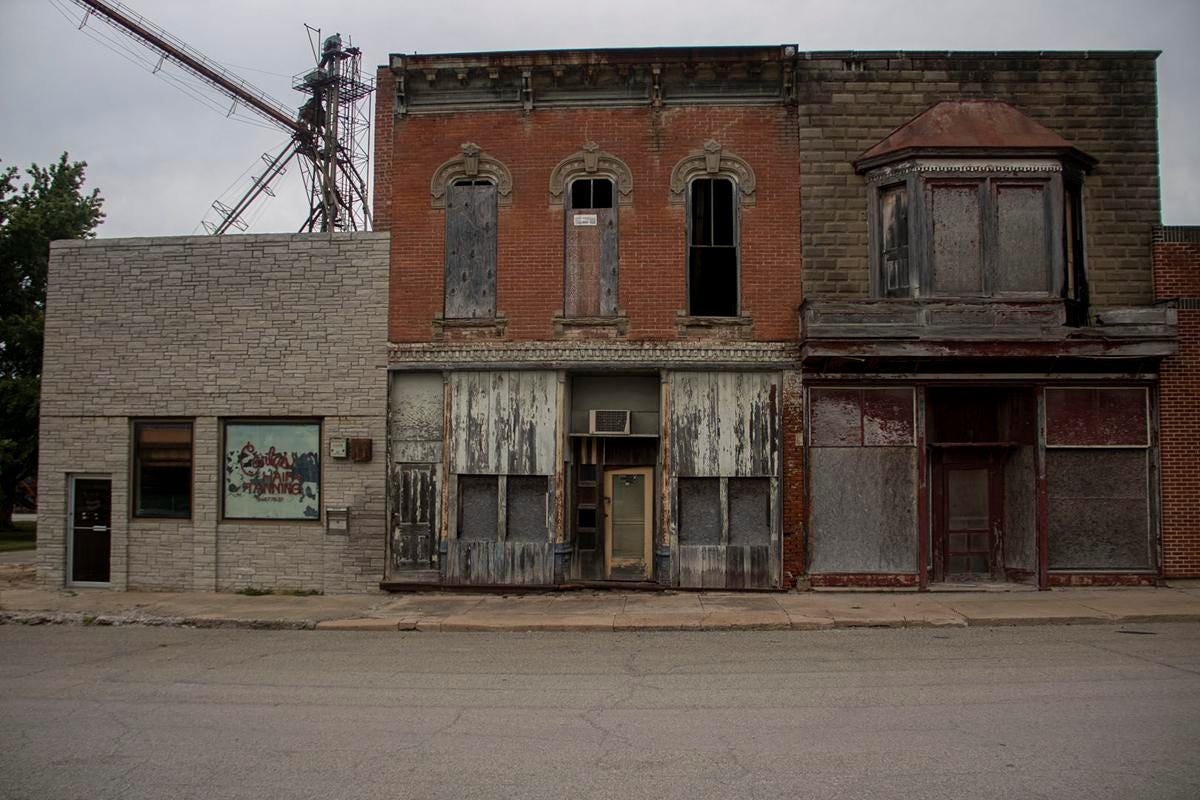
Perhaps it’s because Graves, who first got elected in 2000, has taken a more permanent residence in Washington D.C. than he has in the district in the years since, Piper said. Perhaps it’s because he claims to fight for issues that affect rural voters, like infrastructure, she said, while storefronts in Hopkins sit boarded up and empty, watching over roads that range from unpaved to unkempt, in a community where the fire station resembles a steel shed and the post office might be the nicest building in town.

Or perhaps it’s because Graves has abandoned the rural voter while collecting the rural vote and collecting an annual salary that’s grown from $145,000 when he started in 2001 to $174,000 today.

“I know Sam Graves has no idea what it’s like to go hungry,” Piper said.

Piper does. She knows a lot about the rural struggles Graves has done nothing to combat, she said, and perhaps that’s why she’s so critical of him. Perhaps that’s why she might run to replace him in two years, pending the outcome of his November election.

Piper has been approached by several decision-makers and recruiters within the Democratic party to run for office, and while some have urged her to start small and run for a seat like the one Andrews occupies now, others have encouraged the teacher and activist to go big, to go after Graves.

“I make $41,000 a year; I don’t have money to go after someone that big. But then again, I’m like, ‘Why shouldn’t I go after his position?’”

There’s a lot about the inner workings of politics that Piper doesn’t know. She’s not sure how to run a campaign, she said. She’s not sure if she has a chance to win the 6th District, where Martin, the Democrat Piper knocked doors for, lost by more than 100,000 votes in 2018. But she’s not sure how Graves keeps winning, either.

If she does run against Graves, Piper will have to win the rural vote, a group that doesn’t seem to be voting any more liberally than it did when Graves first took office. Amendment 2, a ballot measure that would expand Medicaid in Missouri at no cost to taxpayers, passed statewide earlier this month but lost by more than 700 votes in Nodaway County, despite the fact that many rural Missourians are on Medicaid, Piper said.

Piper faces an uphill battle in any race she may decide to run in northwest Missouri. A Democrat hasn’t won the 6th District since Pat Danner served from 1993 to 2001 when Graves replaced Danner, the only woman to ever serve as the district’s representative, following her retirement. Graves has won at least 59% of the district’s vote in every election since.

“To go after him would be tough because I’m a teacher. 

What could set Piper apart from the candidates that have tried and failed to unseat Graves for the last 20 years, she said, could be her place in the rural community. There are not rural candidates urging rural voters to vote for Democrats, she said. None of her representatives represent her, nor do they really represent Piper’s Republican neighbor’s a few hundred yards down the road, the ones with a Trump sign in their front yard that reads “NO MORE BULL—-.”

Being conservative and rural have become synonymous. Piper doesn’t understand why, but she knows that kind of campaigning won’t win voters in Hopkins.

“You’ll see people from Kansas City or St. Louis talking about the dumb hicks who vote against themselves,” Piper said. “And I’m like, ‘Well, that’s probably not a message that’s gonna resonate well out here.’”

Piper hasn’t decided yet whether she’ll run for Graves’ seat in 2022 or whether she’ll run for office at all. She’s hopeful Gena Ross, this year’s Democratic challenger in the 6th District, will unseat Graves in November. But history suggests Ross’s bid will be unsuccessful. And the last four years suggest Piper will run. She’s lost too much to stop fighting now.

Upgrade to paid

After months of silence between Piper and her father in the aftermath of the 2016 election, there was a break in late 2017, but only briefly, only for a few days, only long enough to say goodbye. Fighting a bevy of health issues, Piper’s dad, a Navy veteran, received the same low-quality healthcare veterans around the country are subjected to, Piper said.

By the time Piper walked into Britt Snodgrass’s hospital room at Kansas Medical Center, where he’d been transferred after doctors at a local hospital botched a treatment that left Snodgrass’s health declining, Piper’s dad was on his deathbed. A man that Piper described as “strong” and bear-like died a “fragile and horrible death” at the hands of malpractice, she said.

In those last waking moments, as doctors at the Medical Center burned a lavender scent in the hospital room to combat the smell of Snodgrass’s decomposing skin, Piper’s dad was apologetic, she said. He didn’t regret the politics that drove a wedge between them, but he regretted the division they caused. He asked her to read a story she wrote about growing up in poverty called “Mississippi Mudpies.” He asked Piper’s uncle to play bluegrass music, the music of his people, Piper said. And Snodgrass, who hadn’t asked his daughter for anything in more than a year, asked for advice, or perhaps for permission.

“‘What should I do? What would you do?’” Piper recounted her dad saying.

“And I said, ‘I don’t know, daddy,’” Piper said, her southern accent more pronounced now than ever, as she recalled one of the last conversations she had with her father. “‘I don’t know what I would do.’ Because I didn’t want him to go, but I didn’t want him to be in pain either.”

The next day, doctors helped him along, Piper said, pumping morphine into Snodgrass’s body every 15 minutes until he lost consciousness. His breathing slowed. He inhaled once every 90 seconds. Religious music played. Piper watched and waited as he slipped away, her father a victim of a failing healthcare system that predated 2016, their relationship very much a casualty of Trump’s America.

“Another reason why I fight,” she said.

The original article was written by Andrew Wegley. You can find him at andrewwegly on X.

~Jess

Flash Fiction: The Hammock’s New Home

The sun beat down mercilessly as I wiped the sweat from my brow. My wife’s hammock had been in the same spot for years, but she’d recently decided it was time for a change. She wanted it moved to a shadier location next to the woods, and I was tasked with making it happen.

I started by grabbing my extension ladder and chainsaw. There was a pesky limb blocking the new hammock location that needed to be dealt with first. I carefully positioned the ladder against the tree, making sure it was stable before climbing up. The chainsaw roared to life, and I made quick work of the offending branch, watching as it fell to the ground with a satisfying thud.

Next, I turned my attention to the four iron stakes that held the hammock in place, keeping it from being blown over by the wind. I knew I couldn’t simply pull them out by hand, so I fired up my trusty tractor. I attached a chain to each stake and slowly began to pull, feeling the resistance as the stakes stubbornly clung to the earth. One by one, they came loose, leaving gaping holes in the ground where they once stood.

With the stakes removed, I carefully folded up the hammock and carried it to its new home. The spot was perfect, with dappled sunlight filtering through the leaves of the surrounding trees. I could already picture my wife lounging in the hammock, a book in hand, enjoying the peaceful serenity of the woods.

I set to work installing the hammock in its new location, carefully measuring the distance between the trees to ensure it was level and secure. I pounded the iron stakes back into the ground, making sure they were deep enough to withstand any gusts of wind that might come along.

As I stepped back to admire my handiwork, I couldn’t help but feel a sense of pride. The hammock looked right at home in its new shady spot, and I knew my wife would be thrilled with the change of scenery. I could already imagine us spending lazy afternoons together, gently swaying in the breeze, listening to the rustle of leaves and the chirping of birds.

Moving the hammock had been a labor of love, but it was worth every drop of sweat and every ache in my muscles. I knew that the memories we would create in this new spot would be priceless, and I was grateful for the opportunity to make my wife’s vision a reality.

As I packed up my tools and prepared to head inside, I took one last look at the hammock, now gently swaying in the breeze. It was a reminder that sometimes the smallest changes can make the biggest difference, and that with a little hard work and determination, anything is possible.

Novel Excerpts–The Boaz Schoolteacher, Chapter 37

The primary aim of the "Novel Excerpts" blog category is to showcase my creative writing, specifically from the novels I've written. Hopefully, these posts will provide a glimpse into my storytelling style, themes, and narrative skills. It's an opportunity to share my artistic expressions and the worlds I've created through my novels.
The Boaz Schoolteacher, written in 2018, is my fifth novel. I'll post a chapter a day over the next few weeks.

Book Blurb

In the summer of 2017, Katie Sims and her daughter Cullie, moved from New York City to Katie’s hometown of Boaz, Alabama for her to teach English and for Cullie to attend Boaz High School .  Fifteen years earlier, during the Christmas holidays, five men from prominent local families sexually assaulted Katie.  Nine months later, Katie’s only daughter was born.

Almost from the beginning of the new school year, as Katie and fellow-teacher Cindy Barker shared English, Literature, and Creative Writing duties for more than 300 students, they became lifelong friends.  

For weeks, Katie and Cindy endured the almost constant sexual harassment at the hands of the assistant principal.  In mid-October, after Cindy suffered an attack similar to Katie’s from fifteen years earlier, the two teachers designed a unique method to teach the six predators a lesson they would never forget.  Katie and Cindy dubbed their plan, Six Red Apples.

Read this mystery-thriller to experience the dilemma the two teachers created for themselves, and to learn the true meaning of real justice.  And, eternal friendship. 

Chapter 37

By Saturday night, Cindy was two bundles of nerves, each had a separate controller.  Paula Wilkins and Steve.  I had returned from the State Park early Thursday afternoon.  Cindy and her family made it home yesterday shortly before noon.  She wanted me by her side every waking second.  I was lucky she had let me come home at night to sleep and remain until after my early morning writing sessions.  Cullie thought she was lucky too.  She had spent the entire week with the Barker family.  To her, there was nothing better.  Last night, Cindy followed me to my car as I was about to come home.  “Katie, please go with me to Sunday School and Church.  I hate having to go but if I don’t Steve will know something major is wrong.  Please.”

As instructed, I met Cindy in the Church’s parking lot at 9:00 a.m., fifteen minutes before the Assembly began in the Young-But-Maturing Sunday School Department.  She had told Steve the two of us were going to work a few hours this afternoon in our classrooms at school, and for him to transport the kids. 

“I know you think it is insane for me to go to the one place on earth that Paula Wilkins will be this morning.”  Cindy said under her breath as an older couple pulled into the parking spot next to Cindy’s with their windows lowered.

I nodded several times.  We stood between our cars, both of us rearranging our hair in the reflection of the car’s windows, and Cindy slipping on the matching jacket to her pants suit.  Finally, as the blue-haired woman and the hairless man were out of earshot, Cindy reopened her car door, leaned in and took out her Bible.  Apparently, she had forgotten it.  “I almost forgot my pacemaker.”

“I don’t think I’ve ever heard it called that, but I guess it fits.”

“This morning, probably about the time you were walking into, what did you call it, The Thread, I was talking with my Savior.”  Cindy looked puzzled.  I did not know if she was going to cry or scream with excitement.  It could have gone either way.

“What did He say?”  This was the part that had always lost me.  God had never, that I could remember, talked with me.  Although I had often wanted Him to.

“That He is with me always, knows my needs, and will never forsake me.”  Cindy said, but did not seem overly confident of her words.

“Then, His shield will defend you against every arrow shot by Paula or anyone else.  Hadn’t we better be going?  I thought you said it started at 9:15.”

“It does.  Assembly does.  That’s where all four classes in our department meet for general announcements, and fellowship.  I sometimes skip that and go sit in my class, especially if I haven’t read my lesson.”  Cindy said, and I pondered what lesson her teacher had prepared for us today.

After we talked another fifteen minutes, mostly me listening to Cindy speculate whether Paula would confront her at all, we walked inside the Education Building and rode the elevator to the fourth floor.

Maxine Fulton taught the Ruth Sunday School class.  It was for married women although Cindy said there were a couple of recently-divorced woman members.  I was probably the only never-married human in the entire department.  Cindy said this was her fourth Sunday with Maxine and that she and Steve had decided to try separate classes the first of the new Sunday School year.  I thought it oddly appropriate that the lesson title was “The Submission of the Christian Wife,” taken from Ephesians 5:21-32.

Maxine was an excellent teacher, combining short Bible analysis with modern-day examples, and gently but directly drawing the class into a discussion.  By the end of the class I was close to believing that the hierarchical structure espoused by the Apostle Paul could likely work for a man and a woman who were truly soul mates, if they never disagreed.  As I was showered with ‘nice for you to come,’ and ‘we hope you come back next Sunday’ salutations, I couldn’t help but realize why I had always desired a more equitable relationship, one where the two partners were equal, with the total absence of domination.  As Maxine handed me a copy of the Sunday School quarterly, I realized I probably would have been better off if I had been as lucky as Cindy to find a man like Steve.  They both believed strongly in the Bible but seemed to live their lives more according to the model I had always wanted but never found.

I had almost forgotten about the grieving Paula.  I must have subconsciously believed she would restrict herself and her sadness and anger to her home.  This feeling vanished when Cindy and I entered the lady’s restroom.  I guess we were fortunate the three of us were the only ones needing to pee or freshen our makeup.  A pretty face was the last thing on Paula’s mind when she caught us coming in while blotting her lips before the mirror.

“Where the hell is my husband?”  Paula didn’t mince words or waste time.  I didn’t believe she was talking to me.

“I don’t have a clue what you are talking about.  Obviously from your rude and despicable phone call last Thursday, your sweet and faithful husband has been lying to you.  I dare you say he and I are having an affair.”  Cindy wasn’t intimidated.

“I haven’t seen or heard from him in nearly a week.  The last thing he did before he went on his run was apologize.  He confessed the two of you were having an affair.”  Paula looked like she could pounce any minute.  I was glad she hadn’t said Wilkins claimed that Cindy was pregnant, although that’s what I thought he had told her.  Of course, that’s what I had discovered from my Real Justice fictional world.

“I wouldn’t doubt he’s telling you a partial truth.  He probably is having an affair.  God knows he’s hit on me enough at school.”  Cindy said, stopping short of describing how she had resisted.

“Paula, I’m sorry, but I have to agree with Cindy.  Patrick is a womanizer and has flirted with me since school started.  He’s always looking down my blouse or standing way too close.”  It was the right thing for me to do.  Defend Cindy.  I knew she would never have an affair with anyone.  I also knew Patrick had raped her.  I would risk my life for Cindy.

“Shut up you little bitch.  Did I ask you?  This is between me and this slut.”  Paula might want to calm herself just a little.  I didn’t know but I suspect Cindy could take care of herself, especially since Paula was a smaller bitch than me.

“You’re not pregnant, are you?”  I thought I was hearing someone out in the hallway.  Paula had asked the one question I feared but never anticipated coming from her mouth.  “I wouldn’t doubt it.  It’s happened before.”

“What’s that to you?  If I were pregnant, and I’m not, it sure as hell wouldn’t be Patrick’s.”   I was surprised Cindy had used the ‘hell’ word while at church. 

“What did you mean, ‘it’s happened before’?”  I asked, willing to hear the ‘B’ word thrown my way once again.

“You don’t know?  You haven’t heard about last year.  I can’t believe that.”  Paula said looking directly at me.

“She just moved here in August.  I’ve lived here for years and I haven’t heard it either.”  Cindy was now defending my lack of knowledge.

“Seemed to me it was all over town.  Patrick and Pattie Winkles, but she was smart enough to have an abortion.”

Just as Cindy looked at me and scrunched her face into a puzzled and disbelieving contortion, Maxine walked in, saw Paula, took her hand, and expressed her sympathy over the missing Patrick.  Cindy and I walked, both apparently forgetting to pee, or freshen our faces.

After a short song service, Pastor Warren’s sermon was not much longer.  “Faith Can Move Mountains,” no doubt was meant to assuage everyone’s doubts over the fate of the missing Wilkins.  The final thirty minutes of the Worship hour was spent in personal testimonies and prayer.  I suppose Warren believed a few shared stories of how real people had experienced real doubts over their loved ones only to be ultimately rewarded with a satisfying resolution, would help Paula shore up against her raging storm.  The testimonies also inspired all twelve active Deacons to hover around the distraught Paula, lay their hands on her head and shoulders, and to pray that God would find Patrick and bring him home.  One Deacon pleaded, “Almighty God, bring our Education Director back to us in a chariot of fire.”  I had trouble deciphering his exact intention.

After the same Deacon led the congregation in singing three verses of “Amazing Grace,” Cindy and I followed Steve through the line to shake Pastor Warren’s hand.  Sometimes she made the poorest decisions.  I’m not sure she heard it because she was telling Steve what to prepare for the lunch she would miss.  Behind me and towards the entranceway to the hall that leads back to the elevators, I could see two of the Deacons that I had seen praying for Paula, standing and talking.  As the long line wound around closer to them I walked over to a display table holding contribution envelopes and prayer request cards.  I don’t think either of the men knew I was there. 

The taller man said, “Deputy Yates told me they at first hadn’t suspected foul play but yesterday they learned Wilkins was having an affair.  Seems like they might have discovered a motive.”

Right then, Cindy yelled at me, “come on Katie.”  That’s when both men realized I was standing at the corner table.

Wayne, the mysterious and handsome sheriff, called me at school on my cell before Cindy and I had finished the Big Macs we had grabbed at MacDonald’s.

After a two-way exchange of pleasantries, he said, “I’m sorry I haven’t called since our date.  Again, I apologize for not taking you to Huntsville as promised.”

“No problem.  You had a good excuse.  Maybe there’s still time.”  I said, regretting it immediately.  That sounded so desperate.

“I like keeping my promises.  Will you give me a rain check?”

“I’ll think about it.”  Now, he would think I was more like a teenager, playing kid games with him.

“That’s in my favor.  I hope.  I know you need to get back to your work, but I wanted to give you an update.  I’ve had to wait until the family was notified.”  Wayne was confusing me.

“Uh, I’m not sure what you mean?”  I said.

“You remember I had to stay in town during our date because of a new crime scene?”

“I do.”

“It was a murder.  Nathan Johnson.  Your Nathan Johnson.  I mean the man we suspected of killing Darla.”  Wayne was stumbling badly.

“I’m really confused now.  I thought Nathan Johnson was in jail.  Did another inmate kill him?  Or, did Johnson kill someone.”  It seemed it could be either.

“Sorry, Nathan Johnson was murdered.  And, not at the jail.  Again, I apologize for not being able to tell you any of this.  First, and don’t ask me how it happened, but someway his attorney, Nathan’s attorney Cliff Thomas, persuaded Judge Broadside to grant bail.  Johnson was set free that Friday and his body was discovered the following Saturday.  It’s taken a week to reach his parents.  Seems they were traveling in Europe and were truly off the grid.”

“How was he killed?”  This all seemed too convenient, too lucky for Ryan and probably Danny Ericson, maybe the entire Faking Five.

“Two fishermen found him in a slew on Town Creek. His body was tangled in an old dead tree that had fallen into the water.  Shot straight through the forehead.”  Wayne said, giving it to me short and sweet.

“Katie, sorry.  The DA’s calling.  I got to run.  Take care.”

After our call ended I knew without a doubt that Mr. Nathan Johnson was too much of a liability for someone.  I suspected it was the Faking Five.

Novel Excerpts–The Boaz Schoolteacher, Chapter 36

The primary aim of the "Novel Excerpts" blog category is to showcase my creative writing, specifically from the novels I've written. Hopefully, these posts will provide a glimpse into my storytelling style, themes, and narrative skills. It's an opportunity to share my artistic expressions and the worlds I've created through my novels.
The Boaz Schoolteacher, written in 2018, is my fifth novel. I'll post a chapter a day over the next few weeks.

Book Blurb

In the summer of 2017, Katie Sims and her daughter Cullie, moved from New York City to Katie’s hometown of Boaz, Alabama for her to teach English and for Cullie to attend Boaz High School .  Fifteen years earlier, during the Christmas holidays, five men from prominent local families sexually assaulted Katie.  Nine months later, Katie’s only daughter was born.

Almost from the beginning of the new school year, as Katie and fellow-teacher Cindy Barker shared English, Literature, and Creative Writing duties for more than 300 students, they became lifelong friends.  

For weeks, Katie and Cindy endured the almost constant sexual harassment at the hands of the assistant principal.  In mid-October, after Cindy suffered an attack similar to Katie’s from fifteen years earlier, the two teachers designed a unique method to teach the six predators a lesson they would never forget.  Katie and Cindy dubbed their plan, Six Red Apples.

Read this mystery-thriller to experience the dilemma the two teachers created for themselves, and to learn the true meaning of real justice.  And, eternal friendship. 

Chapter 36

I was sitting at my desk in The Thread by 4:00 a.m.  For obvious reasons, I had missed yesterday’s early morning writing session.  There had been plenty of time after I returned home from Cindy’s to conduct an extended make-up session, but I hadn’t.  My habit is too ingrained.  There’s just something about the predawn hours that spurs my imagination. 

The Real Justice scene I was drawn to write contained Stella Gibson and Nancy Fletcher, Noah Fletcher’s wife.  For years, I hadn’t doubted that my subconscious mind and my imagination were two separate entities.  But I also believed they lived together in the same neighborhood.  This morning, they partnered to inspire me to explore Nancy, the fictional educator, to attempt to determine whether there was any connection with Paula Wilkins, the living and breathing wife of the breathless Patrick.

As I was brainstorming and drawing on a pink 5 x 8 note-card, I laughed out loud, and acknowledged the weirdness of what was happening.  My twenty Creative Writing students and I were engaged in writing a fictionalized story that was growing more and more like not only one I had experienced but was moving rapidly towards a new world that Cindy and I had just entered.  The weird part, part of the weird part, was that my twenty students didn’t have a clue about the darker edges of my past or present private life.  I was unable to resist asking myself, “how on God’s green earth was this happening?”  I knew it was happening because I had spent over two hours last night sitting at the kitchen bar reviewing the final drafts of the five outlines the five teams had submitted to me Friday afternoon before school was out for Fall Break.

The good part about my role in the Real Justice project was that I was free to follow my imagination where it leads me while I’m in The Thread.  Later, I can modify my drafts as needed before distributing the sanitized versions to the five teams in my Creative Writing class.  There is nothing like this freedom, the ability to be boundless, allowing my mind to explore, create, and destroy lives, places, relationships, and whole cities.  It was this freedom I pursued as my imagination fed me connections between Nancy Fletcher and Paula Wilkins.

Both women had husbands who were unfaithful, and they knew it.  It was part of the deal.  But neither of them minded because they both realized their lives could be far worse.  Both had married up as they say.  Of the two women, only Paula had ever strayed from her marriage vows.  After her and Fulton had their one and only tryst, she vowed to never stray again.  Although Nancy Fletcher had on several occasions helped Noah extricate him from a potentially scandalously public affair, this was Paula’s first experience.  Her and Patrick’s relationship was unique, likely rare.  Her orgasms were accentuated when her loving husband whispered to her his quests and conquests as he ravaged her body four or five times per week.  She now had made him explore with her the same fantasy on three different occasions.  The last time being Sunday night.  It was then she discovered the sex between her loving Patrick and the slutty Cindy wasn’t consensual.  This was bad enough, until early yesterday morning, as he was getting ready for his run, he divulged even more shockingly disturbing and life-changing news.  Cindy Barker was pregnant. 

I continued to explore the lives of Nancy Fletcher and Paula Wilkins for nearly an hour, ending shortly before 5:30 a.m. in near-complete confusion over what was fiction and what was real.

Wednesday afternoon was spent at Guntersville State Park with a relaxed Steve, a carefully choreographed Cindy, and four beautiful, naïve, but wonderfully blessed kids.  Cullie and I fished from a pier.  Thankfully, the wind picked up around 3:30 and the four rambunctious teen boys sharing our real estate left us alone.  Ever since mine and Cindy’s talk at Wayne’s pond over a week ago, I had decided on three or four different ways to tell Cullie the truth.  On the drive down, I had abandoned each of them.  Just make it plain and simple.  That’s what I finally decided.  And did.  “Cullie, I’m sorry but I have lied to you all your life.  Colton Brunner isn’t your father.  I don’t know for sure who is.”

Her response was surprising.  “Thanks for admitting what I’ve known forever.”  I determined then and there never to underestimate a teenage girl.

It turned out Cullie didn’t know much at all but had stumbled toward the truth when her New York City eighth grade science teacher had asked her students to create a list of the physical characteristics they shared with their fathers.  Cullie had discovered that her and Colton were as different as her and her pet hamster.  “I figured it must have been painful for you and that you would tell me the truth when you were ready.”   I hated the thought that her biological father had unwittingly shared such wisdom with his daughter.  I knew for sure she hadn’t inherited the wise-gene from me.

Our conversation over the rape wasn’t so easy.  This was the part I had struggled with so much.  Should I lie and say that I had slept around, and the father could be one of five men?  Should I tell her the names of the prospective fathers?  I hope I haven’t made a mistake.  At the time, I didn’t think I had.  I virtually had Cullie swear that she would keep every part of her conception secret, other than the name of her actual father, once we discovered the truth.  I told her everything, including the names of the five men, and that we would soon know which one had impregnated me and was her biological father.

Again, she surprised me as she closed the tackle box Steve had let us borrow.  “Mom, people make mistakes.  Sometimes the best things result from the biggest mistakes.”  I cried.  She even let me hold her in broad daylight.  I whispered to her she was the best gift the world could ever give me and that I loved her with my whole heart.

“I know you do and I love you too.  Please don’t hold a grudge against those five men.”  She said as she grabbed her rod and reel, the tackle box, and walked back towards Steve and Cindy’s cabin.

I stayed at the pier, even sat down and hung my feet over the side.  I replayed mine and Cullie’s conversation over and over in my head and could only conclude that she was either the wisest fourteen-year-old in the world, or she was a superior actor, keeping buried her true thoughts and fears.  I suspected it was the latter. 

I hadn’t planned on it but both Cindy and Steve insisted.  It was late when we finished eating the wonderful rib-eyes he had grilled, and it had started to rain.  I spent the night sleeping on a couch that was made into a bed.  My only reservation had been the effect upon my early morning writing.  Oh well, one more missed session wouldn’t kill me, but it certainly made me anxious, as it always did.  It had always been nearly impossible to explain, the feeling of incompleteness, of virtually leaving my head on my pillow as I attempted to walk forward through my day.

Thursday morning, before anyone else was stirring, Cindy and I took a walk.  We were barely out of the cabin when she asked if I had looked at Facebook.  I had not, because I intentionally avoided it, other than interacting with my students in the various writing groups.

“It’s all over my Newsfeed.”  Cindy said assuming I knew exactly what she was talking about.

“It is?  Must be important.”  I could be indirect myself.

“People are saying that the police and sheriff’s departments will continue the search today.  Yesterday, apparently, there were about a hundred-people scouring every inch of Wilkins’ running path.  One guy said Paula, Patrick’s wife, had said he seemed upset when he left their house between 5:05 and 5:10 a.m.”

“I wonder how that guy knew that?  That’s one reason I hate Facebook.  Most of what you read is made-up shit.”

“I agree, but a lot of it isn’t.  It certainly seems natural that folks would be looking for our dearly departed leader.”  Cindy said, picking up our pace more than I wanted.

“I’m confident no one saw us.  I didn’t see a single car during the whole ordeal.  And, there’s no houses close enough on Tanner Road for someone to have seen our spot.”

“I agree.  I also know we didn’t leave a trace where we parked.  I doubt any of the searchers could connect tire tracks to our van even if they were able to determine where Wilkins met his fate.”  Cindy said speaking as confident as a twenty-year crime veteran.

“You’re assuming the bleach we poured on the blood spot on the ground where his head bled for a minute or so, eliminated every trace.”  I said.

“Even if an expert crime scene team found that spot, extracted a sample, and ultimately determined it was Wilkins’ blood, that still wouldn’t implicate us.  He could have fallen and hit his head during an altercation.”  Cindy laid it all out.  At least that’s what she believed.

“His blood and a missing body.  Don’t forget we have spawned a criminal investigation.  They are looking.  They are not yet looking for us, but they are looking for a link, any link, that will point them to the perpetrators.  I can assure you they know a crime has been committed.  As time goes by, this will become unassailable.”  I really wasn’t offering anything new. 

“I still say the weakest link in our plan is where and how we are storing the van.”  Cindy finally said the same thing I had been saying all along.  Maybe she was ready to shore up this loose end.

Her phone rang before I could respond.  Immediately after taking the call and learning who was calling, Cindy activated her iPhone’s speaker.  It was Paula Wilkins wanting to know if Cindy knew where Patrick was.  Paula declared she knew about Cindy and Patrick’s affair.  After another minute or two of Paula’s screaming threats, Cindy ended the call.

“How in the hell does she know?”  I asked.

“Well, no doubt her slimy husband has been lying to her, making it sound like he and I have been having an affair.”  Cindy said as though that was her biggest problem.

“Cindy, wake the fuck up.  Affair, no affair, kidnap, rape, it doesn’t matter.  She knows enough to bury you, the both of us.  You are now in the cross hairs of this investigation.  You do know this, don’t you?”  I said, walking a shallow embankment to sit on a steel rail by the edge of the road.

“Hell, hell, hell, and more hell.  Something we never ever anticipated.”  She said, following me.

“At least not in real life.”  I said, with that same ominous feeling I had already experienced, not remembering when it was.

“You said all along that there would be some issue that would arise.  You said they always do.  Therefore, criminals get caught.  There is no way to plan for every possible variable.  Why did you let me talk you into this?”  Cindy said, pulling out her iPhone and again scrolling through her Newsfeed.

I didn’t respond.  I knew it was too late to make any difference.  If only I had stuck to what my head was telling me when Cindy had been playing with my emotions over what I had to do to square things up with the Faking Five.  The freedom I had felt yesterday morning in The Thread was now gone.  That was fiction.  This was real.

Snowflake Summaries–The Sixth Commandment, by Lawrence Sanders

The primary aim of the "Snowflake Summaries" blog category is to showcase the creative writing of great authors. I use Randy Ingermanson's 'Snowflake' method to create these summaries. Here's a brief description of the one-sentence, one-paragraph, and one-page summary method.

Hopefully, these posts will motivate you to read great fiction and to write your own novel, whether your first or your fifteenth.

The first great novelist I'll start with is Lawrence Sanders. Here's a short biography.

The Sixth Commandment, by Lawrence Sanders

**”The Sixth Commandment” by Lawrence Sanders** is a suspenseful and complex murder mystery that delves into themes of morality, obsession, and the consequences of deep-seated secrets.

### One Sentence Summary:

In **”The Sixth Commandment,”** Lawrence Sanders presents a gripping tale of Sam Todd, a retired investigator who delves into the suspicious death of his friend, stirring up a hornet’s nest of dark secrets and deceit in a small town.

### One Paragraph Summary:

**”The Sixth Commandment”** is set in the quiet town of Williamsburg, where Sam Todd, a retired bureaucrat with a knack for investigation, is drawn into the mystery surrounding the death of his friend, Dr. Nicholas Ely, who was supposedly killed by a burglar. When doubts about the cause of death arise, coupled with Ely’s widow’s odd behavior and the strange activities at the local genetics research institute, Todd finds himself navigating a labyrinth of lies and treachery. As he uncovers unsettling truths about genetic experiments and the real reasons behind Ely’s death, Todd faces moral dilemmas that challenge his perception of justice and loyalty. Sanders crafts a tale that not only probes the ethics of science and the depths of human deception but also tests the boundaries of friendship and the quest for truth.

### One Page Summary:

**”The Sixth Commandment”** by Lawrence Sanders introduces readers to Sam Todd, a clever but world-weary retiree whose quiet life is upended by the violent death of his friend, Dr. Nicholas Ely. Ely, a respected figure in the community and a researcher at a controversial genetics institute, is reported to have been killed during a home invasion. However, Todd’s suspicions are aroused by inconsistencies at the crime scene and the peculiar reactions of the widow, Loretta Ely.

Driven by a sense of duty to his deceased friend and his own intrinsic curiosity, Todd begins to question the official narrative. His inquiries lead him deeper into the operations of the genetics research institute where Ely worked, uncovering not just scientific ambition but a twisted mesh of ethical breaches. Todd interacts with various townspeople, from Ely’s colleagues to local law enforcement, piecing together a puzzle that suggests Ely’s research had attracted dangerous attention.

As Todd digs further, he discovers that Ely had been involved in highly experimental genetic manipulation, potentially worth millions to the right buyer, which provides a motive far more substantial than random burglary. This revelation introduces a host of potential suspects, including disgruntled colleagues, secretive corporate entities, and a mysterious figure lurking in the shadows of the town’s quaint streets.

The novel builds tension through Todd’s methodical investigation and the gradual unveiling of each character’s hidden agendas. Sanders expertly portrays Todd’s transformation from a passive observer to an active participant in the unfolding drama, mirroring the accelerating pace of the narrative. The stakes rise dramatically when Todd becomes a target himself, realizing that uncovering the truth might cost him more than he’s willing to pay.

The climax of **”The Sixth Commandment”** is a dramatic confrontation where the true mastermind is revealed in a twist that challenges the conventions of the murder mystery genre. Todd’s final decisions reflect his complex understanding of justice—torn between legal boundaries and moral absolutes.

In this novel, Sanders not only crafts a tightly wound mystery but also delves into the philosophical underpinnings of friendship, the ethical implications of scientific advancement, and the personal costs of uncovering the truth. **”The Sixth Commandment”** stands out as a profound exploration of how far individuals and societies will go to protect secrets and the sometimes ambiguous nature of justice in a world brimming with moral grey areas.

Novel Excerpts–The Boaz Schoolteacher, Chapter 35

The primary aim of the "Novel Excerpts" blog category is to showcase my creative writing, specifically from the novels I've written. Hopefully, these posts will provide a glimpse into my storytelling style, themes, and narrative skills. It's an opportunity to share my artistic expressions and the worlds I've created through my novels.
The Boaz Schoolteacher, written in 2018, is my fifth novel. I'll post a chapter a day over the next few weeks.

Book Blurb

In the summer of 2017, Katie Sims and her daughter Cullie, moved from New York City to Katie’s hometown of Boaz, Alabama for her to teach English and for Cullie to attend Boaz High School .  Fifteen years earlier, during the Christmas holidays, five men from prominent local families sexually assaulted Katie.  Nine months later, Katie’s only daughter was born.

Almost from the beginning of the new school year, as Katie and fellow-teacher Cindy Barker shared English, Literature, and Creative Writing duties for more than 300 students, they became lifelong friends.  

For weeks, Katie and Cindy endured the almost constant sexual harassment at the hands of the assistant principal.  In mid-October, after Cindy suffered an attack similar to Katie’s from fifteen years earlier, the two teachers designed a unique method to teach the six predators a lesson they would never forget.  Katie and Cindy dubbed their plan, Six Red Apples.

Read this mystery-thriller to experience the dilemma the two teachers created for themselves, and to learn the true meaning of real justice.  And, eternal friendship. 

Chapter 35

Saturday night came and went.  Our date was little different than going out to eat with my brother.  If I had a brother.  Wayne took me to a new little cafe in downtown Boaz called Pirates Cove.  It was a quaint little joint with exposed century-old brick on the walls.  The food was good.  Apparently, he liked country-cooking.  When he had called me early Saturday morning he asked if I was okay with going to Huntsville.  Everything he had said about where we were going and what we were going to do was perfect.  All day I fantasized about our romantic first date.  It didn’t happen.  When he picked me up he apologized and said he had to stay in town, something about a newly discovered crime scene.  He seemed anxious about it but wouldn’t disclose any details.  Wayne had taken me straight home from Pirates Cove, which was fine with me if he had stayed.  He hadn’t.  So much for all my Saturday fantasy thoughts.  Gone.  Evaporated like the early morning fog that had hovered over Wayne’s pond.

The following week of school went by in a blur.  I had conducted my teaching virtually on autopilot which I had sworn I would never do.  It cheated my students.  I never anticipated having a part time job planning and executing a kidnapping and killing (my crime partner refused to use or acknowledge the word murder).  Every day this last week before Fall Break was spent brainstorming and formulating our plan.  By Saturday afternoon we believed we had addressed every possible detail.

It would take place Monday, October 16th.  Cindy and Steve had secured reservations in early August for a cabin at Guntersville State Park.  Steve would take his three children and Cullie on Sunday afternoon, the 15th.  Cindy and I would join them Monday afternoon, using school and a pile of papers to grade as our excuse.  I would stay overnight with her and we would be waiting on criminal asshole Wilkins Monday morning when he turned east on Tarvin Road, probably around 5:10 a.m.

Our vehicle of choice was a tan-colored 2005 Nissan Quest, a van.  We had thought it would be easier for Cindy and me in moving Wilkins’ body.  The side door was much lower to the ground than the bed of a truck.  We had spent time contemplating whether to use Steve’s old pickup, the bright red and fully restored 1975 Chevrolet Silverado.  That would have been rather stupid.  A direct link back to Cindy if discovered.  We found the van at Jeff’s Auto Sales in Leesburg two weeks before D Day.  I suspect Jeff believed Cindy and I were both hookers just trying to make life easier on our johns. We both had worn disguises.  I was impressed with Cindy’s preparation and execution.  She had said, “cosmetology classes in high school and a theater minor in college, glad they finally came in handy.”  We had hidden our getaway vehicle in Nanny’s barn, thankful it hadn’t burned along with her house.

Wilkins was delayed a few minutes.  During the five-minute wait we beat ourselves up over our failure to consider that he and Paula might have taken a little trip this week themselves.  After all, it was Fall Break.  Just as our doubts were pushing us to abandon our plan, Cindy saw him turn right off Aurora Road onto Tarvin Road.  We had parked the van about a hundred yards from his turn.  I was glad Cindy had taken up her post across a shallow ditch and behind a grove of trees fifty feet or so behind the van, back towards Aurora Road.  We had been talking via two burner phones we had purchased in Gadsden.  The plan was for Wilkins to see me having car trouble and when I had him curiously inspecting whether my engine had died, Cindy would come assist.

“Patrick, man am I glad to see you.  Do you live around here?”  I could tell he was surprised.  “I dropped my daughter off at my cousin’s and I think my engine just died.  Can you look?”

“I’m not a mechanic, couldn’t help you if I wanted to.  Sorry.” 

“Can you help me remove my radiator cap.  It may just be out of antifreeze or something.”  I wanted to get him engaged, doing something to distract him. 

“Alright, I can do that.”  He walked from the middle of the road over to where I had parked the van, along the shoulder, almost in the ditch.

I stood very close to him.  I made sure my left leg and left elbow were touching him.  I said, “don’t you think it’s kind of neat for you to find me here.  A lady in distress.  This might be that opportunity we’ve both been looking for.”  I was having so much fun with the bastard.

“There, it wasn’t tight at all.”  He handed me the radiator cap and smiled.  We were now facing each other, still very close.  I reached my hand up to his face and gently felt his prickly beard.  “I like a man before he’s had his morning shave.”  He smiled.

“You’re surprising me.  You’ve never responded this way at school.”  He said looking at me with a devilish smile, his right lip curled upward just slightly. I had to admit, Patrick Wilkins was a nice-looking man, and fit.  He had on a sleeveless tee-shirt and jogging shorts.  His tanned body was sleek, like a runner, including taut stomach, and missing the gross muscles of a weight-room freak.”

“Patrick, believe me I’ve wanted to but, until right now, I hadn’t realized how much I’ve missed.”  I hesitated, giving him my shyest look, intentionally looking down to the ground.  “Too public.  I need my job.  But, we’re not at school now.  Are we?”

He reached out with his right hand and started to pull me into him.  That’s when Cindy hit him in the back of the head with a piece of steel pipe.  He fell forward into my arms.  My body only slightly slowed his collapse onto the ground.  In five minutes we had him bound, gagged, and in the back of the van.  I turned the van around in the middle of the road, turned left on Aurora Road, right on Highway 205, and were soon traveling south on Highway 431. 

It took us nearly thirty minutes to arrive at our chosen spot.  I drove below the speed limit and made a few detours to make sure no one was following us.  I eventually turned right on Highway 278, drove several miles west past the Mountain Top Flea Market and turned left on County Road 132.  Two left turns later and we were on Moody Chapel Road.  About a half mile past Salem Baptist Church, I made our final left turn onto a private road and drove another mile.  We passed one long-abandoned house.  The gravel road gave way to an old logging road that was barely passable.  A slow and bumpy mile later, Wilkins was home.  It was a densely wooded area and would provide plenty of shade for as long as he needed.

For some odd reason, Cindy and I had more trouble removing his body from the van than we had putting it in there to begin with.  It might have had something to do with him being dead.  But, I doubt it.  While I had driven, Cindy had administered a 100 mg dose of potassium cyanide, enough to kill a horse.  Surprisingly, it had taken him over ten minutes to die.  As expected, it took us almost forty-five minutes to dispose of the fearless assistant principal, including putting him in the ground, shoveling in the dirt, and dressing-up the site with an ample amount of leaves and limbs.  We were glad we had dug the grave last Saturday when Steve thought we were shopping.  Over three hours of back-breaking labor.

By 7:30 a.m., Cindy and I were back at her house eating the breakfast we had secured after returning the van to Nanny’s barn.  We had been careful to dispose of the blue tarp, and the thirty-inch section of steel pipe we had confiscated from a pile of scrap metal behind Steve’s shop.

Pastor Warren and Ryan had ordered their breakfast from waitress Gloria at Grumpy’s Diner when Sheriff Waldrup walked in the restaurant and over to their table.

“Radford, I’m glad I saw you.  I was planning on calling you today.  We need to talk.  When can you come see me?”  Waldrup said, not to engage in any pleasantries.

Ryan hesitated, looked at Warren, and said after the Pastor gave him an almost invisible nod, “How about 9:00 a.m. tomorrow?”

“That works for me.  Don’t be late.  I’ll see you in my office in Guntersville.”  The tall man in full uniform, including a wide-brim hat, said, and walked back to the counter for an order Gloria had waiting.

“What the hell do you think that’s all about?”  Ryan said.

“I suspect you know, your family is knee deep in the Darla Sims investigation.”

After Gloria brought their breakfast, the two spent twenty minutes developing a strategy, which was to tell the truth, at least part of it.

“Where the hell do you think Wilkins is?  I warned him against being late.  Pastor Warren said motioning Gloria for more coffee.

“If you ask me, he’s trouble.  By the way, why did you want me to meet with the two of you?”  Ryan said, downing in two swallows, a full glass of orange juice.

“I needed a witness.  Nobody else could come.  Fulton’s getting ready for a Board meeting.  Danny’s in Gulf Shores at a realtor’s conference, and Justin said he had the flu or something.  I think he was still pissed at me from Wednesday night.”  Warren said.

“Yea, he didn’t much like you having Nathan’s lawyer at our meeting two weeks in a row.  By the way, why were you needing a witness?”

“I wanted someone to know exactly what I told Wilkins, where there would never be any doubt that I had given him the final ultimatum.”

“Which is?”  Ryan asked checking out Katie Sims as she came in the restaurant, picked up and paid for her takeout order, and walked outside.  “Nice ass, don’t you think preacher man?”

“Let’s not go there.  If the bastard shows, I was going to tell him that he needs to keep his pants on, that he is going to feel some real pain if he ever scratches his little itch again.  Warren said.

“The rest of us told you all along not to bring him into the Club.  I may like women as much as he does but at least I’m discreet.”  Ryan said eying Gloria as she delivered food to an adjoining table.

“Anyone watching you would certainly know you’re discreet all right.”  Warren said, pulling his iPhone from his shirt pocket.  “Damn, nearly 8:00 o’clock.  Wilkins promised he would be here no later than 7:00.  Since he’s out of school this week, he probably went back to bed after his little run.  I think I’ll go swing by there.  Can you come?”  Warren asked.

“No, I’ve got to get to the store.  Monday morning staff meeting.”

“I’ll see you Wednesday night.  Can you bring a twelve-pack?”

“No problem.”  Ryan said as Warren left.  “Hey darling, can I have a coffee to go?”  Gloria frowned and pushed Ryan’s big right hand from her lower back.

“It’ll be at the register.”

“Thanks baby doll.”

The Marginalian: The Paradoxes and Possibilities of Transformation: Adam Phillips on Our Ambivalent Desire for Change

Here’s the link to this article.

BY MARIA POPOVA

The Paradoxes and Possibilities of Transformation: Adam Phillips on Our Ambivalent Desire for Change

When answering the Orion questionnaire, a question stopped me up short by contracting an incomprehensible expanse of complexity into a binary:

Are you the same person you were as a child?

It is fundamentally a question about change — its possibility and its paradoxes, our yearning for it and our ambivalence toward it. Here I am, living on a different landmass from the one I was born on, in a body composed of cells not one of which existed in its present form at my birth, but my sources of joy and suffering feel largely unchanged since I was a child. What, then, is change — and who is it doing the changing?

“We create ourselves. The sequence is suffering, insight, will, action, change,” the psychoanalyst Allen Wheelis wrote in his 1973 field guide to how people change. But when we wish to recreate ourselves, to change for the better, how do we know what to want, what is truly and dependably better? “The things we want are transformative, and we don’t know or only think we know what is on the other side of that transformation,” Rebecca Solnit wrote in her wonderful Field Guide to Getting Lost, shining a sidewise gleam on our staggering blind spot about transformation — we are simply incapable of imagining ourselves on the other side of a profound change, because the present self doing the imagining is the very self that needs to have died in order for the future self being imagined to emerge.

Butterfly metamorphosis by Maria Sibylla Merian, 1705. (Available as a print and as stationery cards.)

This is why the profoundest changes tend to happen not willed but spawned by fertile despair — the surrender at the rock bottom of suffering, where the old way of being has become just too painfully untenable and a new way must be found. (Such changes tend to happen especially in midlife, when the accumulation of familiar suffering collides with our diminishing store of time to press us against the blade of urgency.)

The psychoanalyst Adam Phillips takes up these restive questions with his characteristic rigor and sensitivity in On Wanting to Change (public library) — an insightful investigation of the paradoxes and possibilities of change, at the heart of which is our fundamental confusion about knowing what we really want, and what to want. He writes:

Wanting to change is as much about our wanting, and how we describe it, as it is about the changes we want. Getting better means working out what we want to get better at.

When we want to think of our lives as progress myths, in which we get better and better at realizing our so-called potential; or conversely as myths of degeneration — as about decay, mourning and loss (ageing as the loss of youth, and so on) — we are also plotting our lives. Giving them a known and knowable shape and purpose; providing ourselves with guidelines, if not blueprints, of what we can be and become. It is not that our lives are determined by our descriptions of them; but our descriptions do have an effect, however enigmatic or indiscernible it might be. And there is no description of a life without an account of the changes that are possible within it.

Jacob’s Dream by William Blake, 1805. (Available as a print and as stationery cards.)

Change is often a consequence of, and a coping mechanism for, the contradictions we live with — an attempt at greater cohesion. With an eye to the various divides that sunder our lives — nature and culture, appearance and reality, the private and the public, the conscious and the unconscious — Phillips considers this essential fulcrum of change:

The so-called self is what we have come to call, in William James’s phrase, “a divided self”; and after James and Winnicott, a true and false self, or a self in language, in fantasy, but perhaps, or really, no self at all. A self and its absence co-existing, in its most modern form and formulation. A self always, at least, having to manage conflicting and competing versions of itself; a self always having to get its representations of itself right, even while knowing, in the modern way, that they are only representations, pictures and descriptions of something that may only exist in its pictures and descriptions. A self riddled with conflict, having to straddle the contradictions; or, at its most minimal, do something with or about them.

In the Judeo-Christian tradition, Phillips observes, the need for resolving and reconciling these inner contradictions has culminated in the notion of conversion, which he defines as “the exchange that demands change, and claims to know the change that is needed,” often “prompted by something unbearable.” But the two most formative conversions in that tradition, Paul and Augustine, “simply expose the conflicts they were meant to resolve and clarify.” (“The trouble with human happiness is that it is constantly beset by fear,” Hannah Arendt wrote in her incisive Augustine-lensed meditation on love and loss, and nowhere is our happiness more beset by fear than in our fear of change. “It’s frightening to step out of oneself, but everything new is frightening,” Clarice Lispector wrote in her novel The Hour of the Star, and what is change if not our supreme way of stepping out of ourselves.) Phillips writes:

This tells us something revealing, so to speak, about our modern scepticism about personal change at its most dramatic and significant. This profound modern ambivalence about conversion experiences — mostly but not always from the non-religious — leads to many questions not only about people’s relationship to God, but about their relationship to change, to transformation itself; questions about how it occurs, and what it might be for (what it might be in the service of).

At the center of these ambivalences, of course, is the problem of free will and the fact that myriad unchosen variables, from genetic and cultural inheritance to accidents and natural disasters, constrain our capacity for change. But beyond this question of whether and how we can choose our transformation is the question of what transformation to choose at all — a fundamental question of self-knowledge, riddled with all the ways in which we are fundamentally opaque to ourselves.

Phillips observes:

Change as an object of desire is a question of knowledge, of in some sense knowing what we want to be, or to become, or knowing that we don’t know what we want but that we want something.

Art by Sophie Blackall from Things to Look Forward to

A great deal of change takes place in relationships. “What’s the use of falling in love if you both remain inertly as-you-were?” Mary McCarthy wrote to Hannah Arendt. With an eye to Donald Winnicott’s pioneering work in developmental psychology, which illuminated how the mother-child relationship lays the foundation of future relationships, Phillips writes:

People are only ever converted to something they believe they can depend on… For Winnicott… the developmental question for everyone is: how can I depend on someone whose reliability can never be guaranteed? It is a straight line from this to the idea of faith; and the equation between believing in and depending on… Questions like this might help us to clarify the differences between conversion, addiction, entrapment and ownership; and whatever the alternatives could be in human relations. Conversion, addiction, entrapment and ownership, we should note, are all forms of consistency; and if and when consistency is equated with reliability, or dependability, or trust, these will be alluring, if malign, options. Winnicott proposes a capacity for surprise as an alternative to the need to be believed; an openness to surprise, a desire for it being integral, in his view, to a realistic and enlivening dependence on anything or anyone.

That capacity for surprise is another way of saying we must trust the uncertainty inherent in change if we are to reap the rewards of true transformation, undergo an inner conversion — one of “those momentous changes of belief that are changes of life.” And the refusal to ossify, the wish to change one’s life, shimmers with the deepest desire to live it. Virginia Woolf knew this: “A self that goes on changing is a self that goes on living.”

Complement On Wanting to Change with poet and philosopher John O’Donohue on the art of beginnings — that supreme springboard of change — then revisit Phillips on knowing what you want and the courage to change your mind.