I’m currently taking a writing and blogging sabbatical due to family health issues. For now, I’ll repost selected articles from my Fiction Writing School.
The action is what the character does in response to the task. The action is usually the character’s attempt at solving the external problem. Action here refers to acting as in doing (not in the sense of pretending to on stage or screen, and not as in action-movies either). The reader/audience gets to know and care about a character through what the character does. Action might be representative of the archetype of which the character may be an example. This means that while a character does lots of things in a story (i.e. performs a succession of individual acts), there might be an overriding connection that can be summed up in one verb. As in, the good guy FIGHTS the bad guy. Usually the action leads to conflict, even if it is peaceful, like loving, because it is in opposition to another character’s action. Often for main characters, there is one central action which is indicative of their true nature. For a protagonist, such a key deed is well-placed in the centre of the story, at the midpoint.
So the old storytelling adage. What does that mean, exactly?
In this post, we’ll consider:
The central or pivotal action – the midpoint
Actions – what the character does
Reluctance
Need
Character and Archetype
The central or pivotal action – the midpoint
More or less explicitly, the main character of a story is likely to have some sort of task to complete. The task is generally the verb to the noun of the goal – rescue the princess, steal the diamond. The character thinks that by achieving the goal, he or she will get what they want, which is typically a state free of a problem the character is posed at the beginning of the story.
The action is what, specifically, the character does in order to achieve the goal (rescue the princess, steal the diamond). In many cases, this action takes place in a central scene. Central not only in importance, but central in the sense of being in the middle.
Let’s look at some examples.
1. The Godfather
Micheal’s world is the mafia. One day, his father the Don gets shot. Then Michael wants to help the family. As a consequence, Michael shoots a rival mafioso and a police captain. Until at last, Michael is the new Godfather.
The pivotal and central action of The Godfather is the midpoint restaurant scene where Michael Corleone takes the irrevocable step of shooting the enemies of the family. It is a point of no return for him. It marks how he has abandoned his initial wish to be free of the family business, and has instead embarked on the path that will lead him to become the Godfather.
2. Star Wars – A New Hope
Luke’s world is set a long time ago in a galaxy far, far away. One day, he sees a message from a princess. Then Luke wants to help the princess. As a consequence, Luke breaks into the dungeon in Darth Vader’s Death Star. Until at last, Luke destroys the Death Star.
Stories are chains of cause and effect set off by trigger events, in Luke’s case, the “call” from Princess Leia. By finding her in that dungeon, Luke has achieved the want that seeing her image set up. The incident happens in the middle of the story, between the heroes’ being sucked into the Death Star and their escaping from it.
3. Titanic
In the two examples above, the pivotal action is a consequence – via a chain of cause and effect – of the protagonist’s want. While it is highly advisable for authors to make the pivotal action a result of characters’ motivations, there are cases in which an outer force provides the central action. This is so in James Cameron’s version of the Titanic story. In general terms, the defining event in the story of the Titanic is the fact of the ship ramming the iceberg. James Cameron wisely places this major occurrence in the middle of the love story he weaves around it.
The central action tends to be a defining moment, in the case of the protagonist for the entire story. In the case of all main characters, their central action defines who they are at heart. Micheal Corleone is ruthless. Luke Skywalker is the fairy tale prince who rescues the princess. Protagonist Luke has a contrastor figure, Han Solo, whose defining moment comes at the climax when he returns to perform his central action by helping his friend Luke.
Actions – what the character does
If a character usually has some kind of task to perform, how does the character react to being set such a task? What does he or she do? These are the actions.
What exactly does the character do? The actions are “don the armour, ride the trusty steed to the dragon’s den and slay him (maybe)”. In a heist caper, the actions might be “persuade potential allies, plan the heist, attain the necessary gear, break into the house and the safe, and get away (maybe)”.
Notice the strength, the inherent “visibility” in the mind’s eye of these verbs. Actions are better seen than told. For the audience or reader to experience the actions as such, i.e. as an emotional experience, it is usually related in such a way as to allow perception of the action as an experienceable event, rather than a report. In other words: show, don’t tell.
Reluctance
As the story begins, there may be some reluctance to set forth about the task at all. This has become a bit of a Hollywood cliché – the detective is usually an ex-detective, who must first be persuaded to take on the case. That so many screenwriters build protagonist reluctance into the first act of their stories may be the result of a popular interpretation – we would say a misreading – of Joseph Campbell’s Hero With A Thousand Faces.
Be that as it may, in a way it is only natural that the protagonist feel some reluctance. After all, the task ultimately arises out of a problem – and who likes problems? Most of us would prefer to stay in our cosy armchairs rather than embark on a perilous journey with unknown end or consequences.
It is, of course, quite possible to show reluctance without resorting to hackneyed story devices. Michael Corleone initially does not want to get involved in the family business. But he later shoots the gangster Sollozzo and police captain McCluskey anyway, because the story gives him plenty of reason to do so.
And while we’re on the subject of Campbell – once the character has overcome the reluctance, gotten out of the armchair comfort zone, and embarked on the story journey to perform the task, he or she will likely meet the first resistance. Campbell calls this the Threshold Guardian. Getting past this character or difficulty marks the beginning of the story proper. The protagonist is out of his usual environment and on the journey towards the goal.
Need
The specific action the character performs in order to achieve the task is usually the response to the perceived need. In other words, once the problem and the potential solution, i.e. the task, are established, a way will usually be made apparent, a plan will be set forth. Sometimes, an entire plan is mapped out, as in a quest or heist story (cf. Lord of the Rings or Ocean’s Eleven). And sometimes, the way or the plan are no more than the first step on the story journey, the first clue in the chain of clues which, for example, will lead the detective to solving the case. The character has to find the way step by step. “What will you do now?” Indiana Jones is asked. His answer: “I don’t know, I’m making this up as I go.” Unlike the author, of course, who knows exactly what the character will do now.
Furthermore, stories are about characters needing to learn something in order to change. The best way to learn is to do. Doing is action, action is direct experience, and one learns best by experience. So it is more effective to show characters as learning something when they are active. Instead of waiting that things happen to them, active characters make decisions and try things out. Since learning implies changing, active characters tend to change more than passive ones, which is one more reason why passive characters are bad for stories.
Character and Archetype
We have said before that in story, action defines character. Take a step back to look at the overall story. You can see that the action the character takes to perform the task provides the story with an overriding verb. A direction, if you will. Try to describe the story in just one sentence (which you will have to when asked to provide a logline), and the sentence is likely to include the protagonist as subject and his or her action as predicate, i.e. verb. An adventurous archaeologist seeks an ancient religious artefact. When the father is shot, the son of a mafia boss must govern the family business.
Depending on how you express the action, you might find that the protagonist resembles an archetype. Luke Skywalker fights the forces of evil. During the course of the story, Luke becomes a warrior. Michael Corleone turns from the son, the prince, into the ruler of the family, into a father figure, into the (dark) patriarch.
I’m currently taking a writing and blogging sabbatical due to family health issues. For now, I’ll repost selected articles from my Fiction Writing School.
“If character is the foreground of fiction, setting is the background,” the narrator of Writing Fiction tells us. But how do you create engaging settings that enhance your story? And how can the popular writing software, Scrivener, help you create setting sketches perfect for particular your story?
Illustration by Guy Moll (creative commons). Modified by The Write Practice.
People (and characters) are a product of their environment, for good or for ill. In order to write compelling stories that draw readers in, you have to not only know your setting intimately, but be able to manipulate that setting to bring out the best and worst in your characters.
A good setting can take on personality traits of its own, and some tend to think of a setting as another character in the story.
However, all settings have to start somewhere. In this post, we’ll go over a classic method to help you flesh out your settings early in the process so that they can become a vital part of your story.
What Is a Setting Sketch?
A setting sketch is an outline of a fictional place. What it looks like, smells like, feels like. You can discuss a setting objectively, as an author, through the lens of your own experiences, or you can take the same setting and examine it through the eyes of a character.
Settings also create an atmosphere and tone of your story. Horror stories are great examples of setting because they create an atmosphere of fear that is almost palpable; it’s what makes them, in their own unique way, such gripping stories, whether you’re working with a haunted house, a zombie apocalypse, or a ruined castle.
As with character sketches, I like to start with visuals using Scrivener’s cork board interface.
You might be wondering which should you work on first, your character sketches or your setting sketches?
Both character and setting sketches are fundamental to the planning phase of the creative writing process, but the order in which you tackle them is really up to you.
I’m of the mindset that you can do setting, character, or plot (which we’ll talk about next week) in any order that makes the most sense to you. Play to your own strengths.
One of the points I’ll be emphasizing as we go through this series is that you should develop your own process, and adjust these tactics and tools to fit your style.
Using Template Sheets in Scrivener for Setting Sketches
We went over how to use template sheets in Scrivener last week for character sketches. Using template sheets for setting sketches is exactly the same. In fact, you can put as many template sheets as you want in Scrivener, so if you need multiple setting sketches to look at a particlar setting from the points of view of each character, the world is your oyster.
Sidenote: I reference Scrivener’s features and include screenshots of the software, but you can still use these methods without Scrivener. Simply create a separate text file for each character and keep them in a folder named “My Story – Character Sketches.” If you’re interested in Scrivener, Joe reviewed it here.
Visualize Your Setting
Start with a notecard for each setting in your story. If the whole story takes place in one room in one house, you might only have a single card. More likely though, your story takes place in multiple settings.
Try to be as specific as possible with your locations. Instead of “New York City,” name your card “The Village” or, even better, “Artichoke Pizza in the Village.” The more specific your setting, the more likely it is to come to life.
Once you have all your setting notecards set up, go out and find a single image that feels like your setting. There can be discrepancies between what you see in the photo you choose, and the actual setting in your story. The idea isn’t to find a photo that represents your story in every way possible, but to capture the spirit of that particular location so that you have a place to start your sketch.
If you find it necessary to use more than one photo, you can add more inside the Scrivenings view of a particular setting, where you’ll be doing the sketch itself.
Write About Your Setting
Now for the fun part: open up a setting and start writing.
Here’s a screenshot of what the default template sheet for a setting sketch looks like in Scrivener. I’ve filled it out with one of the settings in my novel:Pin
Aim for 500+ words. Any more than that, I find, is icing on the cake. But any less than that and you may find yourself coming back to the sketch to flesh it out more as you write. That’s okay. Better to have it and not need it than the other way around.
An Alternate Setting Sketch Template
Here’s an alternate setting sketch template you may use in your writing practice. This is my preferred setting sketch, and I keep it in a separate template file I created for any future novel or short story I create.Pin
What I like about this version, compared to Scrivener’s default, is that it’s less prescriptive and more free form. It leaves room for the imagination to run wild, cuing you with suggestions rather than specific questions. For example, you see in the default sketch above, the label “season”? All I wrote there was “summer.” That wasn’t important to my story, so it was really just a waste of a label. In my sketch below, I’ve combined “Weather & Seasons,” as I find that there is a lot of information to mine with both those categories, whereas a season alone isn’t very significant in the stories I want to tell.
Maybe this will change over time. You have two options here, so mix and match until you find what works for you.
Setting Sketch Checklist
How do you know when you’re setting sketch is done? Again (the nail is in, stop hammering!), that depends on your own unique process. You’re done when you think you can squeeze any more juice out of the setting you’re working on.
Just in case you’re still not sure, here’s a checklist you can run through that may help you out. Consider each of your setting sketches and ask yourself:
What unique atmosphere does this setting evoke?
What important role does this setting play in the story?
Would my story be the same if I changed this setting? Why or why not?
Go through the weather patterns: rain, wind, snow, hot, cold, humid—what about this setting is consistent in each type of weather? What about this setting is inconsistent?
What year is it in this setting? Why does that matter?
How has this setting influences each of your characters?
I’m currently taking a writing and blogging sabbatical due to family health issues. For now, I’ll repost selected articles from my Fiction Writing School.
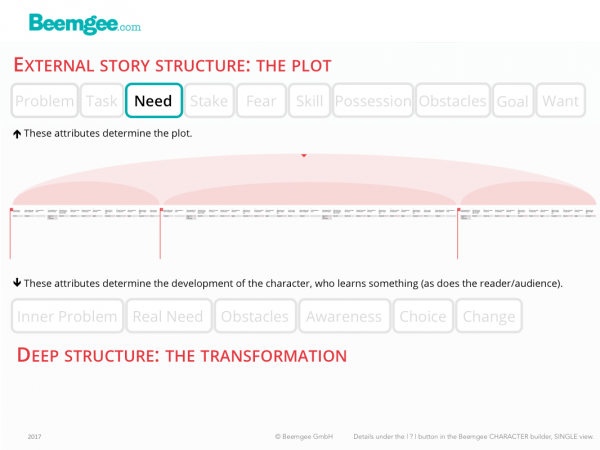
The perceived need is what the character believes she or he needs in order to reach the goal. If the goal is the apparent thing that ought to be achieved in order to solve the external problem, then there may well be certain knowledge, objects or people that the character needs to find or attain first in order to reach the goal. A character may have to do a number of things before it is possible to reach the goal. Attaining these needs marks stages or phases of the story journey. What stages are there in this story?
A character with a goal needs to do something in order to reach it.
The outward needs of a character – things she needs to acquire or achieve in order to reach the goal – divide the story journey into stages.
In storytelling, characters usually know they have a problem and there is usually something they want. They tend to set themselves a goal which they believe will solve their problem and get them what they want.
In order to get to the goal, the character will need something. Some examples: If the goal is a place, a means of transportation is necessary to get there. If we can’t rob the bank alone, we’ll have to persuade some allies to join our heist. If the goal is defeating a dragon, then some weapons would be helpful. If magic is needed, we’ll have to visit the magician to pick some up.
While the perceived need might be an object or a person, it usually requires an action. We’ll need a car, so do we buy one or steal one? We’ll need a sword, so do we pull one out of a stone or go to the blacksmith? If we need help, who do we ask and how do we talk them into joining us? We’ll need magic, but how do we find a magician? Ask an elf or go to the oracle for advice?
So, once the goal is set, a vision of the way to reach it opens up to the protagonist – and with that to the audience/reader. At the very least, the first step of the way presents itself. All this is what the character is conscious of.
In other words, the character forms a plan.
The plan is communicated more or less explicitly to the audience. The anticipation of how things will not go quite according to plan is part of the pleasure. There must always be surprises in store for the characters as well as for the audience.
Stages and Obstacles
The perceived needs are external insofar as they are plot requirements to solving the external problem. There are two things to note about all this. Firstly, the character is aware that she or he will first do this, may then do that and possibly the other after that. Secondly, we are setting up stages or legs of the story journey – for the character, for the audience/reader, and for the author to write.
The story therefore consists, on the surface at least, of the main character reaching the goal by going through several stages of a journey. The story journey is the way to the goal, which involves the character overcoming obstacles on the way. Each stage of the journey contains at least one obstacle. And typically, the obstacles get harder and harder to overcome as the journey goes on.
Quest and heist stories tend to announce many of the stages of such a story journey in advance, including the needs the characters perceive. Often this announcement of what is to come makes the story world feel more believable, because some of its components have been set up before they are actually reached. In The Lord Of The Rings, the journey the characters must set out on and some of the troubles they will encounter on the way are literally mapped out before they set off. In Ocean’s Eleven, the audience is presented the plan of how the robbery will be carried out, or at least part of it, before watching this set of actions being performed. The fun is seeing what goes wrong and not according to plan. In many other genres, the stages of the journey may not be announced in such a direct way, and may come as a surprise as much to the characters as to the audience. But there is always a succession of perceived needs.
Surface Structure
We have suggested that the story journey – the plan, the chain of perceived needs that is the way to the goal – is part of the surface structure of the story. Surface essentially means what the main character is conscious of. Beneath the surface, there may be a whole load of other things going on, starting with the internal problems of the characters. Of course, the author may be interested in exploring all sorts of other fields of meaning, using devices such as metaphor, allegory, symbolism, etc. In terms of dramaturgy, the surface structure amounts to plot and the deep structure to character development, i.e. what the character learns and how she changes because of this.
In other words, the surface structure is not necessarily what makes the story interesting. Nonetheless, every story needs such a surface structure. In order to make a story deep and meaningful, you must have the story. Once the author has that, she or he is able to imbue the plot and the actions of the characters with all sorts of depth and resonance. But without characters doing things, and through these actions forming a plot, the text will remain just that: a text. Such a text might be an intellectual masterpiece. But it won’t be an emotionally engaging story.
To add a deep structure to a story, it helps if the characters have emotional needs.
I’m currently taking a writing and blogging sabbatical due to family health issues. For now, I’ll repost selected articles from my Fiction Writing School.
You can’t write a great story if you don’t master plot and structure. But what is the best structure for a novel? How do you plot a novel?
Pin
Figuring out your plot structure is essential for your story’s success. Even if you have an exciting idea for a story, great characters, and a memorable setting, you still need to put your protagonist through events that have high and escalating stakes, and structure them for maximum effect.
If you want to write a great story, you need to include the elements of suspense. You can do this by using writing techniques and devices like:
But without a sound plot and structure, you risk failing to thrill your readers. Today, we’ll look at dramatic structure and learn how you can build an effective plan for your entire plot. By planning for success, you can create a story packed with suspense, with all the right twists in all the right places.
Definition of Plot and Structure
What is story plot? What is the best structure for a novel?
Plot is the series of events that make up your story, including the order in which they occur and how they relate to each other.
Structure (also known as narrative structure), is the overall design or layout of your story.
While plot is specific to your story and the particular events that make up that story, dramatic structure is more universal and deals with the mechanics of the story—how the chapters or scenes are broken up, how conflict is introduced and amplified, where the climax is placed, how the resolution plays out, and so on.
You can think of plot and structure like the DNA of your story. Every story takes on a plot, and every piece of writing has a structure. While plot is unique to your story, an understanding of effective structures and devices can help you develop better stories and hone your craft.
Searching for Structure
From the beginning of my writer’s journey, I knew story structure had to be a vital part of creating successful stories. But I wasn’t sure how to best construct a story, which of the many models would produce the best results for me.
I started writing short stories using a nine-point, three act structure consisting of hook, backstory, and trigger in act one. Crisis, struggle, and epiphany in act two. And plan, climax, and resolution in the final act.
This worked fine. At first. But as I expanded into longer writing forms like novellas and novels, I realized I needed something more. And something better-suited to the types of suspense fiction I like to write.
I explored several models of story structure, including the Algis Budrys seven-point story structure of simply putting a character in a setting with a problem and then employing try/fail cycles until the climax where he succeeds or ultimately fails before ending with a validation.
I found a lot to like in Syd Field’s model for storytelling. I tried the Lester Dent Master Plot Formula for dramatic writing and found it works quite well for writing an exciting short story. But again, these models weren’t a perfect fit for me. My search continued.
Hitting Paydirt
Just as I began writing my first novel, I stumbled upon Shawn Coyne’s Story Grid and I knew at once that it would be a game-changer for me. I wrote Nocturne In Ashes and Steadman’s Blind using Shawn’s Five Commandments of story to structure each scene and the overall shape of the books.
Following this pattern, I learned an incredible amount about how to hit all the right points in a three-act structure and make sure each scene is vital and has a turning point. But my writing process is still evolving. Though I would never trade my experience with the Story Grid structure which really helped me get a handle on the micro view of storytelling, I was still looking for something ideally suited for writing mysteries and thrillers.
Let me tell you about what I’ve been using lately!
Six Elements of Plot That Strengthen Story Structure
When Joe Bunting published The Write Structure, I purchased it right away. However, it sat on my virtual reading shelf for a couple of months before I cracked it open and began reading.
Once I finally got started, I was delighted to find that The Write Structure resonated with me in so many ways and I knew I could use this pattern to write anything from a short story to a full-length novel and make it shine.
The book is filled with great tips, techniques, and advice for writers, backed up by examples and Joe’s own experience as a best-selling author. He takes you step-by-step through the six elements of a plot that will guide you in writing a stellar story and shows you how to develop each element effectively.
These are the six plot elements, as set forth in The Write Structure:
Exposition
The Exposition is where you introduce your hero and establish the story setting, your hero’s world. By focusing on the core value at stake from the very beginning, you confirm genre for your readers and introduce dramatic tension by setting up conflict and forcing your character to act on a choice.
In most types of suspense fiction, the story will turn on a core value of Life vs. Death or perhaps a Fate Worse than Death. Often, the internal value at stake is Good vs. Evil. Crime stories, on some level, usually deal with issues of justice and good guys vanquishing bad guys while lives are in danger.
Once your reader is grounded in the story world and emotionally invested in your character, something needs to happen to interrupt the established pattern and rock your character’s world in some way. An Inciting Incident begins the story arc that will eventually culminate in the climactic scene and ending resolution of your story.
The inciting incident should be inspired by, and reinforce, the core value at stake in the story. In a crime story, this event—whether coincidental or triggered by a story character—works best when it reflects a conflict between life and death or something worse.
Rising Action is where you raise the stakes and ratchet up the tension in a buildup toward the dilemma. These are the try/fail cycles, the struggle to understand the antagonistic force and find a way to defeat it through trial and error.
When thriller writer, Lee Child, was asked to divulge his recipe for creating suspense, he said it’s not so much about the ingredients as it is about making your family hungry, making them wait. This is where you spin out uncertainty and worry, making your reader hungry for the payoff.
I’ve written several articles about how to increase tension in a story’s plot by focusing on the elements of suspense. The writing techniques I’ve taught in these articles, such as how to create cliffhangers, write an action scene, and plant clues and red herrings, will help you develop rising action in your story. Learn more about how to use these powerful techniques in your stories by reading each article (linked in the previous sentence).
All of these writing skills will help you keep the story pace moving along through the middle, where many writers flounder.
Dilemma
Now we get to the crux of the story, where the rubber meets the road. The Dilemma boils down to a choice your protagonist must make—a difficult and crucial choice.
There are two types of choices that create the most conflict and drama. The first is often called the Best Bad Choice, where there is no happy alternative and your character is forced to choose from a menu of unsavory options.
For instance: Does Katniss cut down a tracker jacker nest and kill some of the tributes, or does she wait for the tributes to kill her?
The other variety of tough choices involves having to decide between conflicting goods, otherwise called an Irreconcilable Goods Decision. In this scenario, someone benefits while someone else is harmed. There is no win/win.
For example: Does Kramer hire someone to take care of his son in order to work a prestigious job, or does he step down from his career to be a reliable parent?
The dilemma is the heart of your story. It’s where your hero demonstrates his true character development. If you’ve created a sympathetic protagonist readers care about, they will be desperate to learn how he chooses and what happens as a result of that choice.
Climax
Your hero faces a difficult choice in the dilemma, but the Climax is where she acts on that choice and reaps the consequences of that action. This is the payoff you’ve been building toward since the beginning. This is the summit readers want to reach when they open a book.
This is also where your hero gains or ultimately loses what she seeks. In suspense fiction, that sought-after objective is usually solving a crime and bringing the perpetrator to justice. Or it might be revenge, rescue, or the acquisition of wealth or power.
Whatever it is, it centers on the conflict between the core values at stake—life or death. The events in your story have transformed and prepared your protagonist for this final confrontation.
Now it’s showtime.
Knowing your story’s climax also helps to hone your skills of foreshadowing. You’ll be able to properly place your setups and readers won’t feel cheated.
It’s also a good idea to make sure you’ve honored reader expectations and delivered a story suited to what suspense fans crave.
Denouement
Writers are sometimes tempted to skip writing the Denouement of the plot, or give it short shrift.
Don’t. If you want readers to look back fondly on your story and pick up your next book, give them the closure they desire.
Readers need a moment to savor the climax and feel the release of tension. If you’ve done a good job creating compelling characters, readers won’t want to say goodbye right away. Let them spend a little more time together.
This is where you validate your protagonist’s arc and reflect on how she’s changed. Even if the world around her is back to normal, she’s not the same person who started the story.
This is also where you wrap up any loose ends and it’s the perfect place to bring secondary plotlines to a close. Read below to learn more about subplots.
“
Master the six elements of plot to write a great story. Then, plan the whole structure of your story by weaving in subplots. Learn how in this article.
The Write Structure addresses the complexities involved in putting together a story that works on multiple levels to engage an audience, and it does so in a user-friendly way. Instead of overwhelming, it simplifies the process so that you can actually create a plan for your own full-length book in just eighteen sentences.
In The Write Structure, you’ll learn the nitty gritty details about how to craft these six elements in your story to develop your idea into a full-blown, living, breathing creation that readers will love. The process gives you the tools to create the right structure for your book while still leaving plenty of room for flexibility and creativity.
Perhaps my favorite aspect of the process is how it can be geared toward a particular genre—in our case, that means mysteries, thrillers, and adventure stories. In my opinion, that makes The Write Structure an excellent model for writing suspense fiction.
Plot AND Structure: Don’t Forget Subplots
If you use the six elements of plot, you’ll develop a sound structure for your suspense story—or any story. However, these vital scenes in the structure won’t uphold a story that can stretch the length of the novel. In order to develop the plot, you need secondary storylines, or subplots, too.
How do you use subplots?
What Are Subplots?
A plot is a series of linked moments, a chain of events with one leading into the next. In a short story, you’re better off sticking with a single plotline in most cases. Anything longer than a short story, however, is enriched by weaving in one or more secondary plotlines, or subplots.
You can see this clearly in just about any television episode. There’s an A plot and a B plot. The A plot is the main story. The B plot forms a supportingstoryline that plays off the A plot and may highlight theme or act as a foil or contrast to the A plot.
“
Subplots are the supporting storylines in your plot and structure. Don’t forget them! Doing so will hinder your main plot.
Sometimes the plotlines tie together at the end. Other times, they simply run parallel and the secondary plotline has its own conclusion, usually in one of the last scenes in the book.
Here’s an example of how a subplot may operate to support the main plot.
Mr. Monk Goes to The Circus
In the television show, Monk, there’s an episode where Monk solves the murder of a circus ringmaster. That’s the A plot.
The B plot is introduced when Monk and his nurse, Sharona, go to the circus to investigate.
Here’s a clip from the episode:
The B plot comes into play when Sharona encounters the elephant and freaks out. We learn she’s terrified of elephants due to a traumatic scene she once witnessed at a zoo.
Monk is oblivious to her distress—his only concern is that she isn’t responding to his needs. Sharona gets upset because she has to deal constantly with his phobias and idiosyncrasies, yet he has zero compassion for her over her fear of elephants. He enrages her by telling her to “suck it up.”
Sharona starts a campaign to teach Monk a lesson. This campaign manifests at various points throughout the A plot when she refuses to hand him a wipe, drinks from his water bottle, coughs in his face, and messes up his orderly magazines. When he protests, she tells him to “suck it up.”
Monk sends her flowers. He calls her to talk about the issue and when she finally opens up and begins sharing her feelings, Monk gets distracted and hangs up on her to follow a lead from the A plot.
Monk discusses the problem with his therapist, Dr. Kroger. Of course, Kroger understands why Sharona’s angry, but he refuses to explain it to Monk, insisting that Monk will have to figure it out for himself—the answer is inside him.
Monk and Sharona continue arguing. Just as she’s telling Monk he’ll never get it, Monk tells Sharona’s son to put his bicycle away, saying, “Let’s give your mother a break.” She points out that he was showing empathy at that point. It’s a start.
Monk arranges for Sharona to confront her fear by meeting with the elephant and his master, unaware that the killer plans to use the elephant as a murder weapon to eliminate a witness. Sharona watches as this event in the A plot plays out and the elephant crushes his master’s skull, killing him.
This makes things worse and now Monk feels really bad. He pampers Sharona, tucking a blanket around her and trying to make her cocoa, but she ends up doing all the work, as usual.
In the story’s climax—the A plot—the culprit tries to escape and is stopped by the elephant. Sharona comes face to face with the creature and Monk soothes and empathizes with her. Then over-empathizes and won’t shut up with the empathizing. Sharona remarks that she’s created a monster.
Sharona feeds carrots to the elephant and tells Monk she’s over it—maybe there’s hope for him. But Monk is still Monk and we know he’ll be back next week, still victim to a thousand debilitating foibles, to solve another baffling crime. (This is the Denouement.)
Do you see how the secondary plotline plays off the main plotline, intersecting it in some spots, adding dimension to the story’s climax, and providing the perfect ending? This is what subplots do.
Including subplots will elevate the tension and create depth to your main plotline.
Do You Really Need Subplots?
You don’t need to include a secondary plotline in your novel. But if you don’t, you’re passing up a great vehicle for adding depth, interest, emotion, tension, and excitement to your story. That said, it’s essential that readers understand who the book is about.
There should be one main character—your hero—whose story carries the most weight and whose arc comprises the main plotline. Readers should not be confused about who this is, so take care not to overwhelm that main arc when developing your secondary plots.
A secondary plotline can center on just about anything, including a character, setting, theme, motif, or problem. It can enter the story at any point and leave at any point—no need for it to run through the entire story unless that’s what serves the story best.
Every subplot, however, should be tied up by story’s end. The only reason you might consider leaving a secondary plotline open at the end of the story is so that it can function as a lead-in to the sequel.
For example, in my thriller novel, Nocturne In Ashes, the main story arc about stopping a serial killer is wrapped up in the end. But one of my subplots involved a police detective’s efforts to gain entry into an elite private security organization. That story line left a dangling thread to be picked up in the sequel.
One more thing—secondary plotlines must relate somehow to the main plotline and not exist just to take up space or add complexity. They must have a valid story reason to be there.
Joe Bunting’s book, The Write Structure, also addresses how to handle subplots in structuring your story.
A Plan for Your Book Sets You Up for Success
Ultimately, the best way to structure your book is to find a process that works for you and the types of fiction you want to write. That may entail exploring and adapting, learning and growing as you move through your own writer’s journey and learn the craft of writing.
You may not want to use the same plan for every story. I still structure my short fiction differently than my full-length books and I decide project by project how I’m going to do it.
I do think it’s important to make some kind of plan before you begin writing. When all is said and done, if you produce a story with all the right elements to attract and hold readers all the way to the end, you have a well-structured story.
You can get there by making a plan to guide you—like signposts along your journey. Or you can stumble around through rewrite after rewrite until you finally arrive. Either way, structure is what you need to make it work.
Why not embrace plot and structure and make it your traveling companion on the road to success?
I’m currently taking a writing and blogging sabbatical due to family health issues. For now, I’ll repost selected articles from my Fiction Writing School.
“How many words in a novel?” is a question many writers ask.
“My memoir is 270,000 words long.” I heard these words during a breakout session I led at a local writers’ conference.
An editor friend of mine, Shayla Eaton with Curiouser Editing, was sitting in on the breakout. We gave each other knowing glances, and because I didn’t want to break this poor memoirist’s literary heart, I nodded at Shayla to take the lead. Soon after I heard someone mention the words in a novel, I held my breathe and let the moment pass.
As nicely but as directly as she could, she explained to the memoirist that a 270,000-word memoir was excessive. Even if she self-publishes, the cost per copy would be high, and few readers would slog through such a tome — particularly for someone who’s not famous.
And no agents or publishers would even look past that number.
The prose could be as fleet-footed as Fitzgerald’s. The life story could be as compelling as Lincoln’s. The platform could be as broad as Oprah’s. But no agent would get to know that because they’d see “Memoir: 270,000 words” and hit delete before reading any further.
So, what word count should a memoir be?
For that matter, how long should any book be? How many words are in a typical novel? What’s the ideal book word count?
If you’re writing your first novel or any book, you’re probably asking these questions.
The short answer is: long enough to tell the story but short enough to consistently hold the reader’s interest.
The long answer is, well, longer.
Why does novel words count matter?
Word count matters because every book, regardless of genre, has an inherent contract with the reader. But that contract is dependent upon the book’s genre.
For instance, when a reader picks up a thriller, they have certain expectations of what they’re about to read. That includes scenes like “the hero at the mercy of the villain,” but it also includes book length. Because thrillers are about pulse-pounding action and maybe some character development (especially if it’s part of a series), the word count isn’t massive. Thrillers tend to be 70,000 to 90,000 words.
If you’re not a thriller author, I won’t keep you in suspense. At the end of this article, you’re going to find a guide to suggested word count length for most every popular genre.
My point is that your genre will likely dictate your word count. There are exceptions, like YA books that exceed 250,000 words, but those tend to be outliers, and first-time authors rarely, if ever, get to be an outlier.
Additionally, knowing your word count before you start writing can help you better plan your narrative arc as well as your writing schedule.
How many words in a novel?
And what’s the average length of other types of books?
Before diving into the specifics of genre-based word counts, let’s look at the broader picture of average book length.
For most publishers, a book is “novel-length” when it’s between 50,000 and 110,000 words.
At a writers conference I recently attended, publishing veteran Jane Friedman said 80,000 words is good for most fiction, below 60,000 isn’t novel length territory, and above 120,000 is likely too much.
Writer’s Digest recommends 80,000 to 89,999 words as a “100% safe range for literary, mainstream, women’s, romance, mystery, suspense, thriller and horror.” That’s approximately 300 pages of double-spaced type.
In “Outlining Your Book in 3 Easy Steps,” editor Shawn Coyne says, “The average novel today is about 90,000 words. Big, epic stories get anywhere from 120,000 to 200,000 words.” But, he also mentions that “The Wizard of Oz was 40,000 words. The Old Man and the Sea was about 25 to 30,000 words, tops.”
Coyne uses the Nanowrimo word-count length of 50,000 words for his examples, calling 50,000 words a good foundation to build upon.
So what does that mean for you, author?
If you’re working on a novel-length book, aim for 50,000 words at the very least — but it’s better to aim for 90,000. Editorial trimming is inevitable.
However, you’ll also want to take your genre into account.
What should my book word count be?
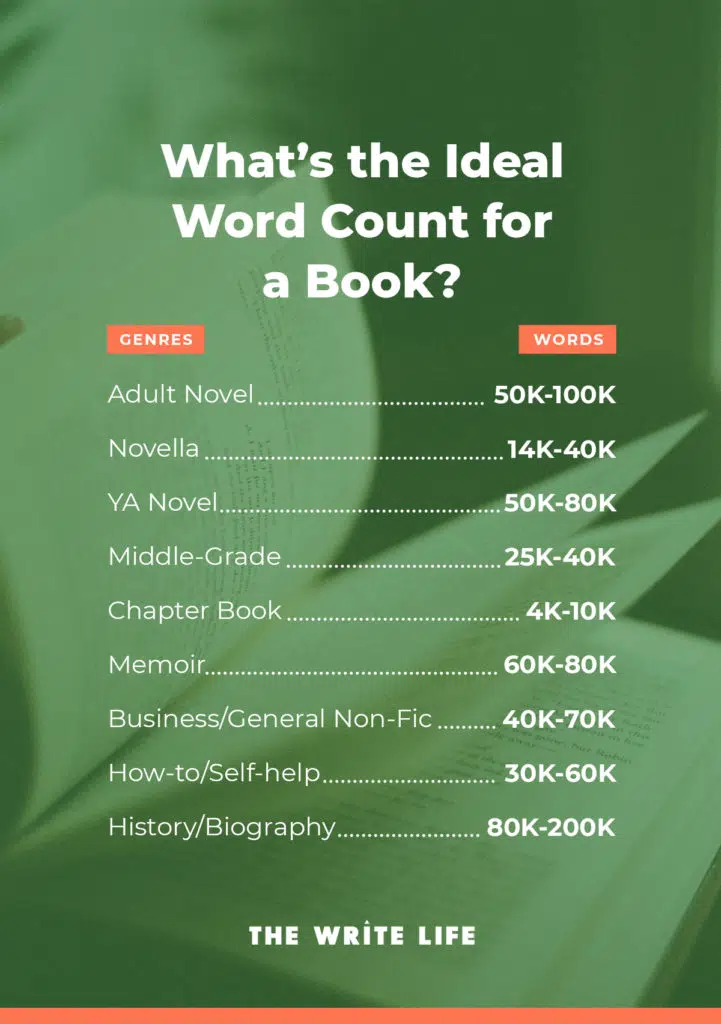
The following are average word-count ranges by genre.
All of these are average book word count ranges and should not be taken as the definitive word count you must reach in your book. We all know of outliers within each genre that have been published well under, or well over, these word counts.
Use these numbers as a baseline for your writing goals.
Know what readers expect in terms of your genre’s word count (even if the reader isn’t aware of their expectations when it comes to how long a book is).
The Write Life has teamed up with Self-Publishing School to create this presentation, “How to Write & Publish Your Book in 90 Days.” In it, you’ll learn how to finish your book in just 30 minutes per day. To sign up for this free training, click here.
How many words per page can you expect in a book?
This is another common question, and for most writers it should be easy to answer by using a “word count” feature in your writing tool.
If you’re writing in Microsoft Word,”word count” is an option under “Tools.” Prefer something different? Here’s how to find word count in Google Docs. You can also track word count in Scrivener.
The average single-spaced document typed in 12-point font contains about 500 words per page, but that can vary pretty drastically depending on your formatting.
So, if you have an hour to write and aim to get down 300 words, you might wonder, how many pages is 300 words — and the answer is less than one! Doable, right?
If you’re thinking bigger and wondering, for example, how many pages is 50,000 words, simply divide your target word count (50,000) by 500 (since that’s the average words per page). Your answer here is 100 pages.
Don’t let those commas instill fear. Fifty thousand words isn’t that much divided into five days a week for a year. That’s only 193 words per writing day!
I’m currently taking a writing and blogging sabbatical due to family health issues. For now, I’ll repost selected articles from my Fiction Writing School.
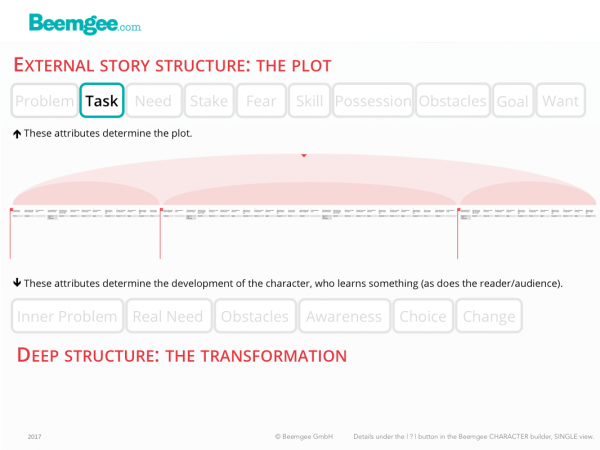
The task is what the character has to achieve in order to reach the goal. The character’s outward task is explicit and therefore external: to solve the external problem by reaching the goal or attaining the McGuffin. The task is a more or less clearly defined quest. It is the mission the character is set, the action the character must take in order to get to the goal which will, in the character’s mind, lead to achieving the want. So the task probably determines the bulk of the action of the story. The task may be divisible into a series of sub-tasks such as perceived needs, or stages of the story journey.
In most stories, the protagonist has something to do.
The task is the more or less explicitly defined mission a character sets out on in order to reach the goal and thereby solve the external problem.
Many of the major characters in a story will have something to do, which may result in them getting in each other’s way.
Task as Function
In a story, more or less everyone has a task. What characters do in a story defines them and determines their roles and narrative functions in the story. In this sense, it is an antagonist’s task to get in the way of the protagonist; an ally’s task is to help the protagonist; a mentor’s task is to advise the protagonist and set them on their way.
But while all that is true, it isn’t really what we mean by task.
Task as Action
The characters’ actions make them who they are. To define a character’s task is to state clearly what that character has to achieve in the story. It is the action that leads to the goal or the McGuffin.
Let’s look at some easy examples.
It is the knight’s task to defeat the dragon and rescue the princess. It is Frodo’s task to destroy the ring. It is Indiana Jones’ task to attain (or raid) the Ark. It is the Bodyguard’s task to guard his ward.
Simple.
The task can often be summed up with just one verb.
The task arises out of the external problem, and therefore relates to the surface of the story. In many stories the protagonist will be given the task to perform in the form of a mission. This is typical of crime, fantasy, and adventure stories.
In other stories, the protagonist might set him or herself the task. Odysseus’ task is to go home, and ultimately – after the task of avoiding it for the afternoon – so is Leopold Bloom’s. Humbert Humbert’s first task is to woo and win Lolita, which he seeks to achieve by a specific action, his perceived need: marrying her mother.
The task, then, makes the story journey clear. Defining each major character’s task gives that character a purpose which everyone involved can understand: the author, the character, and the audience or reader.
The value of a character’s having a purpose which the recipient, the audience or reader, clearly understands can hardly be overstated: it generates interest. The recipient will be interested in the story, will want to find out a) whether, and b) how the character will fulfil the task and the purpose.
Furthermore, the process of carrying out the task will usually bring the character to the point of learning and developing emotionally, and probably discovering his or her real need. Elegantly connecting the surface structure element of task with the deeper level of real need – through the use of comparative or contrastive symbols or metaphors, for instance – can lend the story a further level of meaning.
I’m currently taking a writing and blogging sabbatical due to family health issues. For now, I’ll repost selected articles from my Fiction Writing School.
A few years ago, fresh from a visioning weekend, I created an ambitious writing and business schedule for the year. I made an Excel spreadsheet and listed everything I hoped to develop that year including blog posts, business programs, and book projects. I color coded each project and laid out a beautiful plan.
But it didn’t work. Three months into the year, I hadn’t made significant progress on any of my projects.
Where did I go wrong?
I had too many projects. I did not have clear, actionable steps. Every time I looked at the spreadsheet, I felt overwhelmed.
Clients often approach me with a similar problem: they have a book they want to get done this year. They’re also launching a podcast and working part time. But they haven’t made progress on any of their projects. Can I help them finish something?
You bet. But it won’t be easy.
In order to finish that book, they need to let go of all of their other projects. For now.
This process is explained well in the book, The 12-Week Year: Get More Done in 12 Weeks than Others do in 12 Monthsby Brian P. Moran and Michael Lennington. The authors recommend that we look at our vision and choose one project to focus on each quarter. The idea comes from a sports training practice called periodization. In this practice, athletes focus their training on a specific skill or discipline for 4-6 weeks. The tool allows the athlete to make significant progress over a short period of time.
Brilliant.
The 12-Week Year provides an opportunity for focused writing on a single project, increasing your chances of being successful. Here’s how it works:
Choose a single project
Stop thinking you can get it all done. Instead, imagine what it would be like to complete a single project in the next three months. What do you want to have done by the end of June?
Pro Tip: Consider what you will need to let go of to complete this project. Do you need to take a break from another writing commitment? Can you let go of social media updates for the next three months? Is there anything else that could be put on hold for three months?
Make a plan
How much time will you need to write your book over the next 12 weeks? Remember, when we’re writing a book, we need more than just writing time. We need time to research and outline. We need time to daydream, ponder, and imagine what might happen next.
Get specific. How much time do you need to plan the book? How many scenes or chapters will you need to write each week? Do you need to build in time for anything else?
Schedule time. Schedule blocks of time to work on your book. Know when and where you will write each week. Then, once a week, decide what you will write during each session.
Pro Tip. The authors recommend that people build in “buffer blocks”—sections of time dedicated to doing daily tasks like answering email, exercising, meal prep, and more. They also suggest having “breakout blocks”—free time dedicated to enjoying life. I’ve discovered that breakout blocks are essential to the writing process—they give your brain time to rest and often lead to aha moments.
Ditch the distractions
If you want to finish your book in the next three months, you need to dump the things that distract you.
When you are writing, turn off your phone. Stay offline. Don’t check email.
You know all that. When it comes to distractions, it’s helpful to go deeper. What else distracts you when you write? Are you thinking about the blog post you owe a friend? Are you planning your next Target run or dinner? Are you worrying about other work you need to do? Before your writing session, schedule time to deal with these tasks. During your writing session, jot down any worries or tasks that pop into your head and add them to your schedule later.
Review weekly
At the end of each week, evaluate your progress. What worked? What didn’t work? Are you achieving your daily and weekly writing goals? If not, why? What changes do you need to make to improve your productivity?
Plan the next week. Make changes to your schedule based on the previous week’s challenges and successes.
Pro tip: Be ruthless with your schedule. If you are trying to do too much, and it is getting in the way of your writing, let go of something.
Rest, reflect, repeat
The authors of The 12-Week Year recommend building in a 13th week to finish up tasks, rest, reflect, and plan for the next 12-week cycle. I think you need a bit more time. Take the 13th week to finish up tasks and rest. Then, during the next week, you can start visioning and planning your next book.
Moving Forward
This process works a lot like National Novel Writing Month. During November, we focus on a single book, block out time to write it, and let go of any commitment that threatens to distract us from our big goal. Think of The 12-Week Year as a sustainable way to bring NaNoWriMo into your daily life. Give it a try and see if it increases your finish rate on book projects.
I’m currently taking a writing and blogging sabbatical due to family health issues. For now, I’ll repost selected articles from my Fiction Writing School.
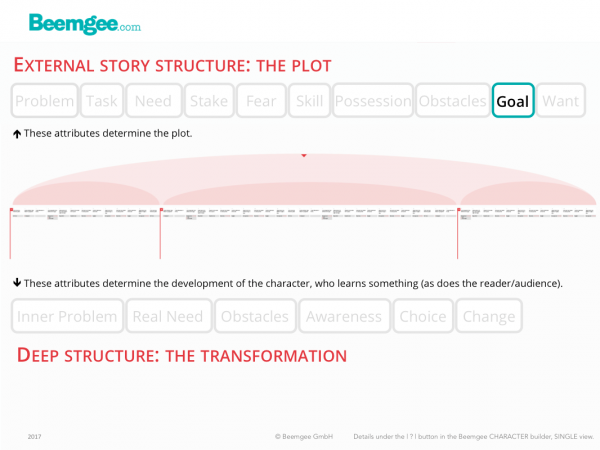
The goal is the point in the story that the character has to reach. The journey towards the goal the character has to reach (perhaps in order to achieve the want) often forms the bulk of the story’s plot. The goal is the presumed point at which the external problem will be resolved. The story question becomes: “will the character reach the goal?” The goal is thus an external marker, for the reader/audience as much as for the character. At the goal, the character may well gain awareness or have a realisation that the goal may not be the solution, that attaining this goal is not actually what the character really needs in order to achieve the want. Sometimes attainment of the goal marks a story’s central turning point, or midpoint, and the story becomes about the effects of reaching that goal.
In a story, if the treasure is what the hero wants, then slaying the dragon is the goal.
The goal is what the character thinks will lead to the (satisfaction of the) want.
Since the treasure hoard has been there for ages, there must usually be some sort of trigger for the story to get started, i.e. for the character to want the hoard now, at the time the story begins. Often, an external problem creates such a trigger. It might supply a reason why the hero needs the hoard now, something more specific than just the general sense of wanting to be rich. Perhaps the hoard isn’t the reason at all. Perhaps there is a princess in distress, which certainly adds urgency to the matter. Either way, dealing with the dragon is the goal.
If somebody says the word “goal” to you, the image that springs to mind might have to do with the ends of a football pitch. The image is valid for our storytelling purposes, since the preposition associated with a goal is “through”. With the goal marking the end of the story journey, the character will get what he or she wants by passing through the goal to the happily ever after, i.e. the want, beyond.
At least, that’s what the character believes. See below.
It is helpful to distinguish between the goal and the want. Reaching the goal marks an important point in the story, often at the midpoint or concomitant with what is often referred to as the crisis. The want, on the other hand, is not a point but a state. As such, the want is somewhat more diffuse than the goal, and not really a part of the story journey, because if and when the character has what she or he wants, the story is over.
Two Techniques
One effective technique is the following: Set up the goal near the beginning of the story. Luke Skywalker sees Princess Leia’s message and sets out to help her. Humbert Humbert sees Lolita and sets out to win her. Then let the character achieve what she or he wants at the midpoint of the story. The second half of the story is then about the consequences of having achieved the goal.
Another technique is the “false goal”. Let the character believe that the goal is what is necessary in order to achieve what the character wants. The Prince hero who sets off to slay the dragon wants wealth, power and union with the Princess. But by the time this character reaches the goal, she or he has recognised her or his weakness, and she or he learns that the goal is not really what is needed at all. For instance, if the internal problem of the Prince is hard-heartedness, when he reaches the dragon he may have a revelation and decide not to slay the dragon, but tame it and take it home in order to guard the kingdom. His mercy will so impress the Princess that she will happily marry him.
The Goal is Part of the Plot
In terms of the layers of the story, the goal is external, at the surface of the structure. It provides an explicit direction not only for the plot, but for everyone concerned: the audience or reader, the characters (especially the protagonist), the narrator, and the author. So we all know where the story is going, and the fun of it is journey. And let’s not forget that a story needs to be fun – remembering that what constitutes fun is relative to the ideal reader or viewer.
It is classic story structure to build a story by setting a goal for the character, having that character surmount obstacles on the way to the goal, and then manage to get through it (or not). The Odyssey works like this. Establishing a direction for the plot is in no way detrimental to achieving layers of meaning for the work.
A great way of creating more resonance and a deeper meaning is by showing an inner transformation in the character, beneath the surface structure of goal attainment. This may be achieved by creating an internal problem for the character, which results in the character really needing something other than the explicit goal.
If this is the case, then the character may realise upon reaching the goal that some sort of revelation, learning experience and emotional growth is required. All of that often entails that the goal loses its importance once the character has reached it.
I’m currently taking a writing and blogging sabbatical due to family health issues. For now, I’ll repost selected articles from my Fiction Writing School.
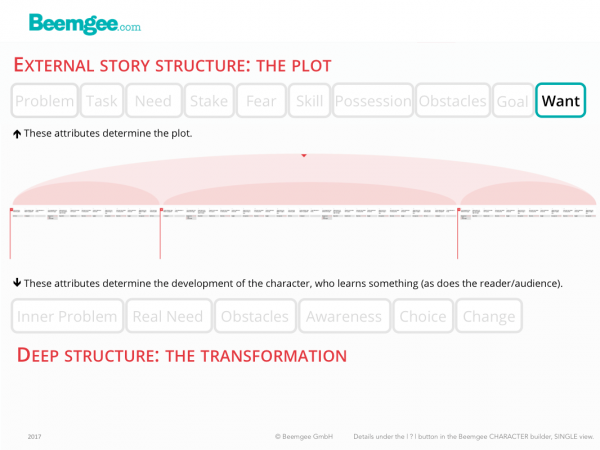
The want is what the character desires. A character must want something in order to be motivated to carry out the action of the story. On the whole, only active characters are interesting. And they become active by consciously wanting something and pursuing it. Usually the character consciously wants to solve the external problem. The desired result of this solution is usually a state of being: solving the problem leads to marital bliss, wealth, power, immortality, survival, etc. So the want tends to be abstract – a state as opposed to a specific thing or point in time. It is distinct from the wish because it comes about because of the external problem. The want is the implied reward for achieving the more concrete goal of the story.
Stories are about people who want something.
We can distinguish between two different types of want:
the wish, or character want
the plot want
Marty McFly wishes to be a musician (character want). He also wants to get Back to the Future (plot want).
The wish or character want is a device which adds cohesion to the story, usually in the form of the set-up/pay-off. Marty is seen at the beginning of the film practicing the guitar; at the end of the film he plays at a concert. A character-inherent wish is a useful technique to make the character clearer to the audience, but it is not essential to composing a story.
Indispensable is what we have called the plot want. As a result of the external problem – the trigger event that sparks the chain of cause and effect which the bulk of the plot consists of –, the character feels an urge, which provides the motivation for the character’s actions in the story.
The want is the state for which the character strives, and is distinct from the goal.
In this post we’ll be talking about active vs. passive characters, motivation, the difference between a want and a goal, a couple of writer traps to avoid, and contradictory wants.
Active Characters
Characters have to be actively acting of their own volition. The want has to be urgent and strong enough for them to do things. If the want is missing or too weak, the character will lack motivation and appear passive. A passive character is usually not interesting enough to hold the audience’ or readers’ attention.
Why is this so?
Evolutionary explanations of stories attempt to shed light on the phenomenon. When characters react to events rather than cause them, they appear weak, as victims in a chaotic, uncontrolled world. Which means that there is not much we can learn from them. Humans try to see cause and effect in everything, not just in stories. And humans experience stories physically and emotionally (our hearts beat faster, our palms sweat), so there is really not much difference between how we experience a story and real life. Since we learn from experience, we instinctively prefer stories which provide us with experiences that benefit us in some way. In stories we vicariously experience or practice primarily social problem-solving, without suffering real-life consequences. We tend to learn more when we experience stories of self-motivated problem-solving.
Motivation
There is a good reason for that cliché about actors always asking about their motivation. It is motivation that prompts the characters in a story to do the things they do. Stories seem to work best not only when characters are active rather than passive, but often when they have comprehensible reasons for their activity.
The reason for what a character wants is usually comprehensible for the audience or reader because of the external problem. In simple terms, the character wants to solve the problem. Take the Cinderella story as an example. Her problem is that she is bound to the stepmother and her two nasty daughters.
In other words, the want is a vision the character has of his or her situation without the problem. Hence what the character wants is actually a particular state of being. Such a state might mean being in a position of wealth, power or respect, or being in a happily ever after relationship. Cinderella wants merely to be free of her involuntary servitude, if only for a little while.
This makes the want distinct from the goal, which is the specific gateway to the wanted state of being, as perceived by the character. A story usually sets up a goal the character needs to reach or attain in order to achieve the want. In Cinderella’s case, it is attending the ball.
So, a story has its characters pursue their wants. These different wants oppose each other, causing conflicts of interest. The conflicting wants make the characters active, and the audience/readers like stories about actions, that is, about characters who do things.
Sounds simple.
And yet frequently stories seem to mess up on this vital point.
Next to passive characters without a strong enough want, lack of clear motivation is a huge writer trap. It is possible to write a whole story full of characters who are reactive instead of active, or who do things of their own volition but without that volition being clearly recognisable to the audience/reader. It is perhaps even tempting to write stories like that, because they seem more lifelike. In real life, people do not necessarily have distinct goals. Often, our wants are vague and not clearly definable. What about writing a realistic story about a character with a general sense of dissatisfaction, who, like so many of us, has lost sight of any clear objective in life?
It’s doable, certainly. But the audience/readers will probably start to look for the specific want of such a character. They would probably begin to expect the story to be about this character’s search for a clear objective in life. That might be the want the audience would tacitly ascribe to the character.
And if the story does not bear such motivation out, the risk is significant. Because stories in which the audience does not understand what the characters want lack emotional impact.
Contradictory Wants
A way of adding psychological depth and emotional complexity to characters is to give them several and even contradictory wants. Gollum in Lord Of The Rings wants the ring. Yet a part of him also wants to give up the ring and help Frodo. Next to solving the case, Marty Hart in True Detective wants to be a good husband and family man, but he also wants affairs with other women. That’s three wants for one character.
A want is not merely a yearning, it is an expression of values. What a character desires shows the audience something about that character. In this sense, two contradictory wants provide the basis for a powerful scene of choice. At a crisis point, the character may face a dilemma and have to choose between two courses. Both might lead to some state the character desires, but these desires prove to be mutually exclusive. For the audience, which choice is the right one might be obvious – they will be rooting for the character to go one way. But for the character there may be a strong pull the other way. The final choice shows the character’s moral fibre – and often expresses the story’s theme.
When not to want
Is it really always absolutely necessary for every character to have a clearly defined want?
Not entirely. Because, of course, there are exceptions.
In certain cases, the author might deliberately obfuscate the why of a character’s actions in order to inject mystery. Not knowing something keeps the audience/reader guessing and turning the pages or not switching the channel. Usually this mystery is cleared up at some point. The audience tends to expect that. Which implies that even if the want was not made clear to the audience early in the story, it was there in the character nonetheless – and certainly the author was aware of it.
Injecting mystery by keeping character motivations hidden is not in itself a writer trap. But nearly. When tempted to use such a device, an author should at least consider if it would not actually be more interesting for the audience to know the character’s motivation.
Having said that, there are rare cases where a character’s motivation does remain unexplained. And those cases can be powerful. Especially when it’s a baddy we don’t understand.
Think of Iago in Shakespeare’s Othello, who is simply bad to the bone and we’ll never really know why. Shakespeare – deliberately, one presumes – gives no hint as to what Iago hopes to achieve by ruining Othello. Shakespeare might easily have given Iago some clearly understandable motivation, such as revenge of a past wrong, envy of Othello’s success, desire to usurp Othello’s position, lust for Desdemona. But he didn’t. And Iago is one of the most superb villains ever.
Another possible exception are (fiction) memoirs in the first person, such as David Copperfield, The Catcher in the Rye, Saul Bellow’s The Adventures of Augie March, or William Boyd’s Any Human Heart. In such stories, the effect of the narrator telling his or her own story creates a disparity between the time of the story told and the implicit future time of the act of telling. The narrator is relating a past from the perspective of an older self. This older self has reached a state of being which is different from that of the character being told about – the narrator is wiser than his or her younger self. This creates an effect for the reader: the reader wants to know how the character reach this older, wiser state. With this device, it is possible to make character wants less obvious or direct and still maintain an emotional drive to the story.
Perhaps the most interesting thing about a character’s want is how it stands in conflict with what that character really needs.
I’m currently taking a writing and blogging sabbatical due to family health issues. For now, I’ll repost selected articles from my Fiction Writing School.
When I first started using Scrivener, I was skeptical. I thought, What can this do that I can’t already do in Microsoft Word? I’m a true cheap skate, and the idea of spending $45 on a program that was basically the same as a program I already had seemed silly.
Photo by Haris Awang (creative Commons). Modified by The Write Practice.
However, I couldn’t argue with the people who recommended it. Seth Harwood, a novelist I admire, said, “I use Scrivener for writing my novels and a MacBook. I used to use Word, but literally I can’t imagine how I’d write a novel without Scrivener now… There’s nothing that can match Scrivener’s chapter view for seeing where the book has gone and is going.”
So I bought it.
And I’m not going back to Microsoft Word any time soon.
For two years, I’ve been doing research for a novel. Nearly every day I read something interesting pertaining to the story, or get a phrase to write down on a napkin, or see a picture on Pinterest that reminds me of one of my characters.
In the past, I had a hard time capturing all those ideas into one, organized place. I had dozens of Word documents strewn around on my computer with snippets of text. I had piles of napkins and scraps of paper all over the house.
Scrivener made all that go away. Now I have one document to capture all my ideas in, whether they’re pictures, snippets of text, links to articles, or quotes from a novel.
I couldn’t have done that with Word.
2. Structure Your Book
I’ve worked on five book projects with Scrivener, and I’ve been impressed with how much easier it is to stay organized, especially between chapters and sub-chapters.
I’ve had people ask me whether I create separate Word documents for each chapter, and now I say, “Not anymore!” Scrivener lets me keep all my chapters separated but easily accessible, which is convenient when working on a big project.
3. Boost Your Productivity
Scrivener also allows you to create word count goals for each section. So if you need to write five more chapters of at least 1,000 words, Scrivener lets you input each goal and see how close you are to achieving them at a glance.
I love word count goals. They keep me so motivated!
4. Sync Between Your Computer and Phone
Often when I’m stuck on a chapter, I like to take a walk to clear my head and brainstorm solutions. If any notes came to me during this process, I would take them down using Evernote, or another app, and then have to laboriously message them or copy and paste them when I came back to my computer.
Scrivener’s new iOS app makes this process seamless. I can sync my chapter with my phone, then take it with me without have to switch between different apps and documents. It’s a huge time saver.
5. Get Published!
Scrivener’s advanced “compile” feature allows you to quickly format your book into publish-ready PDFs, into eBooks, like ePub and mobi (for Amazon Kindle), which you can publish directly to services like Kindle Direct Publishing and Barnes & Noble, and even into documents for agents and publishers.
This can be a huge boost to efficiency. Plus, you don’t have to learn how to convert to all those formats yourself!
Scrivener is a Better Word Processor for Writers
Scrivener can be installed on Macs and PCs. You can purchase it and download it here.







 Richard L. Fricks