Write to Life blog

Understand And Implement Voice

I’m currently taking a writing, blogging, and coaching sabbatical due to family health issues. For now, I’ll repost selected articles from my Fiction Writing School.

Here is the link to this article.

  • By September C. Fawkes

In writing, voice happens at three levels: the author, the narrator, and the characters each have their own voices. While many editors and readers openly state they are hooked and reeled into a story by a strong voice, many writers struggle to understand let alone implement voice. Despite voice often being regarded as elusive, and even magical, voice can be understood and honed just like any other element of storytelling.

Hello everyone, September C. Fawkes here, and I’m going to be covering the writing tip this week, which is all about understanding voice. By the end, you’ll see it isn’t quite as tricky to utilize as many often think, and you’ll have some insight to help strengthen voice in your own stories. Then they, too, may have that extra magic to hook and reel in audiences.

What is Voice, Really?

First, let’s talk about what voice is. Recently I was a guest on The Rebel Author Podcast, and Author Sacha Black pointed out that voice is essentially that person’s personality, as it shows up on the page. In my opinion, when broken down, voice is made up of two things:

What the Person Thinks or Talks About + How They Say It = Voice

This is the equation I like to use when it comes to understanding voice, and it works at any level.

What the Writer Thinks or Talks about + How She Says It = Author Voice

&

What the Narrator Thinks or Talks about + How He Says It = Narrator Voice

&

What the Character Thinks or Talks about + How He Says It = Character Voice

Look at the two ingredients of voice. One is about content and the other is about how it’s communicated. Voice is made up of both, not just the content and not just the way it’s communicated.

Together, this is generally how the writer’s, narrator’s, and/or character’s personality gets on the page.

How The 3 Levels of Voice Work Together

But September, you lament, how do all these voices work together at the same time? (Or maybe you don’t lament, in any case, I’ll be happy to answer 😉 )

It’s sorta like a Russian nesting doll.

The biggest doll is the author’s voice–because every story the writer writes helps make up that voice.

Inside of that is the narrator’s voice–this is the voice of the narrator of a particular story.

Inside of that is the character’s voice–and you may even break this down further, into the viewpoint character’s voice and then into any nonviewpoint characters’ voices (which is often coming through the viewpoint character’s perspective, obviously). . . . Or not, it just depends how you want to slice and dice it.

That’s the gist of it, but for a more detailed breakdown and explanation, check out, “Author Voice vs. Narrator Voice vs. Character Voice.

Of the three, I think character voice is the easiest to spot and understand, so let’s focus in on that one.

Character Voice and The Voice Equation

Almost every character should have their own voice—their distinctive way of communicating their worldview (because, after all, every character has his or her own personality).

To illustrate, here are three lines from Harry Potter that reveal Hermione’s, Ron’s, and Harry’s individual voices, respectively.

“Don’t go picking a row with Malfoy, don’t forget, he’s a prefect now, he could make life difficult for you…”

“Can I have a look at Uranus too, Lavender?”

“I don’t go looking for trouble. Trouble usually finds me.”

Because Hermione believes in following rules, she regularly tells Ron and Harry to do likewise, and she’s often very logical about it. Ron, however, tends to be a little coarser than the other two and usually says comical one-liners. Finally, Harry, who is always associated with trouble, often has to defend and explain himself.

Three distinct characters. Three distinct voices.

Let’s go through the equation in regard to character voice.

What Your Character Talks About

What someone chooses to talk about (and arguably not talk about) reveals character. It reveals worldview, personality, and priorities. For this reason, it’s often helpful to work from the inside out. Knowing your character’s wants, needs, flaws, fears, and layers, will make crafting their voice easier. With that said, it’s also okay to work from the outside in, especially for side characters. You may craft a pleasing voice that then indicates who the character is.

In The Lord of the Rings, the Hobbits often talk about food. They eat a lot more than other characters so food is a higher priority for them. Because they bring up food a lot, we know it’s what they are thinking about a lot. They don’t casually strike up conversations about advanced battle tactics; they don’t have a war-based background. And any conversation they do have about battle tactics wouldn’t be on the same level as a warrior.

So, their culture, interests, and experiences influence their voices. And because they come from similar places, they talk about similar things. However, each Hobbit still has his own voice (because each Hobbit has his own personality). While Pippin would ask about second breakfast without a second thought, Frodo wouldn’t say anything.

If your character is a nutritionist, she might look at her lunch and talk about complex carbs, protein, calories, and vitamins. A fashionista might notice that her best friend is wearing this season’s color. A dentist might see people’s teeth first. Consider your character, what does she think and talk about?

How Your Character Talks

Just as the character’s background and personality influence what she talks about, they also influence how she talks. Education, age, and social circles will factor in as well. You will want to consider word choice and speech patterns, and when appropriate, slang and dialect. The character’s dominating emotions can also play into their voice’s tone.

Listen to how Samwise Gamgee talks:

“It’s like the great stories, Mr. Frodo . . . Those were the stories that stayed with you. That meant something, even if you were too small to understand why. But I think I do, Mr. Frodo, I do understand. . . . . Folk in those stories had lots of chances of turning back, only they didn’t. They kept going.”

Notice words like “Mr. Frodo,” and “folk,” help establish Sam’s voice. Pretend, instead, Gandalf said this. The word choices and speech patterns would be different. Instead of “lots of chances” he might say “many opportunities.” He might pause in different places and use different sentence structures. He’s far more educated and experienced than Sam, so he’d say those same thoughts in a different way.

Then think how Gollum would say those thoughts. . . oh, wait, he wouldn’t say those thoughts. Gollum doesn’t think like that. That’s voice too.

Consider the following example: an old friend shows up at an event the protagonist is hosting.

Notice how these different responses communicate different voices.

“Jason, thanks for coming. I know you’re really busy. How’s your son doing?”

“It’s about time you showed up to one of these things,” she teased.

“I didn’t think you cared about these events.”

“You finally came!” She gasped, ” . . .Looking like that?”

“You finally came and you look like that.”

“Did your mother guilt you into coming?”

Silence.

“What the heck?”

“Jason, I’m flattered you came.”

“Jason,” she said. “You came. I’m flattered.”

Look at the last two examples. Same words, different delivery. Putting the dialogue tag after “Jason,” adds a pause to the character’s speech, which can communicate shock over Jason himself. Whereas, the former version sounds more relaxed.

Applying The Voice Equation to the Author and Narrator

These same concepts apply to you, the author. You are a unique person. You have unique experiences, a unique personality, a unique worldview, a unique belief system. There are particular types of stories you like to write, and some you would never write. There are sentence structures you like using more than others. Maybe you are prone to choosing metaphors that come from nature. Perhaps you never use profanity. Unlike the other layers of voice, your author voice isn’t so much something you “create” as something you are. However, this isn’t an excuse for poor writing. You have an author voice, but you still have to refine how to communicate it, and that comes from study, practice, and experience. To learn more about the author’s voice, check out “Defining and Developing Your Author Voice.”

This same equation applies to the narrator. And often these days, the narrator is the viewpoint character, so you’ll need to write the narration, more or less, from that character’s perspective. Nonetheless, it is possible to narrate from a different perspective, or even a fully omniscient perspective.

Now go forth and write with voice.

Bio:

Sometimes September C. Fawkes scares people with her enthusiasm for writing and storytelling. She has worked in the fiction-writing industry for over ten years, with nearly seven of those years under David Farland. She has edited for both award-winning and best-selling authors as well as beginning writers. She also runs an award-winning writing tip blog at SeptemberCFawkes.com and serves as a writing coach on Writers Helping Writers. When not editing and instructing, she’s penning her own stories. Some may say she needs to get a social life. It’d be easier if her fictional one wasn’t so interesting.

Why It’s Important to Understand Cause and Effect When Plotting Your Story

I’m currently taking a writing, blogging, and coaching sabbatical due to family health issues. For now, I’ll repost selected articles from my Fiction Writing School.

Here is the link to this article.

Lucia Tang

By Lucia Tang.

Lucia is a writer with Reedsy, a marketplace that connects authors with editors, designers, and marketers. In Lucia’s spare time, she enjoys drinking coffee and planning her historical fantasy novel.

Whether we’re piecing together the timeline for a homicide or puzzling out the intricacies of Newtonian mechanics, cause and effect are crucial to how we make sense of, well, everything. Of course, I say “we” loosely. As writers, most of us won’t actually be catching killers or solving the coefficient of fiction. But still, stories are no exception to this rule: without cause and effect, they fall apart.

At the end of the day, writers should have as tight a grasp on causality as any detective or physicist. It doesn’t matter if you’re working on a doorstopper to rival War and Peace, or a breezy picture book for baby bookworms: you’ll need to craft a storyline that makes sense. This makes your readers want to spend time in the world you’ve created — and ensures they’ll leave it feeling enlightened and satisfied.

Of course, you can get there haphazardly, writing juicy scenes as they come to mind and attacking the chaos of your draft with a merciless red pen. But if you want to save time during the editing process, keep cause and effect in mind as you plot. 

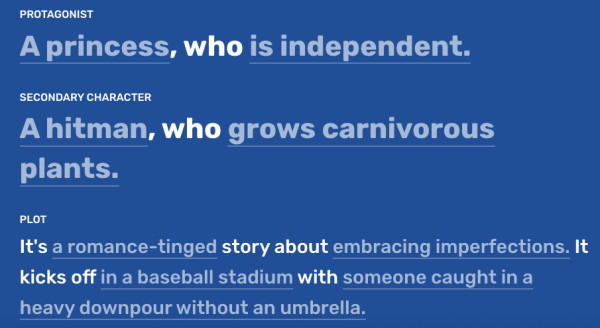
Let’s try that process for a hypothetical novel, a quirky romance called Heart of Moss with a randomly generated plot. Our heroine, Princess Felicienne, grows attached to a hitman, codenamed “Moss,” who spends most of his time — when not assassinating the rich and powerful — as a mild-mannered florist named Alan Gill.

plotting gizmo

Ensuring the reader’s suspension of disbelief

Your readers might be razor-sharp connoisseurs of plot — the type who can spot a twist from a mile away and catalogue the clichés on every page with a sneer. But your job as a storyteller is to make them forget all that. You want to enthrall them so deeply they can’t do anything but turn the page, reading compulsively with slack-jawed awe.

Readers should approach your book as fans, not critics. The second they switch their brains to reviewer mode, you’ve already lost them. One guaranteed way to do that? Disrupting their fragile suspension of disbelief by introducing plot points from seemingly out of nowhere.

Remember Game of Thrones’ much-maligned last season? The conqueror-queen Daenerys spent much of her considerable screen-time insisting she refused to be a “queen of the ashes,” presiding over a wasteland of war dead and charred ground. But just when the city she strove so hard to take signals its surrender, she turns around and sprays it with dragon-fire.

There’s been lots of ink spilled on Daenerys’ apparent turn to the dark side, and maybe that’s a storytelling success in its own right. But as a plot point, there’s no denying it didn’t work for a lot of viewers. This unsatisfying plot twist forced them to step back from the story and watch the footage at a distance — as critics. That’s because the dragon-queen’s rampage seemed out of left field, an effect with no discernible cause.

Using Beemgee to keep track of cause and effect

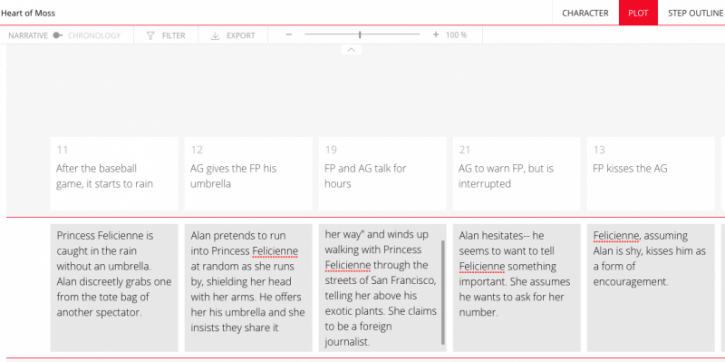
Let’s try our hand at plotting out Heart of Moss without falling into Daenerys Syndrome, as we might call it. Our plot generator provided us with an opening: a meet-cute at a baseball stadium. A downpour furnished a perfect excuse for two strangers with great chemistry to get close to one another, huddling under the same umbrella.

Beemgee’s Plot tool allows us to organize our story in narrative order: that is, the order in which it’s told. So let’s enter these first few plot points:

Beemgee plot

This setup is cute enough, but it’s also pretty implausible — even by the standards of a light, romcom-style read. How exactly do a princess and a hitman end up together at a baseball game, with enough privacy to end up on a quasi-date? What is the cause —  or causes, plural —  behind this seemingly bizarre set of circumstances?  

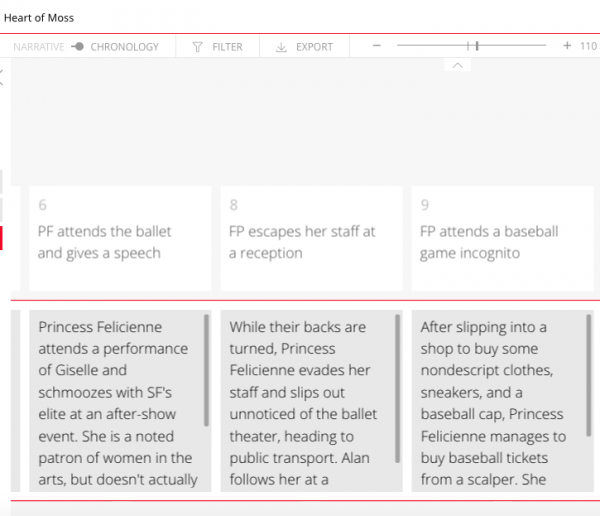
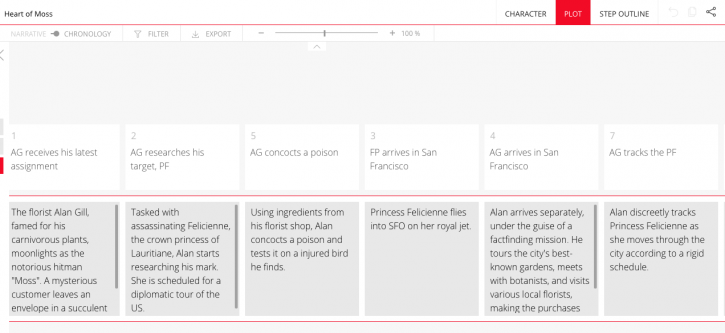
To figure that out, we’ll need to determine what happened before this rain-soaked meet cute. So let’s toggle over to Beemgee’s chronological view. This lets us order events according to when they happen, regardless of any flashbacks and flash forwards. How did Felicienne, a princess presumably supported by an enormous royal staff, end up at a baseball game unsupervised, without an umbrella?

Narrative and Chronology switch

And what about Alan? A hitman, cozying up to a foreign dignitary, feels awfully suspicious, even if she lied to him about her identity. Did he really offer her his umbrella because he thought she was cute, or did he have an ulterior motive? What was the actual cause behind his presence in the stadium?

Back to narrative view

When we return to the narrative view, we can decide when, in the story, to reveal that sweet-natured Alan, with his handy umbrella, is also the notorious hitman Moss. Do we clue the readers in before or after Felicienne herself finds out? 

Either way, the cause and effect behind Alan’s appearance in the stadium should remain unchanged — and that should color how we write the scene. Even if we hold back some of the truth, we can’t make Alan do anything that will outright contradict the fact that he’s secretly also a hitman. If we do, readers will be frustrated when they reach the reveal.

By toggling between the chronological and narrative views, it’s easy to ensure that a story is plotted with impeccable causality, even if it’s told in an order that keeps the characters — or even the audience — in the dark. That way, your readers can enjoy your story as fans instead of critics, no matter how many twists you throw their way. 

To read more of Beemgee’s writing craft articles click here

Scene Type: Midpoint, the Pivotal Scene in Your Story

I’m currently taking a writing, blogging, and coaching sabbatical due to family health issues. For now, I’ll repost selected articles from my Fiction Writing School.

Here is the link to this article.

pivotal point

The midpoint is structurally the most significant point in a narrative.

Given that stories have a tendency to symmetry, the centre of a narrative should mark the zenith of the story arc, and with that, the pivotal point of the story.

So, to get to (mid)point: What happens in the middle of a story?

Here are some typical midpoint events:

  • Something searched for is found (Star Wars IV, Raiders of the Lost Ark, Lolita)
  • A hidden truth is unveiled (to the audience, at least) – if not yet understood (Matrix, Pride and Prejudice, The Gruffalo)
  • A dramatic event thwarts all plans made hitherto (James Cameron’s Titanic)

The centre of the narrative may be the discovery of something missing – in crime stories a vital piece of the puzzle may be revealed here (either to the audience or to the audience as well as the protagonist).

In any genre or dramatic category, the midpoint may be a moment of truth. This might be just a clue for the audience or perhaps an initial revelation of the true state of things.

If a character realises or finds out something that has so far been hidden, then this is the point at which the character begins to gain awareness. This counts in particular for the recognition of the character’s own internal problem. From here on the story might possibly lead up to a moment of choice at the crisis, when it becomes clear to the audience whether the character has learnt from this new awareness or not. In other words, the real need begins to overcome or supplant the character’s initial want due to what happens at the midpoint.

Some well-known examples of the midpoint

In the famous children’s book The Gruffalo, the mouse invents the creature of the title on the spur of the moment in order to scare off first a fox, then an owl, and finally a snake. In the middle of the story the mouse discovers that the Gruffalo does indeed exist. Thereupon the mouse meets (this time accompanied by the Gruffalo) the snake, the owl, and the fox – in reverse order! Perfect symmetry. The truth is revealed in the middle.

The midpoint is powerful and can swing the story into a new direction. Hamlet realises in the middle of the tragedy that Claudius did indeed murder his father. He takes action – and kills Polonius through a curtain.

The goal may be achieved at the midpoint. Indiana Jones finds the Lost Ark in the middle of the story; Humbert Humbert gets Lolita for himself when her mother dies in the middle of the story; Luke Skywalker rescues Princess Leia in the middle of the original Star Wars story. In these examples, the second half of the narrative deals with the consequences of the protagonist having attained the initial goal.

While a midpoint can be so subtle you might miss it (like Princess Leia saying to Luke Skywalker, “Aren’t you a little short for a Stormtrooper?”), in some cases the scene might be designed to be particularly memorable. The fully grown Alien in Alien doesn’t appear in all its horror until the middle of the movie. In The Godfather, it is Michael assassinating the competing mafia don along with the corrupt Police Chief. In The Godfather II, the midpoint is decidedly less spectacular but just as significant: Michael realises that his brother Fredo has betrayed the family. The consequence of this realisation only becomes apparent to the audience at the end.

The central fact of the story of the Titanic, the single most important action or event of this story, is that the ship hit an iceberg. When James Cameron made his film about the Titanic, he put the central event in the centre of the narrative.

So the midpoint marks the most significant point of change, a point of no return. After this, life cannot be the same for the protagonist, not until a new order is established at the end of the story.

After the midpoint, the forces of antagonism gather strength and close in.

The midpoint in theory

Given its striking significance, surprisingly little is made of the midpoint in narrative theory.

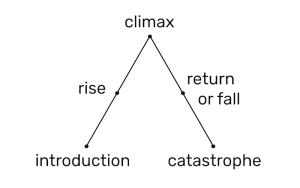
Freytag: Climax in the middle

Gustav Freytag calls the midpoint the “climax”, but nowadays that term is generally used to refer to the final confrontation between protagonist and antagonism that typically occurs towards the end of the narrative. In Freytag’s terminology, the section of narrative after the “climax” is “falling action”, because he called everything that leads up to the midpoint “rising action”.

Freytag’s pyramid is more famous today than his novels, and to an extent it corresponds to the currently fashionable image of the “story arc”. An arc obviously heads downwards after its zenith, but Freytag calling it “falling action” seems counter-intuitive, since the build up to the final confrontation or dénouement feels much more like rising tension. After all, the midpoint escalates the action. Freytag’s unfortunate terminology may be one reason why he is now mostly relegated to academia.

How Checkov’s Gun relates to the midpoint

So, authors composing stories do well to consider which important scene or action is pivotal to the plot or provides the audience with a new understanding of the story. If you’re planning a plot, determine this one scene of greatest significance and place it as close to the exact middle of the narrative as you can.

Then consider all the scenes to the left and right of it, and see how they relate to each other. Arrange the scenes in such a manner that the scenes in the second half correspond to equivalent scenes in the first half. This achieves symmetry in the story.

The technique of foreshadowing or planting (also know as set-up and pay-off) is one of the most emotive of dramaturgical devices. Audiences react more strongly to dramatic events when they have been foreshadowed. And foreshadowing works particularly well when symmetry is taken into account.

So if you have 100 scenes, make sure scene 50 (or thereabouts) is highly significant. And if in scene 90 a gun is fired, see if you can plant that gun in scene 10.

Header photo by Ashish Rangwala from Pexels

Freytag’s pyramid by SinjoroFoster – Own work, CC0

To read more of Beemgee’s writing craft articles click here

Oliver Burkeman on time and how to use it

I’m currently taking a writing, blogging, and coaching sabbatical due to family health issues. For now, I’ll repost selected articles from my Fiction Writing School.

Here is the link to this article.

by Bec Evans | Sep 2, 2021Oliver Burkeman on time and how to use it

Oliver Burkeman’s new book, Four Thousand Weeks: Time and How to Use It explores how to build a life of creativity, productivity and meaning when we have limited time available – and even less control over that time. I caught up with him to ask what that means for how we live and how we write.

Time and how to use it

Writing a weekly productivity column for The Guardian, self-confessed productivity geek, Oliver Burkeman likened himself to an alcoholic employed as a wine expert. He realised that getting more done just made him more stressed and unhappy so he turned to ancient and contemporary philosophers, psychologists, spiritual teachers to better understand how to live. Four Thousand Weeks: Time and How to Use It shares what he learnt about leading a fulfilling and meaningfully productive life.

Productivity is personal

The problem with a lot of productivity advice, said Burkeman, “is how much of the given piece of advice is good, versus that person has the right personality for it?”

I find this a comfort. Because we are all different we don’t have to attain the one, gold standard, approved, best way of doing things. Accepting this takes the pressure off you to conform to the myth of a creative genius. Instead, when figuring out what works for your life and writing, start with you, your life, your personality and preferences.

I was keen to find out what this means for his writing. In a follow up to my 2014 interview, Oliver Burkeman shares his take on how to write when time is limited.

“I’m an expert in a very amateur way – I’m vacuuming up all the research and testing it out with a sample size of exactly one. I stumble through in trial and error, so to some extent I can say I have figured some things out.” Oliver Burkeman

Oliver Burkeman’s tips on writing when time is limited

1. Do a few things that matter to you

A lot of productivity advice promises that soon you’re going to become limitlessly capable of doing everything you need to do: to produce perfect work, to be able to deal with every incoming demand, to get round to every goal and satisfy every person.

That’s systematically, inherently impossible. It’s not because you didn’t find the right technique. It’s not because you haven’t put enough elbow grease into it.

Once you see that that ship has sailed, it’s great. That huge super-structure of pointless stress, lifts away from you, and you can just do a few things that matter to you.

2. Limit the things on your to-do list

I think that a lot of us spend a lot of our time demanding impossible things from ourselves and becoming paralysed in the process. If you were just going to wake up in the morning and pick from all the opportunities, it’s unmanageable.

What I try to do is funnel through work-in-progress where I only allow 10 things. The goal is you’ve just got 10. That narrows your focus a bit. Narrowing it to one item would be hopelessly unrealistic, because you need to bounce around a bit, you need to take care of different life domains. And then once I’ve done a few, and the number’s gone down to six, then bring four more in. It’s not flawless, because you can still use it to just keep turning over three or four easy tasks, but it’s mainly working.

>> Read moreHow to make time to write – 4 approaches to finding time in busy schedules

3. Do one thing at a time

When I’m really in a rut, I then follow some version of this technique where you literally write down an action on a notebook.

Do it, cross it out, write down the next one. Do it, cross it out.

You’re taking yourself by the hand and telling yourself: “Okay, we’re just going to do one thing.” It’s so gentle and the time horizon is just literally the next five minutes. And of course you can chain together a whole career that way. That’s all you’re ever actually doing is one action after another, right?

4. You already have enough to write

Writing is based on things that you’ve already written. It’s based on ideas that you’ve been reading about, things you’ve been talking about with your friends at the park or the pub, and the things you’ve been thinking in the shower.

In other words, the answer isn’t that you have to become some kind of genius who can sit down and summon brand new ideas into being.

5. Hold on to the ideas you have

I don’t think there’s such a thing as a brand new idea.

You just have to have personal systems that allow you to keep track of all the ideas you’re already having and already encountering in your life. Carry a notebook everywhere you go, save all these articles you discover when you’re browsing online.

Create a moment in your daily or weekly routine where you take all these scraps of paper that you’ve been writing ideas on, or the notebook that you’ve kept in your pocket, and put them all into a file to keep track of them. Then all you need to do when it’s time to is to take what you’ve got and work with it.

6. Write little and often

Confronting limitation is about understanding how true it is for almost all writers that little and often is the better path to a productive output than writing in binges.

Again, if you’re a binge writer and you work for days at a time and it works for you, don’t let me stop you. But I think for most people it doesn’t work or it works for three days, and it puts you out of action for a month, which is another way of saying it doesn’t work.

I suggest working in small amounts. Aim only to do half an hour or an hour in a day, maybe a little bit more depending on whether you’re combining it with a day job, but not very much.

7. Stop when your time is up

It took me a while to learn that you also have to stop when your time is up, even if you feel like you’re on a roll and you can continue. It’s all about ignoring that voice in your head that says, “I’ve written 700 words, so why don’t I try to write 3,000 today? That will be amazing.”

Every time you resist that voice, you’re building a muscle, building a capacity for patience, for coming back to the job day after day after day which will lead to much more writing because it will make you feel more excited about getting down to that work and not like writing is something you flog yourself to death on.

>> Read more: Why the fixed schedule productivity approach to writing will give you more downtime

8. Writing is hard – but you can handle it

Writing, or creative work in general, often feels quite difficult. It’s uncomfortable to do it. It’s kind of hard. It makes you feel a bit grouchy.

I think this is another way in which we deny our limitations. We think that if we really knew what we were doing, it would feel totally lovely to be doing it. We’d be in a constant state of flow and therefore, if that’s not how it feels, well, we must have writer’s block. We must just not have the skills that we need to write.

You get into this double-bind where like writing feels like a problem, which it is, but it also feels like it’s a problem that it feels like a problem, which it isn’t.

It’s uncomfortable, but you can totally handle that discomfort. You don’t need to try to power through it and make it go away. You can just say, “Okay, I feel reluctant about doing this. I didn’t particularly want to do it. It feels difficult and I’m going to do it at the same time.”

9. Overcome your discomfort by setting tiny goals

The prospect of this kind of discomfort will stop you doing things for days and weeks and years on end.

Then, it’s consistently mind-blowing how almost all the time, it isn’t a big deal to go through that discomfort. You have to learn this lesson over and over and over again.

That’s another very good reason for these tiny goals and writing in tight bursts is that it gets harder and harder to fool yourself that you can’t cope with that discomfort, because actually 10 minutes of discomfort, you can cope with.

>> Read more: How small steps lead to great progress

10. Procrastination and feeling in control

I’ve often assumed that the next thing would be incredibly hard or scary, and that’s a good reason to procrastinate. I’ve definitely procrastinated on all the book work that I’ve done.

But when you actually get into it, the experience doesn’t justify the anxiety you had about it. Part of the reason that feeling anxious and procrastinating on things is because they boost the feeling of control. If you don’t start something, you’re still in the driver’s seat.

I think most of us will do anything to avoid that lack of control. Because it’s like jumping off the diving board where you don’t know what’s going to happen.

11. The fantasy of perfection

A lot of people are fixed in these perfectionistic ideas, where the moment you start doing 10 minutes that’s not very good on your manuscript – that’s the moment at which you’ve had to wave goodbye to doing five hours a day and it all being Tolstoy quality.

I mean, you can hang onto that thought as long as you don’t start. As long as your finitude doesn’t come into act or contact with the world and you start doing things, you can hang onto the greatest fantasies about how it’s going to be.

12. Reject what doesn’t work

There’s this whole culture of goal-setting which is to use the ambitiousness of the goal to drive to ever greater heights and that has never worked for me.

I never get round to implementing Cal Newport style annual goals. It’s not that I disagree with them. But I have to say, it never quite works out for me. It’s never the way I actually seem to break the most ground.

13. Do what works

All the useful productivity stuff that’s ever worked for me and that continues to work is just about coming up with a slightly wiser answer to the question: “What shall I do right now?” And it’s feeling slightly more motivated and enthusiastic about what shall I do right now.

That idea of just writing a single thing and crossing it out, that’s the sort of most basic expression of “what do I do now?”

14. The game changer: Finish it!

And then the other thing I try to do a lot is to limit work in progress so that there’s a fixed number of things that I’m working on right now and that I will finish one of them or abandon it before I bring in another one.

As and when I manage to motivate myself to do three or four hours of serious creative work, it’s going to be on the same thing for two or three days, until that’s done.

That’s a game-changer. Because otherwise what happens is the moment any project feels a little bit difficult, you just bounce off to another project and you never make serious progress on any of them.

“Done is better than perfect,” relates to this idea that 100 words that you write are better than 10,000 words that you think about writing one day. One thing done is better than 10 things not getting very far.

What I’m doing when I launch into 10 projects at once is fundamentally fuelling my sense of being unlimited or godlike. Busyness can do that sometimes. On some level you’re thinking, “Hey I’m in demand. I’ve got all these things going on, that’s great.” But it’s actually a way of hiding from picking one of them, putting it on the table in front of you and doing that thing.

>> Read more: The complete guide to writing accountability – hold yourself to account and use others to help you achieve your writing goals

15. From systems to success

Make sure that you have, in your own life and work, the personal systems that allow you to keep having and developing ideas, writing words, and sending those words out into the world. What happens then is you gradually expand the perimeter of your reach, and as that perimeter expands, you sort of bump into more of the opportunities that might lead to greatest success.

***

Four Thousand Weeks – Time and How to Use It by Oliver Burkeman

I loved talking to Oliver Burkeman and finding out his advice on how to live and how to write and encourage you to read his book for more wisdom.

Four Thousand Weeks: Time and How to Use It explores how to build a life of creativity, productivity and meaning when we have limited time available – and even less control over that time. The 4,000 weeks of the title is the equivalent to 80 years of life. It’s a number we can all relate to and helps us understand our finitude (a rather nice euphemism for death). That is not reason for despair but, Burkeman argues, a liberating concept. Accepting our limited time on earth allows us to leverage the possibilities and opportunities we have. In short, confronting our own death is the key to leading a fulfilling and meaningfully productive life. And of course, and writing more.

Sign up to his newsletter The Imperfectionist, check out his other books, and read our previous interview with him: Oliver Burkeman’s 10 tips for a productive and happy writing life.

Parts of a Story: A Beginners Guide to the Five Basic Elements of a Story

I’m currently taking a writing, blogging, and coaching sabbatical due to family health issues. For now, I’ll repost selected articles from my Fiction Writing School.

Here is the link to this article.


There are certain elements every good story needs.

If you skip any one of them, there’s a good chance your story will fall flat and fail to resonate with readers. They’ll struggle to lose themselves in the world you’ve created and have little concern for what happens to your characters.

No one ever sets out to write a bad story. But that’s the risk if you don’t have all the foundational pieces in place.

The good news? You can avoid writing a weak story by building a strong foundation. Learn the parts of a story, how they all fit together, and why they matter, and you’ll become a better storyteller.

Are you ready?

The 5 Basic Parts of a Story

Let’s look at the five main parts of a story in detail.

1. An Unforgettable Main Character

Characters are what stories are made of. They help us explore the human condition, even if they’re not human. (malfunctioning robots, anyone?)

And the most important character in all stories is the main character.

Chances are, an idea for your main character will have come to you as a core part of your story idea, or very soon after.

You probably know their gender, rough age, nationality and maybe a little about their personality.

For some writers, that’s enough, and the rest of the character’s personality and backstory will emerge as they write the novel.

A lot of writers, however, prefer to flesh out their main character as they are developing their plot, because the two things are so interdependent.

To help ensure your main character is someone your readers are going to want to spend a lot of time with, you need to build empathy with them (even for characters who aren’t very nice). This can be done by showing them to be kind, skilled, competent or liked by others.

Or if your character really is a nasty piece of work, then make sure you make them funny. We are liable to forgive a host of shortcomings if someone is still able to make us laugh.

Further to that, you may want to consider the following aspects of your main character:

  • Positive traits
  • Negative traits
  • Motivations (see Objective, below, for more on this)
  • Flaws
  • Quirks and mannerisms
  • Fears and Phobias
  • Most treasured possession

You don’t have to define every single aspect of your main character right at the beginning, but try to make sure they feel rounded and interesting, to get you off to a good start.

2. An Extraordinary Situation

Of course, your characters can’t walk around in a void.

In some types of stories, the setting will be a critical part of the story, almost a character in itself, such as a talking space station or a slave ship lost at sea.

But even those where the setting is more everyday, it still needs to play an important role, creating its own specific conflicts, pressures and tensions for your characters.

But why does the title say ‘situation’ rather than ‘setting’?

Setting usually refers to the time and place, such as Victorian England or Futuristic Mars.

But ‘situation’ emphasises that there is more to the setting than that.

There were many stratas of society in Victorian England. Is this story set around the poverty stricken areas or the decadent ones?

And there might be specific things about this setting in this book, such as Vampires roaming the streets, or a threat or war from abroad, or a new invention that is about to change everything.

When talking about futuristic Mars, the situation could involve a threat from an alien species, or lack of resources.

Or the situation could be related to internal politics. Or if the story is a romance, the setting / situation could involve a culture where partners are assigned at birth based on DNA, but the main character falls in love with someone else.

So explore your setting beyond geographic location and year, and see how it can be used to enhance your story, and its themes and conflicts.

3. A Compelling Objective

Everyone wants something.

And the more your character is willing to do, to get what they want, the more compelling your story is likely to be.

In the real world, people don’t always have clear objectives. They may change their minds frequently, or they may not be very serious or motivated about attaining their goals. While that’s the norm, it’s also not very exciting — so it doesn’t make for good storytelling.

So in fiction, it pays for your characters to have clearly defined wants and needs.

Your first step is to consider what your character wants from their normal life. Do they want to be rich? Catch a criminal? Find their soulmate? Save the planet or their own livelihood from ruin?

But what the character wants often turns out to be different from what they actually need. What the character needs is the heart of the story, and what makes the situations much juicer.

For example, maybe your leading man is striving for money and power (his want) because he never felt he had the approval of his domineering father (his need). But once he gains wealth and position, he finds he’s still unsatisfied, as his need is still not met. Only if he’s insightful enough, or has outside help, will he realize he’s been chasing the wrong outcomes, and with self-acceptance he can finally feel at peace.

Wants (external goals) tend to relate to money, power, possessions and possessive love. Whereas Needs (internal goals) tend to relate to courage, compassion, belonging and self-acceptance.

So consider what your main character wants, and what they really need.

4. A Challenging Opponent

Every good novel needs conflict. It’s the driving force behind a good story. It builds tension, excitement, and interest. As a matter of fact, without conflict, there is no story.

While there will be multiple conflicts of different levels throughout your novel, when it comes to the core story parts, we’re thinking about the key opponent—the nemesis.

While the opponent can be a force of nature, an organisation, or a situation, the most powerful ones to hit our human psyches are usually personified.

Voldemort is an obvious ‘Bad Guy’, who is a power-mad, intelligent lunatic.

In the Matrix, the whole world seems to be against them, but we are given a face to focus our fear and courage against, in Agent Smith.

In the Hunger Games, the opponent is the whole system, and the Gamemakers, but the general is made specific in President Snow.

Good opponents aren’t just random evil-doers, their goals directly conflict with the main character’s, and they often act as a reflection, showing what could happen to the main character if they take the wrong path, or fail to find courage or integrity.

It’s important that opponents are powerful formidable opponents. They have to seem impossible to beat, and they must have serious power or control over the main character’s chances at happiness.

5. Impending Disaster and Realistic Stakes

If you’ve hooked your reader with the gripping situation, made them care about your main character and what they desire, and had them rooting for the character against a worthy opponent, then you only have one thing left to do.

Thrill them with an exciting and satisfying ending.

Even successful discovery writers (those who write the novel without planning the plot in advance) usually say that they know roughly how their story is going to end when they start writing.

Your novel will have much better direction if you know where it’s going. And you’re going to want to end with a bang.

So the final key story element is a ‘disaster’.

This may be an actual disaster that occurs, which the main character has to face as their final challenge. Or it may be a looming catastrophe that the main character needs to avert or avoid.

While life or death situations are naturally high stakes and are therefore popular in fiction, it’s possible to grip readers with much more day to day goals and disasters, if you set it up well.

The possibility of losing $20 or $100 in a card game isn’t interesting enough to hold anyone’s attention for long.

But potentially losing the Poker World Championship, after playing for decades and overcoming incredible personal challenges along the way, including the defeat of a shady, evil, and vengeful opponent, is much more riveting.

So think about the finale of your story, and how your main character will be tested. Once you know that, you’ll be able to ensure that they spend the rest of the story gaining the skills they need in order to triumph.

These are the five basic building blocks of your story. But they’re only your starting point.

Other Story Elements to Consider

Once you’ve got the basics, you’ll start adding these additional story elements.

1. An Intriguing Theme or Central Question

Theme is interpreted in different ways, but we use it to refer to the story’s central moral question.

Your theme is the question you want to ask and answer through your story.

Maybe that question is “Do good guys always finish last?” or “Does crime ever pay?”

Theme usually involves moral explorations of a universal idea, message, or lesson that underpins your entire novel.

Your novel is your thesis, where you try to prove the truth of your theme.

Why does theme matter? Because people have a basic need to understand the human condition, and story is one of the main ways we accomplish this.

From a writer’s perspective, a central moral question helps focus your story and gives it deeper meaning. It’s what makes your book emotionally rewarding to readers.

Your theme doesn’t need to be obvious. Instead, use it as an internal guide. Keep it in the back of your mind as you write your story, rather than trying to crow bar it into every scene.

2. A Distinctive Voice

Voice is one of the hardest parts of being an author to pin down, but it might help to split it into three separate categories: The Main Character’s Voice, the Book’s Voice and the Author’s Voice.

The Main Character’s voice will get across the personality of the character. Are they serious or silly? Do they like the sound of their own voice or prefer to think everything through carefully? What sort of vocabulary do they use? What’s their sense of humour?

All of this will come across not only in the words they use in their dialogue (though that is key) but also how they describe the people and situations around them.

The Book’s voice will go beyond the main character. Some books have a whimsical, chatty style of narration. Others, the narrator is almost invisible. Some books go deeply into sensual descriptions using advanced vocabulary, others are sparse and give you only the broadest brush strokes.

The Author’s voice may vary from book to book. Authors will use different tones and styles if writing in different genres or for varying age groups. But Author’s voice is probably the one you need to worry about the least, because it will emerge naturally from your personality, experiences and influences.

The best way to learn about Voice is to see how other authors handle it. In some books the Voice will be so strong it will be unignorable. In others it might be more subtle. Think about which books appeal to you the most and study what techniques the author uses to create a unique and engaging Voice.

You could even try writing something in the style of one of your favourite authors.

3. Effective Symbolism

Symbolism is one tool authors use to convey information without spelling it out explicitly. For example, you might dress a villain in black or a hero in white, use an overcast day to imply sadness or heartbreak, or have birds swooping through the skies to represent freedom.

Good symbolism bypasses the conscious and hits us straight in the subconscious, making us feel a certain way without us being aware of what’s happened.

Like using the weather, clothing and surroundings to convey ideas and emotions, skilled writers will use similes, metaphors and vocabulary choices.

A writer wishing to convey a mood of quiet, simmering threat might describe a train station where darkness oozed, with a gloomy, deserted waiting room, blackened brick walls, a queue snaking across the hall, and the bellow of steam trains like angry beasts tethered to their task with bellies of hungry flames that hissed and crackled.

Alternatively, a writer wishing to create a lighter mood might describe the platform as being filled with bustling families, giggling children in bright colours, the gentle breeze making the sunflowers sway and bob.

The gleaming train would proudly slide into the station and sigh in satisfaction as the conductor blew his brass whistle and fluffy clouds drifted lazily by, overhead.

4. Engaging Subplots

Subplots can make or break your story.

Strong ones add depth and can help you to explore different aspects of your central question.

Subplots move the story along in the same way your main plot does, but often involve secondary characters and/or secondary conflicts.

While you won’t spend as much time developing your subplots, they can be nearly as important as your main plot—some would argue truly effective subplots exist because they must. Without them, you simply couldn’t tell your story.

For example, in the Hunger Games, the main plot involves Katniss’ fight for survival. But the subplot of her romance with Peeta, while adding backstory, insight, and a ‘will-they-won’t-they’ suspense throughout the book, plays an integral role in the end.

So be sure to examine your own subplots. Are they adding to your novel? Are they essential to it? How can you strengthen them?

Master Story Elements and Write a Better Novel

If you’re just beginning your author journey, there’s no better place to start than learning the essential parts of a story.

Now that you’ve got the basics, can you see ways to make your own novel stronger?

Have you got all five elements? Do any of them need to be developed in more depth?

Decide what you need, then check out our writer’s resources for help.

Or, why not visit our Facebook community to ask questions about the Parts of Story, and share yours with us!

Make the Audience Feel! Take them on an Emotional Journey.

I’m currently taking a writing, blogging, and coaching sabbatical due to family health issues. For now, I’ll repost selected articles from my Fiction Writing School.

Here is the link to this article.

The audience' emotional journey

Nothing should be more important to an author than how their story makes the audience feel.

As an author, consider carefully the emotional journey of the reader or viewer as they progress through your narrative.

The audience experiences a sequence of emotions when engaged in a narrative. So narrative structure is a vital aspect of storytelling. The story should be touching the audience emotionally during every scene. Furthermore, each new scene should evoke a new feeling in order to remain fresh and surprising.

The author’s job is to make the audience feel empathy with the characters quickly, so that an emotional response to the characters’ situation is possible. Only this can lead to physical reactions like accelerated heartbeat when the story gets exciting. We have to care.

This “capturing” of the audience, making the reader or viewer rapt and enthralled, requires authors to create events that will show who the characters are and how they react to the problems they must face. The audience is more likely to feel with the characters as the plot unfolds when the characters’ reactions to events reveal something about who they really are – and how they might be similar to us.

One Journey to Spellbind Them All

Here we present a loose pattern that we think probably fits for any type of story, whatever genre or medium, however “literary” or “commercial”. It’s not prescriptive, just a rough checklist of the stages in the emotional journey the audience tacitly expects when they let themselves in on a story. The emotions are in more or less the order they might be evoked by any narrative.

Curiosity

Actually the movie poster, ad, or the cover and blurb of the book do the main job of arousing curiosity. But once the viewer has switched on or the reader turned to page one, your opening should ideally suck this recipient into your story quickly.

At first, on page one or during the first few seconds of the moving image, the readers or viewers are unlikely be emotionally involved yet. They are trying to understand the setting, get to know the main characters, and figure out what the plot is about. The opening is like a riddle – more of an exercise for the brain than the heart. Creating a question in the mind of the viewer or reader with a striking or mysterious first image or line is never a bad idea.

It is not your aim, however, to maintain curiosity as a mental exercise. As quickly as you can, you want to capture the audience’ attention with something stronger than curiosity.

Attention

You want to arouse and heighten your readers’ curiosity to such an extent that they stay with you beyond the first couple of pages or minutes. So the first scene ought to be attention grabbing in some way, perhaps by posing more questions than answering them. It pays to start with a strong kick-off event that makes the audience want to know more – not only on the conscious intellectual level, but also on an empathic one.

Empathy

You need to establish an emotional connection with the reader or viewer as quickly as possible, which may require a particular incident, event or scene designed specifically for this effect. This might be something apparently minor or trivial, but definitely something very human about your main characters’ reactions to something that occurs. The way a character reacts to a cold coffee might be enough for us to react emotionally when something shocking occurs afterwards. If the shock comes without the prior human element, without us knowing anything about who the character is, the chances are we will not care. Creating a sense of moral outrage in the audience only works if the audience knows who this person is that something unfair is happening to.

There are alternatives. A spectacular incident might be enough. Or something mysterious. But whichever event you design as the emotional hook, the important thing is: you need to make sure the audience is feeling for the main characters.

Anticipation

By now, the reader has a feeling for how you are presenting the story, for instance what rules you have set yourself for point of view, as well as for what genre of story this is. This creates expectations in the audience’s mind about the scenes coming up.

Pretty soon after you have established the ordinary story world and set the scene, you want the reader to understand that there is a problem, or actually there are a couple of problems. The story is probably going to show how these can (or cannot) be fixed. If, for instance, the problem is a case and the protagonist a detective, the reader will expect some sleuthing.

The external problem is the incident that begins the chain of events that causes the protagonist of a storyline to set off on their journey.

Another scene that creates a sense of anticipation is the one that shows the audience what the real need of the character is, i.e. what they must learn.

Commitment

Many authors deliberately conceive a scene which strengthens the audience’ interest in the fate of the characters. Sometimes called the “lock-in”, this scene is designed as a point in the narrative after which we may assume that the audience is properly hooked.

Such a scene is not to be confused with the “inciting incident”, the scene that presents the external problem. Rather, the commitment lock-in is a moment that confirms the earlier empathy moment. It is about making the viewer or reader feel some sort of identification with the character, often through recognition of their plight.

Enjoyment

Once the characters have started trying to solve the external problem, have fixed their objective and set out on their task or mission, met the person with whom they will begin a new relationship, etc., the “fun & games” part starts. This is where the expectations you have awakened in your audience need to be satisfied, so that they feel they are getting what they paid for. If they have bought into a crime mystery, give them crime and mystery. If they want adventure, give them action and great locations. If they expect a romance, give them a burgeoning relationship that will develop into the love story.

Structurally, within this stage of the story a pinch point event may occur that shows the audience that the journey is serious, and might make the main characters realise that they will have to face more severe obstacles and difficulties than they thought. The fun for the audience is seeing the characters out of their comfort zone.

Wonder

The midpoint of a story is a pivotal moment. In the middle of the narrative, a goal may be reached, a moment of truth may occur, a revelation take place, or some great turning point transpire. While the event need not be spectacular, and may even not be recognized in its significance by the audience at the time, it is something that will stir them up eventually.

The midpoint is one of the most powerful emotional weapons in an author’s arsenal. It is not so much about eliciting one particular emotion in the audience here. The feeling the event causes could be anything from horror to awe to premonition. It could be momentous, as when the Titanic hits the iceberg in James Cameron’s Titanic, or ironic, as when Luke Skywalker finds princess Leia in Star Wars. It could be spectacular, as when Indiana Jones finds the Lost Ark. Or scary, as when the Alien breaks out of Kane’s chest. Or nail-biting, as when future Godfather Michael shoots the police chief and the rival mafia boss.

Structurally, this event marks a turning point for the characters. Emotionally, it can cause any number of feelings in the audience.

Sadness

If your story ends happily, then at some point in the narrative you need to present the opposite of happy in order for the ending to work. Something should happen to make your readers or viewers sad, such as a death, possibly a metaphorical one.

And vice versa, if your story ends tragically, there must first be joy to make the tragedy all the more poignant.

Calm

To soothe the audience’ the nerves, give them a moment of calm – before the storm. A sort of communal campfire scene, in which the main characters reveal something about their pasts that sheds light on their behavior, can make your audience feel for them all the more in the later climax. A moment of calm can also heighten the sense of threat and dread when the characters head inexorably towards the approaching crisis.

Fear

Things may go terribly wrong for the protagonist, the threat to the characters looms so great that there seems to be no way out. Your audience might be wide-eyed and holding their breath, scared, and virtually clueless about how the seemingly insurmountable final obstacle might be dealt with.

The second pinch point may be the conjunction of the fear that all is lost with the revelation that there is still a way to resolve everything …

Revelation

A moment of hope! Brought on by a realization or revelation, an idea, or a new plan. Your readers’ hearts should be beating faster here as they, and perhaps (but not necessarily) the characters too, gain a new awareness.

In many ways, this moment is the most important in the story. It is the scene that narratives are composed to lead to. Perhaps the effect is exemplified best in mysteries or crime stories, because in this scene the veil is lifted and the truth revealed. The mystery is finally cleared up, the identity of the criminal made known to the audience. The whole story leads up to this revelation. What is so very distinct in a whodunit counts for other forms of storytelling also.

The revelation scene works emotionally on the audience only because it has been foreshadowed. Specific earlier events “set up” the big “pay off” of this all-important point in the story. The audience experiences a powerful “aha moment” because a number of events that seemed insignificant at the time are suddenly cast in a new light.

Anxiety

Just because the audience or the protagonist now knows the truth doesn’t mean that the danger is over. There may be an awful moment of crisis or decision, where the audience are aquiver with anxiety while waiting to see if the hero will do the right thing.

Perhaps the hero in a romance has finally realized the truth that he or she cannot live without her lover. Now the worry is, will this character perform the action or make the choice the audience wants them to make? The tension reaches a high-point.

Excitement

The decision made, the audience roots for the hero as she lives through the final confrontation. This is the climactic excitement of a great finale! Time for nail-biting.

Relief

Relief! A great exhalation of breath as the last great confrontation is dealt with. The final obstacle is surmounted, and even in case it did not end well for the main character, for the audience there is the satisfaction of seeing all the storylines come together in a well-rounded, well-deliberated ending. Even if one strand is purposefully left open (for effect or for the sequel), this story is now at an end, and the audience is left feeling satisfied as after a good meal.

Resolution

A story is a journey for the audience. As an author, you are like a tour guide through your story. You control what the audience feels and when. These feelings build on one another, and the more highs and lows you build in, the better.

From their general mood the emotions should at best alternate between positive and negative from scene to scene. Emotions work best when they are contrasted and placed into juxtaposition. That is, hope must be felt that things are looking up for the characters, only to be dashed by some surprising turn of events.

The narrative is constantly manipulating the emotions of the audience, leading them to feel one way, but not long enough for them to get used to this feeling, instead forcing them to feel something new. In this way, a great range of human emotions can be packed in a very controlled manner into one story.

Focusing on what the audience should feel during each scene is, we believe, more important still than structural paradigms or organisational principles for plot. The most important person of a story is not really the hero, nor the narrator, not even the author. The most important person in a story is each member of the audience.

Image by Aristeidis Tsitiridis from Pixabay 

To read more of Beemgee’s writing craft articles click here

A Great Cup of Coffee & Creativity

I’m currently taking a writing, blogging, and coaching sabbatical due to family health issues. For now, I’ll repost selected articles from my Fiction Writing School.

Here is the link to this article.

Author: Jeff Goins

Morning, Creator.

Have you had your cup of coffee yet? I have. I’ve tasted the sweet nectar of the gods and gone back for more. How could I not? This is the stuff of which creativity is made, after all.

Have you had your cup of coffee yet? I have. I’ve tasted the sweet nectar of the gods and gone back for more. How could I not? This is the stuff of which creativity is made, after all.

It is no surprise to anyone who knows me that I love coffee, that I see the very act of coffee-making as a careful and subtle art, one worth our attention and respect. And this love for something bitter but life-giving has taught me more than a few lessons about the magic of making things.

What is it about coffee that makes life worth living? Maybe you think I am given to hyperbole, but that is only because you must still be a member of the uninitiated, so allow me the privilege of enlightening you. Of educating you.

A cup of coffee is never just a cup of coffee. It is a beautiful pause, a way to say to yourself and to the rest of the day: “Before we do anything, we will take a moment to connect to ourselves and our senses. We will stop the frenzy that is our lives and smell, sip, and sit with what it means to be here, right now, in this wonder we call life.”

Okay, maybe I am being a little dramatic here, but my coffee-making is a ritual. It is important to me, and something I do every day without thinking about it. Yes, I could pop a Keurig cup or go to a coffee shop, but I refuse to rob myself of the important act that allows my day to begin with a little art. Making coffee is a wonderful invitation that life is constantly offering us: take a moment and create something beautiful… and then enjoy your creation.

How do you make a great cup of coffee, you might be wondering? Well, I am glad you asked.

It begins with the beans, with the raw source material that comes straight from the earth. A coffee bean is, in fact, a seed—which means it contains the primary material for making other things. It is pure potential, a fruit from a bush that can grow other bushes and create other things just like it. An entire oak tree is contained in the tininess of an acorn, after all; and all of life that is worth living can be found in the miniature latency of a coffee bean.

Good beans are whole and intact—they’re not grounds. To make great coffee, you’ve got to start with the bean, with something whole and atomic that you can crush into fine powder and turn into something consumable. So your day begins with an act of alchemy, with turning one thing into another thing. And all of life, in a way, is like this. We are always taking raw stuff and turning it into something else: whether that’s a bad day into a good one, an acquaintance into a friend, or an idea into an email. It is our own version of transforming water into wine; and in this way, we can each be children of God, little creators dancing with the creation that is us.

Good beans are not too old, because life tends to grow stale when it sits on a shelf for too long. You want something fresh, not older than a couple of weeks. Most coffee follows the rule of fifteens, which is to say green beans tend to last fifteen months, whereas roasted beans only last fifteen days, and ground coffee lasts a mere fifteen minutes before it starts to lose flavor.

Coffee is a reminder that life is evanescent, as are our best ideas. We must seize the day before it’s over lest the opportunity be lost forever. You cannot hold on to a moment anymore than you can let a cup of coffee sit all day and still expect it to taste as good as it did the minute it was brewed. Enjoy what you can while it’s here is what coffee is trying to tell us. For tomorrow we die. 

Which brings us to the next step: preparation. Surprisingly, the least important part of making coffee is how you actually brew it. If you are in the mountains of Peru and use a stone to grind some freshly roasted beans that a few peasants picked only a day before (side note: you actually want beans that were roasted a few days ago for optimal flavor, because things take time to mature and there is only a small window between maturity and staleness and we are always trying to maintain that balance, aren’t we?), then pour some hot water over those grounds, and strain it in a T-shirt, well, that will likely be pretty good coffee. 

But I digress, albeit only a little.

Whether you use an espresso machine, or an Aeropress, or a Chemex, or a Kinto cup miniature pour-over, or a French press (all of which are devices in my possession), what matters most is that you make the coffee. Not that you do pretty latte art or impress your friends with a fancy machine from Switzerland you don’t know how to appreciate. What matters is you get up tomorrow and dare to taste the morning. That you endeavor to make something worth consuming, something infused with love and art. Something that just might satiate a soul.

Finally, just as important as the beans themselves, is the timing of the whole thing. You need to make your coffee quickly and enjoy it without dragging out the process. Yes, I love a good sit on a balcony with a hot cup of liquid love, but if I am drinking so slowly that I have to microwave the mug, then I am in trouble. I am not carpe-ing the diem. Life is always changing, and fortune favors the bold. So I must drink.

You must make your coffee today. You must pull from the best sources you can find, using whatever tools available. And you cannot sip slowly. Embrace what you’ve created, and let it be just as it is. Of course, you made choices that on another day would be different. Of course, you could have done it differently, and maybe next time you will. But it’s not next time; it’s now. And now, you’re here: with your cup, and your life, and all you can do is imbibe it all.

And of course, we’re not talking about coffee anymore.

P.S. Be sure to tune in to this week’s podcast where I riff on the art of coffee-making and what this has to do with creativity. Enjoy!

“When I think of life as struggle with the Daimon who would ever set us to the hardest work among those not impossible, I understand why there is a deep enmity between a man and his destiny, and why a man loves nothing but his destiny.” —W.B. Yeats

The complete guide to working with beta readers

I’m currently taking a writing, blogging, and coaching sabbatical due to family health issues. For now, I’ll repost selected articles from my Fiction Writing School.

Here is the link to this article.

Everything you need to know about working with beta readers – who they are, the benefits of using them and practical tips on how to recruit, brief and communicate with them.

It’s publishing folklore – how JK Rowling was famously rejected by multiple publishers before Bloomsbury took on Harry Potter. The series changed publishing, influenced an entire generation and created the first female author to become a billionaire. The backstory is just as compelling as the best-selling series.

Harry Potter and the magic beta reader

Nigel Newton, the founder and chief executive of Bloomsbury gave a chapter from the draft manuscript of Harry Potter and the Philosopher’s Stone to his reading obsessed eight-year-old daughter Alice. Newton told a journalist, “She came down from her room an hour later glowing, saying, ‘Dad, this is so much better than anything else.’ She nagged and nagged me in the following months, wanting to see what came next.”

Many publishers were given the very same sample – all of them rejected it. Newton took a punt on this unknown first-time author based on the feedback of a beta reader, someone in the target market of the book, who just happened to be eight years old.

What are beta readers?

Beta readers are not experts. They are not editors, nor are they people who read slush pile submissions or review manuscripts, subject specialists or sensitivity readers. They are not professionals and they are not paid for it.

The ideal beta reader is someone who knows what they like to read and has opinions. They will read a work in progress and offer feedback to the author from the point of view of an average reader. They are happy to invest their valuable time and effort into reading and feeding back because they want to.

Beta readers exist across all types of writing, whether you’re writing fan fiction or an academic monograph, publishing a collection of haikus or historical essays, there will someone who wants to read your words. That’s the heart of the beta reader relationship: readers love to read and writers want feedback.

How I work with beta readers

I signed a contract for my first book How to Have a Happy Hustle in 2018. While I had excellent support from my agent and publisher I wanted to test the concept and draft chapters with real readers who would feedback as I wrote. My genre is ‘how-to’ non-fiction books so I looked for people who were interested in the subject of innovation, who struggled to make ideas happen and were keen to learn more. In short, they wanted my book to help them solve a problem they had.

>> Read more:  How to write a book in 100 days

I set up a beta reader group – a mix of my target audience and people who worked in innovation or startups. They became a sounding board, my trusted advisers and cheerleaders, and some have become firm friends. As well as helping me test my ideas (and writing style) it was a brilliant form of accountability.

As I wrote, I kept the group up to date with email updates. I ran everything past them: from the table of contents, the book title, cover design and the all-important reading of the first draft. Everyone was named in the acknowledgements and many people went on to buy the book and support the launch – though that isn’t part of the process (I’ll share advice in another piece about forming a launch ‘street team’ and the anxiety-inducing request for ‘blurbs’ which are both part of the promo work of an author).

My book was so much better for their feedback, so when my co-author Chris and I started working on our new book, The Writing Playbook, I was determined to get the support of more volunteer readers.

>> Read more: The complete guide to writing accountability – hold yourself to account and use others to help you achieve your writing goals

Why use beta readers?

Beta reading is a form of user testing. The idea behind user testing is that in order to make a product (book) that users (readers) want you need to test with them and find out what they think. I know this will make many writers feel uncomfortable! But writing needs to be read – even the most creative, experimental and esoteric of forms needs an audience.

Personally, I’d much rather someone told me the faults when I have time to fix rather than write a one star review on Amazon. Plus, they can feedback privately and spare my blushes rather than having my failings laid bare for all to see online. Finally, it’s a relationship based on communication where I can ask questions and explore what they think and why.

When product testing you need to get feedback from a range of users. Let’s imagine you are testing a can opener. In this scenario, the users are people who want the beans, that means they need to open the can. Enter the can opener, a product many of us have in our homes. But, users are not all the same – my kitchen and the way I cook will be different to yours.

If you are cooking with a child with smaller hands they will use the can opener in a different way to an adult. Likewise with someone who is left-handed or has arthritis. What about if you work in a hotel or a café and need to open multiple cans a day? What if you’re hiking and don’t have space for a full-size can opener in your backpack? They are all users with the same need but will approach the product in diverse ways.

Our current book is about writing productivity and aimed at a wide variety of writers. I needed people who have written, are currently writing, or dream of writing – and across all genres and formats. I wanted novelists and creative writers, academics, non-fiction and business writers to become beta readers – what they had in common was the desire to overcome writing blocks and build a long-term, sustainable writing practice.

How many beta readers do you need?

You need to test with a range of people and and have several involved. Good practice in user testing suggests the sweet spot is 6-8 people – enough to get diversity of opinion while also spotting patterns. I’m amazed how quickly patterns emerge – EVERYONE spots the same error – and that’s what you are looking for.

Some authors with get more people involved. I like to have at least 20 people feedback because there is no such thing as an average reader and I like the range of opinions. The biggest example I’ve seen is Jake Knapp and John Zeratsky who listed 1,700 test readers in their book Make Time. I can’t even begin to imagine the logistics of that process and how to filter feedback!

It’s really up to you many you can handle. If you’re starting out, you can try a critiquing partnership where you work with one other author and feedback on each other’s work in progress. Many university departments have reading groups where peers can read and feedback in a safe space – it helps build confidence for the often brutal submission process. For one project I joined a critiquing group with 15 members which was facilitated by a professional writer and teacher.

When is best to test?

You can test at any stage of writing – for example, pitching an idea before you write or sharing a synopsis – but for most writers it’s best to wait until you’ve completed the messy creative process and have finished revising. You need to feel confident the draft is as good as you can make it by yourself. As Stephen King famously advised in his book On Writing:

“Write with the door closed, rewrite with the door open. Your stuff starts out being just for you, in other words, but then it goes out. Once you know what the story is and get it right — as right as you can, anyway — it belongs to anyone who wants to read it. Or criticize it.”

How to recruit, brief and communicate with beta readers

For my first book I used my professional network to get my target audience involved, a mix of social media, posting on a few online communities and reaching out to people I knew.

Work out who your audience is and where you might find them – for example a Facebook group, on LinkedIn, an online community or fan site. For the second book I used the Prolifiko newsletter and also asked people personally if they wanted to be part of it.

I kicked off both beta reader groups with a survey. This helped me empathise with my target readers and understand their motivation and what they struggle with. I also asked what else they liked to read and where they got information from. The survey asked them to ‘opt-in’ to being part of an email group, a necessary step in data privacy.

Also it managed their expectations. If they didn’t have time to fill in a survey they wouldn’t have time to read.

>> Read more: Keep going: 10 books to help build your writing resilience

You need to be clear what’s involved, what you expect from people and what they get in return – will they get listed in the acknowledgements, a copy of the book, a discount or a warm fuzzy feeling they’ve helped?

Ask for specific feedback, listen to it and respond – tell people what you’ve done with their comments. I love getting emails from my beta readers and often it’s the follow up conversations where the real insight happens. Just asking why they felt something can open up whole new avenues.

Support fellow writers by being a beta reader

James McConnachie, editor of The Author the magazine of the Society of Authors, said that:

“Writing can be a lonely business. Publishing can be a ruthlessly competitive one. Authorship is different: it is a fellowship and a community.” For me, being an author means helping and supporting other writers in my community. Part of that is being a beta reader for friends and people in my professional network, reading for Alison JonesNir EyalGrace Marshall and Rob Fitzpatrick amongst others.

My advice if you’d like to use beta readers the best way to learn is to be one yourself. It takes time and commitment, there is no getting away from that, so before you sign up, check what’s involved and what the expectations are.

Over the years, I’ve picked up tips on how to recruit, brief, communicate and manage readers.

Ways to gather feedback

You can gather feedback in many ways – by email, asking people to comment on an online version, to organising calls or meeting up. Grace Marshall set up small group video calls about her book Struggle, where a few of us shared feedback, sparked ideas off each other, and supported or challenged someone’s opinion. It was such a fun and lively conversation.

Cara Holland recruited people to attend workshops where she tested Draw a Better Business. She ran three sessions, each taking a couple of hours to work through exercises in the book. Cara facilitated the sessions, getting people to follow instructions, explaining the task and giving time for people to do it. She then followed up with questions, such as:

  • Did the instruction make sense?
  • Do you think that was a useful tool?
  • Did it make any difference to you as a small business owner?

All types of book benefit from structured feedback. John Lugo-Trebble was writing a story based on a character coming of age and coming out in New York in 1993. He called it a love letter to the city he grew up in. But he no longer lived there so the details were hazy and he needed help. He recruited friends who lived, or used to live, in New York and asked about how authentic his description of the city was. The feedback from people helped him finalise the details.

He told me: “I am lucky to have a diverse group of opinionated friends and colleagues in my life who without blinking an eye will tell me whether I am on the right track or if the train has derailed somewhere. The friends from New York City were transported back to their teenage years and felt a longing for that city which they missed. While the millennial reader lamented that he wished he had lived in that city at that time.”

>> Read more: How to keep writing using rewards

For my first book in 2018 I met people for a coffee or a drink (on one occasion I ended up on a night out with a beta reader I’d only just met!) For the second book that wasn’t an option and organising groups was too logistically challenging for me – especially as my readers were scattered across the globe with time zones from Australia, Asia, Europe and north, south, east and west of the Americas. I did however set up 121 calls which were a delight.

There’s one more thing that beta readers aren’t – they are not responsible for decisions made by the author based on their feedback. Which brings me to another chapter of the story of Harry Potter and the beta readers which is less well known.

Rowling gets rejected again

When I was lowly publishing intern for an educational publisher, we were sent a copy of the now published first Harry Potter book to see if we wanted to buy educational rights. The offer was that it would be a class reader, a book that would be read in an English class and set as homework. It was tested with several teachers, in a range of schools and classes – a perfect user testing project.

The feedback was unanimous – this book doesn’t work in the classroom. The publishers I worked for rejected the offer of educational rights. Rowling chalked up another rejection. But I think the right decision was made. The Harry Potter series isn’t a class reader – it’s too long, complicated, and while it is absolutely compelling for some readers, it isn’t going to work for a whole class with mixed ability and interests.

The moral of this story is that if you are up for getting feedback you need to be open to what people tell you. And if you are lucky you might find an eight-year-old like Alice who will make you the biggest author in the world.

How to get started with beta readers

Beta readers are unpaid readers of a work in progress. Here’s some tips on how to find, recruit, brief and manage them – and enjoy the process.

  1. Audience: Work out who’s your target reader and where they hang out so you can recruit the right beta readers for your work in progress.
  2. Expectations: Be clear what’s involved, what you expect from people and what they get in return. You can use perks to boost recruitment – explain if people get free books or their name in the acknowledgements. But remember beta readers do this for love not money!
  3. Feedback: You’ll only get the right feedback if you ask the right questions, so think about what’s important for you to ask, or design exercises to give you what you need.
  4. Logistics: Think about how you’ll receive feedback, whether it is face to face, online or by email or using a collaborative writing tool like Google Docs.
  5. Be open: Listen, learn and use feedback to improve what you’re writing. You don’t have to accept everything that everyone says, but pick up on patterns.
  6. Enjoy. When you get it right, people will notice. You’ve worked hard so appreciate positive feedback and learn to take a compliment – you’ve earned it.
  7. Gratitude: Thank your readers – they have given up their valuable time and attention to help you. Let them know how much you appreciate them.
  8. Give back: Support your community of writers and become a beta reader – you’ll get as much from the experience as the writer will.

How to Raise the Stakes in Your Story

I’m currently taking a writing, blogging, and coaching sabbatical due to family health issues. For now, I’ll repost selected articles from my Fiction Writing School.

Here is the link to this article.

Feel like your plot is falling flat? Learn how to raise your story's stakes today, and you'll never have to worry about whether readers find your book interesting!

Kristen Kieffer


Let’s raise the stakes! Keeping readers engaged in your story is, of course, paramount. And one of the easiest ways to ensure readers keep turning pages is to thread your novel with powerful stakes. Raising the stakes means making sure your characters always have something to lose.

For them, something important is at risk. And that risk can have a huge impact, heightening your story’s conflict, adding thrilling tension and suspense, revealing new truths about your characters, propelling their emotional journeys forward, and more!

But how do you go about building powerful stakes for your story? And how can you raise the stakes when your story seems to be running out of steam? Let’s dive in to today’s breakdown!
 

Begin by identifying your story’s core stakes…

Every story has core stakes, something your main character risks losing for nearly the whole of your novel. Nailing these core stakes is huge because without them you risk your plot reading like a series of unrelated events rather a cohesive and thrilling narrative. 

That’s right: in many ways, the success of your story is staked on the success of your story’s stakes. Wrap your head around that for a moment, why dontcha?

Your novel’s core stakes are inherently tied to your main character. After all, they’re the ones readers will spend the most time with, so making sure that readers can jump into their shoes — or, at the very least, find their journey intriguing — is key.

That is why it’s imperative to know your main character inside and out. Before considering your novel’s stakes, I highly recommend working through my exercise on writing strong, well-developed characters.

Already done? Great! Let’s learn how to build your novel’s core stakes. Begin by asking yourself the following questions:
 

1. What does my main character want (e.g. happiness, revenge, forgiveness, love, etc)?

2. How does my main character plan to achieve this? In other words, what is my character’s story goal?

3. WHY does my main character want to achieve this goal? What’s their motivation?

4. How is the path to achieving this goal out of my main character’s comfort zone? 

5. What does my main character stand to lose if they don’t achieve their goal?

6. How will my main character’s life, beliefs, etc. change for the worse if they don’t achieve their goal?

7. If my main character fails to achieve their goal, what are the consequences for those my main character loves? 
 

But don’t stop there. After asking these questions about your main character, repeat this exercise (using the same questions) for your story’s antagonist. Doing so will help you create a realistic and complex antagonist whom readers can sympathize with, skyrocketing your story’s tension.

(If your story has no antagonist, don’t worry. It’s perfectly alright for your main character to be their own worst enemy. Completing this exercise will still help you create powerful stakes. Just make sure to pay extra attention to the emotional stakes outlined below.)

By completing this first step, you’ll craft a basic outline of your story’s plot and character arcs, naturally constructing the core stakes that will hook readers into your story and keep them intrigued for the long haul.
 

Next, raise the emotional stakes…

Your story’s stakes keep readers so well engaged because they appeal to your readers’ emotions and senses. Taking extra care to amplify these items throughout your story can go a long way in continuing to engage your readers on every single page.

Remember, your story shouldn’t solely be comprised of its core stakes. There should also be smaller stakes at play during individual scenes and chapters. Using emotional stakes during these moments can help flesh out your characters and add to your story’s suspense.

To begin building emotional stakes, you’re going to need to be cruel. This means putting your main character in situations that will compromise their security, and I don’t just mean in a physical sense. To raise the emotional stakes, begin by identifying these three factors:


#1: FEARS

What is your character afraid of and why? Move beyond physical fears (e.g. spiders, heights, the dark) and think about the emotional ones. Is your character afraid of dying alone? Of commitment? Of falling in love with someone who doesn’t love them back? Of losing their best friend?

Try to think of at least three emotional fears your character faces, then identify why it is your character is so afraid of these situations. What in their past has caused them to worry over these situations so deeply?

#2: FLAWS

What are your main character’s worst traits? Are they quick to anger? Prideful or arrogant? Greedy as anything? Think about negative traits that your character is aware of, as well as those they aren’t. How do these negative traits hold them back from becoming the person they’d like to be?

Also, take the time to consider any traits that aren’t necessarily flaws, but that your character doesn’t like about themselves all the same (i.e. their shyness, bad sense of humor, lack of public speaking skills, etc).

#3: REGRETS AND REMORSE

Has your character done anything they wish they hadn’t? Or perhaps they wish they had done something they didn’t? 

Try to think of at least two situations where your character felt regret or remorse, and consider how these experiences shaped them. Do they fear experiencing these situations all over again? Have these situations riddled them with guilt or shame?
 

Now that you have a strong understanding of who your character is at their worst, it’s time to be a little cruel. Begin brainstorming situations in which your characters will have to face these emotional hurdles, then work them into your plot.

Forcing your character far outside of their comfort zone, into situations where they must be brave and overcome or revert to the person they don’t want to be, will continue to keep your readers on the edges of their seats.

Finally, amplify your story’s tension…

One of the reasons why stakes are so important is because they create tension — a feeling of unrest that will keep your readers turning pages until the moment that unrest is resolved. Here are three easy ways to add additional unrest to your story that will heighten your stakes to a whole new level.
 

#1: THE TICKING TIME BOMB

The most classic stake-raising trick is to add a countdown to your conflict. In other words, if your character doesn’t achieve X in a certain amount of time, then big consequences will ensue. Nothing will make readers fly through pages faster than knowing your character will lose something huge if they don’t meet a deadline.
 

#2: SURVIVAL MODE

Another trick to raise your story’s stakes is to put your character in a situation that brings out their primal instincts. 

Everyone wants to feel safe and secure, physically, financially, emotionally, and so on. By putting your main character — or those they love — in a position where they lack such safety and security, you’ll force your character into survival mode. 

The consequences if your character doesn’t succeed are high, but readers also know that people in survival mode often make rash decisions. This heightens your story’s drama and suspense, keeping readers curious about what your character will do next.

#3: R-E-S-P-E-C-T

In true Aretha Franklin fashion, respect — particularly as it concerns a person’s beliefs or reputation — means a great deal. When the very essence of your character is on the line, the stakes are high. Placing your character in a situation where they’re forced to question their beliefs or face the loss of their reputation, is an easy way to add instant tension to your story.
 

Remember, your story’s stakes are deeply entwined with your plot and characters, so it very well may be that you’ve already begun building your stakes without even realizing it.

That said, it’s always good to keep in mind the structure behind your story’s stakes so you can continue to intentionally heighten them as you write and edit. The hard work is always worth it when you wow your readers with a book they just can’t put down!

Ten Reasons to Write Your Novel in Scrivener

I’m currently taking a writing, blogging, and coaching sabbatical due to family health issues. For now, I’ll repost selected articles from my Fiction Writing School.

Here is the link to this article.


Traditional word processors like Microsoft Word and Google Docs are fantastic entry-level writing tools, but their limited features can prove frustrating when working on long-form projects.

That’s why I love writing my novels and non-fiction books in Scrivener, a writing app designed with the complexities of developing, drafting, and revising major projects in mind. Scrivener’s interface combines traditional word processing with advanced file-and-folder organization; easy research and reference tools; and other incredible features that simplify long-form work.

As much as I love Scrivener, I’d be lying if I said the app didn’t come with a learning curve. That’s why I intend to share a series of free Scrivener video tutorials here on the blog. But first, allow me to break down ten ways that creatives can benefit from writing their novels in Scrivener.


#1: HOUSE ALL YOUR FILES AND FOLDERS IN ONE PROJECT

One of Scrivener’s best features is the Binder, an easy-to-navigate sidebar that stores the unlimited files and folders one can create within a single project.

With the Binder, writers no longer need to house an entire manuscript in one document or shuffle between dozens of files to find the right chapter or set of notes. The Binder makes project management easier than ever.
 

1.2.gif


#2: CUSTOMIZE THE TOOLBAR FOR EASY UTILIZATION

Scrivener features dozens of unique tools, such as project bookmarks, targets, collections, and keywords. The customizable Scrivener toolbar makes it easy to access your favorite features with ease.

2.gif


#3: SET GOALS WITH PROJECT & DOCUMENT TARGETS

If you’re a writer who thrives under pressure, then you’ll love using Scrivener’s project and document targets. Use these features to hold yourself accountable to your goals by setting deadlines and target word counts. You can also activate a visual progress bar and push notifications to keep yourself on track.

3.gif


#4: VIEW & WORK ON UP TO FOUR DOCUMENTS AT ONCE

Using Scrivener’s Split the Editor and Copyholder features, you can easily view multiple files at once as you work, meaning you never have to switch between two or more windows to view your notes or drafts again.


#5: IMPORT ENDLESS RESEARCH FILES FOR REFERENCE

Have no fear if your project demands endless research. With Scrivener, you can easily import and organize your references in forms ranging from images and text to webpages, audio and video files, multi-markdown files, and more.


#6: GET FOCUSED WITH COMPOSITION MODE

All of Scrivener’s bells and whistles needn’t prove a distraction. When it comes time to get some serious words on the page, the full-screen Composition Mode can easily help you find your focus.


#7: COMMENTS, SYNOPSES, AND NOTES — OH MY!

Never lose another important thought as you write. When working on a file, you can use Scrivener’s Inspector sidebar to give your document a synopsis, capture revision notes, leave comments on lines of text, and more.


#8: MAKE REVISIONS WITHOUT REGRET

With Scrivener, you don’t need to create a fresh document every time you start a new draft. Instead, you can use the Snapshots feature to capture a version of your work, which you can then view or revert to at any time.


#9: ORGANIZE, OUTLINE, AND IDENTIFY FILES WITH EASE

Scrivener boasts several features that allow you to manage the complexities of long-form work. You can use the Corkboard and Outliner modes to visually assess and re-order your documents, tag files with helpful labels and statuses, and even create your own project keywords to easily navigate your work.

10.gif


#10: COMPILE & FORMAT YOUR MANUSCRIPT FOR EXPORT

With your manuscript complete, you can easily format and export your work as a variety of file types ranging from .mobi and .epub e-book files to paperback proofs, Microsoft Word documents, and beyond.

10.gif


The benefits of these core features are some of the biggest reasons why I love writing in Scrivener, though tools like Collections, Project Statistics, and easy back-up options also lend to what make this writing app so incredible. Think you might like to give it a try for yourself?

Frustrated with the limited capabilities of traditional word processors? Here are ten reasons why I love writing my novels in Scrivener instead!


Scrivener is available for Mac and Windows users for a one-time fee of $49 USD or a one-time fee of $19.99 for iOS (ex: iPad, iPhone, iPod Touch). You can also take advantage of their amazing free trial, which doesn’t expire for 30 working days.

* These are affiliate links, meaning I’ll earn commission on sales made via these links at no extra cost to you. Thank you for supporting Well-Storied!


LOOKING FOR EVEN MORE GUIDANCE AS YOU WORK IN SCRIVENER?

Streamline your writing process and tell better stories by harnessing the power of this epic app for writers. Enroll in Storytelling With Scrivener today!