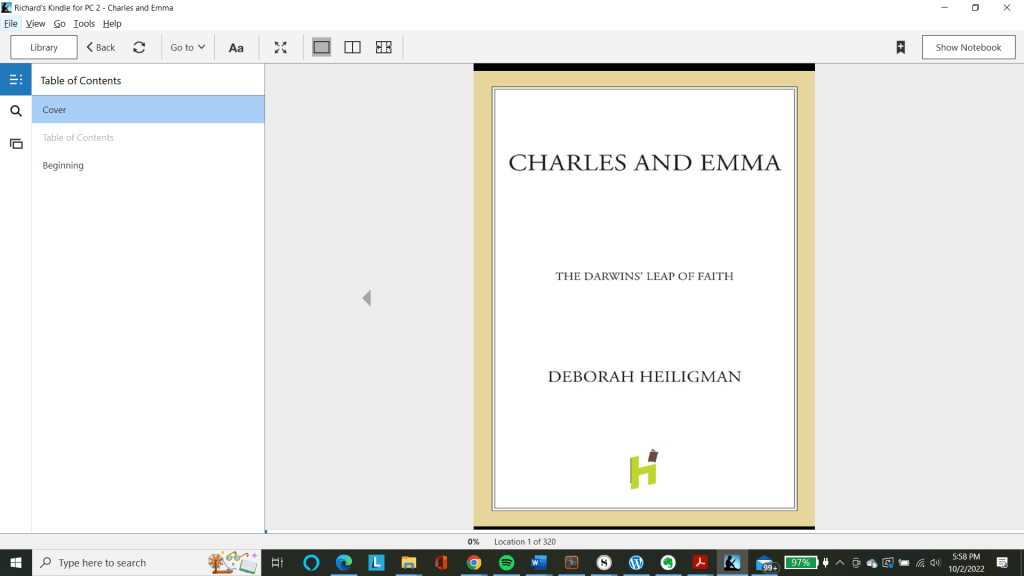
Charles Darwin published The Origin of Species, his revolutionary tract on evolution and the fundamental ideas involved, in 1859. Nearly 150 years later, the theory of evolution continues to create tension between the scientific and religious communities. Challenges about teaching the theory of evolution in schools occur annually all over the country. This same debate raged within Darwin himself, and played an important part in his marriage: his wife, Emma, was quite religious, and her faith gave Charles a lot to think about as he worked on a theory that continues to spark intense debates.
Deborah Heiligman’s new biography of Charles Darwin is a thought-provoking account of the man behind evolutionary theory: how his personal life affected his work and vice versa. The end result is an engaging exploration of history, science, and religion for young readers.
Charles and Emma is a 2009 National Book Award Finalist for Young People’s Literature.
The God of classical theism, that which Jonathan MS Pearce calls “OmniGod”, is in the crosshairs in the collection of arguments against such a god’s existence. Omnipotence, omniscience (including full divine foreknowledge of every event that will come to pass), and omnibenevolence make for difficult bedfellows. In fact, OmniGod’s characteristics are so flawed when employed together, and when seen in light of design, heaven, hell, and Satan, that belief in such a being is almost certainly irrational.
This is what Pearce takes aim at – all of these ideas supposedly working in coherent unison – in this book aimed at a popular audience. The book packs a punch as he handily deconstructs these ideas to show that either God does not exist, or that God is not all-knowing, all-powerful, and all-loving.
“…since believers aren’t usually reasoned out of a faith that they were never reasoned into, the prolific Pearce expertly throws the book at them. I’m a fan of his. Highly recommended reading!”- John W. Loftus, philosopher and counter-apologist with 12 books, including The Case against Miracles and God and Horrendous Suffering.
“A concise but very philosophically sophisticated presentation of thirty evergreen problems for both theism in general and Abrahamic religions specifically. A must for the bookshelves of both atheists (to quickly reference powerful arguments) and theists (to understand the strongest and most commonly-used points of their opposition).”- Gunther Laird, author of The Unnecessary Science: A Critical Analysis of Natural Law Theory
“Jonathan MS Pearce is a talented writer with a thoroughly enjoyable conversational style. While I tend to abhor philosophy, this little book provides a very nice, easy-to-read and comprehensive overview of a number of key philosophical issues pertaining to topics of God, religion and theology. This is an essential read for anyone with an interest in the viability of faith, whether it be theirs or another.”- Dr. Kipp Davis, author of Dead Sea Scrolls Fragments in the Museum Collection
Here’s a taste from Chapter 1
1 – Why Would God Create at All? This is one of those arguments that I have often used in one form or another in my previous work. It is important, though, because it cuts right to the heart of everything – or anything – in existence.
The question we perhaps need to ask of God is why did it create anything at all? I mean, really, why? What is the point? What is the point of us? Of the universe, including black holes and tsunamis, malaria and debilitating mental health? Humans are left – at least, those still clinging onto belief in a supposedly supreme being – trying to desperately work out what the answers to these questions might be without even the slightest peep out of the creator itself.
Indeed, God appears to have been on holiday for 2,000 years and has disconnected the phone. Why indeed. We can but guess. The problem – and, for this, return to previous ideas of a necessary, immutable, perfect God – is the idea that God is, indeed, perfect. Okay, that might make no sense, but let’s grant the theist at least this much for the sake of the argument. I like the idea that they might be “hoist by their own petard”.[7]
Something that is sheer perfection will not be lacking anything. And some entity not lacking anything will not have a need for anything. No lacking, no needs, no desires. If God exists, causally prior to creation, in some scenario of perfection, then there is no rationale for God “deciding” to create anything. Simply put, OmniGod wouldn’t create because creation would invalidate its omni-characteristics and ideas of perfection.
This can be formulated into a syllogism:
(1) If the Christian God exists, then GodWorld is the unique best possible world.
(2) If GodWorld is the unique best possible world, then the Christian God would maintain GodWorld.
(3) GodWorld is false because the Universe (or any non-God object) exists.
(4) Conclusion: Therefore, the Christian God, as so defined, does not exist.
Pearce, Jonathan MS (2022-03-05T22:58:59.000). 30 Arguments against the Existence of “God”, Heaven, Hell, Satan, and Divine Design . Onus Books. Kindle Edition.
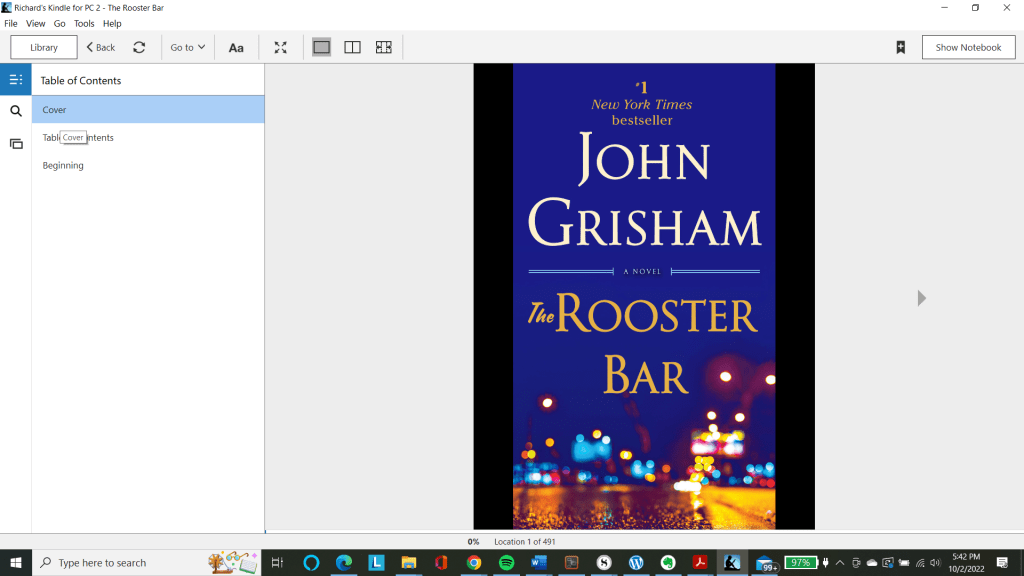
Great book from my favorite fiction author. I confess, this time, my second ‘reading,’ I listened to the audio version while riding my bike–took a couple of weeks on and off.
Abstract from Amazon
#1 NEW YORK TIMES BESTSELLER•John Grisham’s newest legal thriller takes you inside a law firm that’s on shaky ground.
Mark, Todd, and Zola came to law school to change the world, to make it a better place. But now, as third-year students, these close friends realize they have been duped. They all borrowed heavily to attend a third-tier, for-profit law school so mediocre that its graduates rarely pass the bar exam, let alone get good jobs. And when they learn that their school is one of a chain owned by a shady New York hedge-fund operator who also happens to own a bank specializing in student loans, the three know they have been caught up in The Great Law School Scam.
But maybe there’s a way out. Maybe there’s a way to escape their crushing debt, expose the bank and the scam, and make a few bucks in the process. But to do so, they would first have to quit school. And leaving law school a few short months before graduation would be completely crazy, right? Well, yes and no …
Pull up a stool, grab a cold one, and get ready to spend some time at The Rooster Bar.
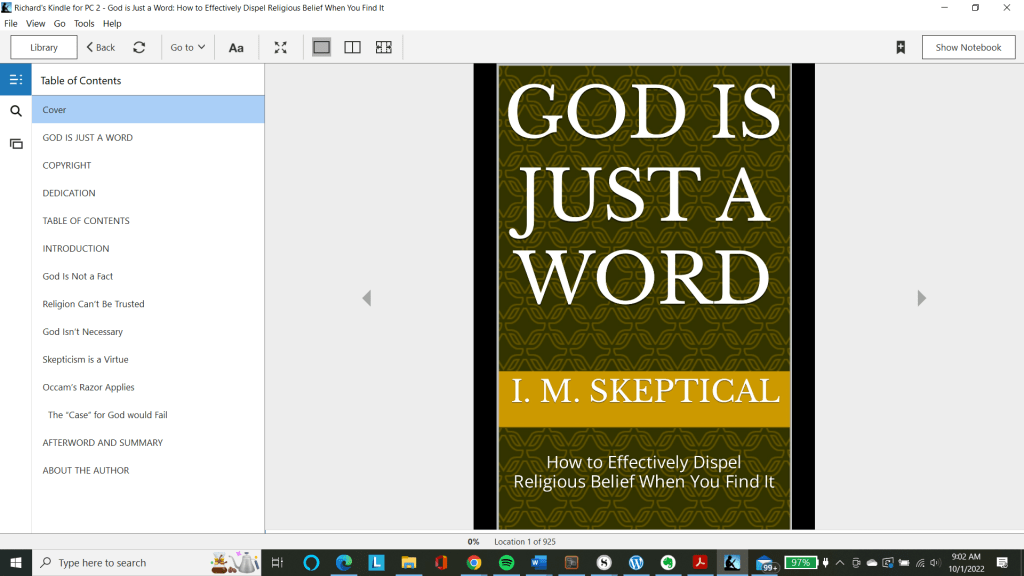
Well written little book. Read it, thinking like a scientist and not a preacher, prosecutor, or politician.
Abstract from Amazon
Religion can be a very negative force in the world. This book shows how to use basic philosophy, historical evidence, and scientific knowledge to challenge religious belief in a non-confrontational way. It pinpoints the fundamental flaws of Biblical dogma, summarizes religion’s poor historical record and lack of trustworthiness, and briefly reviews the growing evidence that many Bible stories are based on natural phenomena. The state of scientific knowledge in fields including cosmology is shown to eliminate the need for supernatural explanations of anything. It explains how to guide Believers to a greater appreciation of skepticism and scientific methodology, and how the philosophical maxim of Occam’s Razor cuts through religious sophistry. It presents many common Believer fallacies, including misunderstandings of evolution, and provides the facts that refute them. It also presents the most incisive questions to ask Believers, based on simple facts and logic and proven effective.
From the book:
Nor does the Bible prove God’s existence any more than comic books prove the existence of superheroes.
Skeptical , I. M. . God is Just a Word: How to Effectively Dispel Religious Belief When You Find It (p. 18). Kindle Edition.
the Church was dead wrong about fundamental truths of the universe,
Skeptical , I. M. . God is Just a Word: How to Effectively Dispel Religious Belief When You Find It (p. 32). Kindle Edition.
The bad news for Believers is that the current observational facts about the Big Bang argue against it being a supernatural phenomenon. It marks the beginning of time as we measure it, but there are theories, such as M-Theory, consistent with all observational data that say that the event itself could be just one of an eternal sequence of such events in a larger multiverse of universes (see the book The Hidden Reality by the physicist Brian Greene).
Skeptical , I. M. . God is Just a Word: How to Effectively Dispel Religious Belief When You Find It (p. 37). Kindle Edition.
But one of the finest, most dimensional inquiries into the significance of books and the role of reading in human life comes from Neil Gaiman in a beautiful piece titled “Why Our Future Depends on Libraries, Reading and Daydreaming.”
Gaiman considers how the act of reading changes us, “what it’s good for”:
Once in New York, I listened to a talk about the building of private prisons — a huge growth industry in America. The prison industry needs to plan its future growth — how many cells are they going to need? How many prisoners are there going to be, fifteen years from now? And they found they could predict it very easily, using a pretty simple algorithm, based about asking what percentage of ten- and eleven-year-olds couldn’t read. And certainly couldn’t read for pleasure.
Echoing Madeleine L’Engle’s spirited 1983 lecture on creativity, censorship, and the duty of children’s books, Gaiman considers how otherwise well-intentioned adults might thwart the seed of that life-enlarging and sometimes even life-saving passion for reading. In a passage of particular urgency for parents and educators, he writes:
I don’t think there is such a thing as a bad book for children. Every now and again it becomes fashionable among some adults to point at a subset of children’s books, a genre, perhaps, or an author, and to declare them bad books, books that children should be stopped from reading. I’ve seen it happen over and over; Enid Blyton was declared a bad author, so was R. L. Stine, so were dozens of others. Comics have been decried as fostering illiteracy.
It’s tosh. It’s snobbery and it’s foolishness.
There are no bad authors for children, that children like and want to read and seek out, because every child is different. They can find the stories they need to, and they bring themselves to stories. A hackneyed, worn-out idea isn’t hackneyed and worn out to someone encountering it for the first time. You don’t discourage children from reading because you feel they are reading the wrong thing. Fiction you do not like is the gateway drug to other books you may prefer them to read. And not everyone has the same taste as you.
Well-meaning adults can easily destroy a child’s love of reading: stop them reading what they enjoy, or give them worthy-but-dull books that you like, the twenty- first-century equivalents of Victorian “improving” literature. You’ll wind up with a generation convinced that reading is uncool and, worse, unpleasant.
Gaiman then turns to the second key function of literature — its unparalleled ability to foster empathy. In a sentiment that calls to mind Rebecca Solnit’s inspired assertion that “a book is a heart that beats in the chest of another,” he writes:
When you watch TV or see a film, you are looking at things happening to other people. Prose fiction is something you build up from twenty-six letters and a handful of punctuation marks, and you, and you alone, using your imagination, create a world, and people it and look out through other eyes. You get to feel things, visit places and worlds you would never otherwise know. You learn that everyone else out there is a me, as well. You’re being someone else, and when you return to your own world, you’re going to be slightly changed.
Empathy is a tool for building people into groups, for allowing us to function as more than self-obsessed individuals.
In a sentiment reminiscent of Ursula K. Le Guin’s electrifying case for how imaginative storytelling expands our scope of the possible, Gaiman points to a third essential function of fiction in human life — its ability to introduce us to different versions of the world by envisioning alternate possibilities for the way things are:
Fiction can show you a different world. It can take you somewhere you’ve never been. Once you’ve visited other worlds, like those who ate fairy fruit, you can never be entirely content with the world that you grew up in. And discontent is a good thing: people can modify and improve their worlds, leave them better, leave them different, if they’re discontented.
But perhaps the surest way to foil a budding love of reading is to cut off access to books altogether, and there is no greater hedge against that hazard than the library — that sacred place Thoreau once extolled as a glorious “wilderness of books.” (“When a library is open, no matter its size or shape,” Bill Moyers wrote in his foreword to a recent photographic love letter to libraries, “democracy is open, too.”) Gaiman recounts the formative role of the library in his own life:
I was lucky. I had an excellent local library growing up. I had the kind of parents who could be persuaded to drop me off in the library on their way to work in my summer holidays, and the kind of librarians who did not mind a small, unaccompanied boy heading back into the children’s library every morning and working his way through the card catalogue, looking for books with ghosts or magic or rockets in them, looking for vampires or detectives or witches or wonders. And when I had finished reading the children’s library I began on the adult books.
They were good librarians. They liked books and they liked the books being read. They taught me how to order books from other libraries on interlibrary loans. They had no snobbery about anything I read. They just seemed to like that there was this wide-eyed little boy who loved to read, and they would talk to me about the books I was reading, they would find me other books in a series, they would help. They treated me as another reader — nothing less, nothing more — which meant they treated me with respect. I was not used to being treated with respect as an eight-year-old.
Libraries are about Freedom. Freedom to read, freedom of ideas, freedom of communication. They are about education (which is not a process that finishes the day we leave school or university), about entertainment, about making safe spaces, and about access to information.
Writing nearly a century after Hermann Hesse’s magnificent manifesto for why the book will never lose its magic no matter how technology evolves, Gaiman borrows a prefect metaphor to substantiate his belief that books will endure in and perhaps past the age of screens:
As Douglas Adams once pointed out to me, over twenty years before the Kindle showed up, a physical book is like a shark. Sharks are old: there were sharks in the ocean before the dinosaurs. And the reason there are still sharks around is that sharks are better at being sharks than anything else is. Physical books are tough, hard to destroy, bath resistant, solar operated, feel good in your hand: they are good at being books, and there will always be a place for them.
But Gaiman takes care not to confuse the medium with the message — it is reading that counts, and its rewards are medium-agnostic. He writes:
We need libraries. We need books. We need literate citizens.
I do not care — I do not believe it matters — whether these books are paper or digital, whether you are reading on a scroll or scrolling on a screen. The content is the important thing.
But a book is also the content, and that’s important.
Books are the way that we communicate with the dead. The way that we learn lessons from those who are no longer with us, that humanity has built on itself, progressed, made knowledge incremental rather than something that has to be relearned, over and over. There are tales that are older than most countries, tales that have long outlasted the cultures and the buildings in which they were first told.
These tales have survived on the shoulders of people who have done their part to transmit them forward — something Gaiman examined in his excellent lecture on how stories last. He considers what it would take to uphold our own responsibilities to the future — as readers, as writers, as citizens, and as members of the storytelling species:
I believe we have an obligation to read for pleasure, in private and in public places. If we read for pleasure, if others see us reading, then we learn, we exercise our imaginations. We show others that reading is a good thing.
We have an obligation to support libraries. To use libraries, to encourage others to use libraries, to protest the closure of libraries. If you do not value libraries then you do not value information or culture or wisdom. You are silencing the voices of the past and you are damaging the future.
We have an obligation to read aloud to our children. To read them things they enjoy. To read to them stories we are already tired of. To do the voices, to make it interesting, and not to stop reading to them just because they learn to read to themselves. We have an obligation to use reading-aloud time as bonding time, as time when no phones are being checked, when the distractions of the world are put aside.
We have an obligation to use the language. To push ourselves: to find out what words mean and how to deploy them, to communicate clearly, to say what we mean. We must not attempt to freeze language, or to pretend it is a dead thing that must be revered, but we should use it as a living thing, that flows, that borrows words, that allows meanings and pronunciations to change with time.
We writers — and especially writers for children, but all writers — have an obligation to our readers: it’s the obligation to write true things, especially important when we are creating tales of people who do not exist in places that never were — to understand that truth is not in what happens but in what it tells us about who we are. Fiction is the lie that tells the truth, after all. We have an obligation not to bore our readers, but to make them need to turn the pages. One of the best cures for a reluctant reader, after all, is a tale they cannot stop themselves from reading. And while we must tell our readers true things and give them weapons and give them armor and pass on whatever wisdom we have gleaned from our short stay on this green world, we have an obligation not to preach, not to lecture, not to force predigested morals and messages down our readers’ throats like adult birds feeding their babies pre-masticated maggots; and we have an obligation never, ever, under any circumstances, to write anything for children to read that we would not want to read ourselves.
We have an obligation to understand and to acknowledge that as writers for children we are doing important work, because if we mess it up and write dull books that turn children away from reading and from books, we’ve lessened our own future and diminished theirs.
Writing more than two centuries after William Blake’s searing defense of the imagination, Gaiman points to the same supreme human faculty as our greatest obligation:
We all — adults and children, writers and readers — have an obligation to daydream. We have an obligation to imagine. It is easy to pretend that nobody can change anything, that we are in a world in which society is huge and the individual is less than nothing: an atom in a wall, a grain of rice in a rice field. But the truth is, individuals change their world over and over, individuals make the future, and they do it by imagining that things can be different.
[…]
Just look around this room… Everything you can see, including the walls, was, at some point, imagined. Someone decided it might be easier to sit on a chair than on the ground and imagined the chair. Someone had to imagine a way that I could talk to you in London right now without us all getting rained on. This room and the things in it, and all the other things in this building, in this city, exist because, over and over and over, people imagined things. They daydreamed, they pondered, they made things that didn’t quite work, they described things that didn’t yet exist to people who laughed at them.
And then, in time, they succeeded. Political movements, personal movements, all begin with people imagining another way of existing.
Gaiman’s final obligation is of especially resonant relevance today:
We have an obligation to tell our politicians what we want, to vote against politicians of whatever party who do not understand the value of reading in creating worthwhile citizens, who do not want to act to preserve and protect knowledge and encourage literacy. This is not a matter of party politics. This is a matter of common humanity.
The transcendent mechanism of the awakening that books furnish in us is what Anaïs Nin (February 21, 1903–January 14, 1977) explores in a beautiful entry from The Diary of Anaïs Nin: Vol. 1 (public library).
A generation after Kafka wrote to his best friend that “a book must be the axe for the frozen sea inside us,” 28-year-old Nin writes in December of 1931:
You live like this, sheltered, in a delicate world, and you believe you are living. Then you read a book (Lady Chatterley, for instance), or you take a trip, or you talk with [someone], and you discover that you are not living, that you are hibernating. The symptoms of hibernating are easily detectable: first, restlessness. The second symptom (when hibernating becomes dangerous and might degenerate into death): absence of pleasure. That is all. It appears like an innocuous illness. Monotony, boredom, death. Millions live like this (or die like this) without knowing it. They work in offices. They drive a car. They picnic with their families. They raise children. And then some shock treatment takes place, a person, a book, a song, and it awakens them and saves them from death.
With a thankful eye to D.H. Lawrence — whose writing, she believed, first awakened her in this fashion and whom, in a gesture of gratitude, she made the subject of her first book — Nin adds:
Some never awaken. They are like the people who go to sleep in the snow and never awaken. But I am not in danger because my home, my garden, my beautiful life do not lull me. I am aware of being in a beautiful prison, from which I can only escape by writing.
Two generations after William Faulkner asserted in his Nobel Prize acceptance speech that the role of the writer is “to help man endure by lifting his heart,” Saunders shares a reflection wonderfully countercultural amid our era of marketable tragedy and rampant cynicism:
When I was younger, I was for some stupid reason really taken aback by the realization that capitalism could be harsh. It had never occurred to me before. So my work tended to be a little preoccupied with that notion, maybe. My wife and I fell head over heels, and had our daughters pretty quickly. Now we’ve been married for twenty-six years and our daughters are grown up and wonderful. So lately my feeling is there ought to be a place for some fictional corollary of the fact that sometimes things actually work… An artist can sometimes represent the idea that things can be wonderful.
Responding to the observation that a line from a short story of his — “Can goodness win?” — encapsulates an undergirding concern across all of his work, Saunders adds:
Why not? Yes, it can win. But it can also lose — can get humiliated. It can also cause other people problems, by morphing into self-righteousness. I think what a fiction writer does is represent different viewpoints vividly. And without necessarily seeming to prefer one over the other. “Can goodness win?” “Yes, it does all the time.” “No, it cannot: it loses all the time.” Both true.
[…]
See how long you can stay in that space, where both things are true. You, little mind, actually don’t have to decide. That’s a great place to try to be. And for a fiction writer, that’s the best place to be: you’ve put two apparently opposing truths in the air and you’re just letting them hang there, knowing that the real truth is … that opposition.
In a sentiment that calls to mind Denise Levertov’s notion of the midwifery of creative work, Saunders suggests that even if one were to inhabit that opposition, one can’t forcibly wrest out of it the sort of aliveness that makes art. Rather than trying to will it, one ought to be willing to let it come into a life of its own. He reflects on having this pivotal realization when he was starting out as a writer and finding his own voice:
I found out that the same minute I had an idea about what I wanted to write, life would go out of it. I’m a Bear of Little Brain, as Winnie the Pooh would say. My challenge is to try to keep the themes out of what I’m writing as long as possible… Einstein said it better: “No worthy problem is ever solved on the plane of its original conception.” … It’s got more integrity if it comes in of its own accord.
At the end of the event, in answering a reader’s question, Saunders returns to the inherent duality of life and the notion that although we’re animated by conflicting impulses and irrepressible moral imperfection, we can still live rich and beautiful lives. Echoing Parker Palmer’s ennobling assertion that “wholeness does not mean perfection: it means embracing brokenness as an integral part of life,” Saunders observes:
At any given moment you’re failing to see the way things actually are. The manifestation is that you’re failing to be kind. You’re anxious. You’re neurotic. I don’t think it’s so much about external things. I think you could be a very happy, high-functioning person and still note the moment-to-moment failures.
Weaving together history, literature, politics, and personal experience, Alexander — who became the fourth poet in history to read at a U.S. presidential inauguration when she welcomed Barack Obama to the presidency with her poem “Praise Song for the Day” — examines the rewards and challenges of being a black woman, a poet, an academic figure of authority and, above all, of inhabiting a culture in which the Venn diagram of these psychographic particulars is still lamentably improbable.
Radiating from these essays and interviews is incisive and generous insight into writing, the creative process, and the complexity of the self.
I want to inject them with a serum that makes them believe what I know: that speaking is crucial, that you have to tell your own story simultaneously as you hear and respond to the stories of others, that education is not something you passively consume.
And yet the necessity of speaking and the authority of visibility come with a personal cost, which Alexander articulates with a vulnerable self-awareness tremendously inspiring amid our culture of invulnerable facades:
I have been in public discussions where my own paralysis had made me quiet or less articulate than I can be and kept me, perhaps, from being the role model a young woman needed at that moment. I now choose my battles and deal with the same beleagueredness that perhaps my teachers those years ago felt. I have learned that you can’t always be who others need you to be at any moment.
Alexander revisits this question in another interview:
I try to remember that you can get really distracted by the demands people make on you. Demands that are real are one thing, demands that come from a real community in need, or a real person in need. We’re asked all the time to be of service. But demands that are about posturing — you may have to deal with them, but I’m trying to figure out a way not to let them worm their way in too much.
Asserting that this obligation to the truth of one’s story must be “lived in our day-to-day lives, in the way we conduct the business of our lives, in the way we spend our money and raise our children and make a multitude of decisions every day,” Alexander considers the role of writing in inhabiting one’s visibility:
Great writing can make you face the truth around you and within yourself.
In another interview from the collection, Alexander turns to the transmutation of personal truth into writing:
A lot of my poetry comes from “personal” or autobiographical material. What is the transformation that has to happen in order for those details and that realm of personal to work within a poem? I can’t really say that I could anatomize it, but I know that there’s a transformation that has to take place.
Citing Sterling Brown’s pronouncement that “every I is a dramatic I” — a quote she wove into her beautiful poem “Ars Poetica #100: I Believe” — Alexander adds:
Regardless of whether or not you’re working in an autobiographical or personal mode, if there is a persona in the poem, you have certain charges to make it work dramatically in the poem itself. So, fulfilling those demands in the poem as such puts a nice set of parameters around the question of working within the infinite personal, because it’s quite infinite… The day-to-day me “I” [is] one level removed, or alchemized.
For any poem to succeed, whatever its rules, there are strict rules, or else the whole thing falls apart.
She recounts what the inimitable Derek Walcott, her only poetry teacher, taught her about writing and about the loaded interplay between personal identity and creative integrity:
He would always say never try to charm in your poems, never try to charm with your identity, it’s not enough that you’re a cute, black girl.
That was very useful advice, though I was already averse to exploiting “identity.” I think the point is, he’s saying, none of us as persona is ever enough. Whatever your identity, your set of particulars, there is going to be someone out there who thinks it’s fascinating unto itself. But that unto itself doesn’t make for a fine poem you could stand with. So he was also saying, don’t be swayed and don’t let praise go to your head. And don’t let it get into your writing, and don’t let it get into your quest.
But Alexander notes that there is a universe of difference between not being swayed by praise and being wholly impermeable, severing one’s connection to the world — a connection carried out through the authenticity of the word:
We live in the word. And the word is precious, and the word must be precise, and the word is one of the ways we have to reach across to each other, and … it has to be tended with that degree of respect… I believe that life itself is profoundly poetic, in all sorts of … guises and unexpected places.
Being open to those poetic surprises, Alexander argues, also requires a certain openness to the audience and to the range of possible receptions:
To be presumptuous about any kind of audience is not a good thing. I’ve had too many wonderful surprises… I’ve had many surprises with people who read poetry who I wouldn’t have imagined read poetry, that it has a place in their lives. You just really never know. You just can’t let that imagining get into the creative process because it would twist it and distort it and shut it down… Some people talk about the ideal reader, and I don’t really have an ideal reader… I just trust that when it goes out there, it will be found by whoever can make use of it… The beautiful thing about poetry is that you never know who will find it, and you never know what will be found in it.
In fact, one of the most beautiful articulations of poetry’s singular power comes from the poet Vassar Miller, quoted in this book:
Poetry, like all art, has a trinitarian function: creative, redemptive, and sanctifying. It is creative because it takes the raw materials of fact and feeling and makes them into that which is neither fact nor feeling. Redemptive because it transforms pain, ugliness of life into joy, beauty. Sanctifying because it gives the transitory a relative form of meaning.
Spiritual and ethical situations and conundrums are occasions for poems — though I am rarely aware of the conundrum as such when I embark upon the poem — and the writing of the poem is a way of working through those conundrums and accepting their frequent open-endedness. Besides making and raising children, the mystery of making art is the most spiritual zone of my life.
No matter how devoted we are to the culture and to each other, we have a lot to overcome, imagining ourselves, or imagining each other. And in receiving each other.
Language, Alexander argues, is the locus of reception — the medium in which we imagine ourselves and each other — something she captures beautifully in the piercing final line of a poem: “…and are we not of interest to each other?” She revisits the complexity of personal identity and considers how the self lives in language:
It’s all well and good to have an idea, to say, I want to write about such-and-such and such-and-such. But I think the idea has to be rooted in language. It has to live in language.
[…]
That’s what catches the imagination of somebody else, a listener or a reader. Even the way that we express ourselves as non-poet “civilians,” if you will, is what makes us interesting to other people… Who is the self in language? And what is the revelatory and unguarded and surprising self in language? That’s what makes somebody else pay attention. When you start turning that into art, that’s what making poems is about.
But this unguarded self in language, she argues, isn’t about “superseding the social identity, but it is about protecting the full dimension of the self.” And yet social identity and the poetics of personhood can never be fully disentwined from one another, nor unmoored from the wider cultural context. Alexander writes:
Being an empowered and intelligent black person and even more so being an empowered and intelligent and self-respecting black woman is profoundly destabilizing to most status quo. You’ve got to remember that in a way that’s not disabling.
Those [are] examples of brilliant, courageous, beautiful, engaged lives full of rampant loving, loving of the world. Loving of the work. Loving of each other. Moving toward what we love and not just toward the destruction of enemies… And that’s what I feel like it’s important to do upon rising each day.
When I was younger I used to think that love as an ethic was … obviously a good thing, but a little corny. I am certainly an optimist but not a fool. In academic environments, we are taught a skepticism that can lead us to discount the power and force of love. But the older I get, the more I think of all the possible permutations and possibilities of a love ethic. To love someone or something is not just to agree with them or affirm them. To bother to engage with problematic culture, and problematic people within that culture, is an act of love. So what does it mean in a complex and dead-serious way to come from that place of love?
When asked about the mental habits and practicalities of her creative process in writing poetry, Alexander offers:
I try to grab things when I can, to keep notes of things as I internally hear them so that when I do have writing time I have something to begin with.
[…]
Paper first, then the screen, for I feel bollixed up if I don’t attend to my internal soundtrack, so there is a personal satisfaction that comes from attending to it in writing. Also, at this point, twenty years into my life as a poet, I feel clearer about having something to say and people who benefit from hearing it.
I always tell student poets to read and listen as much and as variously as they can to build up a rolodex of possibilities in their minds when they sit down to write a poem. You always need to have many more possibilities of approaching a poem than you end up using… It’s about tuning your internal ear and listening to what the poem at hand is trying to do and be.
This internal process, Alexander enjoins, should be the primary focus of creative work:
Submit to it, tend it, nurture it, honor it. Too many young writers get distracted by thinking about career before process; without process, there is no real work and thus, no career. Every day is another blank page to be filled from your own particular landscape. Process it all.
“It’s by writing… by stepping back a bit from the real thing to look at it, that we are most present.”
BY MARIA POPOVA
“One can’t write directly about the soul. Looked at, it vanishes,” Virginia Woolf lamented in her diary midway through writing To the Lighthouse. And yet: “Nothing and nobody exists in this world whose very being does not presuppose a spectator,” Hannah Arendt — another woman of searing intellect and uncommon insight into the human spirit — observed exactly half a century later in contemplating how the rift between being and appearing rips us asunder. So if the seismic core of being we call soul exists, as I emphatically believe it does, how do we reconcile its elemental demand for spectatorship with the impossibility of writing about the drama that animates it?
That improbable, sublime feat is what cartoonist Alison Bechdel accomplishes in Are You My Mother?: A Comic Drama (public library), a psychological sequel of sorts to Fun Home: A Family Tragicomic — Bechdel’s spectacular memoir-turned-Broadway-hit about her childhood and her closeted father’s suicide. In plumbing the catacombine depths of her ambivalent relationship with her mother — which she does with astonishing self-awareness and vulnerability, climaxing in reluctant self-compassion — Bechdel speaks to some of the most elemental and most universal aspects of the human experience: loneliness, love, the perennial perplexities of the child-parent relationship, our longing for unconditional acceptance and adoration, and the pathological onslaught of self-doubt with which those engaged in a creative life live.
I pause here to note that this is one of very few books I’ve encountered which, in addition to being creatively and intellectually superb, I consider absolutely life-changing — so much so, that anything I write here about the book is bound to be a woefully deficient representation of what the book is.
Although she sets out to write a book about her mother’s life, it ends up being a memoir of Bechdel’s own (somewhat like The Autobiography of Alice B. Toklas is really Gertrude Stein’s memoir of her own life, illuminated via a sidewise gleam refracted through her wife’s). Her mother’s resistance to the merits of memoir as a genre only enriches the meta-story of both their relationship and the archetypal yearning for approval in every parent-child relationship:
(I am reminded here of A.M. Homes and her unforgettable insight into the art of memoir: “Making art is all about humans and our psychology: who we are, how we behave, what we do with the hand we’ve been dealt. It’s closer to your own bone when it’s a memoir, but the bone is still the bone.”)
In one of the opening pages, Bechdel captures the Woolfian paradox of this entire meta-project:
You can’t live and write at the same time.
And yet she has been writing about life, perhaps in order to avoid experiencing life, since childhood. The journal, after all, is a technology of thought and selfhood; like any technology, it is the intention behind its use that determines whether its effect is constructive or destructive. Rather than a medium of creative expression, Bechdel’s early diary became an obsessive compulsion, to the point where her mother had to intervene. In looking back on the episode, she invokes a passage from Virginia Woolf’s diary: “What a disgraceful lapse! Nothing added to my disquision, & life allowed to waste like a tap left running. Eleven days unrecorded.”
“My mother composed me as I now compose her,” Bechdel observes of one of the many role-reversals that mark their parent-child relationship, and I’m reminded of the anthropologist Mary Catherine Bateson’s wonderful phrase “composing a life” — for isn’t every life, after all, a composition?
Bechdel writes:
For a long time I resisted including my present-day interactions with mom in this book precisely because they’re so “ordinary.”
Then I started seeing how the transcendent would almost always creep into the everyday.
Indeed, it is in the most mundane of moments that the monumental is revealed — in Bechdel’s life, as in any life. One such moment: her mother’s unease about the publication of Bechdel’s now-legendary lesbian comic. The tension of their culminant conversation broke open an unexpected ease around Bechdel’s anguishing, elemental, lifelong need she had always experienced as unmet, which was now suddenly revealed as unmeetable:
The book is a kind of modern-day florilegium composed of Bechdel’s marginalia on books she is consumed with — above all, the novels and diaries of Virginia Woolf and the work of pioneering psychoanalyst and pediatrician Donald Winnicott, alongside cultural classics like Alice Miller’s The Drama of the Gifted Child (“that endlessly consoling ode to sensitive children everywhere”), Freud’s The Interpretation of Dreams, and On Lies, Secrets, and Silence by Adrienne Rich (who sent a personal rejection, uncushioned yet somehow mobilizing, to Bechdel’s first submission to a major literary journal).
It is also a masterwork of dot-connecting — in a testament to my longtime conviction that literature is the original Internet, Bechdel follows the web of “hypertext” references that lead her from one book to the next, from one thinker to another. But, more than that, she links concepts across wildly divergent books with remarkable virtuosity. It takes a rare kind of mind to go from Winnicott’s influential notion of transitional objects to Winnie the Pooh, the iconic stuffed toy being one such object that just so happens to bear a striking linguistic similarity to the pioneering psychoanalyst’s name.
No doubt the great Vannevar Bush, in contemplating how the future of information will shape human thought in 1945, had in mind rare geniuses like Bechdel when he envisioned “a new profession of trail blazers … who find delight in the task of establishing useful trails through the enormous mass of the common record.”
The book is also a sort of elegy for therapy — at once a celebration and a lamentation, reminding us of our inescapable human fragility and of how imperfect even our most refined, best-intentioned mechanisms for fixing our brokenness are.
Each chapter begins with a strange and particularly psychologically illuminating dream Bechdel has at an existentially pivotal point, then unfolds into the strangeness of her waking life, as if to remind us that the “sleeping counterpart” who does our dreaming springs from the same self that also does our living.
Her sleeping self is stranded by her father at a picnic, falls off an icy cliff that melts to reveal her childhood home, and marvels at a perfect spider’s web on a blanket. Her wakeful self tries to dissipate a fight with her girlfriend by walking into a mass service only to get trapped in a Christmas pageant, kicks a hole in the wall in a fit of jealous rage over an infidelity before falling asleep cuddling her childhood teddy bear, and contends with the fact that her father killed himself by jumping in front of a bread truck. Which world is the stranger of the two?
Anyone who attends to his or her life with the same granular attention with which Bechdel constructs her memoir knows that the answer lies in the thin membrane of consciousness and selfhood separating the two worlds — a membrane as porous and permeable as the one separating our so-called personal and professional lives.
At the end, as she nears the completion of this meta-memoir, Bechdel comes full circle to the paradox with which she began, newly illuminated:
I would argue that for both my mother and me, it’s by writing… by stepping back a bit from the real thing to look at it, that we are most present.
Complement the brilliant, layered, and immeasurably insightful Are You My Mother? with Bechdel’s magnificent Design Matters interview, in which she discusses her life, her work, and the constant dynamic interaction between the two:
I do think there is something about just the fact of being able to show stuff that enables you to convey an order of meaning that, once you attach language to it, something gets lost.